Brian Johnston
Host, The Gilmartin Group
Replay available
Artivion (NYSE:AORT) Q2 2026 earnings call, held 2026-08-06. Watch the replay and read the transcript on 6ix.
On 6ix: 6ix.com/event/artivion-inc-aort-q2-2026-earnings-call
Automated transcript · Written by software from the replay's audio. It can mishear names and figures; the replay is the record.
0:00 Good afternoon and welcome to the Artivion Second Quarter twenty twenty six Earnings Call. At this time, all participants are in a listen only mode. A brief question and answer session will follow the formal presentation. As a reminder, this conference is being recorded. I would now like to turn the conference over to Brian Johnston from the Gilmartin Group. Thank you. You may begin. Good afternoon, thank you for joining the call today. Joining me from Artivion's management team are Pat Mackin, CEO and Lance Berry, COO and CFO. Before we begin, I'd like to make the following statements to comply with the Safe Harbor requirements of the Private Securities Litigation Reform Act of 1995. Comments made on this call that look forward in time involve risks and uncertainties that are forward looking statements within the meaning of the Federal Securities Private Securities Litigation Reform Act of 1995.
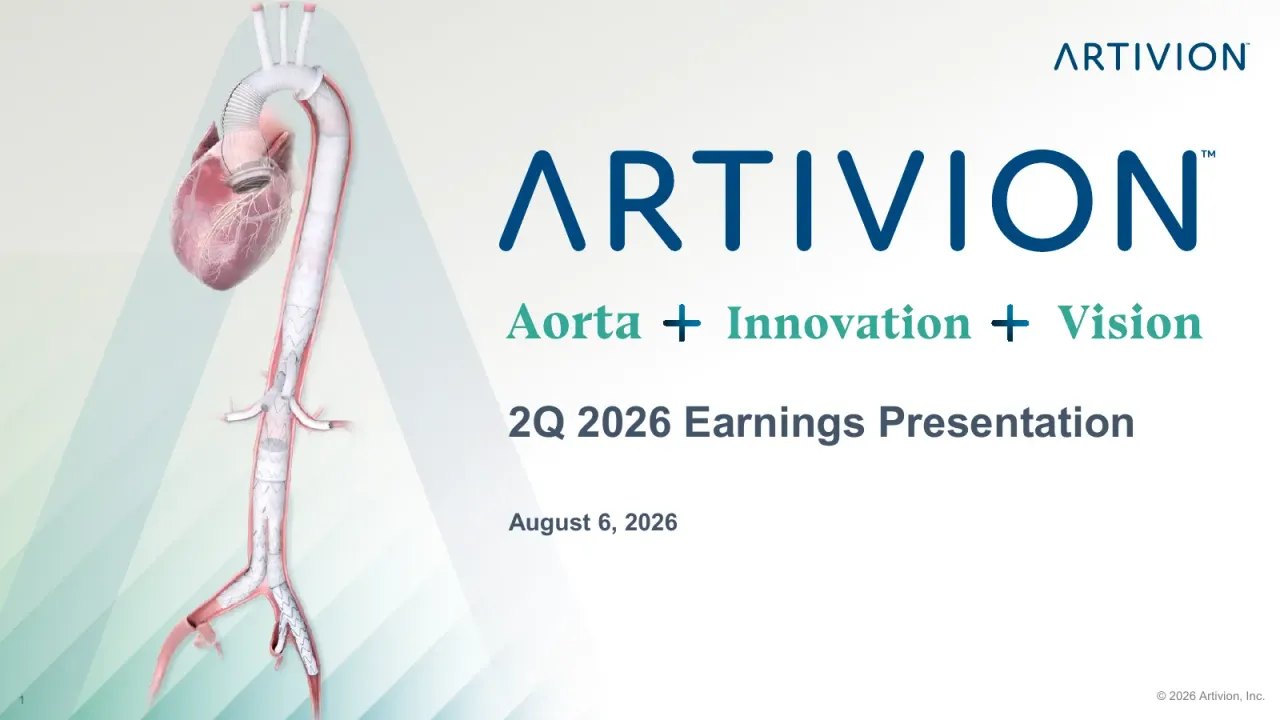
0:55 The forward looking statements include statements made as to the company's or management's intentions, hopes, beliefs, expectations or predictions of the future. These forward looking statements are subject to a number of risks, uncertainties, estimates and assumptions that may cause actual results to differ materially from these forward looking statements. Additional information concerning certain risks and uncertainties that may impact these forward looking statements is contained from time to time in the company's SEC filings and in the press release that was issued earlier today. You can also find a brief presentation with details highlighted on today's call on the Investor Relations section of Artivion's website. Lastly, I'd like to remind you to please refer to our press release published earlier today for information regarding our non GAAP results, including reconciliation of these results to our GAAP results. Unless otherwise stated, all of our comments today will be using our non GAAP results.
1:44 Additionally, all percentage changes discussed will be on a year over year basis. Revenue growth rates will be on the adjusted currency, constant currency rates and expenses as percentage of sales will be based on adjusted revenues. With that, I'll turn the call over to Artivion CEO, Pat Macken. Hey, thanks, Brian, and good afternoon, everybody. Through the second quarter of twenty twenty six, we continue to execute on our strategy designed to drive long term profitable growth through an expanding and clinically differentiated product portfolio. We delivered total constant currency revenue growth of 9% and adjusted EBITDA growth of 7% over prior year. Revenue growth was again driven primarily by On X and stent grafts, including AMVS.
2:30 Before expanding further on product line performance, I want to take a moment to address two milestones that we were most focused on coming into this year and recently achieved. In late June, we received U. S. FDA approval for the PMA for our ANDS hybrid prosthesis in line with our previously communicated expectations. The third quarter will be the first full quarter in which ANDS is sold in The U. S. Under the full PMA. That is meaningful because PMA approval obviates a lengthy IRB review process and new accounts that previously had to work through. And we expect to accelerate new account conversion and set sales going forward. We are also pleased to complete the acquisition of Endospan and its Nexus aortic arch stent graft system during the second quarter, again ahead of the timing we had anticipated.
3:22 This acquisition completes our market leading three pronged aortic arch portfolio. We believe this technology alongside AMD and Arecibo positions us at the forefront of this segment as the only company globally with a complete portfolio of aortic arch solutions. Importantly, NEXUS is a platform technology, not just a single product. It supports three additional PMA programs in development that we expect will further extend and solidify our leadership in the aortic arch market over time. As it relates to NEXUS, our message here is consistent with last quarter. Through 2026, our focus will be on building inventory, working through value analysis committees and augmenting our U. S. Sales team.
4:10 We continue to expect a full U. S. Commercial launch of the NEXUS system in January 2027. As a reminder, the device is approved to treat chronic aortic dissections, which represents about $100,000,000 market opportunity. With that, now let me turn to the second quarter results. From a product category perspective, stent graft revenues grew 12% on a constant currency basis in the second quarter compared to the same period last year. This is an acceleration from the 10% growth we reported in the first quarter and came against tougher year over year comparison, so we're encouraged to see this progress. Importantly, one of our key areas of focus coming out of the first quarter was on AMD asset sales. We are pleased to see improvement in set sales relative to the first quarter with implant trends also remaining strong.
5:02 As we said last quarter, we view implant reordering as the most critical indicator as strong reordering patterns reflect positive user experience and ultimately longer term adoption and higher growth. Looking ahead, we expect U. S. A. MBS set sales to further accelerate following the recent A. MBS PMA approval and as the barriers associated with the initial upfront $100,000 investment associated with the stocking continue to wane. Ultimately, we see our comprehensive stent graft portfolio as a foundational component of our growth strategy. We are encouraged by our enduring fundamental strength and increasingly strong competitive advantages within this segment. Turning to On Our second quarter On X revenues grew 18% year over year on a constant currency basis.
5:51 This growth was again driven by global market share gains and the newer U. S. Opportunity unlocked by data showing improved outcomes mechanical versus bioprosthetic valves in younger patients also came against a much tougher year over year comparison than in prior quarters. The data supports our conviction that the On X valve is the best aortic valve on the market for patients under the age of 65. Meanwhile, tissue processing came in slightly ahead of our expectations, generating approximately $26,000,000 in revenue, representing an increase of 1% year over year on a constant currency basis against a challenging comp due to recovery from the twenty twenty four cyber incident in Q2 of twenty twenty five.
6:37 We had a strong finish to the quarter in terms of tissue releases, resulting in some volume we might otherwise have expected in the third quarter shifted into the second quarter. Overall, we remain on track with our expectations. I also want to briefly highlight the Ross procedure data that was recently published in JAC, the Journal of American College of Cardiology. The study reported a twelve year outcomes of four fifty five adult Ross procedures that were performed at a single high volume center. This study provides compelling long term evidence regarding the performance of our proprietary Synograft pulmonary valve. The results were outstanding. With survival compared to the age matched general population, the autograft reintervention rate was one percent, and the pulmonary homograft intervention rate was at less than two percent, and that's at twelve years.
7:31 As a result, the overall reintervention at twelve years was about three point five percent. Importantly, ninety five percent of the pulmonary homografts implanted in this study were Artivion's Synograph valves. These results further reinforce Synograph's differentiated clinical profile and market leadership. We believe this level of long term clinical evidence is unmatched in the pulmonary homograph market and strengthens physician confidence in the Ross procedure as well as our product. Collectively, these data reinforce our conviction that supply, not demand, continues to be the primary constraint in growth for this segment of our tissue business. Finally, BioGlue revenue declined modestly in the quarter on a constant currency basis.
8:16 As we discussed last quarter, this product line carries a meaningful amount of stocking distribution business, which creates normal quarter to quarter variability, and we continue to expect mid single growth for BioGlue over the full year. Lastly, on our pipeline, we continue to make progress on the ARTISAN clinical trial for our AORTISIN LSA product. We've now enrolled 30 patients in the trial, which is a non randomized clinical trial up to 132 patients in The US and Europe at 30 centers. This is for the treatment of aortic dissection and aneurysm in the arch. We anticipate completing enrollment in mid-twenty seven. We are optimistic the trial will be successful based on in part the positive clinical results from our current generation frozen elephant trunk, Aveda OpenNeo outside The U. S.
9:07 Following a one year follow-up period and assuming the trial meets its endpoints, we anticipate FDA approval for Arecibo in 2029, unlocking an incremental $80,000,000 of annual US market opportunity. In conclusion, the second quarter was a quarter of meaningful progress against our long term strategy. We delivered the AMDSPMA approval we had targeted for midyear. We completed the NEXUS acquisition ahead of schedule. Stent graft revenue accelerated against a tougher comp. Honest continued to take share and our preservation services business is growing constrained generally by supply, not demand. The fundamentals that underpin our growth strategy remain exceptionally strong. A comprehensive clinically differentiated portfolio, a focused commercial organization and a pipeline that stands to expand our total addressable market over time.
10:01 With that, I'll now turn the call over to Lance. Thanks Pat, and good afternoon everyone. Before I begin, I would like to remind you to please refer to our press release published earlier today for information regarding our non GAAP results, including a reconciliation of these results to our GAAP results. Additionally, all percentage changes discussed will be on a year over year basis and revenue growth rates will be in constant currency unless otherwise noted. Total revenues were $125,800,000 for the second quarter of twenty twenty six, up 9% compared to Q2 of twenty twenty five. Meanwhile, EBITDA increased approximately 7% from $24,800,000 to $26,400,000 in the second quarter of twenty twenty six. Adjusted EBITDA margin was 21% in the second quarter of twenty twenty six, an approximately 90 basis point decrease from the prior year, primarily driven by the anticipated increased investments in R and D, including investments in the NEXUS pipeline following the acquisition of Endospan.
11:02 From a product line perspective, stent graft revenues increased 12%, On X grew 18%, tissue processing revenues grew 1%, and BioGlue revenues decreased 2% in the second quarter of twenty twenty six. On a regional basis, revenues in North America increased 8%, EMEA increased 10%, Asia Pacific increased 9%, and Latin America increased 11%, all compared to the second quarter of twenty twenty five. Overall, we were pleased to see a return to growth across international markets. Q2 gross margins were 64%, a decrease from 64.7% in the second quarter of twenty twenty five as favorable pricing was more than offset by unfavorable geographic mix and costs some in our Austin facility as we incur early costs associated with ramping production.
11:57 General, administrative and marketing expenses in the second quarter were $79,800,000 compared to $57,700,000 in the second quarter of twenty twenty five. Non GAAP general, administrative and marketing expenses were $60,000,000 or 47.7% of sales in the second quarter compared to $53,400,000 or 47.2% of sales in the second quarter of twenty twenty five. Approximately 90 basis points of year over year improvement was driven through leveraging existing infrastructure and annualizing our year one U. S. AMDS launch cost, while absorbing costs associated with the acquired Endospan business, which was more than offset by approximately 90 basis points of deleverage from increased stock based compensation and approximately 40 basis points of deleverage from increased amortization expenses following the acquisition of Endospan.
12:48 R and D expenses for the second quarter were $9,000,000 or 7.2% of sales compared to $7,100,000 or 6.3% of sales in the second quarter of twenty twenty five. Interest expense, net of interest income was $6,900,000 as compared to $7,200,000 in the prior year. Other income and expense this quarter included foreign currency translation losses of approximately $700,000 Free cash flow was negative $12,000,000 in the second quarter of twenty twenty six as compared to positive $11,700,000 in the second quarter of twenty twenty five. This quarter's free cash flow was impacted by $1,500,000 of Endospan related diligence and integration expenses and a $10,200,000 payment by Endospan as a result of the acquisition for contractually required transaction bonuses.
13:39 This cash payment was funded as part of the planned $135,000,000 purchase price, but was required to be reflected for accounting purposes expense and a free cash outflow. Our remaining free cash flow is relatively neutral as anticipated as we invested in our On X manufacturing facility, cost to run the acquired IndusFan business and The U. S. NEXUS launch. As of 06/30/2026, we had approximately $77,300,000 in cash and $363,000,000 in debt, net of $6,600,000 of unamortized loan origination cost. At the end of the second quarter, our net leverage ratio was 3.1, reflecting the impact of the recent $150,000,000 of borrowings drawn to primarily fund the Endospan acquisition.
14:26 Note that the $25,000,000 AMDS PMA milestone payment was paid in July and is not included in the 3.1 leverage ratio for Q2. And now for our outlook for 2026. Overall, we are pleased with our 2Q performance as we saw an acceleration in stent graft revenue and strong On X growth, both against difficult comps and a return to growth across all international geographies. This combined with approval leaves us more confident in our ability to deliver our previously outlined guidance. We continue to expect adjusted constant currency growth between 7% to 11% for the full year, representing a reported revenue range of $480,000,000 to $496,000,000 This guidance contemplates FX to have an approximate one percentage point tailwind on as reported revenue for the full year.
15:20 As a reminder, this guidance assumes inconsequential revenue from The US Nexus sales in 2026 as we seek value analysis committee approvals and build supply for an anticipated January 2027 US launch. We also continue to expect a difficult comp for the preservation services business in Q3 before normalizing in Q4. Additionally, as Pat discussed, we had some upside in preservation services in Q2, but that was primarily timing between Q2 and Q3. Outside of that business, we continue to expect sequential improvements through the back half of the year as our U. S. AMDS and U. S. On X sales accelerate. With these revenue expectations and including the impact of the Endospan acquisition, we are reiterating our full year 2026 adjusted EBITDA to be in the range of 92,000,000 to $99,000,000 As a reminder, this guidance includes our expectation to occur approximately $8,000,000 of expenses associated with the acquisition of Endospan through 2026, associated with investments in launch costs and commercial infrastructure, while also accounting for the absorption of Endospan operating costs, including ongoing R and D and clinical expenses.
16:31 Looking forward, we would expect the first meaningful revenue contribution for NEXUS to begin in January 2027 and would anticipate our combined results to be EBITDA neutral for the full year 2027 as U. S. NEXUS revenue ramps over the course of the year as we get combined R and D and clinical spending into targeted range of 7% to 8% of sales. With that, I will turn the call back to Pat for his closing comments. Thanks Lance. Overall, we're very pleased with our Q2 performance along a challenging start to the year. With NEXUS and AMDS, we have a strong conviction in our longer term growth outlook. We continue to build our broader market expansion pipeline, particularly with the ARTISON trial enrolling on schedule. More specifically, we believe the future growth will be driven by four primary U. S. Aortic growth platforms, which collectively represent about $430,000,000 in annual U. S. Market opportunity today with additional upside from expanding innovation pipeline.
17:29 First is the AMDSPMA. We're seeing strong early commercial momentum with AMDS. And following The U. S. PMA approval this past quarter, we expect accelerating adoption as we expand access to The U. S. Market. This represents about $150,000,000 annual opportunity in The U. S. Second, On X Heart Valves. We continue to educate physicians on the compelling clinical data, demonstrating improved survival and lower reoperation rates for patients 65 years old compared with bioprosthetic valves. We believe this data will continue to drive greater global adoption and market share gains for On X, representing an estimated $100,000,000 U. S. Market opportunity. Third, NexSys. We're excited to acquire the NexSys platform following its FDA approval earlier this year.
18:18 In addition to providing an estimated $100,000,000 annual U. S. Market opportunity, the acquisition positions Artivion as a leader in the aortic arch repair market and significantly strengthens our innovation pipeline with three additional PMA programs currently in development. And fourth, the ARTIZON IDE trial. We continue to make excellent progress enrolling on the FDA IDE trial called ARTIZON for our next generation frozen elephant trunk platform. We believe this technology represents an additional $80,000,000 U. S. Market opportunity and further expands our long term growth runway. Finally, I want to thank all of our employees around the globe for the continued dedication to our mission of being a leader a leading partner for surgeons focused on aortic disease. So with that, operator, please open the line for questions.
19:05 Thank you. We will now be conducting a question and answer The first question is from Bill Plavanek from Canaccord Genuity. Please go ahead. Hi, it's Zachary on for Bill. Thank you for taking the question. Q2 revenue beat by a nice bit. Why not raise the guidance? What does it imply for the back half of the year more specifically on product line, especially with some of the drivers you have, AMD getting approval?
19:57 Thank you. Yeah. So a couple of things. We're really pleased with the Q2 performance. Obviously, we got the PMA approval for AMD and closed the Endospan transaction. But both of those were contemplated in our previous guidance. And at the time of the Q1 call, we had a very high degree of confidence in both those things. Beyond that, if you look at Q2, the preservation services, we had a great quarter. It was probably about $2,000,000 above our targeted expectations. But a lot of that was due to really strong releases towards the end of the quarter that really just moved some revenue from that would have been in Q3 into Q2.
20:49 And then lastly though, if you look stent grafts, accelerated revenue growth despite a much tougher comp. And On X was actually even slightly higher growth in Q1 despite a much tougher comp too, which is great. And all that gives us more confidence in our ability to deliver that guidance. I think really just coming off of what was honestly a pretty challenging Q1, we felt at this point it was just prudent to maintain some conservatism until we get a little further in the year. And it's really nothing more than that. Got it. Thank you. And then for my follow-up, if you don't mind. Can you quantify or provide some relative scale to the number of accounts currently with MDS on the shelf and those either in VAC approval or purchasing of inventory?
21:41 I know that there were some headwinds before about, you know, MDS being in HDE and some accounts are waiting until we got off until we got the PMA to adopt it. Just any color on that. Thank you. Yeah. We've not really given a lot of details on those other than like the initial quarter after we launched, we gave some comments. But we did make good progress in Q2 and had an improved performance on set sales and new account openings in Q2 as compared to Q1. So we will say that. And then Pat, don't know if you want to give some qualitative comments on the AMDS in Q2.
22:26 Yes. No, I mean, we clearly haven't given account level detail. We're not planning on anytime soon. But I do think we've said for a while that this PMA is a we think this is a big deal. It allows us to be kind of more aggressive with the marketing. We brought the whole commercial team back in, in July for a sales training meeting. It was fantastic. So I feel like our messaging, the not having to go through the IRB, not having this HDE to deal with, I think it's going to set us up well for the back half. The next question is from Suraj Kalia from Oppenheimer.
23:12 Please go ahead. Hi, Pat. Hi, Lance. This is Seamus on for Suraj. Thank you for taking our questions. Just to start, Pat, can you talk a little bit more about kind of MDS? I think you said something along the lines of the $100,000 set price, you're kind of seeing that kind of barriers waning as you kind of go on. Just trying to understand a little bit better kind of what happened kind of in 1Q, what kind of changed now that obviously we know PMA approval, but obviously that $100,000 price didn't change. So kind of why was it a barrier before and why is it not so much now? Yes. I think as we said on the Q1 call, all the way through 2024, we through 2025 with HD, we were tracking every quarter to our sets, to our implants.
24:07 And Q1 of twenty twenty six was really our first kind of time that we missed our expectations. And trying to predict when these things close is challenging because you're outside of them. We had a number of accounts that had IRB approval, VAC approval, but we're waiting on a PO because this is not normal that they have to write a check for $100,000 So we spent a lot of work in Q2 kind of understanding the barriers of why it was taking people longer. We have programs kind of set up for addressing those types of things. And I just think we've really gotten our arms around kind of what it takes to open accounts and drive adoption. And like I said, we're super excited about the PMA.
24:54 And it'll take us some time to get that out and it doesn't travel out immediately. But we're very bullish on the second half, what we can do with AMGs. Got it. Thank you for that. And then just kind of thinking through things a little bit differently. Fast forward, we'll say, six months or so from now, kind of January Nexus has launched. How are you guys kind of balancing kind of the sales force of selling? You've got these great new products, but obviously you have kind of legacy what's been in the bag. How are you balancing kind of them selling everything that's newer, where it's kind of what you've got and making sure that nothing kind of slips? Thank you again for taking Yes. The So I think a couple of points. So we've got a commercial team in The US of about 60 people.
25:43 And they focus heavily on the aortic cardiac surgeon. That's On X for going against bioprosthetic valves and that's AMBS. It's also the Syngraft pulmonary valve. It's the same customers. They already know them all. We have business in each one of these accounts. They have relationships. So it's really just our team driving messaging into those accounts. Nexus is also done in the big accounts, but that's primarily with the vascular surgeon. And so we're building out a small commercial team that will work with our cardiac team because they actually work together on these, the cardiac and vascular surgeons. And the nice thing about NEXUS, the NEXUS opportunity, is there's probably 150 centers that are really our target.
26:33 So it's not a huge universe of accounts, but that's where all the volume is. So with kind of a small dedicated vascular team, we'll be able to do cover these nexus cases, and they'll work kind of hand in hand with the cardiac team. So our cardiac team just went through value analysis committee and a bunch of accounts. We're already going through value analysis committee even faster because we learned how to do it and we've kind of got the playbook set. So I think there's a lot of synergy between our cardiac and vascular. But the nice thing about this Nexus product is it's a very tight number of accounts and a small team of reps can actually cover the implants. The next question is from John McCauley from Stifel. Please go ahead.
27:28 Hi, Pat and Lance. It was clearly a positive busy quarter on the aortic side of things with NEXUS officially acquired and getting the PMA for AMDS. Quick question sort of on both items. I mean, can you just talk a little more qualitatively about how conversations with customers have changed since the approval has been in hand? Sort of as a follow-up to that, mean, is this a situation where revenues could accelerate in the back half of the year? And then on NexSys, just curious on the progress you're making on integration, rep hiring and getting the device sort of ready to scale from a manufacturing perspective.
28:14 Yes. So I'll let me take the Nexus one first because I think I mean, the great thing about the relationship we had with Endospan is we've been partnering with them since 2019. So this is not a new I've done a lot of acquisitions in my career. When you do an acquisition and people don't know each other and everything's new, this is a team we've worked with for what is it now, six, seven years. So I think that's the integration has gone extremely well. We brought over the majority of their team. We're super aligned on what we're trying to accomplish in delivering breakthrough technology to the aortic arch, and they're a key component of that. So the other thing with NexSys is there's a kind of a as you guys know, there's a built in kind of a six month delay to starting these accounts because of the value analysis committee. So we're taking that time to build up the inventory, hire the reps, train the surgeons.
29:09 And as we've said all along from last quarter, our plan is to launch this product on 01/01/2027. Now we're going to be doing some cases between now and the end of the year, but they're more ad hoc, and we'll take them as they come through. But we're really trying to position ourselves for a January 1 kind of kickoff for NEXUS. As far as AMDS, I think the one thing I would say on the customer side I've been to a lot of these training meetings with surgeons. People were super confused by this HTE. They had to go through your IRB. In some cases, they had to fill out paperwork for the trial, almost like it was a clinical trial. I think the other thing is we've got this very positive reimbursement, and we're getting that messaging out. Both this new DRG two zero nine for Medicare patients and communicating kind of what the private payers are paying.
30:04 So that's been another big thing we've learned through the initial launch is tightening up the messaging around the reimbursement as well as the now that we've got the PMA not having to go through that process. So again, we've I think the biggest thing is we just really kind of tightened up our messaging on AMDS now that we have the PMA. And I think it's very well done. And we've got to get out in the market and put it to work. But we're encouraged by our opportunity in the back half. Got it. That's very helpful. And looking at maybe a tad too far ahead at this stage, but as I'm looking at '27, I hear you talking about a Nexus product launch January 1.
30:53 But at the same time, I also hear you talking about hiring reps and developing that. And I think, Lance, you even made some comments there about EBITDA neutral impact. Just curious sort of about how we should thinking how we should be thinking about the top line equation for next year with NEXUS coming into the fold, but also what the implications are for EBITDA? I know your typical goal is to grow at least higher or at least faster than revenue is growing. So just be curious about any initial thoughts there. Yeah. I mean, first of all, it's a little early. We usually try and give some directional comments on the Q3 call, not the Q2 call. But some directional things. One, we are going to have to make some investments on the commercial side for reps and for training for surgeons. We've talked about Nexus is a more intensive training product.
31:51 What we've also said is it's going be very concentrated from a facility and surgeon standpoint. And we're not going to need a large sales force to be able to deliver what we want to in 2027. So I think there will be some investment, but it's not going to be super significant. And I think obviously the rest of our business, our business model is great if you kind of take the investments in costs from IndusSpan that we're going to have and the revenue out. The underlying business our business model is still great and has an opportunity to generate a lot of leverage and really get revenue growth. So those are some high level comments.
32:38 And I think we'll think about giving you a little bit more detail in Q3 when we get a little bit closer to '27. Appreciate the color. And thanks for taking the questions. The next question is from Keith Hinton from Freedom Capital Markets. Please go ahead. Great, thanks. Yes, so I have a question on ANDS just in terms of what things have looked like since the approval. So should we be thinking about this as the approval hits and then you guys have full license to go out and kind of rebuild the pipeline for potential accounts? Or is there some kind of warehousing effect where you had some accounts that were ready to go and just waiting for that approval and so we could see more of a step change upwards?
33:33 And then I have a follow-up. Yeah, I think we've talked to people in the past like to don't expect like this giant bolus to come through just on PMA approval. And I would say, we're only a month into the quarter, but that's as expected. It wasn't like this avalanche that came through immediately upon PMA approval. I think what it does is just removes a point of friction as we try and move accounts through the process to get them to make that $100,000 investment. The other thing it does is we're fairly restricted around our marketing messaging under the HDE. And now we have a full PMA labeled that we can go out and market more information just from the clinical trial, honestly.
34:26 So we expect that to help not only with getting new accounts set up, but also driving better adoption and implant adoption. Pat also talked about some accounts actually had some administrative friction for just doing implants under the HDE. And that'll go away as well. So directionally, there's a lot of good things that'll be helpful. But no, people should not expect that there's a big bolus that is just going to come through immediately post PMA approval. Okay, great. And then just on the preservation services side of things. So one of your competitors in that space reported having some supply issues on the cardiac side. So did you see any upside from that in the quarter? It sounds like that's not what the upside was.
35:17 It was more just timing. But have you seen any upside from that? Are you expecting any for the full year? And then just when you think about building out the vascular sales force for NEXUS, are there potentially any synergies on the tissue side, the vascular tissue side, where I think you guys have a little bit less of a presence? On the tissue supply, I'll take a shot at at that. I actually obviously don't have that level of detail. But I will tell you this. I mentioned in the script, there was this publication in JAC that just came out, which is a huge cardiology journal, that showed phenomenal results of the synegraf pulmonary valve, which is exclusive to Artivion.
36:04 And frankly, don't know why anybody would put a non synegraf valve in. So I'll just leave it at that. As far as the Nexus sales force, the Nexus is a very advanced technology in the arch. It's super cool technology. It's a catheter delivered a 20 French catheter delivered, and you actually build the stent graft inside the patient's aorta. So it's super sophisticated, and our reps will be in every case. Those are not the same vascular surgeons that are doing vascular tissue. So that's not something we're going to put in their bag. It's just a very different job. It's a good question. But again, I just think that fits the wrong vascular surgeon. They're very different customers.
36:57 Great. Thanks for the clarification. The next question is from Danny Satuer from Citizens Bank. Please go ahead. Yes, thanks. The first one on just on On X, really strong on a much harder prior year comp, so congrats. I was just curious if you started or how much you've invested in the cardiologist directed marketing at this point. If you have started, how much also you might be seeing or a change in referral patterns? Just any more color there would be great. Yeah, I think we've got kind of a multipronged approach there. We're working on some very interesting stuff behind the scenes that I'm not prepared to talk about until we're further down the pipe, which will be, I think, kind of world class clinically communicated information to cardiologists about the benefits of the On X valve.
37:58 So I'll just leave it at that. When we're ready to talk about that, we will. But our team's out there talking to heart surgeons and cardiologists on a daily basis. But getting at that big cardiology population, we've got some other initiatives we're working on that we're not really prepared to share. And then maybe I'll add, as part of our market research, get the whole 100,000,000 opportunity, we're going to have to go upstream and get better education in the cardiologist group. But there's a large portion of 100,000,000 that's available to us just from educating the cardiac surgeon, obviously that's right in our sweet spot. And we're aggressively doing that. Okay, great. Appreciate that. And then just one follow-up on some of the points you made on tightening up your messaging and some of the marketing pieces for AMD.
38:51 I guess I just want to be clear, to what extent were you restricted under the HD from communicating and going out and marketing? And what can you do now with the PMA in hand that you couldn't do before? And it seems like that would be a pretty, you know, big piece in making people understand the pricing and economics. So I just would like to double hit on that if you can give any more color there in terms of what you're now looking Yeah. At to So just think about it to make it simple, think about it this way. When we got the HDE approval, it was off the PERSEVIER trial. Okay, so we were basically allowed to market off of the PERSEVIER trial. In the time from when we got the PERSEVIER trial and the HDE approval, there had been several presentations on the podium about additional data, particularly around malperfusion, cerebral malperfusion, visceral malperfusion, renal malperfusion, which is one of the great benefits of the technology, we've had papers presented and podium presentations specifically about those topics that we were not able to market against because they were not in the HDE.
40:04 Those are in the PMA, and we will be aggressively marking that information. And it's a really important point. So hopefully, that gives you some color without getting too far into the weeds. Great. Thank you very much and congrats on the quarter. The next question is from Mike Matson from Needham and Company. Please go ahead. Hi, guys. Thanks very much. It's Joseph on for Mike. Question on maybe international strip stent growth. Maybe how did that trend in the quarter? Last quarter you guys had called out some supply chain challenges and obviously what's going on in The Middle East, but curious if any of that has been alleviated to any degree Maybe if it has, how much is left?
41:01 And maybe how much is persistent until conflict dramatically dies down in The Middle East? Yes, we all take that. So maybe first of all, on supply, the supply challenge, what we said was we probably had our arms around it, but it would really probably take us through the end of the year to get healthy. And so that was what was contemplated in our guidance. So I think where we stand today, made some great progress during Q2. Feel even more confident that we will be ready to go and back to full strength at the beginning of the year for 2027. Not ready to say that there's upside to 2026 yet, and therefore, there's no change to the kind of underlying assumption on the guidance for supply.
41:55 Qualitatively, feel even better than we did ninety days ago. On The Middle East, we actually did get a little bit of revenue, not very much of revenue in Q2, but definitely can't necessarily count on that going forward given the current situation. So again, nothing in the guidance for the second half of the year on that. If you look at international overall, if you just look at the growth rates, which is obviously not just stent grafts, but if you look at the international growth rates, you can see there was some really nice improvement across the board. And even Latin America, which is pretty small, it was a pretty healthy decline in Q1, and then it was a 10% growth this quarter. So we're really happy to see pretty consistent performance across the international business in Q2.
42:48 Okay. Great. And then just with, know, Endospan now working on, you know, being integrated. I'm just wondering if you guys have any updated thoughts on the manufacturing site there in Israel. If there's any challenges that that seem like could pop up or maybe any contingency plans that are working if if that is the case. And then just just to clarify, did you or are you guys in the process of adding reps specifically for AMDF following the approval? We're not talking about adding reps right now on the AMDF side. We feel like with our channel, we've got the coverage we need.
43:34 We always will evaluate that. I mean, I'm talking about for the second half of this year. We're going to keep the team we have on the ground. Whether we do more next year, we'll evaluate. I'll make a couple of comments on kind of the Endospan manufacturing facility. Even through all the challenges because again, we've been partners with them for the last five years. Even through all the hardships that country's faced, they've done a fantastic job delivering. We've really had with in any one of these situations, we've really had no supply chain challenges from their manufacturing facility. So I think the other thing to keep in mind is that's a PMA facility. We always try to have contingent backups, but it takes time to do something like that. So we're committed to that facility for a while.
44:24 If we do something down the road, it'd be a backup. I don't know. Yeah. I mean, I think with all PMA products, having dual source is just a challenge, particularly right at approval. We're obviously working to contingencies for all parts of the Endospan supply chain, not necessarily just the Israel factory. Endospan already honestly had some things in process that that we're continuing. So we're doing the best we can just like we would for any of our products to try and have contingencies in place recognizing though with the PMA product that's not something you can do overnight. Okay, great. Yeah, that's that's very clear. Thanks for taking our questions.
45:14 The next question is from Frank Takkinen from Lake Street Capital Markets. Please go ahead. Great. Thank you for taking the question. Apologies if this has been asked. I've been hopping between a couple of calls. I wanted to talk about free cash flow a little bit more. I know, Lance, you mentioned the $25,000,000 MBS is in Q3. But But as we think about going forward, can you just remind us if there's any other puts or takes in the cash flow calculations we should think about? And at the risk of getting a little over our skis, maybe just any initial thoughts on 2027, just some anomalies we may want to keep in mind or if it's going to be a little bit cleaner on free cash flow conversion? Well, TOPA is definitely cleaner because it's pretty unclean this year on free cash flow.
46:01 Off the top of my head, right now I can't think of anything that would be really abnormal in 2027. I reserve the right to give a little more clarity on that maybe on the next call when we get a little closer to. A couple of things on cash flow for 2026. Heading into the year, we had kind of said, hey, we expect free cash flow to be basically neutral as we make investments in this Austin expansion in particular that we're going to have a much higher rate of CapEx than we normally would have had. That's pre consideration of the Induspan acquisition or the AMDS earn out payment.
46:48 So obviously, we expected to make the AMDS earn out payment, but that's not really a free cash flow item, if you will. So if you think about Indus Van, we had in this quarter something really kind of odd. There's roughly $10,000,000 that was essentially purchase price, but the GAAP accounting required us to put that through the P and L, which means that it hit free cash flow. So that's not really free cash flow in my opinion, but it shows up there on the cash flow statement. Putting that aside, we do have these kind of $8,000,000 ish of incremental expense. And we do have some incremental interest too. So those things are going to drive us to be free cash flow negative for this year. But as you roll into 2027 and we have EBITDA growth and then we have a step down in CapEx and some of these Endospan expenses that don't repeat, we would expect 'twenty seven to be meaningfully free cash flow positive.
47:57 That's helpful. Thank you. Mr. Macken, this concludes the question and answer session. I'd like to turn the call back over to management for closing remarks. Yes. Well, thanks for participating. Again, we're really pleased with our second quarter. I think I would just leave you with this. I mean, it's rare that a company gets a PMA in a year. We got two in a quarter. We also did an acquisition of Endospan and have closed it through our integration. The combined PMAs from AMD and NEXUS with our ARTISON trial is three, and then we got four more behind it. That's seven PMAs in the arch, which really stands us out or really sets us up for long term profitable growth. So we're super excited about the transaction and look forward to talking to you next quarter.
48:49 This concludes today's call. You may disconnect your lines at this time. Thank you for your participation and have a wonderful afternoon.
Follow Artivion, Inc. into a list and get an email when it puts out news.
Host, The Gilmartin Group
CEO
COO & CFO
Analyst, Lake Street Capital Markets
Analyst, Freedom Capital Markets
Analyst, Citizens Bank