Meg Brown
Vice President, Investor Relations
Replay available
Artemis Gold Inc (OTC: ARGTF) Q1 2026 earnings conference call, held 2026-05-07. Replay captured from the company's public earnings webcast.
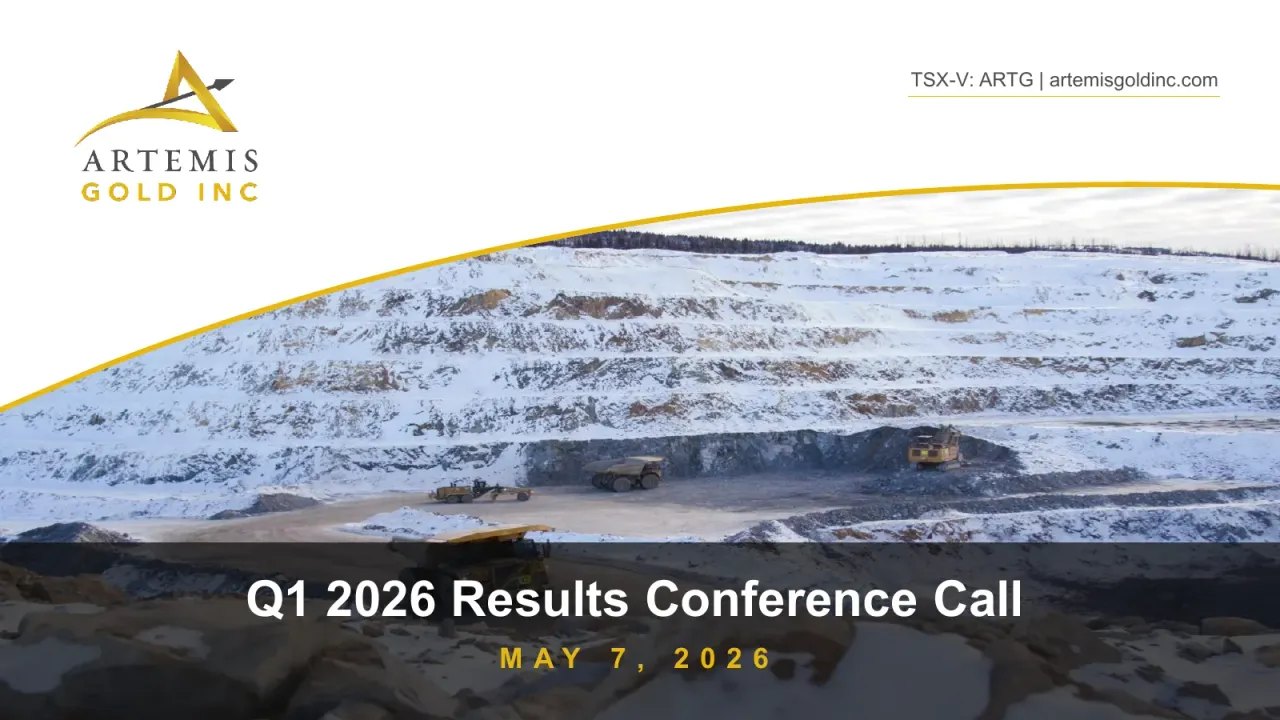
On 6ix: 6ix.com/event/artemis-gold-inc-argtf-q1-2026-earnings-call
Automated transcript · Written by software from the replay's audio. It can mishear names and figures; the replay is the record.
0:00 Thank you for standing by. This is the conference operator. Welcome to the Artemis Gold First Quarter twenty twenty six Results Conference Call. As a reminder, all participants are in a listen only mode and the conference is being recorded. After the presentation, there will be an opportunity to ask questions.
0:32 I would now like to turn the conference over to Meg Brown, Vice President, Investor Relations. Please go ahead. Thank you, operator. Good morning, everyone, and welcome. Thank you for joining our Q1 conference call and webcast. Before we begin, I would like to remind you that certain statements made on the call today may be forward looking and we encourage you to refer to our public filings and disclosures, including the cautionary language in yesterday's news release for a more detailed discussion of potential risks and uncertainties related to these statements. I will now hand the call over to our CEO, Dale Andres.
1:10 Thanks, Meg and thank you all for taking the time to join this call. In addition to myself on the call today, we have our President Jeremy Langford, our CFO, Jerry Vander Westhazen, our Chief Business Development Officer, Tony Scott and our VP Finance, Eric Marchand. Jeremy and Jerry will help present the highlights of the quarter together with myself and then we'll open the call up to your questions. On slide four, there are several important updates to highlight for the quarter. Firstly, we had a strong performance at Blackwater with respect to the open pit mine with record mining rates for the quarter and strong grades continuing.
1:57 While we did have an unplanned shutdown of the mill in March, we recovered quickly and recoveries, which were a record helped to partially offset the lower tons milled. We were successful on a number of other fronts during the quarter, primarily advancing our organic growth initiatives, including the phase 1A expansion, which is being carried out concurrently with a much larger EP2 project. Phase 1A is now 34% complete and on track for tie in and commissioning by the end of the year, adding 33% capacity to our plant. As a reminder, this is an incredibly capital efficient expansion costing just $55 per tonne of annual throughput.
2:47 The much larger EP2 project is also progressing well and was importantly, I think recently named a priority major project by the province of BC. Early works commenced in January with major works construction scheduled to begin in Q3 of this year. Engineering and procurement are well advanced and we have placed orders for the majority of our long lead items, which significantly de risks the schedule. As we mentioned in our news release, the ball mill components are already on route to Blackwater, which is a fantastic position to be in at this stage of the project and Jeremy will be expanding on this, but there's just been great progress to date and really want to commend the team for the work done so far.
3:35 On the financial front, we significantly bolstered our balance sheet in Q1 with a $450,000,000 corporate bond completed at very attractive terms and with the full revolving credit facility balance of 700,000,000 now available as risk mitigation. We announced an inaugural dividend policy in the first quarter, which reflects our confidence in the ability to fund all of our organic growth through operating cash flows over the next two and a half years and importantly lays out our longer term strategy for returning capital to shareholders with our first base dividend payments expected in the third quarter. On Slide five, this shows our operating highlights for the quarter.
4:26 We did achieve a new record as I mentioned for tons mined and we delivered high grade ore to the mill with grades averaging 1.59 gram per ton gold in the quarter. The plant processed just over 1,300,000 tonnes in Q1 and we produced just shy of 62,000 ounces of gold. This is lower than we originally anticipated due to the unexpected failure of the ball mill gearbox. However, our team did respond quickly to restore full operations. And as I mentioned before, lower than expected mill throughput was partially offset by both continuing high grades from the mine, as well as record recoveries of 90.6% for the first quarter and that's due to improvements that are ongoing in ore blending and continued optimization of the mill circuit.
5:22 And I do believe we're well set up for the rest of the year from an ore delivery perspective. On slide six, this shows a recent drone photo of the open pit and our current ore stockpile. We continue to see more low and medium grade material than estimated in the reserve and our stockpile for future processing is now approaching 20,000,000 tons. And you can see it there in the foreground. As mentioned, mining tonnage was higher up 7% from the previous quarter due in part to mine productivity improvements, including the introduction of double sided loading on our shovels and hot seating on our haulage trucks. In the mill, we continue to focus on plant reliability and optimization, including some permanent structural and equipment fixes in some areas of the plant, such as the CIL circuit and there's plans now in place to address and correct these design deficiencies once and for all.
6:26 On Slide seven and looking ahead, we're in the middle of an exciting growth phase at Blackwater with plans to achieve gold production of more than 500,000 ounces per year by the end of twenty twenty eight through ongoing optimization of the current plant delivery of phase 1A and that's coming up quite soon, but by the fourth quarter of this year and completing construction of EP2 in the third quarter of twenty twenty eight with ramp up to full capacity by the end of the year. Beyond EP2, we do believe Blackwater offers tremendous potential. We are advancing studies on various initiatives, which will feed back into our strategic planning process as we assess both life extension and further growth opportunities beyond EP2.
7:17 I'll now pass it over to Jeremy who will provide a progress update on both phase 1a and EP2. Over to you, Jeremy. Thanks very much, Dale and good morning everyone. Things are advancing well on phase 1a, Engineering procurement construction activities progressed in line with the plan, and all the major procurement packages have been committed to, including the three and a half megawatt video mill. And we've already commissioned some minor components that I mentioned last webcast as well. During q one, donation civil works and the concrete force for Verde Mill and the mill building were completed, and work on the oxygen plant foundations was completed also. Phase 1a equipment is expected to support further optimization of the existing processing facility and will be brought online in stages to phase 1a completion targeted for q four this year.
8:13 I'm pleased to report overall phase one a, as Alan just mentioned earlier, is is approximately 34% complete. And as we look forward, we expect to hit a number of key milestones across the one a extension throughout this next period to midyear and even into q three. Certainly, we look to be completing the engineering design and drafting prior to the end of q two, and we've just commenced tank erection on-site of the new tanks. We'll also be commencing the birdie mill building construction across the cruise ship period also. Just a reminder, this is a Brownfield expansion. The team's been actively looking at performing some works on an opportunity basis without impacting the current operating facility. As Dale mentioned, Phase 1 A is incredibly capital efficient, adding circa 33% throughput capacity to our existing infrastructure for a modest $110,000,000.
9:10 We're on track to hand over new facilities as we move towards an 8,000,000 tonnes per annum throughput towards the back end of 2026. And as we jump over to slide nine, please, early works began in 2026 with major works construction scheduled to begin in Q3 this year and continue for approximately two years. In addition to the orders for the 88 megawatt SAG and ball mills, which were placed in q three last year, we've also placed several other orders for long lead equipment, including the dry entry pressure, secondary and pebble crushers, CIP cells, well as the oxygen plants and sulphur burners. Having these orders placed in delivery time is concerned, the ammo clearly derisks the construction schedule.
10:00 We've been largely focused on advancing the construction camp and the new construction camp for that matter, which will allow us to ramp up the construction workforce a lot quicker than normally and as required as we move into full construction activities later this year. We've already constructed circa over 500 rooms to date and they're in various stages of commissioning in different tranches, but we look to add another 100 odd rooms prior to the midyear period and we're on track and in good shape on the accommodation facility area. EP two certainly transforms Blackwater, growing the operation to more than half a million ounces of AU production annually and firmly establishing Blackwater as one of the largest gold mines in Canada.
10:49 In summary, I can say to you all the growth projects of the 8,000,000 tonnes Stage 1A and our new 13,000,000 tonne per annum EP2 plant have been progressing well, with the owners and engineering hybrid teams collectively hitting their short term targets to date. I'm pleased to report it's been very solid, and we look forward to providing another update in the next quarterly update period. With that, I'll hand back to Dale. Dale, over to you, mate.
11:17 I appreciate that, Jeremy. In addition to Phase 1a and EP2, we do see significant additional optionality and upside at Blackwater. We are advancing various optimization studies and that's targeting increased efficiency, lowering unit costs and importantly further production growth. On the mining side, we are reviewing electrification of the shovels, automation of our haulage fleet and conveyor options for our waste movement. These projects are predominantly aimed at reducing our unit operating costs. Importantly, we also continue to evaluate a Phase three plant expansion and what the optimal timing and scale of that will be and we'll progress that through the year.
12:06 In late March, we initiated a diamond drilling program targeting blackwater deposit extensions to the North and East of the existing mineral reserve tip design.
12:18 The deposit does remain open at depths and in multiple directions and drilling is designed to further evaluate this potential. We are drilling at much further depths than the previous drill programs and we're testing extensions as deep as 900 meters or more and later this year, we intend to update the resource block model to incorporate this new drilling as well as recent grade control knowledge from the operation. Finally, we have a regional drill program underway to test high priority district targets. We did take a break from drilling over the winter period and we'll return that drilling now that the trails are starting to dry out in our region.
13:09 I'd now like to hand the call over to Jerry to go through the financial highlights of the quarter. Jerry? Thank you, Dale and good morning to all. It's probably appropriate to just remind everybody that most of the numbers that I'll be mentioning to you will be in Canadian dollars, unless otherwise noted. In the first quarter, we reported net revenue of $315,000,000 adjusted net income of $130,000,000 and adjusted EBITDA of $176,000,000 During the quarter, our average realized gold price per ounces sold into the spot market was over $6,570 Canadian per ounce and benefiting from our low all in sustaining costs when we compare ourselves to peers, we generated $128,000,000 in operating cash flows.
13:55 At the last shareholder call, we provided insights into our quarterly hedge delivery schedule. So there shouldn't be any surprises that we had an outsized hedge delivery this quarter of $25,000 into our mandatory hedge program, which was associated with our original project loan, as well as another 7,000 ounces into our discretionary hedge. In other words, we actually delivered more ounces into hedges this quarter than into the spot market, yet we still generated a healthy all in sustaining margin of 63% compared to cash revenue. We have outlined here on the slide the profile for hedge deliveries for the remainder of 2026, So on a relative basis, we expect to sell a much higher percentage of our production into the spot market going forward, compared to what happened in Q1.
14:40 We incurred a total of about $97,000,000 in capital expenditure in Q1, and the biggest chunks of which were in the EP2 and other category, which just by way of reminder for everyone, other is comprised of primarily our water and tailings infrastructure. Both phase 1a capital and EP2 capital for FY 2026 is backing weighted and will trend higher as we get into the summer and through the balance of 2026. If we can move to Slide 12 and turning our attention to the guidance, we are maintaining our previously announced annual guidance at Blackwater for production with full year production expected in the range of 265,000 ounces to 290,000 ounces of gold produced at all in sustaining costs of $925 to $10.25 dollars per gold ounce.
15:30 I will point out that all in sustaining costs for 2026 is expected to trend towards the higher end of this guidance, primarily due to general inflationary pressures, including higher oil prices, which the company expects to partially offset through continuous improvement initiatives. In line with our growth strategy and the Phase one and Phase O EP2 plans we announced during the latter part of 2025, we are expecting to spend a total of approximately $670,000,000 to $745,000,000 in capital expenditures in total in 2026. If we look at the next slide, as Del mentioned earlier in Q1, we announced and closed on a $450,000,000 corporate bond offering that was not only oversubscribed by three and a half times, it was also the first Canadian mining bond issuance in more than a decade, and the largest B category Canadian dollar issuance in approximately fourteen years, and with a coupon of only 5.625%, it is the lowest inaugural coupon in a dozen years, and so we're very proud of this outcome.
16:31 We used the proceeds from the bond to fully pay down the revolving credit facility, which combined with our cash position of $175,000,000 at March 31, provides us with total available liquidity of $875,000,000 So in summary, we're in a very strong financial position with the financial flexibility to fund organic growth and start returning capital to shareholders. But talking of returning capital to shareholders and before I hand the call back to Dale to wrap things up, I just want to again provide a high level overview of the dividend policy that we announced in Q1 in case some of you missed that at the last call. The introduction of a progressive dividend policy at this time reflects both our confidence in the strength and sustainability of our operating cash flows and our confidence in our near term growth strategy with the disciplined development of Phase one and EP2 expansion projects.
17:20 The inaugural base quarterly dividend of $05 per share will take effect at the end of Q2 with initial payment sometime in Q3. The quarterly base dividend will increase in 2027 to $08 per share, in other words, taking it up to $0.32 per share annually. And then beginning in 2028, we expect to also introduce an additional variable component to our dividend that will top up the base dividend to approximately 40% of our free cash flows. And then beginning in 2027, we may also evaluate opportunistically buying back some shares as part of our capital allocation framework. This would position Artemis Gold among leading peers who balance reinvestment for growth with shareholder returns. With that, I'd like to call it back to you. Thanks, Jerry. And to wrap things up, we did have a solid start to the year, notwithstanding the unplanned shutdown in March.
18:10 We are maintaining our annual guidance with recovery plans in place to make up for that Q1 shortfall in production over the course of the year.
18:19 Our balance sheet is strong, which is expected to support our transformational near term growth provided by the phase 1A and EP2 projects. By next quarter, we expect to announce the first dividend payment as part of our capital allocation framework as Jerry mentioned, and that framework does provide a roadmap for returning capital to shareholders in a manner that is sustainable, prudent, and consistent with both our near term growth strategy and long term goal to maximize value for our shareholders. With that, that concludes our presentation and back over to you now, operator for the Q and A. We will now begin the question and answer session.
19:14 If you are using a speakerphone, please pick up your handset before pressing any keys. To withdraw your question, please press star, then 2. We will pause for a moment as callers join the queue.
19:33 The first question today comes from Wayne Lam with TD. Please go ahead. Yeah, thanks. Morning, guys. Maybe first question just on the grade profile through the year. Obviously, the high grade stockpile strategy has performed very well since the startup. But just curious what the mine grades were in the quarter. And then how should we think about the process grades through the balance of the year as throughput ramps up given the current higher grades versus the reserve? At what point
20:05 should we start to anticipate a decline in those mills grades? Yeah, thanks for the question, Wayne. I would say, as you saw from that photo or stockpile and our stockpiling strategy is progressing and working quite well. We processed just shy of 1.6 gram per ton in the first quarter.
20:34 I would say on average, we're expecting and not to give very specific quarter by quarter guidance, but around the 1.5 gram per ton mark to average through the year. So I think it's probably a little bit higher than the average for the first quarter, but you can expect those kinds of grades in and around the 1.5 gram per ton
20:57 fairly consistent through the next three quarters. We do, as I flagged earlier, have planned a tie in shutdown with some of the components of the phase 1a build towards the end of Q3 or early Q4 and, you know, that will offset, you know, with that downtime some of the additional tonnage. We do expect to process as we start to commission the 1A facility. But in general, I think you can think about it as a fairly balanced next three quarters. Okay, sounds good. Thanks for that color. And maybe just moving on to cost guidance for the year.
21:44 How are you seeing the cyanide consumption levels now versus the prior performance through the transition material? And then do you have an update maybe on the quantum of sustaining capital budget for the year, just given the quantum of spend in Q1 versus the $5,000,000 guide?
22:01 Yes, thanks again for those follow ups. On the cyanide consumption, I would say that we're improving the way we're managing cyanide consumption now that we're out of that transition material. As you know, we're still we're resolving these issues, but still faced with some agitator and gearbox issues with our CIL circuit. So we do vary our cyanide consumption to overcome those mechanical issues that we still have in the CIL circuit. We are resolving those. We do have a long term plan in place to resolve those issues that involve some structural and mechanical fixes to those agitators and gearboxes and tanks going forward. Those should be progressive fixes. They won't, we'll work those in while we're down for mill reliance and other things,
23:04 but yeah, we just adjust our cyanide levels to overcome any downtime we do have on those tanks as we resolve those issues, but in general, I think we're managing the cyanide really well at this stage and I think that's helping as you would have seen our recoveries, we averaged 90.6 for the first quarter and actually in March, were up I'm not saying we can do this every month, but in March we're actually up at 92% recovery.
23:34 I think things have really improved on that front. On the sustaining capital, we're still guiding to the 5,000,000. Think maybe there's some confusion around lease payments that we have and Jerry, don't know if you want to comment on the lease side of things, but our guidance on sustaining is still in 5,000,000 range. 100% agree with you, Dale there. And Wayne, just for your benefit, obviously, these payments has to be included as part of your all in sustaining costs. We incurred $7,000,000 which is in line with our expectations. Just to give you a sense of what that would probably be for the next twelve months, if you want to have a look at our note disclosures in our commitments and our financial statements, you'll see that for the next twelve months, in other words, until the end of Q1 twenty twenty seven, it's roughly $36,000,000 So obviously, it's not linear.
24:25 We don't have not taken deliveries of all
24:28 of our equipment at the same time, but roughly over the next four quarters, we'll be spending roughly $36,000,000 and so that will give you a steer of what the quarterly lease payments will be going forward increasing to that total $36,000,000 mark for the twelve months. And just to be clear, that's included as part of our all in sustaining guidance for the year. Already reflected, absolutely.
24:50 Great. Yeah, that's really helpful color. And then maybe just last question just on the capital spend again. You know, it looks like a bit of a slower spend on Phase 1a and a pickup on EP2 anticipated through the year. Just curious if you could give us a bit more detail on how you classify the various projects underway between the expansion capital or sustaining buckets? And is the other capital projects, the $200,000,000 budgeted this year, is that a one off spend or is that expected to continue over the next few years alongside the EP2 expansion?
25:32 Yeah, thanks for that Wayne. I would say on just on and Jeremy, you may want to kick in or Jerry on this as well, but on the timing of expenditures, a lot of the work we've been doing is on engineering and procurement and those are important advancements on both Phase 1a and EP2
25:56 and we've got much higher committed costs, the cash spend, it is going to be very back end weighted both on both of those projects, both for Phase 1a and EP2 and we are maintaining our guidance for the year on capital. When you look at the buckets and you flagged the kind of roughly 200,000,000 in the midpoint of the guidance for other growth capital that is primarily
26:26 water and tailings infrastructure projects. And I think if you recall, when we gave our guidance for the year, we did flag that there will be additional other growth capital in 2027 and 2028, but that we wouldn't be guiding at this time for that. There's still more work to do on optimization of the mine plan,
26:54 figuring out exactly how much potential acid generating waste goes behind the tailings dam, how much we're going to need to raise that and associated water infrastructure. So, there will be, I would say a continued bucket in future guidance and we'll guide that on an annual basis going forward and that's over and above 110,000,000 on Phase 1A for the total capital cost and the 1,440,000,000 on EP2, which is just for plant expansion capital. Okay, great. Yeah, thanks for taking my questions and congrats on solid quarter. Thanks, Wayne.
27:40 The next question comes from Harrison Reynolds with RBC. Please go ahead. Thanks. Good morning, Artemis team and congratulations on a good start to the year. I appreciate the update so far and good to see the progress. I wanted to ask a bit more on costs. Wondering if you could provide some detail on your diesel exposure. You know, appreciating it's less than,
28:03 maybe other open pit operations with the downhill haul and still relatively shallow pit. But wondering what's baked into your cost outlook in terms of oil prices and what are your sensitivities to higher oil prices?
28:16 And just secondly on that, are you seeing cost pressures on other reagents and inputs like ammonium nitrate for explosives?
28:24 Yeah, thanks, Harrison. If you did notice in our press release, we issued yesterday. We did flag that for every $10 increase in the oil price impact on our all in sustaining cost and this is linked to our fuel consumption is in the range of $5 to $10 and it really does depend on our material movement quarter by quarter And we do benefit from the downhill hall and
29:01 I would say that relatively shallow pit that we still have as well. Regarding so, and just on our budget and our original
29:14 cost guidance was based on around the $70 per barrel oil price. So, obviously we're sitting in the 90 to 100 that has been over that. So you can do the math on the rough impact that's just for fuel consumption. I think there tends to be a lag on the impacts I would say around reagents and explosives and I would say also transportation costs in general across all supplies that we do bring in. I don't think we've fully felt the impact of the higher oil prices. Obviously, oil prices have come down recently, but that's something that we're tracking and watching closely.
30:01 And as you would have noticed, even though we're maintaining our cost guidance for the year, we are trending towards the higher end of that cost guidance. We do have lots of cost savings initiatives through our continuous and business improvement programs, driving productivity, efficiencies, additional production
30:22 and importantly just outright cost saving opportunities. And so we'll be doing everything we can to offset those inflationary pressures primarily driven by the higher oil price.
30:35 Great, that's good color. Thank you. And maybe just switching gears, good to see the project designated by the province. But wondering if you could talk to, you know, any outcomes you see from this. You know, one thing that comes to mind for me is, you know, perhaps the BC Hydro allocation for EP2, you know, but would you see any sort of future permitting benefit from this beyond, you know, the 21,000,000 tons per annum if you, you know, started to consider a phase three expansion? Yeah, I would say there's probably three
31:09 things I think that brings to us. One is just the visibility and profile and importance within the BC government now gets raised up. And so in general, that just provides us with additional support as we go forward on our EP2 build. There is minor permit amendments that we need. Again, I think this helps that process.
31:34 As you rightly pointed out, we're still having discussions with BC Hydro. Those discussions are going very well and we're, yeah, nothing to announce yet on that front, but yeah, we're I guess comfortable and confident that will resolve any kind of lingering concerns regarding BC Hydro and power availability for EP2 for the longer term.
32:10 Great. Thank you for taking my questions and congratulations again on the quarter. Appreciate that. The next question comes from Don DeMarco with National Bank Financial. Please go ahead.
32:24 Thank you, operator, and good morning to Dale, Jeremy and Jeremy as well. First question to Jerry. So Jerry, looking at the remaining hedges, ounces hedged, you prescribed the remaining allocation by quarter. Do you have discretion in terms of which quarter to apply the remaining balance? I mean, that you could opportunistically deploy into a quarter with a high gold price, for example, if you choose. And also, to confirm, will all the hedges be extinguished by year end? Thanks. Don, good morning and thank you for your question. So, I mean, these are contractually agreed maturity dates on the hedges. Is there a flexibility?
33:07 I mean, we could consider that. However, we feel it's prudent right now in the life of the current gold price environment to take our lumps and delivering to these hedges. Our production is strong And so we intend to deliver into the hedges as scheduled as you've seen in the financial statements and in the presentation today. Sorry, Don, the second part of your question, which one is repeating that? Yeah, it was, will all the hedges be extinguished by year end? No, we as you can see on disclosure, we still have some hedges to deliver into in 2027 and partway through 2028. The last hedges are delivered in September 2028.
33:55 And I believe that no disclosure is in note 16 of our financial statements, if you just want to refer to that for the details beyond 2026. In terms of the voluntary hedges that will all be extinguished this year. Yeah, I do think there's maybe I'll just add to that. I do think there's some more flexibility around the discretionary hedges right now. Our plan is to deliver into the remaining 14,000 ounces on the discretionary hedge throughout the rest of this year. And just for clarity, we'll have approximately 100,000 ounces in the mandatory hedge remaining at the end of this year, and about two thirds of that to be delivered in 2027 and a third in 2028 in the first half of twenty twenty eight. Okay, that's very helpful. Thank you.
34:47 So, Phase 1a and congratulations, it's 34% complete so far. Should we expect to see early increases above the 6,000,000 tons per year beginning Q2, Q3 as we kind of march up towards the 8,000,000 tons per year at the end of the year? Yeah, I think I'll answer that in a couple of different ways. I think there's opportunity, Jeremy, please feel free to kick in as well, but there's opportunities to deliver some elements of Phase 1a early, those will primarily benefit recovery. Not to say that there's not still optimization potential to go above the 6,000,000 ton per annum ahead of the commissioning of the Vertamill, but the Vertamill is the main piece of equipment that's gonna get us to 8,000,000 tons. So throughput jumps at that time, which is going to be in the fourth quarter.
35:48 Jeremy, do you want to add any color to that? No, thanks, Good morning, Don. Yeah. I think we've we've mentioned a couple of times that we have the ability to to tie certain elements with the one a project in on the run as we speak. Obviously, you know, cutting in the new the new aeration of leach tanks and and tying those in from a power perspective is is a little bit more difficult. So but certainly things like oxygen addition, the reagents addition, tying in the peripherals around the the verdimum, and, obviously, getting the building up and getting it covered up. They can all be done in a I won't call it ad hoc, but in a sequence in a ground field sequence. So we take advantage of when we've got an opportunity to do something.
36:40 I mean, at at the moment, our focus is is largely on getting the the tank bases rolled out and starting to stand tanks. The big focus has been on getting the AP two footprint paid, but also conversely getting the one a project ready to hand over in a in a concise timeline. We don't just drag it on. And so we're putting a fair bit of effort done into planning these these times and to make sure that they're not invasive on stage one facility. Okay. Okay, that's great. Thanks for that. And then my final question has to do with stockpile management.
37:26 Maybe if you could just remind us, like, how big is the stockpile? How big do think it's going to get? And obviously, it has a lot of benefits with respect to ore blending that ties into recoveries and whatnot. But what's your outlook for kind of is it mostly low grade material that's longer dated for processing? Or what's your plan for drawing down on that over the next couple of years even? And is there visibility maybe for like accentuated cash flow if you choose to kind of draw a higher proportion sooner? Yeah, no, I appreciate the question, Dom. Our current stockpile and I think I mentioned it in the presentation we just gave is approaching 20,000,000 tons. I think it's together with our run of mine and of course our stockpile, we're just shy of 20,000,000 tons, but the stockpile itself is over 19,000,000 tons.
38:17 By the end of this year, that's forecast to grow towards 35,000,000 tons, assuming similar low and medium grade ore that gets added similar to what we're seeing to date. So, that's a very big stop considering we're processing around the 6,000,000 ton per annum mark. That's over five years at the current processing rate. Obviously, we're going to be increasing that processing rate. We don't currently in the current life of mine plan dip into the stockpile in any material way. The opportunity lies in the mine plan optimization work that we're going to be doing incorporating our grade control drilling and additional drilling at depth this year.
39:07 And right now, because we've found so much more material than originally anticipated and it is low, but importantly also medium grade material, we're putting anything that's below one gram per ton onto that stockpile. So, there is above reserve grade in that stockpile. To date, we have not been able to segregate the higher grade portions from the lower grade portions just because there's been too much material. We don't we can't build the foundation pads, you know, there's water management and other things that we need to manage around building those stockpiles pad space and we haven't been able to build the space fast enough in order to build segregated stockpiles.
39:56 That's something that we're pursuing and looking at including potentially going higher, which would free up space to segregate and all of those are being looked at right now and that's where the opportunity lies on if we can segregate some higher grade from the lower grade portions as we optimize the mine plan, we can pull selectively from that stockpile and that will be a contributor to future cash flows and improvements to the mine plan profile and milling profile going forward post EP2 build. So, that's something we're actively focused on this year. Okay, yeah, great. I mean, it sounds like it provides some flexibility when the time is needed.
40:44 And maybe just quick final question. You mentioned Phase three, touched on a little bit with respect to permitting. But what would you be thinking about in terms of the phase, the magnitude of the throughput in a Phase three scenario? And is that contingent upon exploration success? I'm sorry, I missed that. Can you sorry, Don, could you repeat the question? Oh, yeah, just in regard to a hypothetical Phase III expansion, You know, you'd be taking it above EP2. You be thinking of going up to maybe it's early to say because there's still some work to be done on this. But would you be thinking can you give us a sense of how big it could be?
41:30 I mean, right now, you could do goes up to 21,000,000 tons per year. So maybe a Phase III, are you thinking 25, 30? Is is it go forward on that contingent on exploration success? Yeah, I appreciate that. And I think we have absolutely phenomenal exploration potential and not just in the district, but in the deposit itself at depth. We have done our first hole at depth, we don't have assays yet, but like, as I mentioned, drilling to 900 meters below surface. I think as we optimize for higher gold prices, our current reserve is done at $1,400 gold as we incorporate our grade control and the amount of tons that we're seeing over and above what was expected.
42:29 And then in the first year, some of those tonnages are 30 to 40% higher than what we expected on the low and medium grade side, Incorporating all that into a new mine plan, a new resource, a new reserve, that's going to be the backbone of our analysis on Phase three options. I do think that there is phase potential ahead of any kind of capital build for phase three to get towards 25,000,000 tons just through optimization of EP2. So, we'll call it a similar capital efficient optimization like we're doing with phase 1A. We'll be looking at that for EP2, we'll call it EP2A whatever in the marketplace where we put to it, but I think there's that kind of potential to get to 25. When we think about what we would call a phase three that's beyond, you know, looking at potential beyond 25,000,000 tons and I think it's too early to put what exactly that would be, but, you know, something like an additional plant is the kind of way that we're thinking.
43:44 We do think this is not just a mine life that will go for decades, we do believe it has generational potential and as we firm up the resources and reserves through exploration and drilling at depth, I really do think it opens up a lot of opportunity to consider what the next major expansion could be beyond DP2 and that's what we're starting to turn our attention to this year. Okay, well, thank you very much. That's very helpful. That's all for me. Good luck with the rest of the quarter. Appreciate that, Tom. The next question comes from Andrew Milchuk with BMO Capital Markets. Please go ahead.
44:31 Hi, Dale. Thanks for all the detailed and patient answers to the questions ahead of me. Two quick ones. Did your supply team manage to secure an additional backup box for the one that was consumed to replace the one that broke? Quick answer on that, yes, we have two gear boxes. We have two gear boxes on that ball mill, we have two spares and importantly with the couplings already attached and these gear boxes shouldn't fail. We're still doing the full root cause analysis and we're doing a full review of our operating and maintenance procedures as well at the same time.
45:19 These things shouldn't fail. A contributing factor may be the storage and transportation of the gearbox ahead of installation. There may be other issues, we'll address that. But importantly, we do have two spares, one for the main one and one for the follower gearbox and with couplings already attached. If we did and if we shouldn't, but if we did ever have another failure, it would be much quicker to get back up and running. Okay, and then know John asked a whole bunch of questions about the stockpile in these. It was just a simple one and I think you alluded to it. It's really big and it's going to from my notes you said 35,000,000 tons by the end of the year. Where do you essentially run out of space or have to think about something completely different than what's currently planned if this extra tons keeps being defined in the grade control?
46:23 Yeah, I appreciate that Andrew and our original study and permit allows for well over a 100,000,000 tons. So, I think the original plan was a 111,000,000 tons that the stockpile would ultimately grow to through our mine plan optimization. Obviously, things have changed slightly with our Phase 1a and EP2 profiles and then as we optimize those expansions, you know, I'm not sure we'll ever get to 111,000,000 tons but we do have the space, it's about building the foundations for those stockpiles fast enough.
47:09 It's just the ore is coming into the pit, so faster than we can build the foundations to store it and we're trying to get ahead of that. Now that we're out of the winter, you know, we can speed that up and hopefully restrict that and start to segregate. Okay, so this isn't a question of running out of room. It's just having the construction guys. Exactly. Time and space to do their job. Yes, it's how fast it's coming at us. We never expected to have close to 20,000,000 tons at this time already. So, we've really had to ramp up clearing and building the space to store that ahead of what we originally anticipated. That's great, thank you very much again to you and the team for the very detailed and patient answers. I'll sign off and let others ask if there's still time.
48:05 Thanks, Andrew. This concludes our question and answer session. I would like to turn the conference back over to CEO Dale Andres for any closing remarks. Thanks operator and thanks again to everyone who joined the call. I think we've been able to answer all your questions. We are available to answer any follow-up questions if there are any and we look forward to updating you on progress and importantly on our Phase 1a and EPT projects as we go forward. Thank you all. This brings to a close today's conference call. You may disconnect your lines. Thank you for participating and have a pleasant day.
Follow Artemis Gold Inc into a list and get an email when it puts out news.
Vice President, Investor Relations
Chief Executive Officer
President
Chief Financial Officer
Analyst, TD Securities
Analyst, RBC Capital Markets
Analyst, National Bank Financial
Analyst, BMO Capital Markets