Dan Scott
Investor Relations
Replay available
Aqua Metals (NASDAQ:AQMS) Q2 2026 earnings call, held 2026-07-30. Watch the replay and read the transcript on 6ix.
On 6ix: 6ix.com/event/aqua-metals-inc-aqms-q2-2026-earnings-call
Automated transcript · Written by software from the replay's audio. It can mishear names and figures; the replay is the record.
0:01 Good afternoon, and welcome to Aqua Metals Second Quarter twenty twenty six Earnings Conference Call and Webcast. My name is Paul, and I will be your operator this afternoon. At this time, all participants have been placed on a listen only mode. Following management's prepared remarks, we will open the floor for questions. It is now my pleasure to turn the floor over to your host, Dan Scott, Investor Relations. Dan, please proceed.
0:26 Thank you, operator, and thank you everyone for joining us today. Earlier today, Aqua Metals issued a press release providing an operational update and discussing results for the second quarter ended 06/30/2026. This release is available in the Investor Relations section of the company's website at aquametals.com. Hosting the call today are Steve Cotton, President and Chief Executive Officer and Eric West, Chief Financial Officer. Before we begin, I would like to remind participants that during this call, management will be making forward looking statements. Please refer to the company's report on Form 10 ks for a summary of the forward looking statements and the risks, uncertainties and other factors that could cause actual results to differ materially from those forward looking statements. Aqua Metals cautions investors not to place undue reliance on any forward looking statements.
1:16 The company does not undertake and specifically disclaims any obligation to update or revise such statements to reflect new circumstances or unanticipated events as they occur, except as required by law. As a reminder, after the formal remarks, we will conduct a question and answer session. With that, I'd like to turn the call over to Steve Cotton, President and CEO of Aqua Metals. Thank you, Dan, and good afternoon, everyone, and thank you for joining us for our second quarter financial results and business update call. Aqua Metals has now shifted from proving a technology to commercial execution. Over the last several years, we've proven that AquaRefining works. We've demonstrated battery grade products. We've expanded our operating hours, and we validated multiple process flows.
2:03 Everything we're doing today is centered around building a profitable, critical minerals processing business here in The United States. You will also hear us describe the company a little differently moving forward, and that is deliberate. Aqua Metals is a US critical minerals processing company commercializing lower cost recovery and refining technologies. That is not a new business. It's a sharper description of the business we've been building. We continue to believe one of the largest opportunities in the domestic battery supply chain isn't another battery factory. It's the infrastructure needed to process manufacturing scrap and end of life batteries as those factories ramp production. That's exactly what Headwater's ARC is designed to become. We are completing final diligence on a Midwest site with approximately 150,000 square feet of existing industrial infrastructure and approximately 50 or more acres.
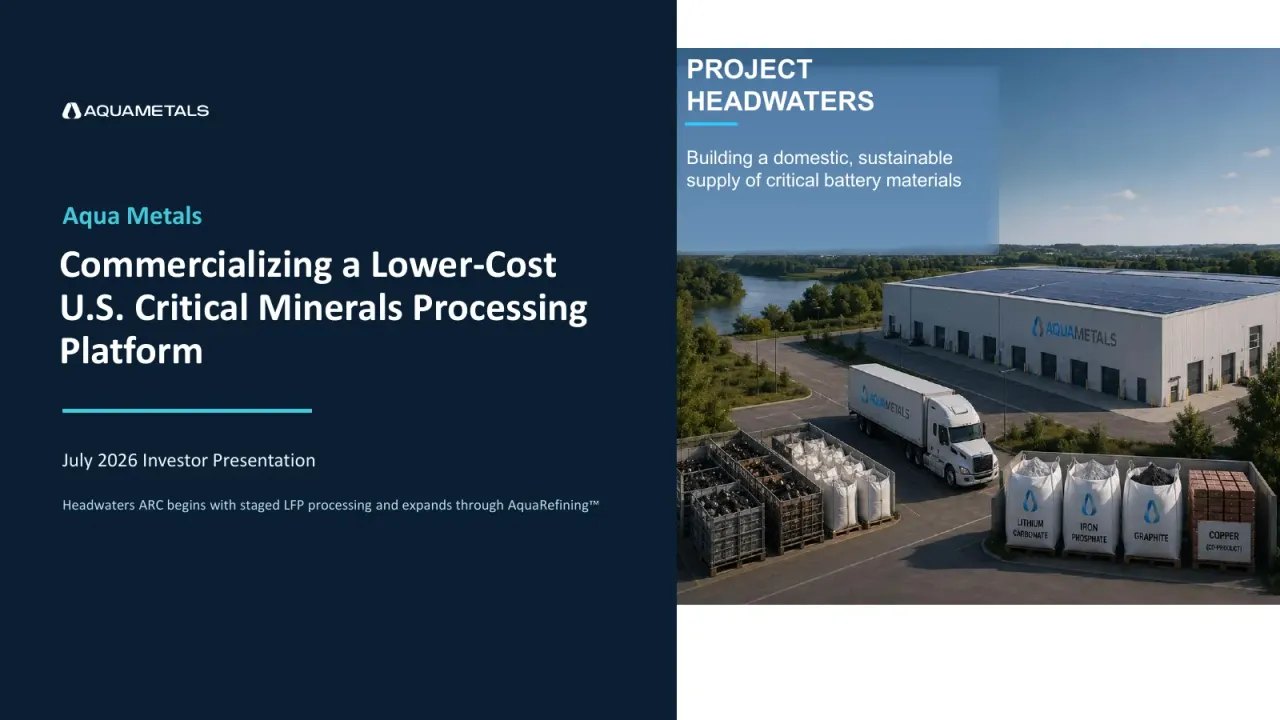
2:56 And it sits a short drive from six major LFP Gigafactory projects. Feedstock proximity drives the economics of this business. And that location puts us next to one of the fastest growing sources of LFP manufacturing scrap in the country. At full campus configuration, Headwaters is designed for approximately 20,000 tons per year of processing capacity. That scope and timing remain subject to financing, permitting, and commercial agreements. One thing I'd like to emphasize is that we've intentionally evolved our commercialization strategy. Instead of attempting to build everything on day one, we've broken the project into logical commercial phases. Phase one is designed to use commercially proven pre processing equipment to domestically recover valuable aluminum, copper, and high specification black mass from segregated LFP battery materials.
3:51 That approach gives us a much earlier pathway toward commercial revenue while substantially reducing execution risk. Once that operating foundation is established, we integrate AquaRefining in Phase two to recover battery grade lithium carbonate, iron phosphate, and graphite from that same black mass. That second step is where we believe Aqua Metals creates significantly greater long term value. We're intentionally deploying capital in stages while increasing value at each step. We believe that's a much smarter commercialization strategy. And some of you have heard us describe commercial plans before, so let me be direct about our standard. We said we would build once and build right, with feedstock, offtake, and financing in place before deploying AquaRefining at commercial scale. That standard has not changed. The phased headwaters model is how we satisfy those gates, one step at a time.
4:50 During the quarter, we made meaningful progress across every major work stream required to make that happen. We've advanced site diligence. We've advanced engineering. We've continued evaluating commercially proven pre processing partners. We've expanded discussions with feedstock suppliers and future offtake customers. We've progressed multiple financing structures, and our intent is to fund Headwaters substantially at the project level rather than off our balance sheet. Eric will walk through that in more detail. And we've continued operating the Innovation Center, which now has exceeded 5,000 cumulative operating hours supporting commercial engineering. None of those work streams are happening in isolation.
5:35 They're all converging toward the same objective, bringing headwaters into commercial operation efficiently and with as little execution risk as possible. One point I'd like investors to appreciate is why we're initially concentrating on LFP materials. LFP, or lithium iron phosphate, is becoming the chemistry of choice across energy storage systems and an increasing percentage of electric vehicles, gigafactory capacity is expanding rapidly. That means manufacturing scrap is expanding just as rapidly. Our market analysis informed by third party industry research projects, recyclable LFP scrap will grow roughly 15 fold by 2030. And Bloomberg NEF projects US storage capacity of approximately two thirty five gigawatt hours by 2035.
6:29 We believe that creates one of the largest underserved critical minerals processing opportunities in North America. Unlike nickel and cobalt rich batteries, LSP requires a different economic model. Our phased commercialization strategy is specifically designed around that opportunity. And I want to be clear that LFP is where we start, not where we stop. The same platform architecture, mechanical, pre processing, followed by refining and product recovery is intended to extend to NMC materials or nickel manganese cobalt, and over time to selected mined materials and industrial waste streams. We have already tested the process on mined feedstocks. Headwaters is designed to be the first node in that platform, not the whole business.
7:16 And at the same time, AquaRefining remains the technology that differentiates this company. Our process is designed to eliminate one time use chemicals, reduce waste, improve worker safety, and lower operating costs compared with conventional processing methods. The Innovation Center continues validating commercial process flows, while supporting engineering for headwaters. So that technology foundation remains very strong. And another area we're pleased with is our financial discipline. We've entered this commercial phase debt free. We're intentionally matching capital deployment with commercial milestones. And our objective isn't simply to build a facility. Our objective is to build a profitable business with disciplined capital allocation.
8:02 And that's an important distinction.
8:05 Looking ahead, our priorities for the balance of 2026 are straightforward: complete the site diligence, secure long term site control, select our Phase I processing partner, advance feedstock and offtake agreements, continue engineering, complete capital formation, advance permitting, and continue moving toward a final investment decision. Those are tangible milestones investors can follow over the coming quarters. And I want to be clear about when the economics arrive. At a final investment decision on Phase one, we intend to provide capital cost, expected throughput, product mix, and expected operating cost. I'll close with this.
8:50 We believe Aqua Metals has reached an important inflection point. The technology foundation has been established, and the market opportunity continues to strengthen. Our commercialization strategy is now clearly defined, and our team is focused every day on executing that plan with discipline. We're excited about the opportunity ahead, and we appreciate the continued support of our shareholders. With that, let's have Eric review the financial results before opening the line for questions. Thanks, Steve. Moving to highlight a few items on the income statement for the second quarter of twenty twenty six. We reported a net loss of approximately $4,500,000 or $1.31 per basic and diluted share compared with a net loss of approximately $6,800,000 $7.44 per basic and diluted share in the second quarter of twenty twenty five.
9:46 The per share comparison also reflects the increase in the weighted average shares outstanding during 2026. The total operating expenses were approximately $4,600,000 for the quarter compared with approximately $7,000,000 in the prior year period. The current year quarter includes an additional non cash provision for credit loss of approximately $2,100,000 related to Line Energy, while the prior year quarter included a non cash impairment charge of approximately $3,800,000 Plant operations, research and development, general and administrative expenses totaled approximately $2,500,000 compared with approximately $3,300,000 in the prior year quarter, reflecting our continued focus on managing our core operating cost structure.
10:35 On Lion Energy, based on developments during the quarter, we updated our estimate of expected recoveries. At June 30, our total allowance for credit losses was approximately $2,500,000 representing 60% of the approximately $4,200,000 gross balance that also includes accrued interest. This resulted in a net carrying amount of approximately $1,700,000 The allowance is an accounting estimate of the expected collections and does not represent a determination of the amount legally owed to Aqua Metals or a waiver of our rights. We remain committed to pursuing recovery through appropriate legal and commercial avenues.
11:17 We ended the quarter with approximately $4,700,000 in cash and cash equivalents and working capital of approximately $4,000,000 and no notes payables outstanding. Cash used in operating activities was approximately $6,500,000 during the first six months of the year. During the second quarter, we raised approximately $581,000 in net proceeds under the ATM program, bringing the total ATM proceeds for the first six months of 2026 to approximately $1,900,000
11:46 We continue to manage our operating spend carefully. As noted in today's release, we are advancing project financing, staged equipment financing, third party real estate structures and economic development opportunities for Headwaters Arc with Newmark's advanced manufacturing practice group engaged as an advisor. Our intent is to fund the project substantially at the project level so that the corporate capital supports operations and staged execution. Our objective is to preserve financial flexibility while advancing Headwater's ARC through disciplined milestone based capital deployment. With that, I'll turn the call back over to the moderator to begin Q and A.
12:29 Thank you. The floor is now open for questions. Speaker phone to provide optimum sound quality. Ask Once again, that's star one if you wish to ask a question. And please hold while we poll for questions.
12:53 Posing We did have a question question coming from Mickey Legg from Benchmark. Mickey, your line is live. Yeah. Thanks, guys. Hey, Steve. Hey, Eric. Maybe just start by expanding on how this is sort of a natural evolution of your previous project working from more of a recycling to Greenfield refinery to
13:22 preprocessing infrastructure with the Gigafactories in the area. Can you just elaborate on that? Like how should we be viewing this evolution and what gives you confidence this is an underserved piece of the supply chain? Thanks. Yeah. Yeah, Mickey, good question. And, you know, it's all about finding the market and having the right solution for the market. And what we are really focused on is the fact that there is just a huge underserved opportunity
13:55 for LFP chemistry batteries with those six gigafactories in the region there. And we see an opportunity to collect those batteries and focus on that chemistry, which is a simplified chemistry, and also de risk the first phase of it by deploying a standard set of collection and processing equipment that preprocesses that into the aluminum copper fines, as well as the black mass production, and then put the Aqua refining in there and focus that on the lithium and not have to worry initially about the nickel and cobalt. So we see it as a de risk, a lower cost of entry, a staged approach, and in literally the middle of the market where it is most needed, because we're building a lot of gigafactories, and we're just not building,
14:43 as a country, the ability to process these materials and keep those materials in the country. So all that together is really the thesis behind the way that we're approaching this and being able to do so in such a way that we preserve our capital along the way.
14:59 Got it. Okay, that's helpful. And then that takes me to my next one, which is sort of about what you've learned from the equipment procurement and the progress you've made there. Seems like you're making good progress, but just curious what should we be looking for on that front? Is there anything particular that you've learned from that?
15:27 You mean on the equipment procurement for Phase I? Yes. Yes. Yes. So we are definitely very close to a decision point on the equipment supplier for Phase I. And that is really exciting for us, because we've seen this equipment operating at scale, and we would be able to take the equipment that's been running at scale and deploy it and execute versus take any technology risk for the collection and preprocessing and production of
16:00 those initial revenue generating products. And so, that's really a key part of the next steps for Aqua Metals is to sign that agreement and get moving forward with the procurement of that equipment and deployment of that equipment at the Project Headwaters location.
16:19 Got it. Okay. And then last one, what are some of the milestones we should be looking for in the near to midterm? Is it more of these economic on the Phase I? That's definitely high on my list.
16:35 Yeah, so lots of milestones to come, of course, and that involves the indication of the the final indication of the specific site, and then the equipment supply portion of it, the financing of the real estate, and tenant improvements of the real estate. Fortunately, it's a
16:57 building that we believe that we can upfit very quickly. And you'll see news flow about that's part of the supply on the equipment, on the facility, on the location, and of course, the commercial side of things, which is feedstock and offtake contracts.
17:20 Okay, great. That's all for me. Thanks, guys. Thanks, Vicki. Thank you. I would now like to turn the call back to Dan Scott to facilitate questions that were submitted online. Thank you, operator, and thank you, Mickey, for the questions. The first one we got was, Steve, could you walk us through why the phased approach at Headwaters creates a path to revenue earlier than a greenfield build would, and why the company is starting with LFP?
17:49 Yeah, certainly. So, the single most important fact about Headwaters is that the facility already exists, as I was saying. We are working with approximately 150,000 square feet of existing industrial infrastructure and 50 or more acres of land surrounding that. And starting inside a building that's already standing means we're not funding a full greenfield construction cycle before we can process a single ton of material. That's really what makes the phased approach work. So, I is designed, again, like I was speaking with Nikki about, to use commercially proven mechanical processing that is already scaled and produces valuable high spec black mass, aluminum fines, copper fines as products, and using that proven equipment that's available today from an established supplier.
18:42 Phase two is where we add our patented AquaRiver Tracking technology, and then we take that black mass and convert it to battery grade lithium carbonate and iron phosphate and graphite right here in The United States. Later phases then would extend the platform to NMC or nickel manganese cobalt and other critical mineral type feedstocks. But each phase is designed to be capitalized and validated on its own terms before we commit to the next phase.
19:13 On the LFP, though, as asked, we're following the feedstock and the demand. And based on our market analysis informed by third party and industry research, that recyclable LFP manufacturing scrap is expected to really increase quite a bit, approximately 15 times by 2030. And Bloomberg NEF projects that the battery storage installations in The U. S. Are going to reach approximately two thirty five gigawatts
19:42 of installed power capacity and nine forty eight gigawatt hours, which is a staggering number of battery energy storage capacity by 2035. And the existing U. S. Shredders today that do that preprocessing are concentrated on the nickel and manganese and cobalt, or that NMC scrap today, which raises the cost of that feedstock and thus leaves the LFP underserved. And the Headwaters sits, as I mentioned earlier, a really short drive from six major LFP data factory projects, and we'd rather build where the feedstock is growing fastest, and the processing capacity there just simply does not exist yet. Great, Steve. Thanks. The next question is, Sierra Arc was announced and then sold, and management has said build once, build right, with concentrated feedstock, committed off take, and bankable financing as the gates before building.
20:40 What is structurally different about Headwaters? And does Phase one clear those same gates?
20:46 Yeah, that's a fair question. And the gates have not moved. The contracted feedstock, committed offtake, and bankable financing remain the conditions for deploying capital at a commercial scale. What has changed is that we now have a structure that lets us satisfy those conditions in sequence, rather than trying to clear all of them before anyone turns a shovel.
21:10 Sierra Arc was the first of kind build that required the full capital commitment upfront. And when the market moved against the industry, where we saw lithium prices dive bomb, we made the disciplined decision at that time to sell the asset and protect the balance sheet. And Headwaters is close to the opposite profile. Phase one is designed to use commercially proven equipment, as I mentioned, rather than the first of kind technology. We've engaged Newmark, who is a leading global commercial real estate adviser, to pursue those third party real estate structures for the land building and site development. And equipment payments are being negotiated on stage terms that are tied to milestones. So Phase I does not go around the gates. It's really more how we get to them.
21:57 And a facility with feedstock coming in the door and product going out is what converts feedstock discussions into contracts, and what makes a Phase two project financeable on a project level terms. Same discipline, but sequenced differently, to summarize. All right. Next one is, share count has increased significantly over the past five quarters. How should existing shareholders think about the funding of Phase I across real estate structures, staged equipment terms, and the ATM? And how do you think about funding the company through a final investment decision? Yeah, this is Eric, and I'll take that one. So, let me start with where we ended the quarter. We finished June 30 with approximately $4,700,000 in cash and approximately $4,000,000 in working capital.
22:50 And we used approximately $2,700,000 of the cash in operations during the quarter. We raised approximately $581,000 under the ATM during the quarter, with approximately $48,000,000 of capacity remaining on the ATM. And we continued to carry no debt.
23:07 On deletion, I will be direct. We raised capital through one of the most difficult stretches the sector has seen, and that decision is the reason the company is in a position to pursue headwaters at all. We raised proactively rather than reactively, and we ran the business lean while we did it.
23:27 Going forward, the objective is to fund Phase one with little capital equity as possible. The architecture of the three layers is: first, land, building, and site development represent a significant component of the Phase one cost, and Newmark is engaged to pursue third party real estate structures, including a long term triple net lease or similar arrangement. Second, we were pursuing staged equipment payment terms aligned with project milestones rather than paying all that upfront. Third, corporate capital is reserved for the operations and staged execution with HEMUs in a measured way. Alongside those, we've submitted state and local economic development packages, and those discussions are advancing.
24:22 And then, on the period between here and the final investment decision, the work ahead of us is diligence, engineering, permitting, and negotiating rather than construction, and our operating cost structure is lower than it was a year ago. We manage to milestones rather than to a calendar. None of these structures are signed, and we are going to characterize and not going to characterize them as any of them as complete until they are. But the preference is clear, project level and asset backed capital ahead of corporate equity and the capital deployed against milestones rather ahead of them. We'll not deploy any capital into construction ahead of these conditions we have set, and we will report against milestones lists every quarter.
25:16 Thanks, Eric. The next question, on the durability of the model, how does headwaters perform if lithium prices fall back toward last year's lows? And is there a genuine domestic demand for the Phase I products? Or does that material get exported the way most U. S. Black mass is today? Yeah, so two things protect the model. The first is that Phase I is not primarily a lithium story. Phase one is black mass, aluminum fines, and copper fines as the products. And in this segment, processors are generally paid to take in feedstock. So, you're in revenue before you even begin processing. The combination is considerably less sensitive to the lithium prices than a pure refining operation would be.
26:05 The second is cost position. AquaRefining is designed to eliminate those one time use chemicals and reduce the waste streams, as we've been talking about all along, and associated disposal costs, and do so in a far safer and less labor intensive environment, which is where the operating cost advantage primarily comes from. We believe still that a lower operating cost position is what allows a platform to operate through a full price cycle, rather than only in a strong one. And for context, you could anyone listening can go back and look at lithium carbonate prices and see how they've recovered substantially from 2025 lows. In the meantime, on domestic demand, aluminum and copper, of course, have deep established U. S. Offtake channels, and pricing has been strong, particularly recently.
27:00 Black mass is the exception, and it's that exception that makes our point. Most black mass produced in the country today is exported because there's not enough commercial scale refining capacity here to process it. That is precisely the gap that Phase II is designed to close. And we view domestic refining as a demand problem that has already got an answer waiting for capacity, not one that has to be created. Great. And then we have one last question. You have described headwaters as designed for approximately 20,000 tons per year at full campus configuration. What does that capacity mean for the business? And can you give investors any sense of the Phase I unit economics behind it?
27:47 Sure. Let me be precise about the structure, because it does clarify the question. So, I is the preprocessing. And getting into some more detail, we expect to install two preprocessing lines that will be approximately 10,000 tons per year each. So that's approximately 20,000 tons per year at full Phase one configuration. Phase two does not add tonnage to the building, but rather it takes that black mass that Phase I produces at its capacity and turns that into refined products. So rather than selling black mass at that point, we would refine it ourselves and sell more lithium carbonate, iron phosphate, and graphite than black mass.
28:33 The scope and timing remains subject, of course, to financing, permitting, and all those commercial agreements. And I'll point out that this is not a production forecast, and it is not guidance yet at this point. So that structure is deliberate and is central to how we are managing that risk. We are not betting the company on a single build. And this first line establishes the operation in the commercial relationships. The second line scales what we have already proven. And Phase II then adds the value to the material that we're already going to be handling, rather than requiring new or different types of feedstock. The capacity is sized against us receiving a portion of the LFP manufacturing scrap that's being generated by the Gigafactory projects within that short drive of the site that I mentioned earlier.
29:21 On economics, I'll give you a standard that we're holding this to, rather than a specific forecast. Phase one has to earn its own return. And we're not asking anyone to fund Phase one on the promise of Phase two. Before we take Phase one to a final investment decision, the case has to demonstrate positive EBITDA and positive cash flow at the project level and return on invested capital that meets our investment criteria in each case after ramp and under commercial assumptions that we can support. If it does not clear that bar, we don't proceed. Two things I want to be precise about: that is an investment criterion, not financial guidance. And it is project level economics, which is a different measure than consolidated company results that carry corporate costs.
30:10 Also, on sizing, the Phase I products are, again, copper and aluminum and high specification black mass, all of which price off of observable markets. Between throughput and the product set, you have the framework, really, to do the math. And that math varies depending on metals prices, obviously. The variables that determine where we land inside it are commercial, therefore, rather than technical. What we pay for the feedstock or even paid to take the feedstock the mix of material we receive what we recover and what those products fetch at the time. Several of those terms are terms that we are actively negotiating, but not quite yet signed, which is why we're not putting estimates on the record ahead of the agreements that determine them.
30:58 As a final investment decision on Phase I, we intend to provide the capital cost, expected throughput, product mix, and existing operating costs, and you'll be able to model it more properly at that point. Thanks, Steve. That's the end of our questions. Maybe I can just turn it back to you for some closing remarks. Appreciate that, Dan, and appreciate everybody attending the call and listening in on Project Headwaters and Aqua Metals. And we're really looking forward to continuing to keep the market updated as we make those milestones one by one between Q3 and Q4. Looking forward to reporting more news, too.
31:45 Thank you. This does conclude today's conference call and webcast. You may disconnect at this time and have a wonderful day. Thank you for your participation.
Follow Aqua Metals, Inc. into a list and get an email when it puts out news.
Investor Relations
President and Chief Executive Officer at Aqua Metals
Chief Financial Officer
at Benchmark