Mary Scafidus
Senior Vice President, Investor Relations and Communications
Replay available
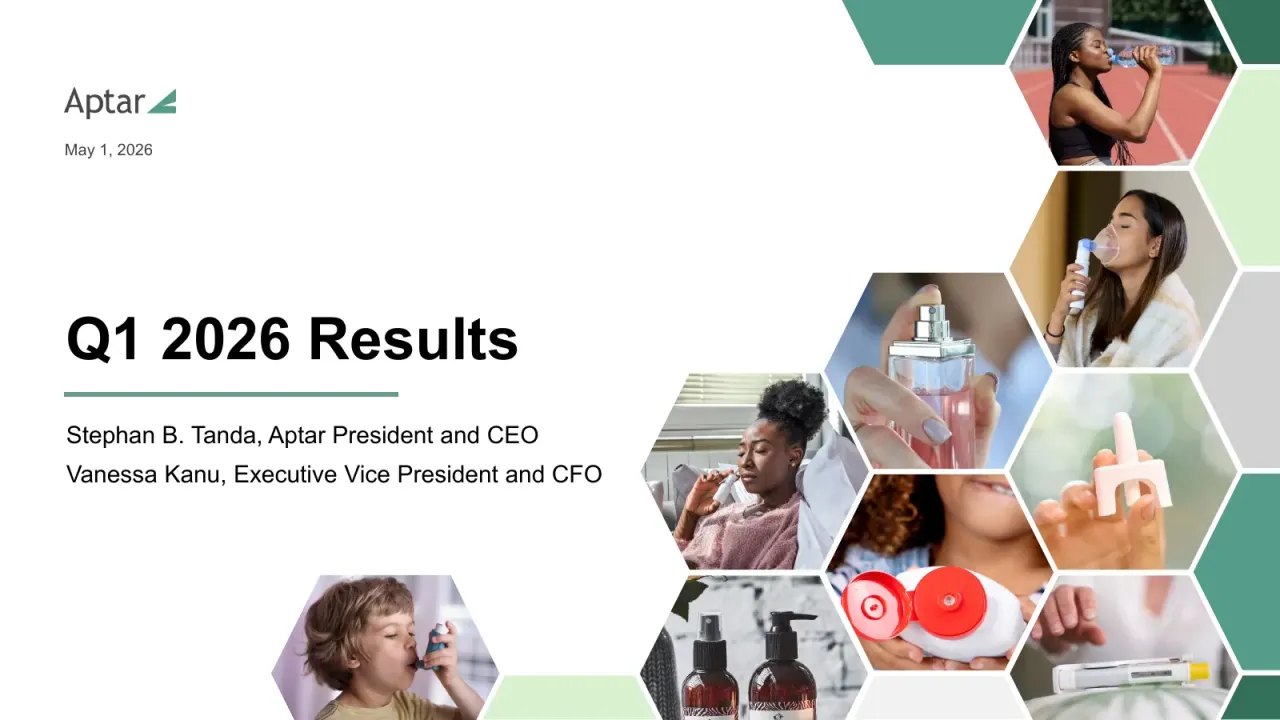
Aptargroup (NYSE:ATR) Q1 2026 earnings call, held 2026-05-01. Watch the replay and read the transcript on 6ix.
On 6ix: 6ix.com/event/aptargroup-inc-atr-q1-2026-earnings-call
Automated transcript · Written by software from the replay's audio. It can mishear names and figures; the replay is the record.
0:00 Ladies and gentlemen, thank you for standing by, and welcome to Aptar's twenty twenty six first quarter results conference call. At this time, all participants are in a listen only mode. Later, we will conduct a question and answer session. Introducing today's conference call is Mrs. Mary Scafidas, Senior Vice President, Investor Relations and Communications. Please go ahead. Hello, everyone, and thanks for being with us today. Joining me on today's call are Stephane Tanda, our President and CEO Vanessa Canoe, Executive Vice President and CFO and Gayel Tuya, our CEO designate and President of Aptar Pharma. Our press release and accompanying slide deck have been posted on our website under the Investor Relations page.
0:51 During this call, we will be discussing certain non GAAP financial measures. These measures are reconciled to the most directly comparable GAAP financial measure, and the reconciliations are set forth in the press release. Please refer to the press release disseminated yesterday for the reconciliations of non GAAP measures to the most comparable GAAP measure discussed during this earnings call. As always, we will post a replay of this call on our website. I would now like to turn the conference call over to Stephane. Thank you, Mary, and good morning, everyone. We appreciate you joining us on the call today. As previously announced, I will be retiring later this year and we will welcome Gael Tuia as Aptar's next CEO on September 1. I will still lead the Q2 earnings call on July 31.
1:41 So please hold any roasting remarks for that call. Gail and I are collaborating closely during the transition period. Gael is joining us today and would like to say a few words to kick off the call. Gael? Thank you, Stephane and good morning everyone. I'm pleased to join the call today and so grateful to the warm welcome I've received as CEO designate. I'm very much looking forward to connecting more closely with our investors and stakeholders over the coming months and happy to be here with you today. Thank you, Gail. Everyone, again, please save your roast comments until the second quarter and the tougher questions you can keep for the third quarter when Gail officially takes over as CEO.
2:31 Now, I'll begin my remarks by highlighting our first quarter results and later in the call, our CFO, Vanessa Kanu, will provide additional details on the key drivers for the quarter. Overall, the quarter unfolded largely as we expected. Reported growth benefited from favorable currency movements. However, underlying performance reflected a mixed operating environment, driven primarily by the anticipated emergency medicine destocking following exceptional growth in quarter one twenty twenty four and quarter one twenty twenty five. Across the broader portfolio, demand trends remain healthy and several of our core growth platforms have continued to perform well. Our pharma segment continued to see growing demand in key areas, including GLP-one, biologics, systemic nasal drug delivery, nasal decongestions, and ophthalmic dispensing, reinforcing our confidence in the long term growth profile of the business.
3:28 Consumer dispensing also contributed positively with volume and mix improvements across both beauty and closures. In beauty, demand was supported by strength in prestige fragrance and select personal care applications. Closures benefited from high product volumes, which was offset by the passing on of lower resin pricing. Across both segments, our teams remain focused on disciplined execution, portfolio optimization and overall operational resilience. Before I turn the call over to Vanessa, let me turn to our pharma pipeline, where our core business has continued to deliver. Systemic nasal drug delivery is accelerating, and injectables now accounts for a greater portion of our opportunity set.
4:15 The decline in emergency medicine dispensing systems negatively impacted core sales by 3% in the first quarter. Over the past several months, multiple programs have advanced through key clinical and regulatory milestones, many of them leveraging Aptar's market leading nasal and drug delivery technologies. Across intranasal delivery, our platforms are supporting a range of phase two programs, including ENA respiratory virus agnostic respiratory therapy. These programs rely on the precision, reliability, and scalability of our delivery systems supported by Aptar's integrated formulation and regulatory capabilities, reinforcing our role as a trusted development partner.
5:04 I also wanted to share a few approval updates regarding Nefi, the emergency treatment of type one allergic reactions, including anaphylaxis. Recently, the US Food and Drug Administration approved an update to prescribing information for Nefi, removing the age criteria. In addition, Health Canada granted approval for Nefi along with the Emirates drug establishment in UAE. In the prescription market, Cipla recently announced that they received US FDA approval for the first AB rated generic therapeutic equivalent of Ventolin using our metered dose inhaler valve. This medication is used to treat or prevent bronchospasms in people who have reversible obstructive airway disease and is another example of our technologies being used on the original drug and then playing a key role in the approval process for the generic version.
6:02 I also want to highlight a few more products that launched in the quarter. Our elastomeric components for injectables are featured on a blood derivative medication in The U. S. Our ophthalmic dispensing technology is being used for an eye care product in Latin America. And in Europe, our bag on valve spray technology is featured on a nasal saline for infants. Finally, our recent partnership with Enable Injections integrates Aptar digital health connected, lifecycle ready digital solutions with the Enfuse on body delivery system, supporting patient engagement, patient adherence, and data insights from clinical development through commercialization. In beauty, one of our newest prestige fragrance pumps is featured on Dior Addict by Christian Dior.
6:50 Also, as brands move toward more alcohol free water based formulas, they need pumps specifically engineered to dispense higher viscosity or bi phase liquids while delivering the fine mist consumers expect from a perfume. There's also a growing trend for skin care infused fragrances, those that hydrate, soothe, or even protect along with microencapsulated fragrances where molecules are suspended in the formula to offer controlled fragrance release. Several of our pumps are engineered to address these growing consumer demands and the associated dispensing challenges, including our spray technology for the European launch of Galen's Aqua Allegoria alcohol free hybrid and micro encapsulated line.
7:37 In skincare and makeup, following the success of Clonaz Double Serum, Clonaz has launched Double Serum Foundation featuring our patented dual dispensing technology with progressive dosage. Lastly, Clorox is using our custom actuator on its daily air spray in North America, highlighting the value of early customer engagement where rapid prototyping and application specific engineering can accelerate product launches. Turning to closures. Our dispensing closure that's often used for Asian sauces is now featured on Newman's own barbecue sauces. Lastly, I want to highlight our technology that's turning beauty and personal care products upside down, similar to what we did with ketchup and other condiments.
8:23 We've launched our inverted lidless closures for single handed dispensing that can be used with shampoos and conditioners, body washes, baby soaps, lotions, pet shampoos, and more. This technology is already being featured on a pet care shampoo line, and additional versions have been successful in the home care and hair care markets. It features our patented Simply Squeeze flow control valve and reflects our commitment to converting categories and making daily routines easier for consumers around the world. I also want to provide a brief update on our ongoing litigation with ARS Pharmaceuticals. The case continues to progress, and we are pleased that the court denied ARS' motion to dismiss.
9:08 We are now well into the discovery phase, and we have also filed a motion to dismiss the Southern District antitrust case, or alternatively to have it transferred to New York where the underlying trade secret case is pending. As these matters remain ongoing, there is nothing further that I can share at this time. Now I would like to turn the call over to Vanessa to share more details on the quarterly results. Vanessa? Thank you, Stephane, and good morning, everyone. Let me begin by summarizing the highlights for the quarter. Our reported sales increased 11% and core sales, which adjust for currency effects and acquisitions, were flat compared to the prior year. We achieved adjusted EBITDA of $189,000,000 an increase of 3% from the prior year.
9:57 And adjusted EBITDA margin of 19.2% compared to 20.7% in the prior year, primarily due to less favorable product mix and operational challenges in beauty and closures. Adjusted earnings per share were $1.19 compared to the prior year's adjusted earnings per share of $1.0.3 at comparable exchange rates. With those high level comments, let's take a closer look at segment performance. Our pharma segment's core sales decreased 1%, primarily due to less favorable product mix. Going into the year, we expected challenging year over year comparisons due to an anticipated decline in emergency medicine. On that note, our previously communicated estimate that emergency medicine sales would decline by approximately $65,000,000 in full year 2026 continues to track.
10:53 In Q1, the decline in emergency medicine dispensing systems negatively impacted pharma core sales by 3%. Let me break that down by market, starting with our proprietary drug delivery systems. Prescription core sales decreased 10%. The decline in emergency medicine dispensing systems negatively impacted prescription core sales by 5%. Additionally, as previously noted by Stephane, Q1 twenty twenty five was a strong quarter for this division across a number of application fields, which created a challenging comparison. Looking ahead, we expect continued growth in key end markets as we progress through the year. Consumer health care core sales increased 4%, primarily due to an increase in sales for eye care and nasal decongestant products.
11:47 Injectables core sales increased 20% with strong demand primarily for elastomeric components used for GLP-one, biologics, and antithrombotics. Services also contributed positively in the quarter, and we continue to see strong pipeline built for Annex One and Biologics projects. And for active material science solutions, core sales decreased 1% in the quarter. Growth in oral solid dose sales was not sufficient to fully offset lower sales in probiotics and diabetes test strips. Pharma's adjusted EBITDA margin for the quarter was 33.3%, 150 basis point decline from the prior year. The margin decline was anticipated and driven by product mix and volume, due primarily to a decline in high margin emergency medicine sales, while royalties continue to positively impact margins.
12:45 Moving to our beauty segment, core sales increased 3% with improving volumes in the quarter. Looking at the two largest end markets for beauty, fragrance, facial skincare and color cosmetics core sales increased 3%, primarily due to double digit sales growth for prestige fragrance pumps, as well as color cosmetics. Sales for Masstige Fragrance Technologies also grew in the quarter, offsetting a decline in skin care. Personal care core sales increased 6% with broad based growth across all regions. Applications for both body care and hair care continue to show strong demand. Beauty's adjusted EBITDA margin for the quarter was 11.1%, a decline of 100 basis points, primarily due to less favorable product mix in North America.
13:38 And we're still feeling the impact from the fire at a supplier that we reported last quarter, although we did see the margins improve sequentially from Q4 twenty twenty five. Moving to the closure segment, core sales were flat compared to the prior year. While volumes were up, core sales were impacted by the pass through of lower resin pricing. Looking at the two largest end markets for closures, food core sales decreased 3%, primarily due to the resin impacts I just mentioned, partially offset by continued demand for our sauces and condiments dispensing closures. Beverage core sales increased 10%, primarily driven by increased sales for dairy drinks and liquid coffee creamers. This segment's adjusted EBITDA margin was 13.1%, a two seventy basis point decline over the prior year, primarily due to previously reported maintenance issues, which our closures team continues to work through, and temporary plant closures as a result of extreme weather conditions in North America during the quarter.
14:44 Additionally, we wrote off a minority investment in the quarter. At the total company level, consolidated gross margins declined by two ten basis points in Q1 year over year, primarily as a result of the aforementioned factors. Selling, research and development and administrative costs, which we abbreviate as SG and A, increased in absolute dollars largely due to currency effects and the impact of acquisitions. Excluding currency effects and acquisitions, SG and A dollars were flat year over year. SG and A as a percentage of sales decreased from 17.5% in Q1 twenty twenty five to 17.1%, a 40 basis point reduction year over year. These amounts include approximately $4,000,000 in legal expenses for non ordinary course litigation, which did not exist in the prior year period.
15:38 Adjusted earnings per share of $1.19 were down 8% year over year at comparable exchange rates due to higher depreciation and amortization expenses associated with our capital investments and acquisitions. And interest expense of 17,000,000, a 6,000,000 increase from the prior year due to higher rates on current year borrowings. Our adjusted effective tax rate for the quarter was 22.6% compared to the prior year's 25.8% due to a more favorable mix of earnings and greater excess tax benefits from share based compensation. Moving over to cash flow. Free cash flow more than doubled year over year to 53,000,000 for the quarter, comprising of cash from operations of 119,000,000, net of capital expenditures of 65,000,000.
16:29 We repurchased 100,000,000 worth of shares in the quarter and paid 31,000,000 in dividends, returning a total of $131,000,000 of capital to shareholders. Finally, we ended the quarter with a strong balance sheet once again, reflecting a cash balance of $223,000,000 as of March 31, net debt of $1,100,000,000 and a leverage ratio of 1.43. Before we move to outlook, I'd like to touch briefly on the impact of the Middle East conflict. For Q1, the impact on our results was minimal. As we look ahead to Q2, along with others, we are seeing significantly increased input costs, most notably raw materials, transportation and energy.
17:14 We are largely passing these higher costs through to customers, supported in some cases by index contract clauses for resin. While we have not experienced any material supply chain disruptions to date, we are monitoring the situation very closely. As a reminder, as costs are passed through, margin percentage will experience some compression. Our focus is on neutralizing the impact to our overall earnings. Now on to outlook for Q2. We anticipate second quarter adjusted earnings per share to be in the range of $1.32 to $1.40 per share, and an effective tax rate range of 22.5% to 24.5%, and a euro to US dollar exchange rate of 1.18.
18:04 For full year 2026, capital investments are expected to be in the range of $260,000,000 to $280,000,000 and depreciation and amortization expense is now expected to be between $310,000,000 and $320,000,000 With that, I will turn it over to Stefan to provide a few closing comments before we move to Q and A. Thanks, Vanessa. Regarding our outlook, looking ahead to Q2 and excluding the impact of destocking in emergency medicine within pharma, we anticipate a solid quarter with growth across each of our segments. As a reminder, the first half of the year is challenged due to the emergency medicine comparison, which should ease in the second half. Within pharma, outside of the emergency medicine end market, we expect our prescription division to return to healthy growth.
18:56 We also anticipate continued growth across a number of pharma end markets, driven primarily by strength in our injectables and consumer healthcare businesses. Beyond pharma, we are expecting a strong quarter in closures, supported by solid demand and continued growth in beauty, with particular strength in fragrance. As we head into the quarter, we remain mindful of potential supply chain uncertainties and cost volatility as we continue to operate in a dynamic environment. While we are managing these conditions actively, we're staying disciplined and focused on what we can control as we execute through Q2. The demand we are seeing across a number of end markets is very positive. Our pipeline continues to build in pharma, and in buter enclosures we see a healthy order book activity.
19:44 And with that, I would like to open the call up for your questions. Thank you. If you would like to ask a question during this time, simply press star one on your telephone keypad. If you'd like to withdraw your question, press star one again. In the interest of time and fairness to all participants, please limit yourself to two questions and then come back into the queue if you have more questions. Please standby while we compile the Q and A list. Your first question comes from Paul Knight at KeyBanc. Your line is open. Please go ahead. Thanks, Steven. We'll save the remarks until July, as you suggested.
20:34 The comments you made at the beginning around NEFI being approved for any age group US and also in Canada, along with some other highlights. Are those events and approvals enough to say my visibility for 2026 is higher? A reminder to unmute yourself locally. All right. Let's try again. Does this work? Can you hear me now? Operator, can you hear me loud and clear? All right. Sorry about that, Paul. We have a new system. So a reminder, no single product really moves the needle substantially.
21:29 I guess the exception is Narcan in any quarter. And these incremental approvals are more proof points that, over time, we expect this to be a successful product, clearly, being able to expand the market to, children over thirty kilos, I think it is, And additional geographic approvals obviously bode well. But I would not translate that to a significant impact on a quarter or even the balance of the year. And having that, we feel very good about prescription growth for the balance of the year. Clearly, quarter one had a very tough comparable, but we already in Q2 expect strong growth in prescription, excluding emergency medicine.
22:22 And then last, are you adding GLP-one capacity in the elastomer business? We made substantial investments. And right now, we've got plenty of capacity, and we do have the ability to create additional capacity by just putting in additional equipment in the existing large building. Okay. Thank you. Your next question comes from the line of Ghansham Panjabi. Please go ahead. Your line is open. Yeah. Hi. Good morning. Can you guys hear me okay? Yep. How are going, gentlemen? Okay. Terrific. Good morning. Congrats to you, Stefan, first off on a great run, and to you as well, Gael. Our team wishes you the very best in your new role.
23:12 I guess, first off on the, you the Rx component, I think you said down 5% excluding the naloxone destock, if you will. You called out tough comps from a year ago in the first quarter of twenty twenty five, but the comp for 2Q is also pretty tough from what I remember. Think it was up 10% 1Q twenty five and plus eight in 2Q. What is the expectation for Rx, ex naloxone in 2Q? Is it, I know you don't give specific guidance, but do you expect it to grow year over year based on the tough comp as well? Hey, so thanks for the congrats. And the short answer is yes. So, yes, the comps are, also demanding if you want in Q2, but we expect very solid growth for Rx in Q2 and excluding emergency medicine, of course.
24:08 Thank you for that. And then consumer, you know, you said plus 4% in 1Q twenty six. But from what I remember last year, you had a pretty easy comparison just given the destock that was occurring in certain whatever it was, cough and cold, etcetera. So was that in line with your plan in terms of consumer? And then if I could just ask a broader question as it relates relates to some of the comments about supply chain uncertainty and was there any benefit in any parts of your businesses across the portfolio as it relates to any sort of pre buy just given customer uncertainty as it relates to supply chain, etcetera? Thank you. Yeah. Let me take the second one, then, Gal, maybe you can comment on consumer health care growth. We really don't see a lot of pre buying.
24:53 And to be perfectly honest, with the bounce back of demand, there's several product lines that, you know, we couldn't even fulfill the demand of pre buying. So it's rather limited. But I understand the question. Consumer healthcare, Gael? Yeah, consumer healthcare, I mean, we are back on a positive trend for second quarters in a row after a good Q4. So it's in line with expectation. We continue to get a very strong ophthalmic business with a good pipeline conversion, thermal drugs is doing well, and from a cough and cold, I mean, we've seen the end of the inventory adjustments and we know that in certain countries, I mean that was a low cold and flu season, especially in The US.
25:45 Okay, terrific, thanks again, congrats to you both again. Thank you, guys. Your next question comes from the line of George Staphos at Bank of America Securities. Your line is open. Go ahead. Thanks so much. Hi, everyone. Good morning. Congrats to Gael and to Stephane. Again, we'll save the roast for July. Congrats on the quarter '2. A point of clarification to Ghansham's question, I'm sorry, because I'm doing dual calls here. Did you say pharma will grow even with the impact from emergency medicines or just Rx will grow ex the eMed impact? How should we think about that? I'll Yeah, it's the latter one. It's the latter one.
26:35 So we just wanted to highlight, and I know you all took a lot of comfort that pharma ex emergency medicine grew 10% in quarter four. And it's a little bit less this quarter, but we expect, again, good growth in quarter two. So don't read too much into a single quarter here. Okay. Growth in pharma ex eMed? Correct. My question is just one on pharma and one on closures. Stephane Gayel, is there any thought in terms of what you're seeing with GLP-1s recognizing it's not a huge driver of your business that nonetheless maybe there's some pipeline filling occurring somewhere?
27:28 How do work against or peer into that if that's a risk? And then on closures, when do you expect that we'll be back to normal margins in this segment? And are you seeing any kind of uptake because of maybe a little bit stronger than expected barbecue season because of America two fifty? Are any of your customers talking about that or is that at this juncture? It'd be nice, but we're not baking it in. Thanks, guys. All right. I haven't heard the America two fifty, although it's a worthy cause to celebrate, that's for sure. So let's all have some barbecues on that. Coming back on GLP-one, I mean, demand is very strong. I still hear anecdotally that consumers have to wait not for weeks, but maybe a few days to get their prescription filled.
28:22 You also Lilly's very strong result with Cepaun, I think, being up 80% or so. So clearly, people see other people losing weight, they want to get in on the fund, and there is strong demands for the product. Gael, do you hear anything about pipeline build? Well, there's a very healthy pipeline, I mean, as we speak, because obviously it's attracting a lot of players. No, I mean, build. No, no, no. There's no inventory. I mean, this is not at all what we are hearing from our customers. Yeah. On closures, let me start and maybe Vanessa also jump in. Clearly, you know, let me not beat around the bush, disappointed with some of the maintenance issues that we had. And the two dozen tornado warnings that we got on our phones in the Midwest haven't helped as we had to shut down plants and people take shelter, adding up to eleven days.
29:28 So my expectation would be for the second half, foreclosure to return to normal margins. But I look to you, Vanessa. Absolutely, Stephane. You're absolutely right. I don't think I have much more to add to that. We did have some challenges, which I did call out in my prepared remarks, and we do expect to see sequential margin improvements in closures, and that's baked into our guidance. Thank you, Vanessa. Thank you, Stephane. Thank you, Gail. I'll turn it over. Your next line comes from Matt Roberts at Raymond James. Your line is open. Please go ahead. It's on Vanessa and Mary. Good morning. Emergency, just going back to the three point headwind in 1Q, is it another dollar amount as well or maybe my Friday morning calculator is broken, so just a sanity check as it seems a bit lower.
30:19 But then how did emergency growth specifically compare in 2Q twenty twenty five to 1Q twenty twenty five? And any other considerations within the pharma category that decelerated in 1Q worth mentioning? I noticed asthma COPD wasn't in the prepared remarks, but just seeing if anything else was going on there. I think on your specific question, I would ask you to follow-up with Mary. I think it's a very specific question that we probably don't have at our fingertips. In general, let's just reconfirm that the sixty five million is still the right number. About twothree of the impact we expect in the first half of this year and the balance in the second half.
31:05 So by the time Q4 comes around, this should be almost washed out. And certainly with Q1 twenty seven, we'll have a clean comparison. So in the first half, the bulk of the 65,000,000 will have been done, and we feel now reasonably confident that this is the new level. If you deduct the 65,000,000, this is the new level from which we expect to grow from kind of low to mid single digits according to our customers. Other movements, I don't think we wanna get into those specifics. Great. I appreciate that, Stephan. And while we're on pharma, the margin was down. It was still within the range despite the mix impact, I think down one point one point five points versus the three points you saw last quarter that had an emergency in there. So given what you saw in 4Q and 1Q, is the long term range still achievable in '26? Or how do you think about the progression through the year? And in 1Q specifically, like I said, despite the mix, it was still within the range. So any other drivers of that, whether it was cost performance?
32:18 Was there any change in royalty revenues in the quarter? Or injectable margins have improved that much? Just any color there on what you're seeing on the margin. Yeah, I mean, look, pharma is a great business and of course, emergency medicine is very profitable, hence, somewhat lower margin, but still within the range. So to answer your first question, yeah, we do expect pharma to be with its long term EBITDA margin target for the year. And, as the year progresses, you know, to return, with the top line growth, I think we said also last time that we expect the company to be within its long term EBITDA margin target for the year, which is usually we don't give guidance for the year, but that is obviously a consequence of pharma being there. So beyond that, do want to say anything else? Yeah, I think the only update I would add to that is as we look at sort of full year, and this really relates to the pass through of higher costs And that we're I did mention this in my prepared remarks that as we pass on these costs, it does have a compression impact on margin percentage.
33:30 But clearly, focus is to neutralize the dollars impact on our bottom line. And so you might see at the segment level some compression based on the pass through of these costs. That makes sense, Vanessa. Thank you again. Your next question comes from the line of Matt Larew at William Blair. Your line is open. Please go ahead. Good morning, everyone. Maybe just following up on the margin point. The six prior quarters before sort of the emergency med destock occurred, corporate gross margins averaged around 38%. And then obviously, the last couple of quarters below that because of the destock, you've also had, as you referenced, the operational issues in Beauty and Closures.
34:18 But all of those things, as we get into the back half, are improving. So is it fair to think that you can get back to that range for gross corporate gross margins by Q3 or Q4? Yeah. I mean, Matt, we're guiding for Q2. We're not guiding for Q3, Q4, but I think directionally, that all aligns to what Stephane just shared and what we shared on the last call as well. We do and really, it's a gross margin story. The overall EBITDA margin impact is a gross margin story because you would have seen in Q1 we're pretty tight from an SG and A perspective, and so no issues there. And so it's really gross margins, right, which is coming from the mix impacts, which is coming from the operational issues that we've had to deal with in Beauty and Closures.
35:03 And all of those will start to sequentially improve starting in Q2. So directionally, you're absolutely right. Okay. And then maybe just following up on the kind of operational issues, the maintenance, which is something sort of you can't control and then the fire at one of your suppliers, which is something you can't control as much. But I just would be curious how those progressed in the quarter and I guess what your expectation is to when you'll be closing the loop on those things. Yes. I think we I can only repeat what we said earlier. I certainly expect in the second half for these issues, both in beauty and in closures to have passed with sequential improvements.
35:52 Thank you. Your next question comes from the line of Daniel Rizzo at Jefferies. Just on the NARCAN, I was wondering if after we get through this initial kind of destock or this issue, if over the long term, we're going see this again where emergency services or buyers of this product kind of reload, so to speak, and you see a huge surge and then it kind of flattened and then it declines. Is it going be lumpy like that? Or is it just, I don't know, just over ordering the first go round? How should we think about it? Yeah. Hi, Dan. I certainly would expect the first one. I mean, is such a unique set of circumstances where you have the originator more than a handful of generics over the counter approval and all this money from the settlements converging on this inhalation or everybody getting ready to do battle to win contracts.
36:58 Now it's a much more not organized, but it's a competitive market. You know, people win in one state, lose in another state. I don't see the same kind of dynamics repeating. Now, will you have lumpiness? I'm sure, you know, there's no business where you don't have that. And this one has less visibility than most because we can't track inventory levels at the end user. But since, you know, we have 50 states being in this game, there should be some evening out, and you have more than a dozen competitors. So this should even out. I don't expect this kind of magnitude.
37:44 I shouldn't say ever again, but in the foreseeable future. Okay. No, that's helpful. That's kind of what I But then also, so you mentioned that there was no pre buying for amongst your customers. I was wondering if you guys have stocked your own inventories or planning to just to kind of, I don't know, smooth things out and make sure that you have security of supply given the volatility with logistics, with input costs and with everything. Yes, Dan, absolutely. So our purchasing teams, our supply chain teams are managing this very, very tightly, securing safety of supply, looking at, obviously, how do we balance geographically and monitoring even the health of some of our suppliers just to see what the impacts of rising energy costs may have on those suppliers' overall health. And so we will actually increase some of our safety stocks. So I do expect that we'll see a bit of a trend in rising inventory, but for all of the right reasons and done intentionally to make sure that we're well managed through the middle of this crisis and its longer term impacts.
38:49 Can you remind me, did you have to do that after COVID, like the COVID logistical issues after COVID, was this something similar kind of unfold? Not really, that I can remember. Remember, main challenges in COVID were US labor availability as we came out of COVID, and people still had government money in their pockets and weren't really coming back into manufacturing. Europe, companies kept running because the companies had the support from the government, not the individuals. So it returned pretty smoothly. So it's very different. All right. Thank you very much. The next question comes from the line of Gabe Haidy from Wells Fargo. Please go ahead.
39:54 Stefan, Gyle, Mary, Vanessa, good morning. I wanted to ask about active this quarter. I know you guys talked about probiotics, and I think another headwind for test strips. On a go forward basis, I know we're talking a lot about GLP-one for injectables, but I think there's some solutions that you all have for oral solid dose of GLP-one. Anything that you can highlight in that arena for us? Yeah, I certainly would not put too much into active film, which is, you know, the kind of the film that goes into the blisters of, let's say, sensitive drugs in the GLP-one drugs. I think it's too early.
40:52 I know we have one in the pipeline here, but it's too early to kind of make any calculations on that. I think the active material business has very exciting pipeline, for example, on nitrosamine reduction. That is a much bigger topic that the FDA is cracking down on and where maybe the only solution where you can reduce your nitrosamine and not change anything else. I think the other dynamic that played out this quarter is that the further transition from the finger prick with diabetes test strips, where we make the vial for the test strips, to more flash glucose monitoring and continuous glucose monitoring.
41:42 As you know, we are involved with Abbott's Libre and Lingo. So it's more of a matter of the decline of the first one or the growth of the second one, how it balances out in any given quarter. But overall, we continue to be bullish about active material. But I wouldn't hang it on oral GLP-one. Understood. Vanessa, I don't think you called out a specific headwind. And generally speaking, historically, you all have been able to catch up pretty quick on price cost headwinds. But is there something specifically baked into Q2 on resin lags or anything else on transports, etcetera, that you're behind on that you would expect to get back in the second half? Not anything material to call out, Gabe. This is something that, so yes, so I'll go back and just start with yes, of course, we are going to see the impacts of rising resin prices. We've already been feeling that in our business.
42:43 Our closures business is actually where we see the biggest impacts from a segment perspective, but of course, does impact all segments. Closures, we are generally protected by indexation and beauty and pharma a little bit less so, but even there we pass it on to customers. We've done that in other periods of rising costs. So this is something that we have a good muscle for. And then in terms of impacts to Q2, we've already started with those costs pass throughs. And we don't expect any net material impact to our overall Q2 results, and that's already baked into our guidance. Okay, perfect. And I guess that's good to see. The last one was, you did mention an answer to a prior question about maybe yourselves building a little bit of safety stock.
43:33 Is that on the raw material side, finished goods side? And I'm just thinking about overhead absorption to the extent that things deescalate here and we're, I don't know, nine months from now that you may be under producing in some product lines. Just curious if there's anything specific. I think Stephane that you may have mentioned where you're, like I said, building up a little bit of safety net. Yeah, no, that's on the raw material side. And just to make sure that we don't run out of any critical inputs. Okay, thank you. Thanks, Gabe. Your next question comes from George Staphos at Bank of America Securities. Your line is open. Please go ahead. Hi, thanks everyone. Just a couple of quick ones. First of all, Vanessa, if you had mentioned it, I'd missed it.
44:23 Can you talk about what the minority investment write off was, what the amount was and what was behind it? And then with the discussion on closures and obviously you're managing through operating issues and you'll resolve them in the second half, can you remind us how the Lincolnton plant has been doing? I know that goes back over ten years, but how has that performed after you put it up for food and beverage? And in general, how do you view your operating network in closures now? And how's the LinkedIn doing in particular? Thank you and good luck in the quarter. Let me start with LinkedIn and Vanessa, maybe you can address the other question.
45:09 Lincoln is doing fine like any other plant. It is sometimes an issue here and there, but overall, it has grown up to be a good performing plant. It had also some of the weather issues that we talked about. It wasn't just in the Midwest, also in the South. I think we had some snow there. But other than that, actually, quite happy with Lincoln. Some of the maintenance issues we talked about are actually more in the Wisconsin plant. Then, Vanessa, maybe you talk about the venturing. Yeah, yeah, absolutely. And George, I didn't talk too much about it in my remarks. Commented that there was additionally a write off of a minority investment.
45:57 It was not the most material item. Stefan just mentioned the maintenance challenges, the weather issues, this was yet another factor that impacted closures unfortunately negatively in the quarter. It was not a big amount. It was a minority investment. It was a venture investment that we made a few years ago. And as we do with all the investments, we assess the recoverability of the investments and we chose to provide against it. So it probably had about I get it was not the most material impact, but another thing that impacted closures margins in the quarter, but not material to Aptar overall. I mean, overall A few million bucks, dollars 100,000, any way to size it bigger than About 50 or 60 basis points in margin impact year over year.
46:43 So Okay. Important to call out, but I wouldn't spend too much time on it. I mean, overall, I actually not to digress too much, we have a venturing program that has served us very well to, you know, complement our in house innovation by taking positions in leading edge companies that do innovation. And, you know, we trade a few million investments, often we're against the board seat and get some dips on the technology. And overall, the portfolio has been returning quite well. But, as as was venturing as venturing goes, you don't win them all. And, those that you don't win, you have to write off. Thank you, guys. Appreciate it. Thanks, George.
47:33 Are no further questions at this time. Mister Tanda, I turn the call back over to you. Great. Thanks. Let me zoom out and summarize the call. Number one, thanks for holding off on the roasting. Appreciate it. On the quarter, the team performed solidly, overcoming some of the unexpected challenges and delivering a good EPS number. As we move through the last two quarters, the visibility of the destocking trajectory of emergency medicine has improved, and we have confirmed our estimate of the 65,000,000 and that about twothree of that will impact the first half of this year with the balance of the second half. We talked about that Q1 was a tough comp for prescription in particular, but we expect prescription, excluding emergency medicine, to return to solid growth in quarter two, adding to the growth of injectables in consumer healthcare.
48:31 We didn't talk about it much, but we continue to be very excited about the growing pipeline in pharma on the back of ever growing numbers of systemic nasal drug delivery projects and higher participation in injectable projects, including the GLP-one biologics and NX-one driven projects. As a reminder, pulmonary, biologics and systemic nasal drug delivery remain the top end markets in our pharma pipeline on a risk adjusted basis. And as I mentioned in my remarks, more and more of our customers choose to disclose their collaboration with Aptar, also a credibility builder for them, in their early development phases, which allows us then to give you progressively more color on the kinds of things that are in the pipeline.
49:19 As we look to Q2 and the balance of 'twenty six, emergency medicine aside, we are well positioned for broad based growth across all three of our segments, continued strong growth in pharma, of course, including EM, with solid momentum across injectables, systemic nasal drug delivery, consumer health care. Beauty has returned to growth, and in closures, we expect continued innovation driving more category conversions, including in personal care applications. We are executing on our rigorous productivity road map, not only to address the short term headwinds, including now the impacts from The Middle East conflict, but also to drive further efficiencies across our operations and supply chain networks as well as SG and A. Last but not least, our strong balance sheet gives us strong optionality while investing in the business and returning capital to shareholders.
50:13 And with that, we look forward to talking to you in the coming weeks. Thank you. You may now disconnect.
Follow Aptargroup, Inc. into a list and get an email when it puts out news.
Senior Vice President, Investor Relations and Communications
President and Chief Executive Officer
CEO Designate and President, Aptar Pharma
Executive Vice President and Chief Financial Officer
Analyst, Key Bank
Analyst
Analyst, Bank of America Securities
Analyst, Raymond James
Analyst, William Blair
Analyst, Jefferies
Analyst, Wells Fargo