Darlene Webb
Investor Relations
Replay available
Anaergia (TSX:ANRG) Q1 2026 earnings call, held 2026-05-13. Watch the replay and read the transcript on 6ix.
On 6ix: 6ix.com/event/anaergia-inc-anrg-q1-2026-earnings-call
Automated transcript · Written by software from the replay's audio. It can mishear names and figures; the replay is the record.
0:00 Ladies and gentlemen, thank you for joining us, and welcome to the Anaergia First Quarter twenty twenty six Conference Call and Webcast. After today's prepared remarks, we will host a question and answer session. If you would like to ask a question,
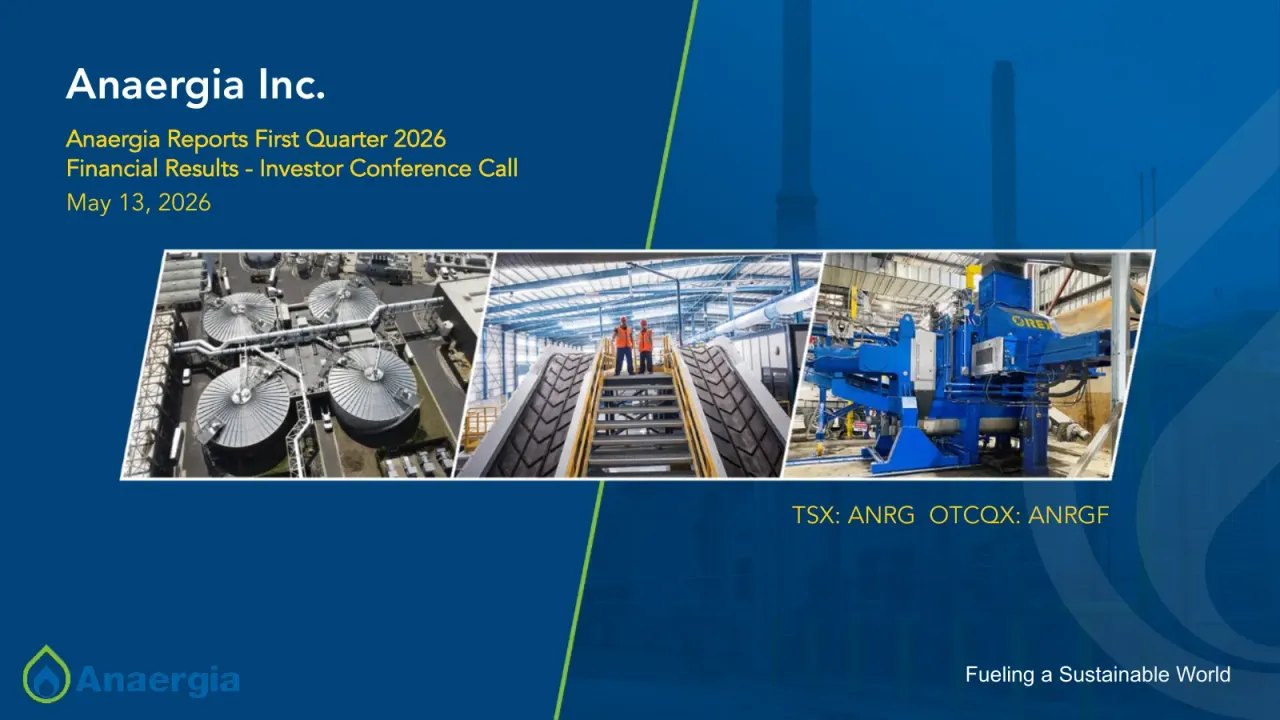
0:23 I will now hand the conference over to Darlene Webb, Investor Relations. Please go ahead. Thank you very much, operator, and good morning, everyone. On today's call, we'll be discussing Anaergia's earnings for the first quarter of twenty twenty six, which ended 03/31/2026. If you're following along with our slide deck, which is available here or on our live streaming webcast, or you can also access it directly from the investors section of our website, my comments relate specifically to slides one through three. On slide two, you'll see that on today's call, am joined by Mr. Asaf An, Anaergia's Chief Executive Officer Mr. Greg Wolfe, Anaergia's Chief Financial Officer and Doctor. Yaniv Sherson, Anaergia's Chief Operating Officer.
1:17 Before beginning our formal remarks, we would like to refer you to slide three of the presentation, which contains a caution on forward looking information and a note on the use of non GAAP measures. Listeners are reminded, as always, that today's discussion may contain forward looking statements that reflect current views with respect to future events. Any such statements are subject to risks and uncertainties that could cause actual results to differ materially from those anticipated in these forward looking statements. Anaergia does not undertake to update any forward looking statements except as may be required by applicable laws. Listeners are urged to review the full discussion of risk factors in the company's prospectus that is filed with the Canadian securities regulators.
2:05 You may now move on to slide four. And with that, I'll turn the call over to Asaf. Thank you, Darlene. Good morning, everyone. Thank you for joining us. We are now on slide five. I want to start with where Energia stands at the close of the first quarter. Almost two years ago, we shifted the company to a capital light business model. The model is built on a clear set of execution pillars, a focus on capital sales, a stronger balance sheet, operational efficiency, strategic partnerships, and geographic expansions.
2:51 In the first quarter of twenty twenty six, every one of those pillars is delivering. We are now on slide six. Total revenue grew 122% year over year. Gross profit grew 135%. Adjusted EBITDA was positive for the third consecutive quarter. And revenue backlog stood at $265,000,000 Greg will walk you through the financial detail.
3:27 Two items in Q1 marked important milestones for the company. We are now on slide seven. First, we entered the hydro treated vegetable oil market, a new vertical for Anaergia. HVO is renewable diesel made from waste, oils, and fats, and their potential is significant. Second, our SoCal BioMetane facility was approved as the first project to deliver under California SB fourteen forty, the state long term regulated procurement program. Yaniv will take you through both of these developments along with the rest of the operation.
4:15 The border environment is moving in our favor. We are now on slide eight. Demand for renewable natural gas is expanding across our key geographies as energy security becomes a dominant policy theme in Europe, North America, and Asia. That demand is coming from large private investors, corporate developers, and utilities in our largest markets, and regulators are reinforcing it with long term program. Slide. What's said in the GI part is our depth of intellectual property and experience, hundreds of active and pending patents, and hundreds of reference facilities across 18 countries.
5:12 Capital light, IP rich, backed by long term demand, that is Anaergia today. After Greg and Yaniv has completed their sections, I will return to discuss what comes next. Greg, over to you. Thank you, Asaf. Good morning, everyone. We are excited to report another quarter of continuous progress. As Asaf mentioned, Q1 was our third consecutive quarter of positive adjusted EBITDA. Let me take you through our financial results for the third three months ended 03/31/2026. Revenue for Q1 twenty twenty six was $55,200,000 an increase of 122% or $30,300,000 compared to $24,900,000 in Q1 twenty twenty five.
6:04 Growth was led by our capital sales business with continued strong performance from EMEA and North America, where we are seeing consistent demand and repeat business. Gross profit for Q1 twenty twenty six was $12,700,000 an increase of 135% from 5,400,000 in Q1 twenty twenty five. In the quarter, gross margins were 23%, an improvement from 21.7% in Q1 twenty twenty five. Improvement in year over year gross margin reflects the continued mix shift towards capital sales and O and M agreements.
6:43 I would note that our gross margins in Q1 twenty twenty six were impacted by approximately $2,000,000 as one of our build own operate assets, Rhode Island bioenergy facility continues to ramp up production since our plant reset late last year. Absent this plant's production ramp up process, our gross margins and our adjusted EBITDA margin would have been 3.6 percentage points higher. We expect steady operational improvements at this facility throughout the year. Yaniv will touch on our improved progress as well as the recently announced CI score approval for the facility, which will increase Rhode Island's top line revenue. With revenue more than doubling in the quarter compared to last year in the same period, our SG and A expenses substantially improved in Q1 twenty twenty six with a decrease of 18% or $3,100,000 to $14,100,000 compared to $17,200,000 in Q1 twenty twenty five.
7:42 We continue to run the business with discipline while ensuring we have the right structure to support growth. Turning to the bottom line. Net loss for Q1 twenty twenty six was $4,400,000 compared to a net loss $5,900,000 in Q1 twenty twenty five, a 26% improvement year over year. Q1 twenty twenty five benefited with a $6,000,000 grant income recognized. Excluding the $6,000,000 grant income recognized in Q1 twenty twenty five, the net loss improvement in Q1 twenty twenty six would be 7,500,000 period over period or a 63% improvement. Now moving to adjusted EBITDA. Adjusted EBITDA for Q1 twenty twenty six was positive $1,100,000 compared to a negative $3,900,000 in Q1 twenty twenty five.
8:34 That is an improvement of $5,000,000 or approximately 127% year over year. As I noted earlier, excluding the Rhode Island build own operate gross margin loss of approximately $2,000,000 adjusted EBITDA would have been 3,100,000 or a 5.6% adjusted EBITDA margin. This is the third consecutive quarter of positive adjusted EBITDA, and it reflects the consistency we said we were building toward. Turning to the revenue backlog on slide 12. During the first quarter, we signed over 54,000,000 in new contract awards across our key markets. Our new contract bookings, net of strong contract revenue execution in Q1 twenty twenty six, increased our revenue backlog from year end twenty twenty five to $265,000,000 at 03/31/2026.
9:27 This is also an increase of 32% compared to Q1 twenty twenty five revenue backlog. As a reminder, our revenue backlog rule is to include only signed contract work in our capital sales segments of the reporting as of the reporting date, and account conservatively only three years of long term O and M contracts, even though those contracts are typically five to fifteen years in duration. Beyond our existing backlog, we have a large pipeline of capital sales and other new opportunities across our key markets. As each individual project is signed, they will be moved to our backlog. Moving to the credit agreement. Subsequent to quarter end, we announced a $20,000,000 credit agreement with National Bank of Canada, with an accordion feature that can increase the facility up to $30,000,000 over the next year.
10:16 This facility strengthens our financial flexibility as we convert our growing revenue backlog through the P and L. We're now moving to Slide 13. We are proud of the accomplishments we have made to date. To summarize, Q1 reflects what the financial pillars of our strategy look like in execution. Capital sales driving revenue growth, operational efficiency increasing gross margins and reducing SG and A expense, our newly announced credit facility strengthening our financial flexibility, and we delivered our third consecutive quarter of positive adjusted EBITDA. With that, I'll turn it over to Yaniv. Yaniv? Thank you, Greg. I'll walk you through how the business performed operationally in the first quarter.
11:03 The strategy we set out nearly two years ago rests on a set of pillars: a focus on capital sales, a stronger balance sheet, operational efficiency, strategic partnerships, and geographic expansion. Greg has just walked you through how the financial pillars are showing up in our results. I will cover the operational side. Q1 produced four developments that show those pillars producing results in the field. Framework conversion is where our capital light model becomes most visible and is materializing in Spain. We signed our 184,000,000 Canadian Spanish framework agreement in 2025, covering more than 15 biomethane facilities. In January of this year, we begin activities on two of those facilities. And our Kona projects being developed with DIV Andalucia, a special purpose company developed renewable projects in South Spain.
11:53 Each facility will convert roughly a 100,000 tons per year of olive pumice and agricultural residue abundant in Southern Spain into renewable biomethane. These are the second and third projects under the framework with more behind them. Italy continues to deliver on two fronts. Our existing customer base is expanding scope on contracts already underway, and the broader market is being supported by sustained policy tailwinds. In March, we signed amendments to three previously announced contracts with QGM covering biomethane production facilities in Ostellato, Coparo and Dorovere in Northern Italy. And as a result of those amendments, our total contract value with QGM increased from $68,000,000 to $85,000,000 an increase of 17,000,000 Italy's National Recovery and Resilience Plan continues to support biogas project investments with fifteen year government backed tariffs and capital grants, and we're well positioned in that market through both QGM and our broader Italian customer base.
12:50 Moving to slide 15. In February, we entered into a contract with Sierra Evolution, short for Circular Renewable Evolution, first of its kind project, the gumming soil recovery. It's a 13,000,000 demonstration scale facility, and it represents our entry into an important adjacent market. The technical context matters here. Sierra Evolution is building BioRefinery to produce hydro treated vegetable oil, or HVO, a clean liquid fuel used in diesel aviation and other applications where high energy density is required. The HVO process produces a waste byproduct called degumming soil, a clay based material that's typically landfilled after external treatment. It's a problem the industry hasn't had a clean answer for.
13:35 Our system developed by our R and D team addresses that problem in two ways. It recovers and regenerates the degumming soil for reuse, which removes the disposal burden, and it produces renewable natural gas as a clean energy byproduct, which adds a revenue stream. Our scope includes our proprietary anaerobic digestion technology, along with our material handling systems, which are specifically engineered to handle materials with high dry matter content and high viscosity. That technical fit is what positioned us well for this contract.
14:03 This plant unlocks a new market segment for us. More than two fifty HVO plants operate globally today, and the market is projected to expand by more than 35% by 2030. It's a known industry with a known waste stream, and we have the right technology to address it. Our r and d team built that. In March, the California Public Utilities Commission conditionally approved the long term biomethane procurement contract between our SoCal biomethane facility, a new climate, and Southwest Gas Corporation. With this approval, our SoCal biomethane facility is set to be the first project to supply renewable natural gas under California's Senate Bill fourteen forty biomethane procurement program.
14:40 This is a significant milestone and the significance is structural, not just contractual. SB fourteen forty is the first state level RNG procurement mandate in The United States. It establishes requirement for California's investor owned utilities to procure RNG derived from landfill delivered organic waste at a scale equivalent to approximately 55 SoCal biomethane sized facilities by 2035. We're talking about a market opportunity of 55 more plants. That is a long term regulated demand signal and the largest gas market in North America. Our SoCal facility located in Victorville, California, processes up to 104,000 tons of organic waste annually and injects pipeline quality RNG into the natural gas grid. The California Public Utilities Commission approval validates our model of retrofitting existing wastewater infrastructure to scale RNG supply from organic waste.
15:31 ANRGIA is the first company approved to deliver under that model in California, and we expect many more to follow. Next slide.
15:38 I'll now turn to our build and operate platform consisting of five assets, the Rhode Island Bioenergy facility in Rhode Island, the Charlotte Bioenergy facility in North Carolina, and Soka BioMethane Mojave and Escondido Bioenergy facilities in California. The California assets continue to perform profitably. At Soka BioMethane, the SB fourteen forty approval I described earlier is a major development this quarter supporting long term profitability. At our Charlotte facility, the asset remains idle as we continue to assess the best path forward for that site. The Rhode Island Bioenergy facility continues stable operations, converting food waste across New England into renewable natural gas that is supplied to Irving Oil under a long term offtake agreement. The facility continued its ramp up in q one. Production has improved year over year, approaching our targets.
16:24 Recently, the facility's negative CI score was approved by the Environment and Climate Change Canada agency marking the first time a US plant
16:33 has been approved with a negative carbon intensity score. The the CI score will improve financial performance enabling monetization of carbon credits in the CFR program resulting in an approximate 30% increase in gas offtake price. Our focus going forward is on three things: operational improvements at the facility itself, feedstock management to ensure consistent input, and process optimization to maximize production.
16:57 We're seeing measurable progress in each. We expect performance to improve progressively throughout the year. RBF is an important asset, and our focus is on bringing it to its full operating potential. What ties these four developments together is that they're not isolated wins. They're evidence that the platform we built is doing what we designed it to do in markets where the conditions are now lining up to support it. Globally, RNG incentive programs continue to accelerate. Italy's National Recovery and Resilience Plan, The UK's Green Gas Support Scheme, Canada's clean fuel regulation, and
17:28 now California's SB fourteen forty. Each of these creates structural multiyear demand for the kind of RNG infrastructure we deliver, and the broader push for domestic energy security is reinforcing this policy direction in nearly every market we operate in. Capital sales is converting framework agreements into firm revenue, strategic partnerships are deepening into expanded multi project programs and reaching into new verticals. Geographic expansion is deepening our presence in Spain and Italy, our largest European markets, and operational efficiency is what's letting us deliver on all of that without expanding the cost base.
18:04 This strategy is demonstrating success, and we expect it to continue. With that, I'll turn it back to Asaf. Thank you, Yaniv, and thank you, Greg. We are now on Slide 18.
18:22 The first quarter of twenty twenty six marked our third quarter of positive adjusted EBITDA. Revenue grew 122%, capital sales grew 187%, our revenue backlog stand at two sixty five million dollars Those numbers tell you that the model is working, but what they do not tell you is what we plan to do with it. So let me speak to that. First, I want our shareholders to understand that Q1 will not be the high point. It is a step. The work we have signed, the contract in execution, and the project in the pipeline are larger than what we delivered in the quarter you just heard about.
19:11 We expect capital sales to continue. We expect backlog to continue to grow. We expect revenue to continue to build behind it. The model is repeatable. That is the point of a capital light model. You do it again and again and again.
19:33 Second, I want to underscore where the demand is coming from. It is not coming from one customer or one country. It is coming from large private investors, regulators, government, and utilities in our large market who are setting policy on the long term time zone.
19:55 That kind of demand does not turn on and off during a quarter. It compounds. We are positioned in every one of those markets with technology, with reference plans, and with execution team already on the ground. Third, I want to talk about discipline. Less than two years ago, we made hard decisions about what this company was going to be and what it was not going to be. We are still making those decisions. We are still focused on margin, on cash, and on every one of the pillars Greg, Yaniv, and I have walked you through this morning.
20:41 Nothing about that focus is going to change in the quarters ahead.
20:47 I want to thank our shareholders for staying with us through the work it took to get here. I want to thank our employees across the world for the quarter you delivered, and I want to thank our partners and our customers for the trust they have placed in this company.
21:09 We are not finished. We are not at the end. We are merely at the beginning. Darlene, over for you for questions.
21:24 Thank you, Asaf. Operator, we may now open the call to questions. Thank you. We will now begin the question and answer session. If you would like to ask a question, please raise your hand now.
21:52 Your first question comes from the line of An Li with National Bank. Your line is open. Please go ahead. Hi. Good morning. Thank you. This is Anaergia Inc. On for Valtteri Saidu at National Bank. Thanks for taking my questions. So maybe just a two part question on capital sales revenue cadence. Given the better than expected execution in Q1, could you help us frame how much of the revenue outperformance
22:21 reflected perhaps like accelerated project timings versus more steady step up in execution capacity? And two, as we think about the remainder of the year, how should we think about the quarterly cadence of ABAP conversion, particularly across the largest European projects currently underway?
22:45 Andy, do you want to take it? Yeah. I think we're well, well, you know, what the numbers that Greg has gone over is showing that our backlog continues to grow, and we're seeing, you know, continued continued cadence of bookings year over year. We have intra intra quarter shifts with timing maybe shifting from one quarter to the next. But generally speaking, the trend we've we've seen consistently year over year is a substantial increase in in backlog as we compare '24 to '25 and now entering into '26. As far as as far as our recognition, most of our projects are
23:25 a year and a half to two years of execution to fully deliver Yep. For the most part. And within our O and M segment, as noted before, we're we're accounting for three years of backlog in our in our figures, although those operating contracts tend to be typically much longer in duration, five, ten years or longer. Mhmm. Okay. No. Thank you. That's helpful. And I just wanna ask a couple of follow ups too. On the O and M service side of things, revenue was down modestly year over year
23:58 due to lower field service activity in North America as reported. Could you help us understand understand whether that stop net was primarily timing related in nature or reflective of resources being redeployed to largest capital sales execution opportunities?
24:18 And as we think about balance of 2026, do you still expect the o and m business to resume to a more stable growth trajectory? Yeah. Absolutely. The the o and m business will still remain a a pillar of our revenue growth as we move forward. You know, the shifts in the figures are adjustments in sizing, mostly timing related. Mhmm. In our in our capital light strategy, we are shifting risk out of our operating agreements. And as a result, there's variability. Some of our agreements we have, you know, pass through costs are a cost plus situation. And so there may be shifts in revenue that may go down and over a quarter to quarter, but that's simply a timing matter on what expenses hit and passing through costs up to our customers.
25:09 The laser focus going forward is our capital sales. The majority of our revenue is driven by the capital sales segment, which is the engine to our business. And our operating agreements, we are working on growing that in the future. It's often an an add on service to clients who purchase a system from us and would like to maintain a long term relationship with
25:31 us involved either through service or operations. And so a number of our clients that we're working with now, we anticipate having incremental operating contracts, again, in an asset light model where we're we're not assuming commodity or volatility risk in our agreements. Mhmm. No. Thanks, Sandra. Yeah. I I guess I would just I would just note that, you know, as we continue the capital sales and we're growing that faster than any other segment that we have, The O and M side of the business, as you as your question was around, will continue to grow as well as we complete projects. You know, the demand for us to do O and M at the end of the project cycle is there. So we expect that to continue to grow. But as a percentage of our total, because cap sales is so much larger and growing so much faster, it will continue to grow as a segment of an overall business and profitably.
26:21 It's just the cap sales is just gonna grow a lot faster in the next several years.
26:27 Thank you. That's very helpful. And lastly, congrats on the news yesterday with the the Canadian CRB negative CI approval for the Rhode Island facility. Could you discuss how meaningful that could become from a monetization perspective all times? Like, should we think about that primarily as margin enhancement opportunity for the BOL segment, or could it be potentially influence how you approach a future RNG asset development more broadly? Well, more broadly speaking, it's a validation and market advantage that we bring to our clients, even if clients that are a capital sale client where we won't be owning the assets, a number of our clients are monetizing or basing their pro formas off CFR participation.
27:21 And the expertise that we have by being, as mentioned, the first US facility to achieve a negative CI score is value add to our clients to assist them with navigating the regulatory process and participating and monetizing in that program to an optimal level. What it does mean for the asset is a top line revenue enhancement. The facility can now participate in monetizing CFR credits. It's a challenging market to get a CI score approved under. The regulatory timeline is long. And so this is really a breakthrough moment through what's been a very challenging and long process for review and approval. Financially, you know, the price will be variable as carbon prices are shifting in that market, although, quite high.
28:11 But we anticipate a roughly 30% increase in the gas sale price, as a result, and further enhancements in the future as we convert to, permanent CI score as the next round. That's awesome. Thank you. I appreciate the color. I'll jump back to the queue. Your next question comes from the line of Craig Irwin with Roth Capital Partners. Your line is open. Please go ahead. Hey, guys. It's Andrew on for Craig. Congrats on the strong results, and thanks for taking my questions. So the first one for me is great to see adjusted EBITDA positive again, I think, for the third consecutive quarter. As you guys kind of continue to scale in the business, can you talk about where you guys see areas where you can continue to drive operating leverage, whether it may be continued reductions in SG and A or margin improvements or maybe elsewhere?
29:10 Greg? Yeah. I would say for us, you know, we continue to look at projects on our capital sales business. We have a obviously, a a very, very nice margins in our capital sales business and our o and m business. I think we'll see some continued advantage as noted in the release, you know, as we get our build, own operate facilities such as Rhode Island, the other build, own operates are profitable, good facilities, and Rhode Island is a great facility as well. And as Yunid mentioned, we have now the CI score. Obviously that was a drag on our margin and our EBITDA for this quarter, but we look as the remaining of the year runs out, that's gonna be an improvement in both gross margin percentages and adjusted EBITDA for us. So that's an area that we are definitely focused on making sure that that gets turned around for the as the year continues on. And so that's gonna be a margin enhancement for us. But, you know, the market, because of our our technology platform, we have a lot of leverage in the market. We are the leader in this space.
30:10 Our clients come to us because we know how to get it done. We've been doing it for two decades, and, you know, we continue to, you know, execute the projects at the margins that we go out at. And we certainly have a lot of opportunities to grow the top line. And SG and A being down to, you know, as we continue to look at SG and A, lowering the cost there as much as we possibly can, but as we grow the top line to different levels, everything's gonna be falling to the bottom line from a gross margin perspective, I guess, is the way I would think about it. Great. Appreciate the detail there. And then second one for me. I saw the IWMF project in, Singapore is, 80% complete now. Can you just kind of talk about what it'll take to get that project across the finish line? And then secondly, once the project is completed, does that kind of open up doors to new relationships and other projects within the region?
31:10 Yeah. Absolutely. The the the project is continuing to execute per plan. It's a, you know, it's a large contract with a multiyear execution timeline. And so we're continuing to progress execution per plan on schedule and per budget as executed originally. The significance of the site is material for us. The client is a globally recognized top tier utility and this will be, you know, the largest facility in Singapore of its kind. So the association and having the reference with the PUBs is going to bring a lot of attention. And clearly having successful reference with top clients is a key establishment of trust and confidence in converting our pipeline and other clients to make selections to go with our technical solutions. So we anticipate it to be a tailwind and a motivator unlocking more of our municipal pipeline in Asia and to help accelerate other projects to a go with successful model.
32:23 Great. Well, thanks for taking my questions, and congrats on the continued progress. Your next question comes from the line of Donagello Volpe with Beacon Securities. Hey, good morning, guys. Congratulations on the quarter and receiving that negative carbon intensity score for the Rhode Island facility. I guess just looking for a little bit more granularity here, understanding that the facility is progressing through operational ramp up.
33:12 What's the expected time line for full ramp up? I guess if we could quantify it on a quarterly basis. And then when we can expect positive contribution to the overall earnings profile? We we're continuing to work on the improvements in the plant, mostly on the feedstock side, which has been improving on a consistent basis annually. We have a goal to be able to hit profitability by year end. Part of this is gonna be timing with, you know, enhanced credit monetization, some government incentives as well that we're working on on the federal level domestically in The US and working with our feedstock suppliers to sort of optimize the mix going forward. So we're executing very focused on this plan, make the plan contribute around the end of the year is our is our target and our goal, and we expect to have improvements quarter over quarter towards that mark.
34:22 Okay. And then just looking at the O and side of things, I'm just wondering if there's kind of a lag from the capital sales because we've seen capital sales growing significantly. I'm just wondering how we should look at O and M moving forward if we treat it kind of as like a year lag to the rising capital sales? That that's about right. I mean, the you know, the o and m start after the cap sales complete. So we we may have a commitment with an o and m contract, but revenue contribution from that o and m won't won't start until the operations start, right, when we're done building the plant. So, typically, a year and a half to two years to, build a plant, then that's when the O and M contribution initiates.
35:10 So that's probably the best way to think about the sequence and timing. Okay, perfect. Thank you. And then final one for me. Just looking at the cash sitting at about $22,000,000 excluding the restricted cash. Just wondering what some of your minimum liquidity targets are and what the expected usage should be over the next few quarters? Yeah. Dan Angelo, we don't give guidance on that. But clearly, you know, we're a growing business quite substantially, and we expect to continue to grow throughout the year, both in the both in revenues and our backlog. So as we move forward, you know, operationally, we now have have the new line of credit. And so I think that's a very strategic for us to have that in place for flexibility, for financial flexibility.
36:00 But from a cash basis, I think we'll continue to run and run around these areas that it's been at in the past. And so, you know, and keeping everything as tight as possible, we obviously are laser focused on collections, laser focused on operations, and all of our projects are cash flow positive from day one throughout the duration of the project. So I would just note that we are very comfortable in the position where we're at today and on a forward basis. Okay. Great. Thanks for answering my questions. I'll hop back in the Your next question comes from the line of Poe Fratt with Alliance Global Partners.
37:01 I had two questions. One is on the backlog. What do you expect to realize or burn off in the backlog? You know, that two sixty five, what do you think you're burn off for the rest of the year? You know, there's well, there's different different projects are in there, of course, different different timing when we signed it. Right? So it's not an exact science to say it take x number of months over, divided by the backlog, right? Certain projects are in the middle stages, which our work is more aggressively occurring on the beginning and the end of the projects. It's a ramp up and ramp down is what you have in project and construction work and contract work.
37:48 But that said, we expect this year, not with any- we're not giving any guidance, but we expect obviously year over year growth in revenue and year over year growth in backlog on a full year basis. So take it- take it as it is, but we will- that means that our sale- our sales have to be continue to be strong, which we expect, and and what we know we have in our pipeline, and our execution has to be there as well. Q one is typically seasonally a little bit slower in the revenue side just because of weather weather constraints in some areas, but we expect the year to continue to ramp up and be be ahead of the, you know, the past. So, that's what I would. Great. That's helpful. And then could you talk about your pipeline?
38:39 You know, the pipeline numbers are just, at least in the presentations I've looked at are are, you know, huge to as probably an understatement. Can you talk about the pipeline in the context of what you think might be decided or move forward in 2026, maybe 2027? I mean, we talking about potential projects in the $500,000,000 range or in total? Or if you could just give me some framing on what how you're looking at that pipeline? Our pipeline is big. And what we put in the pipeline is I'll give you an example. We have signed 16 contracts with NORGAS, the gas company of Spain, and we are working on one. So one is a backlog and the other 15 is in the pipeline. So it is a committed pipeline. Our majority of the pipeline is committed.
39:38 So we see us, going through the pipeline within the next twenty four to thirty two months. And I guess I may have missed it. What is your current pipeline then? Again, our pipeline is quite big. We we have $265,000,000 of backlog, and we have around $1,000,000,000 of a pipeline. Okay, thank you. There appears to be no further Thank you, operator.
40:25 And as always, thank you, everyone, for joining us on the call today. For additional information or should you have any further questions, please do not hesitate to contact the IR team at iranergia dot com or visit us online at anergia.com. Thank you all again for your time today. Operator, you may now end the call. This concludes today's call. Thank you for attending. You may now disconnect.
Follow Anaergia, Inc. into a list and get an email when it puts out news.
Investor Relations
Chief Executive Officer at Anaergia
Chief Financial Officer at Anaergia
Chief Operating Officer at Anaergia
at National Bank
at Roth Capital Partners
at Beacon Securities
at Alliance Global Partners