Transcript
Automated transcript · Written by software from the replay's audio. It can mishear names and figures; the replay is the record.
0:03 Yeah, GFG was set up out of management of Xclode Resources and we established it 4 years ago to be a district scale explorer. So essentially we sold Clode into SSR, a very good transaction where our team was management executive and board as well. And we took that team and board into a private ghost structure called GFG and we took that public 4 years ago. We set ourselves up to be a district sales floor. We've been operating in Wyoming and in Timmins for the last 4 years. We would trade on the TSX. We have about 4.5 million dollars cash in the bank and about 103 million shares outstanding. When you think about gold exploration, the industry is quite challenged in that there are a lack of relevant new discoveries.
0:53 And this has been ongoing for the last decade or so. And when you look at those that are being successful, they're doing things quite differently. They're looking undercover, they're looking different places, they're using different technology. So I think when you think about GFG and the team we have, we have a good track record of finding mines. We've operated them, we've got a good solid base to build on and we are major landholders with 2 key belts. So our goal is really to solve the challenge of the exploration industry, which is finding new ore deposits. And in order to do that, I believe You have to have an appetite to take risks, but an appetite to explore how to do things differently in an industry that's been challenged to continue to yield relevant discoveries.
1:43 So I'm optimistic that GFG is one of those companies that will succeed in finding the relevant new gold deposits in the future. And that's really what we're focused on.
1:57 Yeah, when you look at our exploration philosophy, the initial step we've taken is consolidating large belts. And it's all designed with a mindset to say, if we want to find something new, we need to look in terrains that are well endowed, we need to look in terrains that have yielded relevant discovery, and we need to look in terrains that we feel still hold deposits that are mineable depth and haven't been looked at. And that's why we're focused where we are in Timmins and it's why we're focused where we are in the United States and Wyoming. So our philosophy is to put these belts together, do a lot of surface exploration. We're looking at the tills. We're looking at lots of geophysics. We're doing modeling. And we're using a multi-layered exploration technique. But our first step is to look geochemically at the tills, which is essentially a reflective bedrock and the amount of gold in the bedrock.
2:45 And what we found is large-scale till anomalies. And that's guiding our exploration philosophy. In Timmins, it's guiding us to focus in on an area that might be 3 by 3 kilometers. And within that area, we know there should be something of relevant size. And then we've got something to really focus on in a defined area. And then we're looking at detailed geophysics, more detailed geochemistry, model-driven exploration, and ultimately drill testing that target. So when you look at GFG, we've taken a couple of years, we're putting the belt together, We've taken these initial steps in terms of exploration philosophy of putting the tilt together, putting the geophysics and now we're executing the detailed drill program to drive discovery. So, I think that's why GFG is set up quite well and it's really been part of the game plan right from the outset.
3:34 Well, look, I mean, we work in an exploration space and discovery is always exciting. So what excites me is really about the targets and the caliber of things we have to go into in 2021. We're waiting for a number of results here. We think there's some really interesting material, at least visually, we've seen assays always speak, the lab speaks and the mill speaks. And so we've got to get those assays back and think about what they mean for the program in 2021. So I'm excited to get back out here and test targets like R66 in Slate Rock in 2021. I'm telling the team when we look at some of these targets, they're the best targets we have. R66 looks better than anything we've drilled tested historically. At the stage it's at, never been drilled. There's up to 2 ounce per ton in surface. It's a shear-hosted vein system, an omephic, alternative contact completely underneath cover, open along strike under that cover.
4:26 So it's a really compelling target. So what am I most excited about? It's going into 2021 and getting back out here and field testing, getting the remainder of the results back, pushing ahead at Rattlesnake and having a balance sheet that allows us. And I think we all can see gold has a really bright time. It's in the limelight here. I think there's good runway yet as a commodity as a whole. And I think you're in a supportive sector for the long term here. And I'm happy to be in gold, happy to be in precious metals. I'm happy to be in timmings with the drill bit that's going to be turning right away next year. In 2021, we plan to continue with an aggressive program in Titton's. And if you look at our timeframe in which we've explored this belt, we've been here for about 2.5 years.
5:14 The end of this, we'll drill their own 20,000 meters in 2020. And we plan to step out here in 2021 again, aggressively. Likely a similar magnitude budget to this year, so we're looking at 3 plus or minus million dollars in the ground. I feel that there are a number of targets that we've identified that are high quality and drill ready in the western part of the land position. Those are largely winter based targets, either off ice or off swamp, and we're gonna prioritize those things like Slate Rock and R66. And we're gonna be drilling those in Q1. And then we have the eastern part of our land position where we've executed a program right now. We released the results, some initial results today, including a new discovery from Sewell North and some interesting results from HGM and Nib. And I truly think we're gonna be back drilling a number of those targets as well in Q1. So we'll take a balanced approach across our property, probably looking at a negative budget of plus or minus $3 million on the ground.
6:13 The rig will be starting in January. We have assays in the lab right now where we're waiting and pending 20 holes. So I think there's a good catalyst rich period ahead where you're looking at GFG continuing to push, continuing to test new targets on the West flank of those. And some of those never seen drilling before. The other ones we know the system's working quite well and now we're trying to hone in the details of those systems and that's an example of something like that would be the Slater Rock target. That's generally our plans for 2021 in Timmins.
6:44 It stems from, as I talked about previously, which is putting this large belt together. But if you think of the greater Timmins area, the mindset of the understanding of the camp was always that the metagony fault defined the west end of the camp. And in the 2000s, that was disproved by a company called Lakeshore Gold. And my chairman at the time, Brian Booth, was part of the group that discovered Timmins West Mine, and really that proved the geology and continuity of gold mineralization going west. We put a block together that's about 55 kilometers along strike and about 500 square kilometers. So a very, very large land position. And essentially we took an entire greenstone belt and said, we really feel there's a couple of mines to be found in there. And we want to put our finger on that entire belt before we start looking.
7:34 And we want to apply a belt scale exploration philosophy to explore that. And so that's why we put such a large belt together. A, because it meshes with our philosophy. B, because you feel fully understanding that the endowment should be there, but also that at that point we're still learning a lot about the belt. So we still have to understand detailed intricacies of what we'll figure out in the next 2 years when we took this belt and put it together. So ultimately we wanted to put a very large line position together. We have bought Newmont on one side, we have bought Pan American on the other side. So we're sandwiched between 2 very major precious metal producers and we wanted exposure to that entire belt and that's why we went and took this whole belt under our control.
8:26 When you look at all these belts, and you can take Timmins, You can take Kirkland Lake, you can take Val d'Or, you can take Red Lake. They are all becoming more and more consolidated with each year that goes along. And when you look at Timmins, it's been a good example of that. You've got continued consolidation of the majors controlling vast land positions. Cote, Iron Gold, Borden and Timmins Proper, or mean Timmins Camp would be Newmont, Pan American Silver. So you have 3 major control players and you have Alamos there that has 2 mines on both sides of us. So what you're seeing is a continued theme of consolidation. That's probably why GFG did what it did. We felt we wanted a big tractor ground to apply some new technologies and mindsets towards us.
9:14 The infrastructure piece is really key. And that is a major advancement for the Timmins camp. IM Gold's gonna spend 1 billion dollars in the next 2 years building Cote. It is the biggest mill in the camp and it borders our Dore block by about 10 kilometers. So those pieces of infrastructure are key for continued camp health, continued camp production growth and commitment to the majors that are already there. So when you look at our neighbors, you're looking at Newmont, Pan American, Alamos and IM Gold. And GFT is sandwiched between all those with the largest land position outside of Newmont. So I think we're in a very good position and I believe Timmins is going to continue to yield discovery going forward because of the characteristics of the cover, the characteristics of the style of mineralization And those all ultimately go to the thesis of why GFT went there to start with.
10:05 I think Timmon's got a really bright future from an infrastructure, from a discovery and from a profit profitability perspective. I think that drives discoveries will be acquired if you're working in those belts. I mean Alamos is a mid-tier and a very healthy and well-driven, well-managed, mid-tier gold organization. Operating minds on both sides of us, focused in Mexico and Canada. When you look at many of these companies, the balance sheet is exceptionally healthy. They're well managed. They've got somewhat of an internal organic growth platform. But they also have to look at how they grow their organization and how they leverage their infrastructure.
10:51 And here's a good example where you've got a very seasoned mid-tier gold producer that surrounds us with infrastructure. They're showing a commitment to this belt and they're showing a commitment to the GFG management in our process. So we have had dialogue with Alamos over a couple years, we've built a solid relationship, we have a keen understanding of their team and they understand what they get with GFG. So we were happy to have them as a shareholder. They're committed to the belt, they're infrastructure holders, they believe in our path and our people and at present they're our biggest shareholder at 9.9% and I think that's a stamp of credibility on the company and we're happy to keep them happy to have them and happy to work with them as we unlock the next discovery in Timmins.
11:42 Dory is a block of ground it's about 220 square kilometers It sits 30 or 40 kilometers south of our main Penn Block, so it's still in Timmins, Greater Toones area. It almost starts within 5 kilometers of the border in the IM Gold Block and Crown, which controls and hosts the Koje deposit, which is in construction at present. Dory is an earlier stage project. We haven't put as much dollars into the ground. We've been very focused on the northerly of our 2 blocks, which is the Penn block. I think Dory is a good opportunity that GFG has that hasn't focused much on it yet. It's an earlier stage 1. We'll look at 2021 about what the right path is. I think there's a few avenues to leverage that land position and we're currently in dialogue on a number of those and seeing how we can plan it. We'll continue to stay focused on Penn and we're reviewing a few options for Dory that could come to fruition in 2021.
12:42 Yeah, Rattlesnake Hills is a very interesting project. It has about $45 million in the ground US and about 100,000 meters of drilling. So it is not an early stage project. That being said, it's a very large land position. So there's a couple deposits, Norrstok and Lopasin, scoped to grow those in the regional land position. We were recently in joint venture partnership with Newcrest, and Newcrest focused on drilling some very deep Newcrest-sized targets, which is 10, 20 million ounce plus savings. And we didn't have success at those. We found porphyries at depth and mineralization, but they weren't at the caliber that met the Newcrest threshold. So they turned it back to us. So GFT has undertaken a strategic review of this asset. We're in dialogue with a number of groups at present. We have been for the last 6 months. And we'll continue to push to find the right asset and the right path for this asset.
13:31 It's a heat bleachable, you know, I think there's million plus ounce potential at sort of 0.5 gram, 0.7 gram material and we're keen to find the right path to advance this asset. So for GFG, it's focused on the business development aspect for that asset, finding the right home for it. Our dollars will continue to be committed to the in the ground expenditures in Timmins, and we'll advance Rattlesnake towards finding an appropriate path. And the challenge with Rattlesnake is, probably takes 4 or 5 million US a year to materially advance this project. And for us to fund both projects at present is certainly a challenge. So we're choosing to focus on the Timmins and we're choosing to look at alternative those paths for Rattlesnake. COVID hasn't been easy to enter business development transactions. Due diligence is a challenge and that has slowed this process and is certainly hampering it at present right now.
14:24 But we continue to push on that and I'm optimistic that 2021 will have GFG find an appropriate path to take Rattlesnake forward with.
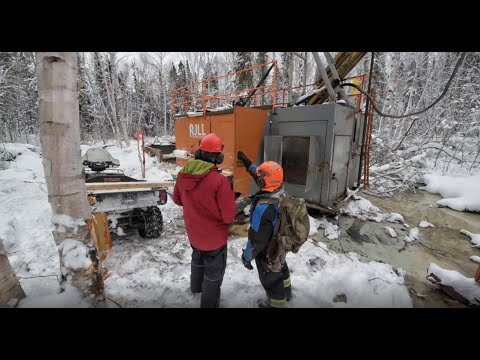
14:37 Yeah, GFD has been drilling in timmins for the last, really since the end of August. And what we announced this morning on December 17th was that we published the results from 9 holes of a 30-hole program. So this program has been ongoing for the last several months. Assays are slow, but we eventually got a basket that was reasonable enough that we felt like we wanted to put something out, And really we talked to the market about wanting to put results out prior to Christmas. And then we wanted to follow through and do what we said we'd do. So we put out a release today that included 9 holes of the 30. It outlined a new discovery at North Sewell, which had some really interesting veining, very shallow depths, new target, open long strike. We have 2 follow-up holes we've built on that target and assays are pending on those and I believe we'll be back at that target in 2021 Q1 as well.
15:30 We published a couple of results on the HGM target, which is one that has seen historic drilling by TFG. We tested down plunge of those. We confirmed the sort of stacked nature of the mineralization. Grades kind of peaked out at 2-3 grams on individual samples, composites which were 2-3-4 meters wide. So I think I would call them modest successes. No high grade there that we've seen so far. System remains open and we've got to really think about where we take that target next. The third target we put out some results on was NIB. NIB was a very high-grade discovery of TFT from Q1 of this year where we returned 71 grams rate in 0.5 meters. So what we did with NIB was we followed up with 4 holes. In this release we put 2 holes out. These were the down dip extension holes on 25 and 50 meters.
16:19 What we found was that veining was pretty weakly developed in those holes and only present in the bottom half. So we didn't find the extension of the real hydrate, but we did find continuity of veins and depths. So we're learning more about this system, we're understanding that these are likely tension vein arrays, and we've got to review the results when we get the remaining holes back and think about how we take this target next. We have assays pending on 2 other holes, which are 50-meter step-outs on either side of the high grade. And when we get all those assays back in Q1 of next year, we'll think about what do we want to do next with this target. So I would say a little disappointed in what we've seen so far on that target, but we've got to learn more, we've got to think about what the next step is for that. And we still have a number of assays pending on that target. So overall what we announced today was 9 holes out of 30, 20 assays pending, those results will come out in Q1 and then we're going to start drilling again at that time frame in Timmins.
17:15 Look, it's something we all think about. We work in this space. There's no shortage of information in this information-rich world that we live in. Much of it's speculation. But when we look at operating business, And I think that's what you have to do at GAS. We're in risk business, risk reward. And what I think about it is the gold space is at an all time high. And we have to recognize that there's downside risk. That being said, It has never probably been more compelling as an investment thesis. And the rationale to own gold has never been stronger. There's never been so much debt in the world. There's never been so much challenge. There's never been so many introvert companies, countries that are really just looking internally, not externally.
18:01 And What that means is that it's going to be challenging to grow the global economy. And lots of protectionists, weaker US dollar, I think these fundamentals all stack up to mean gold should stay relatively strongly. It does have significant upside from here. And those components drive into our business model. We're at the front end of the gold space. We're trying to make the next relevant gold discovery. And I think we're working in a market that needs groups and teams like us. And I had a conversation the other day, is the world wants Margol, it needs Margol. And here's a company that's going out to solve that challenge that we have.