Transcript
Automated transcript · Written by software from the replay's audio. It can mishear names and figures; the replay is the record.
0:08 Hello and welcome to Amarillo's first quarterly corporate update. My name is Anne-Marie Brissenden and I'm the head of Investor Relations for Amarillo Gold Corporation. This investor summit is part of our new strategy to communicate more regularly with our shareholders and other stakeholders. It follows on the launch of our new website and renewal of our social media channels, as well as the start of a concerted marketing effort to raise our profile among a broader group of shareholders. Our speakers today are Mike Muechler, President and CEO, M.Saw CFO and Arau Portugal Country Manager. Please note that we will make forward-looking statements and refer to non-IFRS financial measures during this webcast. For full details, please refer to our financial statements, which are available on our website www.amarillagould.com and under our profile on CDER.
1:04 All dollar amounts are in Canadian dollars unless otherwise noted. We are also recording this webcast and the recording will be posted to our website. You are welcome to put questions in the chat function of the platform and we will answer them during our Q&A session. I'd now like to turn it over to Mike.
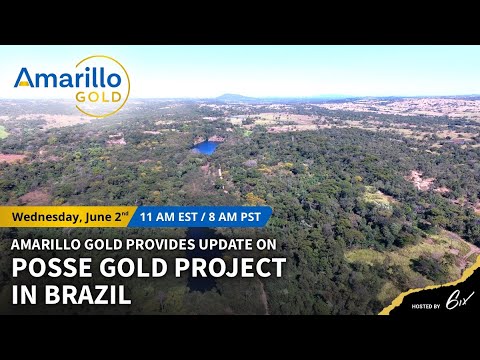
1:22 Thanks Ann Marie. Thank you for taking the time to join us on this webcast. We have an ambitious agenda today and we'll provide a corporate overview, an update on the financing for our flagship asset, the POSE Gold Project, a review of our progress on developing POSE, an overview of how we're enhancing and maintaining our social license to operate in Brazil, and an exploration update for Mara Rosa. As you'll hear, we are developing 2 projects in Brazil. However, today we will focus on our Maraossa property, which hosts the Posay Gold project. We have a clear goal to leverage Posay to become a mid-tier gold producer in Brazil. We expect that it will be producing gold within 24 months of making a construction decision. Our second project, Labras do Sur, is in the south.
2:09 In the exploration stage, it has the potential to be a district scale. Labras has 22,000 hectares of exploration concessions and historic gold workings that date to the 1700s. With multiple anomalies over multiple kilometers, our goal at Labras is to open a second development front. Our focus will be on Mara Rosa today, as we plan to have an update on Labrors for you in the coming months. Neither of our projects are in the rain for us, but in areas where there is a long history of local mining. It is one of the reasons we like Brazil, is that a mining friendly jurisdiction with vast mineral wealth. And our team has a lot of experience with a strong social license to operate there. Our board of directors includes Antonor Silva, who co-founded Yamana Gold and was instrumental in bringing several of Yamana's Brazilian gold mines into production.
3:00 We also have David Lang, who led the rebuilding of the Arizona mine in Brazil for Equinox Gold. And I'm a fifth-generation miner who helped to build the Vanadium mine and mill as COO for Largo Resources, and I was the project director for Kinross Gold's Percatum Mill expansion. Both of these operations are in Brazil. In addition to a robust project pipeline and an experienced board of directors, we also have a strong cash position and supportive shareholders. Amarillo's 2 largest shareholders are Baccarat Trade Investment, which owns 19.95% and Eric Sprott, a well-known Canadian mining financier who owns 17.9%. Board of Management hold about 6%. We are covered by Stuart McDougall at Research Capital Corporation and Justin Chan at Sprott Equity Research.
3:49 Trading at around 33 cents with a market cap of a little over $126 million, we believe we are significantly undervalued and due for a re-rating as we deliver on our strategy. That's why we believe that now is the right time to invest in Amarillo Gold. With a low valuation relative to other gold developers and 41 million in Treasury, we have enough cash to meet our short-term goals while we raise additional funds to get into production. Let's talk a little bit about Posey, which as you'll see is highly leveraged to the gold price. Posey sits on our Mara Rosa property in the state of Goyaz. Mara Rosa has 2500 hectares of mining concessions and 65,000 hectares of exploration concessions, 6,000 of which are along the Post City structural trend. This is a brownfield site that was previously produced gold under a different operator in the 1990s.
4:40 The property contains a small pit from this previous operation. We are well south of the Amazon rainforest and far away from any Indigenous lands. Boce is surrounded by excellent infrastructure including access, service roads and sources of water. There's access to power although we plan to build a 67 kilometer, 138 KB power line through the mine site. The nearby town of Maraossa has a population of approximately 10,000, so we have immediate access to a local labor force, eliminating the need for camp operations. I'd like to turn it over to Hemdat, our CFO, who will talk about our financial models and give an update on our financing. M. Dat has extensive experience working for developing and producing gold companies.
5:26 He has been the CFO for Westone, Scorpio and Gold Belt among others. He also spent 16 years at Grand Thornton, culminating his principal, focused largely on publicly listed mining companies. Mdat. Thanks Mike. Last June, we published a positive feasibility study which showed that Posse will be a low-cost operator with high returns. The chart at the top right shows that using a base case of $1,400 gold and an exchange rate of 4.2 to 1 Riyais to CAD, Posse shows an after-tax NPV5 of $183 million, an average annual EBITDA of 64 million over the first 4 years of commercial production, as indicated at the chart in the upper middle of the slide.
6:20 The NPV increases almost twofold, at 360 million using a gold price of 1730. The chart on the upper left shows that we'll be able to produce gold at an all-in sustaining cost of $738 per ounce US. That means we're still profitable at lower gold prices. In the table Below, at the fourth row, we show average annual production of approximately 102,000 ounces in the first 4 years of commercial production. The next row indicates that the average production over the 10-year life of mine works out to about 8,000 to 4,000 ounces. These positive production statistics are the result of Posse benefiting from higher grade and therefore higher gold production in the earlier years, resulting in a quick payback.
7:20 Posse is highly leveraged for the price of gold. So a 10% increase in the price of gold generates a 30% increase in the after-tax NPV5. That means we're shielded from low gold prices, even as we're poised to benefit from high ones.
7:41 We're also developing Posse in a favorable FX environment. With over 60% of our costs based in REIS, we are not at an opportune moment to build POSSE. The NPV 5 increases from $183 million to $223 million, And the IRR increases from 25% to 33% if you change the FX from 4.2, as used in the feasibility study, to 5.0, which is more realistic relative to current and forecasted FX. Our capital costs are equally favorable. The total capital cost of Posse over the life of mine is estimated at $166 million.
8:29 That's based on an initial mine life of 10 years before any growth from exploration. So we're looking to raise approximately 140 to 150 million until production. We believe this is an appropriate amount, given the valuation of our reserves and resources. If we use POSSE's reserves and resources of 1.2 million gold ounces, that's a value of approximately $2 billion using a gold price of $1,700 per ounce. That works out to an asset value that's more than 10 times the amount of the secure debt that we're planning to raise. Last year, we signed an exclusivity arrangement with an established financier to provide this financing and began the due diligence process.
9:18 This included significant technical due diligence, which raised no red flags, but which took longer than we anticipated. In the interim, we advanced the project and de-risked it considerably. We received the license to install, signed an agreement to build a power line, and began detailed engineering. That's why we decided to allow the exclusivity to expire. We believe we might get better terms than we originally contemplated and are reconsidering the terms from the original finance share. We want to find the best construction financing option for our shareholders. While it's difficult to predict how long this process will take, with $41 million in cash in the bank, we think it's prudent to investigate all financing options while continuing to develop Posse.
10:10 I'd now like to turn it back to Mike, who will talk some more about some of our accomplishments at Posse since the new year. Thanks, Hemdet. This slide summarizes our key development milestones. As you can see, our next big hurdle is raising the balance of the construction financing for Posse. Once we have that in place, we'll make a construction decision and start building. We anticipate that it will take approximately 2 years to build Posey from decision to commissioning.
10:38 As Hemdap mentioned, our strategy is to spend what's necessary to keep Posey on schedule while minimizing our financial exposure until we secure full construction financing. So far we've acquired 85% of the land for the project area. We expect to require the balance of the cup in the coming months. We've also completed 37% of the overall detailed engineering for the project, including 91% of the early works detailed engineering. The balance of the engineering is mostly dependent on buying major equipment that will be purchased as project financing allows. We've begun design engineering for the water dam, waste piles, and low-grade ore stockpile. And we're planning on purchasing vendor drawings for the ball mills, filtration plant, and elution circuit to advance the detailed engineering.
11:30 Finally, since signing the agreement to build a dedicated power line from Perenga II to Mara Rosa in January, we've completed the engineering and acquired 70% of the land. The technical analysis and engineering for the main substation is complete and supplies have been purchased. Installation on the substation is expected shortly. I'm now going to turn it over to our country manager, Arau Portugal, who is going to give an update on our extensive community outreach strategy, as well as an update on the COVID situation in Brazil. Arau has over 40 years of diverse mining and mineral processing experience in South America. He spent over 10 years at Yamana, where he was part of the team that built the company into what it is today. Arau is instrumental in starting 8 gold projects in Brazil for Yamana, including 2 near Maraossa.
12:19 Raul?
12:23 Thanks, Mike. We take our responsibility to our community very serious and have worked hard to build our social license to operate. Gold has been mined in Brazil for centuries and today represents 11% of the country's mineral production, second only to iron ore. Which mining make up such a critical part of Brazil economy? Sorry, man. Many state and municipal governments view the industry as a key to a post-COVID recovery. Both the state of Goiás and our local
13:19 municipality support our project. We have now received the 2 major permits we needed to get into the production. We received the license to install our LI in February. Powered by the environmental authority for the state of Goiás, it was the result of several key steps, including receiving regulatory approval and of a comprehensive environment impact study and report. In early 2016, we held a public hearing as required by the preliminary license process.
14:10 Of more than 650 people in the town of Mara Rosa who attend. Only one person had a complaint, a local farmer who complains that he would have to pay to pay his workers more when the mine start. We continue to receive strong local support for the project and where our this license is in May, 2016. The last permit, the operation license, will be submitted once we commission the plant.
14:58 One of the key to receive the license to install was our decision to invest in dry stack tailing. Something that the regulators preferred. Not only does this eliminate the need for a tailed dam, It will also reduce the amount of raw water needed to run the plant by almost 5 times. One of the terms of our allies is that we hire locally. So we set up a local employment training program late in the last year. The aim of this program is to develop and train local labor. And to date we have held over 10 training programs.
15:55 We have covered carpentry, civil construction, electrical, mechanical, first aid, electrical, mechanical, first aid as well, excavate, truck operate, among other things. We communicate regularly with our community and have set up a local information stall. And one time a month we publish a community newsletter called Amarilo Informativo which provide update on our progresses and program. We continue to be very lucky with respect to COVAID-19.
16:46 A few of our employees have tested positive for the virus, but all have fully recovered. We can still assess our product where we have set up a strict protocol to minimize the risk. And our consulting continues to work
17:10 mostly uninterrupted. Mike? Thanks, Arao. I'd like to talk about our exploration program at Mara Rosa. Our goal is to increase our reserves and resources to add to POSE's mine life by finding satellite near-surface gold deposits along the POSE trend.
17:32 You'll recall that POSE has 1.2 million Ni43-101 gold ounces in the measured and indicated category, including proven and probable reserves of 902,000 ounces. We believe there is potential to expand at the pit, which remains open down plunge to the southwest. We have a high-grade zone plunging below the bottom of the planned pit, which will be an exploration target for us later this year. In addition to that potential at the pit, we're also exploring a long trend where gold anomalies have been found up to 8 kilometers northeast of the Posay deposit. In 2020, we tested 3 targets and all 3 intersected elevated gold values in multiple intervals, implying that the system that hosts Posay is regional in scope.
18:18 We have 2 drills turning at the property since earlier this month and we were keenly awaiting results of our drill program. We're particularly excited about the Pastino target. Its gold mineralization is extensive and similar in style to the gold mineralization at PostSafe. Grow results including 1 meter grading 10 grams per ton gold and 8 meters grading 0.83 grams per ton gold. Surface trenching and auger drilling confirmed the update extension at Pastino. And this year's exploration program includes follow-up drilling. Thank you for listening to our update on our operations since January. I'd like to open it up to questions. Thanks everyone. Please go ahead and type your question in the chat window of the portion of the platform and I'll relay it to the team.
19:09 So our first question is for Mike, how much of the mine construction
19:13 relies on out of country material? With COVID, has there been delays on the construction side? Thanks, Anne-Marie. So we focus on buying Brazilian where we can. We like to bring in the Brazilian products. We avoid the importation taxes. So most of our equipment does come from within Brazil. Most of the large manufacturers have built process. For instance, Metso does construct most of their mills in Brazil. So for the most part, everything is made in Brazil and we're able to purchase it in country.
19:51 As far as COVID, has it resulted in any delays on the project? Our team has been working remotely for the last year. Our engineers are working remotely. For the most part we have stayed on schedule. It seems to have worked very well. We have occasionally mobilized people to site for site inspections or geotechnical inspections, things like that. We are able to do that when necessary. We do go through a testing program and a quarantine program, but as of now we're able to mobilize people to site when needed. Great, thanks Mike. Another question is regarding the financing. Will there be any dilution for the financing? Perhaps either Mike or Hemdat can talk to that. I can speak to that. We're considering terms from several different sources now. It's difficult to say that what the final terms will be. We're considering each of the funds that we deal with as different recipes on how they get their returns. There could be a debt involved. There could be some equity involved. There could be some streaming involved. But currently we're looking at the individual packages, evaluating the overall terms and looking for the least diluted financing for our shareholders.
21:10 Type your questions into the chat if you've got any other questions. Another question was, will the increase in oil prices affect your return on investment? We are seeing – of course, we're seeing an increase in oil prices in Brazil. Our power will all come from hydro sources, so we won't see an impact on our power, which is one of our larger operating costs for the processing plant. In the pit, of course, we will be running diesel equipment and we will see some increase in prices as we see increases in diesel prices, but overall the impact is fairly small. And how many of the warrants were exercised?
21:56 Have they been exercised or expired? Go ahead, Hinda. Okay, yeah, with respect, we had 26 million warrants. 25 million was due on May 31st, and none of those were exercised. We have about 900 and something thousand due by June 14. I am getting expressions of interest that they will be exercising, given the increase of our share price beyond the 30 cents strike price. Another question was the financing. We've had a few people ask this about the timing. How long do we think it'll take to secure the remaining financing?
22:45 That's difficult to predict. We have been working on financing, of course, over the last several months. We've done a lot of the legwork. We've had an independent technical engineer looking at the project. We've identified, or they've identified, no red flags with the project. But financing does take time. Each of the lenders has to do their proper level of due diligence. So I'm not able to put an exact timing on the financing, but I think we'll be wrapping it up sometime over the next few months. And We have a question about the timeframe for building. There's 18 months until construction foundation, or is there an additional 3 months on top, which would push it 21 to 24 months from breaking ground? So really how long will it take to build?
23:36 Well, the overall schedule is driven by, primarily by the ball mills. They need 3 months to prepare those. I'm sorry, they need 12 months to prepare those foundations and be ready to set the ball mills. Once they set those in place, that's another 3 months to commissioning. So approximately 15 months for commissioning the ball mills and then you're commissioning the other systems over the next 3 months. So it's 18 months overall, then with the commissioning and wrap up following after the main commissioning. Great, and another question, are we looking for a development partner? We're always, of course, looking to do the right thing for our shareholders, whether that would be bringing a partner in or doing the project on our own.
24:23 We do talk to people constantly. We have folks who contact us and folks we contact and we are talking to folks, but again, looking to do the best thing for our shareholders and considering the deals as they come along. What is the cost of installing the power line? Can the cost be shared with other users in the area? The overall cost of the power line is about 10 million US dollars. We'll be the primary user of that line. There may be opportunities in the future to have others share that line, but initially we'll be responsible for the full cost of that line. And we have a question about the mineral resources and cutoff grade. Could you speak to that? And before you do, Mike, I'll just note that that information is available on our website.
25:12 If you go to the portfolio section and you click on the resources tab, all of our resources are consolidated there, but Mike, I'll let you answer the actual numbers. We do have 32 million tons at 1.2 grams per ton in the resource. That equates to 1.2 million ounces. We put that into a mine plan with the cutoff rate of approximately 0.35 that returns just over 900,000 ounces in the reserve. And we have a plan now, but a question about exploration. What is your plan for the drilling program? How much drilling have we planned and how much do you plan to spend on drilling? We've got 2 programs going on this year.
26:00 We have 2 drills working on the Pose property north of, north on the Pose trend, and also 2 drills working in the south. The overall program is about 5,000 meters at Pose, about 8,000 meters in the south. Each of those programs are roughly $1.5 million US. We're very excited by the exploration upside at Poce. We are focused right now on the Pastino target. We have identified mineralization there over a kilometer and a half of strike length, down to a depth of 150 meters. And we're currently finishing up an IP survey on the Australia than North Day property 8 kilometers north of post, say will be moving drills there shortly. Great And what's the rationale for doing exploration as we enter into construction?
26:48 Well, of course, it'll take some time to move any of those ounces at Poseidon or the Poseidon trend into reserve and into, sorry, into resource and into reserve. But we think it's important to show the world that we do have likely the opportunity to extend the mine life. Pose currently has an estimated 10-year mine life. Every 100,000 ounces that we can add in these satellite deposits adds about 1 year to the mine life, adds about $50 million to the NPV. So it won't have any immediate effect on the construction or the construction financing in the short term, but certainly it will have an impact on the company and the valuation in the long term. Going back to the mining, is the mining to be owner operated or contract mining, and will there be an owner fleet or where the contractor owned the fleet?
27:37 We're planning on using a contract miner that's very common in Brazil for these size operations. We do have a contractor that we received a detailed quotation from for feasibility. We're negotiating with them now. We believe we have our contractor picked. It will be all his equipment. He will provide the equipment and the operators for all of the mining activities. And did we say, Mike, how much meters we budgeted to drill this year? We budgeted 5000 meters at Poce 8000 meters at La Brisa Sur. And then just because the questions come up again, just the budget for the exploration. The reach about Each of our programs is about 1 million and a half US dollars. And we did a press release on the exploration program at Mara Rosa in early April, I believe, so I would refer you to that as well for details, further details on the exploration program.
28:36 Okay, it looks like we've answered everybody's questions. If we missed one of your questions, I will follow up with you offline. You can always contact us at info at amarillogold.com and I'd be happy to set up a phone call with the management team. I would now like to turn it back to Mike for some brief closing remarks. Mike. Thank you, Anne-Marie. As you've heard, Amarillo is poised for growth. Our Poce Gold project is 24 months away from producing gold once we make a construction decision. And we're in the process of finding the right financing to bring us into production. While that's a key future catalyst, others include breaking ground at Poce and results from our exploration programs. We're led by mine builders with a strong social license to operate in Brazil, and we have plenty of cash on hand to meet our short-term goals while we secure the balance of what we need to build Poce.
29:29 That's why we believe that the future is bright for Amarillo. Thank you