Replay available
Allegro.eu (GPW:ALE) Q1 2026 Earnings Call
Allegro.eu (GPW:ALE) Q1 2026 earnings call, held 2026-05-14. Watch the replay and read the transcript on 6ix.
- Company
- Allegro.eu S.A. (GPW:ALE)
- Period
- Q1 2026 earnings call
- Date
- Thu, May 14, 2026, 4:00 AM ET
- Replay
- Watch the replay on this page · 1 h 23 min
On 6ix: 6ix.com/event/allegroeu-sa-alegf-q1-2026-earnings-call
Replay
Transcript
Automated transcript · Written by software from the replay's audio. It can mishear names and figures; the replay is the record.
0:01 Ladies and gentlemen, thank you for standing by. I would like to welcome you to Allegro Q1 twenty twenty six Results Conference Call. At this point, all participants' lines are in listen only mode. After the presentation, there will be an opportunity to ask questions. So without further ado, I will now pass the line to Tomasz Poinskamp, Director of Investor Relations. Thank you, Rafael, and welcome to all participants of our call. Let me introduce the presenters of today. Mr. Martin Kushmins, the CEO of Allegro Group, who will provide you with the highlights of Allegro performance in Q1 twenty twenty six And John Istik, our CFO, who will guide you through the financials and update of the outlook for the full year 2026.
0:46 As usual, our results presentation is available for download from our investor webpage, allegro.eu. You may also download these slides from the link available on the webcast. As a reminder, today's presentation and discussion contains forward looking statements. Our actual results could differ materially from expectations expressed in such statements. Please make sure you review the full disclaimer on Slide number two. Also, please note that this presentation, the Q and A session are being recorded and will be available for a replay on our website at allegro.e. And with this, I would like to hand over to our CEO. Archim, the floor is yours. Thank you so much for the introduction. Good morning, In a single sentence, I could summarize, it was very strong quarter for Allegro. To start our deep dive, let's look at the five strategic pillars of our performance this quarter.
1:35 First, our Polish operations have shown great resilience with growth rebounding even to 11.6%. This performance came in with margins that actually exceeded our internal expectations. On the international front, we are seeing a very exciting acceleration with marketplaces growing 67% year on growth year on year. Because of this momentum, we are moving our international outlook upward. We are also aggressively expanding our addressable market by entering the services sector, specifically health care and travel. Everything we do remains focused on the customer and seller experience, increasingly powered by our unique AI expertise. Moving to the numbers, the Allegro Group delivered excellent results in Q1 twenty twenty six. What's particularly notable is that our International segment is now actively contributing to the growth rates in of both our GMV and adjusted EBITDA.
2:34 In Poland, our nearly 12% GMV growth outperformed our previous outlook. Revenue grew by 18% and adjusted EBITDA surged by 18.5%, significantly beating our 7% to 10% full year projection. Internationally, we achieved a massive over 46% GMV growth. And while revenues saw a nearly 11% decline, we made significant progress in our in closest to 70% improvement in adjusted EBITDA. At the group level, GMV grew by almost 13% and adjusted EBITDA grew by nearly 24%, which is well ahead of our original four year goals. Our long term strategy is built on three pillars to supercharge our marketplace. First, we focus on growing the core Polish marketplace by leveraging our existing assets.
3:30 We are also reinventing our expansion model to replicate our success internationally, which as results show, is heading in the right direction. We are working to externalize our assets, like logistics, advertising, or financial services to offer them to partners. We are also moving into everyday online shopping by adding new categories and segments. The most important shift this year is launch of services, which improves how customers buy nonphysical products on our platform. All of this is supported by strategic enablers, AI driven productivity gains, and strong focus on ESG and our people. Seeing good progress in our development last quarters, I can add we have stronger and stronger appetite to explore new growth opportunities.
4:19 In Q1, we focused heavily on driving loyalty and category expansion in our core market. We reached a major milestone by crossing 9,000,000 smart users across the group. To simplify the experience, we unified the smart medium order value to a bit less than 50 zloty for all delivery types. We also scaled our smart partnerships, adding names like Zabka, MultiKino, and Mo. For our sellers, we invest a lot to provide the best value for them and creating completely new possibilities, like new categories for products, or now also services, and actively supporting their growth. We also introduced a lot of AI powered automation tool to help them to more to be more efficient.
5:07 We've also seen brand store launches accelerate with 19 new stores this quarter, and our best price guarantee now covers 2,000,000 products in Poland. Finally, our AI support and marketing is making campaigns preparation up to nine times faster. AI is now a live part of the Allegro experience. For buyers, our shopping assistant already offers improved results matching a conversation history feature. We are also piloting an Ask on Page AI component that answers specific technical questions about products before users turn to external search engines. For our selling partners, we are piloting frictionless listing. This allows a seller to simply pass a product link from their own store, and our AI automatically maps into our catalog.
6:00 We are also using specialized ML models in categories like automotive to ensure catalog integrity and high quality product images. To maintain our technological edge, Allegro has launched our new collaboration with OpenAI, which is designed to build the next generation of formats using Frontier AI. It gives us first mover access to leading AI models and allows our engineers to work closely with OpenAI experts to design and test new commerce solutions. This joint engineering effort aims to set new global standard for the industry. By strengthening our technological advantage, we can further simplify the shopping process, support our selling partners more effectively, and significantly accelerate the development of new products.
6:51 Our international segment covering Czechia, Slovakia and Hungary is delivering robust growth. We saw over 67% year on year GMV growth this quarter, reaching over 800,000,000. This was driven by very strong price offering with our prices being on average 14% lower than local competitors. Our active buyer base in the region grew by 32% to 4,900,000 people. We are also seeing structural shift towards free traffic, with app adoption driving a seven percentage point increase in free traffic share. Most importantly, customer trust in Czechia and Slovakia has now reached the same high level as in Poland, and our adjusted EBITDA margin improved by 4.3 percentage points.
7:45 We are officially entering the healthcare services market through a partnership with the Group. This move allows us to capture a high growth nondiscretionary sector where private health spend in Poland is projected to reach 48,000,000,000 zloty by 2026. By partnering with Luxemed, a market leader with 2,500,000,000 customers and over 3,000 medical centers, we gain immediate scale. Our ambition is to become the largest end to end online health care marketplace, scaling from current position in consumer health products in supplements to full service offerings. This strategy capitalize on long term tailwinds from an aging and increasingly affluent population in Poland.
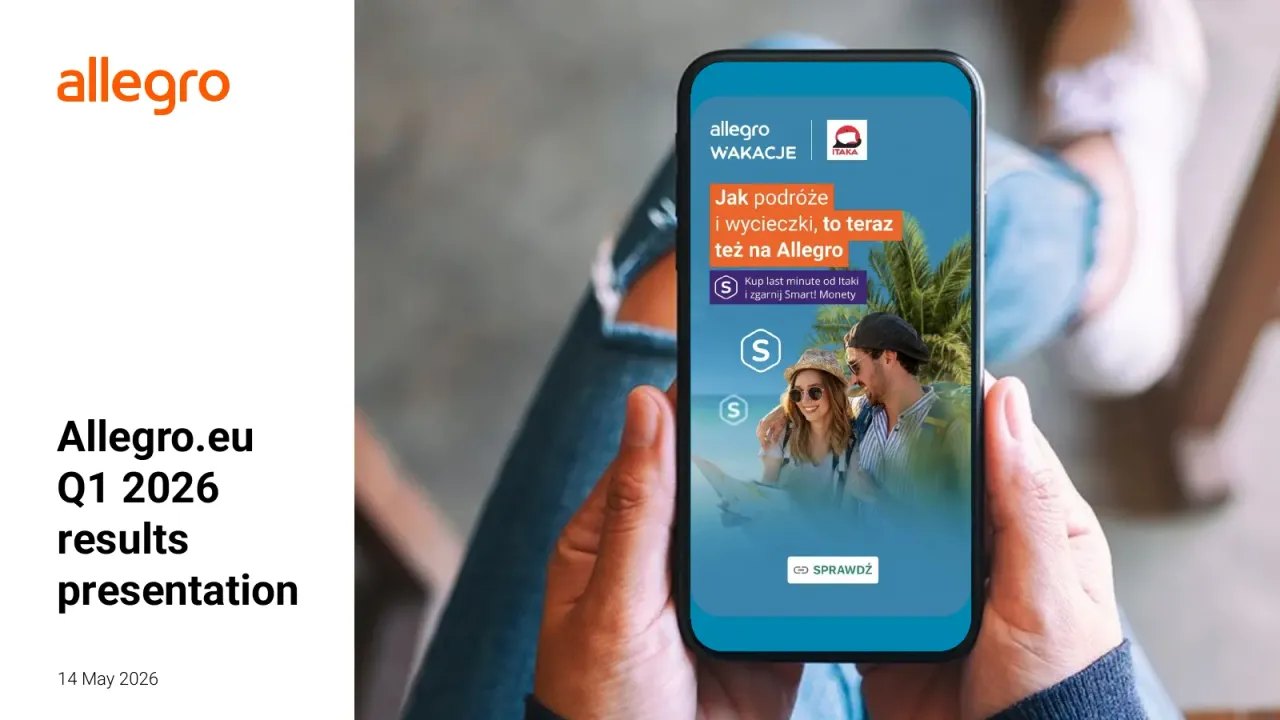
8:35 In Q2 in Q2, we are launching Kadagro Bacatje, a dedicated storefront for the packaged travel market. This is a large and fast growing segment with estimated spend on foreign package travel in Poland projected to hit 27,000,000,000 zloty. We are leveraging our e commerce expertise and partnering with Itaka, the leading tour operator in Poland, with a 20% market share. Our right to win comes from our 15,000,000 loyal customers and the ability to combine travel services with physical goods. We will also offer smart coins rewards, and within around two months of launch, easy buy now pay later refinancing through Allegro app. AllegroPay continues to show exceptional performance.
9:26 Loan origination is up 37% year on year, reaching 3,900,000,000 in Q1. Currently, AllegroPay finances over 16% of our total GMV. We are also successfully growing our other operating income from consumers' loans, which is up 125% as we increased self funding to nearly 60%. Beyond standard loans, our Allegro Paycard has incredible NPS of 92 and is increasingly used for everyday offline spending. Additionally, our newest payment methods, Allegro Click, reached 150,000 users in just two months, making it our fastest growing payment tool to date.
10:18 Finally, our logistics and delivery program is making great strides. The share of volumes managed by Allegro reached nearly 45% in Q1, up significantly from the previous year. This shift towards Allegro delivery partners to critical because it lowers our average cost per parcel. Our network is now the largest partner network in Poland with over 75,000 lockers and pickup points. Our own Allegro one APM network exceeded nine thousand fifth 500 machines this quarter, and we are firmly on track to hit our goal for over 12,000 locations by the end of twenty twenty six. As volume in the network grows, we continue to drive down unit costs.
11:05 And now let's move to the financial section and our outlook. Thank you very much, Martin, and good morning, everyone. It's really a pleasure to be with you today to talk you through the q one twenty twenty six results. It's been an excellent start to the year for the Allegro group. We're gonna do things a little bit differently, and I'm gonna start off with the group perspective this time. And turning to, first to the top line metrics. As you already heard, it's really a story about acceleration this quarter. Q1 GMV for the Polish operations has accelerated to 11.6% year on year, which compares to 8.9% in Q1 last year and to 8.6% in the fourth quarter of twenty five.
11:55 International is up 46.3%, which is 24.8 percentage points higher than it was in the fourth quarter, so tremendous sequential growth. And together, that boosts our GMV growth for the group to 12.8%, and this is about the best level we've seen since 2022 when we purchased Mol. Why is it going so well? Well, the first aspect is that the mol transformation, as you know, is well behind us now, and the mol legacy GMV is fading away from the baseline in 2025, removing that growth headwind. But even more importantly, the whole management team is now able to fully focus on our core strategy, which is to grow our marketplaces across the four countries where we're operating.
12:46 And you see this across the results. Looking at some of the metrics, the active buyers group level is now 20,400,000 customers, but they're all marketplace customers. There's no legacy left in these numbers. The GMV per active buyer at the group level is at PLN 3,500, and it's up 10.4% year on year. The take rate for this quarter for Poland is at 12.65%, essentially flat, and that's because we've made a management decision to forego significant monetization moves for 2026, and talk about that a little bit more later. Advertising, done very well as usual, twenty four point eight percent revenue growth. It's at 2.24% of GMV.
13:38 And we've also had strong contributions from delivery and from fintech, as you've heard, which means that the Polish business is growing revenue at 18%, and the group grew revenue at 16.5% year on year. One technical note also before we move on from this slide, because we sold the Moel South business in February, obviously that's a discontinued operation, so it doesn't appear in these numbers, and it's also been taken out of the prior year numbers, so the prior year is restated Exmol South. So let's move on, and it's really great to see that that growth has dropped through into our adjusted EBITDA performance.
14:24 Q1 adjusted EBITDA for the group is up an excellent 23.6% year on year. Poland is up 18.5%, and our international losses narrowed by 18% versus last year. That means that the group EBITDA in monetary terms is $932,000,000 for Q1. Looking at Poland, the growth in revenues, partly coming from the high margin ads and fintech contributions, lower cost per parcel due to the impact of our Allegro delivery expansion, slower G and A growth as we tightly control our expenditures, are all contributing to the margin being strong and EBITDA growth being as fast as the revenue growth.
15:17 Capital investment is up 16.4% on the group level to EUR $239,000,000. Most of the incremental spend is into our delivery investments. And our cash conversion remains in the top tier of e commerce businesses at 74.3%, actually up on the prior year by 1.6 percentage points. Our investments in growth, whether that be the Polish CapEx or our international expansion, are both well within our guardrails that we that we set out for you back in March. When it comes to leverage, I'll look at that on the next slide. And as you can see, the leverage is slightly higher than it was at the end of the fourth quarter. It's at 0.93 times versus 0.81 times a quarter ago, but it's right around our policy target of running with a one times leverage level.
16:17 This tick up is coming from the seasonal Q1 working capital outflows and that slightly higher year on year capital investment, offset by the higher EBITDA that we have over the last twelve months. The main reason for the tick up though, or the main reason for the increase, is that the cash is down by $520,000,000 compared to December, and that's mainly due to three one off items, the increased investment in the consumer loan book, the disposal of Mol South, and also move from straightforward cash into money market funds, which technically does not go into the cash balance. When it comes to the next three quarters, you should expect it being back to business as as usual with a strong downward trend in leverage.
17:12 Our group liquidity position is tremendous. We have 2,300,000,000 of cash and 2,000,000,000 in undrawn RCFs at the end of March, and this means we have absolutely no hesitation in recommending 1,600,000,000 zloty buyback to the shareholders to vote on at the June AGM. So now let's zero in on the Polish business. And, as usual, starting with the key growth KPIs, it was our active buyers is up 400,000 year on year at 15,510,000 active buyers. That's 2.6% up over the twelve month period and a 1% improvement versus December.
18:03 Active buyer or spend per active buyer is up by 7.2% year on year, so that continues to be the key lever for growing our GMV. It's reached now almost 4,400 zloty per active buyer per annual period. So those two KPIs combined to deliver that 11.6% year on year growth, which is three percentage points higher sequentially than we achieved in Q4. And you probably noted that retail sales in March were extremely strong in the Polish economy. Allegro fully participated in that. And as a result, compared to the current trading that we shared with you when we last met to discuss Q4, our high single very high single digit growth rate that we were seeing at that moment in time got boosted to this 11.6% level.
19:08 Where does that extra growth come from in March? There was a couple of reasons for it. One was that February was extremely cold, and as a result, the seasonal shopping didn't kick off, the spring season shopping really didn't kick off until March, so it was not in the February numbers. And secondly, the move of Easter right to the beginning of April meant that the typical pre Easter increase in shopping in the categories where we're strong slipped into March and into the Q1 quarter. That obviously then reverses in Q2, as we'll see later. So as a result, we had 16,500,000,000 zloty of GMV in Poland.
19:58 Other highlights that are worth pointing out are that the average selling price has also been one of the strongest results that we've had for a while, 3.1% year on year increase, and mix adjusted, it was 3.4%. So a little bit of inflation creeping into the into the numbers, which is great for GMV. And, it's also worth noting part of that improvement was because our relatively high ASP categories, particularly electronics and automotive, also had strong quarters. So moving on and looking at revenue, as usual, much faster than the GMV growth. Revenue growth for Poland was 18%, supported by the usual growth engines. It landed at 2,800,000,000 for the quarter.
20:50 Advertising contributed 25% growth. Decks, a massive 110% growth, delivery experience. And within the other category, have the fintech improvements, which and other other grew by 80%. When it comes to the take rates, you see the seasonal improvement from Q4 level up to this 12.65% for Q1. As I mentioned before, we decided that this year we'll run with essentially constant take rate compared to 2025. And we did make small tweaks to co financing around about 3% increase in the in the rates per parcel for co financing. But other than that, we basically left the whole structure unchanged.
21:47 So adjusted EBITDA, as I mentioned earlier, came in at 18.5% to land at 1,018,000,000 zloty for the quarter. The faster growth is is coming from our ads and fintech, and it's coming also from the lower SG and A growth compared to the levels we were seeing a year ago. And the real highlight here has been our delivery performance, where the growth rate came down to 19.6%, so quite a bit better than we saw in the fourth quarter. And the real star of the show here was our average cost per parcel, which is down by 4.2 percentage points compared to Q1 last year.
22:46 Now that's coming from the investment in our rollout of Allegro delivery and the change in the mix from 29% managed this time last year to 45% of deliveries being managed by Allegro delivery in Q1. And that was worth 6.8 percentage points of mix shift, and that more than offset price increases that kicked in from indexation from non Allegro delivery partners at the beginning of Q1. So the strategy is really working. The parcel prices are coming down, which is really excellent news. The margin is at 6.2% of GMV, which is a bit above our full year outlook, and I'll come back to that as well later in the presentation.
23:42 Moving on to capital investment and 24.8% increase in CapEx to $235,000,000 for the Polish business. The absolute growth is roughly evenly split between the other CapEx, the physical CapEx, which is mainly due to the increasing speed of our investments in the delivery network, both APMs and the core network for the middle mile. And also our capital capitalized development costs. The team size is roughly unchanged. We have obviously higher salaries to pay, but the main difference here is that we're getting increasingly efficient on the maintenance side, and more of the time of our tech team is being spent on functional improvements and developments to help drive growth.
24:39 So that's Poland. Now let's look at Allegro International. As you've already heard, it's been doing extremely well. Let's start with a look at the pro form a data for the marketplaces only, so without any impact of the legacy mall activity, which we'll come to later. And we're really excited to report that the momentum that we were talking about in Q4 and how the flywheel is starting to accelerate in the marketplaces is really continuing to build. The GMV growth has accelerated by 19 percentage points quarter on quarter to 67% year on year for Q1. And it's worth to remember that as in Q4 of twenty five, geographically speaking, these are comparable like for like numbers.
25:33 All three of the markets were open already in the fourth quarter of twenty twenty four. So this is like for like growth and like for like acceleration. You already heard from Martin some of the reasons for this improvement in terms of the customer facing metrics. There's a few more here that are worth touching on. Traffic growth is up 25%, but the GMV growth is 67, which, of course, means that the conversion rates are massively better than a year earlier, which means more engaged customers. The actual number of active buyers is up 33.4% to 4,900,000. That's roughly 25% of ecommerce shoppers across those three countries, which is really a good result after after three years of activity.
26:27 The spend per active buyer is starting to pick up quickly now. It's 17.8 percent up on a year earlier, and is at 613 zloty for a twelve month period. And that means that the GMV itself adds up to 804,000,000 zloty. So then now looking at the whole of the Allegro International segment, which means we need to take into account the mole legacy effects as well. Here we have the key KPIs of active buyers and spend. And when it comes to active buyers, you can see, first of all, in Q1 of twenty twenty six, there's those 4,900,000 marketplace buyers.
27:15 So these customers only shop on the marketplace. The Mall North legacy front ends were closed right at the end of Q1 last year in March. And at that point in time, there were 1,600,000 customers who only had been shopping in the previous twelve months on that legacy platform. So they gradually faded out of the numbers, as you can see there, over following four quarters, and they're completely gone from the figures going forward. Similar thing is going on in the spend, where all you have as of Q1 twenty twenty six is the marketplace spend. And on this basis, we're growing by 22.8%, again as the legacy impact drops out of the numbers.
28:08 So for Q2 going forward, in essence, we're only going to be looking at the marketplace versus the place a year ago. Putting that together at the level of GMV, you can see that Allegro International segment grew by 46.3%, which is up by that 24.8 percentage points sequentially because this was the very last quarter where we had some significant GMV coming off of the legacy business. You can see that in gray there on the right hand chart in Q1 of twenty twenty five, 70,000,000 of headwind, which combines to reduce the growth rate from the 67% on the marketplace only to that 46% for the segment.
29:01 $8.00 4,000,000 of marketplace GMV on the Q1 twenty twenty six slide. So going forward, it's blue skies. There's no legacy. There's only marketplace growth to look at in the numbers for Q2 onwards. On revenue, because of the fact that the mall legacy business was predominantly a 1P business, so the revenue numbers relative to GMV are over indexed, meaning that we still see some revenue shrinkage in Q1 because of that mall legacy activity in the prior year. Q2 going forward, you're only going to be looking at the marketplace, which grew 80% year on year in Q1, and the advertising on the marketplace, which was growing 30%.
29:54 When it comes to profitability, the adjusted EBITDA loss was down by 17.7% or PLN 19,000,000 for Q1. You can see on the left hand side there that the main improvement has come on that legacy business, which has now been transformed into a leaner merchant business, which only operates on the marketplace. That loss has reduced from CHF 43,600,000 a year ago to just under 19,000,000 for Q1, and that includes the WeDo delivery business as well as the merchant. When it comes to the the marketplace part of these numbers, the loss is slightly bigger. 60,000,000 went up to 67,000,000 because we've invested more money in into marketing. We're seeing a better return on marketing expenditure because of the better conversion rates and the better engagement.
30:56 So we're leaning into that and spending a bit more. You can see it's 10,000,000 in the bridge, And that results in us pushing that flywheel even faster and growing the GMV even quicker. When it comes to our adjusted EBITDA margin to GMV, here is where you can see the real progress in our journey towards breakeven. As you remember, we're targeting breakeven by 2029 for these international markets. And there you can see an improvement from minus 19% a year ago to minus 10.7% for Q1, 8.3 percentage point improvement. It's nearly approaching 50% better than a year ago.
31:43 So that's international going really well. We're very happy with it. So let's now move to the outlook to finish up my part of the presentation. And we'll start with the current trading comments for q two, which obviously relate primarily to to GMV. So starting with Poland, the first six weeks have seen high single digit growth, and that is because there are some significant headwinds from the March effect that I was just talking about earlier. First of all, that Easter trading that shifted into Q1 is not in q two, as as a result of the calendar.
32:31 And secondly, and just as importantly, our annual Smart Week events started this year a week later in the calendar, and it only kicked off this past Monday, which means, essentially, it's not in that first six week period. It's actually started extremely well. We're three days in of about a ten day, shopping festival. So if you look through all of that and and look at four and a half months on a year to date basis, we're actually right around the midpoint of our GMV guidance. The guidance, to remind you, for the full 2026 is between 911%. Moving on to international.
33:17 And again, for the first six weeks, this flywheel continues to accelerate, and we're seeing year on year marketplace growth moving now above 70% year on year. And as I've been mentioning ad nauseam in the earlier part of the presentation, the mall legacy effect has now basically completely disappeared from the numbers for q two, almost completely disappeared. And as a result, the Allegro International segment growth has moved up from that 46% in q one to nearly 70% growth for this point in q two. And on a year to date basis, we're up now to 50% growth. What does that mean for the group? For the group, it means that quarter to date, we're at very nearly 10% year on year GMV growth.
34:11 And the group level I'm sorry, and the year to date level is at nearly 12%, so just below the 12.8% we've reported today for Q1. So what does it mean for our outlook? We've made a slight upgrade of the top line expectations for international, slight in the sense that, obviously, it's a much smaller segment than the Polish business, but it's a very important improvement for international itself. And we're holding the Polish outlook unchanged at this point in time. So let's go through our thinking on this, and let's start with, with Poland.
34:57 As you just said, we're right on track for the midpoint of our guidance when it comes to GMV, And we're ahead of plan, or we're delivering on our plan and our key objective to grow the GMV faster than we did in 2025, which would be a major train change of trend that we've seen over the last few years. At the same time, we do have, obviously, like everybody else, an eye on, the geopolitical situation, and we have an eye on consumer sentiment. But so far, we're not seeing any signs of deterioration in performance. But we're obviously aware of the risk, and we have an eye on that. When it comes to that really great EBITDA performance, the 18% growth that we saw in Q1, We don't expect that to continue at that level for the whole of the 2026.
35:56 And the reason for that is obviously we haven't put up the take rates. We will need therefore to absorb cost increases, operating expenses, and obviously salaries will be higher over the course of the year. We have factors that offset some of that, like our growth engines. But nonetheless, we should expect the growth rate to be a bit lower in the subsequent quarters. So we're not making any adjustment at this stage to the EBITDA guidance. For international, we have increased the guidance by million of GMV, which translates to 5% faster growth than in the original outlook.
36:43 That's adding CHF30 million to the revenue, commission based revenue from the marketplaces, which is also a 5% improvement in revenue growth. There's clearly potential that it could be stronger than this, and we do have an appetite for more. At the same time, we have that same geopolitical concern about the consumer. The business is more discretionary dependent, especially in the fourth quarter, than our Polish business, so we need to bear that in mind. We're also enjoying an FX tailwind right now, which can always reverse, so we need to be cautious on that front. So we do have an appetite for more, but this is enough of an increase for now being prudent.
37:33 No change to the EBITDA guidance for international, because any additional gross margin we're we're getting from the faster growth, we're happy to reinvest into marketing at better ROIs than we've been receiving a year earlier, to grow that flywheel even faster. So the group metrics don't really change very much, but I really want to underline that the international business is now accretive across all the group metrics on top of the Polish business, and helps drive our full year growth, and the faster growth of the Allegro group. So with that final comment, I'm going to hand it back to Martin to wrap it up before Q and A. Thank you, Martin.
38:24 Thank you, John. Great summary of the great results we achieved in Q1. So key takeaways for today. Allegro delivered robust Q1 results with growth in Poland rebounding to almost 12% year on year and margins coming in ahead of our previous expectations. We are seeing continued and strong acceleration in our international marketplaces, which grew by 67% in the first quarter. And as a result of this momentum, we have officially upgraded of our full year outlook for the international segment. Then our strategy evolution is progressing very well, and we are successfully expanding into our first service categories.
39:11 At the same time, our key growth engines like fintech, deliver and advertising all delivered more than solid performances this quarter. In terms of operations, we continue to increase the share of volume managed directly by Allegro, which improves both efficiency and the customer experience. And finally, we are committed to shareholder returns with a 600,000,000 slotted share buyback proposal set for a vote this June. Thomas, it's time to open the Q and A session. Thank you, Martin, and Jean, for the presentation. We are now ready for the Q and A session. If you are connected via the phone and you would like to ask a voice question, please press star two on your phone keypad and wait for your name to be prompted. If you are connected via the web, you can also request to ask a voice question or send your question as a text.
40:05 Our first question comes from Andrew Rose from Barclays. Great. Morning, all. Thanks for taking my question. I've got two if that's okay. My first one was to ask about the new travel platform that you've launched in partnership with Etecha. Can you give us a sense as to how the unit economics work? Kind of who who funds the economics that make transactions on the Allegro platform, and then any learnings you're having in terms of how your cohorts behave as you're adding in additional services into the Allegro platform? My my second question is is pretty much exactly the same one in terms of the partnership with Luxemed in terms of of health, and whether you can give us any color in terms of how the economics and the learnings are often from that vertical. And I guess, as part of of the answer, would be great if you give us some perspective as to what we should be expecting next and perhaps some kind of vision as to how adjacent services on Allegro might look kind of one, two, three years down the road in terms of what you're trying to build. Thanks.
41:08 This is a great question. And, of course, as we announced, we just started to explore both segments, starting from health and then travel. Having, you know, or seeing quite promising economics behind both corporations and both segments because of, firstly, rising value of the market in both segments and, you know, quite promising, you know, signs we see on the market. What we can share right now is that, you know, take rate is relatively high. We can say something about, you know, double double digit take rate and, you know, some kind of competition between between some potential partners or vendors. We see or we will see on the marketplace because, as you probably said, we started cooperating with Luxemed and Itaka, but, of course, we are marketplace.
42:02 So we invite all major players to join us and, you know, to develop these both segments together. The great thing is that we see this appetite from our customers to purchase services on Allegro. And combining physical products with services, with value added services, this is something, you know, creating very unique value proposition on our side because you can imagine that, you know, even, you know, purchasing some health care services or travel packages, you can use potentially our financing products like AllegroPay. So this is really something very unique on the market. Of course, we should remember that, you know, we do some tests, and this is kind of exploration for us because this is very first time we provide or we promote services to our customers as a stand alone.
42:57 But, again, of course, we do this development with our customers and, of course, with our merchants. So we did many analysis in the past. We we are close to both segments on the market, and this is something looking for us very promising. Cool. If I if I could just follow-up that. So double digit percent take rate on each incremental transaction, that that's to you guys. And then any big cost you incur as part of that, or is the incremental margin on these transactions pretty high? So looking at investments on our side, we can say that we are very, very efficient. And, you know, there is, let's say, no risk on our side. Again, we are marketplace, so we do not provide those services. We do it with partners.
43:47 So, quite limited investment on our side and, again, very promising market. Thank you. Maybe just just to add, Andrew, the the way we're approaching getting into these services is to partner up with a key player in both cases, a very strong player, and it's a win win opportunity, because they see the opportunity to reach customers amongst our 15,000,000 active buyers, which maybe they've not reached so far, and they think it gives them an edge. And obviously, for us, it's a high take rate three p business model. So if we get traction, it's gonna be value EBITDA, sorry, accretive very quickly.
44:37 And as Martin said, it's it's about testing and seeing how well it goes. Over time, we'd expand it into more of a marketplace with multiple players, but we we try to start with with a strong player in each case. Cool. Thanks. Thank you. The next question comes from Cesar Tyron from Bank of America. Cesar, your line is open. Yes. Thank you so much. Congratulations on the results. Thanks for the call and the opportunity to ask questions. I have three, but I think they're very easy. The first one is on the OpenAI partnership. I wanted to check what are the economics there? Are you paying them? Is that going to help you to generate, in your opinion, incremental revenue, etcetera, etcetera, or potentially lower traffic acquisition costs?
45:31 So that's on the OpenAI partnership. Then on the new services that you've discussed, I wanted to understand, you know, without asking for formal guidance, just as an aspiration, if I look at Allegro in the next three to five years, these new services and probably others that you launch might contribute, in your view, a material contribution of the revenue of the marketplace revenue. Is that the case? Or do you think it could be just low to mid single digit? And then I think the third question, looking at ALLEGO I, the share of ALLEGO I in your deliveries keeps on increasing, so well done on that.
46:17 How significant do you think it will be in the next, again, couple of years? Thank you so much. So great questions. I will start with describing our cooperation with OpenAI because this is something really big and, I guess, one of the first initiatives in Europe between technology vendors specialized in AI and marketplaces. So thanks to this cooperation, we have early access to the newest technology. And you know that OpenAI is the owner of Charge GPT, the the world number one AI application, having access to hundreds of millions of customers or potential customers.
47:07 And for us, you know, opening the new possibilities to be closer to some attractive and new group of customers, like, you know, young generation, for example. So, of course, thanks to this partnership, firstly, we think we will be able to increase conversion in some products or product categories because of giving our customers better advice in some related to some specific products. Thanks to that, as you probably mentioned, we also believe that traffic can be based on different source, quite attractive one because, again, we see that, you know, millions of users or customers in Poland, they use ChatGPT.
47:59 So we will have, you know, our position secured by this in in this application and, you know, potentially having access to some new attractive group of customers. And, of course, you know, we have clear strategy how to leverage AI, both externally and internally. Of course, internally, to use this great technology to just be more efficient and to increase our productivity, and externally, to reach some new group of customers and, of course, to be much more diversified than in the past when it comes to to to traffic.
48:45 So great cooperation and something very promising to us. But, of course, we do cooperate with all major players specialized in in AI development. So OpenAI, this is, you know, one of the key players, but not the only one. So thank you for the questions. I'll take the other two. On the on the the new services, as Martin said, what we're doing initially is testing how the consumers respond to these offers, and whether it works for both us and for the partner. And assuming that it will do, then we'll obviously build it from there. And as I said to the previous question, it should be accretive in an EBITDA sense very quickly if it catches hold.
49:41 As you saw in the presentation, both of those categories are multi billion zloty opportunities, so we can potentially take a reasonably large share there, but we've not tried to make any projections at this point in time. I think more important is we're not finished with just these two sectors. There are other sectors that we can address, and what we've got in mind will become clear over time. We've got within the marketplace something like 10 different categories. We're covering a really wide range, and we're not overly dependent on any particular category, and we'd probably like to get to the similar situation on the services side.
50:33 Regarding Allegro I, there's every reason why we'll continue to build the Allegro delivery share and the managed share quarter to quarter over time. I mean, clearly works. Proximity of the lockers is very important, and we have enough lockers out there in the market that proximity is doing its work, and and the quality of the service is also, very strong, and customers are happy. So they're happy to use the the nearest locker. Back in March, we gave you quite a bit of additional information about where we would need to increase our geographic coverage. We think we needed maybe another 15,000 lockers deployed in underserved areas by Allegro delivery in order to really have the coverage that we need.
51:30 But the middle mile capacity is there. You know, you remember there's four different players within this consortium, all with middle mile capacity. So, you know, we we have potential to do a lot more than we're able to do at the moment. But that isn't the target objective. The target is to keep the impulse lockers also within the offering for the consumers to make sure that everyone's nearest locker, is gonna be available to them on Allegro. That would that's the preferred outcome. Great. Thank you so much, Martin and John. That was very clear. Thank you, gentlemen. The next question comes from Roman Rezepniew from Goldman Sachs. Roman, your line is open.
52:20 Hi. Yes, thanks for taking my questions and congratulations on strong results. I have three questions. The first one would be just a follow-up on Allegro delivery and your expansion into lower density areas. Would you expect some impact on cost per parcel? And are you sure you would still have a cost advantage versus what you pay to import as you go further into this lower density areas? The second question on the international, what technically has structurally changed in the business that gives you confidence on the GMV acceleration? Would you say that you have reached some sort of real inflection in any of the flywheel effect drivers such as order frequency, seller and the set of direction and customer acquisition?
53:10 And the last one on the LLMs, if you can please quantify the current share of traffic and the GMV coming from LLM driven discovery versus traditional channels? How has it trended over the last few quarters? And how does the LLM driven traffic compare in quality versus traditional channels? Thank you. Thank you for the questions. I'll take the first two, and then hand it over to Martin for the L and M. Allegro delivery in low density areas, it's a very fair question, and the answer is pretty obvious. Obviously the lower density areas will have a higher unit cost than the bigger cities.
54:04 So it is something of a headwind on the average unit cost, for sure, going into those areas. But for the time being, given where we are with negotiations, it's absolutely necessary to do that. And we need to be present everywhere. And I think that's also true of the partners. It isn't such a strong headwind though that it would stop us on the average unit cost seeing improvement over time as we continue to build the volume. So, yeah, there is a headwind from it, but it doesn't overwhelm all the good stuff that we've been seeing over the previous quarters.
54:56 International, you were asking, you know, what's giving us confidence in this flywheel? Maybe start starting from the the is quite a long one, I think. There's many things that are starting to move positively and reinforce each other. If we start from the consumer sentiment, remember that these consumers three years ago, had never really met a marketplace with massive selection superiority that was selling mostly branded goods and mostly Central Europe specific selection. And it takes them a while to get used to it, right? But the metrics that Martian was going through should give you some confidence that they're warming up to it.
55:48 They're starting to trust it. And as a result, the frequency is going up. The frequency, when we look at the older cohorts, we can see that they're getting up to levels which are above 10 transactions a year, where we have an average in Poland of above 20, right? So it's going in the right direction, because it's only been for three years. And at the same time, we've got new customers coming in who obviously start with low frequency, right? So that's keeping a cap on the overall average. So the frequency is going up. It means that the conversion rates, when they come to shop, there's much higher purchase intent, which is why the conversion rates are going up.
56:39 And that then feeds into the cost of marketing. You can buy the traffic more cheaply when the conversion rates are better, when, Google has confidence that, sending customers to to this particular site is something that the customers are gonna be happy with. You end up being able to buy the traffic more cheaply. So the cost per click, is moving in the right direction. The, conversion rate is also moving in the right direction, so the marketing spend is more and more efficient in terms of driving growth. And at the same time, the frequency in itself, because it's going up, the customers start to start to get used to coming direct either via the app or direct in their browser, and you don't need to buy as much of the traffic because they start their searches, always on, on Google or on other platforms.
57:37 So all of these things start to work together and turn that flywheel better and better. The other aspect, which is very important, is obviously the merchant side. And again, we've got some really good initiatives running around bringing in local merchants and also additional Polish merchants and widening selection even further. And all of that is helping as well. So, it's really very exciting the way that it's going. We've been very patient with it, and we did an awful lot of work over the last two years, to address initial suspicions or concerns that consumers had about working with a marketplace, and it's paying off. The question about ALEMS and the traffic and their impact is super interesting.
58:28 Unfortunately, we don't share, you know, any specific data related to a traffic structure, but we can say that this is something we perceive as a a promising source. Today, I can say this is not material in the whole big picture, but, of course, we do invest because, you know, that the paid traffic is mainly based on, search engine from Google or some, social media platforms from Meta. So every single player trying, you know, to change or to help us to diversify, sources of traffic is is this is something really helpful for us. The second thing is that people use AI assistance applications today mainly to explore, to be inspired, or to compare some products, or to get some additional specific information.
59:21 And I guess, I believe that, you know, the traffic from AI assistance will be growing next years, but we should be quite patient because this is something all about, you know, changing habits and some scenarios how people use ecommerce and how they want to purchase some goods or now services as well. And as you see, we do invest in corporations like with OpenAI just to have access to the absolutely newest technology and thanks to that to create some advantage in comparison to other platforms and, of course, use this cooperation or cooperations to also create some additional or new sources of of of traffic. So so this is something very promising. Right now, this is not material in the whole big picture, but we strongly believe in that technology and this is something, like, you know, tailing to our marketplace to speed up our development and having access to attractive group of customers.
1:00:27 So so so that's the answer. Thank you, gentlemen. We're quite popular today. So the next question comes from Aram Armstrong from Ashburn Group. Your line is now open. Hi. Good morning. Congratulations on a very strong set of results, and thanks very much for taking the questions. Firstly, on the OpenAI side, just to follow-up on the recent points. Can you talk about, say, a customer that begins a product search within CheckGPT in Poland for a product or a service that you offer? Would you then be a preferential kind of option for them? Would you be bumped up the more organic ways in the way that you would be, say, for paid Google traffic? Would you be kind of like a paid ChatGPT listing?
1:01:18 Is that kind of how that's going to work for you? That's part one. I'll just tag these questions together. And the question is on the ASP growth that we saw, just over 3% in Poland this quarter. Is that an explicit strategy from the management team to help drive higher ticket prices, which can help absorb a delivery cost over higher ticket size with positive implications of profitability and can that continue through the year? And then also in the slide deck, under your partnerships section, Shabka, you just mentioned, can you talk a little bit about that and perhaps any broader comments on grocery, please? So I will cover the first question related to, again, our cooperation with OpenAI.
1:02:06 And, of course, all results, what you see, you know, asking for example, for some products is currently based on organic results. And as you know, I guess, any single platforms announced yet commercial model or, like, you know, to present some, paid traffic, like we know from, search engines like Google. So, again, this cooperation is based mainly on using the newest technology. And, of course, thanks to that, we can expect that, you know, we will see some improvements in visibility of product fit in many applications using AI.
1:02:57 But this is not something, you know, securing our positions. So we do a lot, of course, to have perfect descriptions of products, of course, you know, the best offering and the best pricing on the market. And as said, we do cooperate with many vendors of AI technologies on the market. So we will be even much more active in the future in this field. Sorry. On that second question, there was a bit of background noise. I didn't catch exactly what you were asking about ASP. Could you rephrase it?
1:04:02 So maybe I will jump to the question related to to Zabka and, you know, our view on the grocery market. I guess many times we shared with the market some data related to quite, you know, promising or the most promising categories we have on the marketplace and our supermarket, including grocery, which is is one of them. So we do invest, of course, to have better selection and, of course, to keep most attract the most attractive prices on the market, cooperating with hundreds or even thousands merchants partners we have on on marketplace. Today, we shared that, you know, we do cooperate with Zabka mainly to accelerate growth of our loyalty program, SMART. So we have, you know, great cooperation with with this company.
1:05:01 But answering your question related to grocery, we do believe in this category. We see increasing demand from our customers. We see high growth in our supermarket. So this is something giving us confidence that we should invest maybe even more to to to improve our presence in this part of the market because this is really exciting part of our journey investing in changing habits of our customers. And you know that grocery in ecommerce is still quite demanding category, but very promising. So we carefully invest, but we want to improve our presence in in this part of the market.
1:05:53 Let me take take another stab at the ASP question as I think my colleague understood better than I did. So the question is, is it our strategy to drive the higher ticket categories, if I understand correctly, on average selling price. The answer to that is not particularly. All categories are good. We make money on all categories. And what we see in this quarterly result is that inflation is creeping back into average selling price generally across the categories.
1:06:38 Obviously, very high inflation back in 'twenty two and 'twenty three, it almost completely disappeared out of our numbers, if you've been following closely quarter by quarter. In later 2024 and through 2025, there was very little, ASP inflation, but it's starting to creep back in. Having said that, we are very focused on UX on all categories. As Martin said previously, there are improvements across the board. In particular, automotive has just introduced a great new function where I think you just put in your registration number, if I recall, and it knows immediately what car model it is, and that and when you then say you need windscreen wiper, rubbers, or something like this, or any other component, it knows immediately what what you're looking for.
1:07:42 You know? So that's made a a difference, and it's only one of many things that contributed to automotive having a good quarter. So any relative faster growth in the higher ASP categories is obviously going to have a positive impact on ASP. But as I said, just about anything we sell brings us a profit, and we'll take the growth wherever we're getting it, and everyone's working hard to deliver growth. Thank you.
1:08:27 So next question comes from from UBS. Your line is open. Hi, thank you. Good morning. Thank you for taking my questions. Just follow-up questions really. So really the first follow-up question is regarding the delivery unit cost. In your presentation you mentioned a decline in unit cost. Could you just please clarify whether this refers to the full cash cost, including leases? You have to pay on your ATMs or only the portion recognized at the EBITDA level? And perhaps if the latter is the case, could you perhaps elaborate on this trajectory of total costs including leases you have to pay for your own APMs?
1:09:22 So this is the first question. Thank you. Thanks for that, Miguel. That's a really good opportunity to clarify. Cost that we're measuring in that metric, if you remember, was on the EBITDA bridge. So it's the EBITDA cost that we're taking into account there, which means for the Allegro delivery partners that we have, DPD, DHL and, OLEN, it's the, effectively, the unit price per parcel that we're paying to them for delivering a package, right, and that's the whole cost that we have to worry about. And in the case of Allegro One, which is the fourth partner, and is responsible not for the whole of that 48%, but for a part of it, you're absolutely right that the lease costs are not in that number, because they're below EBITDA.
1:10:26 But those lease costs grow with a number of locations, and from then on they're just the fixed costs, and the more volume we're putting through, the lower the full cost of delivery. I think back in March, we were sharing some information on the full cost. But certainly, the full cost now on Allegro One is low enough that it's competitive with what we're paying to other players, including their profit margin. Hopefully, that's Yes. Thank you. Let me have one more, please, maybe a little bit more philosophical. You have 15,000,000 active shoppers in Poland.
1:11:14 Already, maybe you could provide your perspective on what you see as the potential ceiling for the number of active shoppers in Poland or perhaps you could share some penetration data on different age cohorts. How does it look like? Thank you. Yeah, that's also a great question. I mean, you know, our definition of an active buyer is a unique email account, and that means that in some cases, that's one buyer who's representing a whole household. So there can be two, three, four Polish citizens or residents behind that single account in many cases, right?
1:12:02 So just about everyone in Poland shops with Allegro, either frequently, very frequently, or there is a tale of occasional shoppers. On the cohort side of things, it really becomes super relevant to just about everybody once they become a household, right? It's maybe not so relevant for very, very young shoppers who don't have much wallet. And when they do have wallet, they buy beer or maybe sneakers or bus tickets and things like that, right, as students. So once you actually set up on your own, and you you rent a flat or you own you own a flat, just about everybody shops shops on Allegro.
1:13:04 You wanna add to that margin? Yeah. And, as John said, of course, you know, the number of our customers, you know, actively using our marketplace is one of the crucial things or KPIs to us. But also, secondly, we should think and we do invest a lot how to improve frequency of of shopping at at that marketplace because we do invest to convince people to move some GMV from the offline world to the marketplace because we offer them better selection, better prices, better convenience. So this is, you know, great opportunity to us. And, of course, it should be always combined with the number of active buyers.
1:13:51 But, again, the big win is also to improve frequency of shopping or average spending of our customers. So this is something we are focused on. Thank you. So I understand there's just like no material difference for kind of older cohorts, like 60, let's say people who are not as used to using the online tools in their youth, there is a difference? Thanks. Yeah, they're interesting questions because I remember exactly the same questions when I started nine years ago in Allegro. We were worried about lack of young cohorts, and at that time we were also a bit worried about the fact that some of these older cohorts were not highly representative, because as you just described it, you know, they weren't really internet natives, The people who were sixty five nine years ago are now in their 70s, right? And the consumers who were 16, seventeen nine years ago are now in their mid 20s and have probably moved out of home and have got their first flat and stuff like that, right?
1:15:14 So in both cases, the problem has gone away. Those very young people are now starting out in their adult lives, they start to shop more on Allegro. We've got just as many people in the mid twenties category as we had, if not more than ten years ago. And the same in the sort of 65 category, they're all people that are much more familiar with the internet than the people that are in the 70 category, and they're very active buyers. The amazing thing about Allegro is people, once they start shopping on it, they don't stop shopping on it. So what you do see is probably the heaviest shoppers are the people in their mid-40s who've got the most spending power, or like peak spending power.
1:16:04 And then people tend to start spending less once their kids move out, and stuff like that. Right? So all of these type sort of typical lifetime patterns are visible if you go and look for them. Thank you. That's clear. Thank you, Micha. Thank you, gentlemen. Next question comes from Nick Barter from BNP Paribas. Your line is open now, Nick. Good morning, and thank you very much for taking my question. I was wondering if you can talk more about how the Allegro shopping assistant has been received by buyers and what the learnings are from it in its early stages. Feel free also to talk about any of the other AI initiatives outside of the OpenAI relationship that we've obviously touched on a fair amount, how they're progressing.
1:16:55 And then my second question is is just what's behind the sort of good rollout progress of Allegro PayCard and how can that continue going forward? Thank you very much. So I will take the first question. Again, we do believe in AI, and this is the second or even the third version of our AI assistant or maybe assistance, because we do invest also to help not only consumers, but also our partners, our merchants, to improve efficiency, to be more effective selling some goods on on marketplace. And comparing both versions, because I think the initial version was introduced in q four for some limited part of our customer base, we see huge progress.
1:17:50 This tool is much more effective, and the results are almost perfect, you know, looking for something or be trying to be advised by AI technology or AI assistant. As said before, this is something really helping us to improve conversion in some specific products or some specific, pretty advanced, you know, product categories. So and, again, the new source for us to create some additional GMV, we see that people use AI assistant to explore product catalog and to be inspired by AI. So even yesterday, having several meetings with our customers and observing how they use our AI assistance, they were absolutely amazed how helpful this technology is and how they are advised, you know, to find some proper products. So so, again, to summarize, we do believe in this technology very strongly, and we want to continue our investment in cooperation with OpenAI, but also, as said before, with other leading AI technology vendors.
1:19:15 Thank you very much. Paycard, I think was the second question. This product is very well received by the consumers. We're only offering it to customers who are already having an Allegro Pay wallet, and shop shop on Allegro. And, really, the sky is the limit as as to, how much we can continue to penetrate this space and get an upsell than a card or open a open a card account to go with their, with with their wallet that's dedicated to to Allegro. So plenty of plenty of headroom here, to keep growing that.
1:20:04 Thank you very much. That's very clear. Cheers. Thank you, Nick. Thank you, gentlemen. And the last set of questions for today comes from George Popatrick from PQLP. Kirk, go ahead with your questions. Hello. It's just one. The question is, what take rate do you expect in the next quarters, especially comparing year on year? I I know that take rate increase was very muted in March, but it seems that in the last two quarters, some investments into pricing to be visible or my readers bet here. I mean, the base for comparison in the second, third, and fourth quarter last year is higher in terms of take rate.
1:20:50 So so, yes, to what should we expect here in on on the project business? Yeah. Thank you for that question. Yes. You're absolutely right. One thing that does detract from take rates are when we share take rate with the merchants to try and hit a particular price point, either as part of a campaign event like, Smart Week, or, just generally to because we know that somewhere off of Allegro, there is a lower price point, and we want to to match it. So the amounts we're investing are getting larger, partly because we're managing to monitor more and more selection at scale. So there's more opportunity to spend and to fulfill our promise to be extremely price competitive.
1:21:49 And that does take a few bps off of the take rate on a year on year basis. So the take rate will there's no reason that the take rate's going to move higher because we haven't increased the rates significantly. You will see a slight uptick probably because of the few bits that come from that co financing change. But, you know, the the effect that you've just identified is working in the opposite direction. Okay. So roughly flat take rate versus first quarter, I guess. Yes. Roughly flat, did I hear you say, I think?
1:22:35 Yes. Versus flat versus first quarter of this year. You know, you have to wait and see how it comes out. But, yeah, there's no reason for it to make a significant move in either direction. Okay. Great. Thanks. Thank you, Piotr. And thank you all. This concludes our presentation for today. Thanks for joining, and we're looking forward to speaking with you again when we publish first half results in September.
Follow Allegro.eu S.A. into a list and get an email when it puts out news.
Latest news releases
- GPW:ALE — Allegro.eu: Buy-back programmes - Attachment - EN,PL · Tue, Sep 22, 2026
- GPW:ALE — Allegro.eu: Buy-back transactions - Attachment - EN,PL · Mon, Aug 10, 2026
Companies on this call
More from Allegro.eu S.A.
- Sep 17, 2026 Allegro.eu (GPW:ALE) Q2 2026 Earnings Call
- May 14, 2026 Allegro.eu (GPW:ALE) Q1 2026 Earnings Call
- Mar 12, 2026 Allegro.eu (GPW:ALE) Q4 2025 Earnings Call
- Nov 20, 2025 Allegro.eu (GPW:ALE) Q3 2025 Earnings Call
- Sep 18, 2025 Allegro.eu (GPW:ALE) Q2 2025 Earnings Call
- Mar 13, 2025 Allegro.eu (GPW:ALE) Q4 2024 Earnings Call