Louis Langlois
Senior Vice President of Treasury and Capital Markets
Replay available
Alcoa (NYSE:AA) Q2 2026 earnings call, held 2026-07-16. Watch the replay and read the transcript on 6ix.
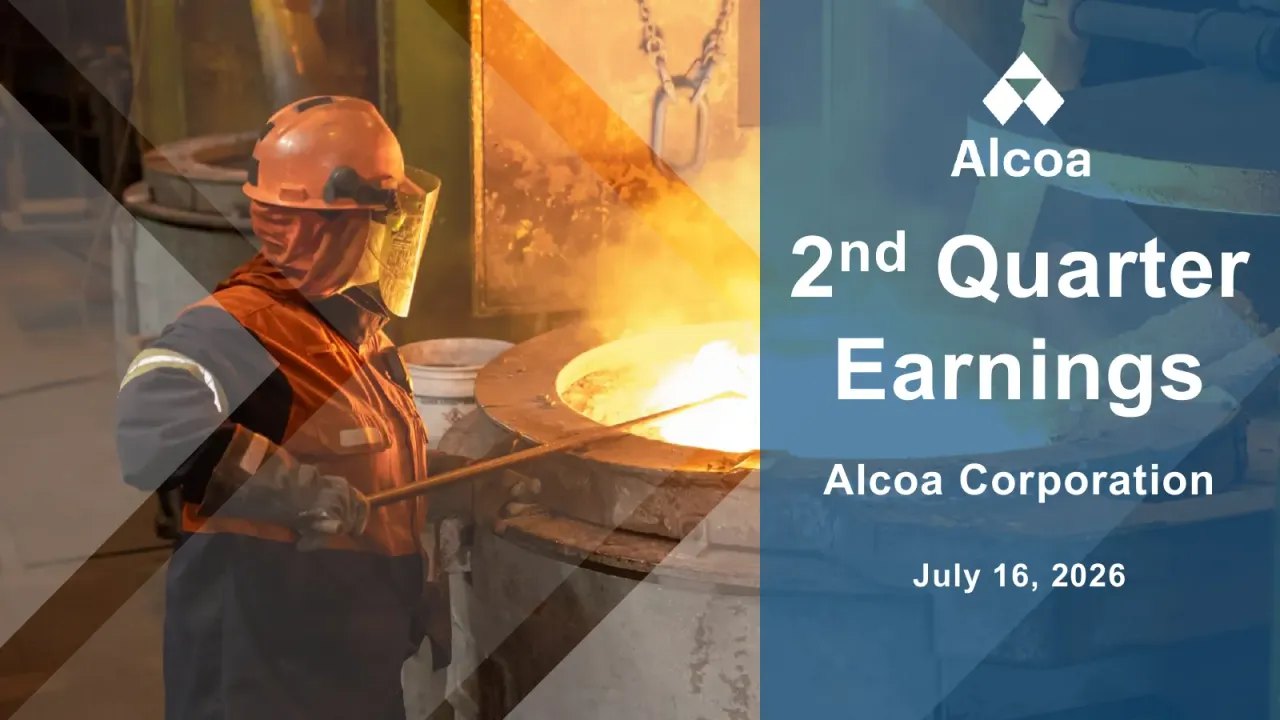
On 6ix: 6ix.com/event/alcoa-corporation-aa-q2-2026-earnings-call
Automated transcript · Written by software from the replay's audio. It can mishear names and figures; the replay is the record.
0:00 Good afternoon, and welcome to the Alcoa Corporation Second Quarter twenty twenty six Earnings Presentation and Conference Call. All participants will be in a listen only mode. After today's presentation, there will be an opportunity to ask questions.
0:27 Please note this event is being recorded. I would now like to turn the conference over to Louis Langlois, Senior Vice President of Treasury and Capital Markets. Please go ahead. Thank you, and good day, everyone. I'm joined today by William Applinger, Alcoa Corporation President and Chief Executive Officer and Molly Bierman, Executive Vice President and Chief Financial Officer. We will take your questions after comments by Bill and Molly. As a reminder, today's discussion will contain forward looking statements relating to future events and expectations that are subject to various assumptions and caveats. Factors that may cause the company's actual results to differ materially from these statements are included in today's presentation and our SEC filings.
1:16 In addition, we have included some non GAAP financial measures in this presentation. For historical non GAAP financial measures, reconciliations to the most directly comparable GAAP financial measures can be found in the appendix to today's presentation. We have not presented quantitative reconciliations of certain forward looking non GAAP financial measures for reasons noted on this slide.
1:43 Any reference in our discussion today to EBITDA means adjusted EBITDA. Finally, as previously announced, the earnings press release and slide presentation are available on our website. Now I'd like to turn over the call to Bill. Thank you, Louis, and welcome to our second quarter twenty twenty six earnings conference call. Today, we'll review our second quarter performance, discuss our markets and provide an update on strategic initiatives, including the previously announced acquisition of South32's upstream aluminum value chain assets. Starting with safety, our top priority. Our performance remains stable and we continue to see improving trends with key injury metrics declining on a twelve month rolling basis.
2:32 We are maintaining a strong focus on operational discipline, leadership presence in the field and fatality risk management to sustain our progress. We have initiated an effort to eliminate fatality risks associated with live work from our operations and expanded our global fatality prevention team to further strengthen our safety culture and risk management capabilities. Operationally, we delivered another quarter of stable and reliable performance across most of our system. Our focus on operational excellence resulted in year to date production records at four smelters and one refinery. Sequentially, we increased primary aluminum production by 30,000 metric tons, including the completion of several restarts and achieved the highest year to date shipment volume at the Alumar smelter since its 2022 restart.
3:25 This allowed us to fully benefit from higher metal prices during the quarter. We also achieved significant labor relations milestones in the quarter, securing multiyear collective agreements through 2030 with the AWU in Western Australia and with the United Steel Workers for our two U. S. Smelters and the ABI smelter in Quebec. We also successfully concluded negotiations in Norway and at Alumar in Brazil. These agreements provide important workforce stability and support our long term operating plans. Strategically, we continue to advance initiatives that strengthen and grow our business. In May, we announced a $65,000,000 investment to expand the Motion Cast House in Norway.
4:12 The project will increase annual production capacity by up to 75,000 metric tons, while adding the capability to incorporate post consumer recycled aluminum into the casting process, further enhancing our value added product portfolio. Just a few days ago, we announced the final investment decision to construct a gallium production facility to be co located at our Wagerup Alumina refinery in Western Australia. Largely funded by the governments of Australia, Japan and The United States, this facility will create a new Western aligned source of a critical mineral, which supports semiconductor, advanced manufacturing and defense supply chains. It also reinforces the strategic importance of Alcoa's Australian refining assets beyond aluminum production alone.
5:02 Last and most importantly, we announced the largest transaction for Alcoa Corporation. The strategic acquisition of South32's interest in bauxite, alumina and aluminum assets, which we will refer to as Ally Group. This acquisition is about creating long term shareholder value. First, the strategic fit is compelling. We're bringing together highly complementary assets that are mostly in close geographic proximity to our existing portfolio. This creates opportunities to improve performance by leveraging our combined expertise and scale. Second, the acquisition unlocks significant value through synergies. We have identified approximately $900,000,000 of net present value synergies, including roughly $50,000,000 of run rate cost savings starting in the first year following closing.
5:58 These synergies are backed by numerous initiatives identified during due diligence by our subject matter experts. The estimates are not high level consultant projections. They're each highly actionable and based on areas where Alcoa has a demonstrated track record of execution. Third, the acquisition delivers compelling financial results. These assets enhance our ability to generate stronger cash flow through the cycle and improve our position on the global alumina and aluminum cost curves. We expect the acquisition to be accretive to our earnings per share and cash flow metrics immediately after close with additional upside as synergies are captured over time. Let me provide some additional context on the transaction based on questions we have received from investors.
6:49 About our rationale for the mix of cash and equity considerations, 3,100,000,000 and $1,000,000,000 respectively. In our view, the stock consideration as well as the contingent value right provides for risk sharing between the buyer and seller. Commodity prices can and will change and we believe this structure adapts to that dynamic, mitigating Alcoa's exposure to those market driven value changes. This results in a fair transaction, one that is appreciated by both sets of shareholders. In addition, Alcoa shares not distributed to South32 shareholders must be liquidated in an orderly manner to mitigate volatility from South32's liquidation. The agreement prevents South32 from selling shares in excess of 20% of our average daily trading volume on any one trading day for three months following completion.
7:43 Considering our leverage post close, we set the cash consideration to a level that allows us to limit debt and not exceed a leverage ratio of 2.0 times based on recent pricing. Both Moody's and S and P recently affirmed Alcoa's current credit ratings and outlook based on the pro form a transaction. Additionally, we want to clarify certain elements of the transaction structure, which includes three important components. The locked box, the ticking fee and the contingent value right or CVR. Starting with the locked box, this structure allows Alcoa to benefit from the cash flow generated by the acquired assets going back to 04/01/2026.
8:29 As the assets generate cash, those amounts accrue to
8:34 offset the cash consideration to be paid at closing. Based on publicly available information, we estimate the locked box to hold more than $200,000,000 as of 06/30/2026. This value will fluctuate until closing, but it gives a sense of the magnitude this mechanism could generate for Alcoa. Second, there is a ticking fee. Beginning after South32 shareholder approval in October or November, we will pay a negotiated 5% annualized fee on the $3,100,000,000 cash consideration to compensate South32 for its cost of capital. We estimate approximately 80,000,000 to $100,000,000 in taking fees to be paid at closing.
9:20 Third, there is a CVR that aligns revenue sharing with market performance. If alumina or aluminum prices exceed agreed thresholds, South32 can participate in a portion of that upside, up to a maximum of $750,000,000 over four years. Between July 1 and closing of the transaction, market prices will impact the calculation of both the locked box and the CVR. If markets remain strong Alcoa benefits through higher earnings and cash flow from these assets in the locked box. And if markets are exceptionally strong, we will retain most of the value for our shareholders, while a portion of that value will be shared with South32 through the CVR that is capped at $750,000,000 The acquisition strengthens our leadership position in the upstream value chain.
10:15 We expect to increase our annual production capacity by approximately 5,200,000 metric tons of alumina, a pro form a 53% increase and approximately 900,000 metric tons of primary aluminum, a pro form a 37% increase. The transaction represents a meaningful expansion of our portfolio in markets where we continue to see attractive long term fundamentals. At our Investor Day last year, we outlined our long term view that the world will need more alumina and more aluminum driven by electrification, grid investment, transportation, packaging and broader industrial growth. That thesis has not changed. Over the next decade, we expect primary aluminum demand outside of China to grow by approximately 7,000,000 metric tons, while alumina demand is expected to increase by approximately 18,000,000 metric tons.
11:13 These are significant growth opportunities, particularly in regions where customers increasingly value secure, reliable and sustainable supply. The challenge is that new supply will be difficult and expensive to bring online. While we expect additional capacity to be built through restarts and expansions, the capital required to develop new refining and smelting capacity today is substantially higher than historical costs, especially when you compare with past expansions in China. That's where the acquisition of the Ali Group assets is particularly attractive. Rather than spending years developing new assets, we are acquiring high quality, large scale operations that are already producing and integrated into the value chain.
11:59 Importantly, we are acquiring that capacity to valuation that is well below replacement cost. Simply put, the acquisition allows Alcoa to participate more fully in the long term growth of the aluminum industry through acquiring assets that would be difficult, time consuming and more costly to replicate today. Now I'll turn it over to Molly to take us through the financial results. Thank you, Bill. Revenue increased by 24% to $4,000,000,000 which is the highest quarterly revenue in Alcoa Corporation's almost ten year history. In the Illumina segment third party revenue decreased by 3% to $637,000,000 on lower volumes and price from bauxite offtake and supply agreements.
12:47 Alumina shipping volumes were flat sequentially as higher shipments from Wadrop were mostly offset by lower trading activity and operational stability issues at the Punjar refinery in the second quarter. In the aluminum segment, third party revenue increased by 31% to 3,300,000,000 due to higher shipments, and increase in average realized third party price and higher value add product premiums. Aluminum shipments increased 113,000 metric tons sequentially, reflecting higher production from capacity restarts at San Ciprian, Aliammar, Lista and Portland. Volumes repositioned in the first quarter and sold in the second quarter, improving shipment performance and typical seasonal uplift after the first quarter low point.
13:38 Second quarter net income attributable to Alcoa was $4.00 $7,000,000 versus the prior quarter of $425,000,000 with earnings per common share decreasing to $1.53 per share. On an adjusted basis, net income attributable to Alcoa was $562,000,000 up $189,000,000 from the first quarter. This increase resulted primarily from higher aluminum prices and shipments, partially offset by unfavorable currency impacts due to the absence of gains recognized in the first quarter, unfavorable energy impacts, and unfavorable production costs in the Alumina segment. These impacts exclude $155,000,000 of special items primarily related to mark to market changes on the Mauden shares.
14:31 Adjusted EBITDA was $9.00 $1,000,000 We delivered a strong quarter operationally and financially. While our reported results were modestly below consensus, the variance was driven by lower than expected aluminum price realization late in the quarter as LME prices declined sharply in the final two weeks of June. Our annual pricing sensitivities, which are based on a fifteen day lag for simplicity, do not account for the steep changes near quarter end. Importantly, this does not change the underlying strength of the business or the quality of our operational execution. We remain focused on providing transparent insight, especially in periods of heightened price volatility.
15:18 Now let's look at the key drivers of EBITDA. Adjusted EBITDA increased $3.00 $6,000,000 sequentially to $9.00 $1,000,000 on record results in the Aluminum segment. The Alumina segment adjusted EBITDA decreased $56,000,000 on higher production costs and unfavorable cost absorption, mainly at the Pinjar refinery due to operational instability experienced during the quarter and higher fuel oil and diesel prices. The aluminum segment adjusted EBITDA increased $379,000,000 primarily due to metal prices including LME and regional premiums, higher aluminum shipping volumes, and improved margins from higher value add product mix and premiums.
16:06 We delivered on opportunities as customers in North America and Europe sought alternate supply after disruptions to Middle East suppliers. In the second quarter, the Aluminum segment delivered record segment adjusted EBITDA of $1,100,000,000 and EBITDA margin of 32.3%. This reflects not only the benefit of higher metal prices, but also our ability to convert strong market conditions into bottom line performance.
16:37 Key contributors to this sequential performance were stable operations and disciplined cost management, effective production ramp up adding approximately 25,000 metric tons, flexible casting capacity which converted approximately 30,000 metric tons of prime metal into value add product shipments with the added product premium and overall strong shipping performance with seven and twenty six thousand metric tons delivered. Moving on to cash flow activities for the second quarter.
17:10 We ended June with a strong cash balance of $1,400,000,000 supported by $422,000,000 of free cash flow generation. Cash from operations was $6.00 $8,000,000 anchored by strong EBITDA, partially offset by an increase in working capital mostly from higher metal prices and accounts receivable. This enabled the company to redeem the remaining $219,000,000 of our twenty twenty eight notes on May 15 at par value.
17:41 This is aligned with our previously stated goal to delever and further strengthen our balance sheet. Cash tax payments of 152,000,000 primarily related to payment of prior period income taxes in Australia. Net payments on debt also included payments on short term borrowings associated with inventory repositioning in the first quarter.
18:06 During the second quarter, the company contributed $24,000,000 to the Gallium joint venture as a final investment decision was reached between the partners. This is Alcoa's only expected contribution to the joint venture.
18:21 Turning to our key financial metrics for the second quarter and the first half of twenty twenty six. Return on equity through the first half of the year was 26.4%. Through the first half, we have returned $53,000,000 in cash to shareholders through our regular quarterly dividend. Supported by strong free cash flow generation in the first half of twenty six, we ended June with a cash balance of 1,400,000,000 and adjusted net debt of $1,400,000,000 within the top end of our adjusted net debt target range. This is the result of consistent, stable operational and commercial performance and disciplined capital allocation. It positions us well to optimize the financing mix for the Ali Group acquisition.
19:09 Turning to the outlook.
19:12 We are lowering our full year alumina production and shipment expectations to 9,500,000 to 9,600,000 metric tons and 11,500,000 to 11,600,000 metric tons respectively due primarily to challenges at the Pinjar refinery during the second quarter.
19:30 The operation was experiencing instability in late March, which was further complicated when the supply of natural gas was disrupted by Cyclone RL, forcing the site to reduce process flow. While the refinery has since returned to stable operations and is performing well, we do not expect to fully recover the production and shipment volumes that were lost during the second quarter. We are increasing our full year outlook for other corporate expenses to approximately $180,000,000 primarily reflecting unfavorable currency impacts and costs related to certain strategic initiatives. We are also increasing our full year depreciation expense to approximately $660,000,000 primarily due to currency impacts and changes in asset lives at certain bauxite mining operations.
20:24 For the third quarter at the segment level, alumina segment performance is expected to be net favorable by approximately $10,000,000 due to recovered stability at the Punjar Refinery, lower energy prices primarily diesel and fuel oil, partially offset by planned maintenance at the Alumar Refinery and Juruti Mine.
20:46 Aluminum segment performance is expected to be flat as improved productivity from the higher production levels and operating efficiencies fully offset higher carbon prices and seasonally lower third party energy sales in Brazil. Based on recent pricing and expected lower shipments which exclude the 30,000 tons repositioned in the first quarter and sold in the second quarter, Section two thirty two tariff costs on U. S. Imports of aluminum from Canada are expected to decrease by approximately $10,000,000 Alumina costs in the aluminum segment are expected to be unfavorable by $10,000,000 Below EBITDA, other expenses in the second quarter included unfavorable currency impacts of approximately $5,000,000 which may not recur.
21:36 Based on recent pricing the company expects third quarter operational tax expense to approximate 80,000,000 to $90,000,000 Now I'll turn it back to Bill.
21:49 Thanks, Molly. During the quarter, alumina prices remained relatively stable despite ongoing geopolitical disruptions in The Middle East. We continue to see a divergence between China and ex China markets. In China, higher consumption and refinery disruptions kept the market relatively tight. Demand outpaced supply growth, supporting domestic alumina prices and driving imports. At the same time, Shiffy prices remained elevated amid continued uncertainty around Guinea's bauxite exports. Outside China, conditions remain more challenging.
22:26 Middle East disruptions have reduced demand and weighed on refinery margins, while supply adjustments have not yet fully rebalanced the market. Looking ahead, new smelting capacity in Indonesia and anticipated smelter restarts in The Middle East should increase alumina demand and move the ex China market toward a better balance in the second half of the year.
22:49 For Alcoa, our focus remains on what we can control, operating reliably, serving our customers and remaining well positioned to capture value when markets improve. During the quarter, the Pinjarra refinery returned to stable operating rates following the challenges experienced earlier this year, and Alumar continued to deliver strong operational performance. Importantly, the disruptions in The Middle East have not impacted our long term alumina sales contracts as volumes continue to move and we maintain our strong customer relationships. Moving on to aluminum. While LME has returned to pre Middle East conflict levels following a macro driven correction, aluminum fundamentals remain strong.
23:35 The market remains tight, inventories are low, the global market is still expected to be in deficit this year and a meaningful amount of Middle East production remains offline with uncertain restart timelines.
23:48 Demand continues to be resilient, particularly in North America and Europe, where markets remain structurally short of metal. We are also seeing continued efforts by customers to localize supply chains and reduce reliance on imported metal, particularly in value add products such as billet, foundry alloy and rod.
24:08 As a result, regional and value added product premiums continued to strengthen during the quarter even as LME prices moved lower. Our global footprint and strong regional presence position us well in markets where reliable supply is increasingly valued. As a result, our value added product volumes increased 30,000 metric tons sequentially and our 2026 order book is stronger than it was at this time last year across all major regions and product categories.
24:41 As we wrap up, I'd like to leave you with three key messages. First, Alcoa delivered a strong second quarter. We executed well across the business and those efforts translated directly into stronger operational and financial results.
24:56 Second, we executed on strategic initiatives. Third, we have momentum entering the second half of the year. We remain focused on the things we can control, safety, operational stability, cost discipline and execution. At the same time, we will progress the milestones related to the acquisition of Ali Group, advance our Australia mine approvals and unlock value from our transformation assets. We are proud of what we accomplished in the second quarter, excited about the opportunities ahead and confident in our ability to deliver value for our shareholders. With that, let's open the floor for questions. Operator, please begin the Q and A session. Thank you. We will now begin the question and answer session.
25:59 And our first question will come from the line of Katja Zankic with BMO Capital Markets. Please go ahead.
26:06 Hi, thank you for taking my questions. Maybe starting on 3Q outlook, you mentioned that you expect energy prices to be lower. Can you maybe talk about what diesel and fuel costs are you assuming or prices you're assuming in that, especially relative to current environment?
27:13 Pardon me. This is the operator. We're unable to hear the main speaker location. Can you hear us?
27:21 Now we can. Yes. Yes. Can you move to the next question?
27:28 You hear the did you hear the reply from Molly? No. We did not, sir. Please go ahead. Okay. Let's try it again. So thanks, Katja. If the if you think about how we guided for the second quarter on energy costs, we guided diesel down unfavorable 5,000,000 and fuel oil unfavorable $15,000,000 As we turn to the third quarter, we see some improvement and diesel and fuel oil now are $5,000,000 favorable in the third quarter. Our outlook is based on $90 per barrel fuel oil, so you could see some upside if prices moderate.
28:11 Okay, thank you. And maybe my second question is on the asset monetization. Can you provide an update what the status there is? Thank you. Sure. So we're still targeting $500,000,000 to $1,000,000,000 over the next between now and
28:29 2030. We have substantially completed the negotiations on the Messina East transaction, and we continue to work through the papering that up at this point. So we feel that we are confident that we'll get that one done. And then there will be others to follow after that. Thank you. The next question will come from Bill Peterson with JPMorgan. Please go ahead. Good afternoon. This is Bennett on for Bill. Thank you for taking my questions. Considering the resiliency in the value add premiums, what sort of additional opportunities are you seeing to flex further capacity on that front
29:16 on the casting side that is?
29:19 So we still have some capacity in North America. It is fairly small. I would say an estimate would be that we're about 95% full on capacity between Europe and North America. If I step back and look at the order books, the order book for value add products, as you said, has remained solid and demand trends are varying by region and segment.
29:45 We've been able to increase our order books based in Europe and North America on the uncertainty of supply in The Middle East. Foundry and billet markets are experiencing an uptick in North America as spot demand customers look to backfill the Middle East supply.
30:05 Slab continues to be strong in North America. In Europe, packaging is the most robust. Rod is solid, while automotive slab demand is still soft. Foundry and slab demand are rising in Europe, supported by The Middle East disruptions with foundry strength concentrated around the Mediterranean. We are seeing some weakness in the B and C market due to the overall high
30:33 outlook for extruders is short. That's in largely in Europe. So that's the view of the order book at this point.
30:44 Thanks for that. And then within aluminum, you guys restarted about a quarter of your curtailed capacity quarter over quarter. So outside of Warwick, how should we think about the trajectory of further restarts moving forward there? Could we see these fully restarted by the end of this year even? We'll continue to get benefit from restarting Alumar. Alumar sits at around as of today around 95% restarted. So they still have some room for restart there. You'll also get the full quarter benefit associated from the ramp up at Alumar. In addition to that, there's still some opportunity to ramp some small volume in Portland. Portland is running at about the highest level it's run well, it is the highest level it's run since becoming an independent company. So Portland's doing great. There's still some capacity there.
31:35 Those are really the two areas that you'll get the benefit going into the third quarter. Thank you. The next question will come from Nick Giles with B. Riley Securities. Please go ahead. Thank you, operator. This is Henry Hurl on for Nick. I want to follow-up on the Massena East sale. So with New York's moratorium on data centers announced this past week, will that have any impact on negotiations or closing going forward? Thanks. So we and the developer are assessing the executive order that was signed by the governor. At this point, we don't have a complete assessment of it, but we're moving forward. And as we said, the transaction is largely negotiated at this point. It's just working through the final contracts.
32:30 Got you. And then on Punjarra, just wondering if the lower bauxite grade had any impact or was the 2Q shortfall and then the full year revision purely based on the operational instability you saw in March and then also the cyclone? So there was really two things that occurred at Pindjarra. The first was that we had what's called an oxalate outbreak and that's due to organic compounds in the bauxite. Normally we will be able to handle that pretty effectively. That was compounded by the curtailment related to the cyclone. And so the combination of those two had the negative impact. Pindjera struggled significantly in April and May, came back up in June and as of today is running very well.
33:20 So it was a combination of those two factors. Mike, just clarify that it was the natural gas supply that was interrupted that caused the curtailment. Thank you. So the the curtailment due to the natural gas interruption. Got it. Thanks for the color, Bill and Molly, and continue the best of luck. Thank you. The next question will come from Timna Tanners with Wells Fargo. Please go ahead. Hey, good evening. I wanted to take a step back and ask a little bit about I know you referred to the aluminum price retreat, of course, of late and attributed to macro factors. But you know your last slide deck talked extensively about the disruptions in The Middle East and she talked about you alluded to them again this time, but yet the aluminum price as you point out has gone to pre Iran conflict levels.
34:08 So what do you attribute that to? And along those same lines, some people are worried about China contributing to that retreat and overproducing. What do you think is happening in China? So I'll address both of those, Tim. The first answer is sentiment. The fundamentals from when the Iran conflict started have not fundamentally changed. So we believe at this point there's between 3,000,003,500,000 metric tons of capacity offline within the Strait Of Hormuz. And that caused prices to run up. Subsequently when the conflict resolution was announced that caused prices to run down. The fundamentals haven't really changed at this point.
34:59 That capacity is still offline. As the straight stays closed for longer, it becomes more difficult for the existing capacity, which is still another 3,000,000,000 to 4,000,000,000 metric tons in the region to continue to operate. So we believe it's sentiment driven. Within China, we are now projecting that China will run between 45,000,046 metric tons of production during the course of the year. Yes, that is higher than the 45,000,000 metric ton cap. We don't believe that's a signal of a change philosophy within China. They have not ok'd capacity increases.
35:44 This is just creeping the assets that they have given the high metal price. Okay, super helpful. Thank you. And I guess if I could just one more on the comment on exporting less from China to The U. S. Contributing to the lower tariff amount paid. Just curious how you're envisioning that going forward? Is it still just about the right price? And are you counting on or contemplating any change in tariff policy anytime soon? Thanks. Can you restate that one, Timna? You said exporting, I thought from China to The U. S. I meant Canada, sorry. Yes, Canada to The U. S. I was just talking about your Canadian exports to The U. S. And how you're mentioning a tariff change being a little smaller just because of lower volumes. So just curious why that was the case and how you're thinking about the tariff going forward?
36:35 Timna, that is all just volume related. And remember, we had repositioned those, tons from the first quarter that then were sold in the second, so we had a higher tariff rate in the second than we expect into the third. So no change in the rate, simply simply volume. Okay. Thank you. The next question will come from Glen Lockock with Bear and Joey. Please go ahead. Afternoon, Bill and Molly. Firstly, Bill, one for you. Obviously you spent the month of June here in Australia obviously negotiating with South32 but you obviously probably caught up with the EPA and other government agencies. Just any thoughts on how things are progressing here now with regards to the permitting side? Anything you'd want to call out or is it all still going well? Yes. So Glenn thanks for asking the question and I spent five weeks in Australia and I enjoyed it tremendously I should say.
37:30 It's a wonderful place, great coffee and even in the winter the weather was really really nice. So as far as the approvals go, our approvals are continuing on the current path and are progressing well. When I was in Australia I met with many of the key stakeholders of the process directly. My meetings reaffirmed my confidence in ultimately securing the mining approvals. That said, they also highlighted the number of important steps remaining in the process. As a result, while my confidence in the outcome remains unchanged, the timing could extend beyond our original expectations. You recall that we had said we would have our ministerial approval by the end of the year. If the approvals are delayed beyond that, we have contingency plans in place for various scenarios that would support the operations. We've built in contingency of six months delay where there will be no impact or supply and no expected impact on quality or cost.
38:31 And if it goes beyond that, we have secondary contingency plans where we would consider modifying mining operations and flow rate at the refineries to avoid an ore gap. And so nothing has fundamentally changed regarding our confidence in securing the approvals through our recent engagement with the stakeholders in Australia. We did gain additional insight into the work that remains to be completed before approvals can be finalized. Importantly, this is a matter of timing rather than outcome and I am confident in ultimately securing the necessary approvals. All right, great. Thanks, Bill. And my second question is for Molly. Molly, you gave a response earlier just to what's happening on the alumina business and its costs.
39:16 Just on the Ali side, obviously, your Q3 guide says efficiencies, production growth will offset some of the cost pressure from, I think, was carbon. If you think about where we are now, with those input costs, those minority ones which are on a one to two month lag, coke, pitch, etcetera, are they now becoming a tailwind as we head into Q4 then? Or are they still elevated? Thanks. So Glenn, when we talked about the carbon cost purchase prices being elevated during the second quarter, we indicated with the lag that that would show up in the third quarter. So part of our outlook in the third quarter we mentioned those higher carbon costs, that's about $15,000,000 unfavorable. And so Molly, then what does that look like now?
40:03 Is that the carbon cost coming down such that you'll now gain that back as a tailwind, you think, after Q3? Carbon prices are purchase prices are remaining high right now. So we're continuing to watch that and look into the fourth quarter, but I don't have any again, they're holding steady at the higher rate. I will just on caustic, I'm going to add this one since you opened the door, Glenn. We had talked about caustic spiking as well during the second quarter. Correction. Now that's about a six month lag for us so you'll see some impact in the fourth quarter on that although again we're seeing a rapid price correction there so whatever we pass through in the fourth quarter shouldn't hang around for long. We're already seeing caustic coming back down.
40:52 All right. Thanks very much. The next question will come from Chris Lefevina with Jefferies. Please go ahead. Thanks, operator. Hi, thanks for taking my questions. First, I wanted to ask, I think, Mal, you mentioned that the change in depreciation guidance was due to shorter assumed mine lives. I was just wondering what's going on there. Which mines and why have you changed the mine life assumptions to lead to a higher depreciation charge? It's it's lives of certain assets. Some of it is, pre mining, the accretion there, and there was one more that is now escaping me. But it's not the mine life itself that's shorter. Okay. Understood. Thanks. And then just secondly, the so in the first half of the year, you typically have cash outflow for working capital, but this was obviously a pretty unusual year with the conflict.
41:44 And I think in the first half of the year, working capital was about $700,000,000 of a cash drain. And I'm wondering how much of that we should expect to reverse in the second half of the year. Could that be material reversal in that working capital build and lead to a significant increase in cash flow in the second half of the year? Thanks. So Chris, if you look at our historical pattern on working capital, we do consume a lot of working capital cash in the first quarter and then it comes down. We generated significant amount of cash in the second quarter, over 600 from operations. Our free cash flow was $422,000,000 We did have a little bit of working capital build related to high metal prices and accounts receivable. But when you look at it on a days basis, we're two days better than we were in the first quarter of twenty six and one day better than we were a year ago quarter.
42:36 And you can use those year ago quarters and watch it come down. We've been pretty closely tracking through '26 as we did to '25, and in history you'll see that the days tracking holds up across the whole year. So yes, you'll see working capital come down as as prices move and you look at it versus sales. Great. Thank you for that. Good luck. The next question comes from Carlos De Alba with Morgan Stanley. Please go ahead. Yes. Hello, Bill and Molly. Just wanted to on alumina, in the second quarter, the sequential guidance for the second quarter was something the adjusted sequential guidance on the business consideration was something of around 60,000,000 unfavorable. And the guidance for the third quarter is about $10,000,000 net favorable. So those $50,000,000 that were lost, is that how much of that is related to the alumina the lower alumina shipments? And how much maybe is perhaps because the Pinara costs have not fully normalized?
43:40 And if it is the second part or that second component, when would you expect those to normalize? Maybe in the fourth quarter? So Carlos, the when we increased the guidance during the second quarter to 55, that included $30,000,000 for Punjaro. And when we gave the update now in the third quarter and we have a net favorable of 10, we do have within that the full 30 recovery on Pinjarra. We also have the lower energy prices of about $5,000,000 but that is offset by the planned maintenance at both the Aliamar refinery and Juruti mine for the net of 10. All right. Great. Thanks. And maybe, Bill, you discussed during the alumina market update, the fact that Guinea is restricting exports of bauxite, but they are also trying to attract investments in alumina refinery.
44:41 And I remember this has been going on for thirty, forty years. But now maybe the Chinese will build that capacity. How do you see that impacting the outlook for alumina in the coming years? I don't see it having a major impact on the alumina outlook over the next few years, Carlos. You got to remember, you all know, the alumina market is around 150,000,000 metric tons. There are a number of projects that are being discussed in Guinea, but they're not huge volumes at this point. Where we are seeing some volume increase, as you well know, is Indonesia, but we believe that's also manageable to be absorbed into the market.
45:29 All right. Thank you very much. Good luck in the quarter. Thank you. Thanks. The next question will come from Lawson Winder with Bank of America Securities. Please go ahead. Thank you, operator, and thank you, Bill and Molly, for taking my questions. Could you speak to U. S. Demand? Mean it does seem there's been some modest softness in U. S. Aluminum demand, but it also appears that it could just be destocking. Are you seeing that? And then do you have any sense of how long that might persist? And then similarly, I mean, you see any contrary indicators that I mean, there could actually be any true demand destruction at this point? Thanks for your comments. So I'll go back to what I had said on another on a prior question.
46:16 In North America, foundry and billet markets we see are strong. And it's very hard to bifurcate whether that's good underlying strength in demand or whether it's more customers that are looking to backfill Middle Eastern supply. But we have seen notably strong foundry demand into Mexico, where we've been able to book large volumes alongside smaller but steady billet requests across the customer base. We think that end market conditions are largely consistent in slab and packaging is leading the way on slab demand. We've had in the building and construction market both in Europe and in North America, we are seeing a little bit softness in building and construction.
47:10 And especially in the case of Europe, we are seeing a shortening up of the order books as far as being able to see how far out customers are looking on orders. So we're not seeing weakness in North America at this point. In fact, it's been a strong second quarter and projecting a strong third quarter. Okay. That's extremely helpful. And if I could ask one follow-up on San Ciprian. Congratulations on the ramp in Q2. With respect to the ramp, would you describe it as being unscheduled for your plans, in particular profitability by year end 2027?
47:56 And could you help guide us toward the EBITDA would have been in Q2 twenty twenty six? Let me take it qualitatively and Molly will give you some numbers. The ramp up once we restarted the ramp up after the power outage that occurred what, last year, the ramp up was, first of all, safe and that's most important. Second of all, on time and on budget. So we were very pleased with the ramp up performance of the San Ciprian smelter. We're also seeing that in today's environment, that's a competitive smelter. Ultimately, we need to have a power supply that solves there. And as you know, we have power through 2027.
48:43 But it was very I was very pleased with the ramp up in San Ciprian. During the second quarter, the EBITDA of the smelter did fully cover the refinery losses, so that's on an EBITDA basis. However, when you look at the whole site, it continues to consume cash with the refinery cash losses as well as the CapEx needed there for the residue storage area, and the smelter has consumed cash for working capital build in connection with the restart. Doing well on EBITDA at least from the complex as a whole, we still have work on cash. Thank you very much. The next question will come from John Tumazos with John Tumazos Very Independent Research. Please go ahead.
49:35 Thank you. Looking ahead five or so years to the renewal of the power contract in South Africa, some of the literature concerning it discusses that power rates in South Africa for other customers average six times what the smelter pays. Clearly, you're not going to want to pay six times more. Do you expect to build a solar or wind capacity or provide some of your own power when the contract expires at least in part? John, five years out on a transaction that we haven't closed yet is difficult to speculate.
50:29 What I can tell you is that South Africa's electricity market reforms have been supporting a more competitive and reliable power system. They do have growing renewable generation and increased participation from independent power producers. Government regulatory support for energy intensive industries combined with some internationally competitive power pricing are encouraging developments for industrial users like aluminum smelters. As you probably know, South32 has already been has begun discussions with Eskom and we would expect to continue advancing those conversations as soon as we get it closed, as soon as we get the deal closed, I should say.
51:17 Thank you. This concludes our question and answer session. I would like to turn the conference back over to Mr. Oppenheimer for any closing remarks. Thank you for joining our call. Molly and I look forward to sharing further progress when we speak again in October. And that concludes the call. Thank you. The conference has now concluded. Thank you for attending today's presentation. You may now disconnect.
Follow Alcoa Corporation into a list and get an email when it puts out news.
Senior Vice President of Treasury and Capital Markets
President and Chief Executive Officer at Alcoa Corporation
Executive Vice President and Chief Financial Officer
at BMO Capital Markets
at JPMorgan
at B.
at Wells Fargo
at Bear and Joey
at Jefferies
at Morgan Stanley
at Bank of America Securities
at John Tumazos Very Independent Research