Benjamin Smith
CEO at Air France KLM
Replay available
Air France-KLM (Euronext:AF) Q2 2026 earnings call, held 2026-07-30. Watch the replay and read the transcript on 6ix.
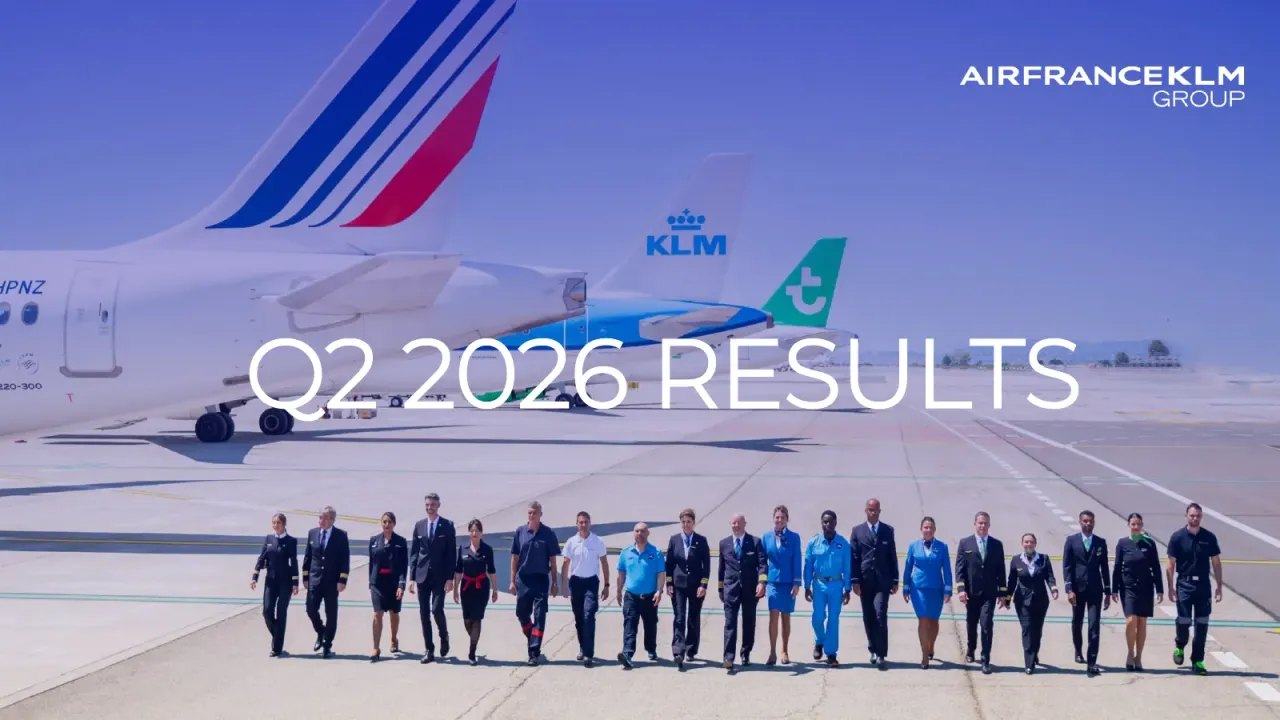
On 6ix: 6ix.com/event/air-france-klm-ads-aflyy-q2-2026-earnings-call
Automated transcript · Written by software from the replay's audio. It can mishear names and figures; the replay is the record.
0:00 Good morning and welcome to the Air France KLM Half Year twenty twenty six Results Presentation. Today's conference is being recorded. During the presentation, participants will be on listen mode only. At the end of the presentation, analysts will be able to ask questions by dialing pound key 5 on their telephone keypad. At this time, I would like to turn the conference over to Benjamin Smith, CEO and Steven Zott, CFO. Please go ahead, sirs.
0:28 Thank you. Good morning, everyone, and thank you for joining us for Air France KLM's Second Quarter twenty twenty six Results Presentation. As usual, I'll begin with the strategic and operational highlights of the quarter before handing over to Stephen Zott, our CFO, who will walk you through our financial performance in detail. I will then return to take your questions together with Stephen Andre Guy, Air France CEO and Marianne Rintel, KLM CEO. As the entire industry, Air France KLM continued to operate in a highly volatile environment this quarter, yet we delivered a strong commercial performance. Good revenues increased group revenues increased by nearly 10% to €9,300,000,000 supported by growth across all our businesses.
1:16 Passenger demand remained robust with more than 28,000,000 customers traveling on our network during the quarter. As anticipated during our last quarterly update, higher fuel prices weighed on Q2 profitability. Our adjusted operating profit reached €484,000,000 representing an operating margin of 5.2%. At the same time, we continue to strengthen our financial position. Recurring adjusted operating free cash flow reached €920,000,000 for the first half of the year, while our cash at hand rose to more than €10,000,000,000 Fleet renewal remains a central priority to improve our financial and environmental performance, while next generation aircraft now represent 38% of our total fleet, driving both an upgraded customer experience and higher operational efficiency.
2:06 So we're going spend a few minutes on the fuel situation. During the second quarter, following the escalation of the conflict in The Middle East, our fuel bill increased by approximately €900,000,000 compared to last year. However, this remained below the US1.1 billion dollars increase we had initially projected at the start of the quarter. Thanks to our strong commercial performance coupled with disciplined pricing and cost management, we successfully recaptured approximately 86% of that additional fuel bill. This once again demonstrates the resilience of our business model in an uncertain market. Looking ahead, while the outlook has improved relative to the assumptions we shared in April, we still expect our full year fuel bill to be roughly US1.9 billion dollars higher than in 2025.
2:57 This reinforces the absolute necessity of maintaining the pricing agility and cost discipline that have underpinned our performance throughout the first half of the year. So turning to Slide four. Premiumization continues to be a structural driver of our commercial performance and revenue quality underpinned by robust global demand for premium travel across all our core markets. Premium cabins now represent 38.5% of our total passenger revenues continue to expand their share within our overall revenue mix. During the first half of the year, revenues in Business and La Premiere grew by 11%, while Premium and Premium Comfort revenues increased by 13%, in both cases significantly outpacing our capacity growth.
3:49 This positive momentum was widespread across our global network with standout performances in India, Asia and The Americas. I'd also highlight the sustained contribution of high yield leisure travelers who continue to provide strong structural support to this premium growth trajectory. Turning now to the next slide. Our ongoing ambition is to elevate and inspire our customers at every stage of their journey, while continuing strengthening the global appeal of our brands. During the second quarter, Air France continued to showcase the finest in French hospitality and gastronomy both on board and the ground. In partnership with Groupe Aeroports de Paris, we launched Paris Stopover, a new offering that allows passengers connecting in Paris at Paris CityG Airport to extend their stay by up to four days, providing travelers a seamless curated opportunity to explore the capital and its iconic sites through exclusive partner offers enriching their journey before flying onward.
4:47 At the Cannes Film Festival, the iconic Air France beach once again elevated our brand presence, while this summer our pop restaurant in Marseille is bringing our long haul business cabin dining experience to an entirely new audience and location, reaffirming our presence in key French cities. We also further continue to elevate our ground product with Air France opening a brand new lounge at London Heathrow Terminal 4 and unveiled an enhanced La Premiere Lounge at Paris CDG Terminal 2E, while Transavia inaugurated its very first lounge at Paris Orly Airport at Terminal 2, marking a major step forward in elevating the passenger experience across all customer segments. For KLM, the brand reinforced its regional and international visibility through its long standing partnership with the KLM Open Golf Tournament, one of The Netherlands' premier sporting events.
5:40 On the fleet and operational front, I'm delighted to highlight the future entry into service of KLM's first Airbus A350 alongside KLM being named best cabin service in Europe, a distinction that reflects both the dedication of our crews and the consistency of our products investments. Our loyalty program, Flying Blue, also achieved exceptional recognition at the renowned Freddie Awards, earning the Best Program in the World award for the second consecutive year. Flying Blue also swept four out of six awards for the Area Europe and Africa, including Best Redemption Ability. This award in particular highlights the sophisticated joint work between our revenue management and Flying Blue teams. Finally, on the sustainability and operational efficiency front, we signed a key five year agreement with GE Aerospace for Fuel Insight.
6:32 This extends a state of the art fuel optimization tool across all group airlines, allowing us to further refine fuel planning and reduce emissions. Turning now to Slide six. We continue to pursue our ambition of building a truly pan European global champion through disciplined consolidation. As you already know and subject to regulatory approvals, we intend to increase our stake in Scandinavian Airlines system, SAS, to 60.5%. We expect this transaction to close by the end of this year, further solidifying our position in Northern Europe and enhancing the reach of our overall network. Furthermore, yesterday, we submitted a binding offer to acquire a strategic stake of up to 49.9% in TAP Air Portugal.
7:21 If selected, Lisbon will be positioned as the group's unique hub in Southern Europe, significantly expanding our connectivity to key growth markets, particularly South America, Brazil and Africa.
7:34 This transaction would unlock substantial synergies for both TAP and Air France KLM, while offering our customers even greater global choice. Both opportunities are fully aligned with our long term vision and demonstrate our disciplined structured approach to strategic consolidation. And now with that, I'll hand over to Steven, who will walk you through our financial results in more detail. Thank you, Ben, and good morning, everybody. Let's start maybe with a remark our new definition of operating profit. We had current operating income before, but we changed already to IFRS 18. So we're not only a leader and innovator in aviation, but even in accounting. So having said that, let's start with the good news. You see that unit revenues were up 9%.
8:26 We guided fuel that we expected around 60% fuel recapturing, and we are now at 85%. That is onethree is related to a lower fuel price. There's $200,000,000 lower fuel bill in the second quarter related to the price. And but the main part is coming actually from the unit revenue. We had very strong revenue in cargo. We actually beat our cargo unit revenue with 13% as expected. On the passenger revenue, it was 3% higher than what we expected. And also, Transavia did 2% better. At the same time, we had our unit costs under control. We are still within the guidance between zero to 2%. And I will explain you later, if we don't have all these problems with the spare parts, we would have done even better.
9:13 But all in all, despite the fact that we have a lower adjusted operating profit, we are quite satisfied with this result for the moment. But there's still a lot of uncertainty in the world. If we go to Page nine, you can see per business segment how we are performing. So as said, and I'll come back on that later, the unit revenue is very strong on the passenger side, 8.9%, but cargo is up 26.7%. So cargo is benefiting from one, the fact that people probably, if they need speed, they prefer a plane above a ship given all the circumstances in the street of Hormuz. And of course, there's also the increase of fuel price, which always impacts significantly the unit revenues at the Cargo. If we go to Transavia, we increased our capacity with 7%. There was an increase of the fuel bill of €100,000,000 That could not be fully offset. So we see that only unit revenue is up with 1.6%, And you need around 10% to, let's say, to recapture your fuel impact.
10:20 So all in all, I think we could not do that on Transavia. I think we are not the only in the industry which are seeing that we cannot fully recapture what we have, let's say, in the low cost market. The good news is that still the unit cost is decreasing with 2.5% for our Transavias in this quarter. The maintenance, we grew further our revenues, we grew further our order book, but here we are hampered especially by in the engine sector because we don't have the spare parts to perform all the shop visits, which we have in our shop. So we have a reduction in result of the engines. It's compensated by a stronger improvement on the component side, especially on KLM Engineering and Maintenance, where we did much better than what we did last year. So all in all, the result is more or less flattish compared to last year, but there should be more coming when we have this spare parts situation solved in the supply chain.
11:20 If we then go to Page 10, then I think the good news is to see that KLM that we see the results of back on track. So KLM actually stabilized the result. We see that Air France was impacted by the higher fuel price, which was partly offset by passenger and cargo unit revenues. We did, of course, deeply the analysis internally about these two carriers. First, KLM is always a better Q2 than Air France. So let's say, if you look at 2025, 42% of the profits of that year was made in the second quarter for KLM, where it's just 35% for Air France. Second, KLM is bigger exposed to Asia, where we benefit a lot from the higher yields in the market.
12:10 So all in all, that is also one of the reasons that actually KLM could have a higher fuel recovery than Air France. KLM was almost at 100% fuel recovery in this quarter. So with that, you see that it's good to see because I should also mention that the cost control is really there and that we see now a reduction of unit cost at KLM. So the back on track is becoming really effective. If we go to Page 11, you see the, let's say, the world map and our business performance on revenues. As I said, very strong performance on the long haul, more than 11% yield increase.
12:55 First in business, still doing very strong, as explained also by Ben, 11% in yield, almost 2% in load factor up. Premium economy, we grew our capacity almost with 8%, but still the pricing is up 9% and then economy is at 6%. You see that North America is still holding strong despite the fact that we increased our capacity by 7%. And of course, Asia and Middle East, where we had a yield increase of 20%. The capacity is down, but be aware that it is minus 18%, one-eight, for The Middle East. And the goal the goal, we are almost, let's say, at 0% capacity. So we grew the rest of Asia at a very attractive yield in this quarter.
13:41 Then on the short and medium haul, you see that we increased our load factor, and we are slightly up in terms of yields. But all in all, it's not enough to actually recapture the increase of our fuel price. So very good news on the long haul, so so news on the medium haul. And I think Transavia, they increased significantly capacity. They were able to increase also the load factor. That's good. So the demand is there, but the pricing power in this segment is rather difficult, which we also have seen at our competitors. If we then go to the unit cost, so we are up at 1%, which is fully in line with our full year guidance. There is the 0.4% on the premiumization, which we earn back easily to our unit revenues.
14:31 And it's a bit of a pity that actually the better operations is not completely visible in our results. We had less wet leases, which has a positive impact on our unit cost of 0.6%. We have due to all the fleet renewal, we gained in fuel efficiency, so we should have gained 1% out of the operations. But unfortunately, due to all the problems in the supply chain, we had higher maintenance costs. And at the same time, we have a lot of leases for engines and rotables, which are included in our unit costs. So all in all, that is the bad news on our operations. And at the other side, you see that we are partly compensating the labor price increase by productivity. Then on the cash side. So on the cash side, we did actually better if you look at our recurring adjusted operating free cash flow than last year. Last year, we were around EUR 800,000,000.
15:24 We are now above EUR 800,000,900 million. The net debt is more or less flattish despite the fact that we paid €250,000,000 of deferred social charges and wage tax, and we also paid the cargo claims. So if we would not have these incidentals, we would actually have reduced the debt. You see that the leverage is down with 0.1 compared to the beginning of the year. So all in all, the net debt is quite stabilizing despite the fact that we still have this, let's say, impact of the COVID years, which are still running through our cash flow. But that will end from the next year, where we will see that we don't have that impact anymore, only slightly on KLM where it runs for €200,000,000 on the wage tax till October.
16:14 Then we go to the balance sheet. So very strong cash at hand, 10,300,000,000, much above our targeted liquidity. We put two senior bonds in the market at very attractive prices, so let's say, around 4%. I think the timing of the last bond was really, really great if you look where we were in terms of peace treaty for the Street Of Hermos and what happened afterwards. And we also put in place a new multipurpose credit facility. We didn't draw that. It is the purpose to draw that. Actually, it is a way to manage the fact that at a certain moment, we have to redeem the bonds and to issue a new bond. So that you have more flexibility and agility during the year so that you don't put a lot of cash on the bank accounts to secure that you can redeem a bond any time. You see that we reduced the very expensive sustainably linked bonds, which had a coupon of over 7%.
17:10 We did that just after the Ukraine war started and when we had to repay the Peugeot in France. You see that we repaid the KLM perpetual, which had a coupon of almost 6% in Swiss franc. And we paid back this week the hybrid of Apollo with a coupon of 7%. So all in all, you see a balance sheet simplification and a reduction of our interest cost. And that has also been let's say, if you look at the credit ratings, we were reaffirmed in May and June on our credit rating. Then we go to the outlook. So the biggest chunk is, of course, again, the fuel bill. It is still very stable unstable, sorry.
17:56 We had €200,000,000 gain in the second quarter compared to our previous guidance in dollars. Q3, you see that we go to 600,000,000 up year over year, which was €200,000,000 less than what we guided previously, which was around €800 And Q4, we are still at 500,000,000 So they didn't change so much for Q4, unfortunately, because we all expected that the fuel price would come down further because of the U. S. Elections. If you go what we did on the hedging, so we stopped at the end of Q1 our hedging policy. We did still some tactical moves if there was any news coming from the President of The U. S. Regarding his view of the war. So every time there was a drop in the jet fuel price or the oil prices, we acted on it. But in general, we restarted our hedge strategy policy during the PEACE treatment. So that was in June.
18:53 So we continue our hedge strategy, but we have a maximum price. So we don't do it at any price. And if you look where we are for 2027, you see that we are 40% hedged. At the end of Q1, we were 33% hedged. Usually, we should increase it by 10% per quarter. So actually, we lost around 3% to 4% in our hedging strategy due to the pricing. We stopped all the hedging, by the way, for the year 2026 because we have already a portfolio of 67%, which is close to the 70%. If we then go to the booking trends, you see that there is a drop in bookings. So it's minus two percent for the long haul, minus two for the short and medium haul. But Transavia is at 2%, which is very promising for this quarter.
19:44 It's always a balance between yield and load factor. We see that there is, in general, a trend of later bookings. It has probably also to do that ticket prices are higher, So people are waiting and wait that the fuel price comes down, which is not going as fast as we all expected. So what we see up to the first four weeks of July, and I talk about passenger business numbers, we see that the load factor is minus 1%, but at the same time, the yield is up 7%. And everybody can then do the math on the fuel recapturing because it all depends what the fuel will do, but you can have an order of magnitude. And we still see strong cargo unit revenues, not in the 20 ranges, but at least you should expect something with a double digit number, but at the lowest, lowest side of a double digit number. So I think I guide you more than I should actually do.
20:39 If we go then to the capacity, you see that we are of course, we are getting into the year. So we have more visibility of the capacity because half a year is already behind us. So for the long haul, it is around 2%. For the short and medium haul, we are at minus 1% for year over year. And on TransEnhav, yes, we are at 8%. So in total, you see that we will grow this year 2% to 3%. We have very previously guided two to 4%, but we all have to see still what will happen in the winter because if we have these very high fuel prices, we probably will act further to reduce capacity. And then on the outlook, so group capacity already explained, to 3% unit cost, zero to plus 2%, where there is 0.5% coming from the premiumization CapEx below €3,000,000,000 and our leverage between 1,522,000,000 Before I hand over, I have and probably everybody knows already in the news that Michio Klinkers is leaving his position. He will become VP Commercial Controlling and Alliances in our group entity, and we will have Rommel Vellend, who is currently responsible for the fleet financing in Air France.
21:57 I worked with Roman many years when I was the Head of Audit of KLM. We will miss Michel. I think everybody will appreciate his honesty and his transparency. So we really will miss him. I think we had a very bumpy road together the last years from, let's say, the capital increases we did in 2022 up to the moment where we are. So I will wholeheartedly
22:20 thank Michel for all his contribution to this company. And with that, I hand over to Ben Smith. Okay. Thanks, Steven. To conclude, I wanna express my sincere gratitude to all Air France KLM employees for their hard work, dedication, and resilience throughout this quarter. And together with Marianne and Anne, we thank all our teams who remain on the front lines to run our operations safely and smoothly through this busy peak season. So thanks for your attention, and we're now happy to take your questions.
23:07 The next question comes from Alex Irving from Bernstein. Please go ahead. Good morning. Two for me, please. First of all, on premium revenues. These keep outgrowing economy despite premium capacity continuing to grow quite quickly. How long can that go on? And what is the risk that as competitors also all invest into their own premium products, then premium yields end up compressing?
23:33 Second question is around the recent SAS fleet order. They'd ordered some AC30s but no AC50s. And I imagine you're likely involved in that decision. Why is there no more AC50 order? And is this maybe a play that's too large the role you see SAS playing in the group network structure? Thank you. Thanks, Alex. On the premium premium cabin front, so our premium economy cabin's business class and first class, we continue to retrofit the existing fleet with a higher percentage of premium seats, as you know, and the new aircraft coming in are are equipped with a with a higher percentage of premium seats as well. So the markets are really strong, especially coming inbound from from other countries, in particular, The Americas.
24:31 The power of the US dollar is is quite helpful. And, you know, the attractiveness of Paris in particular continues to to grow. And the the Air France brand Mhmm. I think is the the image of the Air France brand, the the strength of the brand is, you know,
24:54 is reaching is reaching, I'd say, levels that that were not there a few years ago. And because we were starting from a lower base, I think the numbers you're seeing from us are showing much more positively than some of our other competitors. So that's that's number one. And on the KLM side, you know, premium comfort was not there. I mean, we, KLM was one of the last carriers to introduce it. So here, again, a very low base. We still don't have it on the entire,
25:25 KLM fleet, so this will continue to, to improve. And as you know, with most airlines, premium economy is usually, the highest yielding, real estate on the airplane. So that is another, another, I'd say, element to what you're seeing there. On the SAS fleet side, we're not directly involved, as you know, because we don't control the company as of today, and we do not we don't manage the company. However, the the fleet on the on the fleet side, SAS already has Airbus a three fifties more than enough to cover their long haul network. And on the shorter international flights and shorter I mean, you can go up to ten, twelve hours very efficiently with the a three thirty neos.
26:14 It is it's a very efficient airplane. We know the airplane quite well. We studied it extensively. We we didn't buy it for the Air France KLM group, but, you know, we were fully aware of its strengths And for SAS and its geographical position and its growth opportunities, we're very happy that that's the aircraft they selected.
26:36 Alright. Thank you. The next question comes from Jared Castle from UBS. Please go ahead.
26:48 Good morning, everyone. And as Stephen said, thanks, Mikhail. Probably, I'm sure all the analysts appreciate all you've done for us. Three from me, if you don't mind. Obviously, the announcement around TAP, you have touched on it. I think the next stage is Portuguese government comes back maybe sometime in September.
27:09 Could could you then see a situation where there's a next round of bids? And, you know, can you give any color how you feel you've differentiated your bid, compared to Lufthansa? I mean, a lot of mention around Delta, for instance, and MRO, but I'll leave that to you, Ben, I guess. And then secondly, you kind of highlight, obviously, and you don't split out cargo profits, but obviously, very good yields. I mean, is it fair to assume that profitability in cargo internally is going up quite nicely and there's all the pressure is in the passenger side of the business
27:46 and looking forward, that's where the pressure is expected to stay?
27:52 And then lastly, we saw probably two weeks ago, you know, the EU, changing or proposing to change, the rules around the ETS scheme, which will encompass, you know, 5,000 kilometers now. I'm just interested, to hear if you've done any math in terms of how much more of your network, you think will be impacted by 2029 or, you know, potentially even what the additional cost would be, for you under the expansion of the scheme? Thank you.
28:27 Okay. Thanks, Jared. The the TAP process and how the Portuguese government looks at our bid and the the other bid we understand has been submitted is you know, we're not in control of that, you know, for us to speculate how they're going to, to move forward. Obviously, when these kind of bids have, have evolved in the past, they've all done so in different ways. So, I mean, in the end, we'd like to prevail, between now and and prevailing. I assume there's gonna be lots of different
29:05 iterations of how the how the deciding government is going to pick, but, I think it's it's much too early to speculate on that, that process.
29:17 You know, what our strengths, which I think are well known by those who follow follow this file or those who've been following this file is, you know, we are not a centralized airline. We are much more a group. We are much less centralized than our our two major competitors in, in Europe. We have we have a fantastic setup with, our three major brands, Transavia, KLM, and Air France. And in particular, KLM, we have November twenty one year history with the first consolidation
29:52 operation that took place twenty one years ago. And we have a head office for KLM in next to Amsterdam Schiphol. We have the brand is secure, which was a a big concern at the time. It's a similar concern in Portugal. We've invested a lot of money into the KLM brand, and it's it's paid off. We have we've maintained the strategic jobs, and those people who add a lot of value to to the strength of the group, and they are based in Amsterdam. So we have a good balance of talent throughout our network. And this you know, I think this bodes well for for many many parties that are interested in the on the TAP file. We also, you know, is we're surprised that the Portuguese or the TAP, you know, Portugal unions have publicly come out.
30:47 They are nervous about what's what they're seeing with the other bidder. We've had good alignment with our staff on on our strategies over the last eight years. We put a lot of effort into that, and we see a very different result, you know, to the east of of us. So those, I think, with all stakeholders, hopefully, gonna it's going to help our bid,
31:14 and we'll see, we'll see how things go, going forward. And for cargo, I'll let Steven touch on this one. Yes. You can imagine that, of course, this cargo contribution is helping a lot our long haul network. So we we don't have an integral profitability for cargo, as you know, Gerard. We look from it from a contribution perspective. Of course, we look at the profits from our full freighter. So it helps a lot if you compare it to last year. But we take it into account for the full contribution of our long haul network on which cargo is indeed quite bringing a lot of value to the profitability. And on the ETS
31:59 change or proposed change, so going up to now destinations up to 5,000 kilometers, there's pluses and minuses. Obviously, it's now going to impact some of our biggest competitors, which will level a little bit the playing field.
32:20 And then we also really welcome the obligation for member states to allocate at least 50% of ETS revenues to the decarbonization of ETS sectors. So that's a big plus. At least the money is going towards something that would be good for our business. And we, I mean, we firmly believe it should be, you know, it should be 100%.
32:40 And we're also well we also welcome the extension of SAF allowances and the commission's openness to a book and claim system, both of which can support, you know, the scale up of sustainable aviation fuels. However, we're totally opposed to any additional ETS related costs that would further burden the aviation sector and weaken its ability to finance its own transition. Ensure a global level playing field, and we've been saying this for a while as well as our partners and competitors. We believe the EU must continue working to strengthen CORSEA as
33:15 the global framework applicable to all airlines and not add additional burdens such as this unique European tax. So to size the additional cost of this, it's a bit early for us. Mean, net net of what benefits we will now get from the lowering of the level playing field and what that would bring along with this ETS charge increase to come up with the net value. It's a bit early for us. We're still calculating what that could be. And Jared, sorry, let me feel yes, Jared, I'll come back on the cargo. It is if you want the number because we feel that you should give him a number in my last analyst call. So it's around EUR 100,000,000 additional contribution. Thanks very much.
34:05 The next question comes from Steven Furlong from Davy. Please go ahead. Yes. Good morning, gentlemen. And I echo comments about Mikael. Thanks for all your help. I'm assuming you're kind of, and it's not mentioned, but that your medium term margins and other targets are unchanged. And I presume you kind of model out or make some assumptions about what the
34:31 that the there's a recovery in your competitor airlines in The Middle East. That's the first question. And then the second one, just on the merger or the acquisition or the bid for TAP.
34:50 Just wanted, Ben, some general comments on your view that you referenced SAS where you don't where you didn't have controls. And of course, it's only a minority stake in TAP. But are you you're obviously comfortable enough that you will have a big say in that business going forward, so that'd be great. Thank you.
35:12 Hi, Steven. Just if you could clarify the second question again, it didn't come through clearly. Yeah. No. So what I was basically saying, because you're required the bid is is only a minority stake, does that, let's say, prevent, I I guess, a kind of control you'd really like to have with the company or it doesn't really change things?
35:44 So let me come back on your question on TAP. Let's say, on SAS, we have a minority stake, really a minority stake, and we didn't go to, let's say, the merger process at the EU. So that's totally different. For TAP, we talk about a much higher stake. It is up to 49%. And we will go to a merger process. So we will have the synergies which we usually have on the network, on the cargo, on the MRO, we can completely work together. And that also
36:15 is a reason that for SAS, we could implement immediately, let's say, the the shareholding, but we could not implement all the synergies. The synergies on SAS for part came due to the fact that they moved from the Star Alliance to the Sky team. So we have code shares, and we work together, but we don't work together on the loyalty. We don't work together on network coordination. We don't work together on pricing. So we have a lot of synergies to come from SES. And for TAP, again, it is a minority share, but we have, let's say, so we can cooperate together with TAP to optimize both companies. If we win
36:53 the bid, of course, just a remark. And then there was a question on The Middle East for you, Ben. Well, it's more a comment on the mid the midterm targets, and, obviously, you're them greater than eight percent margins. But Yeah. Sorry. We we we we
37:10 yeah. Yeah. Yeah. So what let let's say we we just come from our strategy session with our board, which we had last month. Of course, we keep our midterm target. Otherwise, we should adjust it and tell you. There is, of course, an uncertainty where we will be in 2027 because it's very difficult to to see what will be the fuel price, etcetera. But we still keep our trajectory for 2028. And you can imagine that we are let's say, we that there's a kind of linear
37:42 line where we are today and where we will end in 2028. So that is the discussions we had with our Board. But there's a lot of uncertainty still to for Q4 at the moment. So in that context, it's always difficult to tell what will be the exact number in the meantime. But for 2028, we are still adhered to our targets. Thank you.
38:10 The next question comes from James Hollins from BNP Paribas. Please go ahead. Yeah. Thanks very much. And, Michel, I never knew how to say your name correctly, but good luck. And then two questions, please. Just on the ADP announcement yesterday, maybe just get your broader thoughts, first take on that ADP proposing tariffs of CPI plus 2.1%, 2027 to '34, whether you're comfortable with that, whether you plan on challenging it if you can. Just let us know your thoughts there. And secondly,
38:44 Steven, on unit cost ex fuel, up 0.5% Q1, up 1% in Q2, clearly flagged those maintenance costs. Maybe just run us through, I think you were hinting at a few bits, but run us through how we should be thinking about some of the puts and takes on into Q3 and then in particular on MRO costs or staffing, etcetera? Thank you.
39:18 We are trying to get Andre Guy on the line. Sorry. It was difficult to find the mic. You're talking about the I think I Go ahead. This is me. You're talking about the Air France proposed economic regulation agreement. We think in this increasingly competitive market environment that it's a strategic priority to strengthen the efficiency of our hub in Paris Charles de Gaulle. You know that we have been working very closely with Aeroports de Paris with the Connect France initiative that we launched last year at the Paris Air Show.
39:57 We support indeed this long term economic agreement, because it provides visibility that we need to deliver the investments that are required to modernize our airport. And you know that we account for around half of these airport activity.
40:16 We worked with our report on this investment program to focus on the key priorities, which are the optimization of the passenger and aircraft flows, the simplification of the passenger journey, the increasing that is really needed of the number of contact stands and also the acceleration of the decarbonization and the strengthening of the connection with the railway station. So the intermodal connectivity, it's clear that the it and it's we need to make a significant investments. Significant investments have already been made for other areas in Paris, including the full refurbishment of Terminal 1, which now offers 100% contact stance and major upgrades to the terminals to A, B, C, D and all E3.
41:15 So we've not been developing our hub since the opening of the whole M that was in 2012. So you see a while ago, and the hub has grown, but with capacity constraints that have emerged with several critical points, particularly on the aircraft parking stents and also the border control facilities that are quite congested. So, this proposed investment plan addresses those challenges. So we fully support it. Stephen. Yes. So let's say the trend on the maintenance cost will continue. It's not that it's going up further, but let's say we still see an increase year over year in the same kind of magnitude.
42:05 I don't expect that the OEMs get their X together on this area. So we have that in our forecast, but that's still all within the guidance of the 0% to 2%. So if you take out the 0.5%, you could say it's between 01.5%. So we offset that. We have, of course, the fuel efficiency, which you have seen in the second quarter. We still have benefits of the fleet. We have less wet leases, especially in the third quarter, so that trend will also continue for the summer. And last but not least, we expect a better operation than we had last year, and that should also contribute to our unit cost in the customer compensation. So the increase of the maintenance will be offset by other operational measures.
42:53 Thanks very much. The next question comes from Harry Gowers from JPMorgan. Please go ahead. Yeah. Morning, everyone. Two questions, if I could. First one, Stephen, just going back on your comments, I think, on July yields up 7%. I was wondering if you could give any color on what Asia and The Middle East was within that figure. With Middle East capacity coming back, I presume Asia yields kind of normalizing will be the main difference between the plus 7% and what you guys delivered, the 8%, 9% in Q2? So maybe just a bit more color on that. And then second question, just one for Ben, a big picture one. Once things are fully normalized, do you think anything will structurally change off the back of the Middle East conflict, whether that's positive or negative for for Air France-Klm? Or are we just kind of gonna go back to where we started in terms of earnings trajectory, but just with some volatility from the conflict in between. So yes, anything structurally which can change into 27% or 28%?
44:00 Thank you, Harry. Yes. If you look at Asia, of course, we don't have the dynamics, which we especially saw in March and April, where there was so much tight in terms of seats availability, and we could give the seats actually what usually should have given by the Middle East carrier. So we benefit a lot of that at that moment, but it's still doing much better. So you can still talk about double digits, but also more starting with a one and not starting with a two or with a three. So we benefited a lot from at that moment. Of course, we should also take into account that the fuel price is down. But of course, there's much more availability of seats from everybody because there are of course, we are in another booking curve than when we were in March, April when it just started.
44:52 So that is one. And also the Middle East carriers are coming back. So but we still have a benefit in terms of yield and, of course, unit revenue because also the load factor is quite good. And on on how this this this conflict in The Middle East could structurally impact Air France KLM going going forward, as of today, we don't see that impact potential in the mid to long term. So we believe things will come back to where we were before as of today, and, hopefully, that will be that will be soon. Great. Thanks a lot, both. The next question comes from Andrew Lobbenberg from Barclays. Please go ahead.
45:42 Oh, hi there. And, yeah, let me just join the chorus of thanking Michelle and and and also Maro Anne who who also left earlier. They've been a great great partnership, and we'll miss them. Just coming back on where you were just being quizzed on on the Asia fade from Harry. Can you tell us I mean, you're pooling the Asia and Mideast, revenue data that you give us for q two. Can you tell us what happened on the Asia routes in q two? And can you tell us what happens on the Asia routes for July just rather than the pooling of the Mideast? And then can I just ask, you know, how is trading on the overseas territories routes?
46:27 Because I think, you know, I saw some press about Air France needing to get funding. I'm not sure how the other competitors have got on fuel hedging. So, you know, you had quite healthy yields on the overseas territories market. Is that a big opportunity for you, looking into the winter with with peers perhaps less financially stable than yourself? Hi, Andrew. Can you can you repeat a little bit what is kind of coloring you want more on the Asia for me? Yeah. You told us that Asia and Mid East yields in q two were up 20%.
47:12 What was Asia? Yes. You told us that it's Okay. It's in the teens. Yeah. Yes. Okay. That is, pretty clear. Let's say, of course, The Middle East, there is a there was almost no impact. So this is actually all coming from the from the Asian part. So it was especially strong on India. It was especially strong on Korea, and it was especially strong on Southeast Asia. Those were actually driving up, let's say, the yields which you see, let's say, on Page 11. But of course, let's say, Middle East itself was not in this kind of range. First of what we still had in had a negative load factor and it's almost a flattish yield. So this is especially all coming from there.
48:07 And then your second question. Yeah. It is we are getting into the season where airlines at least burning their ticket sales. So we will see what will happen to other carriers which are not hedged. We had, of course, a big contribution from the hedge in our results, especially till the end of the year. So it's quite a good cushion. Let's see what will happen. We are always surprised that these airlines are still alive, but we benefit from it at the end of the day in our yields and unit revenues. Thanks. The next question comes from Rory Cullinane from RBC Capital Markets. Please go ahead.
49:00 Yes. Good morning. First question is, should we expect this scope to retain unit revenue increases if and when fuel costs decline, given the higher than expected recapture rates in the quarter? And then secondly, on fuel, how the hedge prices in full year 2027 compared to full year 2026? So I see you're 40% hedged. And should we be concerned that jet fuel availability concerns could recur given the ongoing conflict? Thank you. It was very, very difficult to hear, but I think I catched it.
49:47 Let's say, I gave you already indication for, let's say, the first four weeks in terms of the yields, which are not the same as what we have seen in the Q2. So there is, of course, the fact that fuel price is coming down. I gave a fuel recapturing in for the second quarter after the first quarter because I think that was very relevant. But now you see that the fuel price is continuously changing, which you also have seen in Q2. But we are let's say, we are still having an increase in our yields year over year to cover this higher fuel price. We also have still, let's say, it's in our tariff structure. We keep that still in place. If you look at the hedges, I think on Page 16, we explain it quite well. So you can see that we will benefit this year from $1,600,000,000 And the jet fuel price goes from, let's say, on average for 2026 for $1,200 per metric ton to around a thousand of metric ton. We use collars, so it is not we most of our instruments are collars.
50:55 So it's not one to one. It depends. Are you just over and above a certain level before the hedges kicks in? But you see quite an effective hedge result for this year. Thank you. The next question comes from Axel Stas from Morgan Stanley. Please go ahead. Yeah. Morning, everyone. Thanks for taking my questions. Apologies for coming back on this. But you mentioned so yields up 7%, growth factors down 1% in the first four weeks, but fuel has increased quite meaningfully in the last couple of weeks, right? So I just wanted to understand here why not higher yields?
51:43 Is it driven by demand? Is it driven by capacity? And how should we look at August, September based on the data that you can see internally? Can we assume August is softer than July, for example? And then second question is on Transavia. We have seen that the load factors are up 200 bps year over year for Q3. Can you quantify maybe the pickup in pricing that we have been seeing in July for Transavia specifically? And potentially what we can expect for August and September as well? Thank you. Hi. Sorry. We had some internal debate. So if you look at the yields, the 7%, I think what it but if you look at the current fuel price, it's not too bad, to be honest, but it depends on where the fuel price is going.
52:52 So, of course, it's up. We we gave you the curve of last Monday. So we we are pretty close to what is, let's say, the current fuel price. But you're right. If it goes up very steeply again, and therefore, don't want to give any guidance on the fuel recapture. But I think the 7% yields are well, I find them not too bad, especially if you take on average what the unit cost because it's the fuel is not 100% our unit cost. So you should take the the the part, which is related to fuel and then the increase which you see year over year. And then I think the 7%, but do your math yourself is not too bad. If you look at the two months, August is indeed a bit softer. That's true.
53:37 So July looks a bit better than August, and September looks better than much looks better than August. So I think August and September are balancing out in that sense, but we have to see because the late bookings, they are very favorable in yield. So it always is about the last two weeks when you really see some upticks in the pricing. On Transavia, Q2 is the first quarter where we've we have the Transavia numbers reflecting the full pullout of Air France from Orly Airport with the exception, of course, of the very small operation to Corsica. Transavia has an extensive network that touches the Middle East, so that's obviously impacted Transavia in a material way. So those airplanes have been redeployed across the Transavia network, and the overall balance is positive.
54:40 So it's a it's a moving the the network has taken a big shift and transition since Q1. Very happy to see the initial performance of Transavia in the French domestic market. This is one of the major underpinnings of the strategy behind Transavia. It's moving in the positive direction much faster than we expect would have expected. And if we were not in this difficult period, as you saw in Q1 of last year, Transavia continues support Air France's much stronger result than its results that it had in the past. Now as I've always said, you have to balance the two at least in this midterm until we have Transavia in a position where it can fully absorb the some of the difficult markets that Air France was operating in, whereas in the past severe losses, really bad losses were witnessed.
55:41 Okay. Thank you. The next question comes from Kirin Mulder from ING. Please go ahead. Good morning, everyone. Congratulations with your numbers in the second quarter, I would say. And, of course, I would like to thank Michel for for for his contribution to to the IR. Very helpful, I can say, very accurate and always calling back. So my question I have two questions. The first question is about KLM. So if you if you look at the numbers, so it's a little bit better, but it's purely thanks to the 100% hatching, let me say the the the hatching of the fuel.
56:28 So it was all passed on. But if you look at the progression with regard to the target of 8%, by 2027, I if in the line, it does not look very, very, very exciting, and I'm I'm very, very wondering how how you're going to to reach the targets given the progress to, let's say, the last couple of quarters. And the second question is about Portuguese acquisitions. What are your plans for, let me say, to combine with the Portuguese? More like, or is that more, let me say, network like opportunities there you see for, let me say, for example, for South America or whatsoever? Can you maybe elaborate a little bit on that? Quirijn. I will start on KLM, but we have Marianne, Rintel and Bas Bruns in the room, so they can add on it. I would say, I think it's quite promising.
57:31 It's not completely coming from the hedge. It is also coming from the unit revenue, and there is a unit cost decrease. But at the end of today, as we say in the range of magnitude and zomar. So let's let's keep that in mind. There's still a lot of work to be done, but I think it's a very good step first towards an improvement and towards the 8% margin target. And for oh, sorry. No. Hello. This is Marianne. So, yeah, the re the results improved. So it it it shows that what we are doing, that it has an effect in effect that that there's a strong, discipline, cost reduction, reduction, productivity improvements, full program running, like back on track achievements that we made within a real insecure world.
58:23 So it's step by step, and we are progressing. And on the question of of TAP and and some of the reasons that that interest us in in making this bid, well, the geographical position of of a Lisbon hub on the Iberian Peninsula is key. We don't have a strong presence in that area and access to Latin America, in particular to Brazil. South America is a really important market for us. So if we were successful with TAP, that will strengthen our position there. Synergies, of course, major justification behind this bid. Brazil, obviously, is the major market transatlantic for TAP.
59:12 And one of the major objectives is to better align our network, our pricing, all of that commercial management that we're hoping to put in place if we are successful in this bid. We've done, even before taking management control, which you've heard us already say at the beginning of this call, the synergies that we've been able to enjoy from SAS without management control have given us confidence that even early stages before we're able to align, if we do win, would be strong. Thank you. The next question comes from Jack Rayburn from Bank of America. Please go ahead.
1:00:14 Good morning. Standing in for Maniba today. Three questions from me. What are your yield expectations on the North Atlantic for the remainder of the year? Do you expect yield growth to continue? And have there been any changes to The U. S. Point of sale strong, European point of sale weaker rhetoric? Secondly, I was wondering if you could provide more details on cargo. How do you view supply demand dynamics moving forward? And do you expect this market to remain structurally tight despite returning Gulf capacity due to hyperscaler and AI demand? And finally, when do you think airlines will start to make decisions about potential winter capacity rationalization? And do you expect it largely into Europe or on the Transatlantic too? Thank you. Jack, let's say, if you look at The U.
1:01:07 S, yes, we still expect strong pricing. So we are let's say, we don't expect that the prices are coming down. You know that our competition over there is not hedged. So with the current fuel price, they need much more yields to recapture all the fuel costs than the European carriers need. So we are staying in that market, and we expect a strong yield. If you look at it from the point of sale, we have seen that again, indeed, in this quarter, The U. S. Point of sale is getting stronger. And we are now almost reaching a point that twothree of all our passengers back and forth from The U. S. Are American passengers. So we are really, really dependent on that part of the world, but it is still doing very strong and very well. On the cargo, you have to keep in mind capacity is in the belly, and most of the capacity in the belly is not totally sold out except for our Asian network. So it also we benefited also part because we are stronger to Asia in the last quarters where we could also have better yields than, for instance, towards The U.
1:02:18 S. So I think the supply demand will not change as much. All the freighters of The Middle East are in, so there's still the competition over The Middle East. Probably some forwarders are trying to avoid it to have no insecurity. But all the capacities so from a supply demand, I don't expect any anything different, expect except that I expect in the current circumstances that there's a little bit more preference for flights above shipping due to the fact of the security that we will make it at the end from A to B on time. And then on the winter capacity, yes, I think our profitability on the long haul is quite good. So if we are going to reduce capacity, it's probably more on the European part. Thank you.
1:03:08 The next question comes from Antonio Duarte from Goodbody. Please go ahead. Good morning, and thank you, Mikael, for all your help. It was a pleasure working with you. My question relates Flying Blue. Of course, I appreciate it's still a small part of your business. But maybe taking a step back and having a look at the progression of that part of the business and of the strong margin, just asking your thoughts about progression there for growth going into FY 2027 in the outer years. Thank you. Yes. Antonio, good morning. Sorry, I should have addressed much more on the flying blue if you see what is the improvement in the second quarter.
1:03:56 We are really, really optimizing, let's say, all our partner activity, and we see more incremental revenue. So the revenues are up with more than 40% and driving up further the profit. So we expect a lot to come. Probably, you have seen the IAG release of their AVEOS program. We will come back to you more in-depth when we will do another Investor Day, probably somewhere in 2027. But we have high expectations from this domain. It is the the gift which keep on giving. You for your questions. Let me hand the conference back to the speakers for closing remarks.
1:04:46 Okay. Well, thank you for participating on the call today, and we wish you all a fantastic summer. And we'll talk with you at our next call in November.
Follow Air France-KLM SA into a list and get an email when it puts out news.
CEO at Air France KLM
CFO at Air France KLM
CFO at Air France KLM
Air France CEO at Air France
KLM CEO at KLM
at Bernstein
at UBS
at Davy
at BNP Paribas
at JPMorgan
at Barclays
at RBC Capital Markets
at Morgan Stanley
at ING
at Bank of America
at Goodbody