Replay available
Aeroports de Paris (Euronext:ADP) Q2 2026 Earnings Call
Aeroports de Paris (Euronext:ADP) Q2 2026 earnings call, held 2026-07-30. Watch the replay and read the transcript on 6ix.
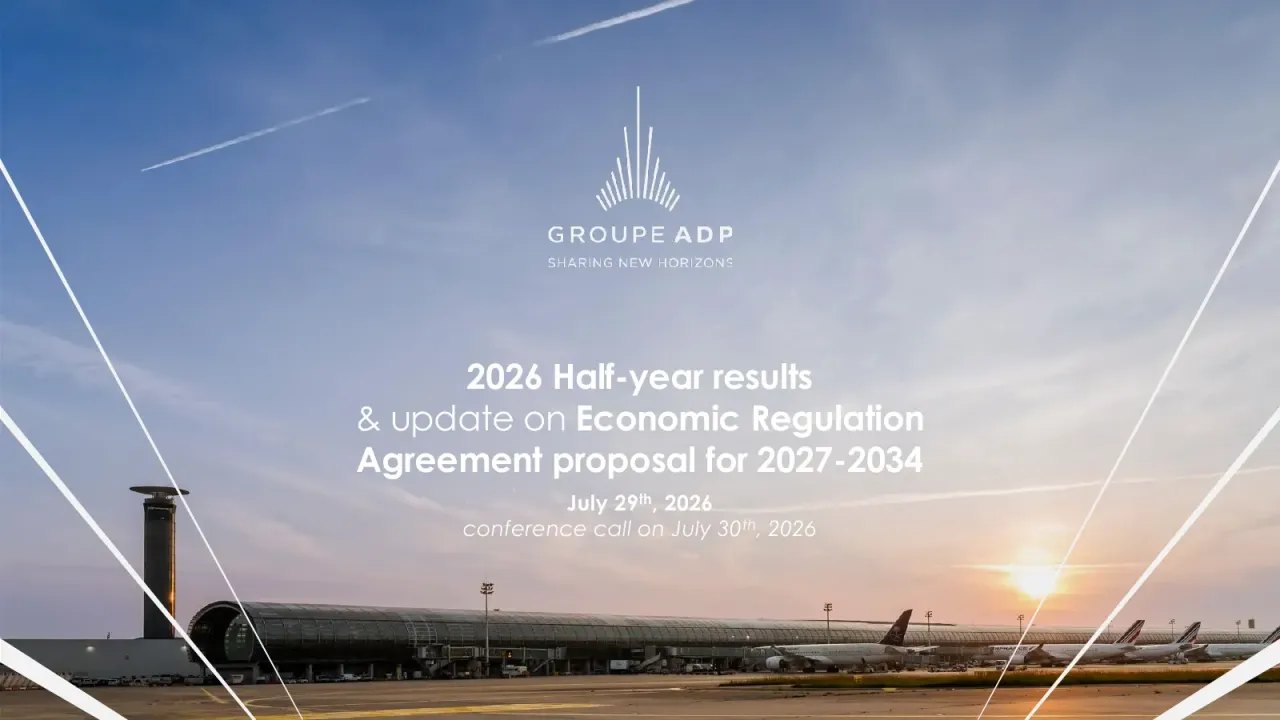
- Company
- Aeroports de Paris (EURONEXT:ADP)
- Period
- Q2 2026 earnings call
- Date
- Thu, Jul 30, 2026, 2:00 AM ET
- Replay
- Watch the replay on this page · 1 h 1 min
- Results news release
- Aeroports de Paris : 2026 half-year results. A resilient performance in a challenging environment · Wed, Jul 29, 2026
On 6ix: 6ix.com/event/aeroports-de-paris-sa-arrpy-q2-2026-earnings-call
Replay
Transcript
Automated transcript · Written by software from the replay's audio. It can mishear names and figures; the replay is the record.
0:00 Good Group ADP twenty twenty six Half Year Results Presentation. For the first part of the conference call, the participants will be in listen only mode. Now I will hand the conference over to Cecille Combo, Head of Investor Relations to begin today's conference. Please go ahead. Good morning, everyone, and thank you for joining us for our twenty twenty six half year results presentation. I'm here with the management team Philippe Pascal, Chairman and CEO Justine Coulart, Deputy CEO and Crystal de Robillard, Group CFO. Philippe and Crystal will first go through prepared remarks on H1 and on our economic regulation agreement project before we open the line for a Q and A session.
0:52 Before we begin, I would like to remind you as usual that today's discussion may include forward looking statements, which are subject to risks and uncertainties that could cause actual results to differ materially. For more details, please refer to the disclaimer included in our press release and on the last slide of our presentation. And I will now hand over to our Chairman and CEO, Philippe Pascal. Thank you, Cecile and good morning, ladies and gentlemen. Thank you for joining us to discuss our twenty twenty six half year results and progress on our economic integration agreement project. Let me first start with the key message for the first half on Slide three.
1:38 The first half reflects two realities. First, the operating environment became progressively more challenging, while the direct impact of the Middle East conflict has gradually faded since April. Its indirect consequences have spread more broadly affecting traffic growth and airline behavior and ultimately demand trends. Second, the group demonstrated resilience. We reacted quickly by implementing targeted cost and efficiency measure expected to deliver EUR40 million to EUR60 million of savings. This action will help protect margin while preserving our strategic investment and our quality of service.
2:25 At the same time, we continue to deliver on our industrial roadmap and strategic priorities. We completed the partial monetization of JMI airports, crystallizing €257,000,000 of value while continuing to prepare the group's next strategic plan. We also reached an important milestone on the future economic regulation framework, which will provide greater visibility for the twenty twenty seven to two thousand and thirty four period. I will come back to this important topic in the last part of this presentation. As a result, while we are revising our traffic and EBITDA guidance to reflect the current environment, we remain confident in the strength of our business model and in our ability to deliver long term value creation.
3:19 Slide four shows that despite the challenging environment, we delivered key investments. In Paris Saint Laurent, we commissioned a new baggage handling system at Terminal 2. In India, GMR added two airports to its portfolio. And in The U. S, PS opened two new premium terminals. These achievements illustrate our continued focus on operational efficiency, growth and customer experience. Turning now to our first half result on Slide five. Revenue increased by 1.6%, while recurring EBITDA remains above EUR1 billion and attributable net income reached EUR312 million supported by the partial monetization of Gemini Airport.
4:08 These numbers show that despite a significantly more challenging environment, we delivered resilient results, took decisive action to protect profitability and continue to execute our strategic priorities. Christel will now take you through the details of this result. Thank you, Philippe. I'm turning now to Paris traffic on Slide seven. Traffic grew by 0.5% in the first half. The direct impact of the Middle East conflict peaked in March and has since progressively faded. However, this improvement has been offset by softer demand across other international destinations particularly long haul. Combined with higher fuel costs, higher ticket prices and more cost shelter and capacity deployment, this led us to adopt a more prudent view for the second half.
5:01 This is the rationale behind our revised full year traffic outlook of around 0.5% growth. Looking now at our international assets. Traffic remained broadly resilient across the portfolio although performance varied by geography reflecting both different exposure of such assets to the current geopolitical environment and specific operational headwinds. At CAE airports, traffic grew 1.3% in the first half. GMR traffic grew by 0.6%, while AIG was more significantly impacted by The Middle East conflict with traffic down 15%. Turning to our commercial performance on timeline. Ex time Paris spend per pack stood at €31 in H1, reflecting resilience despite a still softer luxury environment, the adverse currency effects from stronger euro in Q1 and the impact of works in Terminal 2 EK.
6:02 Encouragingly, SPP remained broadly stable year on year in the second quarter as the adverse FX impact that weighed on SPP in Q1 is materially in Q2. Turning now to revenue, slide 10. Group revenue increased by 1.6% to €3,200,000,000 demonstrating the resilience of our diversified business model. In Paris, aviation revenues continued to benefit from tariff increases in the first quarter as well as traffic growth which remained slightly positive in the first half. Retail and services proved broadly resilient despite the more difficult environment. In international assets, strong revenue growth at CAB airports more than offset the impact of the conflict in Jordan on AIG.
6:54 Overall, the diversity of our activities enabled us to continue growing revenue despite the challenging environment. Turning now to EBITDA, Slide 11. Recurring EBITDA stood at just above €1,000,000,000 and down only 1% year on year. We maintain tight cost discipline while continuing to invest in the business and absorb inflationary pressures across the group. In addition, the majority of the benefits from our cost saving measures are expected in the second half. Moving on to slide 12, net income reached €312,000,000 more than three times last year's level. The strong increase was primarily driven by the €257,000,000 gain generated by the partial monetization of GMR airports together with a more favorable financial result than in the first half of twenty twenty five, which was impacted by non cash negative one offs as you will all recall.
7:59 The key takeaway is that we continue to generate value brought through the resilience of our operations and through active portfolio management. Now on slide 13, net debt is totaling €9,100,000,000 at the end of June, corresponding to a leverage ratio of 3.9 times recurring EBITDA. Our financial position is robust. At the end of June, our net debt position reflects continued investment in the business, the annual dividend payment of €3.8 per share as well as the non cash accounting impact of GMR related options, which partially offset the cash proceeds from the transaction. Let me now come back briefly on the partial disposal of our stake in GMR Airport on Slide 14 to emphasize one point that might have been overlooked by the market.
8:53 This transaction is not only about pre releasing value from GMR. It is also a significant deleveraging transaction. Compared with our net debt at the end of twenty twenty five, once all three components of the transaction are completed and all else being equal, net debt would be reduced by more than EUR 1,300,000,000 and leverage would improve from 3.7 to 3.1 times EBITDA. At the same time, we preserve our strategic relationship with GMR and maintain significant economic exposure to India long term growth potential. In other words, we are at the same time preserving value, reinforcing the balance sheet and returning access to one of the most attractive aviation growth markets in the world.
9:43 That combination is what makes this transaction particularly compelling for ADP shareholders. Let's now turn to our 2026 outlook. As discussed throughout the presentation, we are operating in a more challenging environment. Slide 16 illustrates how we are responding to it. We have deployed targeted cost saving measures across the group, focusing on discretionary spending, outsourced services, hiring discipline and expenditure prioritization. These actions are expected to deliver between 40,000,000 and €60,000,000 of savings in 2026 with most of the benefits materializing in H2. Importantly, we are protecting profitability without cutting strategic investments or weakening quality of service.
10:35 In many respects, these actions are also accelerating the efficiency journey embedded in our future economic regulation framework. Let me conclude with our updated outlook on slide 17. With a prolonged Middle East conflict, our assumption now reflects a more cautious traffic scenario for the second half. We now expect Paris traffic growth of around 0.5%. Extra intense per passenger would be stable at €32 and recurring EBITDA in the range of €2,300,000,000 to €2,350,000,000 including 40,000,000 to €60,000,000 of saving measures. At the same time, we are maintaining our investment program broadly unchanged at around €1,450,000,000 of CapEx at group level.
11:26 We continue to target a disciplined balance sheet with net debt expected at around 3.8 times recurring EBITDA. All in all, the key message is simple. We navigate the current environment with discipline to protect profitability in the short term without compromising our long term growth. And with that, let me hand back to Philippe who will provide an important update about the economic regulation agreement. Thank you, Christelle. And let me now turn to the economic regulation agreement starting with slide 18. We have reached an agreement with the French state on the parameters and provision of the future economic regulation agreement. This is a decisive milestone.
12:12 This updated project address the main issue raised by the regulator and reflects the key recommendation for the approval non binding opinion. And it provides the visibility needed to move forward with the final phase of the process launched in December. It is a result of several months of negotiation with the French civil aviation, a continued dialogue with airline and extensive technical works with the regulator. In all, while a few regulatory steps remains ahead of us, including the airlines formal consultation and the ART binding opinion, we now have a clear and credible path towards implementation on 01/01/2027.
13:07 This agreement reiterates the key fundamental of the project presented in December. First, it confirms an ambition investment program aimed at enhancing the competitiveness of Paris Airport, including operational efficiency, reinforcing quality of service and accelerating decarbonization. Second, it ensures a balanced economic framework combining Paris moderation for airlines and a fair return on invested capital. Since the proposal we issued last December, we took into account the recommendation of the regulator. We listened carefully to airlines and engaged in extensive negotiation with the civil aviation.
13:55 As a result, we confirm a program of EUR8.2 billion regulatory investment over an unchanged eight year duration, supported by strong productivity commitment of around €650,000,000 annual savings cumulative over the duration of the contract and a balanced tariff trajectory capped at CPI plus 2.1% points on average. The revised framework also relies on updated traffic assumption, updated allocation key that better reflects infrastructure use, and redesigned risk sharing adjustment factors. These changes directly address regulatory recommendation and airline concerns.
14:42 And we believe the contract now provides a robust basis of ART review. Ultimately, the parameters agreed with the French state support the convergence of the regulatory ROACE with the regulated WACC at 5.8% in average over the duration of the agreement. One important outlook today is the confirmation of the eight year duration of the agreement. I am now on slide 21. This is critical because the transformation of Paris Sapport require long term visibility and a stable framework to deliver an unprecedented investment program.
15:28 The agreement therefore confirms the planning on which our industrial roadmap is built and it's also established the necessary stakeholders associated with such long term commitments included a mid term revenue mechanism and revision clause. The result is a framework that provided both the visibility needed to invest and the flexibility required to manage long term uncertainty. Let me now turn to the weighted average cost of capital for the regulatory scope, which is the central component of the agreement. As required by law, the framework must ensure fair remuneration of the capital invested within the regulatory perimeter.
16:21 Consistent with the principle, our objective remains for the expected regulated ROCE to converge on average over the duration of the contract with the regulated WACC. Importantly, the level of WACC retained in our proposal is fully consistent with the ART methodology. Based on the last up market parameter and applying the regulator's own approach, the result is an updated range of 5.1% to 5.9% with our proposal set at 5.8% in the upper part of the range. We believe this positioning is consistent with the framework set out by the ARRP in its opinion published last April.
17:16 The economic regulation agreement last eight years and compared with the initial proposal issued in December, the revised framework increased our exposure to a number of operational risks while maintaining protection against exogenous risk. Therefore, we believe that the regulated WACC of 5.8% appropriately reflects the duration and risk profile of the contract fully in line with the ART methodology. I will now hand over to Kristin regarding the other parameter of this agreement. Thank you, Philippe. Another important evolution compared with the December proposal is the allocation keys used to split costs and assets between the regulated and non regulated businesses.
18:11 This was a key issue identified by the regulator. We introduced two main changes. First, a wider recognition of mixed use areas within terminals And second, a more granular allocation of transfer passenger infrastructure based on actual usage. The result is a transfer of around €50,000,000 of OpEx and €64,000,000 of regulated assets out of the regulated perimeter. ART had estimated an allocation bias of around €50,000,000 to 100,000,000 of OpEx in its approved opinion. Therefore, the adjustment is very much in line with the regulator's assessment and addresses one of its main expectations.
19:00 Turning now to OpEx discipline. Our project relies on an efficiency plan with aim to deliver around €140,000,000 of annual cost savings by 2034. This represents around €650,000,000 of cumulative savings over eight years. Despite higher business as usual cost trajectory compared with the December proposal and this is driven by the slightly heightened traffic growth rate, regulated OpEx are expected to remain broadly unchanged by 2034. The main savings levels remain unchanged: better procurement, more efficient operations and maintenance, improved support functions and continued control of staff costs.
19:49 All those initiatives will allow us to contain regulated OpEx growth at around CPI plus 1.3 points. Let's now move to traffic. We included a few adjustments to our assumptions. First, the lower pricing points. Our revised 2026 outlook mechanically adds around 0.2 points to the average growth rate over the period. And second, we have also refined our assumption regarding the impact of SaaS deployment and other price related regulatory effects on demand and we are expecting a more limited effect compared to our initial assumptions. As a result, we now expect average traffic growth of 1.9% per year between 2026 and 2034.
20:39 Moving on to our industrial project. Since December, we have refined project cost estimates, completed additional technical studies, incorporated feedback from procurement consultation and airlines and finalized a number of strategies regarding the design of some projects. As a result, we confirm €8,200,000,000 regulated investment with the main project maintained, reflecting our unchanged ambition to improve operational efficiency of our platform, enhance quality of service and reinforce competitiveness of both airlines at the Paris hub. Let me now turn to the airport charges trajectory.
21:24 The realized tariff path remains consolidated with CPI plus four points in the first two years followed by CPI plus 1.5 points for the rest of the agreement. This trajectory supports the convergence between regulated ROCE and regulated WACC on average over the eight year period. And I would also like to remind you that the signing of the ERA will validate at the same time the 2027 tariffs implying an increase of CPI plus four points from first at 2027. Overall, the agreements provide for a moderate tariff increase capped at CPI plus 2.1 percentage points on average while preserving the competitiveness of Paricap or tariffs related to European peers.
22:16 The next slide illustrates the expected convergence between regulated ROCE and regulated WACC at 5.8% on average over the life of the era. This trajectory is not based on ADP assumption alone. The underlying business plan has been exclusively challenged by both the state and the regulator including traffic, investment and execution assumptions. The resulting economic balance has been calibrated to deliver this convergence while adjustment mechanisms help further it over time. As can be seen on the graph, we expect convergence from the very beginning of the contract. This is supported by the front loaded tariff trajectory with the 2027 tariff validated upon signature of the era.
23:07 Overall, we believe this is a robust and credible path towards the fair remuneration and invested capital. Let me finish with the adjustment factors that help secure the long term economic balance of the contract. Following IRCA recommendation, the revised framework is simple. ADP bears more of the risk it can influence or manage through its operation, traffic, operational performance and project delivery while remaining protected against major external risks, particularly fiscal risks. These mechanisms help preserve the contract's economic balance and support the fair remuneration of invested capital over time.
23:55 Together with the review clause, they provide the flexibility and protection needed for an eight year agreement. With that, I will hand back to Philippe for the conclusion. Thank you, Crystal. So today's argument represents a major milestone in the economic regulation agreement process. There are three reasons why we believe uncertainty around this process has been significantly reduced. First, our revised contract addressed the key concerns raised during the review of our initial proposal and we now see a credible path towards the signature of contract before year end.
24:41 Second, the industrial project and its economic fundamentals have been confirmed. Third, the contract provides a credible path towards convergence between regulated ROACE and regulated WACC and at 5.8% on average over the eight years period, fully consistent with the methodology of the French IRET. More broadly, this agreement supports the most ambitious investment program ever undertaken at the Paris Airport with EUR8.2 billion of executive investment over eight years. And just as importantly for investors, it preserves the Group's strategic flexibility with a confirmed capacity to invest in future non regulated growth opportunities remain, maintain our dividend policy of 60% payout ratio with a floor of €3 per share and preserve our current credit profile.
25:48 Looking ahead, the next steps are well diversified, consultation of airlines in September, IRT binding opinion later in the year and our unchanged objective of implementing the economic revision agreement on January one, twenty seventh. We therefore approach the next phases of the process with confidence. With that, let's open the line for questions. The next question comes from Christian Nadelcu from UBS. Please go ahead.
26:41 Hi. Thank you very much for taking my questions. Both of them are on the economic proposal. The first one, a few months back, Ireta suggested that in order for the WACC to be at the higher end of the range, they would like to see more risk taken by the ADP. And I think in Slide 30, you bring a few references to the changes to the adjustments factor that you've made versus your first proposal. Could you elaborate on these changes? And what gives you confidence that the changes you made on the risk adjustment factors are sufficient to allow a WACC at the higher end of the range? And secondly, just from a scenario perspective, could you tell us what's the tariff, the CPI plus 2% tariff sensitivity for a 50 basis points lower WACC than in your base case?
27:39 Just for us to visualize if by any chance the WACC ends up being a bit lower, what does it actually mean for the tariff you proposed today? Thank you. Thank you for this question. So for the first question, in fact, are fully in line with the IRT methodology. We've range of WACC and the fact that when we have an economic regulation agreement, mechanically we are in the high part of the range. And we are also very comfortable with WACC at 5.8% due to the risk that we have in our economic segregation agreement that is business risk and not exogenous risk.
28:37 And just to remind the main risk that we have in this proposal, that is not the proposal of EDP, but the proposal of the French state and EDP. The first risk is the traffic risk. We increased slightly the traffic growth trajectory to try to have a good and well balanced in our business approach. The second element is investment risk that we increase we have a new mechanism like remuneration to deliver cost of certain major projects in addition to existing schedule related incentive. And the last but very important risk is the service quality incentive that we have reinforced with a larger penalty in case of underperformance.
29:34 At the same time, that is very important to understand, it's the protection against tax related change remain in place. So we don't have exogenous risk in terms of tax. Changes in the corporate tax are covered at 75% for the expenses accounting for CapEx and the taxation of any kind factors allowing to offset any impact from an evolution in tax framework other than corporate tax above €5,000,000 So a good balance between business risk and the other risk that we also cover. Today, the proposal is calibrated around 5.8% conversion target, which we believe is consistent with French regulatory methodology and the revised risk profile of the contract.
30:33 So after good negotiation with the civilisation administration, after good dialogue with airlines, but also after an extensive work, technical work with the regulator, we are fully confident. For the second question, Christian? Maybe on the second question regarding the sensitivity of tariff trajectory and WACC, just to say that the sensitivity indicated in our December proposal remain valid. So it was mentioned that 10 bps of ROCE or WACC equals plus 0.7% tariff increase on average. I really insist on average because of course it depends on the timing of the tariff increase.
31:27 But to have just a color it's this kind of sensitivity. Today the proposal is calibrated around 5.8% conversion target as Philippe mentioned, which we believe once again as Philippe clearly explained is consistent with the regulatory methodology and the revised risk profile of the contract. Thank you. The next question comes from Tobias Fromm from Bernstein. Please go ahead. Good morning, and thank you for taking my question. We do understand that the agreement would be with the state after all. But just because the state has issued its opinion and you published this joint proposal, were just wondering what do you think is the leverage on the regulator here? Obviously, you will enter into agreement with the state and it's clear. It's more like the regulator is entirely independent and have had a lot of sort of criticism on your first proposal in April.
32:33 How much leverage do you think this joint proposal will put on the the regulator? Thank you. Thank you. So we cannot judge the regulatory decision and we fully respect the French regulatory independence. But with this new project contract, we are designed and addressed all the main issue identified by the French regulatory simple opinion in a premium. So it incorporates change to allocation key. We also have worked with the risk sharing arrangement and we have a significant technical discussion to during this last month included regarding the update of the WACC the current market parameters.
33:31 So all in all, we believe the contract provides a robust basis for the French regulator review. And we are obviously, we have to wait the formal consultation of the airline. We have to wait the audition with the French regulator and the final review. But now with the French state, it's not just the EDP, we consider that it's a very good balance with all the elements that we can have to finalize our agreement for the end of this year. Thank you. Thank you. The next question comes from Eric Lemarie from CICCIB.
34:21 Please go ahead. Yes. Hi. Good morning. I've got two questions. The first one on India. I was wondering whether the recent social movement in India and you know the cockroach political protest had any impact on your traffic there and whether the recent opening of the Noida Airport close to Delhi had an impact as well or not? And the second question on traffic in Paris. Did you see any negative impact from the implementation of the EES in Europe? And what's your view on the future step regarding the EES and the potential impact on tariff traffic? Thank you.
35:11 Thank you, Eric, for your question. So the first one regarding India traffic. So on the social movement, far no impact has been observed. Traffic trajectory increased by only 0.6% year on year, but it's not related to this element. And answer to your second question on Noida Airport. So as we had already the opportunity to tell, we consider that Noida Airport does not constitute a threat to daily traffic growth and prospects. Know that Noida Airport is located outside daily metro area and serve more point to point traffic starting notably with local domestic traffic without changing the status of Delhi.
36:06 So clearly no stress from that perspective. So thank you. Per, just about the EES deployment. So at this stage, we are not observing any material operational impact for the EES at our airport. We have fully implemented infrastructure and equipment. The main point that is very important for us, it's the fact that the Board of Police and the French government are taking a pragmatic and flexible approach to implementation. In period of high passenger volume, the use of ES is not applied systematically. That is a key element for us. That is quite a different manner to approach this element compared to the other European countries.
36:57 So based on the experience to date, we do not consider ARREST to be a material operational risk and without the impact in the tariff. Thank you for your question. Thank you, Juan. Next question, please. The next question comes from Elodie Rawl from JPMorgan. Please go ahead. Hi, good morning. So I have a few follow ups on the regulatory agreement. First of all, I was wondering if you had any discussion with the regulator during this whole of redrafting of the proposal. And notably, on the OpEx to be transferred to the non regulated scope, I think the ARRP had estimated in April that you should transfer EUR 50,000,000 to EUR 100,000,000 and here you're proposing to transfer EUR 50,000,000.
37:56 So I was wondering like how comfortable you are that the ARRP will be okay with this amount being at the bottom of their proposal. And second, on the risk, you're saying that you've increased the risk that you are taking on your side. I'm just trying to understand with regard to traffic estimate in previously, I think there was like the case of deviation being needed by a certain amount in order to be rebasing every year? And here it seems like it's not really necessary anymore that every year on any deviation no buffer zone you can rebate. So is it really taking more risk in that consideration?
38:50 Thanks. So thank you, Olivier. So just to start by a global remark, just to understand that during the last months, we work a lot with the French state, obviously, and we finalized all the elements of the agreement, which is a very large agreement in the details, so we are fully in alignment with the French state first. Second, we have a strong dialogue with all the airlines, that is a key element. Obviously, we invest a lot and it's a good news for the airline that we have a global interest to invest because of course of in terms of traffic because performance in Paris, but it's not necessarily a good news for the other airline that is not fully aligned with the growth strategy.
39:44 And the last but not the least element is the fact that have a lot of work work, technical work work, an extensive work with the team of the French regulator. So we are fully consistent with the methodology of the French IR team and fully in line with the decision, the non binding decision of Eupril. So in the detail and specifically for the cost allocation system, Christine? Yes. Thank you, Philippe. So on this topic, indeed allocation, KIELD was among the central areas of work since December. It has been part of the extensive technical discussion that Philippe mentioned.
40:31 As you've noticed, so we have transferred around €50,000,000 of regulated OpEx and €65,000,000 of regulated asset base between the two parameters. This compares with an estimated bias of 50,000,000 to €100,000,000 OpEx in the view of the ARRP December decision. So, of course, we can never prejudice the regulator final assessment and we fully respect regulatory independence, but we consider that what we've done addresses the ARRP main observation, particularly regarding mid use terminal areas and transfer passenger infrastructure.
41:18 Once again, we had also extensive technical workshop with airlines. So we have a constructive dialogue both with the regulator and with airlines on the cost allocation system. So we therefore believe the allocation framework is now significantly more robust than it was in December underlying with the regulator expectation. Maybe regarding your second question in terms of traffic deviation. So indeed, we've taken more risk compared to December proposal since we have revised upward the traffic trajectory. So 0.3 points difference compared to the initial proposal in December in a context where we start from a lower beginning point, starting point in 2026.
42:06 So this is where we are taking the risk. And at the same time, we have revised the adjustment, the traffic adjustment factor. Indeed, there is no longer a franchise corridor around the central scenario, a symmetrical adjustment factor which protects both operator and the airline. And all in all the central trajectory plus this adjustment factor we consider that it should also answer to ARRP recommendation in its pending opinion in April. Thank you. Thank you, Tristan. Thank you, Erdrich.
42:55 Next question, please. The next question comes from Emily Feng from Barclays. Please go ahead. Thank you very much. I have two questions, please. One on the ERA process and another on the cost savings in 2026. So my first question is on the ongoing ARRP Board appointment, how should we think about the implications for the timing and the outcome for the binding opinion? Do have any comments on the process there? And on the guidance of the 40,000,000 to 60,000,000 savings expected in 'twenty six, how much is that structural cost removal rather than expenditure deferred into 'twenty seven? So what should be carrying to recurring cost base? Thank you.
43:48 So thank you for these two questions. For your first question, so for the moment, we don't have any news about the appointment in for the French regulator what we do and what we know is the fact that we work a lot with the technical team. We have some meetings also with the President of the French regulator. But indeed, at the end of the day, for the mining decision, need to have the full agreement of the majority of the five guys that we have in the French regulator.
44:34 But due to the usual technical work that we have made, we are quite confident about that. What's the other question? Yes. So regarding cost savings, so as you understood, we have embedded EUR40 million to EUR60 million of savings in our assumption with most of the benefits expected in H2. These measures are targeted at discretionary spending and efficiency levels. So it's the measure the cost saving measure have been deployed all across the group on different OpEx line. To answer precisely to your question, so a significant portion of the savings are temporary actions including deferred recruitment, delayed discretionary spending, postponed expenditures that may resume when conditions improve.
45:28 But of course certain measures will continue to generate benefits beyond 2026 And we can consider that roughly half of the 40,000,000 to €60,000,000 saving is a structural saving and will be part of the productivity measures that we target to implement within the economic regulation agreement. Thank you, Christian. Thank you for your question. The next question comes from Dario Maglioni from BNP Paribas. Please go ahead. Hi, good morning. Two questions from me. So regarding the regulatory proposal for Paris.
46:17 So putting all together, how confident are you that ADT will sign an agreement and the ART will sign it off by the end of the year? Second question, remind us please of the process. And the AFT will provide will either sign it off or not. Can they approve with some conditions? For instance, say we can approve this deal but you need to make these changes. Or if they don't approve what happens? You need to go back to discussions, long discussions and so on. So if you can tell us a bit more about the signing of the RFP and what happened if they don't agree with the proposal that you presented today? Thanks.
47:11 So thank you for your question. So just remind that at the beginning of September, we have the formal consultation of all the airlines and in mid September probably, we have the formal decision of the French state to ask for the binding decision of the French IRT. The French regulator have two months to decide and to realize all the audition of the airlines and after that to finalize the binding decision. In terms of binding decision, we have the first scenario, the best scenario that we can have, it's a green light for all the elements and we can assign a few days after just at the end of November.
48:12 The second scenario that is for us not a real scenario, it's the fact that you have a negative decision. It's not realistic for us due to the fact that we work a lot with all the stakeholders and we have the full support of the French state and we are fully consistent with all the elements that the French regulator put in this non binding decision and fully consistent with the methodology of the French regulator. So the last scenario, it's a scenario that we have a green light, but with some reserve. If it's just reserve that is not so without impact in main element of the economic relation agreement.
49:09 Obviously, it's a question of day. We can take account of this element. We can sign a few days after, in the beginning of December, the middle of December. If it's always there, but in some element, it's for us a key element, it's a little bit more tricky. But at this time, what we can see is the fact that we have some elements that we are globally comfortable for all the regulator and some elements that we have also to continue to work, especially the fact that have a specific element for the review in the mid the period. But for us, we are very confident to find to preserve this global economic balance and to sign.
50:18 It's a key milestone for us. So no issue. Perhaps we can complete, Juste? Yes, just to complement, to tell that among the three scenario mentioned by Philippe, of course, the objective of all parties is to obtain a positive binding and to complete the contract before year end. We believe a robust and balanced contract. We have a robust and balanced contract and that it would be premature to speculate on alternative scenario. As Philippe mentioned, there are some key structural parameters for which we are comfortable given the technical discussion, especially allocation key, especially traffic territory, especially the HR duration.
51:09 And as Philippe mentioned, there remain a limited number of topics under discussion with the regulator and we can mention here the adjustment factor and more specifically the audit process to calibrate the cost of major investment. We mentioned that we have adjusted our proposal to have an incentive mechanism around the cost of some main projects. So here we need to continue the discussion. And indeed the condition of mandatory mid term review clause where discussion will continue especially because ARRP intends to disclose guideline expected from September. So once again, we believe the contract provides a robust basis for the ventilator review. Thank you. Thank you.
52:00 The next question comes from Nicolas Mora from Morgan Stanley. Please go ahead. Yes, good morning guys. Thanks for the early call. Just a couple of questions on the RT agreement. When we look at the trajectory of the ROCE, it's you obviously outperforming quite meaningfully at the back end of the period. You don't think this is one of the biggest risks in the agreement that actually you never get to see the tariff increases that you promised today at the back end of the project? That's question number one. Actually, the other one on more on the short term well, short term on the at least on the earnings.
52:47 Can you tell us a little bit what's going on in retail? You've had actually a decent second quarter in terms of ex time spent per packs. What are you seeing on the ground? And when you expect, especially stores, either luxury goods stores or beauty and cosmetics to come back in all edge? Is it something we should expect from the back end of this year? Is it 27%? Is it 28%? Just want to understand a little bit how you're going to finally benefit from a bit of tailwind on the retail front. Thank you. Thank you, Nicolas, for your first question about the convergence between the regulated OTA and the regulated WACC.
53:32 And as you know, it's in the law and we have to convert on average over the life of the economic regulation agreement. Mechanically, when we start with a very low regulatory growth rate at the end of twenty twenty six, we have to accelerate the convergence at the beginning of the period. And after that, linked by trajectory in term of investment, linked by the capacity we have to rebalance the trajectory during the contract, we have to assume higher ROCE at the end of the period.
54:23 But it's a mechanic application of the law. So we don't expect any issue about that and we don't have any debate, any discussion about that during the preparation of this common proposal with the French state. So included with the French regulator. That we can have in term of discussion. It's more of the fact that is front loaded in terms of tariff increase. We have two years, two first year with CPI plus 4% but we know and we that for the first year, we have a mechanic validation of the tariff for 27%.
55:10 So we derisk the first year of the application of the tariff increase and we assume and we don't have any concerns about the convergence on average and the fact that at the end of the economic regulation agreement we have a higher road shape compared to the level of WACC. For the second question? Yes. So regarding retail, so indeed, the operating environment remains challenging as we've been able to see that the combination of different headwinds are contributing to our performance at the end of June among them adverse FX effects, slowdown in luxury demand and a less favorable Middle East traffic mix, but also the continued work in Terminal 2 EK that you were mentioning.
56:03 However, there are some few positives since over the last few weeks, especially as anticipated the adverse FX impact that I was mentioning that weighed very much on STP in Q1 eased materially in Q2 and we expect only a limited impact over the remainder of the year as exchange rates have stabilized now. And secondly, after challenging recent quarters in the luxury sector, we are also beginning to see the first positive effects on the designer renewals at several major luxury houses supporting the attractiveness of product offerings and underpinning demand. So all in all and despite traffic headwinds because you've seen that we have also realized our assumption in terms of traffic, SPP was flat in Q2 and so that's why we are confident in achieving the updated outlook at circa €32 per passenger.
57:07 Regarding the works in Terminal 2EK, so no new from that front. Works will continue through 2026, 2027 with different phases in the works. All in all, you can expect a more normal commercial configuration progressively from 2028. Thank you. Thank you. Thank you for your question. The next question comes from Martin Wojdal from Bank of America. Please go ahead. Yes. Morning. Thank you for the update. I have two questions. Firstly, could you share with us perhaps the amount of unregulated CapEx that you are expecting over the eight year period on top of the 8.2 regulated?
57:58 And related to that and more broadly, are you planning to provide us with more, let's say, comprehensive projections like a Capital Markets Day with a medium term earnings outlook for the entire company once you have regulatory deal signed off? And when could we expect that potential update? Thank you. Thank you, Martin. So two elements on your question regarding non regulated CapEx. So we indeed mentioned 200,000,000 amount of regulated CapEx, but of course it includes mixed COB projects that's related to our discussion regarding cost allocation system.
58:49 So as a result, the non regulated share of this mixed use project represents roughly €1,000,000,000 additional €1,000,000,000 on top of the €8,200,000,000 So roughly $92,000,000,009,400,000,000 euros cash commitments on those mix using asset. Of course, on top of that will come pure non regulated investment, but it will depend on the strategic plan currently under preparation. And so that's a good transition for your second question. Indeed, so we intend to communicate on our strategic plan that we are currently working on.
59:38 It's well underway but we believe it's important to present investors with a clear and fully comparable major term financial trajectory. So globally, we expect to present the plan in early twenty twenty seven. Thank you. Thank you. Thank you for your question. There are no more questions at this time. So I hand the conference back to the speakers for any closing comments. It's time to close today's call as it is a busy day for everyone. Thank you for joining us this morning and for your continued interest in Group A B C. Our next scheduled quarterly presentation will be on October 22 when we will report our nine months revenue figures.
1:00:29 And until then, we obviously look forward to reconnecting with many of you during the upcoming conference and virtual season. And as always, Elias and I remain available for any follow-up questions you may have. For those of you about to take a break, we wish you a restful and enjoyable holiday period after the end of the last results publication. I know that there are a lot of them. So, good luck with that. Enjoy the rest of the day. Thank you and we look forward to seeing you later in the year. Thank you. The live presentation is over now. Thank you for your participation. You may now disconnect.
Follow Aeroports de Paris into a list and get an email when it puts out news.
Latest news releases
- Euronext:ADP — Aéroports de Paris SA - 2026 9-month revenue · Thu, Oct 22, 2026
- Euronext:ADP — Aéroports de Paris SA - Chiffre d\'affaires des 9 premiers mois 2026 · Thu, Oct 22, 2026
Companies on this call
More from Aeroports de Paris
- Oct 23, 2026 Aeroports de Paris (Euronext:ADP) Q3 2026 Earnings Call
- Jul 30, 2026 Aeroports de Paris (Euronext:ADP) Q2 2026 Earnings Call
- Apr 29, 2026 Aeroports de Paris (Euronext:ADP) Q1 2026 Earnings Call
- Feb 19, 2026 Aeroports de Paris (Euronext:ADP) Q4 2025 Earnings Call
- Oct 24, 2025 Aeroports de Paris (Euronext:ADP) Q3 2025 Earnings Call
- Jul 31, 2025 Aeroports de Paris (Euronext:ADP) Q2 2025 Earnings Call