Gregory Gin
Vice President, Investor Relations and Corporate Development
Replay available
Abeona Therapeutics (NASDAQ:ABEO) Q2 2026 earnings call, held 2026-08-13. Watch the replay and read the transcript on 6ix.
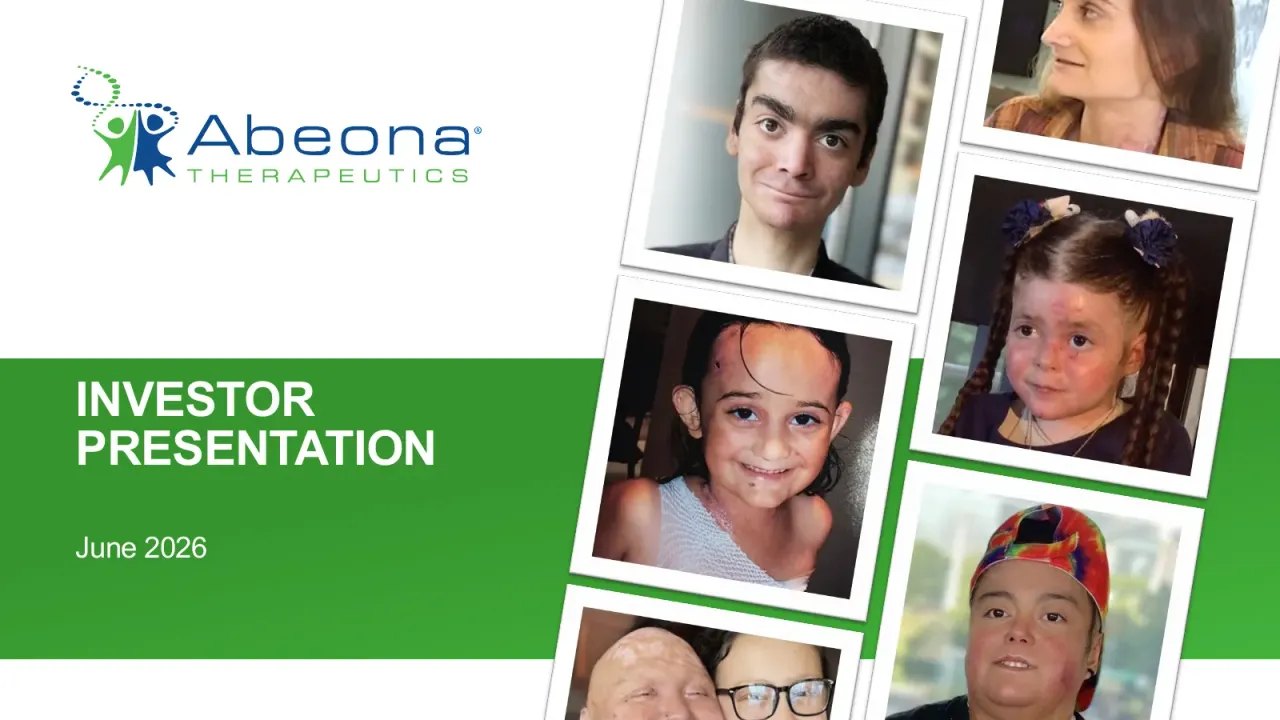
On 6ix: 6ix.com/event/abeona-therapeutics-inc-abeo-q2-2026-earnings-call
Automated transcript · Written by software from the replay's audio. It can mishear names and figures; the replay is the record.
0:00 Good morning, everyone, and welcome to Abeona Therapeutics 2Q twenty twenty six Conference Call. At this time, all participants have been placed on a listen only mode and a question and answer session will follow the formal presentation. Please note this conference is I will now turn the conference over to your host, Gregory Jin, Vice President, Investor Relations and Corporate Development. Greg, the floor is yours. Thank you, Jenny. Good morning, and thank you, everyone, for joining us on our second quarter twenty twenty six results conference call.
0:47 During this call, we will refer to the press release issued this morning announcing the financial results. It's available on our corporate website at www.abionatherapeutics.com. Joining me on today's call are Doctor. Vish Deshagari, Chief Executive Officer Doctor. Madhav Visandavada, Chief Commercial Officer Gil Vasanto, Chief Financial Officer and Doctor. Brian Keveney, Chief Technical Officer. We anticipate making projections and forward looking statements during today's call, which are made pursuant to the Safe Harbor provisions of the federal securities laws. These forward looking statements are based on current expectations and are subject to change. Actual results may differ materially from those expressed or implied in the forward looking statements due to various factors, including, but not limited to, those outlined in our Form 10 ks and periodic reports filed with the Securities and Exchange Commission.
1:39 These documents are available on our website at www.abontherapeutics.com. And with that, I will now turn the call over to Nish Desairee to leave soft. Vish? Thank you, Greg, and good morning, everyone. I'll begin today with an overview of our commercial progress before turning the call over to Madhav for operational details. Our commercial experience to date reinforces our confidence in ZeelaSkin's substantial commercial opportunity. During the second quarter, we advanced our rollout by expanding our qualified treatment center network and progressing more patients through the treatment pathway. With the recent addition of Cincinnati Children's, which is one of the largest Epidomyolysis Bullosa treatment centers in the country, we now have seven activated QTCs nationwide.
2:29 Importantly, CHOP and UTMB are biopsying patients, and CHOP has completed its first treatment. We have treated 12 patients since launch, including five in the second quarter of twenty twenty six, and three additional patients in third quarter to date. As Madhav will discuss further, a couple of these treatments did not generate revenue. As our commercial footprint expands, we're refining how we report progress to the investment community. Over the past quarter, we have seen that leading indicators, such as scheduled biopsies or biopsies in manufacturing, are subject to external variables outside our control, and have limited utility in predicting revenue generating treatments. Later on the call, Joe will outline the specific reporting updates we're making to eliminate this uncertainty and to align with standard practices of commercial stage companies.
3:23 With that, I'll turn the call over to Madhav Vasanthavara, our Chief Commercial Officer, to detail our commercial execution and network expansion. Madhav? Thank you, Vish, and good morning, everyone. We are making progress and executing the launch with clear priorities. Advancing identified patients through the treatment journey, strategically expanding the QTC footprint by onboarding leading EV centers, and raising Ziva Skin awareness across the EV community. Let me start with EV community engagement since we just attended back to back meetings. The Deborah Care Conference, which is a flagship meeting for EV patients hosted by Deborah of America, a patient advocacy group, and the Society of Pediatric Dermatology, SPD annual meeting, where we interacted with dozens of highly engaged patients, caregivers, and physicians.
4:23 Patient ambassadors from our Strong Together Network, which is a group of patients who received Ziva Skin in clinical trials, engage with families and physicians throughout these events, fostering meaningful dialogue, sharing the impact Ziva Skin has had on their lives, and helping connect patients and caregivers with ZivaSkin resources and support. Following these interactions, and the many that we have been having in the recent months, we are energized by the opportunity and the fundamental role ZivaSkin can play in healing RDEF wounds today and for the years to come. Based on our interactions with patients and caregivers, we continue to believe that the distinct value of Ziva Skin is deeply resonating with the RDEF community.
5:13 We see clinical conviction building across our QTC network and the community practices of other RDEF physicians. While we are thrilled with the patient community's interest in ZivaSkin, our recent experience has revealed bottlenecks that we are working through in the journey from patient identification to ZivaSkin treatment. Because ZivaSkin is the first surgically applied autologous cell therapy in dermatology, and is operationally very different from traditional topical therapies, QTCs have a steep learning curve to climb. As a result, the time from patient identification to patient treatment can vary considerably site to site and be influenced by a broad range of factors that are beyond the control of individual stakeholders.
6:05 Executing the launch has provided us with several real world learnings, of which I'd like to highlight three important ones. First, administering ZeevaSkin, which has an eighty four hour shelf life, requires a QTC to execute seamless real time coordination across multiple stakeholders. Well before requesting a biopsy slot, dermatologists, surgical specialists, anesthesiologists, and hospital staff must lock in precise dates for biopsy appointments, for Operating room reservations, and for surgeon and medical teams. These unique operational dynamics require even greater planning, particularly when patient and physician availability can be limited with holidays and back to school planning.
6:53 And we have seen this lead to scheduling disruptions for biopsy and treatment dates. Second, on the clinical side, we have observed that the health of our patients can sometimes change unexpectedly, which can lead to unavoidable biopsy delays or cancellations. In the second quarter, patient health deterioration resulted in two last minute cancellations of scheduled biopsies. Because of the amount of coordination required at the QTC with payer and patient schedules well before booking a treatment slot, a last minute cancellation means that the slot cannot be filled by another patient. Lastly, on the supply side, as our patient sample size has continued to grow, we have learned that manufacturing yields can be influenced by variability in the incoming biopsy material.
7:52 These factors resulted in one low yield batch in Q2 and one out of specification batch in Q3, for which no revenue was recognized. Despite these challenges, we are gratified that both patients received treatment. While the launch has highlighted these complexities, they have provided valuable operational and commercial learnings that continue to strengthen execution by both Abeona and its QTC partners. Importantly, despite these complexities, we have maintained a steady quarterly growth and 12 patients have now been treated with Ziva Skin since launch. As we apply these launch learnings, our focus remains on ensuring more patients enter the top of the funnel to help offset patient attrition that can occur for reasons beyond our control.
8:47 A key component of that strategy is continued expansion of our qualified treatment center network, continued engagement with the EV community, and improving patient access. Towards that end, during the second quarter, we activated two leading institutions, New York Presbyterian, Columbia University Irving Medical Center, and Children's Hospital of Philadelphia, CHOP. More recently, Cincinnati Children's Hospital, one of the largest ED centers in The US, has come on board. Activating treatment sites has taken significant time and commitment from QTC's and Abeona teams, and I want to thank everyone involved who helped achieve our stated goal of activating seven QTCs by the end of this year.
9:41 With our expanded QTC network, about 40% of our addressable market now has in state access to a QTC based on claims analysis. In addition, our QTCs also provide specialized care for a sizable portion of patients traveling from out of state, which enables even broader patient access. That said, we are getting requests from additional EB centers to onboard ZevaSkin, and we plan to work with those centers to further our expansion of the QTc network. While site activation is a critical milestone, it is only a first step that allows a QTc to initiate the ZevaSkin treatment process, including consultation, patient workup, and payer engagement.
10:35 Our commercial and medical teams continue to communicate regularly with each activated center as they build treatment readiness and administrative planning, including pharmacy and therapeutics committee review, prior authorization and payer agreement processes, and planning for surgery and logistics. As an example of exceptional operational efficiency, CHOP completed its first ZevaSkin treatment in July, shortly after its activation in May. UTMB recently completed its first patient biopsy, representing another important step towards future treatments, and overall reflecting growth in the number of QTCs that are treating patients. Next, as we think about the long term adoption curve for Ziva Skin, we know that physician confidence and learning build over time.
11:28 Our QTc physicians rely heavily on multicenter, real world experience shared through peer to peer dialogue before transitioning a new therapy like ZevaSkin into standard practice. As we actively facilitate best practice sharing amongst QTCs and the early treaters observe positive post treatment outcomes and share them with their peers, we believe that this growing clinical conviction will trigger the tipping point that bridges initial experience to broad clinical adoption and routine prescribing across our entire QTC network. Based on recent discussions with our physicians, we expect that enthusiasm for ZivaSkin will continue to build as RDEF physicians see and share even more examples of positive treatment outcomes.
12:20 Equally important for adoption is ensuring economic alignment and reimbursement for our treatment centers across all payer channels. To that end, we achieved a significant milestone from CMS, granting new technology add on payment or NTAP status for ZevaSkin effective 10/01/2026 for fiscal year twenty twenty seven. NTAP is a CMS program that provides hospitals with supplemental reimbursement for eligible new high cost and innovative therapies during inpatient stays, helping to cover the costs beyond standard DRG payments. For fiscal year twenty twenty seven, CMS had received 15 new applications under the traditional pathway, and ZevaSkin was one of only three to achieve NTAP status.
13:16 The other 12 either did not meet the requirements or withdrew their applications or were denied. We are pleased that CMS has granted ZivaSkin a new technology add on payment. This is a significant recognition that comes after months of clinical rigorous clinical review and public commentary, and it is an external validation of the newness, cost criterion, and substantial clinical improvement that ZivaSkin offers over existing treatment options for RDEB. While Medicare represents about ten percent of RDEB payer mix, NTAP now provides a mechanism for hospitals to seek a substantial add on reimbursement and facilitate patient access.
14:02 In closing, we remain encouraged by the demand we see and are focused on ensuring eligible patients can receive ZivaSkin. Our approach is to achieve this by building robust access, expanding our QPC networks, and further improving patient and QPC treatment experiences, which is exactly what we are doing. With that, I'll now pass the call to our chief financial officer, Joe Vazano, to discuss our financial results. Thanks, Manav. Let me start by reviewing the reporting changes we're making to provide maximum transparency and align with standard commercial stage practices. We will anchor future quarterly disclosures around completed operational achievements, specifically patients treated during the quarter and net revenue recognized.
14:56 Consequently, going forward, we will report treatment activity solely within the designated quarter. Before reviewing the financial results, I would like to remind everyone that you can find additional details for the quarter ended 06/30/2026 in our most recent Form 10 Q. Starting with the statements of operations. For the quarter ended 06/30/2026, Abeona reported net ZEVITSKIN revenue of $11,400,000 representing a quarter over quarter increase of 31% or $2,700,000 compared to $8,700,000 in the first quarter of twenty twenty six. While five patients were treated with ZevaSkin during the second quarter of twenty twenty six, we recognized revenue for four treatments as one batch had cell yield that was below the threshold for revenue recognition.
15:49 Research and development expenses were $5,000,000 for the second quarter of twenty twenty six compared to $9,600,000 in the first quarter of twenty twenty six. R and D expenses in the first quarter of twenty twenty six included a onetime upfront cost of $7,000,000 for in licensing ABO-seven zero one. Selling, general and administrative expenses were $15,800,000 for the second quarter of twenty twenty six compared to $19,500,000 for the first quarter of twenty twenty six. The decrease primarily reflects fewer engineering runs and less manufacturing training costs in the second quarter of twenty twenty six. We reported a net loss of $20,200,000 or a loss of $0.35 per basic and diluted common share for the quarter ended 06/30/2026.
16:43 Net loss for the first quarter of twenty twenty six was $17,100,000 or $0.30 per basic and diluted common share. As of 06/30/2026, we maintained a strong balance sheet with cash, cash equivalents and short term investments totaling $146,800,000 Our focus remains on disciplined capital allocation as we drive toward a sustainable cash flow positive business model, which we believe is achievable by maintaining a consistent cadence of patient treatments. And with that, I will pass the call back to Vish for additional remarks before opening the call for Q and A. Thank you, Joe. In closing, we're proud of the dedication shown by our commercial, medical, manufacturing and quality teams, and we look forward to bringing ZeevaSkin to many more families.
17:35 While we continue to learn to overcome the unique long challenges associated with the logistically complex product delivery, each learning helps us to lay a strong foundation to deliver sustained long term value to both the RDEB community and our shareholders. With that, I will hand the call back to the operator to open the line for your questions. Thank you. Thank you very much. We are now conducting our question and answer session. Thank Our first question is coming from Maury Raycroft of Jefferies. Maury, your line is live.
18:38 Hi, thank you for taking our questions. This is Ameon on for Maury. A couple of questions from us. First, on you previously mentioned one patient per month per QTC is a reasonable near term cadence. Just wanted to know when do you expect your existing QTCs, more specifically the deleting ones like Lurie and Stanford to get there? And then I have a follow-up. Thank you, Amin, for that question. Yeah, I think Madhav is best positioned answer this question. Thanks, Amin. I think, yes, we continue to hear about one patient per month from QTCs on average, and this is something that we will have once all of these centers are reaching the steady state, as we now know earlier, Lurie and Stanford were the ones treating.
19:30 Now we have a biopsy from UTMB and CHOP has treated a patient. So we're just waiting for other centers also to open up to be able to say when we reach a steady state. But once we are in the steady state is when we believe that one patient per month cadence is something that we continue to hear from the QTCs. Okay, thank you. Given you've now seen both a low yield batch and an out of spec batch, how should we think about the long term success rate for manufacturing? Do you view this as like isolated incidents? Or do you think this could be something that we will see in future as well? Thank you for that question. I mean, it's a little early. As you recall, our manufacturing experience in the clinical trials was a total of 11 patients treated, right? It's a very small data set.
20:27 The, and between the clinical trial, as well as the subsequent clinical studies of phase 3B, and our manufacturing experience to date, the low yield batch is the first time we've encountered. So, up until this point, it looks like a low probability event, and there are several variables that cause such events that are related to variations in the incoming biopsy material. It could be related to the anatomic locations where biopsies are taken, or, you know, a particular patient status, or, you know, just the cellular yield that the growth characteristics that we derive out of any given biopsy. And given the limited experience, this is a rare kind of event that we've seen, that the cell yield was low, and fortunately for us, whatever sheets were manufactured were used for patient treatment, it's just that it's below the threshold of billable unit.
21:27 Having said that, we continue to, we're running a lot of process science on every manufacturing run that we conduct, and you know, hopefully with enough experience, we'll be able to point towards causative reasons why this may happen, and how we can improve upon that. But it's very hard to predict what such ratios could be. And since you asked about the out of spec, just wanted to take the opportunity to also mention what it was about. You may recall that there was one test that we never had in clinical development, which is the identity test, which relates to the pan CK marker expression on keratinocytes. And we, since there was no clinical experience, the way in which thresholds or specifications were set for this test was based on, you know, six samples of five being healthy volunteers, and one, you know, frozen RDEB samples that we had at the time of BLA review, this was not based on true GMP manufacturing runs experience to set such specifications, and that was a test that failed. This has nothing to do with either the safety of the product or the potency of the product. So we are working, you know, with the agency to revisit whether the specifications that were set during the BLA review are, were appropriate, or should we even relook at that, right? So some of these things will take some time and more experience to get concrete numbers to put on what should
22:59 be our assumed rate of non billable units, but if you look at overall numbers to date, for any autologous therapy that has been launched in the past, you will see such examples, and we'll continue to keep refining numbers and probabilities as we gain more experience there. Helpful. Thank you. Thank you very much. Our next question is coming from Stephen Wiley of Stifel. Stephen, your line is live. Yeah, good morning. Thanks for taking the questions. Can you remind us of the manufacturing yield that you're seeing in the commercial setting? I know you have the capacity for 12 sheets on a per patient basis, but what's average number of sheets you've been able to manufacture for the patients you've treated thus far? And I guess, how does this differ if at all from the prior clinical trial experience? And I just have a follow-up.
23:59 Thank you and good morning, Steve. The manufacturing yields from our commercial experience are actually, they are very favorable when you compare it to what the clinical trial experience was. You may recall that for VITAL, our Phase III trial, the maximum number of sheets that were allowed to be put on patients was six per patient, and in reality, it was about five sheets across the trial. And right now, we're around nine sheets average per lot, which is a pretty healthy rate compared to what our clinical trial experience was. And therefore, which is why we're calling this a anomalous or a rare event that you had a low yield. And of course, 12 is the maximum that we can supply, but we're learning from every batch and making sure that, you know, any indicators that tell us that, you know, you could have a certain type of yield, we're learning from that to adopt our process and put best practices in real time. So, we're actually pleased by averaging nine sheets, which is a pretty substantial body area coverage.
25:09 And then, can you say what that low yield number is that triggers your inability to not recognize revenue? Yes, anything that is lesser than four sheets in a batch is a low yield batch, so that's really our threshold. So three, two, or one, as per NDC, it's still on label, but it's for billing purposes, we will not recognize revenue for those batches. Okay. And then just with respect to the pan CK marker assay that you mentioned on the keratinocyte side, where are you now in terms of engaging the agency around, I guess, either changing that number with a larger sample size or widening the confidence intervals? Thanks.
26:02 Yeah, we have had some interactions with the agency. The first thing was, the first step was to make sure that we could treat the patient, which is why we had to go through some communications with the agency, and we were successful in treating the patient. And I think from, we should have more updates on where we are with the revision of the spec by the next quarterly update, because we're still gathering the type of data. We're confident that the data that we have from our manufacturing runs in the GMP setting now, you know, justifies the lower specification from real world experience, versus something that was arbitrarily set based on limited experience during BLA reviews. So, it's a TBD, how quickly this can be implemented, because there are some mechanisms that are beyond our control, and have with the FDA. So that's all I have for you at this point in time, but we will update you as, in our subsequent quarters on this particular topic.
27:06 All right, that's helpful. Thanks for taking the questions. Thank you very much. And our next question is coming from Ram Selvaraju of H. C. Wainwright. Ram, your line is live. Thanks so much for taking our questions and congrats on all the progress made this quarter. I wanted to ask about kind of last minute cancellations, you know, arbitrary withdrawals of patients from the process of Ziva Skin treatment, and how often you see that specifically occurring. So this has nothing to do with, you know, failures in manufacturing or inability to qualify a batch, this specifically has to do with, you know, patients being unwilling to ultimately go through the treatment process.
27:54 You know, what we might call the arbitrary attrition rate. Just maybe you could give us some sense of how often that occurs, you know, based on current experience. Morning Ram, thanks for the question. Madhav? Yeah, hey Ram. Well, so far we have had two such events, right, as we mentioned, that has happened in terms of her record. So, it's hard to predict, but it's, if you look at the willingness for these patients to undergo the procedures, is definitely a very strong willingness. But it's some of these things are if they are not able to make it because of illness or some health deterioration reasons, then we are talking about moving the biopsy date to some other date. It's not that the patients don't want to, or are just backing off from the procedure itself. So, I just want to be very sort of clear with that, especially coming out from this Deborah conference and SPD that I mentioned, you're just so energized.
28:59 Literally seeing the number of patients that we've engaged with, who were at our booth, who were talking about ZivaSkin. Some of them had the concern about what does the biopsy look like and what does the procedure look like. But we've had our people from the Strong Together Network who went through this procedure in clinical trials sharing their own experiences. Right? The product theater that we presented was also, you know, packed. We had room for more than 150 people, and there was a lot of interest in these product theaters to learn about the procedures and the outcome. So even if patients are dropping out for health deterioration reasons, we have not seen that these patients saying, don't want Zika skin. It's a matter of rescheduling the biopsy to another date. And when that happens, especially in a quarterly report like this, when we talk about the number of slots with the number of patients, we are going to have different numbers for that particular finite period of time. And that's really how this current model is. So, we are not saying that there is a patient attrition kind of forever. We haven't seen that even with these two health reasons that we've talked about.
30:05 And it's therefore what we reiterated our strategy. The more centers we have active, the more patients that are going through this process, the greater shots we will have at goal to be able to have these more number of patients treated in a given period of time. So, I just hope that offers a bit more clarity. I know you were asking about our ability to predict such, you know, movements, but it's hard to tell so far we've had two. And then with respect to maximizing patient accessibility and convenience, you know, you said during your prepared remarks that, you know, at this point, I believe you said almost half of the addressable patient population has in state access to a qualified treatment center.
30:53 I was wondering if you could elaborate on this from two perspectives. Firstly, you know, how necessary you feel it needs to be for a patient to have in state access to a qualified treatment center. And secondly, in order for the company to be able to provide this to the majority of patients, or say 80 of the addressable patient population, how large would the qualified treatment center network, you know, theoretically have to be? Thank you. Yeah. Yeah. Great question. So the first question, importance of having a QPC in state. You see, earlier we were talking about the payer mix. Right? So one of the things is, when you have Medicaid, especially, and when you have an in state Medicaid patient, the access there is much faster relative to a patient traveling from an out of state, and a physician needs to be enrolled in the host Medicaid state.
31:54 So, it actually helps to have a patient in the same state where you have a QTc just from an access standpoint. The way we are saying that you have about forty percent of our addressable patients are in state is based on our claims data. When you count the number of claims that we have seen from patients in these states, you know, divided by the total number of claims across the country. It's not necessary to have a QTC in all of the states, and we will never have such kind of scenario. We'll have so many QTCs because this is such a tight knit community, and we know patients travel from out of state. In fact, about again, 40% roughly of the patient mix that a QTC has for some of our QTCs are coming from out of state. They're traveling 300,400 miles away.
32:45 And hence we are dealing with leading EB centers. So, to get to that, like, 80% kind of a number that you mentioned, we will still be able to get that. It's a matter of prioritization. You know, some of these in state patients might get faster access as the centers are working to have you know, clearance for out of state travels. So far in the patients we have treated, as we mentioned on our prior quarterly call, we've actually had quite a few patients traveling from out of state already. So that mechanism already exists for people to travel and get treated. Then lastly, was just wondering if you could just give us a sense of when you anticipate NTAP status to be reflected on two levels.
33:32 Firstly, the revenue cadence and secondly, you know, if you expect it to show up on the margin front and if so, how? Thank you. On the revenue cadence, it really does depend on the payer of the patient. I I think for Medicare beneficiaries, because NTAP is going to really apply to Medicare beneficiaries, whether they are pure Medicare or dual eligible. Sometimes you have patients that are Medicaid, Medicare. So for those, patients is where, you know, revenue actually is going to come in through. And in the absence of NTAP, you know, these patients would have had really very limited access, if any.
34:17 And now NTAP actually opens up that vital reimbursement for the centers. And then Vish, you have to Yeah, so one more thing I wanted to add, Ram, about the NTAP status is it has two effects, right? The direct effect is, of course, for the ten percent of our patient mix that is dependent on the Medicare reimbursement. So it's a small sliver of our TAM, so to speak. However, the fact that you've been through this clinical rigor and gotten that NTAP status for those patients is also going to have a halo effect with other types of payers on how they view the technology, because you kind of have a validation here. So that is definitely going to make it easier for centers, even for other types of patients to get their payer paperwork done.
35:05 So we're hoping that that will aid their, you know, payer negotiations and things like that. In terms of, you asked about the margin front, for us, it's not so much of a margin play, it's more for the QTCs on, are they going to be whole, made whole? And that's where the NTAP plays a big role, because currently for Medicare patients, as you know from the CAR T world, without NTAP, it's a big P and L loss for a treating institution. And NTAP fills a big hole there. So that's what we hope will, you know, debottleneck treatment for some of these patients in these centers. Thank you so much.
35:52 Thank you, Ron. Thank you very much. Our next question is coming from Kristen Kluska of Cantor Fitzgerald. Kristen, your line is live. Good morning. Thanks for taking my question. So you mentioned in your prepared remarks that you want to have more patients enter the top of the funnel in case some of these situations arrive. I guess, parts or issues could having more patients at the top of the tunnel potentially mitigate and then which ones would this disruption still continue? So, yeah, I mean, I think it's top of the funnel. So, things that are outside of our control, Kristen, you know, is where we anticipate that that's going to help mitigate. Right? So, for example, all of the topics you mentioned, if there is a movement of a biopsy date that needs to happen, if you have multiple patients across multiple centers that are aiming to have a biopsy, then that'll that'll help, that'll help to offset, and have more patients come through.
37:03 And it's essentially it's it's it's having more shots at filling those manufacturing slots, which are finite in number. So that's really the, you know, the the whole purpose. Plus also having more, qualified treatment centers, helps with the patient access to travel, the amount of distance that they have to travel, that these patients trust certain institutions, right, more than others. So we therefore want to increase that footprint. We also want physicians, and actually, we're already seeing that. We recently engaged at the SPD through advisory meetings and the cross pollination of best practices. The number of treatments as we have more treatment centers come on board to bring the physicians together and have that cross pollination is just helping greater, you know, dissemination of information, and that also helps with overall raising awareness and clinical conviction in Ziva Skin. So it helps on multiple fronts, and that's exactly what, we are currently in the process of doing.
38:09 Okay, appreciate that. And given that some of these some of these windows are very limited, is there like, does it make any sense to do, like, screening when they come in for biopsies or anything? Make sure that they're healthy. I know you can't prevent one hundred percent of the time them from getting sick and potentially needing to cancel, but can this mitigate it at all? Potentially, right? These examples that we gave for the two patients that had to cancel their biopsies happened very close to their biopsy. In fact, one was on the day of biopsy, that they said, well, I can't travel to the site and very sick. And the other example was like a day or two. When you have that kind of close to the biopsy date last minute, it's very hard to, you know, make adjustments.
38:59 Whereas if you have this information like two, three weeks in advance, that's definitely something else, and that's where, to your first question, if you have more patients on the top of the funnel, you have more flexibility or shots on goal that you may be able to move some patients and adjust dates. If you only have one or two, those idiosyncratic examples will just take over, we don't have reaction time to make amends. So that's really where it is, and we'll continue to monitor, and hopefully they're all cancellations, we learn some ways to mitigate it as we go through more such examples. Thank you very much. Thank you. Our next question is coming from David Bautz of Zacks Small Cap Research.
39:49 David, your line is live. Hey, good morning, everyone. I appreciate you taking the questions. So my first one is just about kind of clearing up the revenue recognition. So if I understand correctly, you said that two of the patients you didn't record revenue for, but I believe those two patients were still treated. So is this a case where the company is just going to kind of incur the full treatment and manufacturing costs? Or is there going to be a chance to recognize revenue for those two patients at a later date? The former, we will not be recognizing revenue for those two treatments because that is that is our agreement, right? I mean, whether it's a low yield or if it's an out of spec, we basically eat up the COGS. Okay, so the Q2 gross margins looks like they were about 63%.
40:42 So as you know, the manufacturing process becomes a bit more predictable. Where do you see the normalized gross margin settling? Yes, so, our gross margins are heavily dependent on the number of patients that get treated in a given quarter, mainly because most of our manufacturing costs are fixed. So with higher volumes, then our margins will improve. And we think standard state would be probably about 85% to 90% once we reach full operating capacity. Okay, great. And then lastly, can you give any additional details on the patient funnel, kind of where it stands today?
41:28 How many patients use IDs? Haven't even biopsied or treated or seen into QTCs? Any of those type of numbers would be really helpful. Yeah, David, I mean definitely patients are interested. We know that there are identified patients on our prior calls. We had mentioned about more than 100 patients that have been identified by their community physicians and QTCs that are considered clinically eligible. There are certainly multiple other steps right downstream steps about consultation and funneling these patients. So that's all happening. I think for us like we mentioned on this call the really the rate limiting step is at the qualified treatment center and you know advancing these patients through the treatment process.
42:16 So, as that continues to happen, we continue to believe there are patients that are going to move through especially in light of some of the more recent interactions we've had with patients and physicians. So I'm not able to provide any particular numbers, but we see that movement happening. Okay, thanks. And I appreciate you taking the questions. Thank you. Thank you very much. And our next question is coming from Fanny Zhong of Oppenheimer. Fanny, your line is live. Hi, this is Fanny on for Geoff Jones from Oppenheimer.
43:03 Thanks for taking my questions. Maybe a clarification question. When you indicated you had a low yield, revenue was not recognized for two patients. Does that mean the patient is unable to receive any treatment or there is sufficient material for a partial treatment? So what happens in that scenario? And the second question is, do you have a few for how long for new QTCs to begin treating patients? Thank you. Thank you and good morning. Just wanted to clarify that the two cases where we did not recognize revenue were two different cases. One was a low yield issue and the other one was an out of spec.
43:48 They're slightly different in nature, but in just to be clear, revenue was not recognized for either of those, but the patient was treated. Whatever sheets we produced and provided to the treatment center, patients were treated. So they received treatment, and you know, we're hoping that the patients received the clinical benefit and that experience will grow with these treatments, but revenue has not been recognized and will not be recognized for those two particular treatments. Your second question was about how much time does it take to activate a QTTA and get to patient treatment? And we had previously indicated this is about an average four to six months, but then the problem is, with averages are not useful when the variance is so high. And you have examples we just gave you today where CHOP was activated in May and they treated a patient in July. So, that was a very quick turnaround. Whereas we have had other sites that have twelve months since activation and not treated a single patient. So this, because of this variability, it's very hard to predict, and the reasons are, you know, many fold. It's got to do with the types of payer mixes in certain states, and the paperwork that patients have to go through, and you know, various such factors. So it'll take us a little bit more time to, you know, try to thematize and put any numbers to what is the reasonable time that you can expect that a site will take between getting active and treating a patient. However, we are learning from
45:19 these experiences, the more recent activations that we're seeing, sites that are already talking to patients and trying to line up every part of the process that can be pre lined up before even activation. So that is something that we're seeing sites starting to do, but we'll have to wait and see how much that accelerates this time period. I hope that answers your question. Thanks, it's helpful. Thank you very much. Well, we appear to have reached the end of our question and answer session. I will now turn the call back over to Vish for any closing comments. Thank you, Jenny. I'd like to thank everyone for joining us for today's business update, and we'll talk to you again soon. Thank you very much. This does conclude today's conference call. You may disconnect your phone lines at this time, and have a wonderful day.
46:13 We thank you for your participation.
Follow Abeona Therapeutics Inc. into a list and get an email when it puts out news.
Vice President, Investor Relations and Corporate Development
Chief Executive Officer
Chief Commercial Officer
Chief Financial Officer
Analyst, Jefferies
Analyst, Stifel
Analyst, H.C. Wainwright & Co.
Analyst, Cantor Fitzgerald
Analyst, Zacks Small Cap Research
Analyst, Oppenheimer