Transcript
Automated transcript · Written by software from the replay's audio. It can mishear names and figures; the replay is the record.
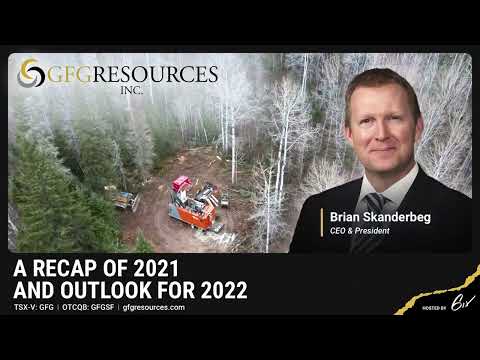
0:07 Hello, everyone, and welcome to GFG Resources live investment summit today hosted by SEX. Today I'm joined by Brian Skenderbeg, President, CEO and director at GFG Resources. Brian's gonna walk us through a company presentation and after we'll be accepting questions. You can submit your questions using the Q&A panel found on the right hand side of your screen at any time today. And as always, the summit is being recorded and it'll be available to watch afterwards on six.com as an on-demand video. But without further ado, Brian, I'm going to hand things over to you to get us kicked off. Thanks very much and welcome everybody to our presentation today.
0:38 We're going to walk through 2021, which was an exciting year for DFG and more so give you some forward-looking expectations for 2022. Just a bit of a cautionary statement here. I'm a geologist, I'm an explorationist, and I work in the gold business, so obviously make some forward-looking statements here. When we think about GFT, we're a district scale exploration vehicle and I think it's a really interesting time to pay attention to this company. We're a team and board that's built companies, ran mines, discovered mines and I think there's a very diverse and successful track record here. We have 2 main assets that I'm going to talk to you about today. The partnership with G11 down in the US and also our Timmins portfolio.
1:24 Ultimately, this company is set up to look for and discover world-class gold systems. And I think where you see our efforts are being focused, there's a good probability we're gonna make some relevant discoveries here. One of the key things I think that investors and obviously as management pay attention to is what we're doing differently and how we're impacting our strategy to make this next discovery. I think that's really key in advancements in the exploration industry and I think this company is one of the groups that's on the cutting edge of quite a few different technologies. Before I go into the technical details, I'll walk you guys through the company structure here. We're well financed, we have about $4 million in the bank, market cap between $20 and $25 million, with some very, very strong shareholders here, both institutional and corporate. We'll flag US Global in 1875, Delbrucks of the World and Alamos Gold, a long time and very strong strategic shareholder in DFT.
2:21 Now, when you look at the insiders, I think this is always a relevant benchmark. We own about 6% of this company. We participated in every financing, very strongly leveraged and aligned with shareholders here. When we look at the gold exploration space, and I think this is a real larger view of this sector here, And the graph on the upper right is really showing exploration trends. And it's a 30-year window. I think ultimately what it shows us is that exploration trends are declining over time here. And ultimately, when we look at what TFT is focused on, we're trying to make these 2 discoveries off on the right side here. And I think there's a recipe for success here. Ultimately what this company has done is put together 3 large scale land positions and we've done it off cycle. And I think when you look at the groups that have potential to make discoveries these days, it's those that are looking with different exploration philosophies, it's using technology and it's likely teams that have done it before.
3:28 Now when we think of where we're working, we have 2 main asset bases, 1 in Timmins and 1 in Wyoming. I'm going to spend most of today talking to you about our advancements in Timmins. That's where our capital gets allocated. On the big picture here, there's about 130Moz of Gold in this map. Very, very high endowment and extensive infrastructure. I would flag the Newmont infrastructure, I would flag Pan American and Alamos Gold as being very significant infrastructure holders, but also companies like Kirkland Lake and Kewen, very leveraged here. When I think about this as an explorationist, I think there's been very relevant discoveries here over the last cycle. I would flag Borden, Tewani with Kote Lake and Timmins West with their chairman Brian Booth who found that system out there.
4:18 So very strong history of discovery in the last exploration cycle. GFG controls in excess of 700 square kilometers here. The area in pink, I'm going to talk to you about Montclair, the Pengold property and the Dore property as well. Very highly endowed systems, great infrastructure base and GFG is an extensive landholder in this belt. Now, when we think about Montclair, this was an acquisition that GFG made in October. And we very quickly turned this into a drill program, have published some results and have pending results from a number of drill holes as we speak today. The big picture is the southerly of these 2 breaks, including the main Timmins Camp and things like McEwen and Taylor Mine of Kirkland Lake, These are all in the Porcupine Dester. The northerly of the 2 breaks, which would be the Pipestone Fault Zone, host things like Fenn Gibb and Clavos and Bradshaw.
5:10 These are also very relevant gold systems. When you think about Montclair, It's about a 10 kilometer segment of the Pipestone Break. It was acquired back in October from IEP and we see some great potential to grow the Montclair deposit through the resource and continue to expand it in an area where it is an infrastructure rich area. Now this is what we acquired back in October. There's about 125 drill holes here. The northern portion of this map is would be the Kidman Road volcanic stratigraphy. A southern portion of it would be the porcupine sediments. Now there's about 125 drill holes here. Very keen on flagging a few of these here for you and understanding for you what we see as the potential here. So if We look at these drill holes here, it outlined about 100 and 1500m of historic strike.
6:07 Most of these drill holes were done prior to 1960 and pre-1943 101. They're not sampled extensively, they're not in compliance, But what they did for us is really outline the scale of the gold system. So I'm going to talk to you about the Montclair trend, as we call it the MC trend. I'm going to talk to you about the Canamax trend, which is the CX trend. 2 gold systems. I think both of These have only been tested relatively shallowly and offer us immense potential. I'll show you a cross-section right through that line as we go forward into the next slide. So thinking about these 2 systems, and I'll start on the main break with the Canamax Trend. This would be the host to the Gold mine next door to us, Clavos. Only tested relatively shallow on this property.
6:52 When we think about the Clavos mine, it really does focus on this contact of the porphyry. Now, When we think about what we're doing here and why we like this potential, these assays down here, 0.21 and 3 grams, they show a very broad system, well mineralized in both the sediments and the annual volcanics, and some high-grade veins developed on the contacts already. So GFT likes this target. We will continue to explore it along trend. And I think most importantly, we'll test it at depth in 2022 moving to the other trend. And this is where we started our work. And I think it offers probably the most potential is the Montclair Prospect over here. It's about a kilometer into the hanging wall from the main break. It's hosted in a rhyolite and porphyry intrusive body.
7:43 And I think it has very strong potential to host both tonnage material, but also some high grade or higher grade material. So I'll flag these holes drilled by the vendor of the property back in 2006, you know, good 15, 20, 30, 40 meters, even some of them up to 100 plus meters bulk mineable material above 200 meters depth. And this is a cross section through the main part of the ore body, but I see great potential along the strike. We also have these foot wall fault zones and shear zones that come out of the rhyolite trending over to the ultramarine body. These have a different style of mineralization, typically a little higher grade than the main Montclair trend. These are the 2 main structural corridors and Gold systems that we're exploring on the property.
8:30 On Monday of last week, we put out our first drill hole. If we wind ourselves back to Q4 last year, we drilled 3,200m and 14 holes in Q4. You see the distribution and plan map. The historic maps with drill holes would be the assays in the background. I flag things like this, you know, these are all the old assays, single point assays down the hall from the 1940s. They show you where the system's working, but they don't show you the true extent of the system. The section I showed you previously was drilled through here. GFG's first hole stepped out several hundred metres to the west. I show you that cross-section through there. It was a 50-metre step out on dip from a hole drilled in 1986. I think it very much proved what a thesis is, that you see good high-grade potential here and you see good bulk tonnage potential here and you see the shallow depths and you also have the depth potential of some of the higher grade systems as well. So this is our first hole, returned some high-grade mineralization over both a 30 and a 70 meter interval. You can composite it over a full 100 meter interval and certainly have a very compelling composite to it.
9:40 In black are the drill holes that we drilled as well that are pending assays. I know those are 13 holes that we expect to bring to market in the next 3-6 weeks. Just for investor awareness, we're seeing about 50-60 days turnaround time on assays. I don't expect that to change as we move through this year. The assay labs are very busy and quite competitive. Looking at a few of the textures that we're seeing, I think this is really key to understanding the Gold system. I show you 6 different examples from that single drill hole. This was 1 drill hole, our first hole. 2 nice bulk composite intervals, grades up to 27 grams in quartz vein systems, cross cutting the rhyolite and the felsic porphyry.
10:28 We also see very strong sulfidation of the main rhyolite in places with quartz veining truncating across it also very respectable gradients, 5 grams. Moving through here an intensely altered example with some folded quartz veining going through it. And then on the bottom, I want to show you here is other examples. And this is really the bulk tonnage aspect to it. So even like this, 2g material, not prominent veining, pervasively altered and sulfidized, a really great looking rock. And then you see some more of these sigmoidal tension quartz veins, you know, 0.5 gram plus or minus material and also a very intensely rock, altered rock. So the point of these pictures to me is they imply an intense Gold system that has an earlier solidified event and an overprinting quartz vein event, both of which can host high grades.
11:23 Very encouraged by our first drill hole of this property. Now, we also put some forward-looking guidance in our last press release. And When we think about what we have pending here, I'm really excited by what we've seen in Drill Core. We show you some slides here, examples of the relevant veining and sulfidation that we hit in a number of drill holes. So reference, I just showed you this slide, this drill hole, we have step outs to the east and west of it all flagged in yellow stars here. These would be relevant examples of what I think have good-looking styles of mineralization. This would be a footwall system, intensely carbonate altered and sulfidized with quartz veining going through it. As you move through, we also have sulfidic breccias in places, highly carbonate altered, dismembered vein systems, a really, really interesting rock that was in hole 5. It was in this environment in here.
12:16 Other deep holes like here where you're seeing very strong sulfidation and highly altered and veined rocks. These are some of these deeper holes back in the football environment or sorry yeah into the football environment fairly deep intercepts. And then even off to the east This hole was very interesting down here, heavily sulfidized, great looking veining, multi generations of veining. And this was a step of 300 meters to the east. So what we're seeing here is a system that has very large scale, It has intense sulfidation, it's got good veining, good grades, and I'm very encouraged by what we've seen here. So I think what we can confidently say is, I think we're gonna see some good results from the pending assets as well, and that's provided us encouragement for planning the 2022 program as well.
13:06 Now, this was 1 target that we started on. That was Montclair Trend. I think it's got immense potential. We're gonna continue to drill it. As I talked about, The Canamax system is very interesting. So this was Montclair down here on the upper portion of the map, just north of the break. This would be the Canamax corridor. Same as geologically, the Clavos Mine next door. These are historic drill holes, which I would have flagged in some of the examples from preceding slides, a really nice altered porphyry of the right age. If you know Timmins geology, this is the age you want. It's Sin-Tamiskaming, it is the Sin-Gold event. We also see strong mineralization in the flanking sediments and in the Ultramaphex communities.
13:51 We truly believe that Lake Clavos next door, which is where these mine sections are based on, we see great opportunity to test the Kanamak Strain to depth and draw the analogy to the mine next door to us. Now, when we think about GFG and our focus in Timmins, we've just brought Montclair into our fold. We also have 2 exceptionally large land positions out west of Timmins and we haven't forgotten at all about these. When we think about Penn, this is where we worked the last 3-years, we've got great results. We continue to work this property. We're doing regional sonic drilling in the western flank of the land position. We have a number of targets that weren't more drilling and we will be back out here in 2022 as well, the second half of the year. The point is, this remains a Greenfield project and we brought in a more advanced project to pair with it. We will continue to explore the greenfield opportunity that exists in this land position and I find it quite valuable.
14:52 When we think of the southerly of the 2 blocks out west, the other one is Dore. I quite like this land position. It is also greenfield. It abuts Newcrest to the west of us, directly to the west of us is a very extensive Newcrest portfolio ground, which they recently acquired right next to us. IM Gold is immediately to the east of us. This is a strategic land position, 100% controlled by GFG. And we are currently reviewing a number of strategic options for it. So when we think about our vision for Timmins, here we sit with 3 main properties under our tenements. In 2022, we're going to launch a 10,000 metre program here, probably mid to late February. There will be 2 phases, one of them in Q1, 1 of them in Q3, Q4.
15:38 And I think a good chunk of that is going to go into this red box here. Now I showed you about 1.5 kilometers of strike point on the preceding blow-up map, but on the bigger picture, we've got about 10km here. There's good greenfield targets, long strike, very limited drilling outside the main deposit, and we know there's a good system that's working here. So I'm excited to explore both greenfield and brownfield opportunities within the Montclair prospect. As I said, at Penn, we will be working on some Sonic and some overburdened work, particularly on the Western flank of it and down at Doray, we're looking at a few strategic alternatives. So this in terms of the efforts in Timmins really should make for an exciting 2022. Now, when we think about our business, and I think GFT is very unique, we have a platform of assets. We've got the exploration portfolio that we allocate into Timmins, and We also have the Rattlesnake Hills project in Wyoming. When we took this company public, we were only with the Rattlesnake Hills asset.
16:39 Now we've moved through a partnership with Newcrest. We've also now vented the property to a company called G11. G11 is a private vehicle looking to bring in-situ mining to the Gold sector. When you think about this asset, this is the main deposit, the North Stock deposit, which is a younger 40 million year old dietary mostly Gold system. I think it can look like any of these maps on the bottom and these are in situ Uranium mines from Wyoming. And ultimately what we're trying to do is bring some of this technology to the Gold space. Now when you think about in this asset base and understand what it does host, I think there are a few things that are quite interesting about it. A, it is in a great jurisdiction.
17:26 Wyoming is known for mining and resource and extractive industries. It very much appreciates the input of the mining sector to its economy. There's 100,000 meters of drilling being completed on this asset and about $40 million in the ground. The whole land position is tied up, owned by DFG and optioned to our partner Group 11. On the bottom right here you see a cross-section through the 2 main deposits. Look, this thing has scale. The Norstock deposit itself would be about 700m along strike. Good thickness is in about a 100 meter range, all oxidized down to about 150 meters. Over at Antelope Basin you see a modestly shallower system down to about 200 meters.
18:12 Good thickness still 50 to 75 meters thick and reasonable grades present there. Just flagging greater than 0.1 would be in yellow on that map. Now, when we think about in-situ mining and our partner, G11, I think The deal we structured with them last July is really interesting. Ultimately, we believed they had a really interesting technology. Group 11 is owned largely by 2 parent companies. One of them is EnviroMetals and the other one is Encore Energy. Both contribute their technology and expertise to
18:47 the company. I think they have great potential to take this through and evaluate and really develop NCG mining expertise. So the joint venture structure allows them to earn 70% by bringing the asset to commercial production. We are in stage 1 of this joint venture and we have been there for the last 8 months. We have extensive metallurgical testing that is ongoing. We expect to publish results from those in the short term. I think it is a very interesting opportunity when we look at these metallurgical results. They will ultimately determine and showcase the leachability of our ores with the ligand of environmental G11. Stage 2 is a 5-spot well testing.
19:36 This would be the first in-situ test for Gold and we anticipate doing this in the next phase of the deal.
19:42 Stage 1 would be 12 months, stage 2 would be an 18-month. Stage 3 is a commercial build phase and stage 4 should they execute the commercial build cash and equity payments to increase their ownership to 70%. Now what to me brings uniqueness to G11 is ultimately their access to a proprietary ligand of environmental. This solution is patented, it is controlled by environmental, which is the parent, licensed to Group 11 Technologies. It, I believe, offers a very benign and compelling alternative to cyanide. It is a recyclable solution that is aqueous based, uses electro-wetting on the back end of their circuit.
20:31 Everything in this recipe as an ingredient would already be FDA approved. So when we think about in-situ mining
20:39 for either copper or uranium, ultimately you're putting a fluid down into the rock, you're moving that fluid through the rock and you're recovering it up through boreholes and through wells. I think the technology has very much been developed in the copper and uranium space and there is no reason we can't see it in the gold space as well. These are the graphs that to me convinced me we had a chance. And the G11 was the right partner for us. So when you look at the kinetics of the ligand, this would be a conventional cyanide recovery. These would be some examples of the enviro metals and enviro leach ligand. So quicker kinetics, very strong recoveries, and ultimately the benign chemistry allows you to apply this in an in-situ setting.
21:30 These are the patents controlled and the license agreements that work back to G11. One of the things that I found really interesting was this graph which is from the 3-ACES project in the Yukon, completed by Golden Prater, which showed very strong recoveries in a sulfide concentrate. This would be non-refractory ore, 97% to 96% recovery in about 17 hours. The point of this that I take as a technical expert is that anything that cyanide dissolves, This ligand can appears to dissolve just as well or better and quicker. Now when we look at the Rattlesnake Hills project, here we sit in central Wyoming and the location of it west of Casper is interesting in the sense that these are all in-situ uranium development projects or mines.
22:22 And the inference is that the Wyoming as a state and a jurisdiction very much understands in-situ permitting, accepts it as a very viable path in the extraction industry. And the regulators are certainly supportive of us advancing this path. So you've got a framework in the jurisdictional side that works. You've got a deposit that's largely drilled off and oxidized down to a reasonable depth. It shows good potential to expansion. When you look at the technical parameters of this deposit, it seems like it should very much be a good match for in-situ potential. These are all the reasons TFT has partnered with G11 to evaluate this technology. And I'm really excited to see the next couple of weeks to month when I think we should be able to put some of this initial metallurgical work out to the market.
23:14 So When you think about GFG as a whole, I think 2021 has been a really exciting year for us. We completed a 10,000m program split between Molenclair and the Penn property. We developed a partnership with Group 11 to advance the Rattlesnake Hills project. We acquired the Montclair property. We raised $3M and completed an initial drill program. That was a very, very busy year for us. What it's done is set us up for a series of catalysts in 2022. We already published 1 drill release and I do expect us to publish several more on the 2021 drill results. I expect us to launch a very aggressive drill program based on what we're seeing in the initial results in Q1 here as well. 3,000 to 4,000m at the start, a further 5,000 to 6,000m, 7,000m in the second half of this year as well. And to push on the Penn project as well in terms of some sonic drilling. If we think of catalysts that may be out there 6, 9, 12 months later in the year,
24:15 I think we should see a steady stream of good drill results. There should be clarity from Group 11, not only on the metallurgical data, but on the permitting path and what that looks like for a 5-spot weld test. And I expect this to be continued to drill in the Montclair property. Investing in GFD, look, we're listening to us, this talk today. Hopefully your shareholders, if not, I think this is still an opportunity to get in us. I think this is a good example in a very unique company that has a great future. We've got these district scale assets that we've put together over several cycles. I think both of them offer great opportunities. We've got a technical team that's found mines before with a great ability to finance. Look, our shareholders are amongst the most sophisticated in the world, high net worth and institutional with insider ownership
25:03 that stacks up very highly as well. If you think about, to me, the exploration industry, I want to see as much money going to ground as possible and that's what this company does. And within the next 12340I think there's great opportunities to find the next Timmins gold mine, but also with our partners, G11, bringing C2 Mining to the gold space. So this is a fully funded vehicle. And I think there's a very, very catalyst rich 2022. Wonderful. So with that, though, Brian, let's get into the Q&A. Let's dive right in. Could you speak more towards the current metallurgical testing being done with Group 11? And what does success look like to you?
25:42 Yeah, look, with G11, I think the program, as we've outlined it right now, has a couple of phases to it. There's bottle roll testing and there's immersion testing. There's a suite of samples, you know, a dozen samples or so from historic core we're running through with bottle rolls which really assesses how the rock responds and is recovery based on the the ligand and the proprietary technology of G11. And then there's the immersion testing, which essentially takes the whole core, immerses it in the solution and assesses recovery that way. So I think this spectrum of testing would allow us to give a good, to garner a good understanding of how the technology and the leach works on our rocks and also start thinking about how it may behave in an in-situ setting. So a key first step in the
26:32 development of this technology to the cold industry. Okay, fair enough. Thank you. Mike in the audience, his question is, you said that you'd be publishing the G11 results in the short term. He'd like you to clarify if you mean 1 week, 1 month, several months, what does short-term mean to you in that sense? Yeah, I could address that. I mean, ideally we would have published these a while ago already. Understand that when we're working with the environmentalist lab, we need to be very confident that we have all the data, the QA, QC wrapped up in a full report that summarizes what the data means from the lab. So, I expect in the next several weeks to be able to publish an update. I'm optimistic that that time frame is in kind of February here. Here we sit on
27:21 February 1st and I'd love to be able to have another webinar with G11 and talk to you guys about the results of these in February here. So that's what my expectation is. OK, great. Mike has a follow up question. For a young, aggressive company, why is insider ownership only 6%? And how many insiders does that include? Yeah, look, I think 6% is a pretty strong ownership. You can compare it to a number of our peers. I would own about 5.5 million shares myself on a non-diluted basis. The chairman of the board would be the next largest shareholder of the insiders. Each board member owns stock as well as all of the executive team. So I think that's a pretty compelling ownership. It's also expressed by the fact that we participated in every financing at all price levels and continue to support it and through each
28:15 of the financing. So I'm quite proud of our ownership. I think it is a good thing to see that alignment and 6% is still quite a compelling piece for us. Thanks for that. Great. Could you go into further details about the infrastructure and how that relates to the Montclair Gold Project. For instance, are the mills nearby being fully utilized? Yeah, this is ultimately why I think Timmins is a great place to do exploration, is because the infrastructure exists in this camp, both from a mine and a mill and an ultimately road power and people perspective. And the assets nearest would be inclusive of things like the old Holloway Mill, currently owned by Kirkland Lake, and the Kewen and Black Fox Complex, which is immediately south of us, Taylor Mine, and then even moving into the Timmins Camp, this would be the dome mill of Newmont and the Pan American Mill, Belk Creek.
29:12 These pieces of infrastructure are all busy milling golors, obviously. I think there is spare capacity in a number of these facilities. Ultimately, acquisitions and if TFT makes a relevant discovery, if it makes sense for a company to acquire us, and it makes financial sense to put the ore through their mill, either an expansion of their facility or displacing some lower grade ore they have that will be made. I think the history in Timmins dictates that relevant discoveries are acquired. If you looked at the Bell Creek history with Lakeshore, you looked at things like Cote, and if you looked at things like the Newmont current board and mine at West, all of those were relevant acquisitions of I think good gold systems.
29:58 And I think that's ultimately why the infrastructure in this camp is very key in the long term and it's why we chose to focus here. Wonderful, okay so you kind of touched on
30:09 it and you were just talking about the current state and past of the Timmins Gold District but from a discoverer exploration perspective what are your thoughts about the future? Yeah, again, this goes back to understanding the history of the camp and ultimately understanding how discoveries were made here over the last number of decades. Discovered in the 30s, the camp is produced 70 million ounces plus. A very, very bright future. And to me, most importantly, Discovers have continued to be made in the last exploration cycle. And they've been made in non-traditional cycle, non-traditional rocks, maybe a little bit off main trend, but all in a similar theme and all the same age as the main Timmins ore bodies. So I think because of the till cover, which is a blanket of post-ore, post-rock cover, anywhere from 5 to 25 meters thick, places that might even be thicker than that.
31:07 That obscures the more traditional prospecting driven exploration. I think it creates opportunities for more discoveries. And when I think about it as the first search space, which is the upper 250 meters, I think there's still very relevant discoveries in this camp that will be made. And so I think the Timmins Camp is very bright future, both because it has very relevant infrastructure, but equally because there's extensive cover here on the logical belt extensions. And those, many of those are very still only explored immaturely. Okay, great. Another question we've received in advance. What was the strategy to acquire another project? And do you plan on doing more M&A?
31:54 Yeah, with GFT, we set ourselves up to be a district scale exploration vehicle. Penn plus Dory, we had Rattlesnake. Now, I think there's a reality that we have to understand in greenfield exploration that if you push a project to market and your company is solely reliant on news flow from a greenfield, you better have success relatively early. The market gets a little tired of it. The market doesn't want to listen to till results, it wants to drill results. It wants a resource and it wants seeing activity move at a more advanced level. Now, greenfield exploration doesn't always move at that pace. I think we've had good success at Timmins in Penn on the Greenfield style of things. Ultimately, I think we needed to add something a little more advanced. We looked at a number of assets over the last couple of years.
32:41 We bid on several of them and Montclair was one of the ones that we actually found a good track path in partnership with YEP to acquire and I think it brought on more advanced assets. So to me this is creating a robust and less risky portfolio to advance GFG within and I love the pairing between something that's more advanced, like Montclair, where we can say, there's a direct path to take it to resource. We see a good gold system working, and we pair that with something that is more greenfield, like a Penn or a Dory, where obviously our risk profile is higher. So corporate strategy that we follow at GFT is this modest portfolio approach right from Greenfield through to Brownfield in a similar jurisdiction or at least that would rely on all similar pieces of infrastructure.
33:32 Wonderful. Okay. We have a question coming in from a member of the audience, Don. Will the Group 11 site recovery work in the Timmins area? The Group 11 technology and The solution they use ultimately will dissolve Gold very well. The ore bodies and Timmins all use Cyanide to recover the Gold. In time, I think The solution and the ligand that G11 has, has applicability in an underground setting, in open pit settings, in conventional mills. Now that's not what G11 is looking at. G11 is looking at it as an in-situ setting. And I do believe that pure in-situ mining probably works better in more broken, fragmented, younger rocks. Things like in Nevada, Wyoming, Idaho, and Chile.
34:27 Different styles of systems where you're seeing an oxidized Gold deposit and much more porous host rocks. I think there is applicability into the Timmins Belt. I think it would probably fall not within pure in-situ mining, but more within applications either in a mill setting or in replacing sawing, maybe in a permitting challenged local area. So yes, I see applicability, although it probably sits within more environmental than within G11. Okay, fair enough. Question, What percent of G11 would GFG own? When you look at G11 and the deal structure we made, it has 4 stages to it. Now, the initial stage, which we're in right now, is based on metallurgical testing.
35:15 As we move into stage 2, G11 would have to grant us 1.5% of their equity to move into stage 2. Moving into stage 3, this is a commercial build phase, G11 would have to grant us another 3.5% of this. And assuming commercial build success, they would have the opportunity to acquire up to 70 by granting us another 4 or 9. So throughout the joint venture partnership, there are staged equity payments that would amount to 9.9% of the company. Right now, TFT doesn't own anything of D11. As we advance through the partnership, we would have staged increase in ownership. Great, thank you for that. And if you continue to have success at Montclair, do you plan to build it?
36:05 I think this goes back to the nature of the Timmins camp and the presence of infrastructure. So this company has the capacity to build a mine. We've ran mines, we've built mines before, both within the board and the executive team. That being said, the biggest chunk of capital investment in building mines is often the mill. And there are existing mills, 4 of them within 25 kilometres or 30 kilometres of this property. So I think the most probable path on relevant discovery is that it would make most sense for somebody to acquire us as opposed to us building it. That being said, if you want to optimize and maximize the value of your share base, you have to be prepared to do it yourself. And we certainly would be.
36:51 No, fair enough. Absolutely, Brian. Well, listen, that's just about all the questions we've received so far. So I'd like to pass it back to you for some closing remarks before we wrap up finally for today. Yeah look thank you very much for the opportunity to present GFT in 2021 and what to look forward to in 2022. You know I think it's an exciting year for us. I think there's a number of relevant catalysts both at Montclair and G11. I think the gold sector is going to have a really, really interesting year. It's trading very resiliently through the first month here, 18, it broke back above 1800 today. I think that's a great sign And I'm excited to get some updates back to market here through the next several quarters.
37:37 So certainly pay attention to GFT. Always look at our website. Mark, LaPage, and myself, very reachable at any point. Please reach out with any questions. Thank you very much as well. Absolutely, Brian. Look, before we wrap up, we've actually had one more question come in. But if this works, does G11 get royalties or how do they make money? G11 ultimately would own 70% of the mine in Rattlesnake Hills. So they would construct an in-situ mine, they would run it, and in terms of how they would work and their financials, they would hopefully have a profitable mine and GFG would own 30% of it. Now, as they look at other alternatives, I have little doubt that if we're successful or they're successful in building Rattlesnake Hills, there will be a wide spectrum of gold deposits and interesting candidates that would love to have a piece of this technology as well.
38:34 So I think there's a lot of really diverse ways to win with G11 as well. Okay, great. Well, that is all the questions we've had today. So I'd like to thank everyone first and foremost who submitted questions. If you have any other questions, please feel free to reach out to GFT directly, or you can of course, go to their website for more information found at www.gfgresources.com. But Brian, thank you again for coming on. And with that, we'll be wrapping up today. Cheers. Thank you.