Transcript
Automated transcript · Written by software from the replay's audio. It can mishear names and figures; the replay is the record.
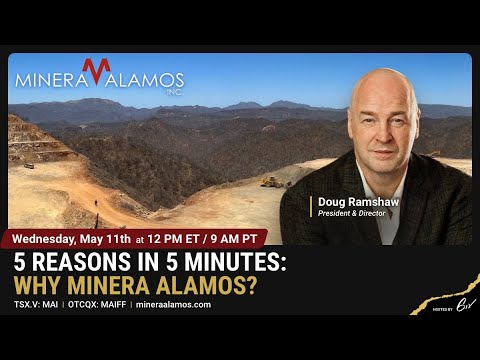
0:08 Well, welcome everyone to the Manera-Elmos live event today, hosted by 6. I'm very pleased to introduce Doug Ramshaw, the president of Manera-Elmos. In this event, we're going to discuss the 5 reasons in 5, roughly 5 minutes, why Monero Alamos. So, and after that, we will be accepting questions live. So as a reminder, feel free to submit questions at any time using the Q&A panel on the right-hand side of the screen, And we'll try to get to them after the presentation portion is over. And as always, this is being recorded and available to watch afterwards on six.com. But without any further
0:40 ado, Doug, I'm gonna pass it off to you to go through the 5 reasons why. Thanks, Dasher. And yes, apologies in advance. I kind of bastardized the format a little bit. It's 5 reasons in 5 slides, not 5 minutes. Anyone who knows me knows I can take 5 minutes to drink a glass of water, to give 5 key points in 5 minutes. A little limiting, but we'll keep it punchy and hopefully it will present an opportunity to ask some questions on either the points I've raised today or other things which have failed to be mentioned. I will be making a few forward-looking statements, probably one big one as well, so obviously bear that in mind.
1:26 Okay, the theme for this year for Monera, I think I have to give credit to a banker in Toronto who mentioned to me back in January that the Monero business model is so perfectly suited for this current inflationary environment we're in. You know, he said, look, you built your first mine for 10 million US, what are your next 2 mines? Maybe 60 million US combined? If you saw a 30% cost overrun on your CapEx, it's 20 million bucks. It's not a deal breaker like we've seen on other things. It's an annoyance, but with the first mine up and running, it's more than manageable. So something I absolutely will be pounding the table with this year is, we have a smart business plan. It's not sexy, but it's smart.
2:16 And I think will serve us and our shareholders extremely well and when the industry is facing major inflationary pressures both on the OPEX and obviously the CAPEX. Ounces in the ground. This kind of goes back to the the Manera business model of bootstrapping. It goes back to the previous slide, which is bootstrapping these projects and starting small and scaling up organically. You know, Our starting resources are all in that kind of plus or minus 500,000 ounce range. Can they grow? Absolutely. Will they grow? Yeah, that's our intent. That's why we're developing projects on a smallest footprint to start with to scale up. It's a key component of what assets we go after is we have to have visibility on how they grow.
3:10 And that means those ounces that we expand the resources out of cashflow, a genuine brownfields ounces. So, right now would I rather have small projects where we can define ounces that very quickly can be put on a leach pad and turned into real dollars or do I wanna have something where I can arm wave that I got 5 or 6 million ounces of low-grade gold is going to require huge capex, which then presents all the challenges that those inflationary pressures so, you know and the heat leach Again, it's it's smart not sexy, you know, You're not going to get crazy headline drill results from us showing high-grade gold in core pitches, but grade isn't king. Margin is. Grade isn't king, margin is. And open pit heap leach, which really isn't a sexy mining style, you know, is a great way to protect yourself in these environments.
4:12 And honestly, you know, a lot of the great mining companies we see today started out on, you know, far from sexy open pit heap leach assets. So that's our skill set and that's what we're going to drive our growth from. And that growth comes from Cerro de Oro, which is a game changer. Obviously, Santana, we built during the pandemic, and it's going through its ramp up now. I think back to something I said about Santana 3 years ago when I was presenting Minera Alamos. Santana, I said at the time, was it was the starter motor. It got things up and running. Thereafter, it was gonna be a lower cost operation in La Fortuna that was gonna be the engine, really driving growth forward.
5:05 Santana hasn't changed. It's still the starter motor. It's important because you get up and start generating positive cash flow. The key was always it would allow you to take some debt on to build the second project. Now that second project has changed from La Fortuna to an asset we picked up in the fall of 2020 called Cerro Duro, another open pit heap leach operation.
5:32 It's going to be a very big mine. We have, we've done some initial internal scoping purely off the starting maiden resource we put out in November, 2020. We know it can be a lot bigger than that. You know, the numbers are good enough that I absolutely want to frame these into a PEA, hopefully Q3 of this year. It will be a very robust and conservatively modeled PEA. And even with that degree of conservatism,
6:10 I expect the numbers are gonna be very, very well received by the market. It's fair to say Cerro de Oro has been a frustration in 1 aspect, 1 that I hope this will be about the last time I'm presenting where I'm talking about the surface rights not having been received.
6:34 And I'm happy to address that in the Q&A, so if someone can ask me the question in the Q&A about Cerro Doro surface rights, I'll do it then, because I don't want to get off the format of this kind of bullet point of, and I think I've got 2 more to come. Organic production growth. Not only can we build mines with limited capex that helps in this environment and everything else. We can build them sequentially and relatively rapidly by industry standards. And that goes to the jurisdiction we're in in Mexico, where the permitting timelines are pretty short.
7:20 When you're developing initial mines at scale anywhere between 25,000, 30,000 ounces or 60,000 or 70,000 ounces to start, you're not talking about huge permitting operations like in Canada and stuff, which can take many years to permit. And that allows us to build these things incrementally, rapidly, and deliver organic production growth. Notwithstanding the fact that each of these projects, when we start them out, is just the first iteration of their production profile. So there can be a real compounding of that production growth should we deliver on both expansions of these projects, as well as bringing on a number back to back.
8:07 And finally, and this is something very close to my heart and pretty evident in my CDI filings over the last, well, 6 months and 12 months. I think in the last 12 months, I bought 1 million shares and in the last 6,500,000 of those. But we look at it in all aspects of our company. I mean, so it's not just the share purchases. How we approach stock option awards, we do them to start with infrequently. The last one we did, I think, were the first times we've issued them in 18 months. And when we did so, we issued them at a considerable premium to market. I think at the time the stock was trading around 60 cents.
8:52 We set them at 72, but that didn't end there. We also tied their vesting to meaningful production milestones. We didn't put it in the press release at the time, I believe it's in our MD&A. For those to vest on a quarterly basis, 25% vesting basis, each 25% of that option grant only vests upon reaching 50,000 ounces of cumulative gold production. So for us as management to see those options have value, we will in their entirety, we will have had to have produced 200,
9:34 000 ounces of cumulative gold production from our operations within a five-year period. Now we absolutely believe that's going to happen. We probably wouldn't have set the vesting on those conditions if we didn't have a plan to actually be able to do it. But I think it was important because I think when we are speaking to shareholders and expect shareholders to put their after-tax dollars at risk, it is very important for management to align their rewards or their purchases with those very same shareholders. And we are in it with you. We're not in it for ourselves because of you. So I would say that Monera ranks very, very highly in our peer group in terms of that alignment with our shareholders. And it's something that's very close to my heart and I'm very proud of.
10:28 Now, with that, I'm sure we can turn to a question about surface rights at Cerro de Oro, but I don't want to preempt any other questions that come in. So that was 5 bullet points that I think separates Monera. It certainly makes Monera a very interesting story for the coming years, but certainly what I like about these kinds of presentations is hearing from shareholders or potential shareholders alike and happy to answer any questions that might come in. All right. Well, thank you so much, Doug. Of course, the question that he requested has come up.
11:07 So can you please tell us more about the surface rights at Cerro de Oro? Well, it's funny you should ask that question. So Cerro de Oro is a very interesting project. The first one of our team is built that actually sits within the municipal boundaries of a nearby town. So 95% of the land that we'd need to develop that mine, actually fell within those boundaries. And we had those surface rights tied up middle of last year because it was just an agreement that needed to be done when you're dealing with the mayor of the town. A lot of companies, not saying all, but a lot of companies probably would have pushed ahead with a mine plan based around that ground, but it wasn't the optimal ground for an operation we saw at the scale that it can be.
12:03 And so rather than doing things in a rushed or premature way, this is where I'll always defer to our excellent team in Mexico. They said, no, it's going to take more time to do it right. It's caused me and I'm sure our shareholders, immense frustration, you know, and there've been a number of times where we thought, you know, we had everything tied up. This is, you know, but they weren't. And I think I look back to pre-pandemic, I was incredibly proud of us being spot on with our guidance and on timings of everything. I used to have a slide about it because we were so accurate on that. And I've hated the fact that timelines have become more fluid over the last couple of years.
12:54 The funny thing is, to some extent, I wish we didn't have to give timelines. But if a shareholder was to ask, when is someone we're expected to. So we give guidance based on the most accurate information we have at hand at the time. Most recently,
13:13 we thought before the BMO mining event in March, end of February, beginning of March, that we'd have them right around that time. But there was still some more meetings. These surface rights, often it's back and forth with local community members, in terms of this last bit of land we want. And it's not that there's any distaste for mining. Cerro de Oro is probably our best located project in Northern Zacatecas. It's fantastic. All the people around there are very pro-mining. They either work directly or have indirect work from a lot of the large mines in the area. And so it's not a question of you're dealing with 2 groups of people. Some are opposed to mining, some are against it, but there's a procedure and it's like the back and forth on negotiations on your pricing and everything else. You don't want to create dangerous precedents So you take your time and that time is in the interest of our shareholders but it does cause a lot of frustration.
14:21 So I don't want to put a time on it but it's really close and I'm probably going to get guidance that would help me in saying how close towards the end of this week. I don't have it for you now, but it's close and it's not hung up because of the government. It's not hung up because of anti-mining elements. It's just procedural. The final step is a final meeting down there where we get an agrarian
14:51 attorney come in to ratify everything was done correctly. And then we're away to the races. And within 2 months of getting those surface rights, we'll have the project into permitting, all the engineering, all the works ready to go. Our consultants, permitting consultants down there believe it's about an eight-month permitting process, highlighting again the attractions of these things in Mexico. So that would still, even if it's 2 months from end of next week to going into permitting, so call it end of July, we're still factoring getting those permits right around the end of Q1 next year. And if that's the case with a roughly 6 month build, Cerro de Oro can be on stream before the end of 2023.
15:48 So, and it really is a big game changer project for us because I think it rapidly pushes us to kind of that 100,000 ounce production
16:00 profile with Fortuna waiting in the wings and really hopefully being able to leave the kind of junior producer world, that sub-100,000 ounce producer world behind us. So it's been frustrating, though, and I think our shareholders have shown incredible patience with us during this. And I think that patience will genuinely be rewarded in due course. Thank you. Paul saying Mexico recently nationalized lithium rights. In your view, are gold and copper next? I don't think so, no. I think lithium was something that AMLO had talked up, wanted to make the point. I mean, there's, there isn't some extensive lithium industry in Mexico.
16:53 I, there's really only one major project back in Aura is one that is now owned by the Chinese that is any kind of
17:03 advanced lithium project in Mexico. So there was talk at the time about energy stuff. So copper was also raised. But some wholesale nationalizing
17:19 of the Mexican mining industry that is a big contributor, but is supported by big investment from companies that, you know, in North America. Yeah, I don't believe it's going to lead to other commodities. I think lithium was, it was an odd one to make so many headlines because it's not like there's some extensive lithium industry in Mexico. It's not like the lithium triangle of South America. Was there a lot of political statements being made by AMLO on it?
18:02 Populist kind of stuff, maybe. It wouldn't be the first time. But I don't see it translating to copper, silver, gold, where the investment, you know, has been made. It would be very hard. I think you'd probably have some major issues with the USMCA as well in that regard too. Okay, thank you. Our next question here is, Will you continue to develop projects without compliant feasibility studies? In terms of feasibility studies, I would very much think that we're not ever going to do a feasibility study. A compliant economic study, we have one for Fortuna, it's PEA.
18:50 PEAs come in different qualities. I think the PEAs we put together are very good. Cerro D'Or will have a PEA. Santana was a bit of an anomaly. Did it make sense delay it for a year and spending a whole bunch of money when in fact, you know, the project we inherited there had better than feasibility study met, for example. You know, most feasibility studies on a heap leach wouldn't have met data that was supported by a 50,000 ton bulk heap leach test pad that was done at site. So we had, I think, a better handle on the metallurgical characteristics of Santana than if we put it into a feasibility study.
19:37 And to be perfectly frank, feasibility studies have been found to be woefully inaccurate over the years, routinely, not just some outliers.
19:48 And again, I think that's one of the other beauties of projects that can be rapidly taken from resource and the PEA into production. The more you can tighten up that timeline, the less likelihood a CAPEX number that appears in a PEA is going to be woefully inaccurate 2, 5 years later when that project's built. We're seeing that right now. So many of these projects where construction was built under 1 set of operating assumptions are now finding significant funding shortfalls, which is tough when you say you've invested 700 million dollars in a project and now you've realized you've got another 1.3 billion to go as opposed to 600 million.
20:38 You know that's where companies can get into real trouble. And yeah those projects have the kind of scale and require the kinds of lending requirements that require that kind of study. But at the same time, the time it takes to them build them, those studies I think often are shown to be inaccurate just because of the length of time that's passed between the study being created and an operation being built. So we will, you know, Cerro de Oro, within 2 months of picking up that project, we put out a 43-101 resource on it. And part of that was to send the message, look, we're not cowboys, we want to do things by the book.
21:20 Santana was an outlier. Even that will have a Maiden 43-101 resource coming out soon. Just the first iteration to kind of support the first part of the mine life there. And it will grow in time as we expand our exploration to some of the other targets and build answers there. But Cerro de Oro, we put one out within 2 months because I want to absolutely make sure the market realizes that we're not averse to filing stuff on CDA with a nice little bow for everyone to see. And that's why we've made the determination which will make my life easier, which will make the analyst's lives easier, which will make shareholders' lives easier in understanding our projects of coming out with a PEA for the Cerro de Oro project.
22:09 Yeah, that's one of the questions is when can we expect the 43-101 documents on Centena?
22:16 We should be before the end of this quarter. So that gives us about 6 weeks, I guess, 6, 7 weeks. We're just actually right now determining what gold price to use. It's an interesting question. Where do you use it? What gold price do you model your resource at? I mean, I know if you're one of the majors, they'll all stress test stuff at 1250, you know, the value that reserves them at 1250 gold price. You know, And we're not a barrack or a new month. One thing I'll say is our business model was conceived in a 1250 gold environment to work in a 1250 gold environment. I think we're very insulated in terms of any reversal in gold. I'm not going to prognosticate as to where gold could go.
23:05 All I know is on the downside, our business model stays intact. And I think that's really important. Obviously, if it goes the other way, we're there to take advantage of it. But I was having this question the other day, like when we did the resource for Cerro de Oro and likely the PEA, which will be based, the base PEA will just be based off that resource, We'll use 1450 gold, which I think is very conservative against the studies coming out right now. For a project like Santana, where we're taking those ounces right now, putting them on pad, do we use 1450? Do we use 15?
23:48 Do we use 1600? It's like, at least these are ounces that conceivably are going to be turned into dollars very rapidly and short of a major couple of hundred dollar reversal in the gold price, I think, you know, there's a flaw that's being set there now. So we're just making that determination as to what gold price to use. But I think the beauty of ounces that we're developing that very rapidly are turned into the very gold that's contained within that rock, gives us a little bit of flexibility there. But overall, I think, you know, the key point is, you know, when we're using prices, we always tend to err to the side of being cautious. I think most PAs now would not be using 1450 gold in them, but I'm pretty sure that's what we'll use for the base case for Cerro de Oro. And I think it underscores why we're building a business model that can support the highs and lows of the gold cycles. I think part of the problem with our business is it is very cyclical and for the longest time the bigger producers would trade with those cycles because there wasn't that.
25:05 Or there was a reluctance to really take a more conservative approach to when buying assets and everything else. And I think there's been a longstanding knock on the sector and why we don't see the generalists pouring in as much as some would think should happen because they've been bitten in the past and so if we can emulate a business model like some of the majors are now starting to achieve, which is not a cyclical business model. I think that's a good company to try to be. All right, thank you.
25:51 Lots of questions here. Given that you expect to be cash flow positive on Santana this year, will the delay in Cerro de Oro affect how much financing you may wish to take on? They're going to say you've been very open that you may take on a modest amount of financing. Yeah, I mean, certainly I think we'll lose our debt-free badge of honor. It was important to be debt-free when building the first mine, so we took a royalty instead. You know, Cerro de Oro is, at a guess, it's going to be about 25 million US to build. I have no problems taking on a bit of debt to help support that. In fact, I would love post PEA to kind of line up what that debt component could be so that the market is aware that as when we get those permits, we've got the funding in place, that there aren't any unpleasant surprises.
26:54 With Cerro de Oro, there definitely comes an additional line of expense. As we started advancing that, we've got draw programs mapped out to do at Cerro de Oro this year, both infill and expansion drilling. Probably 10,000 meters of drilling at Cerro de Oro. There's obviously the permitting work itself. And other stuff we want to do down there as well because we've been finding other targets that we really want to wrap our heads around. But overall I mean I think this is the beauty of that starter motor that was Santana is if we are debt-free, I'm not going to wear it like a badge of honor. It's been good to this point but I have no problem. It will be more efficient for us to look for taking on a modest amount of debt for a project like that.
27:56 To be honest, if gold prices hung up at $1450 or $1500 gold, which is where we'll model that PEA, the payback on it will be so quick that I don't even view that debt as anything more than a short-term bridging loan. This is not something that we'll see years and years of payback to deplete that number. So, you know, I'm pretty comfortable with where we're at right now. Thank you. Jim's asking, is there an aspirational sense of how many ounces you think you might be producing in 4 to 5 years if all goes to plan? Yeah, I mean, from a personal point of view and looking at what we have now, you know, My hope is, I mean, actually I hope we can do it before 5 years, but I want to build this company into a plus 200,000 ounce a year producer, and not just for the sake of getting a number of ounces produced.
29:02 The kind of quality ounces which are gonna deliver meaningful margin to both reinvest into the company to expand it. But hopefully, again, looking to emulate bigger companies in what we do, you know, build projects which have sufficient margin where honest to goodness, there isn't, you know, it would be inefficient to try to just reinvest all of that for the sake of reinvesting it in the business. The ultimate goal for me, you know, would be to see a return of capital to shareholders, to be able to build a production base that's spitting off so much cash that you can do a blend of dividends and buybacks and the like. I sure as hell know that every time I buy stock in the company I'm not seeing that money again. So maybe selfishly building a business model that's aligned with generating enough cash that we can pay a dividend. Hey, at least there's the nice dividend check that can come in due course. But first things first, it's about executing, getting these multiple mines built out. But it is, I think, quite conceivable that we can build that 200,000 ounce a year producer in that 4 to 5 year range, if not sooner.
30:26 But in light of what I was saying about timelines right now, let's use 5 years as the outside date. Yeah, I guess another timeline question about the construction start of Cerro de Oro. Kevin's asking, right now it's HQ 2023, do you see the upside moving close to HQ 2022? So in a perfect world, if we were to have surface rights, in the next 2 or 3 weeks, let's say around the end of the month in a perfect world. It's about 2 months from there before the permit applications we've got all ready to go can be submitted. And that's because the last thing that needs to happen is some baseline and flora fauna surveys. That can't be done without all those surface rights. So our permitting consultants have said within 10 months of surface rights, 2 months for those surveys, 8 months for permitting, we should be getting our permits back.
31:40 So on that basis, we're talking right around the end of Q1 next year. Now, Q1, early Q2. Construction could start immediately upon receipt of the ETJ-MIR permits. And that's as little as 5 months, but let's say 6 months. From an open pit heap leach perspective, it's a really nice area we're in. There's huge areas of flat ground for what are gonna be very large leach pads. The leach pad we're thinking of permitting has 100 million tons of capacity, not just for our starting operation, but for the expansions we see thereafter.
32:32 So, I would hope worst case scenario, we've had our first blast and mining has commenced before the end of next year. Could we have been going through a few months of the ramp up by end of next year? Or is it a first blast on Christmas Day 2023? I am not sure. But if I had a goal, it would just be that mining has commenced before the end of 2023 and there's a realistic chance that mining could have been going for a few months by before the end of 2023. Okay, thank you. Paul's asking what inflationary cost pressures are you seeing in 2022 so far?
33:18 Yeah, it's an interesting one. Not that much. Part of this is like, so from a diesel perspective, gas prices, How Mexico deals with gas is they look at things on kind of a, with setting prices is they look at everything on kind of a three-year rolling basis. So when prices collapse, we really didn't see the benefit of that. But now that they're going up, we've actually only seen a modest single digit percent increase in our gas prices there for our contractor and the small carbon plant that we operate. So that's been pretty minimal. We agent costs like cyanide and lime, And we have low consumption of both, but you know, they've been modest. They probably have added, you know, maybe 20, $25 an ounce in terms of cost.
34:21 It's an interesting one because I said this in a meeting I had recently, there was a whole big thing a couple of months ago or 6 weeks ago about a big Czech Republic company that produces a lot of cyanide shutting down their plant and they were producing it for use in the mining sector and everything else, shutting down their plant because of high energy costs in Europe. And you know our cyanide is produced in Mexico. It isn't a supply chain issue but it's it's an interesting example of there are genuine supply chain issues which are going to lead to some cost inflation, and the more the advanced planning required to mitigate those.
35:13 Lead, a long lead item ordering, you'll want to start a little earlier. A good example, drip lines for pads, dripping your cyanide solution over your, I mean, we're talking plastic pipe here. And our pipe supplier, normally, our drip line supplier, normally you'd call up 2 weeks later, you'd have your pipe. And as a courtesy to us a few months ago, he said to us, by the way, if you're needing drip lines, you know, I need 3 to 4 months. It wasn't the price of the drip lines was going up, but you had to be prepared for the time it was gonna take to get certain things.
36:01 And so we get a lot of lessons we're learning from just operating Santana will be very, very helpful for Cerro de Oro, including a lot of lead order items that we want to have well in advance, just to ensure the smooth transition of building that and starting up that operation. And so cyanide, we've seen a slight price increase but that's not because of any other reason than those Mexican suppliers are seeing the cost of Sinai going into North America and saying, well, you've got to pay by for us because you don't want to be paying those prices. So they're using it a little. Elizabeth Warren would be saying, here's an example of price gouging. There's a bit of price gouging going on. You know, and look, a lot of these companies have probably struggled like a lot of people in society over the last couple of years. Can I blame them a little?
36:56 No, I can't. But overall, we're not seeing much in the way of cost inflation. We are absolutely as vulnerable as anyone else to breakd chain. And so I think So always to be ahead of being very well informed so you can get ahead of supply chain issues. That's really interesting. Ken's asking, do you see Monero-Elmos as a buyout target? No, I don't actually. I mean, maybe people like a liquidity event. We're about building a new significant gold producer and you know that's something I think that there's room for in the market.
37:47 And so whilst we sometimes as investors, and I'm an investor in this space as well, sometimes we love the idea of a liquidity event. I'll give you an example of 1 where I think there was when Darren and his team built Castle Gold, and they built that very similar to Santana or what Cerro de Oro is going to be, it started on a 300,000 ounce resource. They built it for 7 million US, started out as a 25,000 ounce a year operation and 2 years later it got bought out for 130 million dollars. And during that time they'd increased the resource to 1.2 million ounces, The profile was 50,000 ounces a year and it was heading to 75. It got bought out by Argonaut. It was a bit of an arranged marriage. There were some shareholders still feeling the hurt after the GFC.
38:43 So in 2010, Argonaut Gold bought them for $130 million. They also bought a company called Pediment Gold that had the La Colorado project. I think they paid about $160 million for that. So roughly $300 million in combined acquisitions. In very short order, relatively short order, I've not gone to 1 billion dollar market cap. So, I mean, you can kind of ask yourself a question as shareholders of those companies, how much money did you leave on the table taking the liquidity event? You know, it's my job to show that, you know, we are better poised to continue to add value off our own hard work than succumbing to something. But I think the very nature of bootstrapping these operations means a potential acquirer just doesn't have the line of sight on the resource that we do and stuff.
39:42 So I don't think so, honestly. But I'd also just couch that by saying, just because I believe that we can build a great new gold producer off the foundation that we've put in place now, we will always, always think about things from all shareholders' perspectives and not our own desires to lead this charge to build the next great big thing. So, you know, whilst I personally think that that is a path that is best serving our shareholders, I am but 1 voice or 6.5 million shares of 448.
40:29 I'm a very small voice in this, You know, it's our shareholders at large we have to think about. So. Next question is what will the Sarah to oral PDA cost? Oh, it won't cost much at all. And the reason is that you're not going to see a PEA. Like our PEA for Fortuna was done by CSA. This PEA will be of 43-101 standard, co-authored by a number of expert QPs in their respective fields. All independent QPs co-authoring a report. It won't have some glossy logo on the front cover, but it will have every single page and every bit of data you would see in a report produced by an SRK or a CSA or a JDS or whoever, and will be done with a degree of conservatism that will not have anyone questioning approaching it from that perspective. After all, when you're going through a SRK or a JDS or whoever, it's basically authored by a whole series of independent professionals, you know, working under that umbrella in their respective fields. So you know this this will be no different, it just won't have a company logo on the front, it will have you know the credentials of the the 3 or 4 QPs required to that will have done the
42:01 work to put it together. So that's why we can think about, you know, putting something out in Q3, because this is not gonna be a long process. It will be a diligent process, and it will be a very cost effective process as a result. All right, thank you. I want to close out with this question from Ben here. Apart from declaring commercial production on Santana and obtaining the rights at Cerro de Oro, what would you say are the main catalysts shareholders should look forward to for the rest of 2022? Okay, yeah, it's a good question. People always ask about catalysts and I've actually, I get for good reason a lot of people are hanging on when's commercial production, when's commercial production at Santana and I've pointed them to a lot of companies where I think there's been a haste to make that declaration and we're not in a hurry to do so.
43:09 I think by taking our time to get there, it will be more impactful. So it is a genuine Catalyst, but it's one of many this year. Those surface rights are key because they start the ball rolling for us being able to talk about a lot more about Cerro de Oro for us doing the PEA on it, for getting the permits in. So that all starts, it's the biggest gating item for Cerro de Oro and why it's been a source of frustration that I've had to kind of see to, okay, it's better to do it right than rushed. It is the gating item for news flow at Cerro de Oro. So that to me, when I look at our whole business model, it's funny.
43:58 I'm sure people think it's gotta be commercial productions, the most significant catalyst. I actually think the surface rights of Cerro de Oro are. And so in terms of the rest of the year, I think the biggest catalyst thereafter is actually going to be the PEA and Cerro de Oro, because I'm sure that's how I'm going to enjoy actually being able to talk real numbers. I don't want our shareholders to have to guess. The PEA is going to clear all that up. And if it's even close to our internal modeling, everyone should be very, very surprised. And I think it will be a major, major catalyst for the company. So, we're also going to be doing quite a bit of exploration this year in the second half.
44:52 But I think in the short term, surface rights at Cerro de Oro, then commercial production at Santana, then CDO's PEA, I think would be the first 3 things on deck to really watch out for. All right, well, thank you so much, Doug, for taking us through the update and obviously this live Q&A. Thank you everyone for joining and who submitted questions. If you do have other questions following the summit, feel free to reach out directly to Monero-Almos. The email is here on this slide. And of course, there's more information on their website, monero-almos.com. And as always, this has been recorded, so you can rewatch it on Six.com. Before I close out, I'm just going to pass it back to you, Doug, if you have any final remarks. No, I appreciate everyone being here today. I hope it was a good use of your time.
45:44 Not only the info at Moneer Alamos email address. I pride myself and in fact love it when people want to reach out directly to me. I think as investors in this business, you should be doing that more. You know, you should be challenging CEOs and presidents of the companies, calling them out on stuff, you know, and making sure you can reach them because we serve at your pleasure. So at the bottom of every press release, there is my cell phone number and my email address. Don't be a stranger. There are questions that today or any time in the future you want to ask, I am always available. And if I can't get back to you for when you call, you'll get a call back within 24 hours. So Anyway, with that, good luck in the markets out there. It's a bit of a choppy old time we're dealing with. So I hope that the markets are treating you well and thank you