Xenon Pharmaceuticals Inc. · NASDAQ:XENE
Xenon Pharmaceuticals — 2026 J.P. Morgan Healthcare Conference
31 slides from Xenon Pharmaceuticals's conference presentation, January 2026

Slide 1: Corporate Overview
Corporate Overview 2026 J.P. MORGAN HEALTHCARE CONFERENCE JANUARY 2026 NASDAQ: XENE xenon-pharma.com
Slide 2: Forward Looking Statement/Safe Harbor
Forward Looking Statement/Safe Harbor This slide presentation and the accompanying oral commentary contain forward-looking statements (within the meaning of Section 27A of the Securities Act of 1933, as amended, and Section 21E of the Securities Exchange Act of 1934, as amended, and the Private Secu
Slide 3: About Xenon Pharmaceuticals
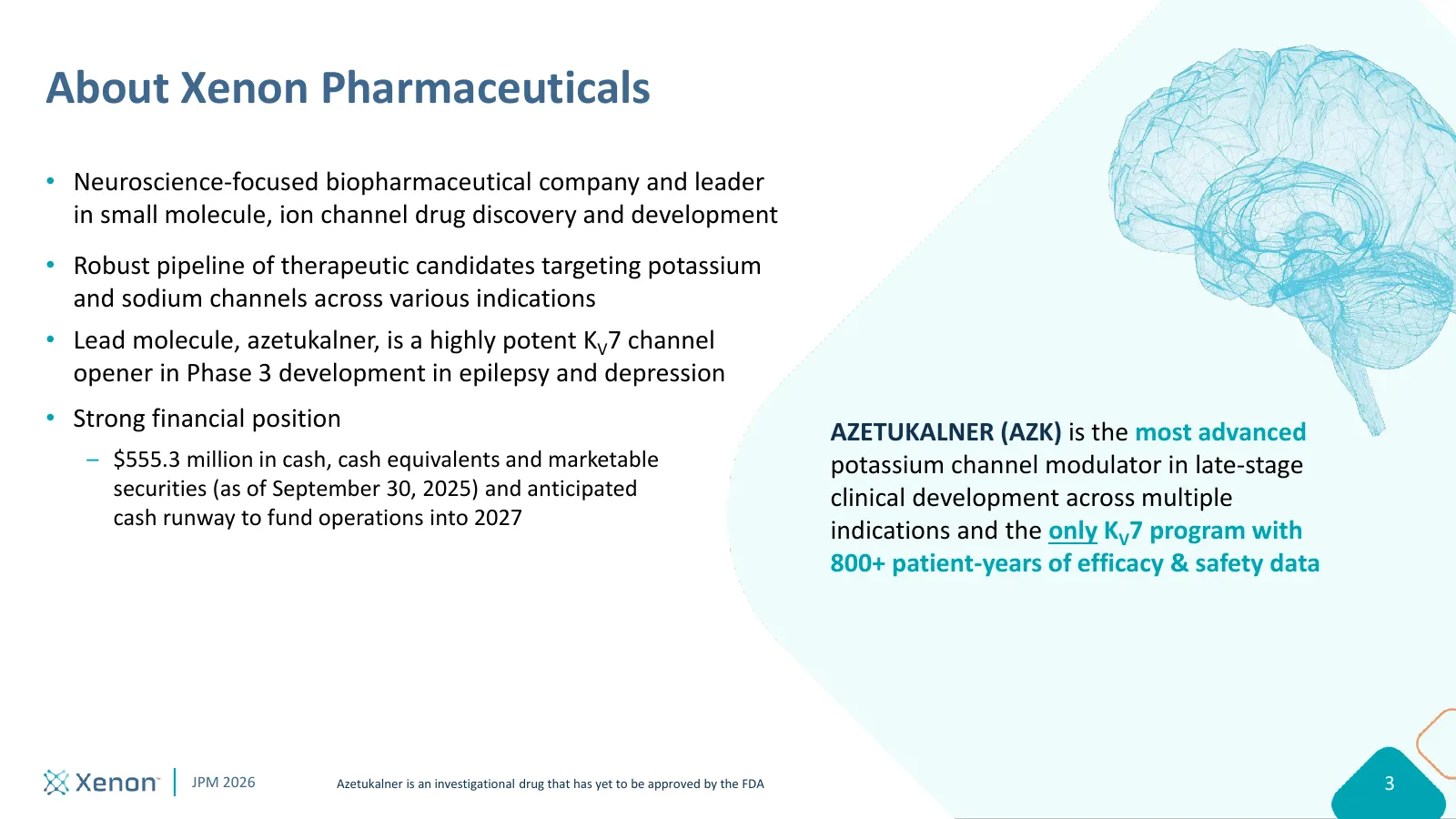
About Xenon Pharmaceuticals • Neuroscience-focused biopharmaceutical company and leader in small molecule, ion channel drug discovery and development • Robust pipeline of therapeutic candidates targeting potassium and sodium channels across various indications • Lead molecule, azetukalner, is a high
Slide 4: Xenon's Neuroscience-Focused Pipeline
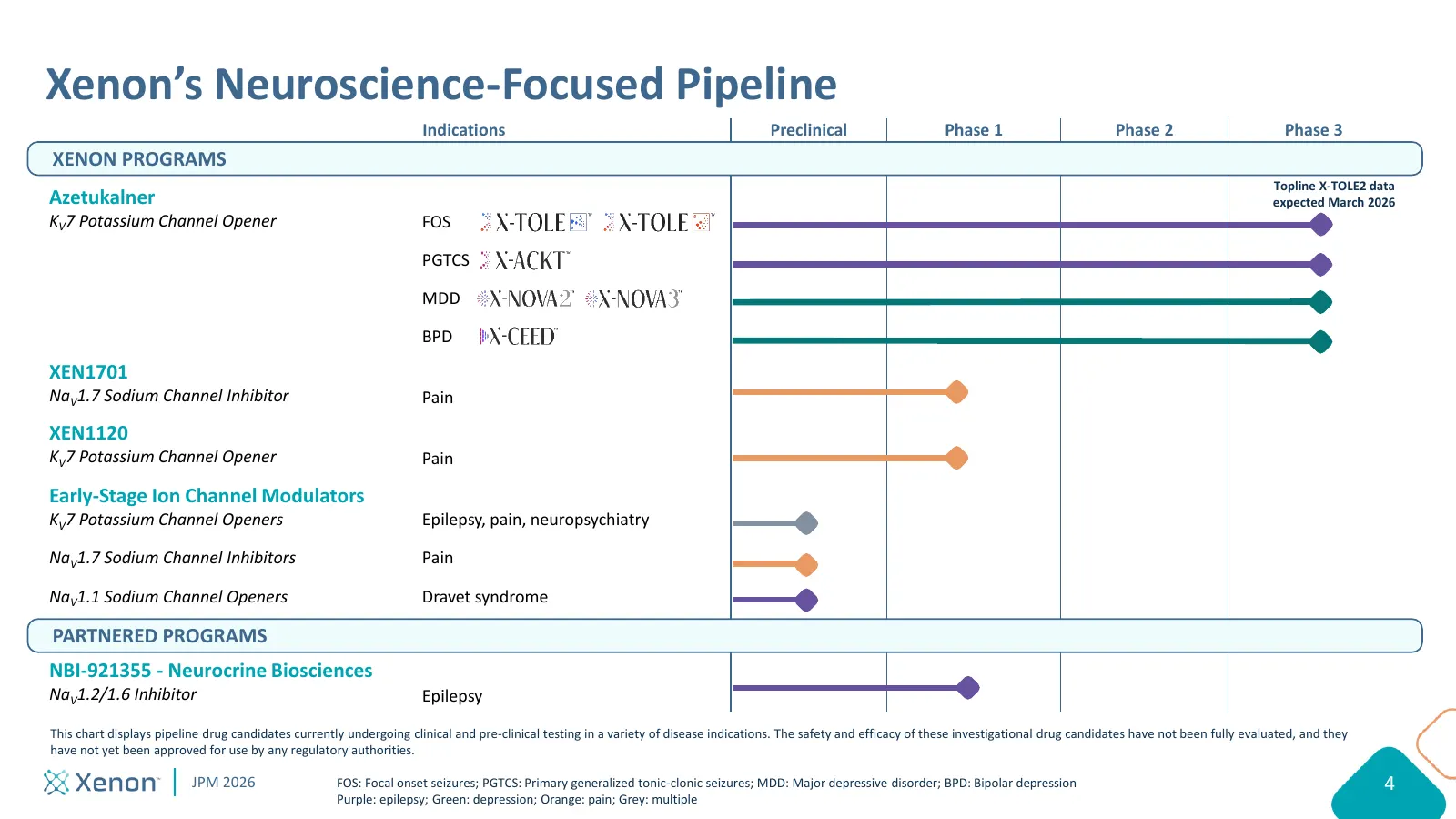
Xenon’s Neuroscience-Focused Pipeline Indications Preclinical Phase 1 Phase 2 Phase 3 XENON PROGRAMS Topline X-TOLE2 data Azetukalner expected March 2026 KV7 Potassium Channel Opener FOS PGTCS MDD BPD XEN1701 NaV1.7 Sodium Channel Inhibitor Pain XEN1120 KV7 Potassium Channel Opener Pain Early-Stage
Slide 5: Azetukalner's Significant Potential Across Epilepsy & Neuropsychiatry
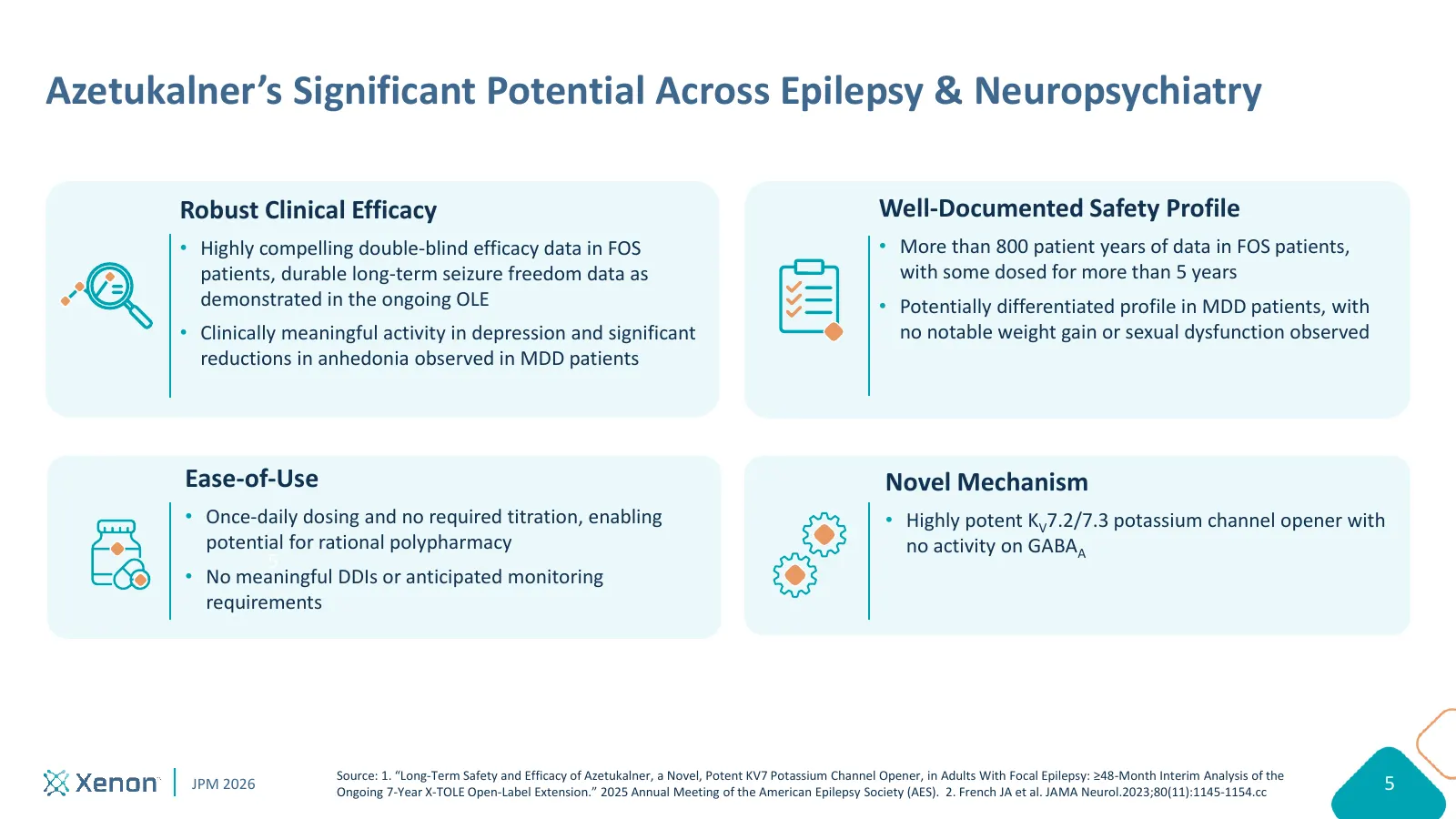
Azetukalner’s Significant Potential Across Epilepsy & Neuropsychiatry Robust Clinical Efficacy Well-Documented Safety Profile • Highly compelling double-blind efficacy data in FOS • More than 800 patient years of data in FOS patients, patients, durable long-term seizure freedom data as with some dos

Slide 6: Azetukalner & Epilepsy Market Opportunity
Azetukalner & Epilepsy Market Opportunity
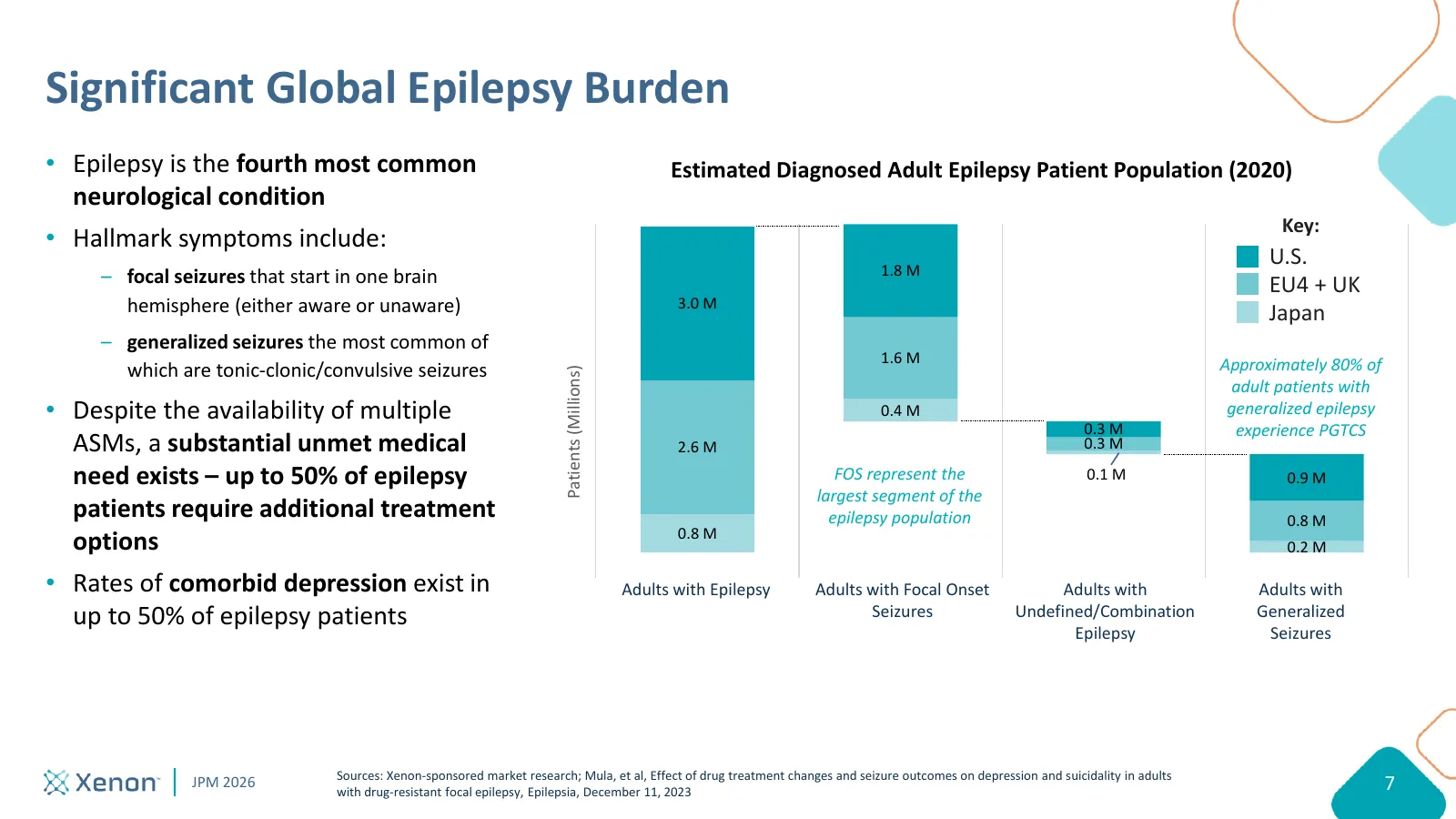
Slide 7: Significant Global Epilepsy Burden
Significant Global Epilepsy Burden • Epilepsy is the fourth most common Estimated Diagnosed Adult Epilepsy Patient Population (2020) neurological condition Key: • Hallmark symptoms include: 1.8 M U.S. – focal seizures that start in one brain EU4 + UK hemisphere (either aware or unaware) 3.0 M Japan
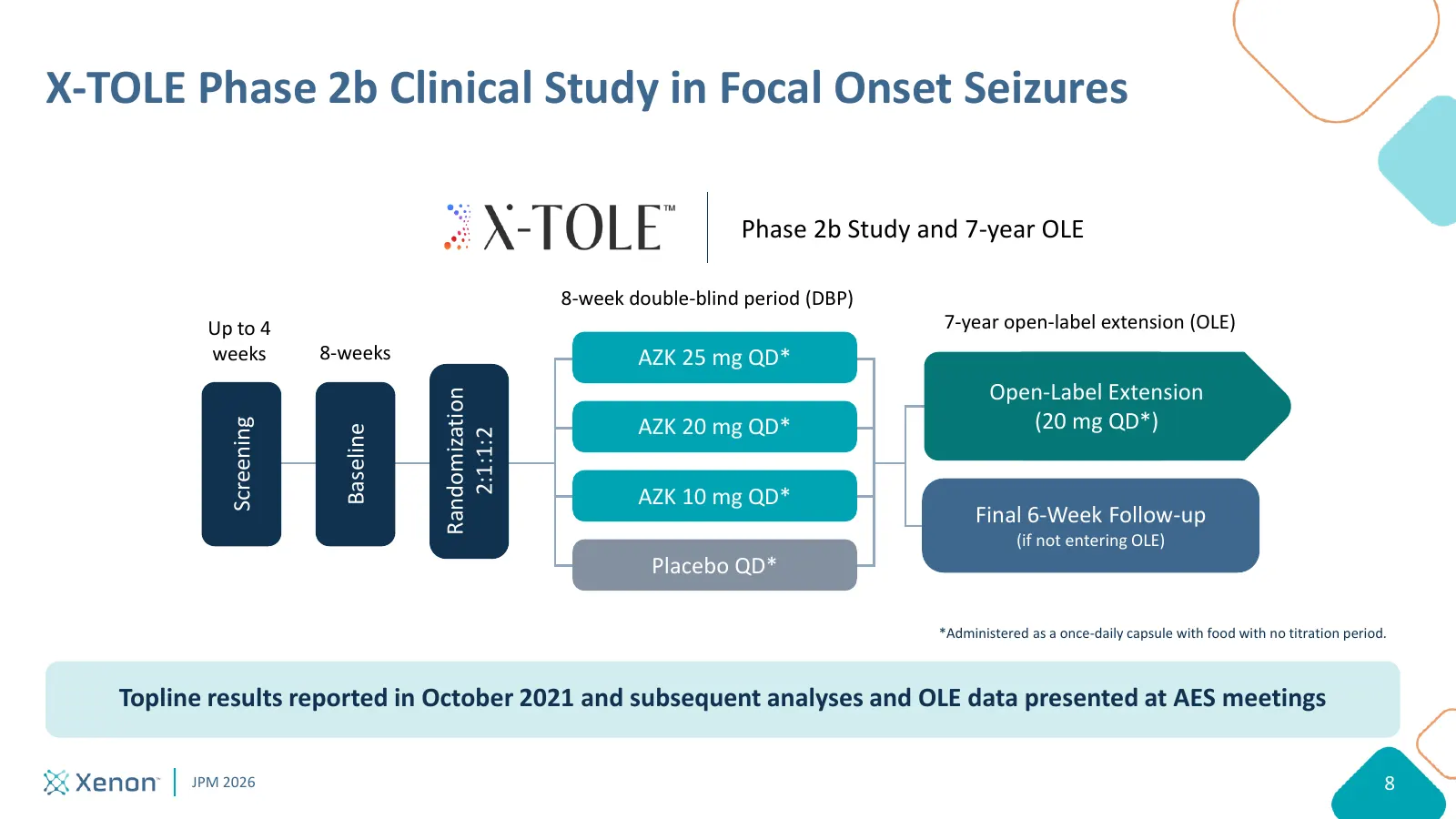
Slide 8: X-TOLE Phase 2b Clinical Study in Focal Onset Seizures
X-TOLE Phase 2b Clinical Study in Focal Onset Seizures Phase 2b Study and 7-year OLE 8-week double-blind period (DBP) Up to 4 7-year open-label extension (OLE) weeks 8-weeks AZK 25 mg QD* Open-Label Extension Randomization (20 mg QD*) Screening AZK 20 mg QD* Baseline 2:1:1:2 AZK 10 mg QD* Final 6-We
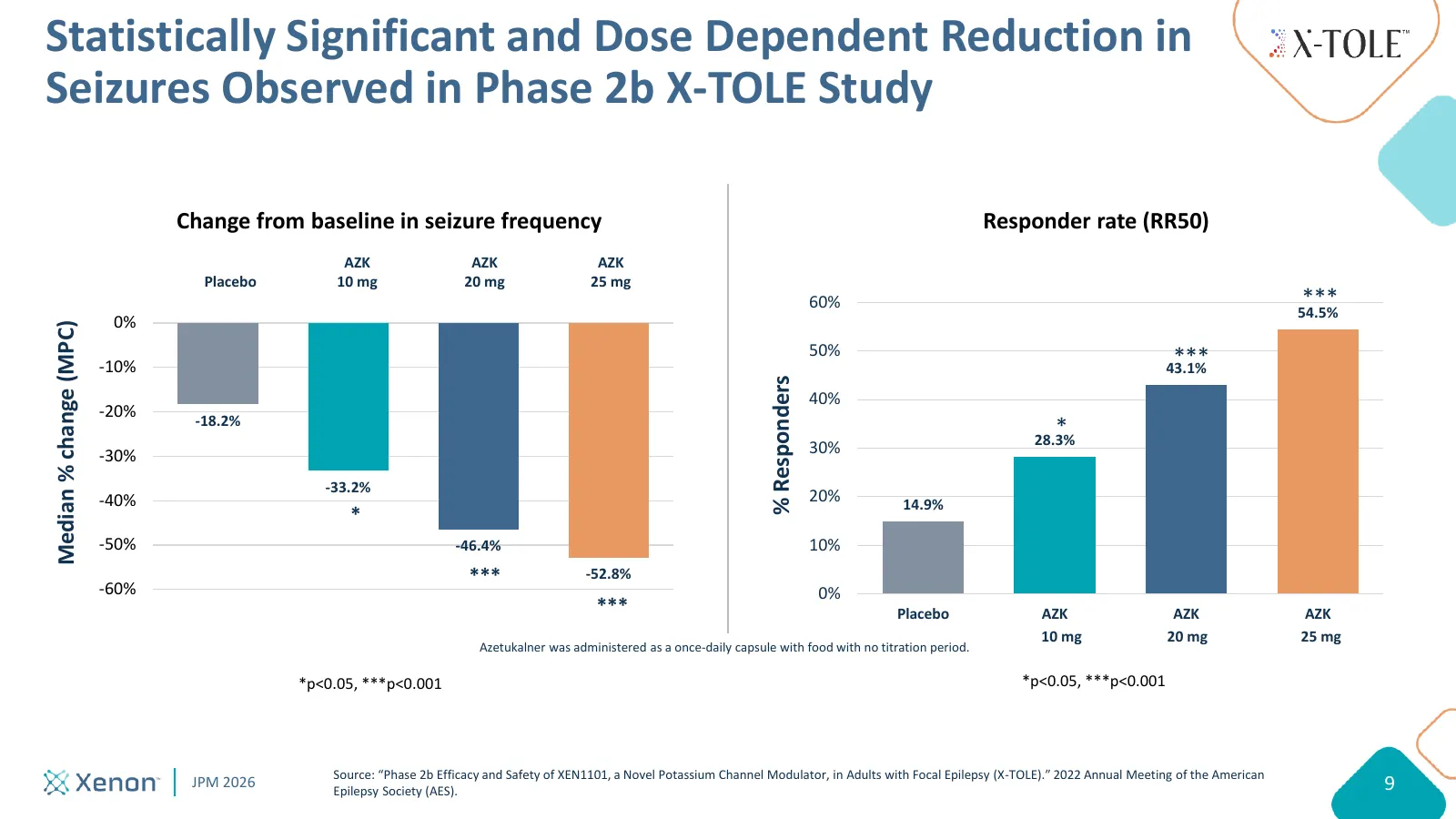
Slide 9: Statistically Significant and Dose Dependent Reduction in Seizures Observed in Phase 2b X-TOLE Study
Statistically Significant and Dose Dependent Reduction in Seizures Observed in Phase 2b X-TOLE Study Change from baseline in seizure frequency Responder rate (RR50) AZK AZK AZK Placebo 10 mg 20 mg 25 mg 60% *** 54.5% 0% Median % change (MPC) 50% *** -10% 43.1% % Responders 40% -20% -18.2% * 28.3% -3
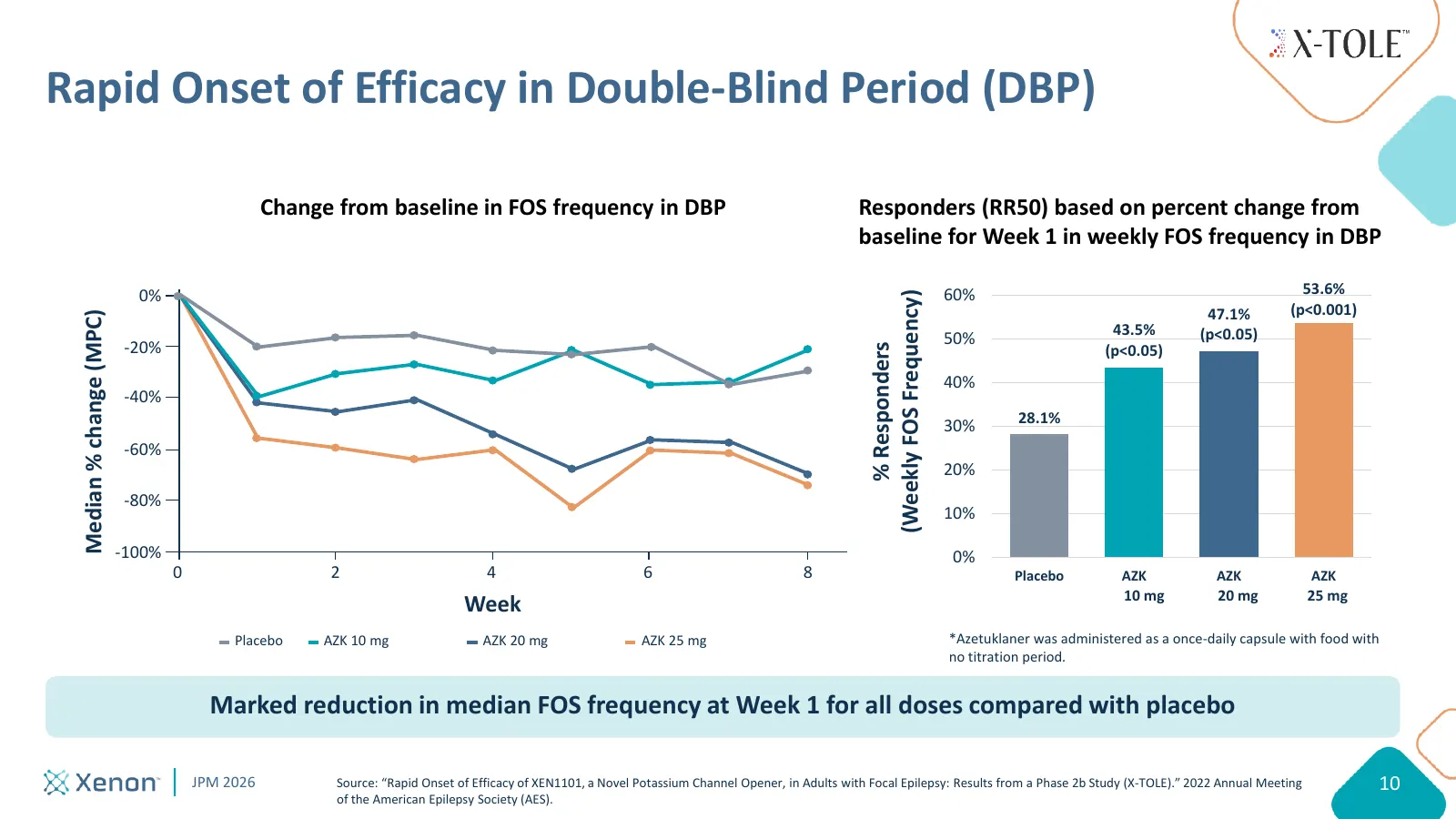
Slide 10: Rapid Onset of Efficacy in Double-Blind Period (DBP)
Rapid Onset of Efficacy in Double-Blind Period (DBP) Change from baseline in FOS frequency in DBP Responders (RR50) based on percent change from baseline for Week 1 in weekly FOS frequency in DBP 0% 60% 53.6% (Weekly FOS Frequency) 47.1% (p<0.001) Median % change (MPC) 43.5% (p<0.05) 50% -20% % Resp
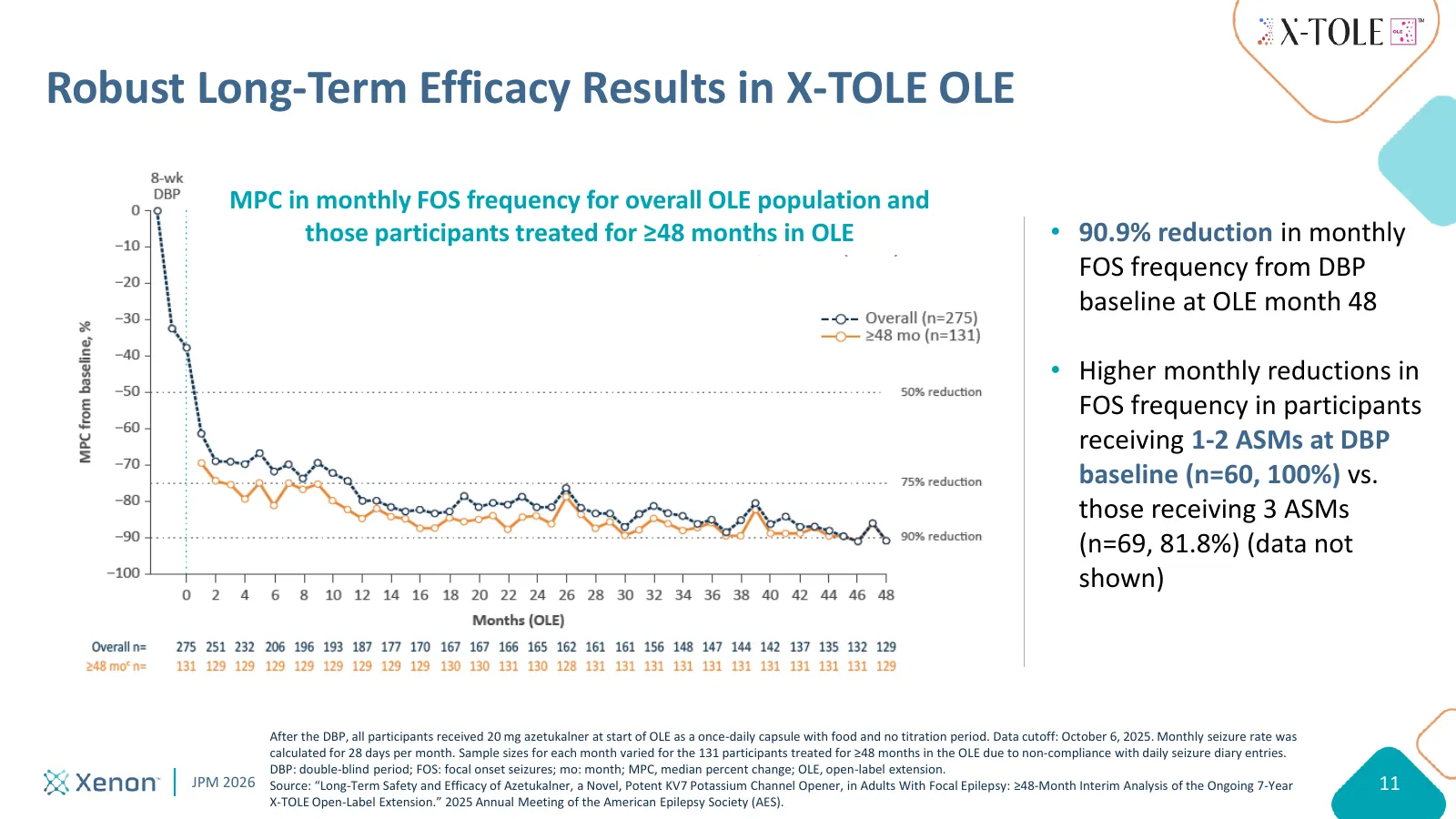
Slide 11: Robust Long-Term Efficacy Results in X-TOLE OLE
Robust Long-Term Efficacy Results in X-TOLE OLE MPC in monthly FOS frequency for overall OLE population and those participants treated for ≥48 months in OLE • 90.9% reduction in monthly FOS frequency from DBP baseline at OLE month 48 • Higher monthly reductions in FOS frequency in participants recei
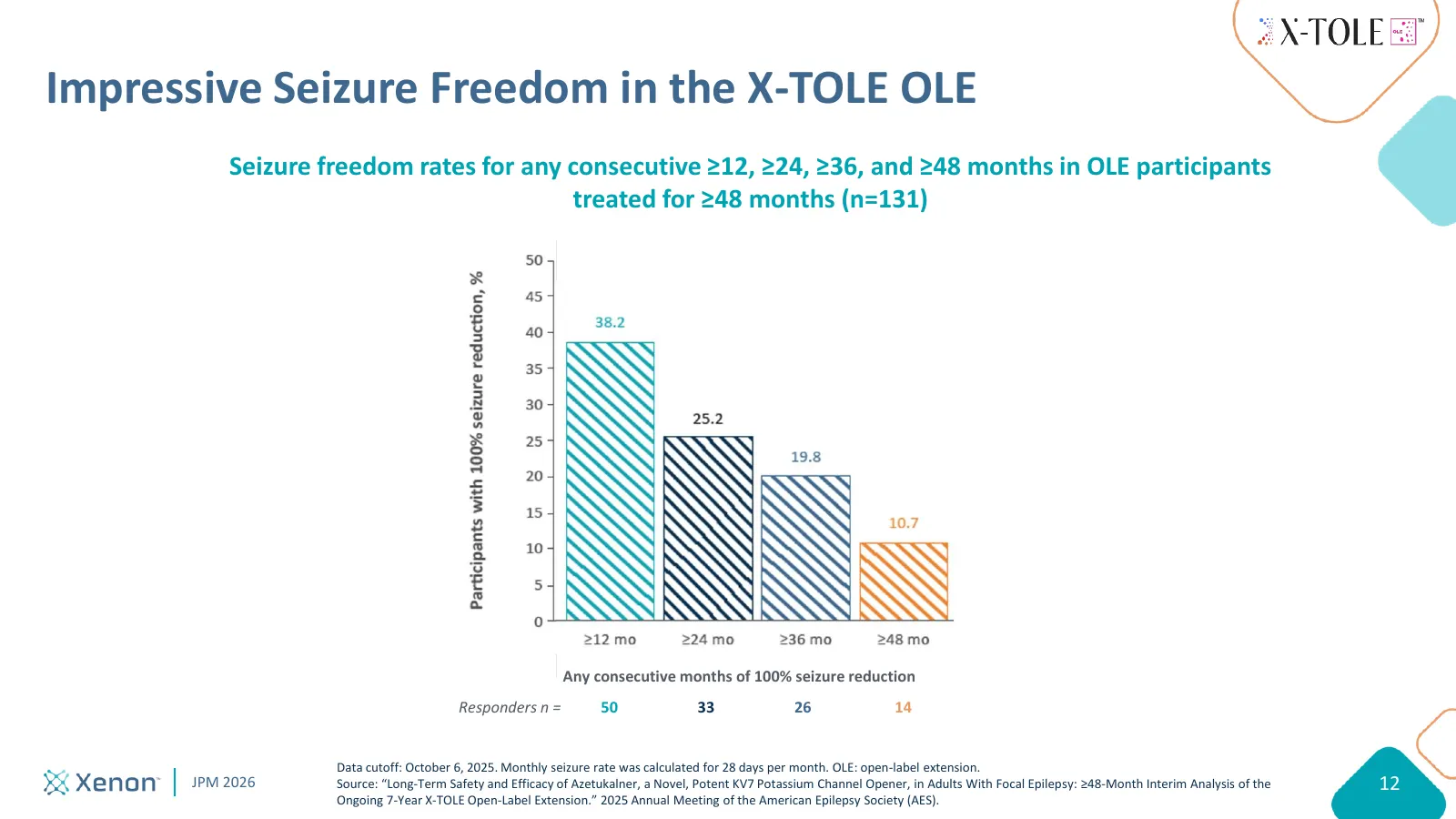
Slide 12: Impressive Seizure Freedom in the X-TOLE OLE
Impressive Seizure Freedom in the X-TOLE OLE Seizure freedom rates for any consecutive ≥12, ≥24, ≥36, and ≥48 months in OLE participants treated for ≥48 months (n=131) Any consecutive months of 100% seizure reduction Responders n = 50 33 26 14 Data cutoff: October 6, 2025. Monthly seizure rate was c
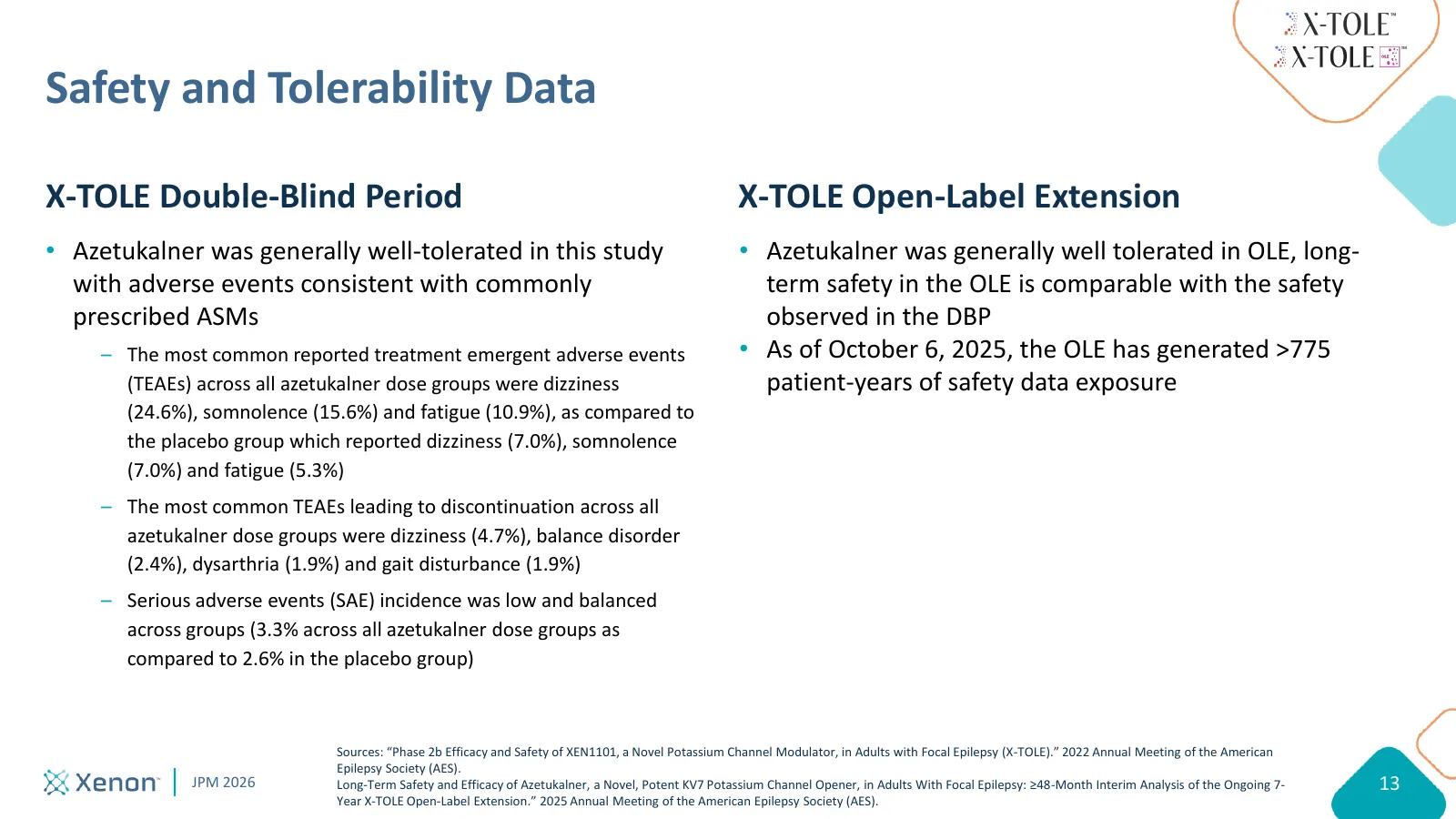
Slide 13: Safety and Tolerability Data
Safety and Tolerability Data X-TOLE Double-Blind Period X-TOLE Open-Label Extension • Azetukalner was generally well-tolerated in this study • Azetukalner was generally well tolerated in OLE, long- with adverse events consistent with commonly term safety in the OLE is comparable with the safety pres
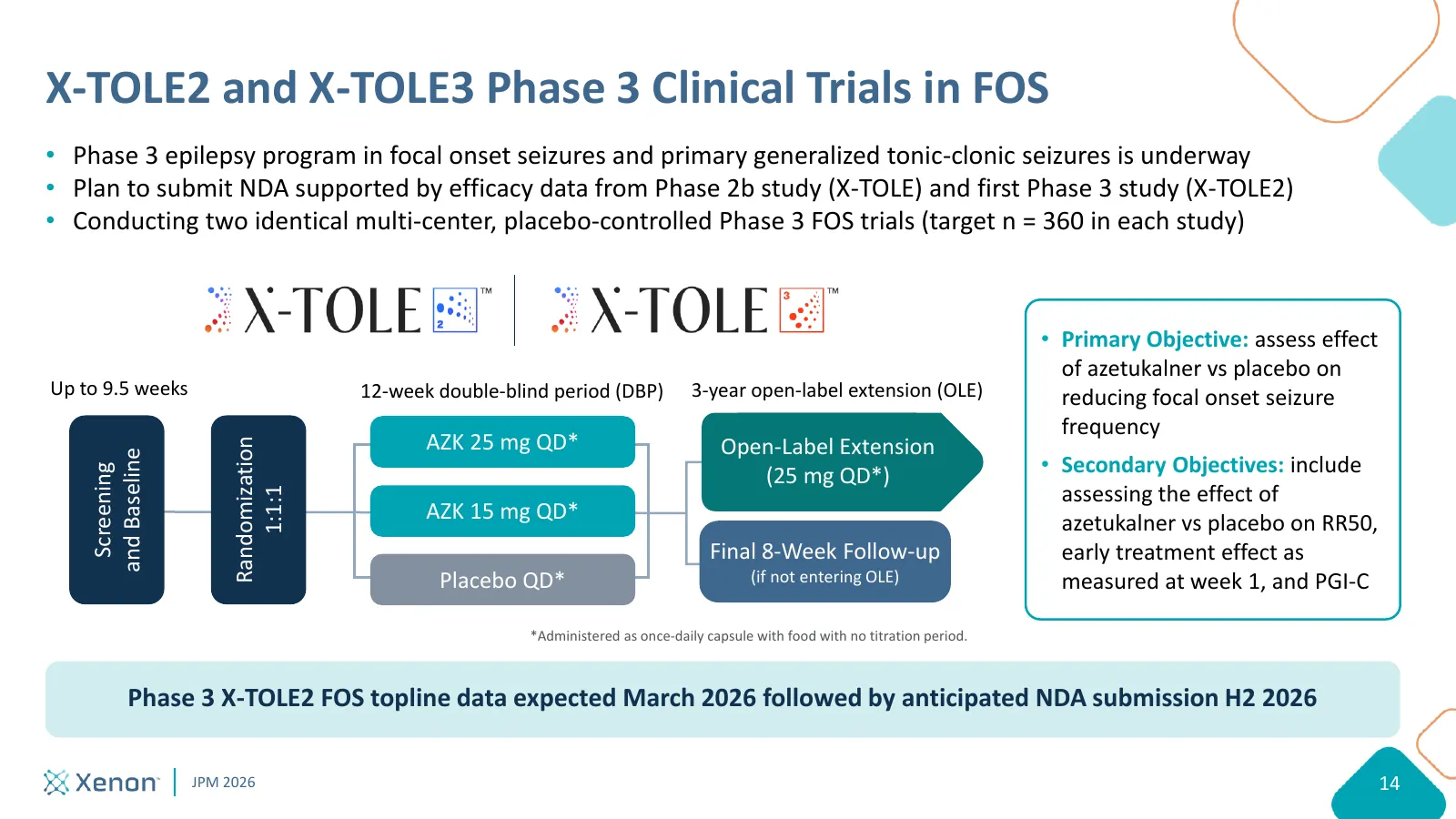
Slide 14: X-TOLE2 and X-TOLE3 Phase 3 Clinical Trials in FOS
X-TOLE2 and X-TOLE3 Phase 3 Clinical Trials in FOS • Phase 3 epilepsy program in focal onset seizures and primary generalized tonic-clonic seizures is underway • Plan to submit NDA supported by efficacy data from Phase 2b study (X-TOLE) and first Phase 3 study (X-TOLE2) • Conducting two identical mu
Slide 15: X-ACKT Phase 3 Clinical Trial in PGTCS
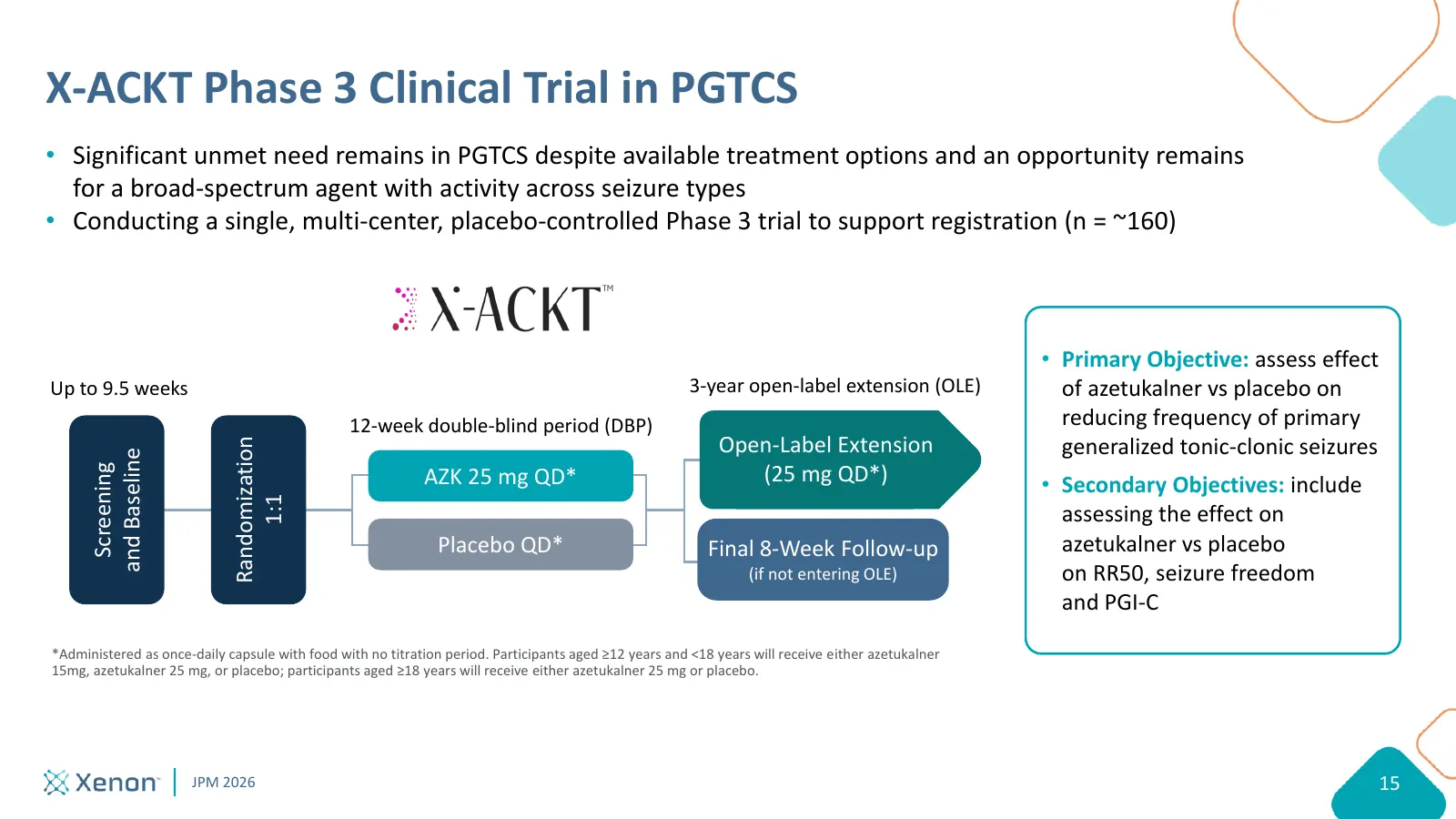
X-ACKT Phase 3 Clinical Trial in PGTCS • Significant unmet need remains in PGTCS despite available treatment options and an opportunity remains for a broad-spectrum agent with activity across seizure types • Conducting a single, multi-center, placebo-controlled Phase 3 trial to support registration

Slide 16: Expanding Azetukalner in Neuropsychiatry
Expanding Azetukalner in Neuropsychiatry
Slide 17: X-NOVA Phase 2 Proof-of-Concept Clinical Study in MDD
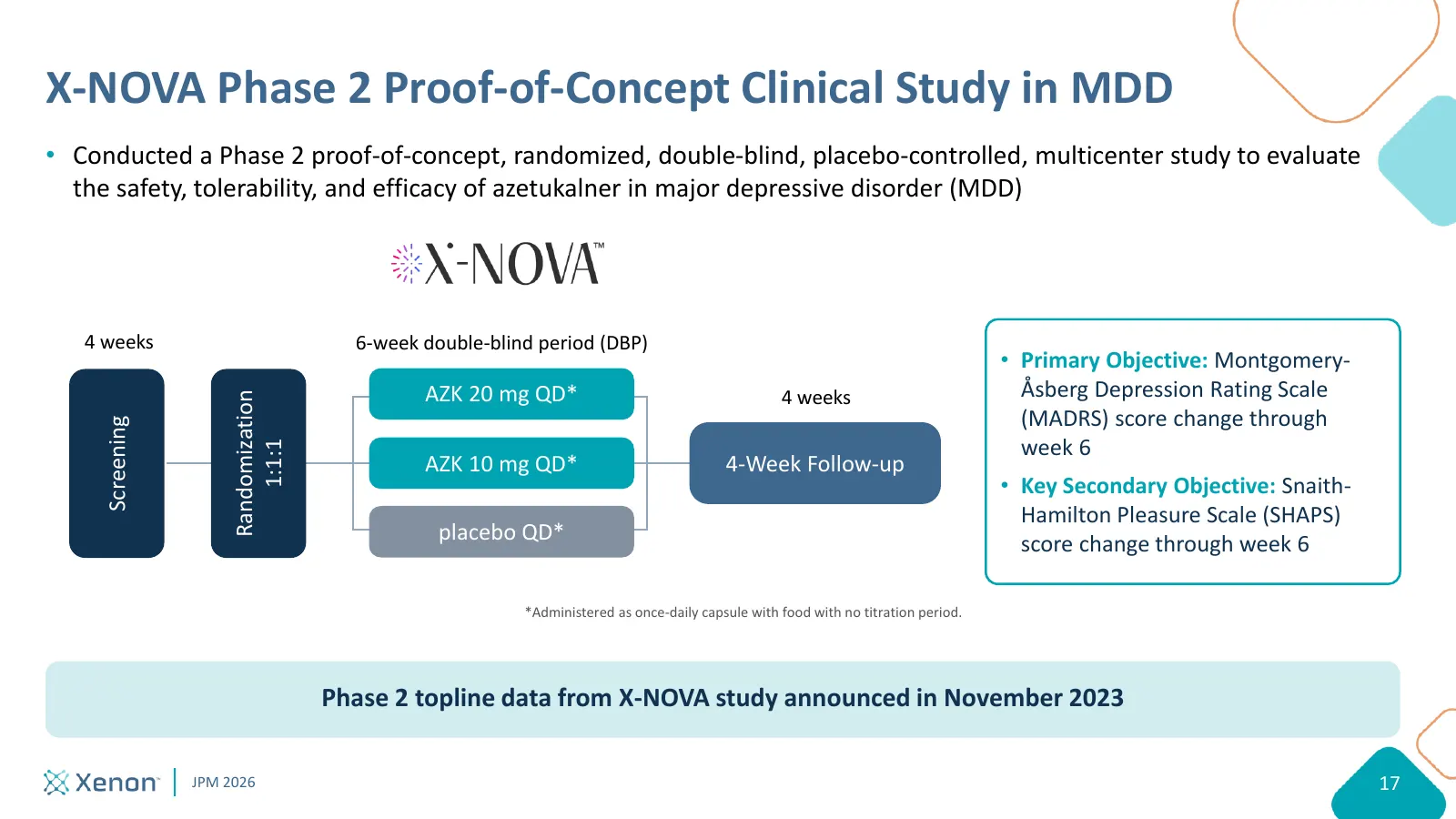
X-NOVA Phase 2 Proof-of-Concept Clinical Study in MDD • Conducted a Phase 2 proof-of-concept, randomized, double-blind, placebo-controlled, multicenter study to evaluate the safety, tolerability, and efficacy of azetukalner in major depressive disorder (MDD) 4 weeks 6-week double-blind period (DBP)
Slide 18: X-NOVA Primary Efficacy Endpoint
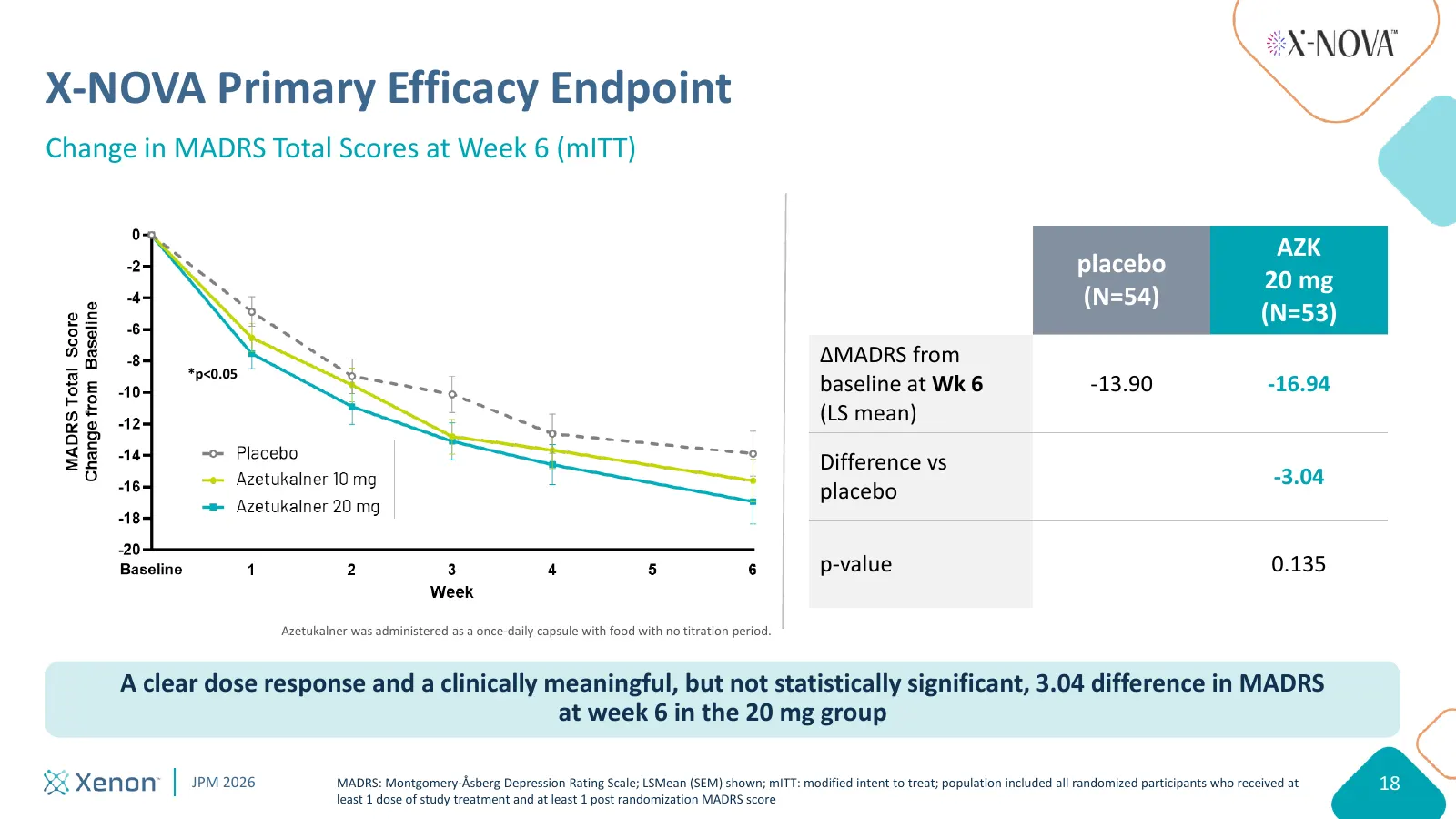
X-NOVA Primary Efficacy Endpoint Change in MADRS Total Scores at Week 6 (mITT) AZK placebo 20 mg (N=54) (N=53) ΔMADRS from *p<0.05 baseline at Wk 6 -13.90 -16.94 (LS mean) Difference vs -3.04 placebo p-value 0.135 Azetukalner was administered as a once-daily capsule with food with no titration perio
Slide 19: X-NOVA Pre-Specified Endpoint Improvement in Depressive Symptoms
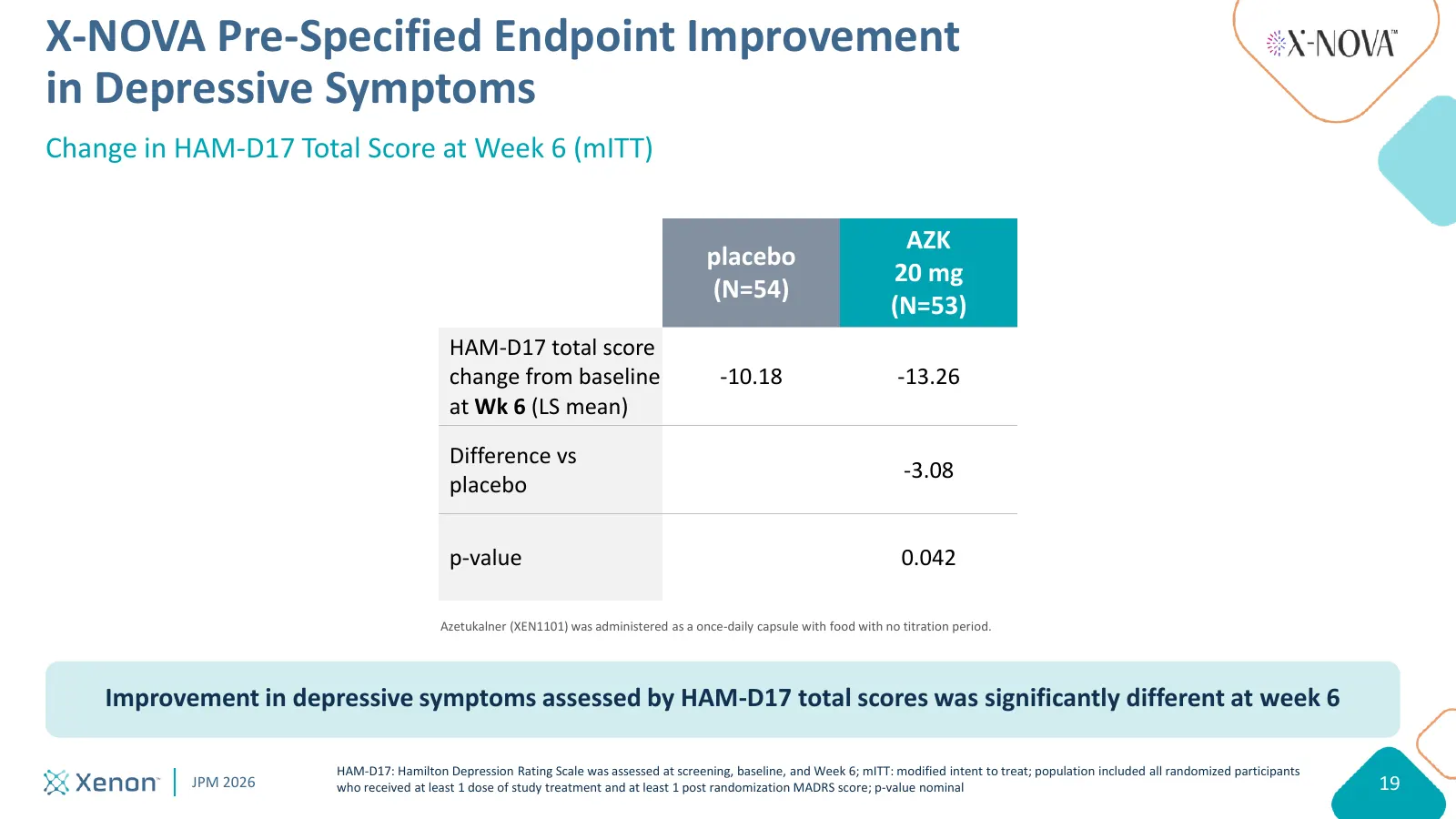
X-NOVA Pre-Specified Endpoint Improvement in Depressive Symptoms Change in HAM-D17 Total Score at Week 6 (mITT) AZK placebo 20 mg (N=54) (N=53) HAM-D17 total score change from baseline -10.18 -13.26 at Wk 6 (LS mean) Difference vs -3.08 placebo p-value 0.042 Azetukalner (XEN1101) was administered as
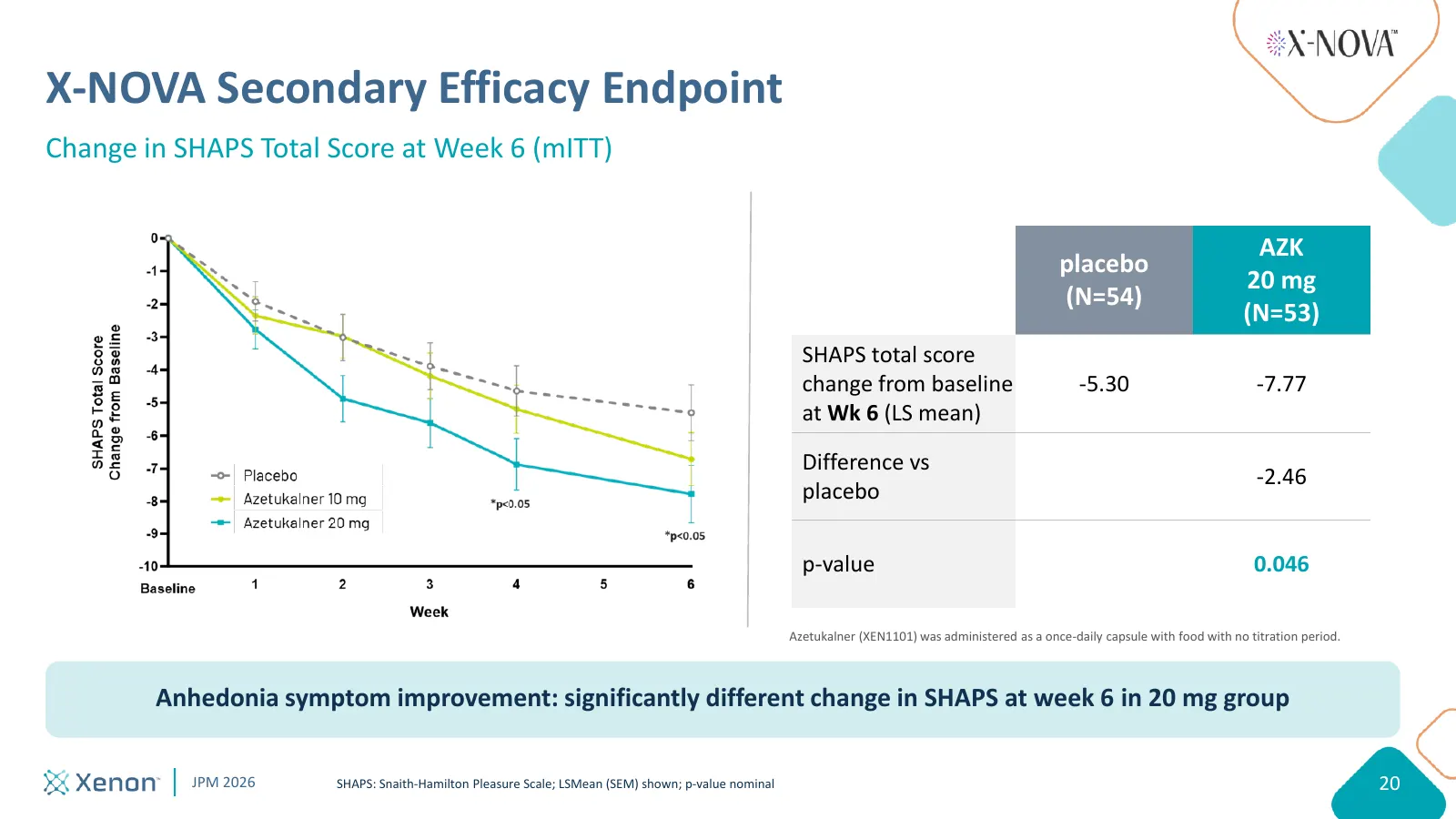
Slide 20: X-NOVA Secondary Efficacy Endpoint
X-NOVA Secondary Efficacy Endpoint Change in SHAPS Total Score at Week 6 (mITT) AZK placebo 20 mg (N=54) (N=53) SHAPS total score change from baseline -5.30 -7.77 at Wk 6 (LS mean) Difference vs -2.46 placebo p-value 0.046 Azetukalner (XEN1101) was administered as a once-daily capsule with food with
Slide 21: X-NOVA: Safety and Tolerability Data
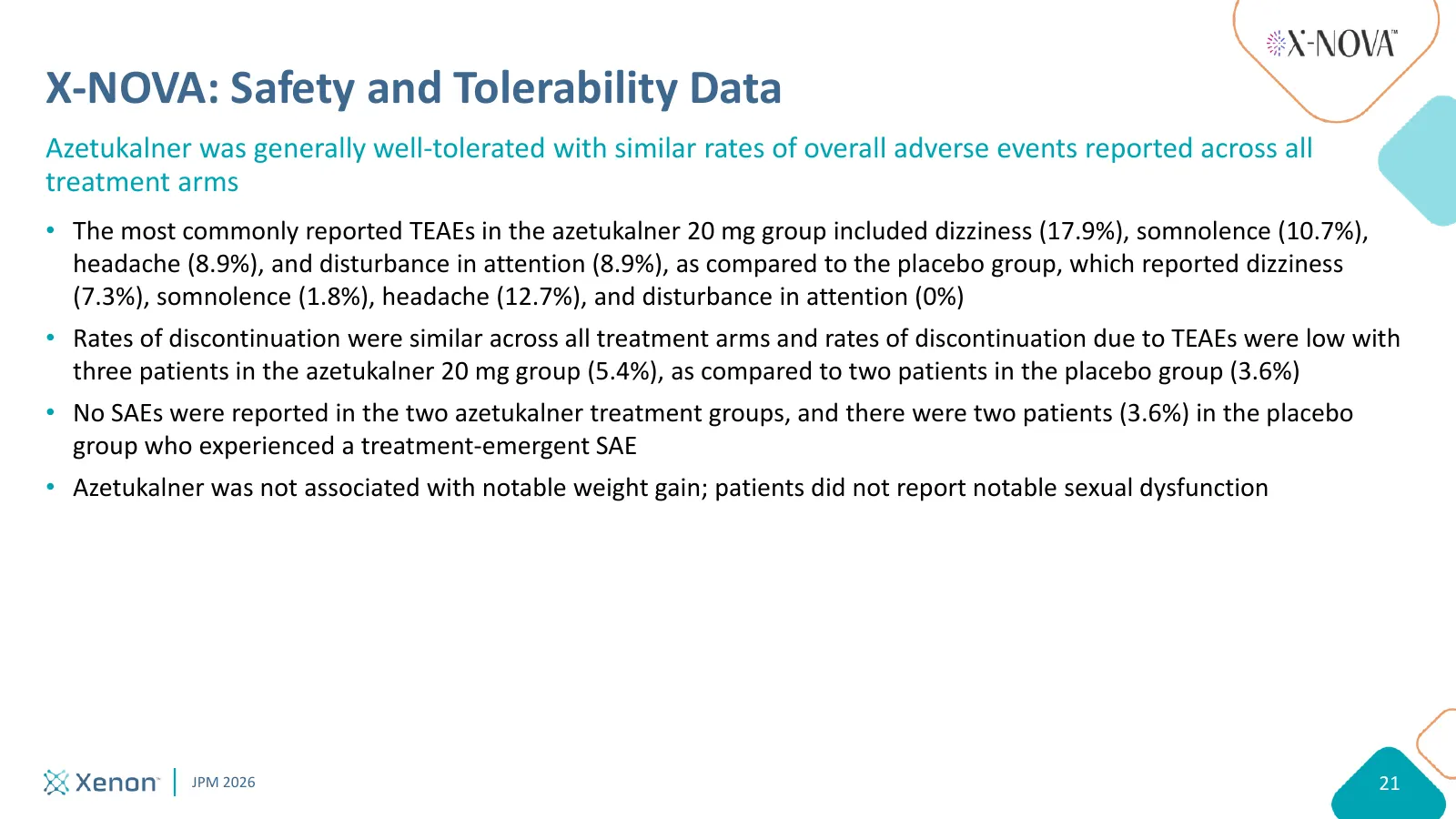
X-NOVA: Safety and Tolerability Data Azetukalner was generally well-tolerated with similar rates of overall adverse events reported across all treatment arms • The most commonly reported TEAEs in the azetukalner 20 mg group included dizziness (17.9%), somnolence (10.7%), headache (8.9%), and disturb
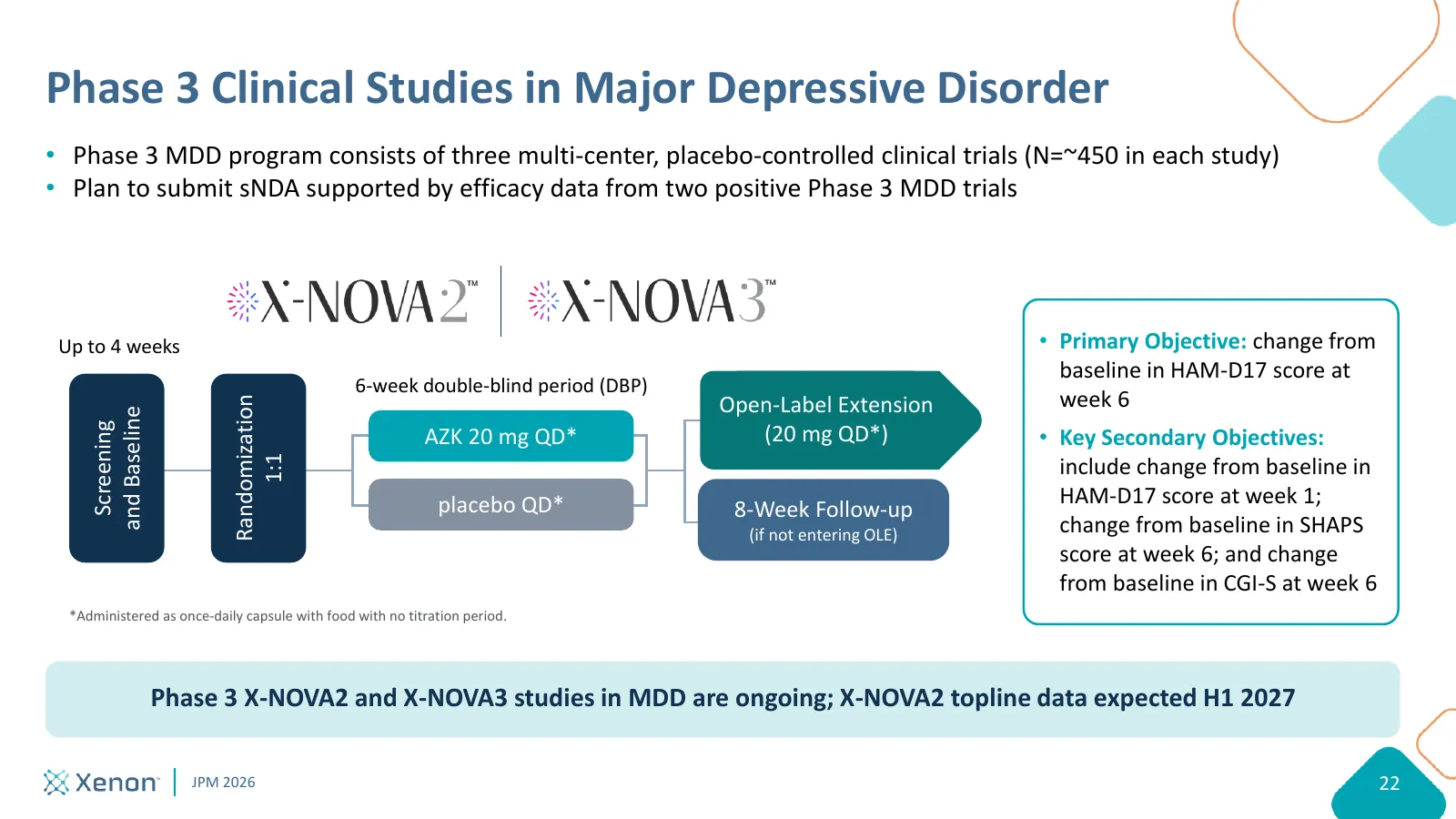
Slide 22: Phase 3 Clinical Studies in Major Depressive Disorder
Phase 3 Clinical Studies in Major Depressive Disorder • Phase 3 MDD program consists of three multi-center, placebo-controlled clinical trials (N=~450 in each study) • Plan to submit sNDA supported by efficacy data from two positive Phase 3 MDD trials Up to 4 weeks • Primary Objective: change from b
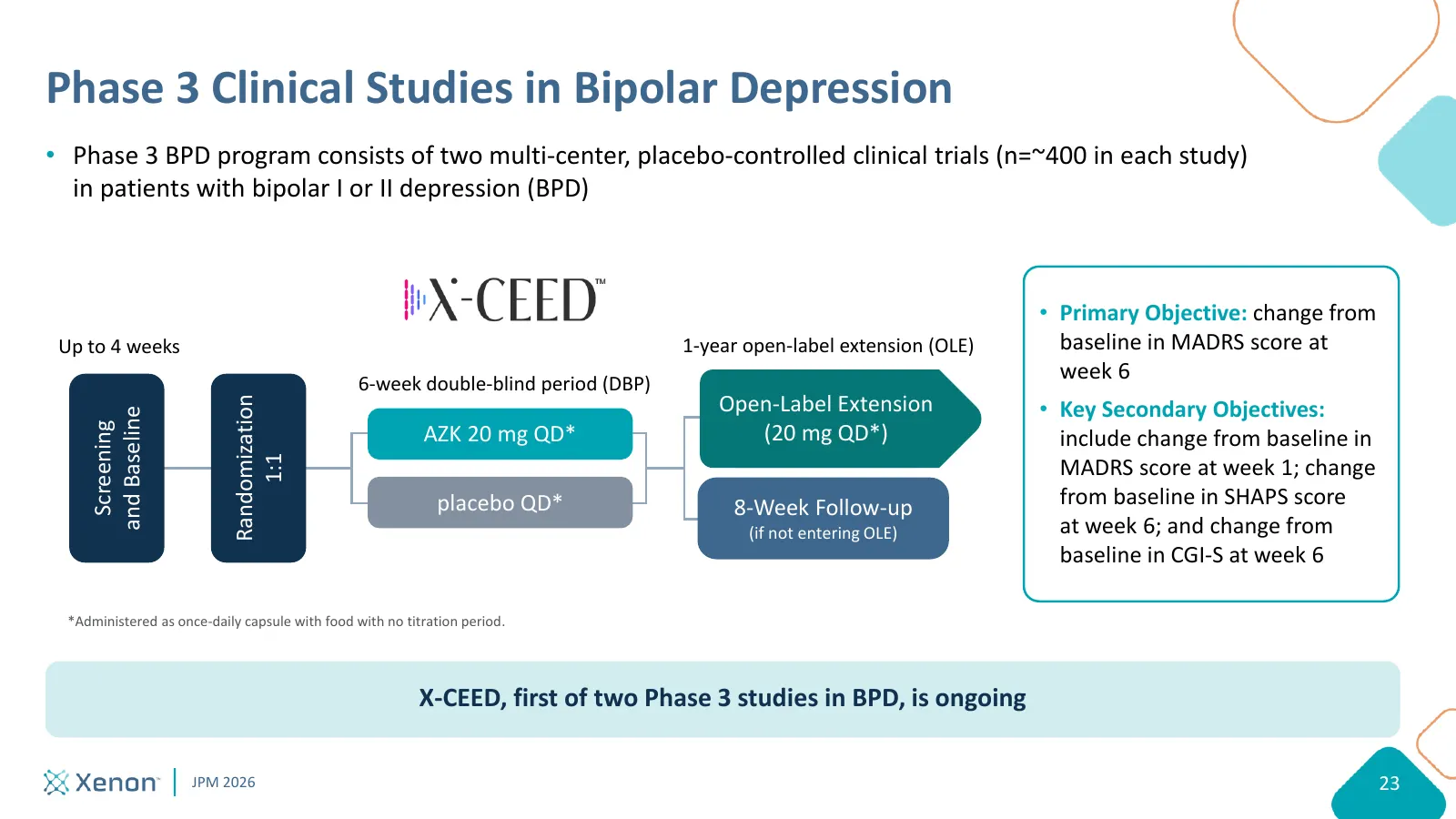
Slide 23: Phase 3 Clinical Studies in Bipolar Depression
Phase 3 Clinical Studies in Bipolar Depression • Phase 3 BPD program consists of two multi-center, placebo-controlled clinical trials (n=~400 in each study) in patients with bipolar I or II depression (BPD) • Primary Objective: change from Up to 4 weeks 1-year open-label extension (OLE) baseline in

Slide 24: Pain Programs
@ Pain Programs
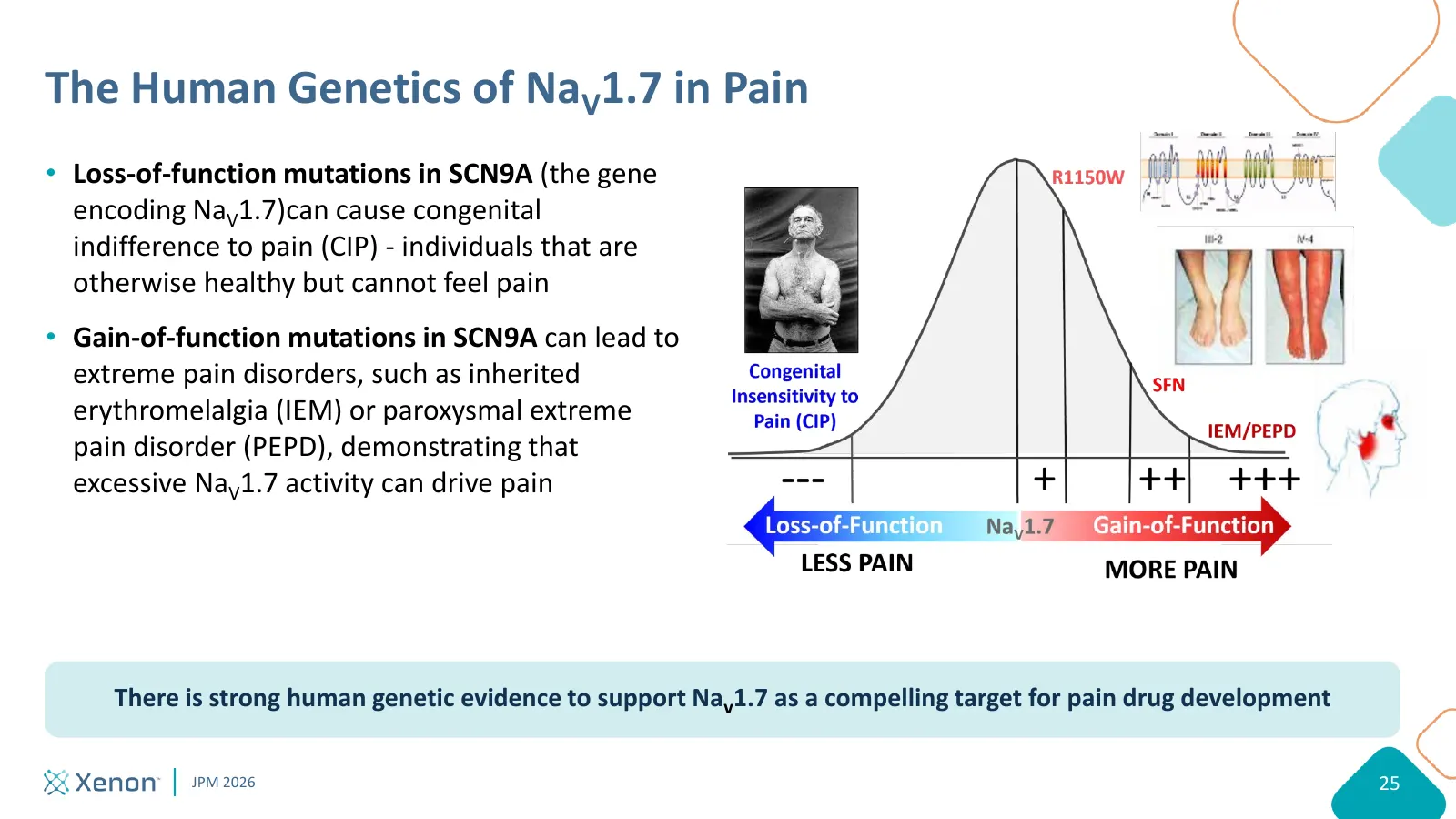
Slide 25: The Human Genetics of NaV1.7 in Pain
The Human Genetics of NaV1.7 in Pain • Loss-of-function mutations in SCN9A (the gene encoding NaV1.7)can cause congenital indifference to pain (CIP) - individuals that are otherwise healthy but cannot feel pain • Gain-of-function mutations in SCN9A can lead to extreme pain disorders, such as inherit
Slide 26: NaV1.7 Pain Program
NaV1.7 Pain Program • Xenon has long history with NaV1.7 science and deep ion channel drug discovery expertise and is applying this knowledge to generate a pipeline of NaV1.7 molecules with differentiated profiles: – CNS penetrant to globally inhibit NaV1.7, better mimicking patient genetics – Demon
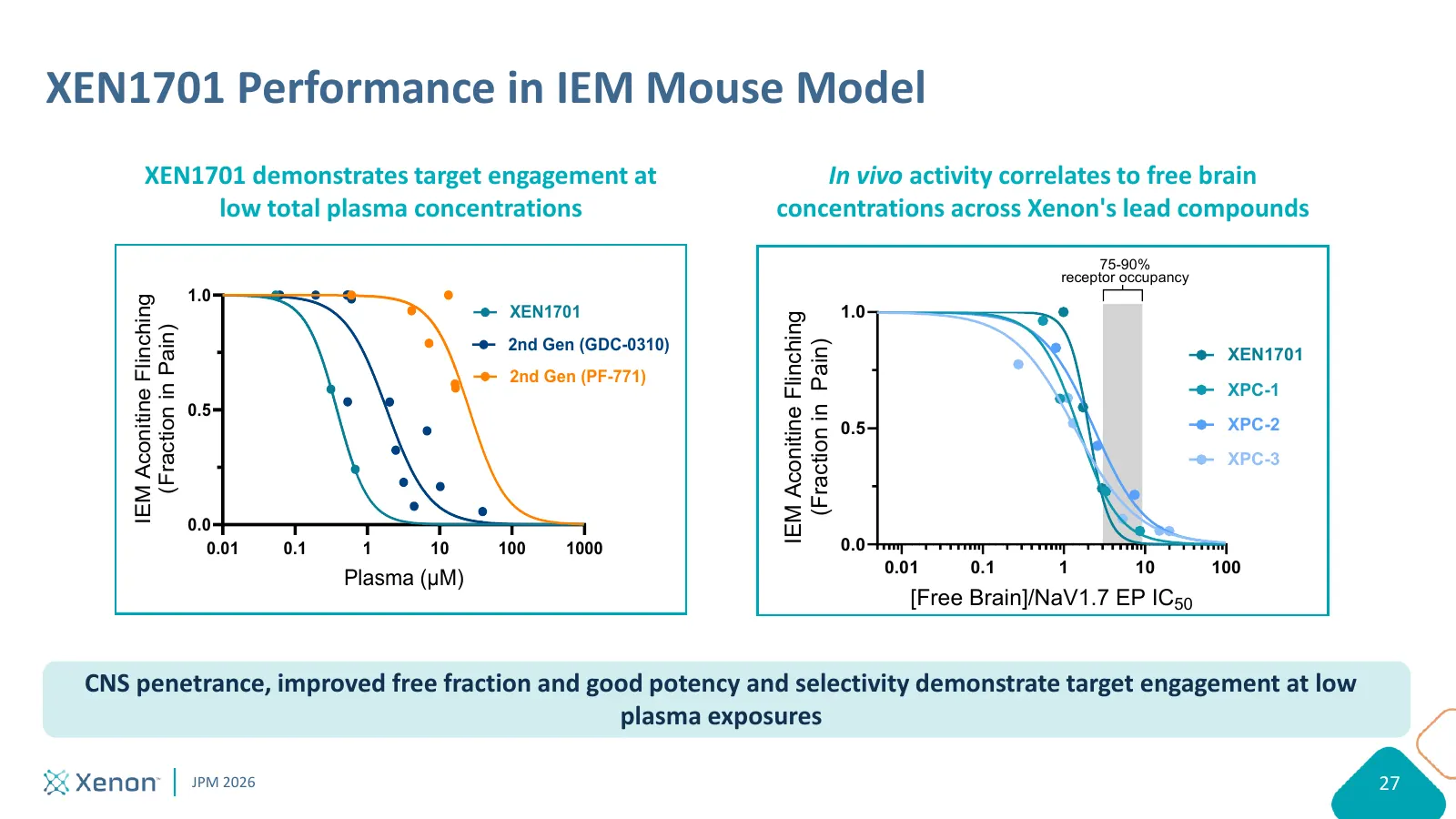
Slide 27: XEN1701 Performance in IEM Mouse Model
XEN1701 Performance in IEM Mouse Model XEN1701 demonstrates target engagement at In vivo activity correlates to free brain low total plasma concentrations concentrations across Xenon's lead compounds 75-90% receptor occupancy 1.0 IEM Aconitine Flinching XEN1701 1.0 IEM Aconitine Flinching (Fraction
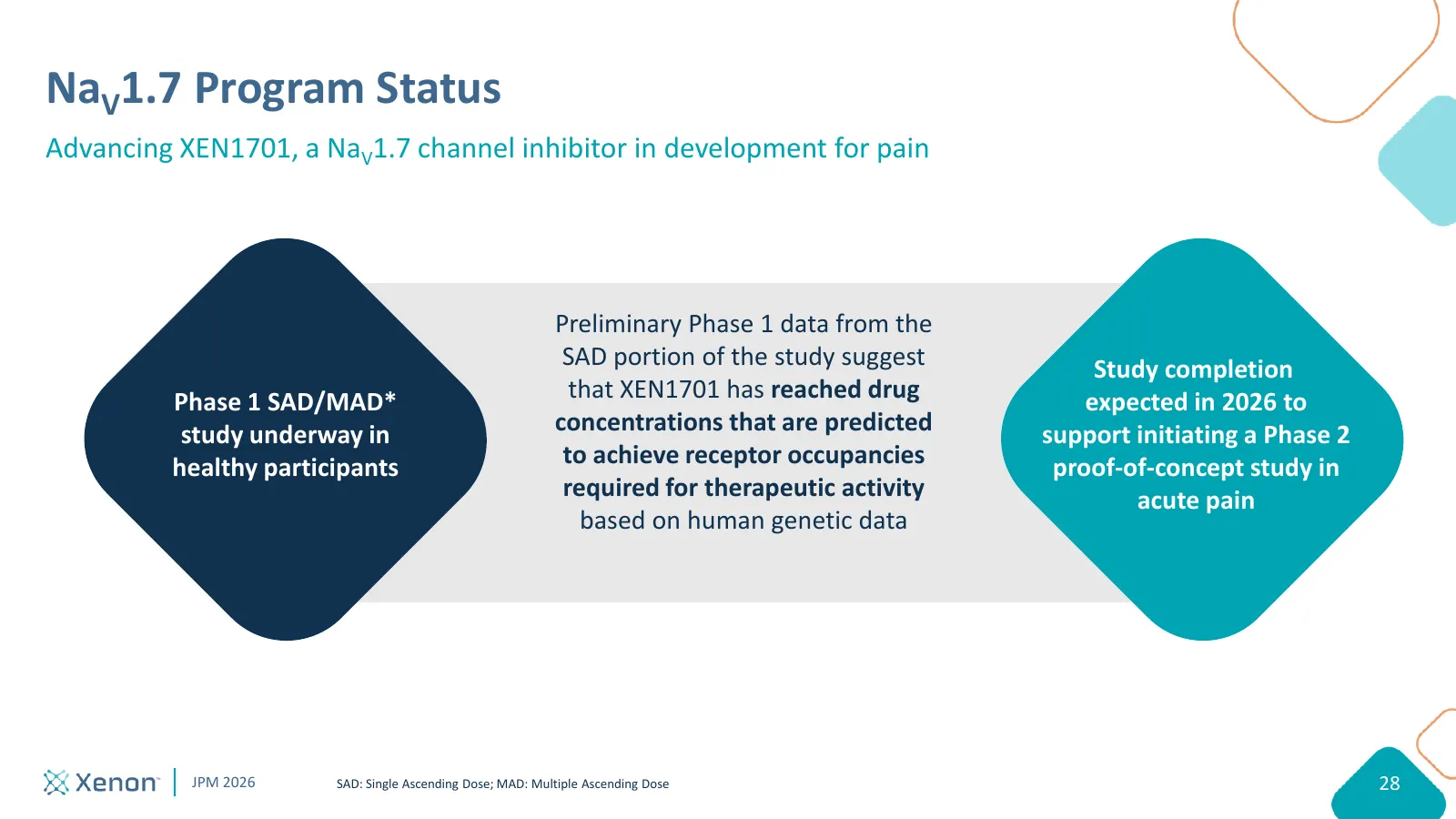
Slide 28: NaV1.7 Program Status
NaV1.7 Program Status Advancing XEN1701, a NaV1.7 channel inhibitor in development for pain Preliminary Phase 1 data from the SAD portion of the study suggest Study completion Phase 1 SAD/MAD* that XEN1701 has reached drug expected in 2026 to study underway in concentrations that are predicted suppo

Slide 29: Milestones
Milestones -
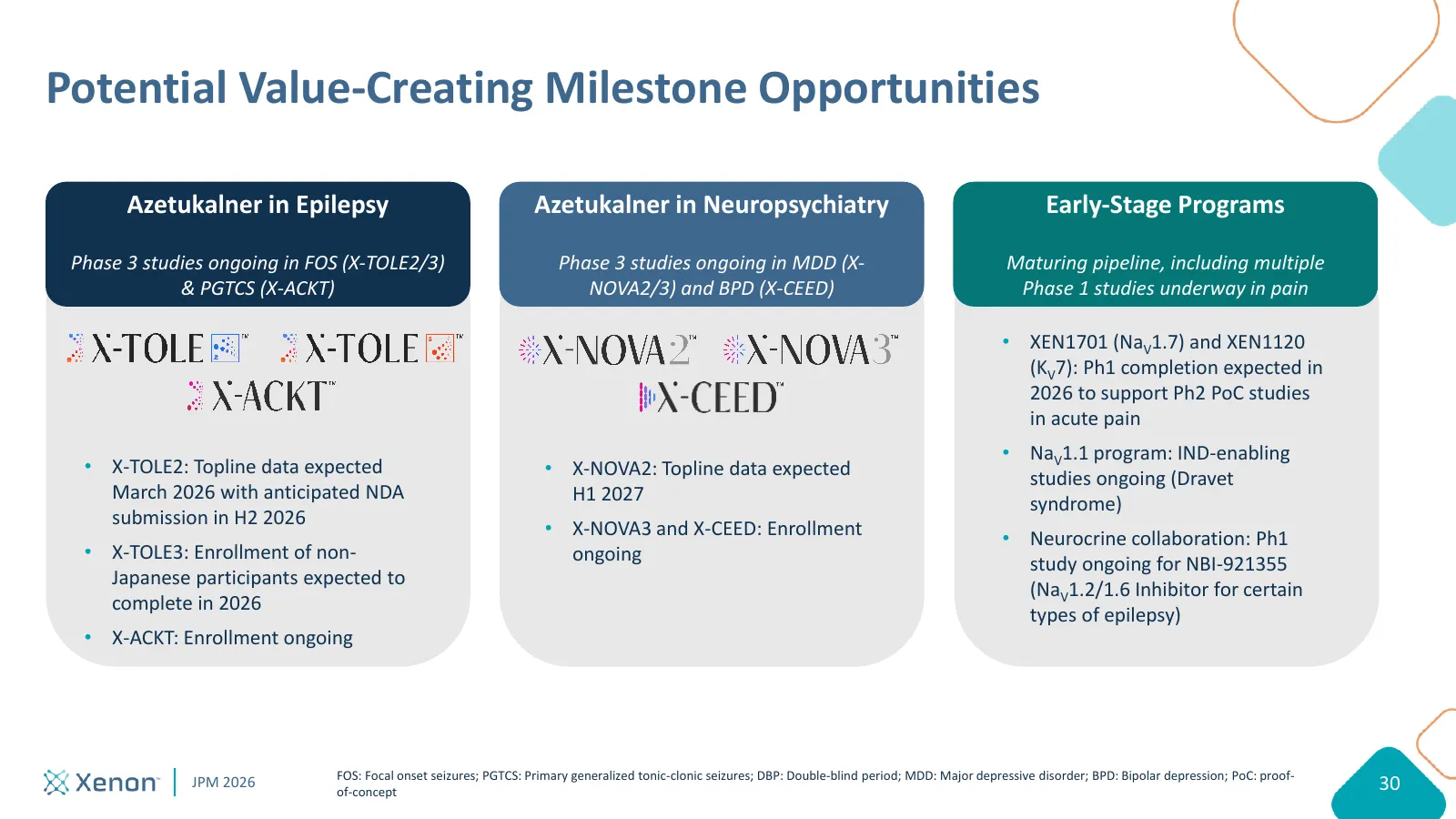
Slide 30: Potential Value-Creating Milestone Opportunities
Potential Value-Creating Milestone Opportunities Azetukalner in Epilepsy Azetukalner in Neuropsychiatry Early-Stage Programs Phase 3 studies ongoing in FOS (X-TOLE2/3) Phase 3 studies ongoing in MDD (X- Maturing pipeline, including multiple & PGTCS (X-ACKT) NOVA2/3) and BPD (X-CEED) Phase 1 studies

Slide 31: For more information
For more information [email protected]
Source: company website
More decks from Xenon Pharmaceuticals Inc.
 Investor Presentation (September 2026)43 slides · September 2026
 Technical Presentation (March 2026)30 slides · Mar 9, 2026
 2025 J.P. Morgan Healthcare Conference25 slides · Jan 13, 2025
 Eilat XIV Meeting 201821 slides · May 15, 2018
 Eilat XIV Meeting 201832 slides · May 15, 2018
 Epilepsy Foundation 2018 Pipeline Conference10 slides · February 2018