Turning Point Therapeutics Inc
Turning Point Therapeutics — 38th Annual J.P. Morgan Healthcare Conference (January 2020)
21 slides from Turning Point Therapeutics's conference presentation, Jan 13, 2020

Slide 1: Next-Generation Precision Oncology Medicines
38th Annual J.P. Morgan Healthcare Conference Next-Generation Precision Oncology Medicines Athena Countouriotis, M.D., President and CEO January 15, 2020 Exhibit 99.1
Slide 2: Disclaimer: Forward-Looking Statements
Disclaimer Forward-Looking Statements Statements in this Presentation that are not statements of historical fact are forward-looking statements. Such forward-looking statements include, without limitation, statements regarding our research and clinical development activities and plans, business stra
Slide 3: Precision Oncology Platform with Potentially Best-in-Class Drug Candidates in Four Ongoing Clinical Trials
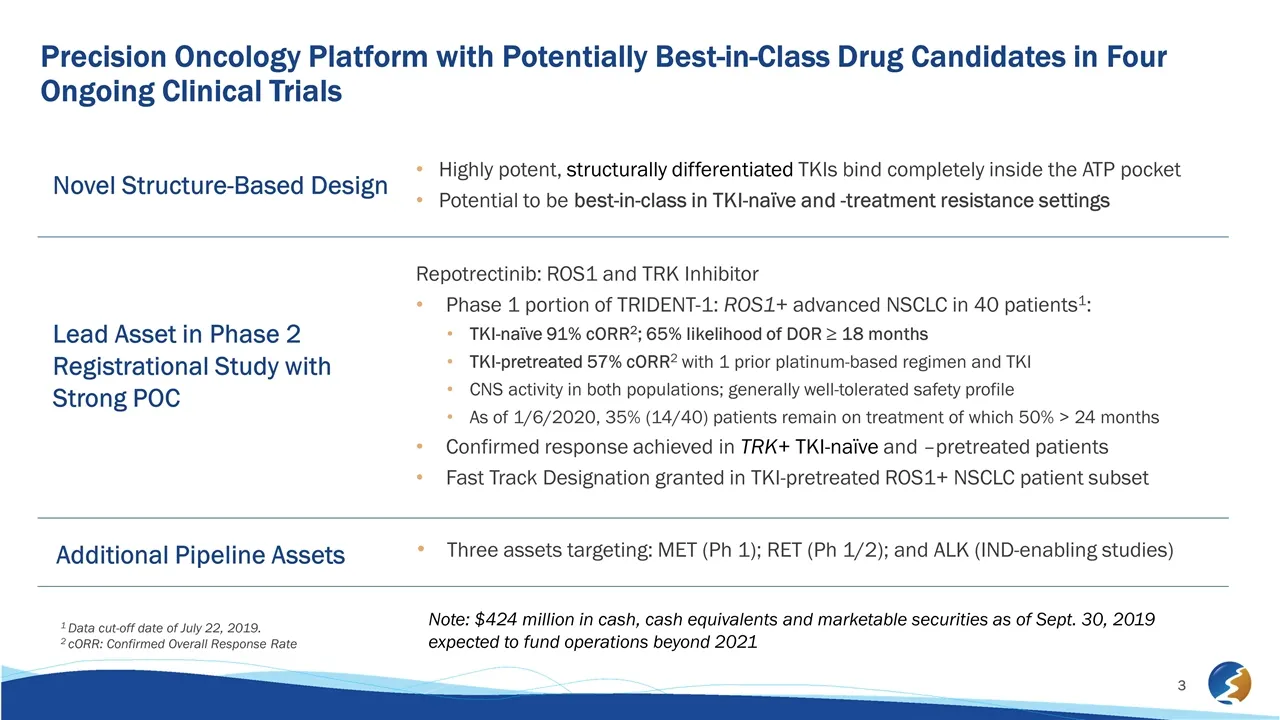
Precision Oncology Platform with Potentially Best-in-Class Drug Candidates in Four Ongoing Clinical Trials 1 Data cut-off date of July 22, 2019. 2 cORR: Confirmed Overall Response Rate Highly potent, structurally differentiated TKIs bind completely inside the ATP pocket Potential to be best-in-class
Slide 4: MET, RET and ALK Candidates Expand Potential Addressable Opportunity to 15% of Advanced NSCLC
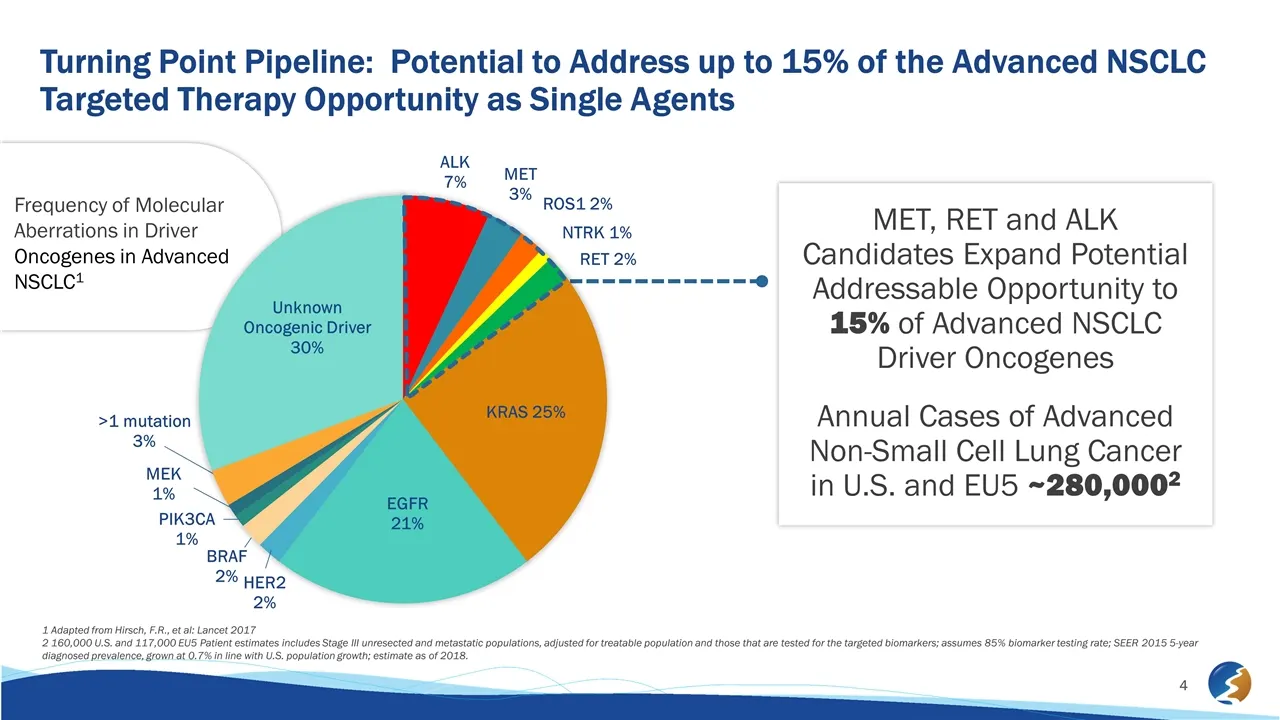
MET, RET and ALK Candidates Expand Potential Addressable Opportunity to 15% of Advanced NSCLC Driver Oncogenes Annual Cases of Advanced Non-Small Cell Lung Cancer in U.S. and EU5 ~280,0002 Turning Point Pipeline: Potential to Address up to 15% of the Advanced NSCLC Targeted Therapy Opportunity as Si
Slide 5: Extensive Pipeline in Four Ongoing Clinical Studies Against Well-Validated Oncogenic Targets
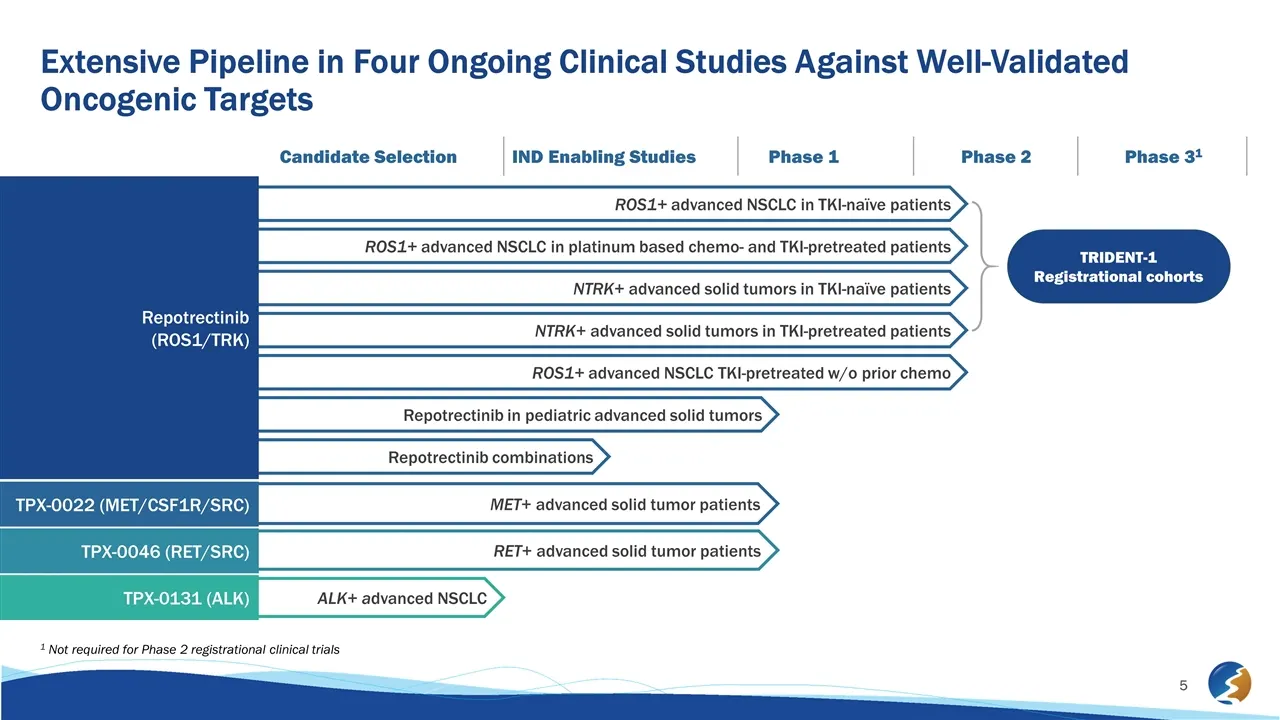
Extensive Pipeline in Four Ongoing Clinical Studies Against Well-Validated Oncogenic Targets 1 Not required for Phase 2 registrational clinical trials ROS1+ advanced NSCLC in TKI-naïve patients NTRK+ advanced solid tumors in TKI-naïve patients NTRK+ advanced solid tumors in TKI-pretreated patients R
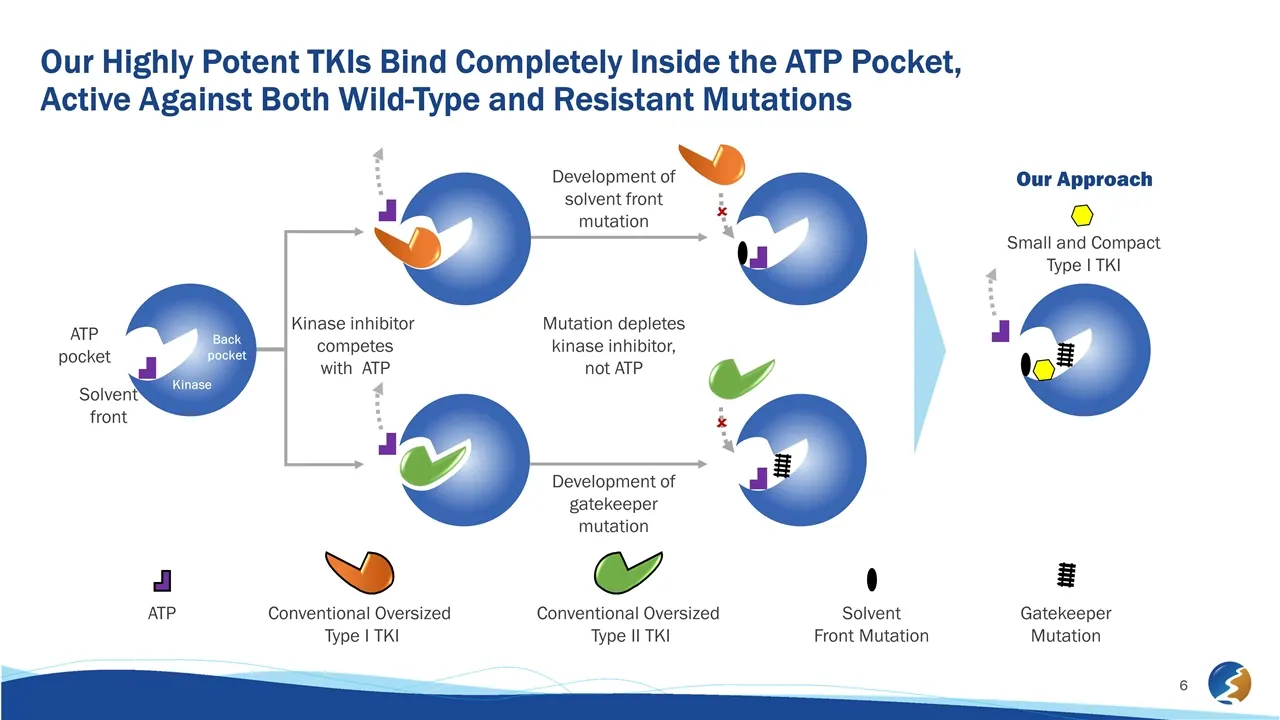
Slide 6: Our Highly Potent TKIs Bind Completely Inside the ATP Pocket
Our Highly Potent TKIs Bind Completely Inside the ATP Pocket, Active Against Both Wild-Type and Resistant Mutations Conventional Oversized Type II TKI Conventional Oversized Type I TKI Solvent Front Mutation ATP Gatekeeper Mutation Small and Compact Type I TKI ATP pocket Kinase Solvent front Back po
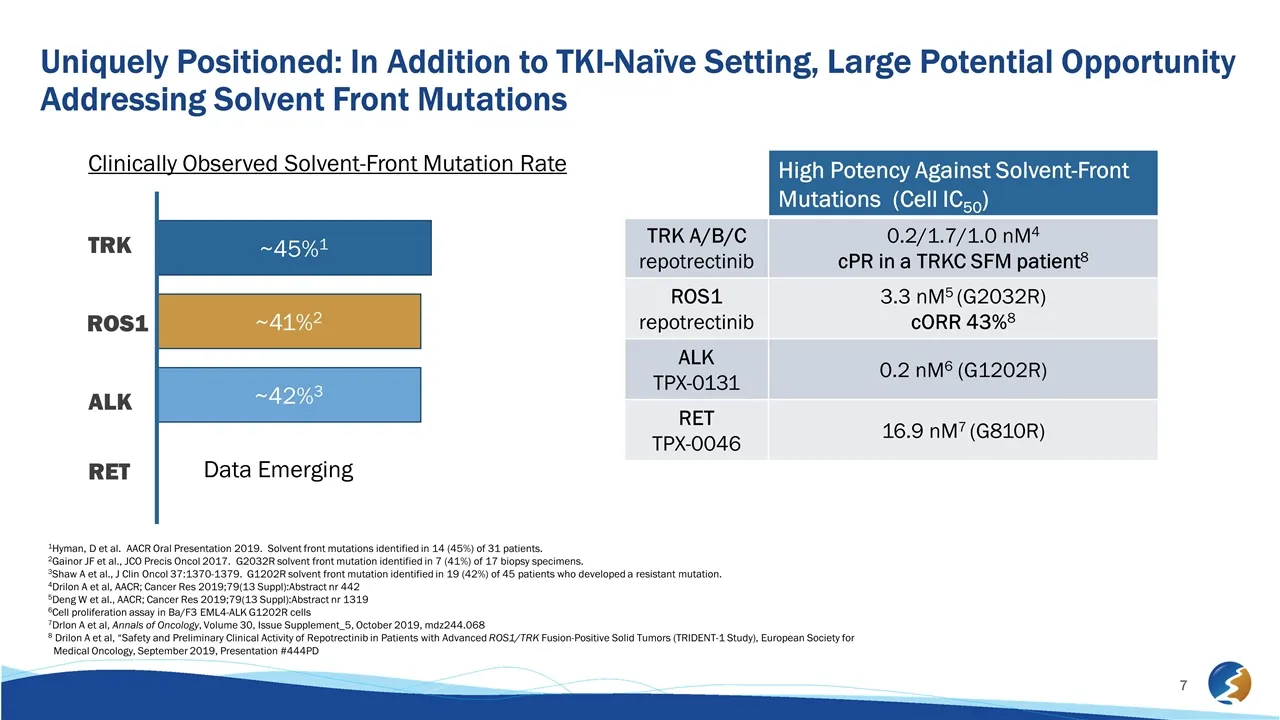
Slide 7: High Potency Against Solvent-Front Mutations
H High Potency Against Solvent-Front Mutations (Cell IC50) TRK A/B/C repotrectinib 0.2/1.7/1.0 nM4 cPR in a TRKC SFM patient8 ROS1 repotrectinib 3.3 nM5 (G2032R) cORR 43%8 ALK TPX-0131 0.2 nM6 (G1202R) RET TPX-0046 16.9 nM7 (G810R) Uniquely Positioned: In Addition to TKI-Naïve Setting, Large Potenti
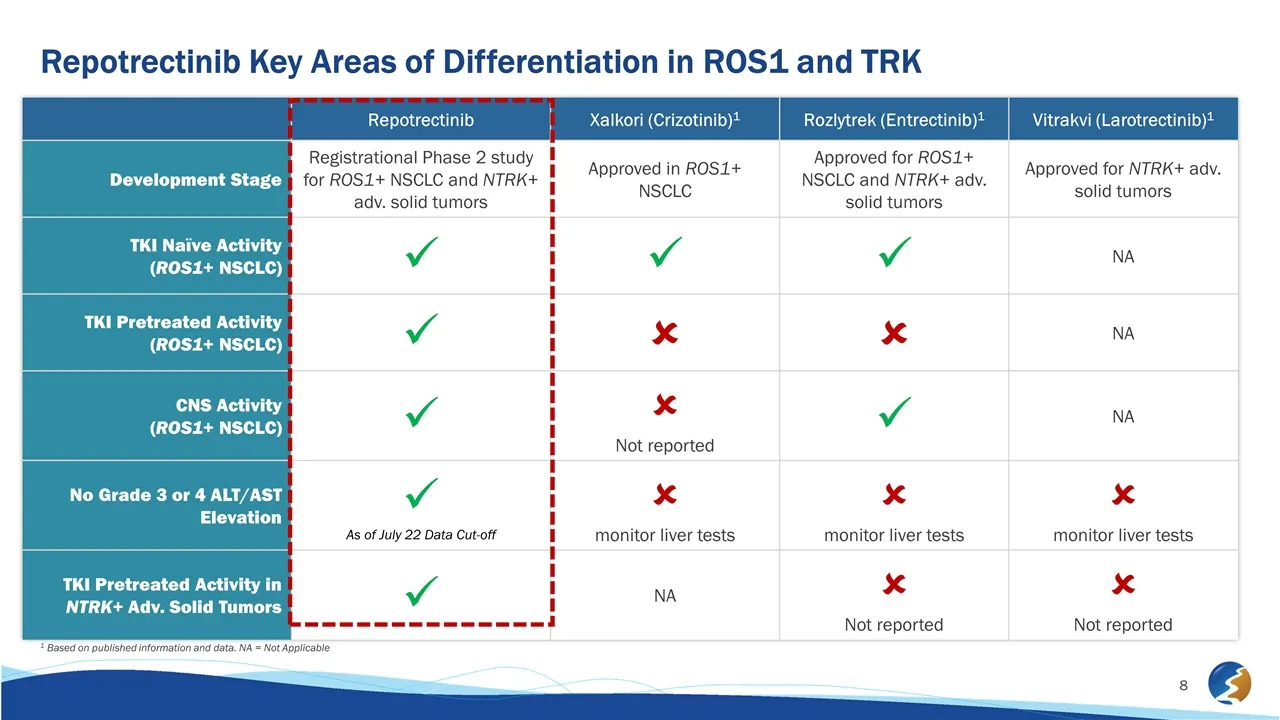
Slide 8: Repotrectinib Key Areas of Differentiation in ROS1 and TRK
Repotrectinib Key Areas of Differentiation in ROS1 and TRK 1 Based on published information and data. NA = Not Applicable Repotrectinib Xalkori (Crizotinib)1 Rozlytrek (Entrectinib)1 Vitrakvi (Larotrectinib)1 Development Stage Registrational Phase 2 study for ROS1+ NSCLC and NTRK+ adv. solid tumors
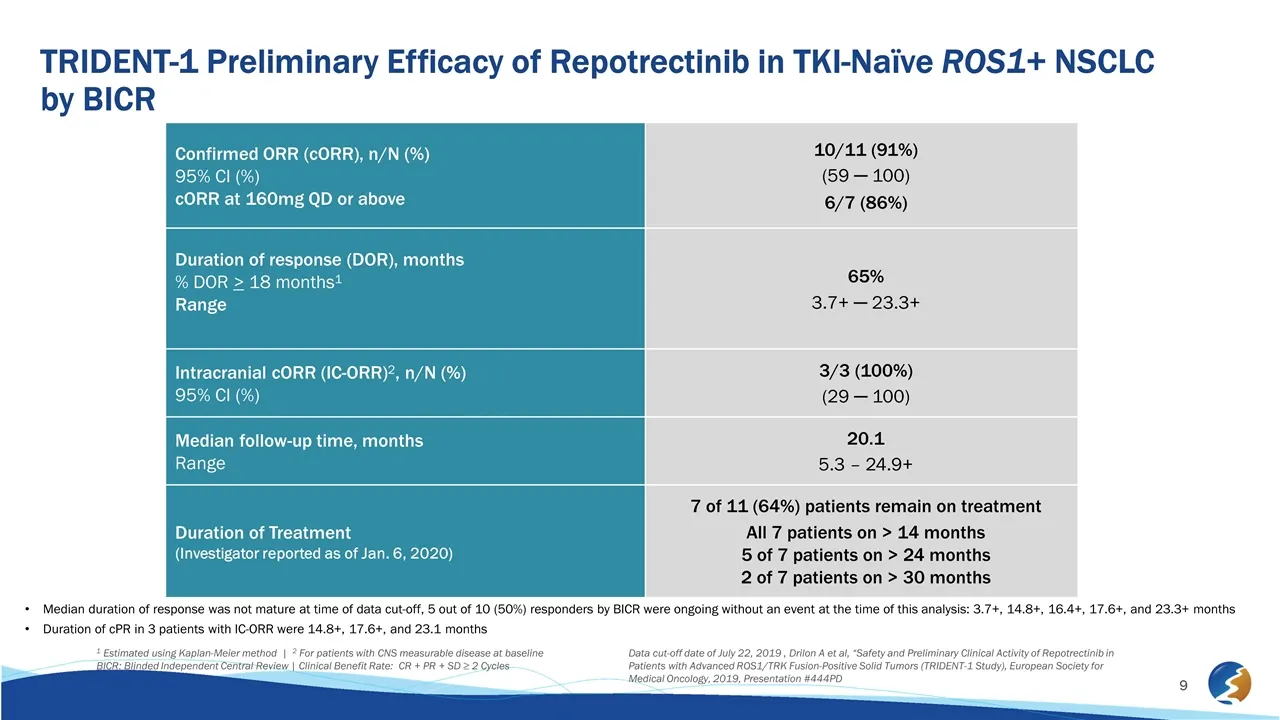
Slide 9: TRIDENT-1 Preliminary Efficacy of Repotrectinib in TKI-Naïve ROS1+ NSCLC by BICR
TRIDENT-1 Preliminary Efficacy of Repotrectinib in TKI-Naïve ROS1+ NSCLC by BICR 1 Estimated using Kaplan-Meier method | 2 For patients with CNS measurable disease at baseline BICR: Blinded Independent Central Review | Clinical Benefit Rate: CR + PR + SD ≥ 2 Cycles Data cut-off date of July 22, 2019
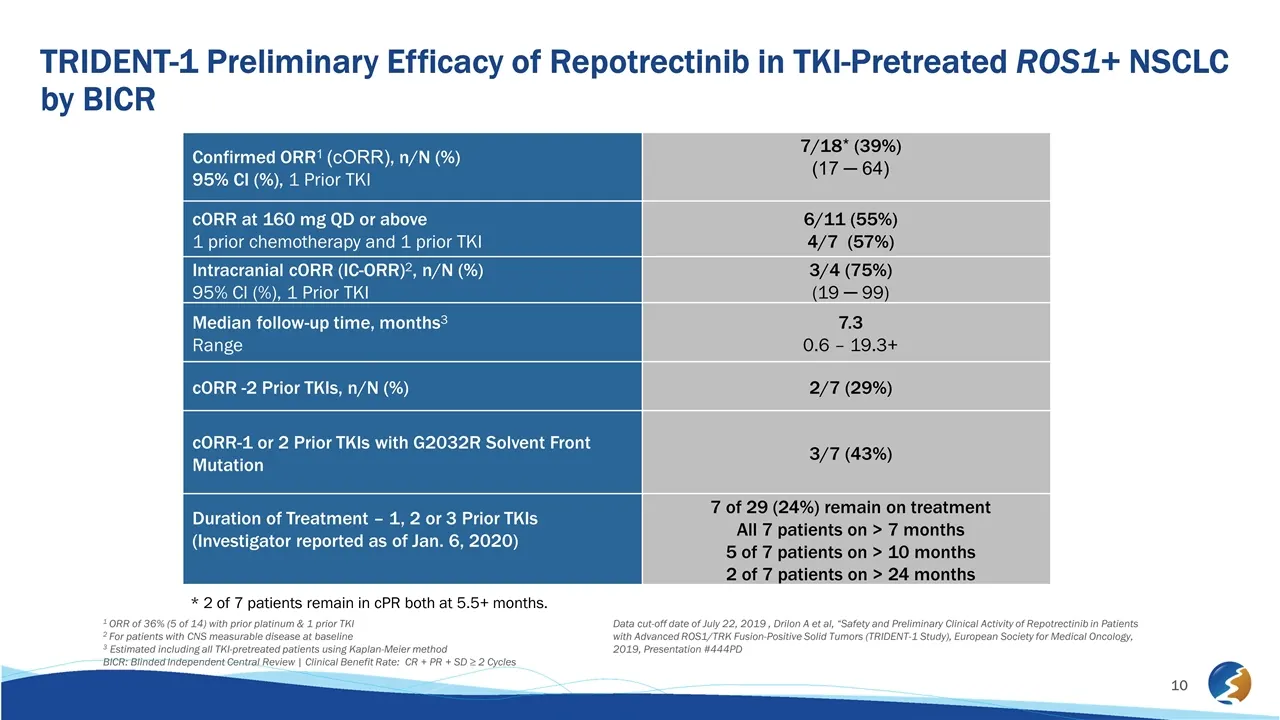
Slide 10: TRIDENT-1 Preliminary Efficacy of Repotrectinib in TKI-Pretreated ROS1+ NSCLC by BICR
TRIDENT-1 Preliminary Efficacy of Repotrectinib in TKI-Pretreated ROS1+ NSCLC by BICR 1 ORR of 36% (5 of 14) with prior platinum & 1 prior TKI 2 For patients with CNS measurable disease at baseline 3 Estimated including all TKI-pretreated patients using Kaplan-Meier method BICR: Blinded Independent
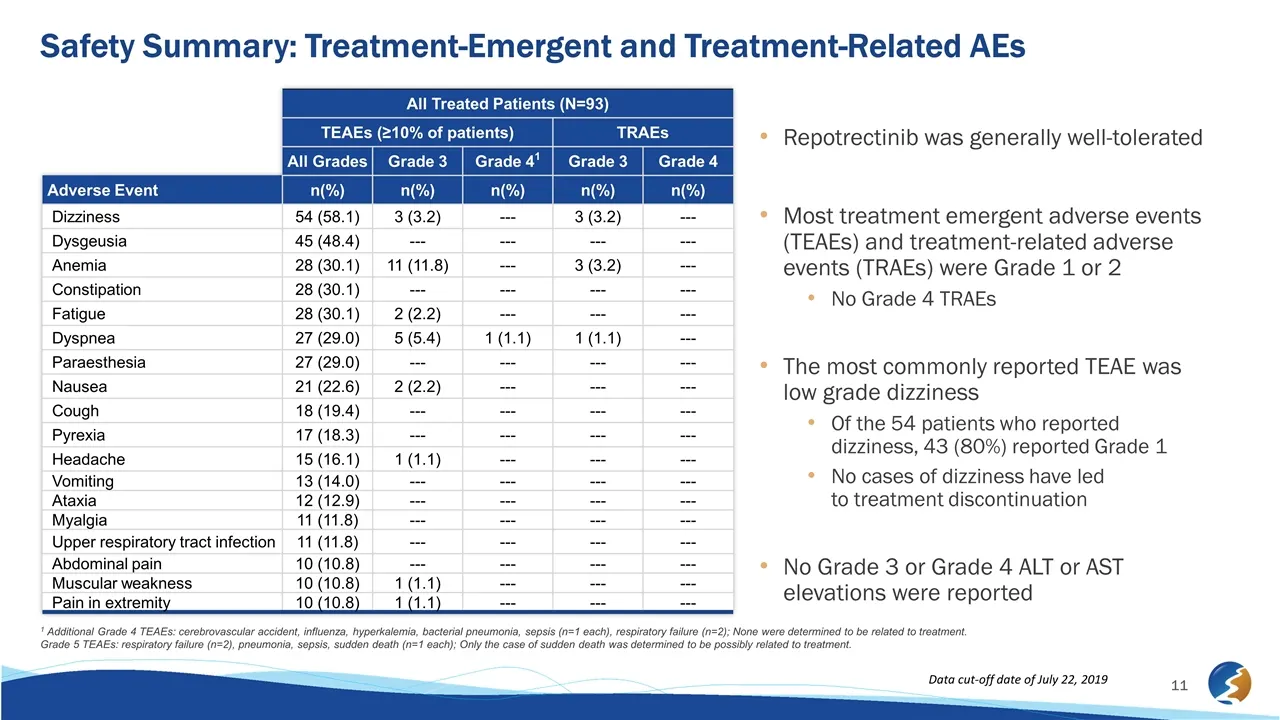
Slide 11: Safety Summary: Treatment-Emergent and Treatment-Related AEs
Safety Summary: Treatment-Emergent and Treatment-Related AEs Repotrectinib was generally well-tolerated Most treatment emergent adverse events (TEAEs) and treatment-related adverse events (TRAEs) were Grade 1 or 2 No Grade 4 TRAEs The most commonly reported TEAE was low grade dizziness Of the 54 pat
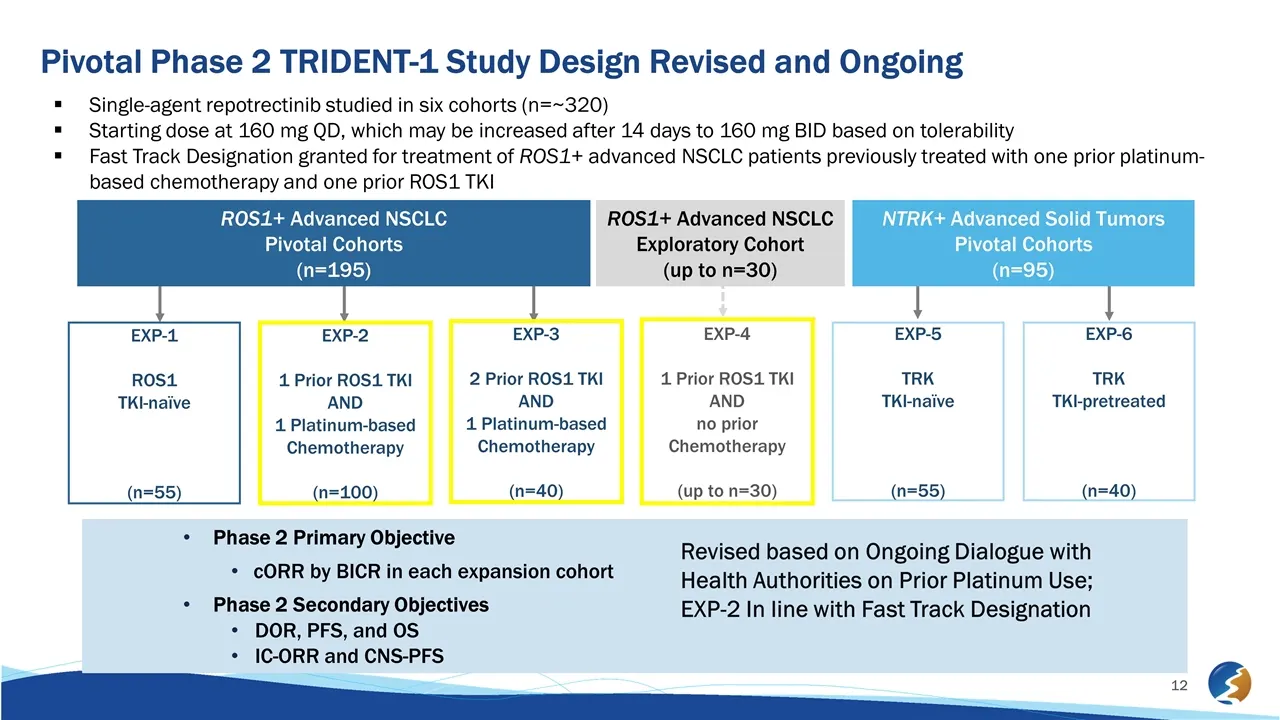
Slide 12: TRIDENT-1 Pivotal Phase 2 Study Design Revised and Ongoing
ROS1+ Advanced NSCLC Pivotal Cohorts (n=195) NTRK+ Advanced Solid Tumors Pivotal Cohorts (n=95) EXP-3 2 Prior ROS1 TKI AND 1 Platinum-based Chemotherapy (n=40) EXP-1 ROS1 TKI-naïve (n=55) EXP-2 1 Prior ROS1 TKI AND 1 Platinum-based Chemotherapy (n=100) EXP-5 TRK TKI-naïve (n=55) EXP-6 TRK TKI-pretre
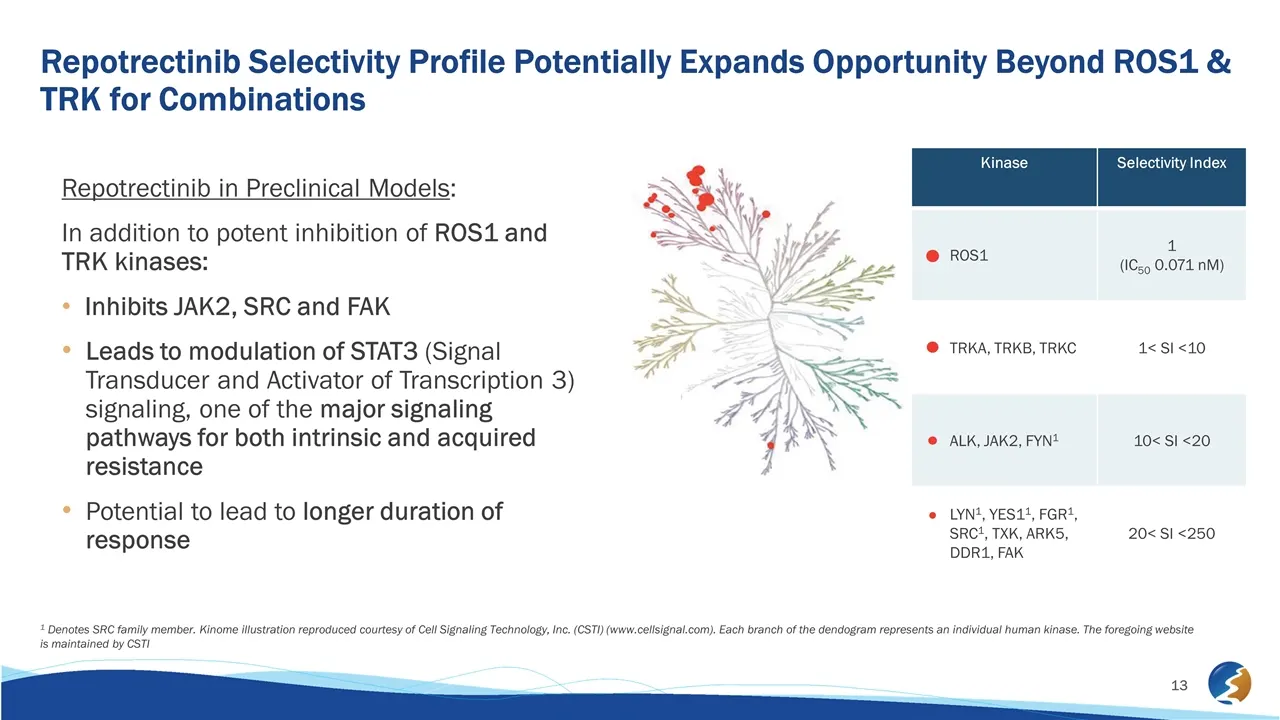
Slide 13: Repotrectinib Selectivity Profile Potentially Expands Opportunity Beyond ROS1 & TRK
Repotrectinib Selectivity Profile Potentially Expands Opportunity Beyond ROS1 & TRK for Combinations 1 Denotes SRC family member. Kinome illustration reproduced courtesy of Cell Signaling Technology, Inc. (CSTI) (www.cellsignal.com). Each branch of the dendogram represents an individual human kinase

Slide 14: Advancing Next-Generation Pipeline of Kinase Inhibitors
Advancing Next-Generation Pipeline of Kinase Inhibitors
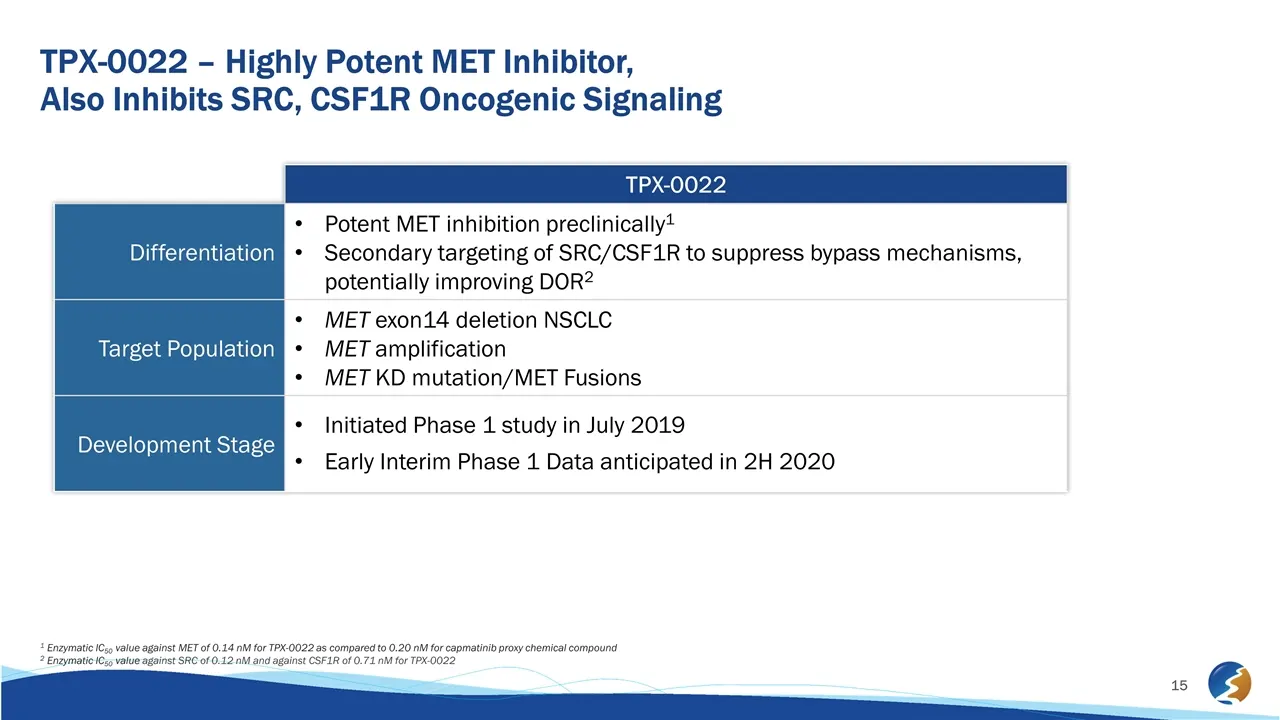
Slide 15: TPX-0022 – Highly Potent MET Inhibitor, Also Inhibits SRC, CSF1R
TPX-0022 – Highly Potent MET Inhibitor, Also Inhibits SRC, CSF1R Oncogenic Signaling 1 Enzymatic IC50 value against MET of 0.14 nM for TPX-0022 as compared to 0.20 nM for capmatinib proxy chemical compound 2 Enzymatic IC50 value against SRC of 0.12 nM and against CSF1R of 0.71 nM for TPX-0022 TPX-00
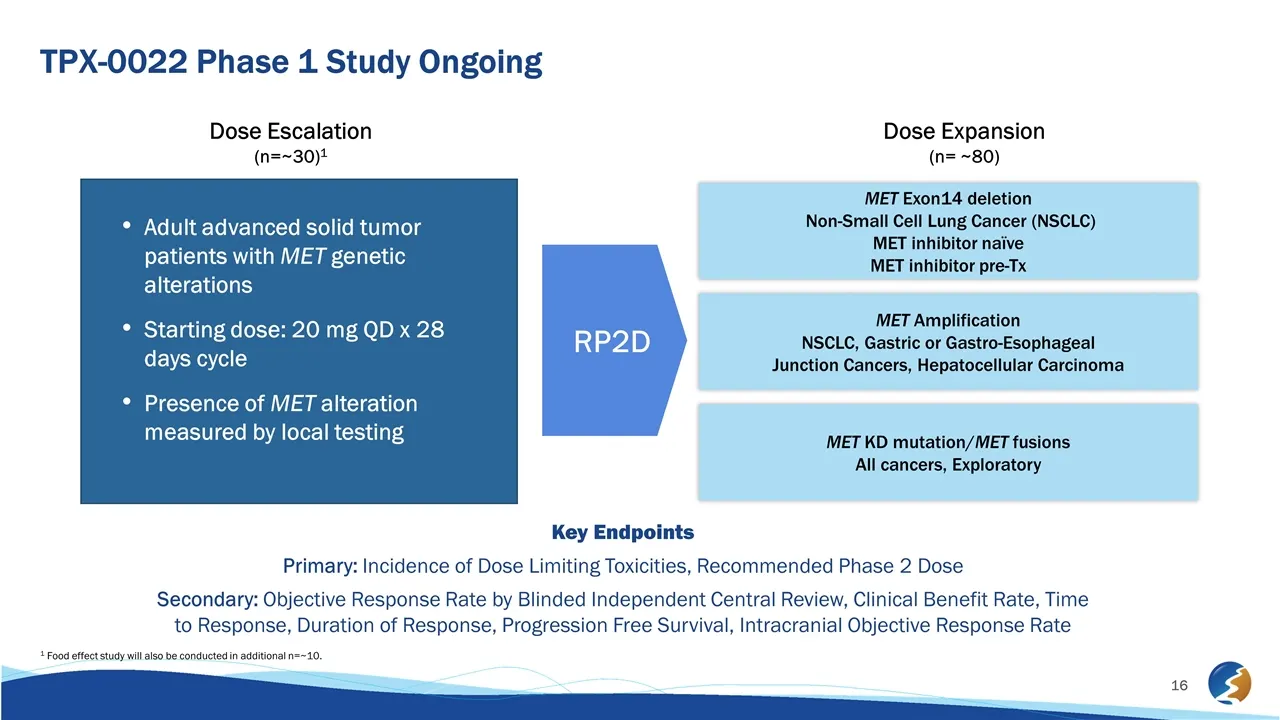
Slide 16: TPX-0022 Phase 1 Study Ongoing
TPX-0022 Phase 1 Study Ongoing 1 Food effect study will also be conducted in additional n=~10. Confidential Dose Escalation (n=~30)1 Dose Expansion (n= ~80) RP2D MET Exon14 deletion Non-Small Cell Lung Cancer (NSCLC) MET inhibitor naïve MET inhibitor pre-Tx MET Amplification NSCLC, Gastric or Gastro
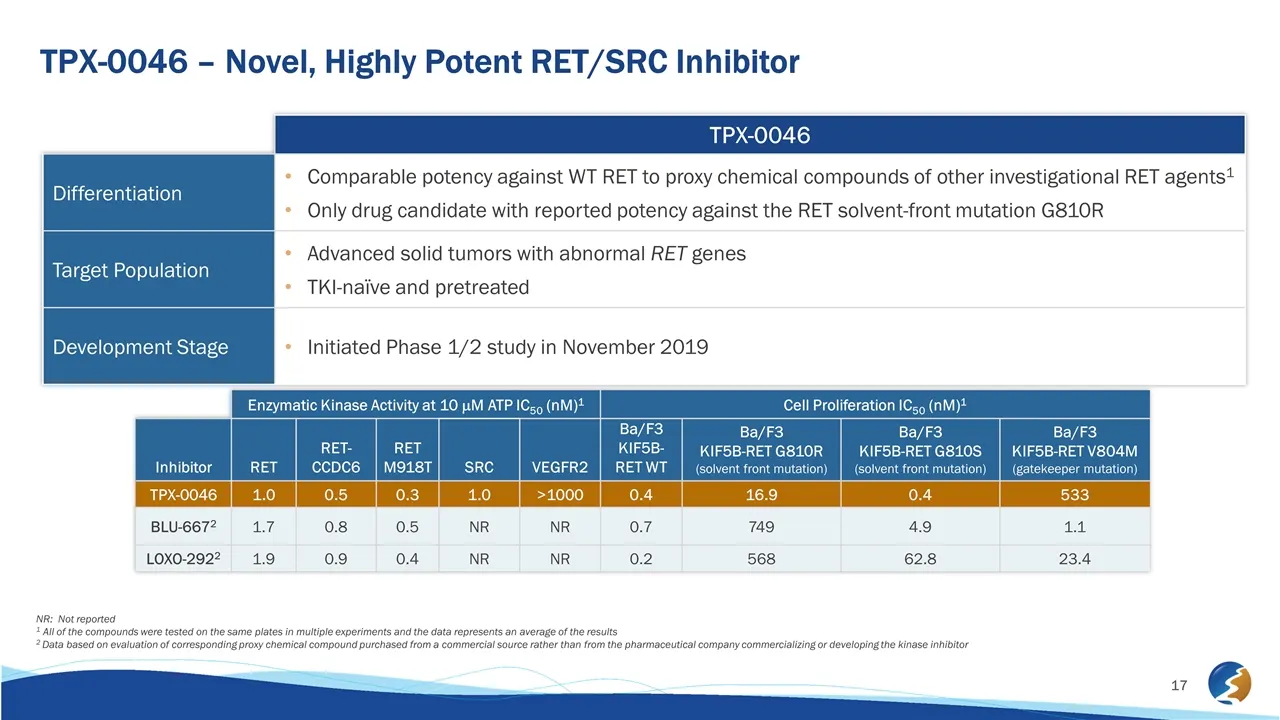
Slide 17: TPX-0046 – Novel, Highly Potent RET/SRC Inhibitor
TPX-0046 – Novel, Highly Potent RET/SRC Inhibitor NR: Not reported 1 All of the compounds were tested on the same plates in multiple experiments and the data represents an average of the results 2 Data based on evaluation of corresponding proxy chemical compound purchased from a commercial source ra
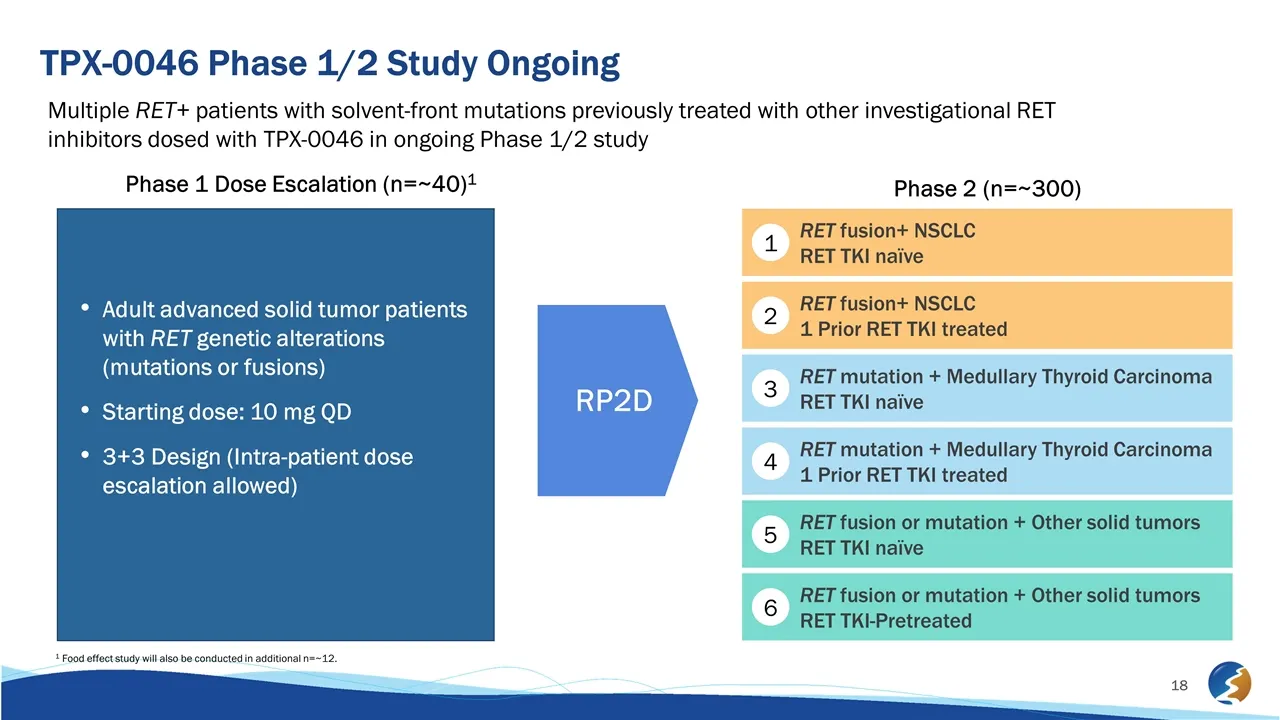
Slide 18: TPX-0046 Phase 1/2 Study Ongoing
RP2D TPX-0046 Phase 1/2 Study Ongoing 1 Food effect study will also be conducted in additional n=~12. Phase 1 Dose Escalation (n=~40)1 RET fusion+ NSCLC RET TKI naïve RET fusion+ NSCLC 1 Prior RET TKI treated RET mutation + Medullary Thyroid Carcinoma RET TKI naïve RET mutation + Medullary Thyroid C
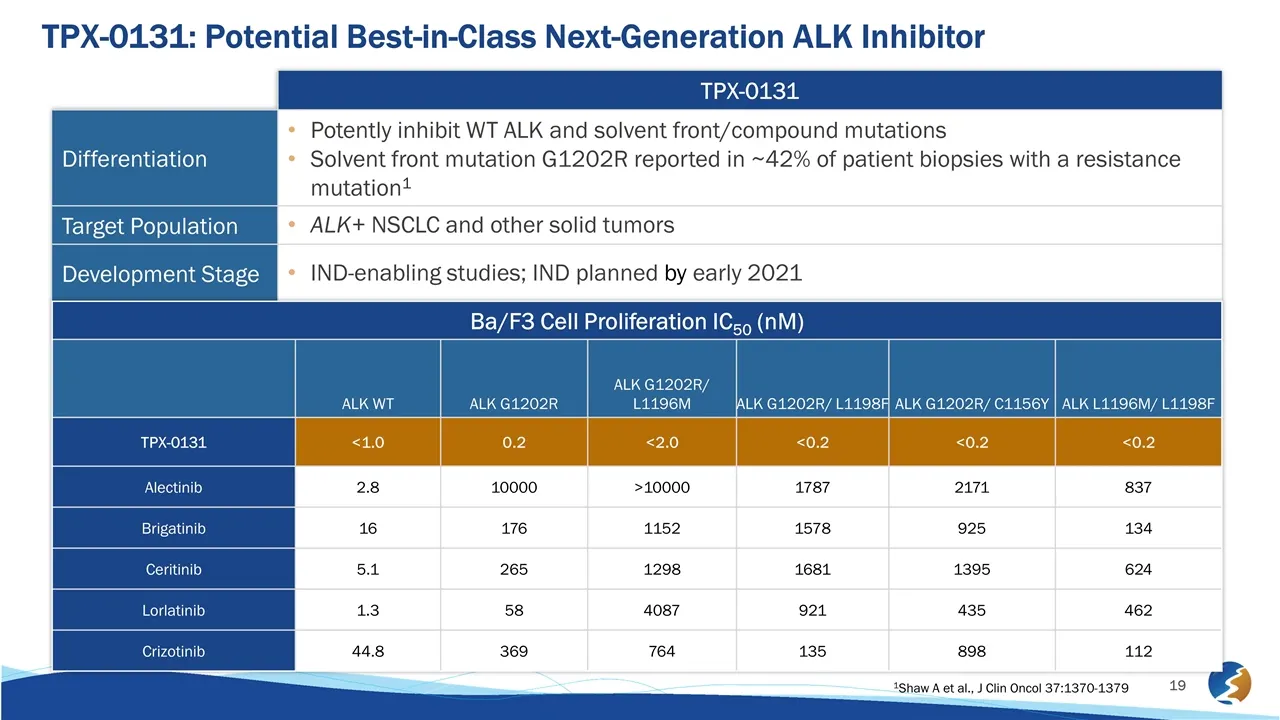
Slide 19: TPX-0131: Potential Best-in-Class Next-Generation ALK Inhibitor
TPX-0131: Potential Best-in-Class Next-Generation ALK Inhibitor TPX-0131 Differentiation Potently inhibit WT ALK and solvent front/compound mutations Solvent front mutation G1202R reported in ~42% of patient biopsies with a resistance mutation1 Target Population ALK+ NSCLC and other solid tumors Dev
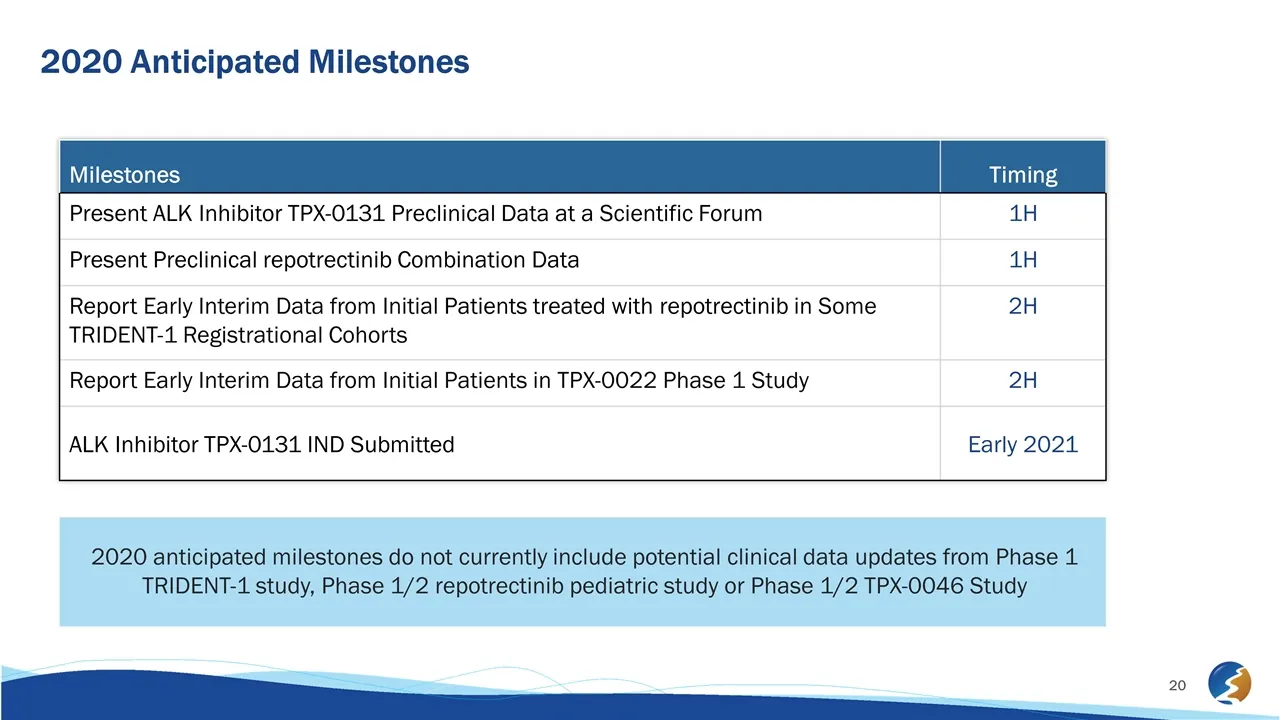
Slide 20: 2020 Anticipated Milestones
2020 Anticipated Milestones Milestones Timing Present ALK Inhibitor TPX-0131 Preclinical Data at a Scientific Forum 1H Present Preclinical repotrectinib Combination Data 1H Report Early Interim Data from Initial Patients treated with repotrectinib in Some TRIDENT-1 Registrational Cohorts 2H Report E

Slide 21: 38th Annual J.P. Morgan Healthcare Conference
38th Annual J.P. Morgan Healthcare Conference Next-Generation Precision Oncology Medicines Athena Countouriotis, M.D., President and CEO January 15, 2020
Source: SEC EDGAR · 8-K filed Jan 13, 2020
More decks from Turning Point Therapeutics Inc
 Investor Presentation (May 2022)53 slides · May 10, 2022
 Technical Presentation (April 2022)15 slides · Apr 13, 2022
 Investor Presentation (October 2021)46 slides · Oct 8, 2021
 AACR-NCI-EORTC Investor Meeting 202129 slides · Oct 7, 2021
 Investor Presentation (January 2021)33 slides · Jan 11, 2021
 Investor Presentation (October 2020)30 slides · Oct 26, 2020