Nabriva Therapeutics — Investor Presentation (February 2017)
34 slides from Nabriva Therapeutics's investor presentation, Feb 15, 2017
Slide 1: Forward-looking statements
This presentation contains forward-looking statements that involve substantial risks and uncertainties. All statements, other than statements of historical facts, contained in this presentation, including statements about our future expectations, plans and prospects, including but not limited to sta
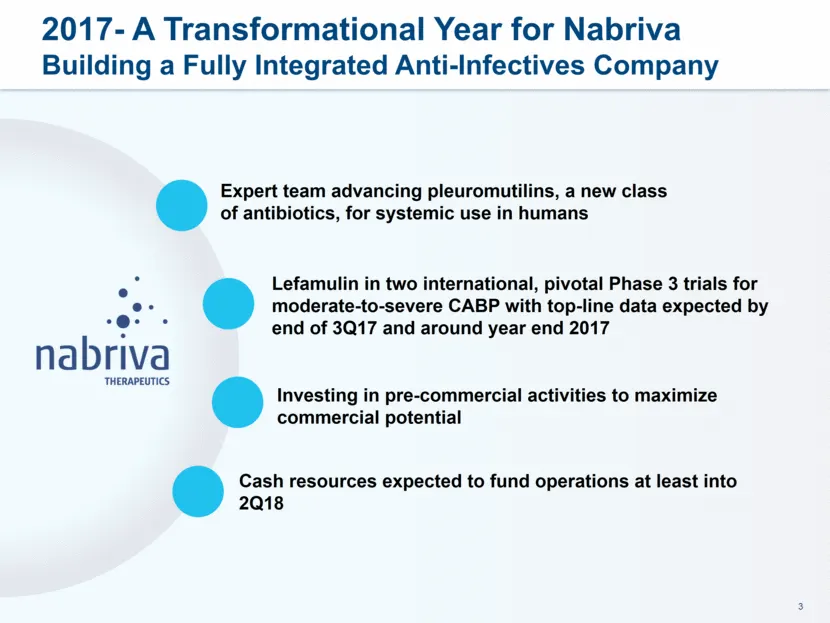
Slide 2: 2017 - A Transformational Year for Nabriva
Expert team advancing pleuromutilins, a new class of antibiotics, for systemic use in humans Lefamulin in two international, pivotal Phase 3 trials for moderate-to-severe CABP with top-line data expected by end of 3Q17 and around year end 2017 Investing in pre-commercial activities to maximize comme
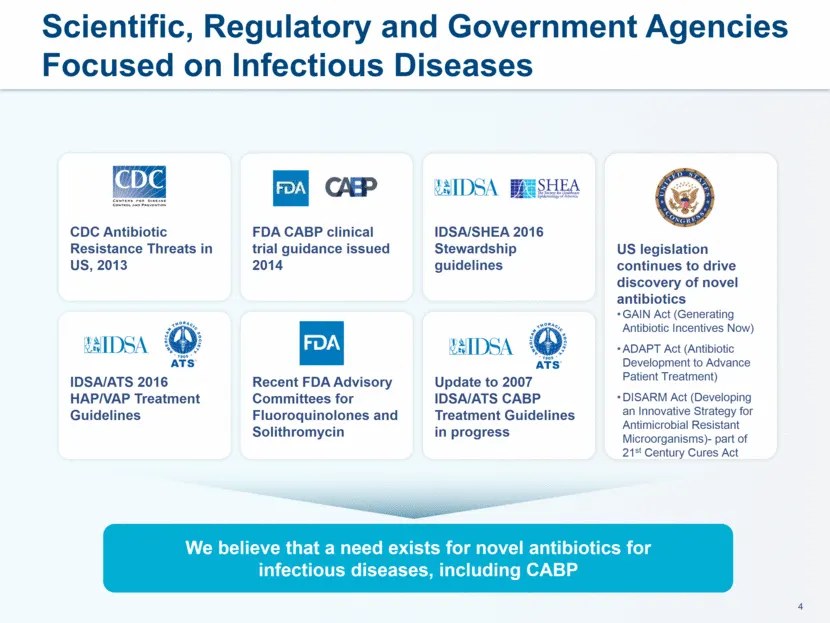
Slide 3: US legislation continues to drive discovery of novel antibiotics
US legislation continues to drive discovery of novel antibiotics GAIN Act (Generating Antibiotic Incentives Now) ADAPT Act (Antibiotic Development to Advance Patient Treatment) DISARM Act (Developing an Innovative Strategy for Antimicrobial Resistant Microorganisms)- part of 21st Century Cures Act C
Slide 4: Burden of Pneumonia is Increasing due to Significant Morbidity and Mortality
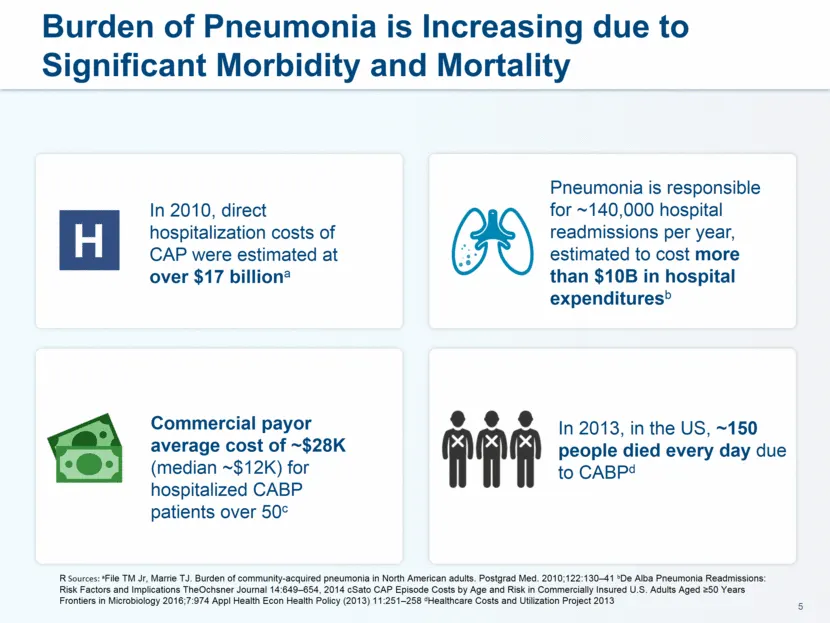
In 2010, direct hospitalization costs of CAP were estimated at over $17 billiona H Pneumonia is responsible for ~140,000 hospital readmissions per year, estimated to cost more than $10B in hospital expendituresb In 2013, in the US, ~150 people died every day due to CABPd Commercial payor average cos
Slide 5: Bacterial Resistance Complicates the Choice of Appropriate Empiric Therapy
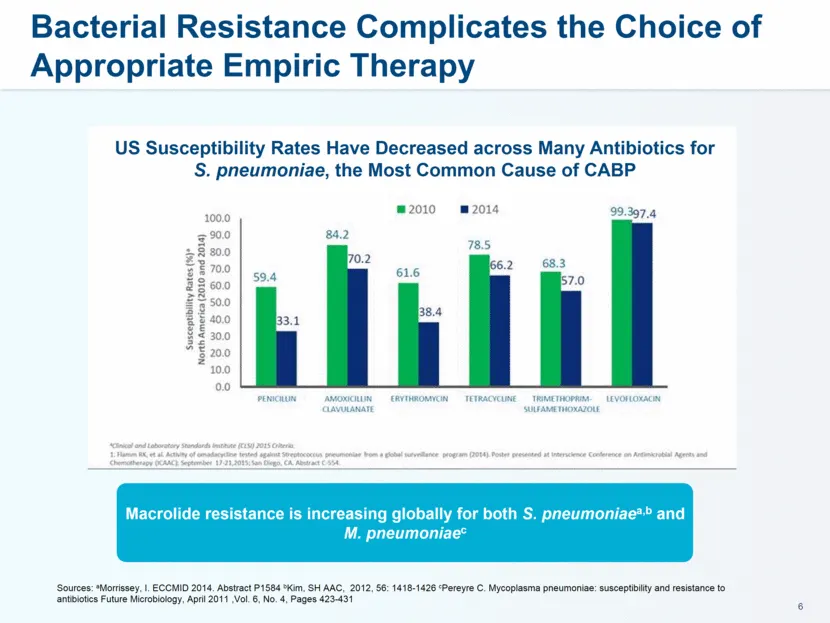
Bacterial Resistance Complicates the Choice of Appropriate Empiric Therapy Macrolide resistance is increasing globally for both S. pneumoniaea,b and M. pneumoniaec Sources: aMorrissey, I. ECCMID 2014. Abstract P1584 bKim, SH AAC, 2012, 56: 1418-1426 cPereyre C. Mycoplasma pneumoniae: susceptibility
Slide 6: Antibiotic Stewardship Should Increasingly Drive Antibiotic Choices
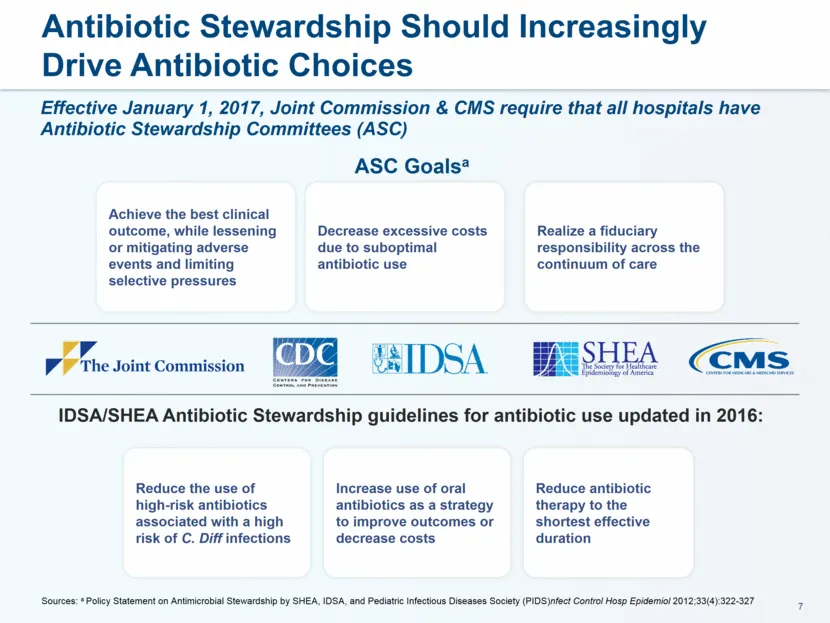
Achieve the best clinical outcome, while lessening or mitigating adverse events and limiting selective pressures Effective January 1, 2017, Joint Commission & CMS require that all hospitals have Antibiotic Stewardship Committees (ASC) Decrease excessive costs due to suboptimal antibiotic use Realize
Slide 7: Significant US Adult CABP Opportunity in Hospital-Initiated Therapy
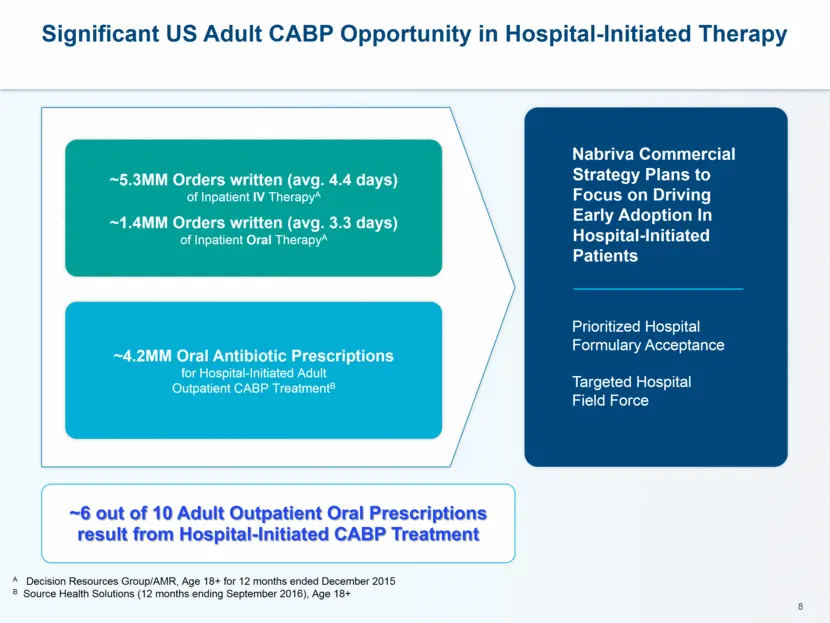
Significant US Adult CABP Opportunity in Hospital-Initiated Therapy ~4.2MM Oral Antibiotic Prescriptions for Hospital-Initiated Adult Outpatient CABP TreatmentB A Decision Resources Group/AMR, Age 18+ for 12 months ended December 2015 B Source Health Solutions (12 months ending September 2016), Age
Slide 8: Pleuromutilins Represent a New Class of Antibiotics for Systemic Human Use
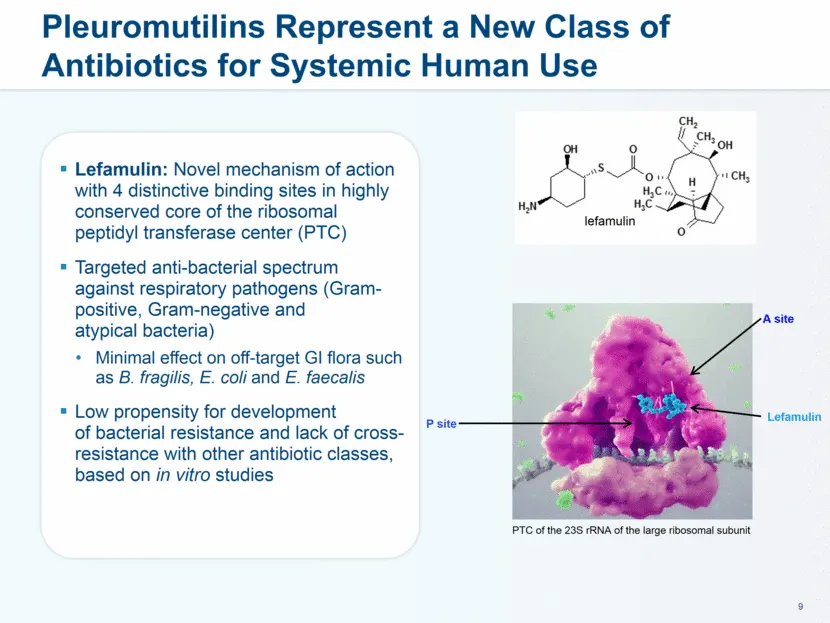
Lefamulin A site P site PTC of the 23S rRNA of the large ribosomal subunit Pleuromutilins Represent a New Class of Antibiotics for Systemic Human Use Lefamulin: Novel mechanism of action with 4 distinctive binding sites in highly conserved core of the ribosomal peptidyl transferase center (PTC) Targ
Slide 9: External Factors Likely to Influence Future Antibiotic Treatment Choices for CABP
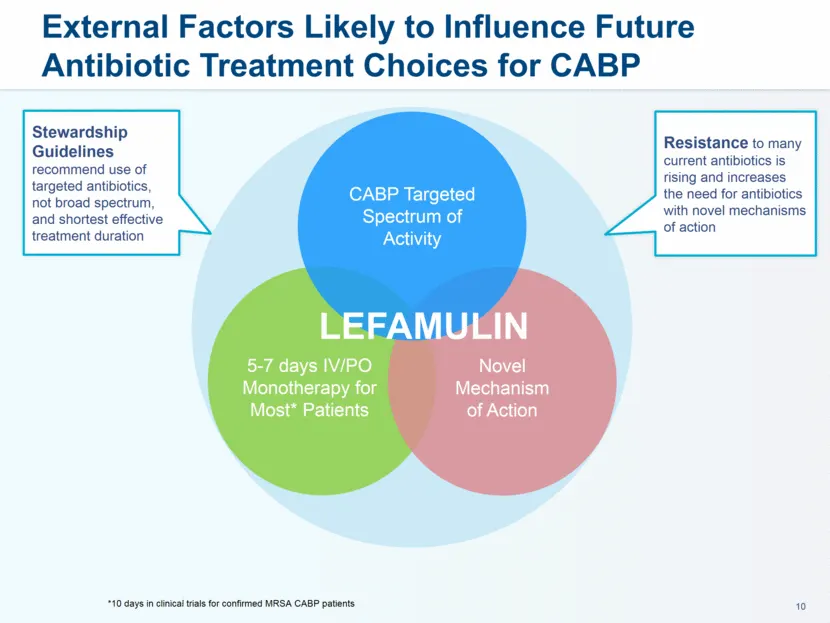
5-7 days IV/PO Monotherapy for Most* Patients Novel Mechanism of Action CABP Targeted Spectrum of Activity Stewardship Guidelines recommend use of targeted antibiotics, not broad spectrum, and shortest effective treatment duration Resistance to many current antibiotics is rising and increases the ne
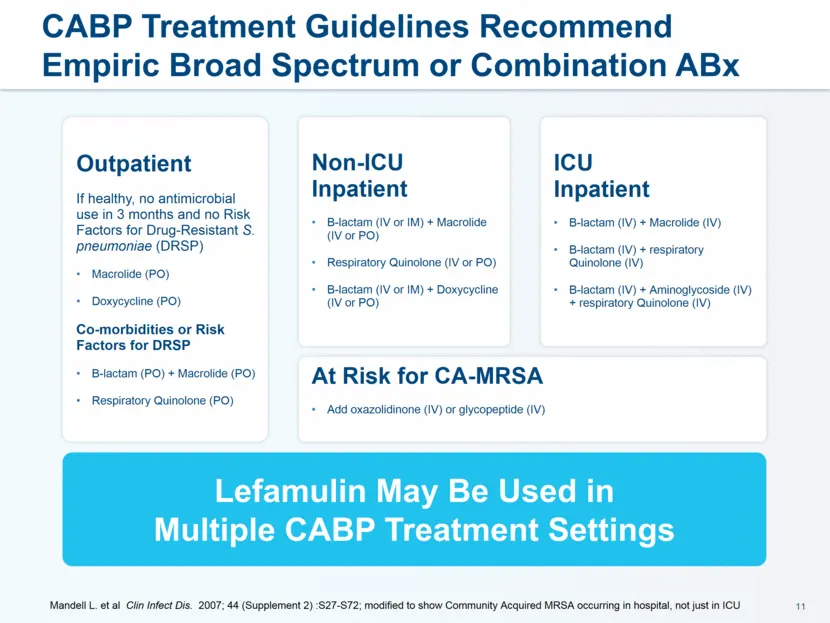
Slide 10: Lefamulin May Be Used in Multiple CABP Treatment Settings
Non-ICU Inpatient B-lactam (IV or IM) + Macrolide (IV or PO) Respiratory Quinolone (IV or PO) B-lactam (IV or IM) + Doxycycline (IV or PO) ICU Inpatient B-lactam (IV) + Macrolide (IV) B-lactam (IV) + respiratory Quinolone (IV) B-lactam (IV) + Aminoglycoside (IV) + respiratory Quinolone (IV) Mandell
Slide 11: Lefamulin: First in Class Systemic Pleuromutilin for Targeted Empiric CABP Monotherapy
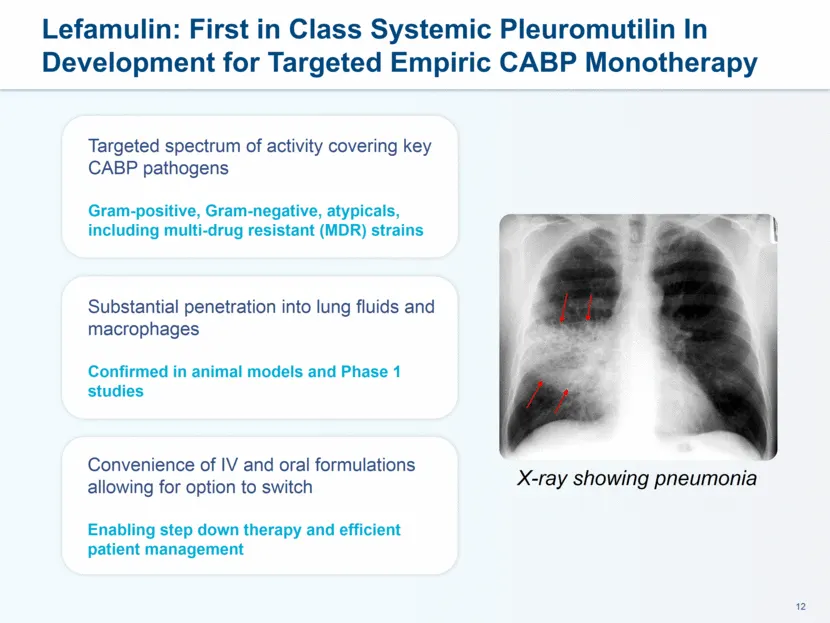
Lefamulin: First in Class Systemic Pleuromutilin In Development for Targeted Empiric CABP Monotherapy Targeted spectrum of activity covering key CABP pathogens Gram-positive, Gram-negative, atypicals, including multi-drug resistant (MDR) strains Substantial penetration into lung fluids and macrophag
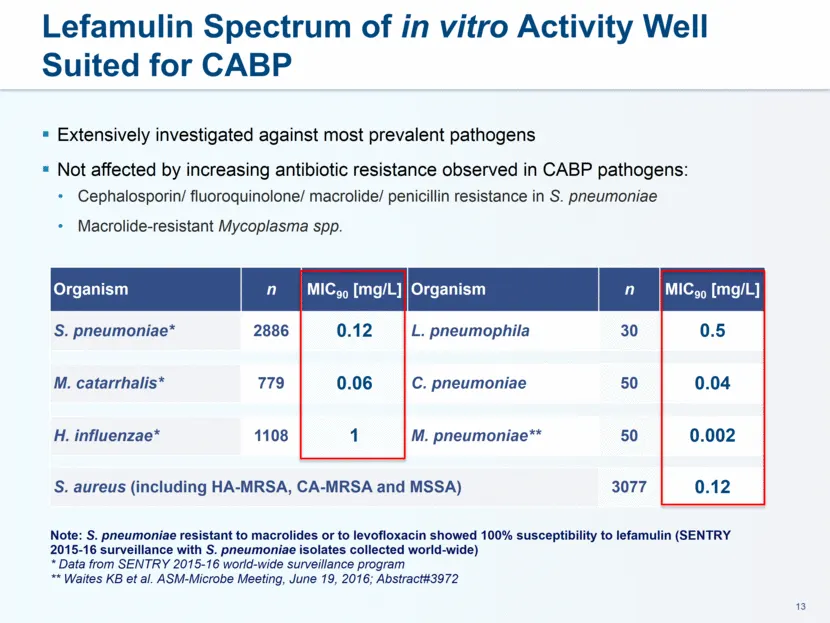
Slide 12: Lefamulin Spectrum of in vitro Activity Well Suited for CABP
Lefamulin Spectrum of in vitro Activity Well Suited for CABP Extensively investigated against most prevalent pathogens Not affected by increasing antibiotic resistance observed in CABP pathogens: Cephalosporin/ fluoroquinolone/ macrolide/ penicillin resistance in S. pneumoniae Macrolide-resistant My
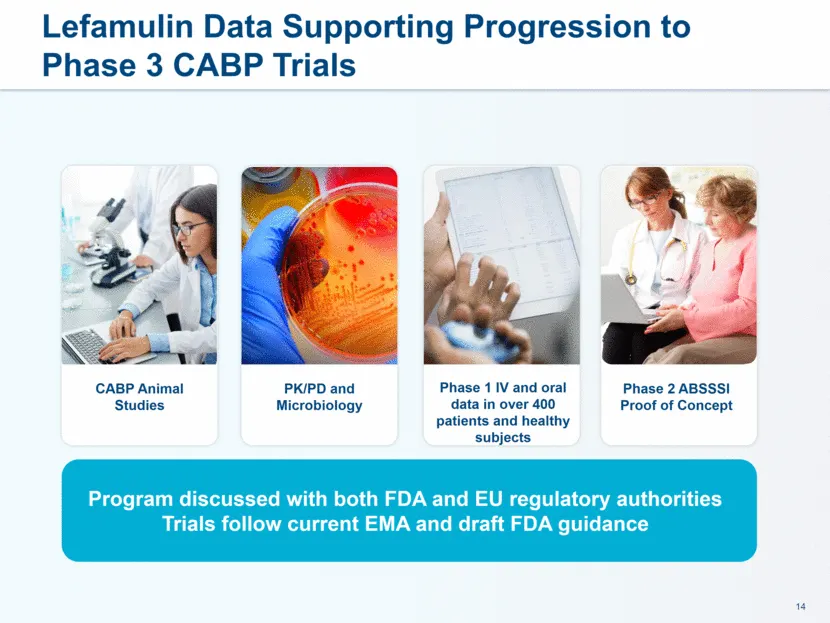
Slide 13: Lefamulin Data Supporting Progression to Phase 3 CABP Trials
Lefamulin Data Supporting Progression to Phase 3 CABP Trials Program discussed with both FDA and EU regulatory authorities Trials follow current EMA and draft FDA guidance CABP Animal Studies PK/PD and Microbiology Phase 2 ABSSSI Proof of Concept Phase 1 IV and oral data in over 400 patients and hea
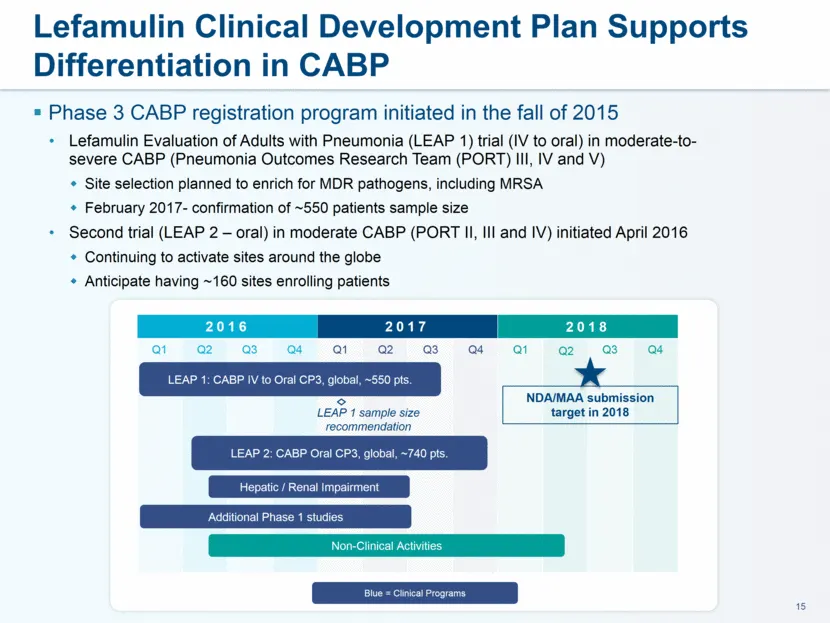
Slide 14: Lefamulin Clinical Development Plan Supports Differentiation in CABP
Lefamulin Clinical Development Plan Supports Differentiation in CABP Phase 3 CABP registration program initiated in the fall of 2015 Lefamulin Evaluation of Adults with Pneumonia (LEAP 1) trial (IV to oral) in moderate-to-severe CABP (Pneumonia Outcomes Research Team (PORT) III, IV and V) Site selec
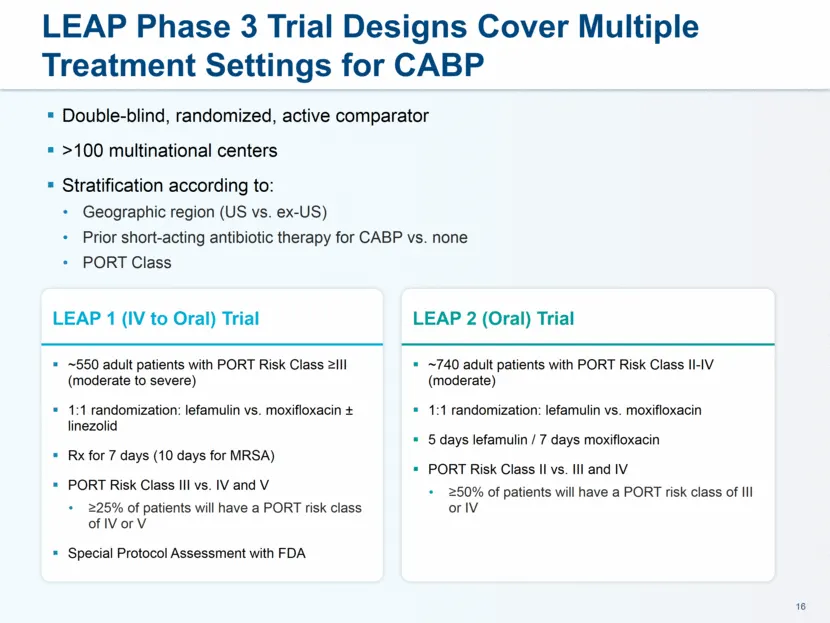
Slide 15: LEAP Phase 3 Trial Designs Cover Multiple Treatment Settings for CABP
LEAP Phase 3 Trial Designs Cover Multiple Treatment Settings for CABP LEAP 1 (IV to Oral) Trial ~550 adult patients with PORT Risk Class >III (moderate to severe) 1:1 randomization: lefamulin vs. moxifloxacin ± linezolid Rx for 7 days (10 days for MRSA) PORT Risk Class III vs. IV and V >25% of patie
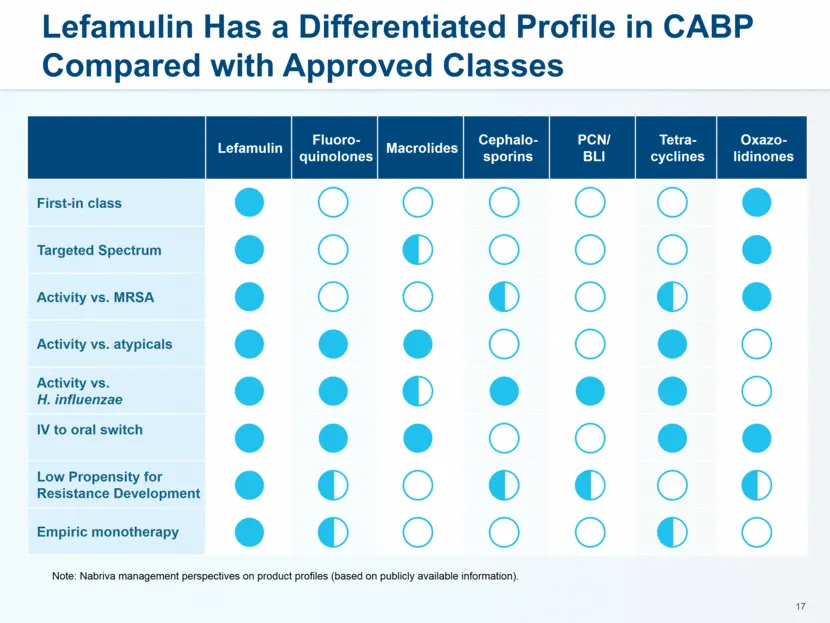
Slide 16: Lefamulin Has a Differentiated Profile in CABP Compared with Approved Classes
Lefamulin Fluoro-quinolones Macrolides Cephalo-sporins PCN/ BLI Tetra-cyclines Oxazo-lidinones First-in class Targeted Spectrum Activity vs. MRSA Activity vs. atypicals Activity vs. H. influenzae IV to oral switch Low Propensity for Resistance Development Empiric monotherapy Note: Nabriva management
Slide 17: Financial Highlights
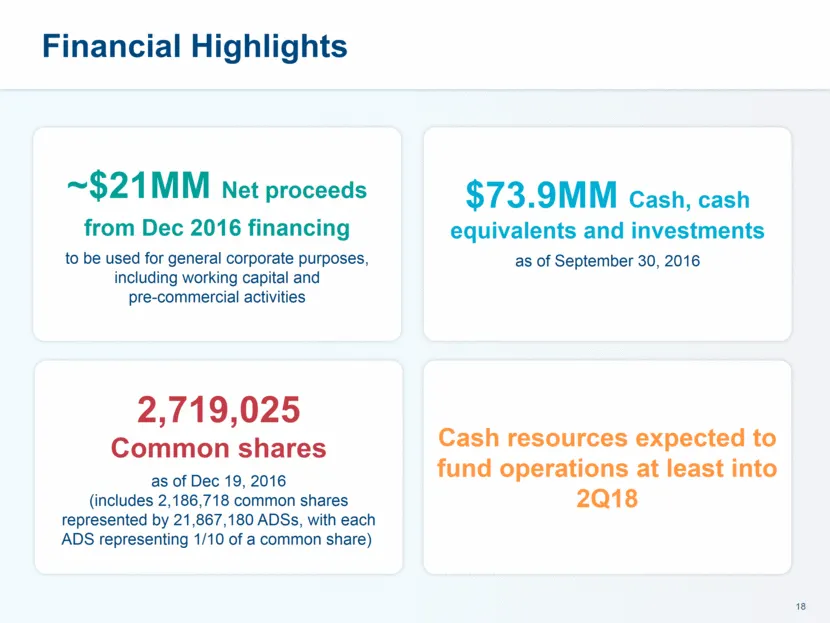
Financial Highlights $73.9MM Cash, cash equivalents and investments as of September 30, 2016 ~$21MM Net proceeds from Dec 2016 financing to be used for general corporate purposes, including working capital and pre-commercial activities 2,719,025 Common shares as of Dec 19, 2016 (includes 2,186,718 c
Slide 18: Anticipated Lefamulin Milestones
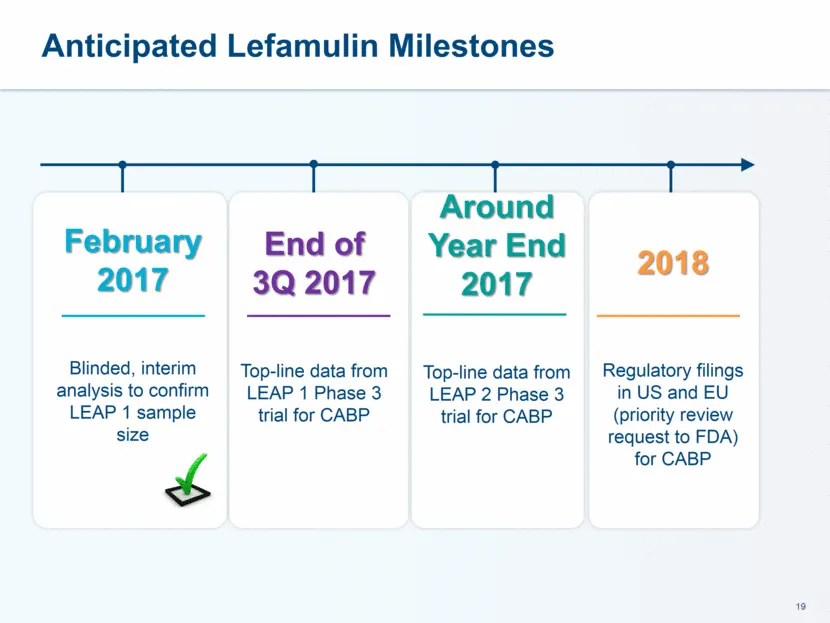
Anticipated Lefamulin Milestones February 2017 Blinded, interim analysis to confirm LEAP 1 sample size Around Year End 2017 Top-line data from LEAP 2 Phase 3 trial for CABP 2018 Regulatory filings in US and EU (priority review request to FDA) for CABP End of 3Q 2017 Top-line data from LEAP 1 Phase 3
Slide 19: Advancing Pleuromutilin Development Pipeline
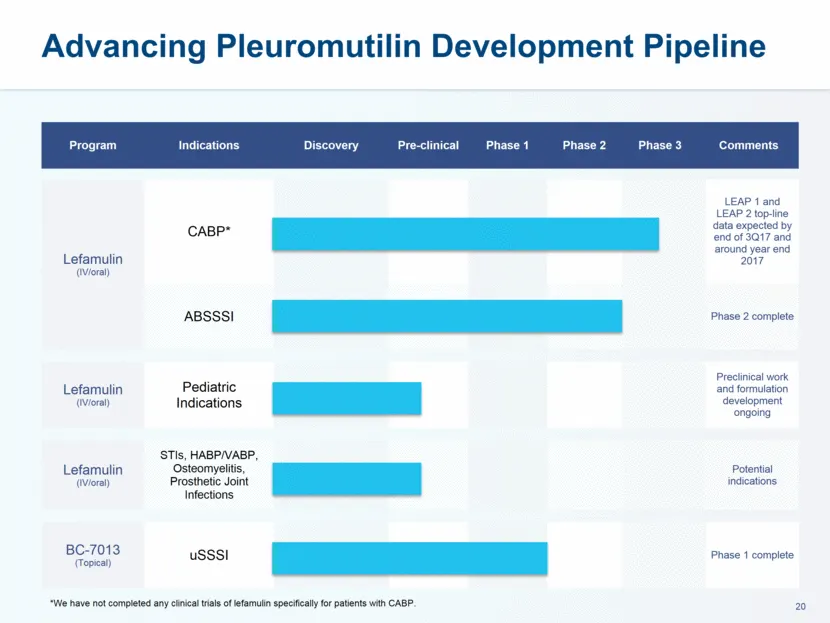
Advancing Pleuromutilin Development Pipeline Program Indications Discovery Pre-clinical Phase 1 Phase 2 Phase 3 Comments Lefamulin (IV/oral) CABP* LEAP 1 and LEAP 2 top-line data expected by end of 3Q17 and around year end 2017 ABSSSI Phase 2 complete Lefamulin (IV/oral) Pediatric Indications Precli
Slide 20: Key Takeaways for Transformational Year
Lefamulin in two international, pivotal Phase 3 trials for moderate-to-severe CABP with top-line data expected by end of 3Q17 and around year end 2017 Investing in pre-commercial activities to maximize commercial potential Cash resources expected to fund operations at least into 2Q18 Key Takeaways f
Slide 21: Developing Novel Anti-Infectives
February 2017 Developing Novel Anti-Infectives
Slide 22: Market Research Indicates Lefamulin Patient Opportunity from Across Generic CABP Regimens
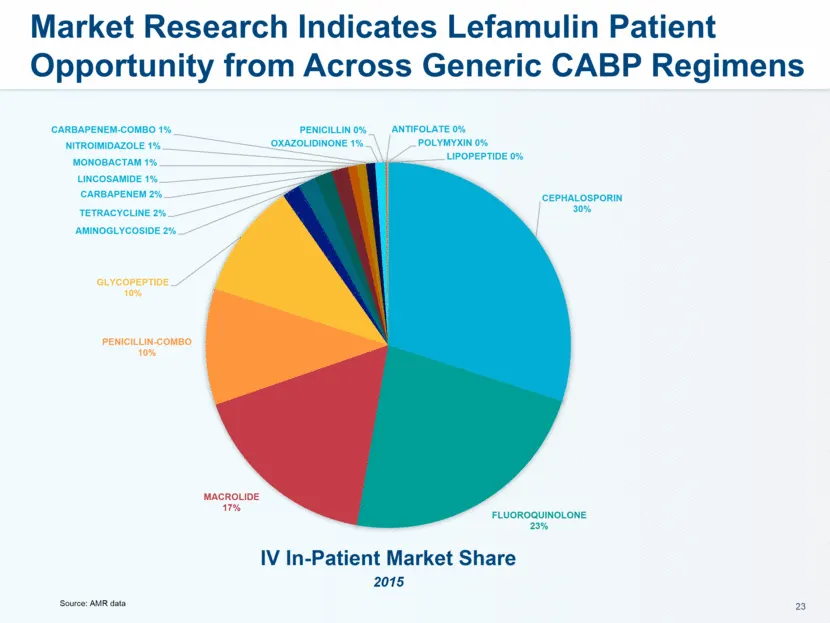
Market Research Indicates Lefamulin Patient Opportunity from Across Generic CABP Regimens IV In-Patient Market Share 2015 Source: AMR data CEPHALOSPORIN 30% FLUOROQUINOLONE 23% MACROLIDE 17% PENICILLIN - COMBO 10% GLYCOPEPTIDE 10% AMINOGLYCOSIDE 2% TETRACYCLINE 2% CARBAPENEM 2% LINCOSAMIDE 1% MONOBA
Slide 23: Resistance and Safety Issues Could Slow Future Macrolide and Fluoroquinolone Use
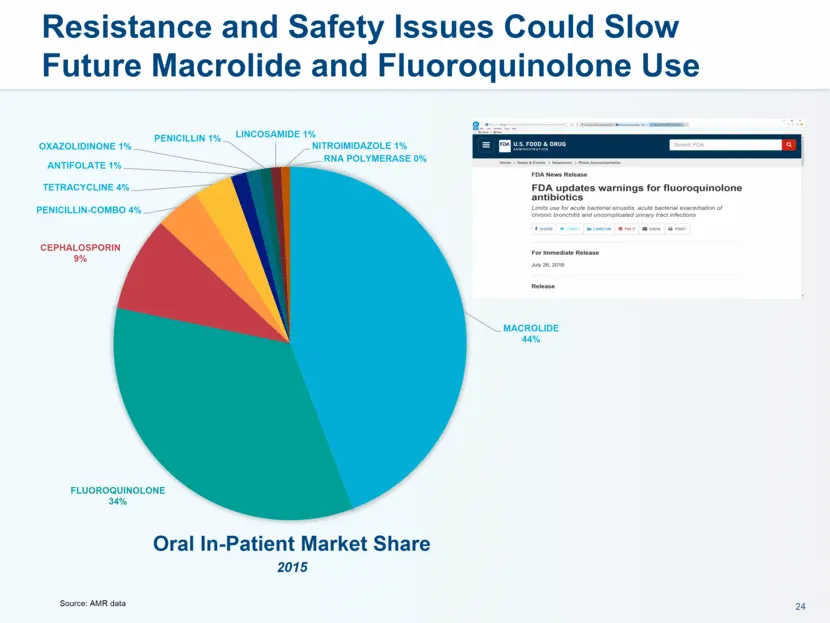
Resistance and Safety Issues Could Slow Future Macrolide and Fluoroquinolone Use Source: AMR data Oral In-Patient Market Share 2015 MACROLIDE 44% FLUOROQUINOLONE 34% CEPHALOSPORIN 9% PENICILLIN - COMBO 4% TETRACYCLINE 4% ANTIFOLATE 1% OXAZOLIDINONE 1% PENICILLIN 1% LINCOSAMIDE 1% NITROIMIDAZOLE 1% R
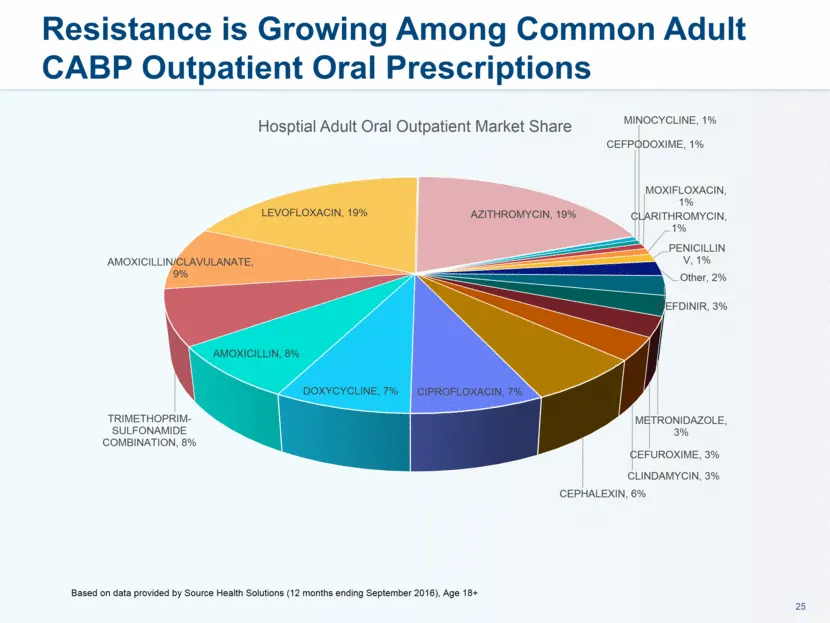
Slide 24: Resistance is Growing Among Common Adult CABP Outpatient Oral Prescriptions
Resistance is Growing Among Common Adult CABP Outpatient Oral Prescriptions Based on data provided by Source Health Solutions (12 months ending September 2016), Age 18+ CEFPODOXIME , 1% MINOCYCLINE , 1% MOXIFLOXACIN , 1% CLARITHROMYCIN , 1% PENICILLIN V , 1% Other , 2% CEFDINIR , 3% METRONIDAZOLE ,
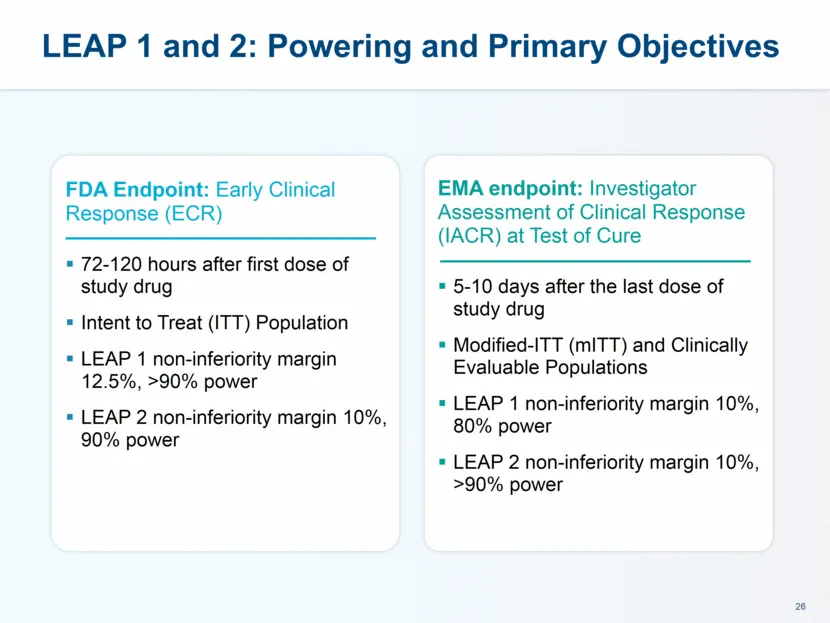
Slide 25: LEAP 1 and 2: Powering and Primary Objectives
LEAP 1 and 2: Powering and Primary Objectives FDA Endpoint: Early Clinical Response (ECR) 72-120 hours after first dose of study drug Intent to Treat (ITT) Population LEAP 1 non-inferiority margin 12.5%, >90% power LEAP 2 non-inferiority margin 10%, 90% power EMA endpoint: Investigator Assessment of
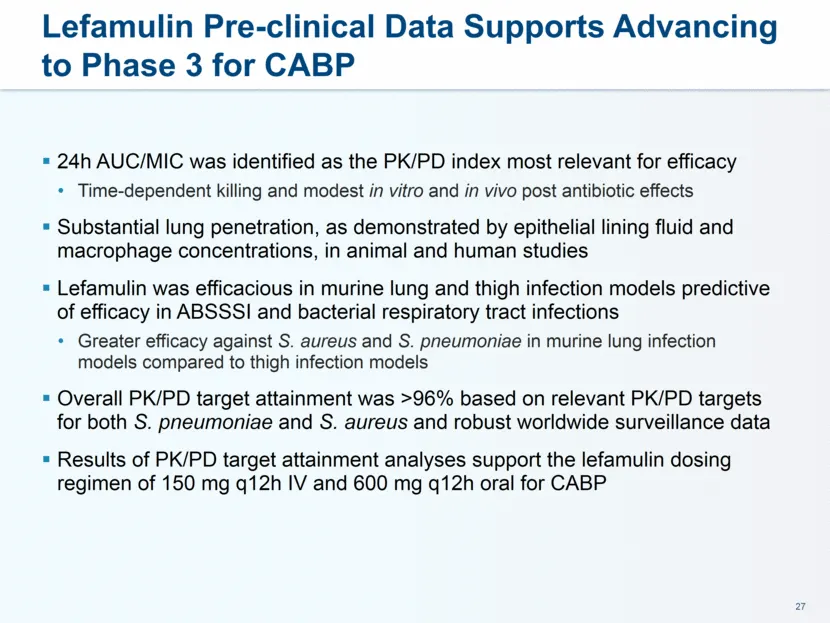
Slide 26: Lefamulin Pre-clinical Data Supports Advancing to Phase 3 for CABP
Lefamulin Pre-clinical Data Supports Advancing to Phase 3 for CABP 24h AUC/MIC was identified as the PK/PD index most relevant for efficacy Time-dependent killing and modest in vitro and in vivo post antibiotic effects Substantial lung penetration, as demonstrated by epithelial lining fluid and macr
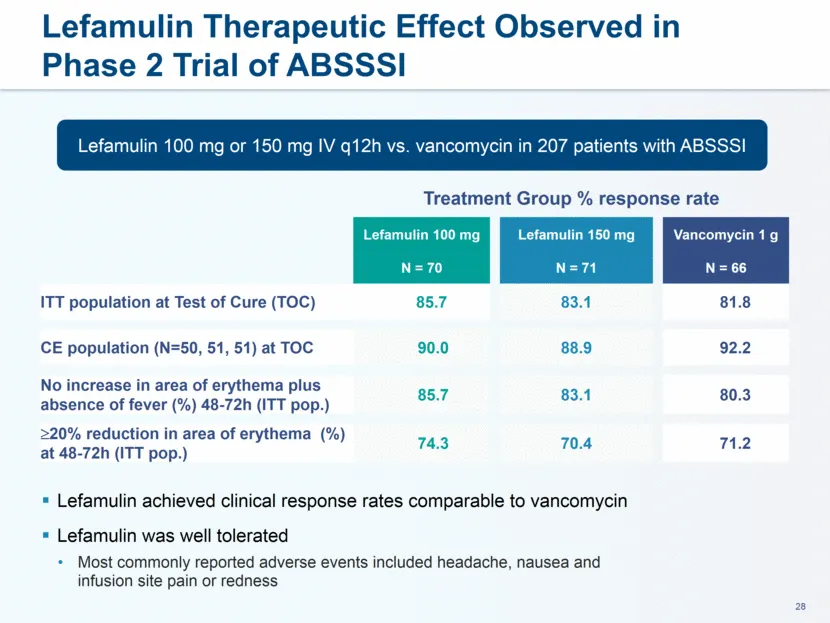
Slide 27: Lefamulin Therapeutic Effect Observed in Phase 2 Trial of ABSSSI
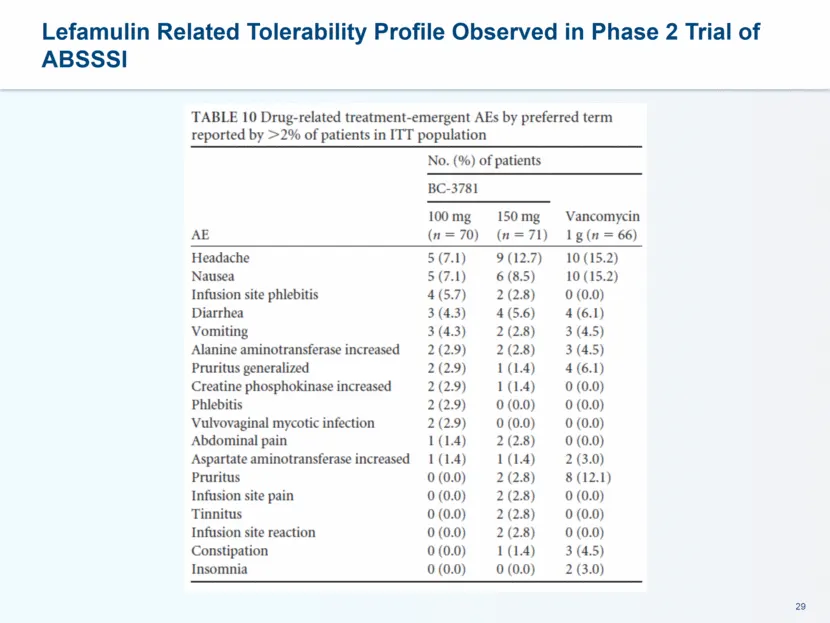
Lefamulin Therapeutic Effect Observed in Phase 2 Trial of ABSSSI Lefamulin achieved clinical response rates comparable to vancomycin Lefamulin was well tolerated Most commonly reported adverse events included headache, nausea and infusion site pain or redness Lefamulin 100 mg Lefamulin 150 mg Vancom
Slide 28: Lefamulin Related Tolerability Profile Observed in Phase 2 Trial of ABSSSI
Lefamulin Related Tolerability Profile Observed in Phase 2 Trial of ABSSSI
Slide 29: Lefamulin Clinical Database Supported Advancing to Phase 3 for CABP
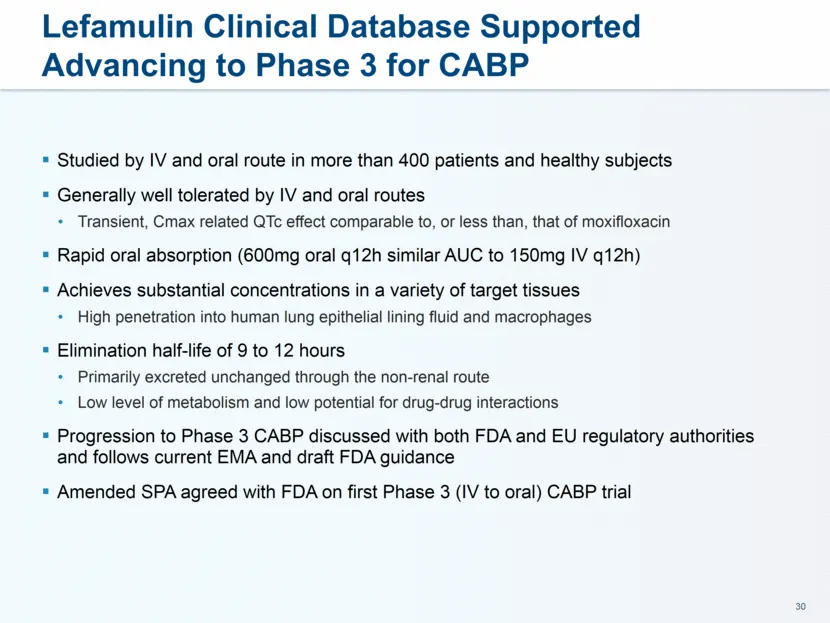
Lefamulin Clinical Database Supported Advancing to Phase 3 for CABP Studied by IV and oral route in more than 400 patients and healthy subjects Generally well tolerated by IV and oral routes Transient, Cmax related QTc effect comparable to, or less than, that of moxifloxacin Rapid oral absorption (6
Slide 30: LEAP 1 and 2: Treatment Scenarios
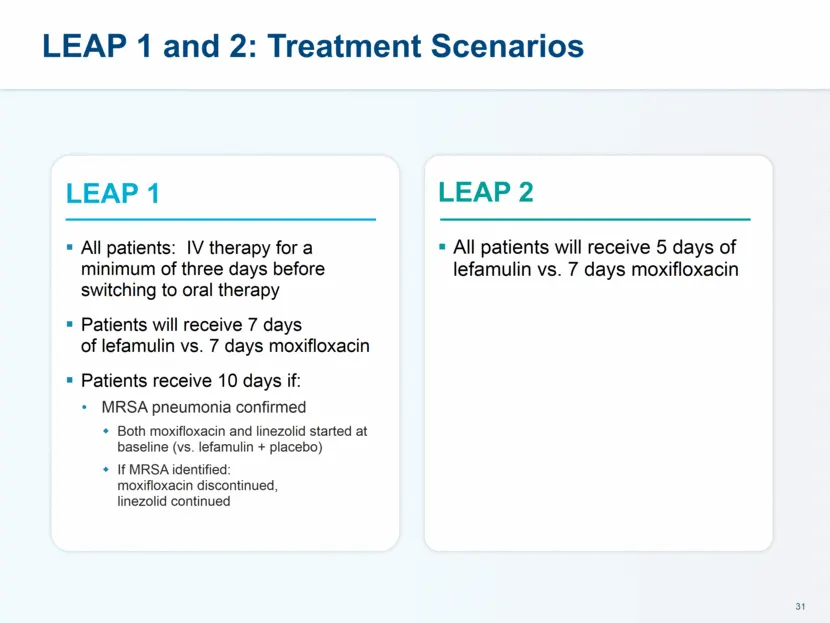
LEAP 1 and 2: Treatment Scenarios LEAP 1 All patients: IV therapy for a minimum of three days before switching to oral therapy Patients will receive 7 days of lefamulin vs. 7 days moxifloxacin Patients receive 10 days if: MRSA pneumonia confirmed Both moxifloxacin and linezolid started at baseline (
Slide 31: Nabriva Has a Strong and Broad Patent Portfolio
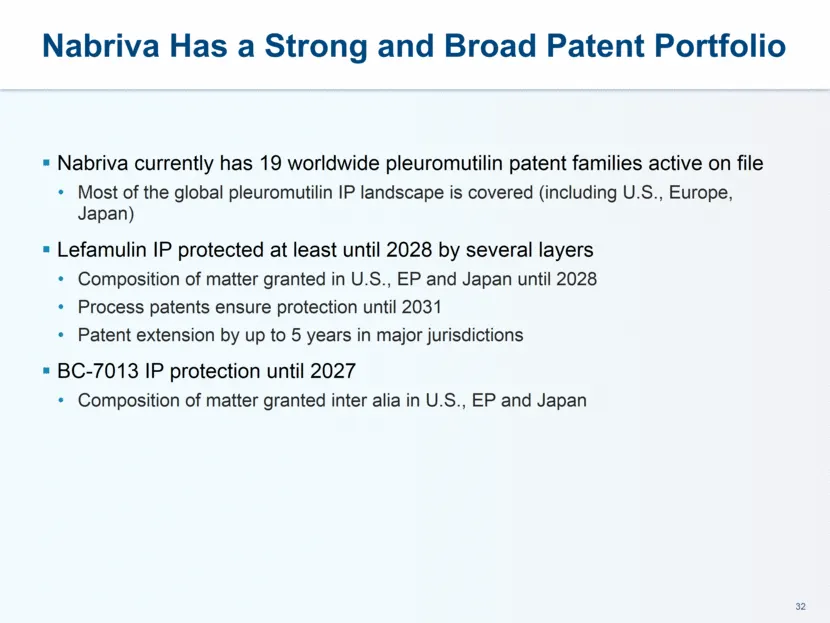
Nabriva Has a Strong and Broad Patent Portfolio Nabriva currently has 19 worldwide pleuromutilin patent families active on file Most of the global pleuromutilin IP landscape is covered (including U.S., Europe, Japan) Lefamulin IP protected at least until 2028 by several layers Composition of matter
Slide 32: Lefamulin Manufacturing On Track for NDA Submission in 2018
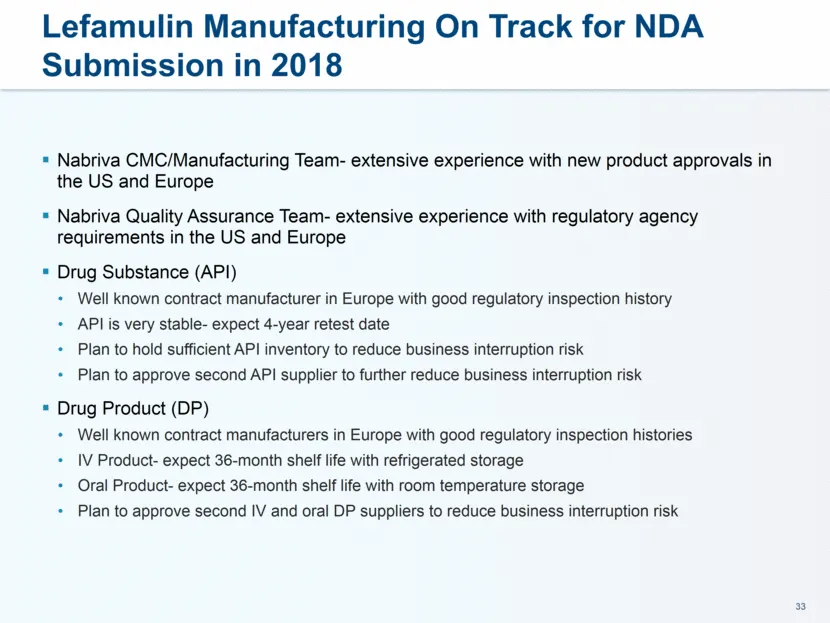
Lefamulin Manufacturing On Track for NDA Submission in 2018 Nabriva CMC/Manufacturing Team- extensive experience with new product approvals in the US and Europe Nabriva Quality Assurance Team- extensive experience with regulatory agency requirements in the US and Europe Drug Substance (API) Well kno
Slide 33: MRSA Pneumonia Increases Patient Risk
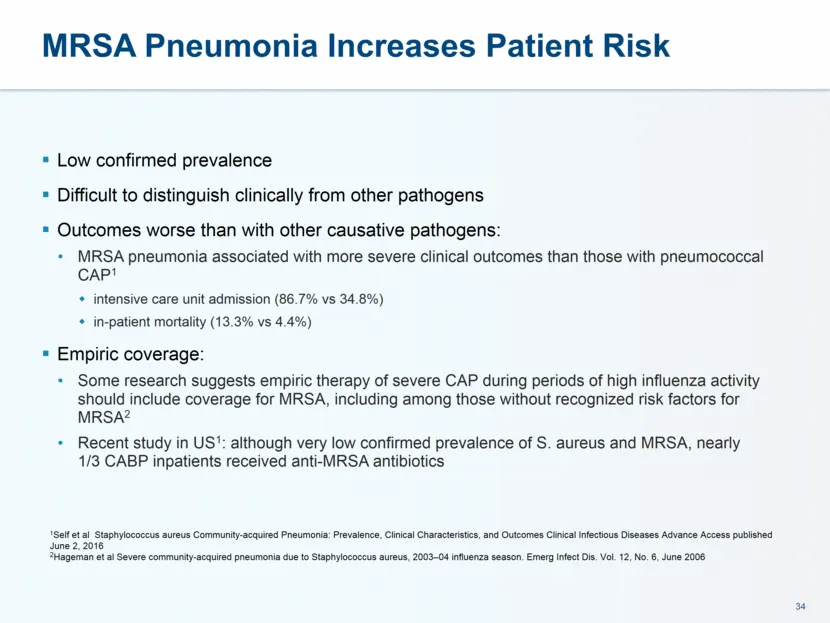
MRSA Pneumonia Increases Patient Risk Low confirmed prevalence Difficult to distinguish clinically from other pathogens Outcomes worse than with other causative pathogens: MRSA pneumonia associated with more severe clinical outcomes than those with pneumococcal CAP1 intensive care unit admission (86
Slide 34: MRSA Pneumonia Increases Patient Risk
MRSA Pneumonia Increases Patient Risk = Low confirmed prevalence * Difficult to distinguish clinically from other pathogens = Outcomes worse than with other causative pathogens: + MRSA pneumonia associated with more severe clinical outcomes than those with pneumococcal CAP? + intensive care unit adm
Source: SEC EDGAR · 8-K filed Feb 15, 2017
More decks from Nabriva Therapeutics AG
 Investor Presentation (April 2021)30 slides · Apr 15, 2021
 Q3 2019 Earnings Presentation27 slides · Nov 12, 2019
 Technical Presentation (May 2018)36 slides · May 21, 2018
 Investor Presentation (November 2017)57 slides · Nov 7, 2017
 Conference Presentation (September 2017)28 slides · Sep 18, 2017
 Investor Day (June 2017)49 slides · Jun 19, 2017