Nabriva Therapeutics — Investor Day (June 2017)
49 slides from Nabriva Therapeutics's investor day presentation, Jun 19, 2017
Slide 1: Forward-looking statements
This presentation contains forward-looking statements that involve substantial risks and uncertainties. All statements, other than statements of historical facts, contained in this presentation, including statements about our future expectations, plans and prospects, including but not limited to sta
Slide 2: Agenda
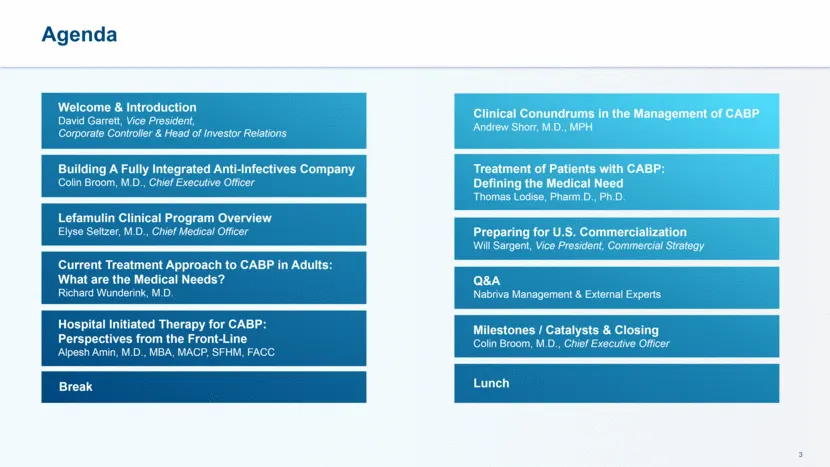
Agenda Welcome & Introduction David Garrett, Vice President, Corporate Controller & Head of Investor Relations Building A Fully Integrated Anti-Infectives Company Colin Broom, M.D., Chief Executive Officer Lefamulin Clinical Program Overview Elyse Seltzer, M.D., Chief Medical Officer Current Treatme
Slide 3: Building a Fully Integrated Anti-Infectives Company
Building a Fully Integrated Anti-Infectives Company Colin Broom, M.D. Chief Executive Officer
Slide 4: 2017 - A Transformational Year for Nabriva
2017- A Transformational Year for Nabriva Building a Fully Integrated Anti-Infectives Company Expert team advancing pleuromutilins, a new class of antibiotics, for systemic (IV and oral) use in humans Investing in pre-commercial activities to maximize US commercial potential and evaluating ex-US par
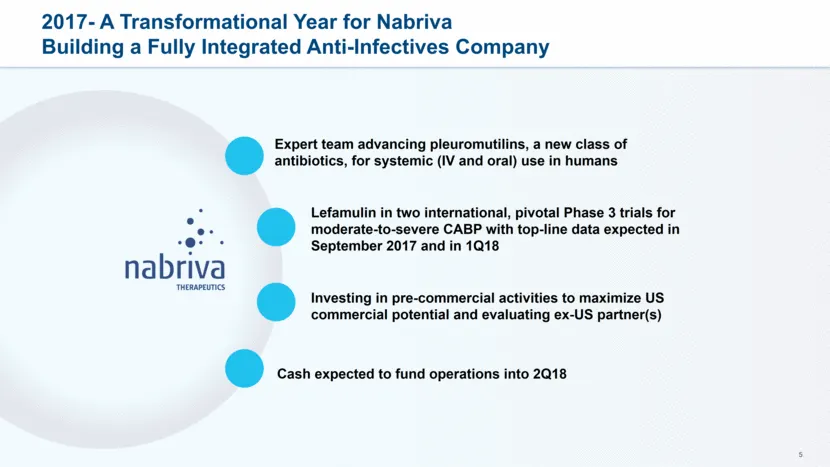
Slide 5: Burden of Pneumonia is Increasing due to Significant Morbidity and Mortality
Burden of Pneumonia is Increasing due to Significant Morbidity and Mortality R Sources: aFile TM Jr, Marrie TJ. Burden of community-acquired pneumonia in North American adults. Postgrad Med. 2010;122:130–41 bDe Alba Pneumonia Readmissions: Risk Factors and Implications TheOchsner Journal 14:649–654,
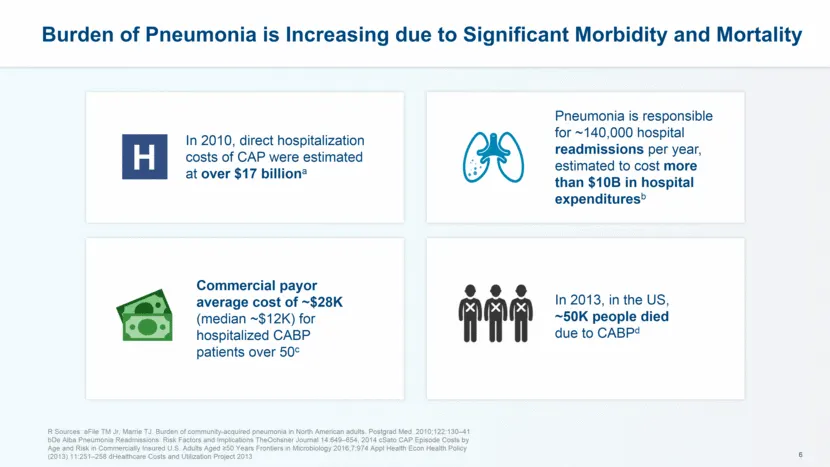
Slide 6: Significant US Adult CABP Opportunity in Hospital-Initiated Therapy
Significant US Adult CABP Opportunity in Hospital-Initiated Therapy A Decision Resources Group/AMR, Age 18+ for 12 months ended December 2015 B Source Health Solutions (12 months ending September 2016), Age 18+ ~4.2MM Oral Antibiotic Prescriptions for Hospital-Initiated Adult Outpatient CABP Treatme
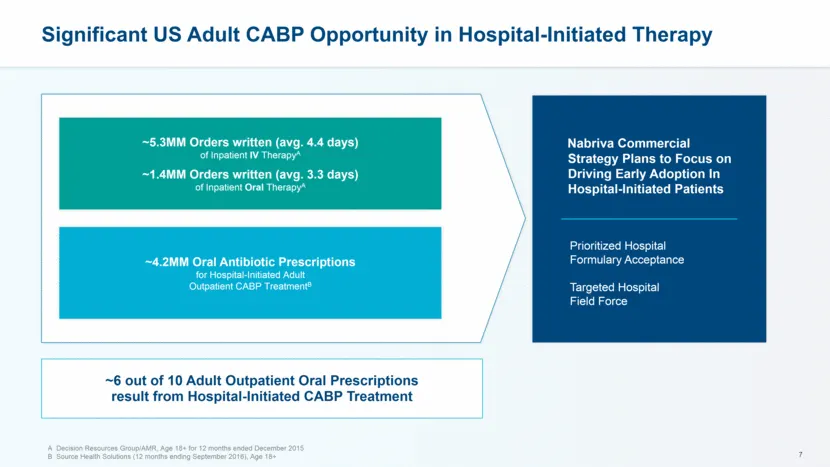
Slide 7: Bacterial Resistance Complicates the Choice of Appropriate Empiric Therapy
Bacterial Resistance Complicates the Choice of Appropriate Empiric Therapy Sources: aMorrissey, I. ECCMID 2014. Abstract P1584 bKim, SH AAC, 2012, 56: 1418-1426 US Susceptibility Rates Have Decreased across Many Antibiotics for S. pneumoniae, the Most Common Cause of CABP Macrolide resistance is inc
Slide 8: Antibiotic Stewardship Should Increasingly Drive Antibiotic Choices
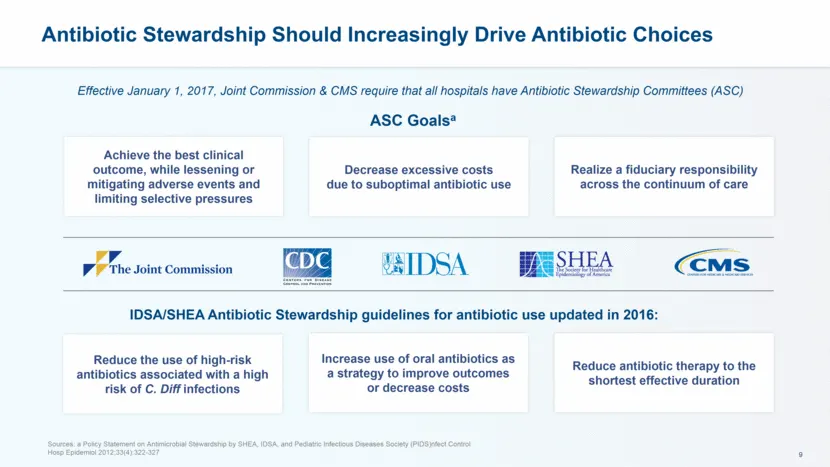
Antibiotic Stewardship Should Increasingly Drive Antibiotic Choices Sources: a Policy Statement on Antimicrobial Stewardship by SHEA, IDSA, and Pediatric Infectious Diseases Society (PIDS)nfect Control Hosp Epidemiol 2012;33(4):322-327 Achieve the best clinical outcome, while lessening or mitigating
Slide 9: Lefamulin Addresses the Factors that Increasingly Influence Treatment Choices for CABP
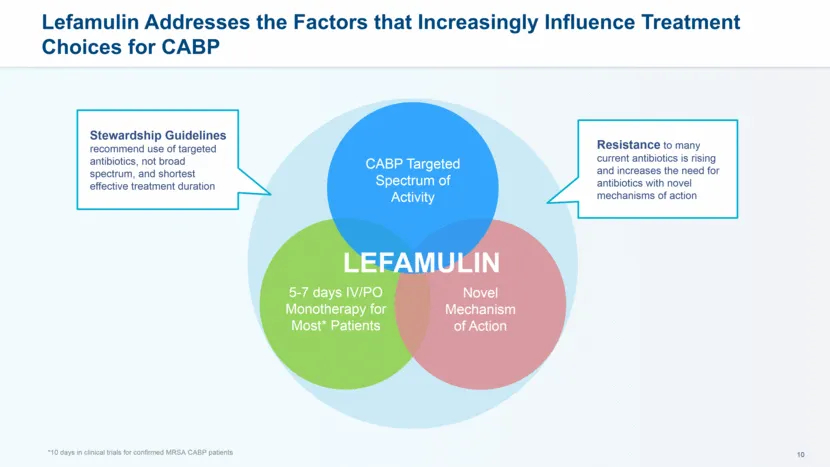
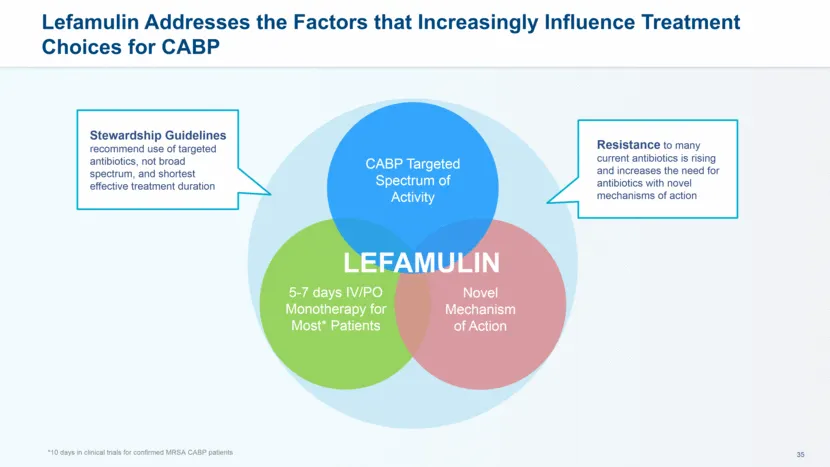
Lefamulin Addresses the Factors that Increasingly Influence Treatment Choices for CABP *10 days in clinical trials for confirmed MRSA CABP patients 5-7 days IV/PO Monotherapy for Most* Patients Novel Mechanism of Action CABP Targeted Spectrum of Activity Stewardship Guidelines recommend use of targe
Slide 10: Pleuromutilins Represent a New Class of Antibiotics for Systemic Human Use
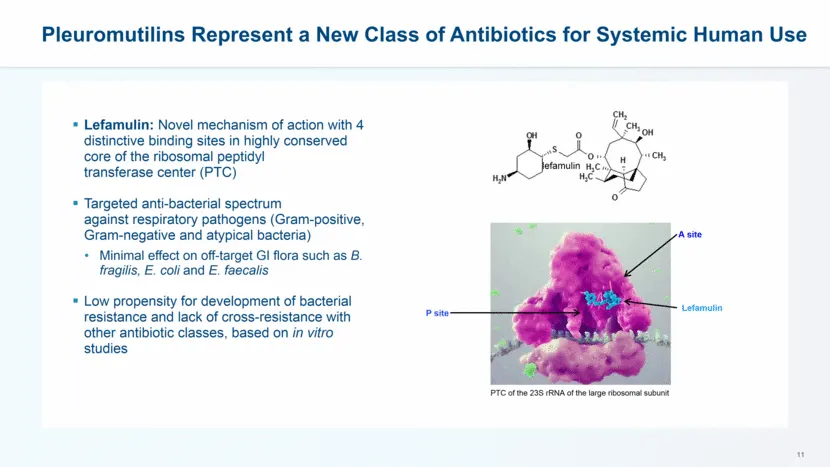
Pleuromutilins Represent a New Class of Antibiotics for Systemic Human Use Lefamulin A site P site PTC of the 23S rRNA of the large ribosomal subunit Lefamulin: Novel mechanism of action with 4 distinctive binding sites in highly conserved core of the ribosomal peptidyl transferase center (PTC) Targ
Slide 11: Lefamulin Clinical Program Overview
Lefamulin Clinical Program Overview Elyse Seltzer, M.D. Chief Medical Officer
Slide 12: Lefamulin: First in Class Systemic Pleuromutilin for Targeted Empiric CABP Monotherapy
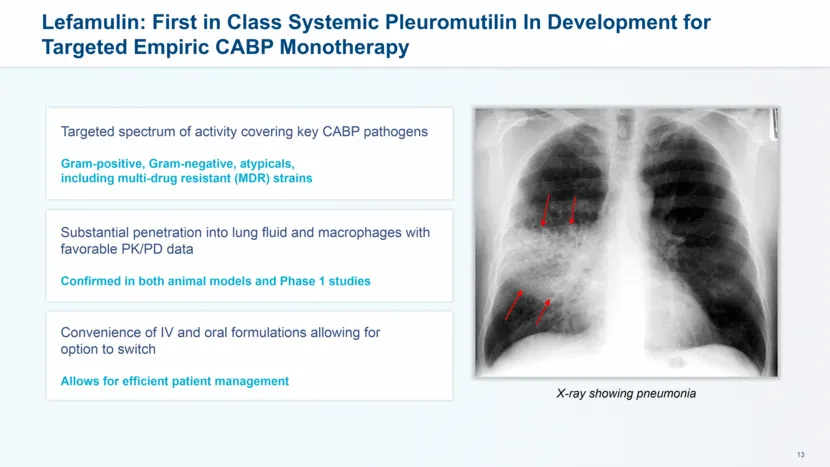
Lefamulin: First in Class Systemic Pleuromutilin In Development for Targeted Empiric CABP Monotherapy Targeted spectrum of activity covering key CABP pathogens Gram-positive, Gram-negative, atypicals, including multi-drug resistant (MDR) strains Substantial penetration into lung fluid and macrophage
Slide 13: Lefamulin Addresses the Factors that Increasingly Influence Treatment Choices for CABP
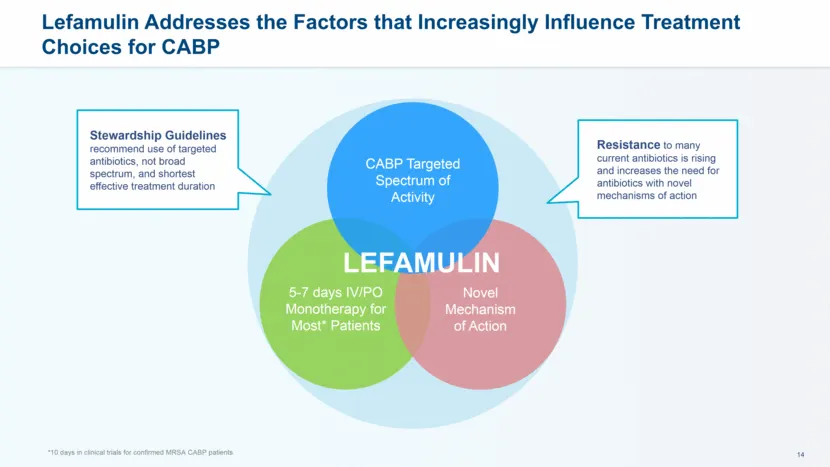
Lefamulin Addresses the Factors that Increasingly Influence Treatment Choices for CABP *10 days in clinical trials for confirmed MRSA CABP patients 5-7 days IV/PO Monotherapy for Most* Patients Novel Mechanism of Action CABP Targeted Spectrum of Activity Stewardship Guidelines recommend use of targe
Slide 14: Phase 3 CABP Program Supported by Robust Preclinical and Clinical Data
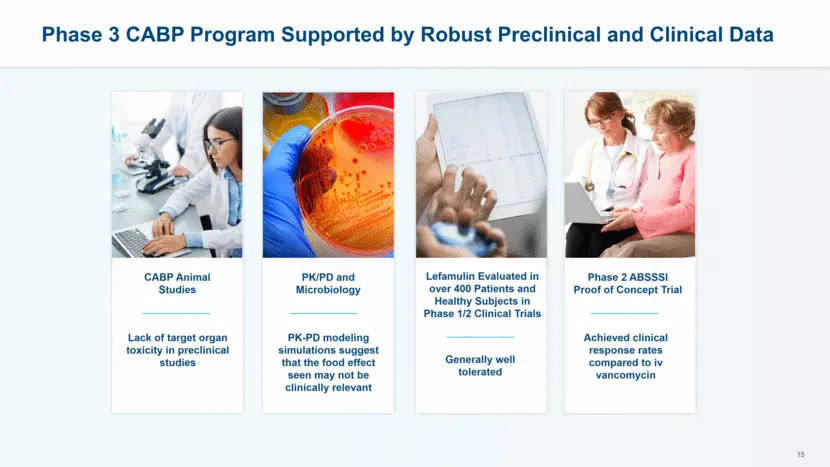
Phase 3 CABP Program Supported by Robust Preclinical and Clinical Data Lefamulin Evaluated in over 400 Patients and Healthy Subjects in Phase 1/2 Clinical Trials Lack of target organ toxicity in preclinical studies CABP Animal Studies PK/PD and Microbiology Phase 2 ABSSSI Proof of Concept Trial PK-P
Slide 15: Lefamulin Spectrum of in vitro Activity Well Suited for CABP
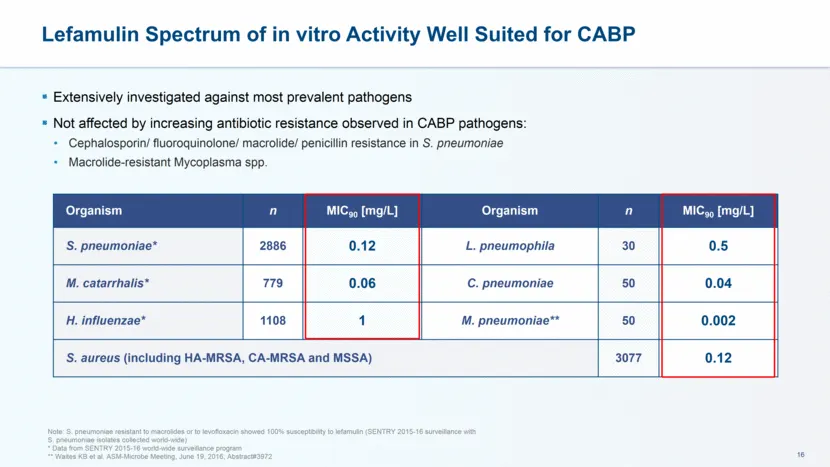
Lefamulin Spectrum of in vitro Activity Well Suited for CABP Extensively investigated against most prevalent pathogens Not affected by increasing antibiotic resistance observed in CABP pathogens: Cephalosporin/ fluoroquinolone/ macrolide/ penicillin resistance in S. pneumoniae Macrolide-resistant My
Slide 16: Lefamulin Clinical Development Plan Supports Differentiation in CABP
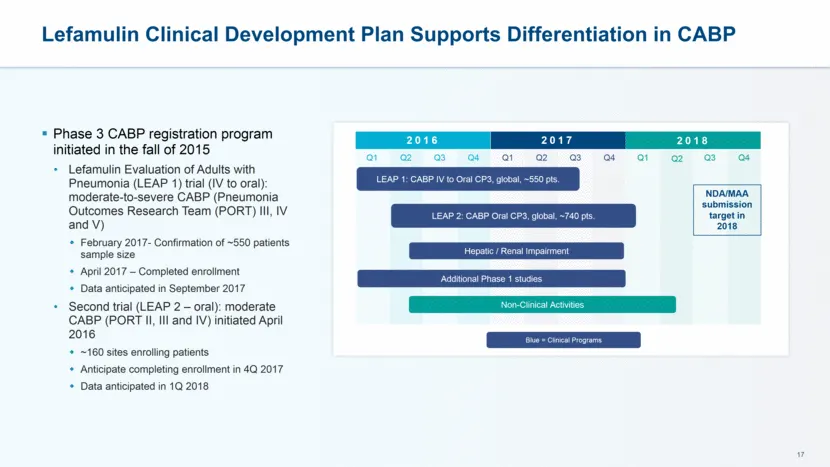
Lefamulin Clinical Development Plan Supports Differentiation in CABP Phase 3 CABP registration program initiated in the fall of 2015 Lefamulin Evaluation of Adults with Pneumonia (LEAP 1) trial (IV to oral): moderate-to-severe CABP (Pneumonia Outcomes Research Team (PORT) III, IV and V) February 201
Slide 17: LEAP Phase 3 Trial Designs Cover Multiple Treatment Settings for CABP
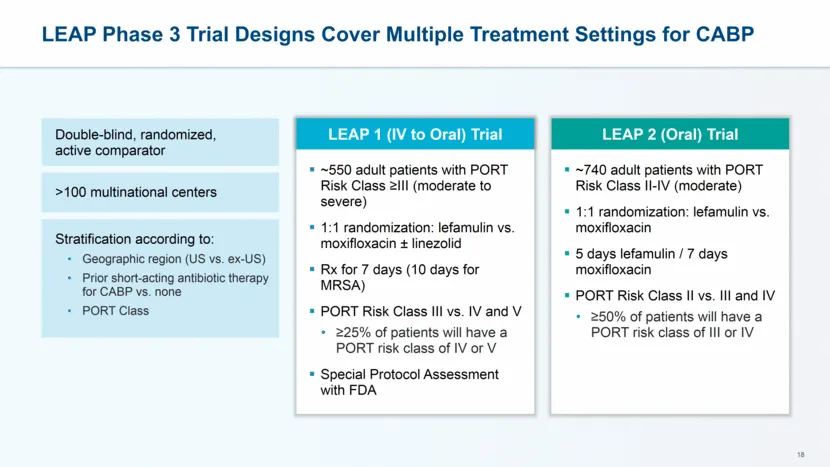
LEAP Phase 3 Trial Designs Cover Multiple Treatment Settings for CABP Double-blind, randomized, active comparator >100 multinational centers Stratification according to: Geographic region (US vs. ex-US) Prior short-acting antibiotic therapy for CABP vs. none PORT Class ~740 adult patients with PORT
Slide 18: LEAP Study Overview
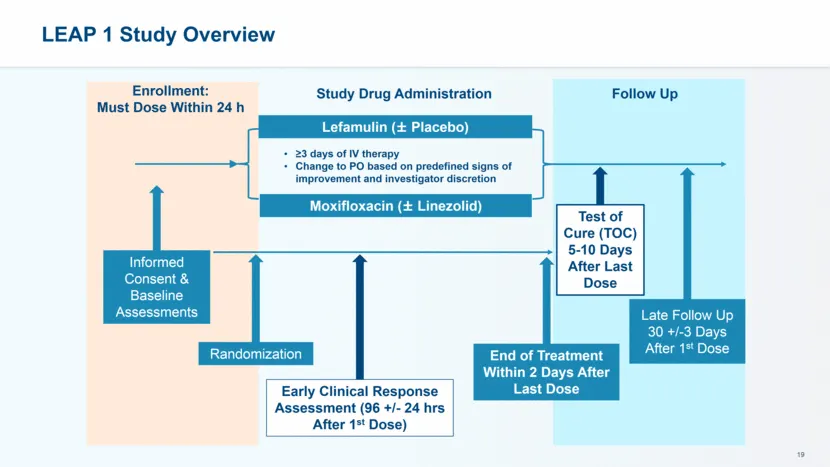
LEAP 1 Study Overview Lefamulin (± Placebo) Moxifloxacin (± Linezolid) Follow Up Study Drug Administration Enrollment: Must Dose Within 24 h Informed Consent & Baseline Assessments Randomization Early Clinical Response Assessment (96 +/- 24 hrs After 1st Dose) End of Treatment Within 2 Days After La
Slide 19: LEAP 1 and 2: Powering and Primary Objectives
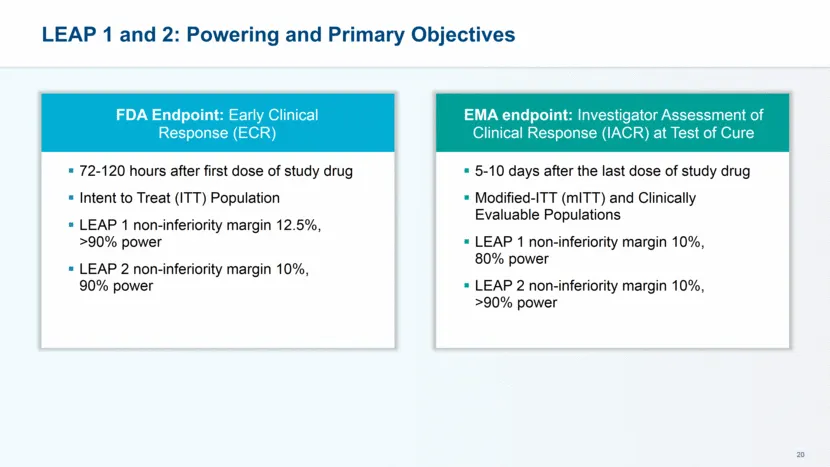
LEAP 1 and 2: Powering and Primary Objectives FDA Endpoint: Early Clinical Response (ECR) 72-120 hours after first dose of study drug Intent to Treat (ITT) Population LEAP 1 non-inferiority margin 12.5%, >90% power LEAP 2 non-inferiority margin 10%, 90% power EMA endpoint: Investigator Assessment of
Slide 20: LEAP 1 and 2: Additional Endpoints for Analysis
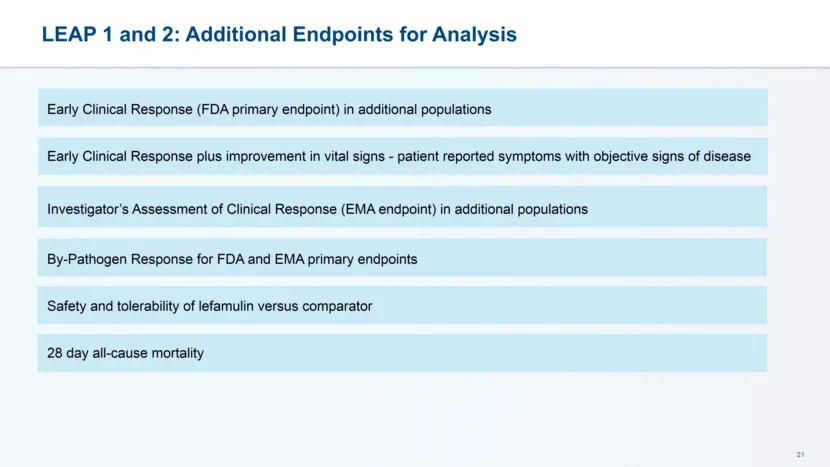
LEAP 1 and 2: Additional Endpoints for Analysis Early Clinical Response (FDA primary endpoint) in additional populations Early Clinical Response plus improvement in vital signs - patient reported symptoms with objective signs of disease Investigator’s Assessment of Clinical Response (EMA endpoint) i
Slide 21: Preparing for U.S. Commercialization
Preparing for U.S. Commercialization Will Sargent Vice President, Commercial Strategy
Slide 22: What You Will Hear Today
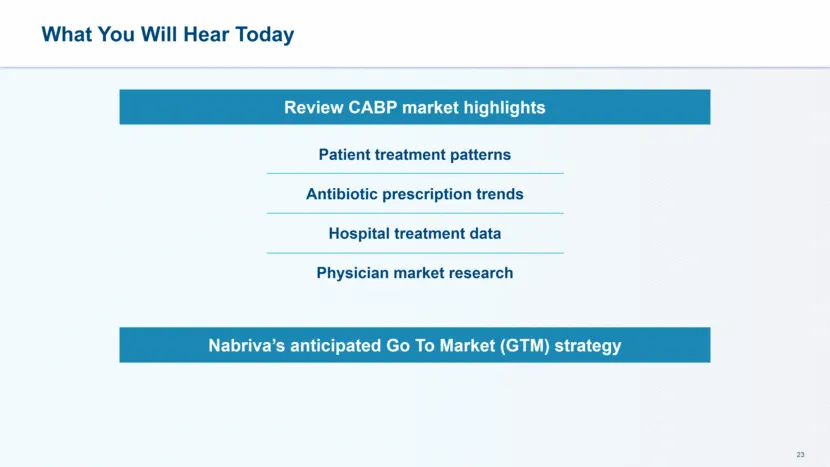
What You Will Hear Today Patient treatment patterns Antibiotic prescription trends Hospital treatment data Physician market research Review CABP market highlights Nabriva’s anticipated Go To Market (GTM) strategy
Slide 23: Lefamulin Has a Significant Opportunity for Use in Hospital-Initiated Adult CABP Treatment
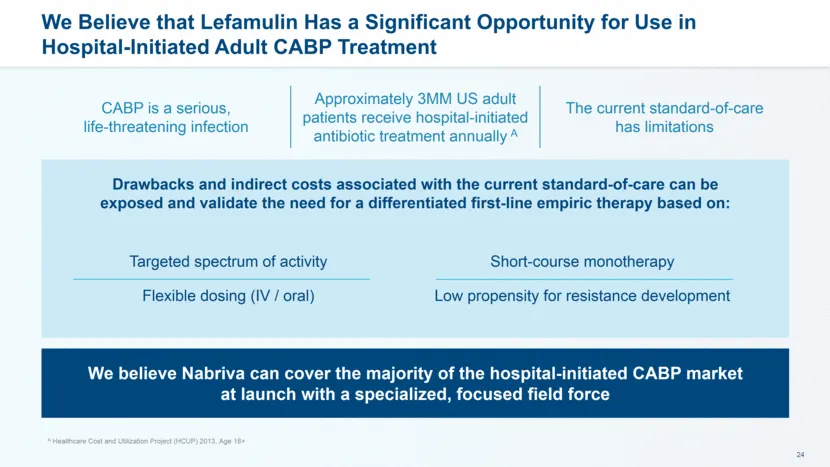
CABP is a serious, life-threatening infection Approximately 3MM US adult patients receive hospital-initiated antibiotic treatment annually A The current standard-of-care has limitations We Believe that Lefamulin Has a Significant Opportunity for Use in Hospital-Initiated Adult CABP Treatment Drawbac
Slide 24: Adult CABP Patient Treatment Patterns
Adult CABP Patient Treatment Patterns
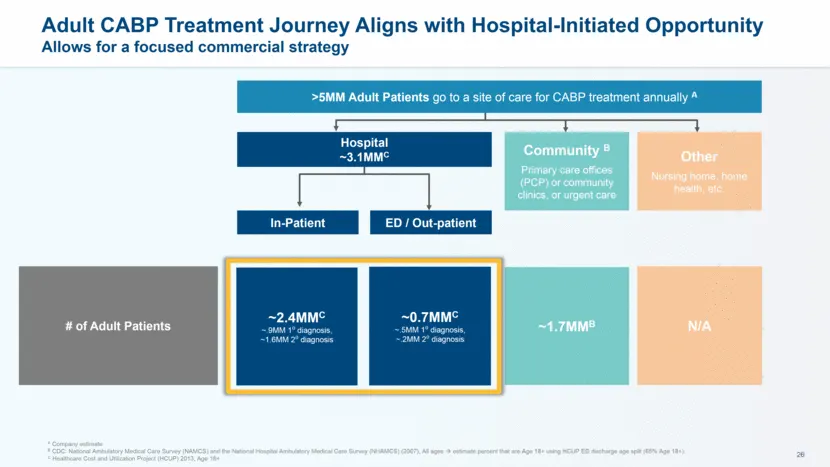
Slide 25: Adult CABP Treatment Journey Aligns with Hospital-Initiated Opportunity
A Company estimate B CDC: National Ambulatory Medical Care Survey (NAMCS) and the National Hospital Ambulatory Medical Care Survey (NHAMCS) (2007), All ages estimate percent that are Age 18+ using HCUP ED discharge age split (65% Age 18+) C Healthcare Cost and Utilization Project (HCUP) 2013, Age 18
Slide 26: Adult CABP Prescription Trends
Adult CABP Prescription Trends
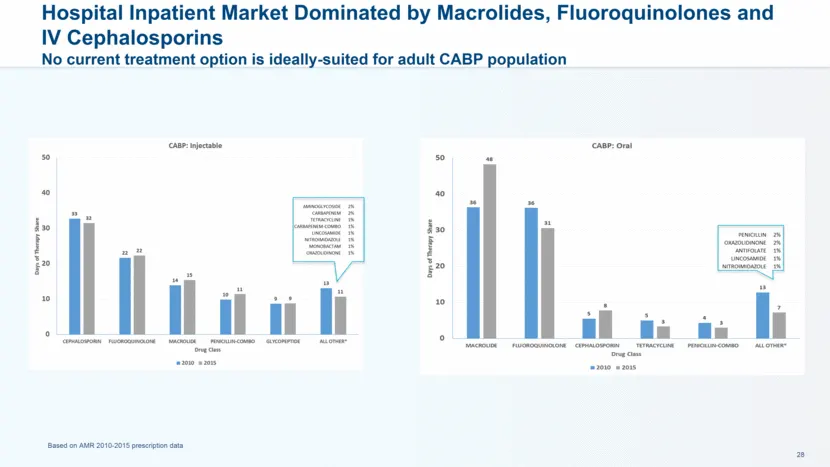
Slide 27: Hospital Inpatient Market Dominated by Macrolides, Fluoroquinolones and IV Cephalosporins
Based on AMR 2010-2015 prescription data Hospital Inpatient Market Dominated by Macrolides, Fluoroquinolones and IV Cephalosporins No current treatment option is ideally-suited for adult CABP population
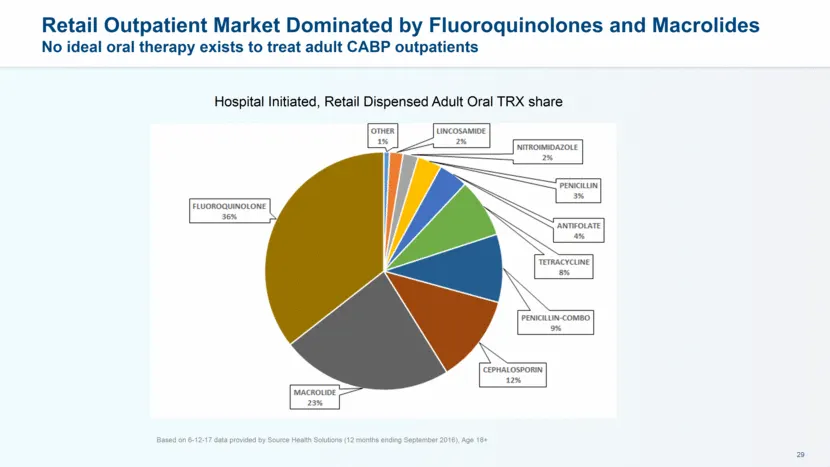
Slide 28: Retail Outpatient Market Dominated by Fluoroquinolones and Macrolides
Retail Outpatient Market Dominated by Fluoroquinolones and Macrolides No ideal oral therapy exists to treat adult CABP outpatients Based on 6-12-17 data provided by Source Health Solutions (12 months ending September 2016), Age 18+ Hospital Initiated, Retail Dispensed Adult Oral TRX share
Slide 29: Adult CABP Hospital Treatment Data
Adult CABP Hospital Treatment Data
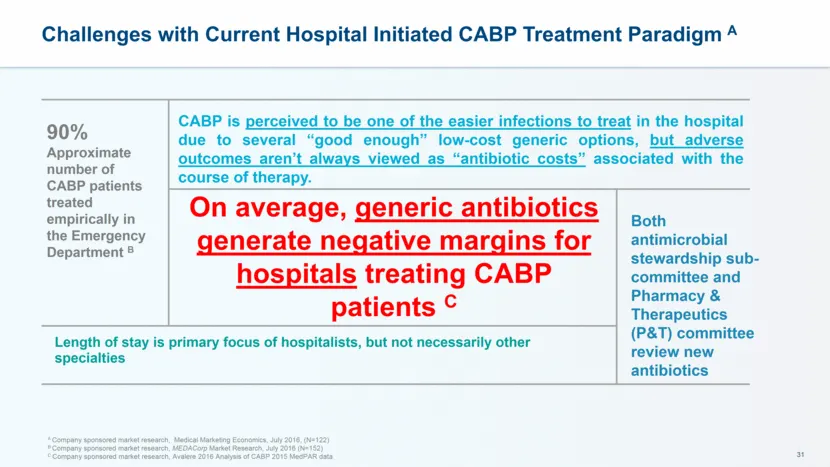
Slide 30: Challenges with Current Hospital Initiated CABP Treatment Paradigm
Challenges with Current Hospital Initiated CABP Treatment Paradigm A Length of stay is primary focus of hospitalists, but not necessarily other specialties 90% Approximate number of CABP patients treated empirically in the Emergency Department B CABP is perceived to be one of the easier infections t
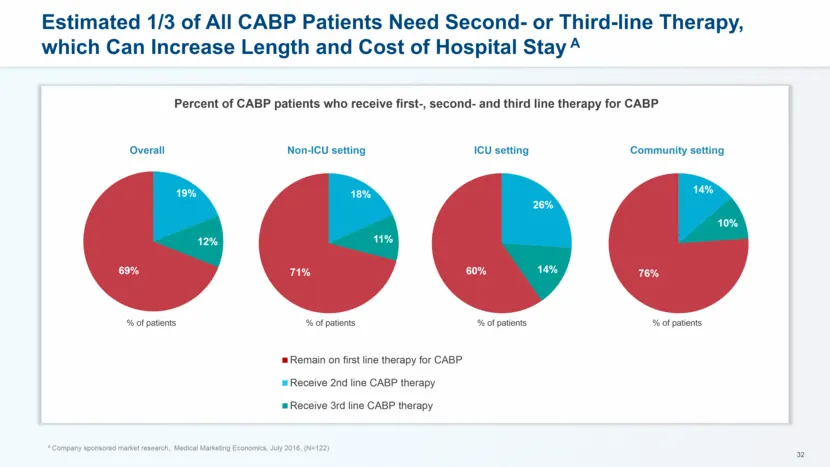
Slide 31: Estimated 1/3 of All CABP Patients Need Second- or Third-line Therapy
Estimated 1/3 of All CABP Patients Need Second- or Third-line Therapy, which Can Increase Length and Cost of Hospital Stay A A Company sponsored market research, Medical Marketing Economics, July 2016, (N=122) Percent of CABP patients who receive first-, second- and third line therapy for CABP Non-I
Slide 32: Most Hospitals Lose Money when Treating Adult Medicare CABP Inpatients
Most Hospitals Lose Money when Treating Adult Medicare CABP Inpatients Treatment scenario Number of cases Average length of stay Average CABP patient cost Average CABP patient payment Average margin Primary Dx CABP 354,423 5.2 days ~$9,600 ~$8,901 -7.5% Secondary Dx CABP 752,985 8.2 days ~$21,000 ~$
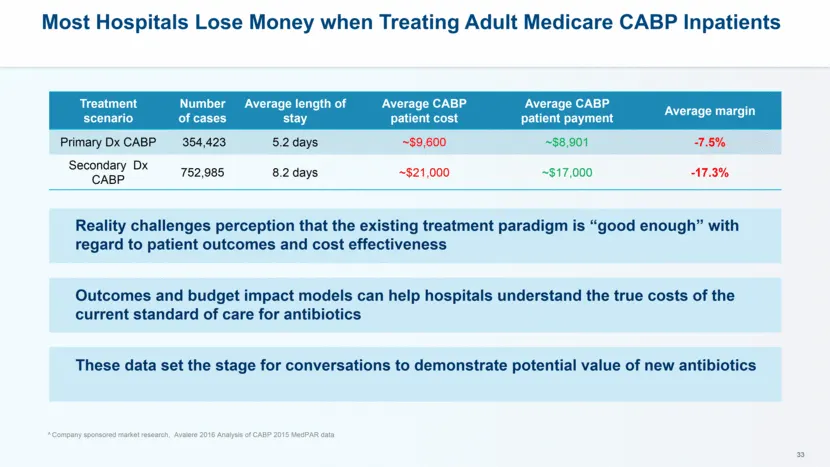
Slide 33: Most Hospitals Lose Money when Treating Adult Medicare CABP Inpatients
Most Hospitals Lose Money when Treating Adult Medicare CABP Inpatients ‘Average length of Average margin stay patient cost Primary DxCABP 954,423 5.2 days ~$9,600 18% ‘Secondary Dx e aces 752,985 8.2 days, $21,000 AT3% Reality challenges perception that the existing treatment paradigm is “good enoug

Slide 34: Lefamulin Addresses the Factors that Increasingly Influence Treatment Choices for CABP
Lefamulin Addresses the Factors that Increasingly Influence Treatment Choices for CABP *10 days in clinical trials for confirmed MRSA CABP patients 5-7 days IV/PO Monotherapy for Most* Patients Novel Mechanism of Action CABP Targeted Spectrum of Activity Stewardship Guidelines recommend use of targe
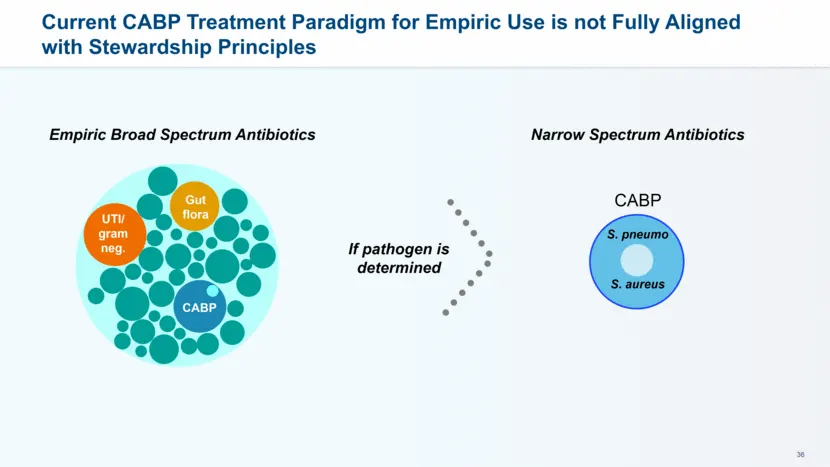
Slide 35: Current CABP Treatment Paradigm for Empiric Use is not Fully Aligned with Stewardship Principles
Current CABP Treatment Paradigm for Empiric Use is not Fully Aligned with Stewardship Principles Empiric Broad Spectrum Antibiotics CABP Narrow Spectrum Antibiotics If pathogen is determined S. aureus S. pneumo CABP Gut flora UTI/ gram neg.
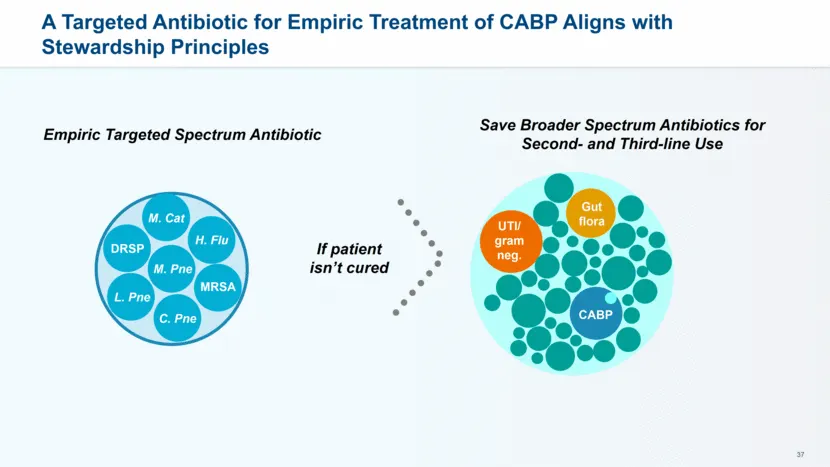
Slide 36: A Targeted Antibiotic for Empiric Treatment of CABP Aligns with Stewardship Principles
A Targeted Antibiotic for Empiric Treatment of CABP Aligns with Stewardship Principles Empiric Targeted Spectrum Antibiotic Save Broader Spectrum Antibiotics for Second- and Third-line Use If patient isn’t cured MRSA M. Cat DRSP H. Flu L. Pne C. Pne M. Pne CABP Gut flora UTI/ gram neg.
Slide 37: Physicians Believe Targeted Coverage of Most Common CABP Pathogens Will Have Greater Impact
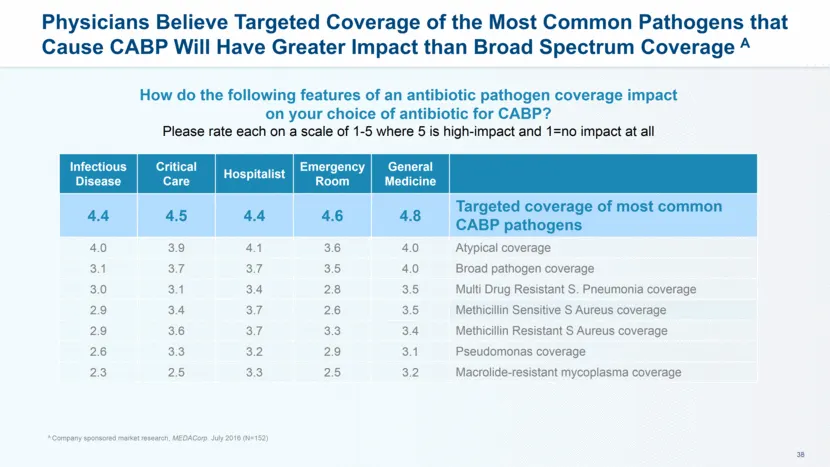
Physicians Believe Targeted Coverage of the Most Common Pathogens that Cause CABP Will Have Greater Impact than Broad Spectrum Coverage A Infectious Disease Critical Care Hospitalist Emergency Room General Medicine 4.4 4.5 4.4 4.6 4.8 Targeted coverage of most common CABP pathogens 4.0 3.9 4.1 3.6 4
Slide 38: Nabriva's Market Research Focuses on Factors Affecting CABP Treatment Choice
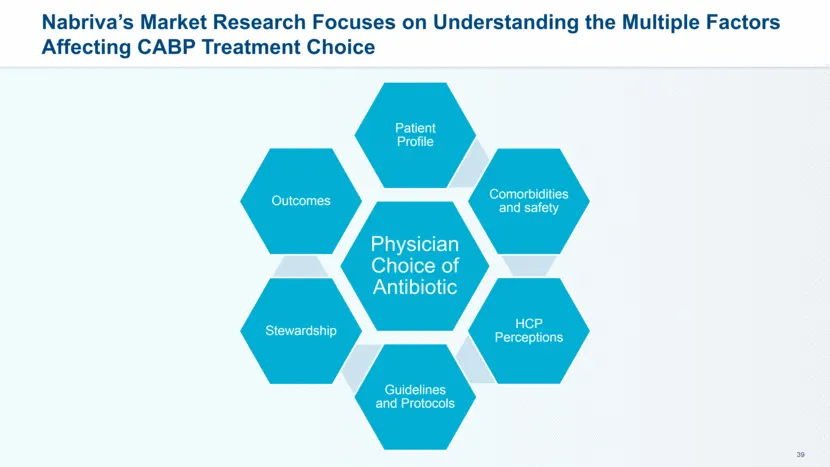
Nabriva’s Market Research Focuses on Understanding the Multiple Factors Affecting CABP Treatment Choice Physician Choice of Antibiotic Patient Profile Comorbidities and safety HCP Perceptions Guidelines and Protocols Stewardship Outcomes
Slide 39: Limitations of Current CABP Treatments Create the Market Opportunity
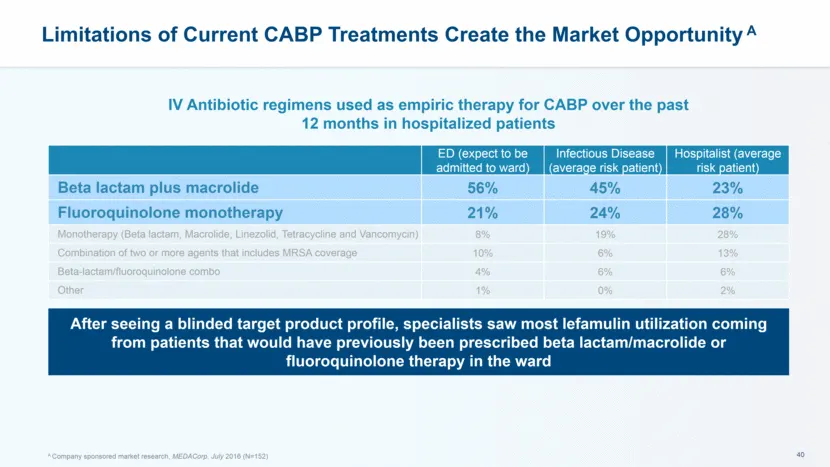
After seeing a blinded target product profile, specialists saw most lefamulin utilization coming from patients that would have previously been prescribed beta lactam/macrolide or fluoroquinolone therapy in the ward Limitations of Current CABP Treatments Create the Market Opportunity A ED (expect to
Slide 40: Potential Nabriva GTM Strategy
Potential Nabriva GTM Strategy
Slide 41: Preparing for a Hospital Focused U.S. Strategy
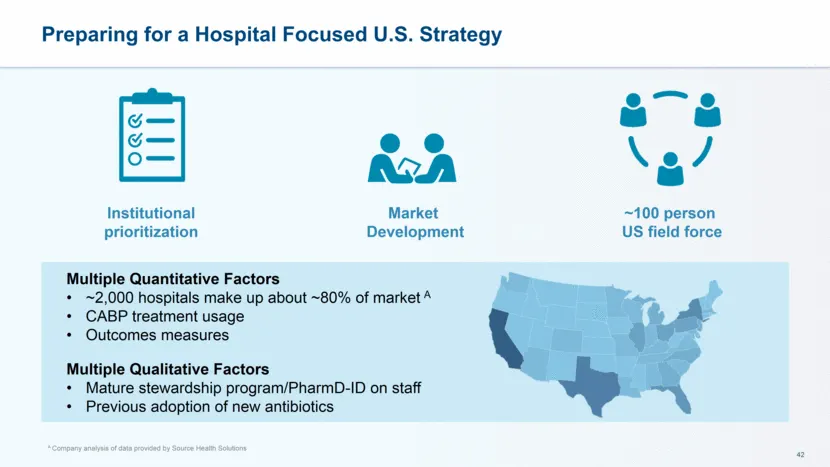
Multiple Quantitative Factors ~2,000 hospitals make up about ~80% of market A CABP treatment usage Outcomes measures Multiple Qualitative Factors Mature stewardship program/PharmD-ID on staff Previous adoption of new antibiotics Preparing for a Hospital Focused U.S. Strategy A Company analysis of da
Slide 42: Lefamulin Opportunity Exists in Three CABP Hospital-Initiated Treatment Settings
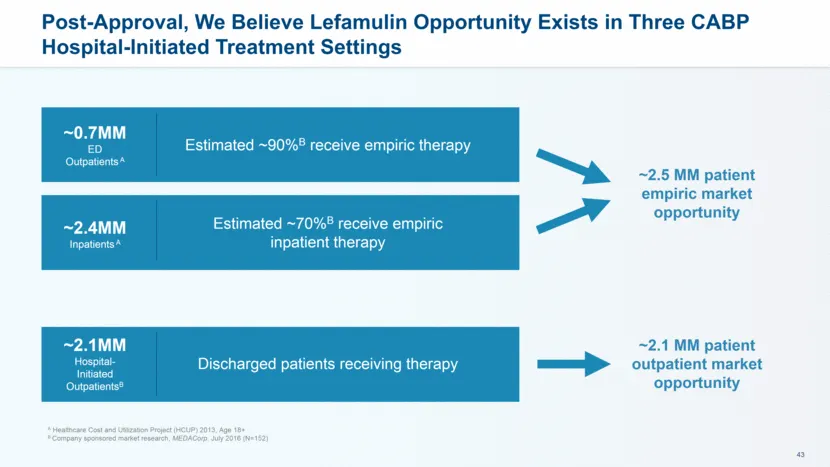
Post-Approval, We Believe Lefamulin Opportunity Exists in Three CABP Hospital-Initiated Treatment Settings A Healthcare Cost and Utilization Project (HCUP) 2013, Age 18+ B Company sponsored market research, MEDACorp. July 2016 (N=152) ~2.1MM Hospital-Initiated OutpatientsB Discharged patients receiv
Slide 43: Lefamulin Has a Significant Opportunity for Use in Hospital-Initiated Adult CABP Treatment
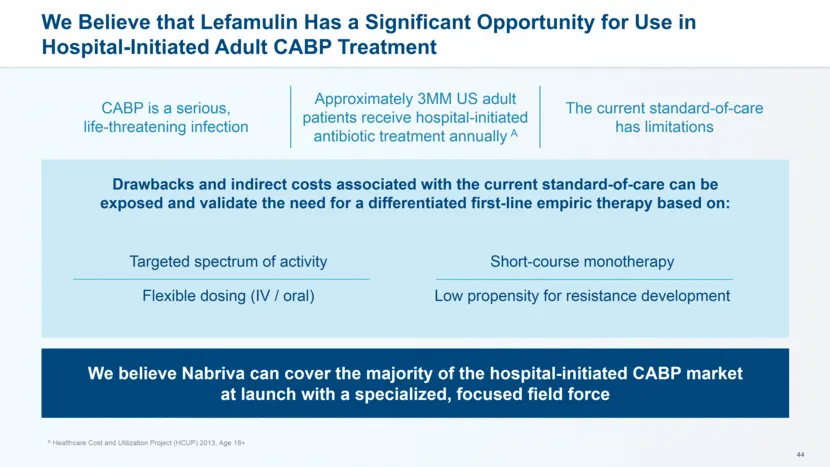
CABP is a serious, life-threatening infection Approximately 3MM US adult patients receive hospital-initiated antibiotic treatment annually A The current standard-of-care has limitations We Believe that Lefamulin Has a Significant Opportunity for Use in Hospital-Initiated Adult CABP Treatment Drawbac
Slide 44: Q&A 2017 Analyst & Investor Day
Q&A 2017 Analyst & Investor Day

Slide 45: A Transformational Year for Nabriva
A Transformational Year for Nabriva Colin Broom, M.D. Chief Executive Officer
Slide 46: Anticipated Lefamulin Milestones
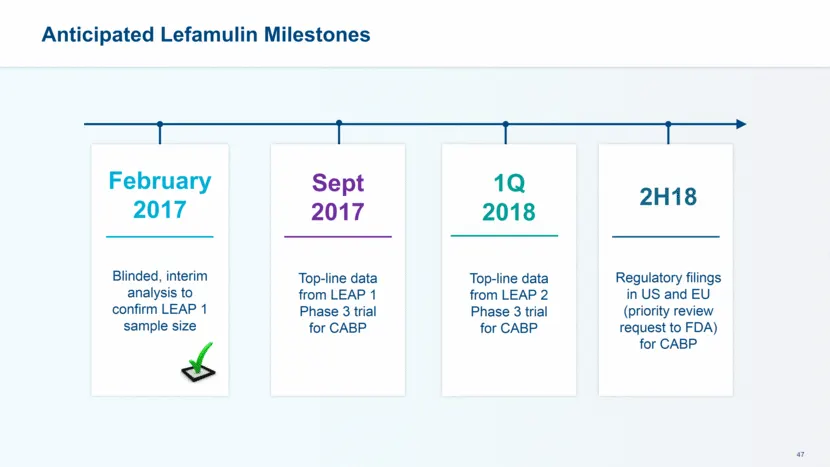
Anticipated Lefamulin Milestones February 2017 Blinded, interim analysis to confirm LEAP 1 sample size 1Q 2018 Top-line data from LEAP 2 Phase 3 trial for CABP 2H18 Regulatory filings in US and EU (priority review request to FDA) for CABP Sept 2017 Top-line data from LEAP 1 Phase 3 trial for CABP
Slide 47: Advancing Pleuromutilin Development Pipeline
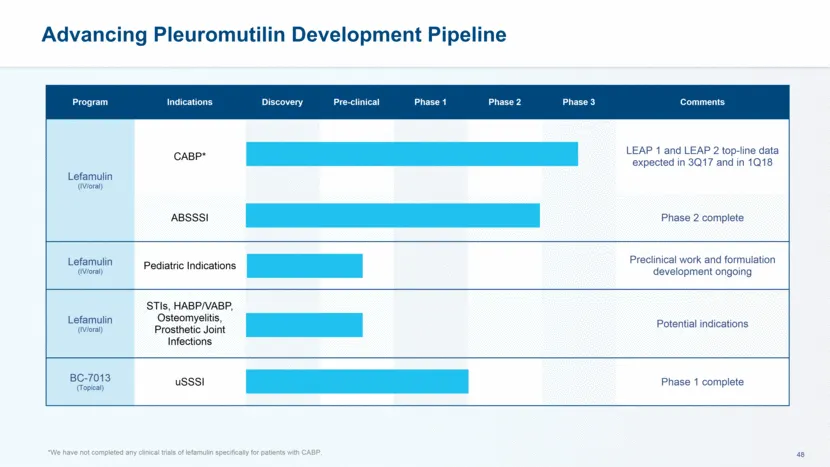
Advancing Pleuromutilin Development Pipeline *We have not completed any clinical trials of lefamulin specifically for patients with CABP. Program Indications Discovery Pre-clinical Phase 1 Phase 2 Phase 3 Comments Lefamulin (IV/oral) CABP* LEAP 1 and LEAP 2 top-line data expected in 3Q17 and in 1Q18
Slide 48: Nabriva: Positioned for Long-Term Growth & Success
Nabriva: Positioned for Long-Term Growth & Success CABP represents a significant medical need Rising rates of bacterial resistance to commonly used antibiotic therapies Utility of available treatment options becoming more limited Lefamulin is well-positioned to address limitations of current antibio
Slide 49: Nabriva: Positioned for Long-Term Growth & Success
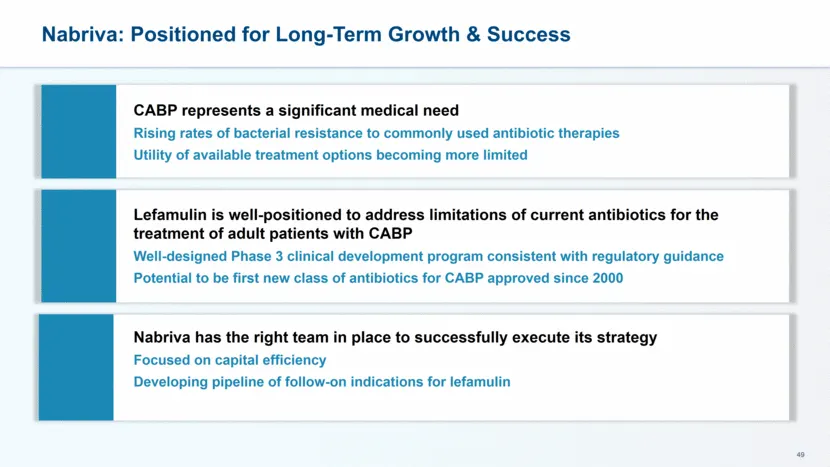
Nabriva: Positioned for Long-Term Growth & Success CABP represents a significant medical need Rising rates of bacterial resistance to commonly used antibiotic therapies Utility of available treatment options becoming more limited Lefamulin is well-positioned to address limitations of current antibio
Source: SEC EDGAR · 8-K filed Jun 19, 2017
More decks from Nabriva Therapeutics AG
 Investor Presentation (April 2021)30 slides · Apr 15, 2021
 Q3 2019 Earnings Presentation27 slides · Nov 12, 2019
 Technical Presentation (May 2018)36 slides · May 21, 2018
 Investor Presentation (November 2017)57 slides · Nov 7, 2017
 Conference Presentation (September 2017)28 slides · Sep 18, 2017
 Investor Presentation (April 2017)35 slides · Apr 5, 2017