PartnerRe Ltd. · OTC:PREJF
PartnerRe — Cracow Summer Insurance & Reinsurance Days 2006
31 slides from PartnerRe's conference presentation, Jun 29, 2006
Slide 1: Solvency II – Challenge for the quantitative and qualitative risk management
Solvency II – Challenge for the quantitative and qualitative risk management Cracow Summer Insurance & Reinsurance Days 28.-30. June 2006 George Muhle 29. June 2006
Slide 2: Abstract
29. June 2006 2 Abstract Introduction Scope of Solvency II Quantitative aspects of Solvency II Qualitative aspects of Solvency II Consequences for risk management Conclusion
Slide 3: Introduction
29. June 2006 3 Introduction Scope of Solvency II Quantitative aspects of Solvency II Qualitative aspects of Solvency II Consequences for risk management Conclusion
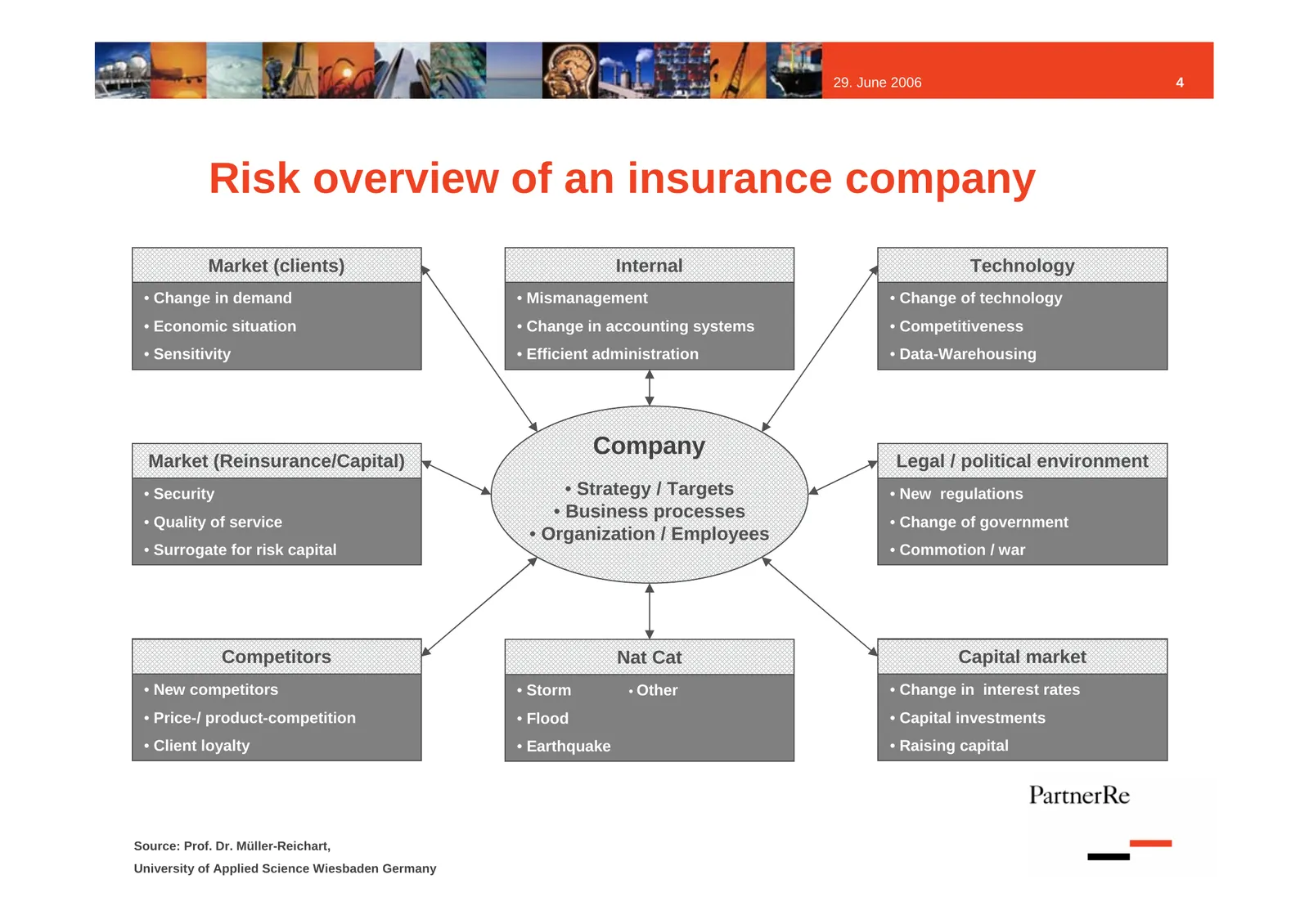
Slide 4: Risk overview of an insurance company
29. June 2006 4 Risk overview of an insurance company Market (clients) Internal Technology • Change in demand • Mismanagement • Change of technology • Economic situation • Change in accounting systems • Competitiveness • Sensitivity • Efficient administration • Data-Warehousing Company Market (Reins
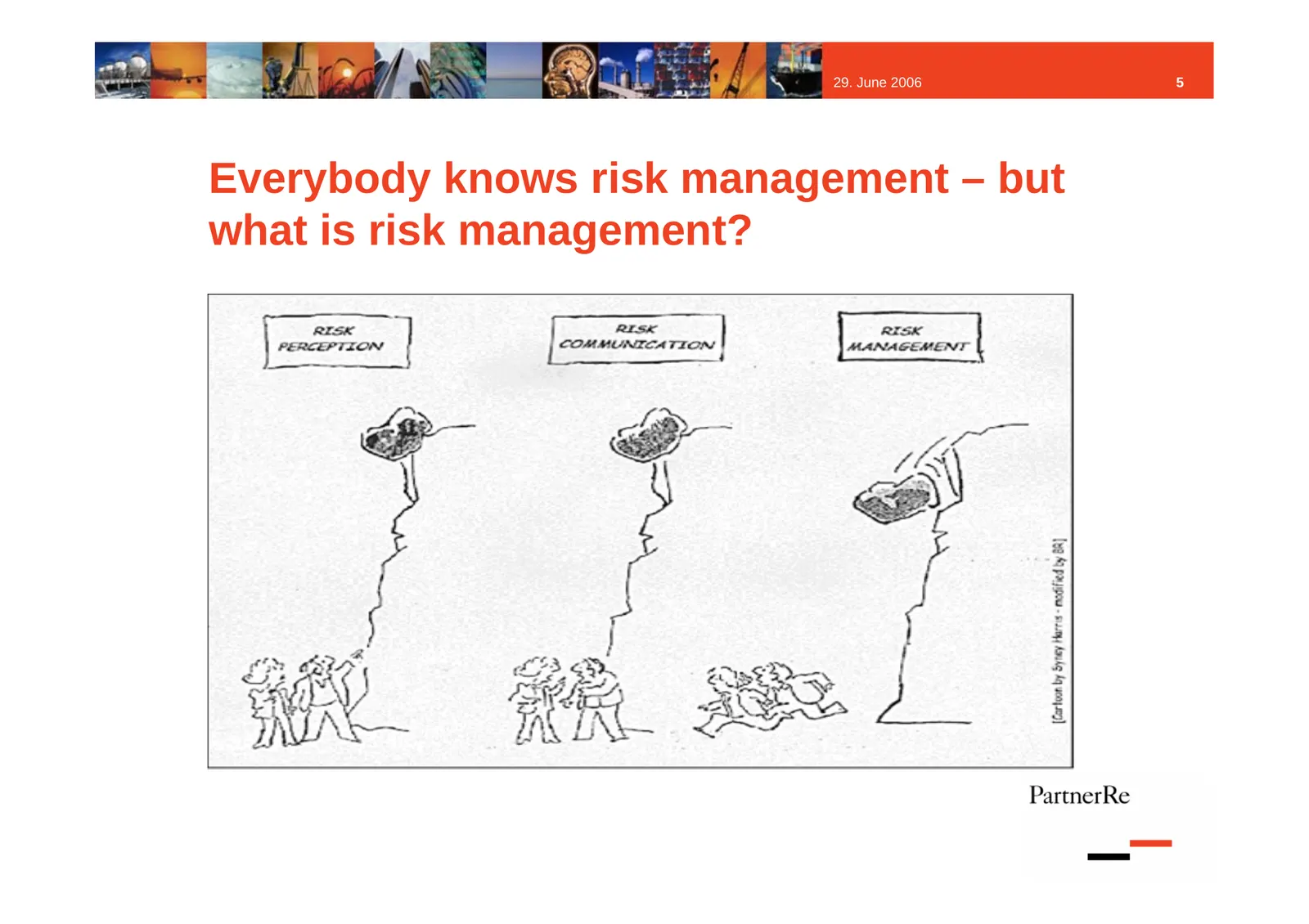
Slide 5: Everybody knows risk management – but what is risk management?
29. June 2006 5 Everybody knows risk management – but what is risk management?
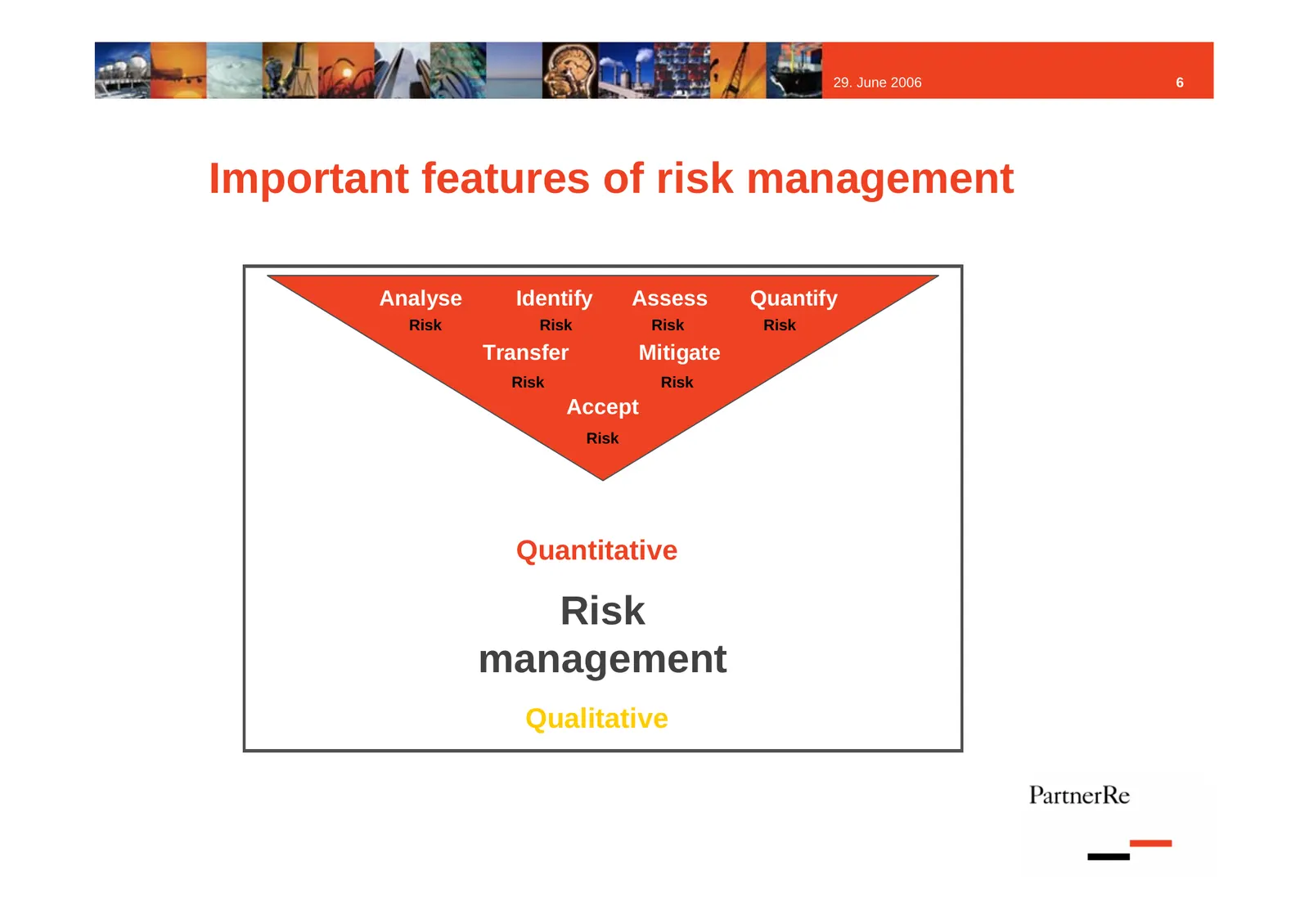
Slide 6: Important features of risk management
29. June 2006 6 Important features of risk management Analyse Identify Assess Quantify Risk Risk Risk Risk Transfer Mitigate Risk Risk Accept Risk Quantitative Risk management Qualitative
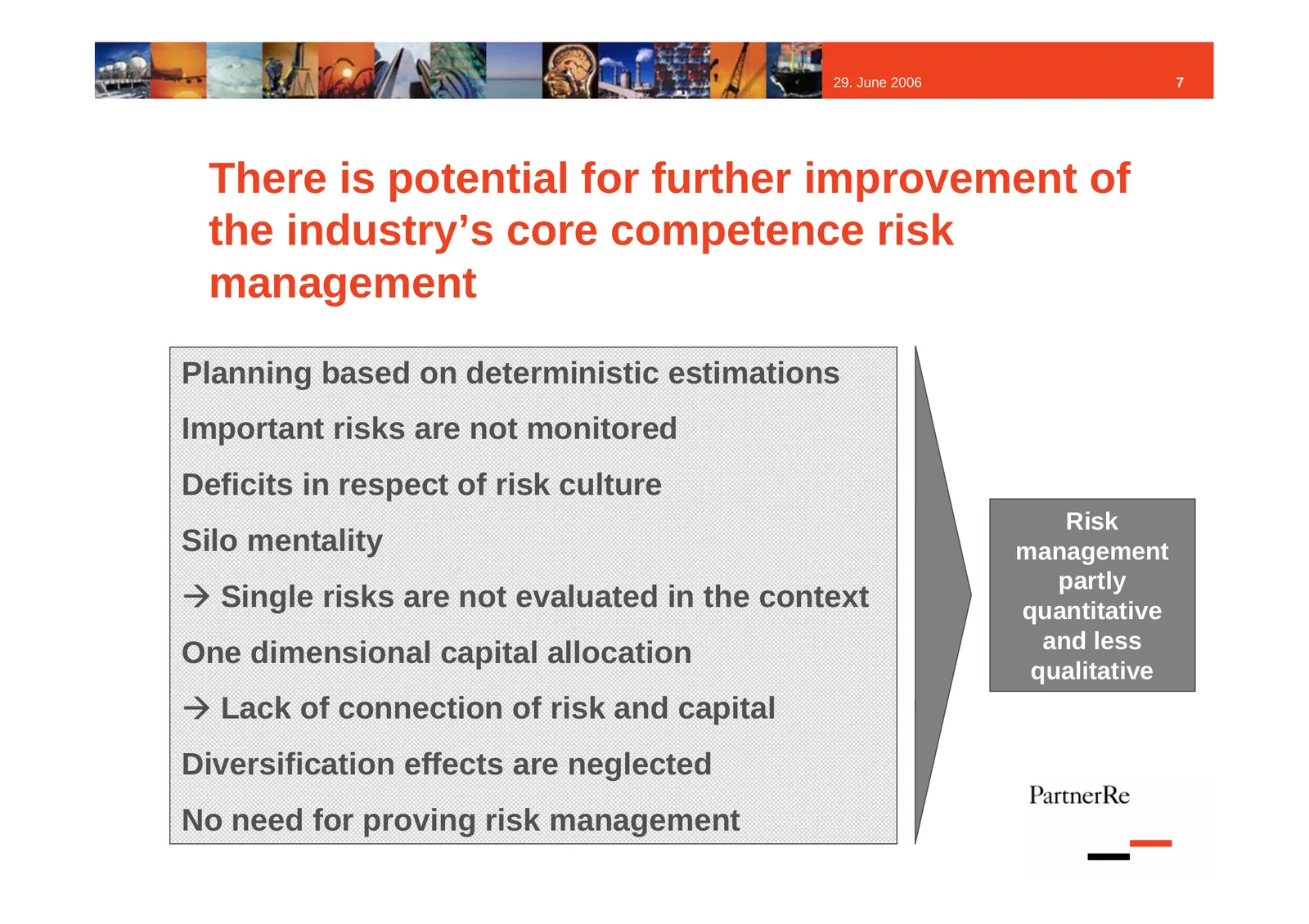
Slide 7: Potential for further improvement of the industry's risk management
29. June 2006 7 There is potential for further improvement of the industry’s core competence risk management Planning based on deterministic estimations Important risks are not monitored Deficits in respect of risk culture Risk Silo mentality management partly Æ Single risks are not evaluated in the
Slide 8: Scope of Solvency II
29. June 2006 8 Introduction Scope of Solvency II Quantitative aspects of Solvency II Qualitative aspects of Solvency II Consequences for risk management Conclusion
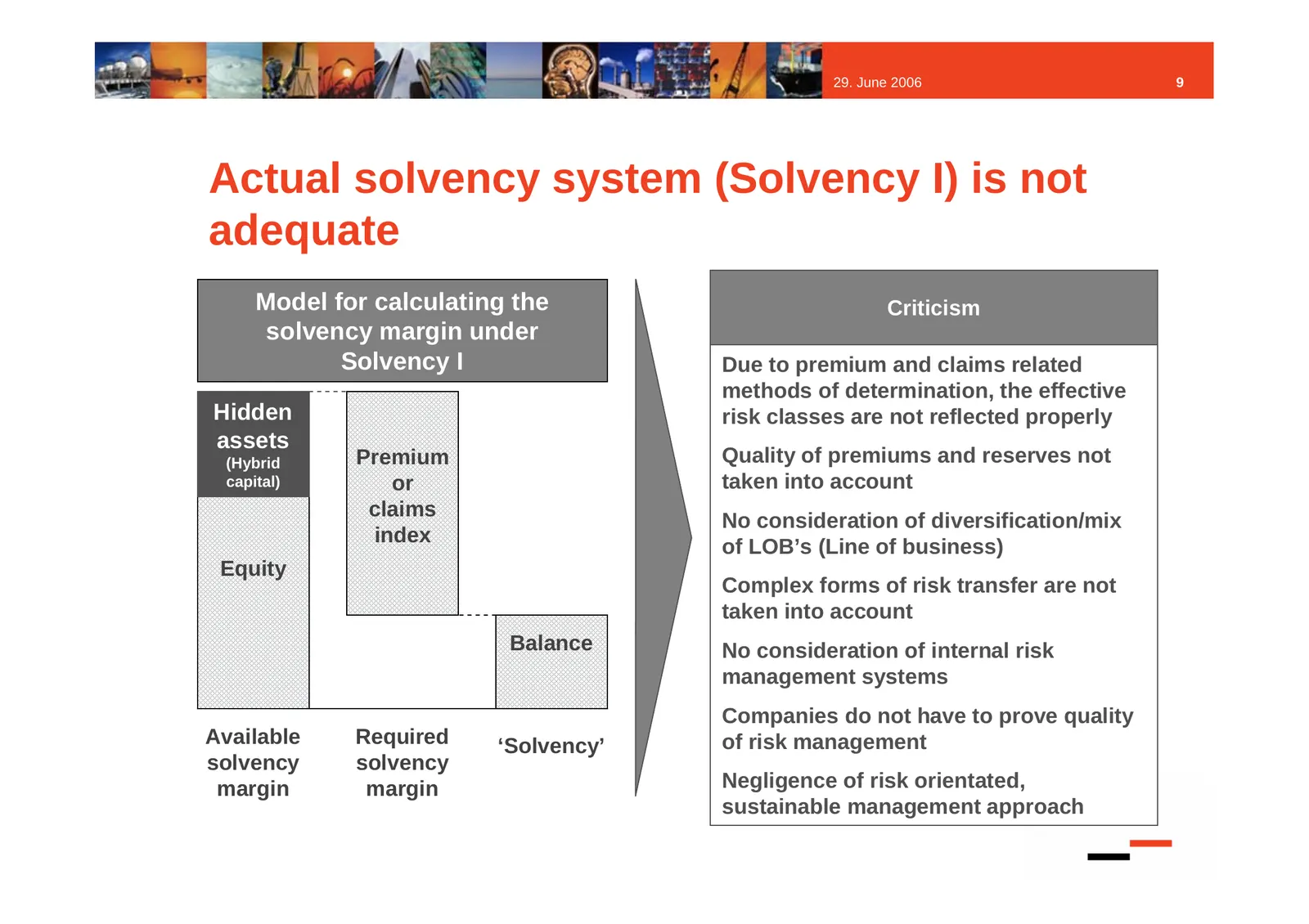
Slide 9: Actual solvency system (Solvency I) is not adequate
29. June 2006 9 Actual solvency system (Solvency I) is not adequate Model for calculating the Criticism solvency margin under Solvency I Due to premium and claims related methods of determination, the effective Hidden risk classes are not reflected properly assets (Hybrid Premium Quality of premiums
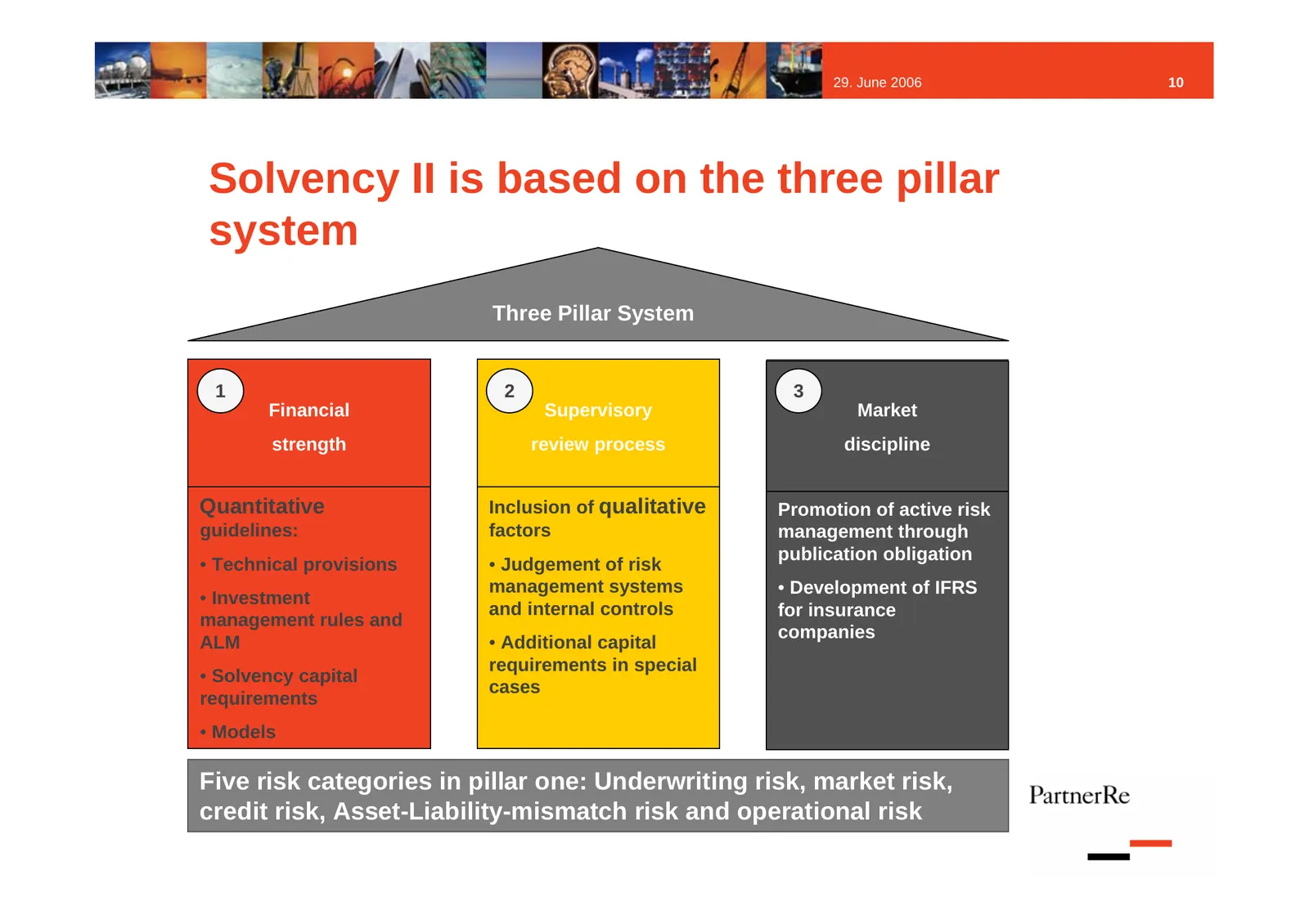
Slide 10: Solvency II is based on the three pillar system
29. June 2006 10 Solvency II is based on the three pillar system Three Pillar System 1 2 3 Financial Supervisory Market strength review process discipline Quantitative Inclusion of qualitative Promotion of active risk guidelines: factors management through publication obligation • Technical provisio
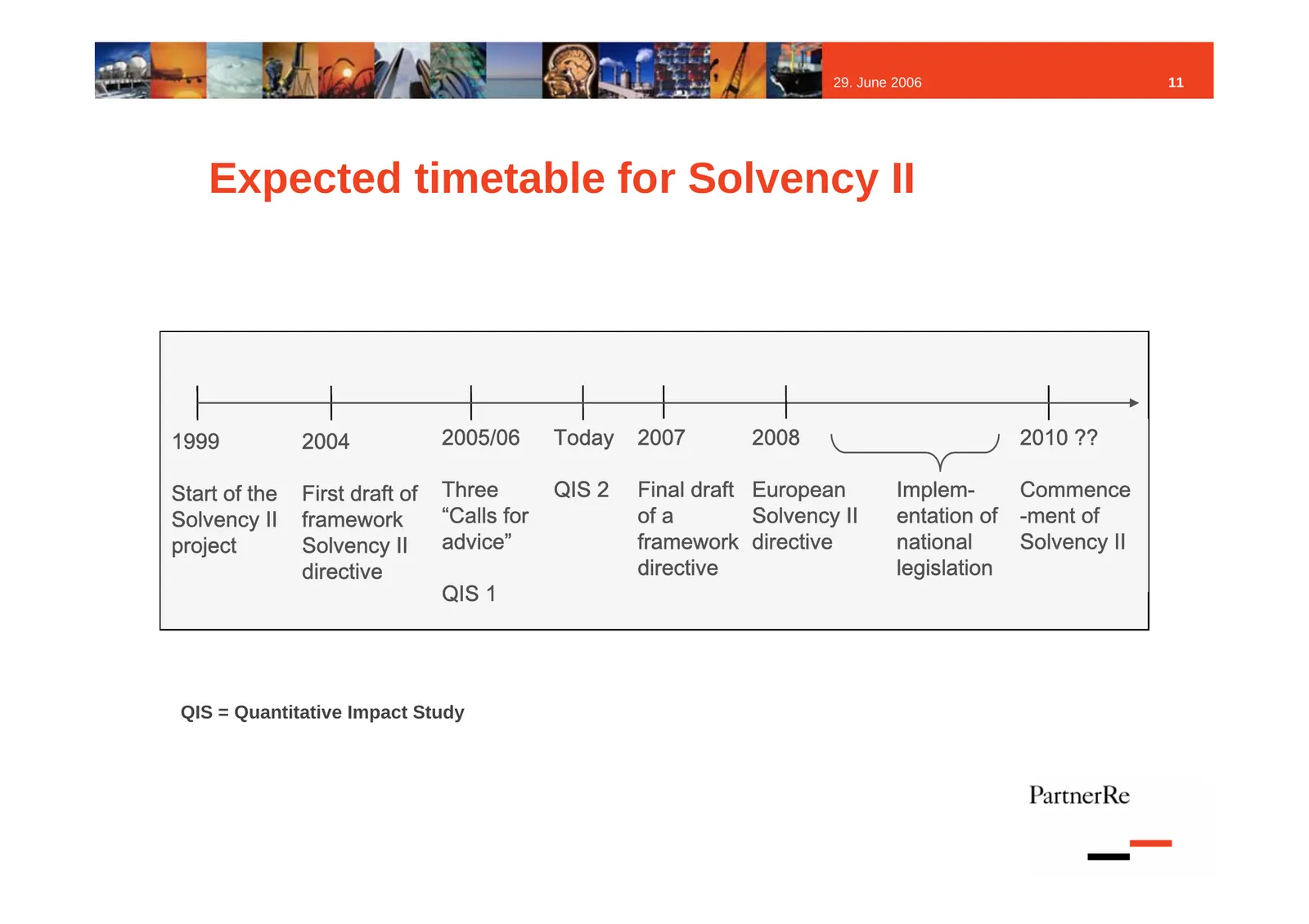
Slide 11: Expected timetable for Solvency II
29. June 2006 11 Expected timetable for Solvency II 1999 2004 2005/06 Today 2007 2008 2010 ?? Start of the First draft of Three QIS 2 Final draft European Implem- Commence Solvency II framework “Calls for of a Solvency II entation of -ment of project Solvency II advice” framework directive national
Slide 12: Quantitative aspects of Solvency II
29. June 2006 12 Introduction Scope of Solvency II Quantitative aspects of Solvency II Qualitative aspects of Solvency II Consequences for risk management Conclusion
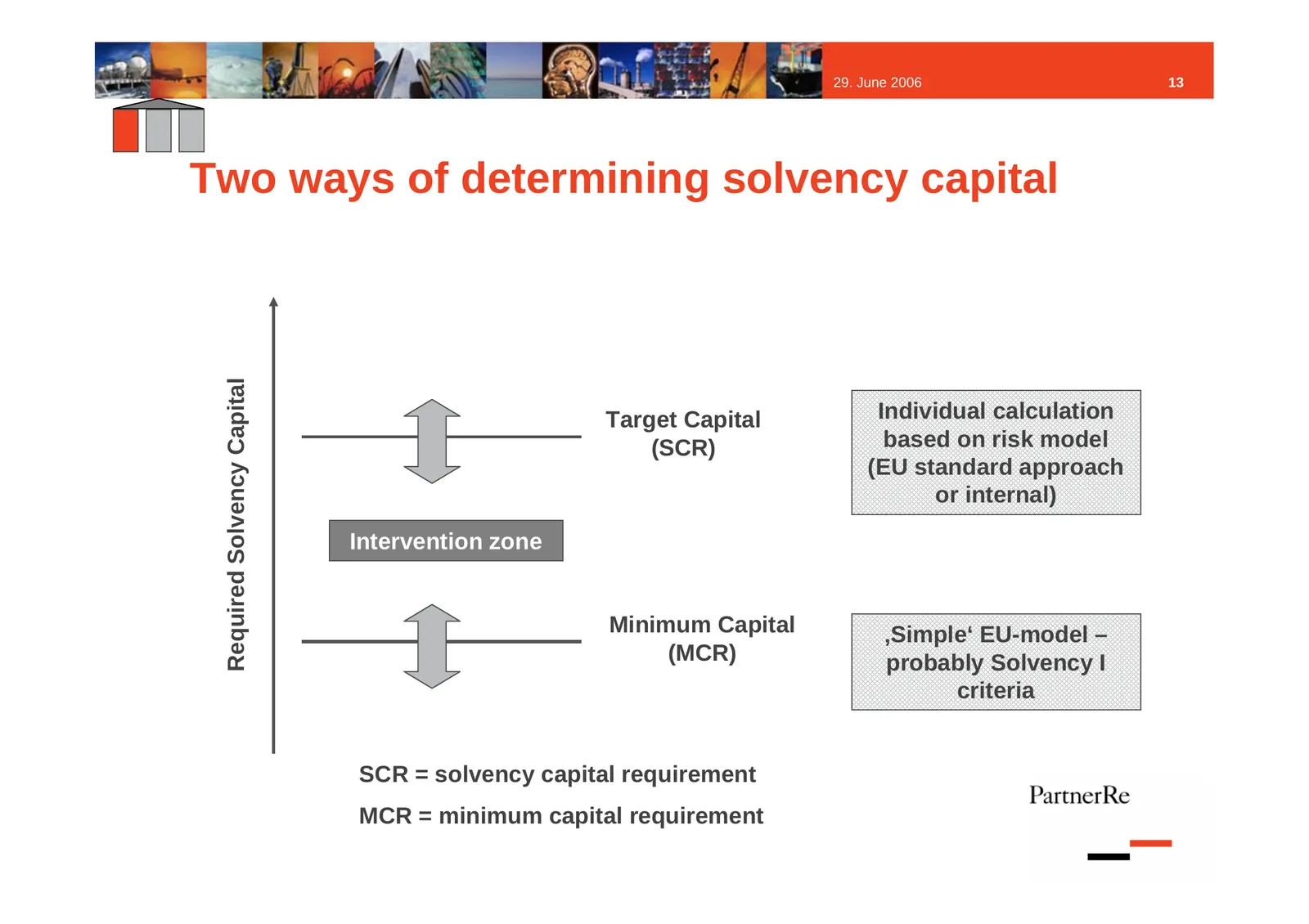
Slide 13: Required Solvency Capital
29. June 2006 13 Two ways of determining solvency capital Required Solvency Capital Target Capital Individual calculation (SCR) based on risk model (EU standard approach or internal) Intervention zone Minimum Capital ‚Simple‘ EU-model – (MCR) probably Solvency I criteria SCR = solvency capital requi
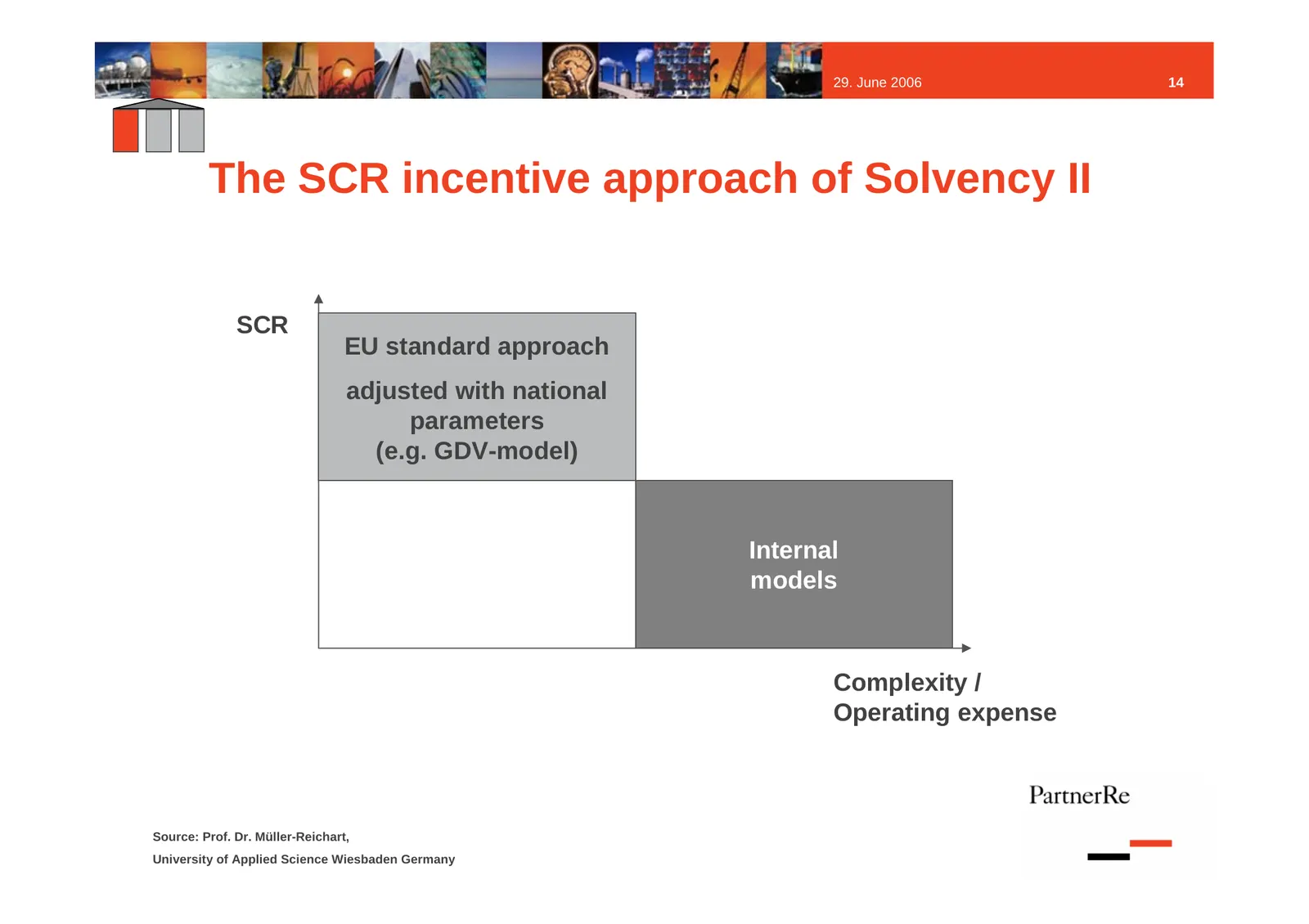
Slide 14: The SCR incentive approach
29. June 2006 14 The SCR incentive approach of Solvency II SCR EU standard approach adjusted with national parameters (e.g. GDV-model) Internal models Complexity / Operating expense Source: Prof. Dr. Müller-Reichart, University of Applied Science Wiesbaden Germany
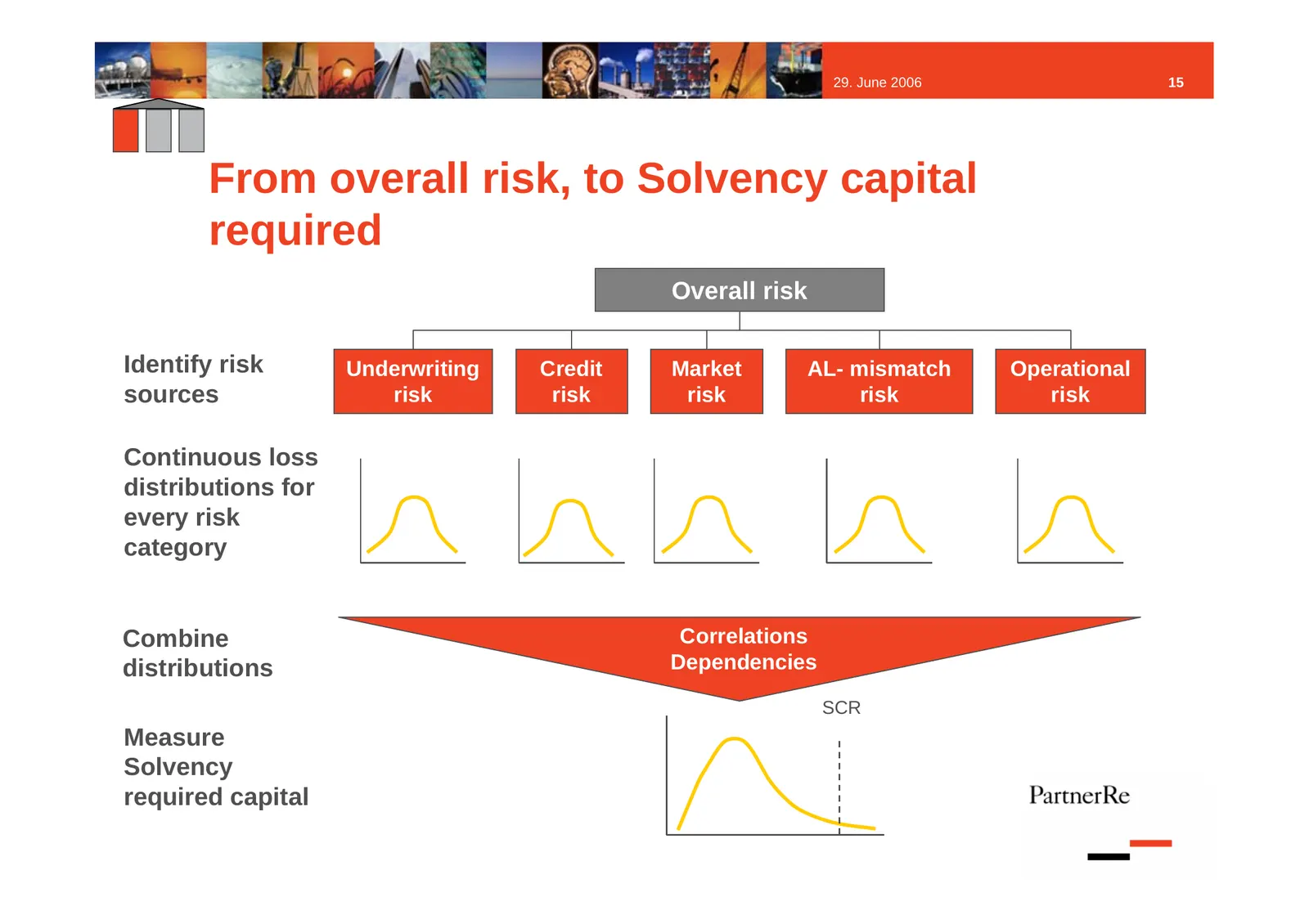
Slide 15: From overall risk to Solvency capital required
29. June 2006 15 From overall risk, to Solvency capital required Overall risk Identify risk Underwriting Credit Market AL- mismatch Operational sources risk risk risk risk risk Continuous loss distributions for every risk category Combine Correlations distributions Dependencies SCR Measure Solvency
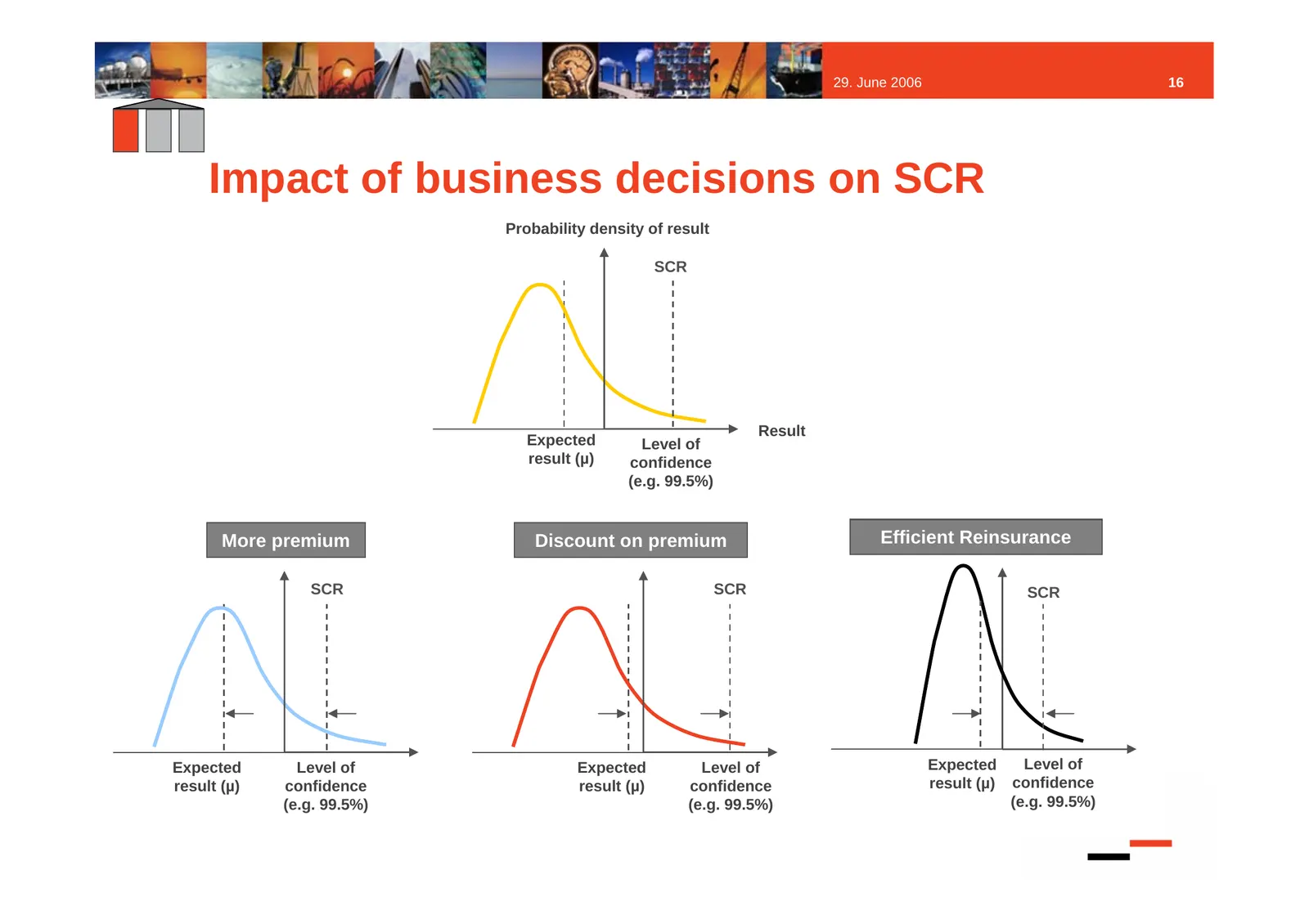
Slide 16: Impact of business decisions on SCR
29. June 2006 16 Impact of business decisions on SCR Probability density of result SCR Result Expected Level of result (µ) confidence (e.g. 99.5%) More premium Discount on premium Efficient Reinsurance SCR SCR SCR Expected Level of Expected Level of Expected Level of result (µ) confidence result (µ)
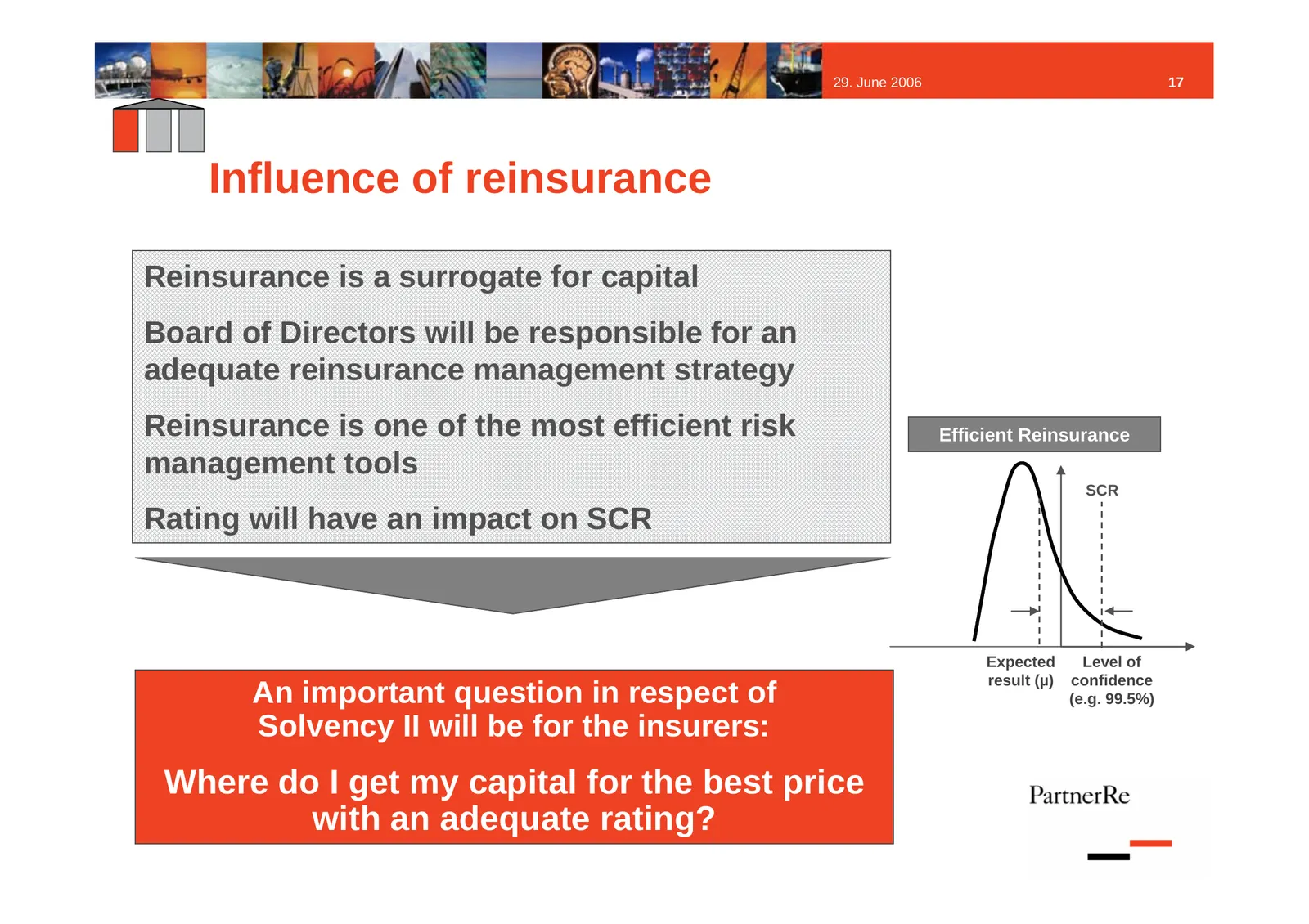
Slide 17: Influence of reinsurance
29. June 2006 17 Influence of reinsurance Reinsurance is a surrogate for capital Board of Directors will be responsible for an adequate reinsurance management strategy Reinsurance is one of the most efficient risk Efficient Reinsurance management tools SCR Rating will have an impact on SCR Expected
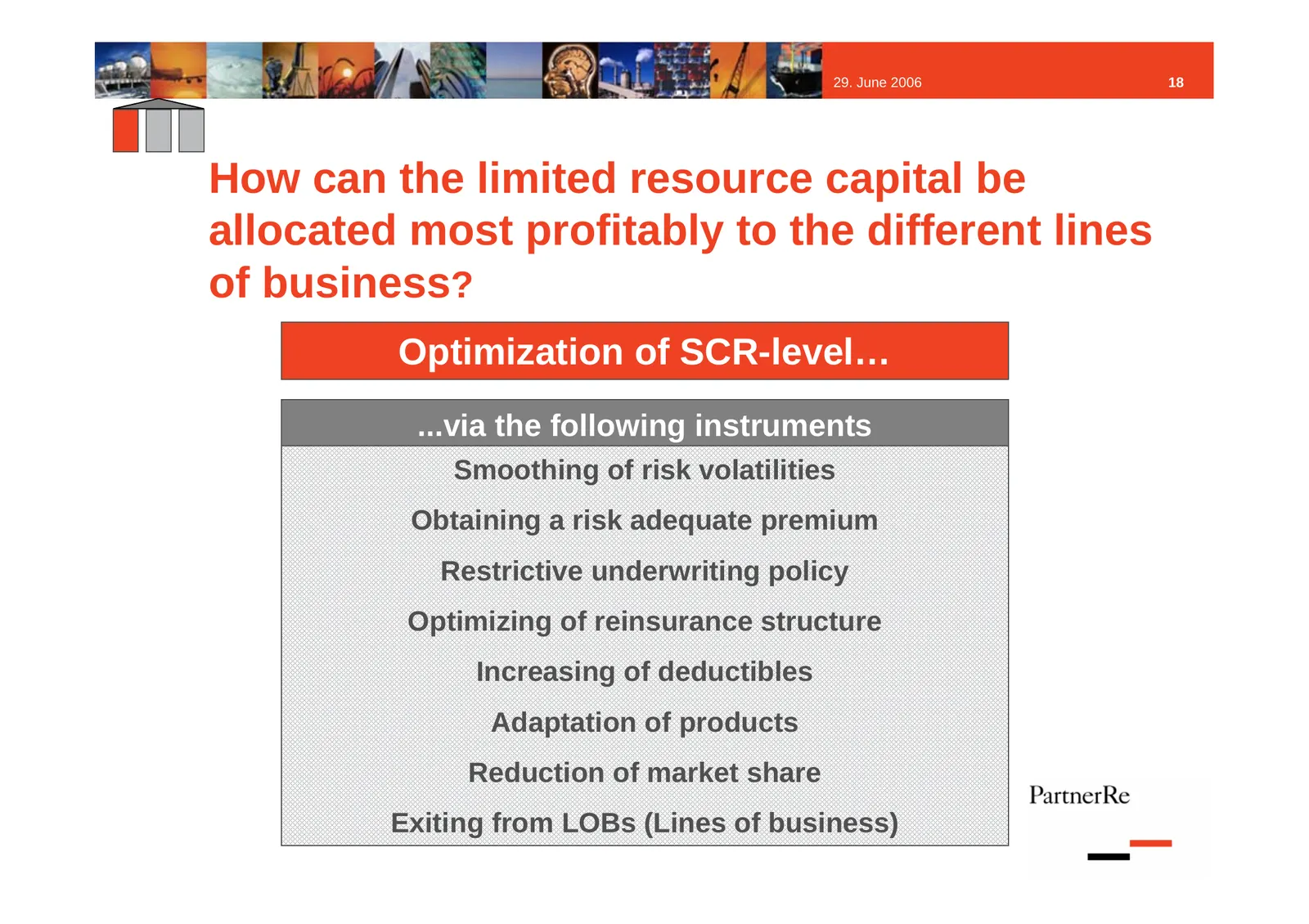
Slide 18: Allocating limited capital most profitably to lines of business
29. June 2006 18 How can the limited resource capital be allocated most profitably to the different lines of business? Optimization of SCR-level… ...via the following instruments Smoothing of risk volatilities Obtaining a risk adequate premium Restrictive underwriting policy Optimizing of reinsuranc
Slide 19: Qualitative aspects of Solvency II
29. June 2006 19 Introduction Scope of Solvency II Quantitative aspects of Solvency II Qualitative aspects of Solvency II Consequences for risk management Conclusion
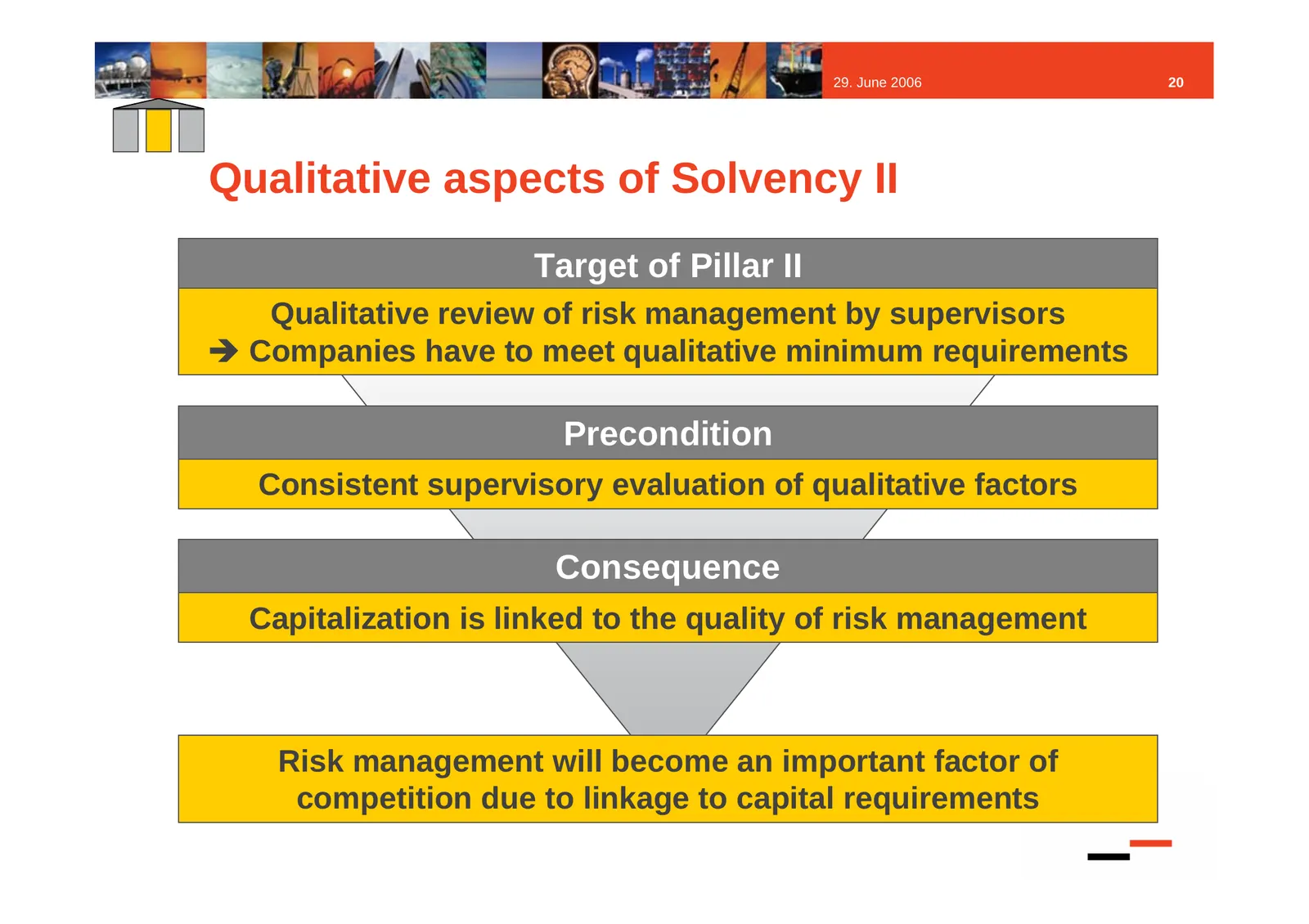
Slide 20: Qualitative aspects
29. June 2006 20 Qualitative aspects of Solvency II Target of Pillar II Qualitative review of risk management by supervisors Î Companies have to meet qualitative minimum requirements Precondition Consistent supervisory evaluation of qualitative factors Consequence Capitalization is linked to the qua
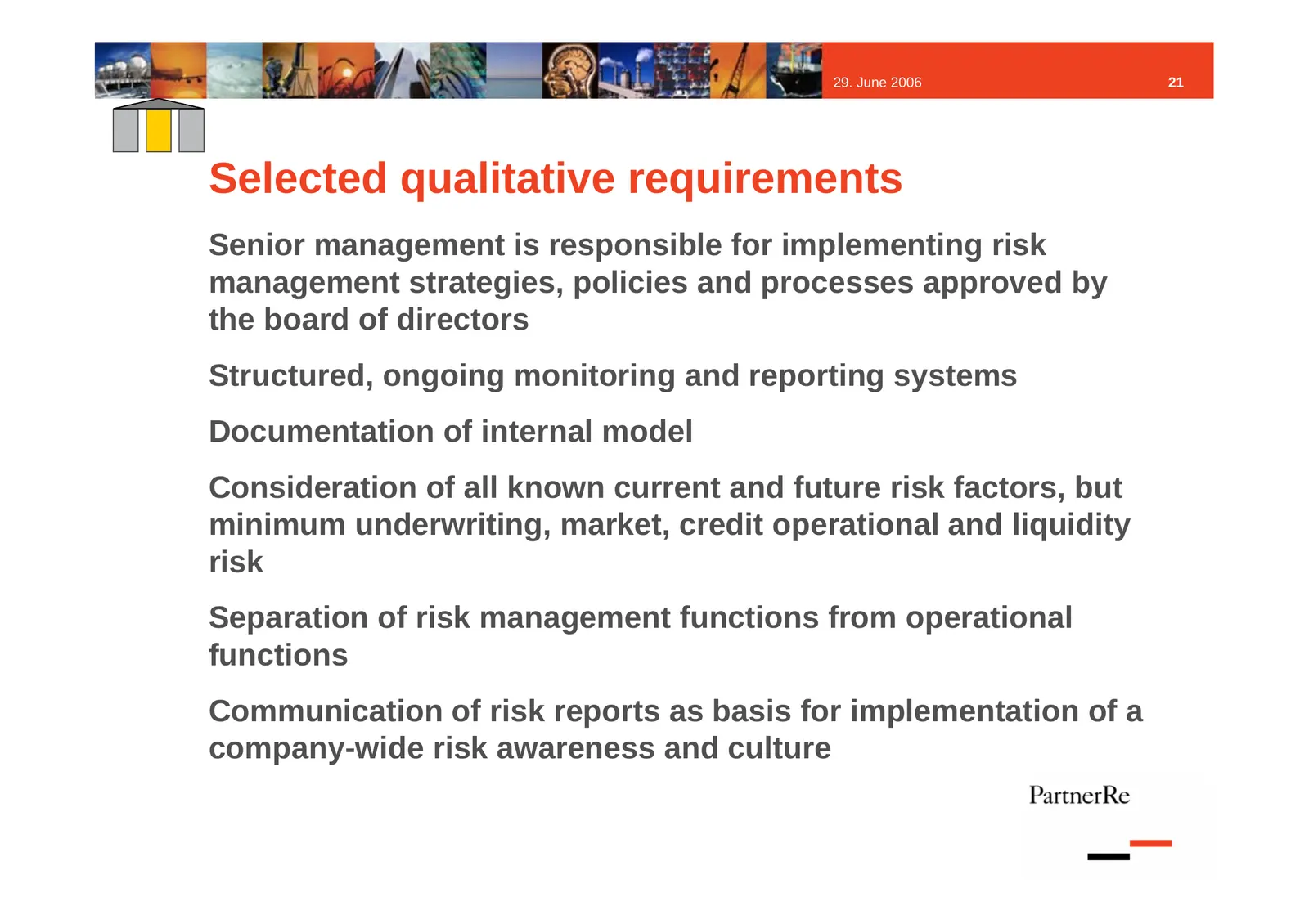
Slide 21: Selected qualitative requirements
29. June 2006 21 Selected qualitative requirements Senior management is responsible for implementing risk management strategies, policies and processes approved by the board of directors Structured, ongoing monitoring and reporting systems Documentation of internal model Consideration of all known c
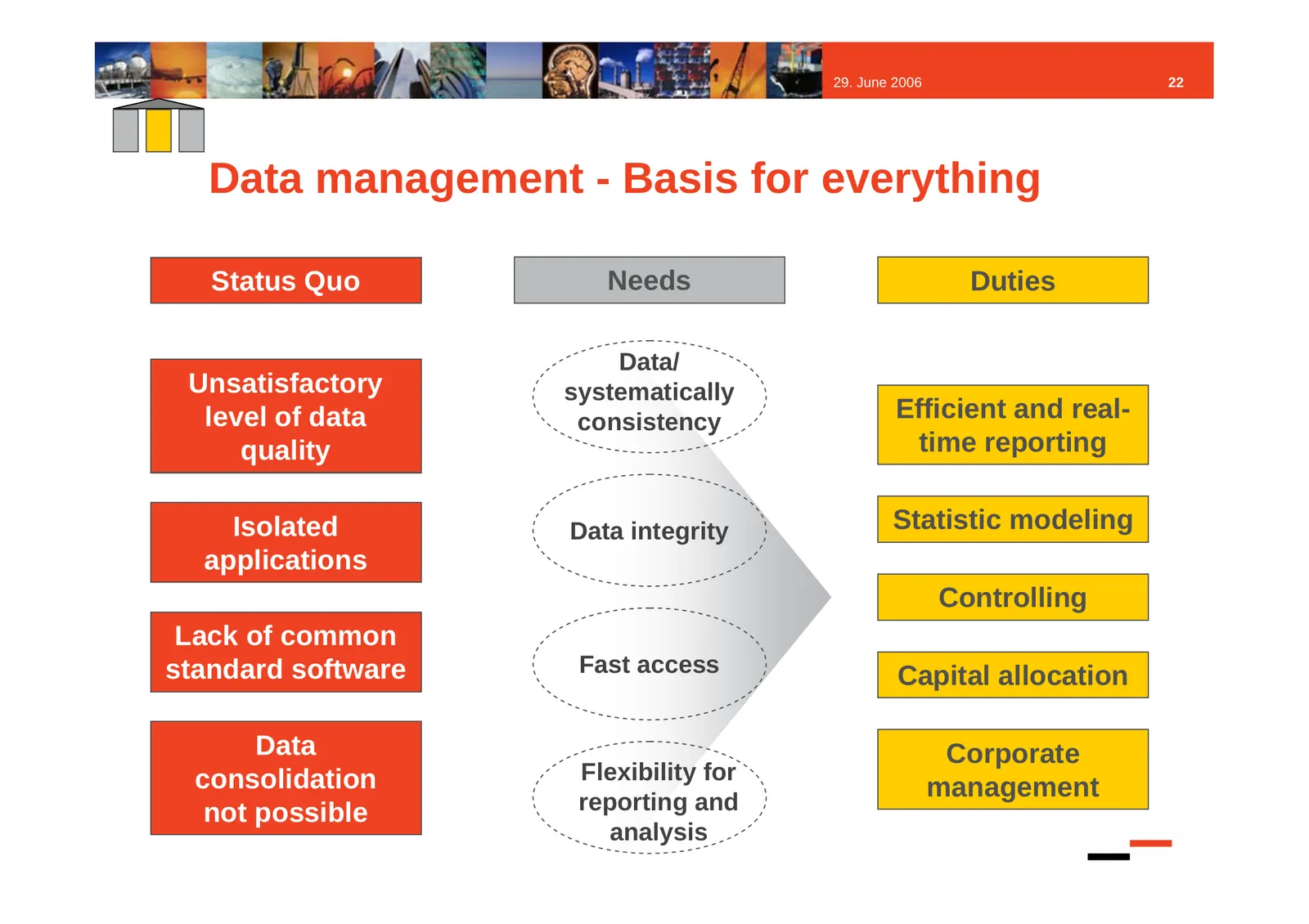
Slide 22: Data management - Basis for everything
29. June 2006 22 Data management - Basis for everything Status Quo Needs Duties Data/ Unsatisfactory systematically level of data consistency Efficient and real- quality time reporting Isolated Data integrity Statistic modeling applications Controlling Lack of common standard software Fast access Ca
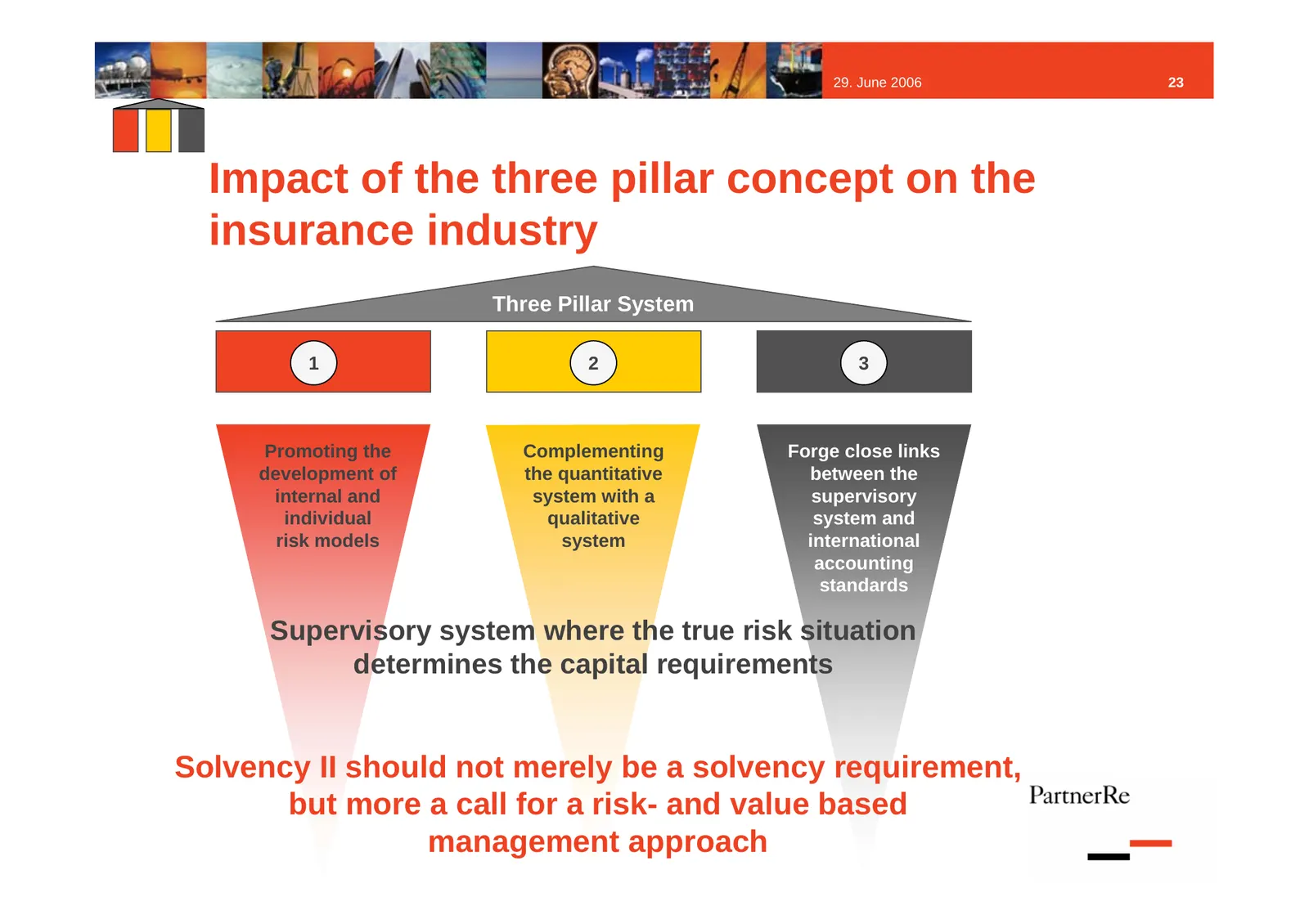
Slide 23: Impact of the three pillar concept on the insurance industry
29. June 2006 23 Impact of the three pillar concept on the insurance industry Three Pillar System 1 2 3 Promoting the Complementing Forge close links development of the quantitative between the internal and system with a supervisory individual qualitative system and risk models system international
Slide 24: Consequences for risk management
29. June 2006 24 Introduction Scope of Solvency II Quantitative aspects of Solvency II Qualitative aspects of Solvency II Consequences for risk management Conclusion
Slide 25: Scope of risk management in respect of Solvency II
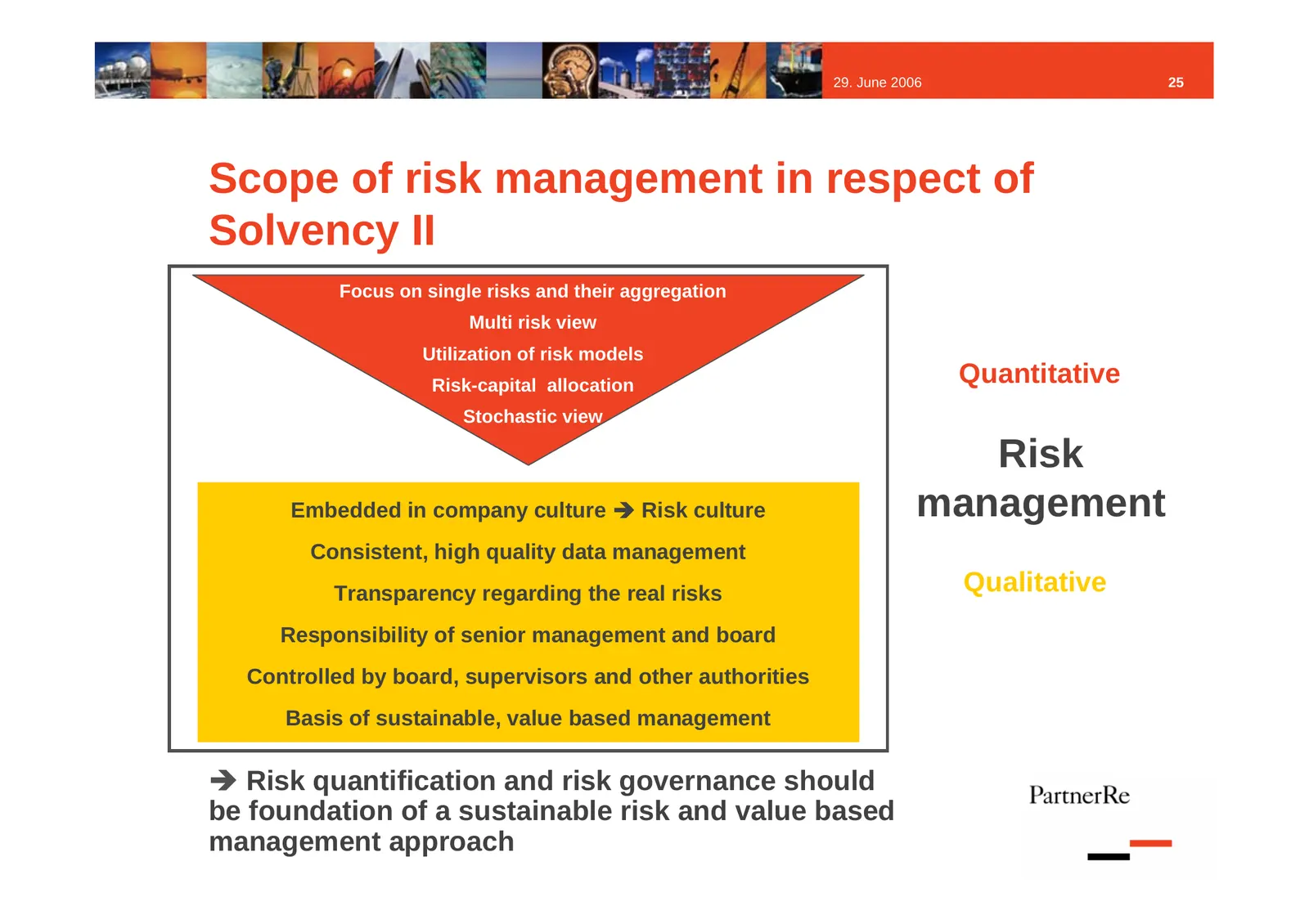
29. June 2006 25 Scope of risk management in respect of Solvency II Focus on single risks and their aggregation Multi risk view Utilization of risk models Risk-capital allocation Quantitative Stochastic view Risk Embedded in company culture Î Risk culture management Consistent, high quality data man
Slide 26: General aspects of the impact of Solvency II
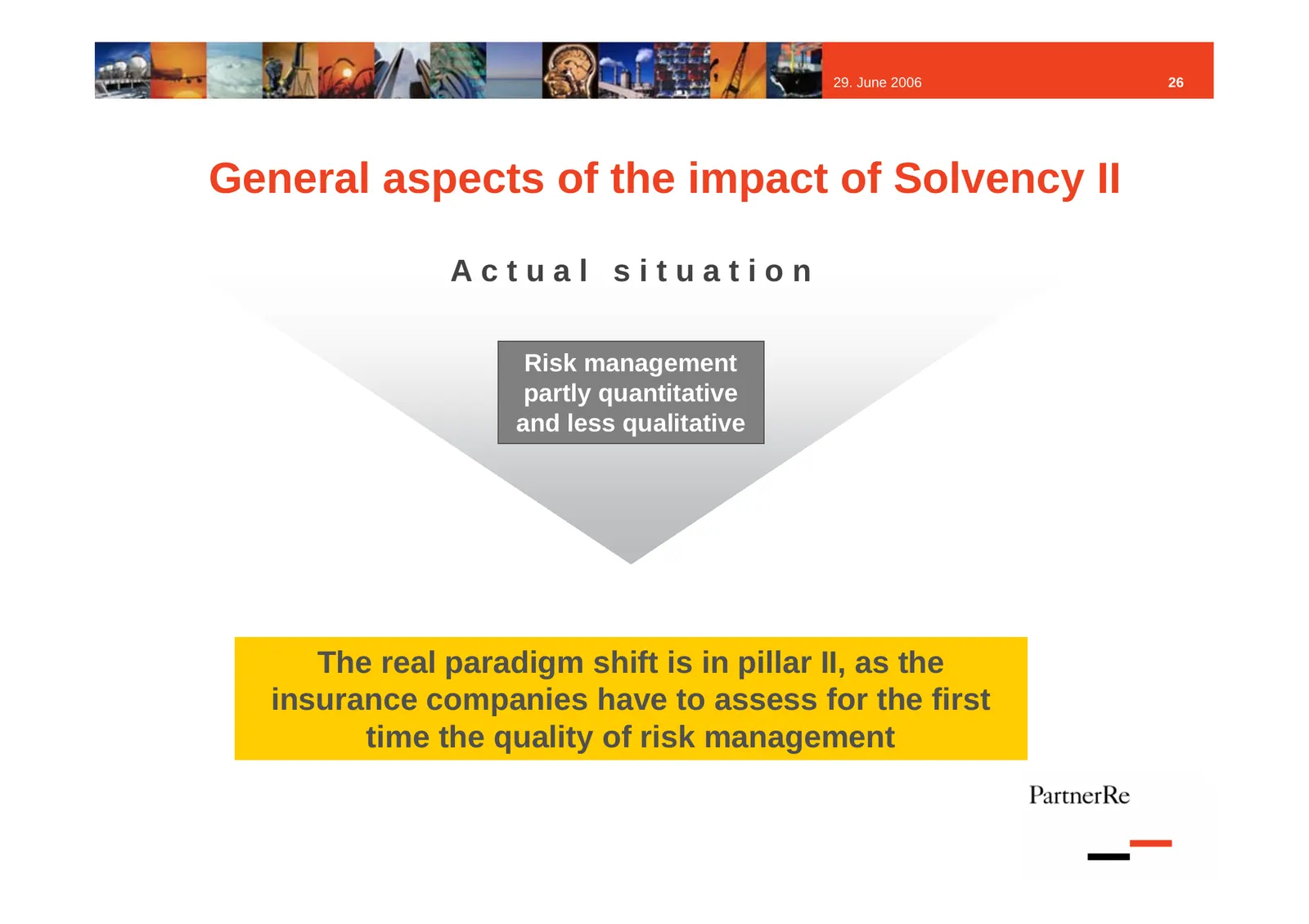
29. June 2006 26 General aspects of the impact of Solvency II Actual situation Risk management partly quantitative and less qualitative The real paradigm shift is in pillar II, as the insurance companies have to assess for the first time the quality of risk management
Slide 27: Possible adverse development while implementing risk management culture
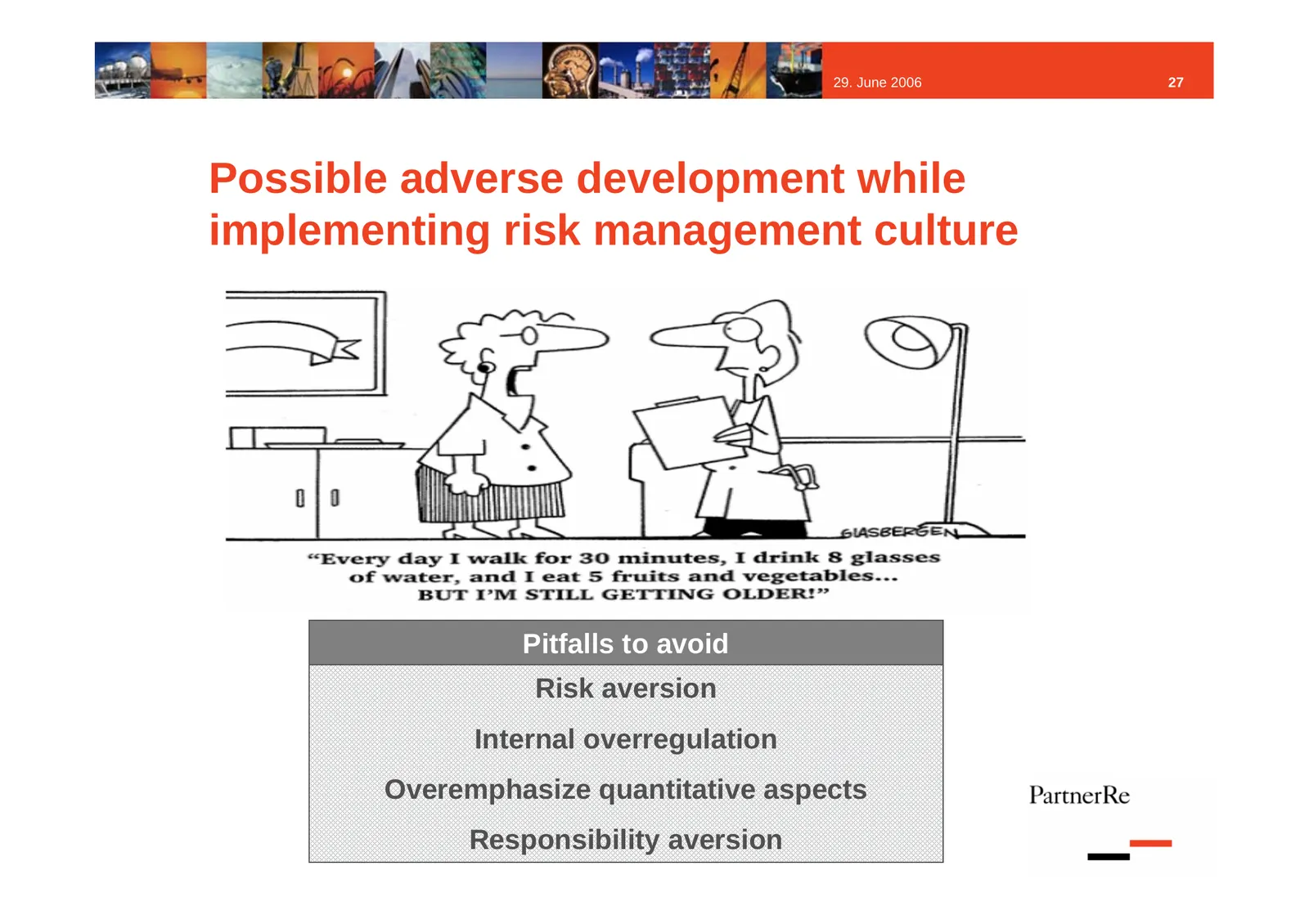
29. June 2006 27 Possible adverse development while implementing risk management culture Pitfalls to avoid Risk aversion Internal overregulation Overemphasize quantitative aspects Responsibility aversion
Slide 28: Conclusion
29. June 2006 28 Introduction Scope of Solvency II Quantitative aspects of Solvency II Qualitative aspects of Solvency II Consequences for risk management Conclusion
Slide 29: Conclusion
29. June 2006 29 Conclusion Combination of a quantitative- and qualitative risk management should lead to value- and risk based management approach Creation of sustainable security- and growth effects Implementation of an open and transparent risk culture Establishing of a formal and methodical foun

Slide 30: Thank you for your attention!
29. June 2006 30 Thank you for your attention!
Slide 31: More information on Solvency II
29. June 2006 31 More information on Solvency II CEIOPS http://www.ceiops.org/ European Commission Internal Market http://ec.europa.eu/internal_market/insurance/solvency_en.htm International Actuaries Association (IAA) http://www.actuaries.org/ Groupe Consultatif Européen http://www.gcactuaries.org/
Source: Internet Archive copy of partnerre.com
More decks from PartnerRe Ltd.
 Debt Investor Presentation (June 2019)23 slides · Jun 12, 2019
 Investor Day (October 2017)26 slides · Oct 5, 2017
 Proxy Contest (July 2015)16 slides · Jul 20, 2015
 Proxy Contest (July 2015)34 slides · Jul 7, 2015
 Proxy Contest (June 2015)65 slides · Jun 22, 2015
 Proxy Contest (June 2015)47 slides · Jun 16, 2015