Geron Corporation · NASDAQ:GERN
Geron — 31st Annual J.P. Morgan Healthcare Conference (January 2013)
27 slides from Geron's conference presentation, Jan 7, 2013

Slide 1: 31st Annual J.P. Morgan Healthcare Conference
31st Annual J.P. Morgan Healthcare Conference jeron John Scarlett, M.D. President & CEO

Slide 2: Forward-looking statements
geron forward-looking statements xcept forthe historical lnformation contained herein this presentation contain forward-looking statements made pursuant to the “safe harbor" provisions ofthe Private Securities Ligation Reform Act of 1995, Investors are cautioned that without imitation, the following
Slide 3: Geron today
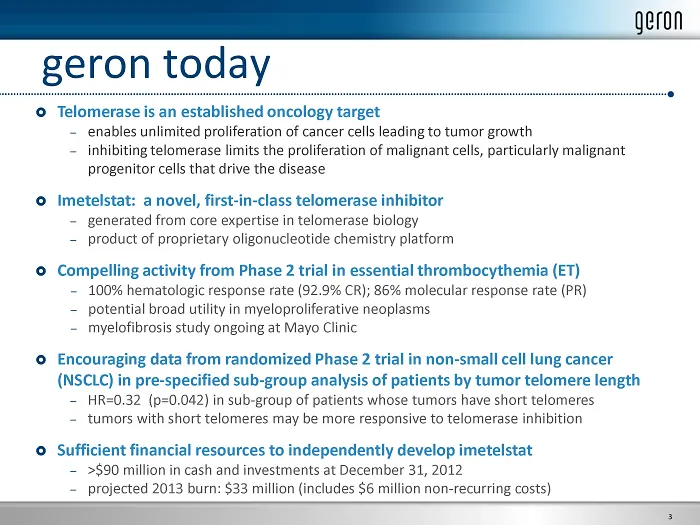
geron today © Telomerase is an established oncology target = enables unlimited proliferation of cancer cells leading to tumor growth = inhibiting telomerase limits the proliferation of malignant cells, particularly malignant progenitor cells that drive the disease © Imetelstat: a novel, first-in-cla
Slide 4: The science: telomere length regulates cell proliferative capacity
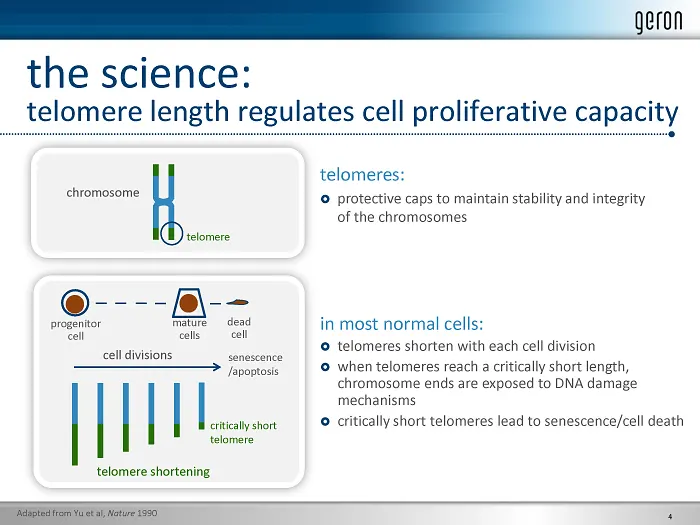
geron the science: telomere length regulates cell proliferative capacity telomeres: © protective caps to maintain stability and integrity of the chromosomes chromosome telomere. @----@-- Progen ee) ie oe in most normal cells: eclenstiars senescnce _® telomeres shorten with each cell division japonto
Slide 5: The enzyme telomerase is naturally occurring and maintains telomere length
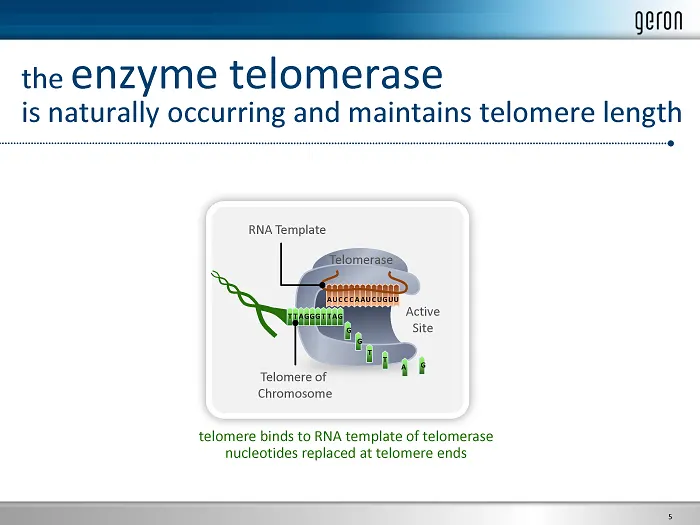
geron the enzyme telomerase is naturally occurring and maintains telomere length ° RNA Template Telomere of Chromosome. telomere binds to RNA template of telomerase nucleotides replaced at telomere ends
Slide 6: In normal progenitor cells telomerase is transiently upregulated
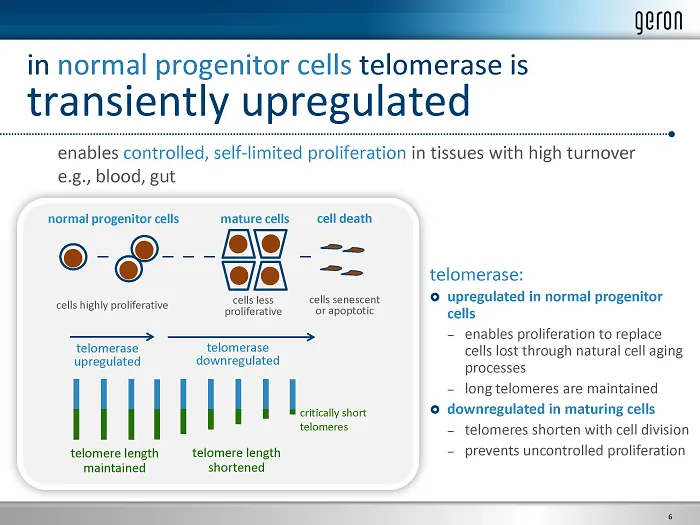
geron in normal progenitor cells telomerase is _transiently upregulated enables controlled, self-limited proliferation in tissues with high turnover e.g., blood, gut normal progenitor cells maturecells cell death _ @---@\e _-- & \ele\ -- telomerase: cells highly proiferative ales celesenescant ° upr
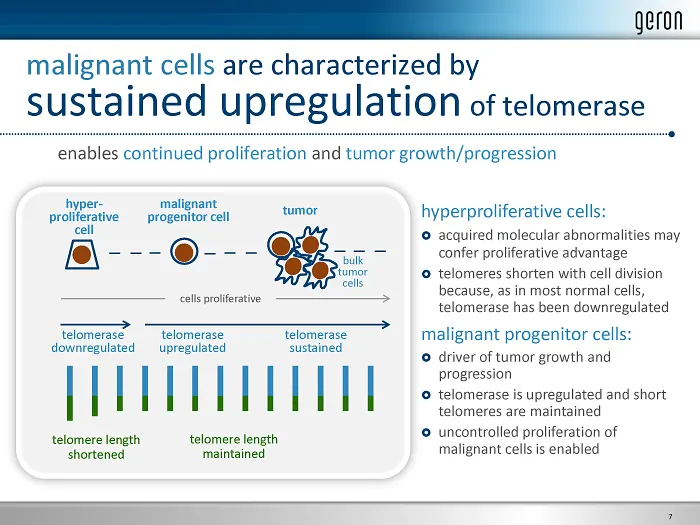
Slide 7: Malignant cells are characterized by sustained upregulation of telomerase
geron malignant cells are characterized by sustained upregulation of telomerase enables continued proliferation and tumor growth/progression ee tumor hyperproliferative cells: © acquired molecular abnormalities may fe ===(j-== sa confer proliferative advantage umor © telomeres shorten with cell divi
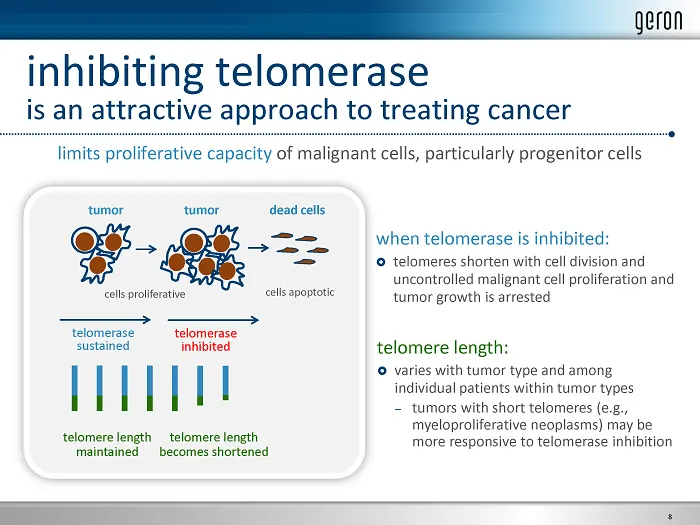
Slide 8: Inhibiting telomerase is an attractive approach to treating cancer
geron inhibiting telomerase is an attractive approach to treating cancer limits proliferative capacity of malignant cells, particularly progenitor cells ‘tumor ‘tumor dead cells = Ses, when telomerase is inhibited: = © telomeres shorten with cell division and uncontrolled malignant cell proliferatio
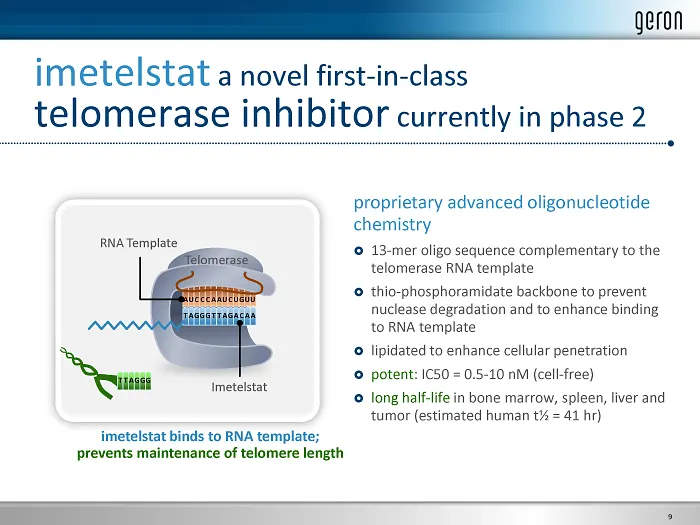
Slide 9: Imetelstat: a novel first-in-class telomerase inhibitor currently in phase 2
geron imetelstat a novel first-in-class telomerase inhibitor currently in phase 2 proprietary advanced oligonucleotide chemistry © 13-mer oligo sequence complementary to the telomerase RNA template © thio-phosphoramidate backbone to prevent nuclease degradation and to enhance binding to RNA template
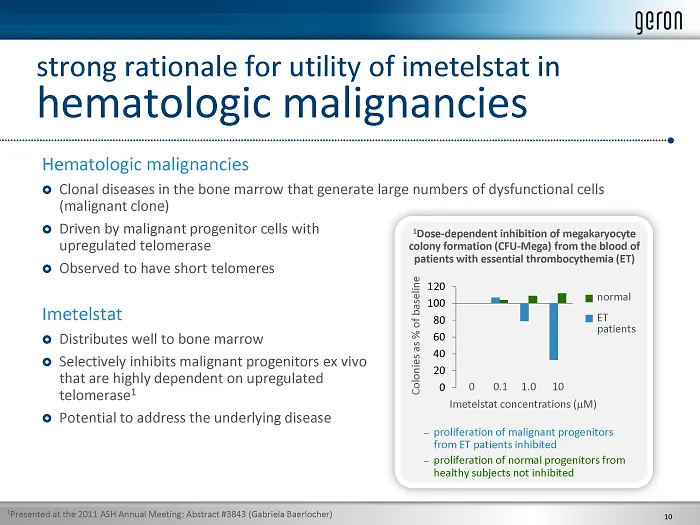
Slide 10: Strong rationale for utility of imetelstat in hematologic malignancies
strong rationale for utility of imetelstat in hematologic malignancies Hematologic malignancies © Clonal diseases in the bone marrow that generate large numbers of dysfunctional cells (malignant clone) © Driven by malignant progenitor cells with upregulated telomerase © Observed to have short telome
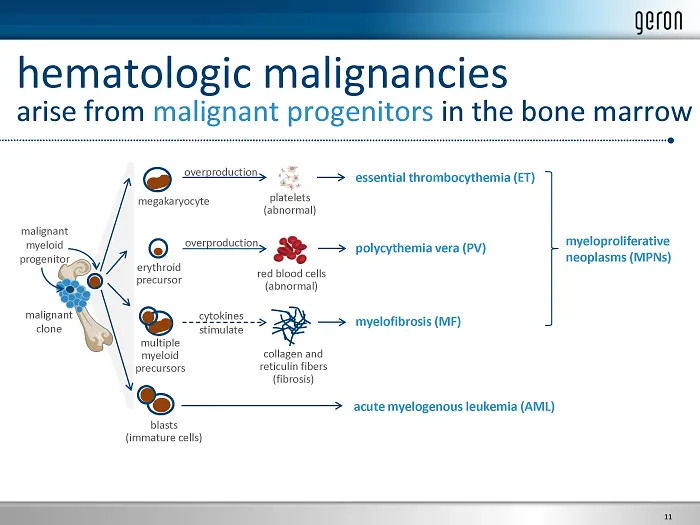
Slide 11: Hematologic malignancies arise from malignant progenitors in the bone marrow
geron hematologic malignancies arise from malignant progenitors in the bone marrow ° @ -Qverproduction,, & —> essential thrombocythemia (ET) megokaryocyte aos, malignant neni myeloid @ sanctsina, SB idohvorticinta eta V) myloproliertve wreeentee V1 ois ou neoplasms (MPNs) rN precursor ‘atnormah maln
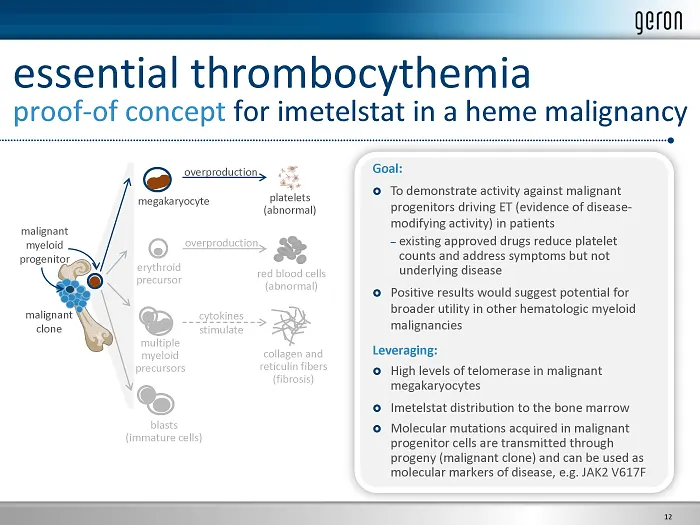
Slide 12: Essential thrombocythemia: proof-of-concept for imetelstat in a heme malignancy
geron essential thrombocythemia proof-of concept for imetelstat in a heme malignancy @ wae & Goal: ed (© Todemonstrate activity against malignant megakaryocyte platelets t g 4 (abnormal) progenitors driving ET (evidence of disease- realign modifying activity) in patients myeloid sting approved drugs
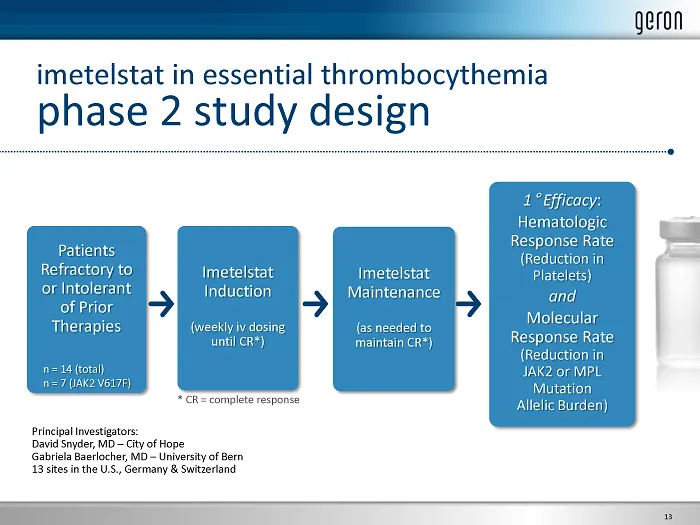
Slide 13: Imetelstat in essential thrombocythemia phase 2 study design
a eon imetelstat in essential thrombocythemia phase 2 study design 1° Efficac Hematologic ; Response Rate Patients (Reduction in Refractory to Imetelstat Imetelstat Platelets) or Ingsiaen Induction Maintenance and. of Prior Therapies (week (as needed to Sitolssllsr maintain CR) Response Hise (Reduct
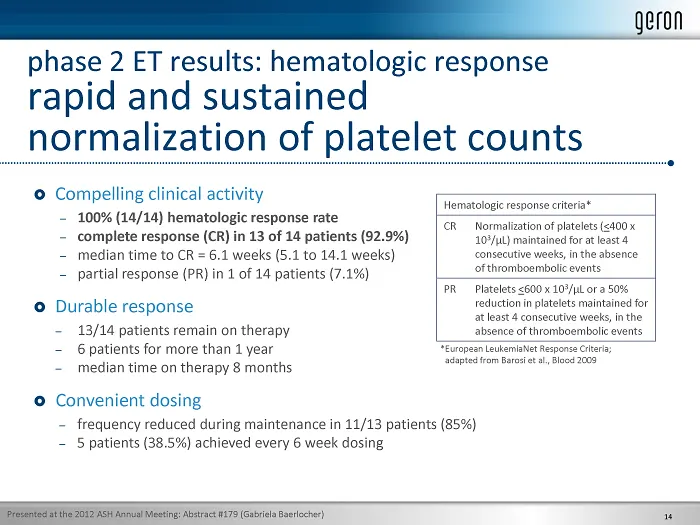
Slide 14: Phase 2 ET results: hematologic response
geron phase 2 ET results: hematologic response rapid and sustained © Compelling clinical activity v Hematologic response eiteriat ~ 100% (14/14) hematologic response rate CR _ Normalization of platelets (400 = complete response (CR) in 13 of 14 patients (92.9%) 20"fl} maneaned frat ost 4 = median ti
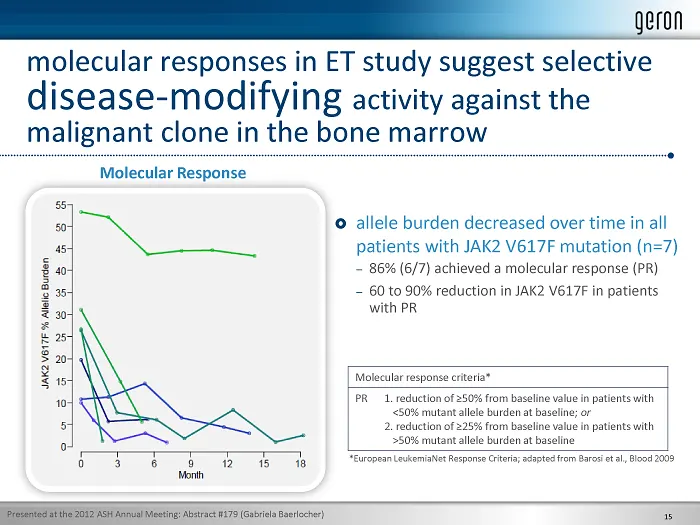
Slide 15: Molecular responses in ET study suggest selective disease-modifying activity
geron molecular responses in ET study suggest selective disease-modifying activity against the malignant clone in the bone marrow Molecular Response ss 60° © allele burden decreased over time in all patients with JAK2 V617F mutation (n=7) = 86% (6/7) achieved a molecular response (PR) = 60 to 90% re
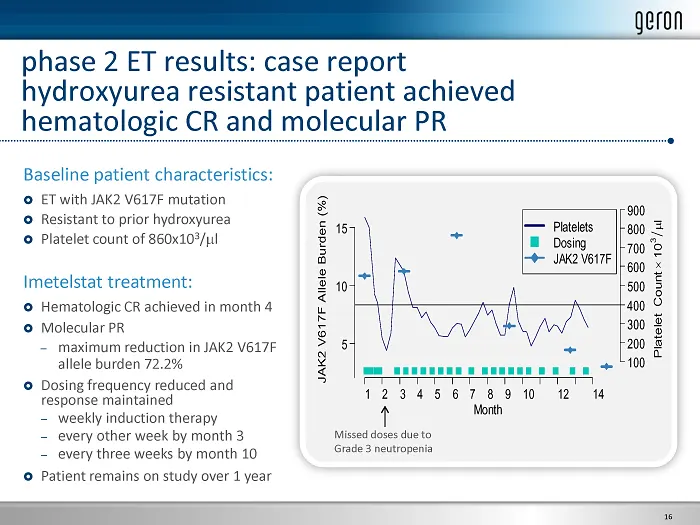
Slide 16: Phase 2 ET results: case report
geron phase 2 ET results: case report hydroxyurea resistant patient achieved hematologic CR and molecular PR Baseline patient characteristics: © ET with JAK2 V617F mutation © Resistant to prior hydroxyurea © Platelet count of 860x102/j1! Imetelstat treatment: © Hematologic CR achieved in month 4 © M
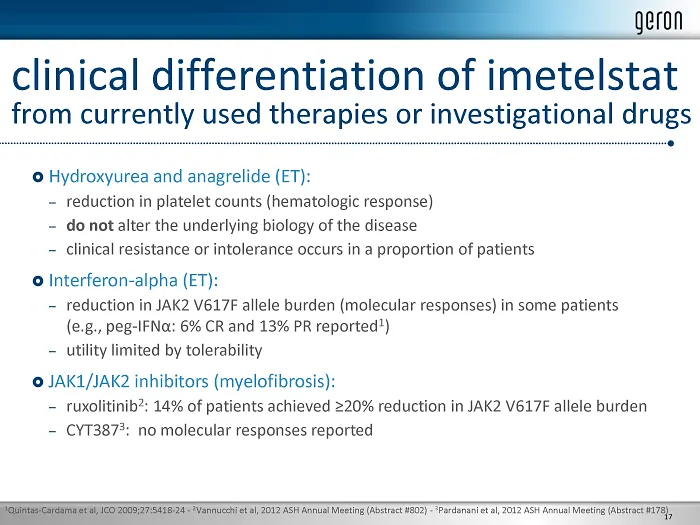
Slide 17: Clinical differentiation of imetelstat
geron clinical differentiation of imetelstat from currently used therapies or investigational drugs © Hydroxyurea and anagrelide (ET): ~ reduction in platelet counts (hematologic response) ~ do not alter the underlying biology of the disease ~ clinical resistance or intolerance occurs in a proportio
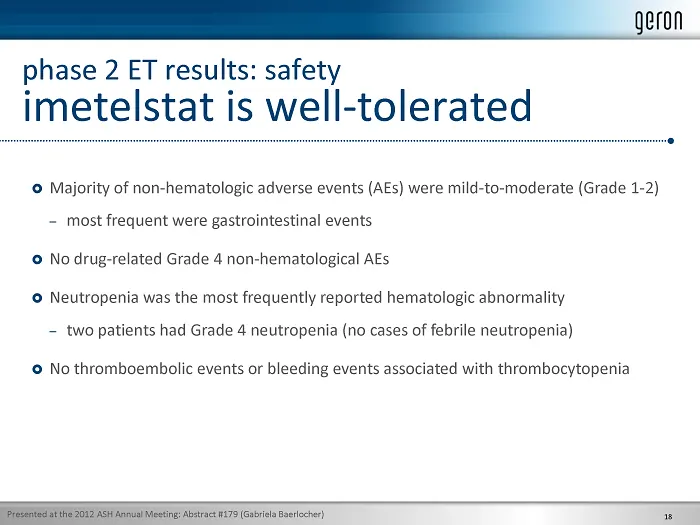
Slide 18: Phase 2 ET results: safety
geron phase 2 ET results: safety imetelstat is well-tolerated © Majority of non-hematologic adverse events (AEs) were mild-to-moderate (Grade 1-2) - most frequent were gastrointestinal events © No drug-related Grade 4 non-hematological AEs ‘© Neutropenia was the most frequently reported hematologic
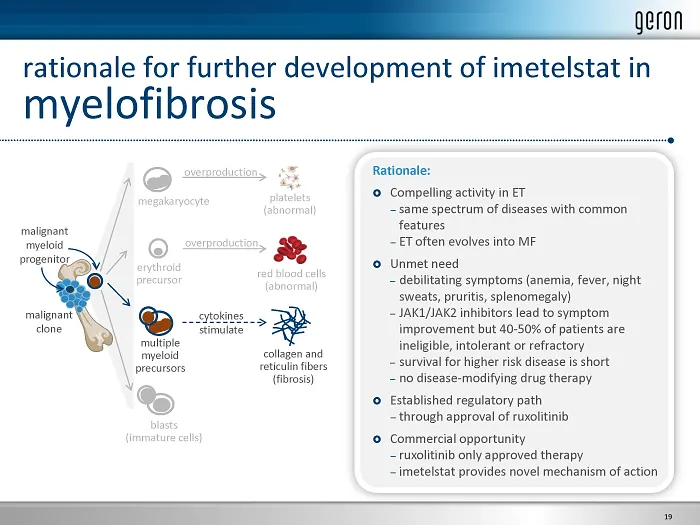
Slide 19: Rationale for further development of imetelstat in myelofibrosis
geron rationale for further development of imetelstat in myelofibrosis Rationale: atete ‘© Compelling activity in ET normal = same spectrum of diseases with common features verproduction,, x ~Toften evolves into MF © Unmet need = debilitating symptoms (anemia, fever, night sweats, pruritis, splenome
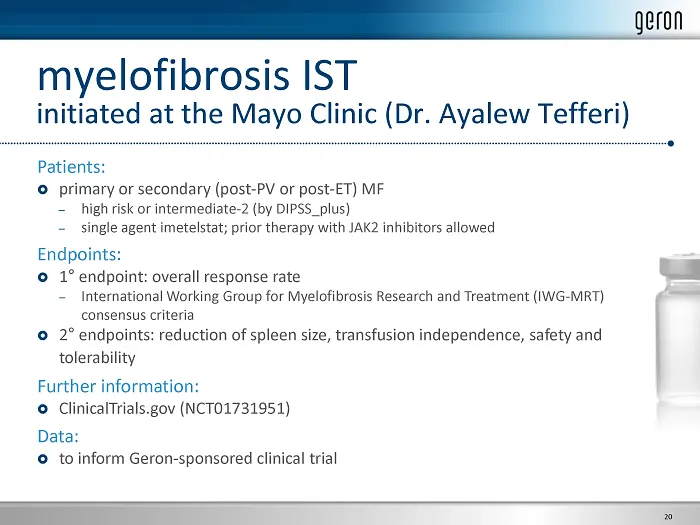
Slide 20: Myelofibrosis IST initiated at the Mayo Clinic
geron myelofibrosis IST initiated at the Mayo Clinic (Dr. Ayalew Tefferi) ° Patients: © primary or secondary (post-PV or post-ET) MF high risk or intermediate-2 (by DIPSS_plus) - single agent imetelstat; prior therapy with JAK2 inhibitors allowed Endpoints: © 1° endpoint: overall response rate Us =
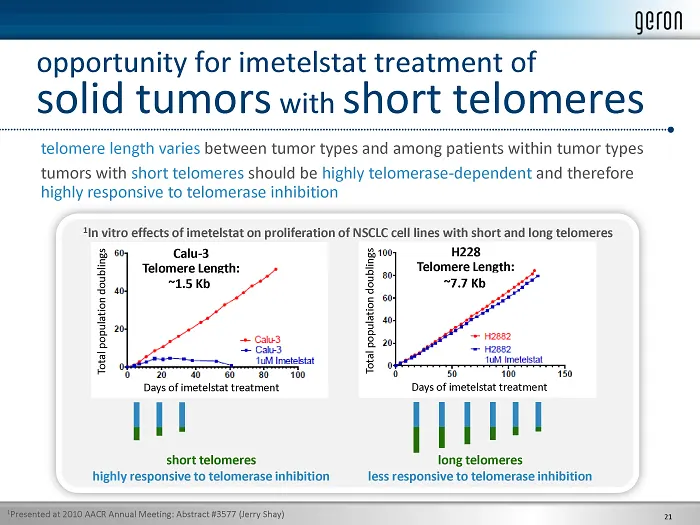
Slide 21: Opportunity for imetelstat treatment of solid tumors with short telomeres
geron opportunity for imetelstat treatment of solid tumors with short telomeres telomere length varies between tumor types and among patients within tumor types tumors with short telomeres should be highly telomerase-dependent and therefore highly responsive to telomerase inhibition 4In vitro effect
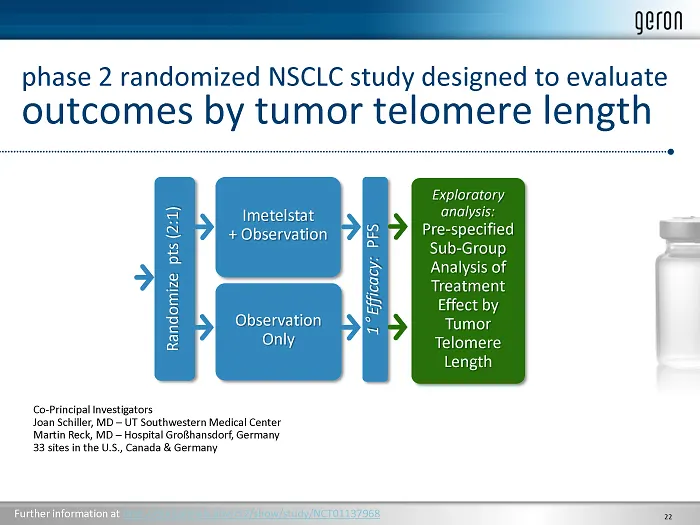
Slide 22: Phase 2 randomized NSCLC study design
iron phase 2 randomized NSCLC study designed to evaluate outcomes by tumor telomere length Explor Sub-Group Analysis of o-Principal Investigators Joan Schiller, MD ~ UT Southwestern Medical Center “Martin Reck, MD —Hospital Grofhansdorf, Germany 33 sites in the U.S,, Canada & Germany
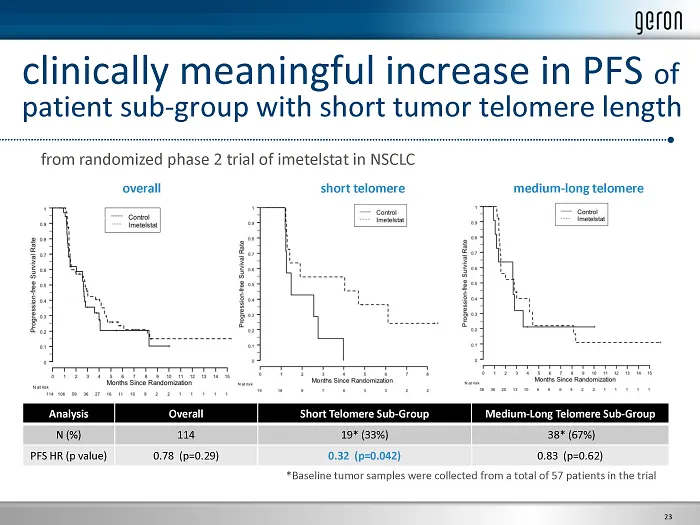
Slide 23: Clinically meaningful increase in PFS of patient sub-group with short telomere length
geron clinically meaningful increase in PFS of patient sub-group with short tumor telomere length from randomized phase 2 trial of imetelstat in NSCLC overall short telomere ‘medium-long telomere N (6) 19* (33%) 38* (67%) PFS HR (p value) 0.78 (p=0.29) 0.32 (p=0.042) 0.83 (p=0.62) ‘baseline tumor sa
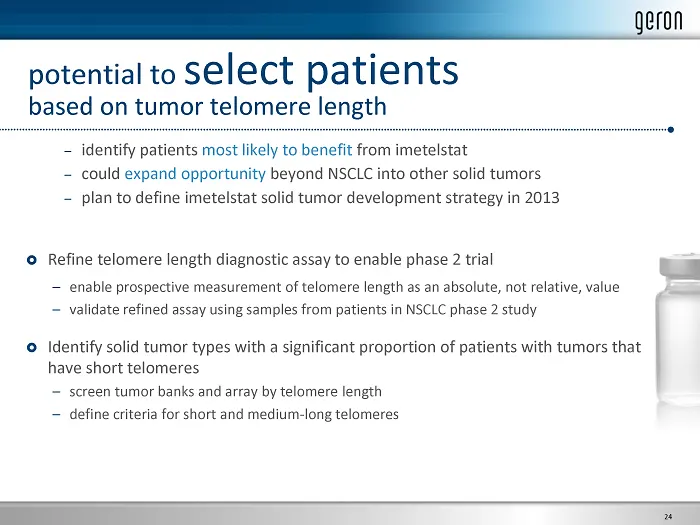
Slide 24: Potential to select patients based on tumor telomere length
geron potential to Select patients _ based on tumor telomere length - ‘identify patients most likely to benefit from imetelstat = could expand opportunity beyond NSCLC into other solid tumors ~ plan to define imetelstat solid tumor development strategy in 2013 © Refine telomere length diagnostic ass
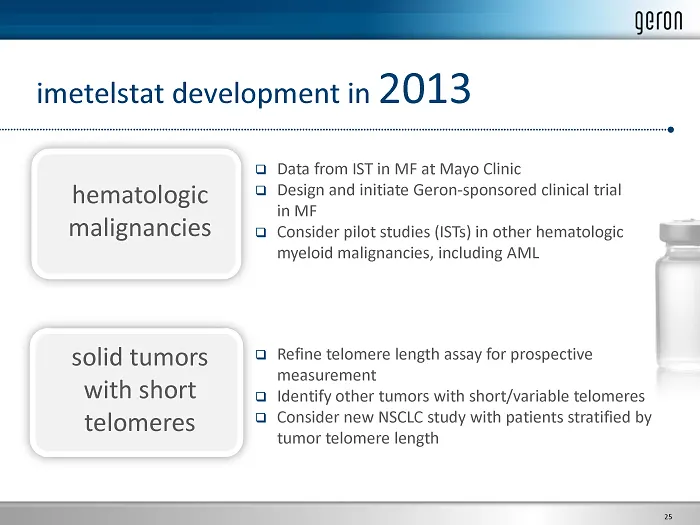
Slide 25: Imetelstat development in 2013
geron imetelstat development in 2013 @ Data from IST in MF at Mayo Clinic hematologic Q Design and initiate Geron-sponsored clinical trial in MF malignancies a Consider pilot studies (ISTs) in other hematologic il myeloid malignancies, including AML = solid tumors | @ Refine telomere length assay fo
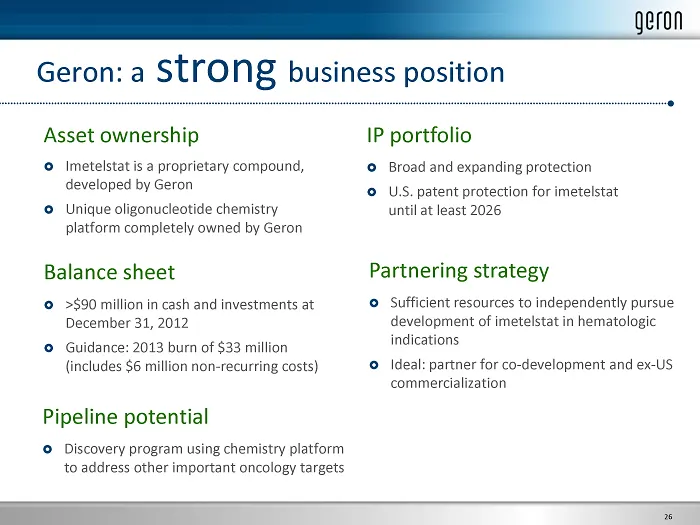
Slide 26: Geron: a strong business position
geron Geron: a StrONg business position Asset ownership © Imetelstat is a proprietary compound, developed by Geron © Unique oligonucleotide chemistry platform completely owned by Geron Balance sheet © >$90 million in cash and investments at December 31, 2012 © Guidance: 2013 burn of $33 million (inc
Slide 27: For further information, please contact
For further information, please contact: Anna Krassowska, Ph.D., Investor Relations +4+1.650.566.7127 or investo ‘or
Source: SEC EDGAR · 8-K filed Jan 7, 2013
More decks from Geron Corporation
 Q4 2025 Earnings Presentation25 slides · Feb 25, 2026
 Investor Presentation (January 2026)20 slides · Jan 12, 2026
 Q3 2025 Earnings Presentation37 slides · Nov 5, 2025
 Q2 2025 Earnings Presentation35 slides · Aug 6, 2025
 Q1 2025 Earnings Presentation21 slides · May 7, 2025
 Q4 2024 Earnings Presentation17 slides · Feb 26, 2025