Commonwealth Bank of Australia · ASX:CBA
Commonwealth Bank of Australia — AIFRS Conference Call (August 2005)
28 slides from Commonwealth Bank of Australia's conference presentation, Aug 16, 2005
Slide 1: AIFRS Conference Call
AIFRS Conference Call 16 August 2005 1
Slide 2: Disclaimer
Disclaimer The material that follows is a presentation of general background information about the Bank’s activities current at the date of the presentation, 16 August 2005. It is information given in summary form and does not purport to be complete. It is not intended to be relied upon as advice to
Slide 3: AIFRS Topics
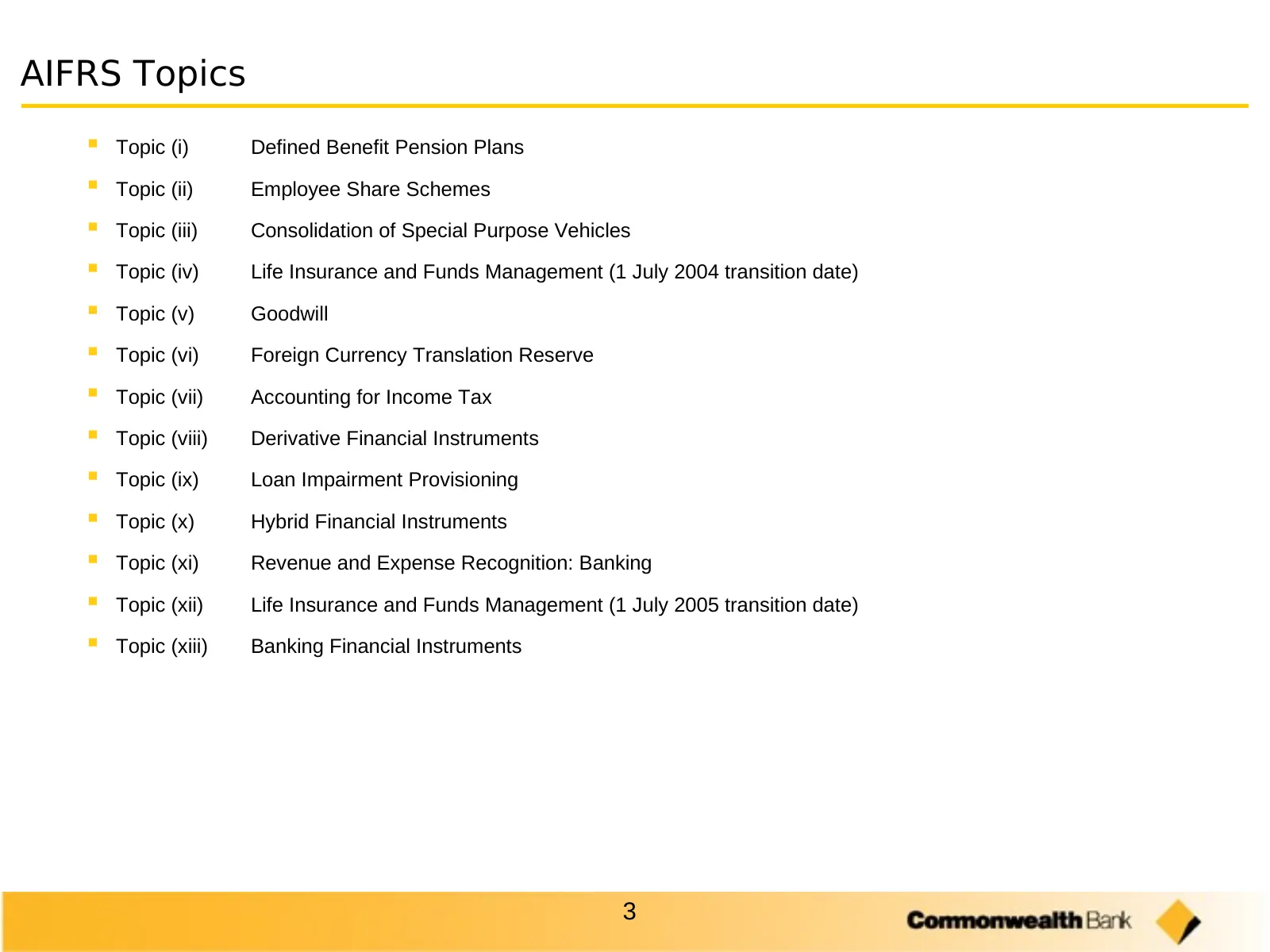
AIFRS Topics Topic (i) Defined Benefit Pension Plans Topic (ii) Employee Share Schemes Topic (iii) Consolidation of Special Purpose Vehicles Topic (iv) Life Insurance and Funds Management (1 July 2004 transition date) Topic (v) Goodwill Topic (vi) Foreign Currency Translation Reserve T
Slide 4: Topic (i) – Defined Benefit Pension Plans
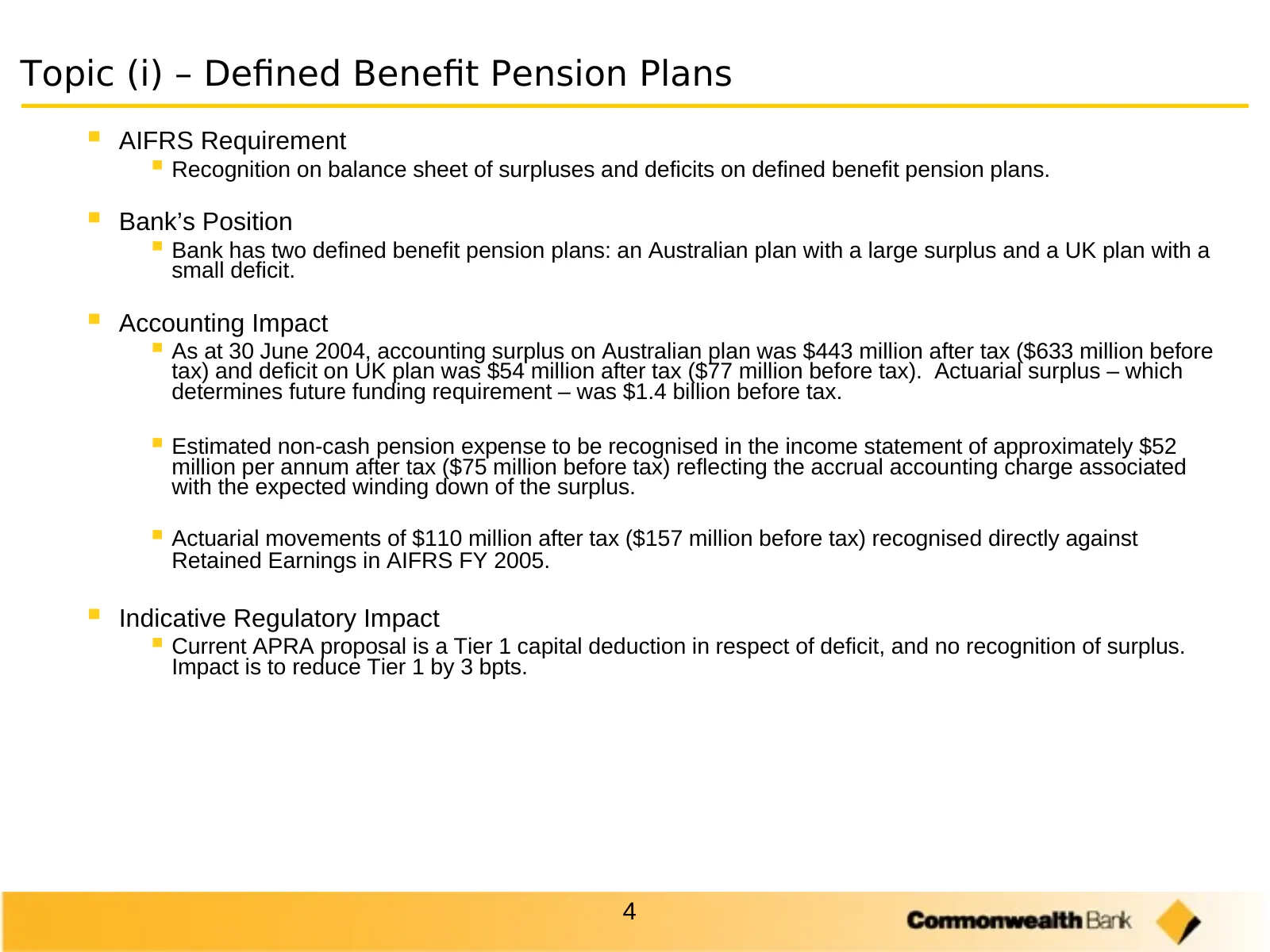
Topic (i) – Defined Benefit Pension Plans AIFRS Requirement Recognition on balance sheet of surpluses and deficits on defined benefit pension plans. Bank’s Position Bank has two defined benefit pension plans: an Australian plan with a large surplus and a UK plan with a small deficit. Accou
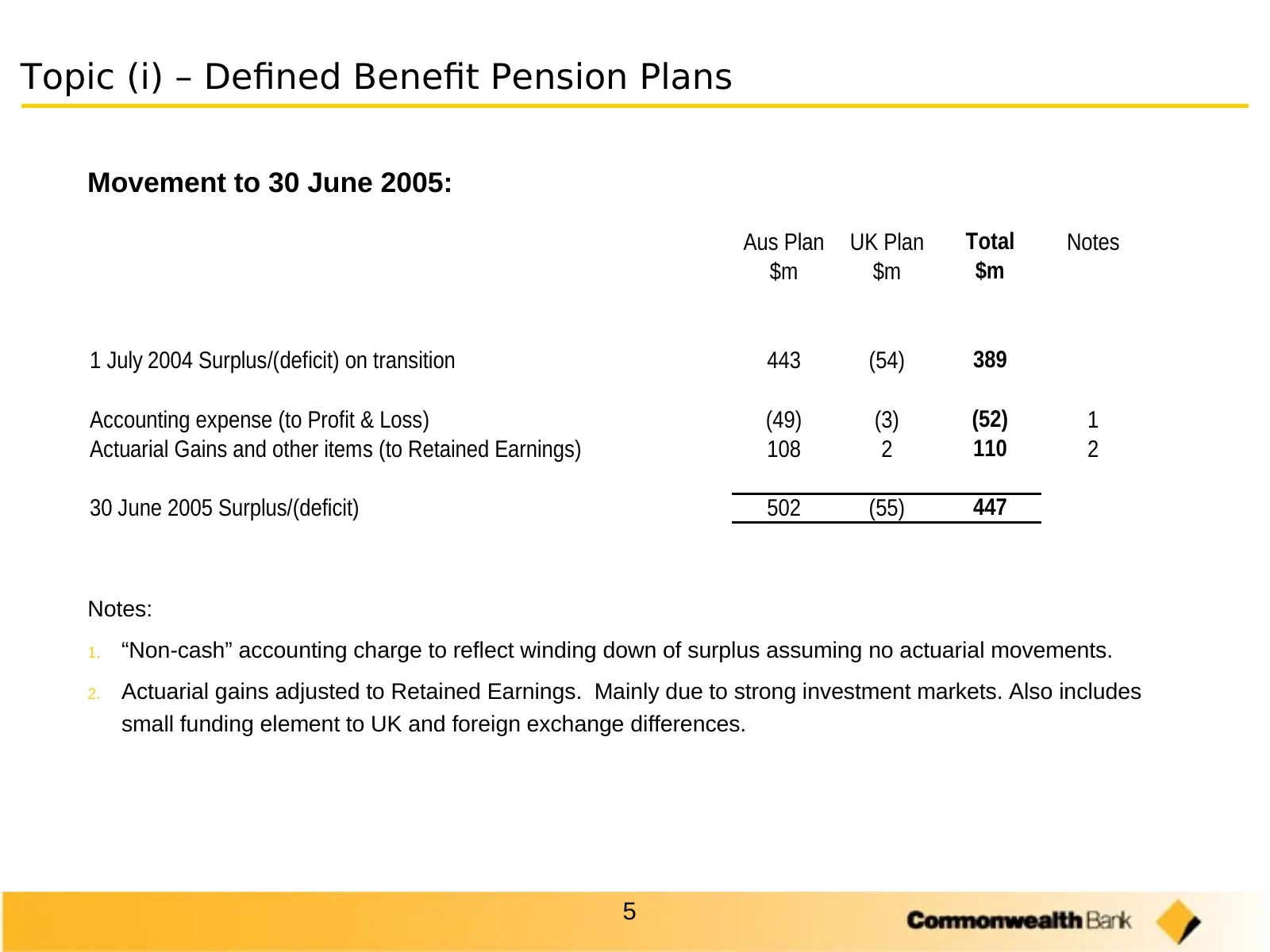
Slide 5: Topic (i) – Defined Benefit Pension Plans: Movement to June 05
Topic (i) – Defined Benefit Pension Plans Movement to 30 June 2005: Aus Plan UK Plan Total Notes $m $m $m 1 July 2004 Surplus/(deficit) on transition 443 (54) 389 Accounting expense (to Profit & Loss) (49) (3) (52) 1 Actuarial Gains and other items (to Retained Earnings) 108 2 110 2 30 June 2005 Sur
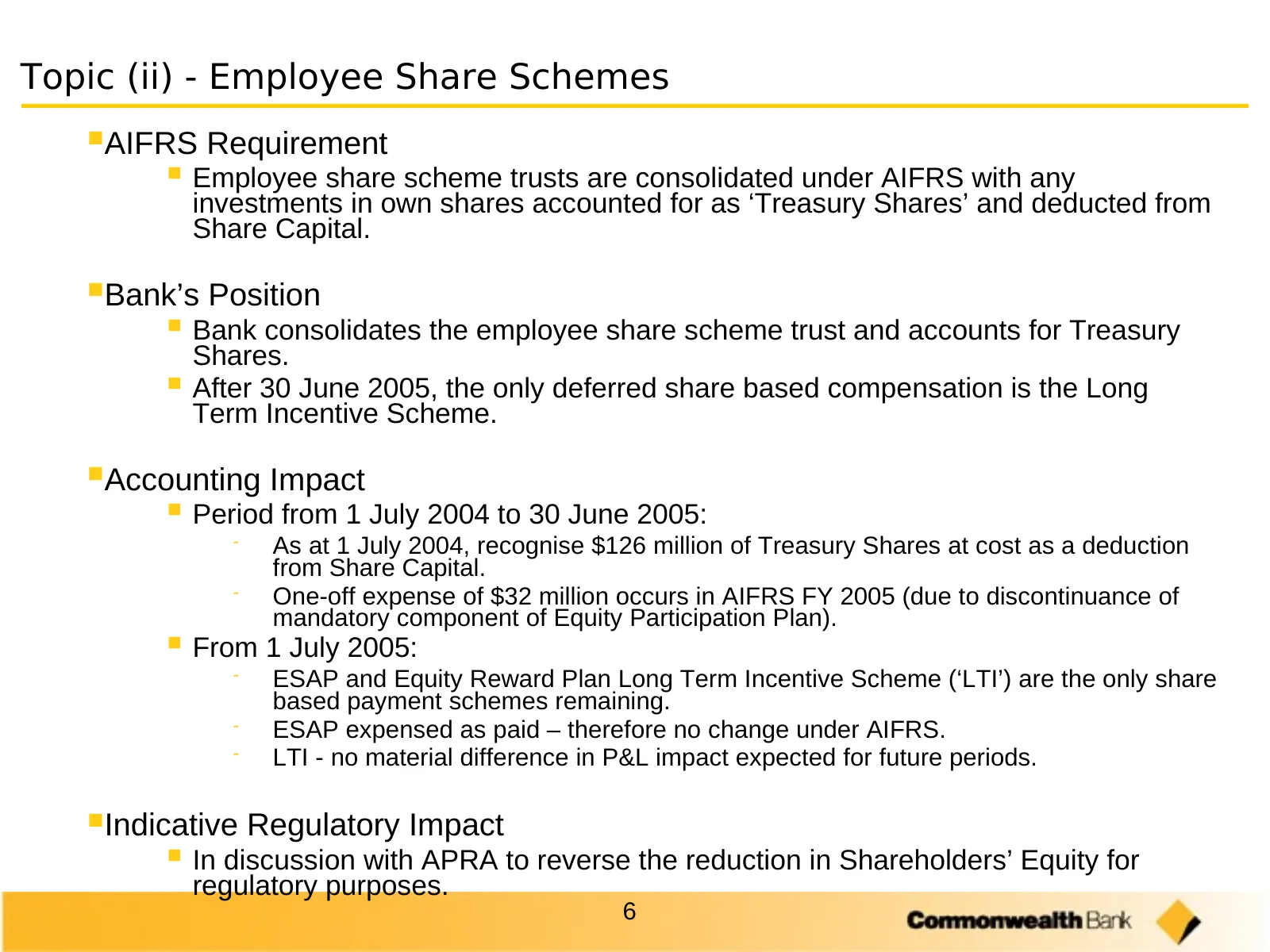
Slide 6: Topic (ii) - Employee Share Schemes
Topic (ii) - Employee Share Schemes AIFRS Requirement Employee share scheme trusts are consolidated under AIFRS with any investments in own shares accounted for as ‘Treasury Shares’ and deducted from Share Capital. Bank’s Position Bank consolidates the employee share scheme trust and accounts
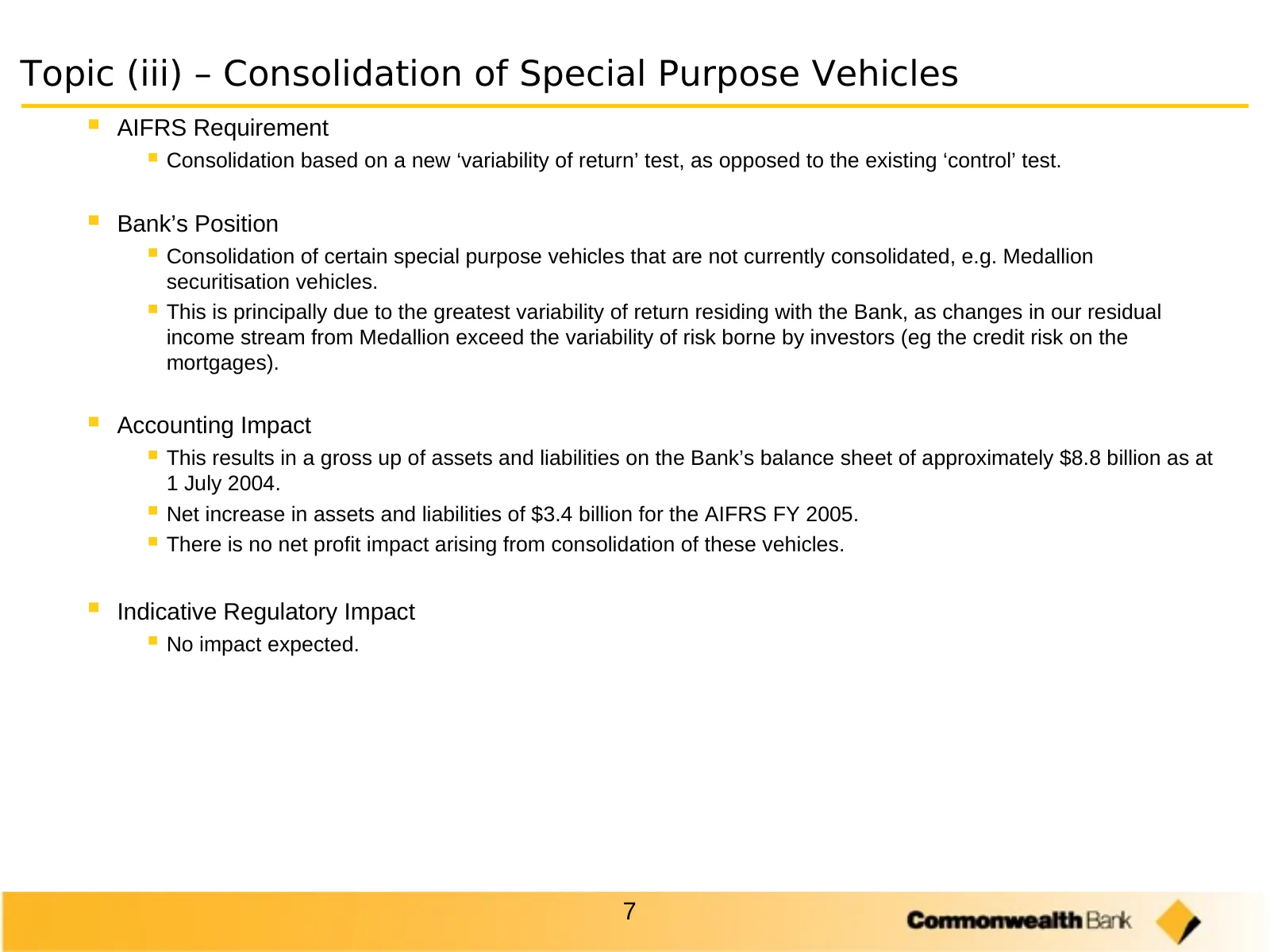
Slide 7: Topic (iii) – Consolidation of Special Purpose Vehicles
Topic (iii) – Consolidation of Special Purpose Vehicles AIFRS Requirement Consolidation based on a new ‘variability of return’ test, as opposed to the existing ‘control’ test. Bank’s Position Consolidation of certain special purpose vehicles that are not currently consolidated, e.g. Medallio
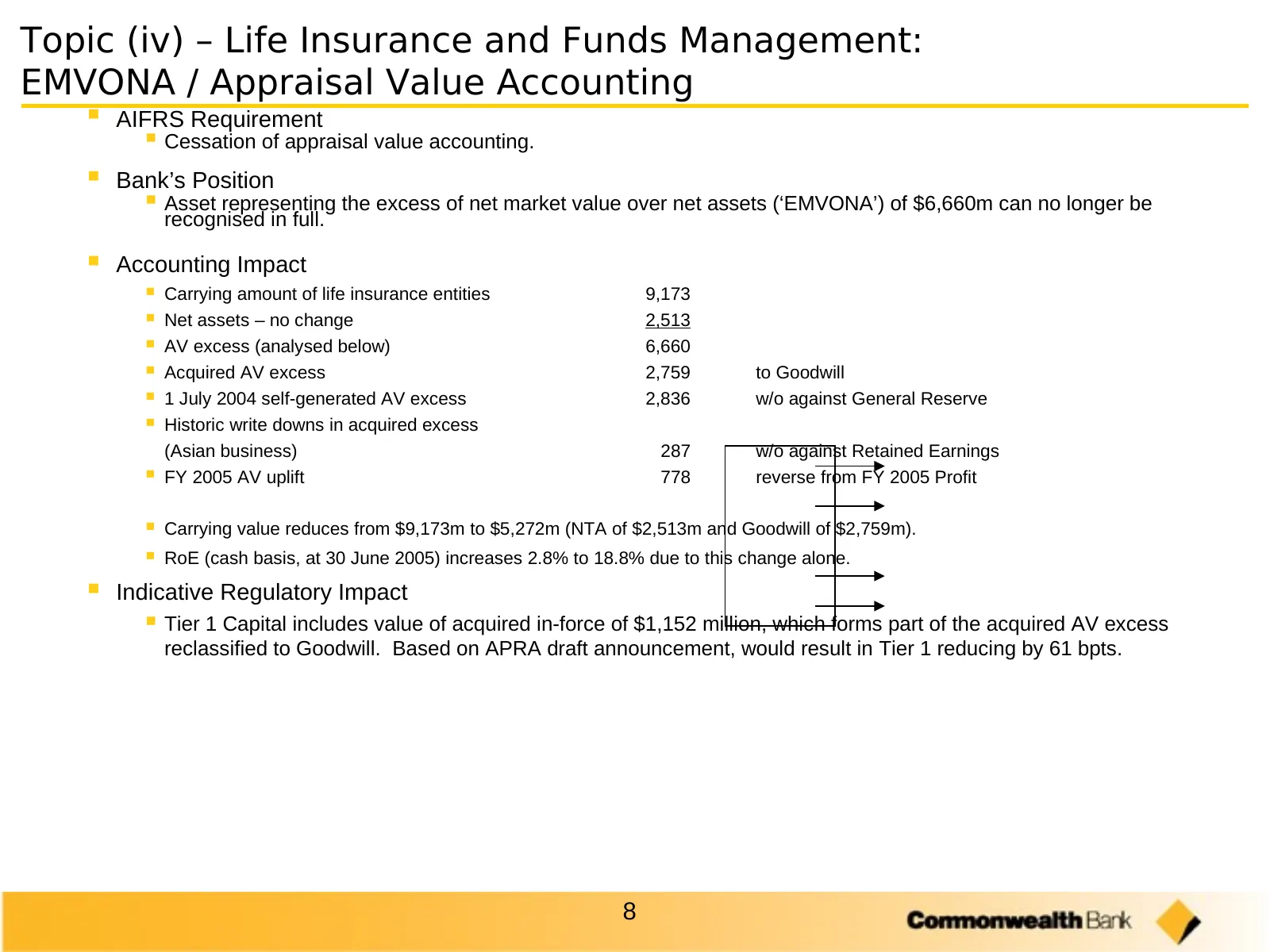
Slide 8: Topic (iv) – Life Insurance and Funds Management: EMVONA / Appraisal Value Accounting
Topic (iv) – Life Insurance and Funds Management: EMVONA / Appraisal Value Accounting AIFRS Requirement Cessation of appraisal value accounting. Bank’s Position Asset representing the excess of net market value over net assets (‘EMVONA’) of $6,660m can no longer be recognised in full. Acco
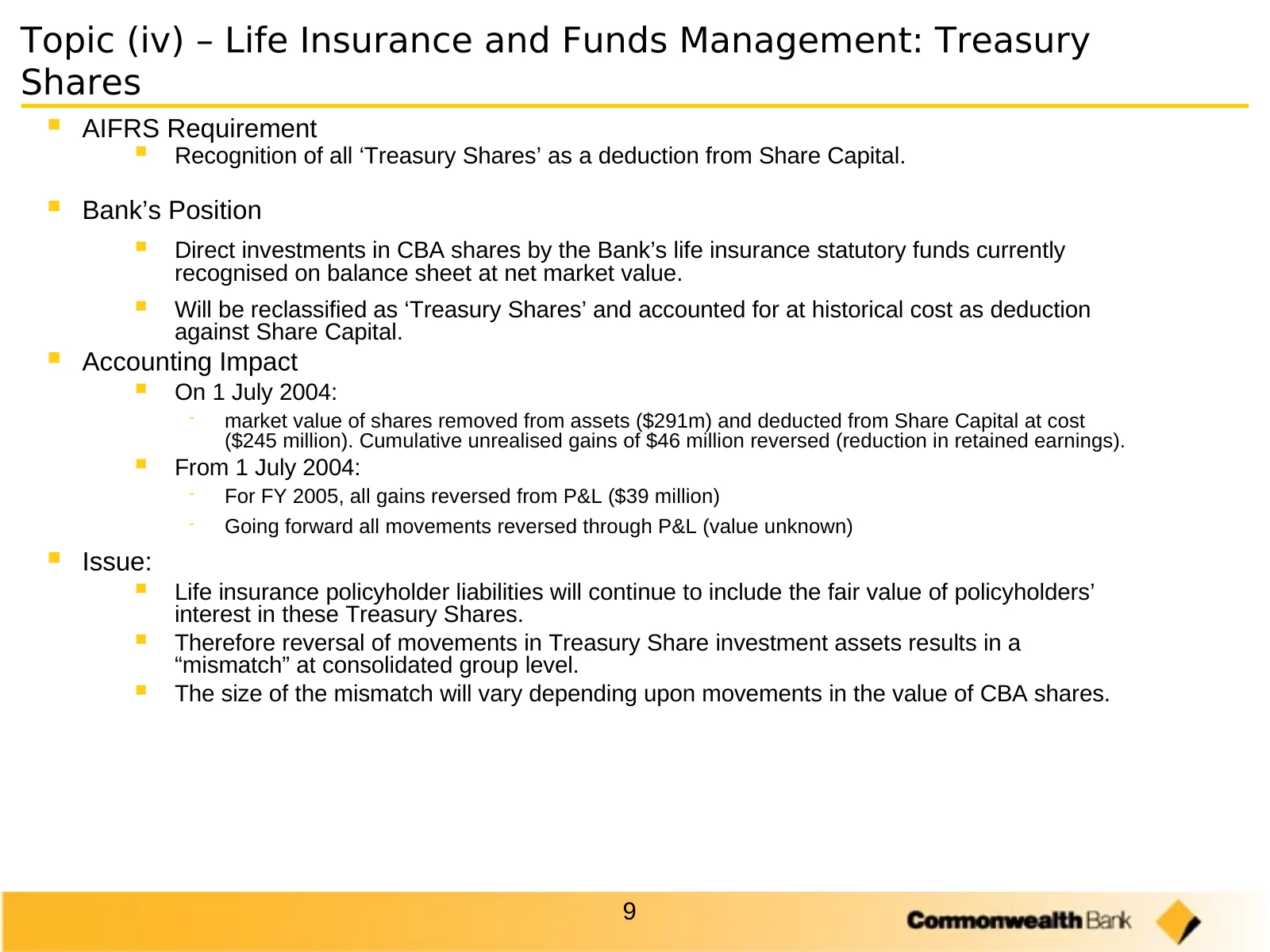
Slide 9: Topic (iv) – Life Insurance and Funds Management: Treasury Shares
Topic (iv) – Life Insurance and Funds Management: Treasury Shares AIFRS Requirement Recognition of all ‘Treasury Shares’ as a deduction from Share Capital. Bank’s Position Direct investments in CBA shares by the Bank’s life insurance statutory funds currently recognised on balance sheet at n
Slide 10: Topic (iv) – Life Insurance and Funds Management: Treasury Shares
Topic (iv) – Life Insurance and Funds Management: Treasury Shares Indicative Regulatory Impact In discussion with APRA to reverse the reduction in Shareholders’ Equity for regulatory purposes. 10
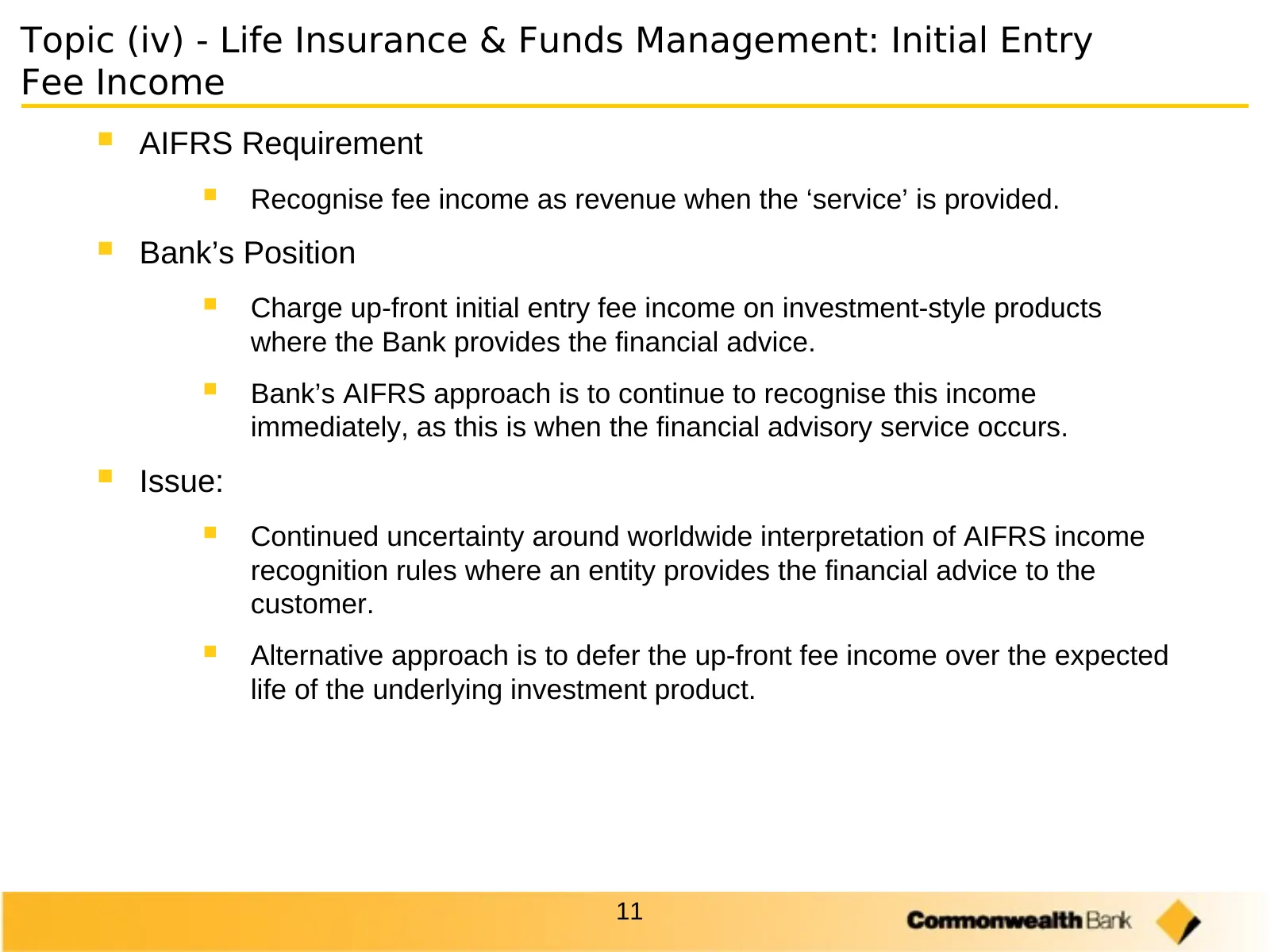
Slide 11: Topic (iv) - Life Insurance & Funds Management: Initial Entry Fee Income
Topic (iv) - Life Insurance & Funds Management: Initial Entry Fee Income AIFRS Requirement Recognise fee income as revenue when the ‘service’ is provided. Bank’s Position Charge up-front initial entry fee income on investment-style products where the Bank provides the financial advice. Ban
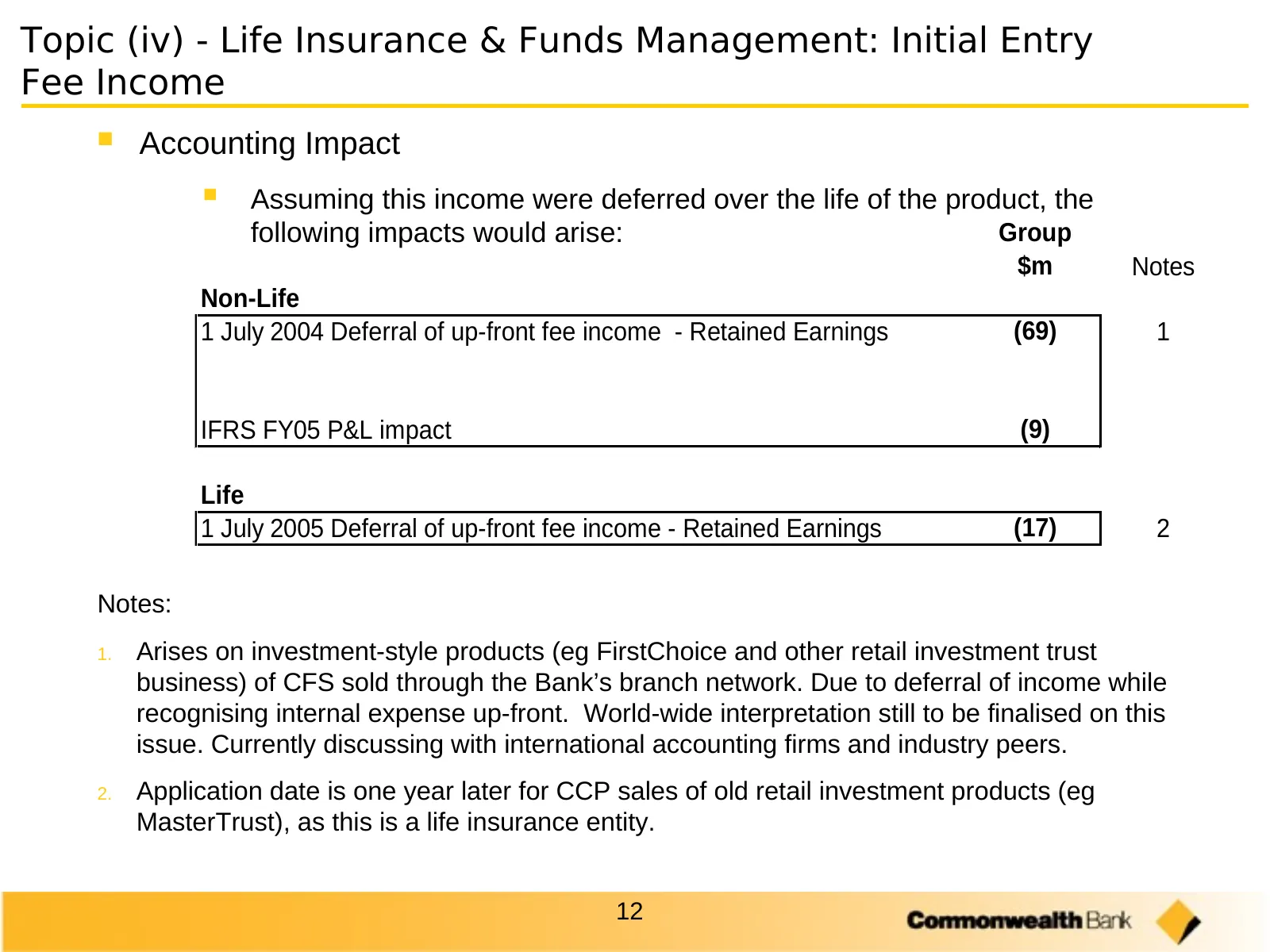
Slide 12: Topic (iv) - Life Insurance & Funds Management: Initial Entry Fee Income
Topic (iv) - Life Insurance & Funds Management: Initial Entry Fee Income Accounting Impact Assuming this income were deferred over the life of the product, the following impacts would arise: Group $m Notes Non-Life 1 July 2004 Deferral of up-front fee income - Retained Earnings (69) 1 IFRS FY05
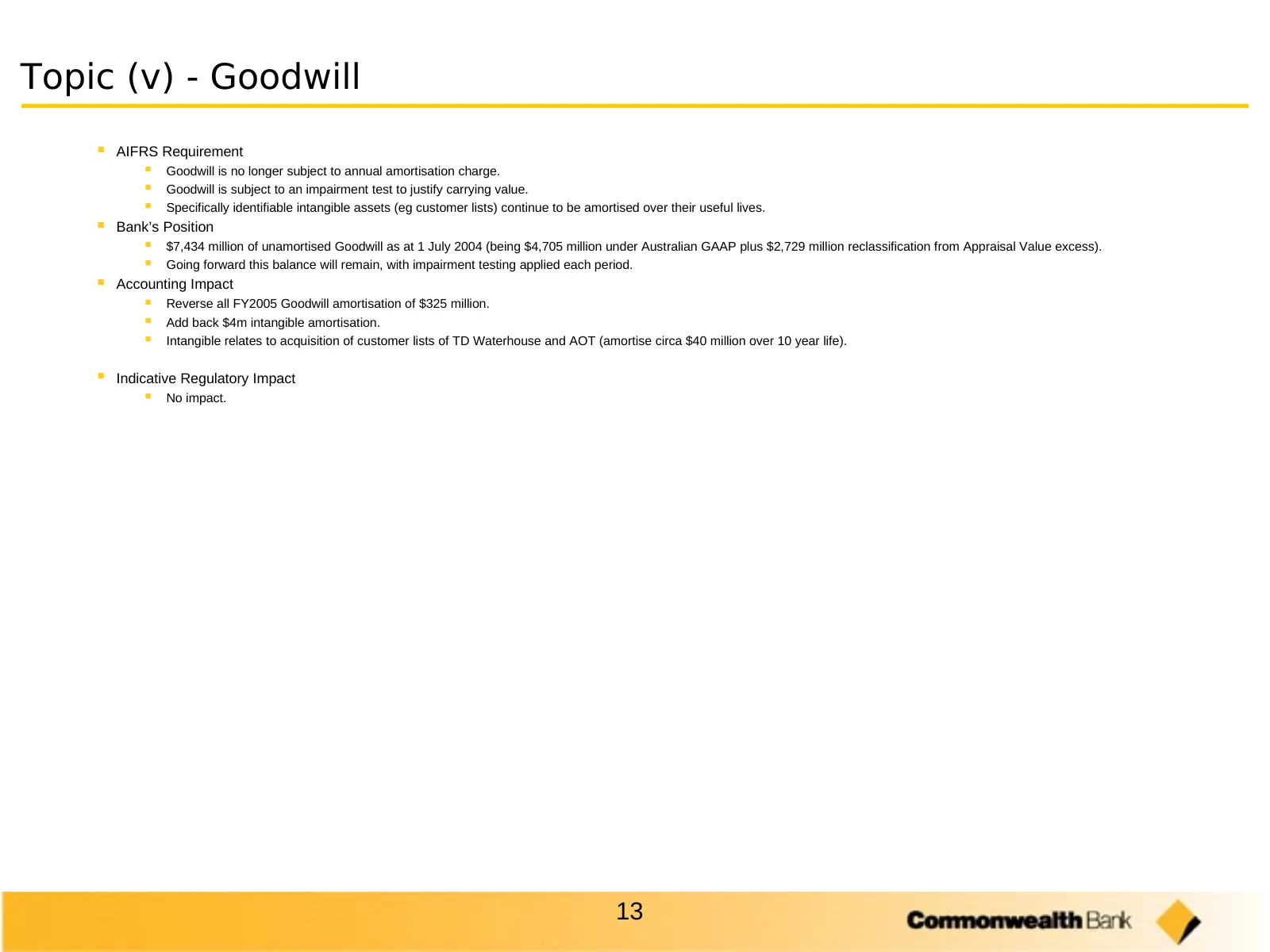
Slide 13: Topic (v) - Goodwill
Topic (v) - Goodwill AIFRS Requirement Goodwill is no longer subject to annual amortisation charge. Goodwill is subject to an impairment test to justify carrying value. Specifically identifiable intangible assets (eg customer lists) continue to be amortised over their useful lives. Bank’s
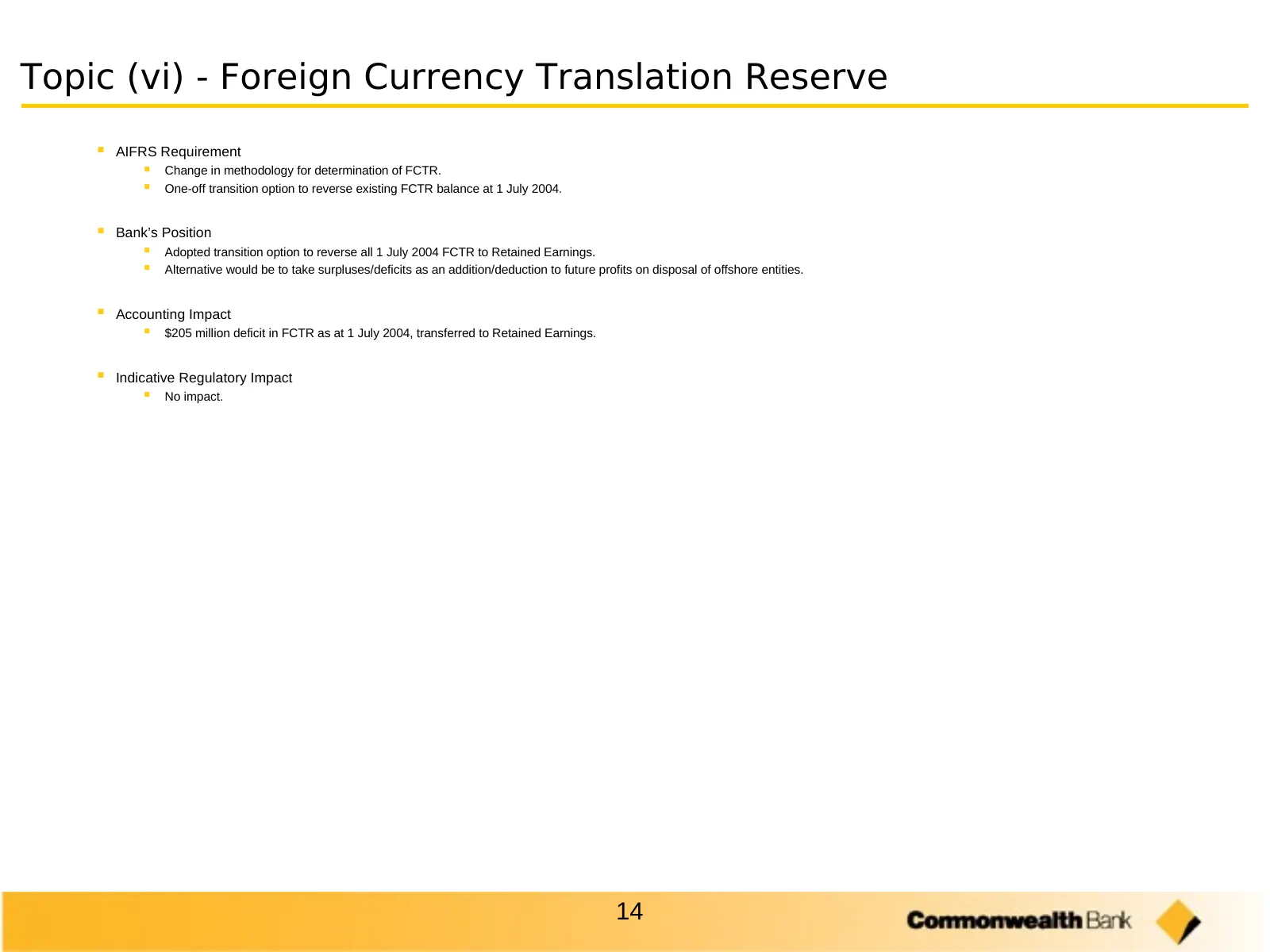
Slide 14: Topic (vi) - Foreign Currency Translation Reserve
Topic (vi) - Foreign Currency Translation Reserve AIFRS Requirement Change in methodology for determination of FCTR. One-off transition option to reverse existing FCTR balance at 1 July 2004. Bank’s Position Adopted transition option to reverse all 1 July 2004 FCTR to Retained Earnings.
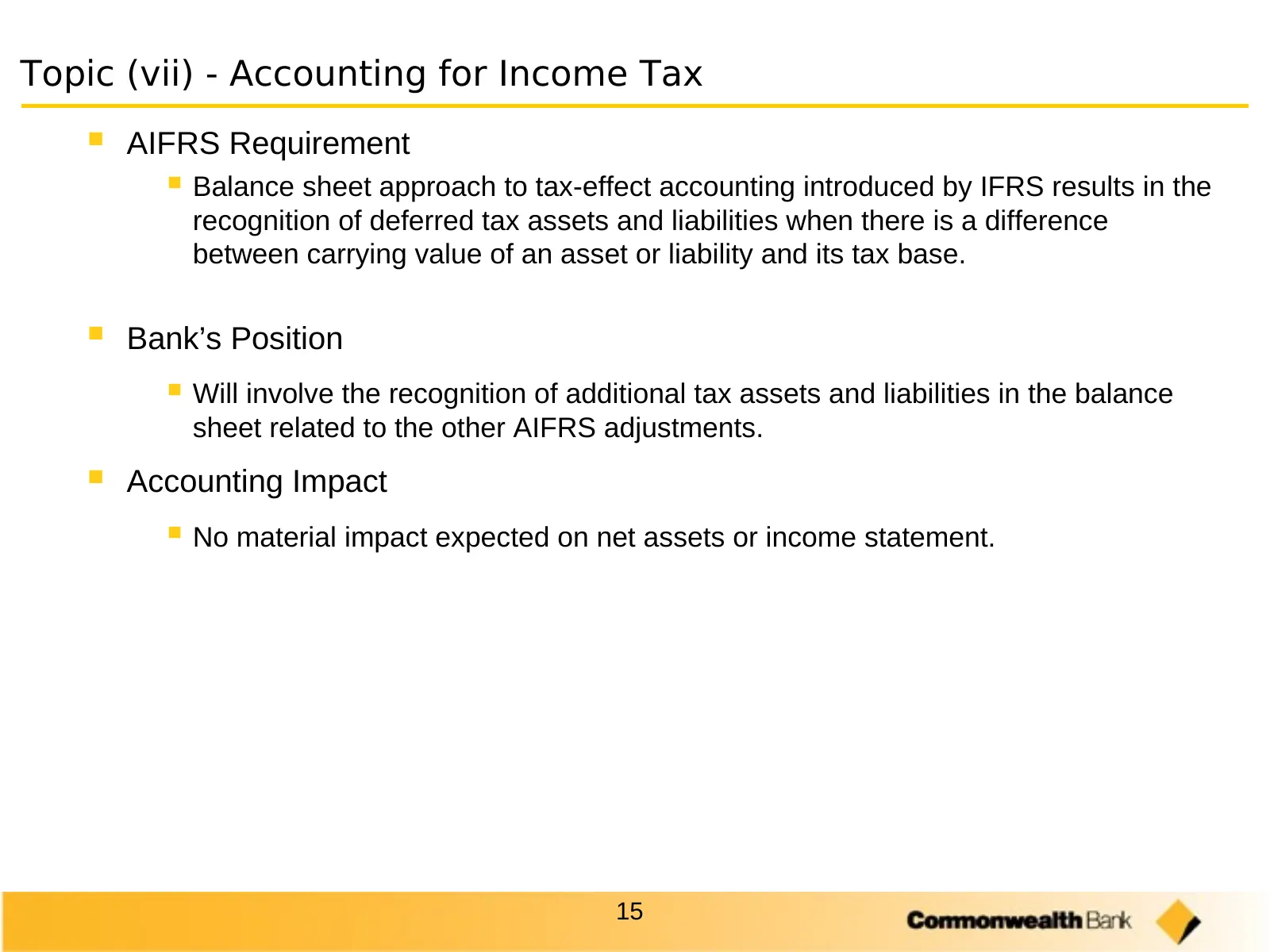
Slide 15: Topic (vii) - Accounting for Income Tax
Topic (vii) - Accounting for Income Tax AIFRS Requirement Balance sheet approach to tax-effect accounting introduced by IFRS results in the recognition of deferred tax assets and liabilities when there is a difference between carrying value of an asset or liability and its tax base. Bank’s Pos
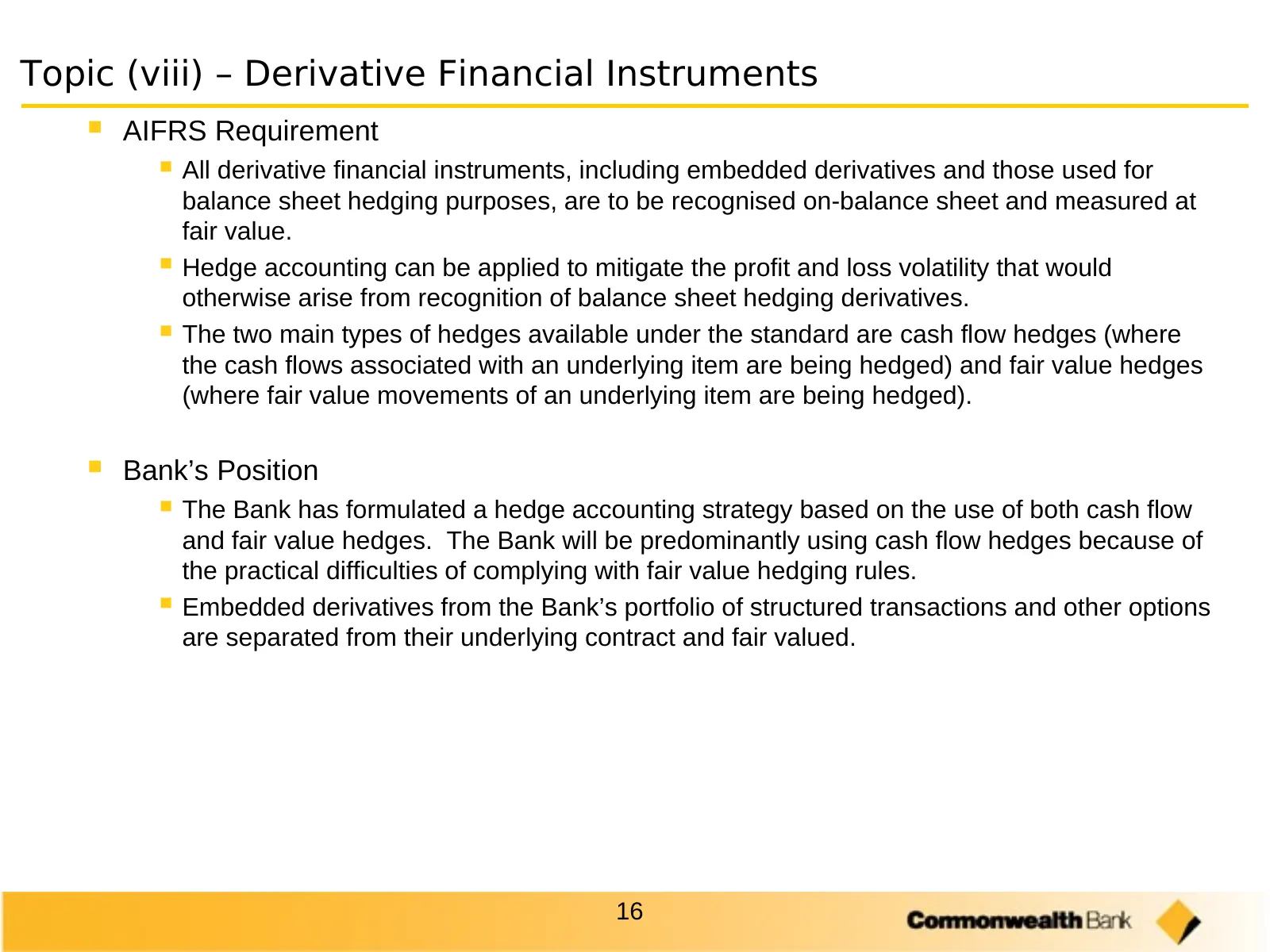
Slide 16: Topic (viii) – Derivative Financial Instruments
Topic (viii) – Derivative Financial Instruments AIFRS Requirement All derivative financial instruments, including embedded derivatives and those used for balance sheet hedging purposes, are to be recognised on-balance sheet and measured at fair value. Hedge accounting can be applied to mitigat
Slide 17: Topic (viii) – Derivative Financial Instruments
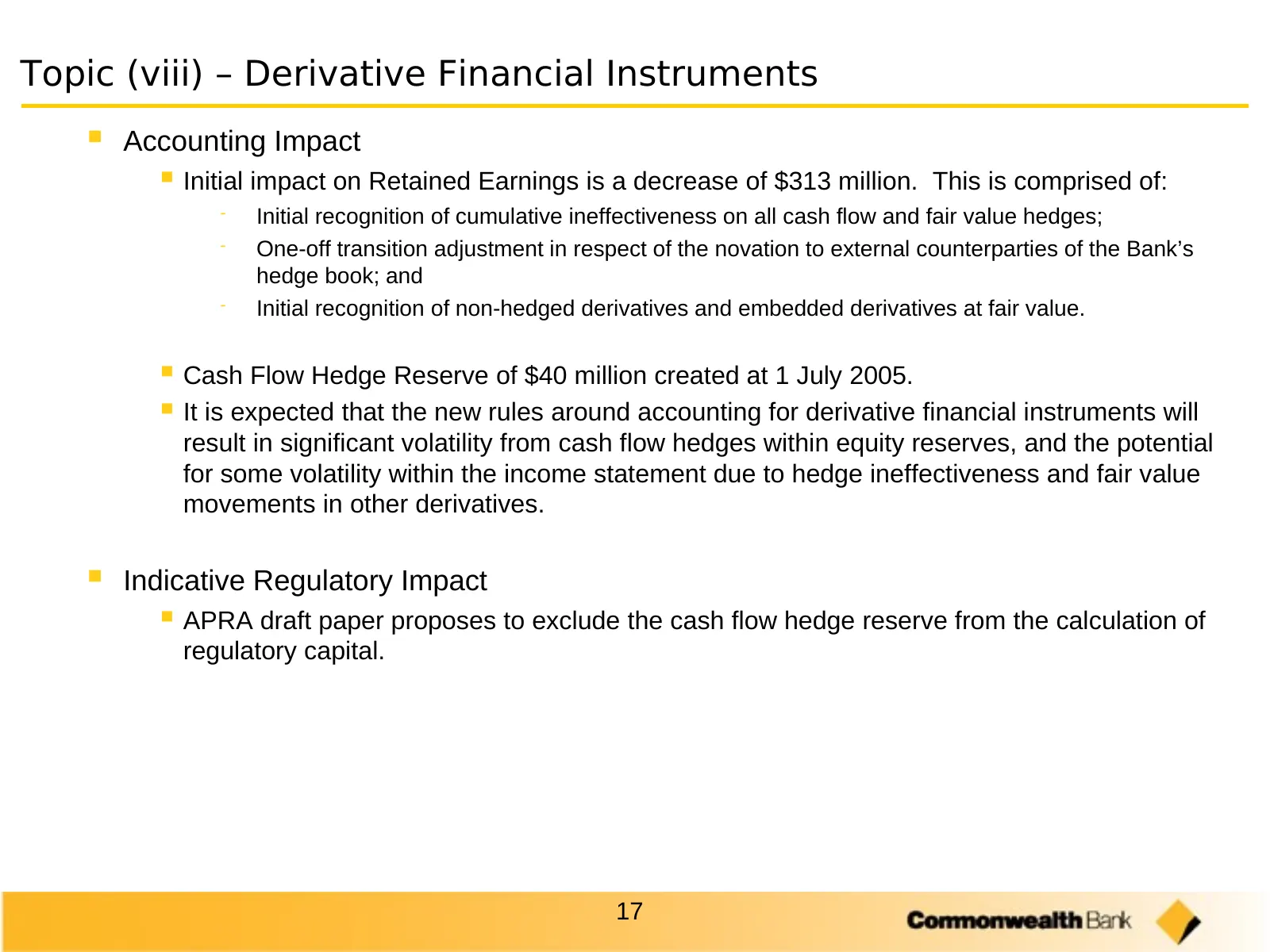
Topic (viii) – Derivative Financial Instruments Accounting Impact Initial impact on Retained Earnings is a decrease of $313 million. This is comprised of: Initial recognition of cumulative ineffectiveness on all cash flow and fair value hedges; One-off transition adjustment in respect of the
Slide 18: Topic (ix) – Loan Impairment Provisioning
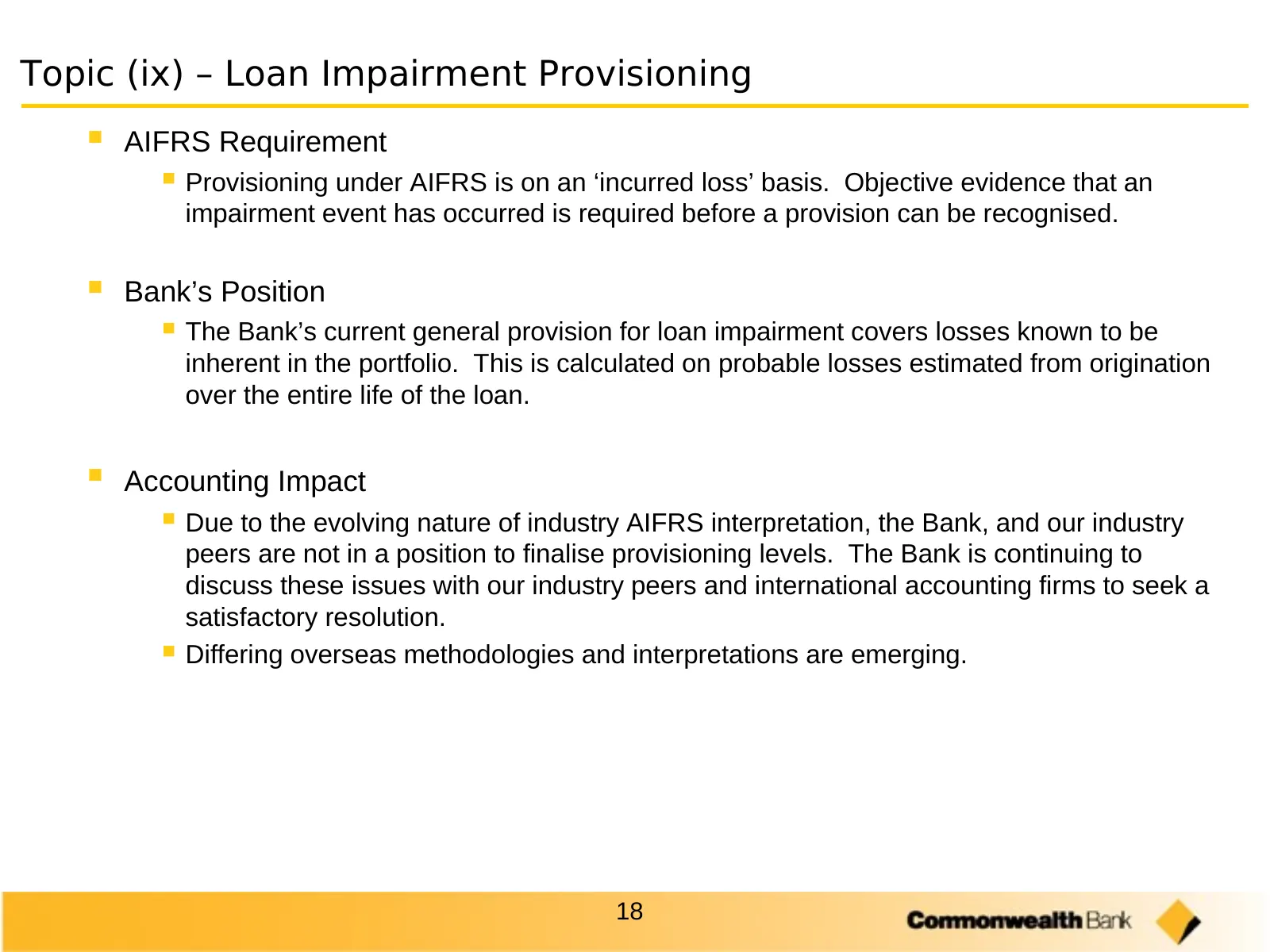
Topic (ix) – Loan Impairment Provisioning AIFRS Requirement Provisioning under AIFRS is on an ‘incurred loss’ basis.Objective evidence that an impairment event has occurred is required before a provision can be recognised. Bank’s Position The Bank’s current general provision for loan impairm
Slide 19: Topic (ix) – Loan Impairment Provisioning
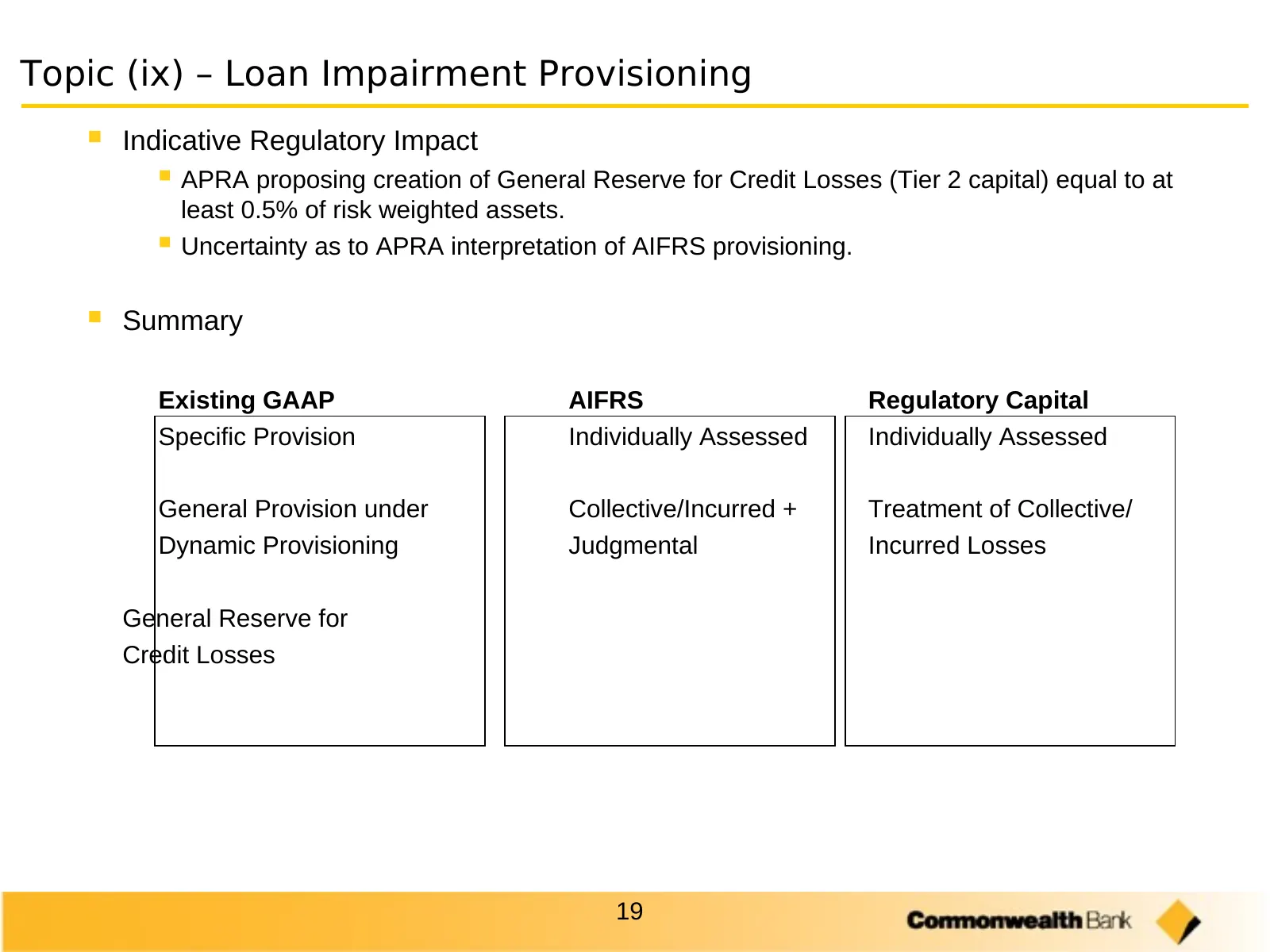
Topic (ix) – Loan Impairment Provisioning Indicative Regulatory Impact APRA proposing creation of General Reserve for Credit Losses (Tier 2 capital) equal to at least 0.5% of risk weighted assets. Uncertainty as to APRA interpretation of AIFRS provisioning. Summary Existing GAAP AIFRS Regula
Slide 20: Topic (x) – Hybrid Financial Instruments
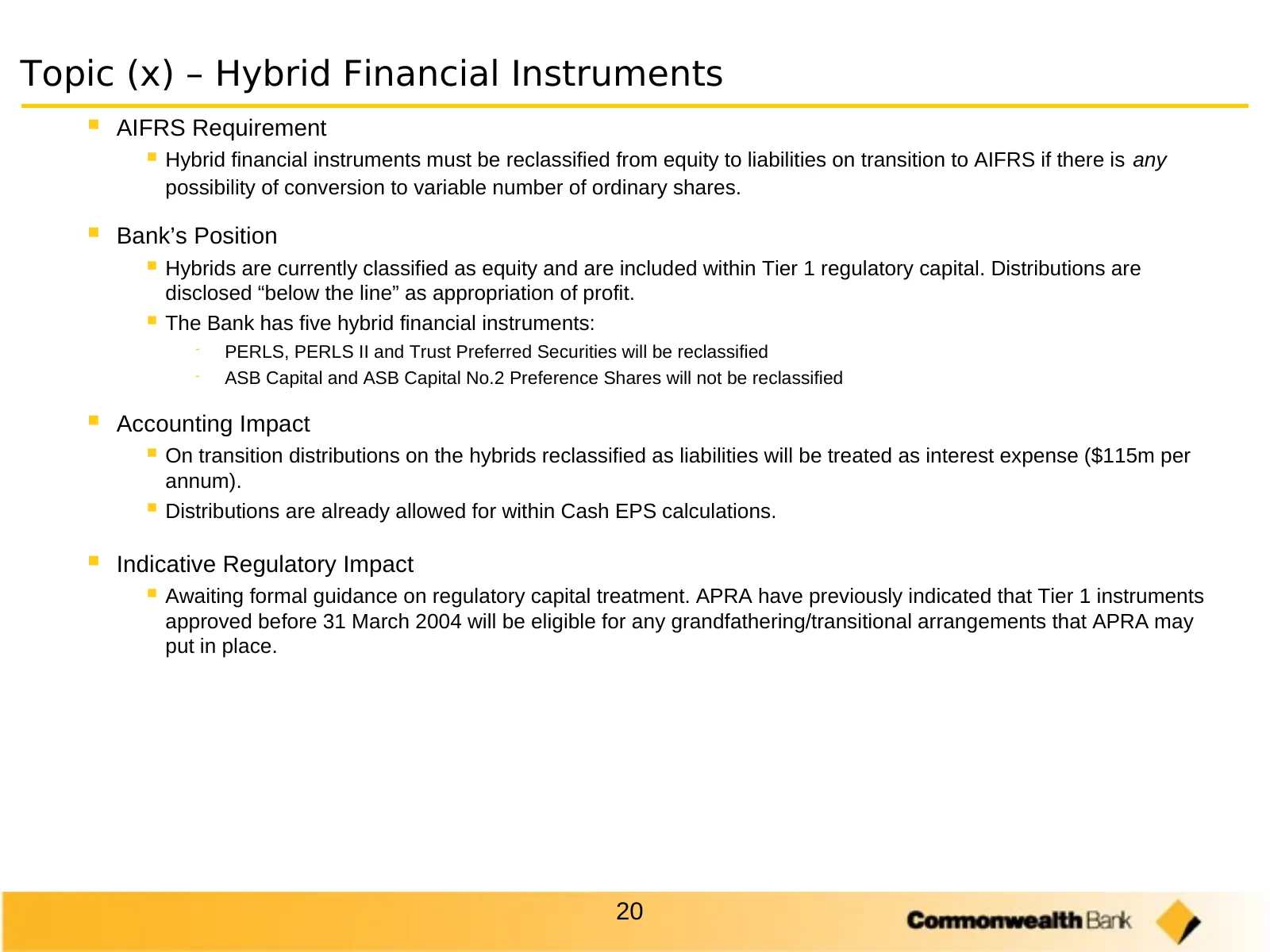
Topic (x) – Hybrid Financial Instruments AIFRS Requirement Hybrid financial instruments must be reclassified from equity to liabilities on transition to AIFRS if there is any possibility of conversion to variable number of ordinary shares. Bank’s Position Hybrids are currently classified as
Slide 21: Topic (x) - Hybrid Financial Instruments
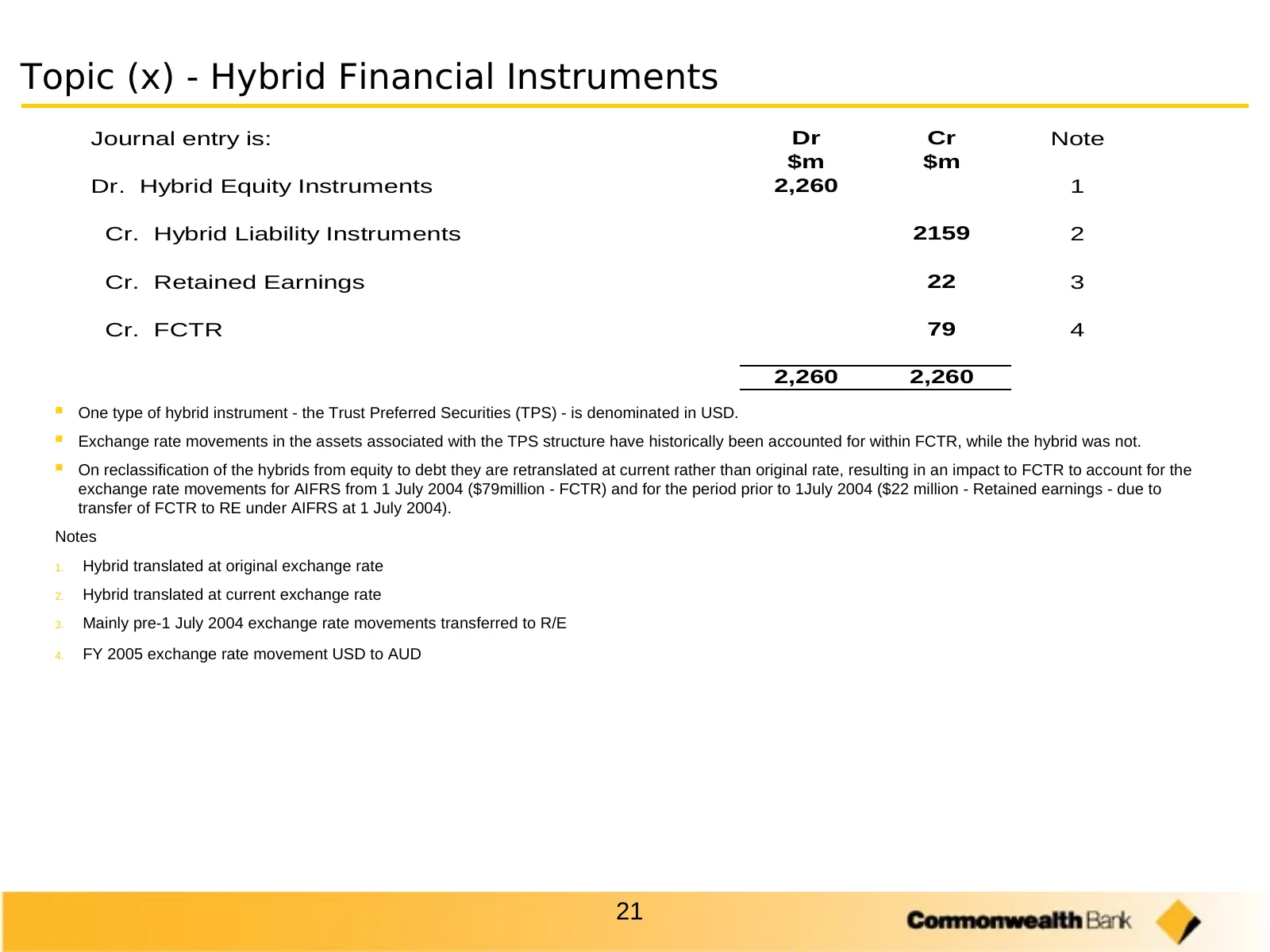
Topic (x) - Hybrid Financial Instruments Journal entry is: Dr Cr Note $m $m Dr. Hybrid Equity Instruments 2,260 1 Cr. Hybrid Liability Instruments 2159 2 Cr. Retained Earnings 22 3 Cr. FCTR 79 4 2,260 2,260 One type of hybrid instrument - the Trust Preferred Securities (TPS) - is denominated in US
Slide 22: Topic (xi) - Revenue and Expense Recognition: Banking
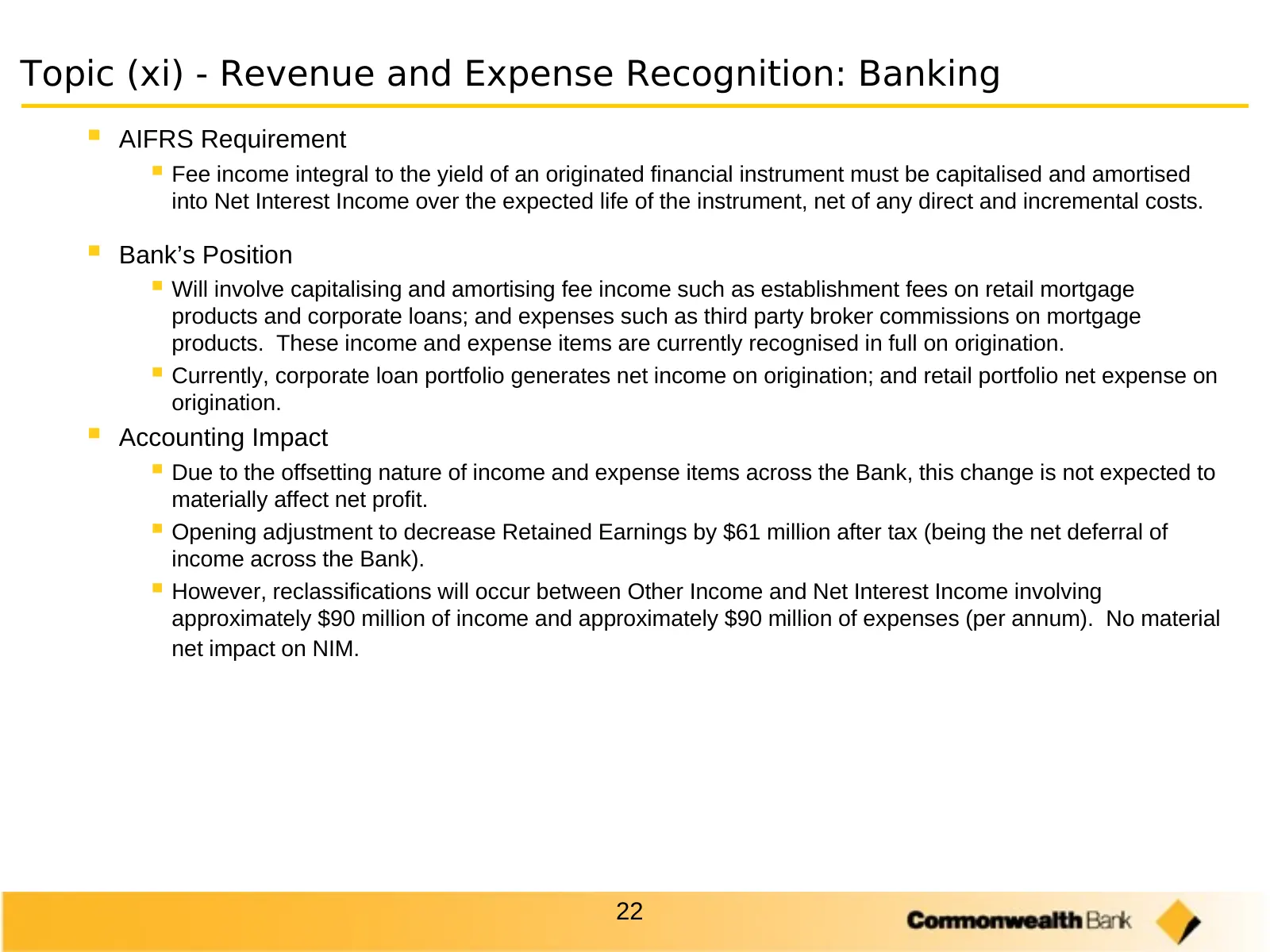
Topic (xi) - Revenue and Expense Recognition: Banking AIFRS Requirement Fee income integral to the yield of an originated financial instrument must be capitalised and amortised into Net Interest Income over the expected life of the instrument, net of any direct and incremental costs. Bank’s Po
Slide 23: Topic (xii) – Life Insurance and Funds Management: Income Recognition
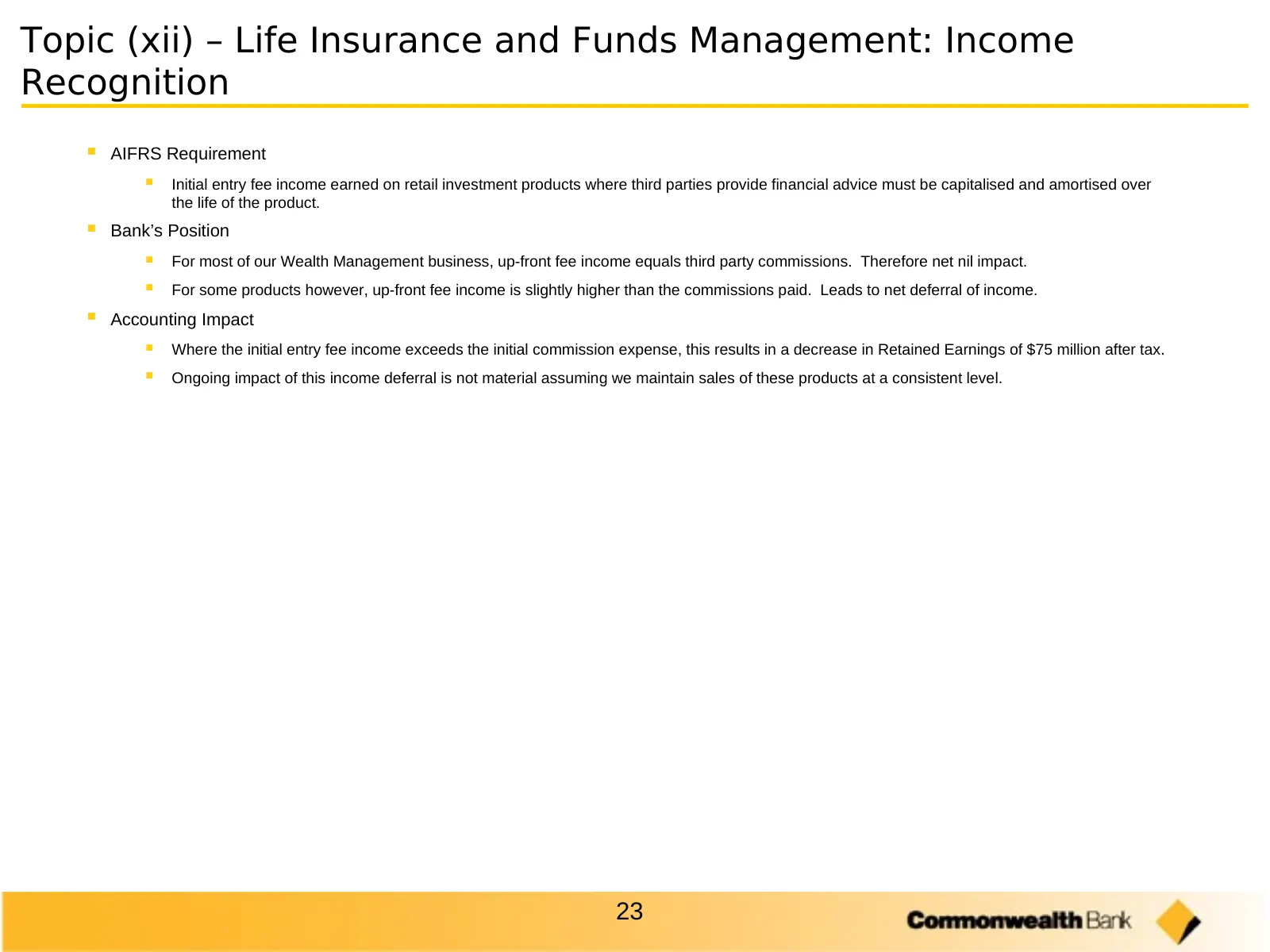
Topic (xii) – Life Insurance and Funds Management: Income Recognition AIFRS Requirement Initial entry fee income earned on retail investment products where third parties provide financial advice must be capitalised and amortised over the life of the product. Bank’s Position For most of our W
Slide 24: Topic (xii) – Life Insurance & Funds Management: Measurement Differences
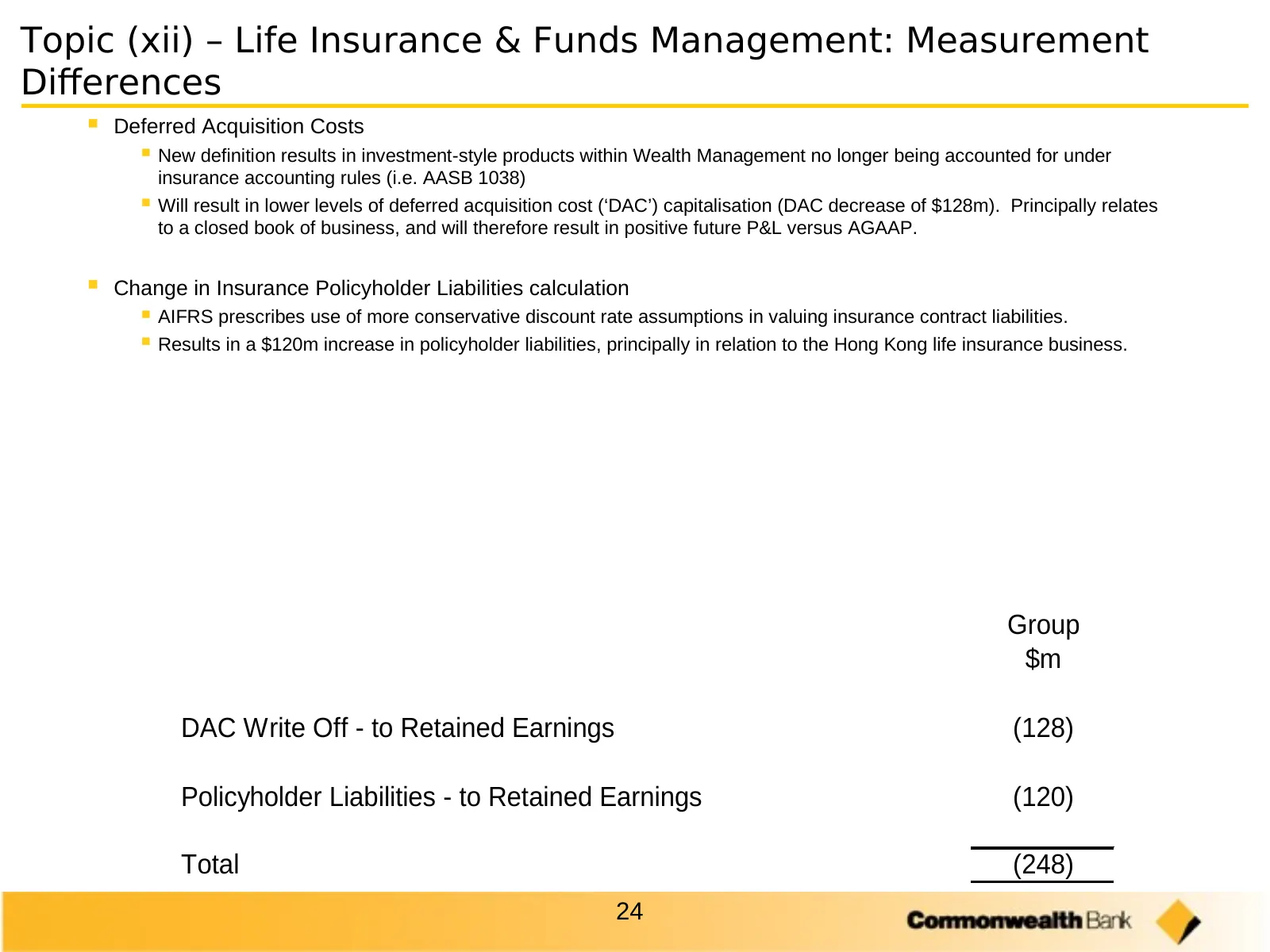
Topic (xii) – Life Insurance & Funds Management: Measurement Differences Deferred Acquisition Costs New definition results in investment-style products within Wealth Management no longer being accounted for under insurance accounting rules (i.e. AASB 1038) Will result in lower levels of deferr
Slide 25: Topic (xii) - Life Insurance and Funds Management: Outside Equity Interests
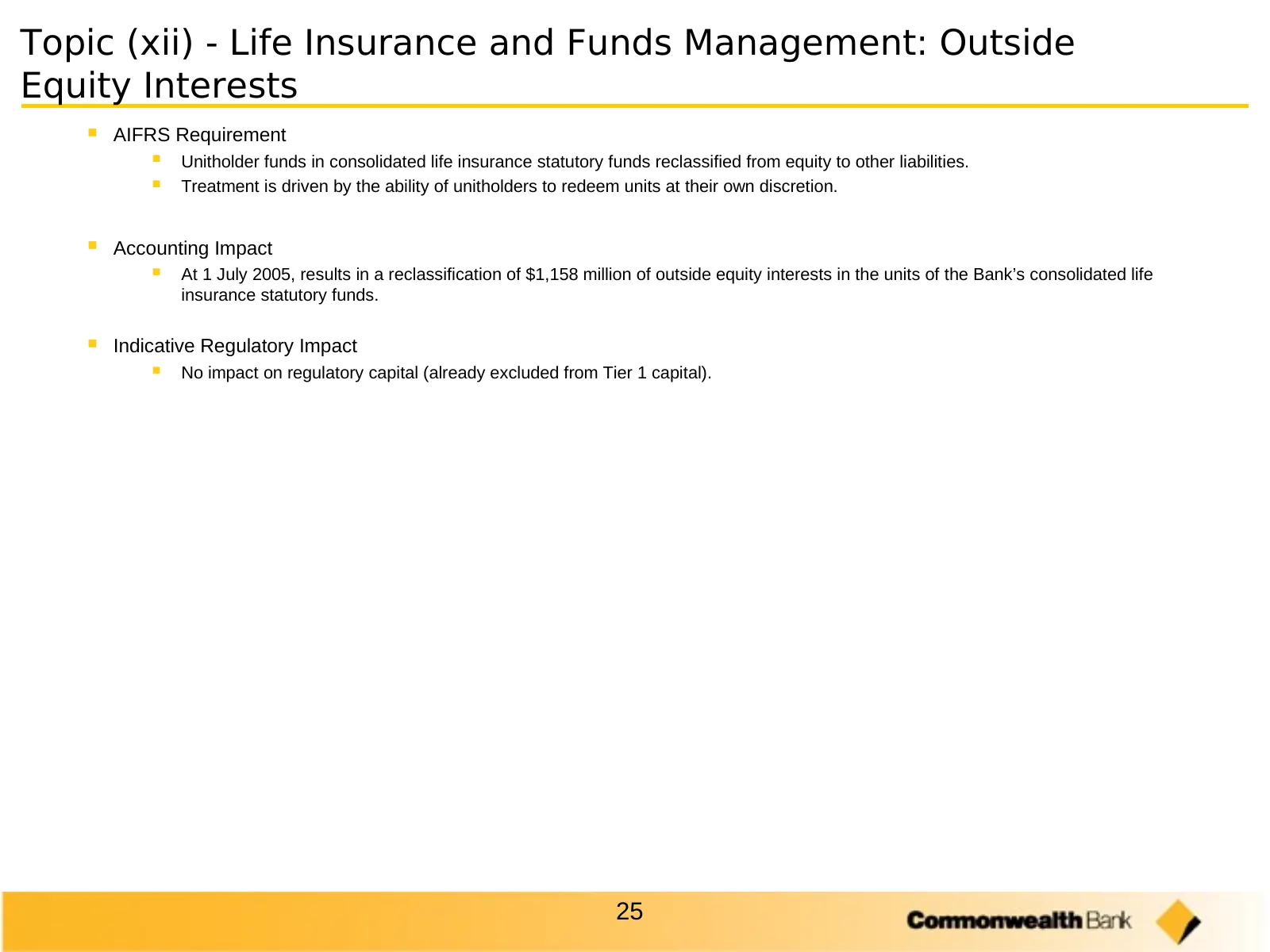
Topic (xii) - Life Insurance and Funds Management: Outside Equity Interests AIFRS Requirement Unitholder funds in consolidated life insurance statutory funds reclassified from equity to other liabilities. Treatment is driven by the ability of unitholders to redeem units at their own discretion
Slide 26: Topic (xiii) – Banking Financial Instruments
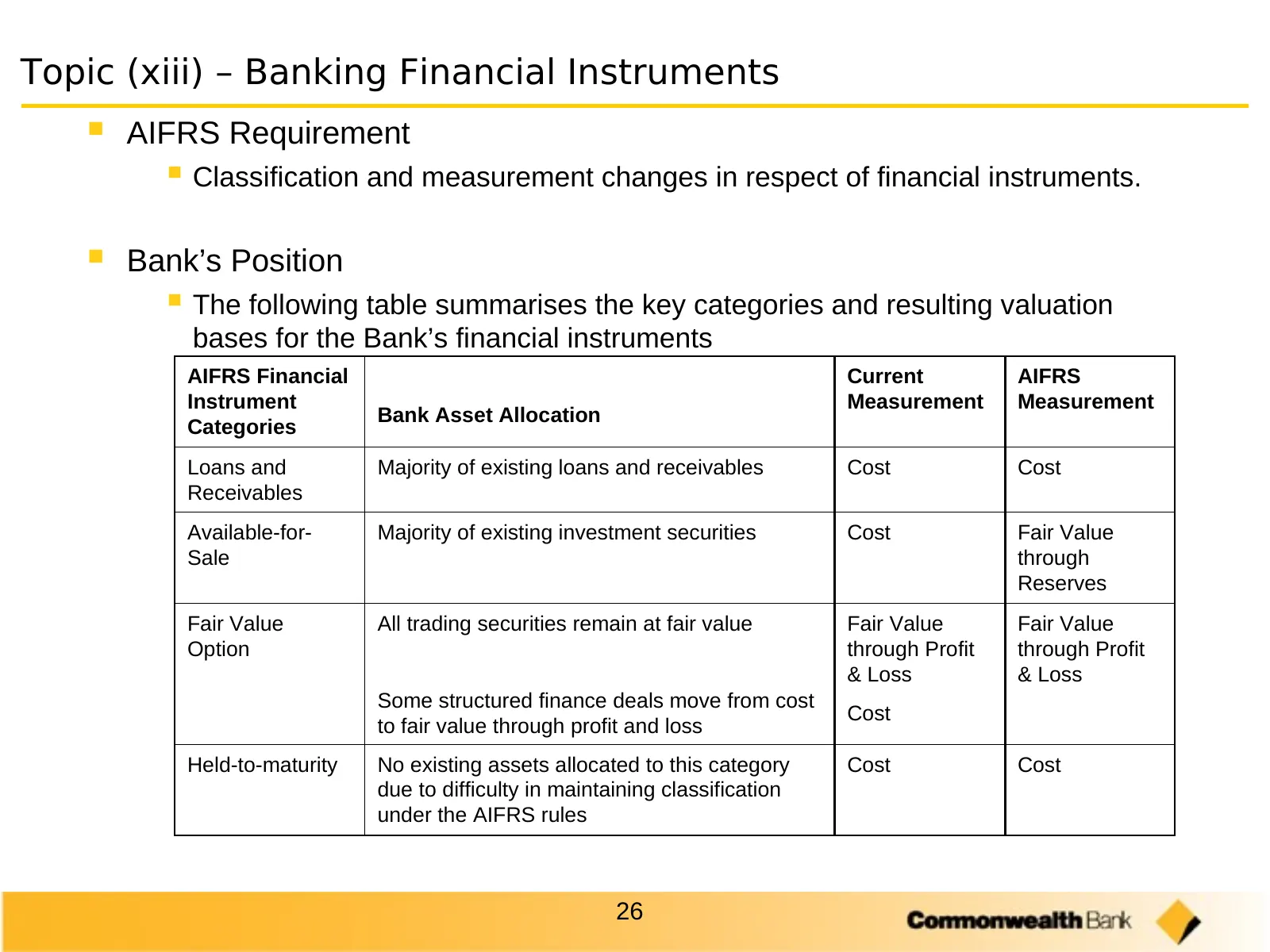
Topic (xiii) – Banking Financial Instruments AIFRS Requirement Classification and measurement changes in respect of financial instruments. Bank’s Position The following table summarises the key categories and resulting valuation bases for the Bank’s financial instruments AIFRS Financial Curr
Slide 27: Topic (xiii) – Banking Financial Instruments
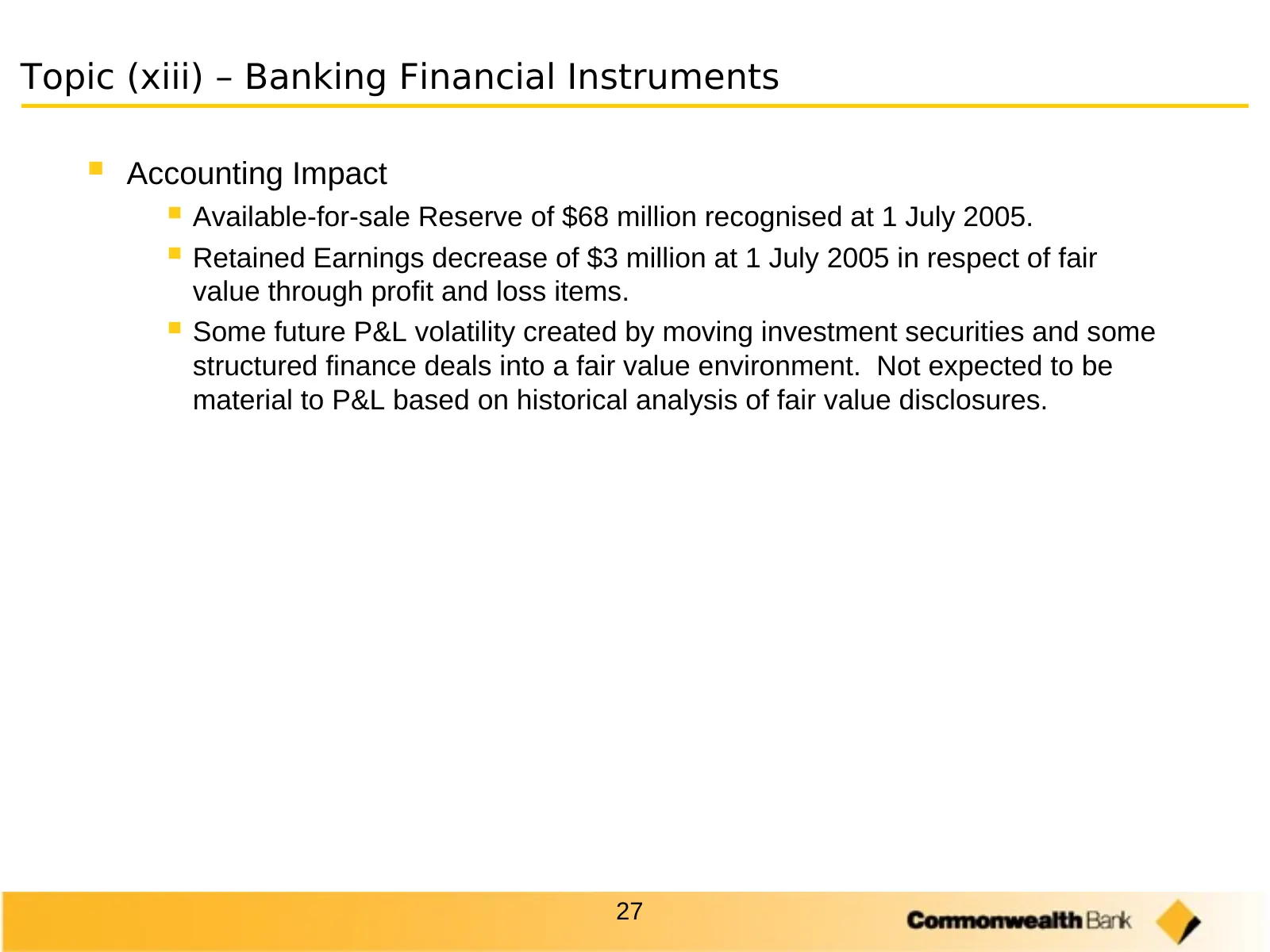
Topic (xiii) – Banking Financial Instruments Accounting Impact Available-for-sale Reserve of $68 million recognised at 1 July 2005. Retained Earnings decrease of $3 million at 1 July 2005 in respect of fair value through profit and loss items. Some future P&L volatility created by moving inv
Slide 28: AIFRS Conference Call
AIFRS Conference Call 16 August 2005 28
Source: Internet Archive copy of commbank.com.au
More decks from Commonwealth Bank of Australia
 FY2026 Earnings Presentation139 slides · Aug 12, 2026
 Debt Investor Presentation (August 2026)63 slides · Aug 12, 2026
 Debt Investor Presentation (August 2026)63 slides · Aug 12, 2026
 Debt Investor Presentation (February 2026)61 slides · Feb 11, 2026
 1H26 Earnings Presentation135 slides · Feb 11, 2026
 FY2025 Earnings Presentation133 slides · Aug 13, 2025