DuPont de Nemours, Inc. · NYSE:DD
DuPont de Nemours — DuPont — Technical Presentation (October 2007)
39 slides from DuPont de Nemours's technical presentation, Oct 29, 2007
Slide 1: DuPont ETPV Web Seminar
DuPont™ ETPV Web Seminar THE THERMOPLASTIC RUBBER THAT RESISTS OIL AND HEAT Applications for DuPont™ ETPV for Your Extruded Product Portfolio October 29, 2007

Slide 2: DuPont ETPV Web Seminar: Sponsored by
2 DuPont™ ETPV Web Seminar Sponsored by: H. Chul Lee Business Director, Engineering Polymers Canada and Flexible Solutions Applications Manager for DuPont™ ETPV 10/29/07
Slide 3: DuPont ETPV Web Seminar disclaimer
DuPont™ ETPV Web Seminar THE THERMOPLASTIC RUBBER THAT RESISTS OIL AND HEAT The information and suggestions provided in this on-line seminar are based on data believed to be reliable, but the DuPont Company makes no warranties express or implied as to their accuracy and assumes no responsibility or
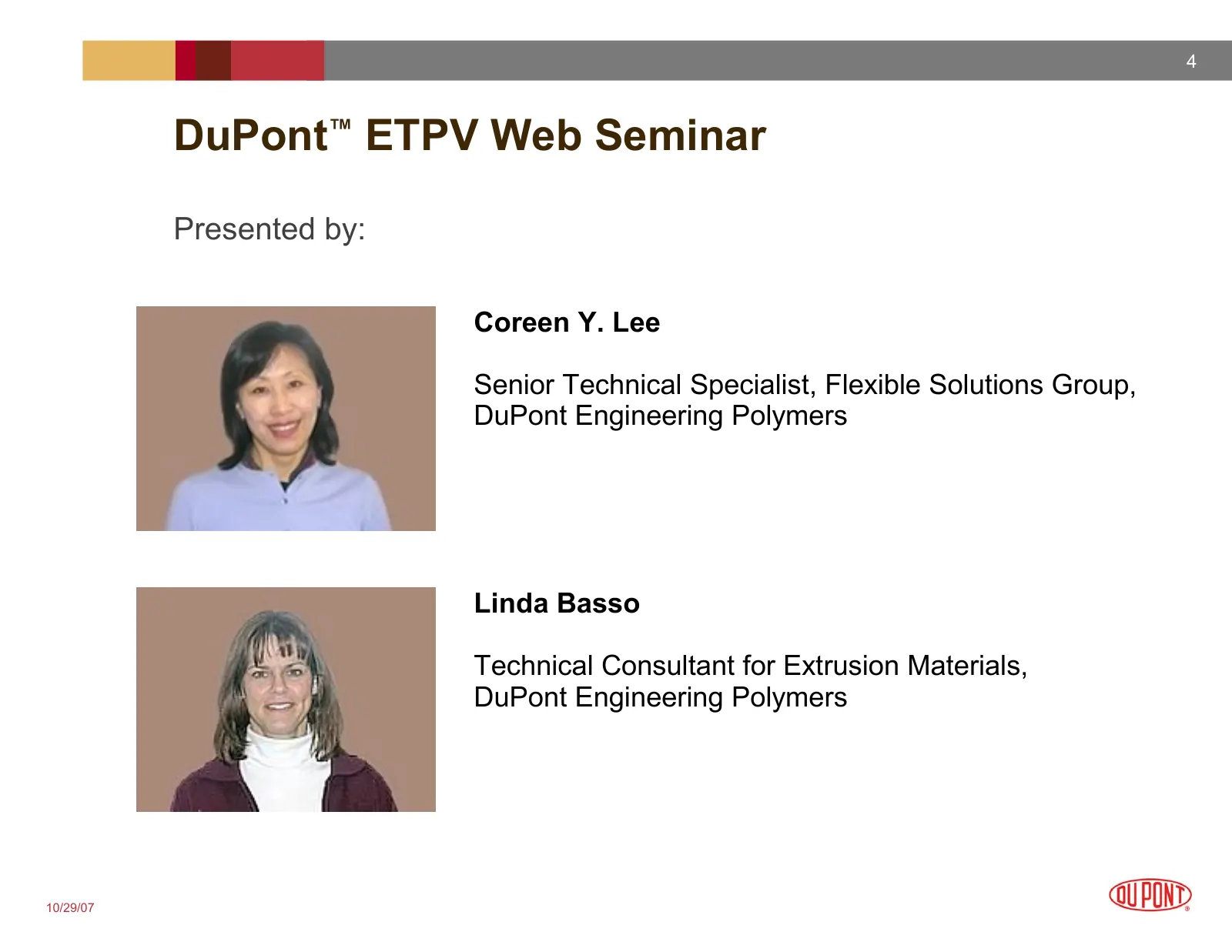
Slide 4: Presented by
4 DuPont™ ETPV Web Seminar Presented by: Coreen Y. Lee Senior Technical Specialist, Flexible Solutions Group, DuPont Engineering Polymers Linda Basso Technical Consultant for Extrusion Materials, DuPont Engineering Polymers 10/29/07
Slide 5: Agenda
5 Agenda 1 Why DuPont™ ETPV 2 Product Line Portfolio and Key Properties 3 Extrusion Processing Considerations 4 DuPont™ ETPV Applications 5 Summary 10/29/07
Slide 6: Why are you interested in DuPont ETPV?
6 Why are you interested in DuPont™ ETPV? Because replacing cross-linked rubber with a thermoplastic material will significantly reduce costs. 10/29/07
Slide 7: DuPont ETPV engineering thermoplastic vulcanizates
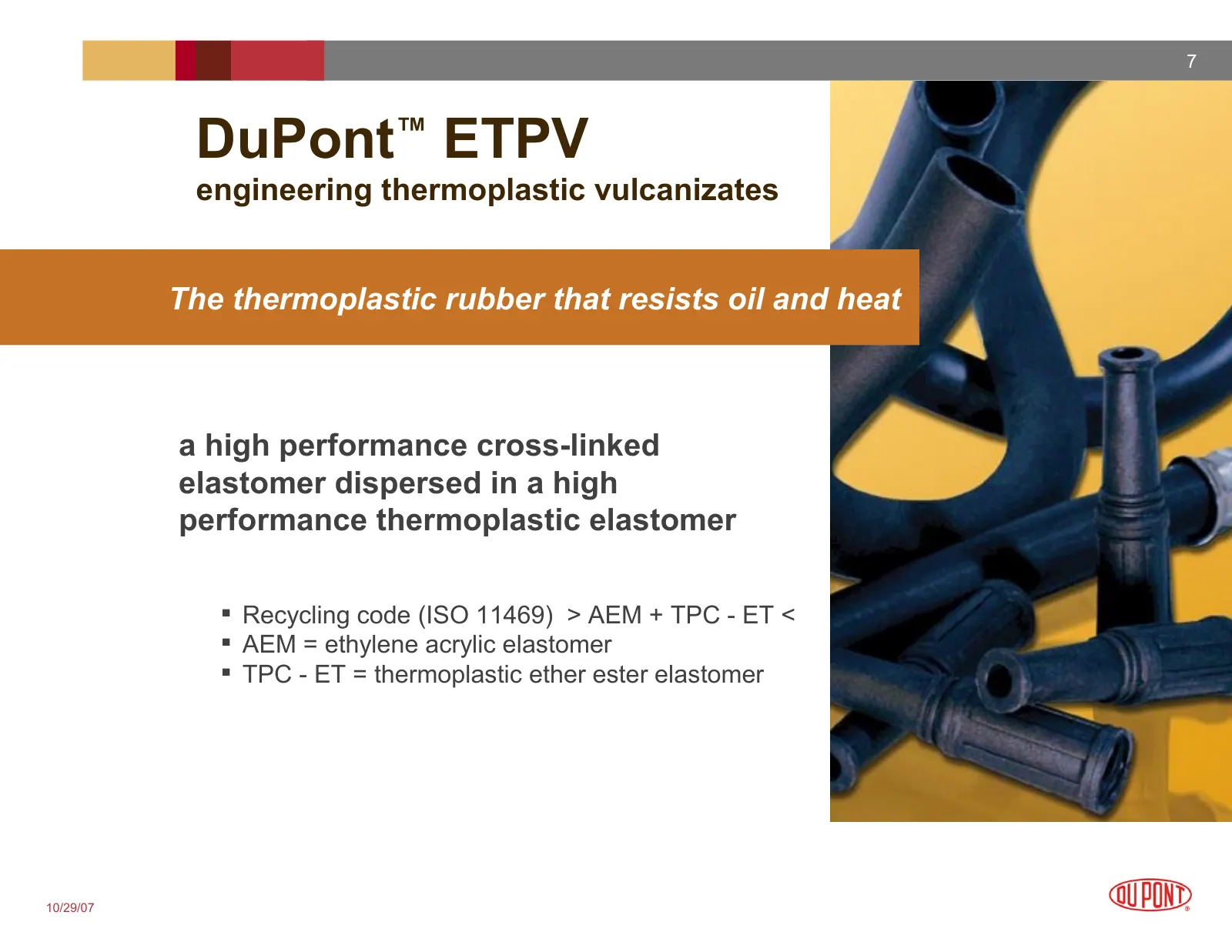
7 DuPont™ ETPV engineering thermoplastic vulcanizates The thermoplastic rubber that resists oil and heat a high performance cross-linked elastomer dispersed in a high performance thermoplastic elastomer Recycling code (ISO 11469) > AEM + TPC - ET < AEM = ethylene acrylic elastomer TPC - ET = t
Slide 8: DuPont ETPV and cross-linked rubbers: heat resistance vs oil swell
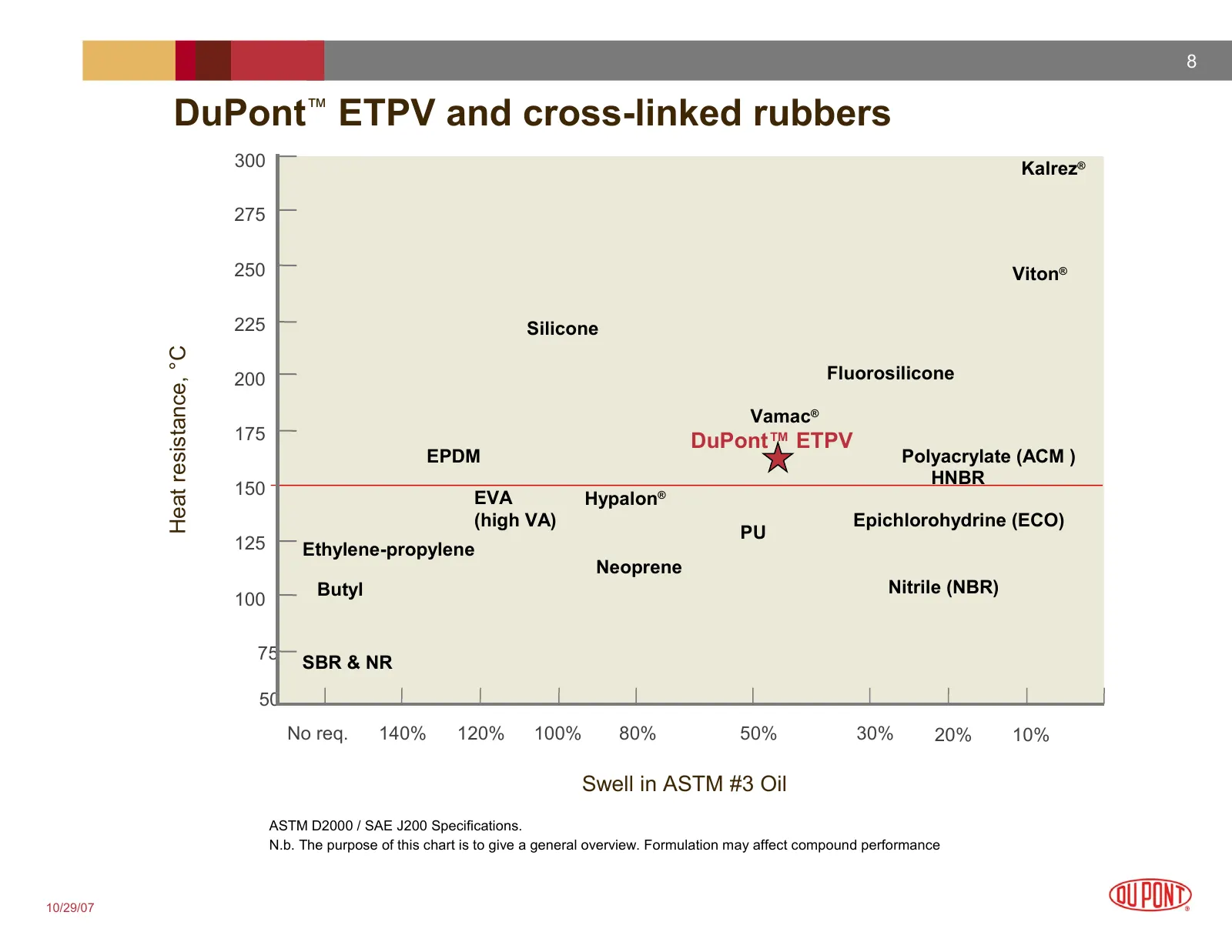
8 DuPont™ ETPV and cross-linked rubbers 300 Kalrez® 275 250 Viton® 225 Silicone Heat resistance, °C 200 Fluorosilicone Vamac® 175 DuPont™ ETPV EPDM Polyacrylate (ACM ) HNBR 150 EVA Hypalon® (high VA) Epichlorohydrine (ECO) PU 125 Ethylene-propylene Neoprene Butyl Nitrile (NBR) 100 75 SBR & NR 50 No
Slide 9: DuPont ETPV: Positioning Vs Rubber
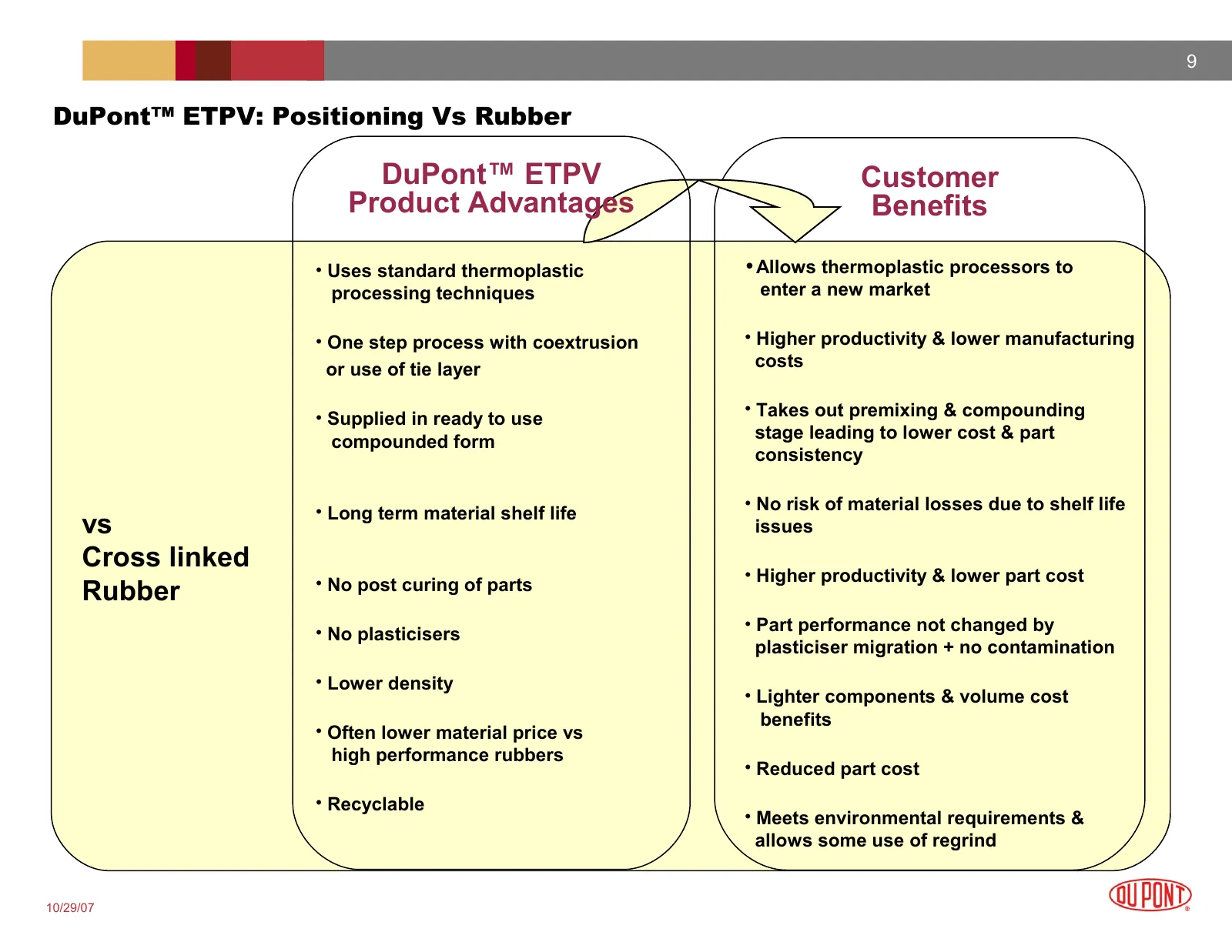
9 DuPont™ ETPV: Positioning Vs Rubber DuPont™ ETPV Customer Product Advantages Benefits • Uses standard thermoplastic • Allows thermoplastic processors to processing techniques enter a new market • One step process with coextrusion • Higher productivity & lower manufacturing or use of tie layer cost
Slide 10: Agenda
10 Agenda 1 Why DuPont™ ETPV 2 Product Line Portfolio and Key Properties 3 Extrusion Processing Considerations 4 DuPont™ ETPV Applications 5 Summary 10/29/07
Slide 11: Product Line
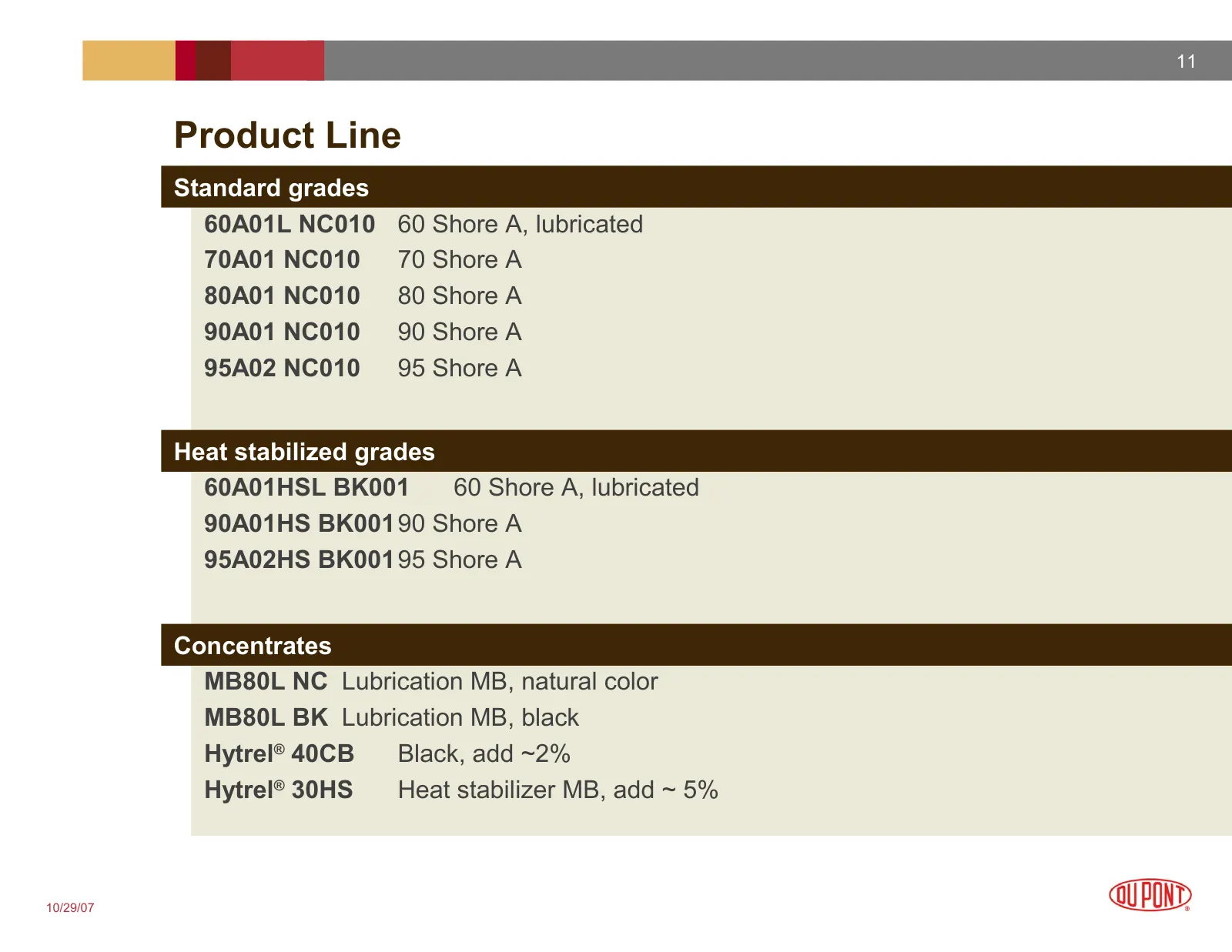
11 Product Line Standard grades 60A01L NC010 60 Shore A, lubricated 70A01 NC010 70 Shore A 80A01 NC010 80 Shore A 90A01 NC010 90 Shore A 95A02 NC010 95 Shore A Heat stabilized grades 60A01HSL BK001 60 Shore A, lubricated 90A01HS BK001 90 Shore A 95A02HS BK001 95 Shore A Concentrates MB80L NC Lubrica
Slide 12: Elongation at break retention, air oven aging
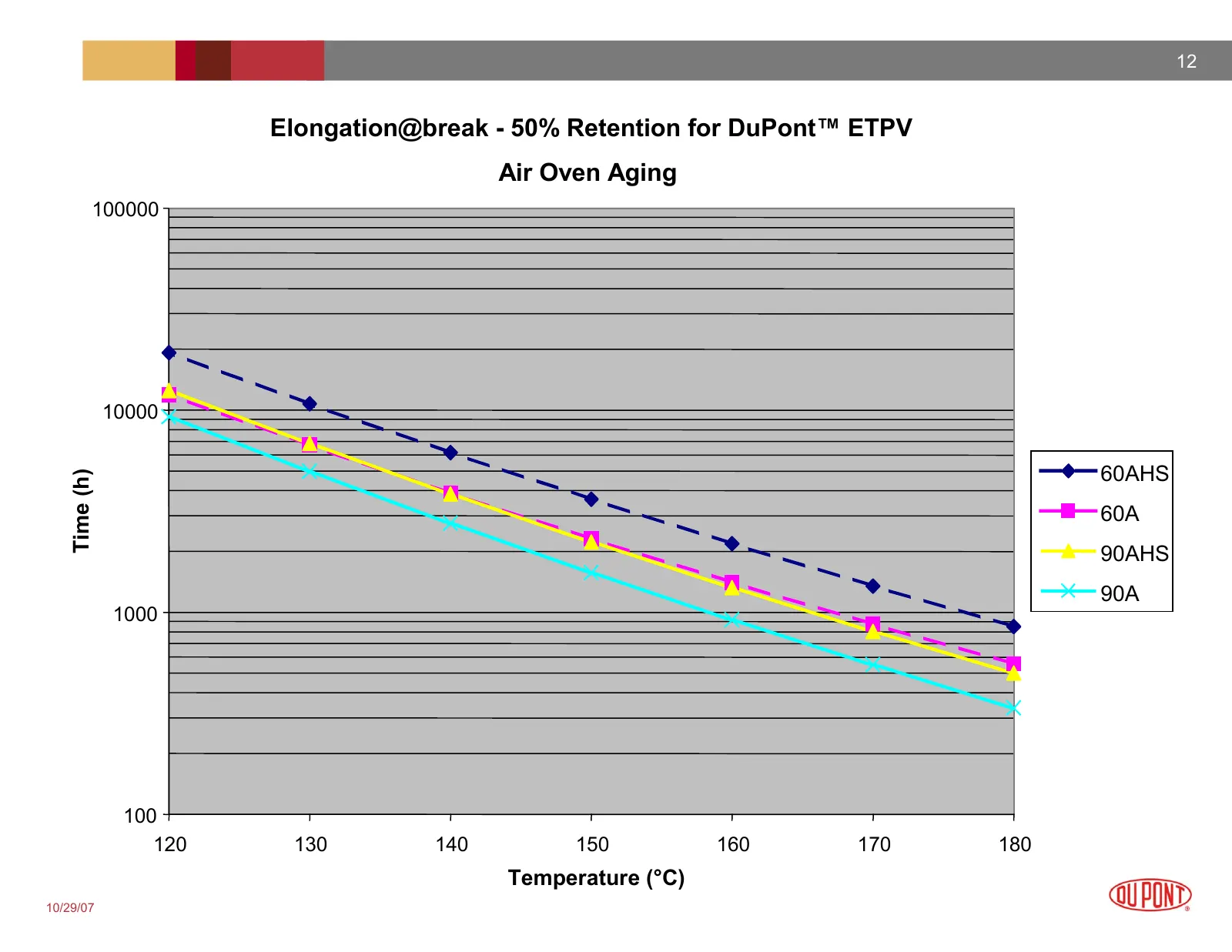
12 Elongation@break - 50% Retention for DuPont™ ETPV Air Oven Aging 100000 10000 60AHS Time (h) 60A 90AHS 90A 1000 100 120 130 140 150 160 170 180 Temperature (°C) 10/29/07
Slide 13: ASTM#1 Oil Aging at 150°C
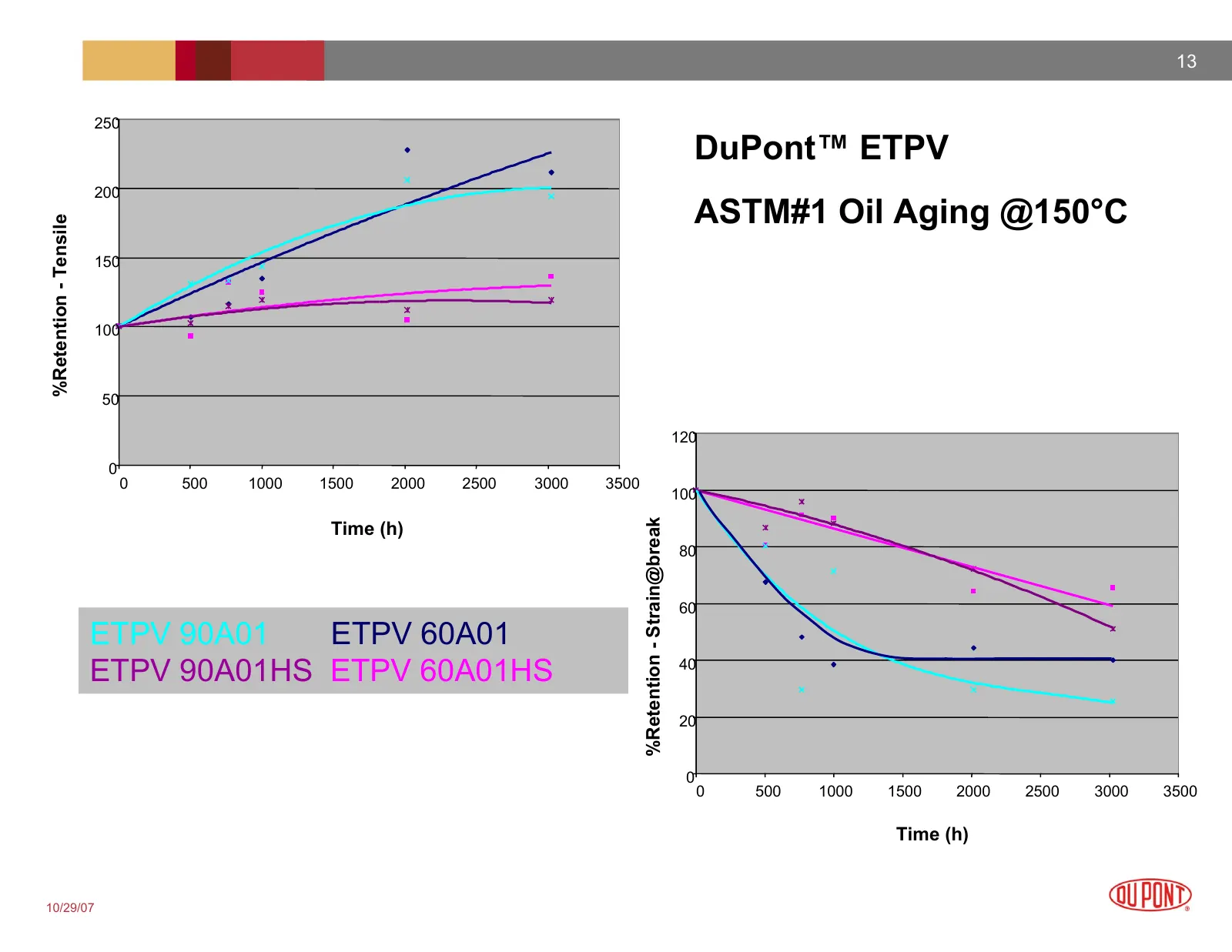
13 250 DuPont™ ETPV 200 ASTM#1 Oil Aging @150°C %Retention - Tensile 150 100 50 120 0 0 500 1000 1500 2000 2500 3000 3500 100 %Retention - Strain@break Time (h) 80 60 ETPV 90A01 ETPV 60A01 ETPV 90A01HS ETPV 60A01HS 40 20 0 0 500 1000 1500 2000 2500 3000 3500 Time (h) 10/29/07
Slide 14: IRM903 Oil Aging at 150°C
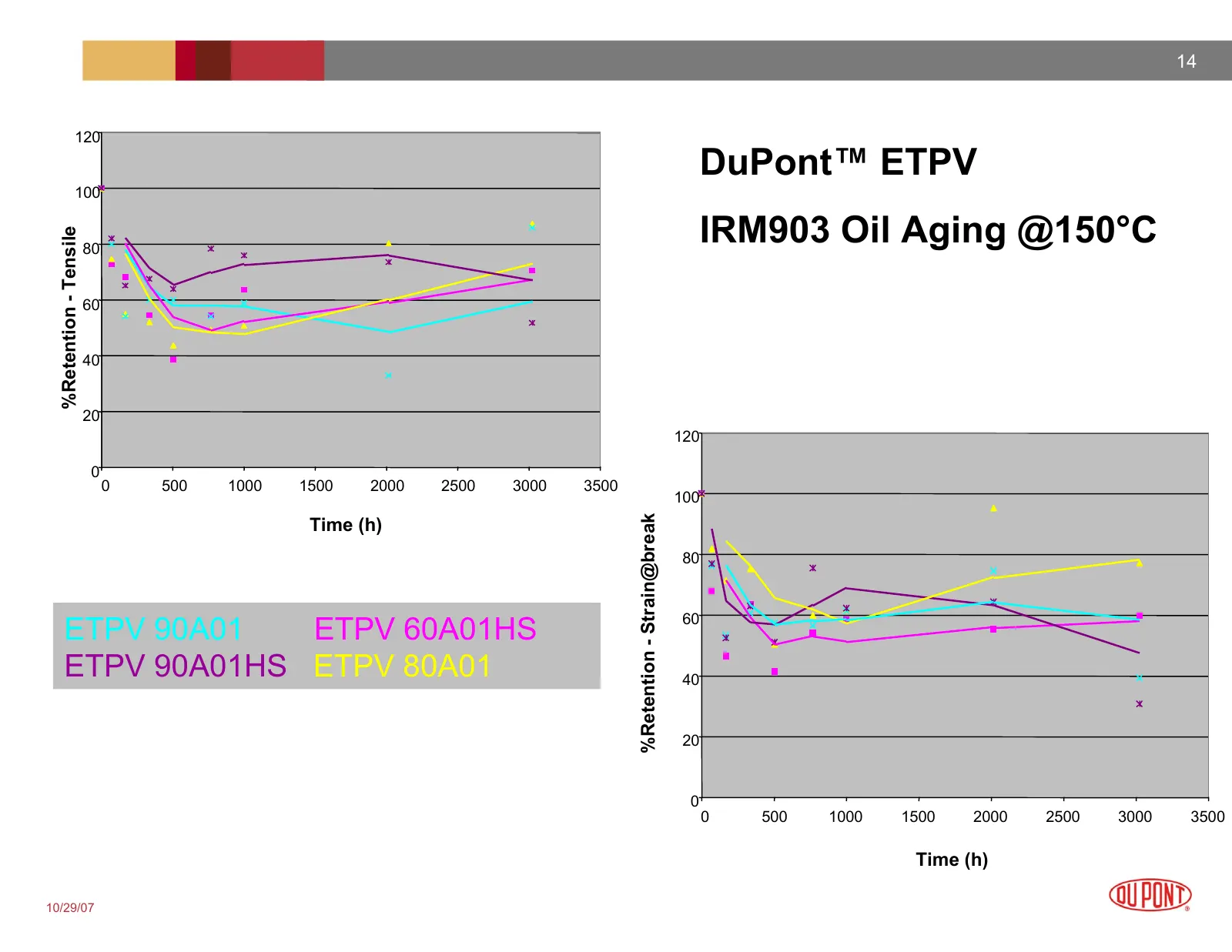
14 120 DuPont™ ETPV 100 IRM903 Oil Aging @150°C %Retention - Tensile 80 60 40 20 120 0 0 500 1000 1500 2000 2500 3000 3500 100 %Retention - Strain@break Time (h) 80 60 ETPV 90A01 ETPV 60A01HS ETPV 90A01HS ETPV 80A01 40 20 0 0 500 1000 1500 2000 2500 3000 3500 Time (h) 10/29/07
Slide 15: Part Design—Adhesion
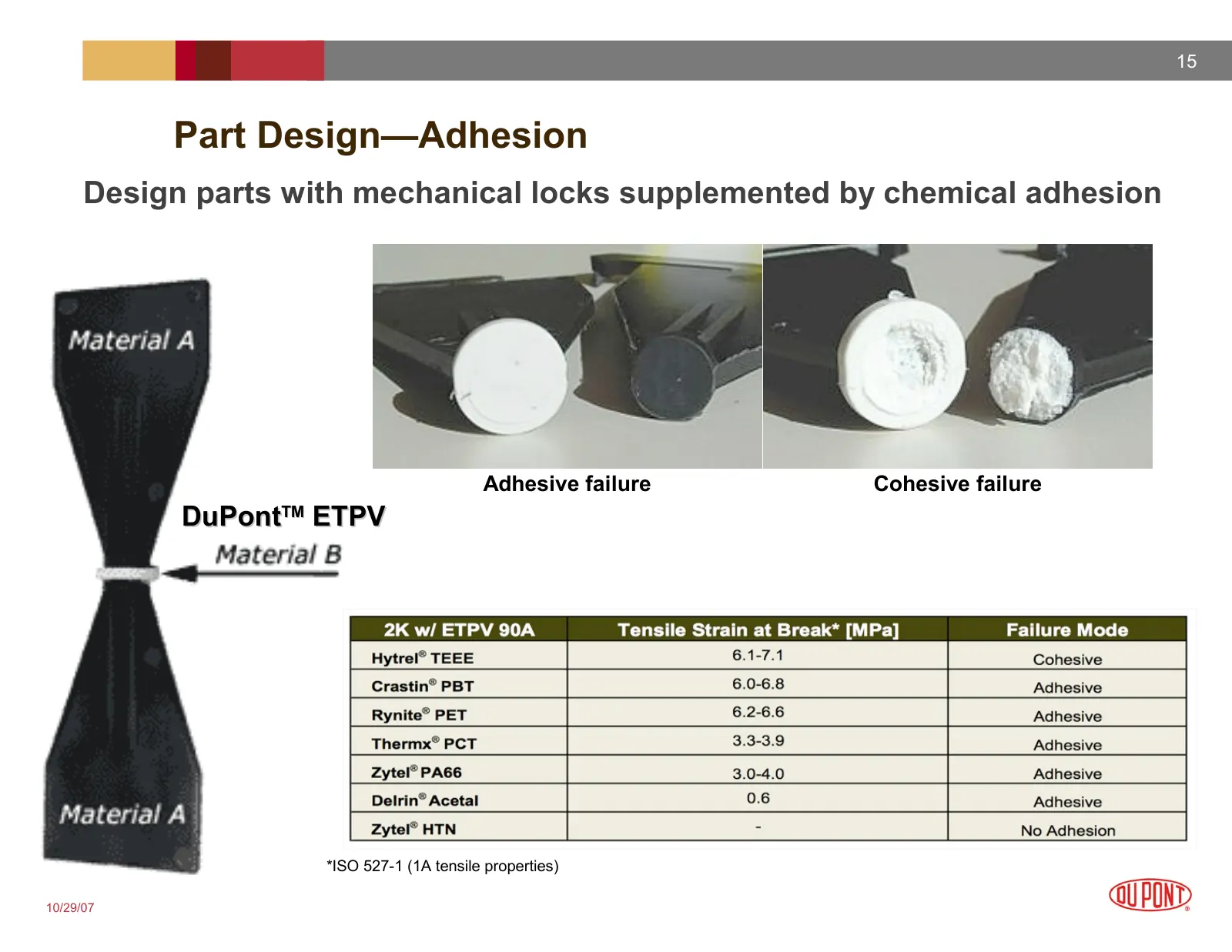
15 Part Design—Adhesion Design parts with mechanical locks supplemented by chemical adhesion Adhesive failure Cohesive failure DuPontTM ETPV *ISO 527-1 (1A tensile properties) 10/29/07
Slide 16: Co-extrusion possibilities with DuPont ETPV
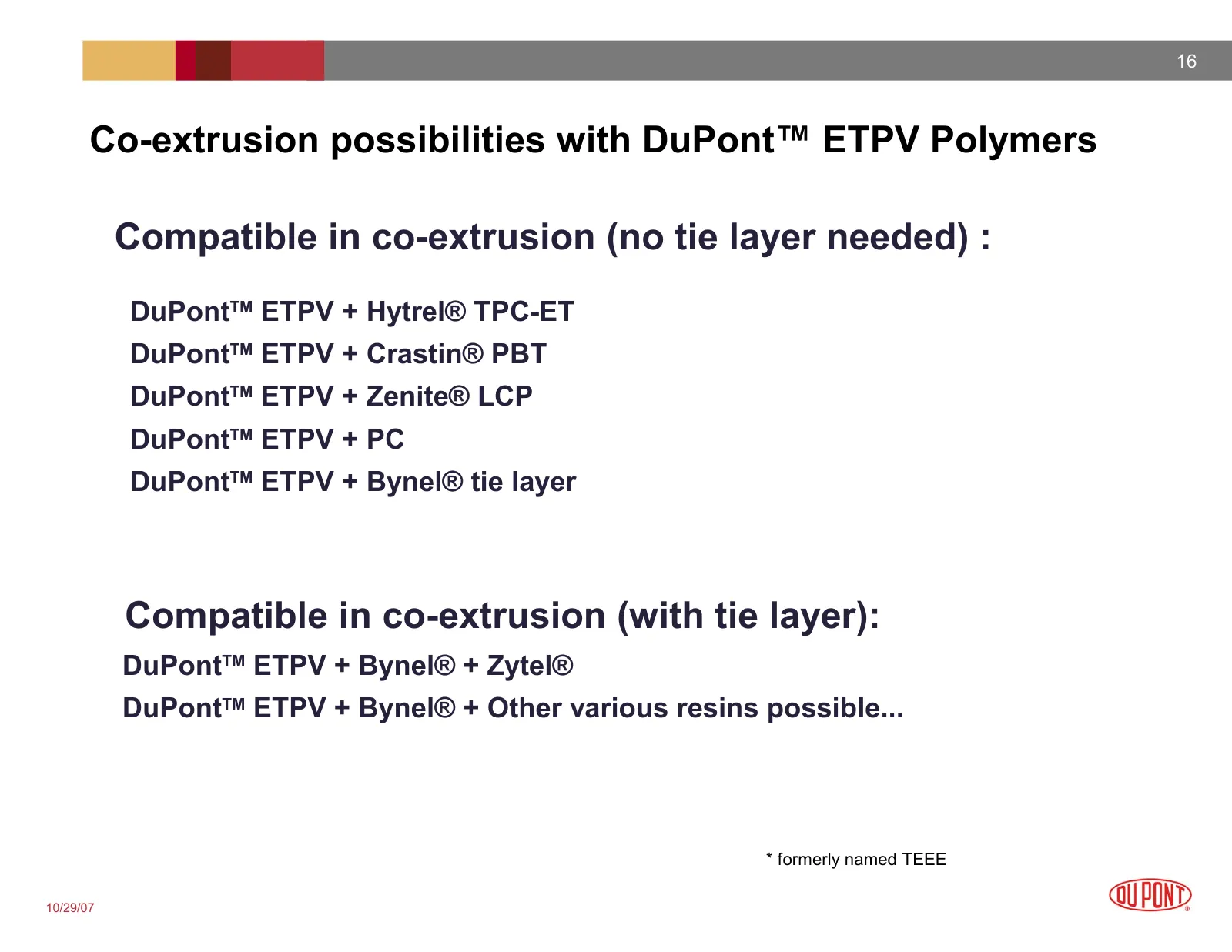
16 Co-extrusion possibilities with DuPont™ ETPV Polymers Compatible in co-extrusion (no tie layer needed) : DuPontTM ETPV + Hytrel® TPC-ET DuPontTM ETPV + Crastin® PBT DuPontTM ETPV + Zenite® LCP DuPontTM ETPV + PC DuPontTM ETPV + Bynel® tie layer Compatible in co-extrusion (with tie layer): DuPontT
Slide 17: Multi-layer extrusion - Sketch of process
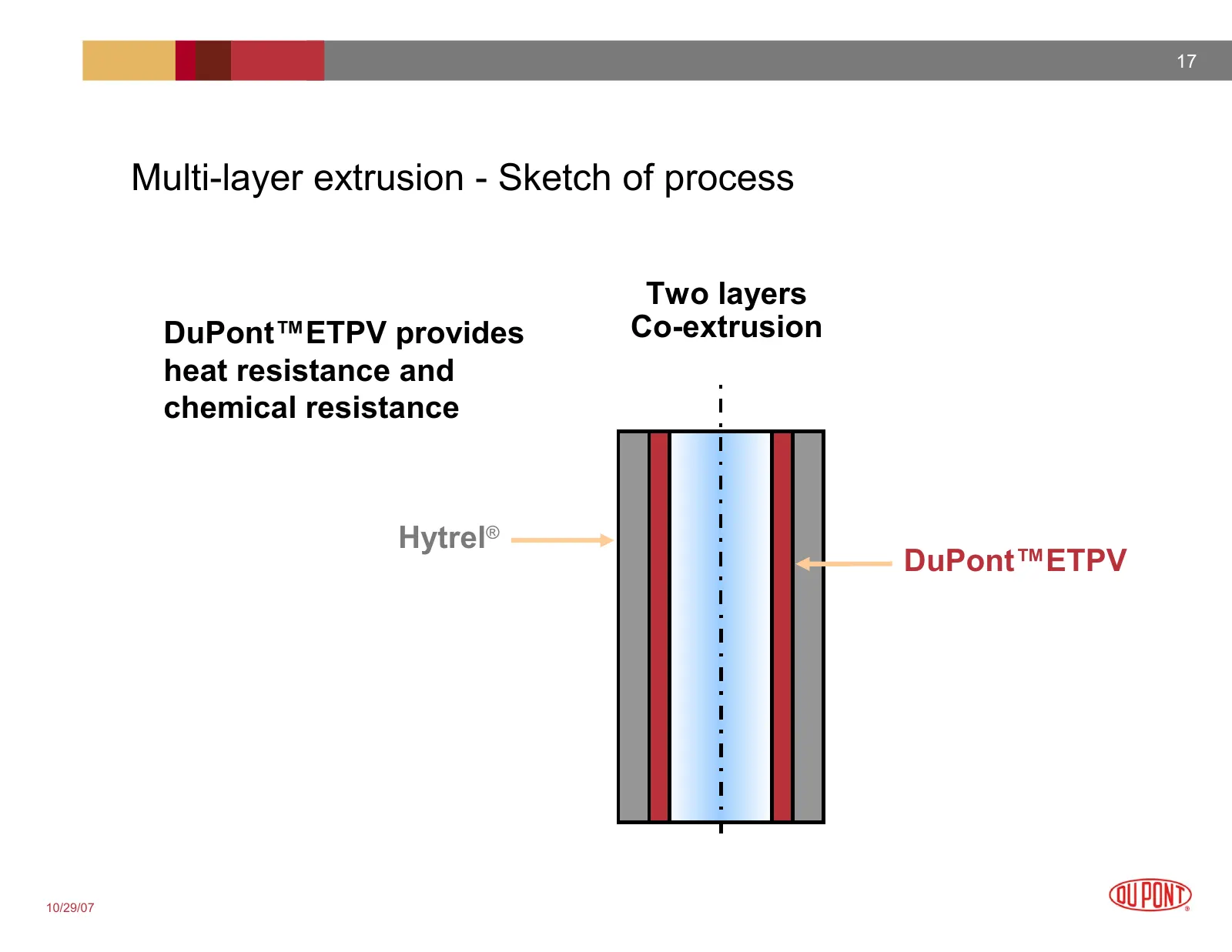
17 Multi-layer extrusion - Sketch of process Two layers DuPont™ETPV provides Co-extrusion heat resistance and chemical resistance Hytrel® DuPont™ETPV 10/29/07

Slide 18: Agenda
18 Agenda 1 Why DuPont™ ETPV 2 Product Line Portfolio and Key Properties 3 Extrusion Processing Considerations 4 DuPont™ ETPV Applications 5 Summary 10/29/07
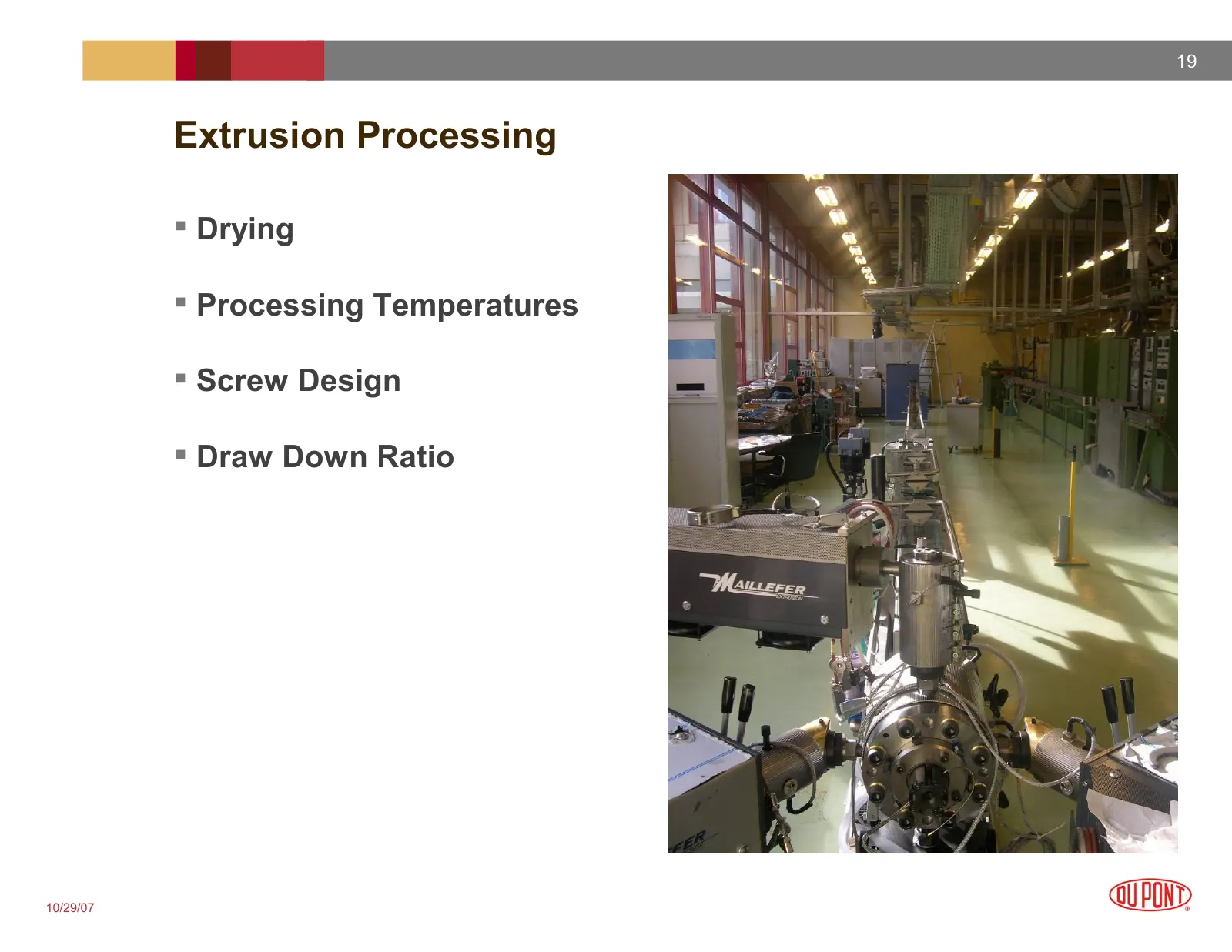
Slide 19: Extrusion Processing
19 Extrusion Processing Drying Processing Temperatures Screw Design Draw Down Ratio 10/29/07
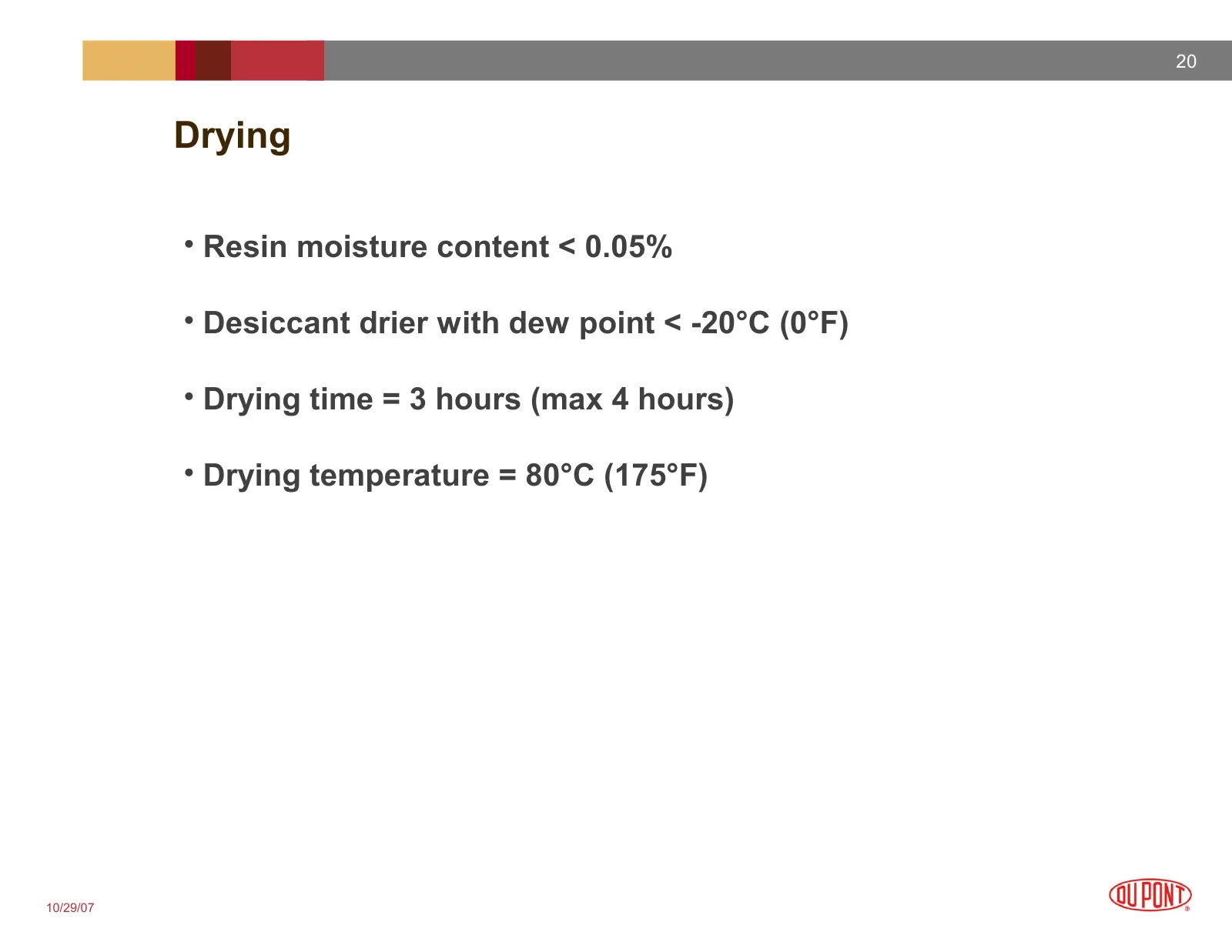
Slide 20: Drying
20 Drying • Resin moisture content < 0.05% • Desiccant drier with dew point < -20°C (0°F) • Drying time = 3 hours (max 4 hours) • Drying temperature = 80°C (175°F) 10/29/07
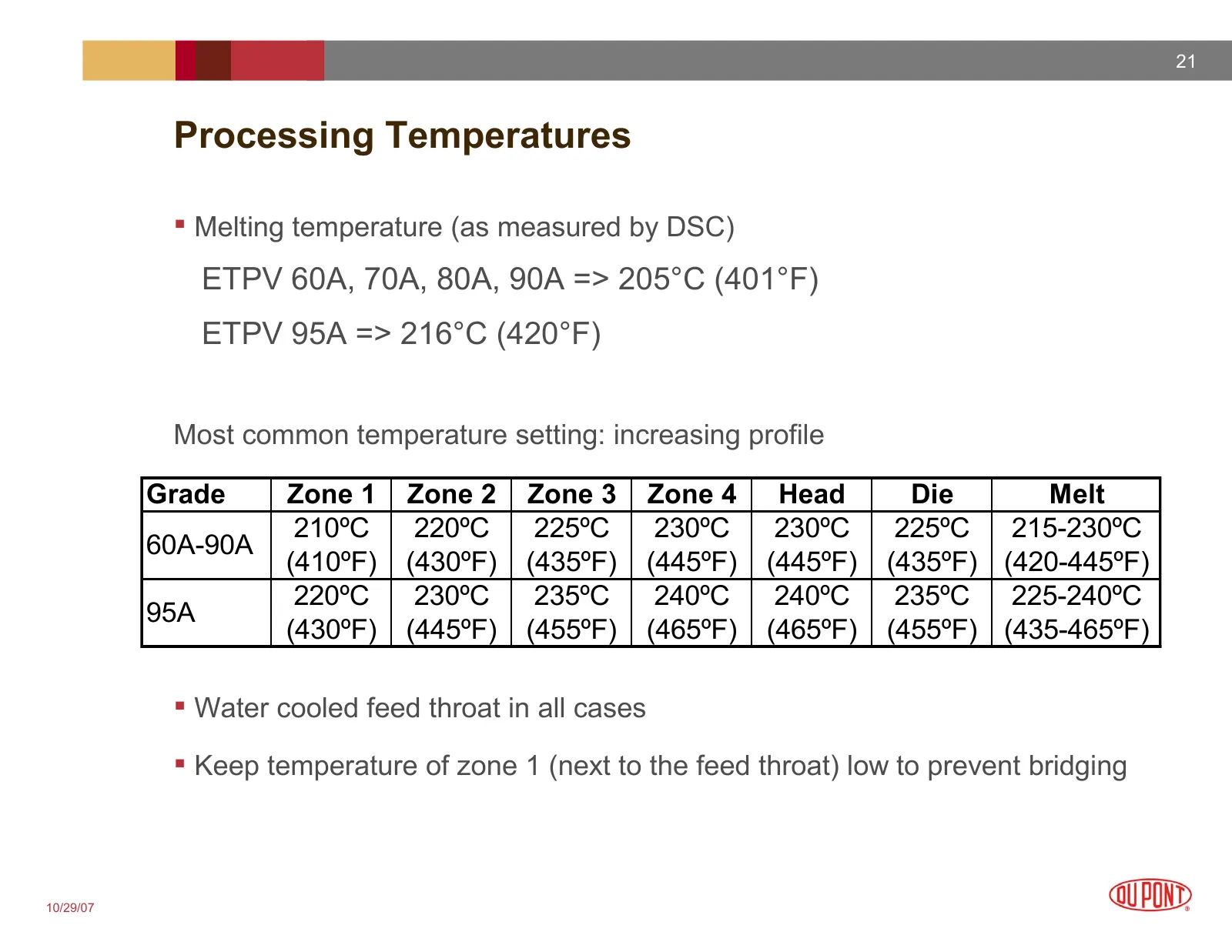
Slide 21: Processing Temperatures
21 Processing Temperatures Melting temperature (as measured by DSC) ETPV 60A, 70A, 80A, 90A => 205°C (401°F) ETPV 95A => 216°C (420°F) Most common temperature setting: increasing profile Grade Zone 1 Zone 2 Zone 3 Zone 4 Head Die Melt 210ºC 220ºC 225ºC 230ºC 230ºC 225ºC 215-230ºC 60A-90A (410ºF) (
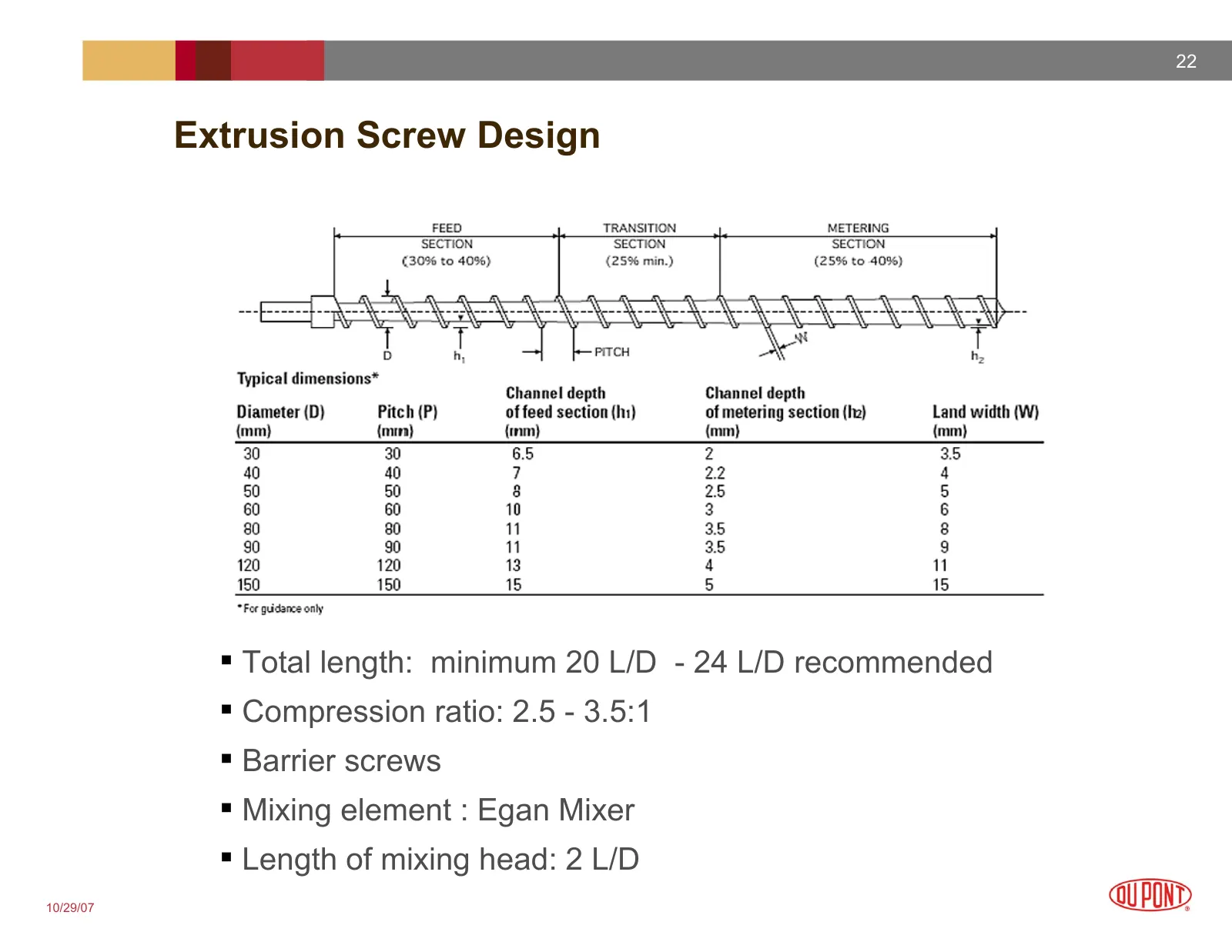
Slide 22: Extrusion Screw Design
22 Extrusion Screw Design Total length: minimum 20 L/D - 24 L/D recommended Compression ratio: 2.5 - 3.5:1 Barrier screws Mixing element : Egan Mixer Length of mixing head: 2 L/D 10/29/07
Slide 23: Processing – Draw Down Ratio
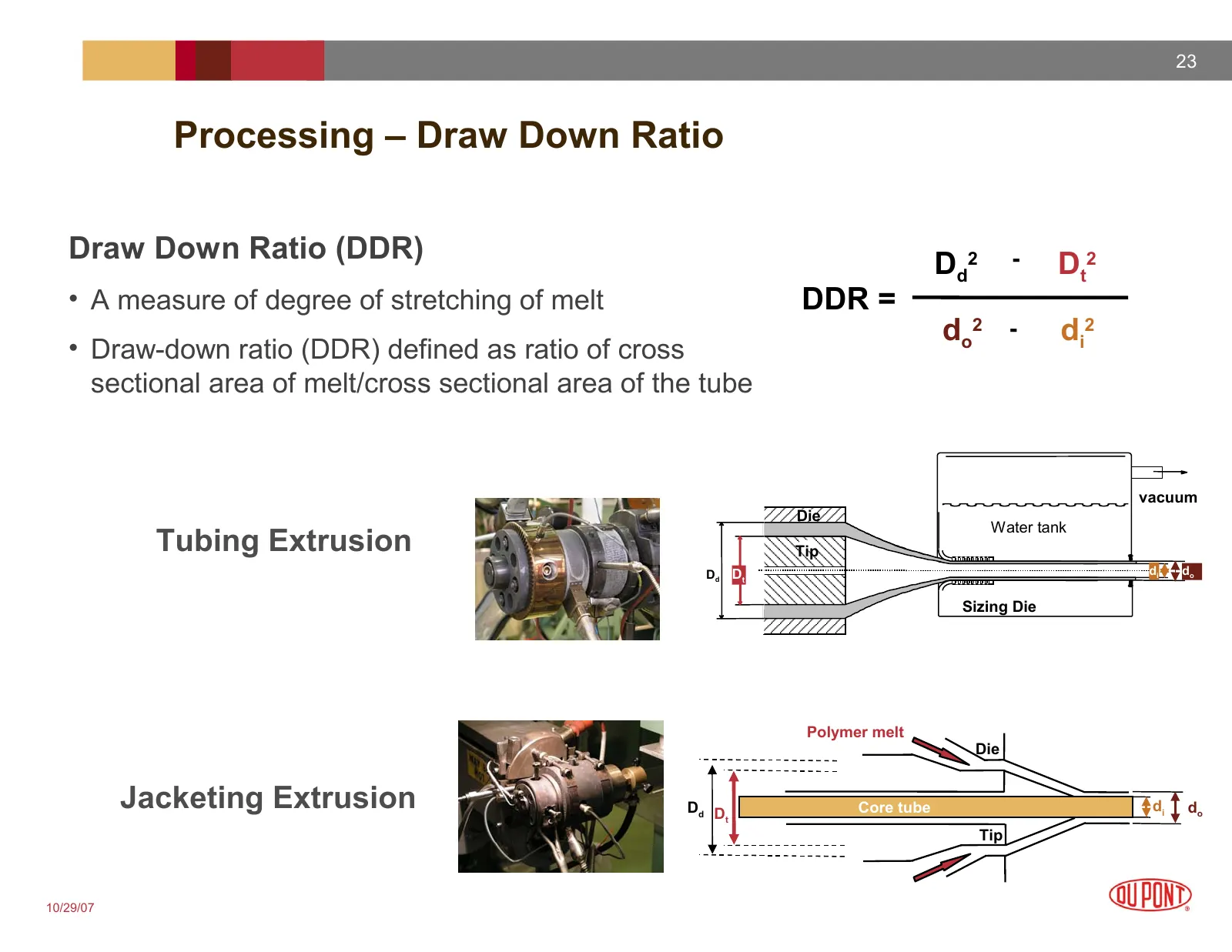
23 Processing – Draw Down Ratio Draw Down Ratio (DDR) D d2 - Dt2 • A measure of degree of stretching of melt DDR = do2 - di2 • Draw-down ratio (DDR) defined as ratio of cross sectional area of melt/cross sectional area of the tube vacuum Die Water tank Tubing Extrusion Tip D d Dt di do Sizing Die Po
Slide 24: Processing – Draw Down Ratio
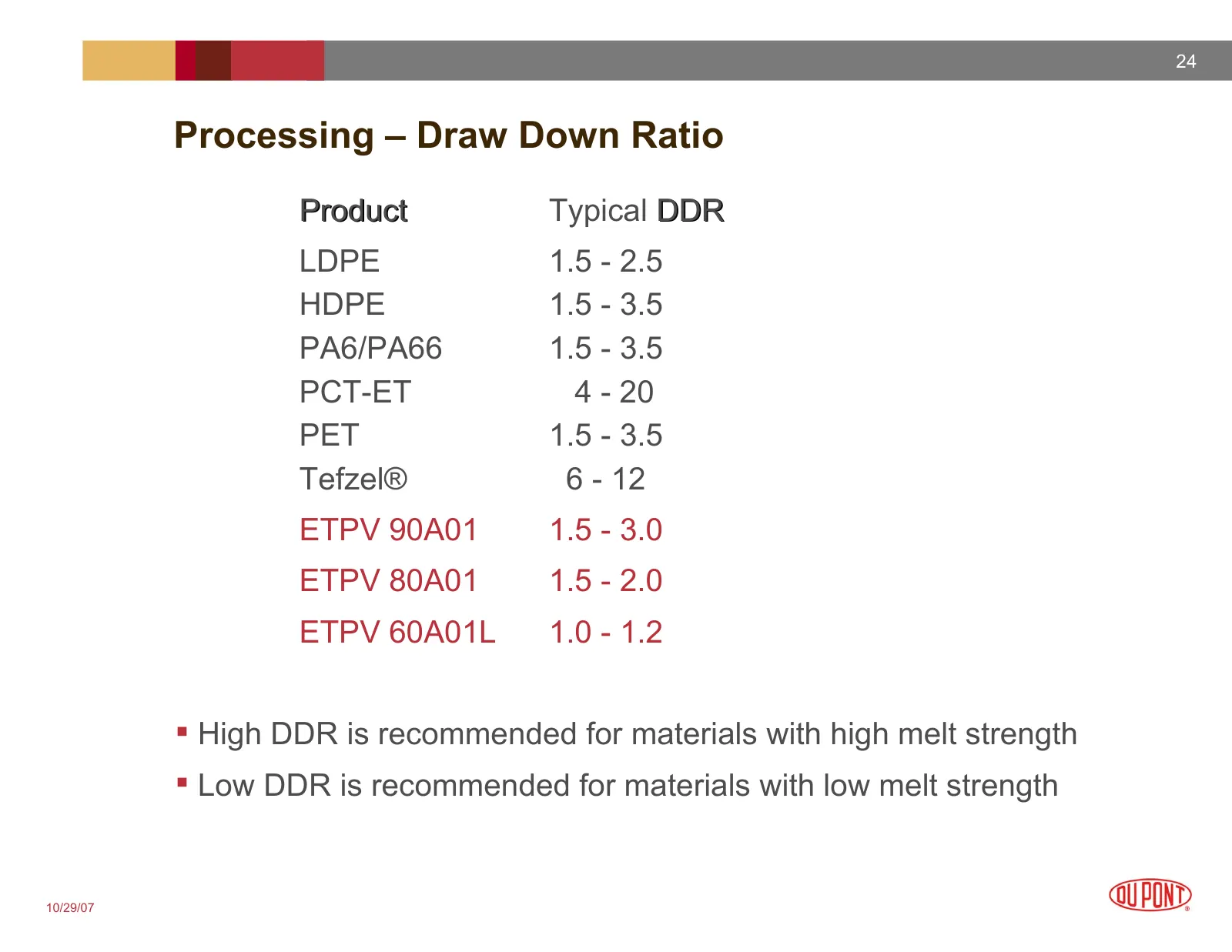
24 Processing – Draw Down Ratio Product Typical DDR LDPE 1.5 - 2.5 HDPE 1.5 - 3.5 PA6/PA66 1.5 - 3.5 PCT-ET 4 - 20 PET 1.5 - 3.5 Tefzel® 6 - 12 ETPV 90A01 1.5 - 3.0 ETPV 80A01 1.5 - 2.0 ETPV 60A01L 1.0 - 1.2 High DDR is recommended for materials with high melt strength Low DDR is recommended for
Slide 25: DuPont ETPV in Extrusion
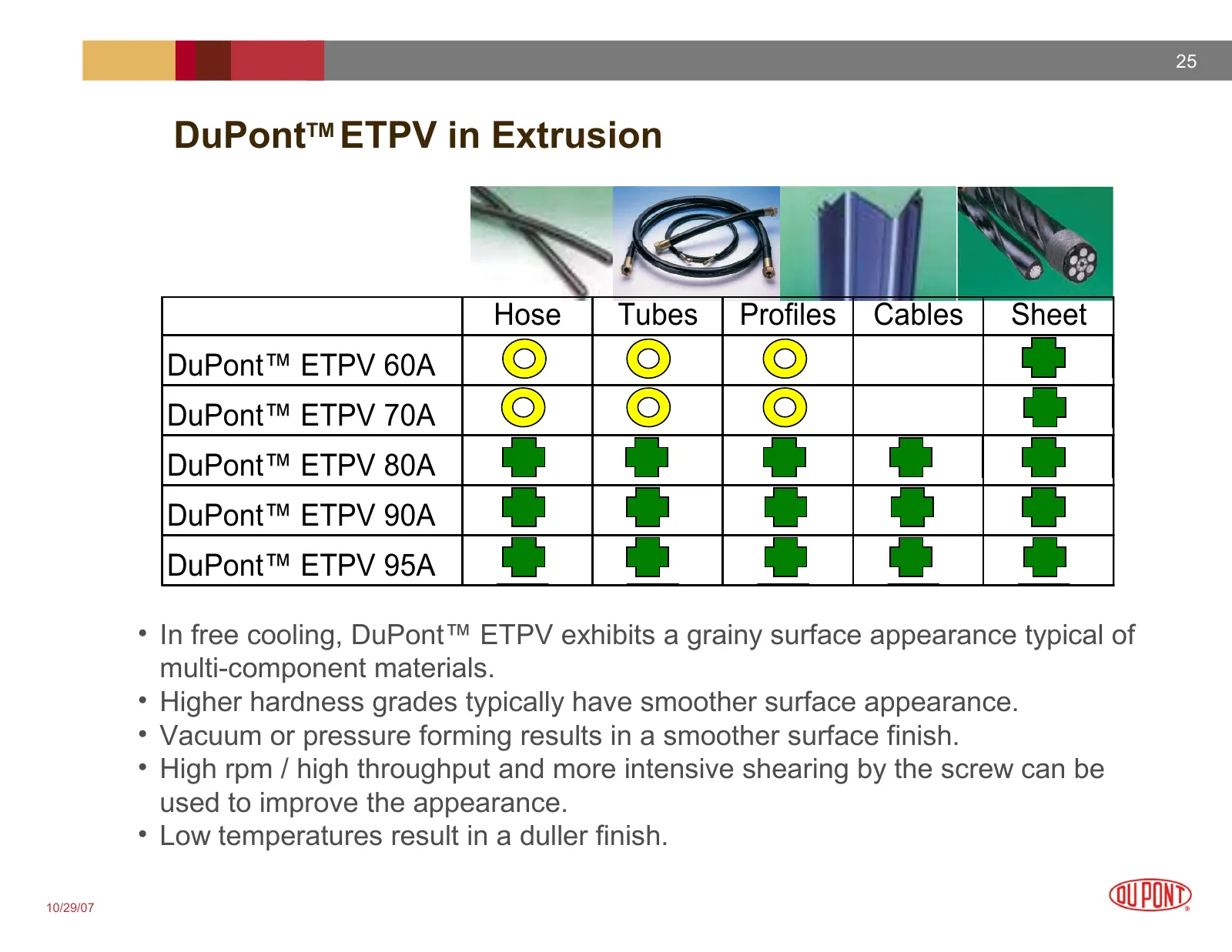
25 DuPontTM ETPV in Extrusion Hose Tubes Profiles Cables Sheet DuPont™ ETPV 60A DuPont™ ETPV 70A DuPont™ ETPV 80A DuPont™ ETPV 90A DuPont™ ETPV 95A • In free cooling, DuPont™ ETPV exhibits a grainy surface appearance typical of multi-component materials. • Higher hardness grades typically have smoot
Slide 26: Agenda
26 Agenda 1 Why DuPont™ ETPV 2 Product Line Portfolio and Key Properties 3 Extrusion Processing Considerations 4 DuPont™ ETPV Applications 5 Summary 10/29/07
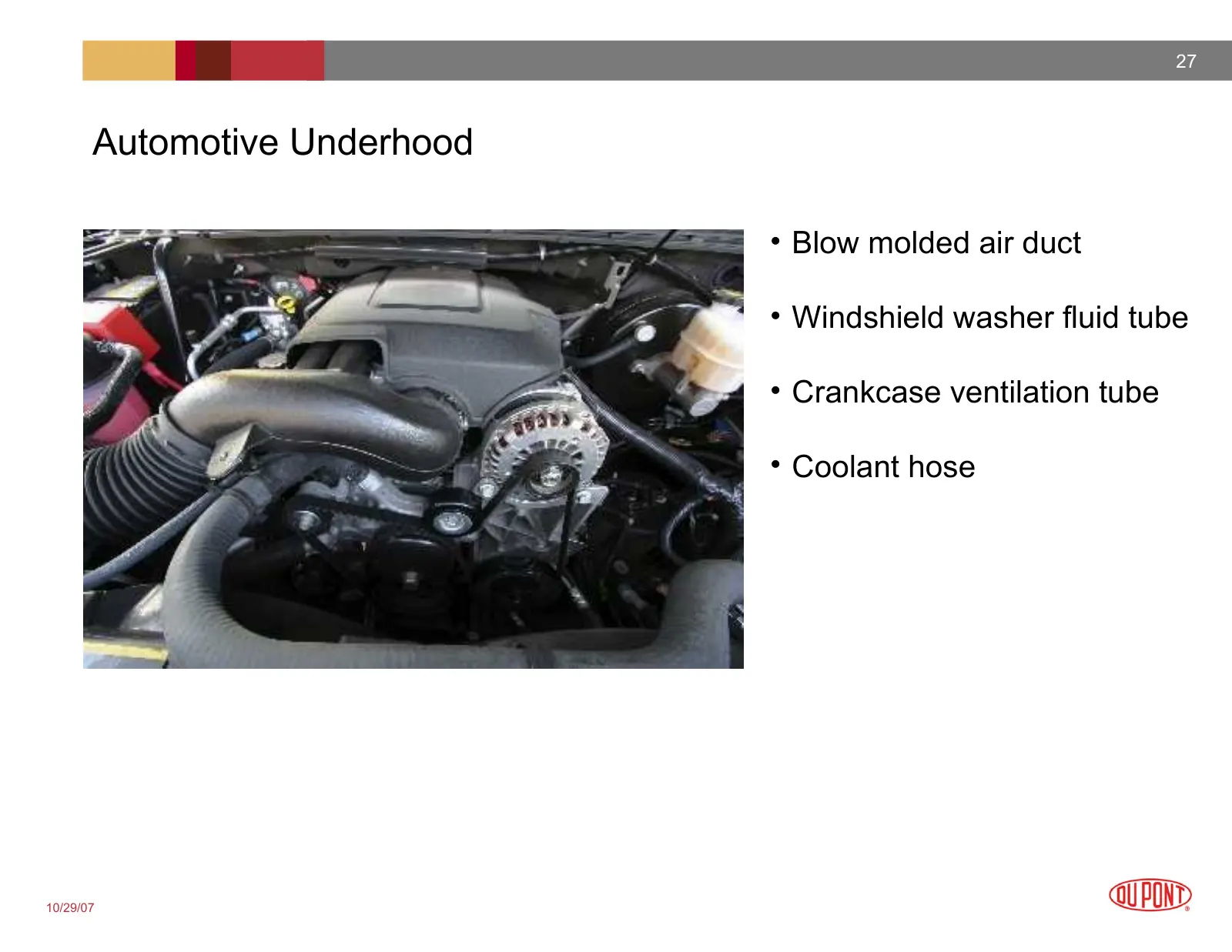
Slide 27: Automotive Underhood
27 Automotive Underhood • Blow molded air duct • Windshield washer fluid tube • Crankcase ventilation tube • Coolant hose 10/29/07
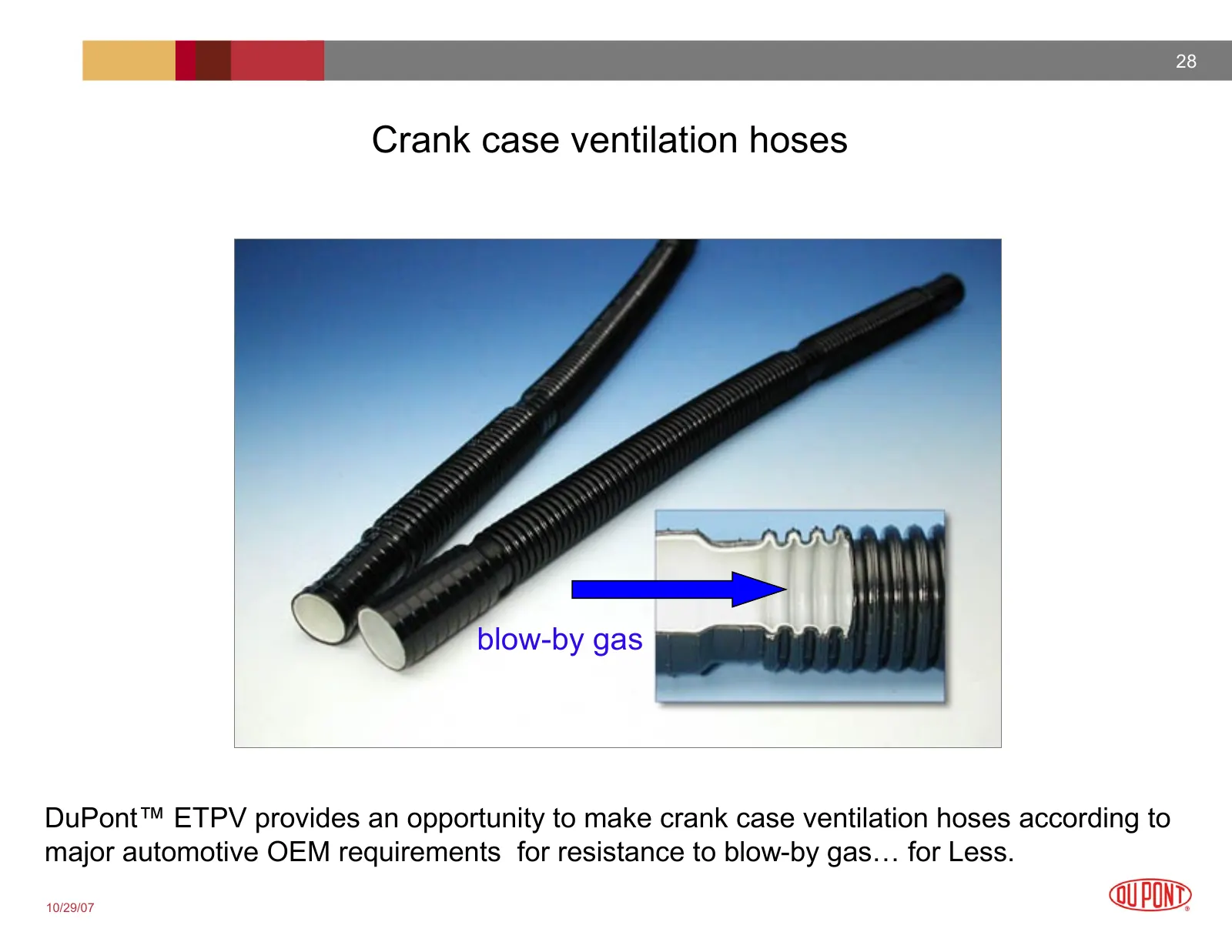
Slide 28: Crank case ventilation hoses
28 Crank case ventilation hoses blow-by gas DuPont™ ETPV provides an opportunity to make crank case ventilation hoses according to major automotive OEM requirements for resistance to blow-by gas… for Less. 10/29/07
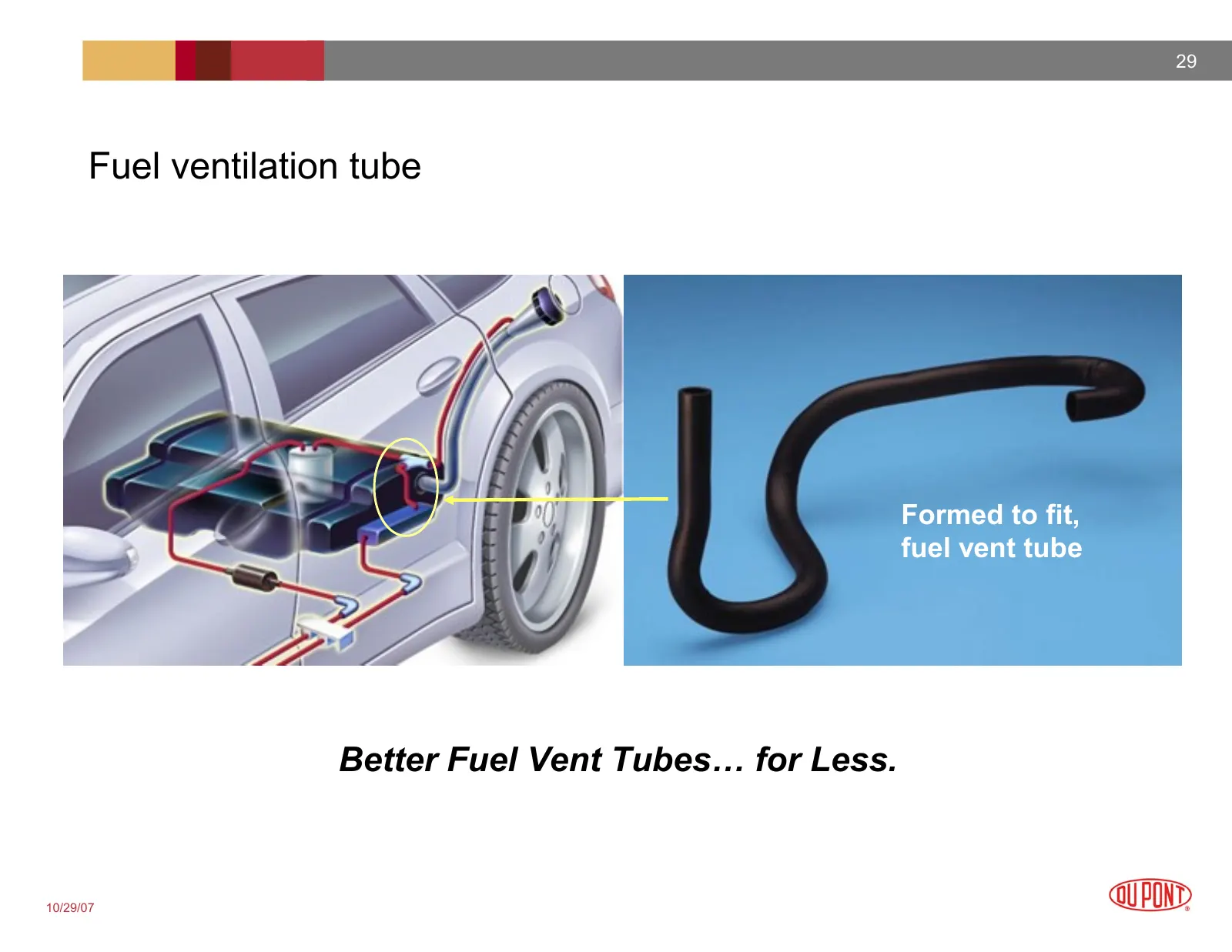
Slide 29: Fuel ventilation tube
29 Fuel ventilation tube Formed to fit, fuel vent tube Better Fuel Vent Tubes… for Less. 10/29/07
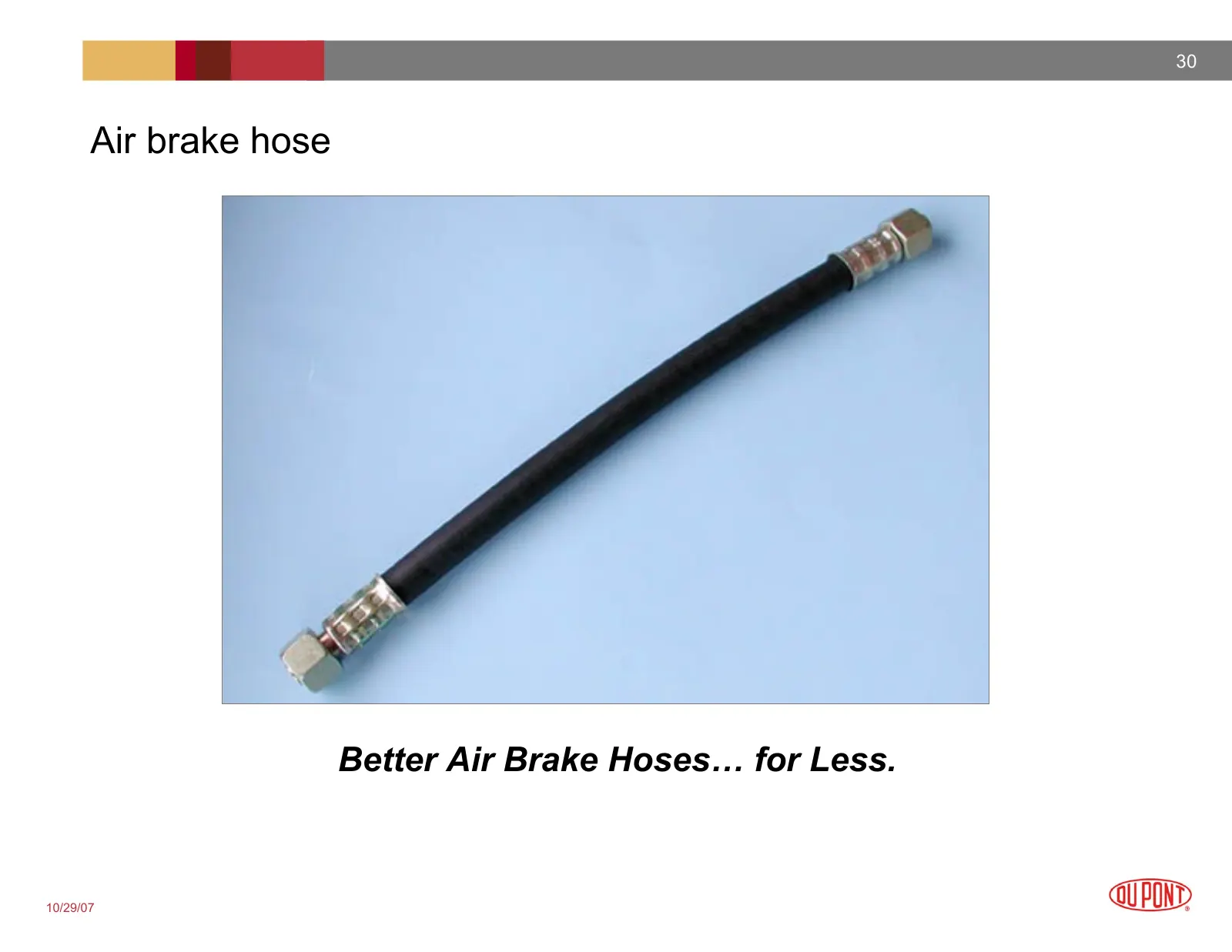
Slide 30: Air brake hose
30 Air brake hose Better Air Brake Hoses… for Less. 10/29/07
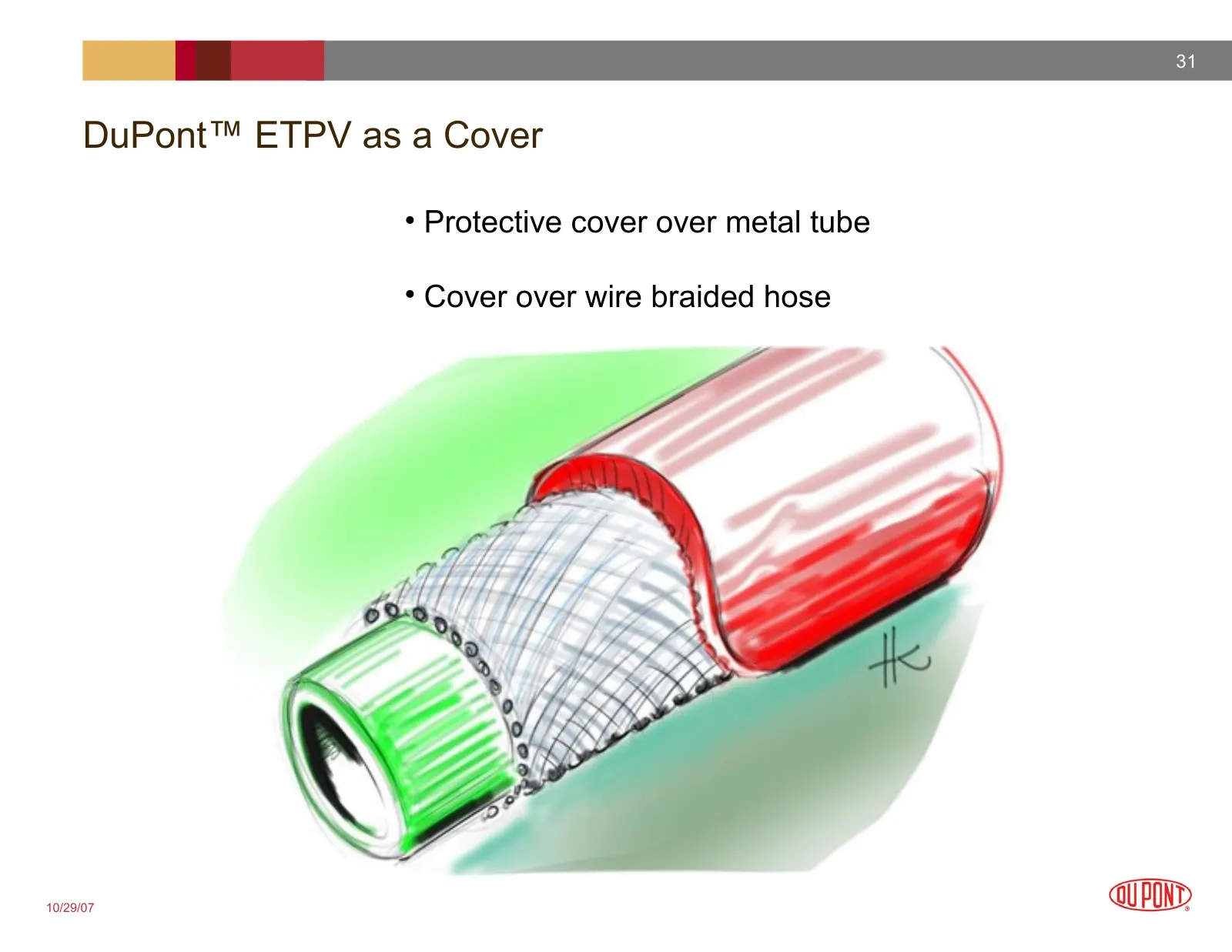
Slide 31: DuPont ETPV as a Cover
31 DuPont™ ETPV as a Cover • Protective cover over metal tube • Cover over wire braided hose 10/29/07
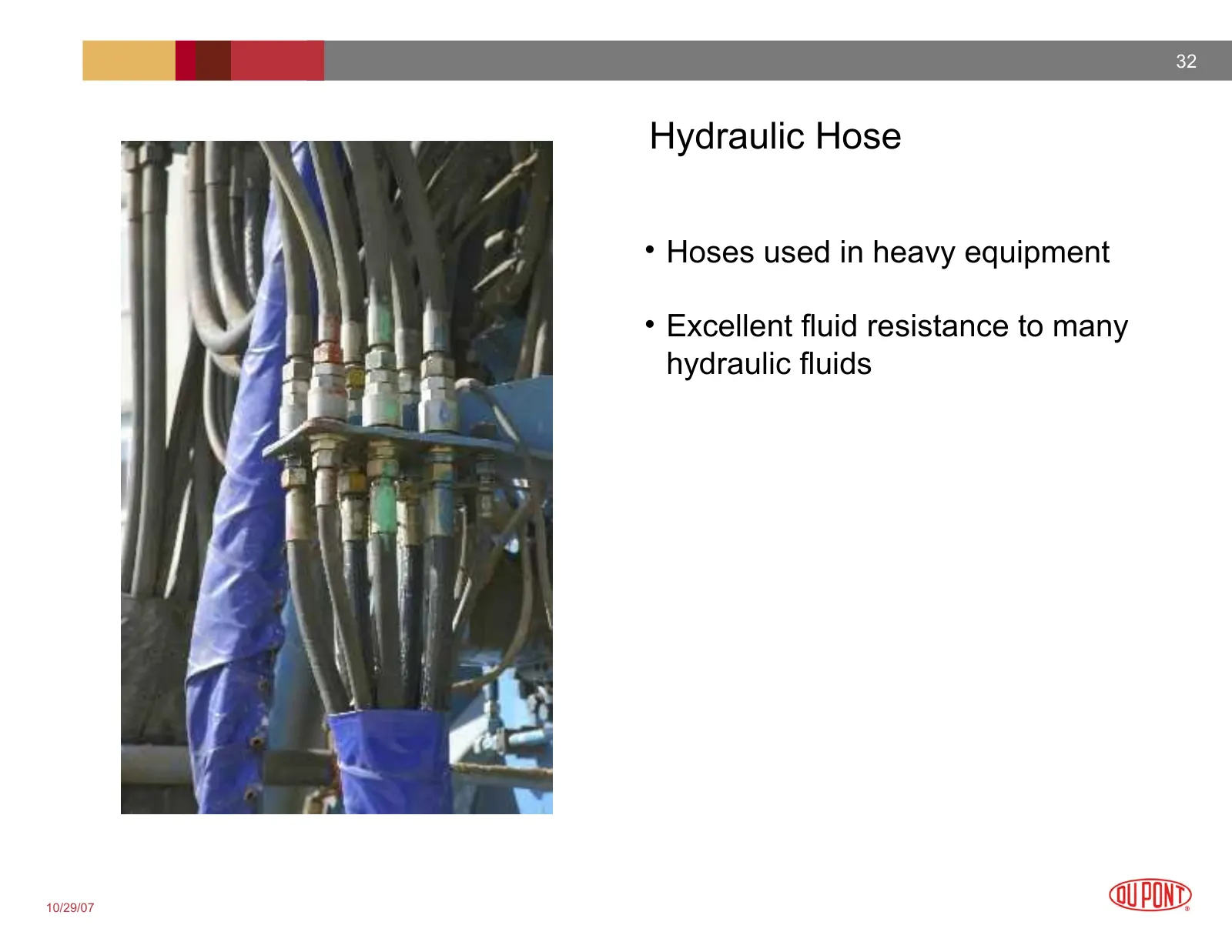
Slide 32: Hydraulic Hose
32 Hydraulic Hose • Hoses used in heavy equipment • Excellent fluid resistance to many hydraulic fluids 10/29/07
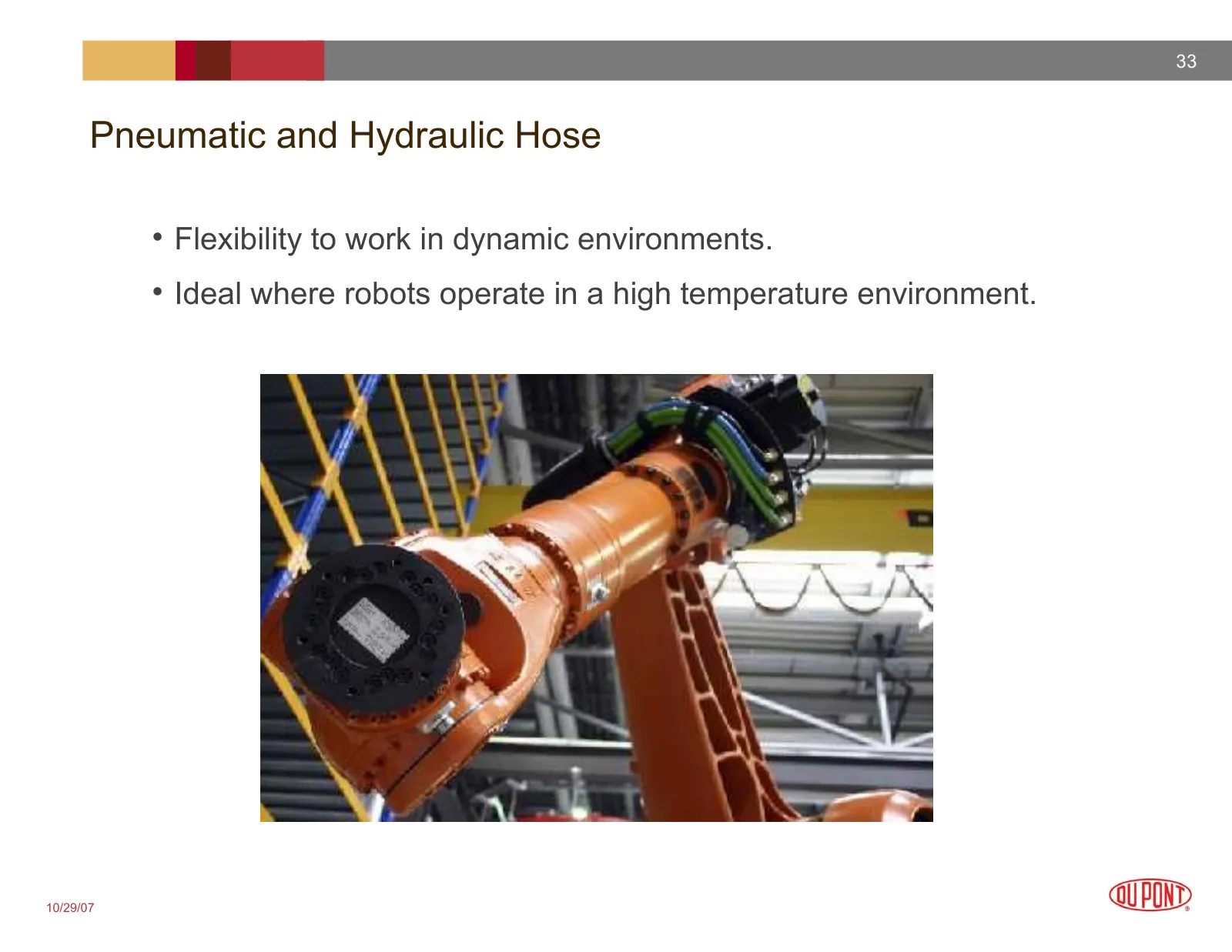
Slide 33: Pneumatic and Hydraulic Hose
33 Pneumatic and Hydraulic Hose Flexibility to work in dynamic environments. Ideal where robots operate in a high temperature environment. 10/29/07
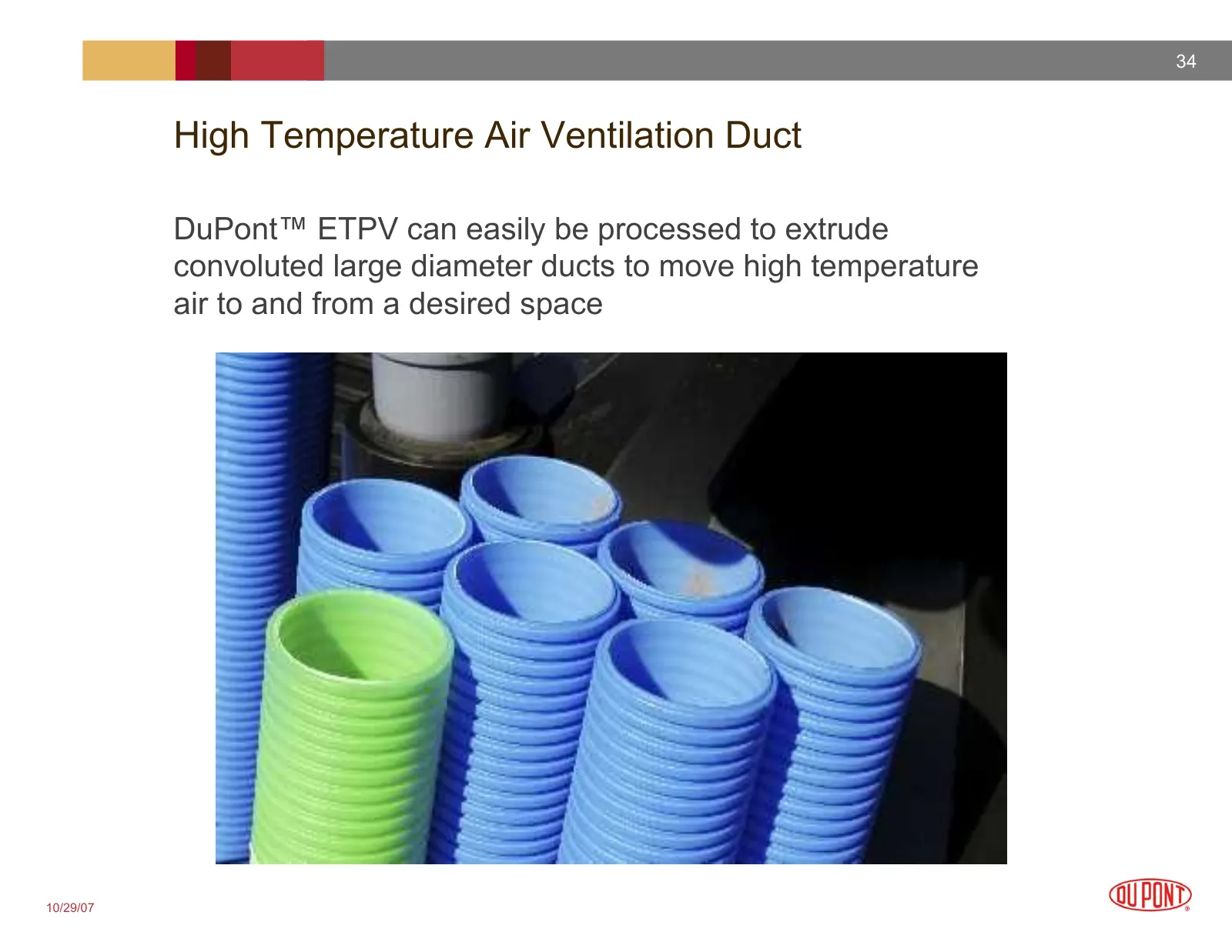
Slide 34: High Temperature Air Ventilation Duct
34 High Temperature Air Ventilation Duct DuPont™ ETPV can easily be processed to extrude convoluted large diameter ducts to move high temperature air to and from a desired space 10/29/07
Slide 35: DuPont ETPV for Profile
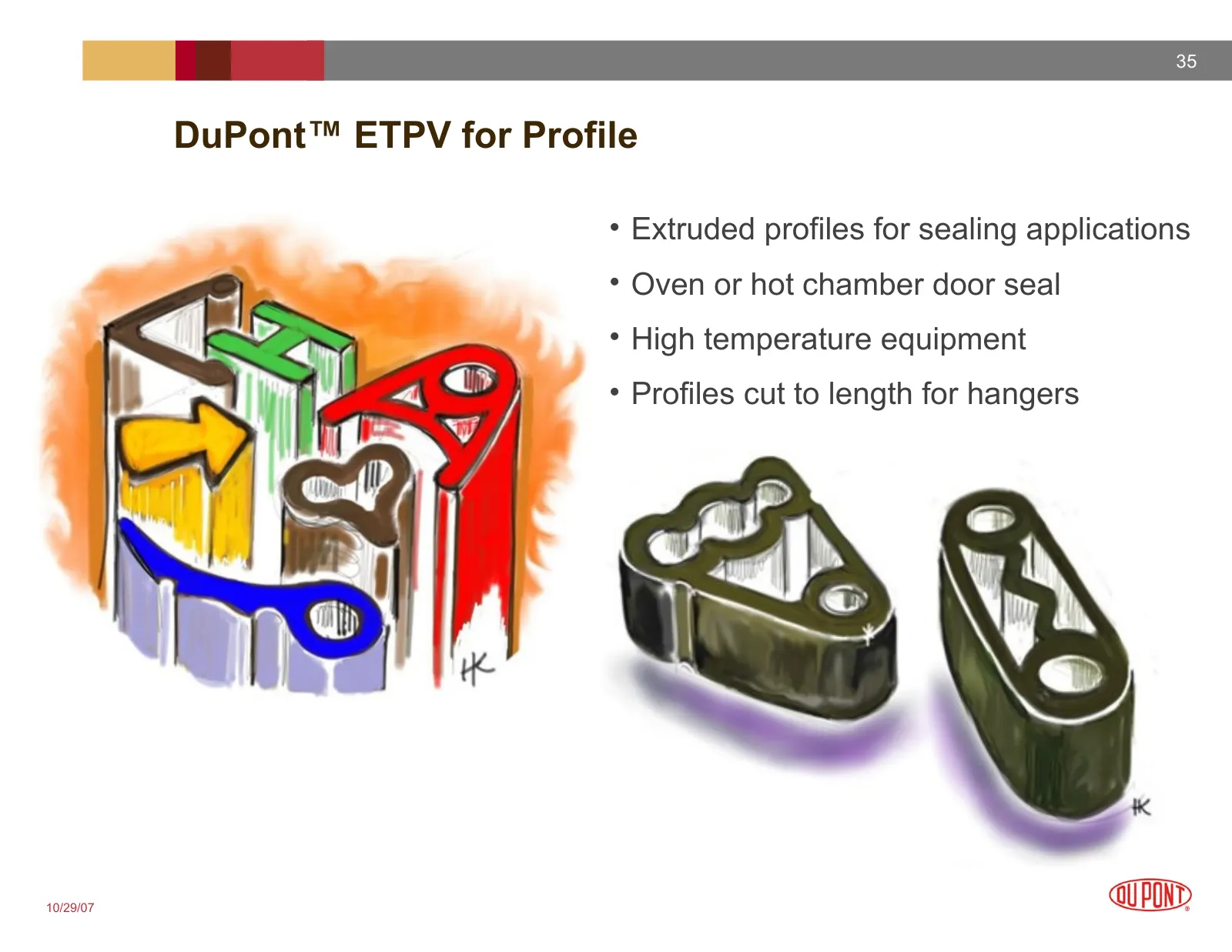
35 DuPont™ ETPV for Profile • Extruded profiles for sealing applications • Oven or hot chamber door seal • High temperature equipment • Profiles cut to length for hangers 10/29/07
Slide 36: Summary
36 Summary DuPontTM ETPV and its unique set of high temperature and oil resistance properties, offers opportunities to expand your product portfolio. Benefits of DuPont™ ETPV Product Portfolio Extrusion Tips Examples of applications Maximize opportunity for program success… engage your DuPont re

Slide 37: Thank you for joining us today
37 Thank you for joining us today. Please send in any questions using the Q&A function. We will be answering questions for the rest of the hour. Depending on demand, we may not be able to answer your question straight away. All questions will be logged and any questions unanswered at the end of the
Slide 38: Copyright and trademarks
38 Copyright © 2007 DuPont or its affiliates. All rights reserved. The DuPont Oval Logo, DuPont™, The miracles of science™, Kalrez®, Viton®, Vamac®, Hypalon®, Hytrel®, Crastin®, Rynite®, Thermx®, Zytel®, and Delrin® are registered trademarks or trademarks of DuPont or its affiliates. 10/29/07

Slide 39: The miracles of science
The miracles of science 10/29/07
Source: Internet Archive copy of plastics.dupont.com
More decks from DuPont de Nemours, Inc.
 Q3 2026 Earnings Presentation23 slides · Nov 3, 2026
 Q2 2026 Earnings Presentation23 slides · Aug 4, 2026
 Q1 2026 Earnings Presentation26 slides · May 5, 2026
 Q4 2025 Earnings Presentation27 slides · Feb 10, 2026
 Q3 2025 Earnings Presentation24 slides · Nov 6, 2025
 Investor Day (September 2025)81 slides · Sep 18, 2025