Foghorn Therapeutics Inc. · NASDAQ:FHTX
Foghorn Therapeutics — Cambridge Health Institute 18th Annual Drug Discovery Chemistry Meeting (April 2023)
24 slides from Foghorn Therapeutics's conference presentation, Apr 13, 2023
Slide 1: Discovery of FHD-609, a Potent and Selective Heterobifunctional Degrader of BRD9
Discovery of FHD-609, a Potent and Selective Heterobifunctional Degrader of BRD9 Cambridge Health Institute 18th Annual Drug Discovery Chemistry Meeting Matthew R. Netherton, Ph.D. ([email protected]) Senior Director, Medicinal Chemistry April 13th, 2023
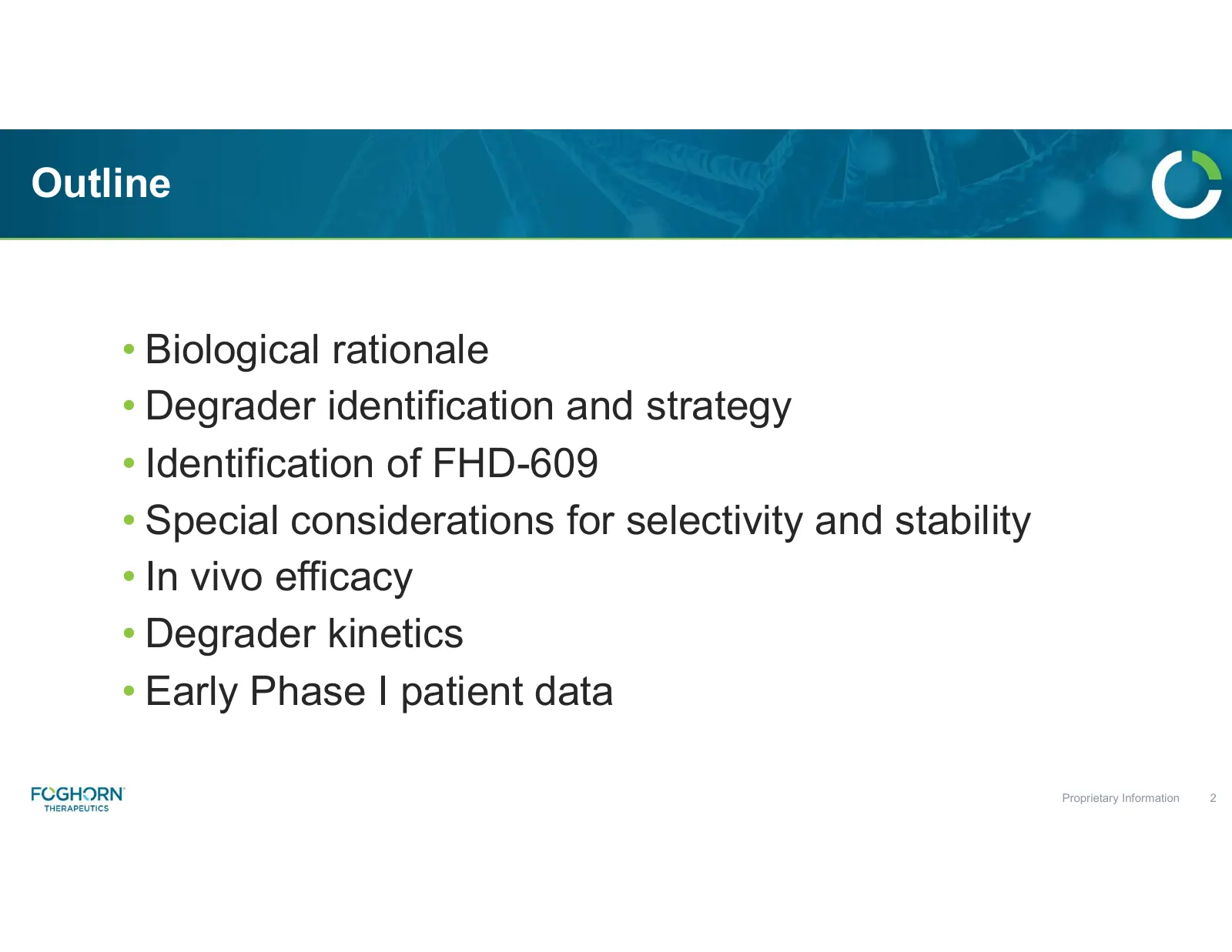
Slide 2: Outline
Outline • Biological rationale • Degrader identification and strategy • Identification of FHD-609 • Special considerations for selectivity and stability • In vivo efficacy • Degrader kinetics • Early Phase I patient data Proprietary Information 2
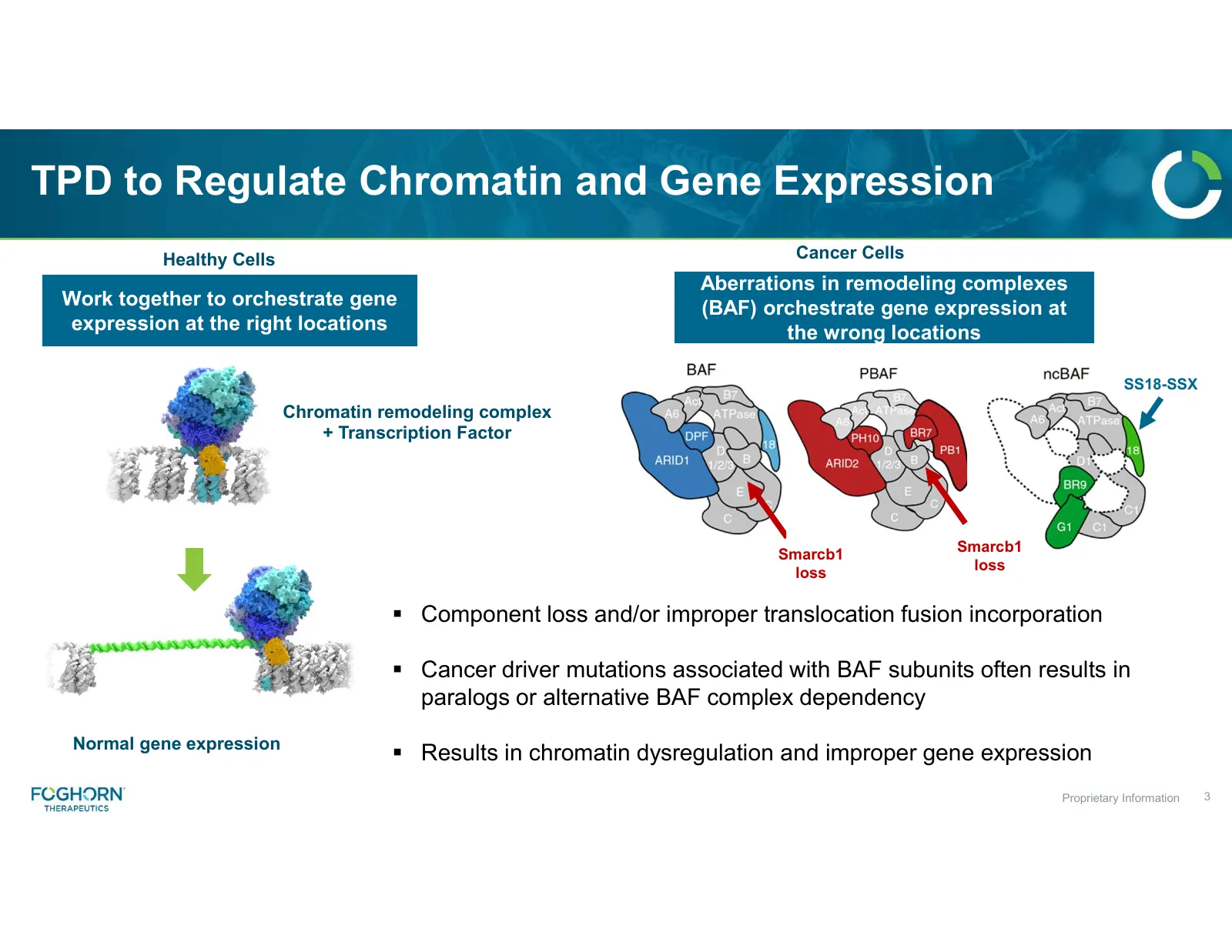
Slide 3: TPD to Regulate Chromatin and Gene Expression
TPD to Regulate Chromatin and Gene Expression Healthy Cells Cancer Cells Aberrations in remodeling complexes Work together to orchestrate gene (BAF) orchestrate gene expression at expression at the right locations the wrong locations SS18-SSX Chromatin remodeling complex + Transcription Factor Smarc
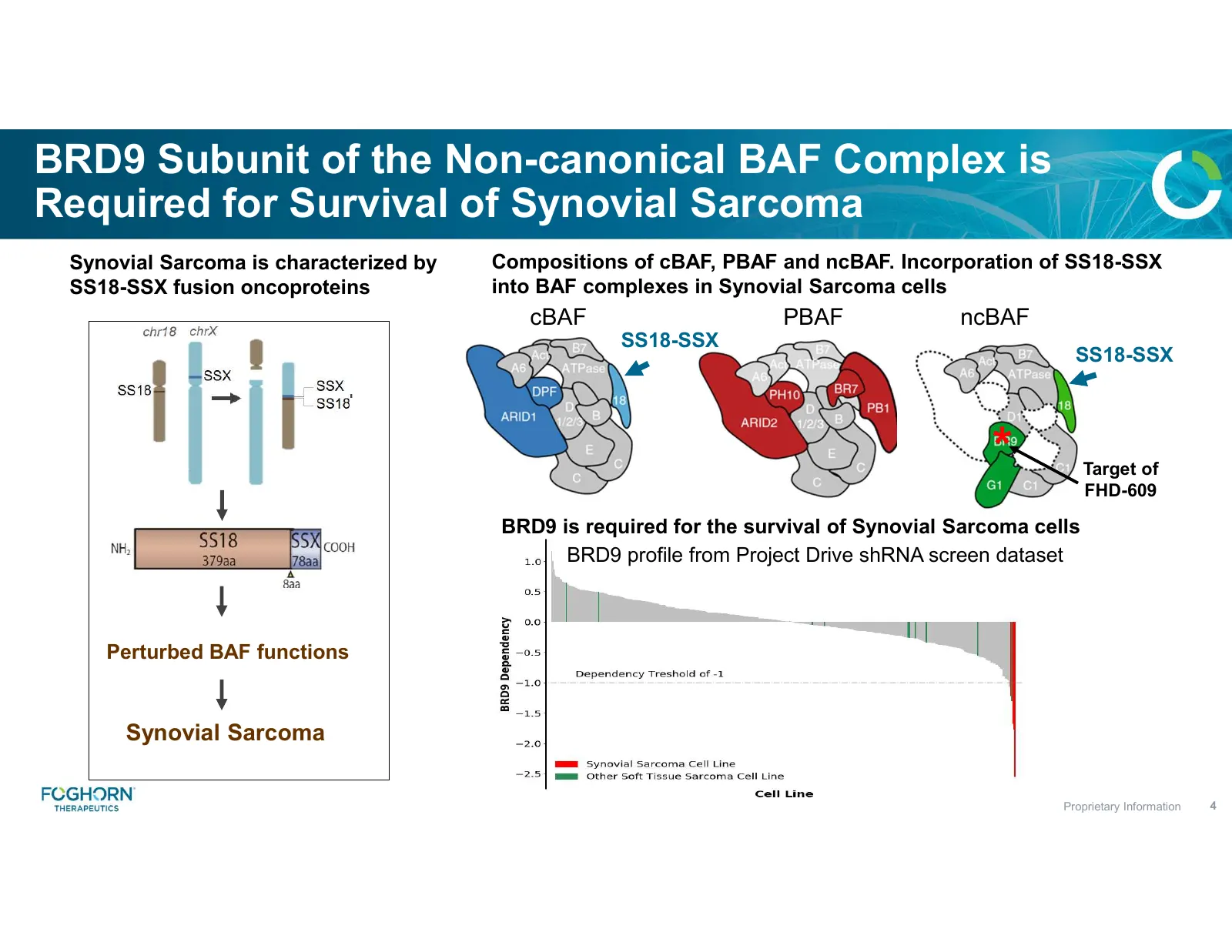
Slide 4: BRD9 Subunit of the Non-canonical BAF Complex is Required for Survival of Synovial Sarcoma
BRD9 Subunit of the Non-canonical BAF Complex is Required for Survival of Synovial Sarcoma Synovial Sarcoma is characterized by Compositions of cBAF, PBAF and ncBAF. Incorporation of SS18-SSX SS18-SSX fusion oncoproteins into BAF complexes in Synovial Sarcoma cells cBAF PBAF ncBAF SS18-SSX SS18-SSX
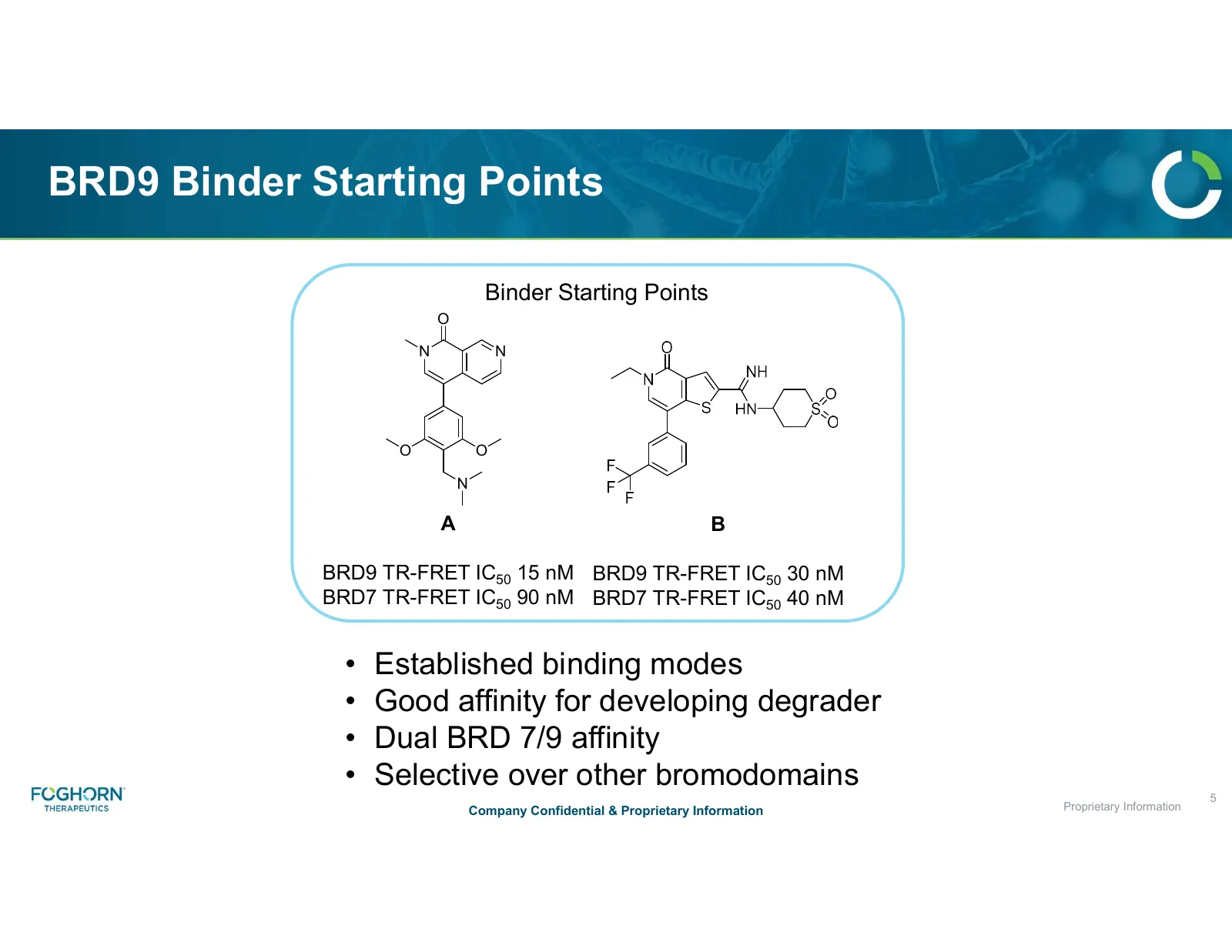
Slide 5: BRD9 Binder Starting Points
BRD9 Binder Starting Points Binder Starting Points O N N O O N A B BRD9 TR-FRET IC50 15 nM BRD9 TR-FRET IC50 30 nM BRD7 TR-FRET IC50 90 nM BRD7 TR-FRET IC50 40 nM • Established binding modes • Good affinity for developing degrader • Dual BRD 7/9 affinity • Selective over other bromodomains 5 Company
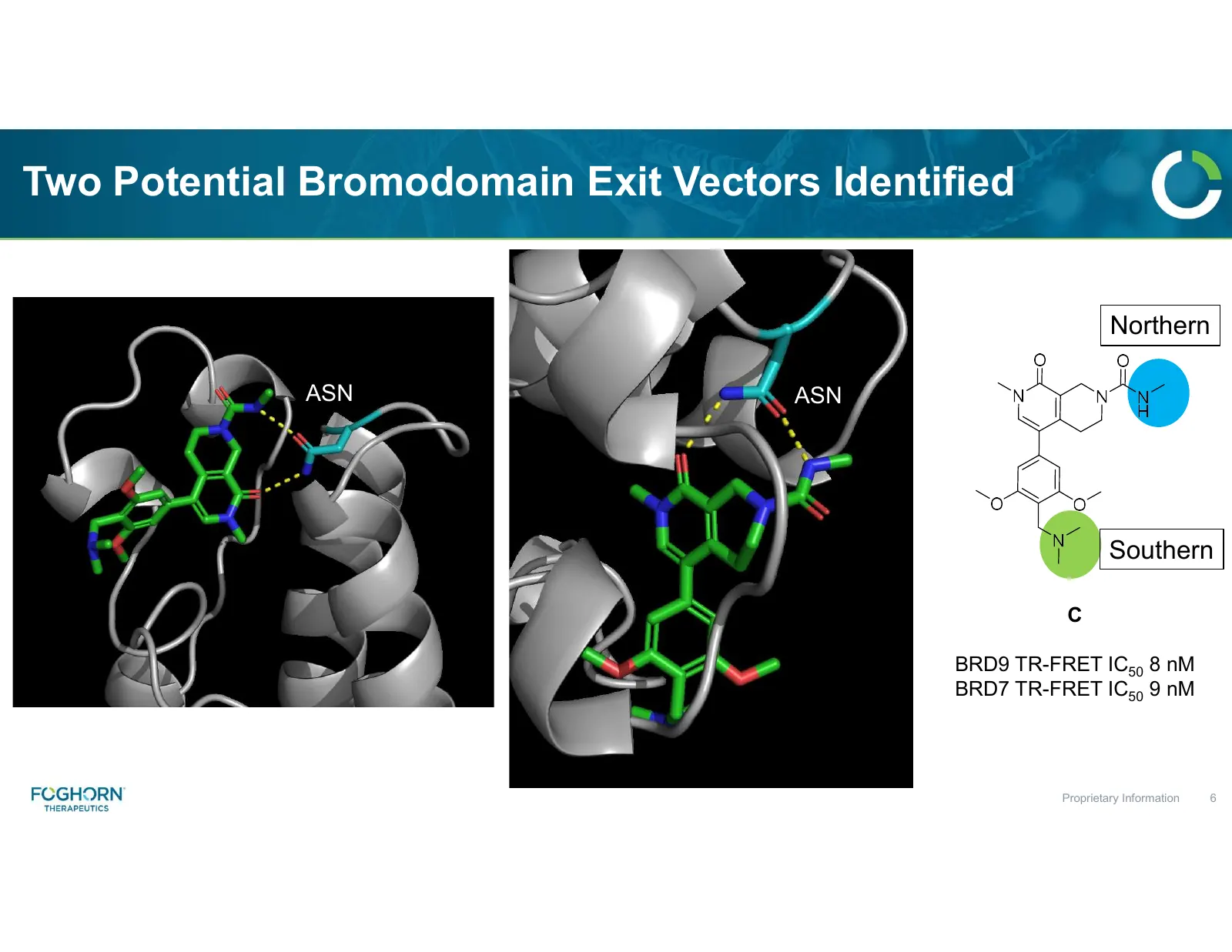
Slide 6: Two Potential Bromodomain Exit Vectors Identified
Two Potential Bromodomain Exit Vectors Identified Northern ASN ASN Southern C BRD9 TR-FRET IC50 8 nM BRD7 TR-FRET IC50 9 nM Proprietary Information 6
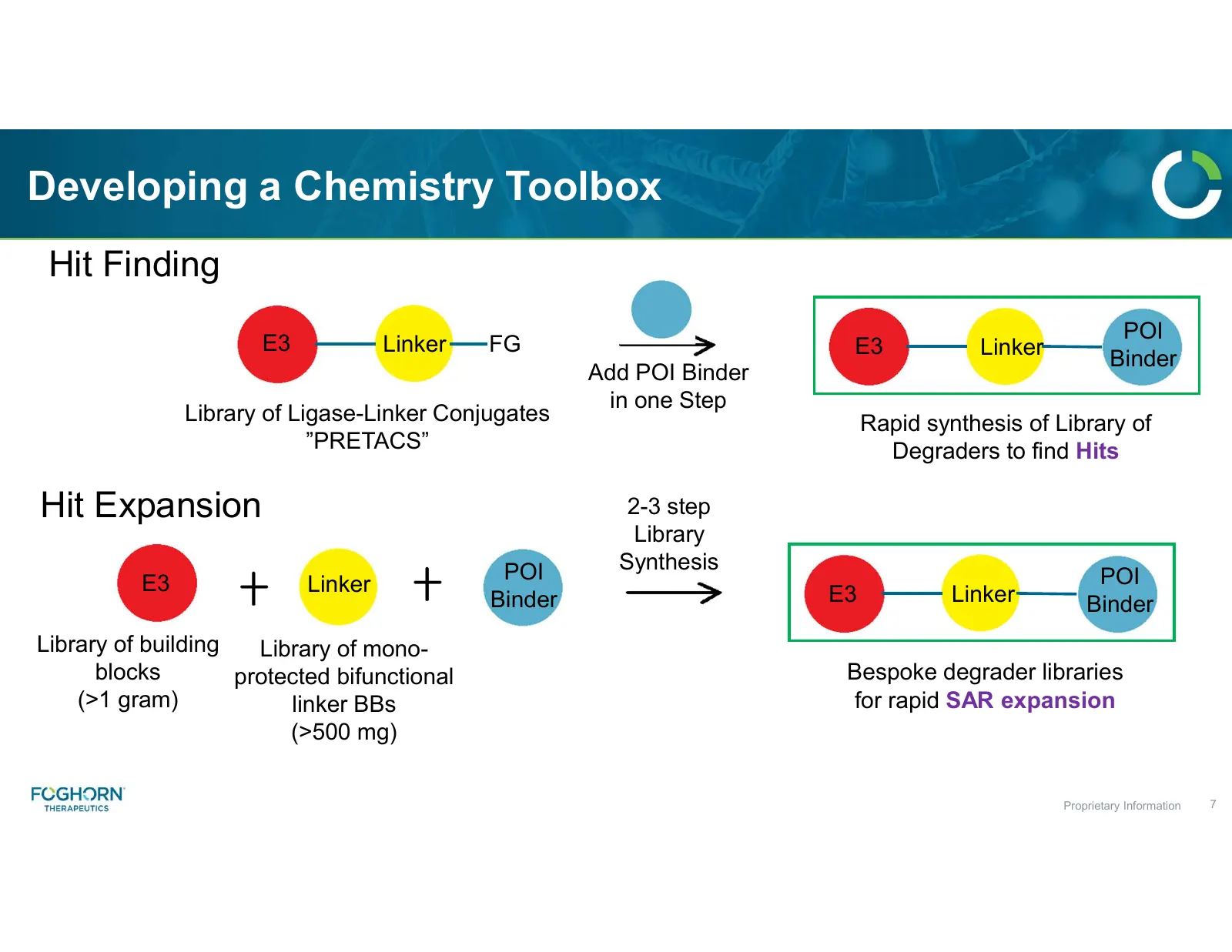
Slide 7: Developing a Chemistry Toolbox
Developing a Chemistry Toolbox Hit Finding POI E3 Linker FG E3 Linker Binder Add POI Binder in one Step Library of Ligase-Linker Conjugates Rapid synthesis of Library of ”PRETACS” Degraders to find Hits Hit Expansion 2-3 step Library POI Synthesis E3 Linker POI Binder E3 Linker Binder Library of bui
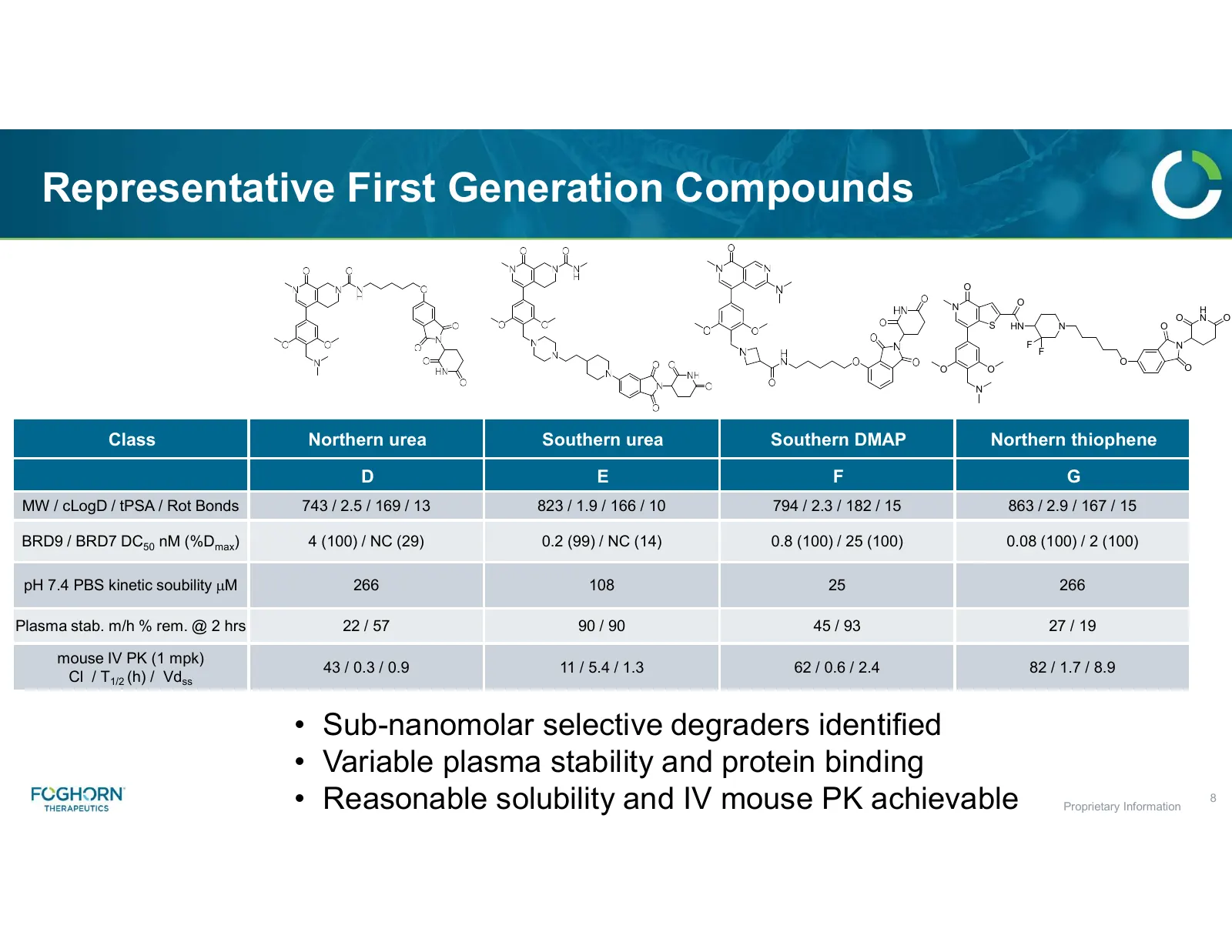
Slide 8: Representative First Generation Compounds
Representative First Generation Compounds O O N H O N O S HN N O F N F O O O O N Class Northern urea Southern urea Southern DMAP Northern thiophene D E F G MW / cLogD / tPSA / Rot Bonds 743 / 2.5 / 169 / 13 823 / 1.9 / 166 / 10 794 / 2.3 / 182 / 15 863 / 2.9 / 167 / 15 BRD9 / BRD7 DC50 nM (%Dmax) 4
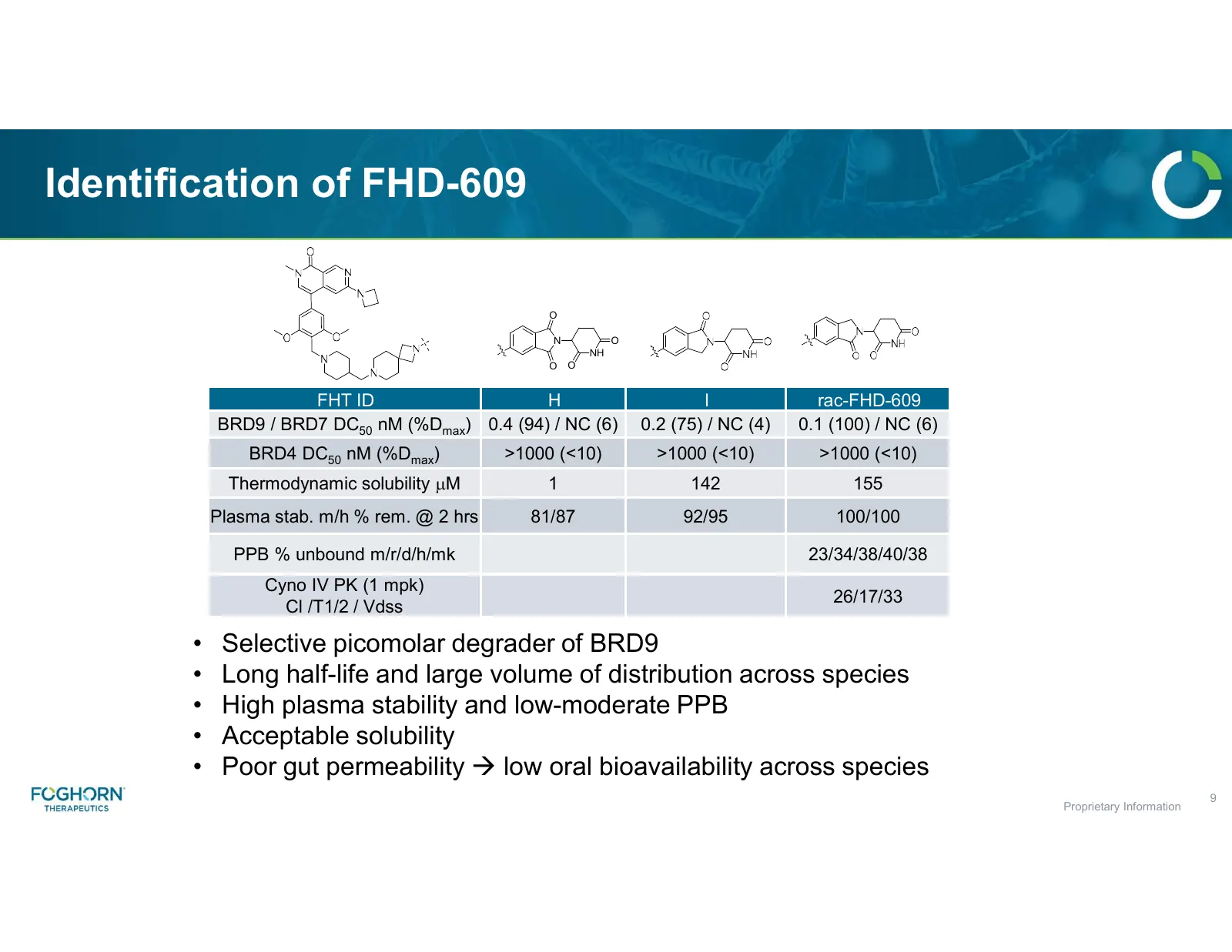
Slide 9: Identification of FHD-609
Identification of FHD-609 O N O NH O O FHT ID H I rac-FHD-609 BRD9 / BRD7 DC50 nM (%Dmax) 0.4 (94) / NC (6) 0.2 (75) / NC (4) 0.1 (100) / NC (6) BRD4 DC50 nM (%Dmax) >1000 (<10) >1000 (<10) >1000 (<10) Thermodynamic solubility mM 1 142 155 Plasma stab. m/h % rem. @ 2 hrs 81/87 92/95 100/100 PPB % un
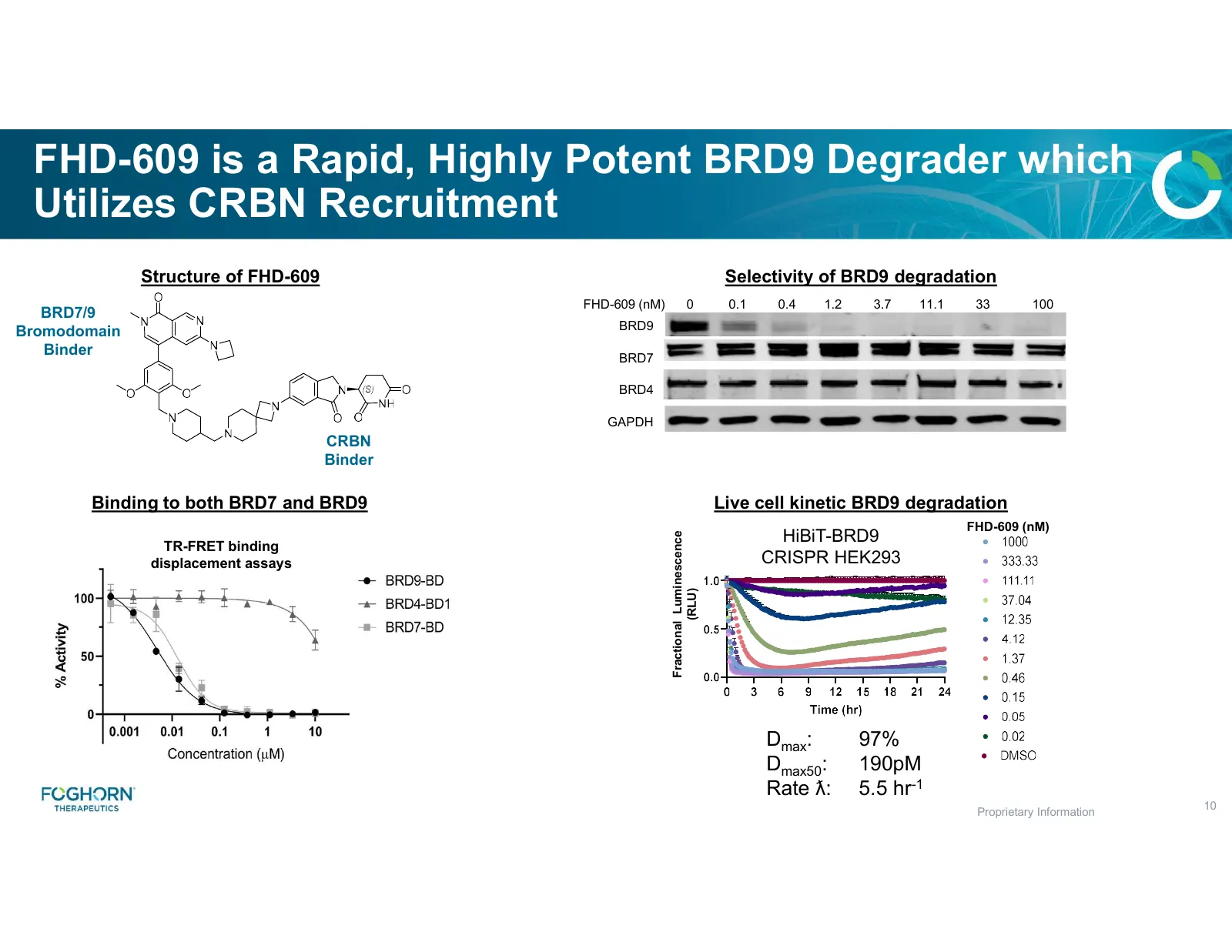
Slide 10: FHD-609 is a Rapid, Highly Potent BRD9 Degrader which Utilizes CRBN Recruitment
FHD-609 is a Rapid, Highly Potent BRD9 Degrader which Utilizes CRBN Recruitment Structure of FHD-609 Selectivity of BRD9 degradation FHD-609 (nM) 0 0.1 0.4 1.2 3.7 11.1 33 100 BRD7/9 Bromodomain BRD9 Binder BRD7 BRD4 GAPDH CRBN Binder Binding to both BRD7 and BRD9 Live cell kinetic BRD9 degradation
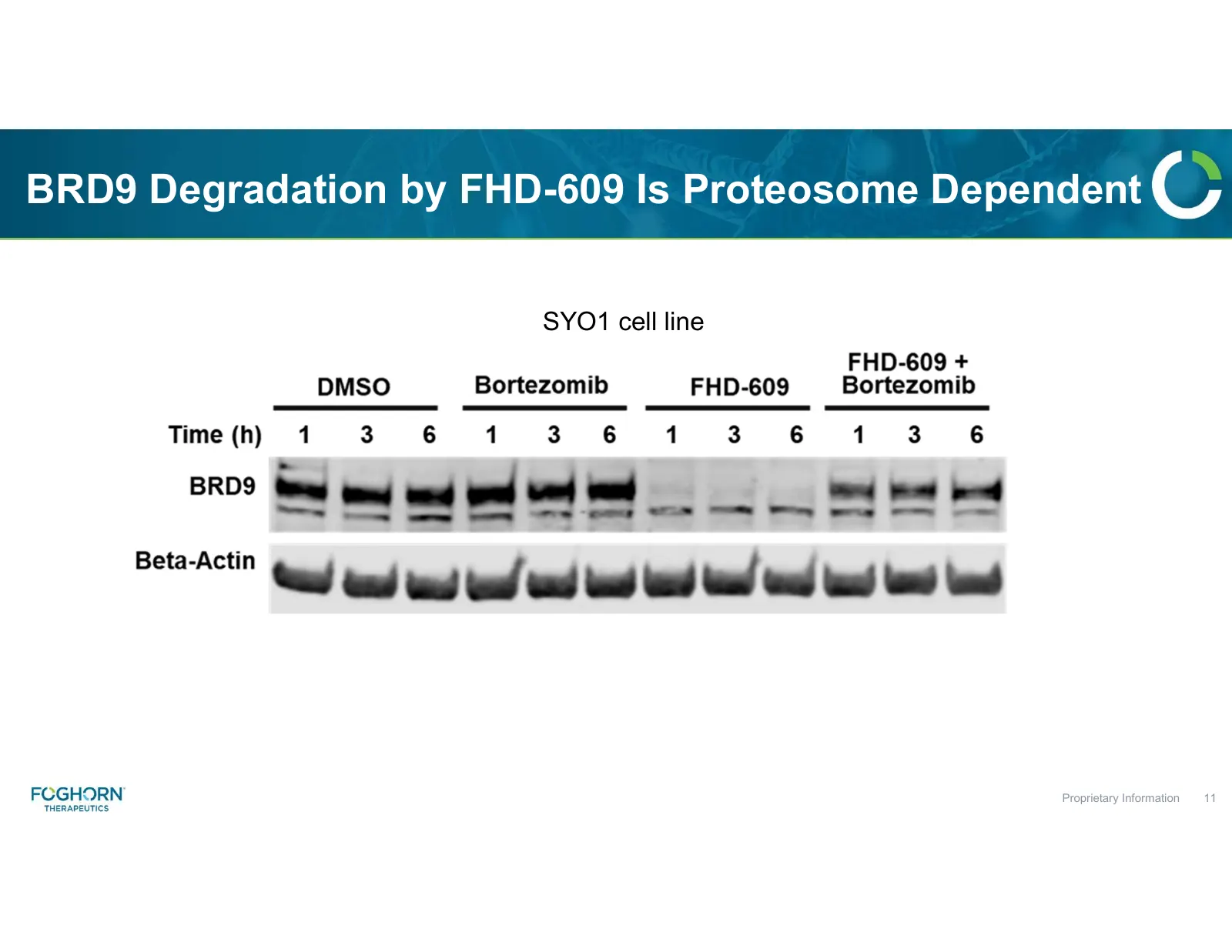
Slide 11: BRD9 Degradation by FHD-609 Is Proteosome Dependent
BRD9 Degradation by FHD-609 Is Proteosome Dependent SYO1 cell line Proprietary Information 11
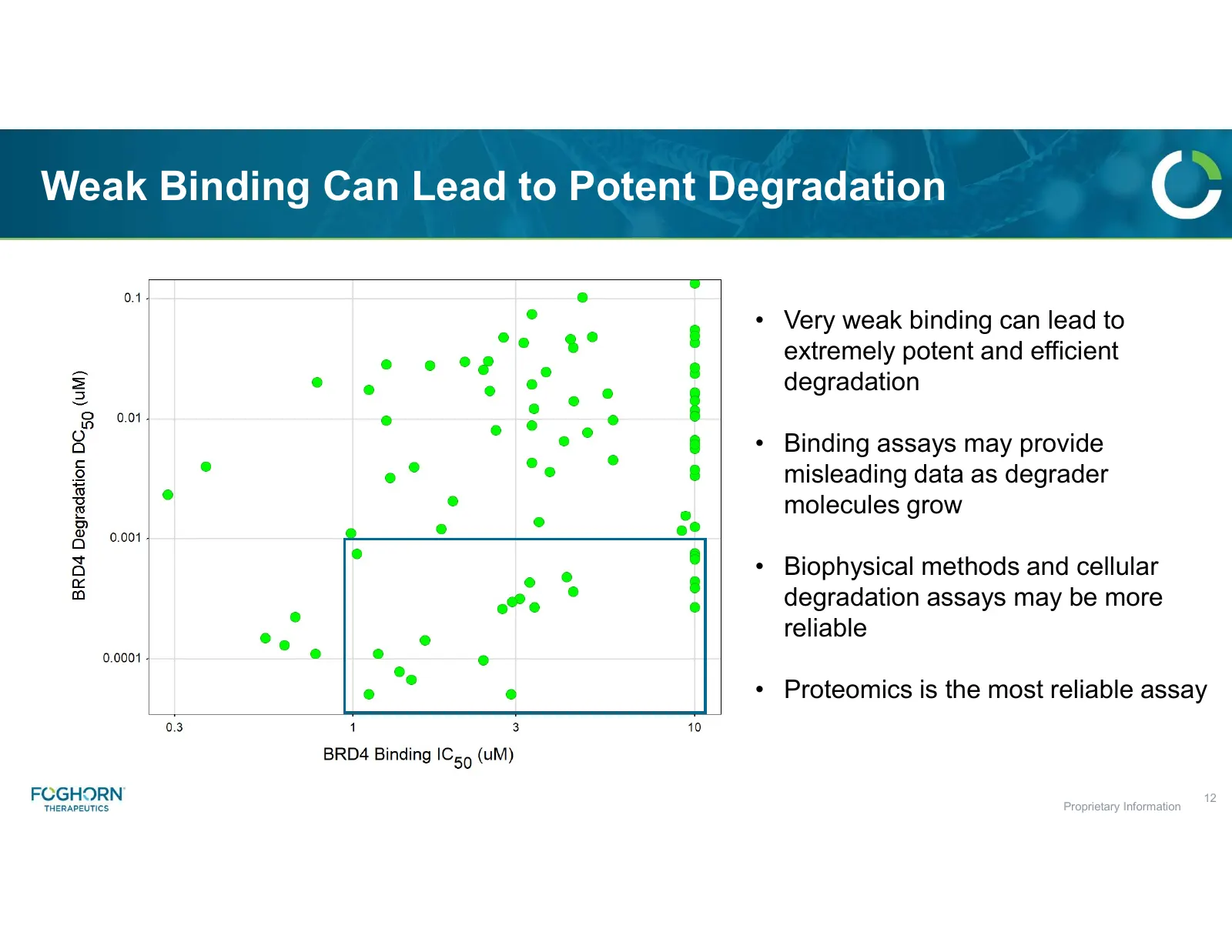
Slide 12: Weak Binding Can Lead to Potent Degradation
Weak Binding Can Lead to Potent Degradation • Very weak binding can lead to extremely potent and efficient degradation • Binding assays may provide misleading data as degrader molecules grow • Biophysical methods and cellular degradation assays may be more reliable • Proteomics is the most reliable
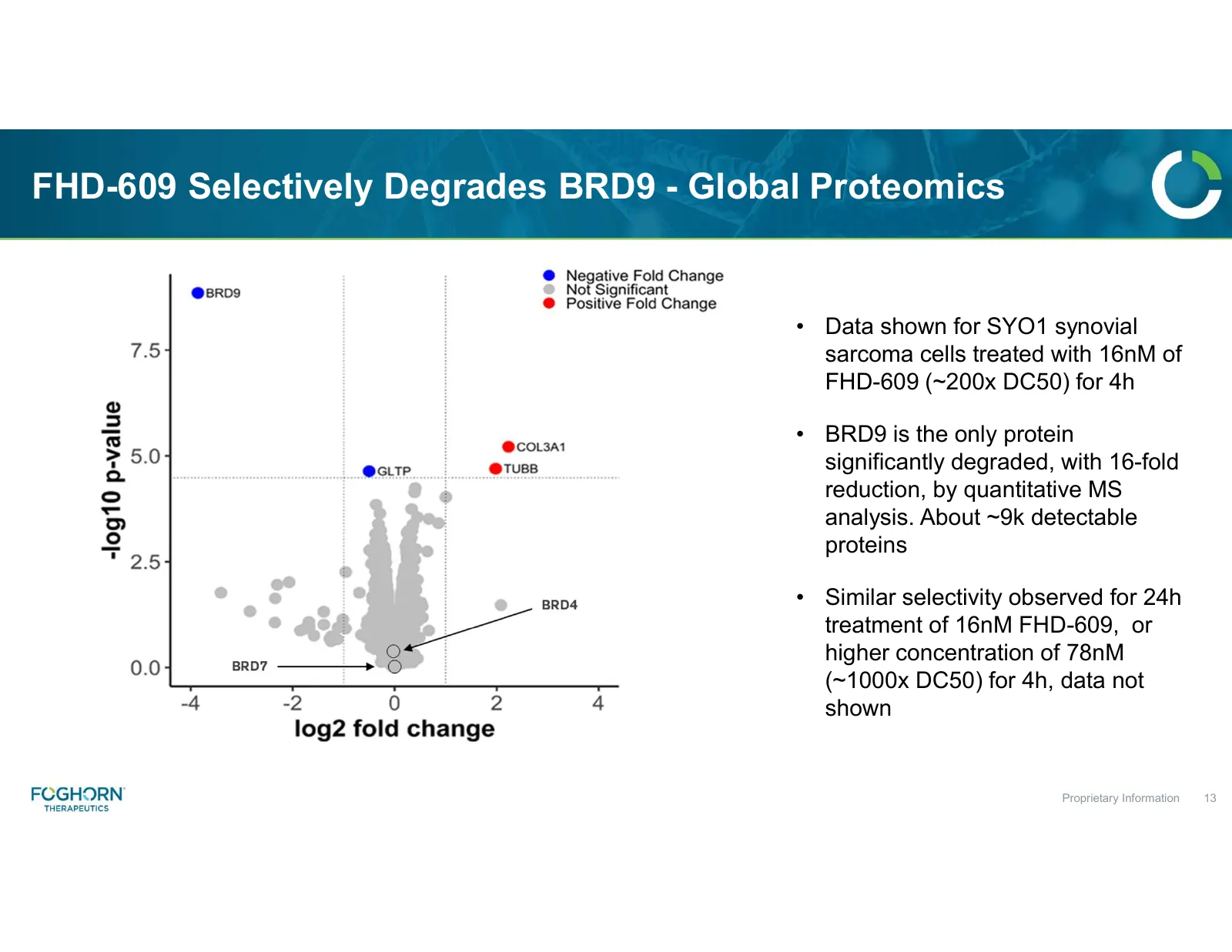
Slide 13: FHD-609 Selectively Degrades BRD9 - Global Proteomics
FHD-609 Selectively Degrades BRD9 - Global Proteomics • Data shown for SYO1 synovial sarcoma cells treated with 16nM of FHD-609 (~200x DC50) for 4h • BRD9 is the only protein significantly degraded, with 16-fold reduction, by quantitative MS analysis. About ~9k detectable proteins • Similar selectiv
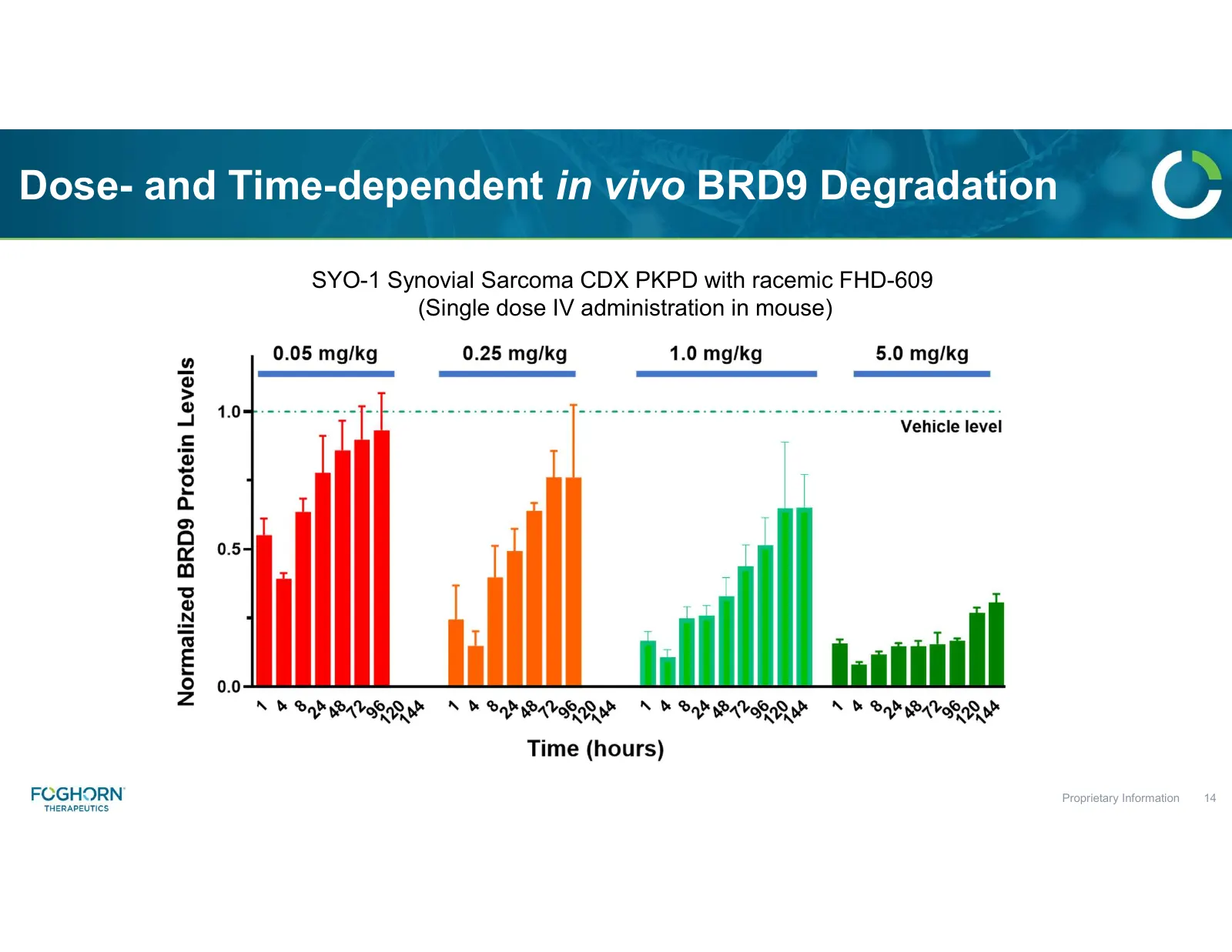
Slide 14: Dose- and Time-dependent in vivo BRD9 Degradation
Dose- and Time-dependent in vivo BRD9 Degradation SYO-1 Synovial Sarcoma CDX PKPD with racemic FHD-609 (Single dose IV administration in mouse) Proprietary Information 14
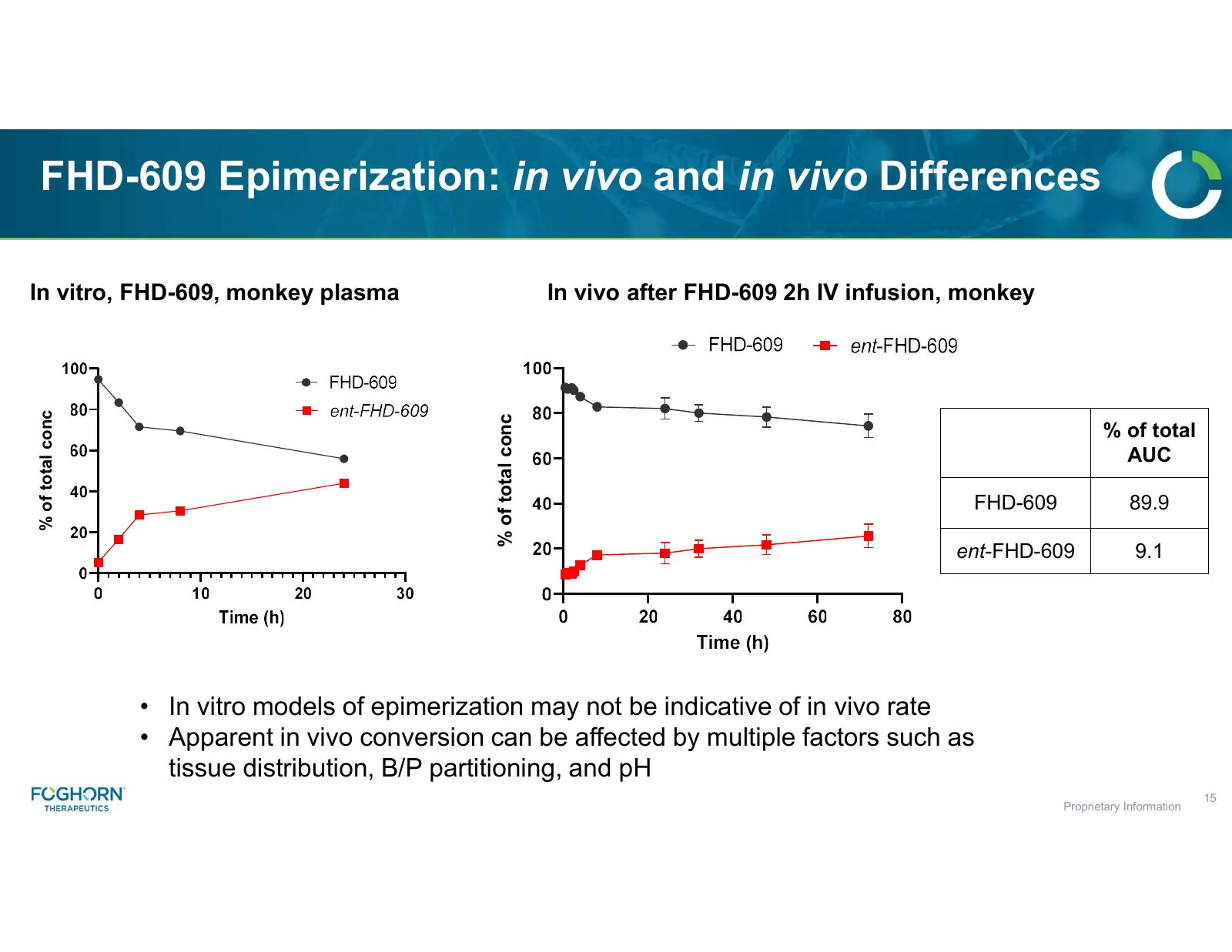
Slide 15: FHD-609 Epimerization: in vitro and in vivo Differences
FHD-609 Epimerization: in vivo and in vivo Differences In vitro, FHD-609, monkey plasma In vivo after FHD-609 2h IV infusion, monkey % of total conc % of total conc % of total AUC FHD-609 89.9 ent-FHD-609 9.1 • In vitro models of epimerization may not be indicative of in vivo rate • Apparent in vivo
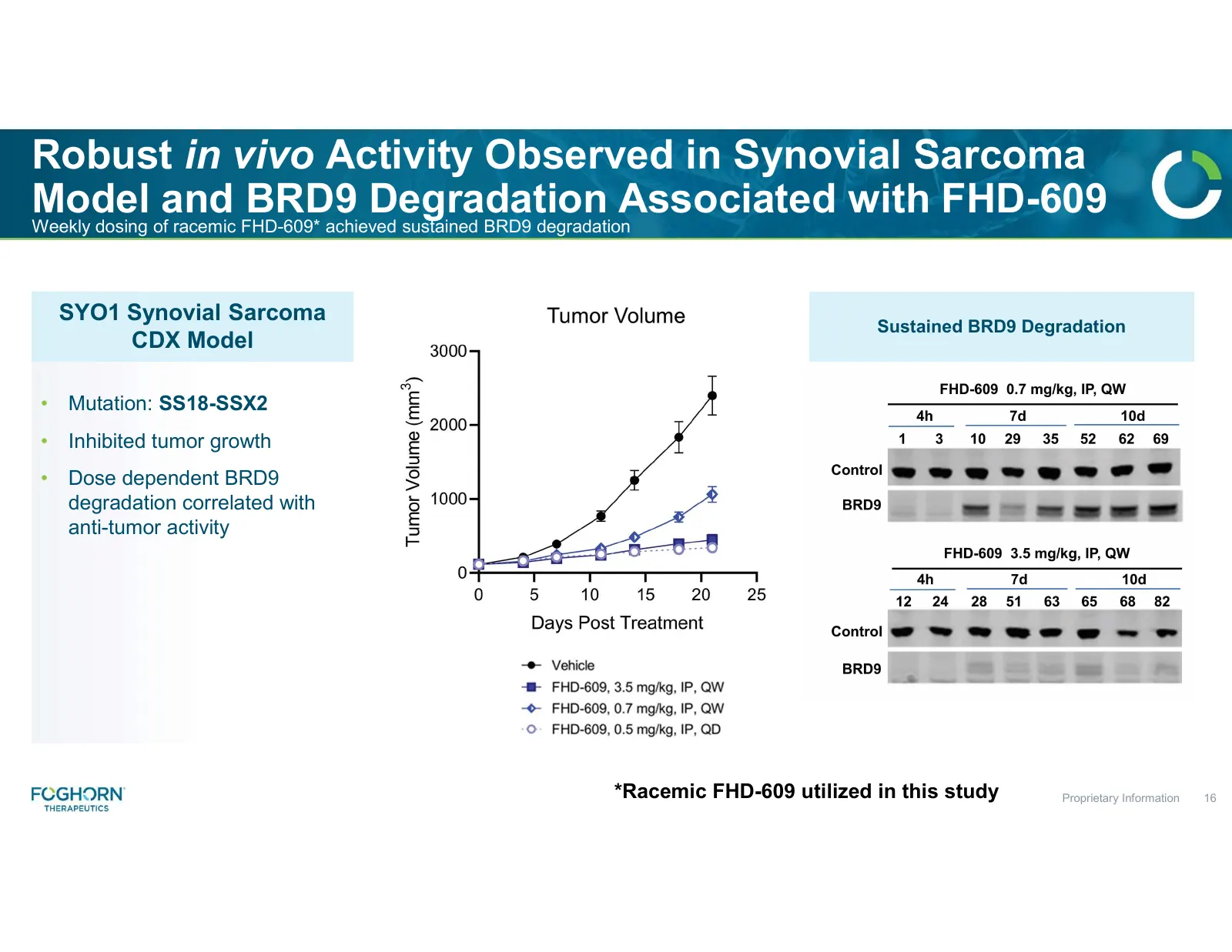
Slide 16: Robust in vivo Activity Observed in Synovial Sarcoma Model
Robust in vivo Activity Observed in Synovial Sarcoma Model and BRD9 Degradation Associated with FHD-609 Weekly dosing of racemic FHD-609* achieved sustained BRD9 degradation SYO1 Synovial Sarcoma Sustained BRD9 Degradation CDX Model • Mutation: SS18-SSX2 • Inhibited tumor growth • Dose dependent BRD
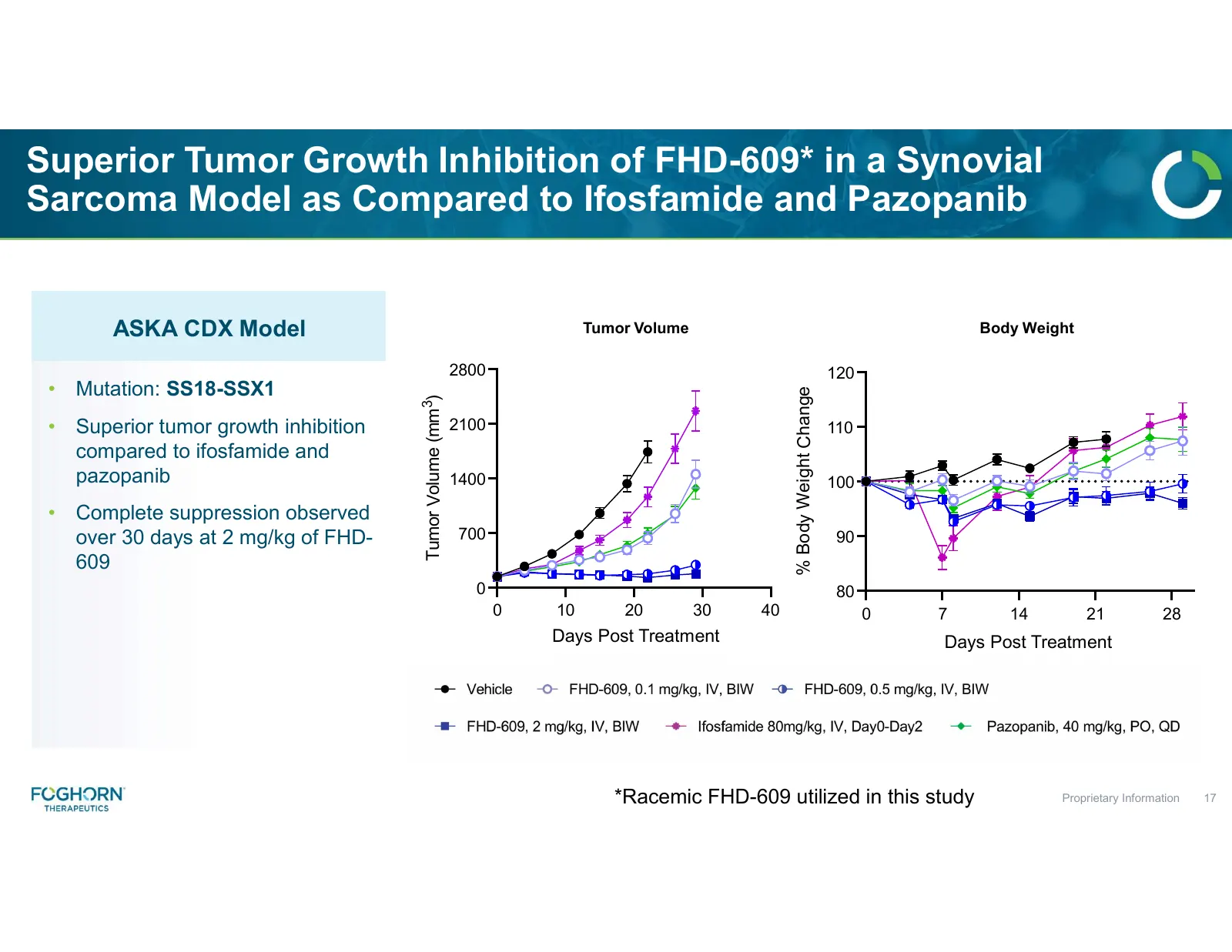
Slide 17: Superior Tumor Growth Inhibition of FHD-609 Compared to Ifosfamide and Pazopanib
Superior Tumor Growth Inhibition of FHD-609* in a Synovial Sarcoma Model as Compared to Ifosfamide and Pazopanib ASKA CDX Model Tumor Volume Body Weight 2800 120 • Mutation: SS18-SSX1 % Body Weight Change • Superior tumor growth inhibition Tumor Volume (mm3) 2100 110 compared to ifosfamide and pazop
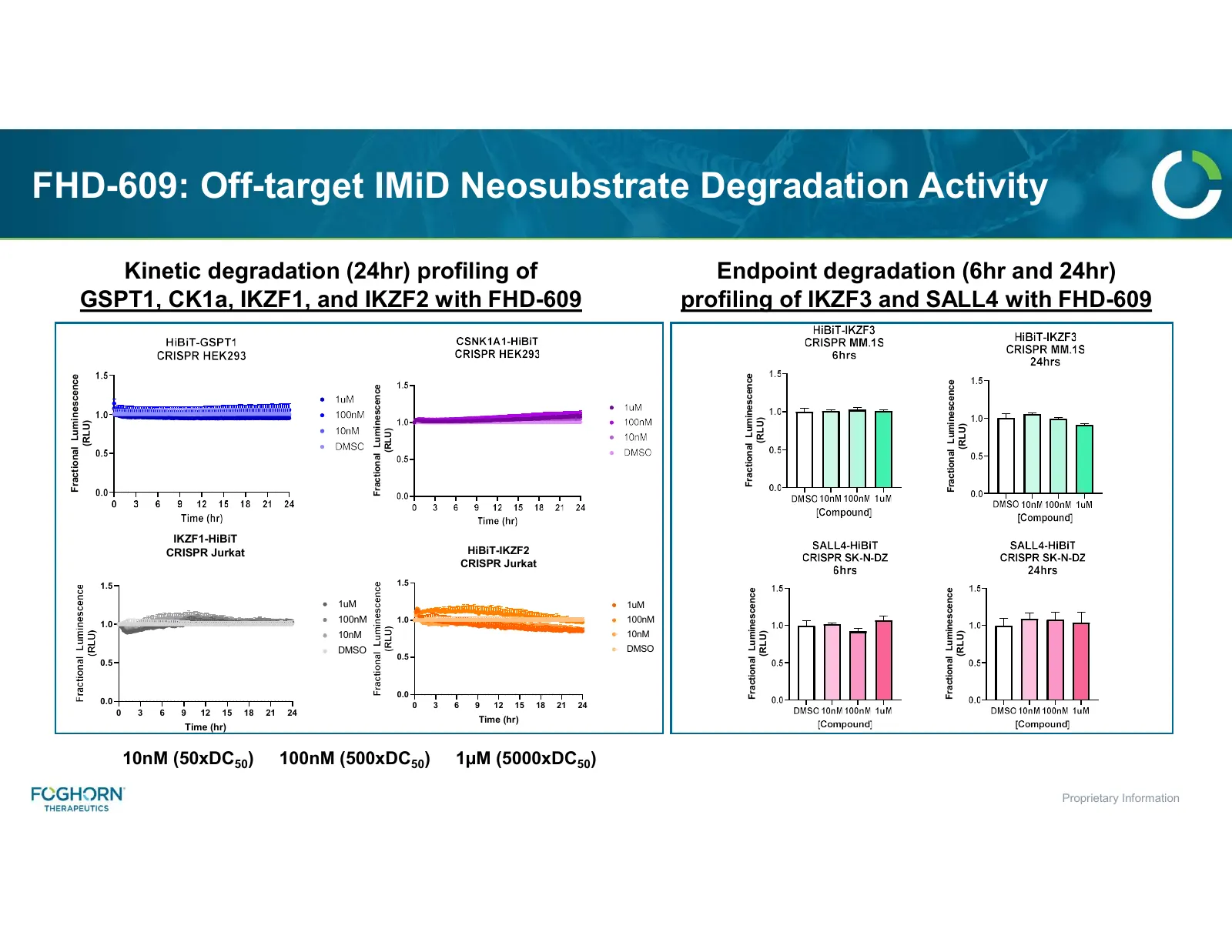
Slide 18: FHD-609: Off-target IMiD Neosubstrate Degradation Activity
FHD-609: Off-target IMiD Neosubstrate Degradation Activity Kinetic degradation (24hr) profiling of Endpoint degradation (6hr and 24hr) GSPT1, CK1a, IKZF1, and IKZF2 with FHD-609 profiling of IKZF3 and SALL4 with FHD-609 Fractional Luminescence Fractional Luminescence Fractional Luminescence Fraction
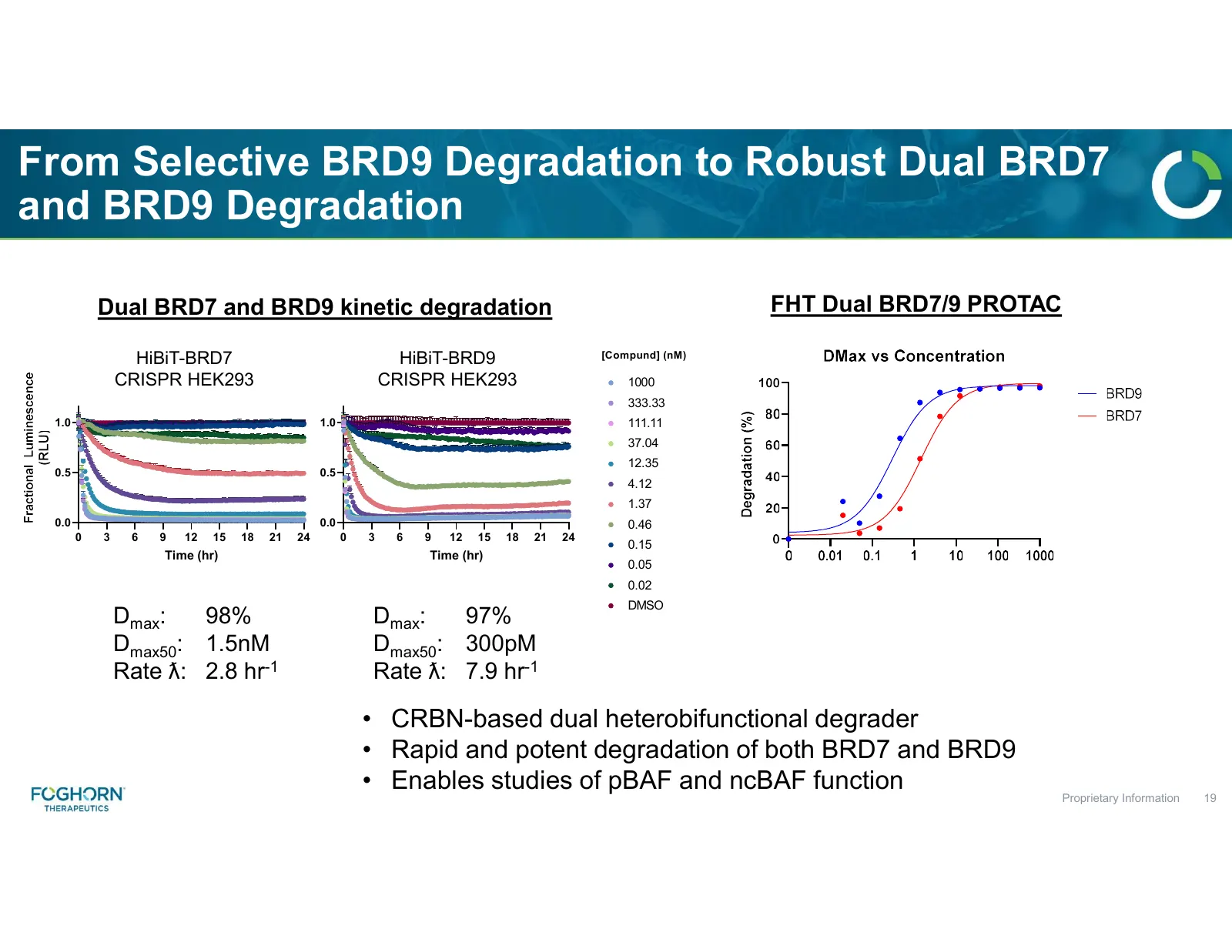
Slide 19: From Selective BRD9 Degradation to Robust Dual BRD7 and BRD9 Degradation
From Selective BRD9 Degradation to Robust Dual BRD7 and BRD9 Degradation Dual BRD7 and BRD9 kinetic degradation FHT Dual BRD7/9 PROTAC BRD7-HiBiT (HEK293 + LgBiT) HiBiT-BRD9 (HEK293 + LgBiT) Compound 5 Compound 5 HiBiT-BRD7 HiBiT-BRD9 [Compund] (nM) 1.5 1.5 CRISPR HEK293 CRISPR HEK293 1000 333.33 1.
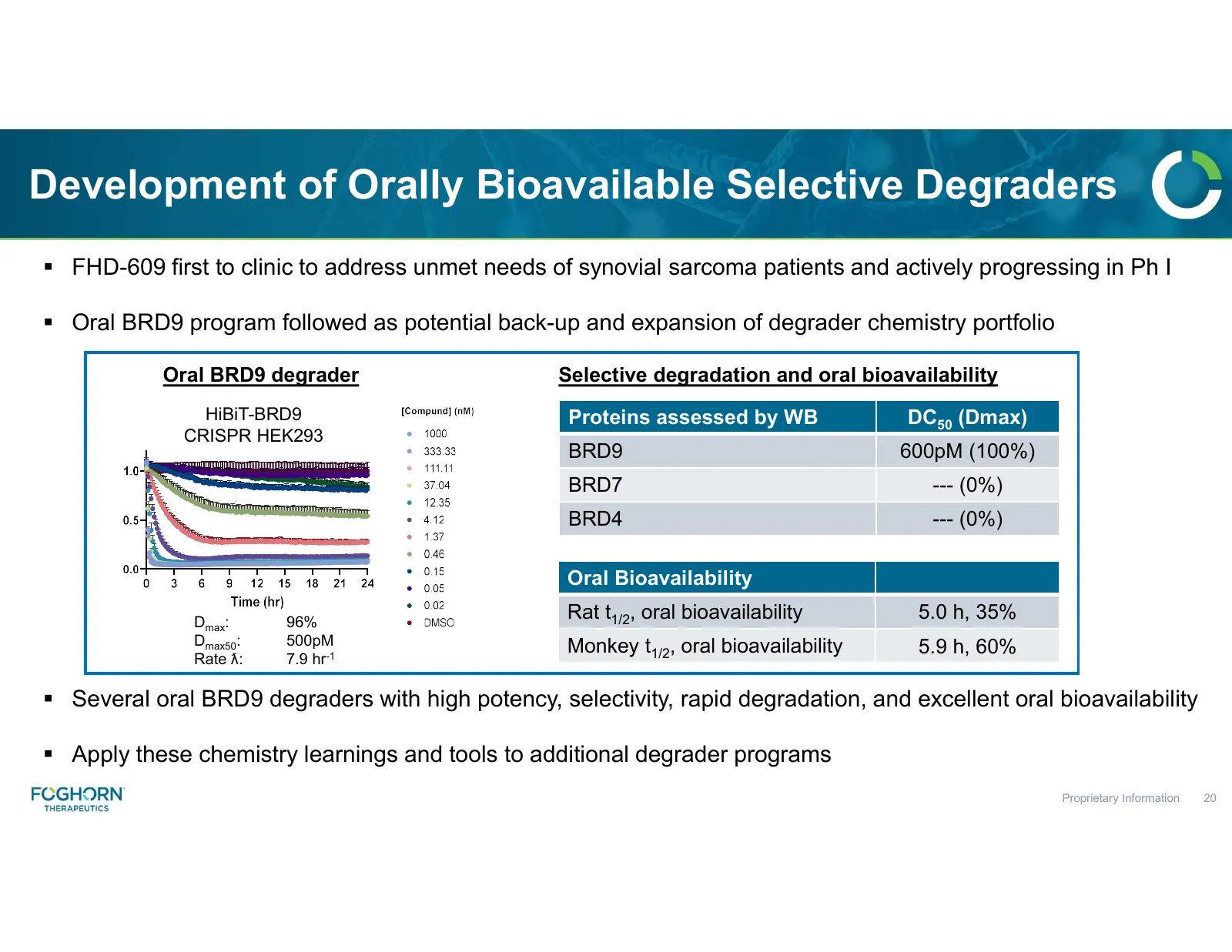
Slide 20: Development of Orally Bioavailable Selective Degraders
Development of Orally Bioavailable Selective Degraders FHD-609 first to clinic to address unmet needs of synovial sarcoma patients and actively progressing in Ph I Oral BRD9 program followed as potential back-up and expansion of degrader chemistry portfolio Oral BRD9 degrader Selective degradati
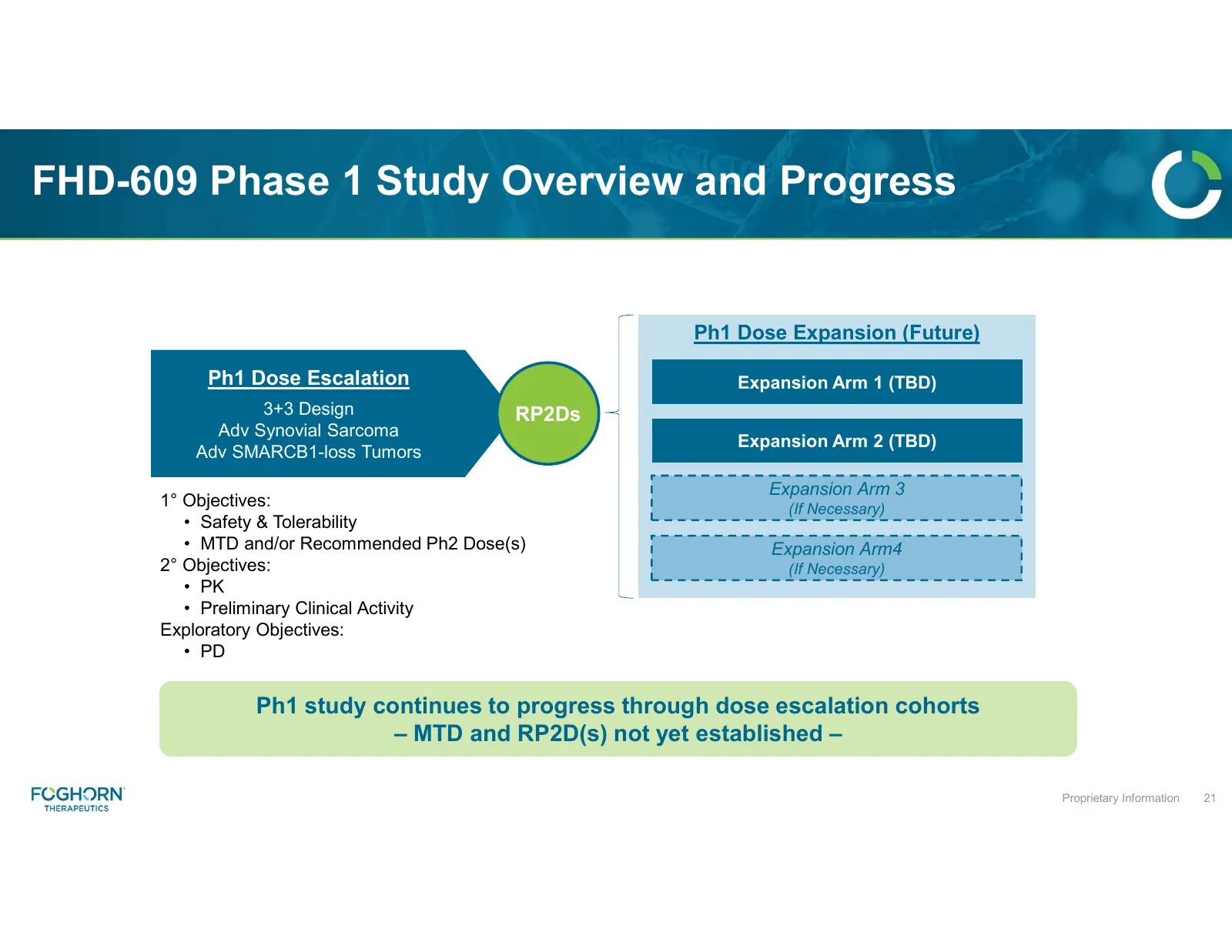
Slide 21: FHD-609 Phase 1 Study Overview and Progress
FHD-609 Phase 1 Study Overview and Progress Ph1 Dose Expansion (Future) Ph1 Dose Escalation Expansion Arm 1 (TBD) 3+3 Design RP2Ds Adv Synovial Sarcoma Expansion Arm 2 (TBD) Adv SMARCB1-loss Tumors Expansion Arm 3 1° Objectives: (If Necessary) • Safety & Tolerability • MTD and/or Recommended Ph2 Dos
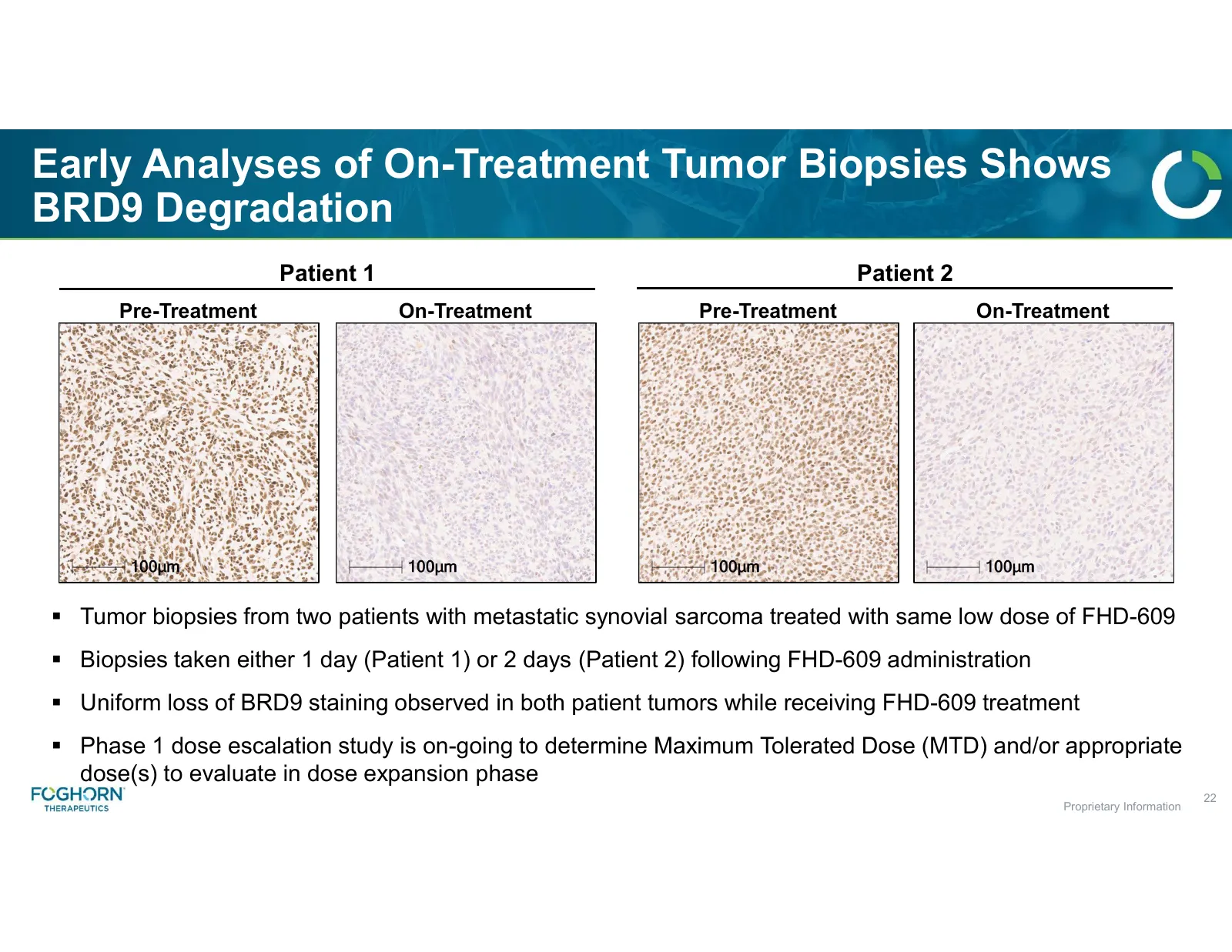
Slide 22: Early Analyses of On-Treatment Tumor Biopsies Shows BRD9 Degradation
Early Analyses of On-Treatment Tumor Biopsies Shows BRD9 Degradation Patient 1 Patient 2 Pre-Treatment On-Treatment Pre-Treatment On-Treatment Tumor biopsies from two patients with metastatic synovial sarcoma treated with same low dose of FHD-609 Biopsies taken either 1 day (Patient 1) or 2 days
Slide 23: Conclusion and Summary
Conclusion and Summary • FHD-609 is a heterobifunctional degrader with proteosome dependent and picomolar potency for BRD9 degradation with selectivity over BRD7, BRD4 and the wider proteome • Demonstrates picomolar growth inhibitory and colony formation effects in vitro against several synovial cel

Slide 24: Acknowledgements Thank you! Questions?
Acknowledgements Thank you! Questions? Proprietary Information 24
Source: Internet Archive copy of foghorntx.com