China Life Insurance Co. Ltd. Class A · SSE:601628
China Life Insurance Co. Ltd. Class A — China Life Corporate Day (May 2007)
42 slides from China Life Insurance Co. Ltd. Class A's conference presentation, May 2007
Slide 1: The distinctive characteristics of life insurance operation
The distinctive characteristics of life insurance operation Mr. Wan Feng Executive Director, Vice President May 2007, Nan Ning
Slide 2: Foreword
Foreword • The characteristics • Why we need to understand them • How we analyze them
Slide 3: The distinctive characteristics of life insurance operation
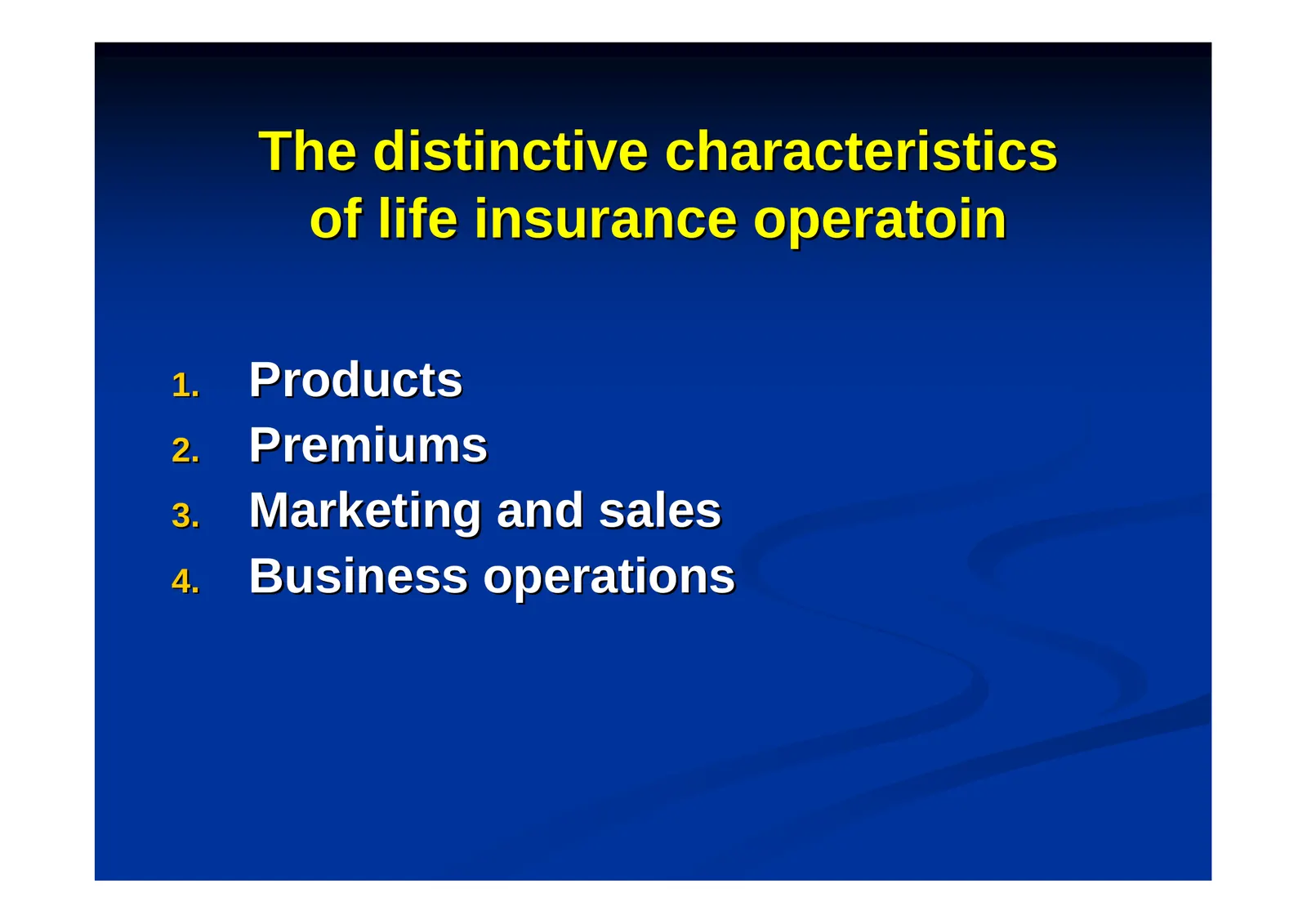
The distinctive characteristics of life insurance operatoin 1. Products 2. Premiums 3. Marketing and sales 4. Business operations
Slide 4: Products: 1. Life insurance is an intangible product
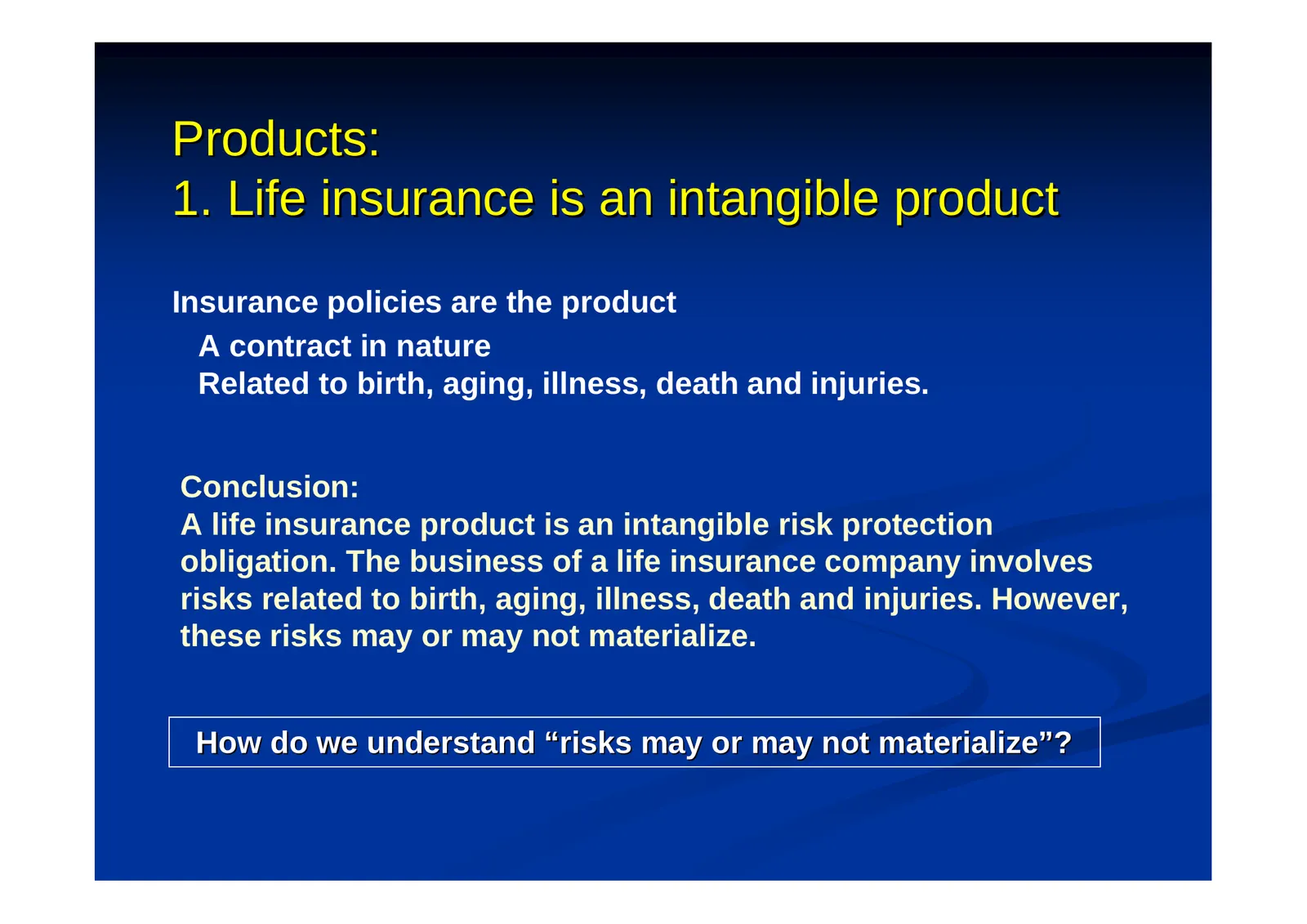
Products: 1. Life insurance is an intangible product Insurance policies are the product A contract in nature Related to birth, aging, illness, death and injuries. Conclusion: A life insurance product is an intangible risk protection obligation. The business of a life insurance company involves risks
Slide 5: Products: 1. Life insurance is an intangible product
Products: 1. Life insurance is an intangible product The meaning of “Intangible product”: •Insurance companies sell promises. An insurance policy is a proof of this promise. Therefore, credibility is the foundation of the business of an insurance company. •A customer experiences the benefit of insur
Slide 6: Products: 2. The need for insurance is not obvious to buyers
Products: 2. The need for insurance is not obvious to buyers. • The insured risks involve events that may or may not happen. • Therefore, buyers can choose to buy or not to buy such products. • The risks borne by an insurance company will materialize.
Slide 7: Products: 2. The need for insurance products is not obvious to buyers
Products: 2. The need for insurance products is not obvious to buyers. Implications: • Most buyers are reactive. • Since risks may or may not occur, sales is more difficult. • Adverse selection may occur.
Slide 8: Products: 3. Sales of insurance products rely on sales people
Products: 3. Sales of insurance products rely on sales people. • The ‘needs’ are not obvious. And the risk involved – birth, aging, illness, death and injuries – are not something people want to talk about. • Life insurance products need to be marketed by sales people.
Slide 9: Products: 3. Sales of insurance products rely on sales people
Products: 3. Sales of insurance products rely on sales people. The meaning of “marketed by sales people”: • A life insurance company needs sales people. In the primary market, the number of sales people is in proportion to sales. • A unique sales team management model • Making the primary market a s
Slide 10: Products: 4. Life insurance products are not consumer products
Products: 4. Life insurance products are not consumer products. • Insurance covers life and health, which are not commodities. • An insurer buys a policy for financial compensation, not for consumption.
Slide 11: Products: 4. Life insurance products are not consumer products
Products: 4. Life insurance products are not consumer products. Implications: • Life insurance is not considered a basic necessity by many. • Only people who have achieved a certain living standard feel the need. • Development of the industry is closely linked to market environment.
Slide 12: Premiums: 1. First-year premiums and renewal premiums
Premiums: 1. The difference between first-year premiums and renewal premiums • First-year premiums – the value of output of an insurance company • The number of first-year policies – the quantity of output of an insurance company
Slide 13: Premiums: 1. Significance of first-year premiums
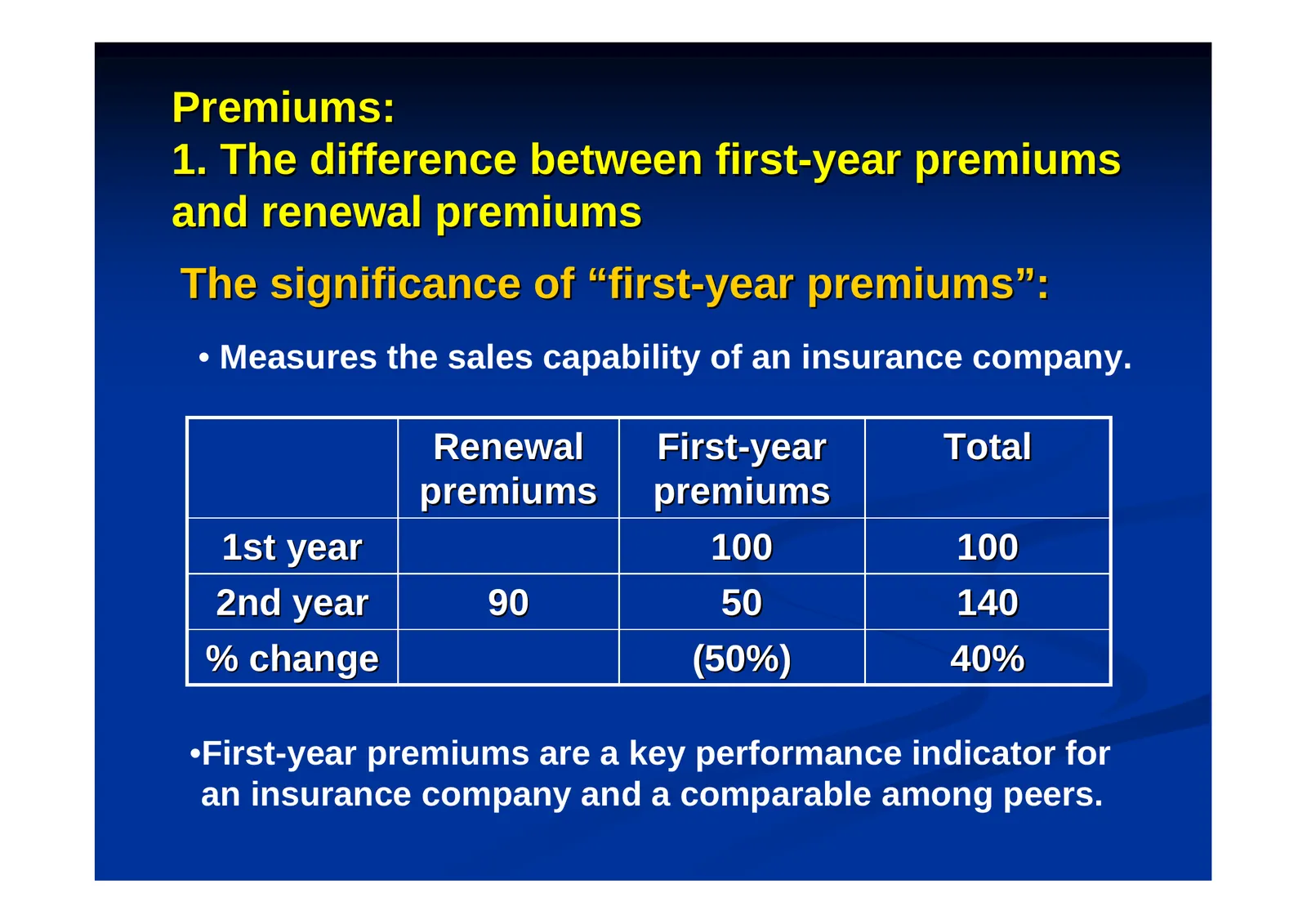
Premiums: 1. The difference between first-year premiums and renewal premiums The significance of “first-year premiums”: • Measures the sales capability of an insurance company. Renewal First-year Total premiums premiums 1st year 100 100 2nd year 90 50 140 % change (50%) 40% •First-year premiums are
Slide 14: Premiums: 1. First-year premiums as growth driver
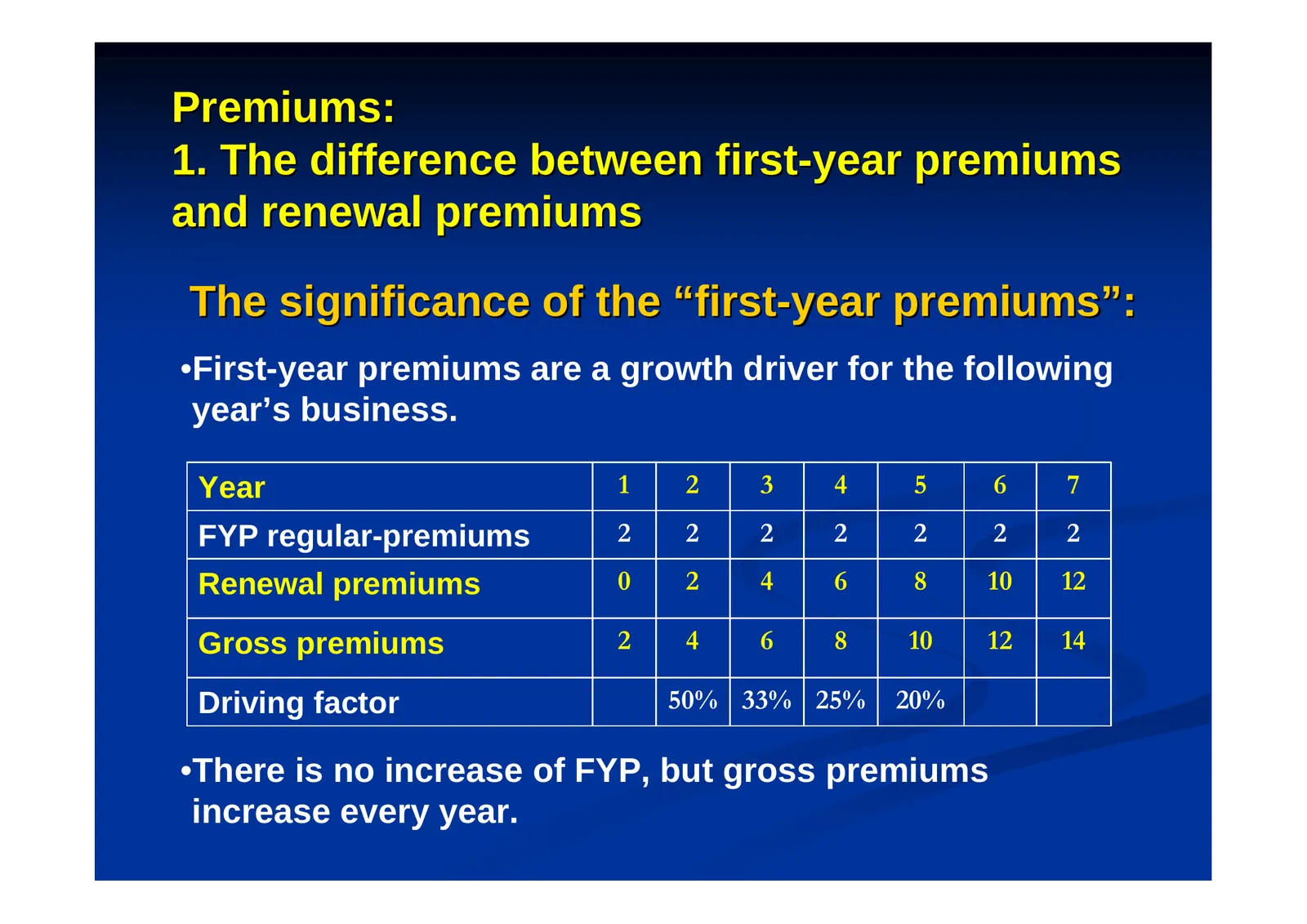
Premiums: 1. The difference between first-year premiums and renewal premiums The significance of the “first-year premiums”: •First-year premiums are a growth driver for the following year’s business. Year 1 2 3 4 5 6 7 FYP regular-premiums 2 2 2 2 2 2 2 Renewal premiums 0 2 4 6 8 10 12 Gross premium
Slide 15: Premiums: 1. Significance of renewal premiums
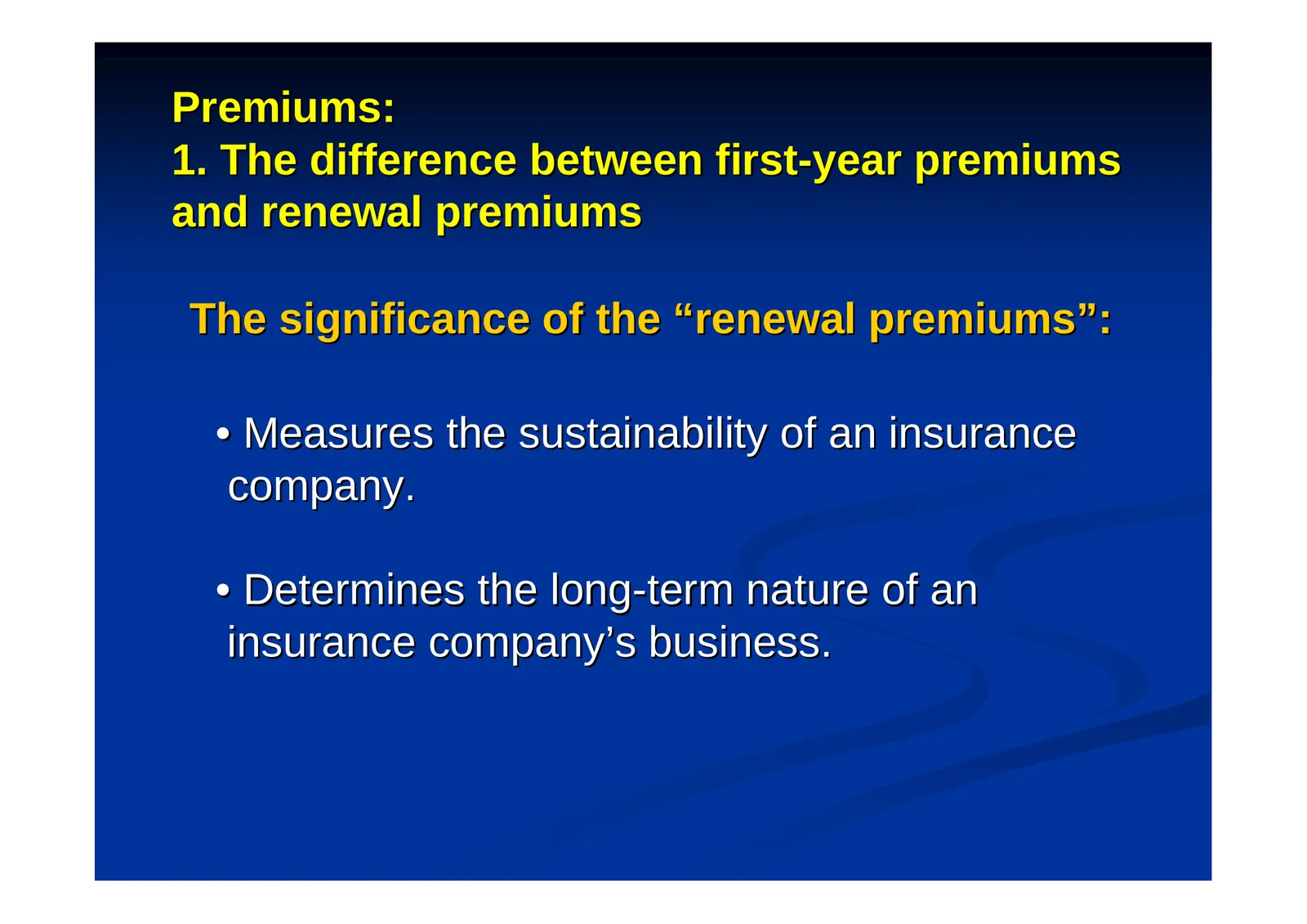
Premiums: 1. The difference between first-year premiums and renewal premiums The significance of the “renewal premiums”: • Measures the sustainability of an insurance company. • Determines the long-term nature of an insurance company’s business.
Slide 16: Companies A and B: renewal premiums lead to different gross premiums
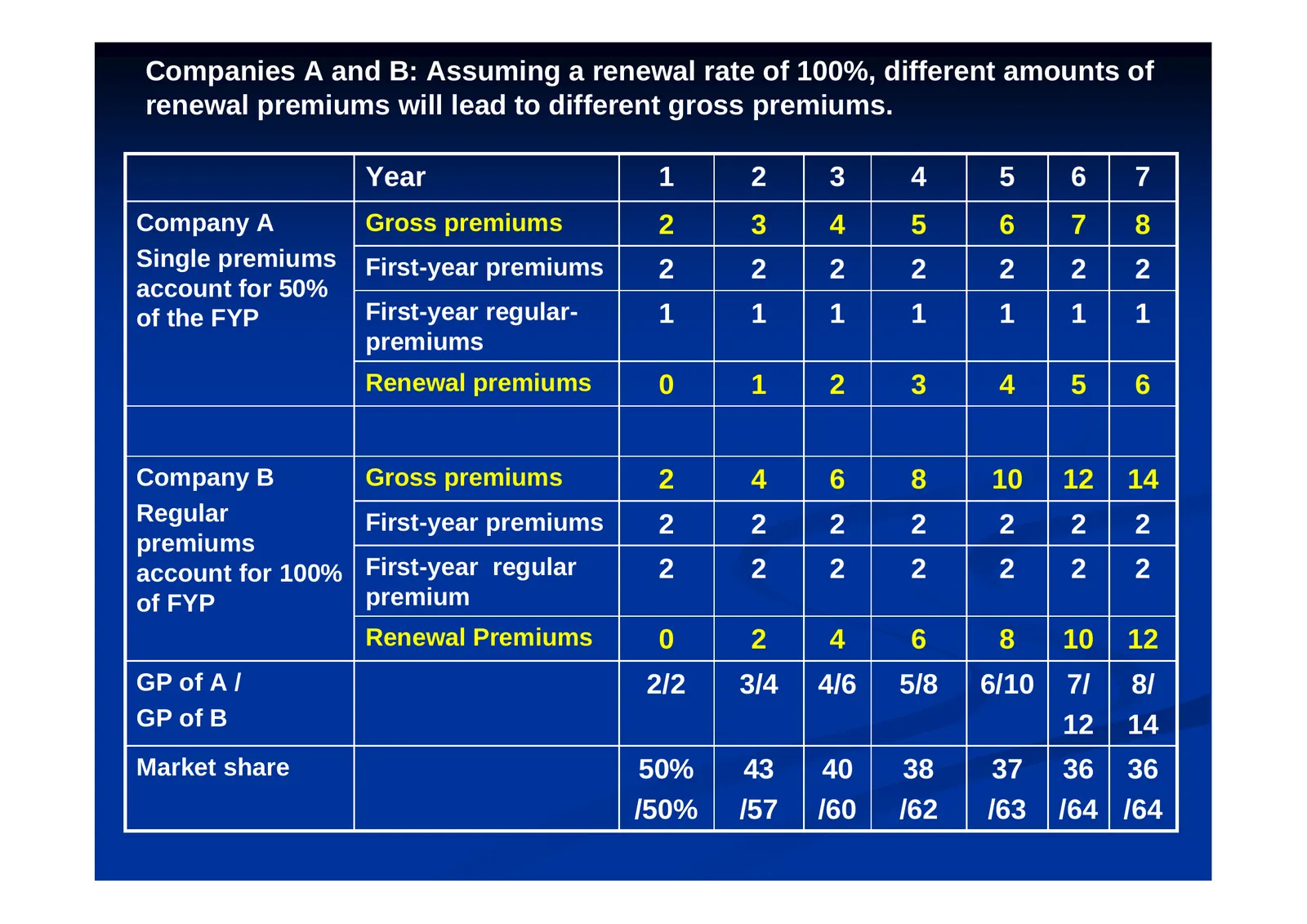
Companies A and B: Assuming a renewal rate of 100%, different amounts of renewal premiums will lead to different gross premiums. Year 1 2 3 4 5 6 7 Company A Gross premiums 2 3 4 5 6 7 8 Single premiums First-year premiums 2 2 2 2 2 2 2 account for 50% of the FYP First-year regular- 1 1 1 1 1 1 1 pr
Slide 17: Premiums: 2. Premium income is accumulative
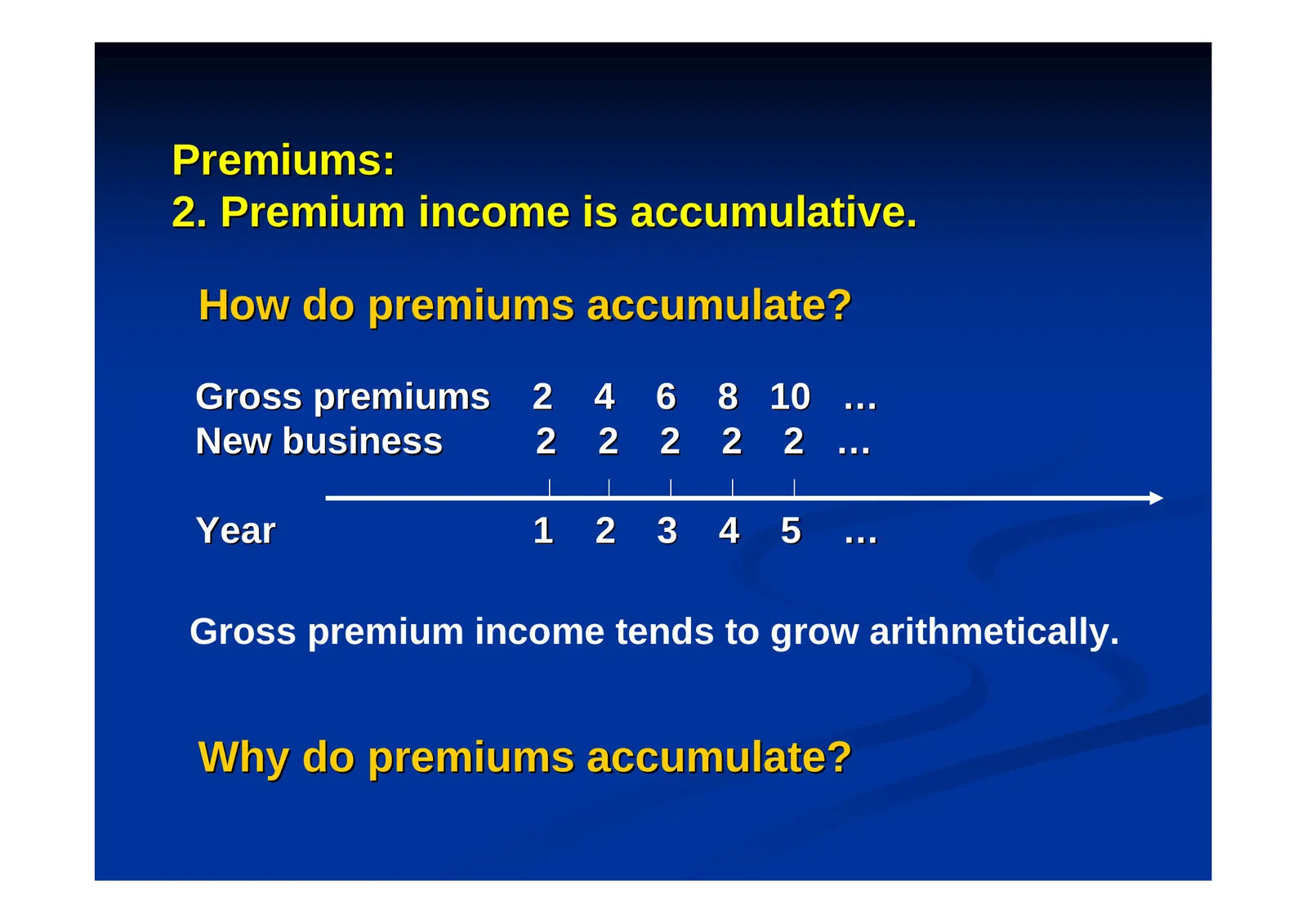
Premiums: 2. Premium income is accumulative. How do premiums accumulate? Gross premiums 2 4 6 8 10 … New business 2 2 2 2 2 … Year 1 2 3 4 5 … Gross premium income tends to grow arithmetically. Why do premiums accumulate?
Slide 18: Premiums: 2. Premium income is accumulative
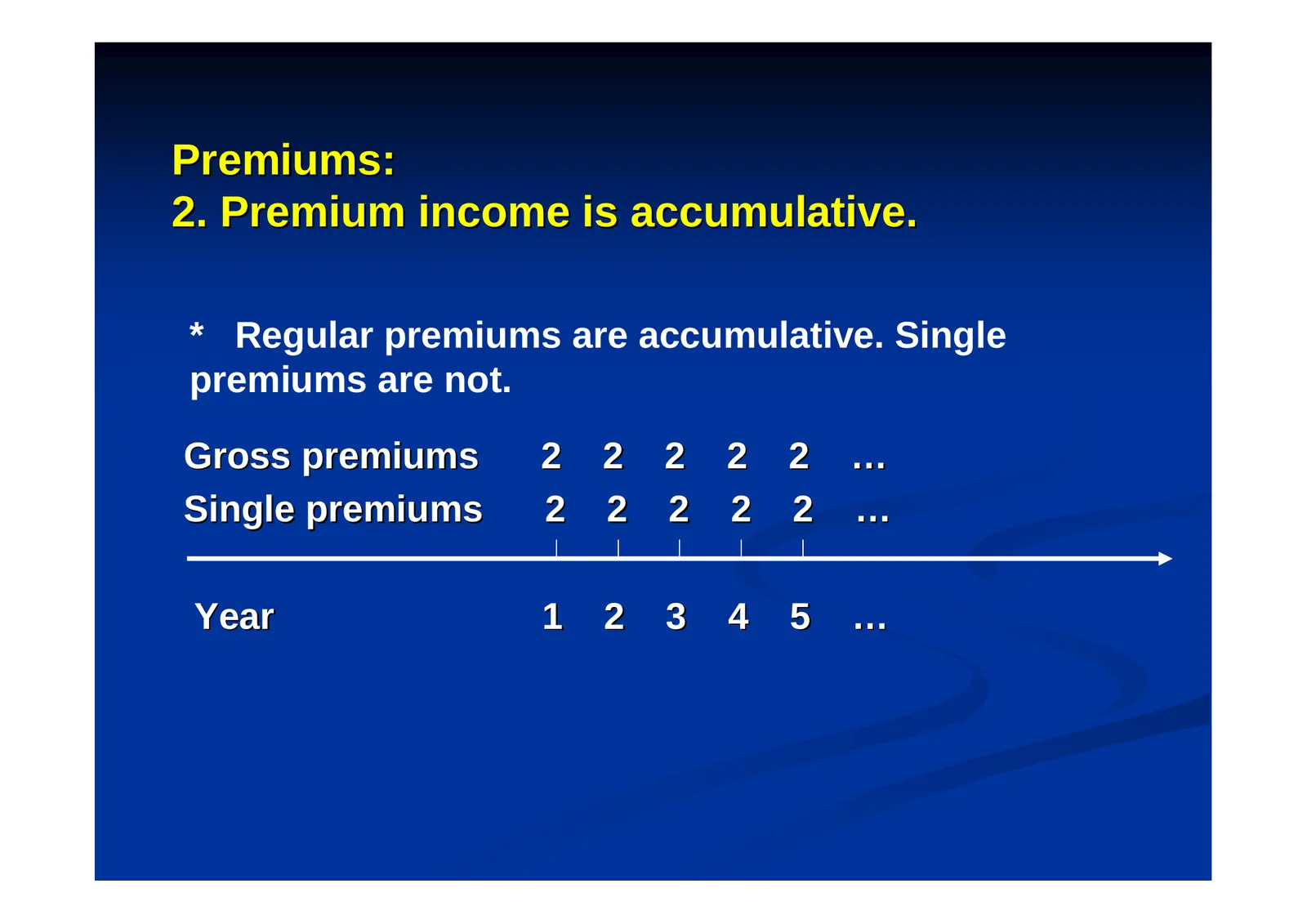
Premiums: 2. Premium income is accumulative. * Regular premiums are accumulative. Single premiums are not. Gross premiums 2 2 2 2 2 … Single premiums 2 2 2 2 2 … Year 1 2 3 4 5 …
Slide 19: Premiums: 2. How do premiums accumulate?
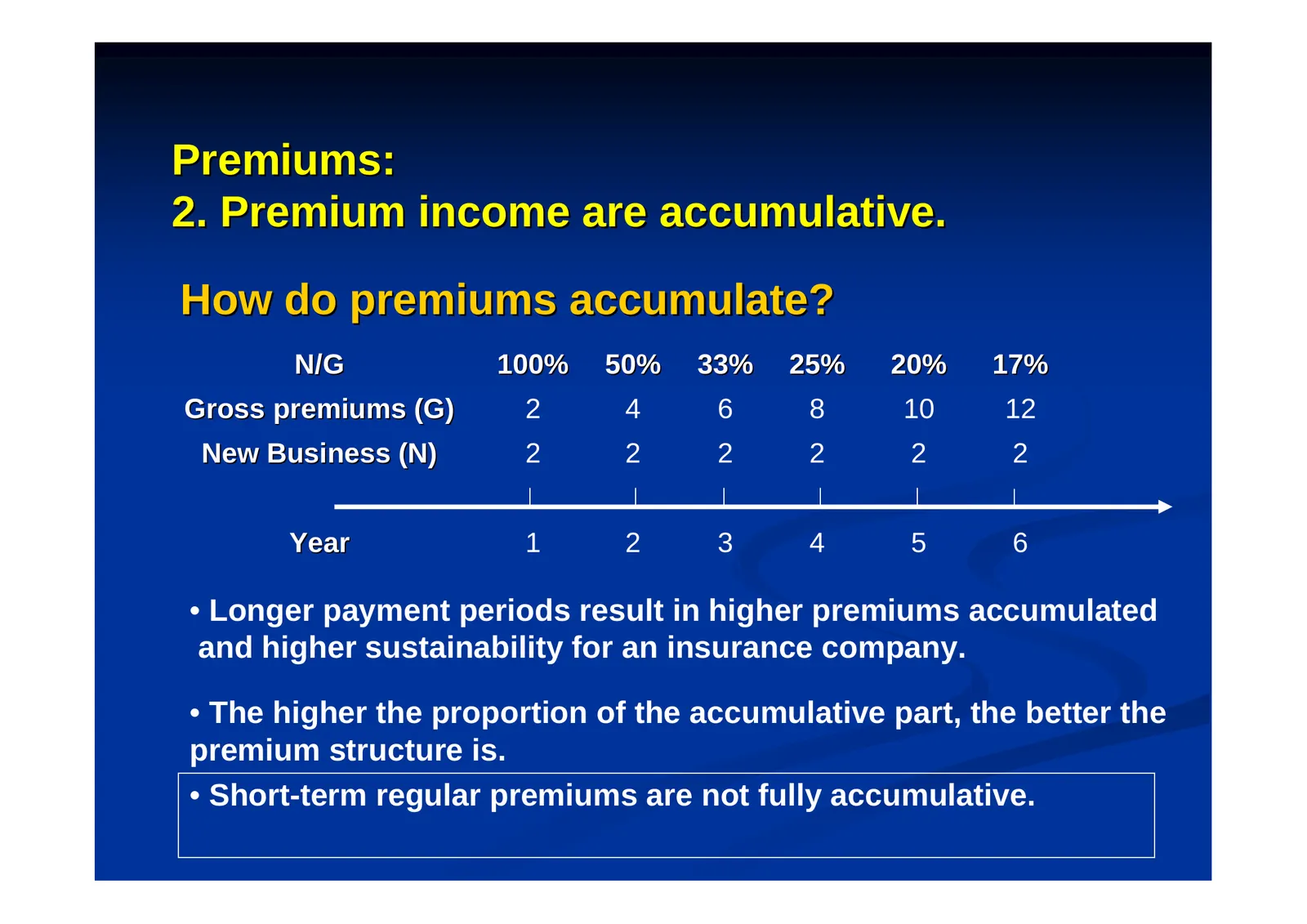
Premiums: 2. Premium income are accumulative. How do premiums accumulate? N/G 100% 50% 33% 25% 20% 17% Gross premiums (G) 2 4 6 8 10 12 New Business (N) 2 2 2 2 2 2 Year 1 2 3 4 5 6 • Longer payment periods result in higher premiums accumulated and higher sustainability for an insurance company. • T
Slide 20: Premiums: 3. Organic growth of premiums
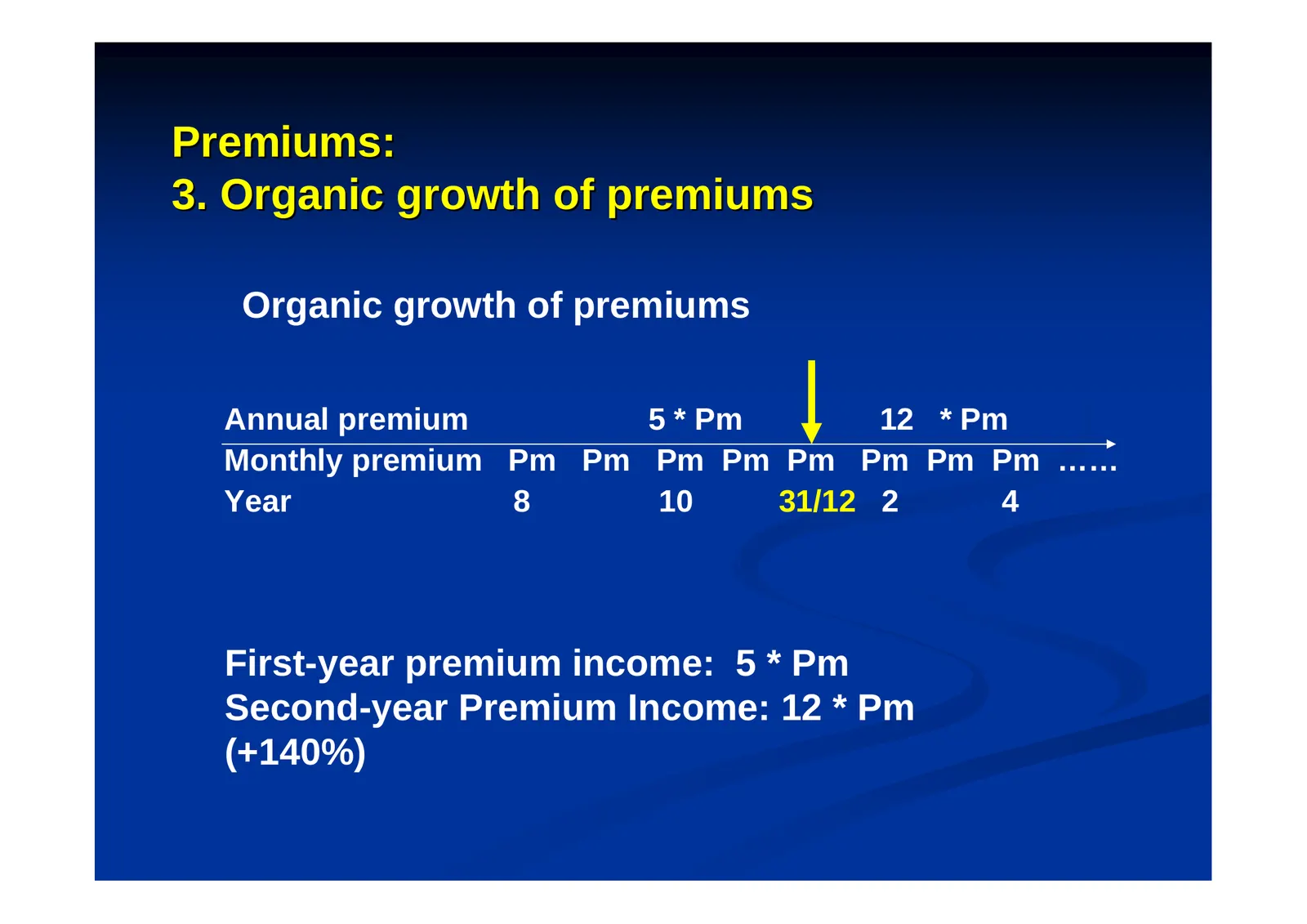
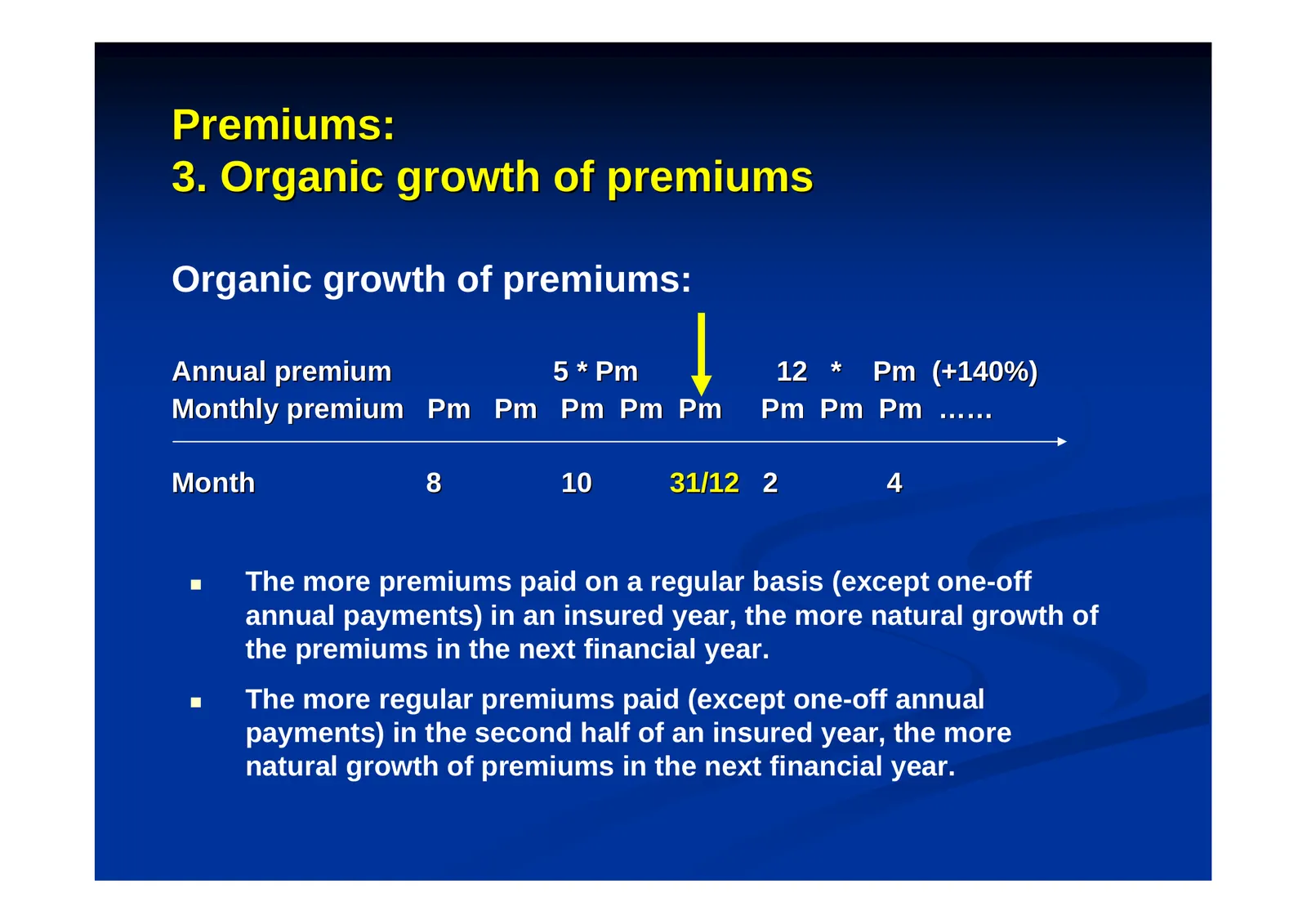
Premiums: 3. Organic growth of premiums Organic growth of premiums Annual premium 5 * Pm 12 * Pm Monthly premium Pm Pm Pm Pm Pm Pm Pm Pm …… Year 8 10 31/12 2 4 First-year premium income: 5 * Pm Second-year Premium Income: 12 * Pm (+140%)
Slide 21: Premiums: 3. Why do premiums grow organically?
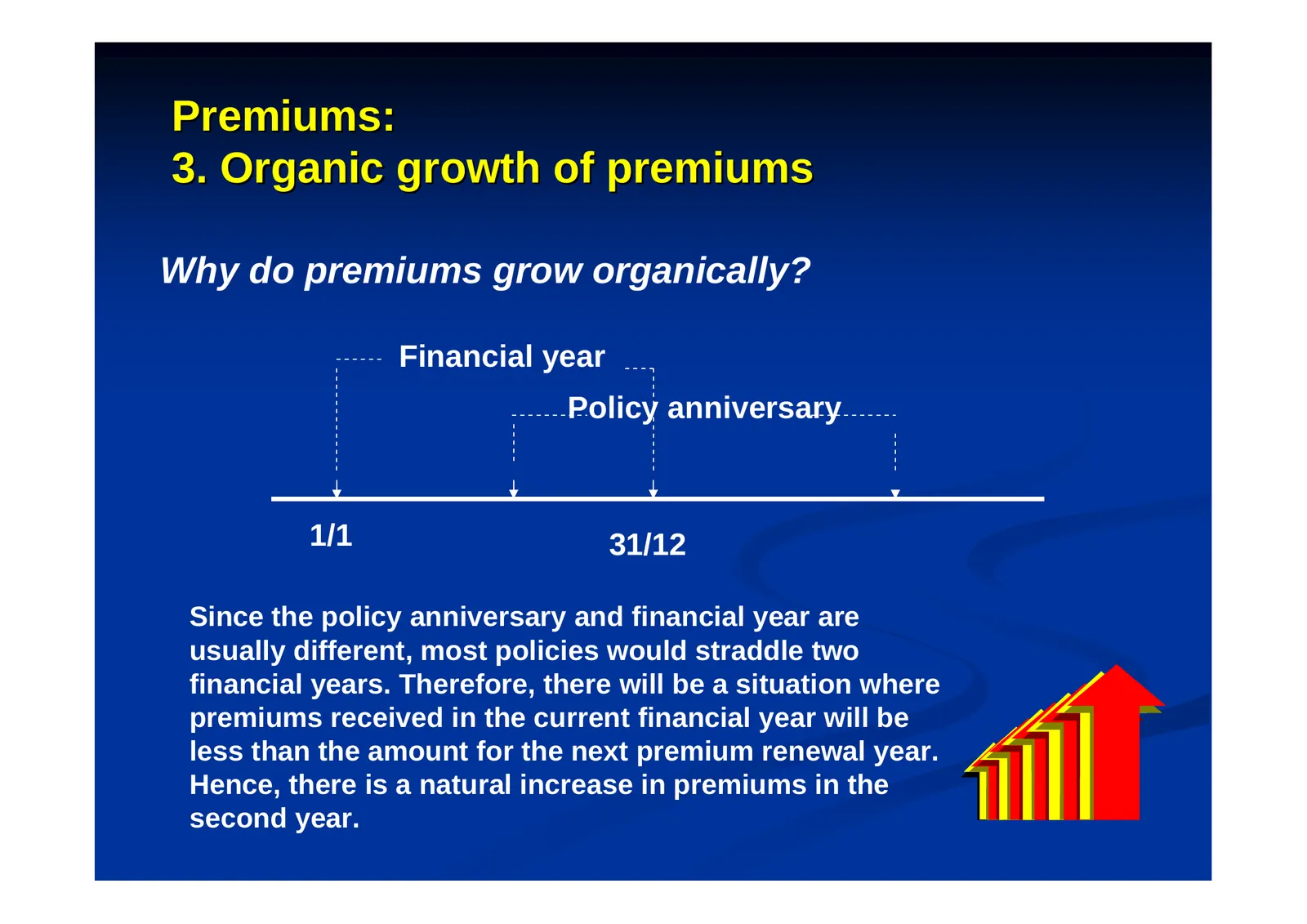
Premiums: 3. Organic growth of premiums Why do premiums grow organically? Financial year Policy anniversary 1/1 31/12 Since the policy anniversary and financial year are usually different, most policies would straddle two financial years. Therefore, there will be a situation where premiums received
Slide 22: Premiums: 3. Organic growth of premiums
Premiums: 3. Organic growth of premiums Organic growth of premiums: Annual premium 5 * Pm 12 * Pm (+140%) Monthly premium Pm Pm Pm Pm Pm Pm Pm Pm …… Month 8 10 31/12 2 4 The more premiums paid on a regular basis (except one-off annual payments) in an insured year, the more natural growth of the pr
Slide 23: Premiums: 4. Cost of premiums
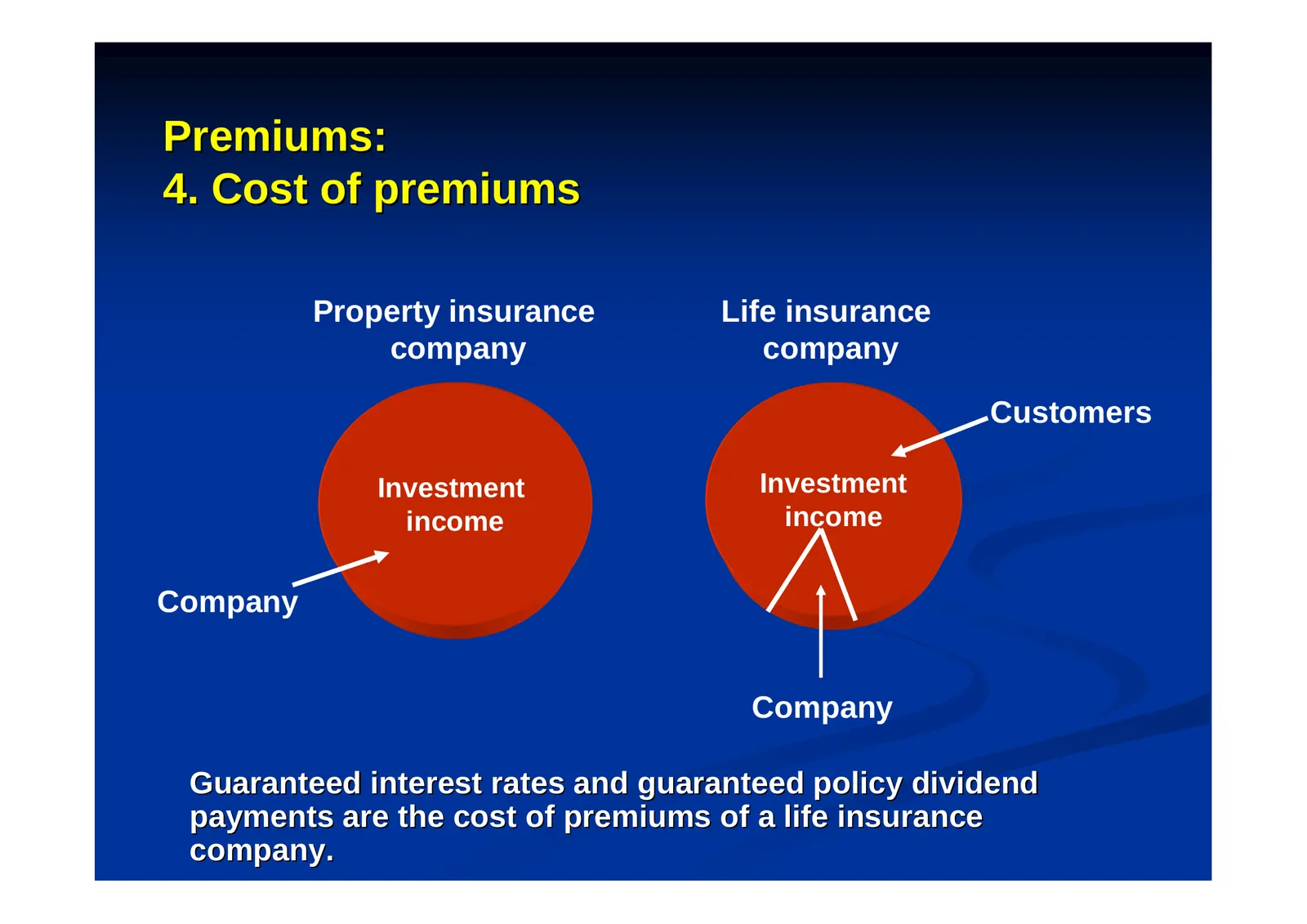
Premiums: 4. Cost of premiums Property insurance Life insurance company company Customers Investment Investment income income Company Company Guaranteed interest rates and guaranteed policy dividend payments are the cost of premiums of a life insurance company.
Slide 24: Premiums: 4. Cost of premiums
Premiums: 4. Cost of premiums Implications: • Since premiums come with a cost, the use of capital has a very significant impact on the business operations of a life insurance company. • The “cost” is deducted from the tax a life insurance company pays.
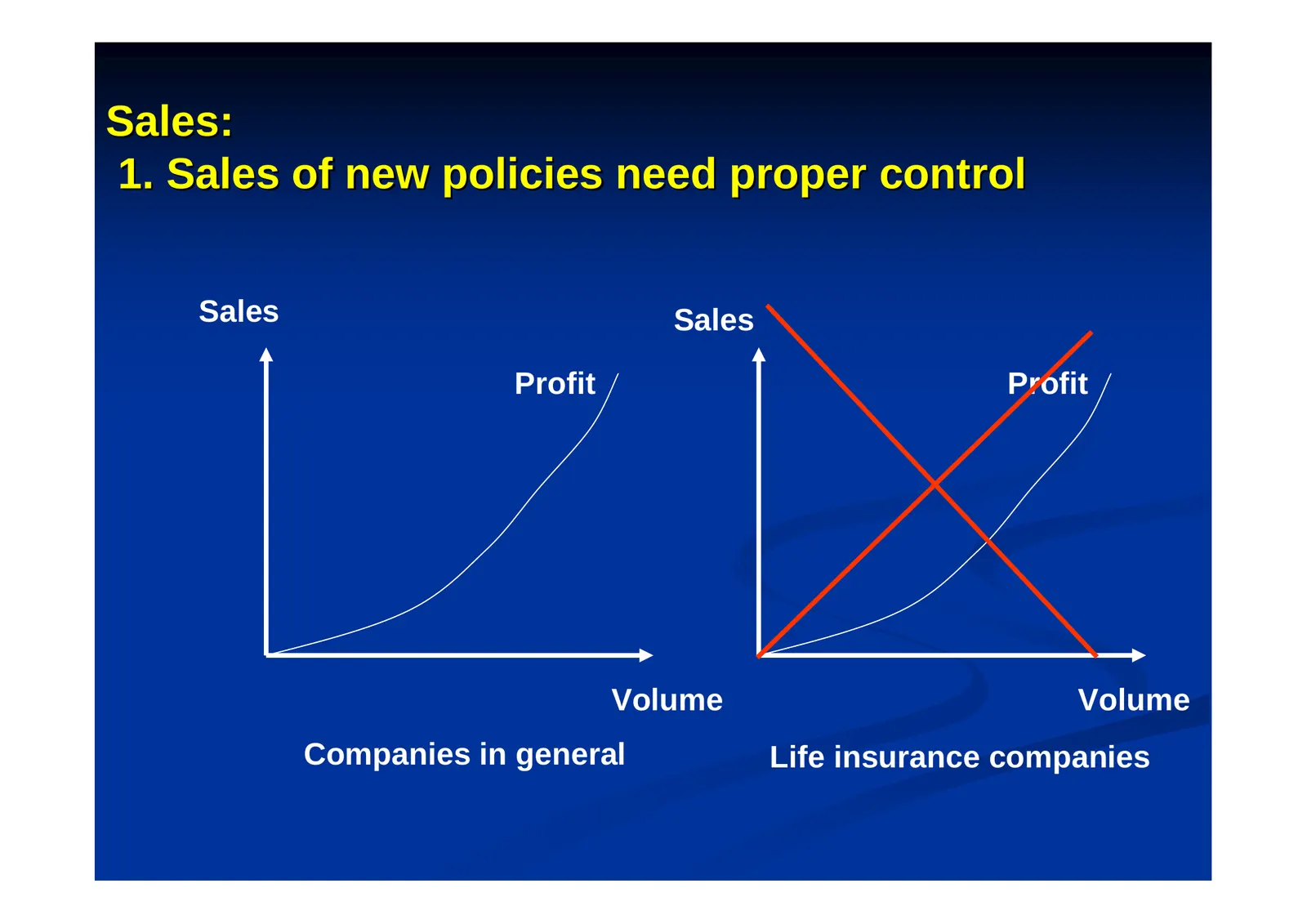
Slide 25: Sales: 1. Sales of new policies need proper control
Sales: 1. Sales of new policies need proper control Sales Sales Profit Profit Volume Volume Companies in general Life insurance companies
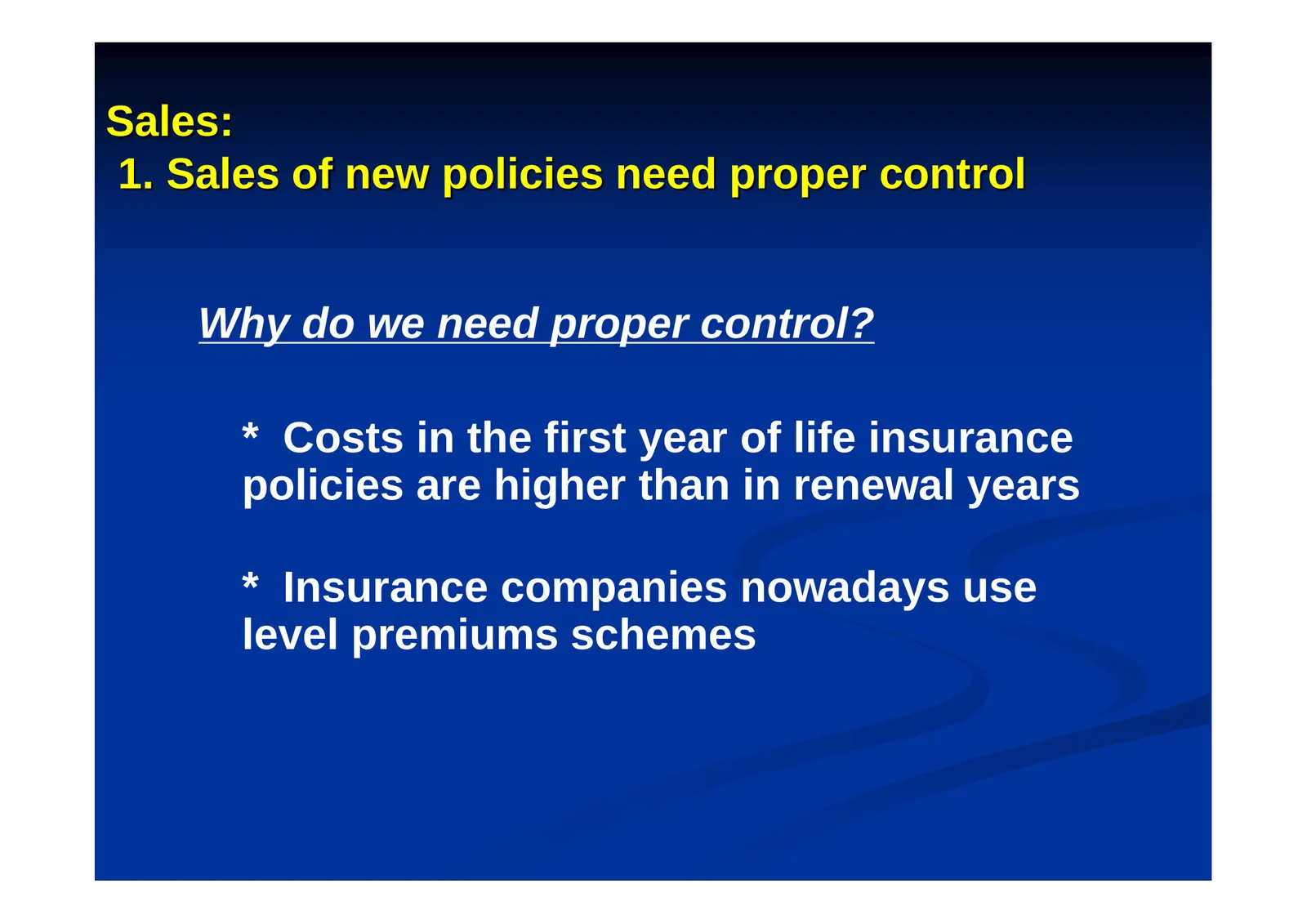
Slide 26: Sales: 1. Why do we need proper control?
Sales: 1. Sales of new policies need proper control Why do we need proper control? * Costs in the first year of life insurance policies are higher than in renewal years * Insurance companies nowadays use level premiums schemes
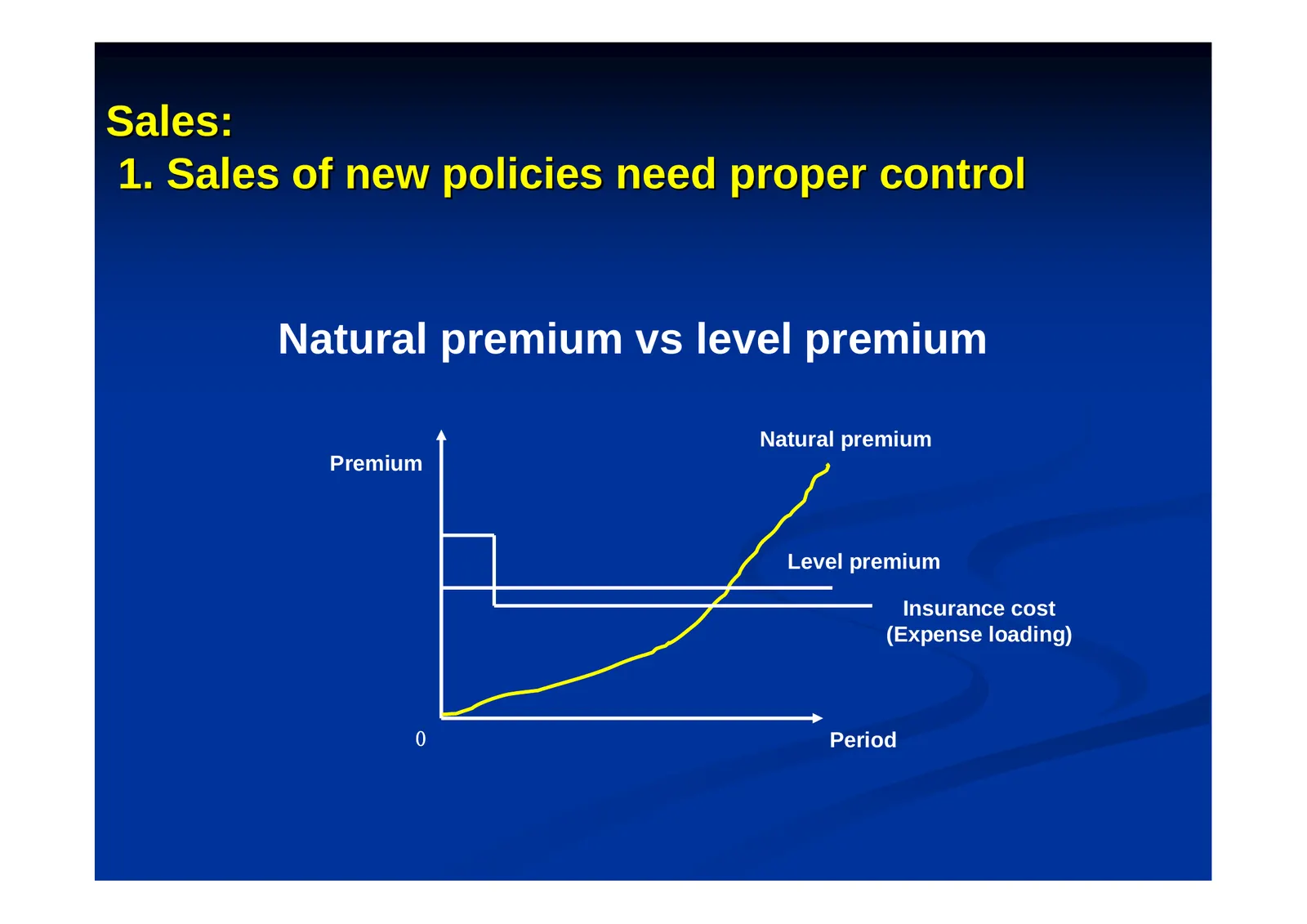
Slide 27: Natural premium vs level premium
Sales: 1. Sales of new policies need proper control Natural premium vs level premium Natural premium Premium Level premium Insurance cost (Expense loading) 0 Period
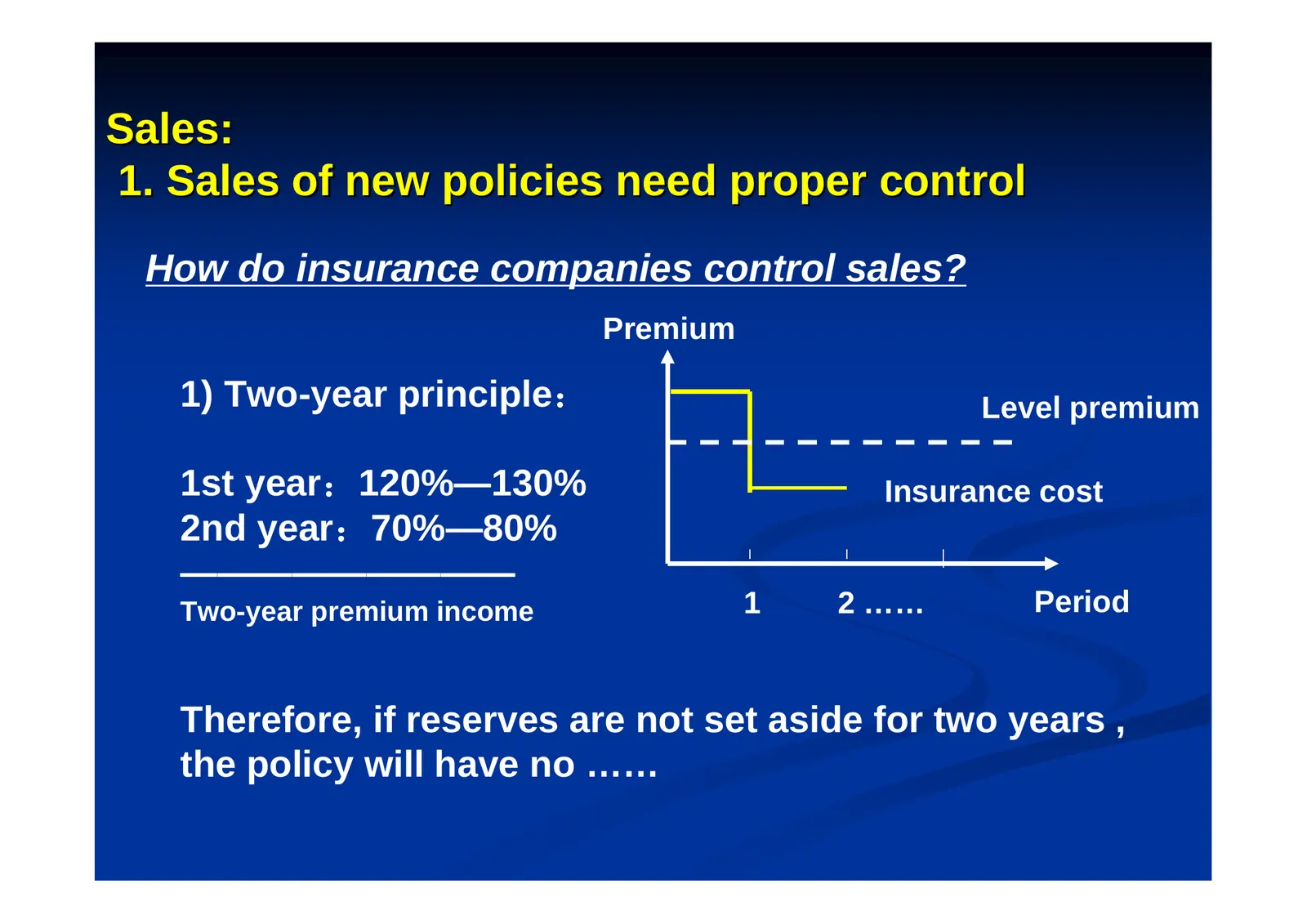
Slide 28: How do insurance companies control sales? Two-year principle
Sales: 1. Sales of new policies need proper control How do insurance companies control sales? Premium 1) Two-year principle: Level premium 1st year:120%—130% Insurance cost 2nd year:70%—80% ————————— Two-year premium income 1 2 …… Period Therefore, if reserves are not set aside for two years , the p
Slide 29: How do insurance companies control sales? Budget management
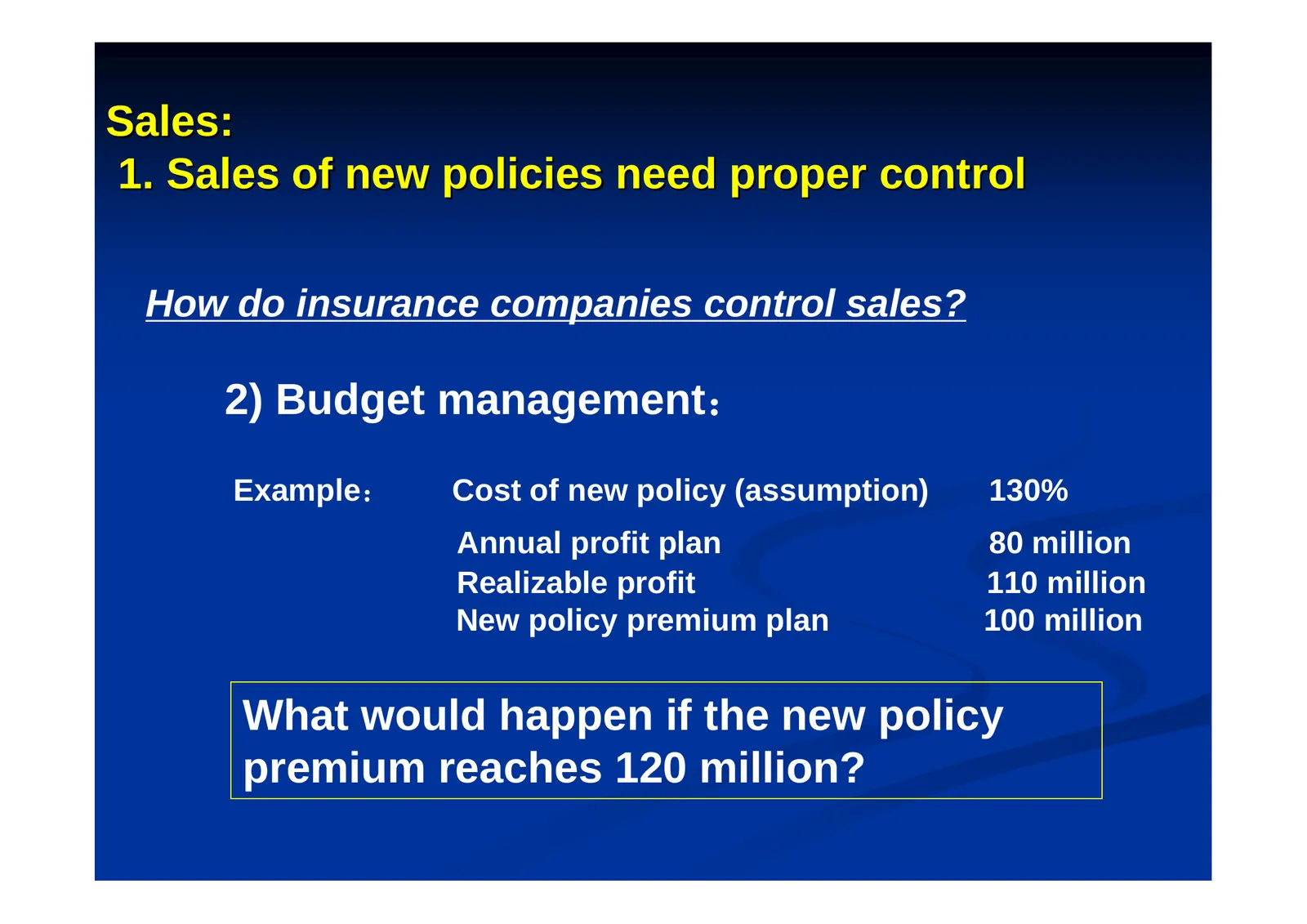
Sales: 1. Sales of new policies need proper control How do insurance companies control sales? 2) Budget management: Example: Cost of new policy (assumption) 130% Annual profit plan 80 million Realizable profit 110 million New policy premium plan 100 million What would happen if the new policy premiu
Slide 30: Sales: 1. Why do we need proper control?
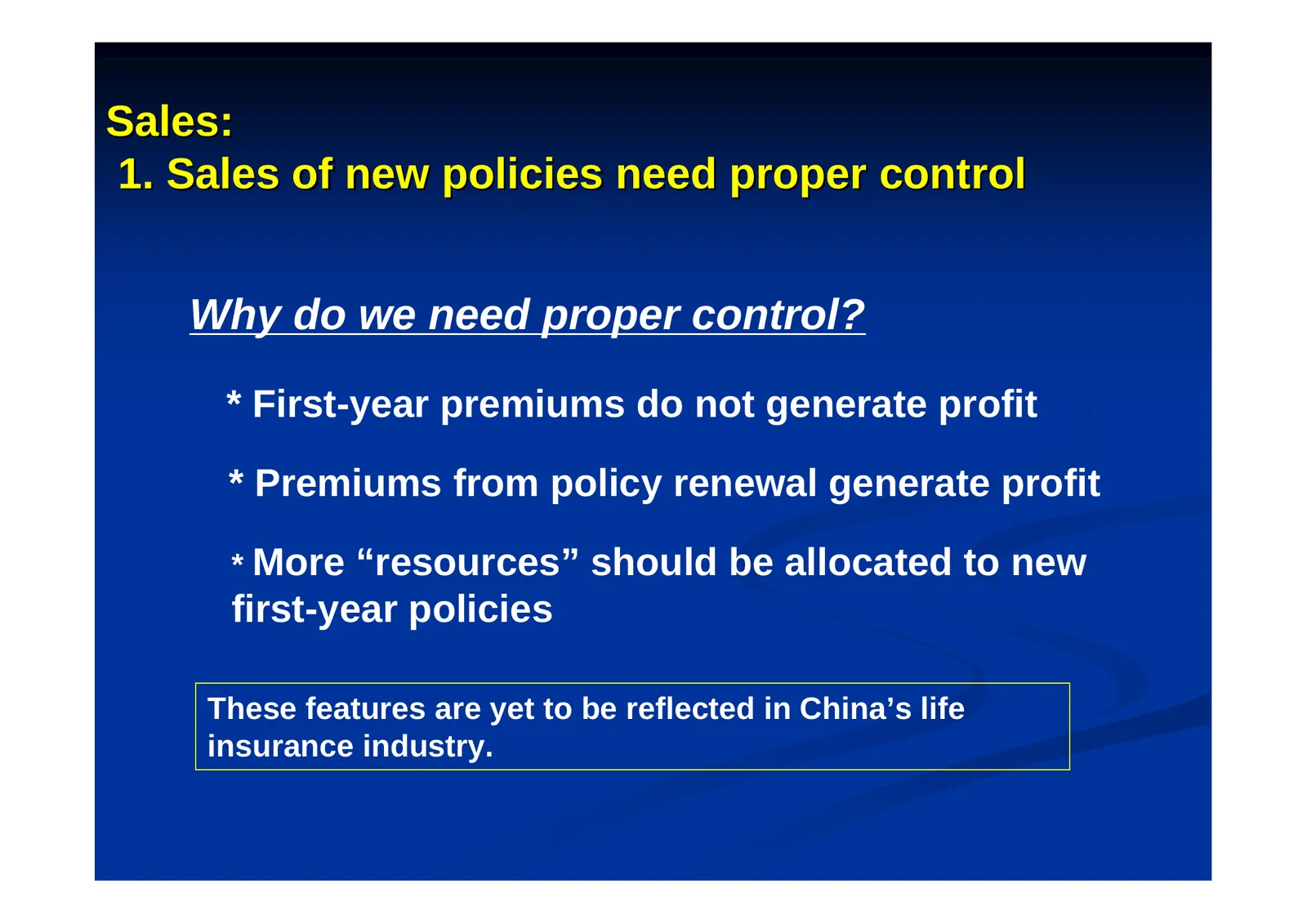
Sales: 1. Sales of new policies need proper control Why do we need proper control? * First-year premiums do not generate profit * Premiums from policy renewal generate profit * More “resources” should be allocated to new first-year policies These features are yet to be reflected in China’s life insu
Slide 31: Sales: 2. Careful selection of customers is essential
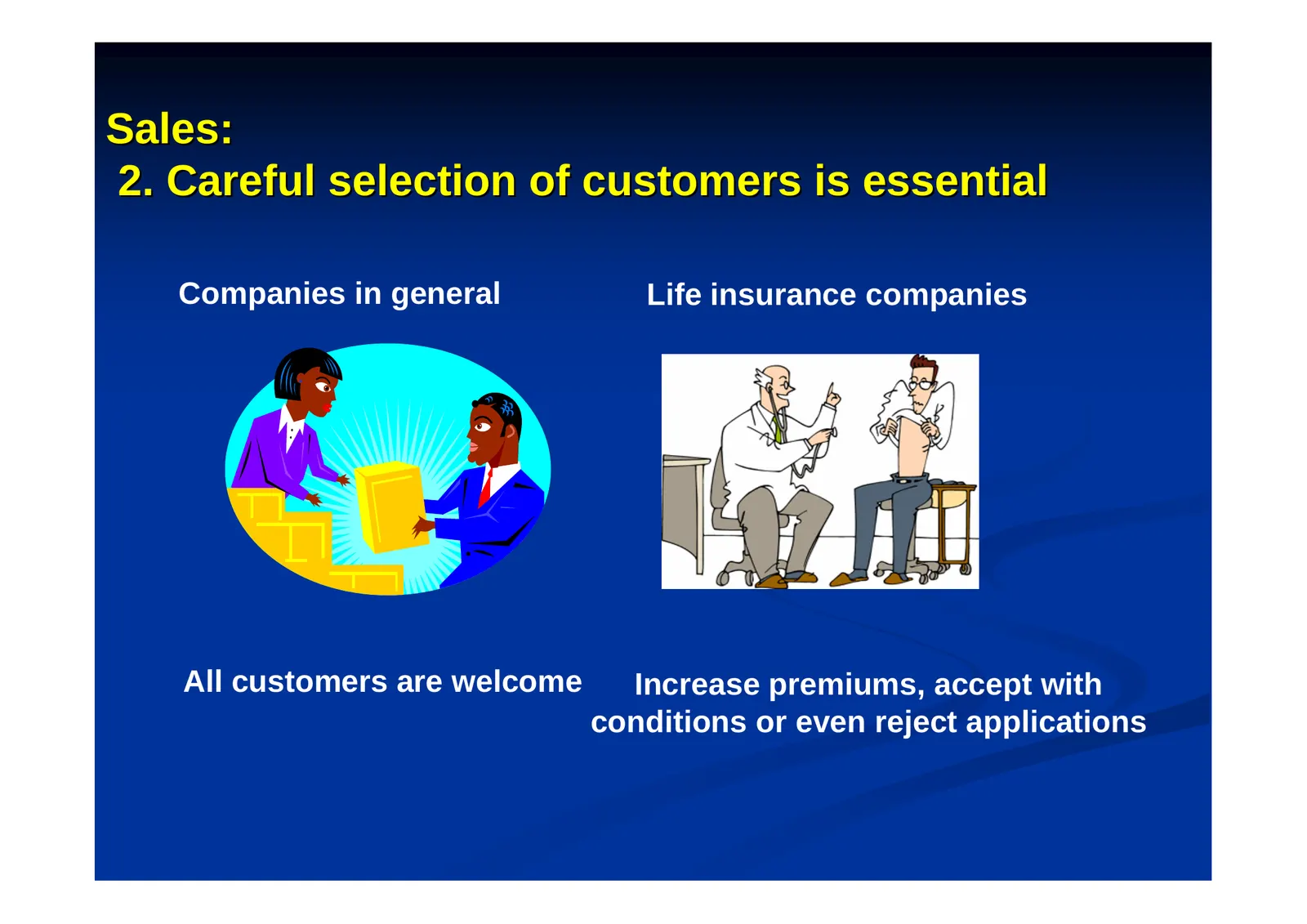
Sales: 2. Careful selection of customers is essential Companies in general Life insurance companies All customers are welcome Increase premiums, accept with conditions or even reject applications
Slide 32: Why be selective
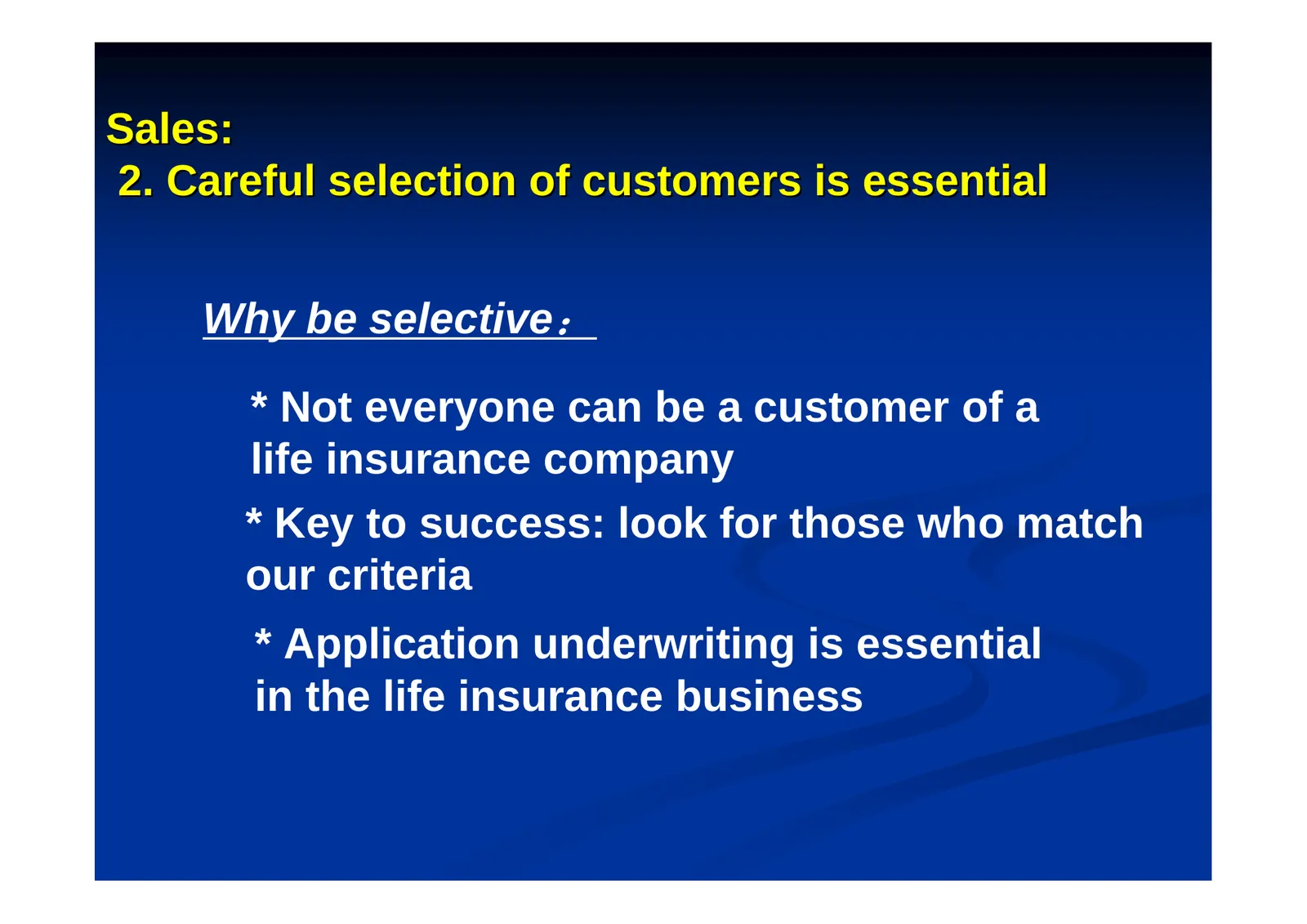
Sales: 2. Careful selection of customers is essential Why be selective: * Not everyone can be a customer of a life insurance company * Key to success: look for those who match our criteria * Application underwriting is essential in the life insurance business
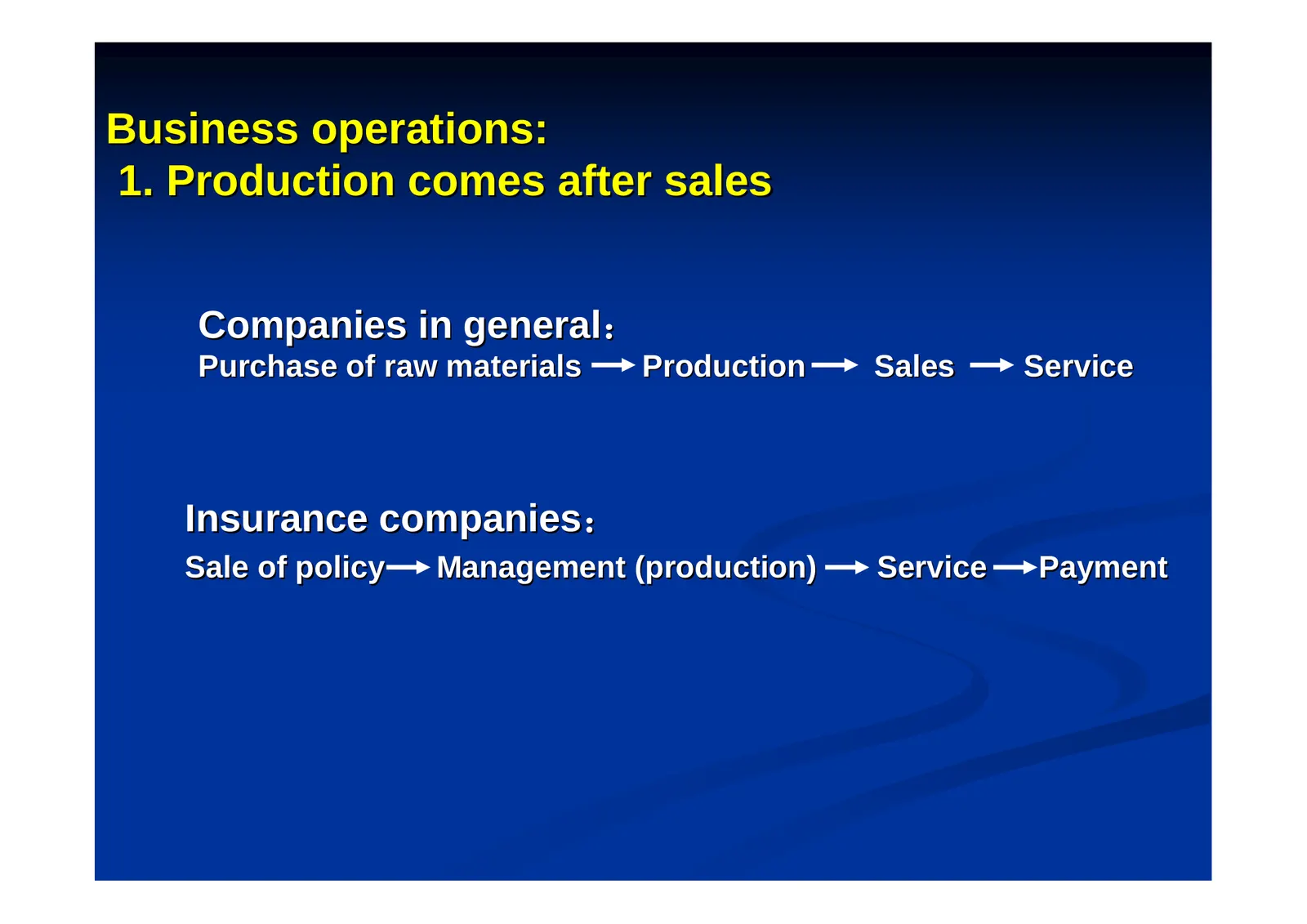
Slide 33: Business operations: 1. Production comes after sales
Business operations: 1. Production comes after sales Companies in general: Purchase of raw materials Production Sales Service Insurance companies: Sale of policy Management (production) Service Payment
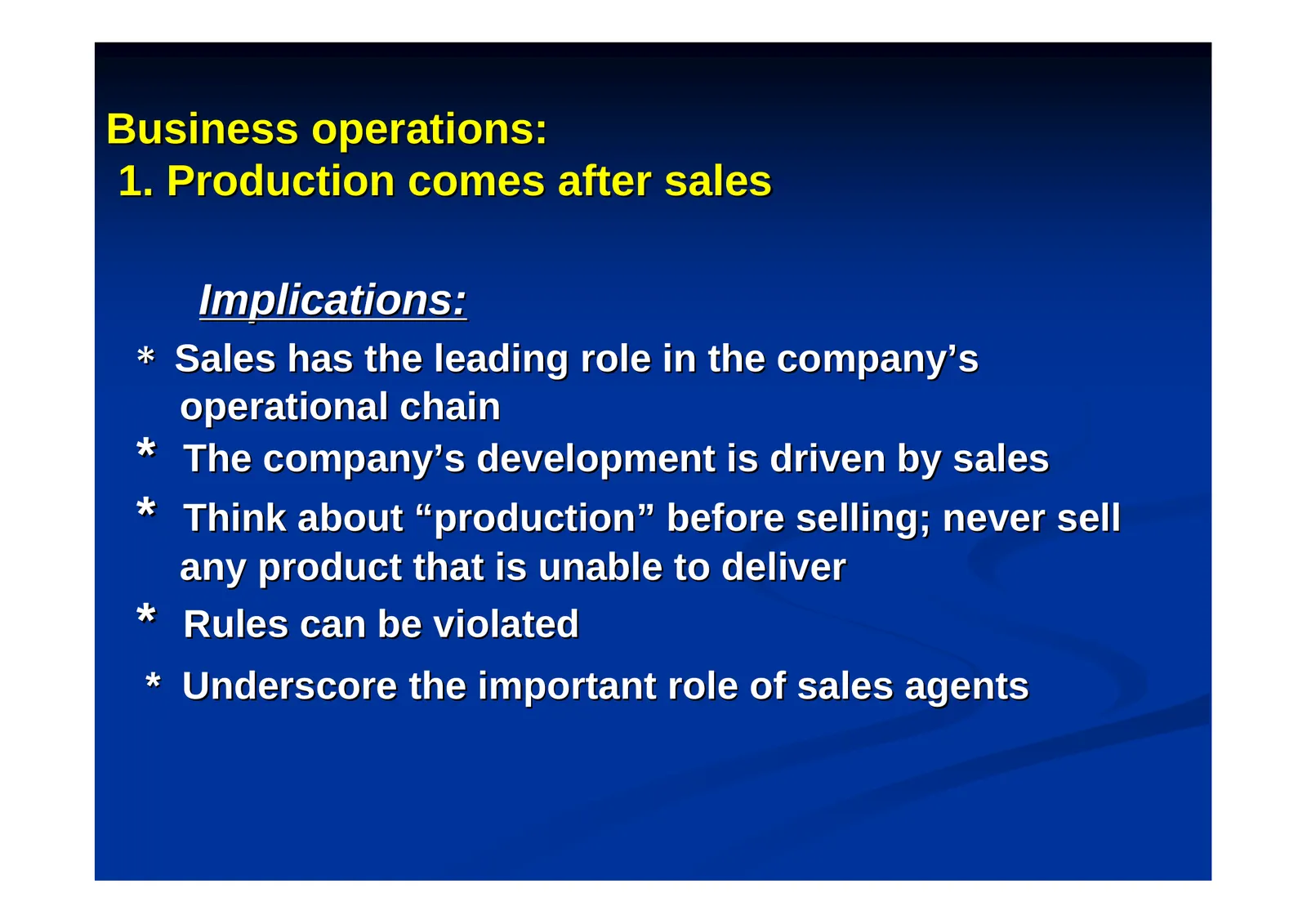
Slide 34: Business operations: 1. Implications of sales leading
Business operations: 1. Production comes after sales Implications: * Sales has the leading role in the company’s operational chain * The company’s development is driven by sales * Think about “production” before selling; never sell any product that is unable to deliver * Rules can be violated * Unde
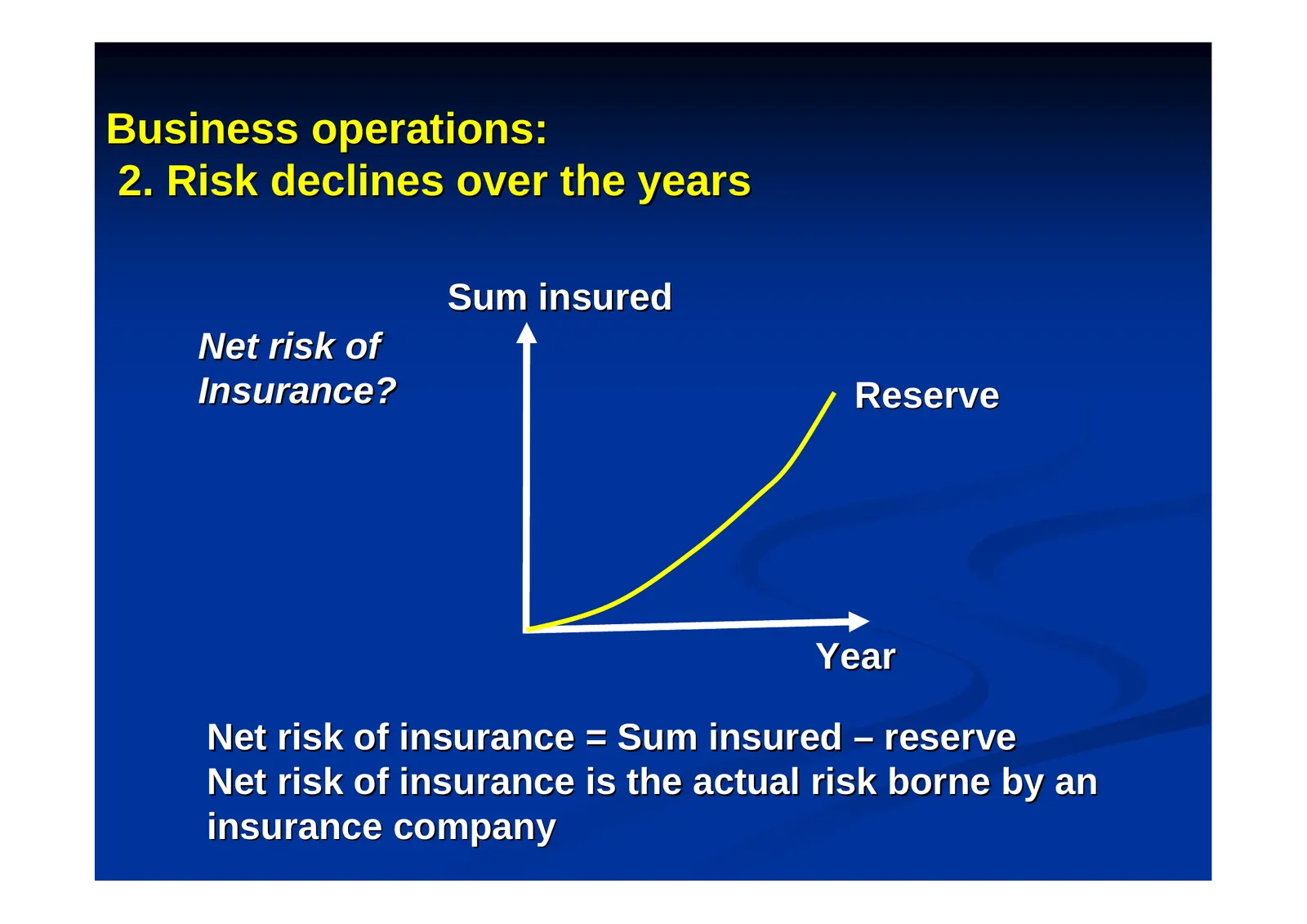
Slide 35: Business operations: 2. Risk declines over the years
Business operations: 2. Risk declines over the years Sum insured Net risk of Insurance? Reserve Year Net risk of insurance = Sum insured – reserve Net risk of insurance is the actual risk borne by an insurance company
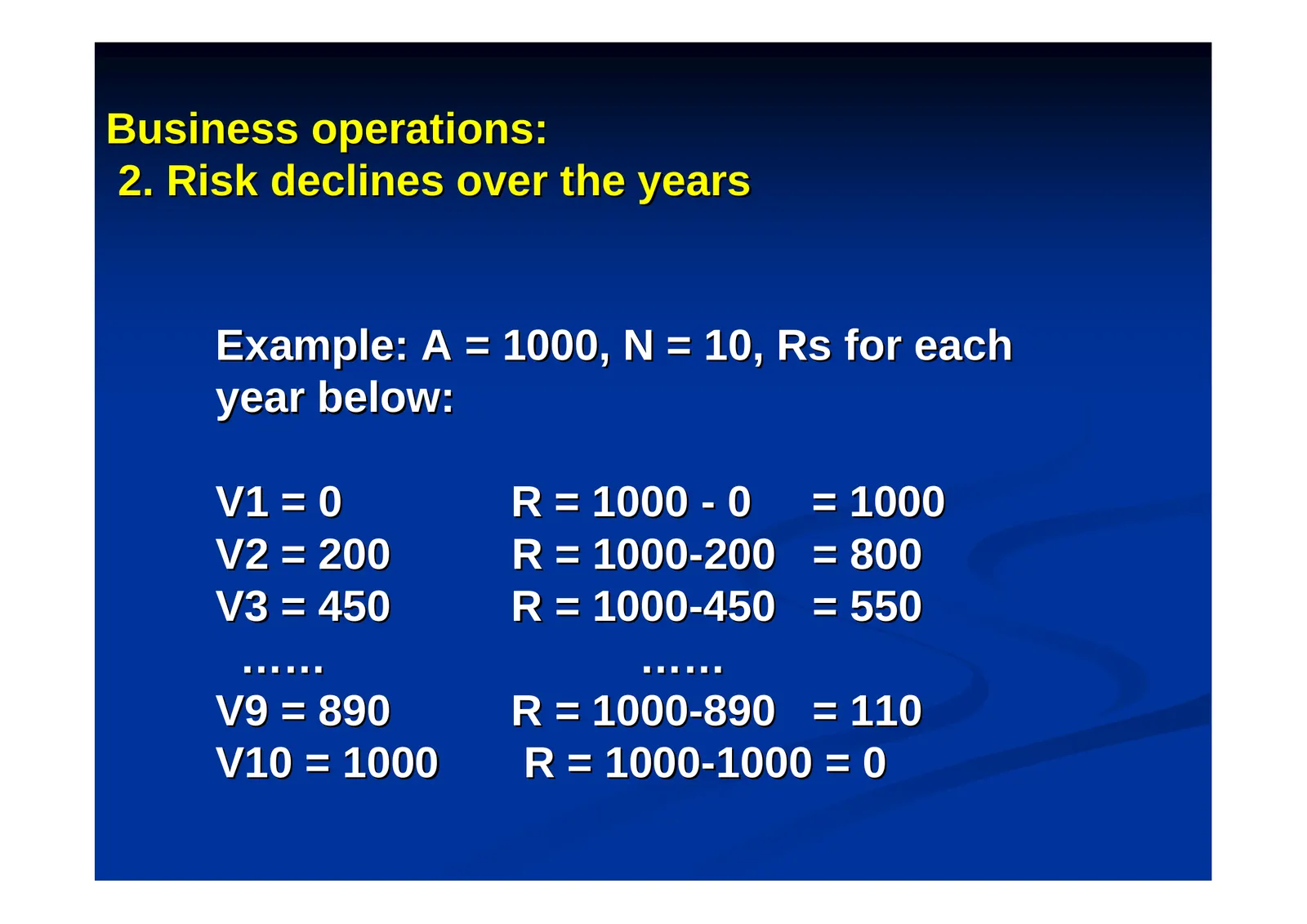
Slide 36: Risk declines over the years: example
Business operations: 2. Risk declines over the years Example: A = 1000, N = 10, Rs for each year below: V1 = 0 R = 1000 - 0 = 1000 V2 = 200 R = 1000-200 = 800 V3 = 450 R = 1000-450 = 550 …… …… V9 = 890 R = 1000-890 = 110 V10 = 1000 R = 1000-1000 = 0
Slide 37: Business operations: 2. Risk declines over the years
Business operations: 2. Risk declines over the years Implications: • The longer an insurance policy has been in force, the less risky it is for an insurance company. • Therefore, after-sales service to long-term customers is extremely important.
Slide 38: Business operations: 3. Profitability hinges on anticipated costs
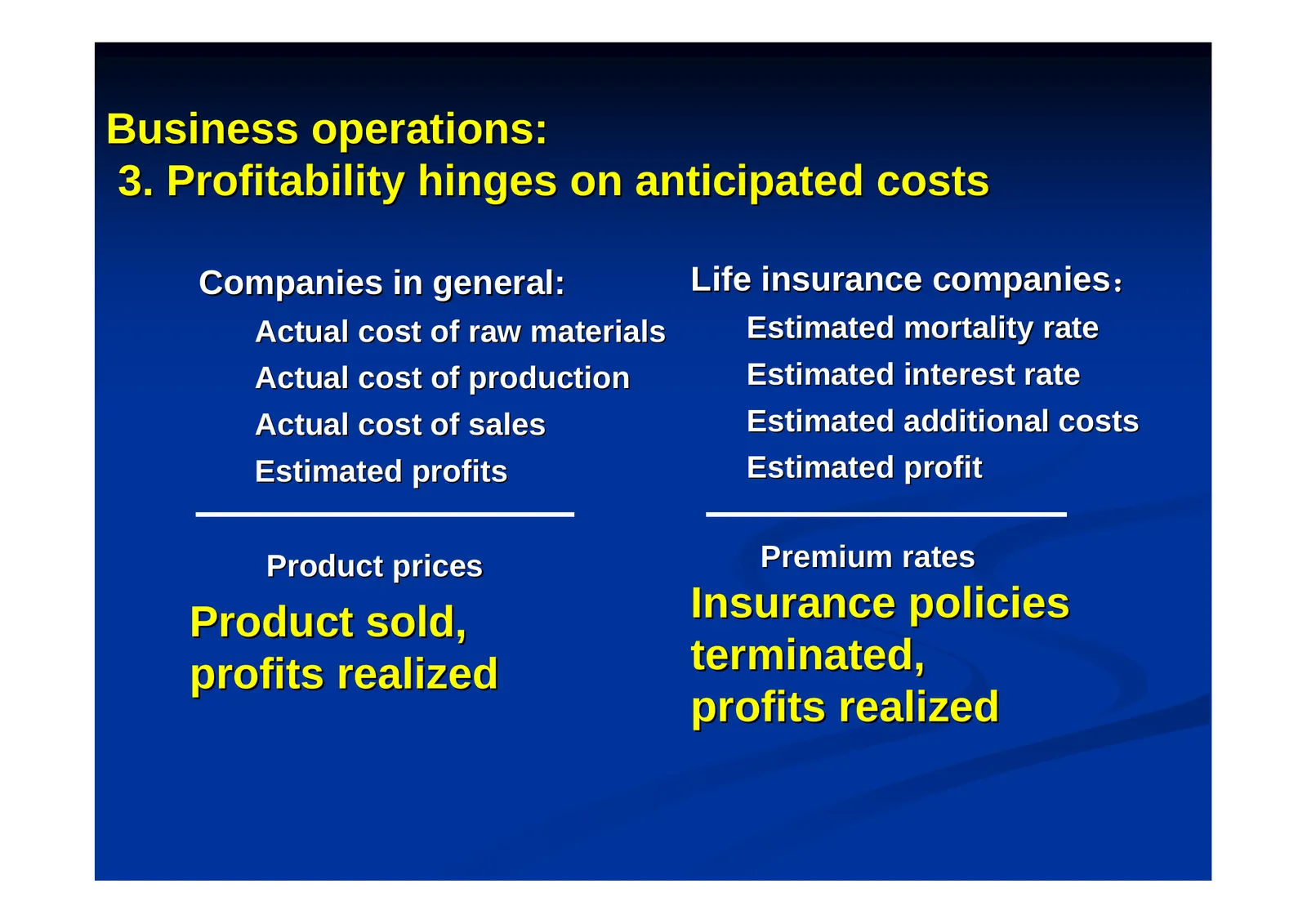
Business operations: 3. Profitability hinges on anticipated costs Companies in general: Life insurance companies: Actual cost of raw materials Estimated mortality rate Actual cost of production Estimated interest rate Actual cost of sales Estimated additional costs Estimated profits Estimated profit
Slide 39: Business operations: 3. Implications
Business operations: 3. Profitability hinges on anticipated costs Implications: • Operating risks for a life insurance company are “potential” in nature. • Cost control is essential. • The actuary has a very special position and duties. • Use of embedded value (EV) to evaluate the value of a life in
Slide 40: Business operations: 4. Reserves are an obligation to customers
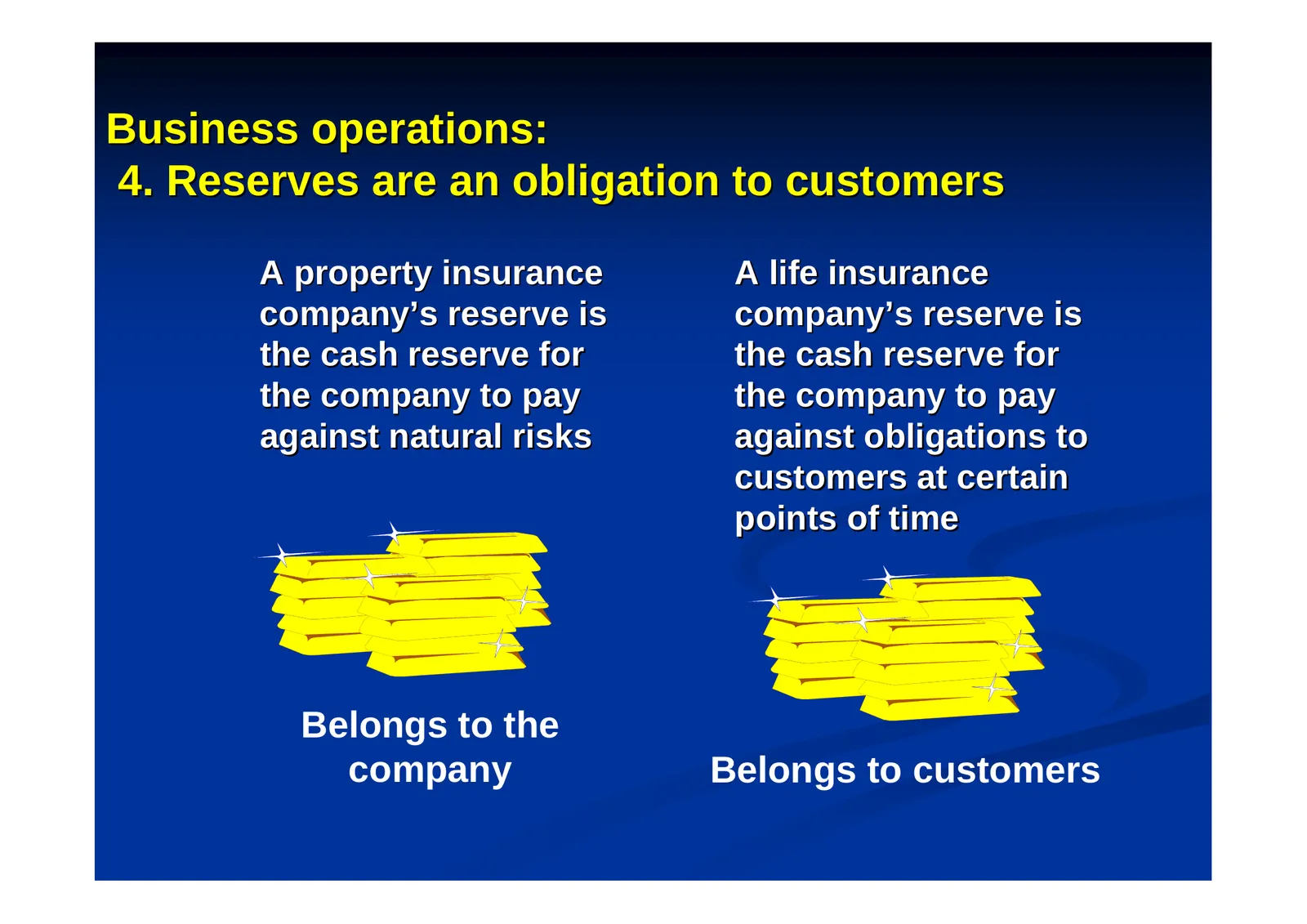
Business operations: 4. Reserves are an obligation to customers A property insurance A life insurance company’s reserve is company’s reserve is the cash reserve for the cash reserve for the company to pay the company to pay against natural risks against obligations to customers at certain points of
Slide 41: Business operations: 4. Implications
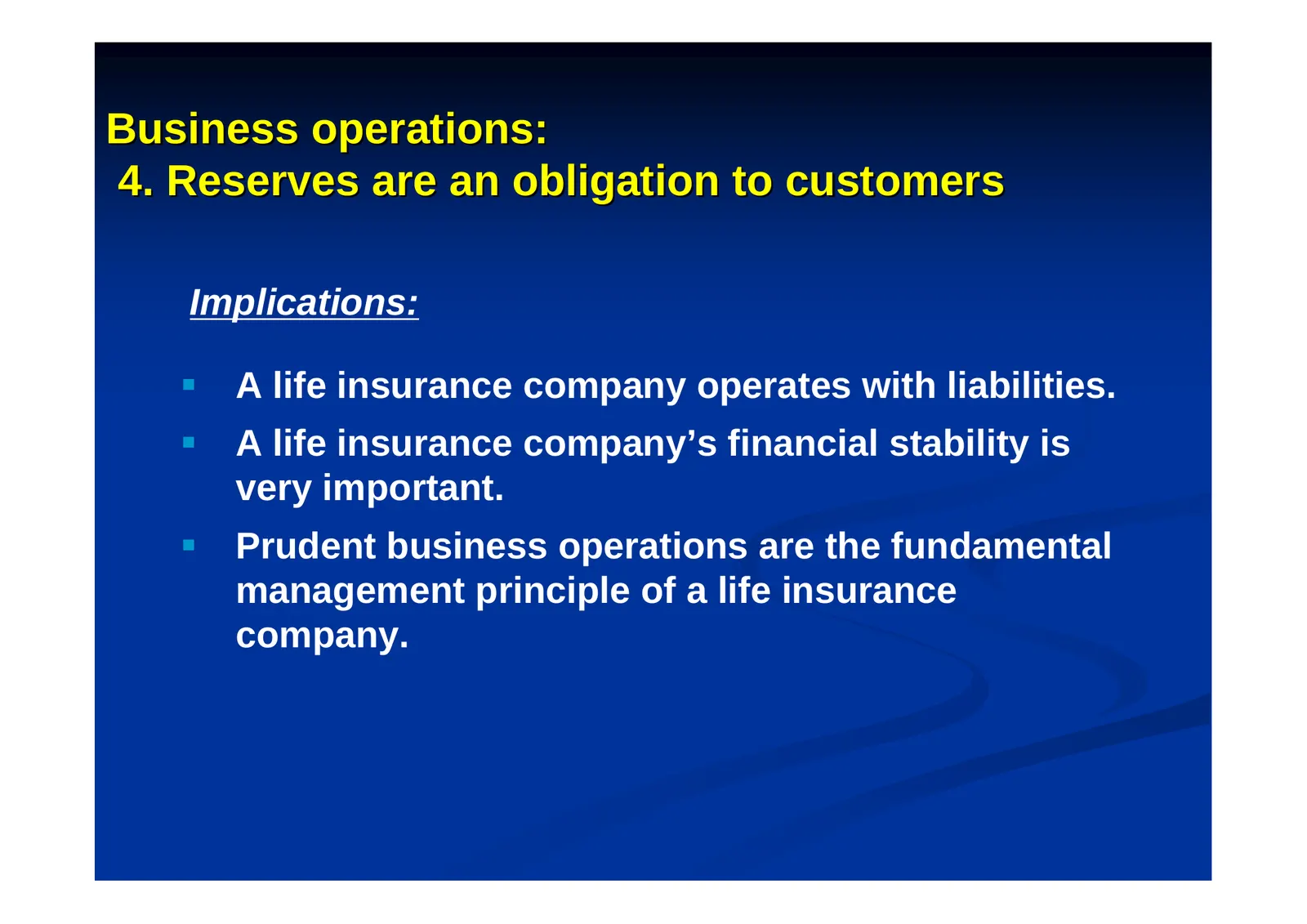
Business operations: 4. Reserves are an obligation to customers Implications: A life insurance company operates with liabilities. A life insurance company’s financial stability is very important. Prudent business operations are the fundamental management principle of a life insurance company.
Slide 42: Business structure and profitability of a life insurance company
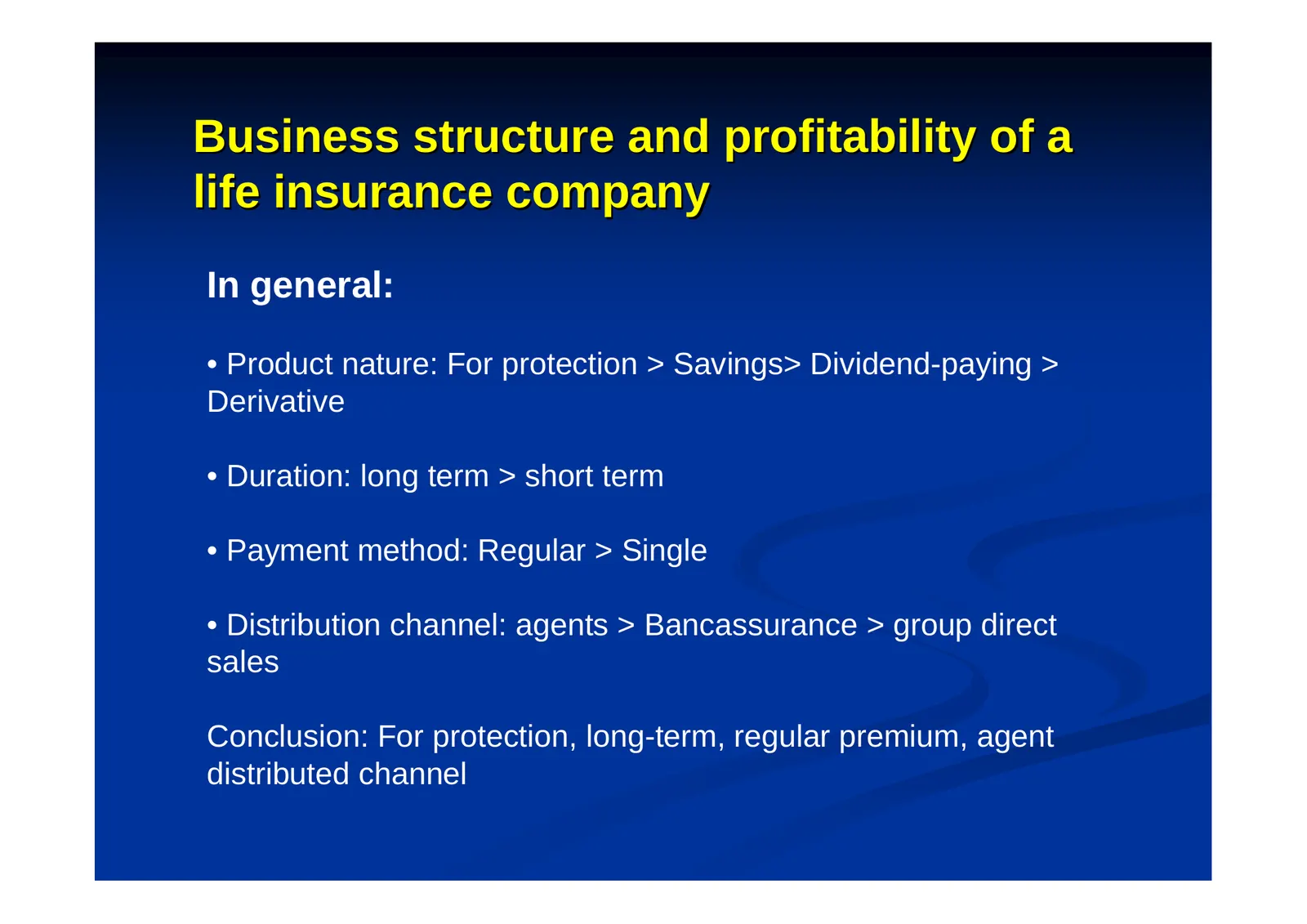
Business structure and profitability of a life insurance company In general: • Product nature: For protection > Savings> Dividend-paying > Derivative • Duration: long term > short term • Payment method: Regular > Single • Distribution channel: agents > Bancassurance > group direct sales Conclusion:
Source: Internet Archive copy of e-chinalife.com
More decks from China Life Insurance Co. Ltd. Class A
 Investor Day (October 2023)25 slides · Oct 30, 2023
 Investor Day (October 2023)14 slides · Oct 30, 2023
 Corporate Update (October 2023)37 slides · Oct 30, 2023
 Investor Presentation (May 2023)32 slides · May 8, 2023
 2020 Corporate Day64 slides · Dec 7, 2020
 H1 2019 Earnings Presentation40 slides · Aug 23, 2019