Crinetics Pharmaceuticals, Inc. · NASDAQ:CRNX
Crinetics Pharmaceuticals — Technical Presentation (November 2020)
58 slides from Crinetics Pharmaceuticals's technical presentation, Nov 20, 2020
Slide 1: Acromegaly KOL Event
ACROMEGALY KOL EVENT November 20, 2020
Slide 2: Safe Harbor Statement
Safe Harbor Statement This presentation contains forward-looking statements. All statements other than statements of historical facts contained in this presentation are forward-looking statements, including statements regarding: the potential benefits of paltusotine for acromegaly patients; the plan
Slide 3: Company Overview
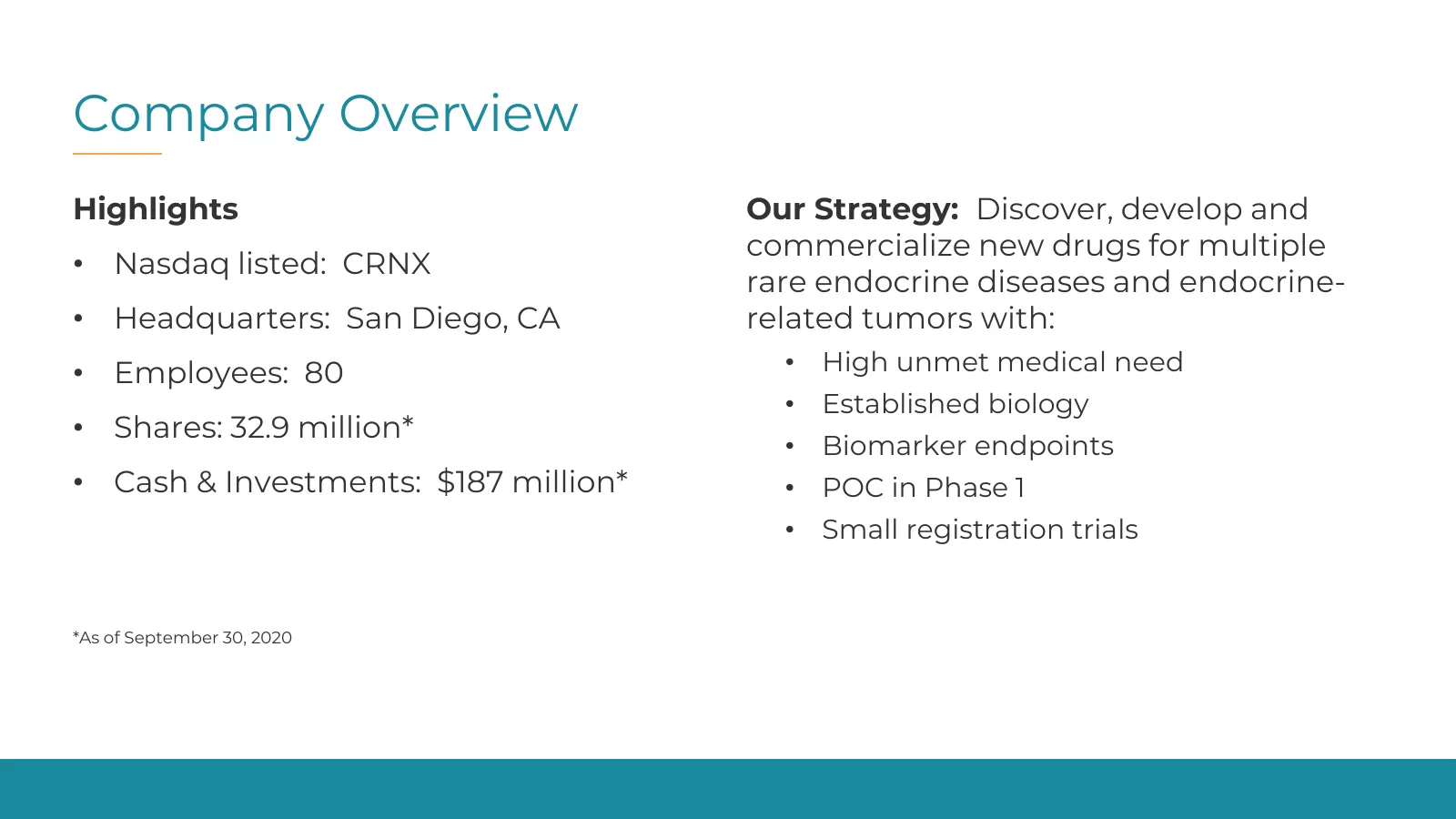
Company Overview Highlights Our Strategy: Discover, develop and commercialize new drugs for multiple • Nasdaq listed: CRNX rare endocrine diseases and endocrine- • Headquarters: San Diego, CA related tumors with: • Employees: 80 • High unmet medical need • Established biology • Shares: 32.9 million*
Slide 4: Pipeline: Rare Disease Franchise in Endocrinology
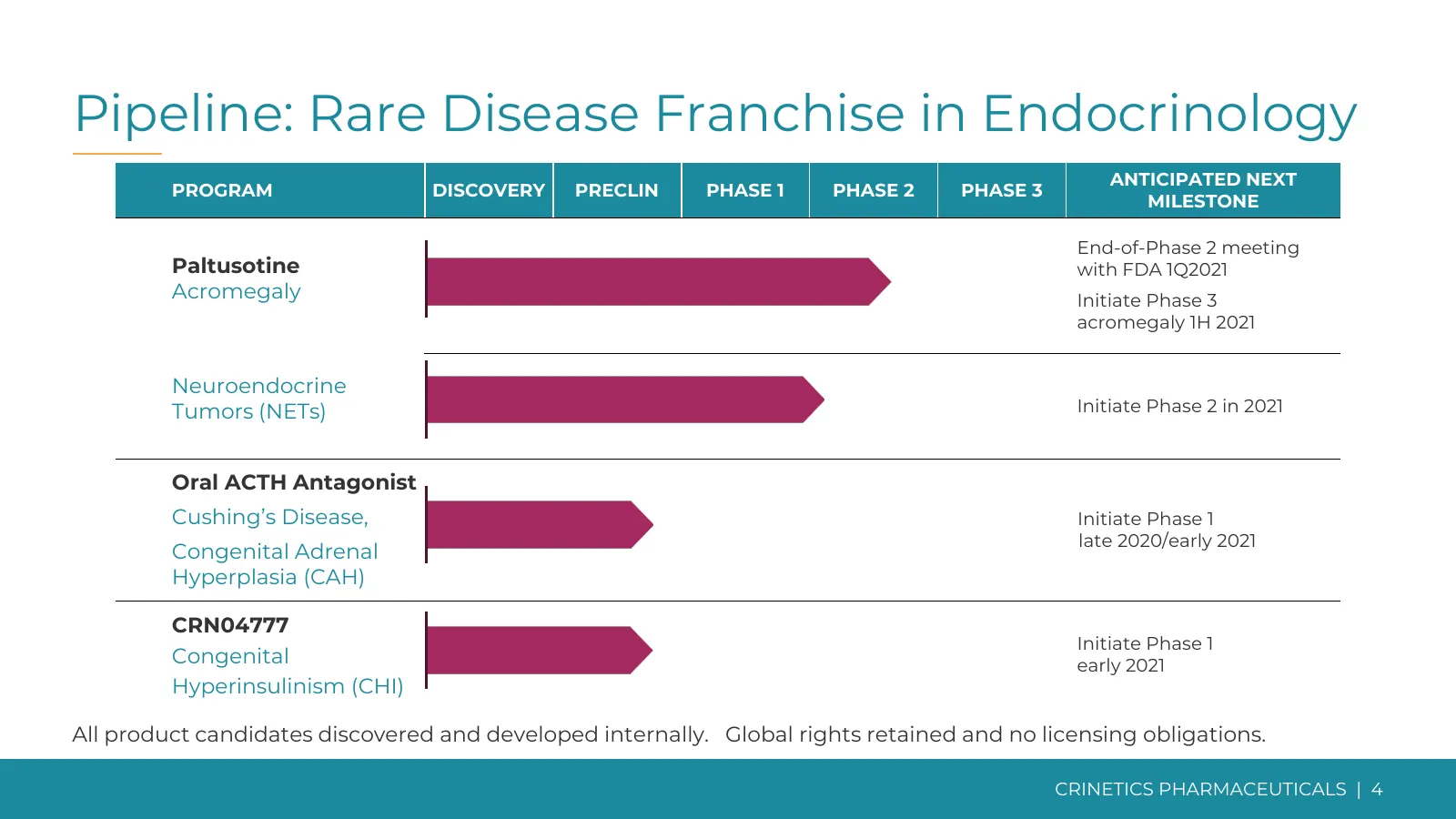
Pipeline: Rare Disease Franchise in Endocrinology ANTICIPATED NEXT PROGRAM DISCOVERY PRECLIN PHASE 1 PHASE 2 PHASE 3 MILESTONE End-of-Phase 2 meeting Paltusotine with FDA 1Q2021 Acromegaly Initiate Phase 3 acromegaly 1H 2021 Neuroendocrine Tumors (NETs) Initiate Phase 2 in 2021 Oral ACTH Antagonist
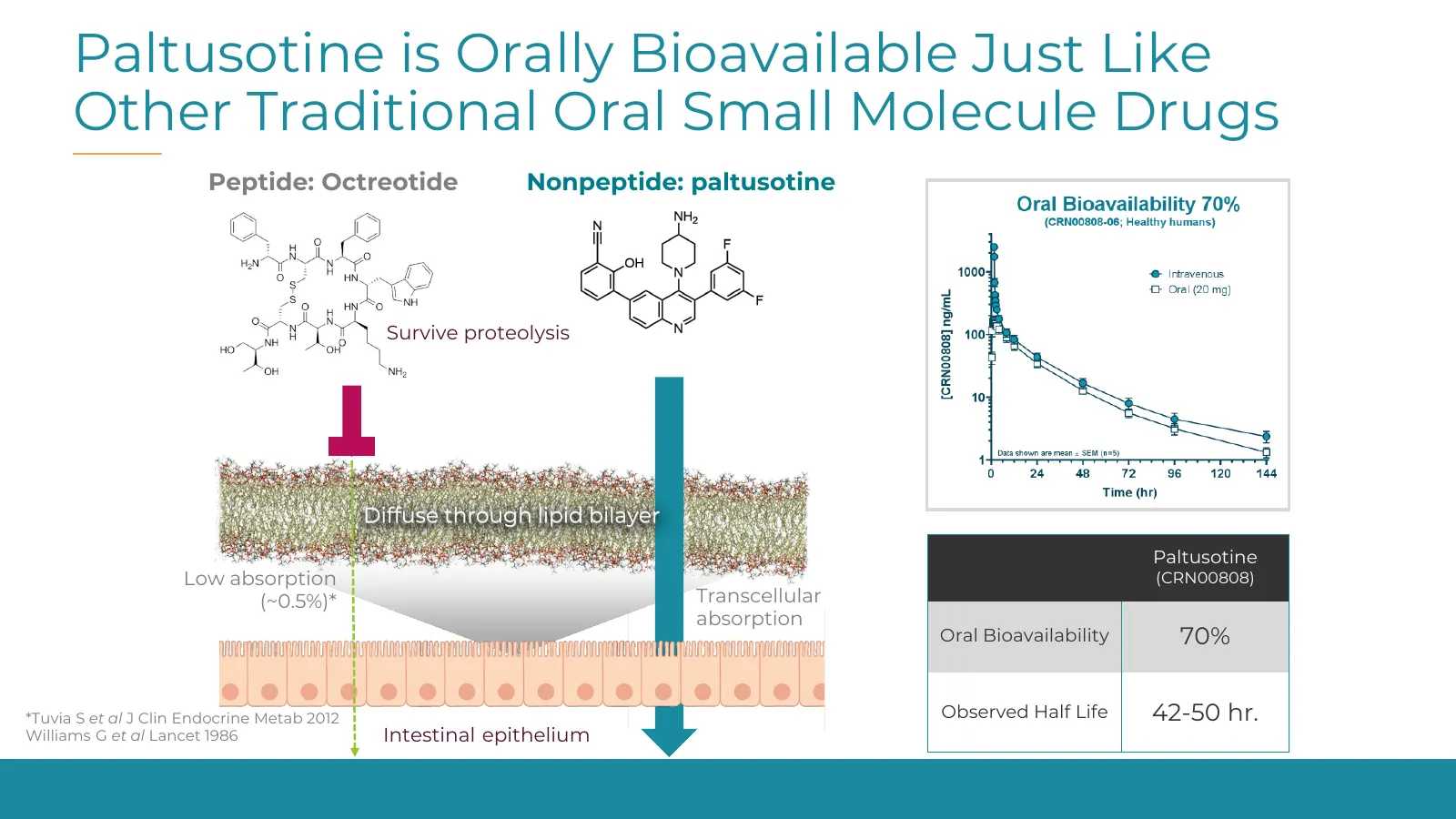
Slide 5: Paltusotine is Orally Bioavailable Just Like Other Traditional Oral Small Molecule Drugs
Paltusotine is Orally Bioavailable Just Like Other Traditional Oral Small Molecule Drugs Peptide: Octreotide Nonpeptide: paltusotine Survive proteolysis Diffuse through lipid bilayer Paltusotine Low absorption (CRN00808) (~0.5%)* Transcellular absorption Oral Bioavailability 70% *Tuvia S et al J Cli
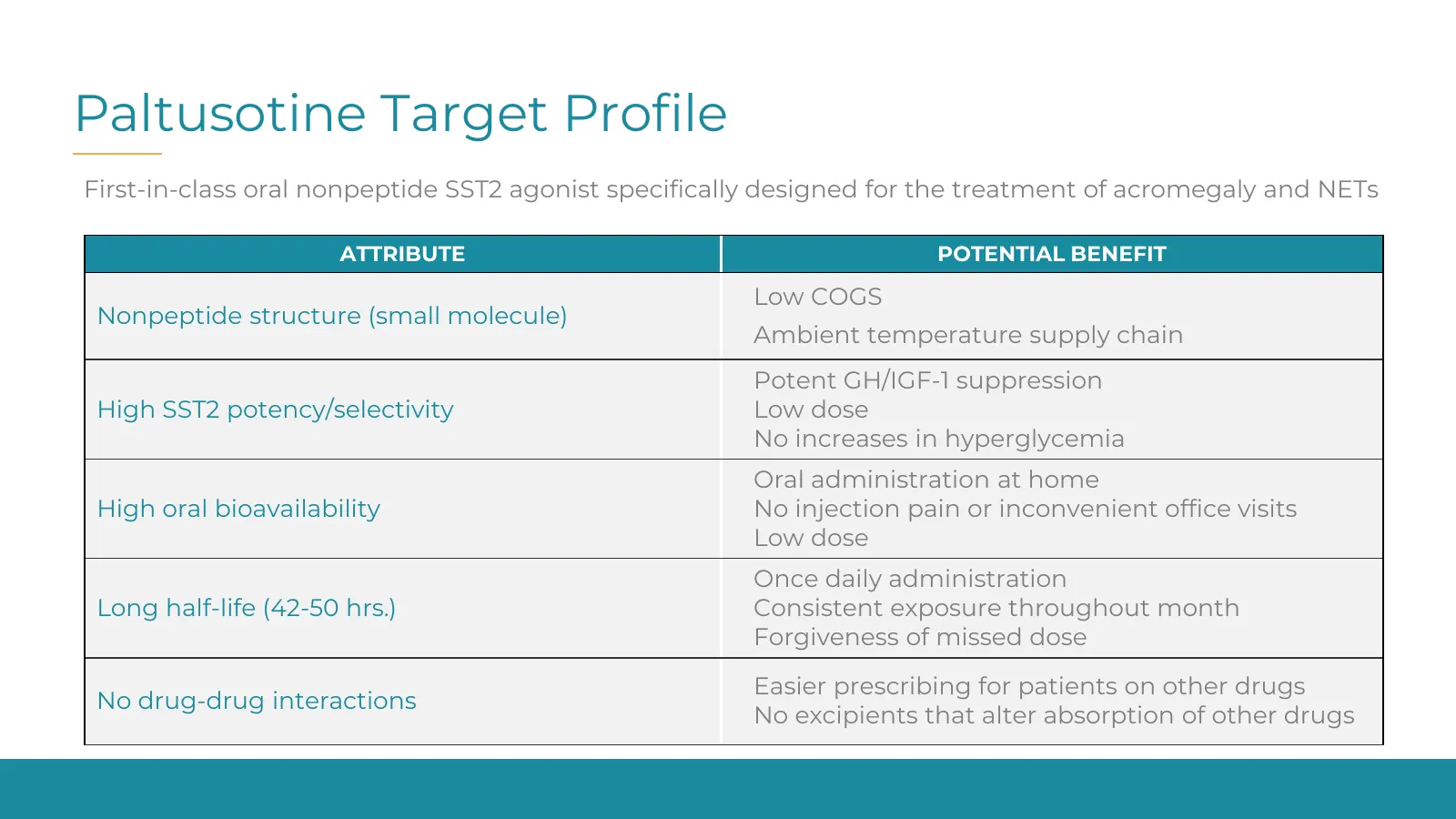
Slide 6: Paltusotine Target Profile
Paltusotine Target Profile First-in-class oral nonpeptide SST2 agonist specifically designed for the treatment of acromegaly and NETs ATTRIBUTE POTENTIAL BENEFIT Low COGS Nonpeptide structure (small molecule) Ambient temperature supply chain Potent GH/IGF-1 suppression High SST2 potency/selectivity
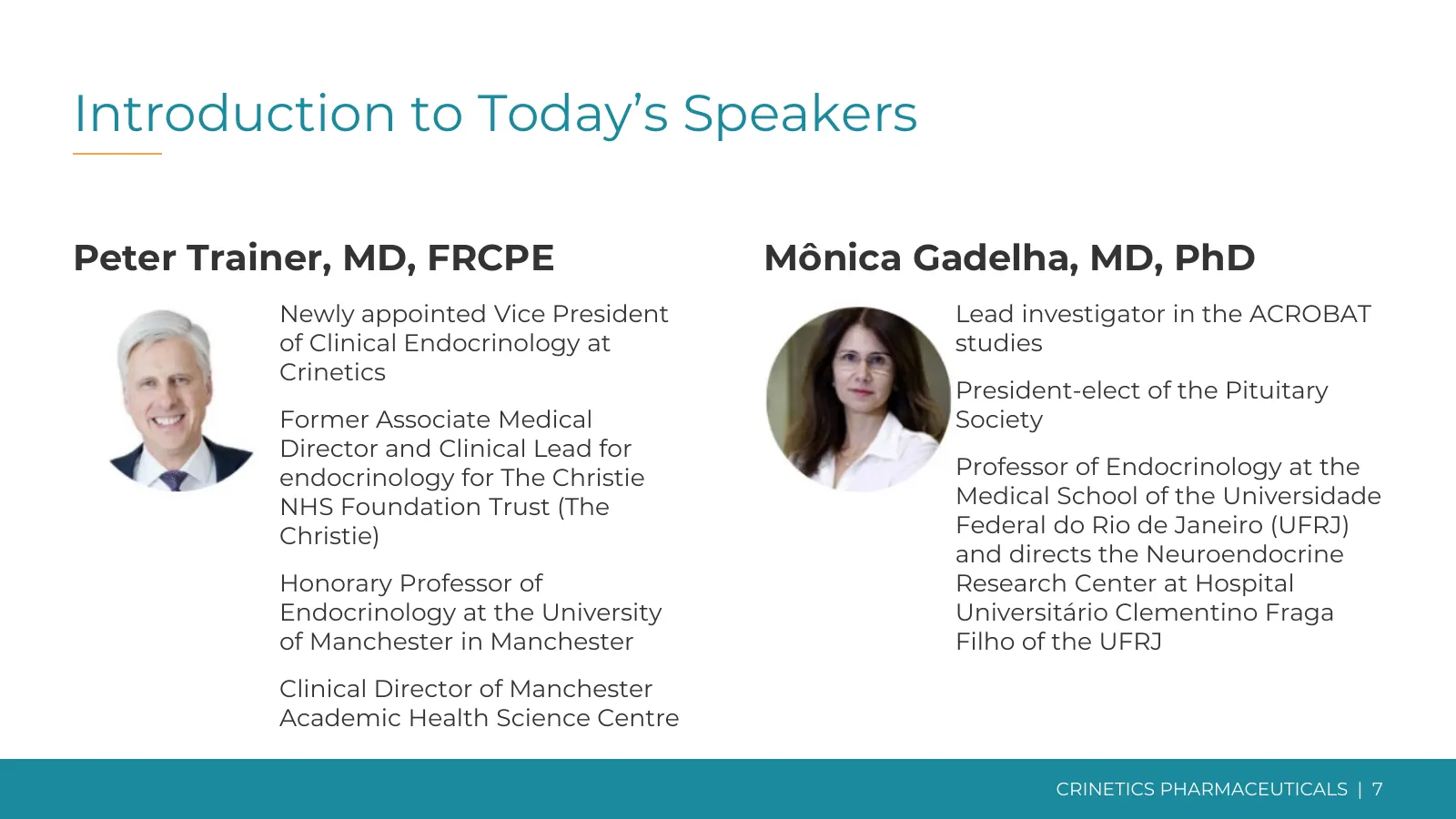
Slide 7: Introduction to Today's Speakers
Introduction to Today’s Speakers Peter Trainer, MD, FRCPE Mônica Gadelha, MD, PhD Newly appointed Vice President Lead investigator in the ACROBAT of Clinical Endocrinology at studies Crinetics President-elect of the Pituitary Former Associate Medical Society Director and Clinical Lead for endocrinol
Slide 8: Introduction to Acromegaly
INTRODUCTION TO ACROMEGALY Dr. Peter Trainer, VP of Clinical Endocrinology at Crinetics CRINETICS PHARMACEUTICALS | 8
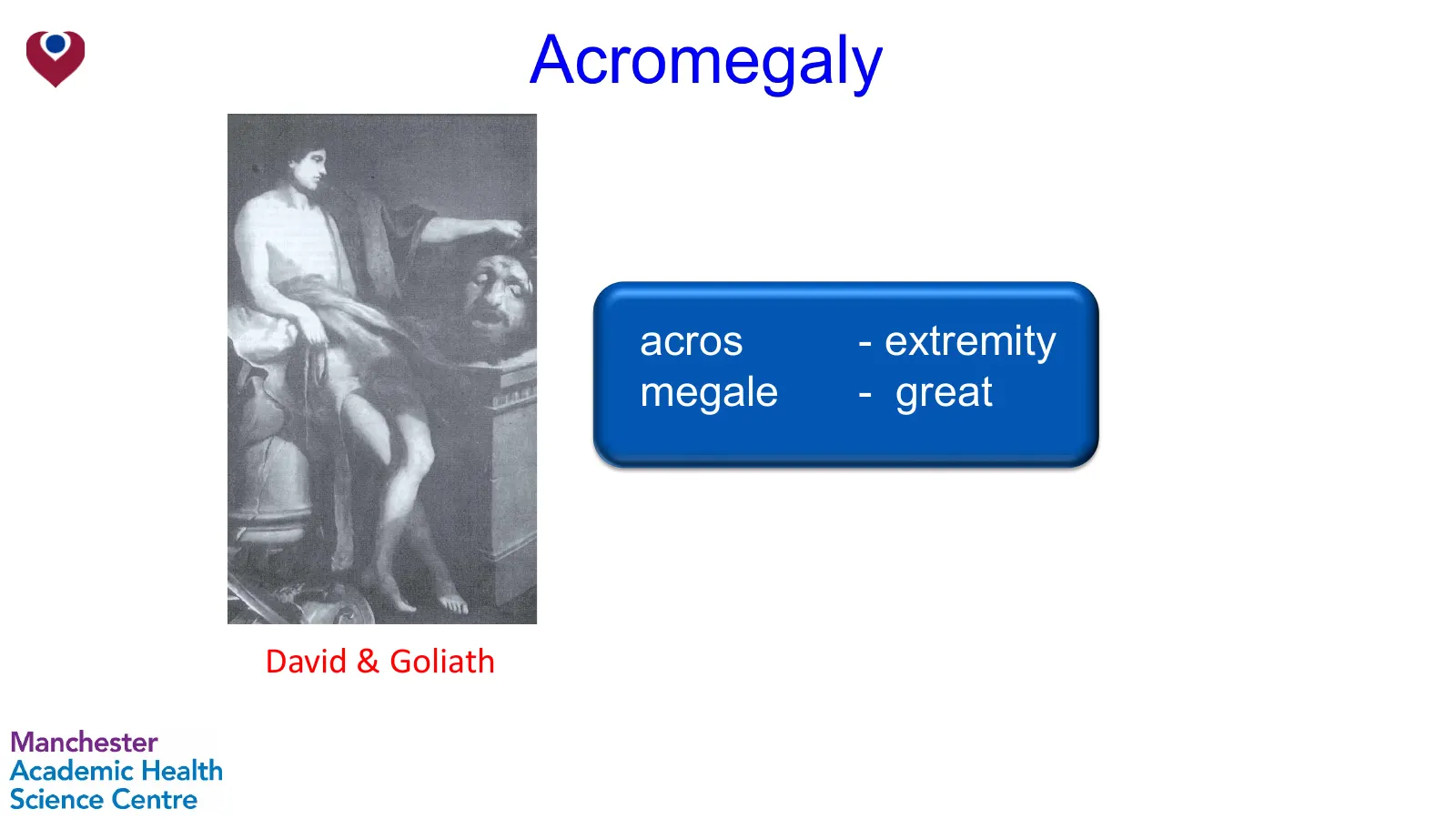
Slide 9: Acros megale - extremity
acros - extremity megale - great David & Goliath
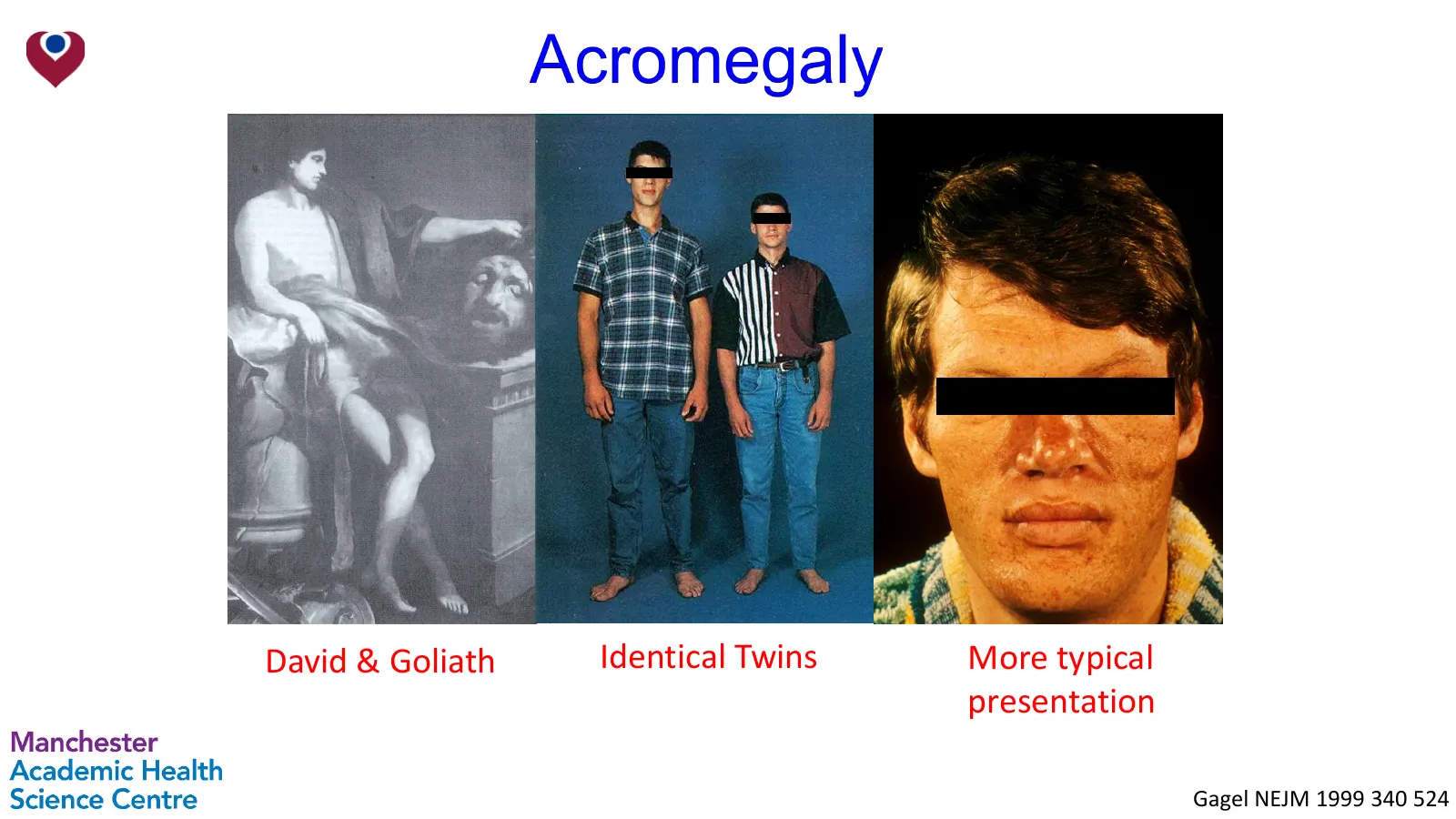
Slide 10: Acros megale - extremity
acros - extremity megale - great David & Goliath Identical Twins More typical presentation Gagel NEJM 1999 340 524
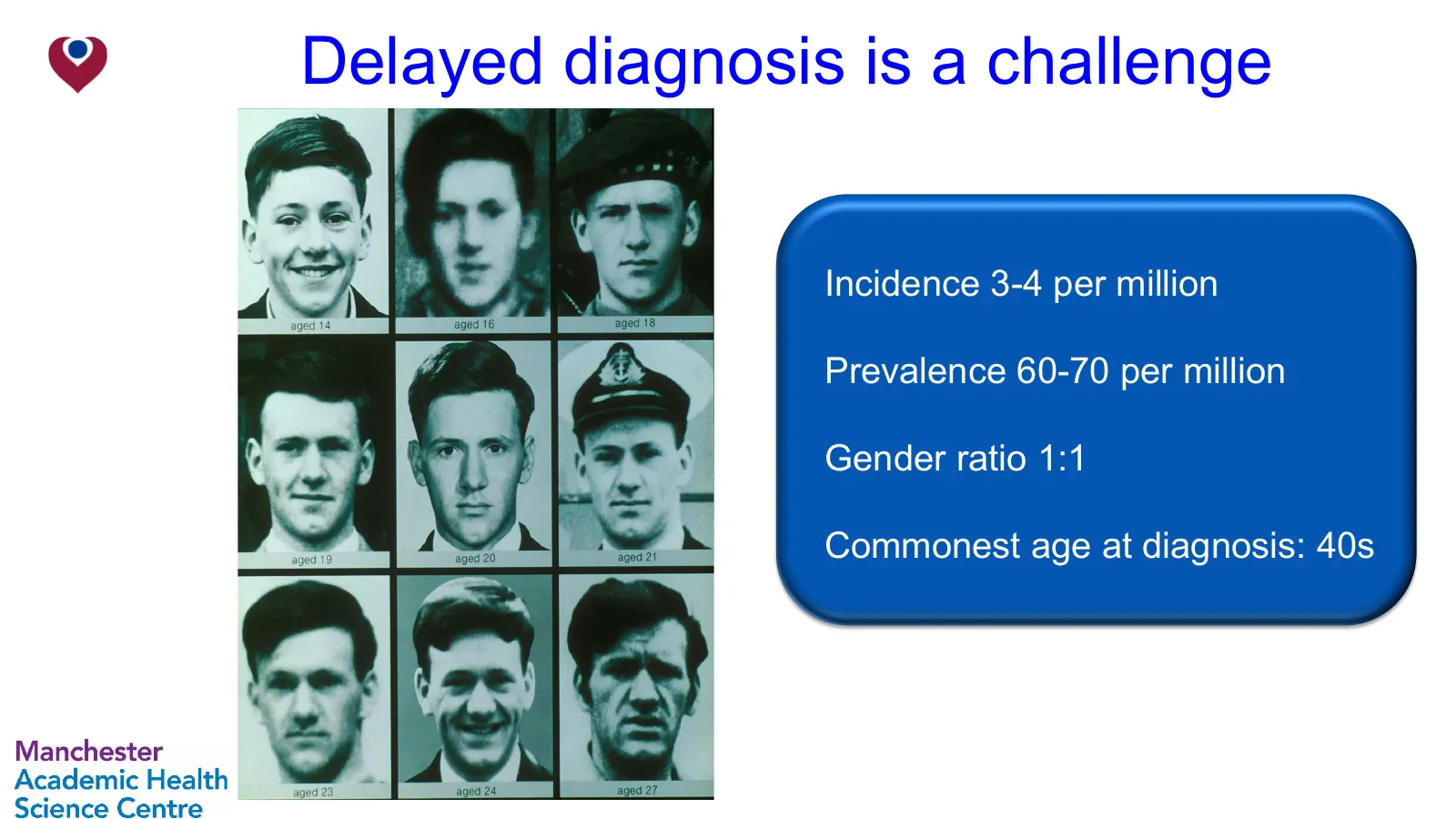
Slide 11: Delayed diagnosis is a challenge
Delayed diagnosis is a challenge Incidence 3-4 per million Prevalence 60-70 per million Gender ratio 1:1 Commonest age at diagnosis: 40s
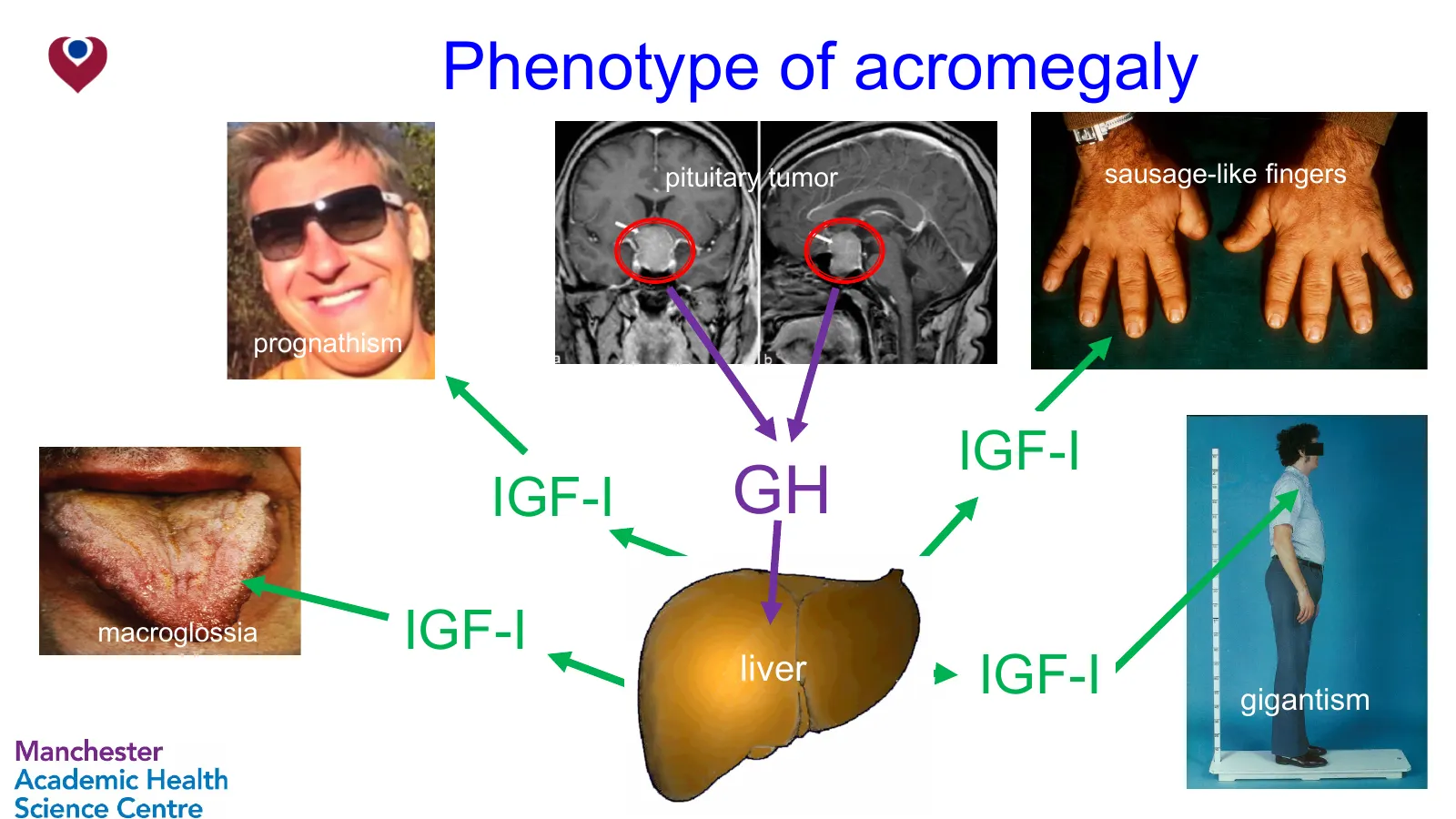
Slide 12: Phenotype of acromegaly
Phenotype of acromegaly pituitary tumor sausage-like fingers prognathism IGF-I IGF-I GH macroglossia IGF-I liver liver IGF-I gigantism
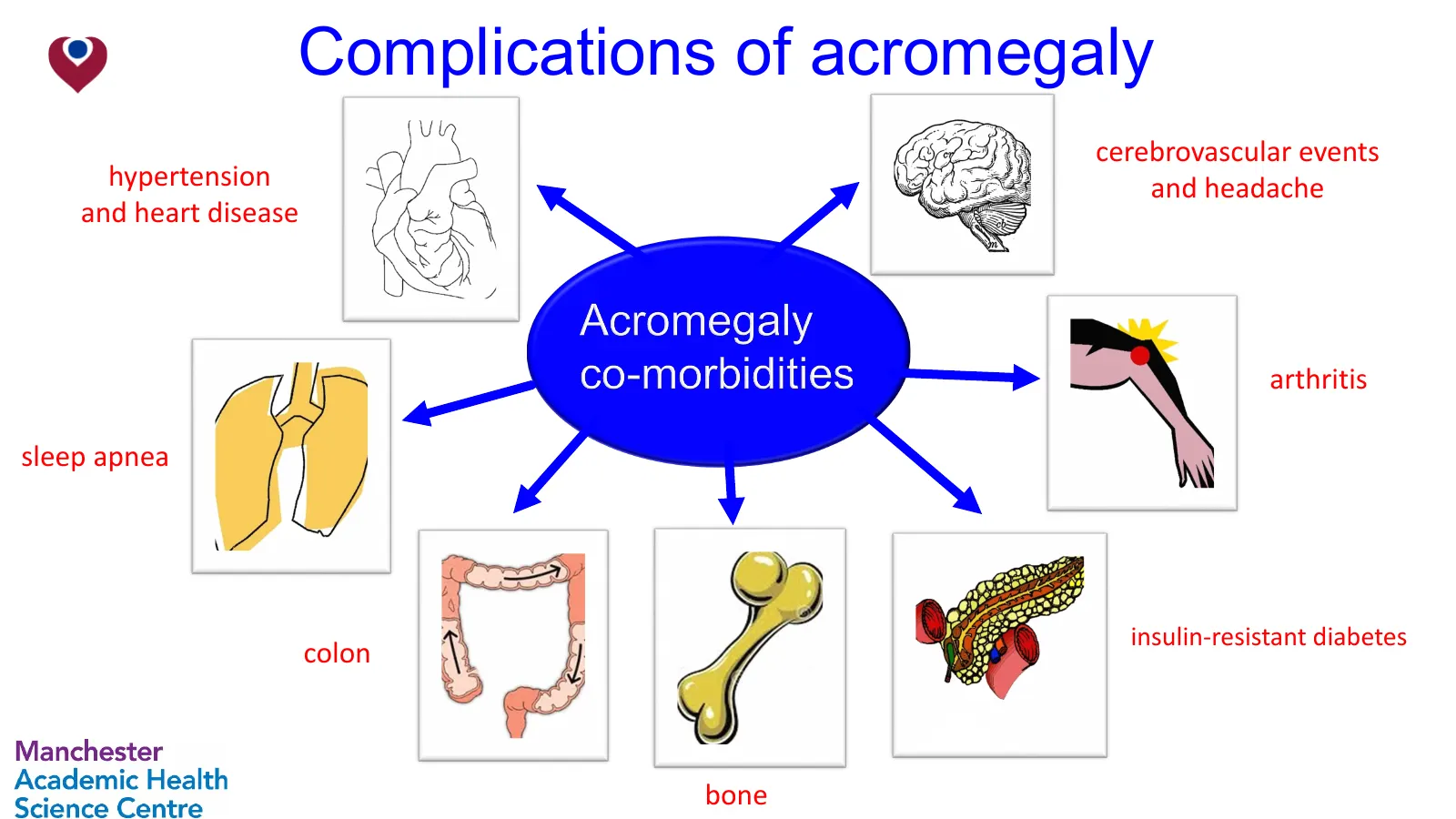
Slide 13: Complications of acromegaly
Complications of acromegaly cerebrovascular events hypertension and headache and heart disease arthritis sleep apnea insulin-resistant diabetes colon bone
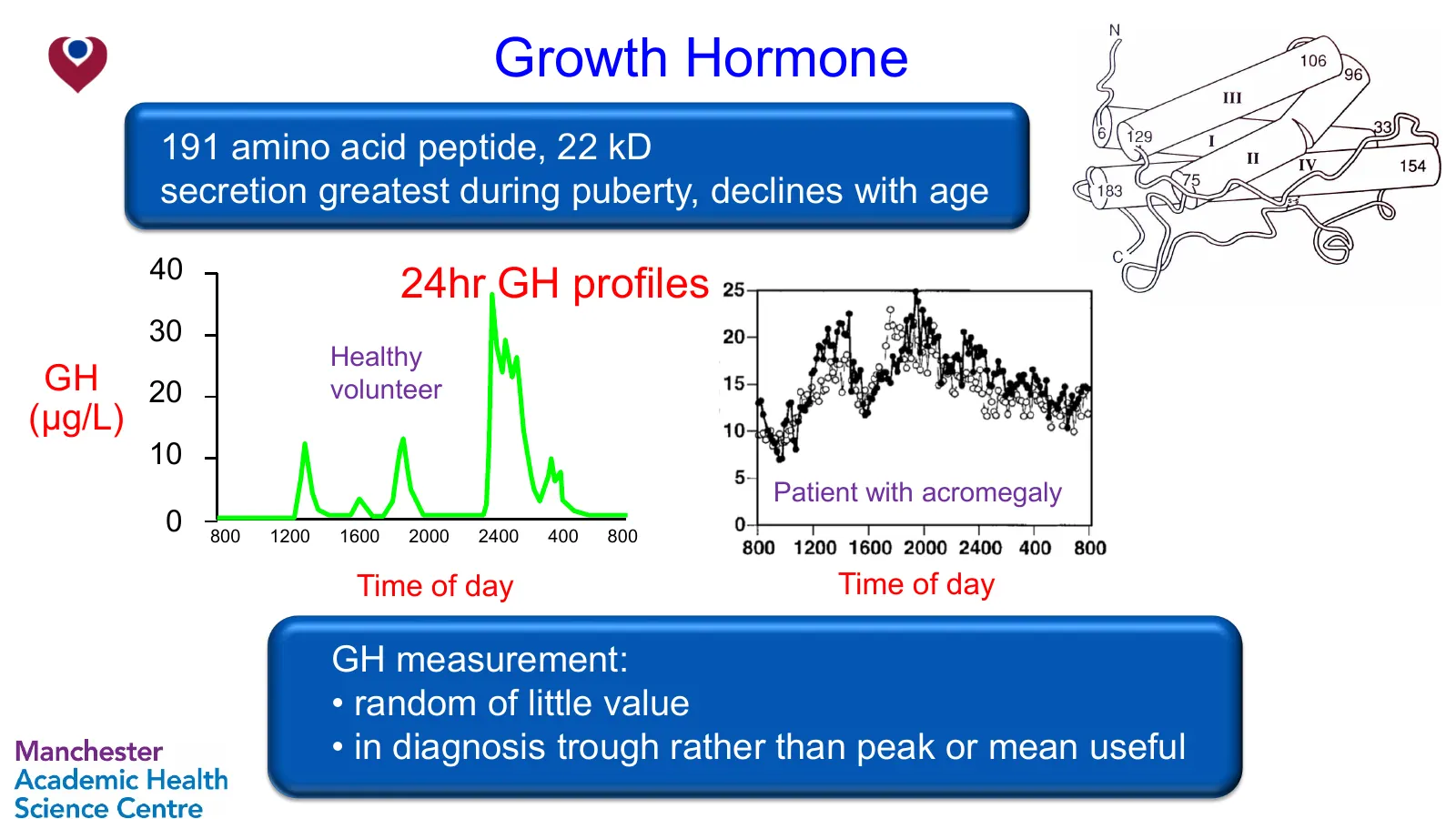
Slide 14: Growth Hormone
Growth Hormone 191 amino acid peptide, 22 kD secretion greatest during puberty, declines with age 40 24hr GH profiles 30 Healthy GH 20 volunteer (μg/L) 10 Patient with acromegaly 0 800 1200 1600 2000 2400 400 800 Time of day Time of day GH measurement: • random of little value • in diagnosis trough
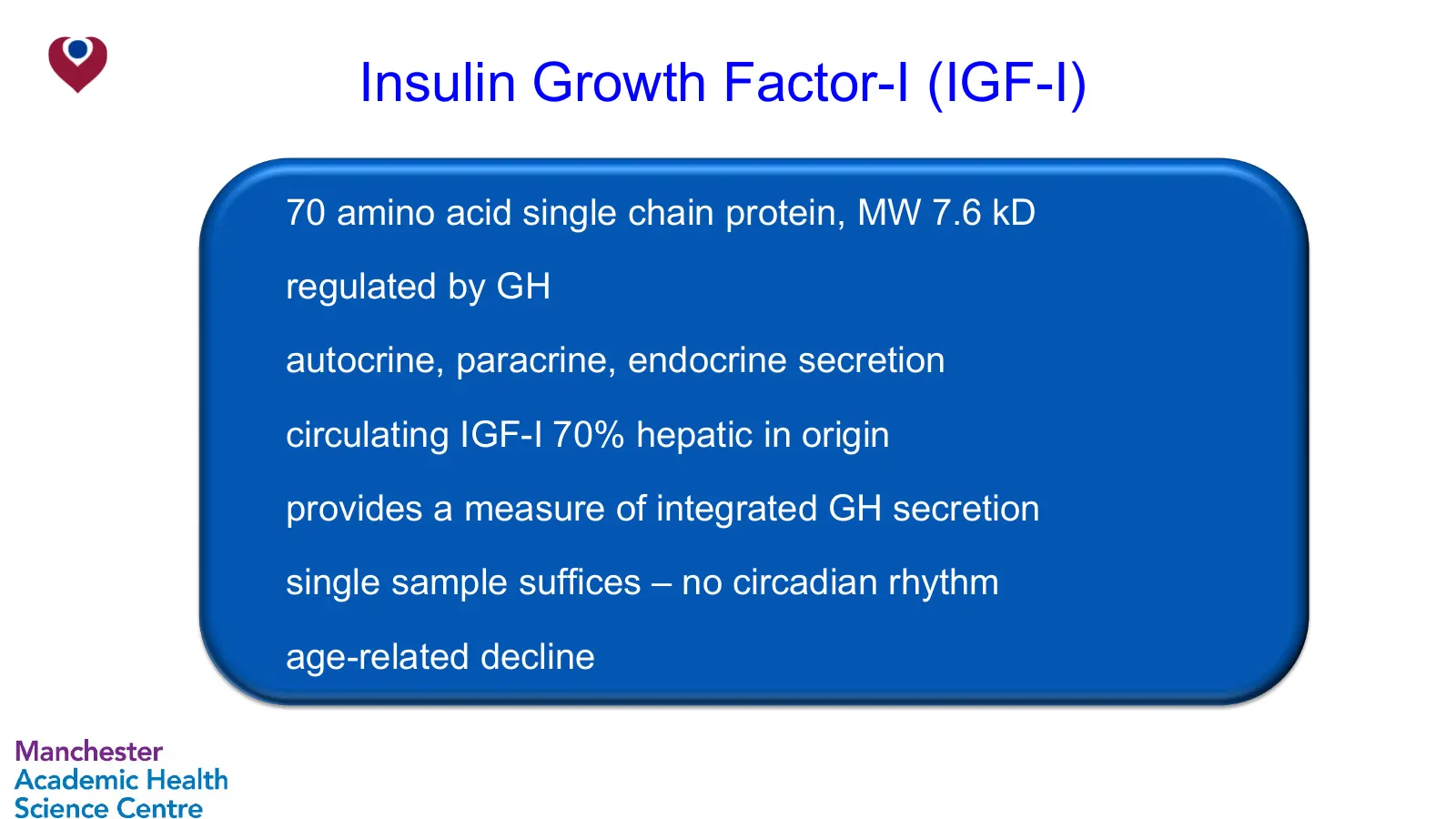
Slide 15: Insulin Growth Factor-I (IGF-I)
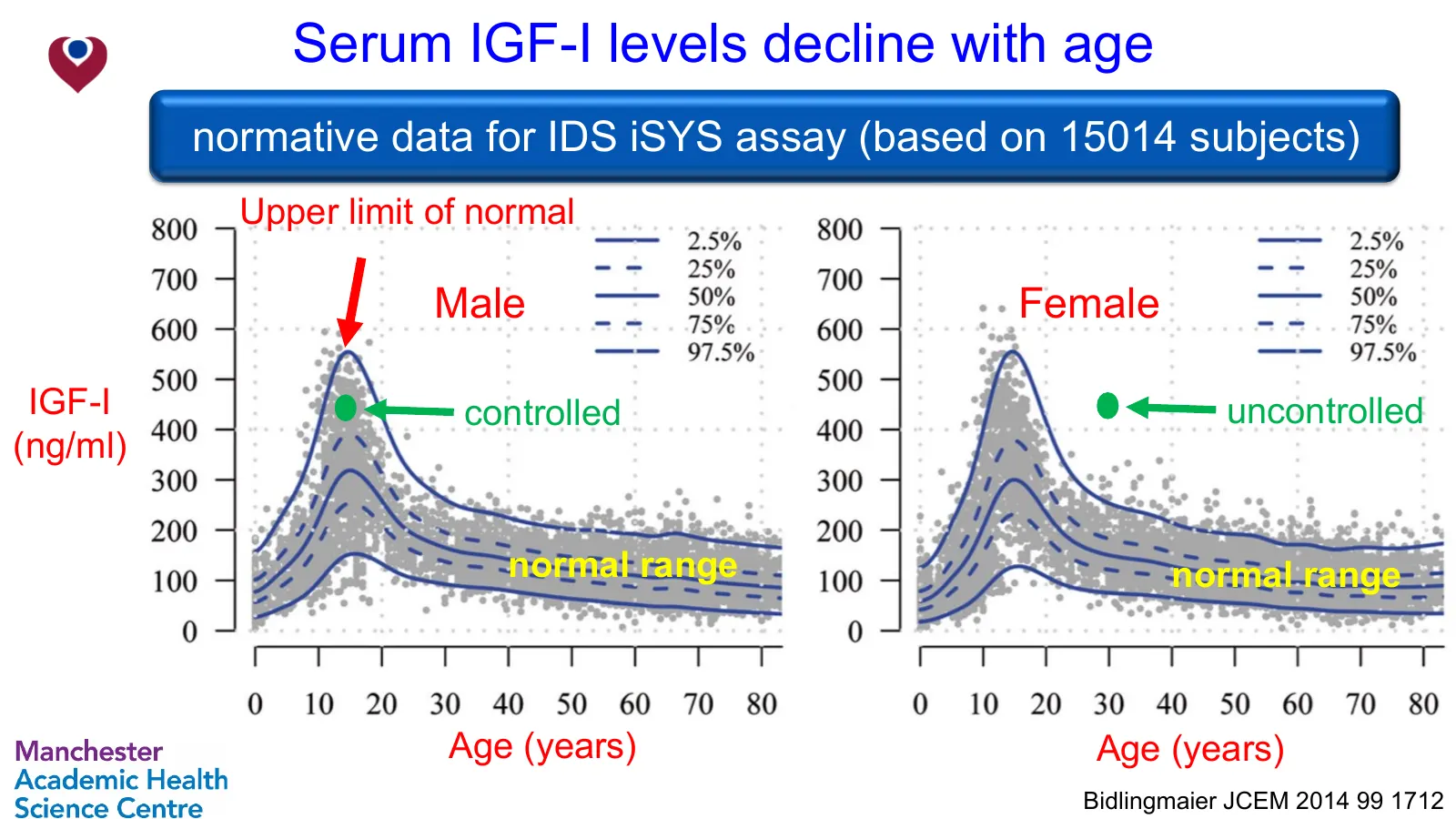
Insulin Growth Factor-I (IGF-I) 70 amino acid single chain protein, MW 7.6 kD regulated by GH autocrine, paracrine, endocrine secretion circulating IGF-I 70% hepatic in origin provides a measure of integrated GH secretion single sample suffices – no circadian rhythm age-related decline
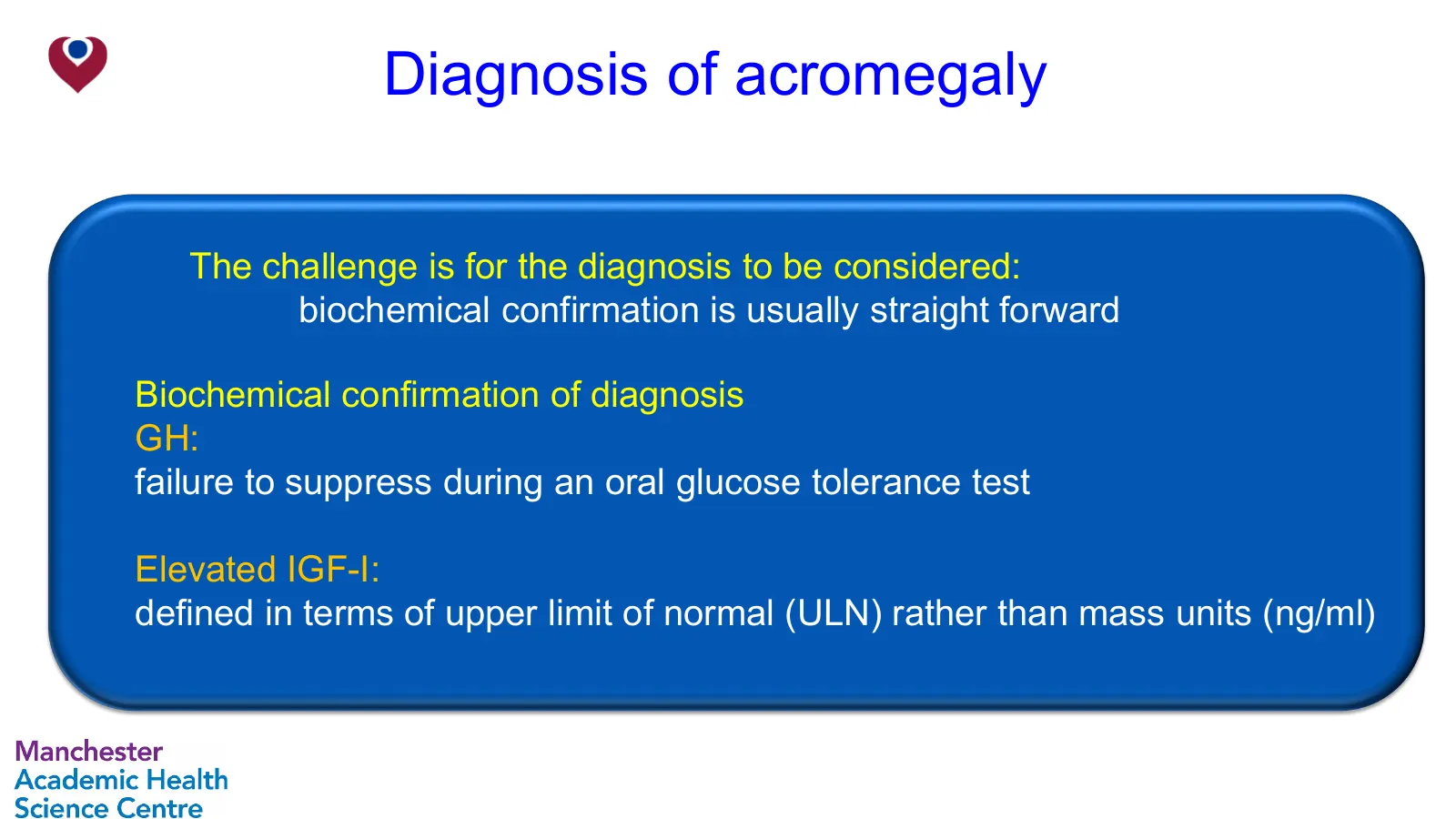
Slide 16: Diagnosis of acromegaly
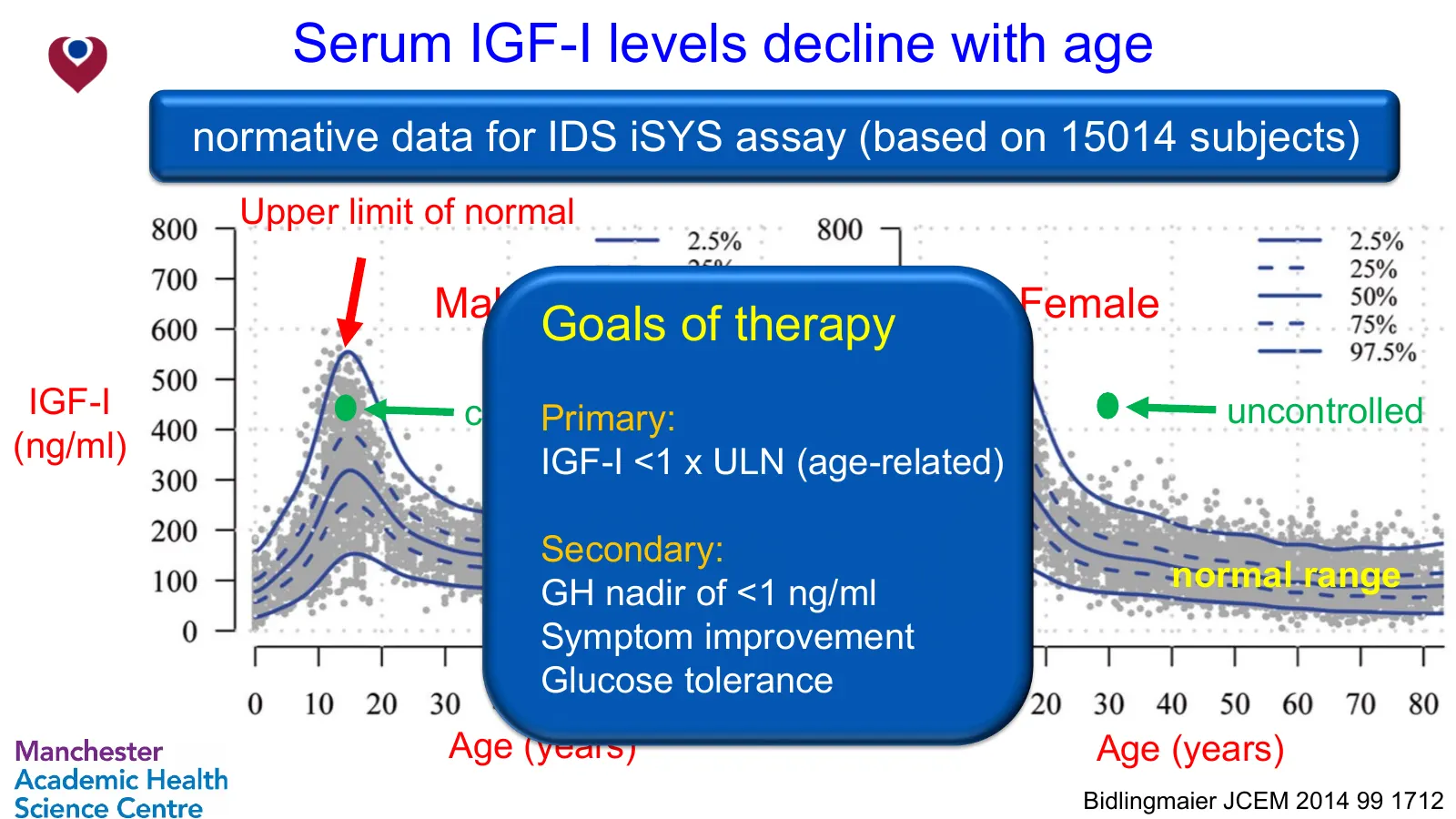
Diagnosis of acromegaly The challenge is for the diagnosis to be considered: biochemical confirmation is usually straight forward Biochemical confirmation of diagnosis GH: failure to suppress during an oral glucose tolerance test Elevated IGF-I: defined in terms of upper limit of normal (ULN) rather
Slide 17: Serum IGF-I levels decline with age
Serum IGF-I levels decline with age normative data for IDS iSYS assay (based on 15014 subjects) Upper limit of normal Male Female IGF-I controlled uncontrolled (ng/ml) normal range normal range Age (years) Age (years) Bidlingmaier JCEM 2014 99 1712
Slide 18: Serum IGF-I levels decline with age
Serum IGF-I levels decline with age normative data for IDS iSYS assay (based on 15014 subjects) Upper limit of normal Male Female Goals of therapy IGF-I controlled Primary: uncontrolled (ng/ml) IGF-I <1 x ULN (age-related) Secondary: normal range GH nadir of <1 ng/ml normal range Symptom improvement
Slide 19: The Impact of Acromegaly on Survival
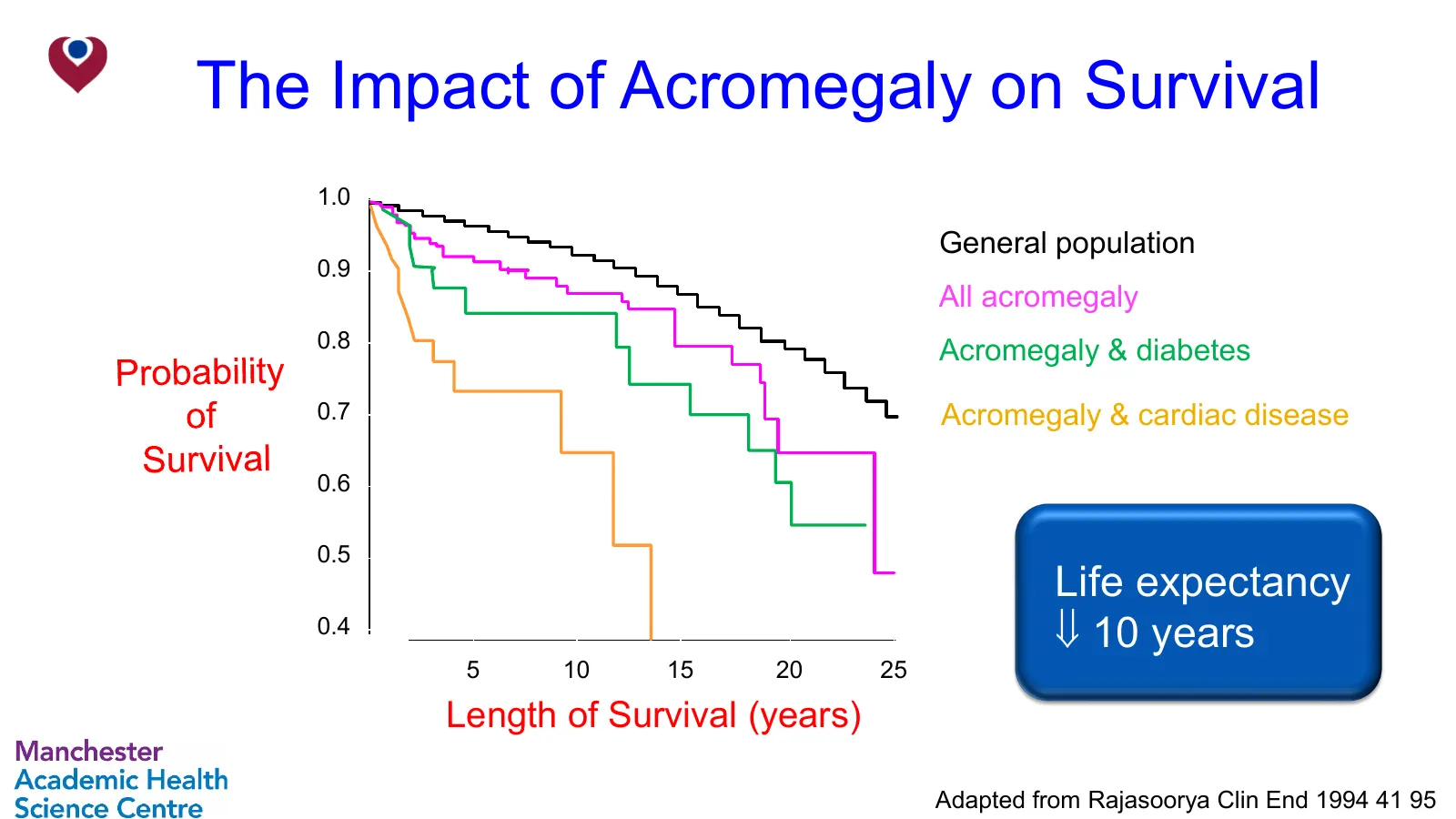
The Impact of Acromegaly on Survival 1.0 General population 0.9 All acromegaly 0.8 Acromegaly & diabetes 0.7 Acromegaly & cardiac disease 0.6 0.5 Life expectancy 0.4 ⇓ 10 years 5 10 15 20 25 Length of Survival (years) Adapted from Rajasoorya Clin End 1994 41 95
Slide 20: Relationship between probability of survival and IGF-I
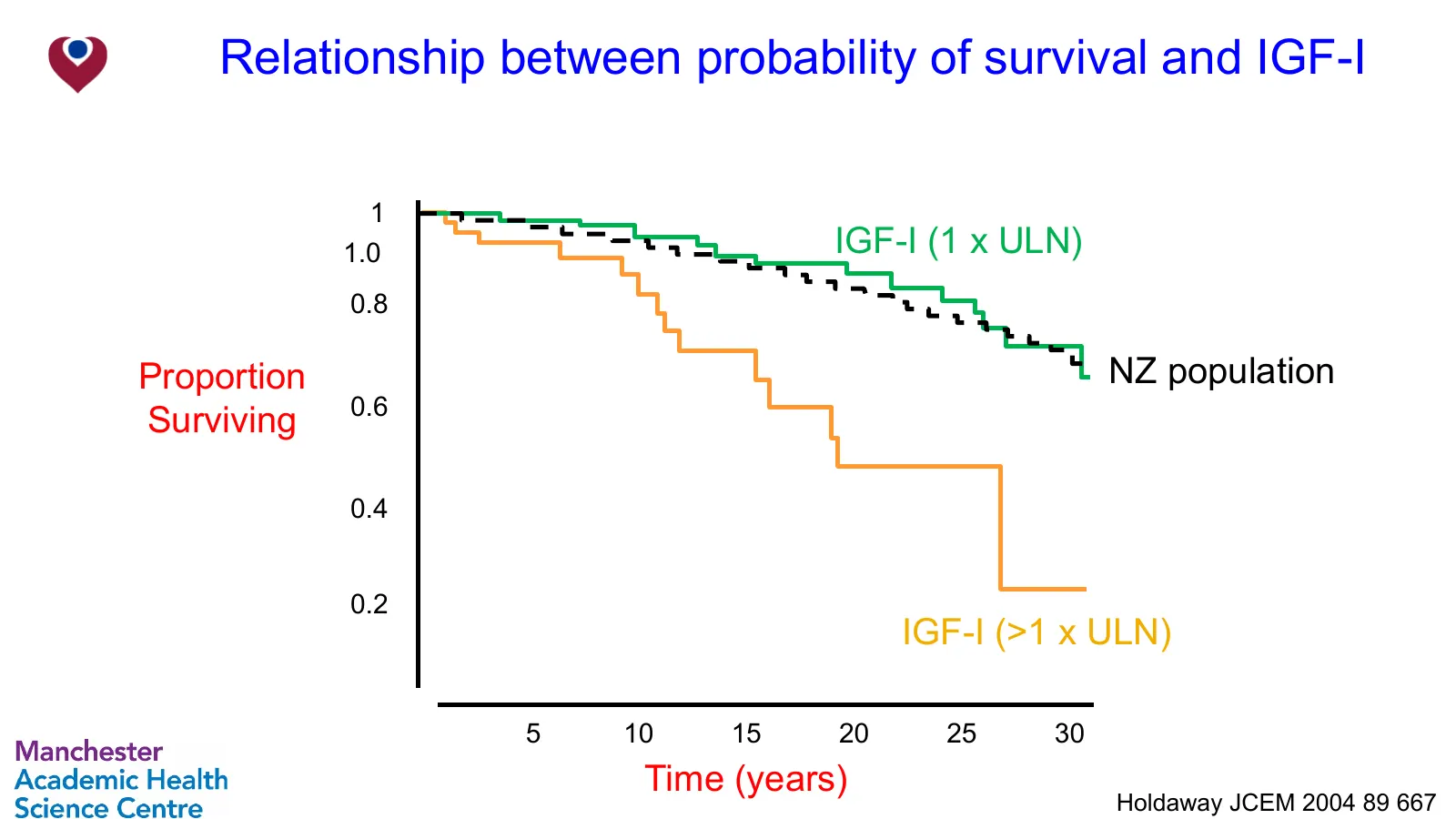
Relationship between probability of survival and IGF-I 1 1.0 IGF-I (1 x ULN) 0.8 Proportion NZ population 0.6 Surviving 0.4 0.2 IGF-I (>1 x ULN) 5 10 15 20 25 30 Time (years) Holdaway JCEM 2004 89 667
Slide 21: The challenges of reliance on IGF-I measurement
The challenges of reliance on IGF-I measurement Differences between assay technologies Variable quality of reference ranges IGF-I levels can be variable within a single patient A single elevated IGF-I (>1 x ULN) is not indicative of loss of disease control
Slide 22: Variability and reliability of single IGF-I measurements
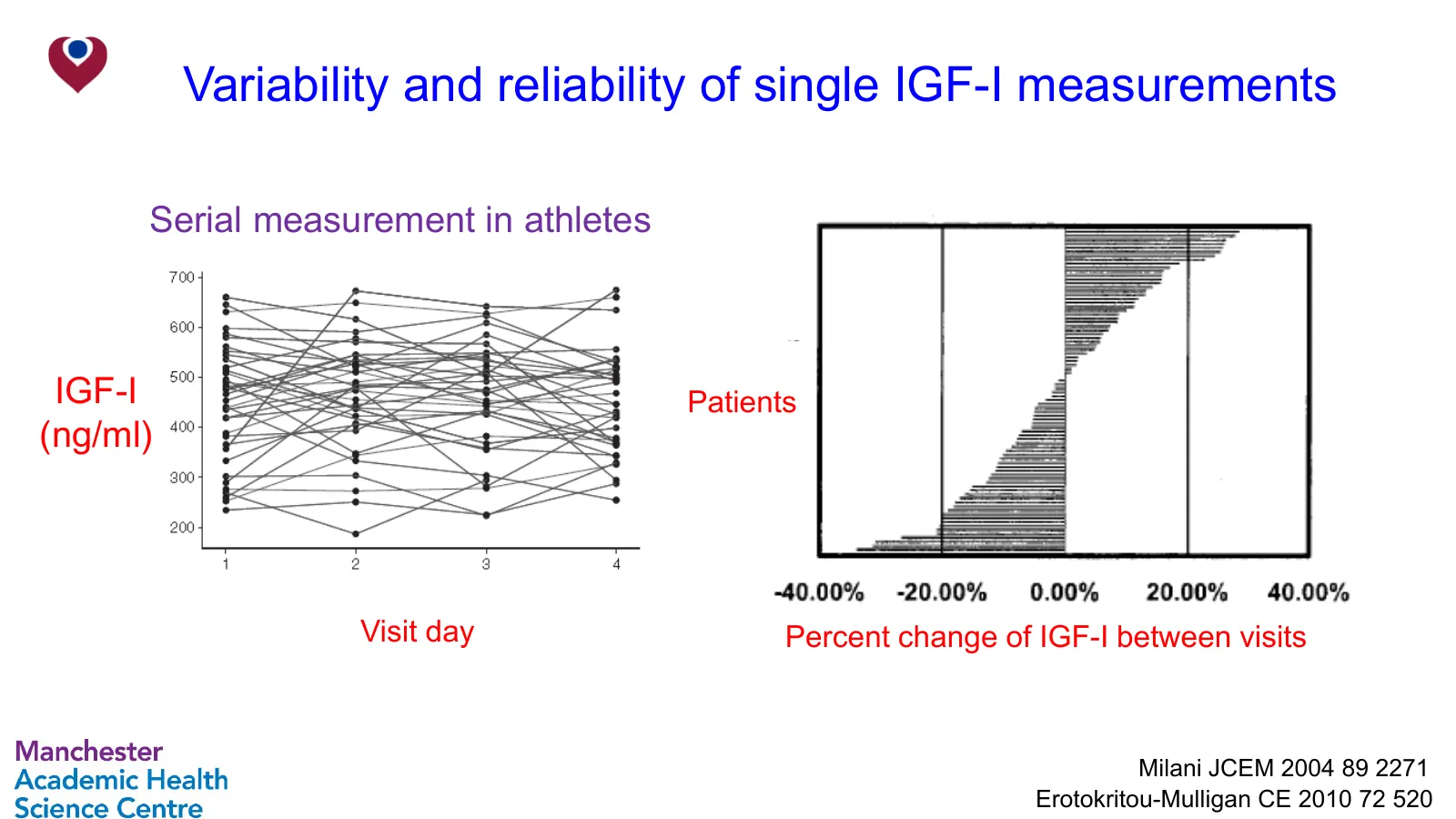
Variability and reliability of single IGF-I measurements Serial measurement in athletes IGF-I Patients (ng/ml) Visit day Percent change of IGF-I between visits Milani JCEM 2004 89 2271 Erotokritou-Mulligan CE 2010 72 520
Slide 23: Treatment of Acromegaly
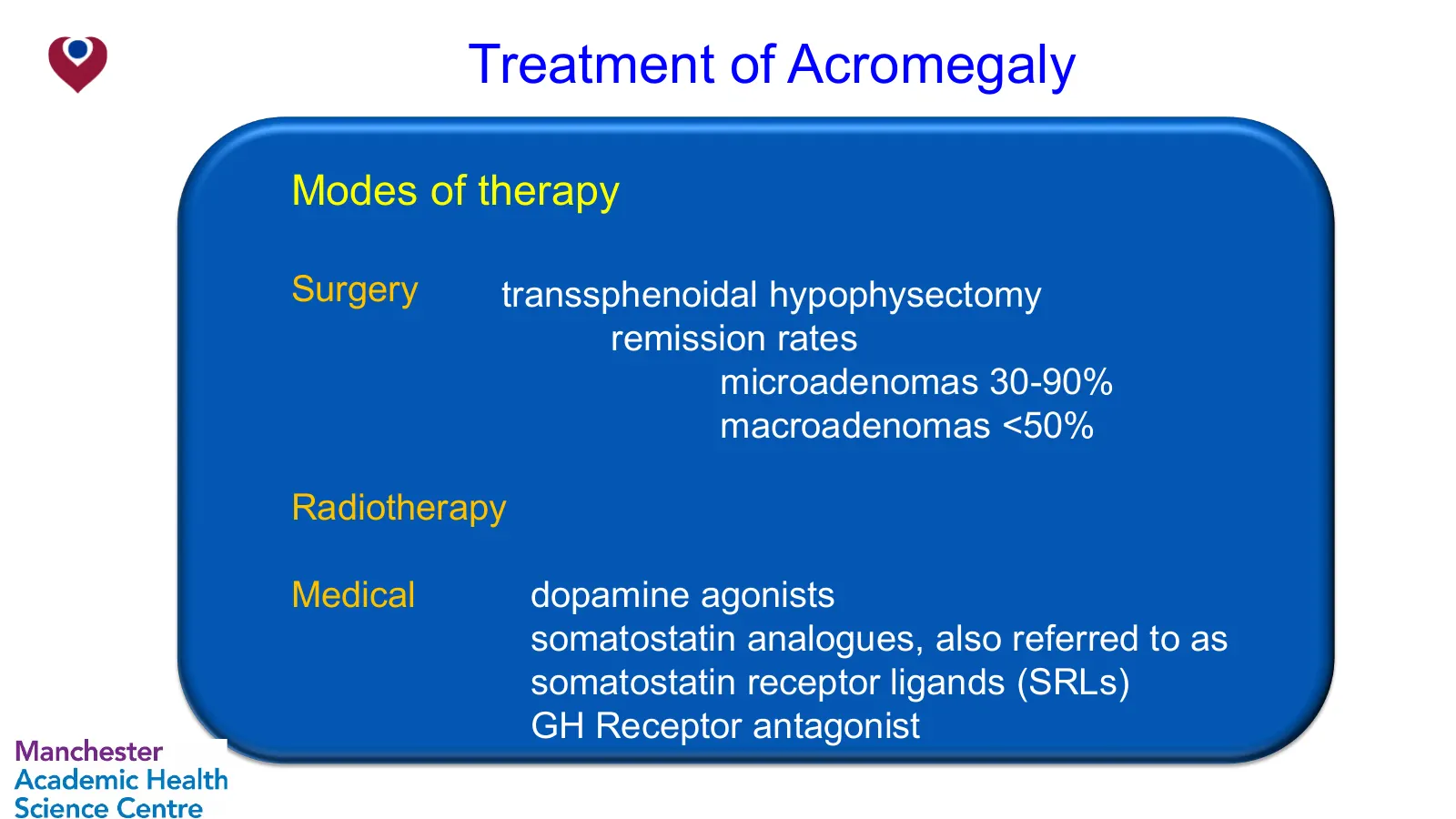
Treatment of Acromegaly Modes of therapy Surgery transsphenoidal hypophysectomy remission rates microadenomas 30-90% macroadenomas <50% Radiotherapy Medical dopamine agonists somatostatin analogues, also referred to as somatostatin receptor ligands (SRLs) GH Receptor antagonist
Slide 24: Cure rate in different UK surgical centres
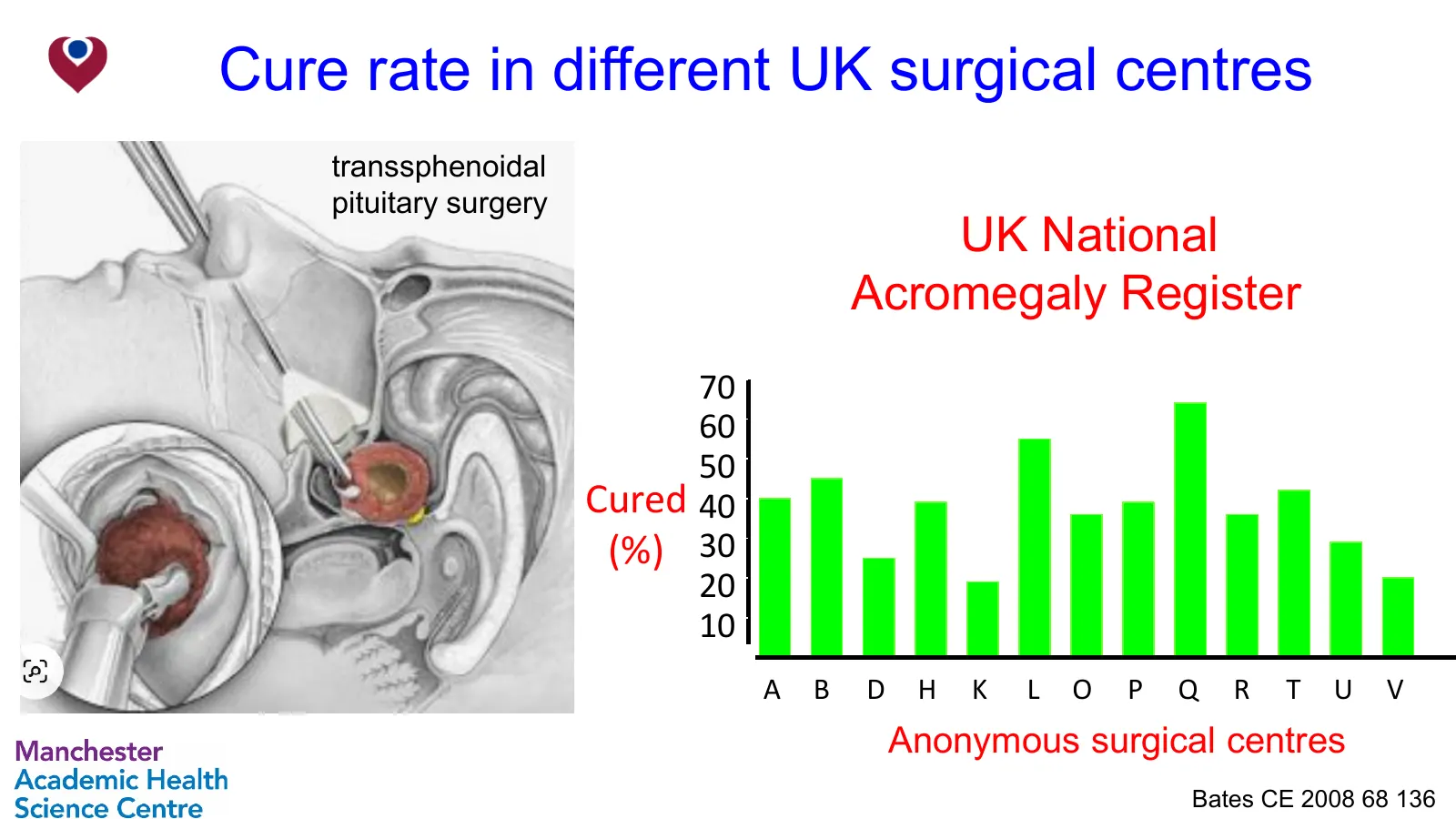
Cure rate in different UK surgical centres transsphenoidal pituitary surgery UK National Acromegaly Register 70 60 50 Cured 40 (%) 30 20 10 A B D H K L O P Q R T U V Anonymous surgical centres Bates CE 2008 68 136
Slide 25: Pituitary Radiotherapy
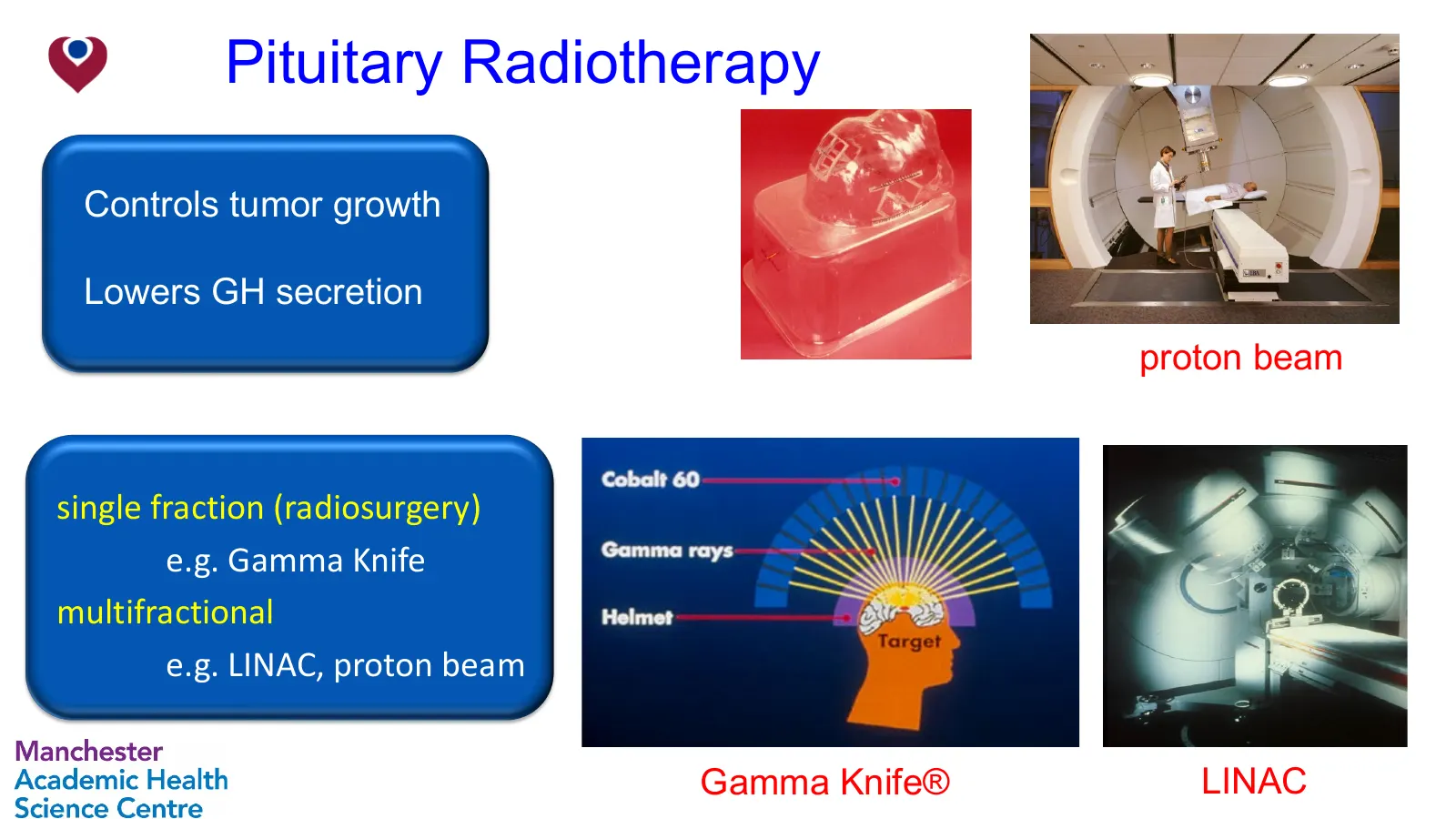
Pituitary Radiotherapy Controls tumor growth Lowers GH secretion proton beam single fraction (radiosurgery) e.g. Gamma Knife multifractional e.g. LINAC, proton beam Gamma Knife® LINAC
Slide 26: Pituitary Radiotherapy
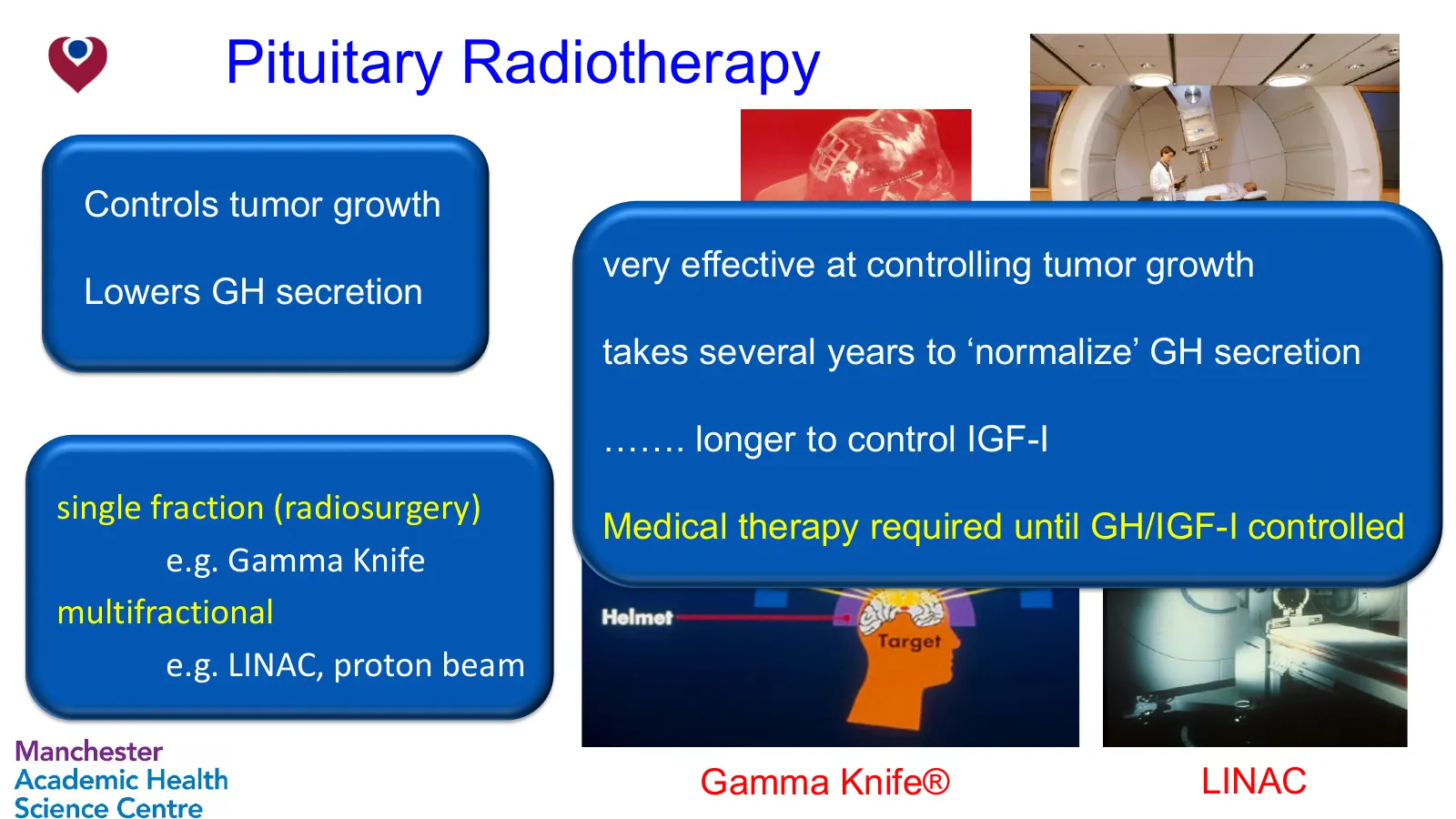
Pituitary Radiotherapy Controls tumor growth very effective at controlling tumor growth Lowers GH secretion takes several years to ‘normalize’proton GH secretion beam ……. longer to control IGF-I single fraction (radiosurgery) Medical therapy required until GH/IGF-I controlled e.g. Gamma Knife multif
Slide 27: Somatostatin Receptor Ligands
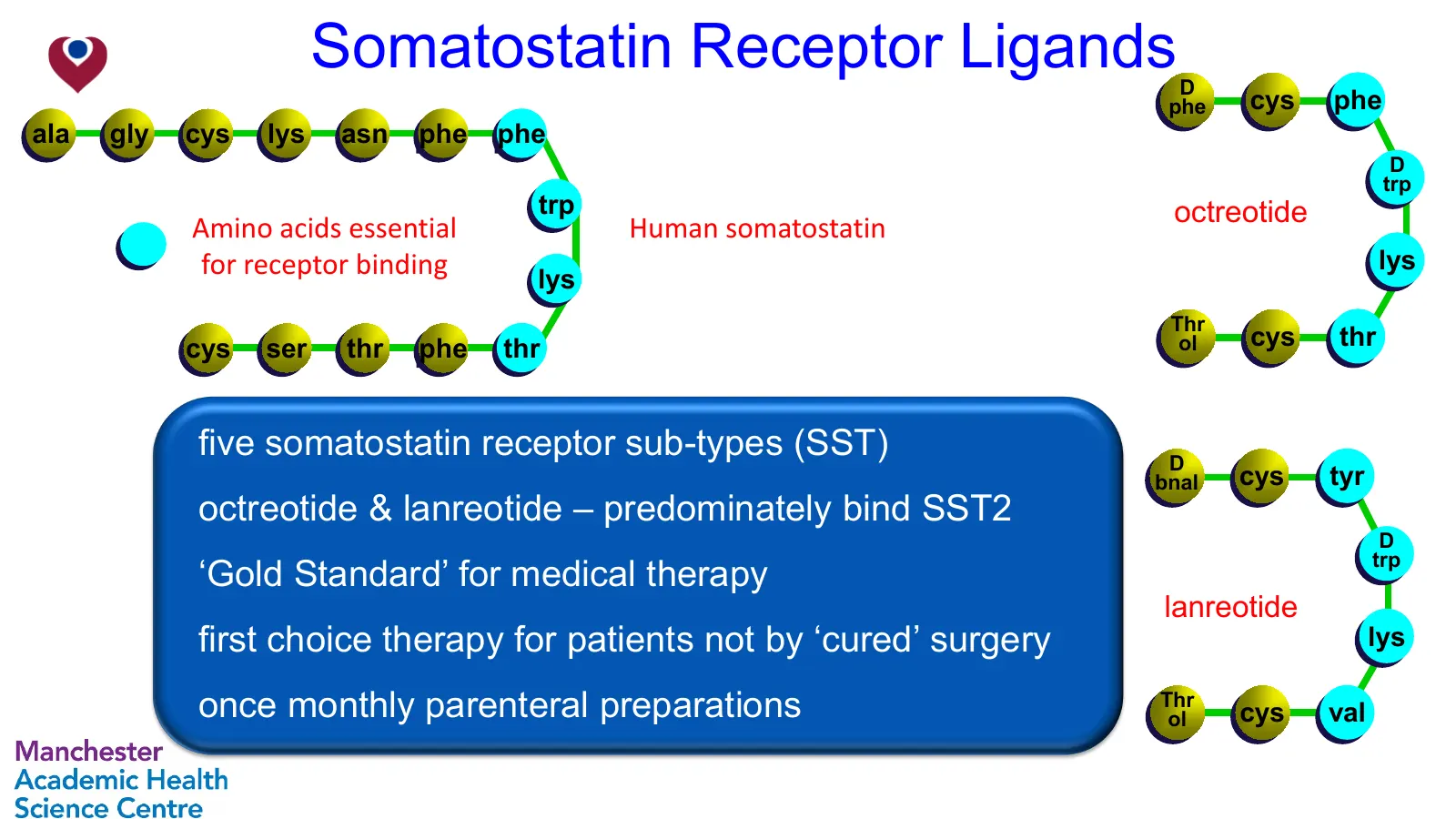
Somatostatin Receptor Ligands D Octreotide phe cys phe ala gly cys lys asn phe phe D trp trp octreotide Amino acids essential Human somatostatin for receptor binding lys lys Thr cys ser thr phe thr ol cys thr Lanreotide five somatostatin receptor sub-types (SST) D bnal cys tyr octreotide & lanreotid
Slide 28: Experience with Paltusotine in the Acrobat Phase 2 Studies
Experience with Paltusotine in the Acrobat Phase 2 Studies Mônica Gadelha, MD, PhD Academia Nacional de Medicina Faculdade de Medicina da Universidade Federal do Rio de Janeiro Instituto Estadual do Cérebro Paulo Niemeyer
Slide 29: Disclosure of Conflicts of Interest
Disclosure of Conflicts of Interest Speaker: Novartis; Ipsen; Pfizer Principal Investigator clinical trials: Crinetics, Novartis, Recordati Advisory board member: Novartis, Crinetics, Ipsen, Recordati
Slide 30: Recommendations of the last Endocrine Society guideline
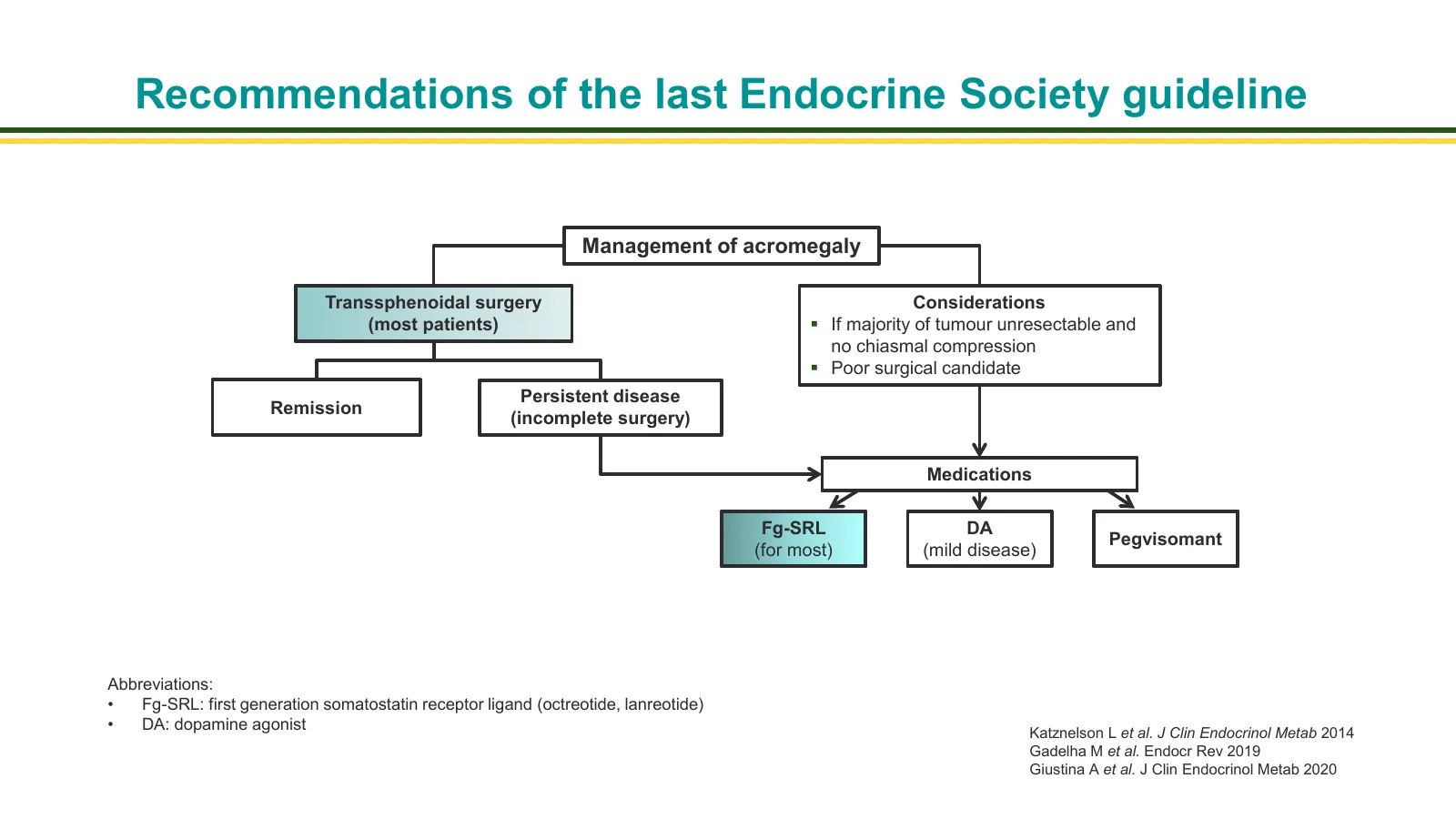
Recommendations of the last Endocrine Society guideline Management of acromegaly Transsphenoidal surgery Considerations (most patients) If majority of tumour unresectable and no chiasmal compression Poor surgical candidate Persistent disease Remission (incomplete surgery) Medications SSA Fg-SRL
Slide 31: Results of treatment with first-generation injectable SRL in our center
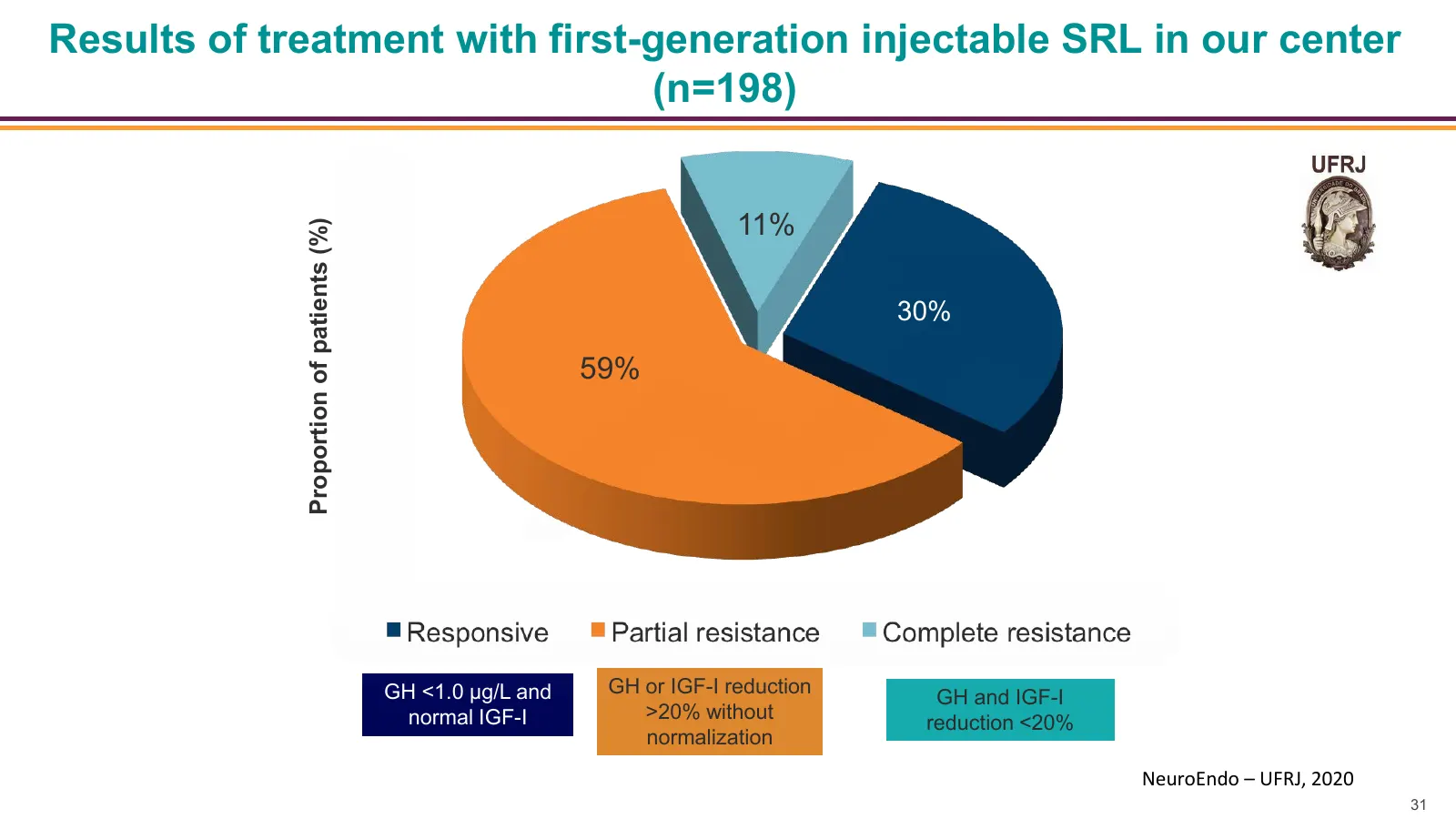
Results of treatment with first-generation injectable SRL in our center (n=198) 11% Proportion of patients (%) 30% 59% GH <1.0 μg/L and GH or IGF-I reduction GH and IGF-I normal IGF-I >20% without reduction <20% normalization NeuroEndo – UFRJ, 2020 31
Slide 32: Octreotide LAR injection
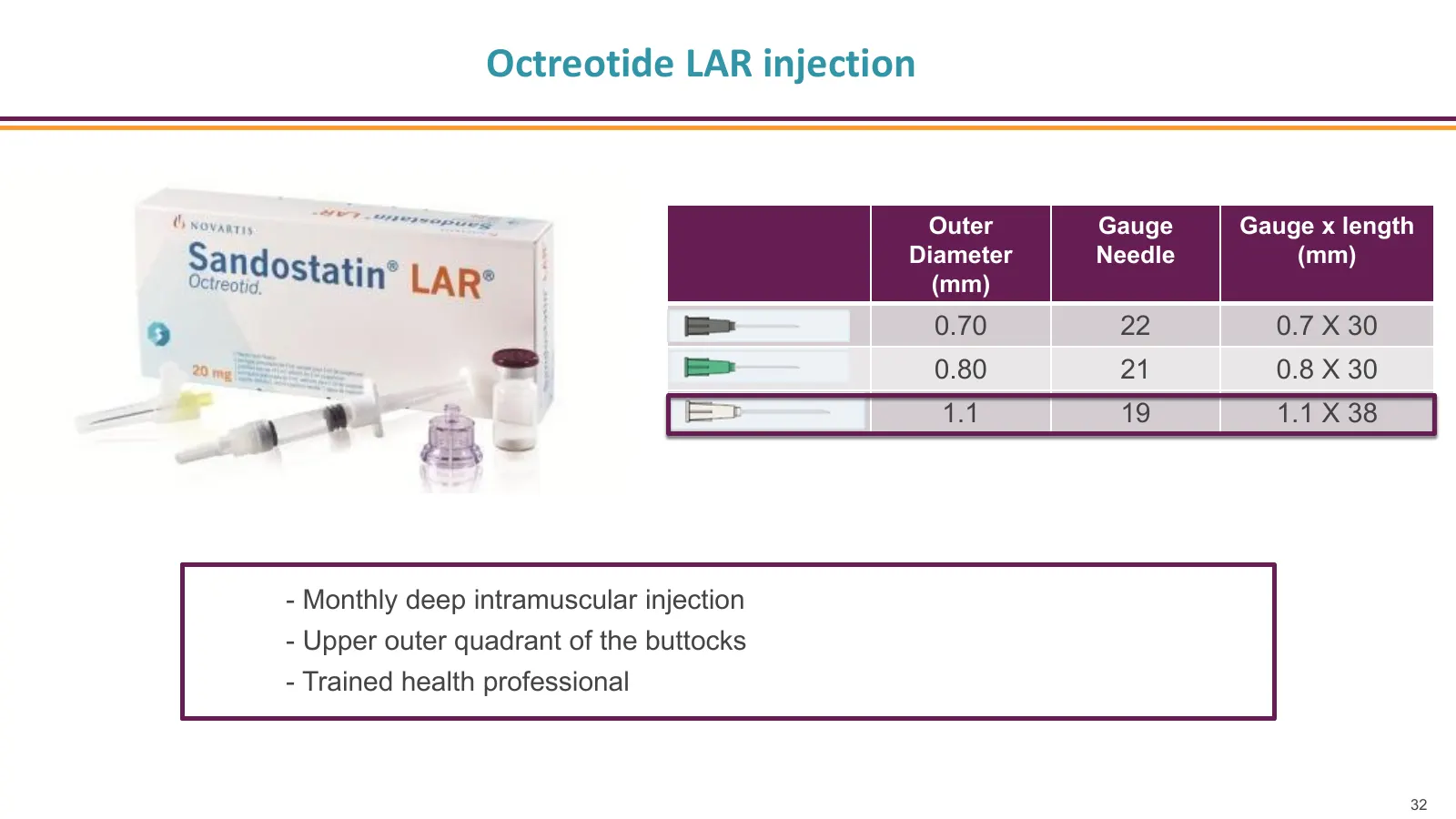
Octreotide LAR injection Outer Gauge Gauge x length Diameter Needle (mm) (mm) 0.70 22 0.7 X 30 0.80 21 0.8 X 30 1.1 19 1.1 X 38 - Monthly deep intramuscular injection - Upper outer quadrant of the buttocks - Trained health professional 32
Slide 33: Lanreotide autogel injection
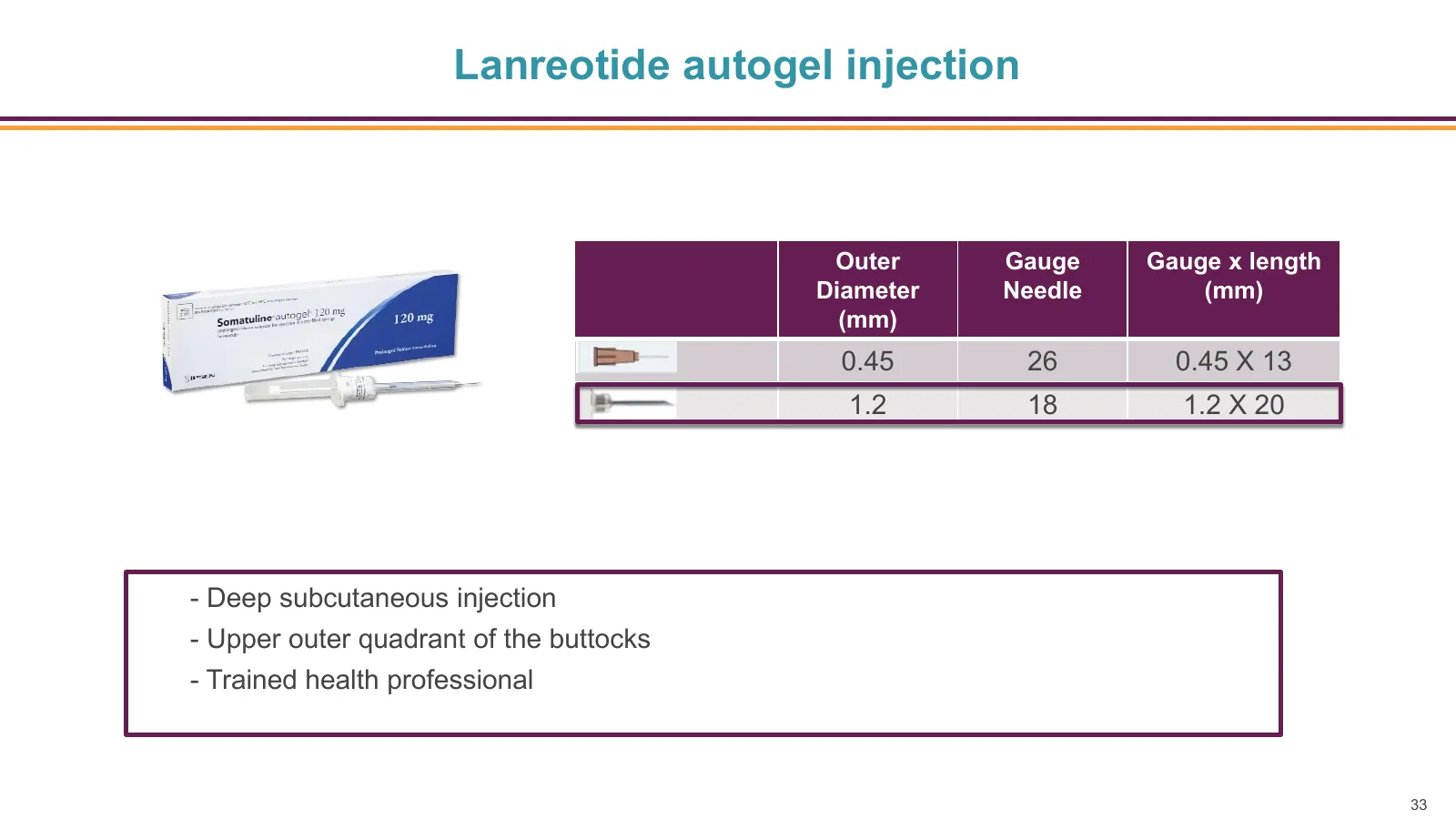
Lanreotide autogel injection Outer Gauge Gauge x length Diameter Needle (mm) (mm) 0.45 26 0.45 X 13 1.2 18 1.2 X 20 - Deep subcutaneous injection - Upper outer quadrant of the buttocks - Trained health professional 33
Slide 34: Geer et al. BMC Endocrine Disorders (2020) 20:117
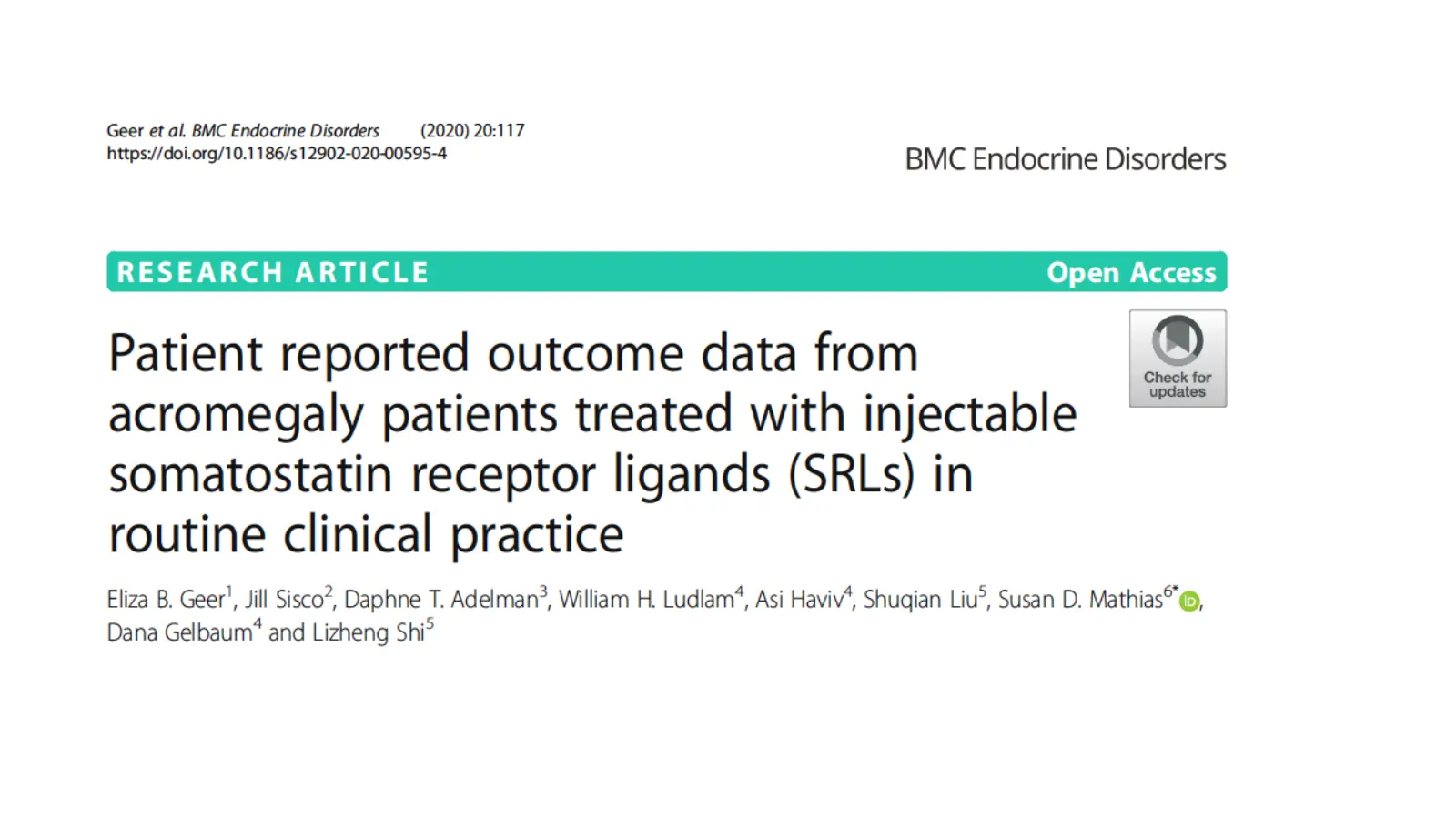
Geer et al. BMC Endocrine Disorders (2020) 20:117 https//dol.ong/10.1186/s12902-020-00595-4 BMC Endocrine Disorders RESEARCH ARTICLE Open Access Patient reported outcome data from ® updates: acromegaly patients treated with injectable somatostatin receptor ligands (SRLs) in routine clinical practice
Slide 35: Geer et al., BMC Endocrine Disorders 2020
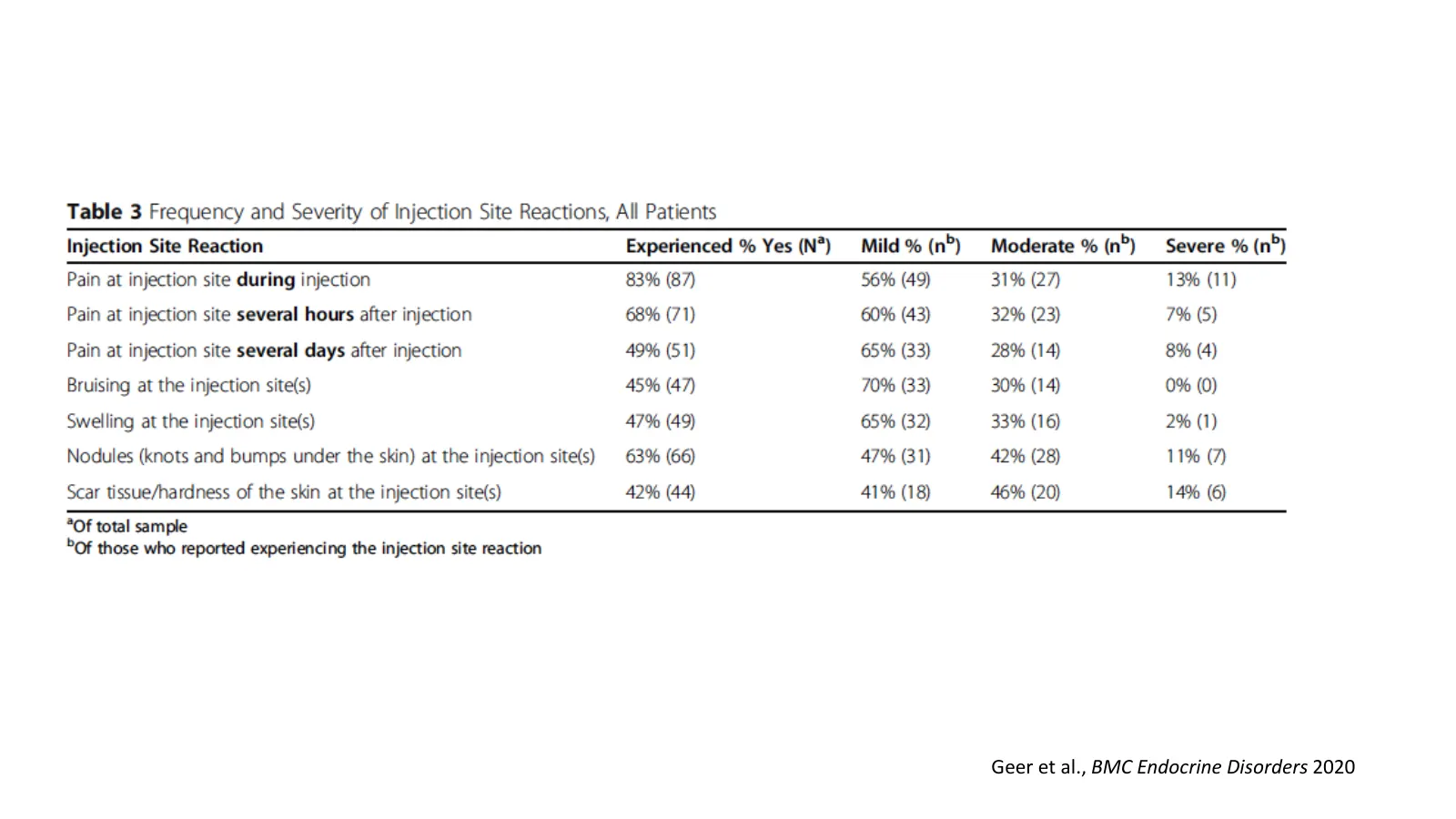
Geer et al., BMC Endocrine Disorders 2020
Slide 36: Geer et al., BMC Endocrine Disorders 2020
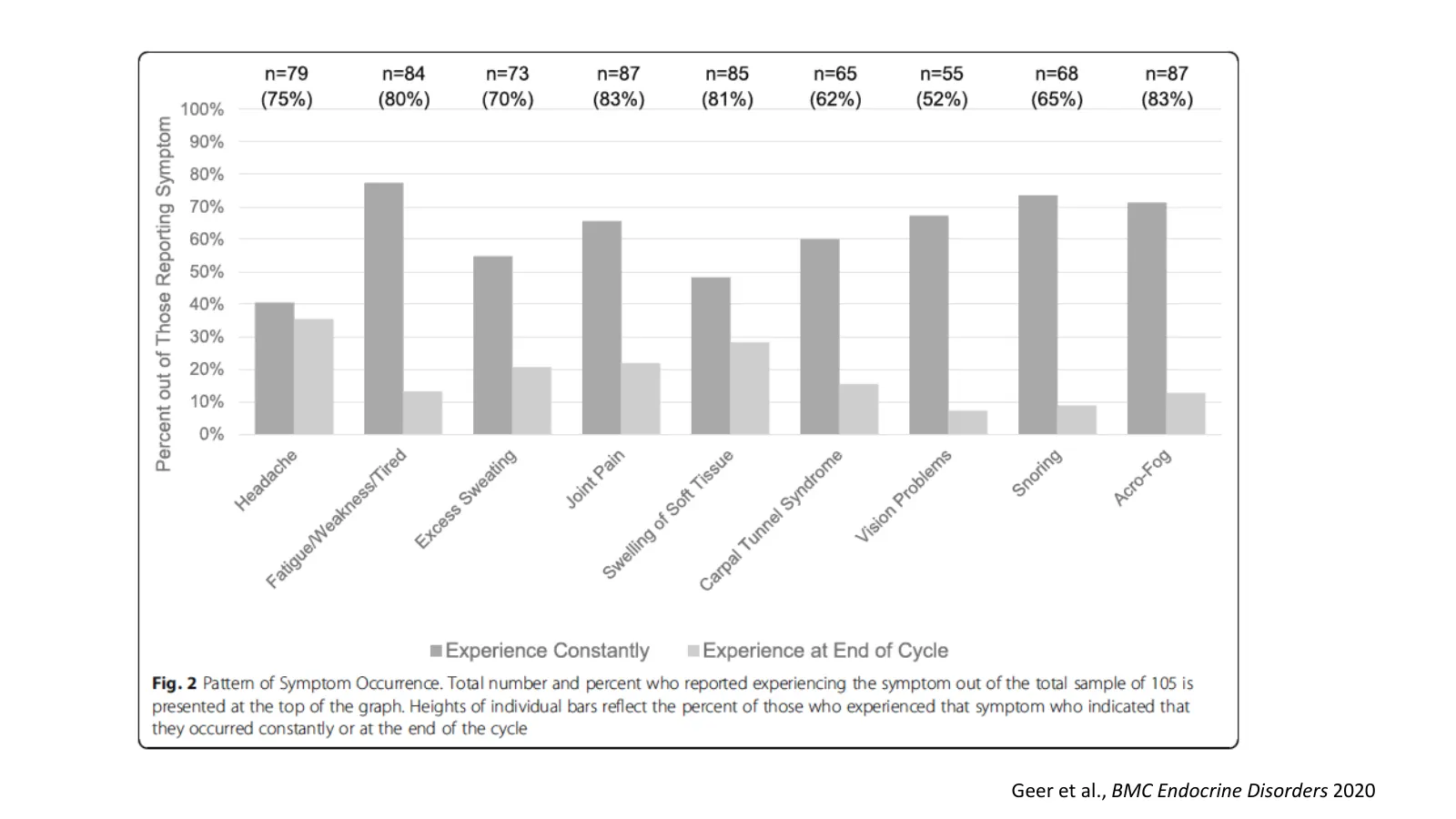
Geer et al., BMC Endocrine Disorders 2020
Slide 37: ACROBAT Edge Study Design
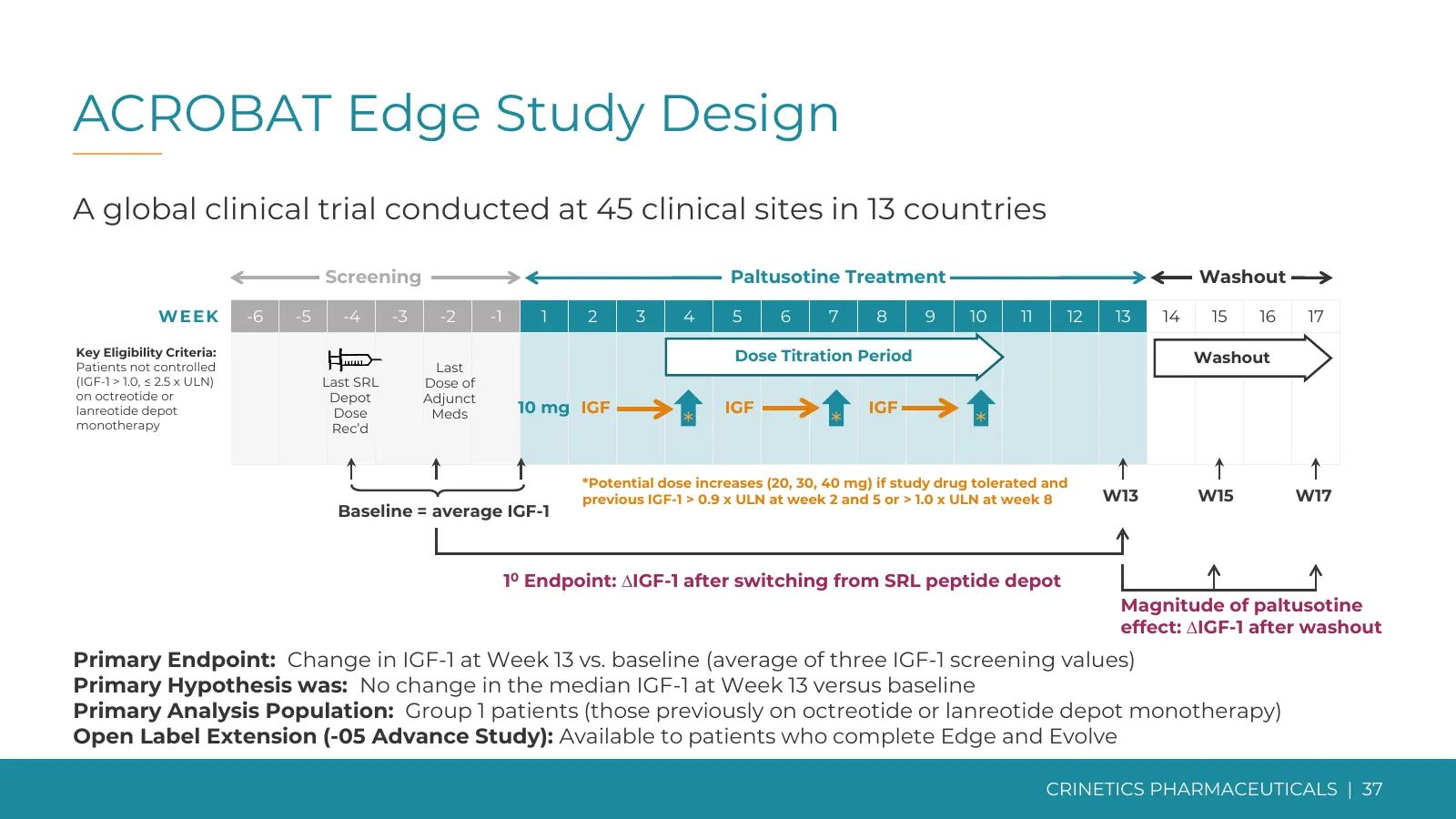
ACROBAT Edge Study Design A global clinical trial conducted at 45 clinical sites in 13 countries Screening Paltusotine Treatment Washout WEEK -6 -5 -4 -3 -2 -1 1 2 3 4 5 6 7 8 9 10 11 12 13 14 15 16 17 Key Eligibility Criteria: Dose Titration Period Washout Patients not controlled Last (IGF-1 > 1.0,
Slide 38: ACROBAT Edge Patient Groups
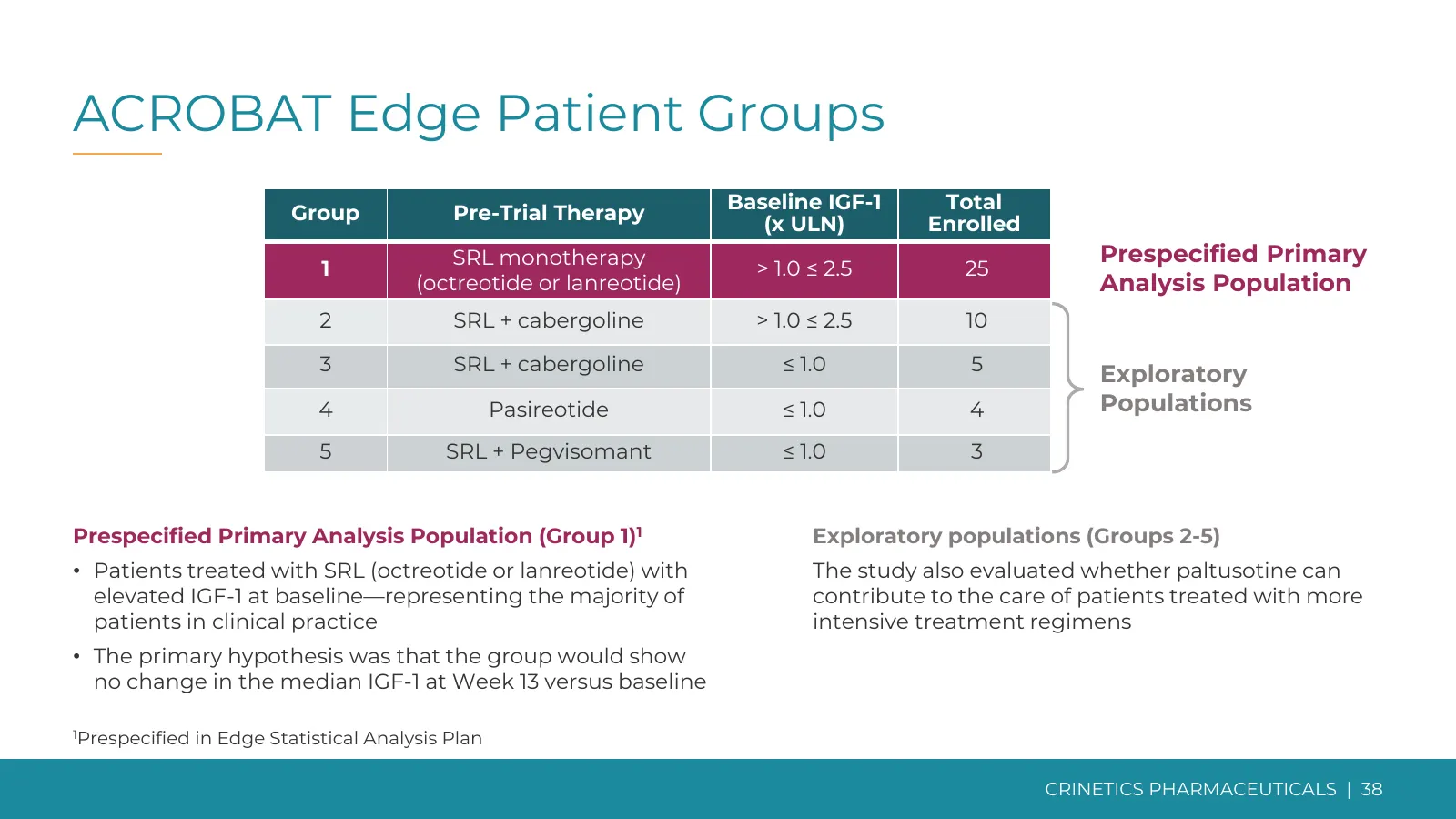
ACROBAT Edge Patient Groups Group Pre-Trial Therapy Baseline IGF-1 Total (x ULN) Enrolled SRL monotherapy Prespecified Primary 1 > 1.0 ≤ 2.5 25 (octreotide or lanreotide) Analysis Population 2 SRL + cabergoline > 1.0 ≤ 2.5 10 3 SRL + cabergoline ≤ 1.0 5 Exploratory 4 Pasireotide ≤ 1.0 4 Populations
Slide 39: ACROBAT Edge Patient Disposition
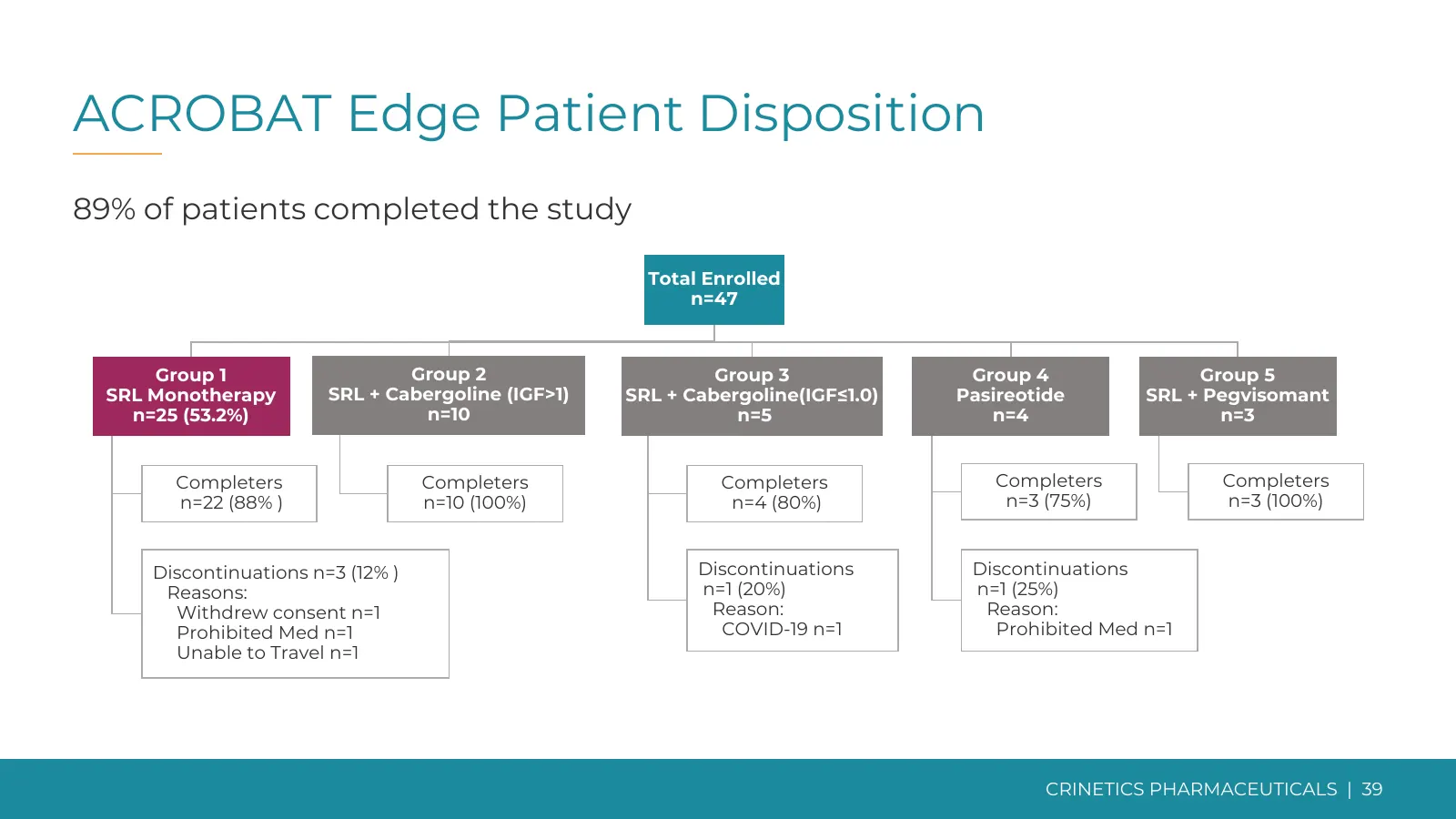
ACROBAT Edge Patient Disposition 89% of patients completed the study Total Enrolled n=47 Group 1 Group 2 Group 3 Group 4 Group 5 SRL Monotherapy SRL + Cabergoline (IGF>1) SRL + Cabergoline(IGF≤1.0) Pasireotide SRL + Pegvisomant n=25 (53.2%) n=10 n=5 n=4 n=3 Completers Completers Completers Completer
Slide 40: ACROBAT Edge Patient Characteristics
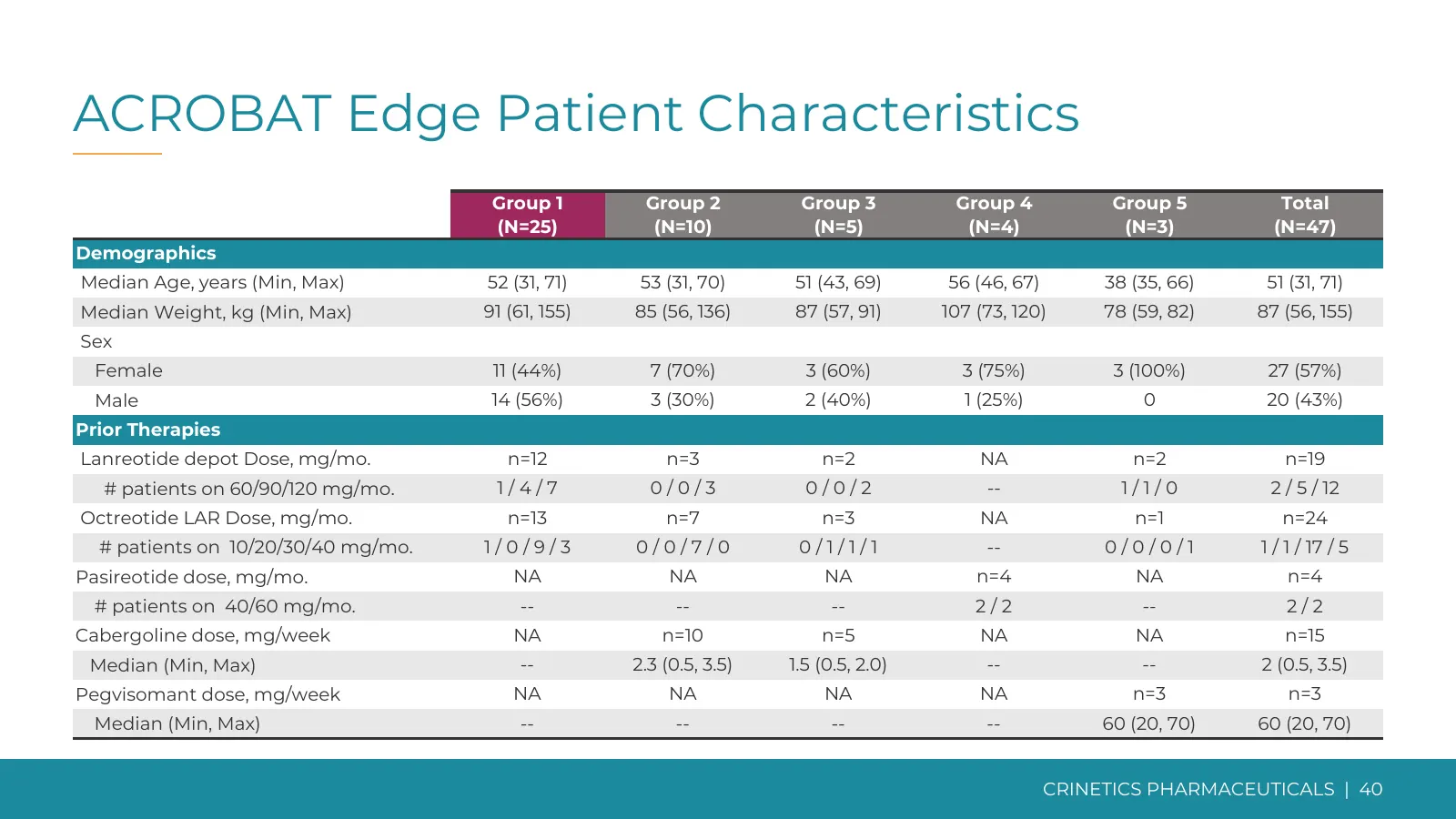
ACROBAT Edge Patient Characteristics Group 1 Group 2 Group 3 Group 4 Group 5 Total (N=25) (N=10) (N=5) (N=4) (N=3) (N=47) Demographics Median Age, years (Min, Max) 52 (31, 71) 53 (31, 70) 51 (43, 69) 56 (46, 67) 38 (35, 66) 51 (31, 71) Median Weight, kg (Min, Max) 91 (61, 155) 85 (56, 136) 87 (57, 9
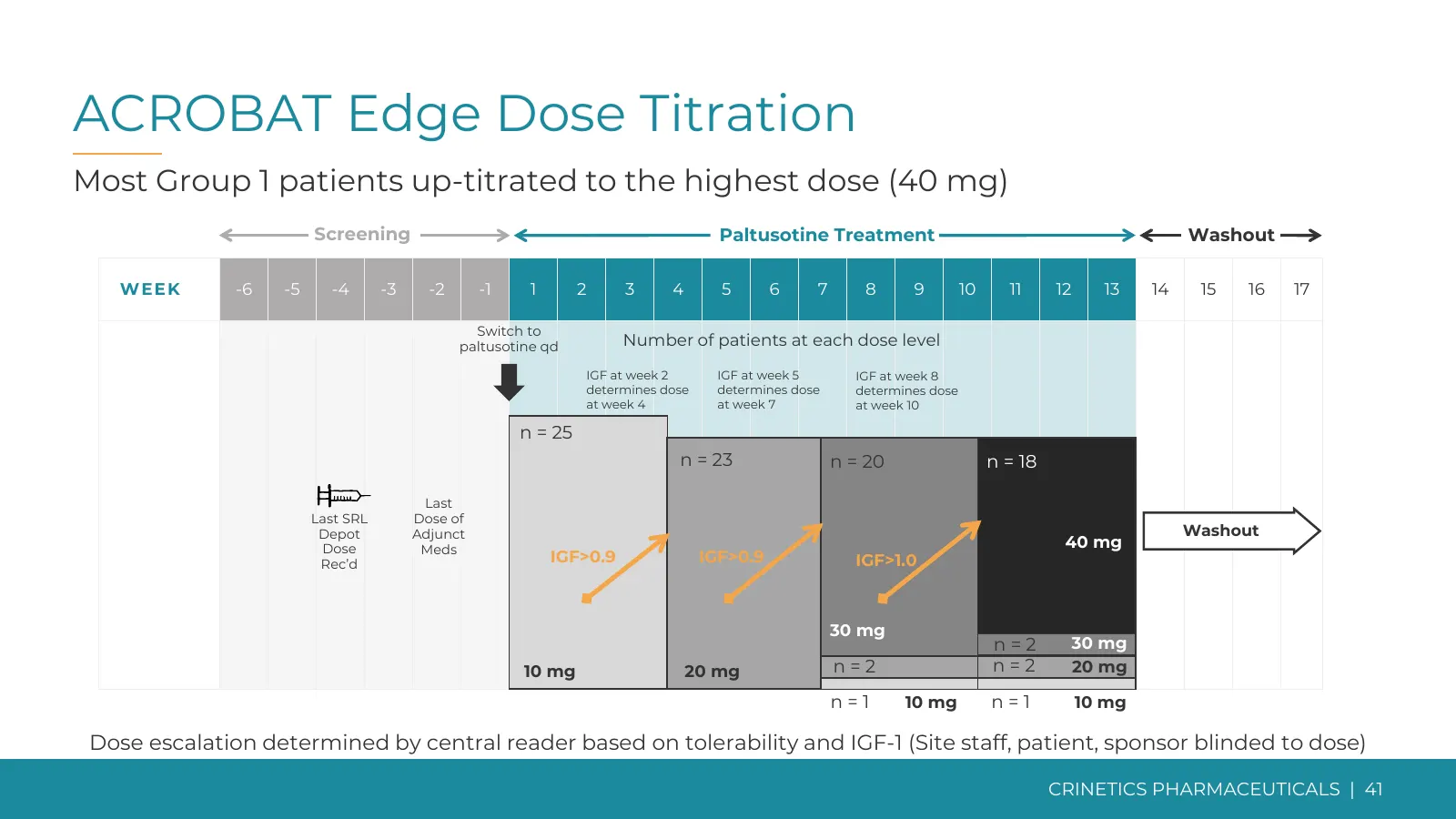
Slide 41: ACROBAT Edge Dose Titration
ACROBAT Edge Dose Titration Most Group 1 patients up-titrated to the highest dose (40 mg) Screening Paltusotine Treatment Washout WEEK -6 -5 -4 -3 -2 -1 1 2 3 4 5 6 7 8 9 10 11 12 13 14 15 16 17 Switch to paltusotine qd Number of patients at each dose level IGF at week 2 IGF at week 5 IGF at week 8
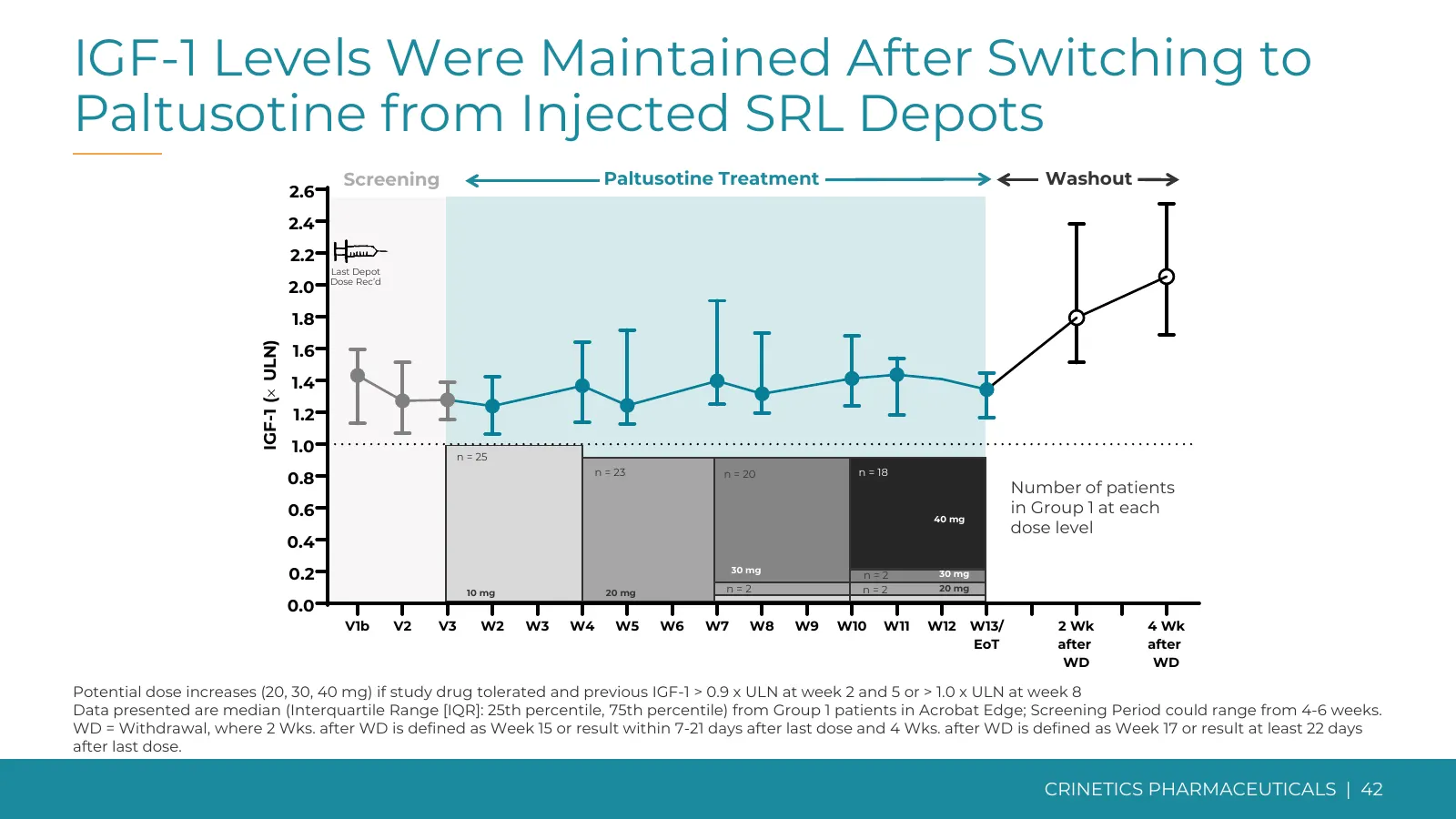
Slide 42: IGF-1 Levels Were Maintained After Switching to Paltusotine from Injected SRL Depots
IGF-1 Levels Were Maintained After Switching to Paltusotine from Injected SRL Depots Screening Paltusotine Treatment Washout 2.6 2.4 2.2 Last Depot 2.0 Dose Rec’d 1.8 1.6 IGF-1 (× ULN) 1.4 1.2 1.0 n = 25 n = 23 n = 18 0.8 n = 20 Number of patients 0.6 in Group 1 at each 40 mg dose level 0.4 0.2 30 m
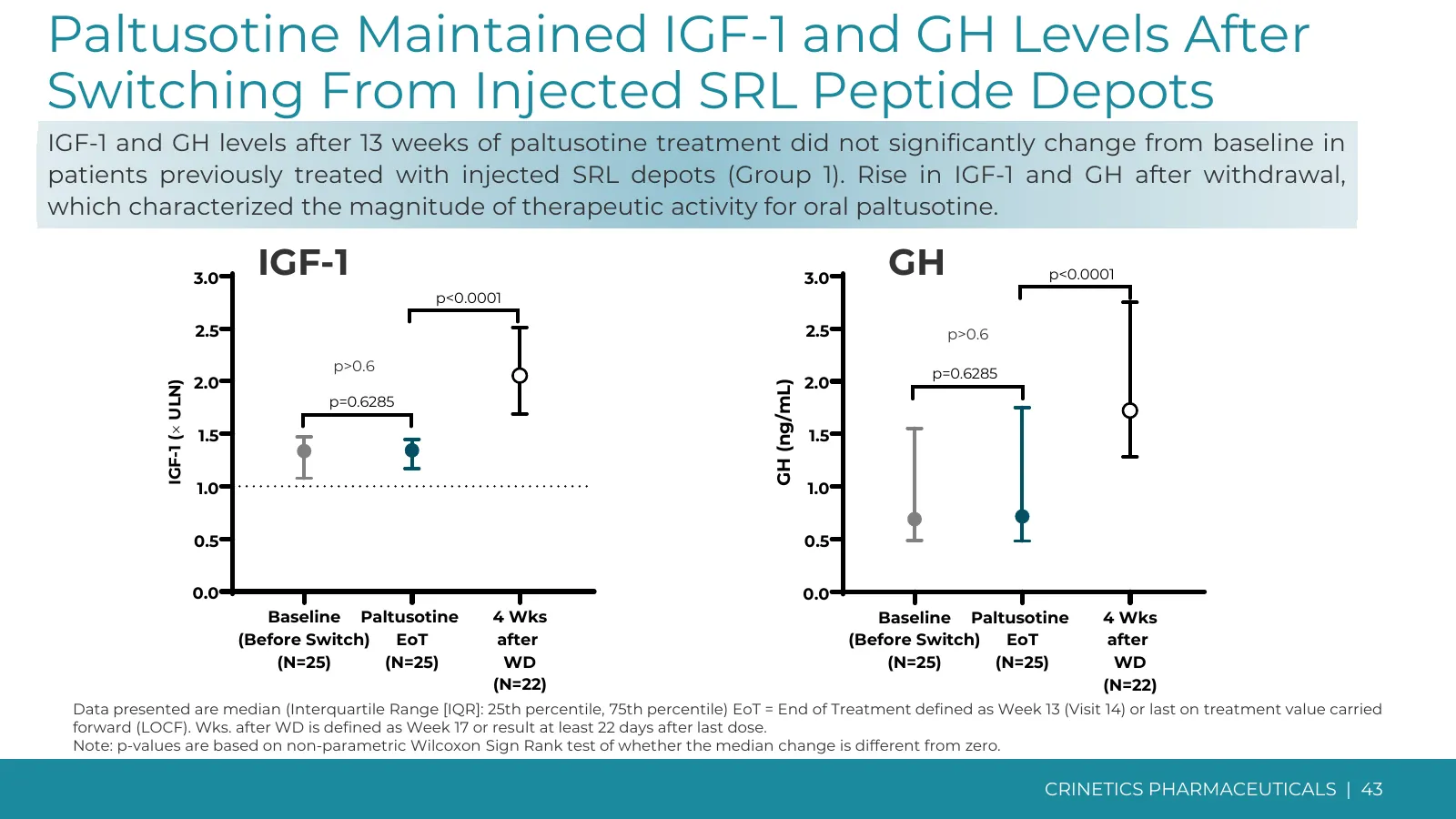
Slide 43: Paltusotine Maintained IGF-1 and GH Levels After Switching From Injected SRL Peptide Depots
Paltusotine Maintained IGF-1 and GH Levels After Switching From Injected SRL Peptide Depots IGF-1 and GH levels after 13 weeks of paltusotine treatment did not significantly change from baseline in patients previously treated with injected SRL depots (Group 1). Rise in IGF-1 and GH after withdrawal,
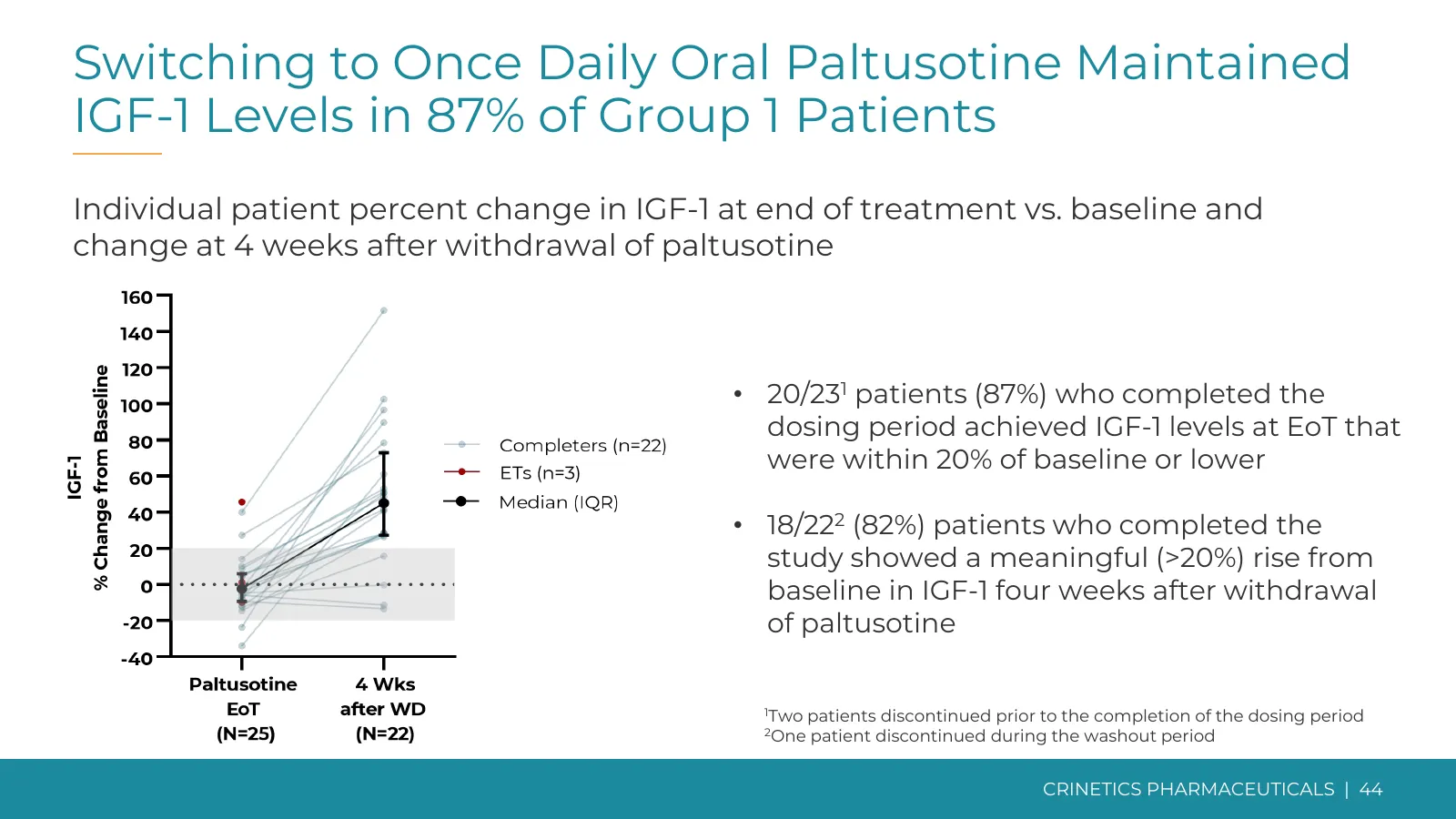
Slide 44: Switching to Once Daily Oral Paltusotine Maintained IGF-1 Levels in 87% of Group 1 Patients
Switching to Once Daily Oral Paltusotine Maintained IGF-1 Levels in 87% of Group 1 Patients Individual patient percent change in IGF-1 at end of treatment vs. baseline and change at 4 weeks after withdrawal of paltusotine • 20/231 patients (87%) who completed the dosing period achieved IGF-1 levels
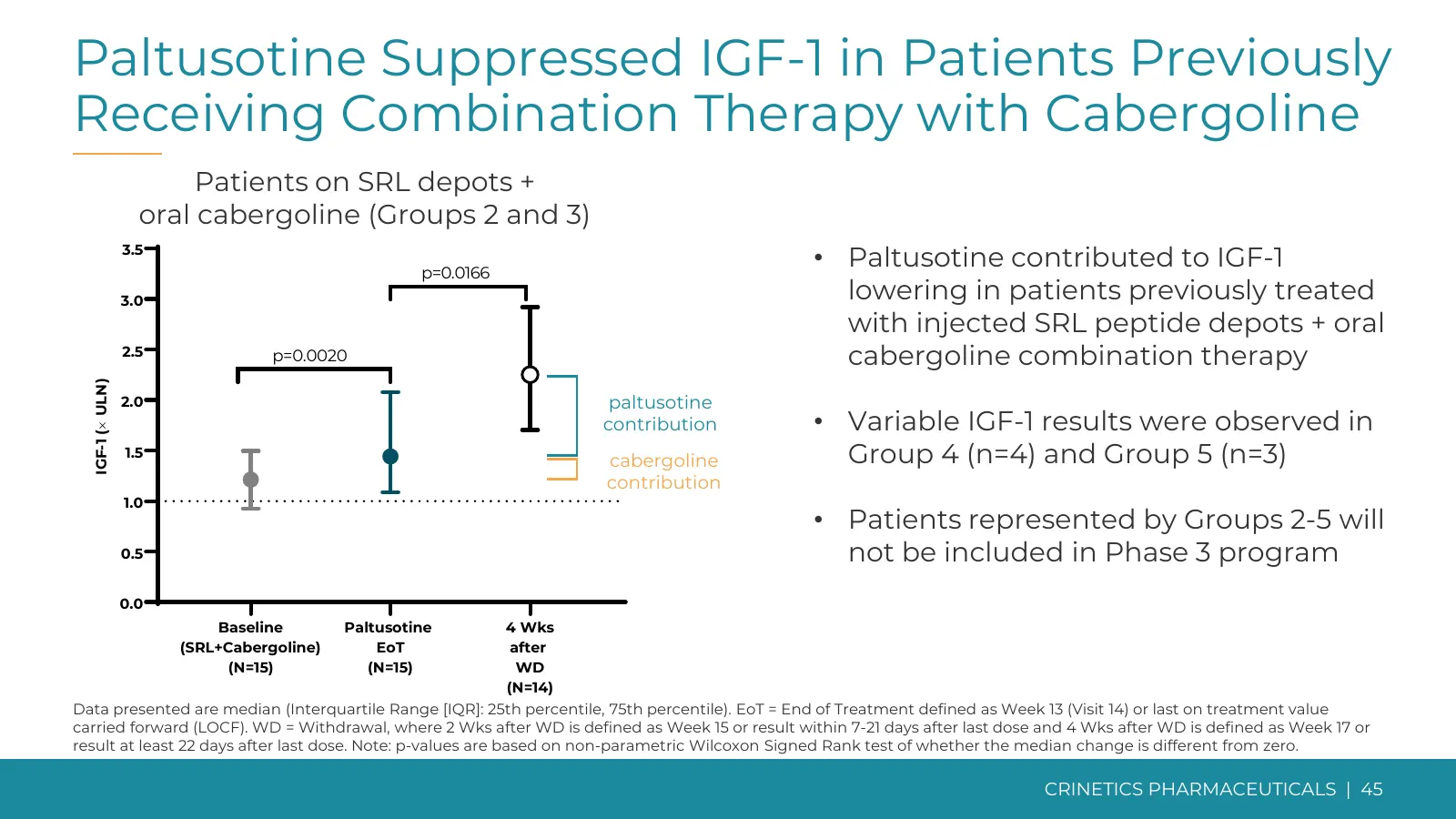
Slide 45: Paltusotine Suppressed IGF-1 in Patients Previously Receiving Combination Therapy with Cabergoline
Paltusotine Suppressed IGF-1 in Patients Previously Receiving Combination Therapy with Cabergoline Patients on SRL depots + oral cabergoline (Groups 2 and 3) 3.5 p=0.0166 • Paltusotine contributed to IGF-1 3.0 lowering in patients previously treated with injected SRL peptide depots + oral 2.5 p=0.00
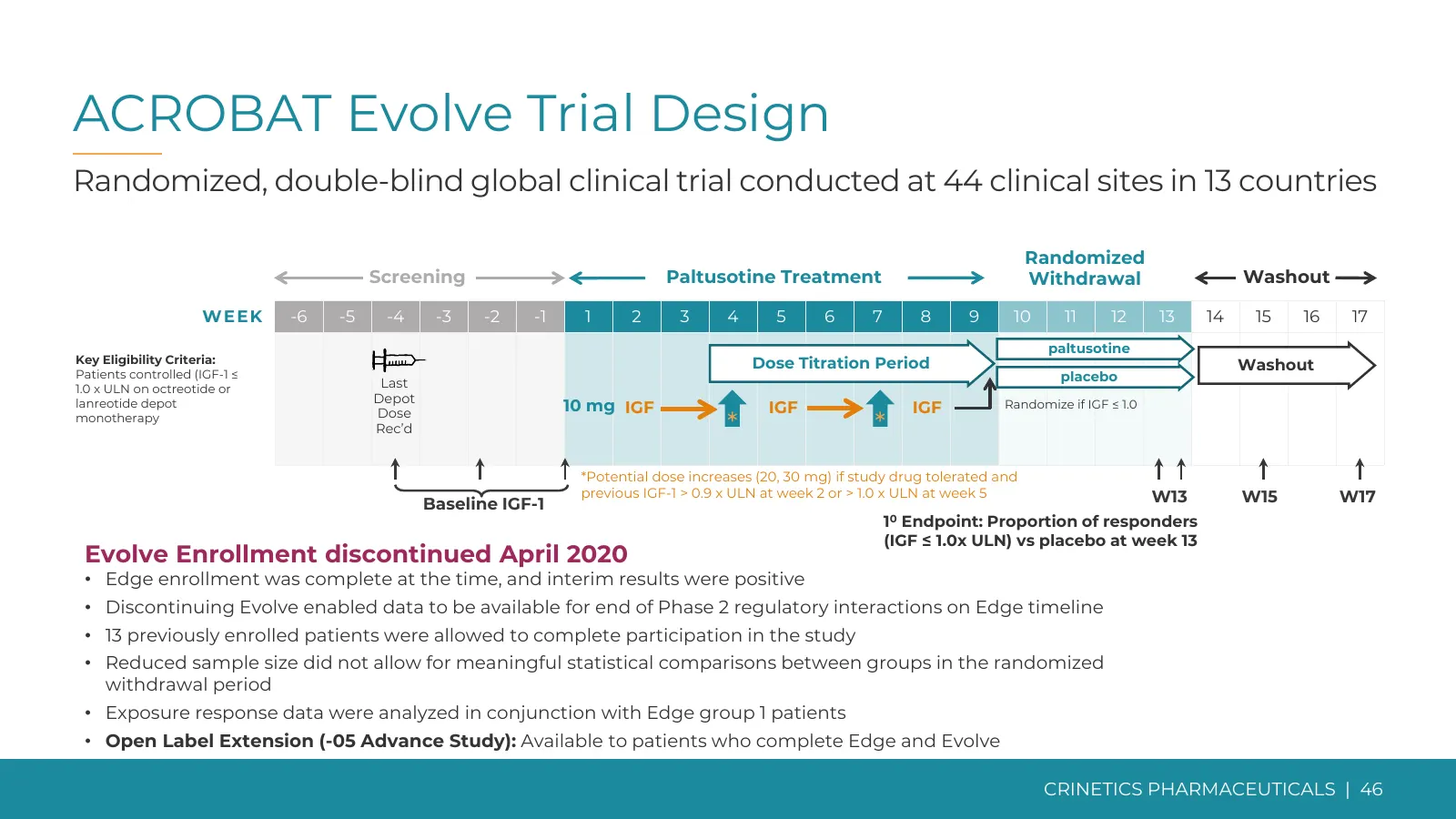
Slide 46: ACROBAT Evolve Trial Design
ACROBAT Evolve Trial Design Randomized, double-blind global clinical trial conducted at 44 clinical sites in 13 countries Randomized Screening Paltusotine Treatment Withdrawal Washout WEEK -6 -5 -4 -3 -2 -1 1 2 3 4 5 6 7 8 9 10 11 12 13 14 15 16 17 paltusotine Key Eligibility Criteria: Dose Titratio
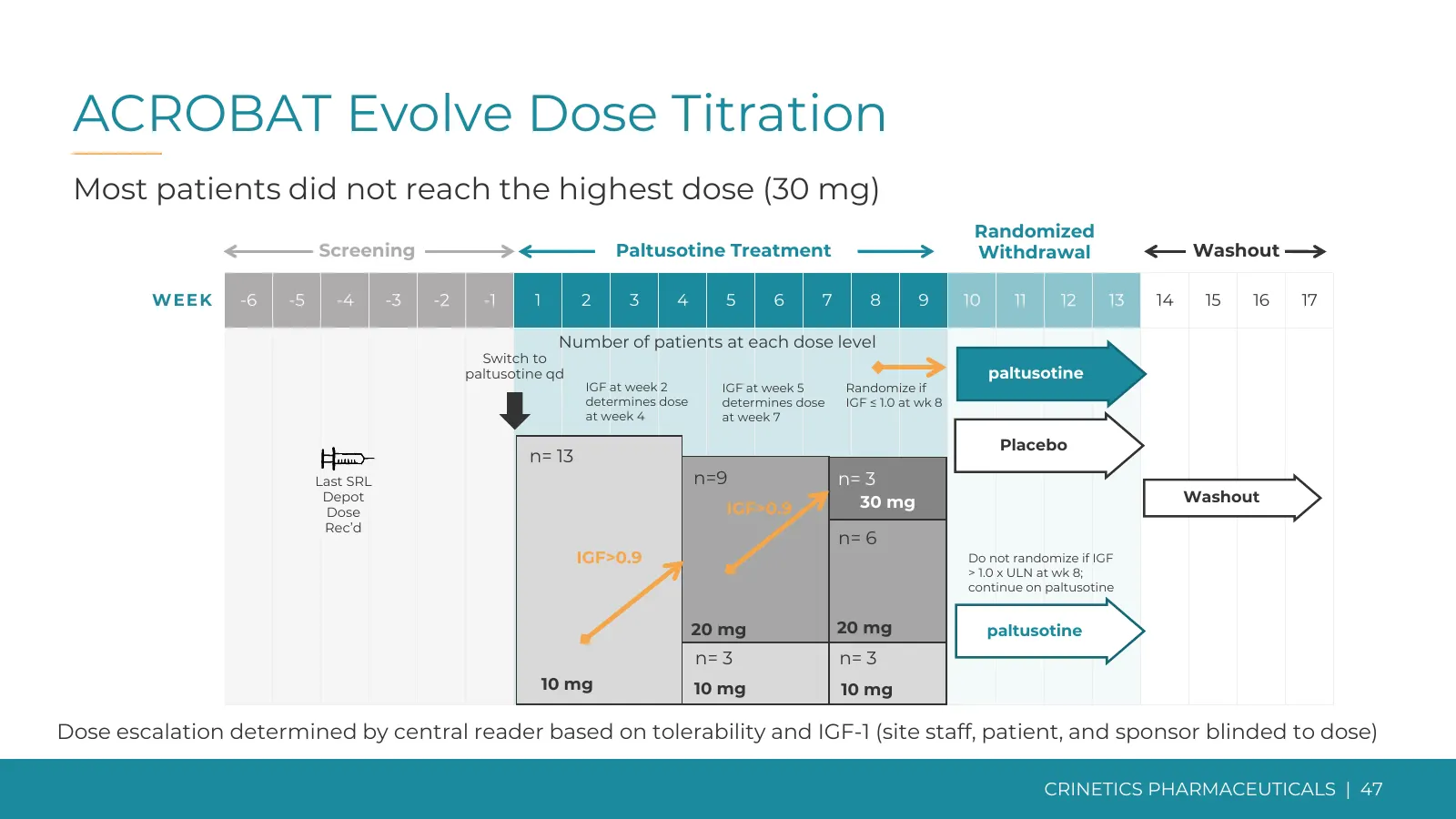
Slide 47: ACROBAT Evolve Dose Titration
ACROBAT Evolve Dose Titration Most patients did not reach the highest dose (30 mg) Randomized Screening Paltusotine Treatment Withdrawal Washout WEEK -6 -5 -4 -3 -2 -1 1 2 3 4 5 6 7 8 9 10 11 12 13 14 15 16 17 Number of patients at each dose level Switch to paltusotine qd paltusotine IGF at week 2 I
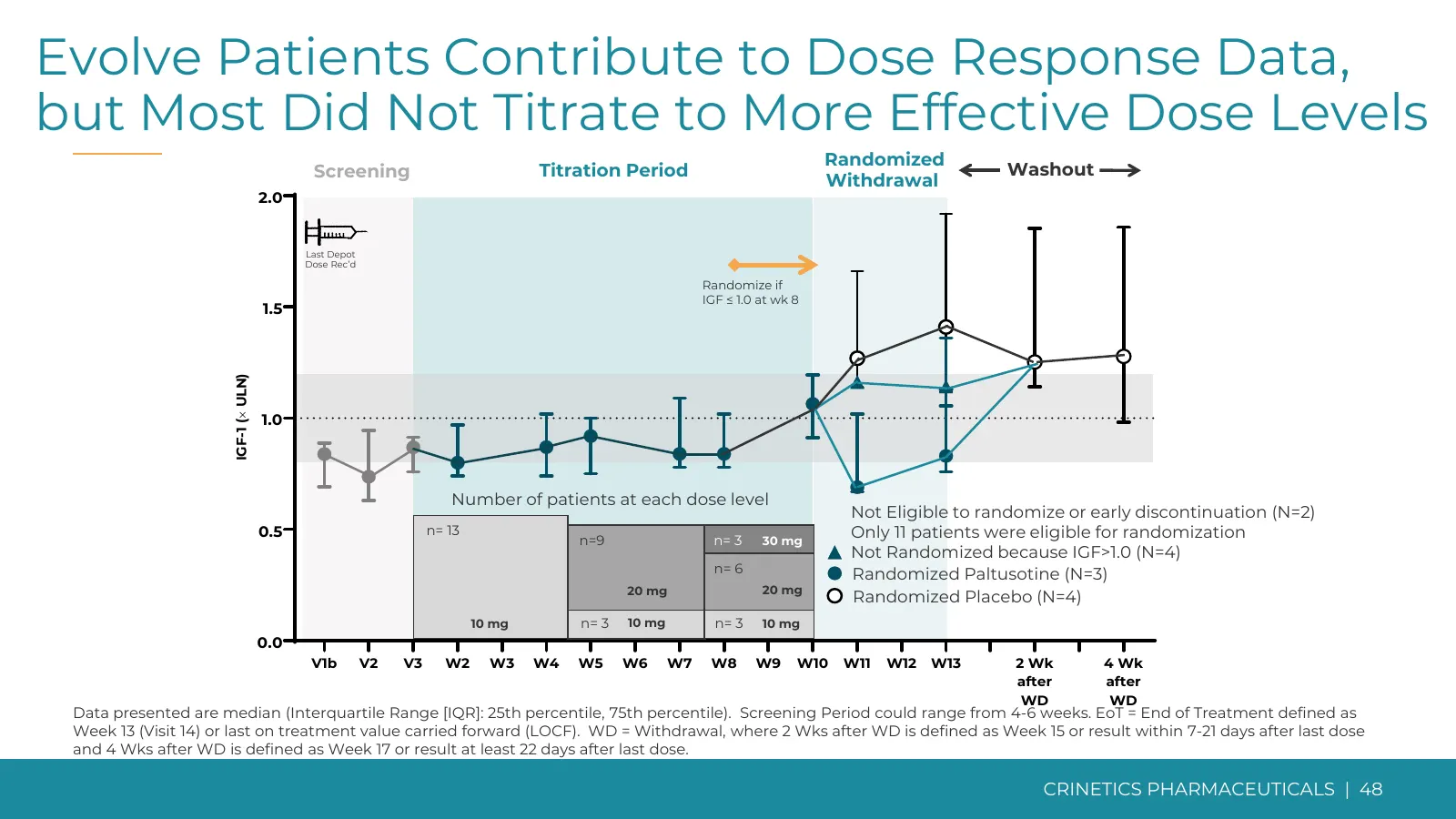
Slide 48: Evolve Patients Contribute to Dose Response Data, but Most Did Not Titrate to More Effective Dose Levels
Evolve Patients Contribute to Dose Response Data, but Most Did Not Titrate to More Effective Dose Levels Randomized Screening Titration Period Washout Withdrawal 2.0 Last Depot Dose Rec’d Randomize if IGF ≤ 1.0 at wk 8 1.5 IGF-1 (× ULN) 1.0 Number of patients at each dose level Not Eligible to rando
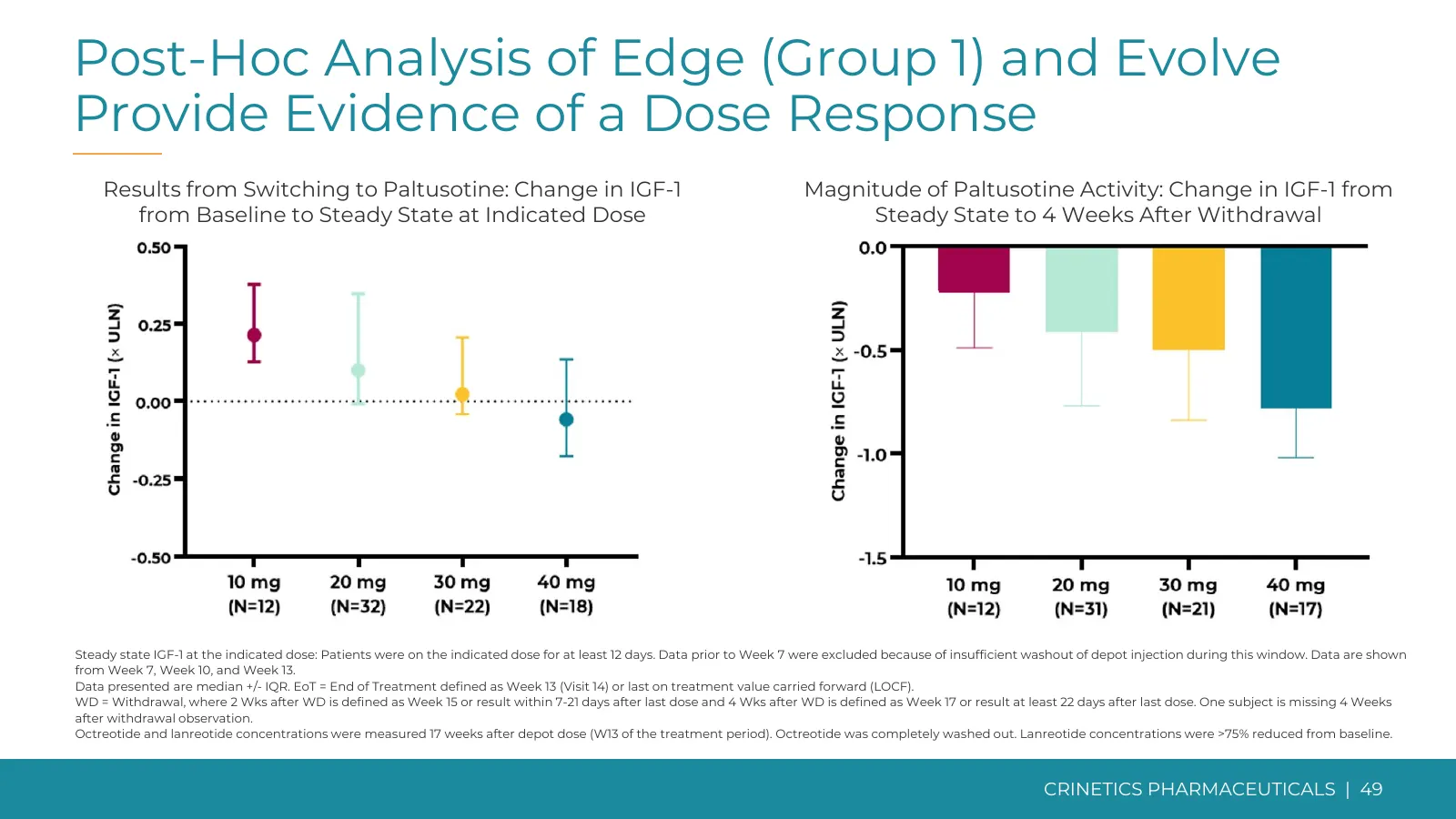
Slide 49: Post-Hoc Analysis of Edge (Group 1) and Evolve Provide Evidence of a Dose Response
Post-Hoc Analysis of Edge (Group 1) and Evolve Provide Evidence of a Dose Response Results from Switching to Paltusotine: Change in IGF-1 Magnitude of Paltusotine Activity: Change in IGF-1 from from Baseline to Steady State at Indicated Dose Steady State to 4 Weeks After Withdrawal Steady state IGF-
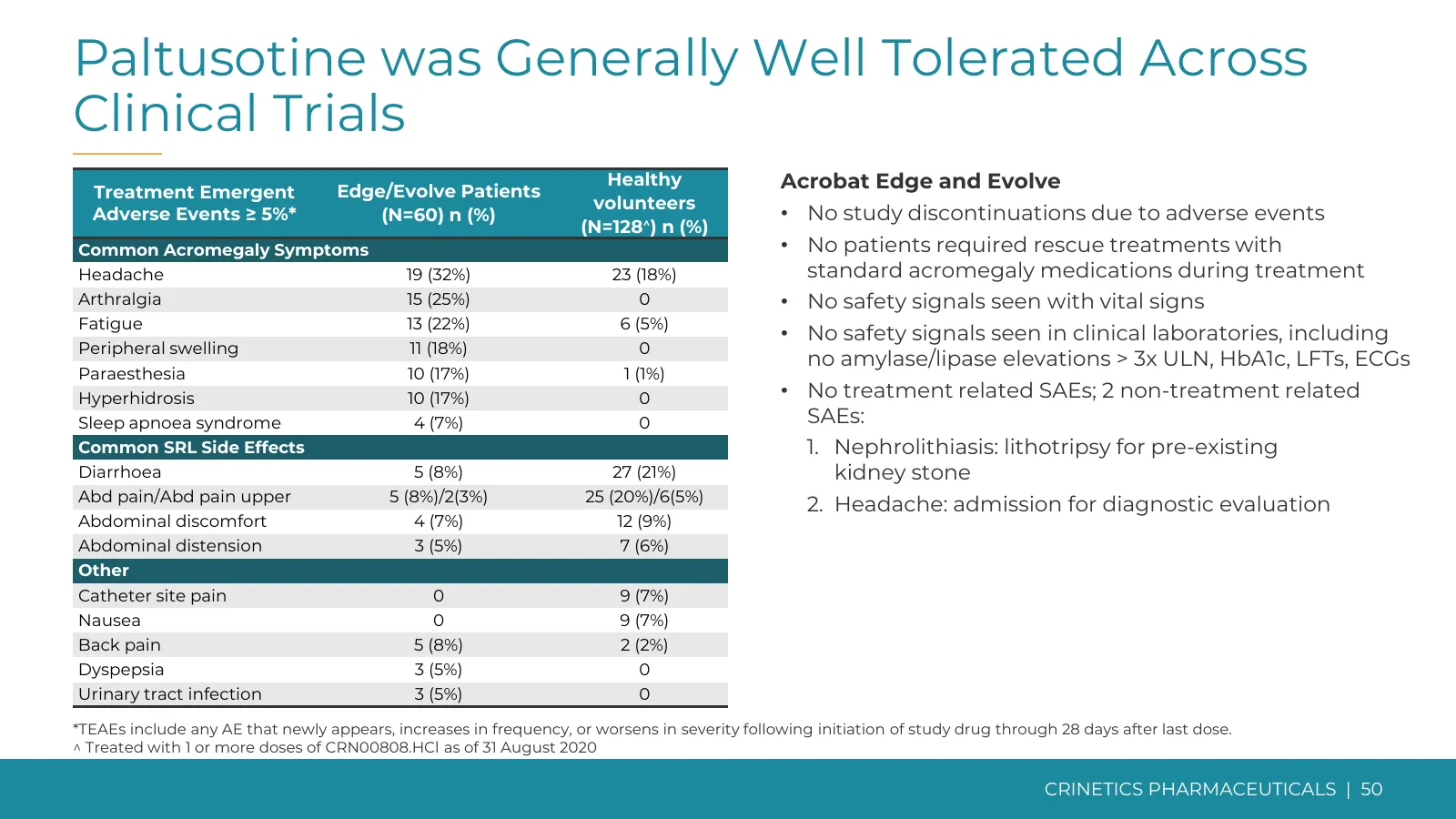
Slide 50: Paltusotine was Generally Well Tolerated Across Clinical Trials
Paltusotine was Generally Well Tolerated Across Clinical Trials Treatment Emergent Edge/Evolve Patients Healthy Acrobat Edge and Evolve volunteers Adverse Events ≥ 5%* (N=60) n (%) • No study discontinuations due to adverse events (N=128^) n (%) Common Acromegaly Symptoms • No patients required res
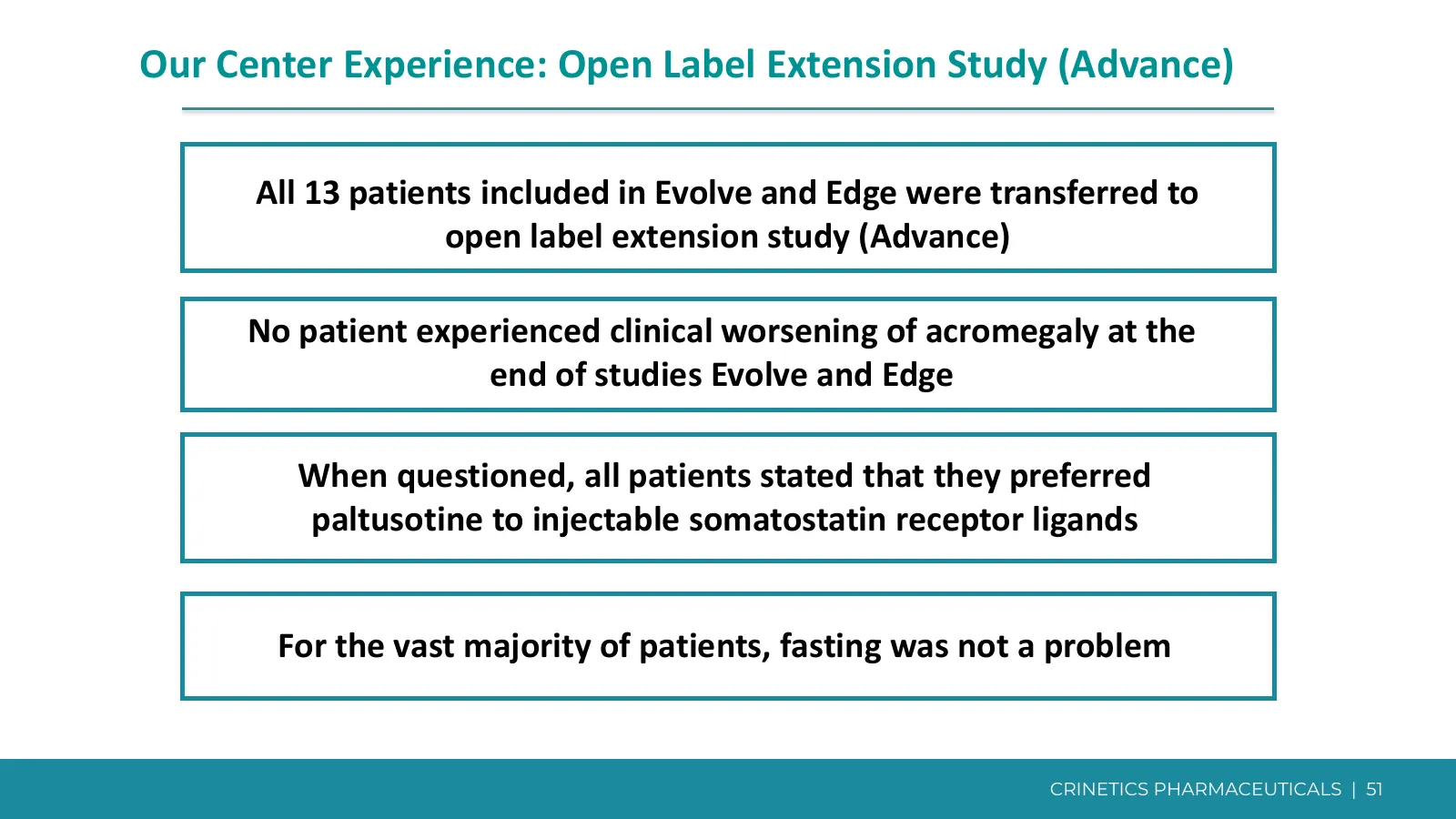
Slide 51: Our Center Experience: Open Label Extension Study (Advance)
Our Center Experience: Open Label Extension Study (Advance) All 13 patients included in Evolve and Edge were transferred to open label extension study (Advance) No patient experienced clinical worsening of acromegaly at the end of studies Evolve and Edge When questioned, all patients stated that the
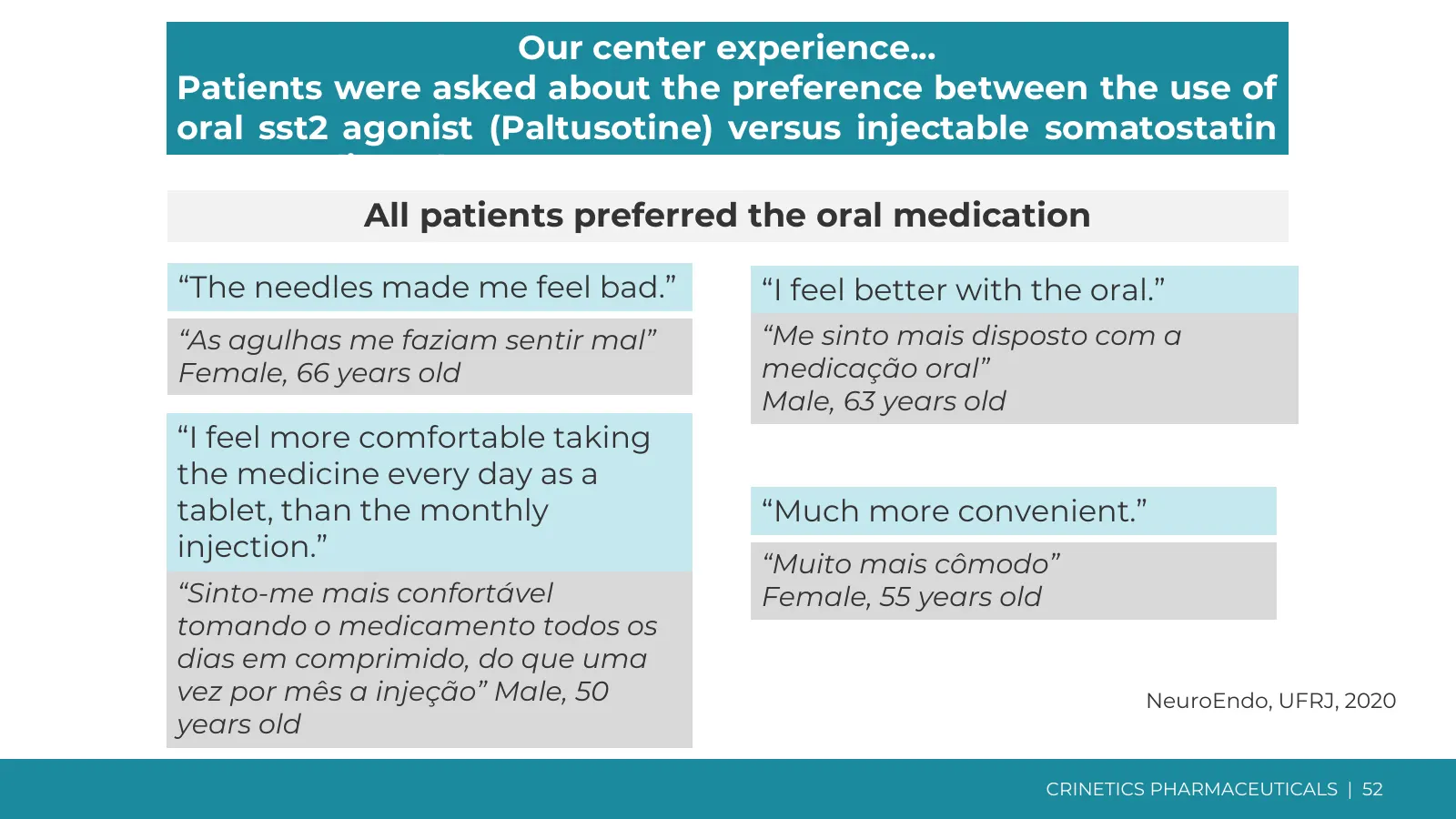
Slide 52: Our center experience...
Our center experience... Patients were asked about the preference between the use of oral sst2 agonist (Paltusotine) versus injectable somatostatin receptor ligands All patients preferred the oral medication “The needles made me feel bad.” “I feel better with the oral.” “As agulhas me faziam sentir
Slide 53: Conclusions
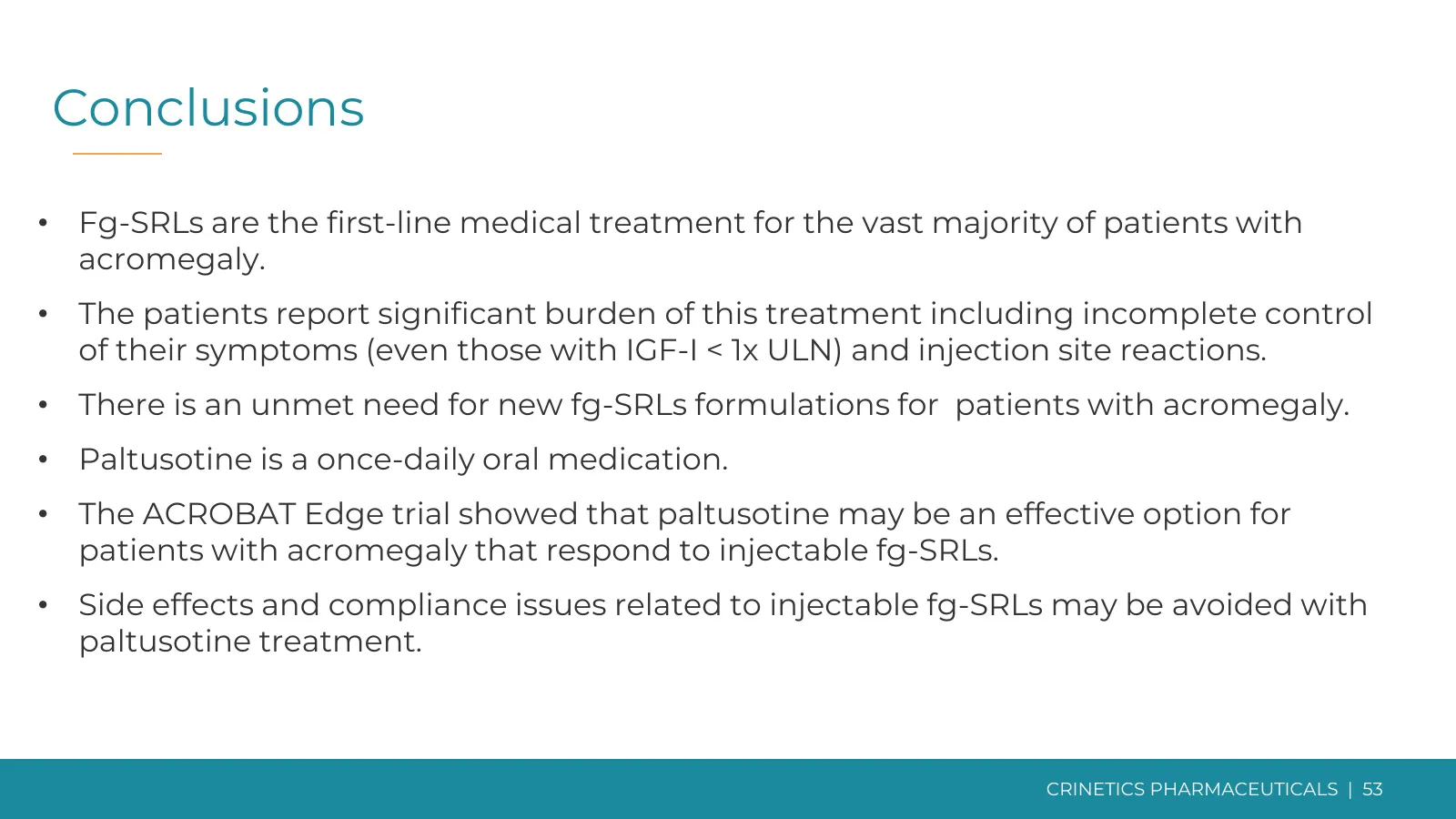
Conclusions • Fg-SRLs are the first-line medical treatment for the vast majority of patients with acromegaly. • The patients report significant burden of this treatment including incomplete control of their symptoms (even those with IGF-I < 1x ULN) and injection site reactions. • There is an unmet n
Slide 54: Thank you
Thank you [email protected] CRINETICS PHARMACEUTICALS | 54
Slide 55: Paltusotine Next Steps and Q&A
PALTUSOTINE NEXT STEPS AND Q&A Scott Struthers, PhD, Founder and CEO CRINETICS PHARMACEUTICALS | 55
Slide 56: Paltusotine Development Program 2021 Plans
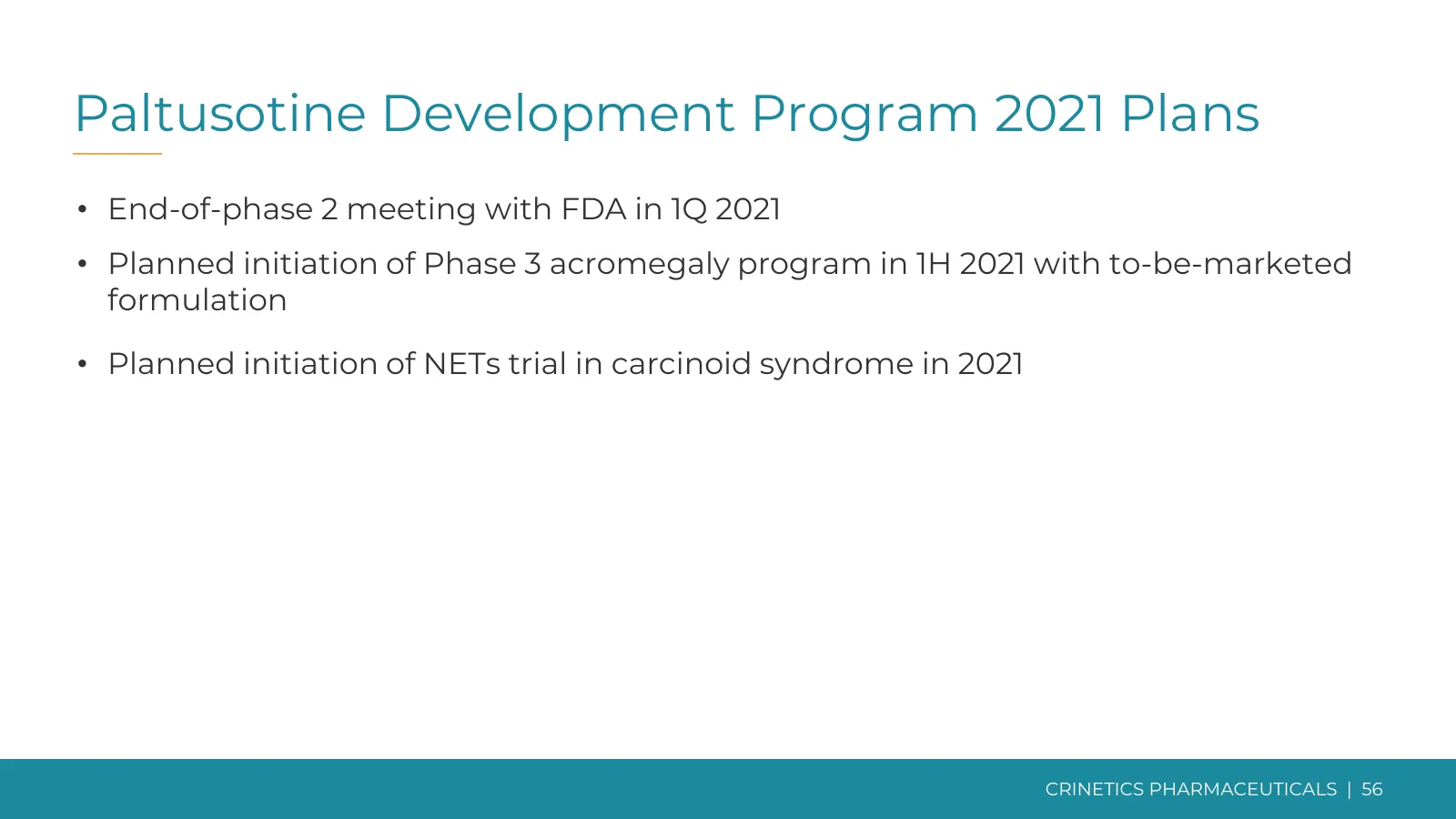
Paltusotine Development Program 2021 Plans • End-of-phase 2 meeting with FDA in 1Q 2021 • Planned initiation of Phase 3 acromegaly program in 1H 2021 with to-be-marketed formulation • Planned initiation of NETs trial in carcinoid syndrome in 2021 CRINETICS PHARMACEUTICALS | 56

Slide 57: Q&A
Q&A CRINETICS PHARMACEUTICALS | 57

Slide 58: Thank You
‘Crinetics armaceutica THANK YOU
Source: company website
More decks from Crinetics Pharmaceuticals, Inc.
 Q1 2026 Earnings Presentation20 slides · May 7, 2026
 TD Cowen 46th Annual Health Care Conference 20269 slides · March 2026
 Q4 2025 Earnings Presentation18 slides · Feb 26, 2026
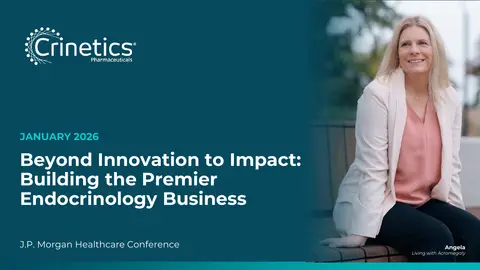 44th Annual J.P. Morgan Healthcare Conference (January 2026)18 slides · Jan 13, 2026
 Corporate Update (January 2026)26 slides · January 2026
 Q3 2025 Earnings Presentation24 slides · Nov 6, 2025