Lexeo Therapeutics, Inc. · NASDAQ:LXEO
Lexeo Therapeutics — Technical Presentation (November 2026)
14 slides from Lexeo Therapeutics's technical presentation, November 2026
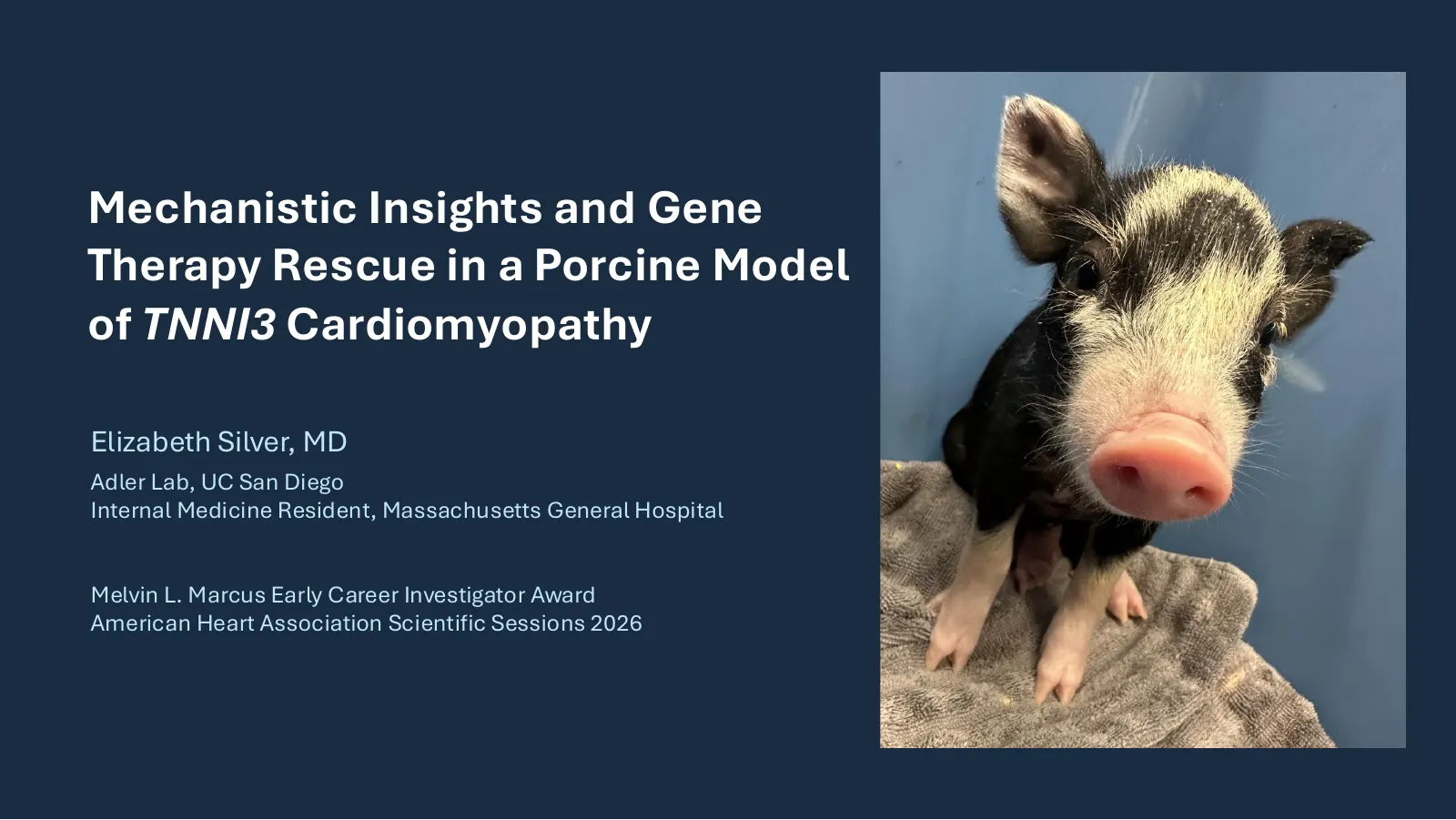
Slide 1: Mechanistic Insights and Gene Therapy Rescue in a Porcine Model of TNNI3 Cardiomyopathy
Mechanistic Insights and Gene Therapy Rescue in a Porcine Model of TNNI3 Cardiomyopathy Elizabeth Silver, MD Adler Lab, UC San Diego Internal Medicine Resident, Massachusetts General Hospital Melvin L. Marcus Early Career Investigator Award American Heart Association Scientific Sessions 2026
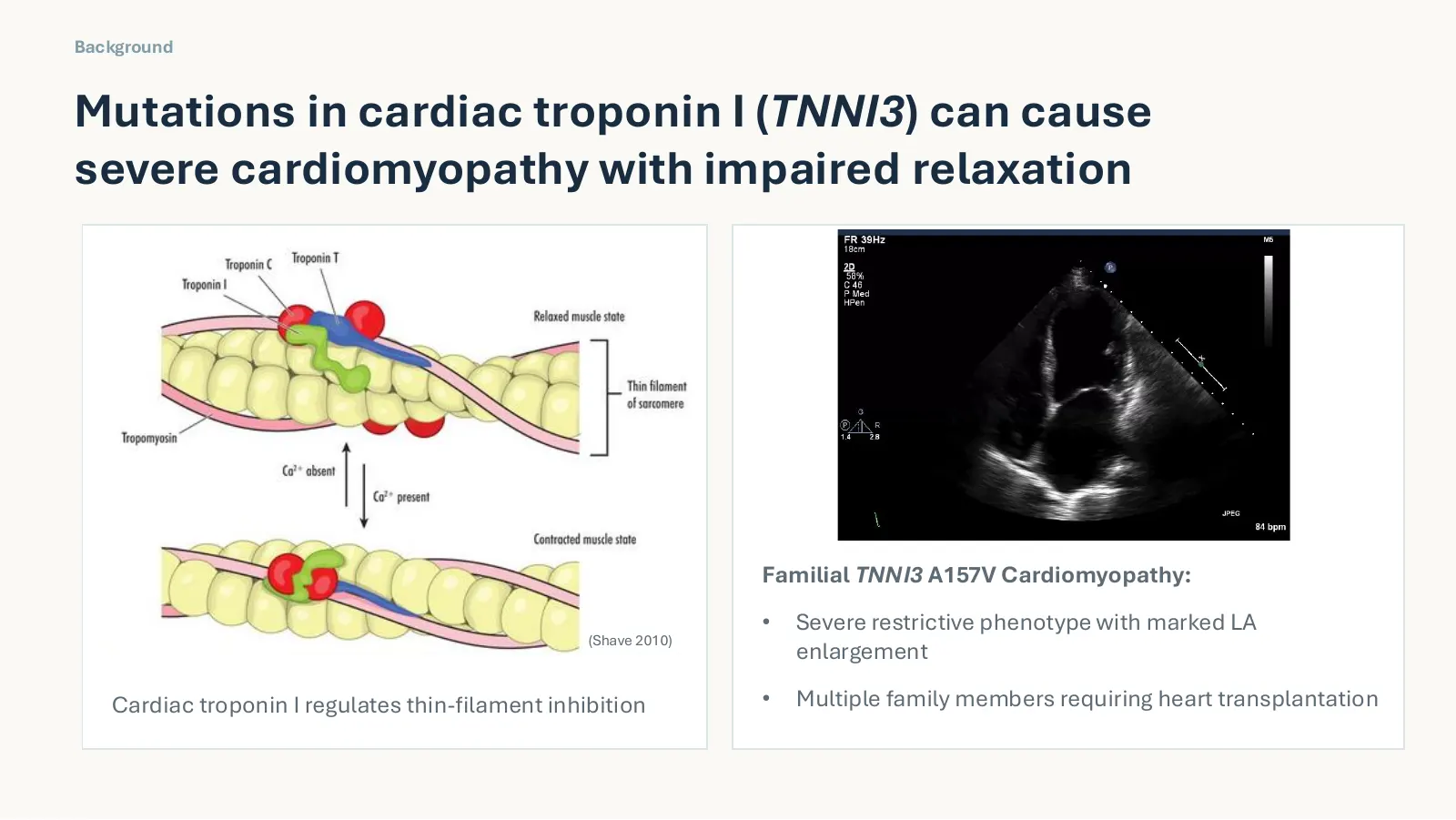
Slide 2: Mutations in cardiac troponin I (TNNI3) can cause severe cardiomyopathy with impaired relaxation
Background Mutations in cardiac troponin I (TNNI3) can cause severe cardiomyopathy with impaired relaxation Familial TNNI3 A157V Cardiomyopathy: • Severe restrictive phenotype with marked LA (Shave 2010) enlargement Cardiac troponin I regulates thin-filament inhibition • Multiple family members requ
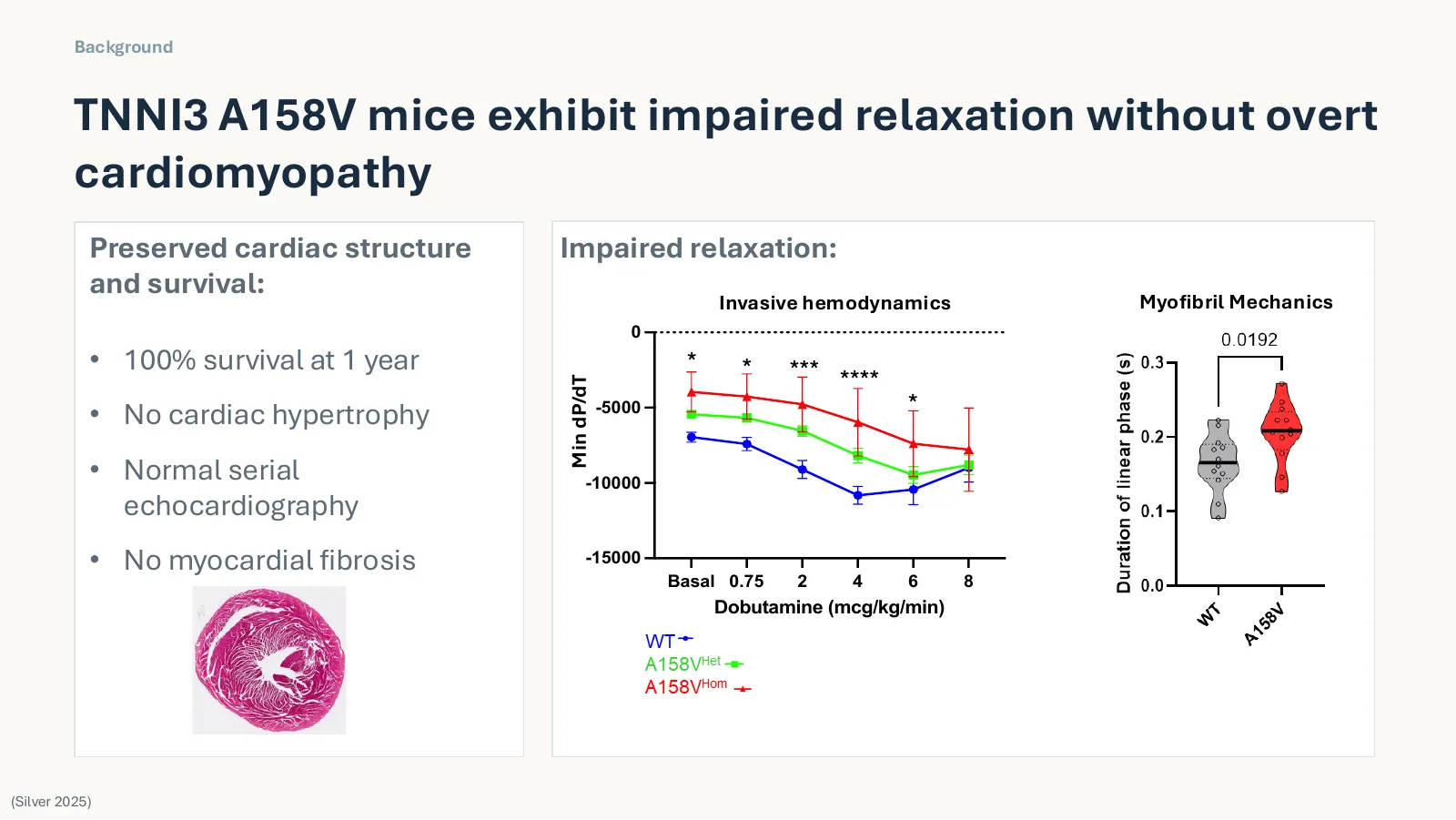
Slide 3: TNNI3 A158V mice exhibit impaired relaxation without overt cardiomyopathy
Background TNNI3 A158V mice exhibit impaired relaxation without overt cardiomyopathy Preserved cardiac structure Impaired relaxation: and survival: Minimum dPdT Invasive hemodynamics Myofibril Mechanics 0 M +/+ • 100% survival at 1 year * * *** **** M +/- Min dP/dT * • No cardiac hypertrophy -5000 M
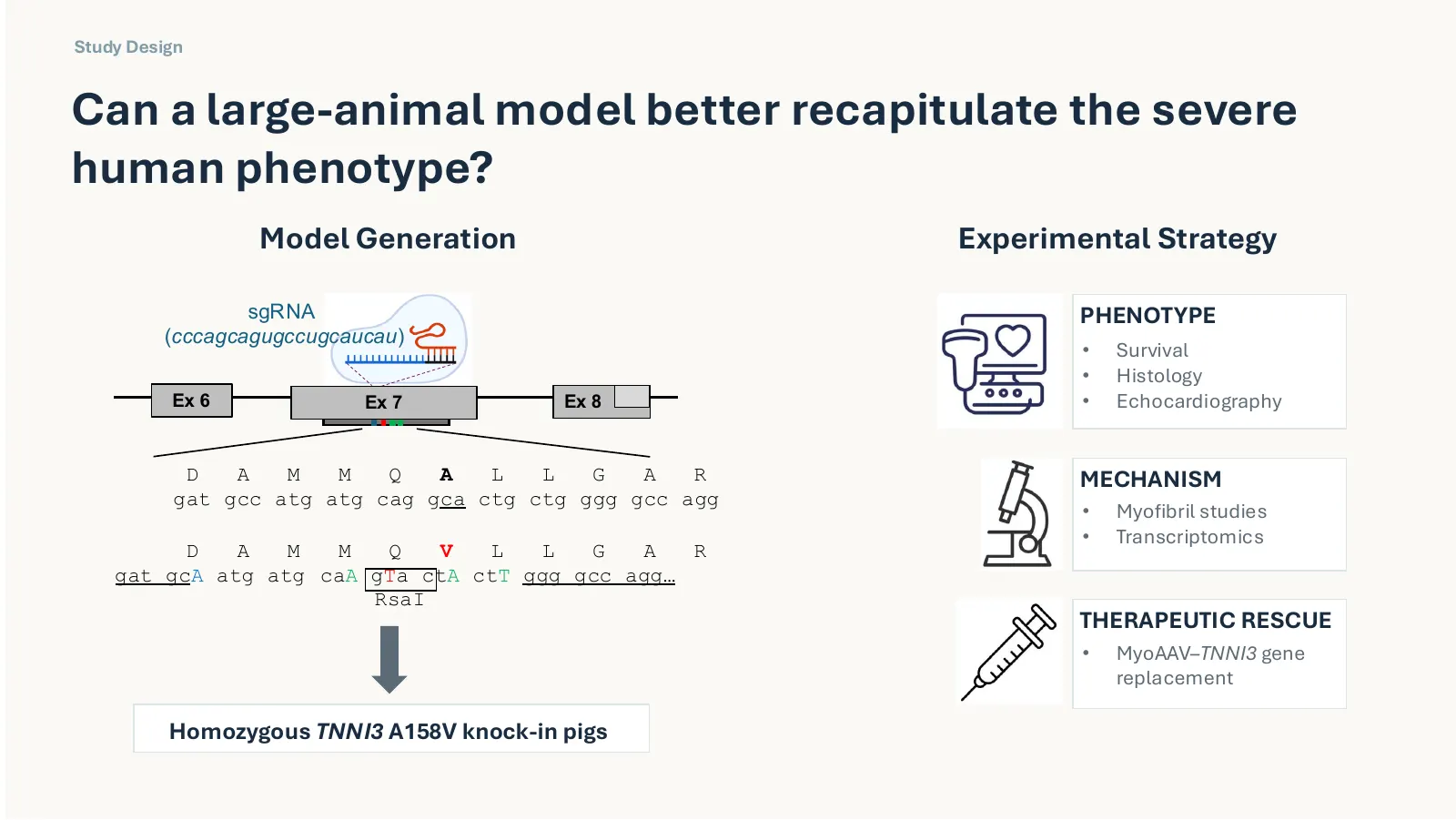
Slide 4: Can a large-animal model better recapitulate the severe human phenotype?
Study Design Can a large-animal model better recapitulate the severe human phenotype? Model Generation Experimental Strategy sgRNA PHENOTYPE (cccagcagugccugcaucau) • Survival • Histology Ex 6 Ex 7 Ex 8 • Echocardiography D A M M Q A L L G A R MECHANISM gat gcc atg atg cag gca ctg ctg ggg gcc agg • M
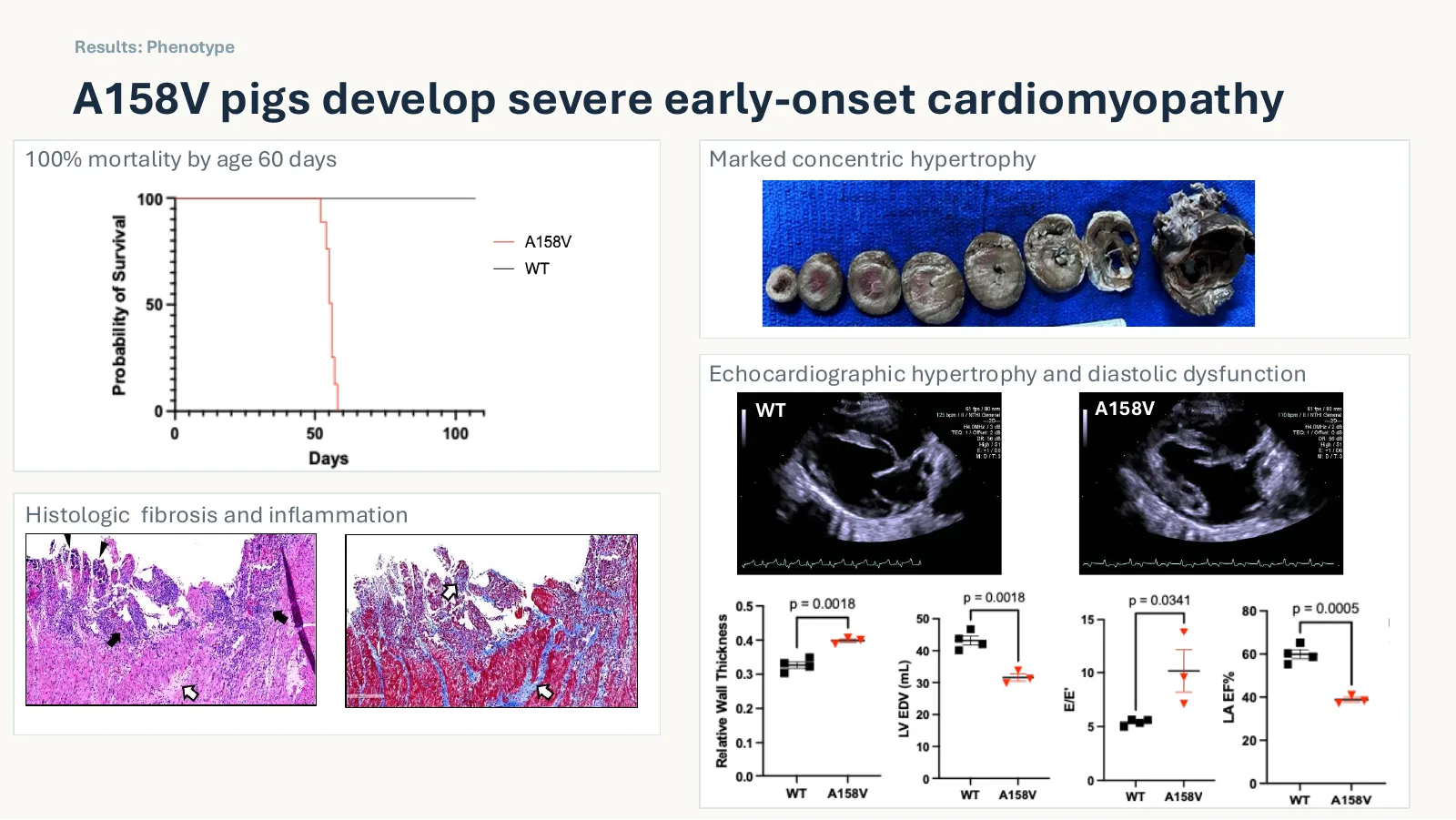
Slide 5: A158V pigs develop severe early-onset cardiomyopathy
Results: Phenotype A158V pigs develop severe early-onset cardiomyopathy 100% mortality by age 60 days Marked concentric hypertrophy Echocardiographic hypertrophy and diastolic dysfunction WT A158V Histologic fibrosis and inflammation
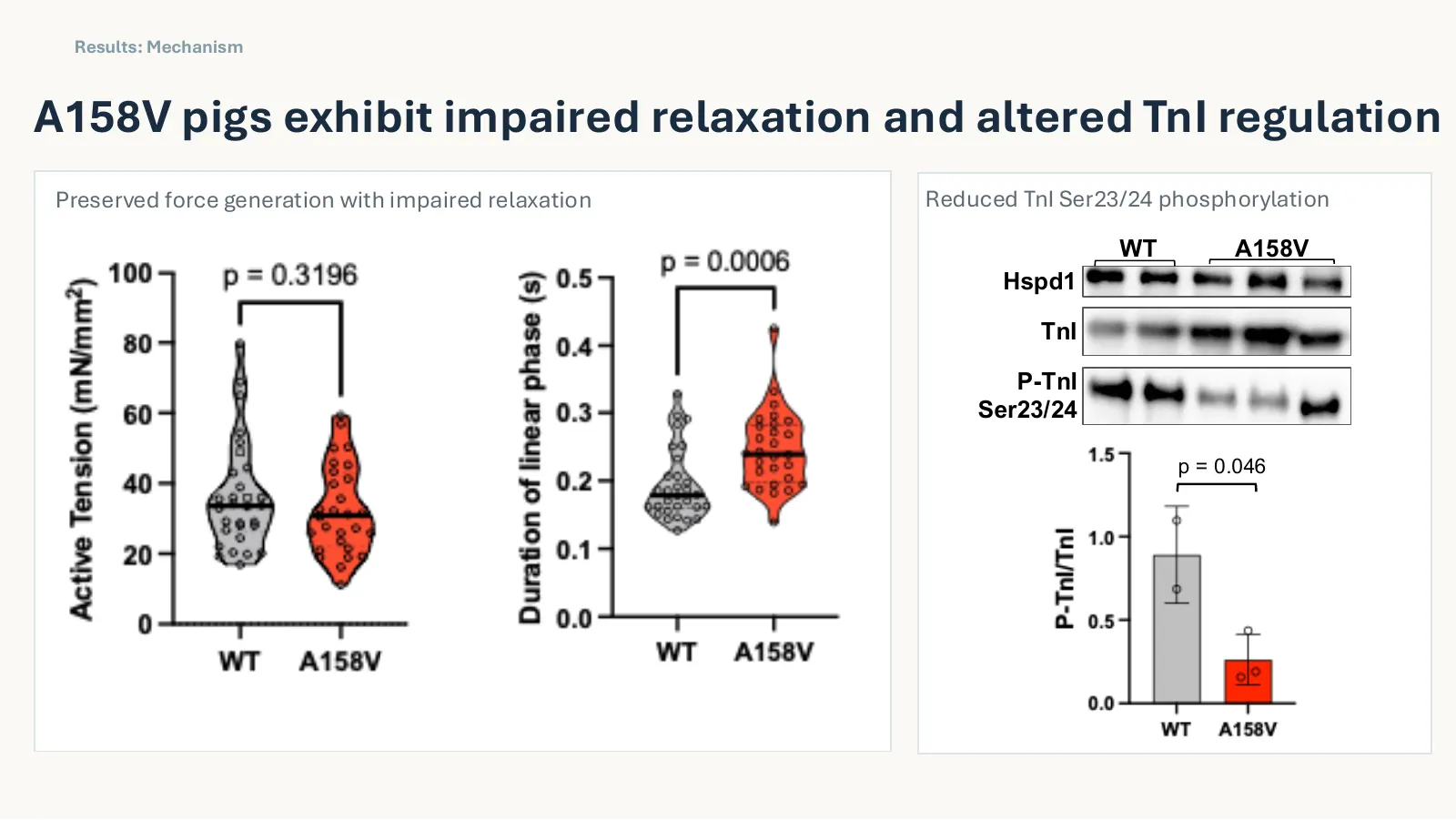
Slide 6: A158V pigs exhibit impaired relaxation and altered TnI regulation
Results: Mechanism A158V pigs exhibit impaired relaxation and altered TnI regulation Preserved force generation with impaired relaxation Reduced TnI Ser23/24 phosphorylation WT A158V Hspd1 TnI P-TnI Ser23/24 p = 0.046
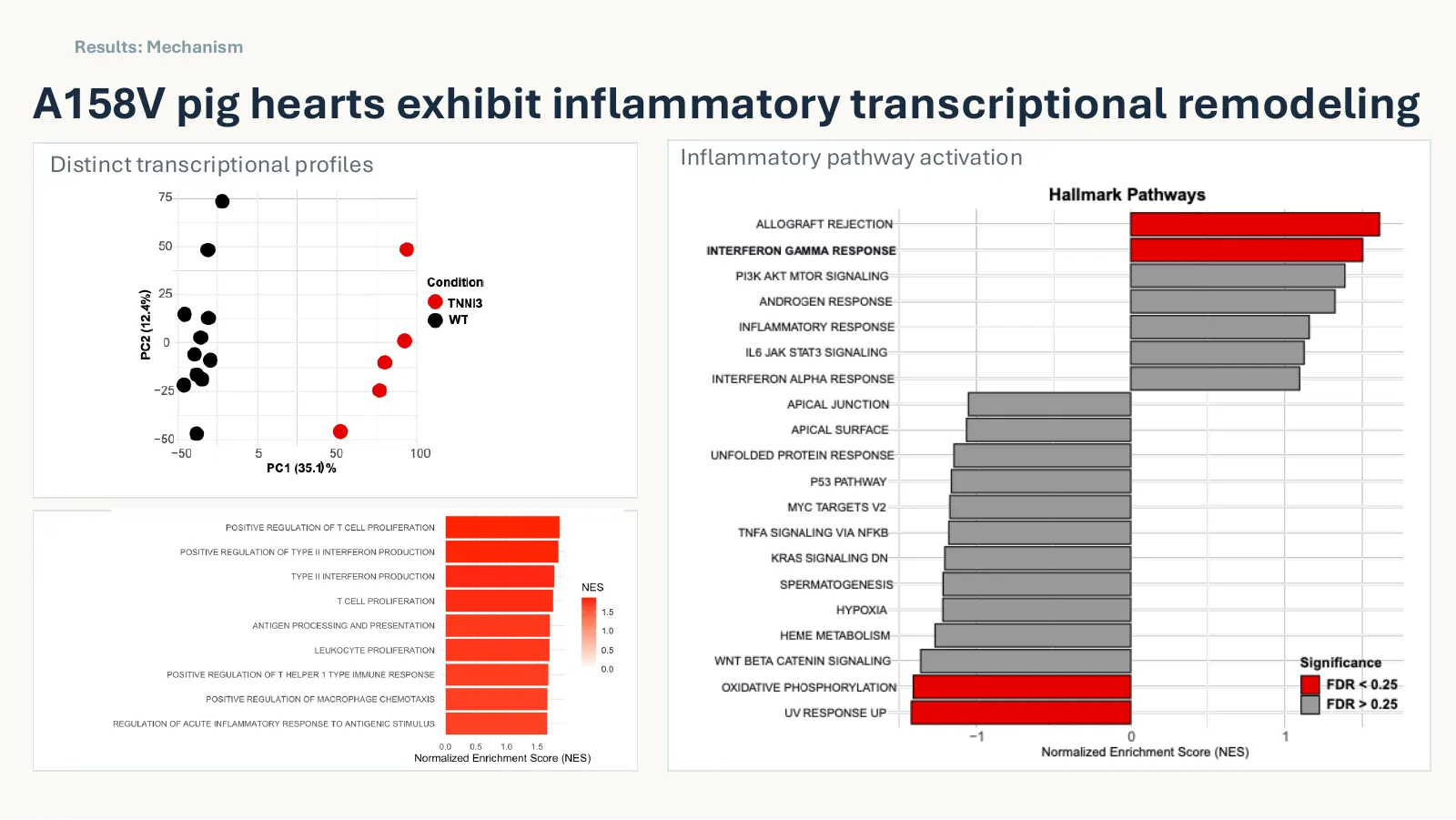
Slide 7: A158V pig hearts exhibit inflammatory transcriptional remodeling
Results: Mechanism A158V pig hearts exhibit inflammatory transcriptional remodeling Distinct transcriptional profiles Inflammatory pathway activation
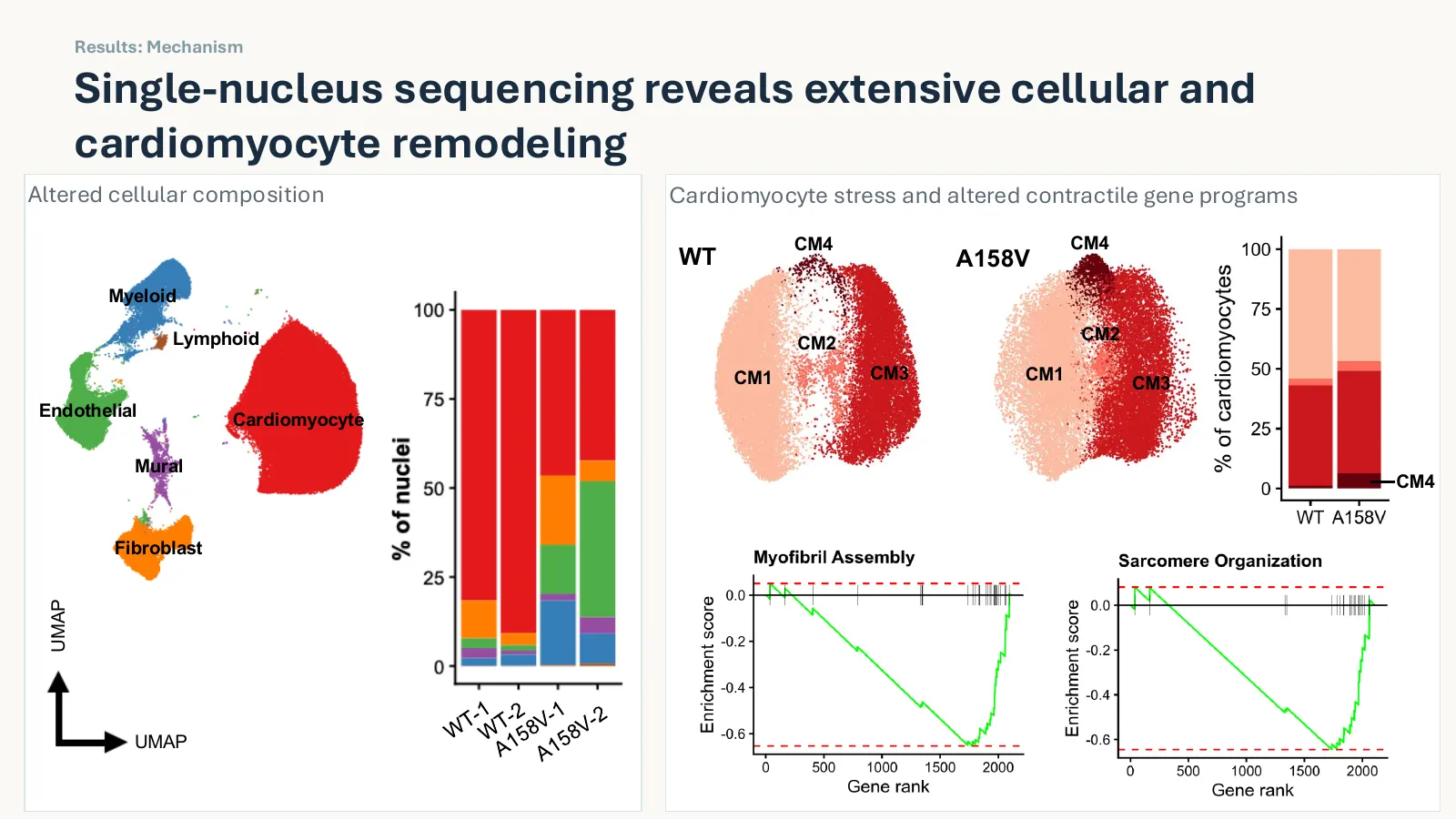
Slide 8: Single-nucleus sequencing reveals extensive cellular and cardiomyocyte remodeling
Results: Mechanism Single-nucleus sequencing reveals extensive cellular and cardiomyocyte remodeling Altered cellular composition Cardiomyocyte stress and altered contractile gene programs CM4 CM4 WT A158V Myeloid Lymphoid CM2 CM2 CM1 CM3 CM1 CM3 Endothelial Cardiomyocyte Mural CM4 Fibroblast UMAP U
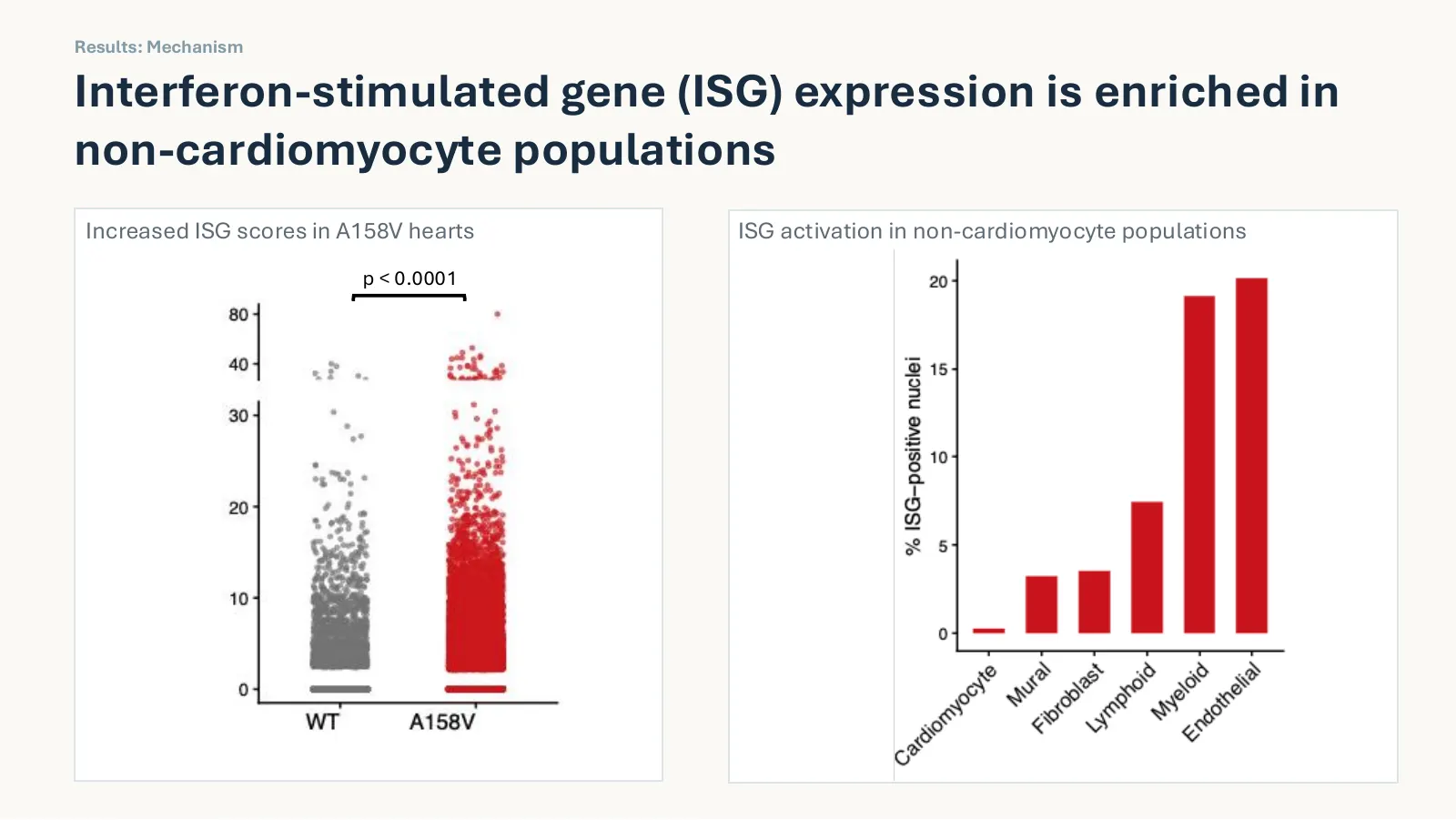
Slide 9: Interferon-stimulated gene (ISG) expression is enriched in non-cardiomyocyte populations
Results: Mechanism Interferon-stimulated gene (ISG) expression is enriched in non-cardiomyocyte populations Increased ISG scores in A158V hearts ISG activation in non-cardiomyocyte populations p < 0.0001
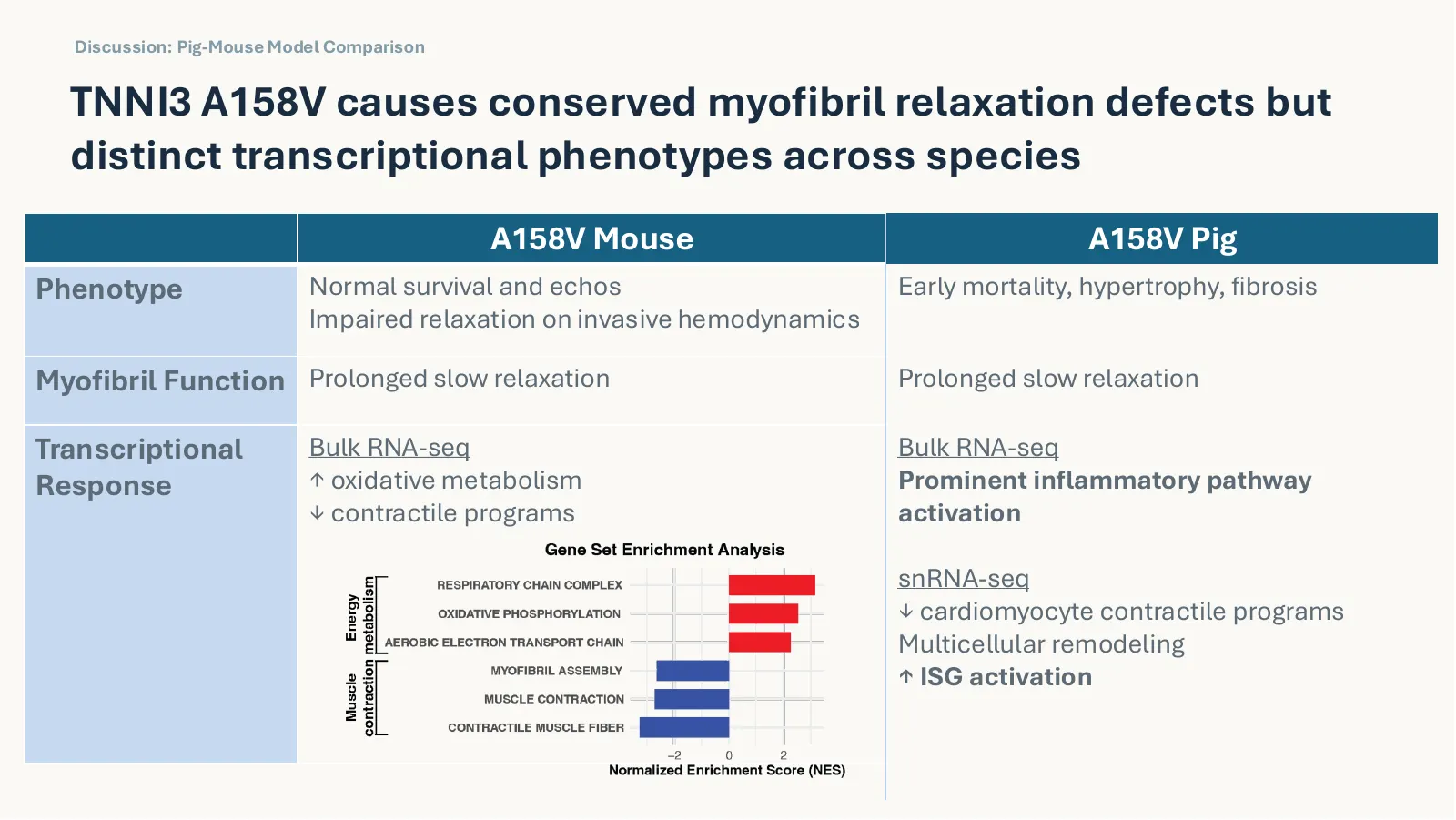
Slide 10: TNNI3 A158V causes conserved myofibril relaxation defects but distinct transcriptional phenotypes across species
Discussion: Pig-Mouse Model Comparison TNNI3 A158V causes conserved myofibril relaxation defects but distinct transcriptional phenotypes across species A158V Mouse A158V Pig Phenotype Normal survival and echos Early mortality, hypertrophy, fibrosis Impaired relaxation on invasive hemodynamics Myofib
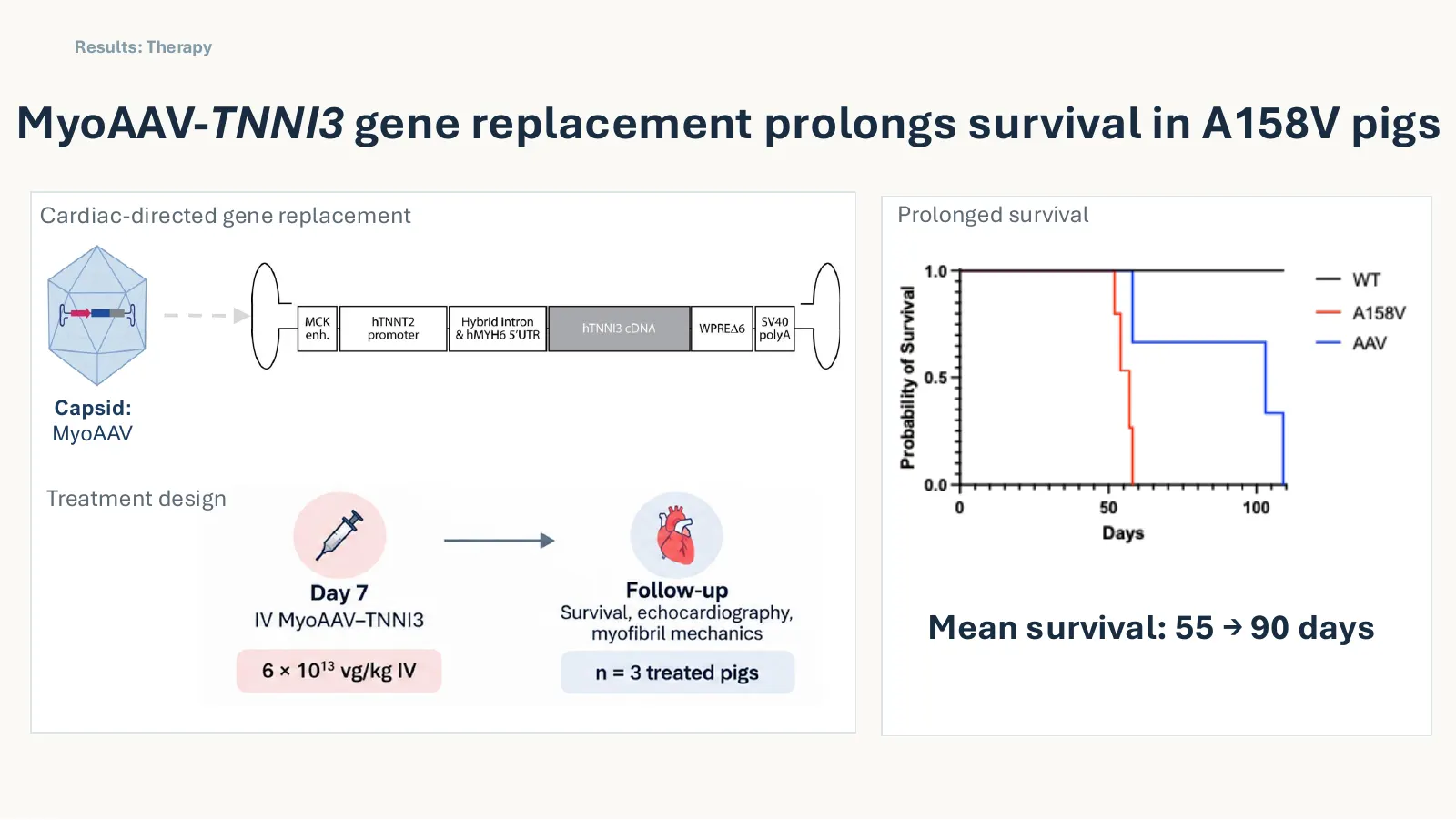
Slide 11: MyoAAV-TNNI3 gene replacement prolongs survival in A158V pigs
Results: Therapy MyoAAV-TNNI3 gene replacement prolongs survival in A158V pigs Cardiac-directed gene replacement Prolonged survival Capsid: MyoAAV Treatment design Mean survival: 55 → 90 days
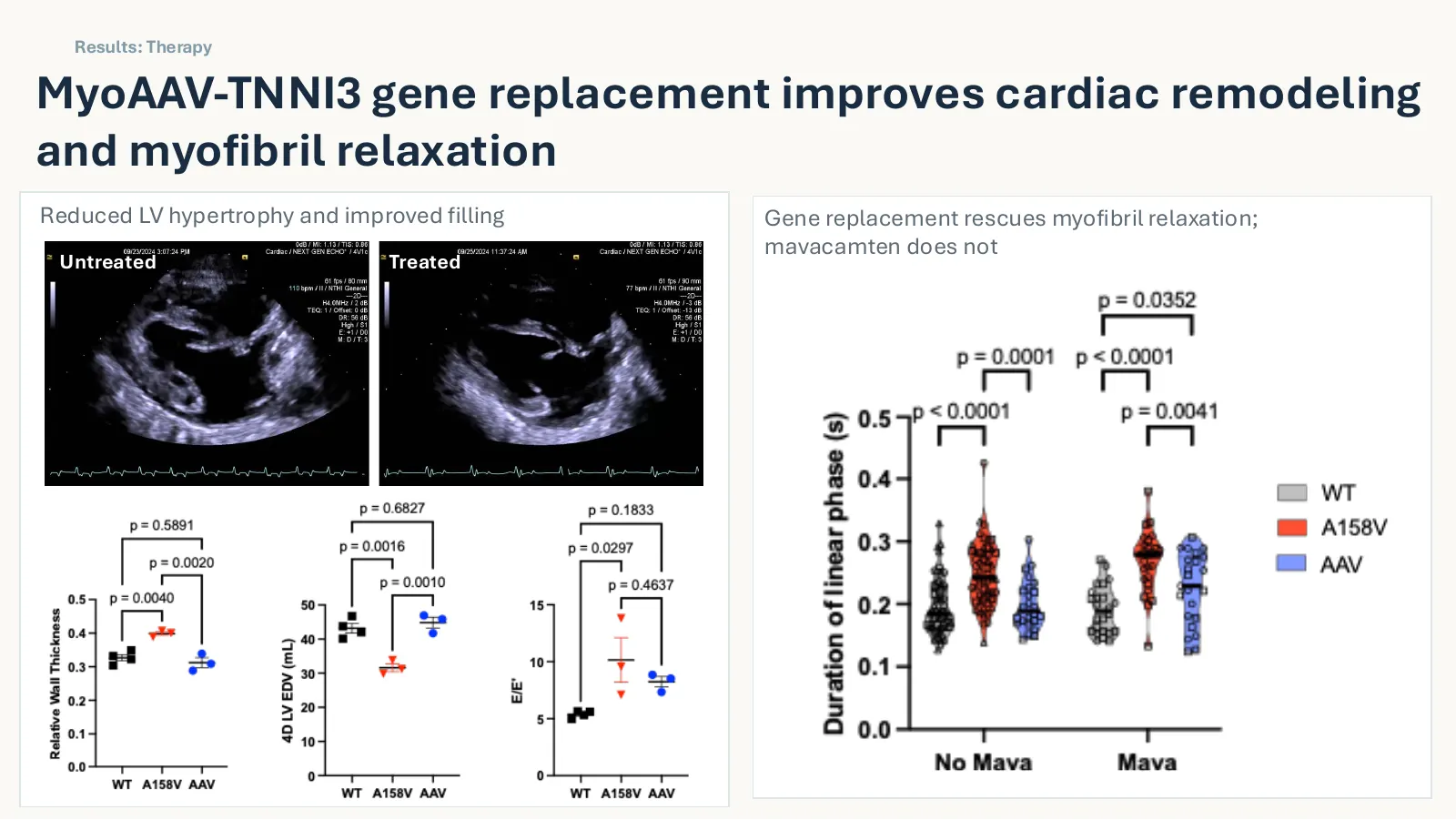
Slide 12: MyoAAV-TNNI3 gene replacement improves cardiac remodeling and myofibril relaxation
Results: Therapy MyoAAV-TNNI3 gene replacement improves cardiac remodeling and myofibril relaxation Reduced LV hypertrophy and improved filling Gene replacement rescues myofibril relaxation; mavacamten does not Untreated Treated
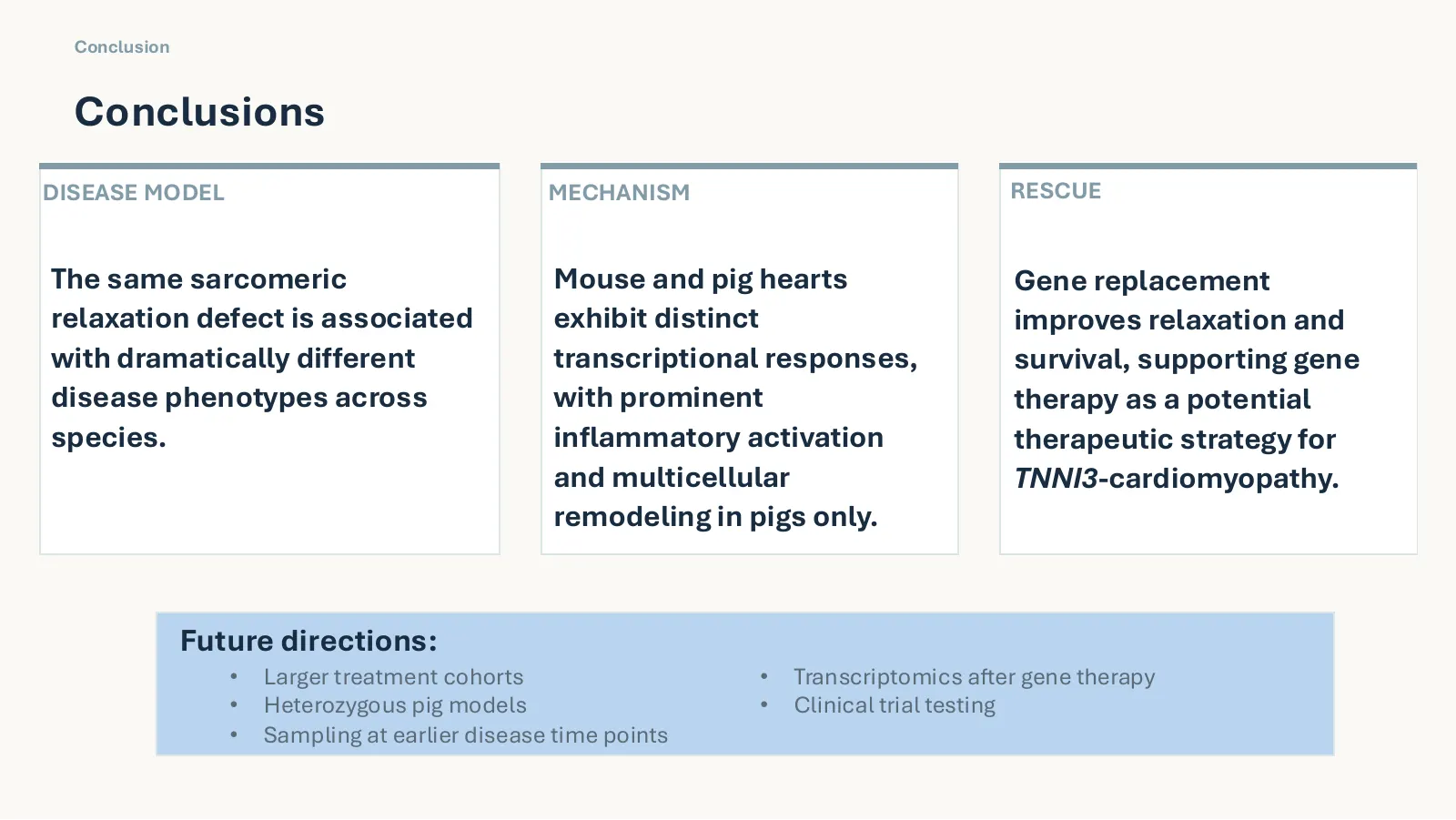
Slide 13: Conclusions
Conclusion Conclusions DISEASE MODEL MECHANISM RESCUE The same sarcomeric Mouse and pig hearts Gene replacement relaxation defect is associated exhibit distinct improves relaxation and with dramatically different transcriptional responses, survival, supporting gene disease phenotypes across with pro
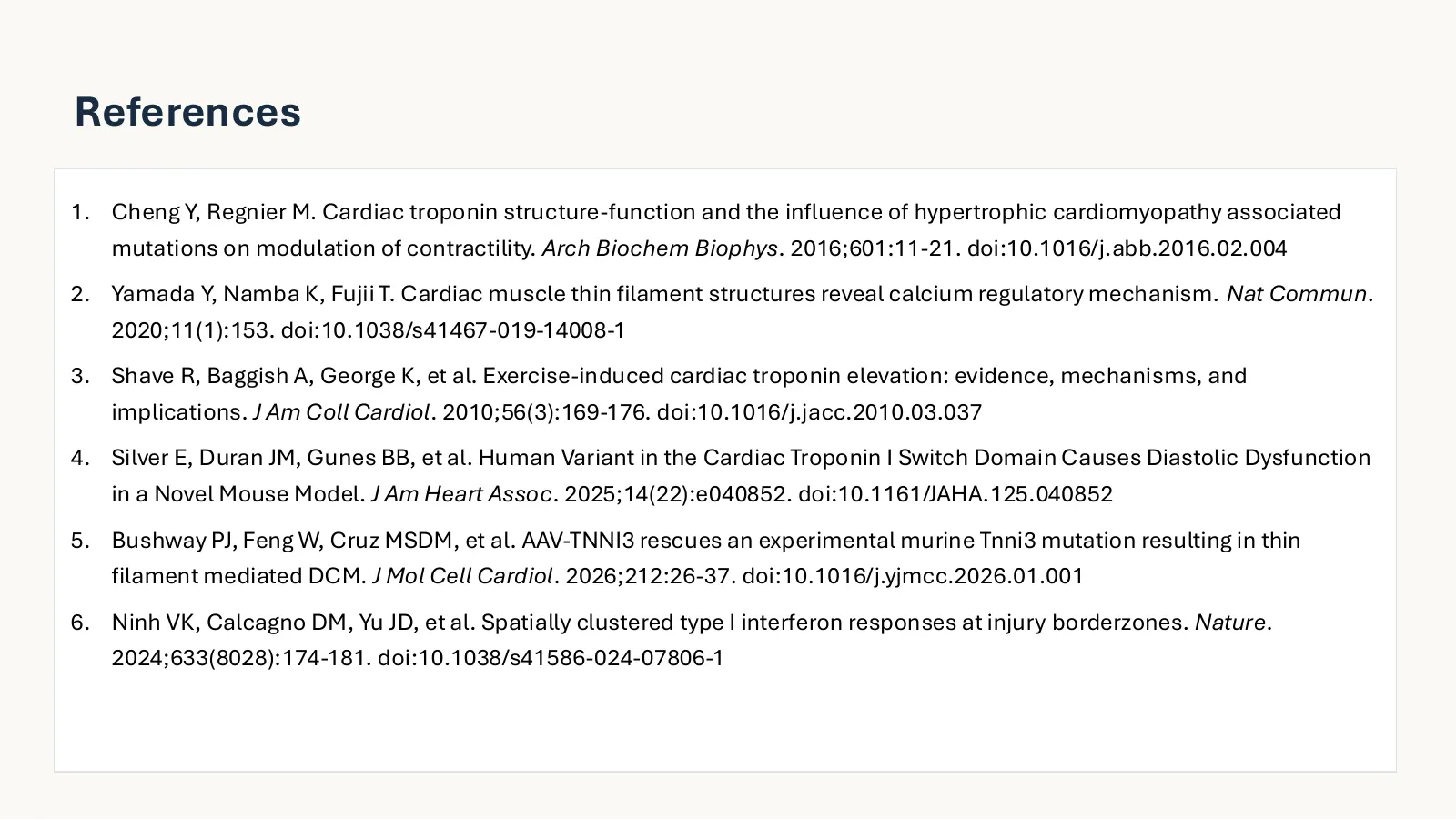
Slide 14: References
References 1. Cheng Y, Regnier M. Cardiac troponin structure-function and the influence of hypertrophic cardiomyopathy associated mutations on modulation of contractility. Arch Biochem Biophys. 2016;601:11-21. doi:10.1016/j.abb.2016.02.004 2. Yamada Y, Namba K, Fujii T. Cardiac muscle thin filament
Source: company website
More decks from Lexeo Therapeutics, Inc.
 Investor Presentation (November 2026)37 slides · Nov 16, 2026
 Technical Presentation (November 2026)21 slides · Nov 16, 2026
 International Congress for Ataxia Research 202614 slides · Nov 11, 2026
 Technical Presentation (November 2026)14 slides · Nov 7, 2026
 Corporate Update (September 2026)14 slides · Sep 22, 2026
 Investor Presentation (August 2026)35 slides · Aug 12, 2026