Bristol-Myers Squibb Company · NYSE:BMY
Bristol-Myers Squibb — Investor Day (September 2023)
155 slides from Bristol-Myers Squibb's investor day presentation, Sep 14, 2023

Slide 1: Research & Development Day
Research & Development Day September 14, 2023 Not for Product Promotional Use
Slide 2: Forward Looking Statements and Non-GAAP Financial Information
Forward Looking Statements and Non-GAAP Financial Information This presentation contains statements about Bristol-Myers Squibb Company’s (the “Company”) future financial results, plans, business development strategy, anticipated clinical trials, results and regulatory approvals that constitute forwa
Slide 3: Agenda for today
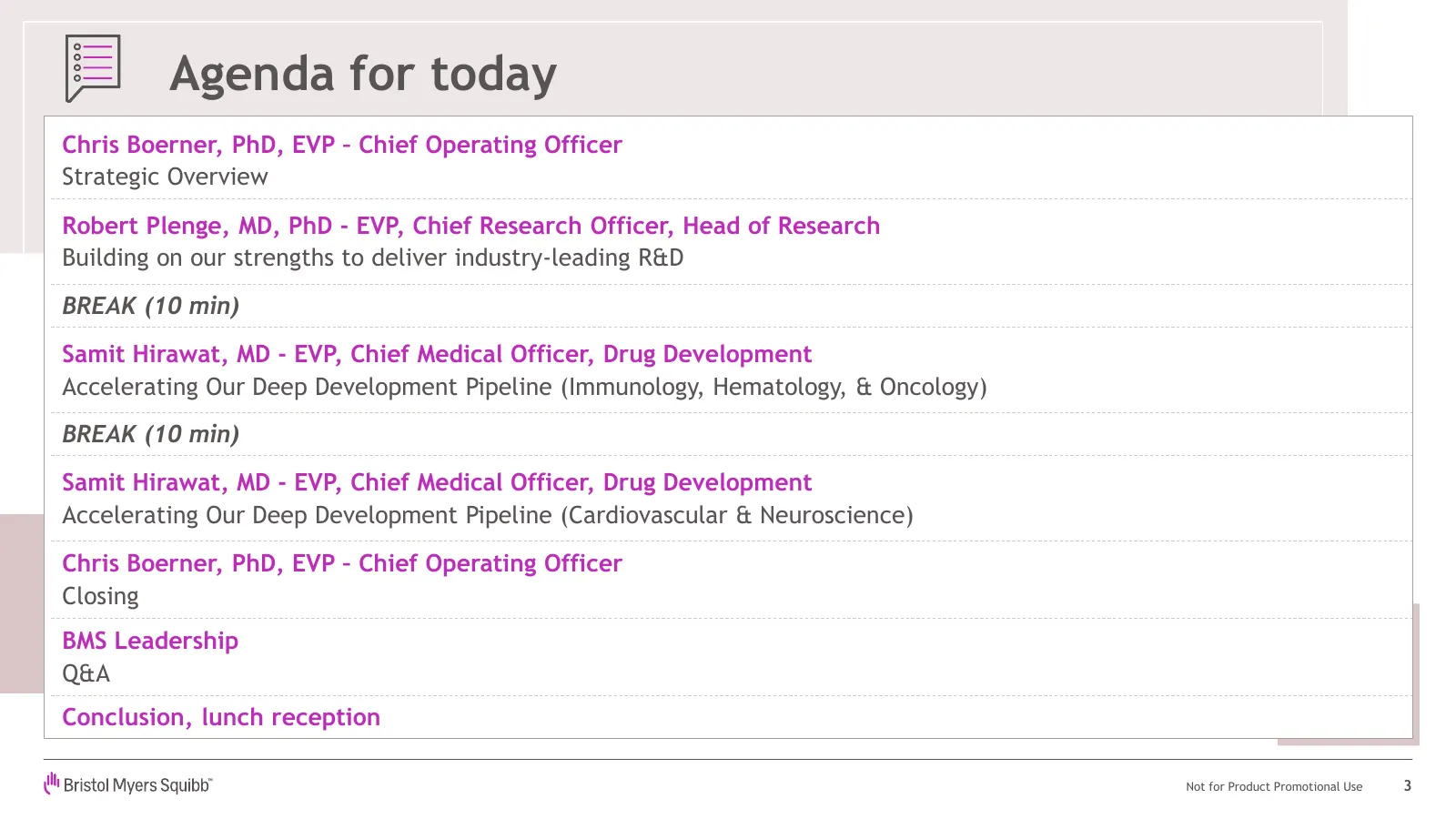
Agenda for today Chris Boerner, PhD, EVP – Chief Operating Officer Strategic Overview Robert Plenge, MD, PhD - EVP, Chief Research Officer, Head of Research Building on our strengths to deliver industry-leading R&D BREAK (10 min) Samit Hirawat, MD - EVP, Chief Medical Officer, Drug Development Accel
Slide 4: Strategic Overview
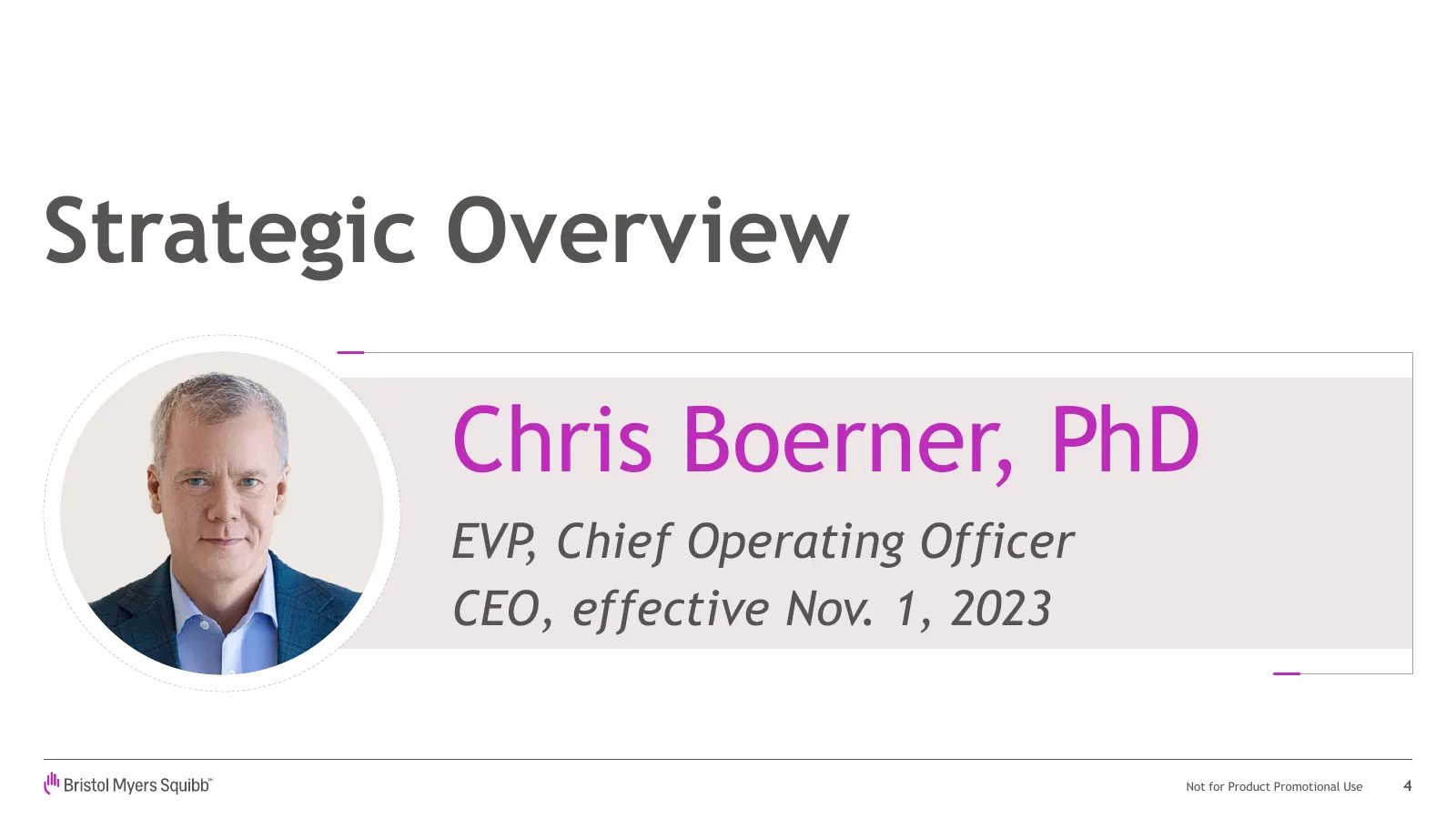
Strategic Overview Chris Boerner, PhD EVP, Chief Operating Officer CEO, effective Nov. 1, 2023 Not for Product Promotional Use 4
Slide 5: Our business has significant opportunities beyond external expectations
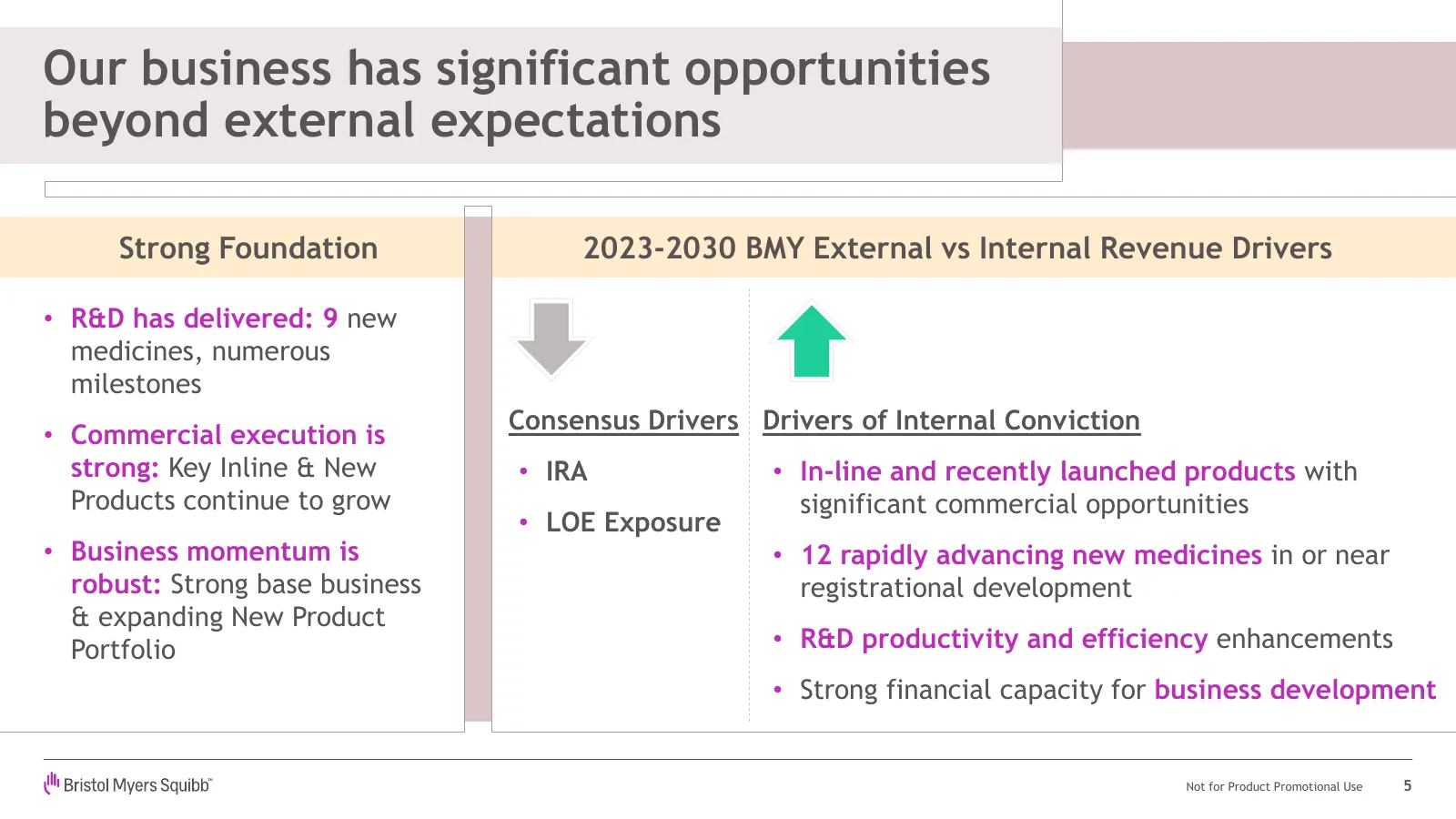
Our business has significant opportunities beyond external expectations Strong Foundation 2023-2030 BMY External vs Internal Revenue Drivers • R&D has delivered: 9 new medicines, numerous milestones Consensus Drivers Drivers of Internal Conviction • Commercial execution is strong: Key Inline & New •
Slide 6: Numerous levers to drive long-term growth
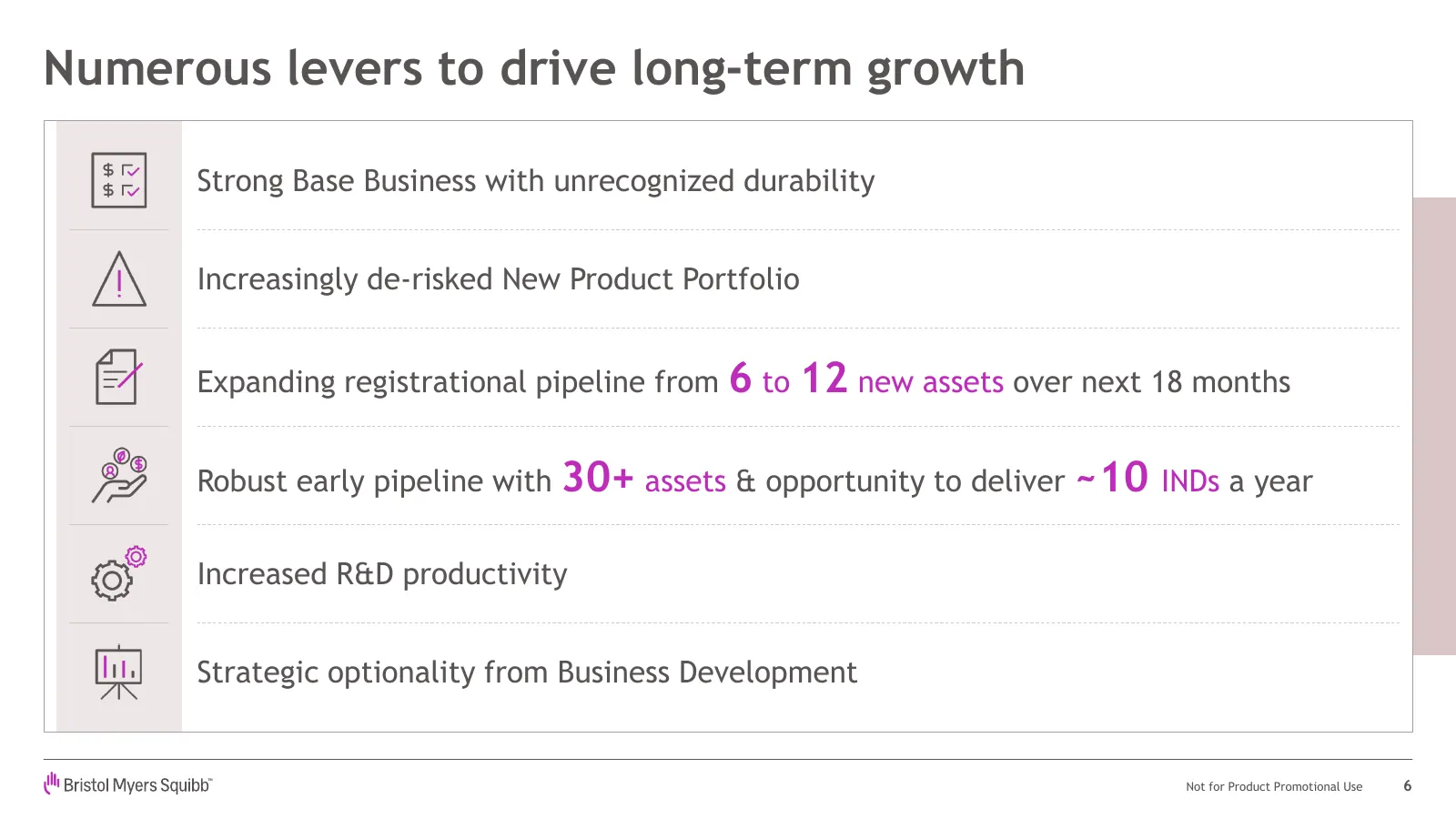
Numerous levers to drive long-term growth Strong Base Business with unrecognized durability Increasingly de-risked New Product Portfolio Expanding registrational pipeline from 6 to 12 new assets over next 18 months Robust early pipeline with 30+ assets & opportunity to deliver ~10 INDs a year Increa
Slide 7: Our goal is to deliver sustainable growth
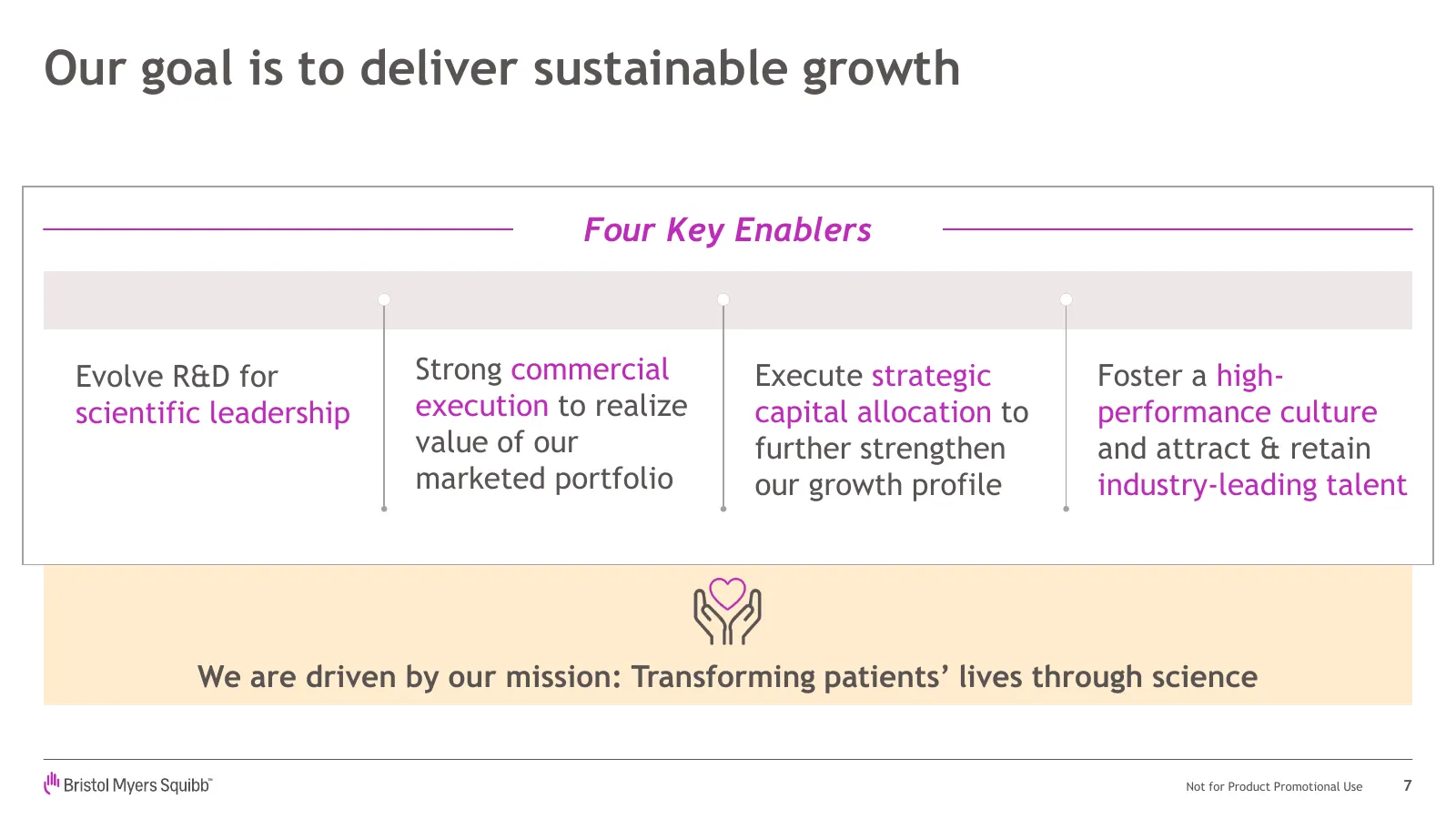
Our goal is to deliver sustainable growth Four Key Enablers Evolve R&D for Strong commercial Execute strategic Foster a high- scientific leadership execution to realize capital allocation to performance culture value of our further strengthen and attract & retain marketed portfolio our growth profil
Slide 8: Focus for today
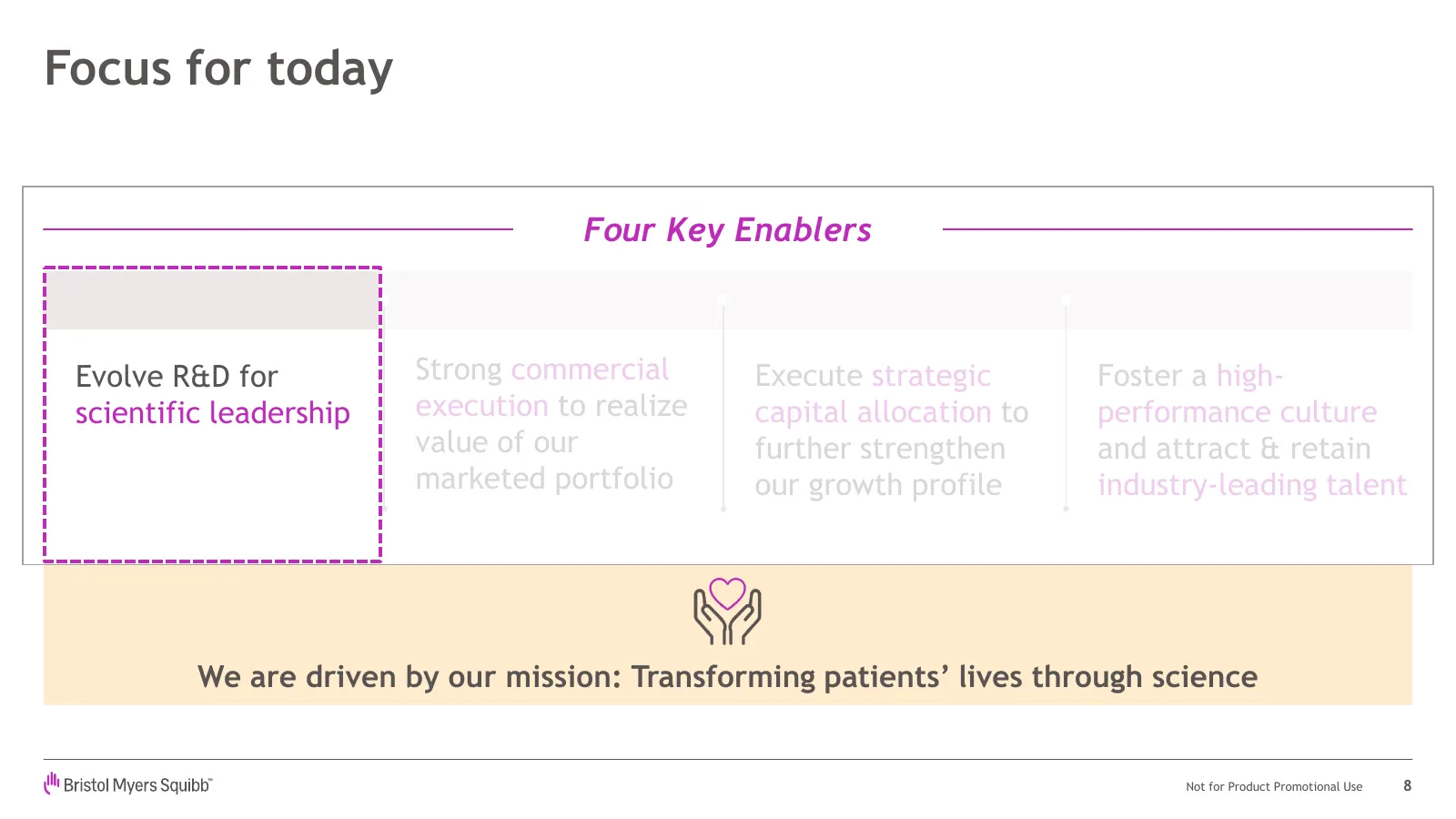
Focus for today Four Key Enablers Evolve R&D for Strong commercial Execute strategic Foster a high- scientific leadership execution to realize capital allocation to performance culture value of our further strengthen and attract & retain marketed portfolio our growth profile industry-leading talent
Slide 9: Evolving BMS R&D: World-class organization with increased focus on productivity
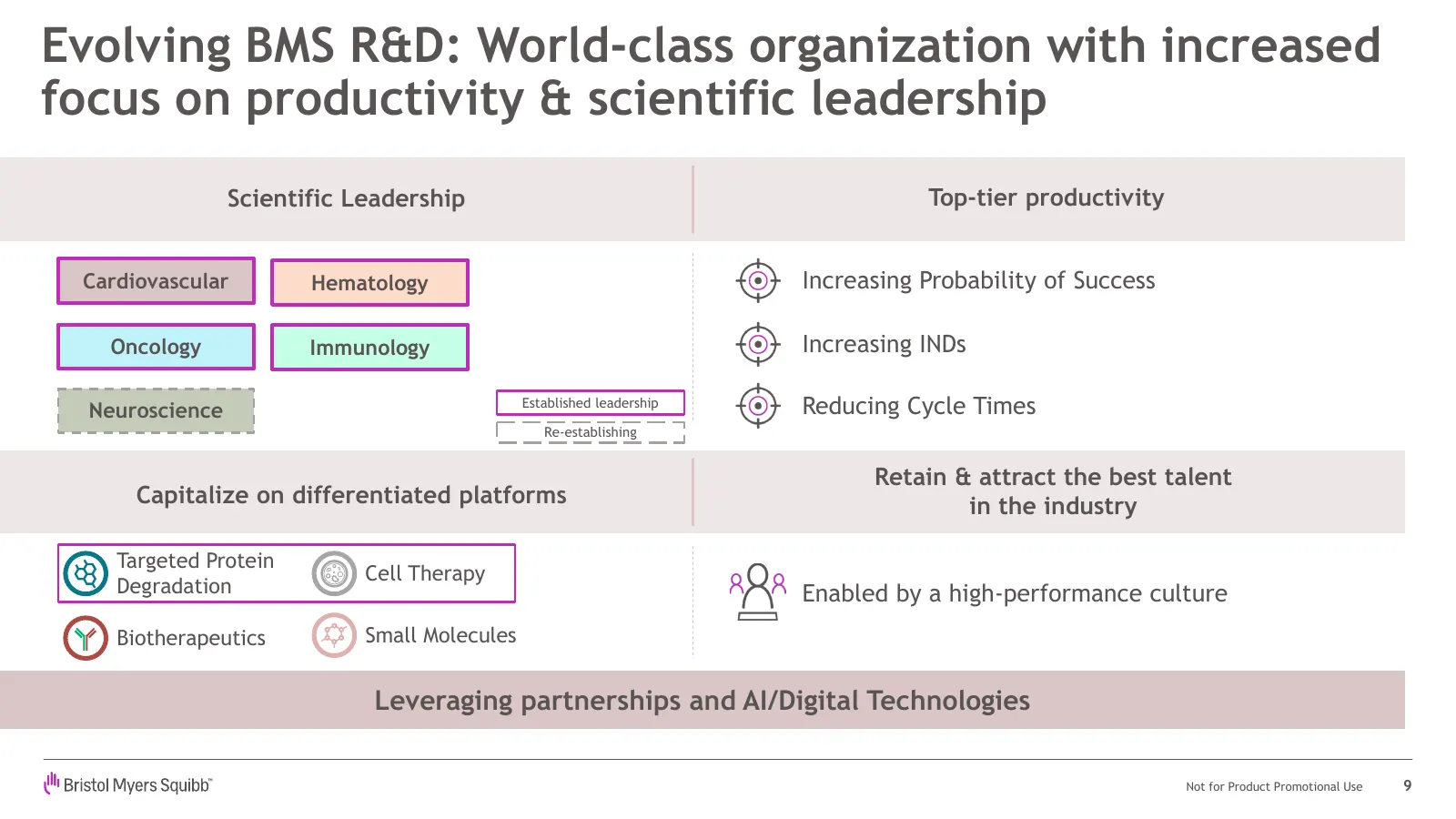
Evolving BMS R&D: World-class organization with increased focus on productivity & scientific leadership Scientific Leadership Top-tier productivity Cardiovascular Hematology Increasing Probability of Success Oncology Immunology Increasing INDs Neuroscience Established leadership Reducing Cycle Times
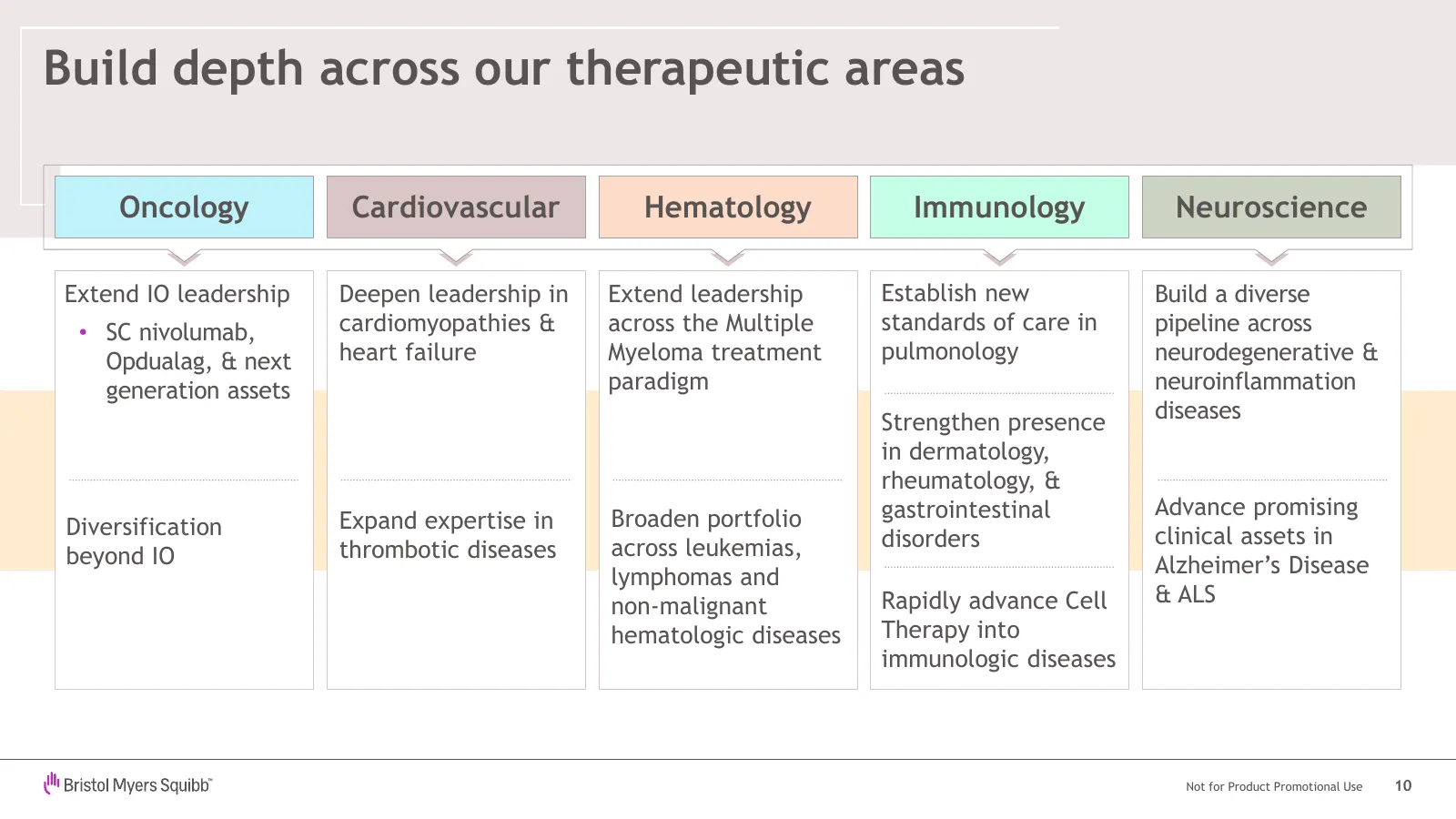
Slide 10: Build depth across our therapeutic areas
Build depth across our therapeutic areas Oncology Cardiovascular Hematology Immunology Neuroscience Extend IO leadership Deepen leadership in Extend leadership Establish new Build a diverse • SC nivolumab, cardiomyopathies & across the Multiple standards of care in pipeline across Opdualag, & next h
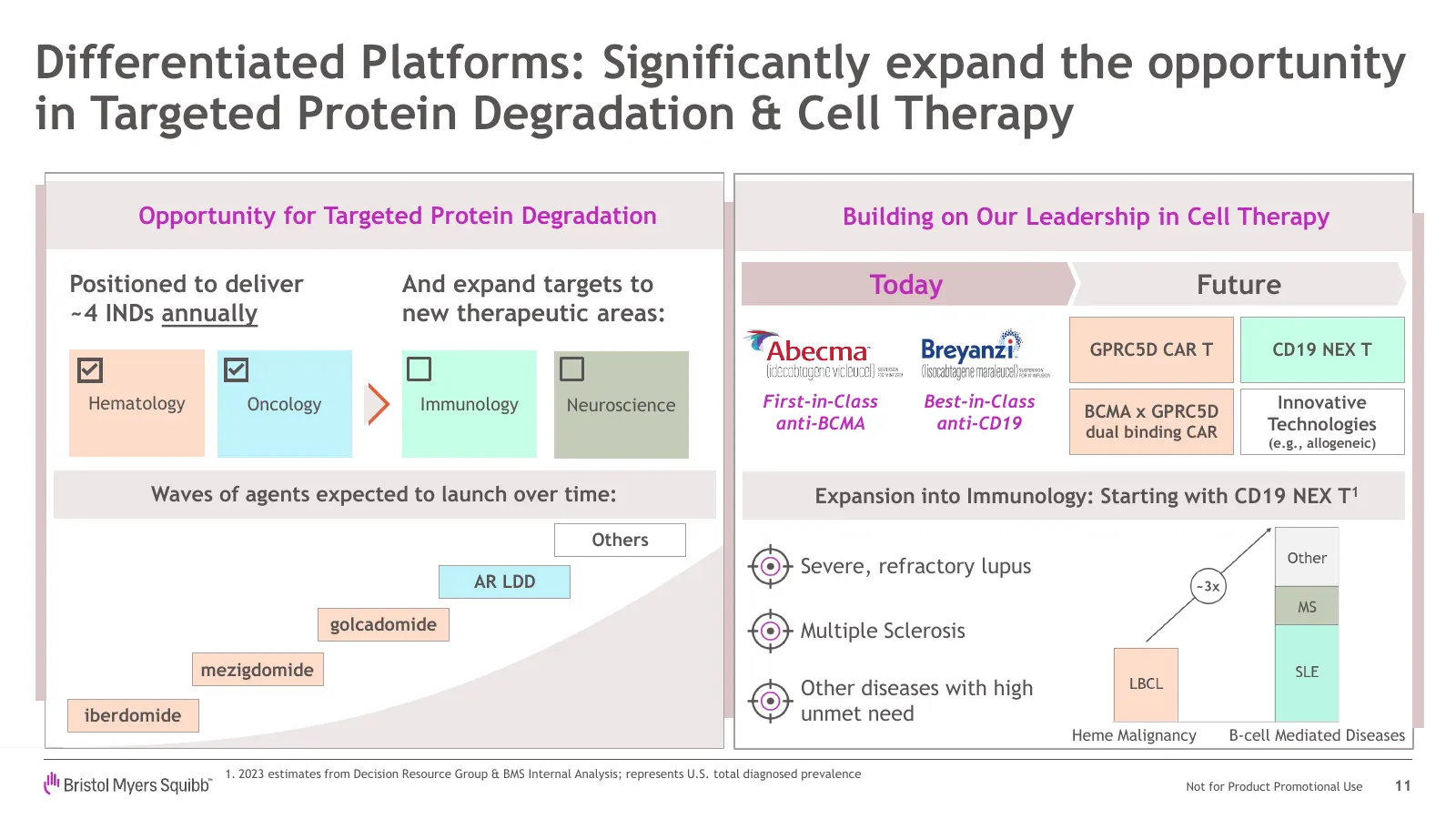
Slide 11: Differentiated Platforms: Targeted Protein Degradation & Cell Therapy
Differentiated Platforms: Significantly expand the opportunity in Targeted Protein Degradation & Cell Therapy Opportunity for Targeted Protein Degradation Building on Our Leadership in Cell Therapy Positioned to deliver And expand targets to Today Future ~4 INDs annually new therapeutic areas: GPRC5
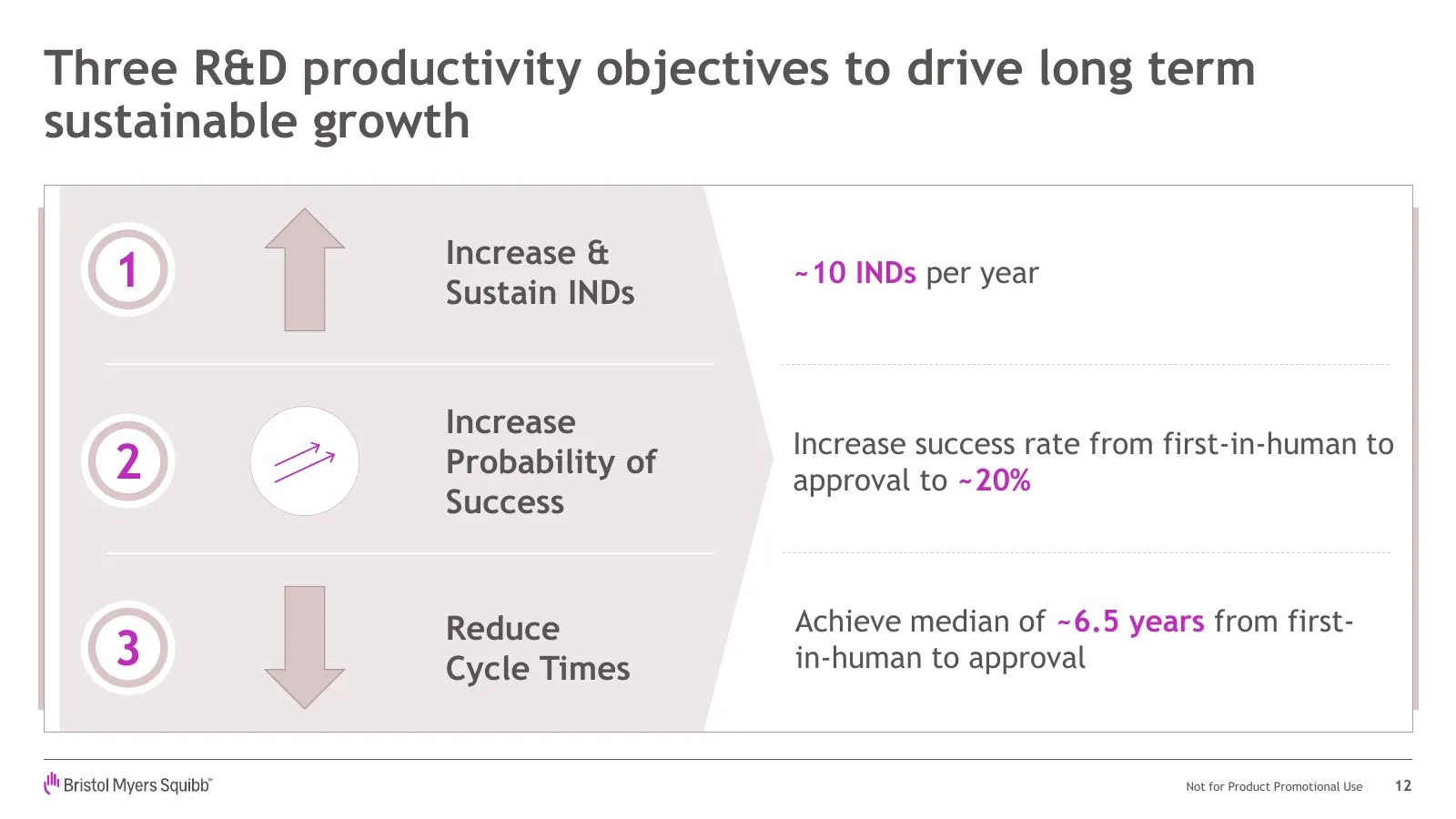
Slide 12: Three R&D productivity objectives to drive long term sustainable growth
Three R&D productivity objectives to drive long term sustainable growth Increase & 1 Sustain INDs ~10 INDs per year Increase Increase success rate from first-in-human to 2 Probability of approval to ~20% Success Reduce Achieve median of ~6.5 years from first- 3 Cycle Times in-human to approval Not f
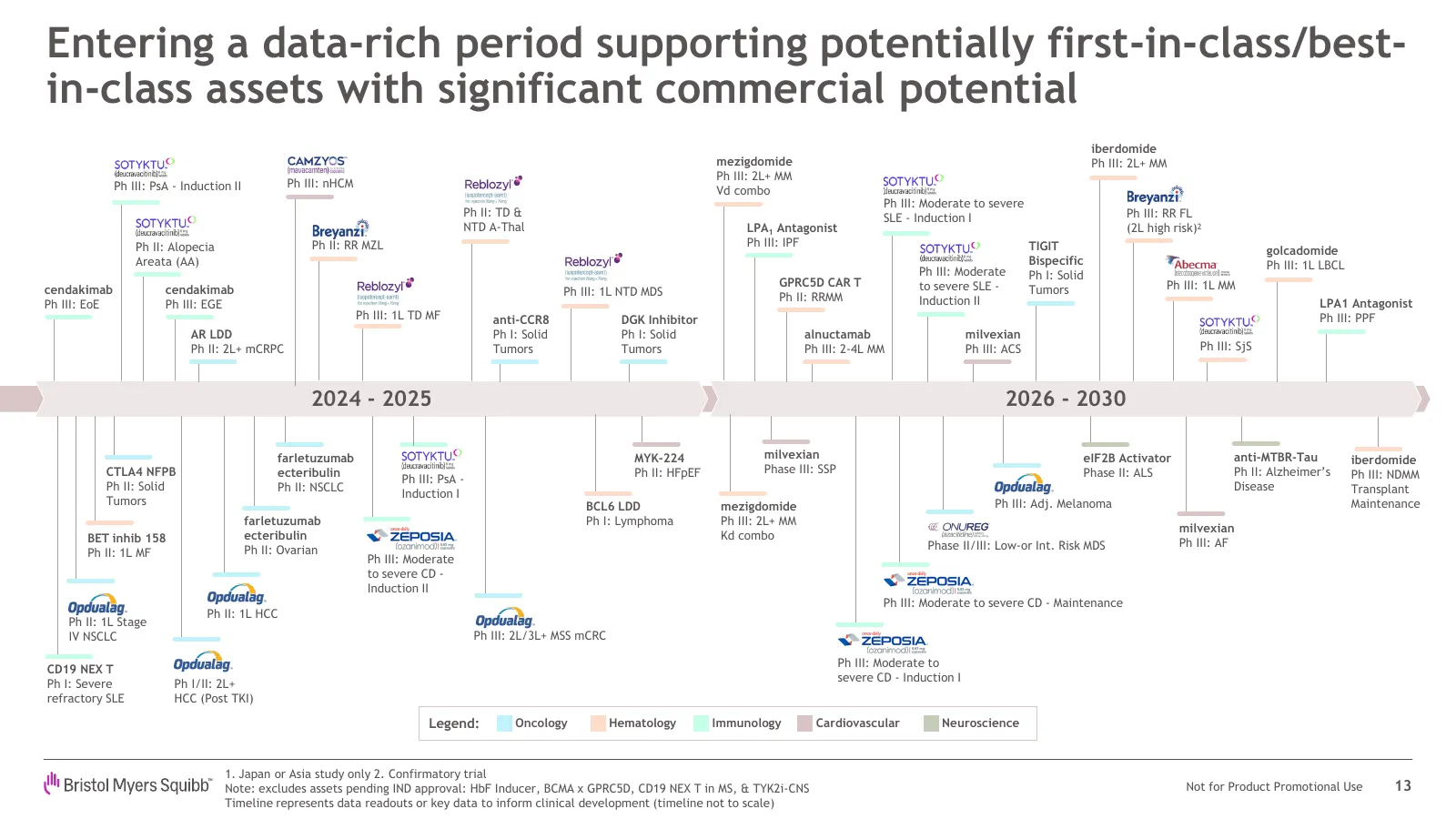
Slide 13: Entering a data-rich period supporting potentially first-in-class/best-in-class assets
Entering a data-rich period supporting potentially first-in-class/best- in-class assets with significant commercial potential iberdomide mezigdomide Ph III: 2L+ MM Ph III: 2L+ MM Ph III: PsA - Induction II Ph III: nHCM Vd combo Ph III: Moderate to severe Ph II: TD & SLE - Induction I Ph III: RR FL N
Slide 14: What you will hear today
What you will hear today We are focused on transforming our approach to R&D with an emphasis on: • Strengthening scientific leadership in our TAs and platforms • Significantly improving the efficiency and productivity of our R&D engine • Building a culture of innovation that attracts and retains the
Slide 15: Building on our strengths to deliver industry-leading R&D
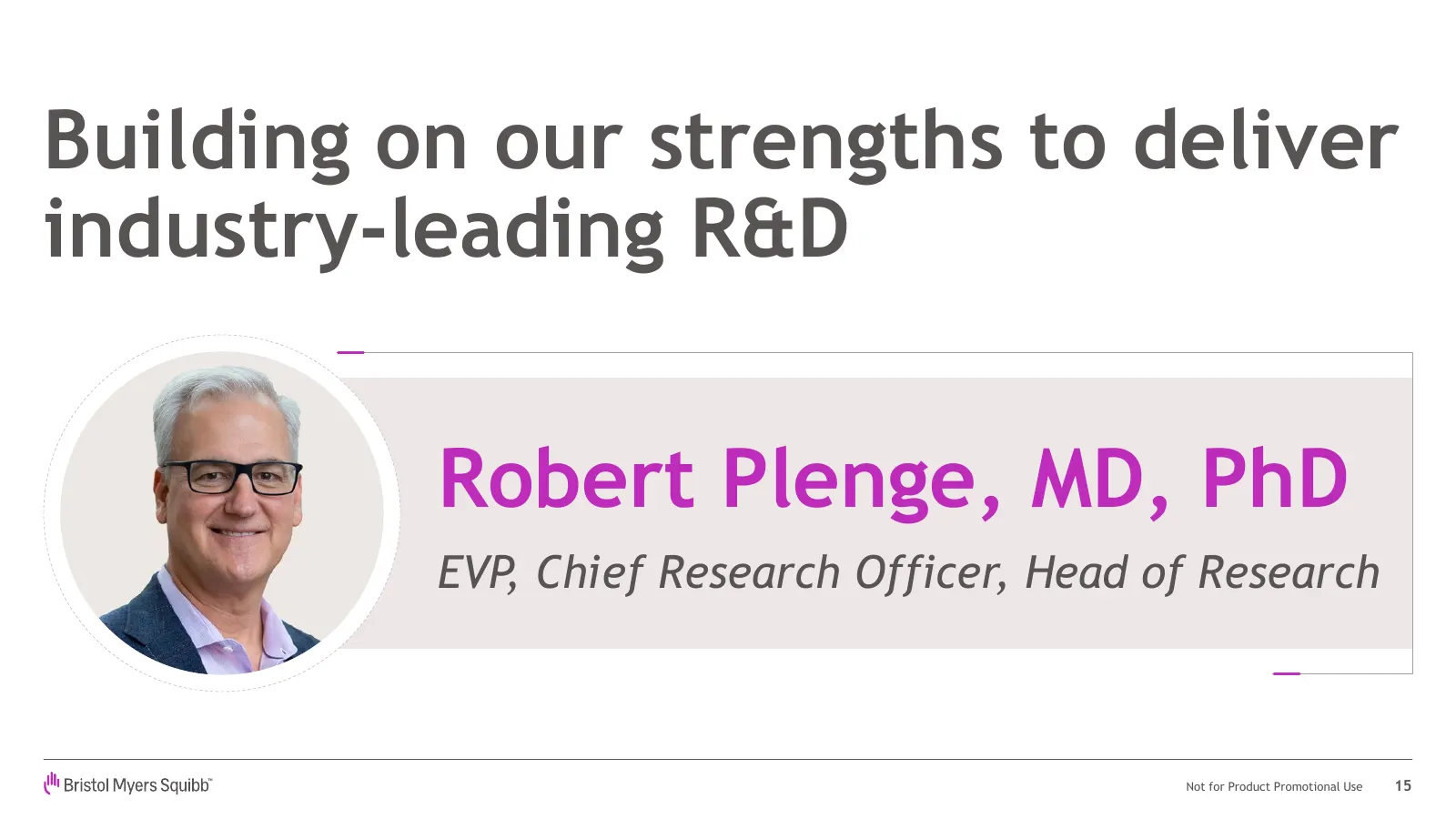
Building on our strengths to deliver industry-leading R&D Robert Plenge, MD, PhD EVP, Chief Research Officer, Head of Research Not for Product Promotional Use 15
Slide 16: An integrated approach to research & development
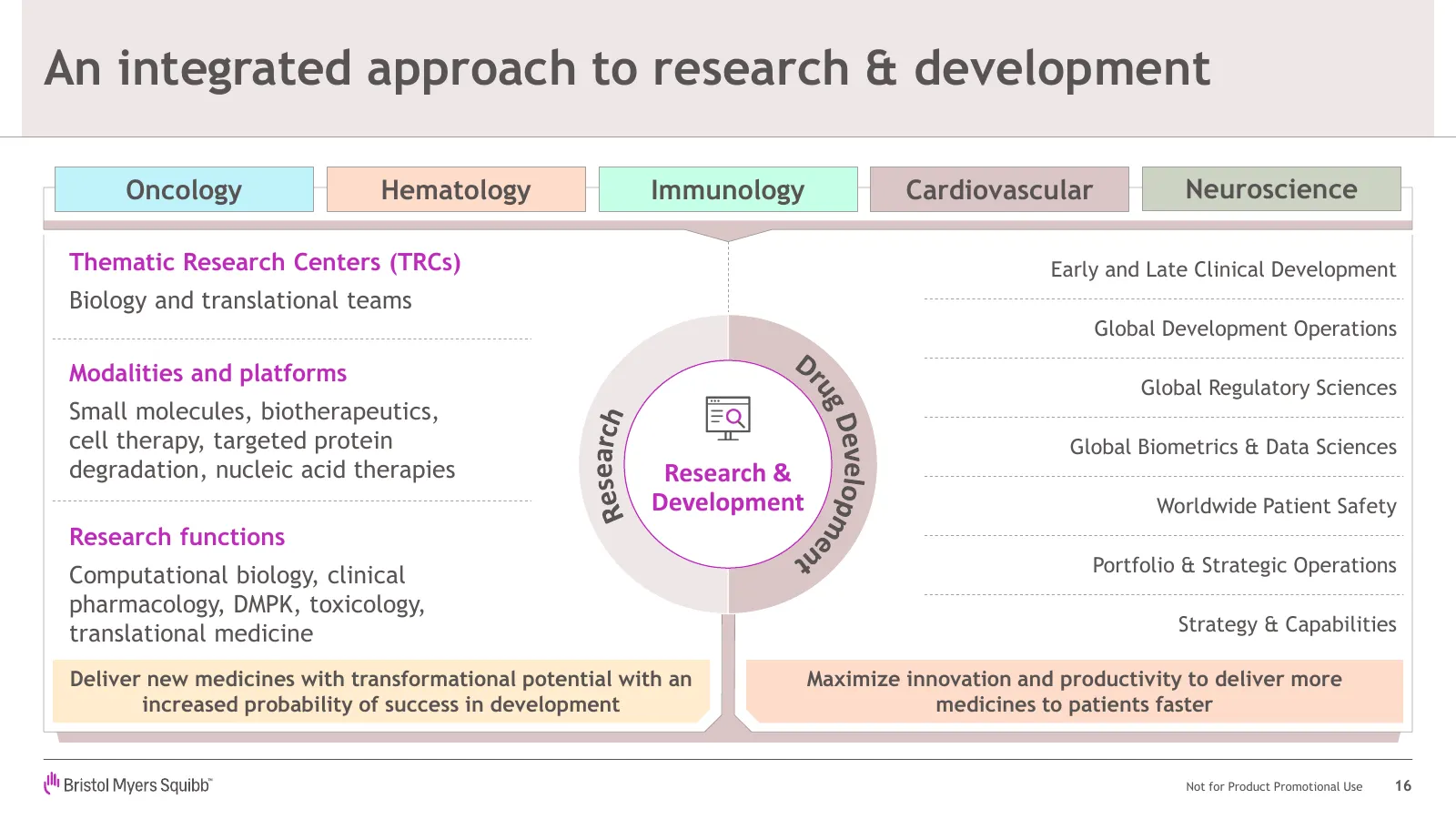
An integrated approach to research & development Oncology Hematology Immunology Cardiovascular Neuroscience Thematic Research Centers (TRCs) Early and Late Clinical Development Biology and translational teams Global Development Operations Modalities and platforms Global Regulatory Sciences Small mol
Slide 17: Three key Research principles to improve R&D productivity
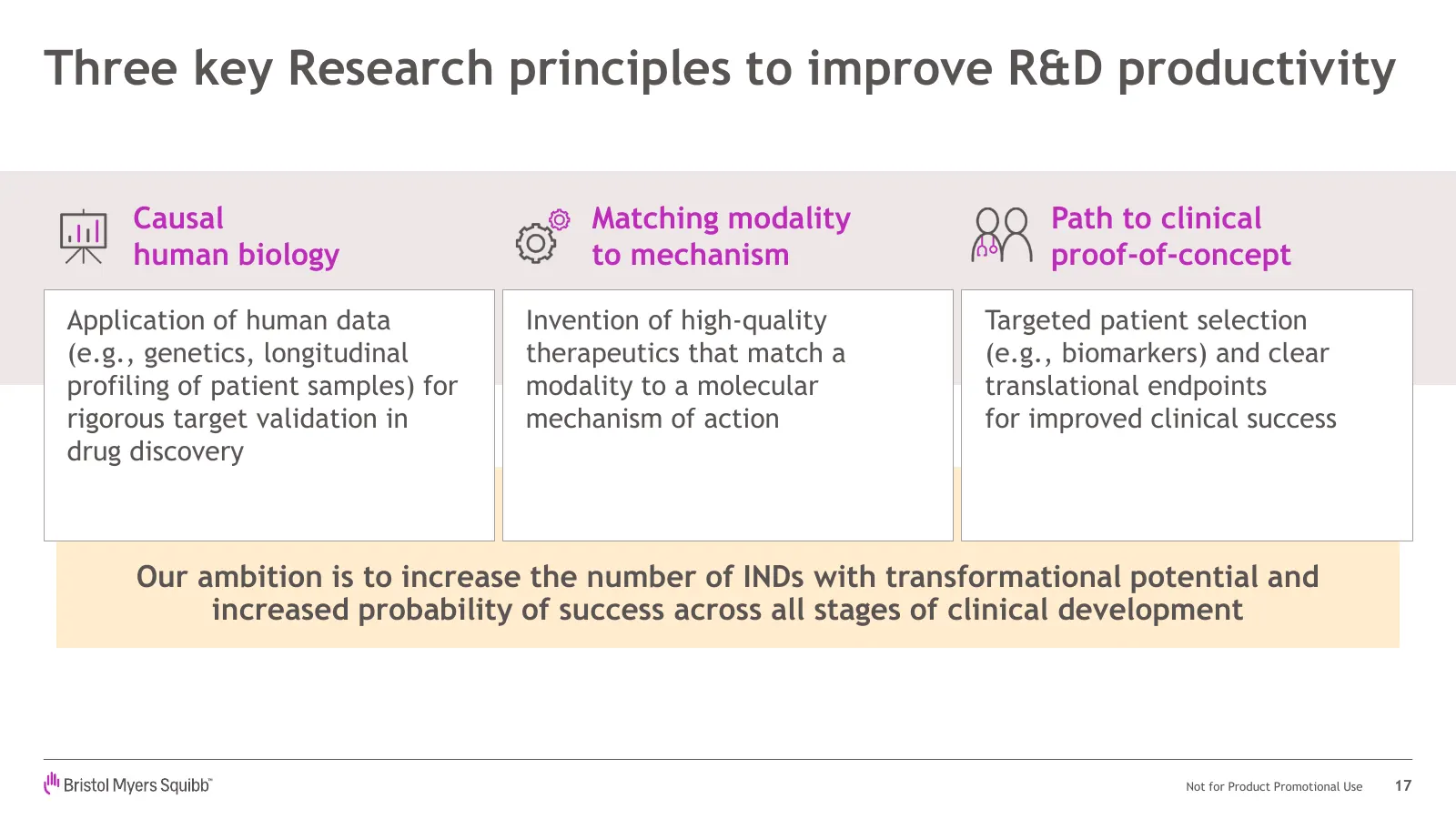
Three key Research principles to improve R&D productivity Causal Matching modality Path to clinical human biology to mechanism proof-of-concept Application of human data Invention of high-quality Targeted patient selection (e.g., genetics, longitudinal therapeutics that match a (e.g., biomarkers) an
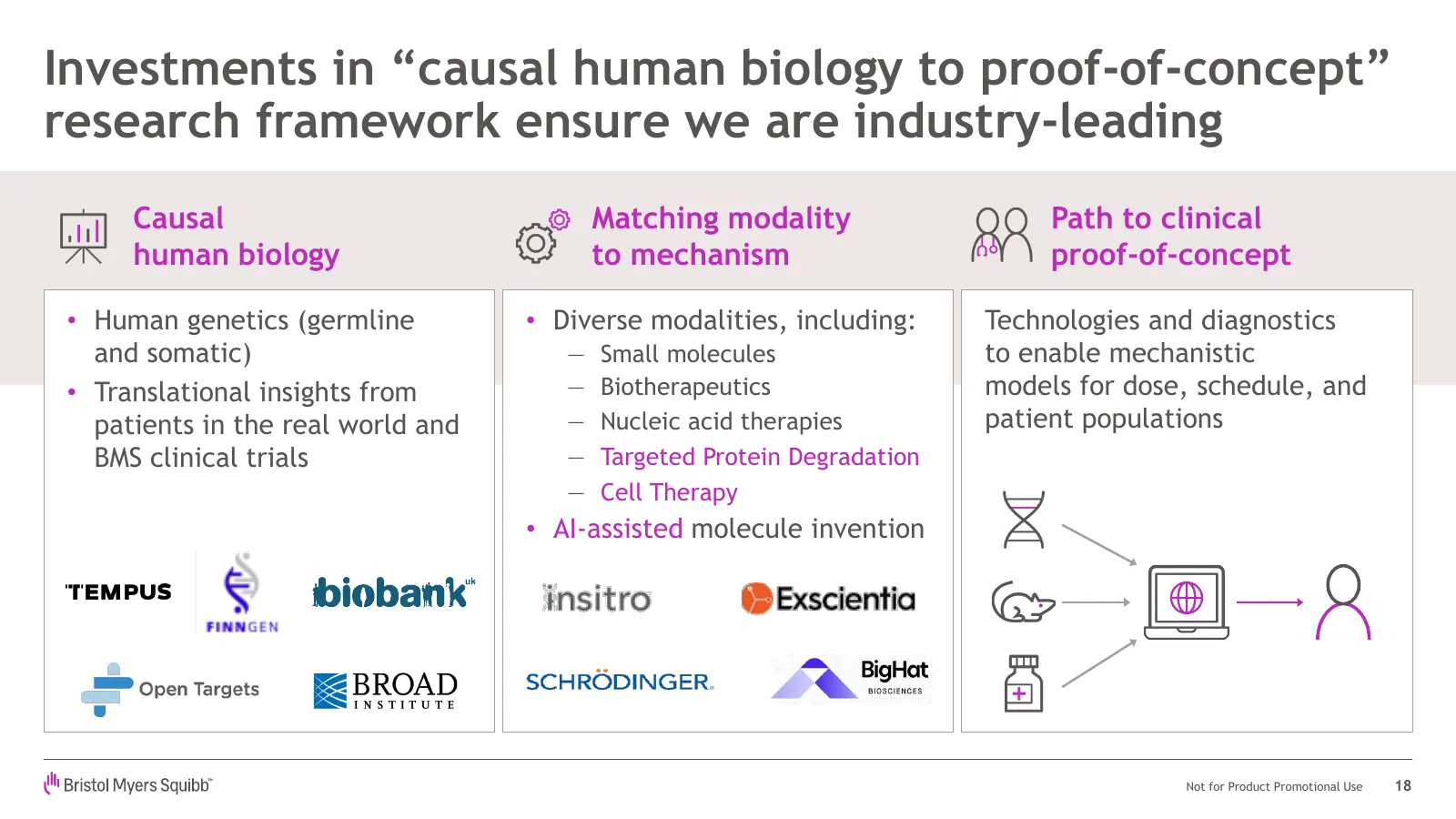
Slide 18: Investments in causal human biology to proof-of-concept research framework
Investments in “causal human biology to proof-of-concept” research framework ensure we are industry-leading Causal Matching modality Path to clinical human biology to mechanism proof-of-concept • Human genetics (germline • Diverse modalities, including: Technologies and diagnostics and somatic) — Sm
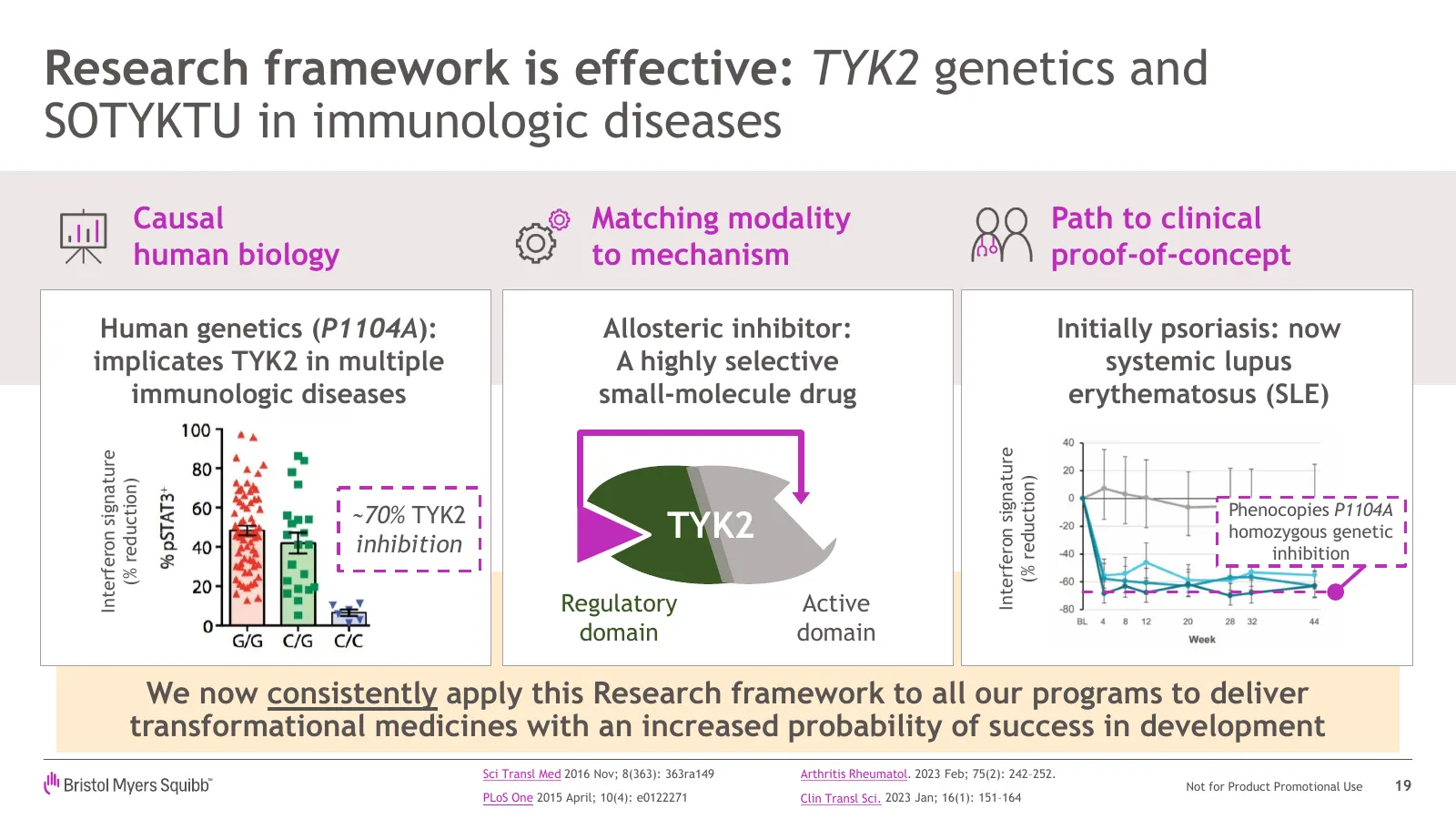
Slide 19: Research framework is effective: TYK2 genetics and SOTYKTU
Research framework is effective: TYK2 genetics and SOTYKTU in immunologic diseases Causal Matching modality Path to clinical human biology to mechanism proof-of-concept Human genetics (P1104A): Allosteric inhibitor: Initially psoriasis: now implicates TYK2 in multiple A highly selective systemic lup
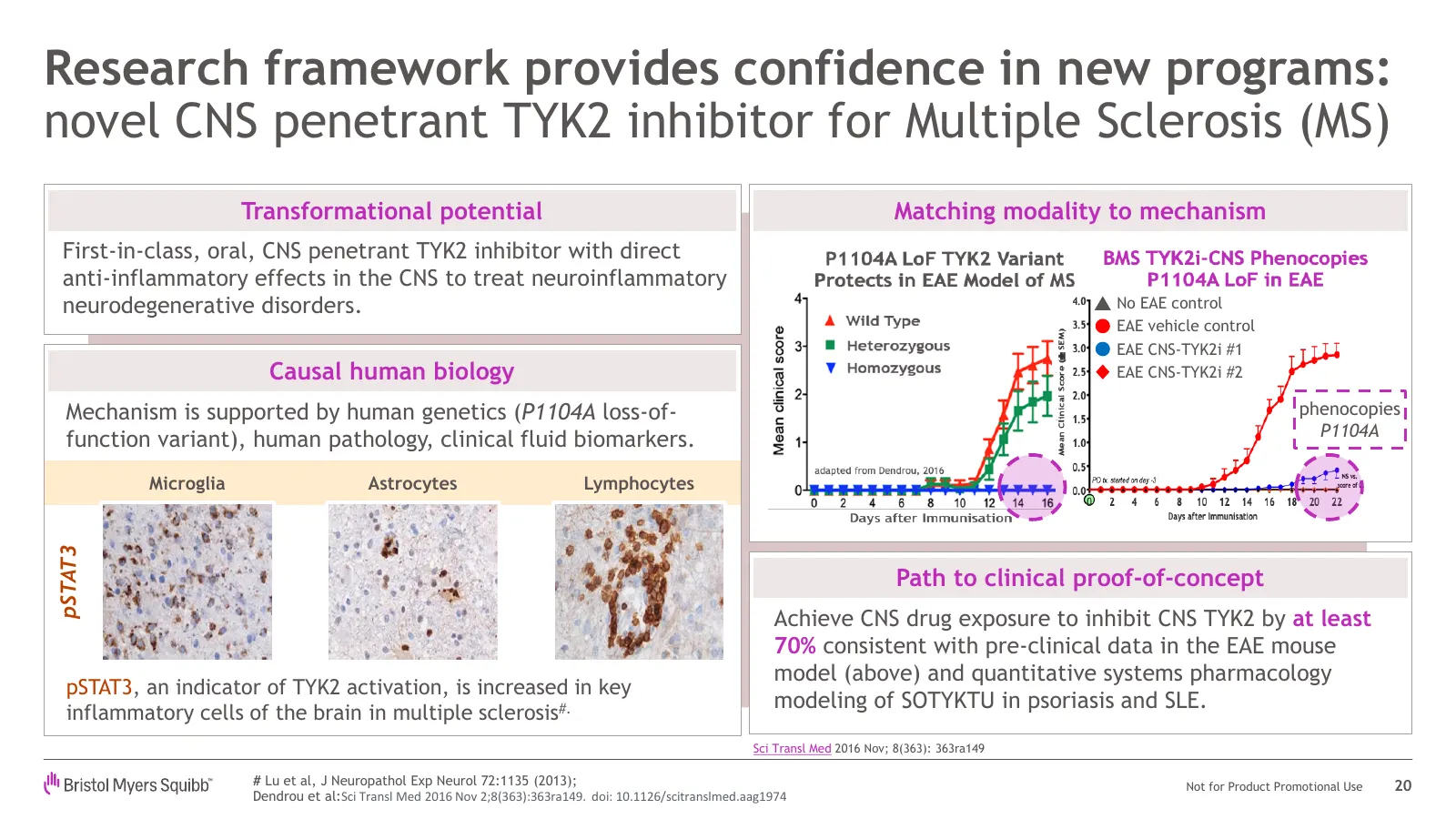
Slide 20: Novel CNS penetrant TYK2 inhibitor for Multiple Sclerosis
Research framework provides confidence in new programs: novel CNS penetrant TYK2 inhibitor for Multiple Sclerosis (MS) Transformational potential Matching modality to mechanism First-in-class, oral, CNS penetrant TYK2 inhibitor with direct anti-inflammatory effects in the CNS to treat neuroinflammat
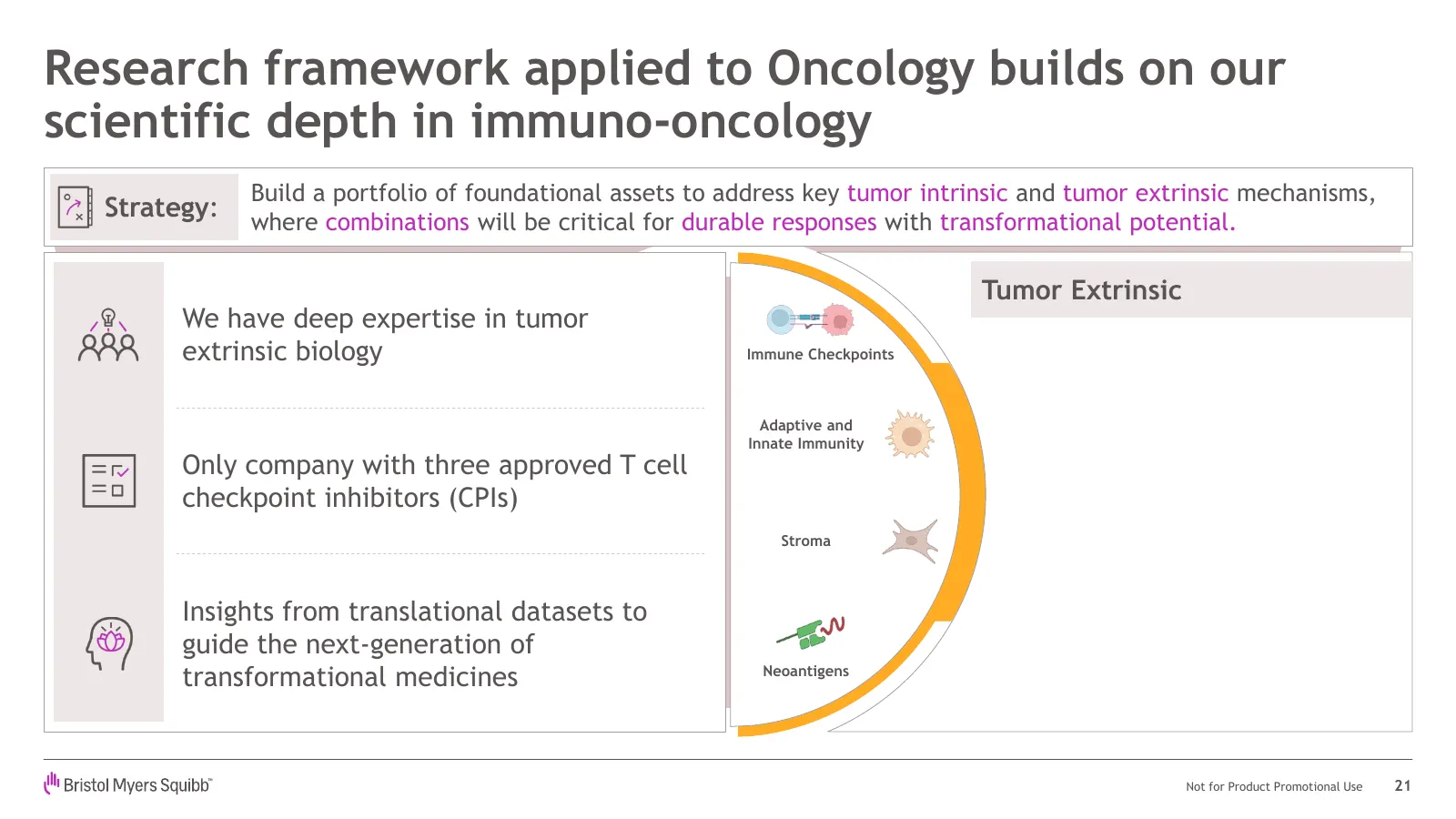
Slide 21: Research framework applied to Oncology: immuno-oncology depth
Research framework applied to Oncology builds on our scientific depth in immuno-oncology Build a portfolio of foundational assets to address key tumor intrinsic and tumor extrinsic mechanisms, Strategy: where combinations will be critical for durable responses with transformational potential. Tumor
Slide 22: Research framework applied to Oncology: immuno-oncology depth
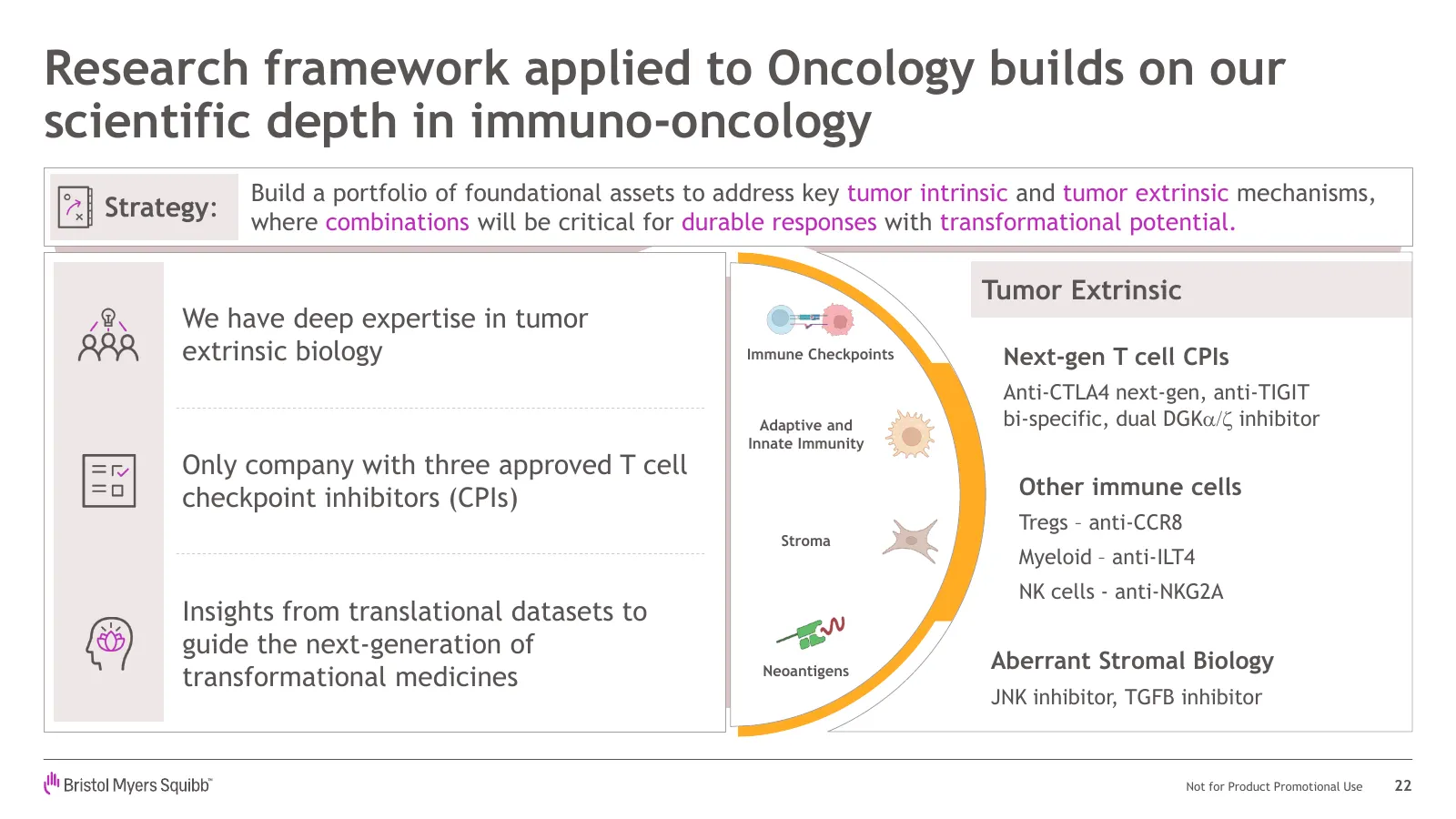
Research framework applied to Oncology builds on our scientific depth in immuno-oncology Build a portfolio of foundational assets to address key tumor intrinsic and tumor extrinsic mechanisms, Strategy: where combinations will be critical for durable responses with transformational potential. Tumor
Slide 23: Research framework applied to Oncology: tumor intrinsic mechanisms
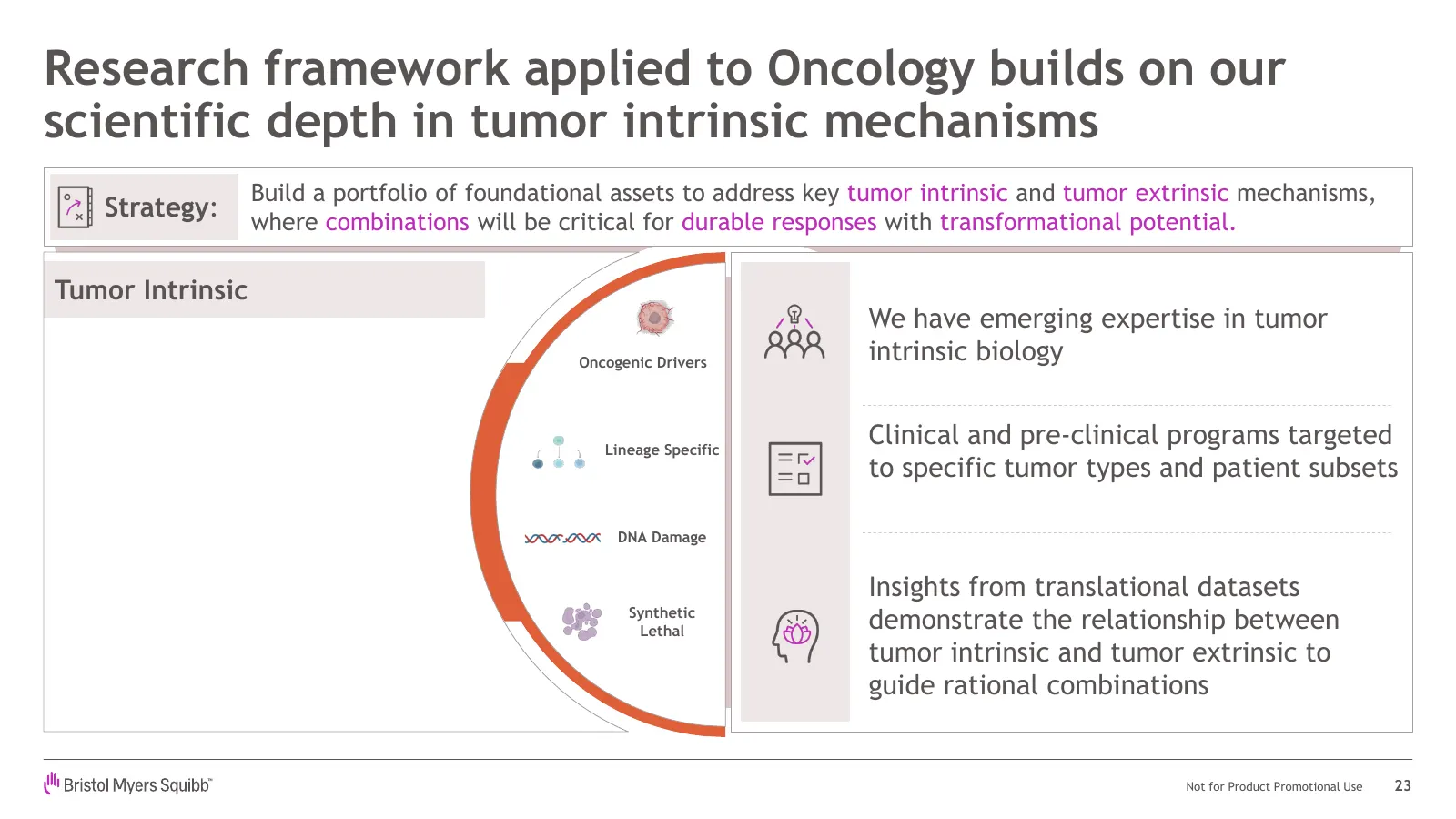
Research framework applied to Oncology builds on our scientific depth in tumor intrinsic mechanisms Build a portfolio of foundational assets to address key tumor intrinsic and tumor extrinsic mechanisms, Strategy: where combinations will be critical for durable responses with transformational potent
Slide 24: Research framework applied to Oncology: tumor intrinsic mechanisms
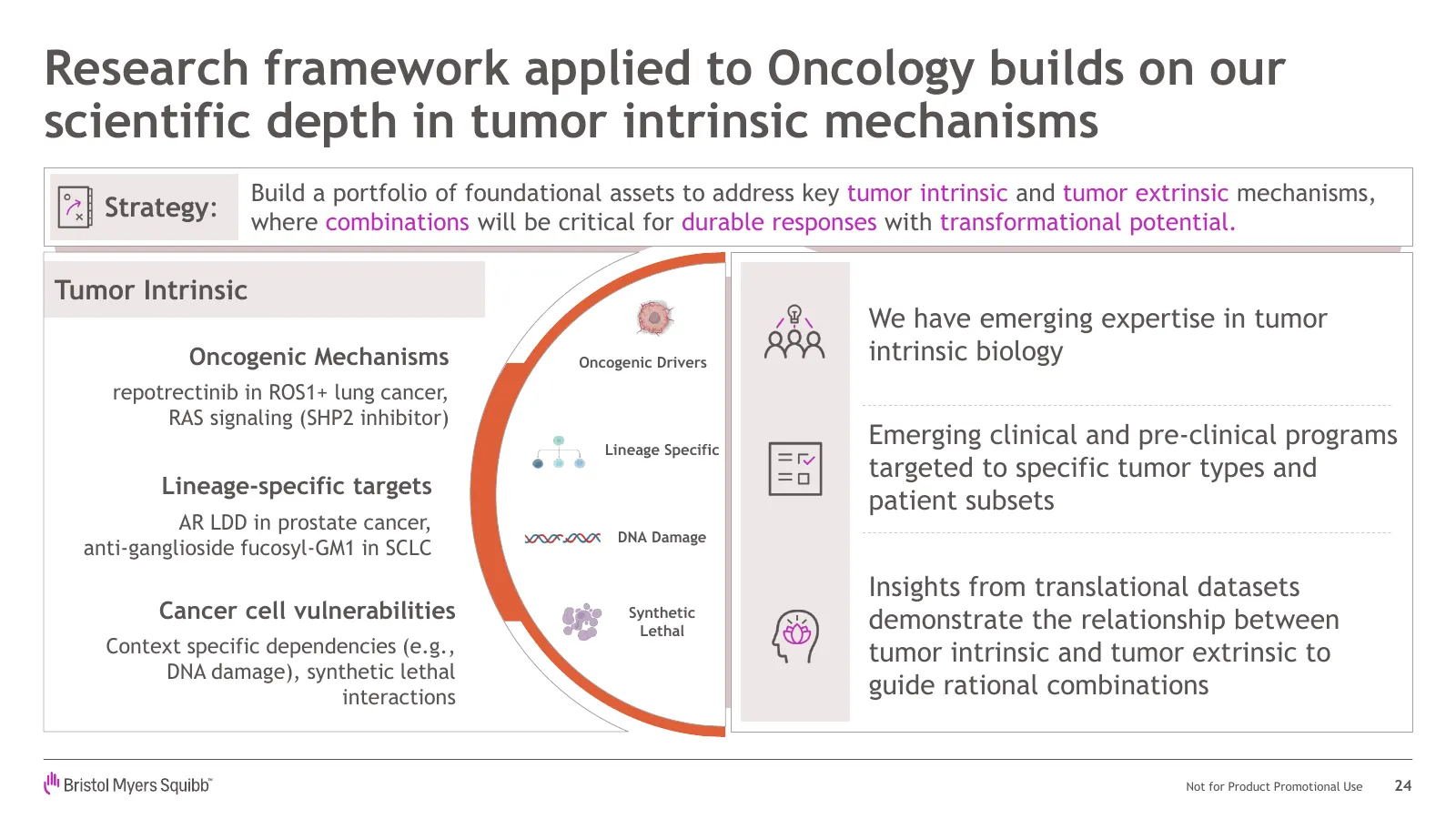
Research framework applied to Oncology builds on our scientific depth in tumor intrinsic mechanisms Build a portfolio of foundational assets to address key tumor intrinsic and tumor extrinsic mechanisms, Strategy: where combinations will be critical for durable responses with transformational potent
Slide 25: Research framework plus tumor intrinsic and extrinsic strategy
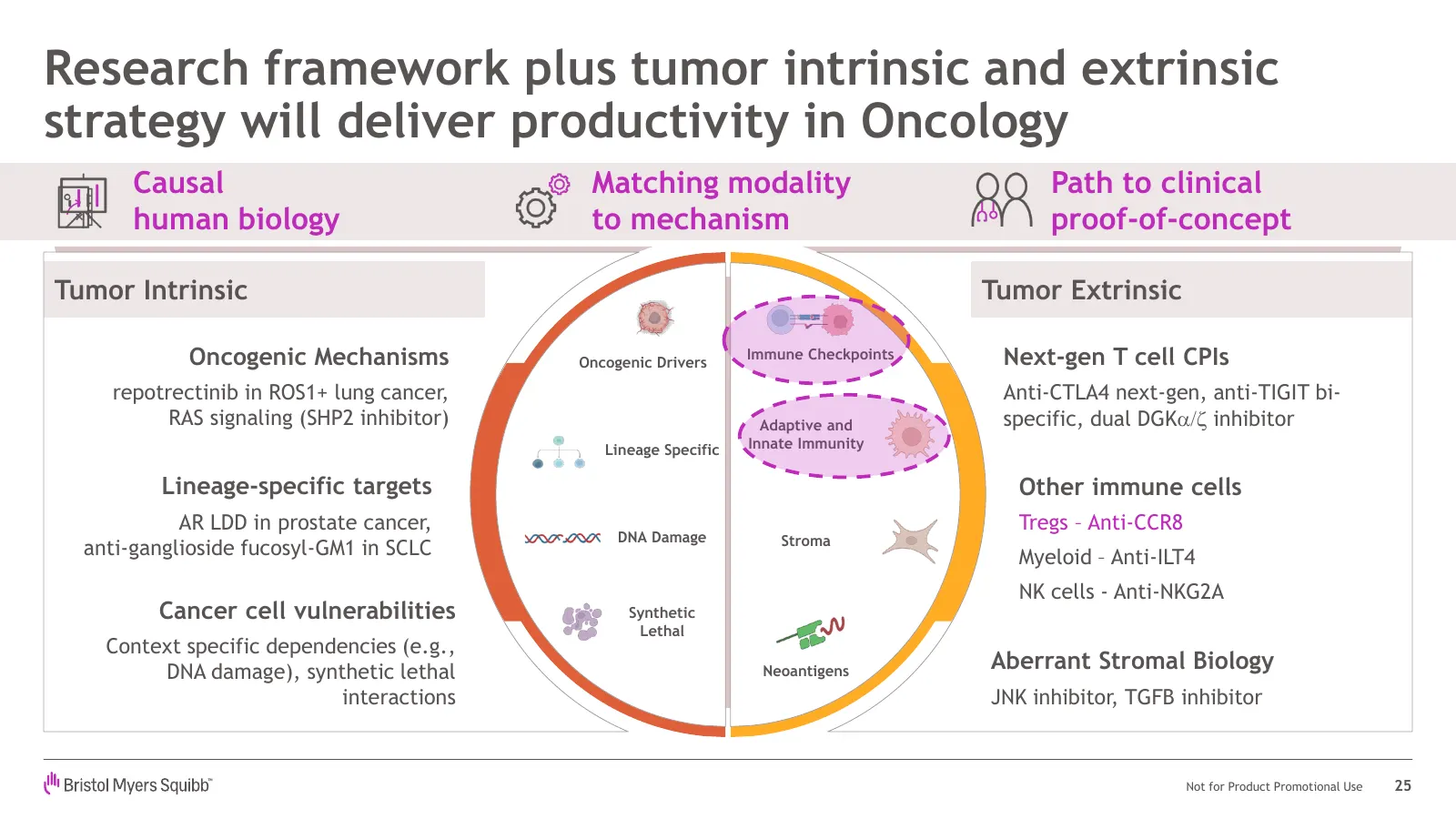
Research framework plus tumor intrinsic and extrinsic strategy will deliver productivity in Oncology Causal Matching modality Path to clinical human biology to mechanism proof-of-concept Tumor Intrinsic Tumor Extrinsic Oncogenic Mechanisms Oncogenic Drivers Immune Checkpoints Next-gen T cell CPIs re
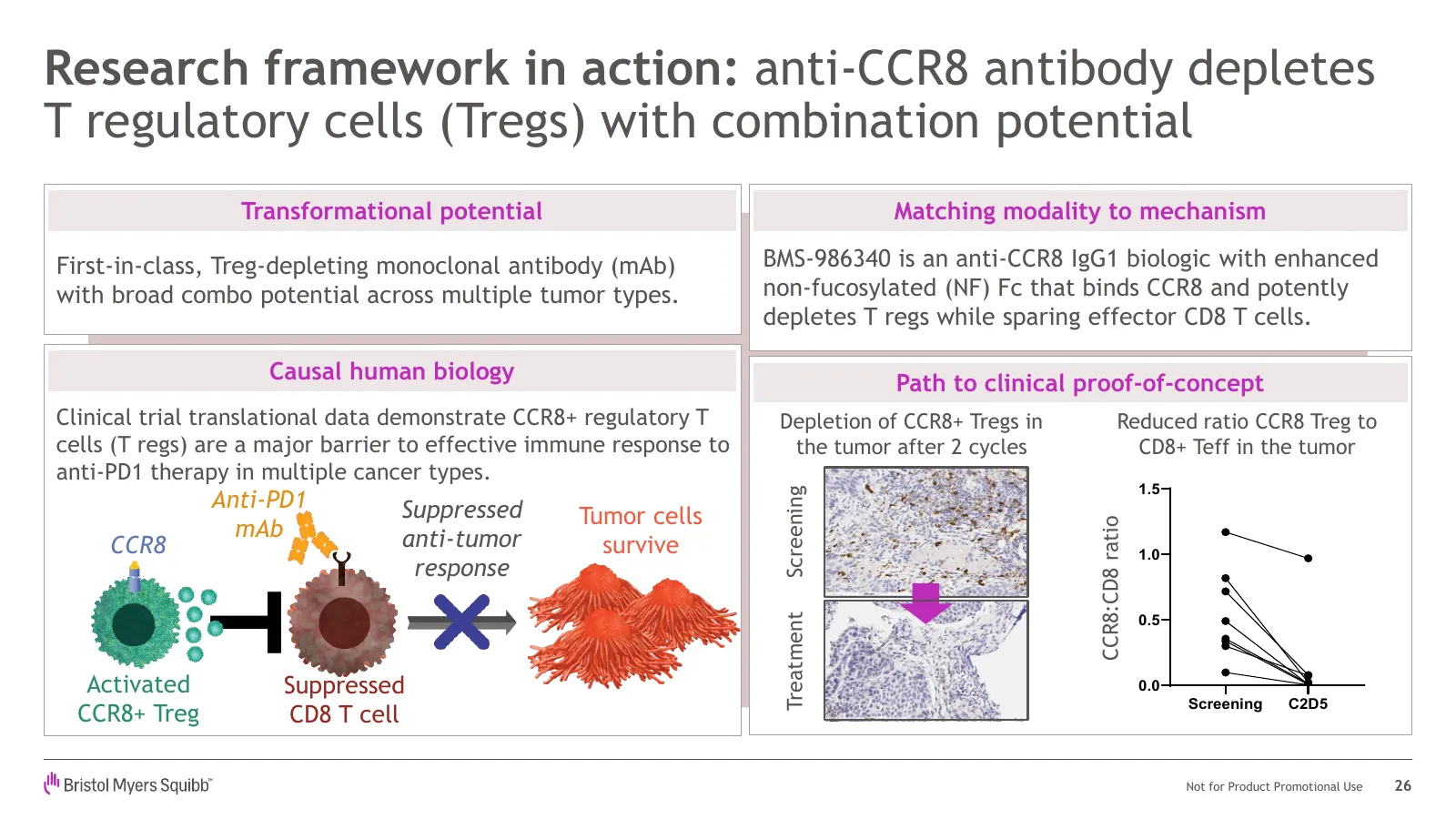
Slide 26: Anti-CCR8 antibody depletes T regulatory cells
Research framework in action: anti-CCR8 antibody depletes T regulatory cells (Tregs) with combination potential Transformational potential Matching modality to mechanism First-in-class, Treg-depleting monoclonal antibody (mAb) BMS-986340 is an anti-CCR8 IgG1 biologic with enhanced with broad combo p
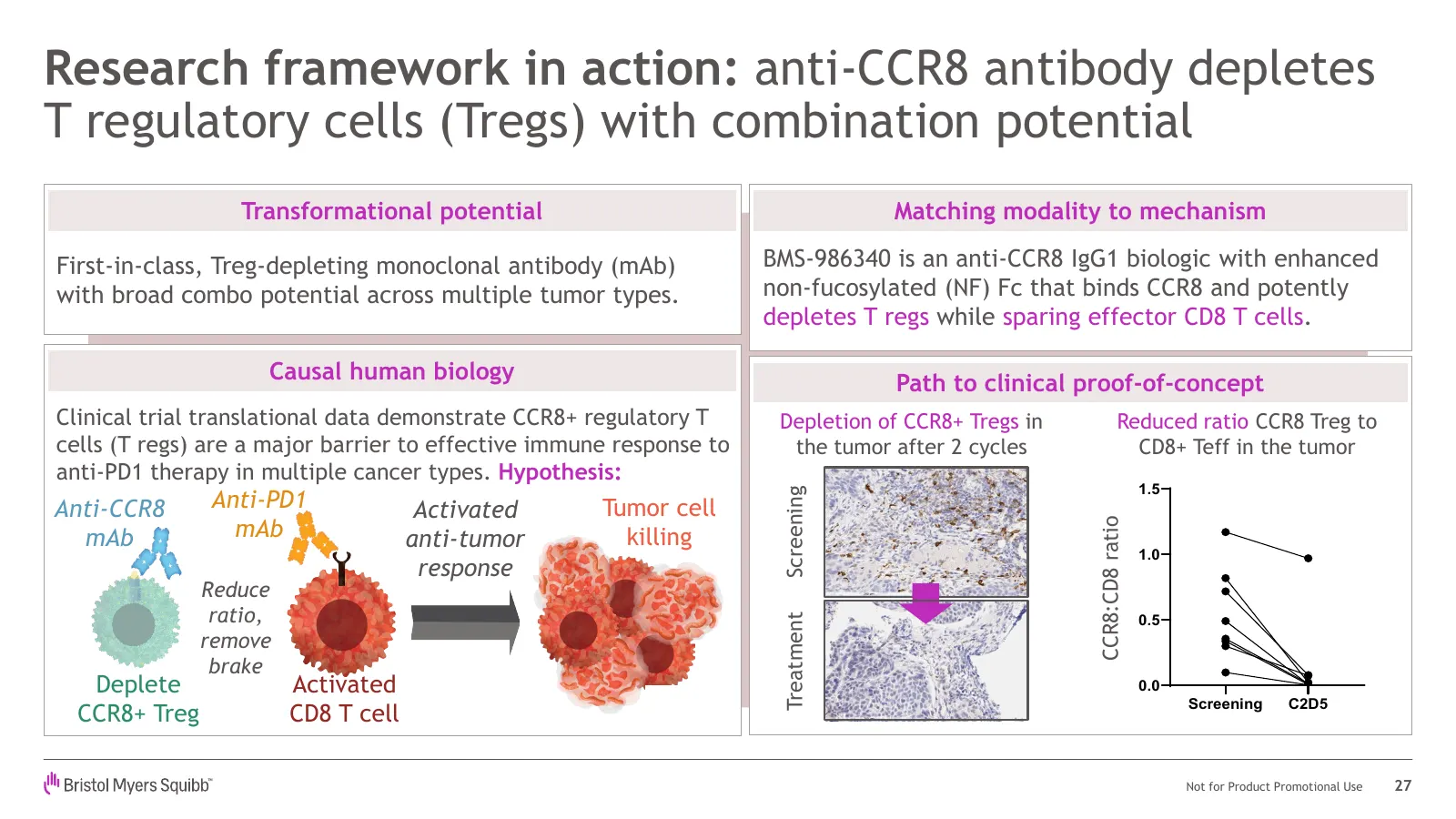
Slide 27: Anti-CCR8 antibody depletes T regulatory cells
Research framework in action: anti-CCR8 antibody depletes T regulatory cells (Tregs) with combination potential Transformational potential Matching modality to mechanism First-in-class, Treg-depleting monoclonal antibody (mAb) BMS-986340 is an anti-CCR8 IgG1 biologic with enhanced with broad combo p
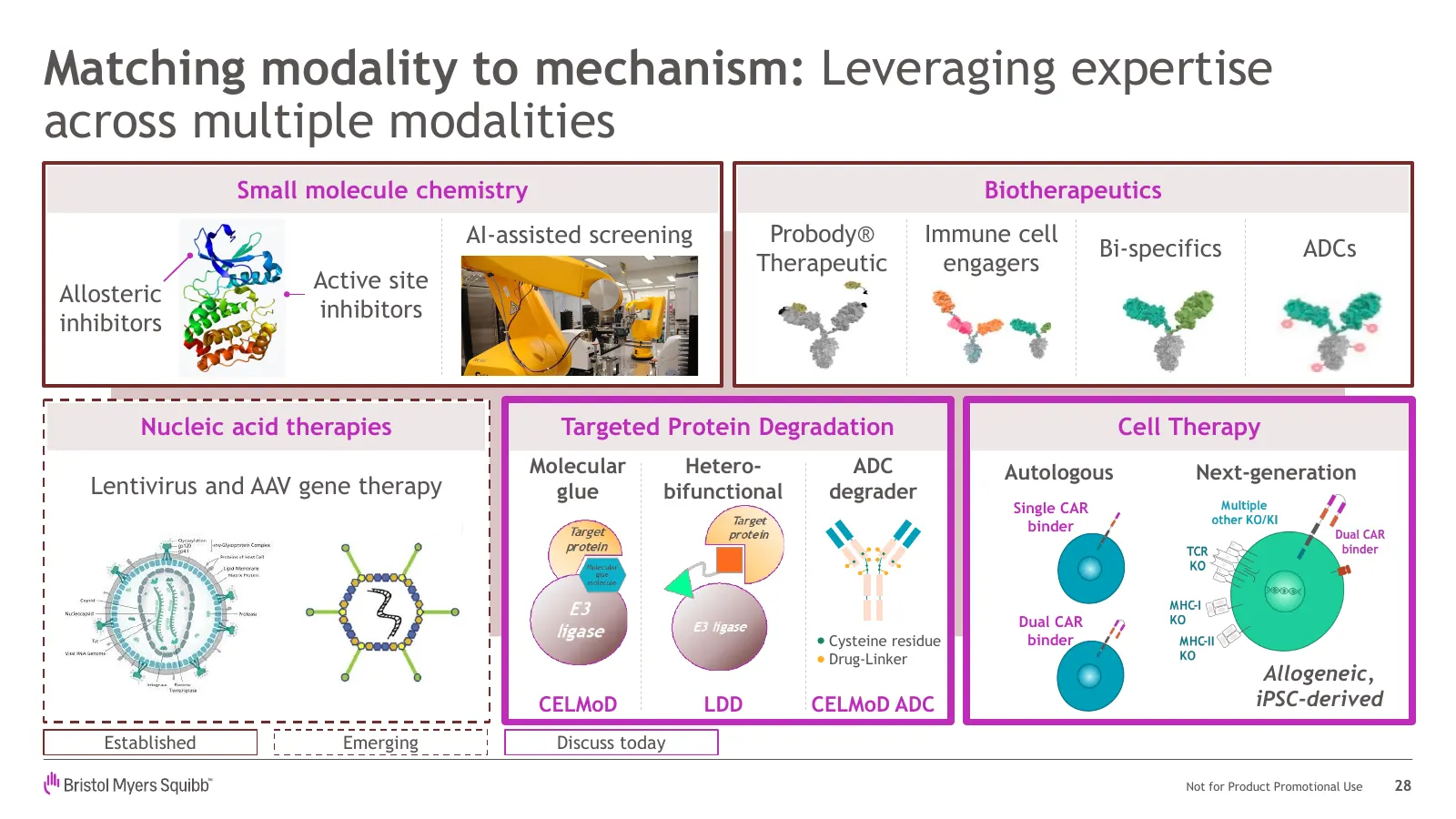
Slide 28: Matching modality to mechanism across multiple modalities
Matching modality to mechanism: Leveraging expertise across multiple modalities Small molecule chemistry Biotherapeutics AI-assisted screening Probody® Immune cell Bi-specifics ADCs Therapeutic engagers Active site Allosteric inhibitors inhibitors Nucleic acid therapies Targeted Protein Degradation
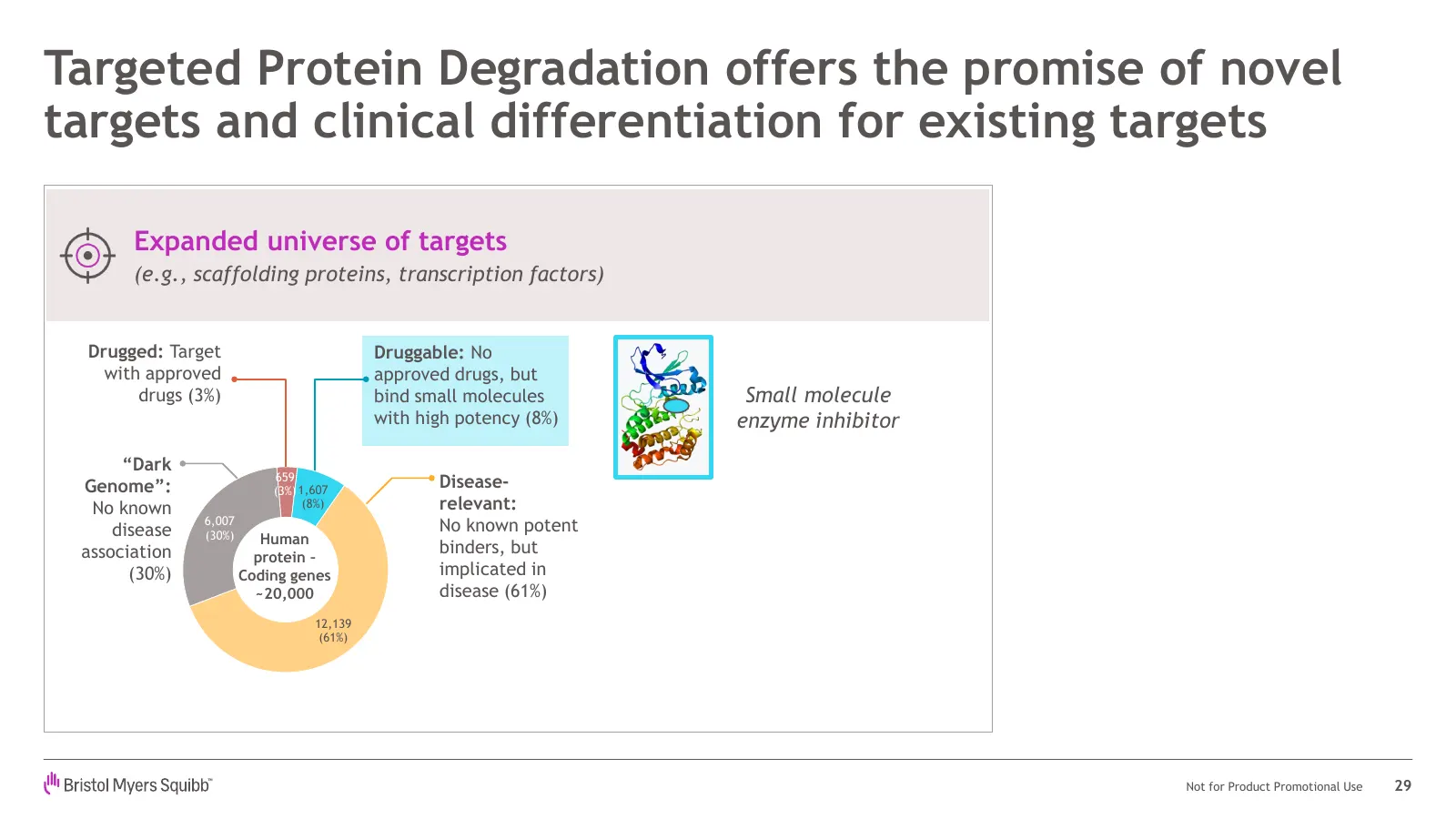
Slide 29: Targeted Protein Degradation offers novel targets and differentiation
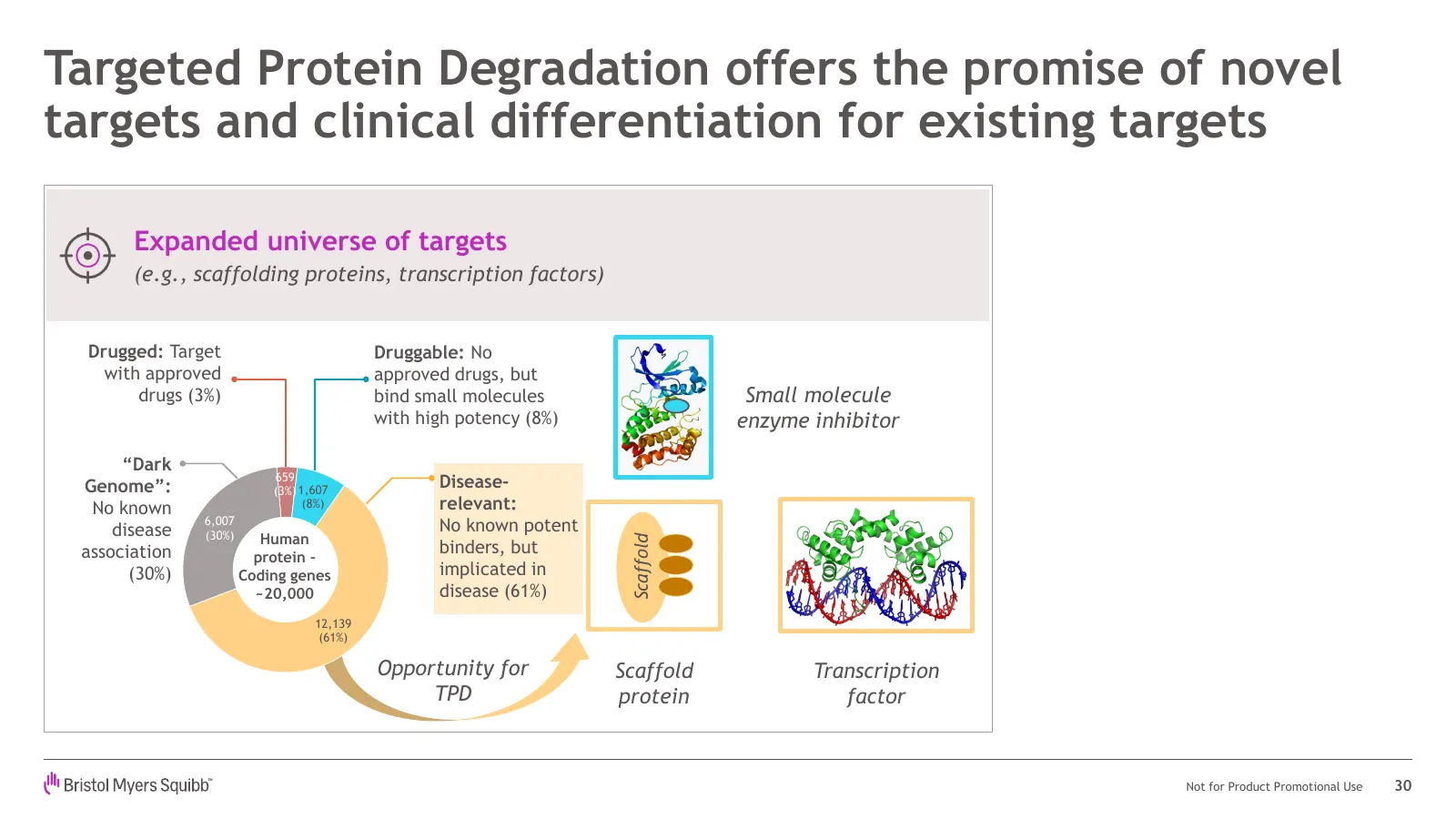
Targeted Protein Degradation offers the promise of novel targets and clinical differentiation for existing targets Expanded universe of targets (e.g., scaffolding proteins, transcription factors) Drugged: Target Druggable: No with approved approved drugs, but drugs (3%) bind small molecules Small mo
Slide 30: Targeted Protein Degradation offers novel targets and differentiation
Targeted Protein Degradation offers the promise of novel targets and clinical differentiation for existing targets Expanded universe of targets (e.g., scaffolding proteins, transcription factors) Drugged: Target Druggable: No with approved approved drugs, but drugs (3%) bind small molecules Small mo
Slide 31: Targeted Protein Degradation offers novel targets and differentiation
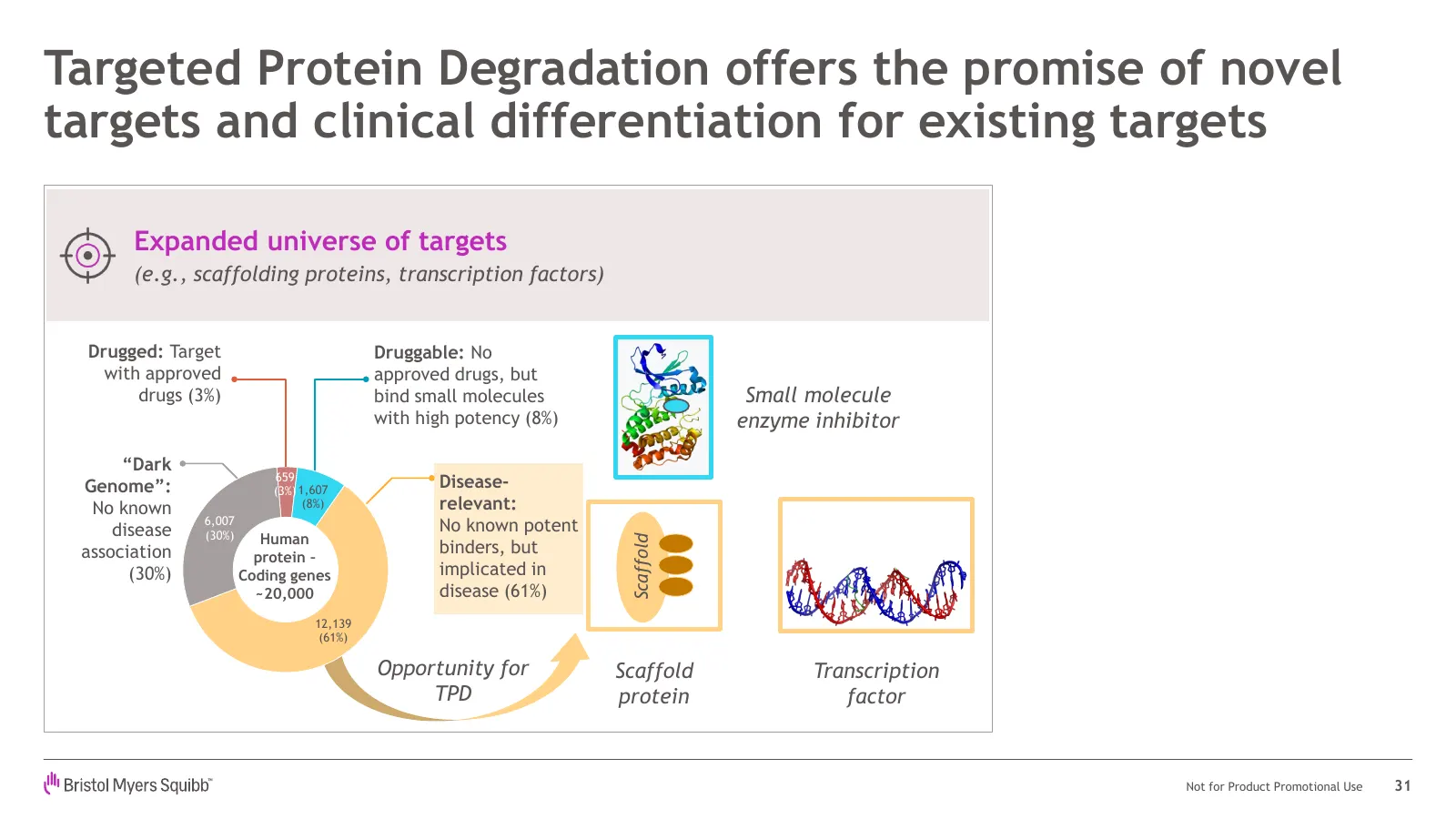
Targeted Protein Degradation offers the promise of novel targets and clinical differentiation for existing targets Expanded universe of targets (e.g., scaffolding proteins, transcription factors) Drugged: Target Druggable: No with approved approved drugs, but drugs (3%) bind small molecules Small mo
Slide 32: Targeted Protein Degradation offers novel targets and differentiation
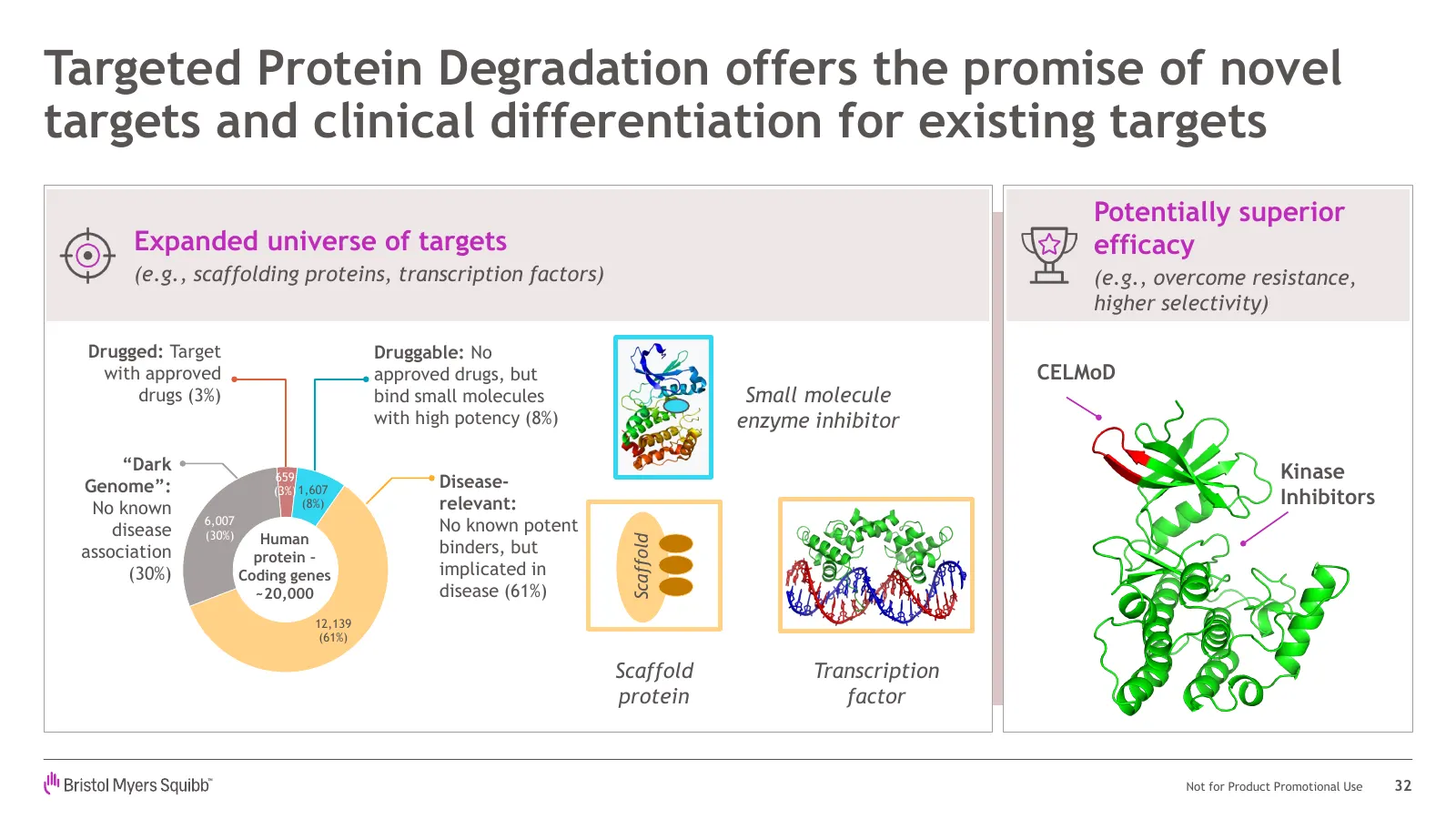
Targeted Protein Degradation offers the promise of novel targets and clinical differentiation for existing targets Potentially superior Expanded universe of targets efficacy (e.g., scaffolding proteins, transcription factors) (e.g., overcome resistance, higher selectivity) Drugged: Target Druggable:
Slide 33: Industry leading position in protein degradation
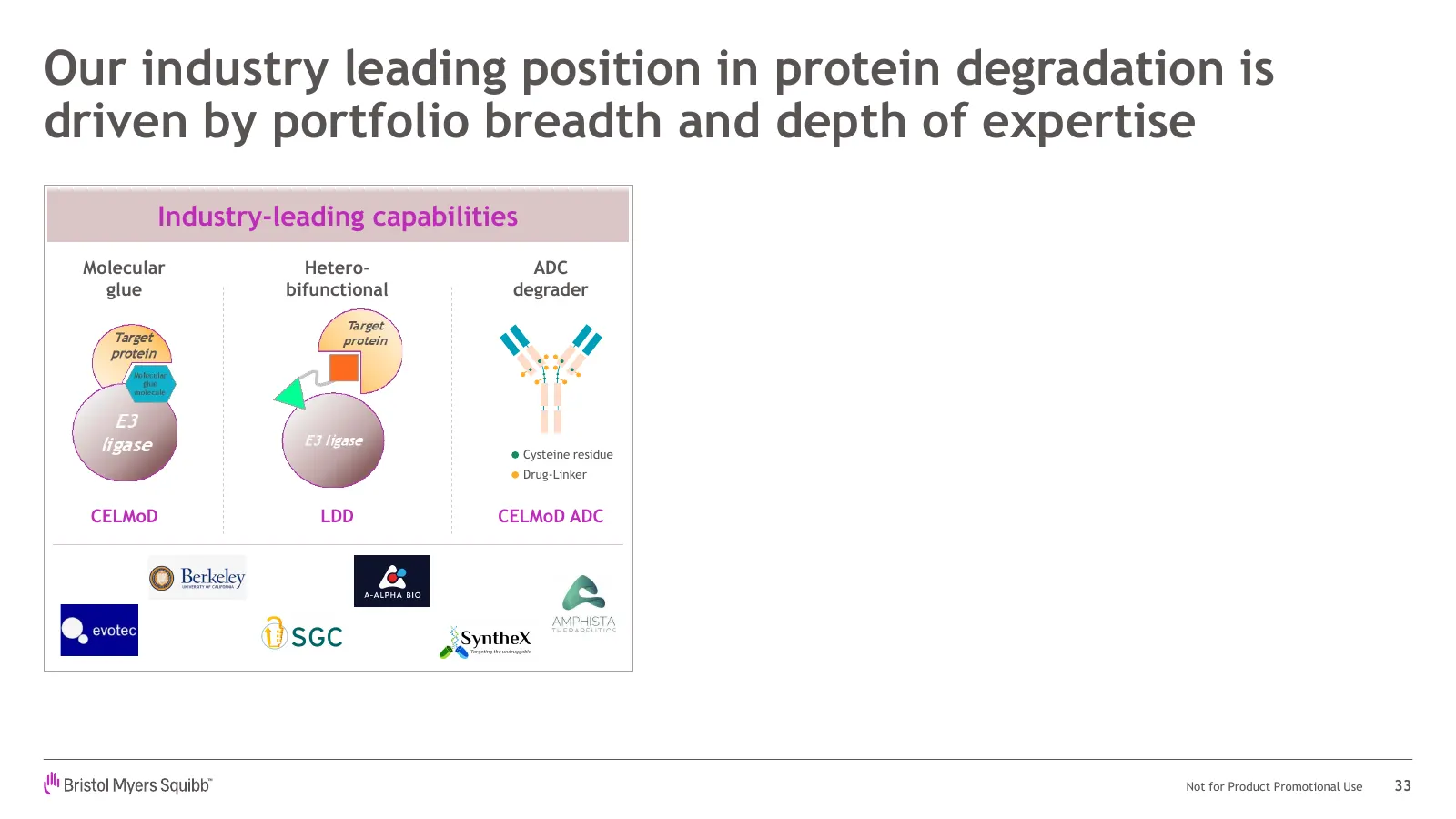
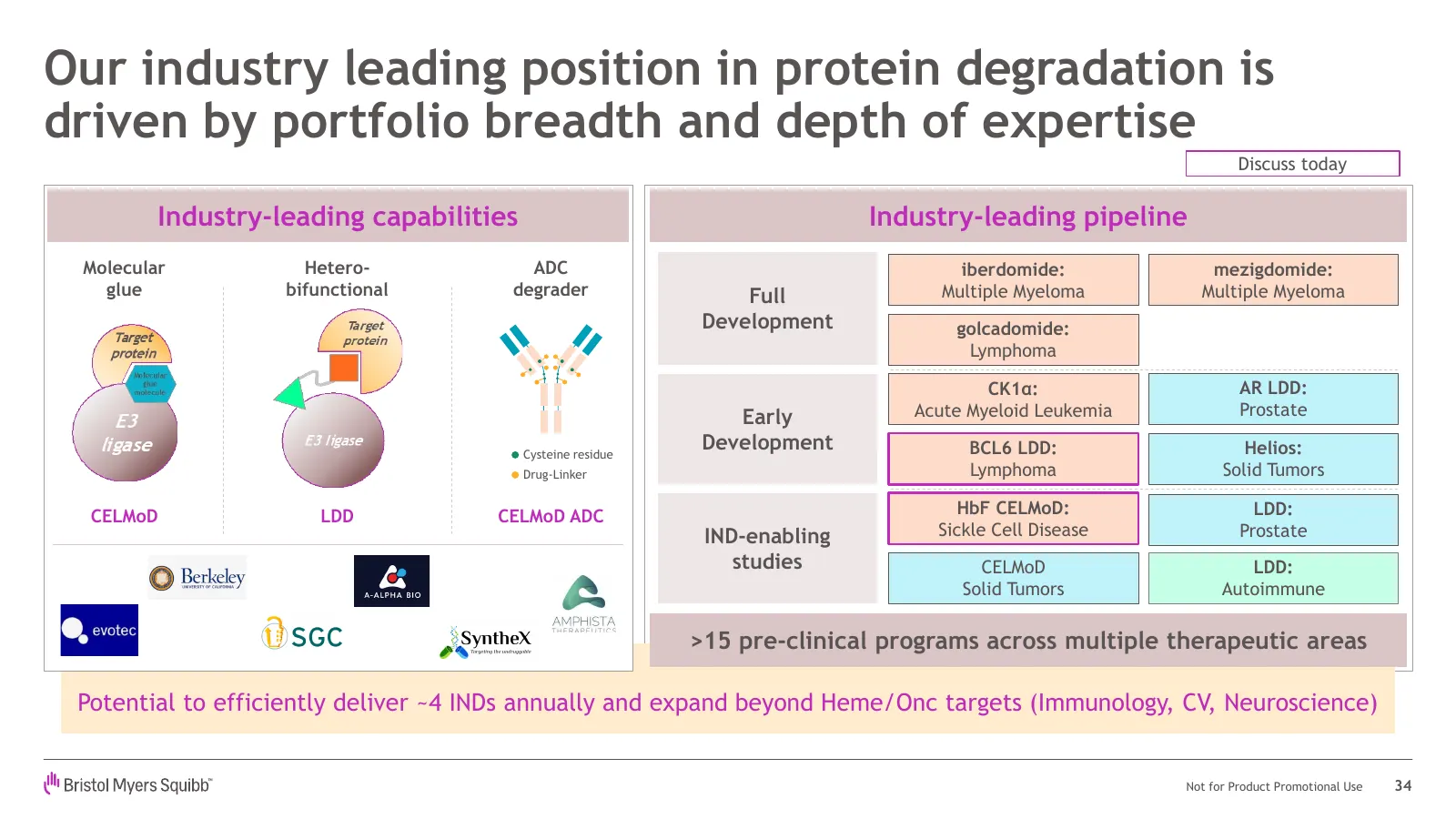
Our industry leading position in protein degradation is driven by portfolio breadth and depth of expertise Industry-leading capabilities Molecular Hetero- ADC glue bifunctional degrader Cysteine residue Drug-Linker CELMoD LDD CELMoD ADC Not for Product Promotional Use 33
Slide 34: Industry leading position in protein degradation
Our industry leading position in protein degradation is driven by portfolio breadth and depth of expertise Discuss today Industry-leading capabilities Industry-leading pipeline Molecular Hetero- ADC iberdomide: mezigdomide: glue bifunctional degrader Full Multiple Myeloma Multiple Myeloma Developmen
Slide 35: Swift expansion of our CELMoD library
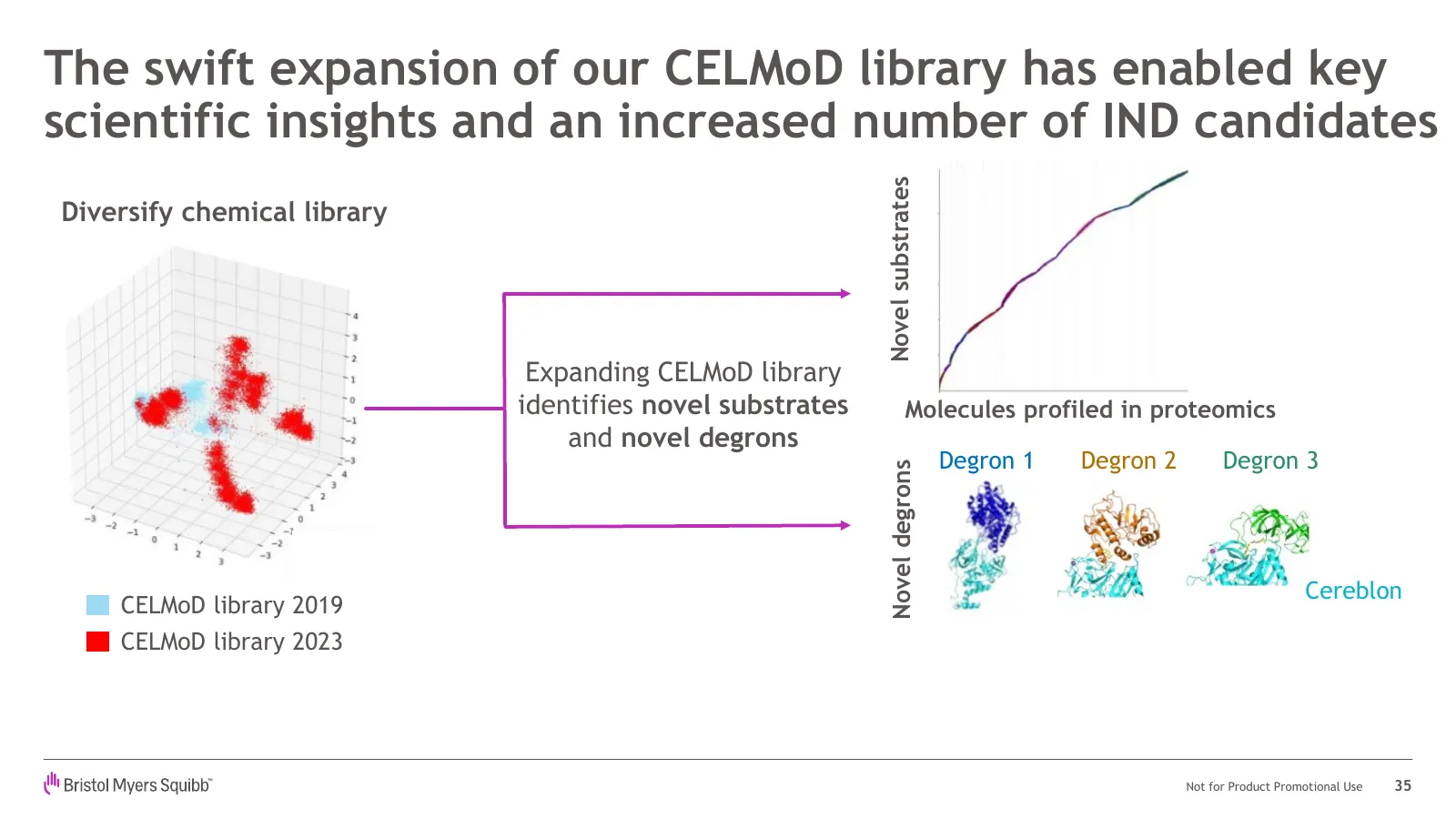
The swift expansion of our CELMoD library has enabled key scientific insights and an increased number of IND candidates Novel substrates Diversify chemical library Expanding CELMoD library identifies novel substrates Molecules profiled in proteomics and novel degrons Degron 1 Degron 2 Degron 3 Novel
Slide 36: Swift expansion of our CELMoD library
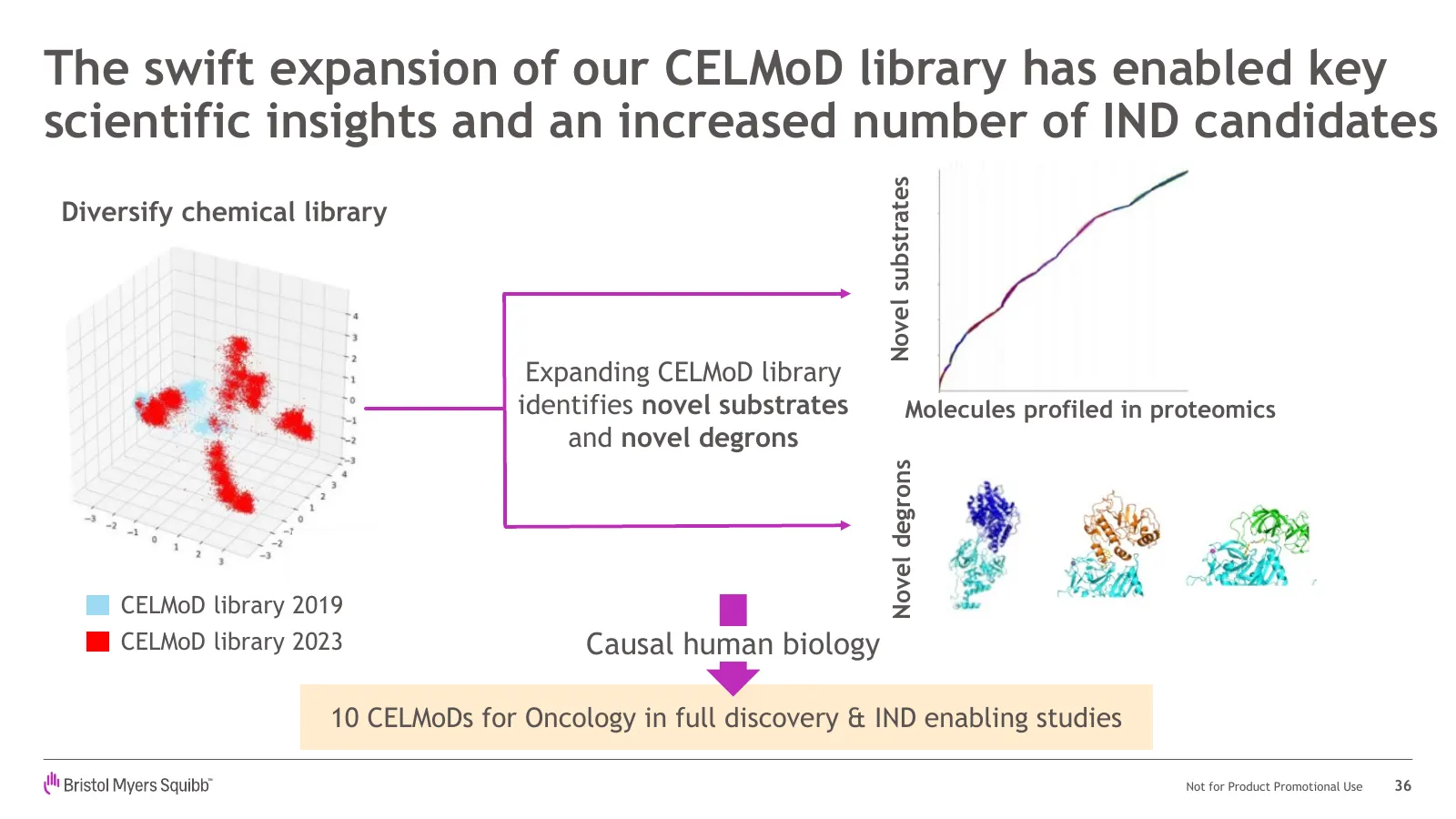
The swift expansion of our CELMoD library has enabled key scientific insights and an increased number of IND candidates Novel substrates Diversify chemical library Expanding CELMoD library identifies novel substrates Molecules profiled in proteomics and novel degrons Novel degrons CELMoD library 201
Slide 37: A novel CELMoD for Sickle Cell Disease
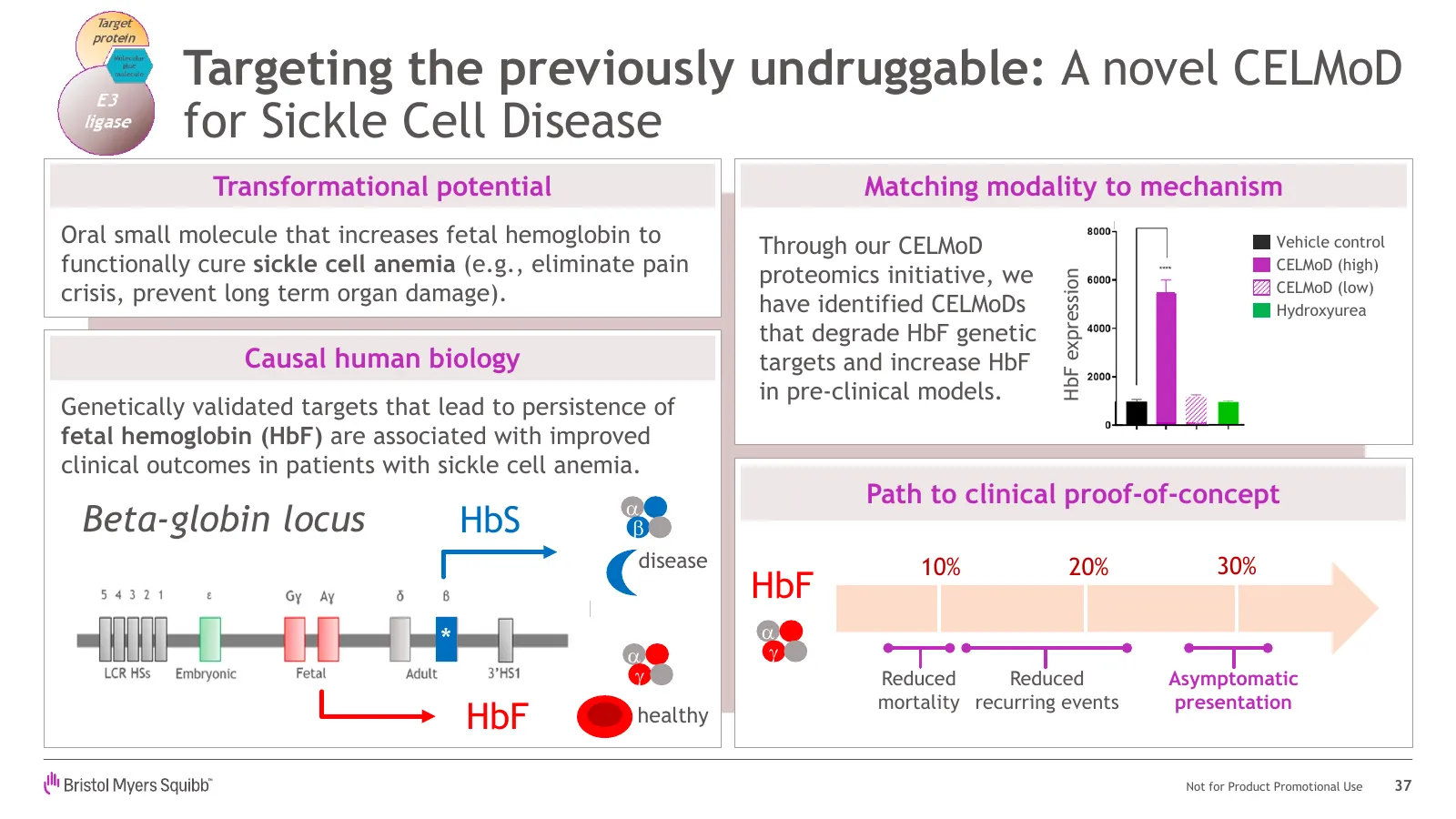
Targeting the previously undruggable: A novel CELMoD for Sickle Cell Disease Transformational potential Matching modality to mechanism Oral small molecule that increases fetal hemoglobin to Through our CELMoD Vehicle Vehicle control control functionally cure sickle cell anemia (e.g., eliminate pain
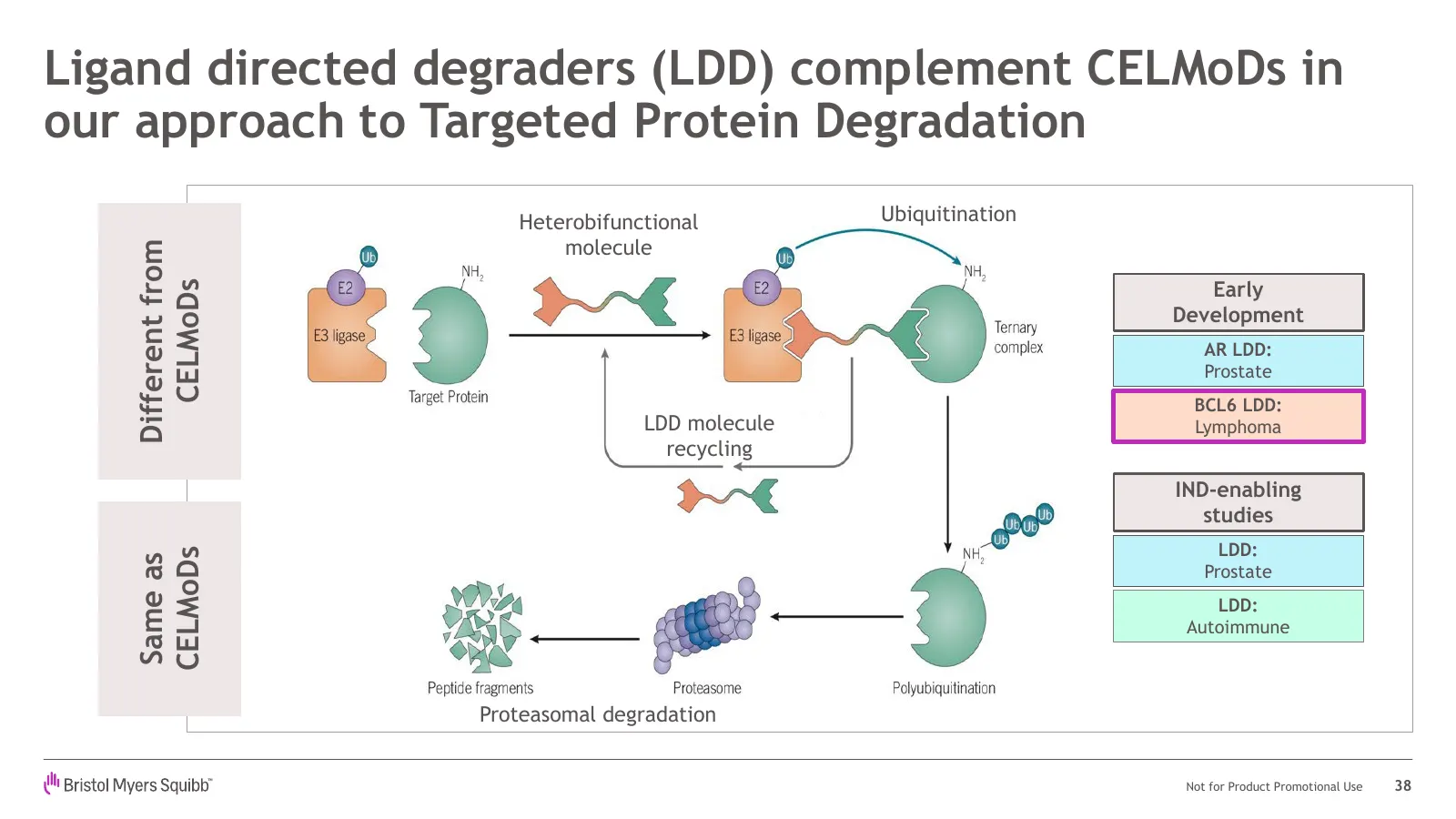
Slide 38: Ligand directed degraders complement CELMoDs
Ligand directed degraders (LDD) complement CELMoDs in our approach to Targeted Protein Degradation Heterobifunctional Ubiquitination molecule Different from L Early CELMoDs Development AR LDD: Prostate BCL6 LDD: LDD molecule Lymphoma recycling IND-enabling studies LDD: CELMoDs Same as Prostate LDD:
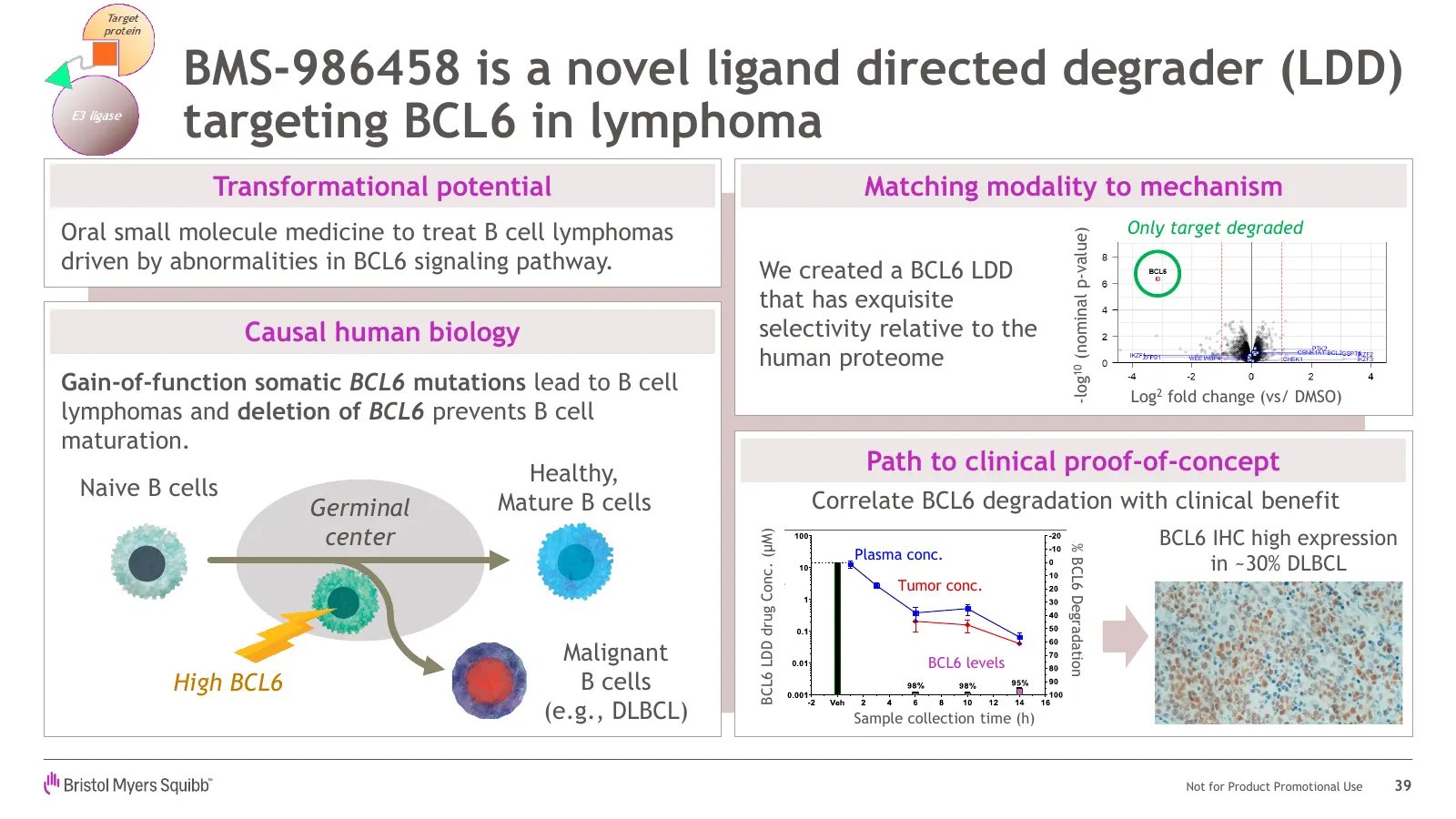
Slide 39: BMS-986458 is a novel LDD targeting BCL6 in lymphoma
BMS-986458 is a novel ligand directed degrader (LDD) targeting BCL6 in lymphoma Transformational potential Matching modality to mechanism Oral small molecule medicine to treat B cell lymphomas Only target degraded -log10 (nominal p-value) driven by abnormalities in BCL6 signaling pathway. We created
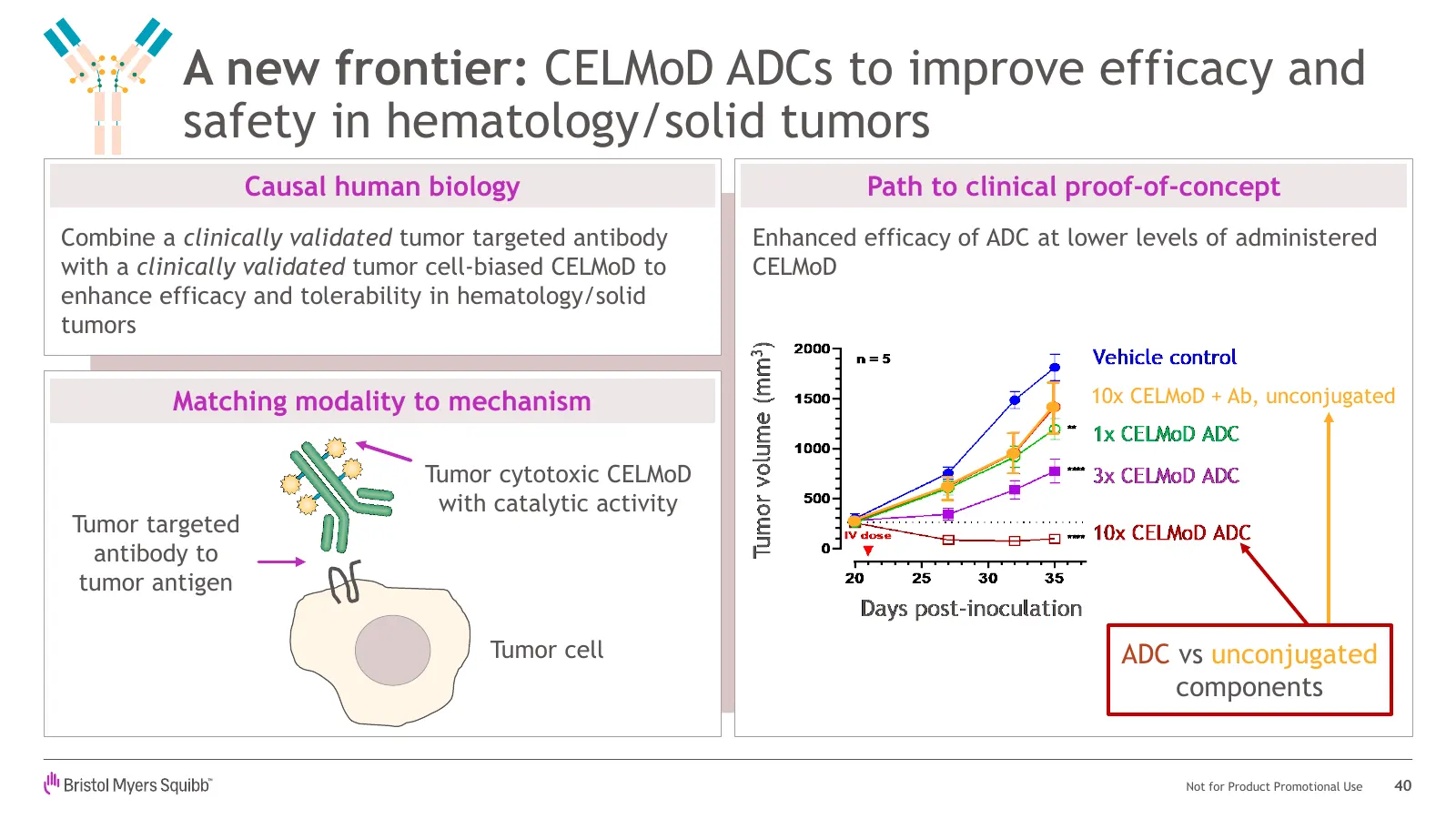
Slide 40: A new frontier: CELMoD ADCs
A new frontier: CELMoD ADCs to improve efficacy and safety in hematology/solid tumors Causal human biology Path to clinical proof-of-concept Combine a clinically validated tumor targeted antibody Enhanced efficacy of ADC at lower levels of administered with a clinically validated tumor cell-biased C
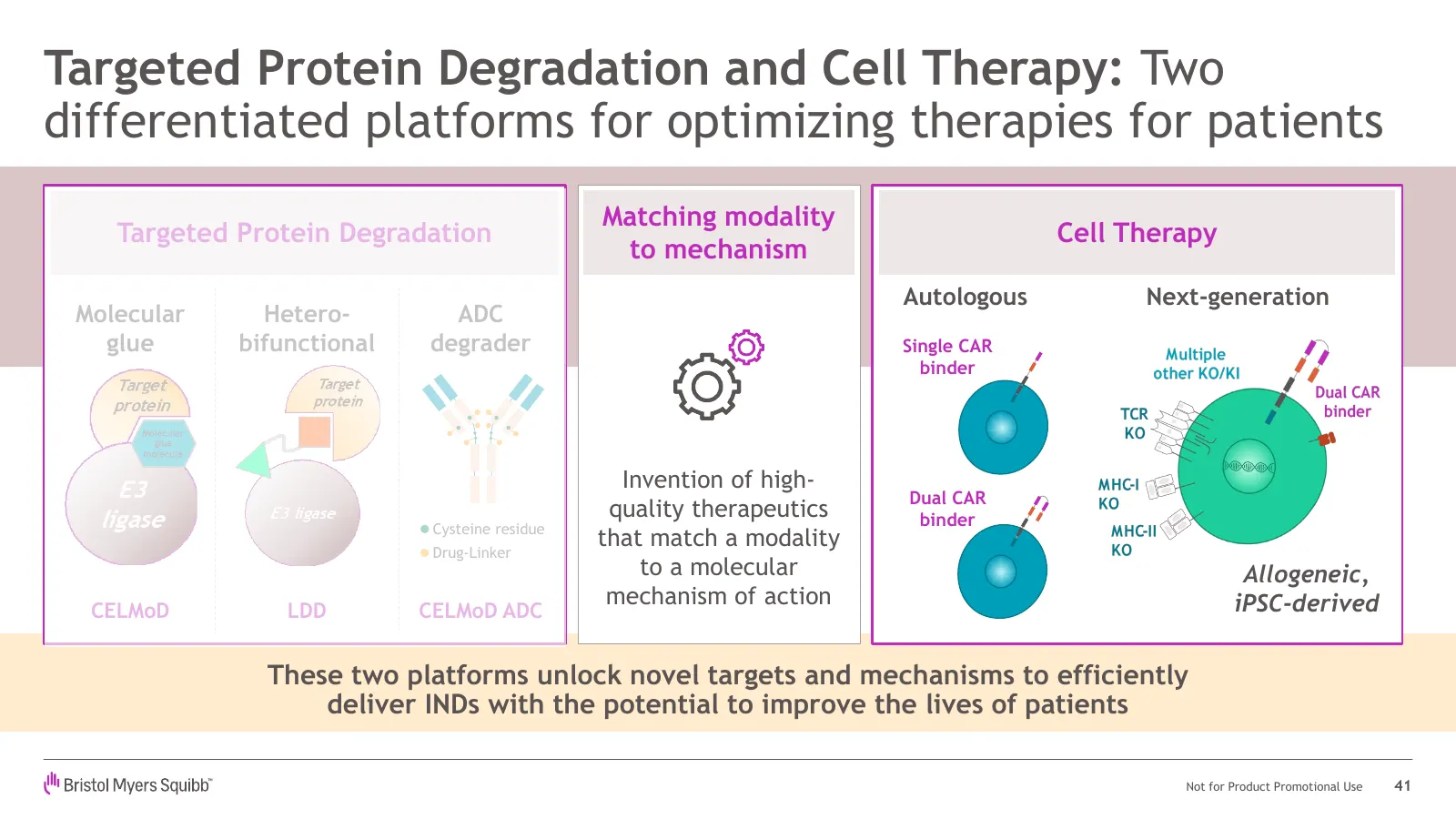
Slide 41: Two differentiated platforms for optimizing therapies
Targeted Protein Degradation and Cell Therapy: Two differentiated platforms for optimizing therapies for patients Matching modality Targeted Protein Degradation Cell Therapy to mechanism Autologous Next-generation Molecular Hetero- ADC glue bifunctional degrader Single CAR binder Invention of high-
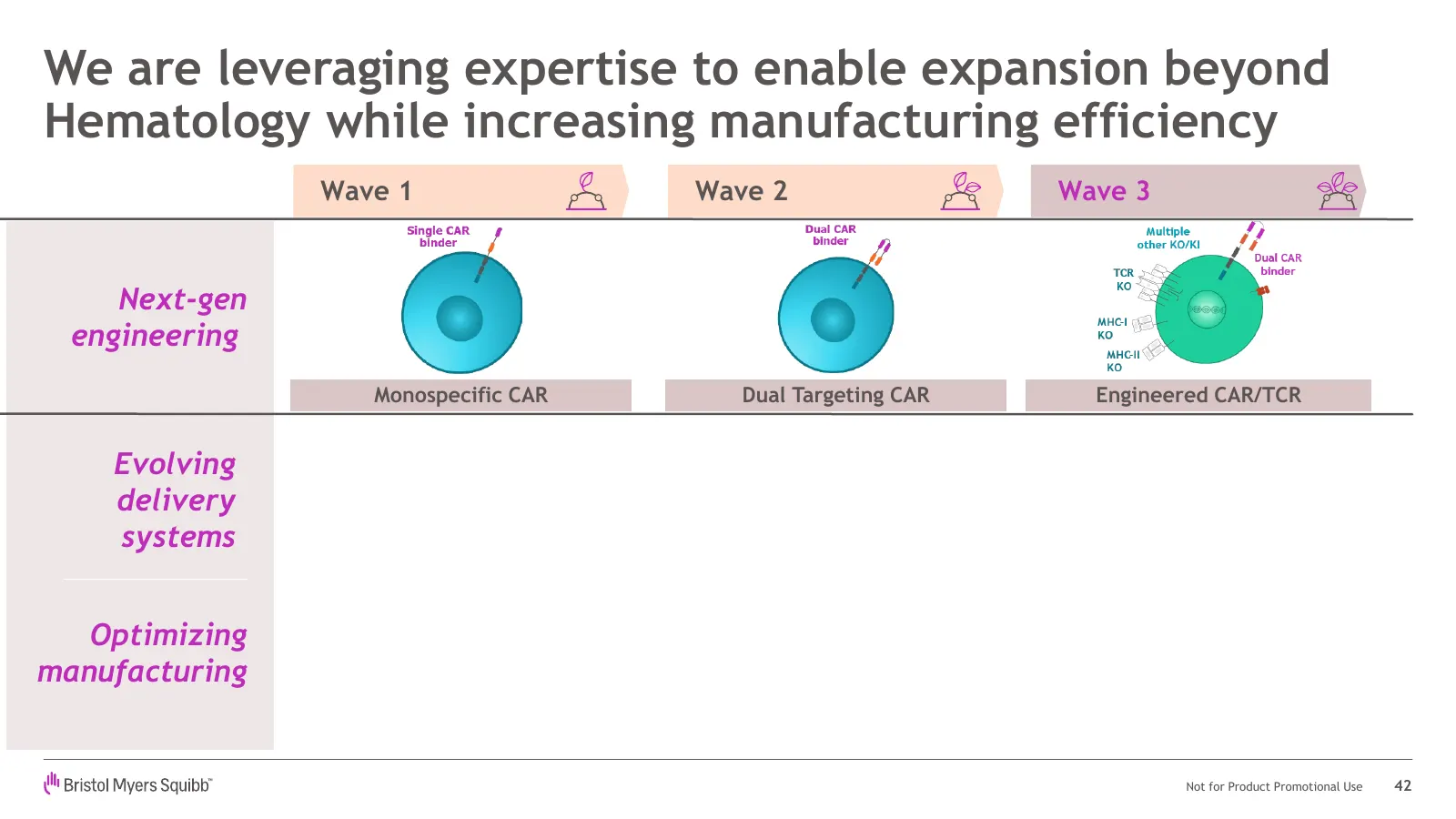
Slide 42: Expanding beyond Hematology while increasing manufacturing efficiency
We are leveraging expertise to enable expansion beyond Hematology while increasing manufacturing efficiency Wave 1 Wave 2 Wave 3 Next-gen engineering Monospecific CAR Dual Targeting CAR Engineered CAR/TCR Evolving delivery systems Optimizing manufacturing Not for Product Promotional Use 42
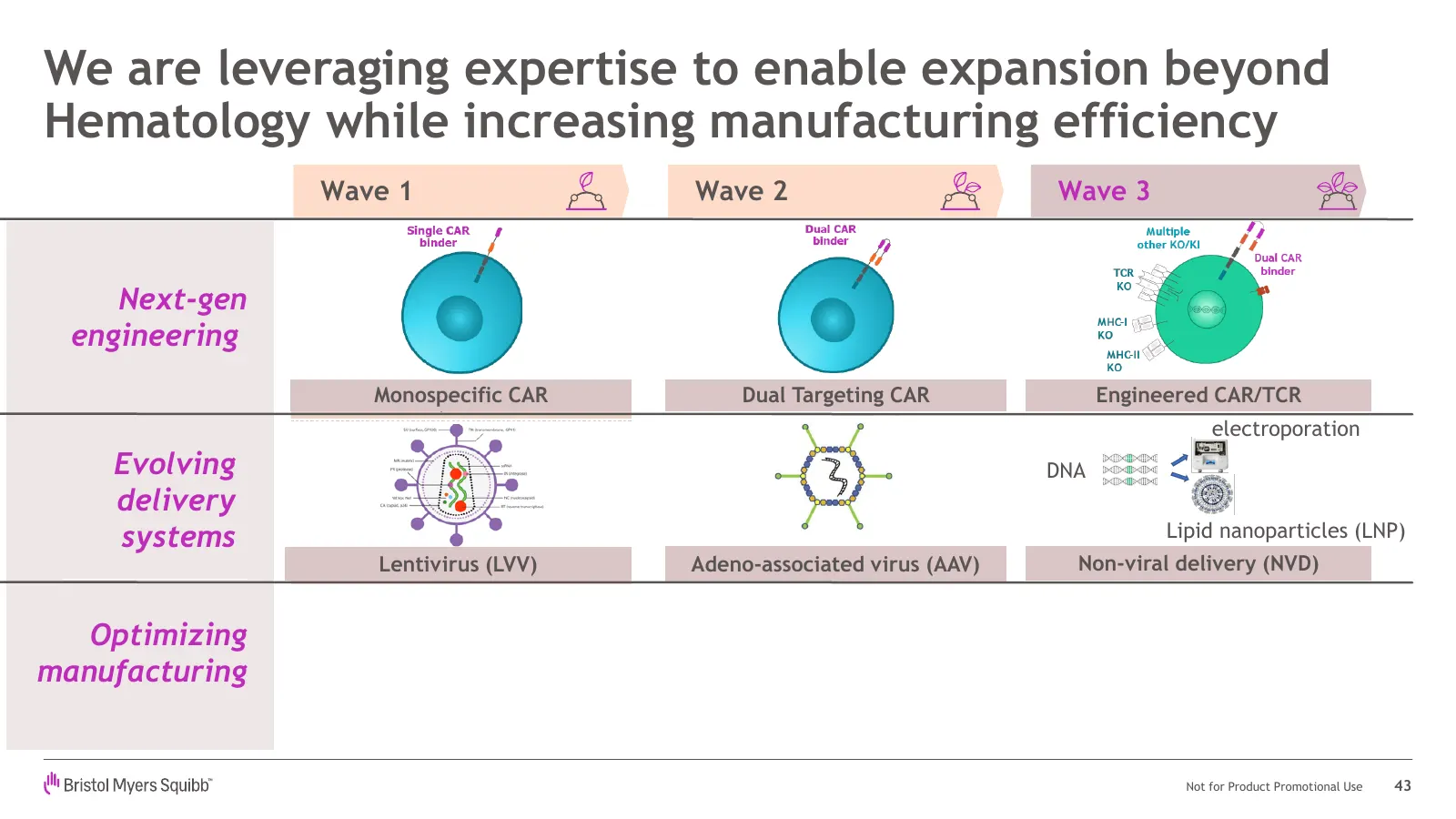
Slide 43: Expanding beyond Hematology while increasing manufacturing efficiency
We are leveraging expertise to enable expansion beyond Hematology while increasing manufacturing efficiency Wave 1 Wave 2 Wave 3 Next-gen engineering Monospecific CAR Dual Targeting CAR Engineered CAR/TCR electroporation Evolving DNA delivery systems Lipid nanoparticles (LNP) Lentivirus (LVV) Adeno-
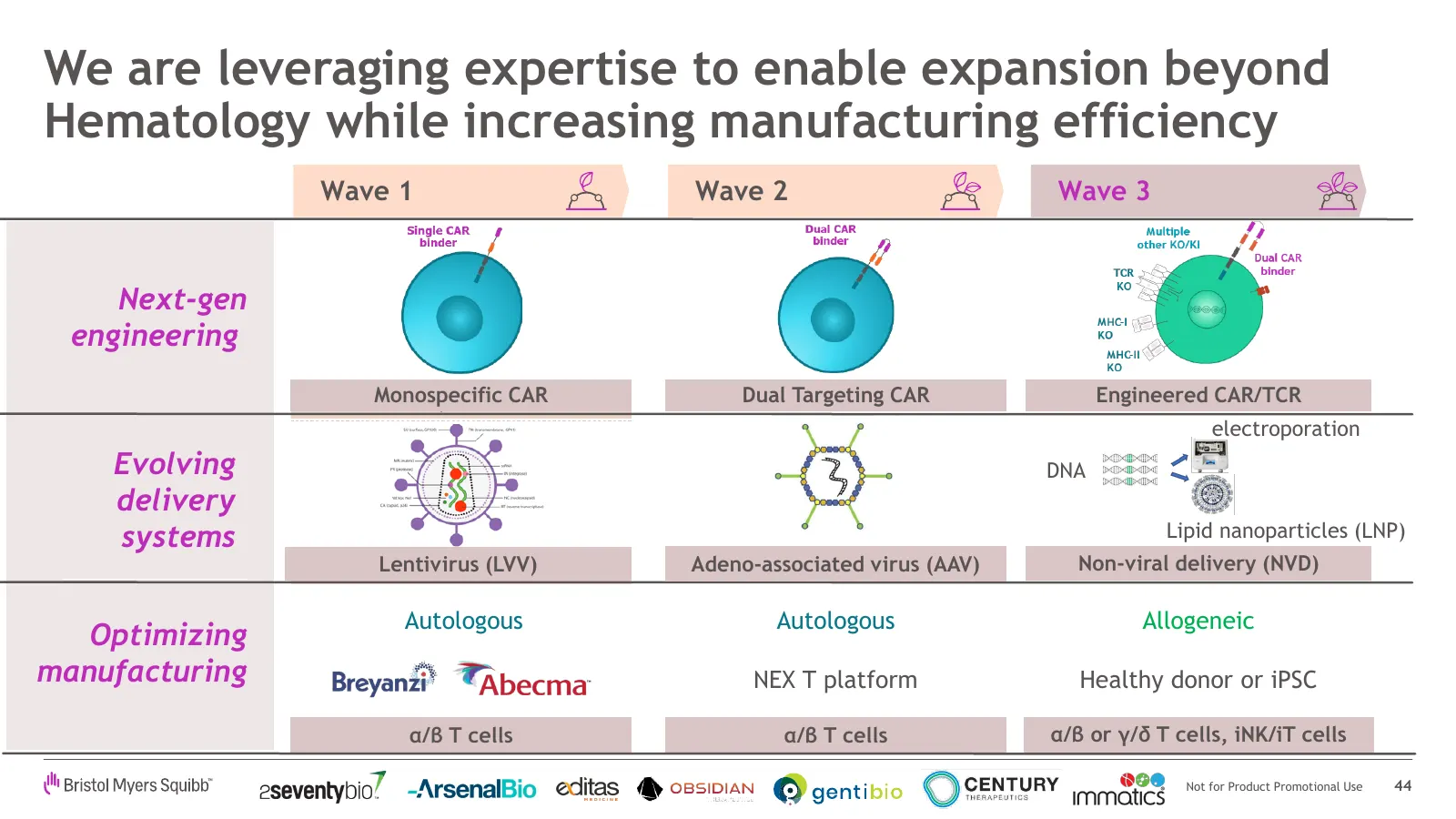
Slide 44: Expanding beyond Hematology while increasing manufacturing efficiency
We are leveraging expertise to enable expansion beyond Hematology while increasing manufacturing efficiency Wave 1 Wave 2 Wave 3 Next-gen engineering Monospecific CAR Dual Targeting CAR Engineered CAR/TCR electroporation Evolving DNA delivery systems Lipid nanoparticles (LNP) Lentivirus (LVV) Adeno-
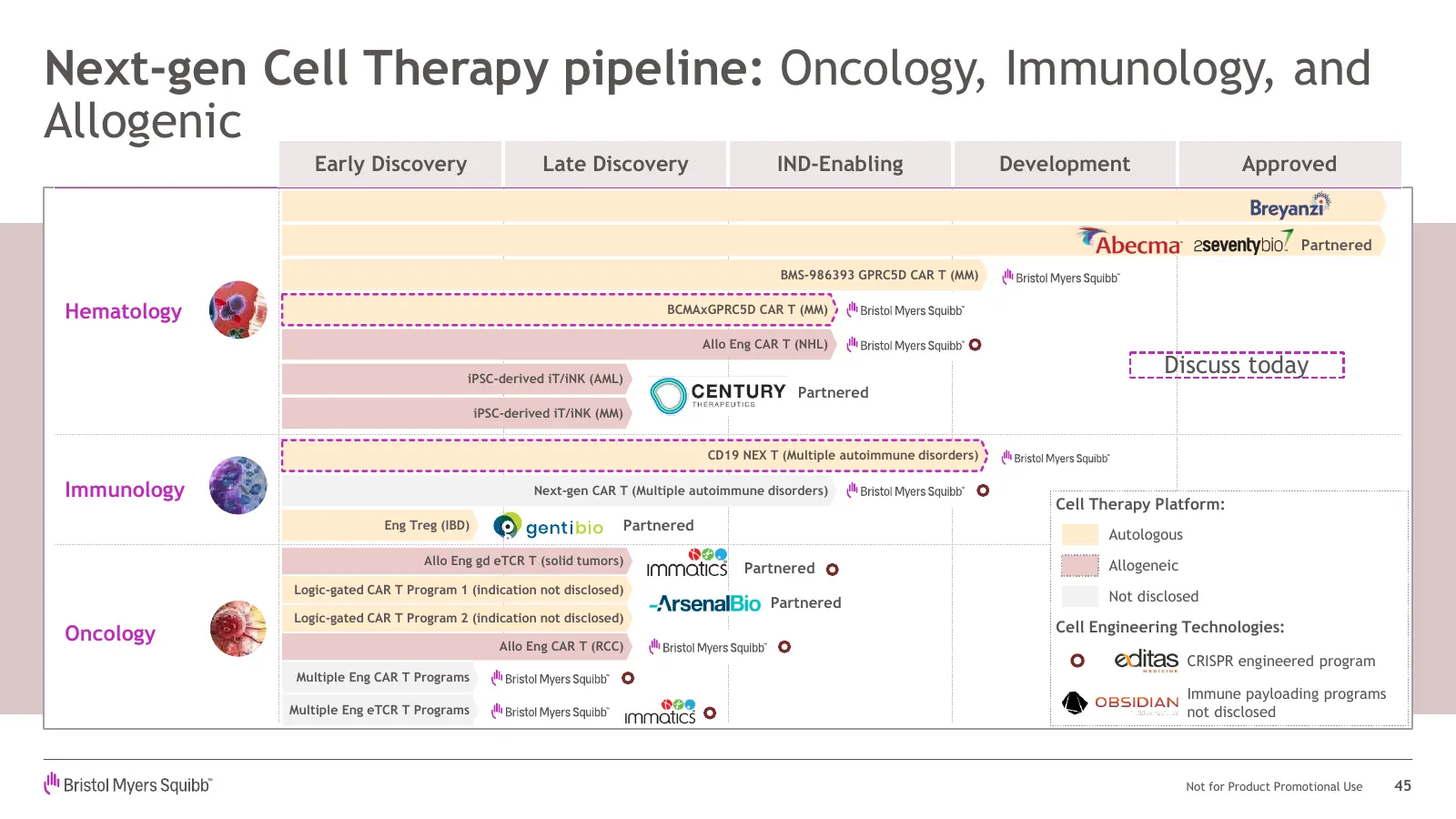
Slide 45: Next-gen Cell Therapy pipeline: Oncology, Immunology, and Allogenic
Next-gen Cell Therapy pipeline: Oncology, Immunology, and Allogenic Early Discovery Late Discovery IND-Enabling Development Approved Partnered BMS-986393 GPRC5D CAR T (MM) Hematology BCMAxGPRC5D CAR T (MM) Allo Eng CAR T (NHL) iPSC-derived iT/iNK (AML) Discuss today Partnered iPSC-derived iT/iNK (MM
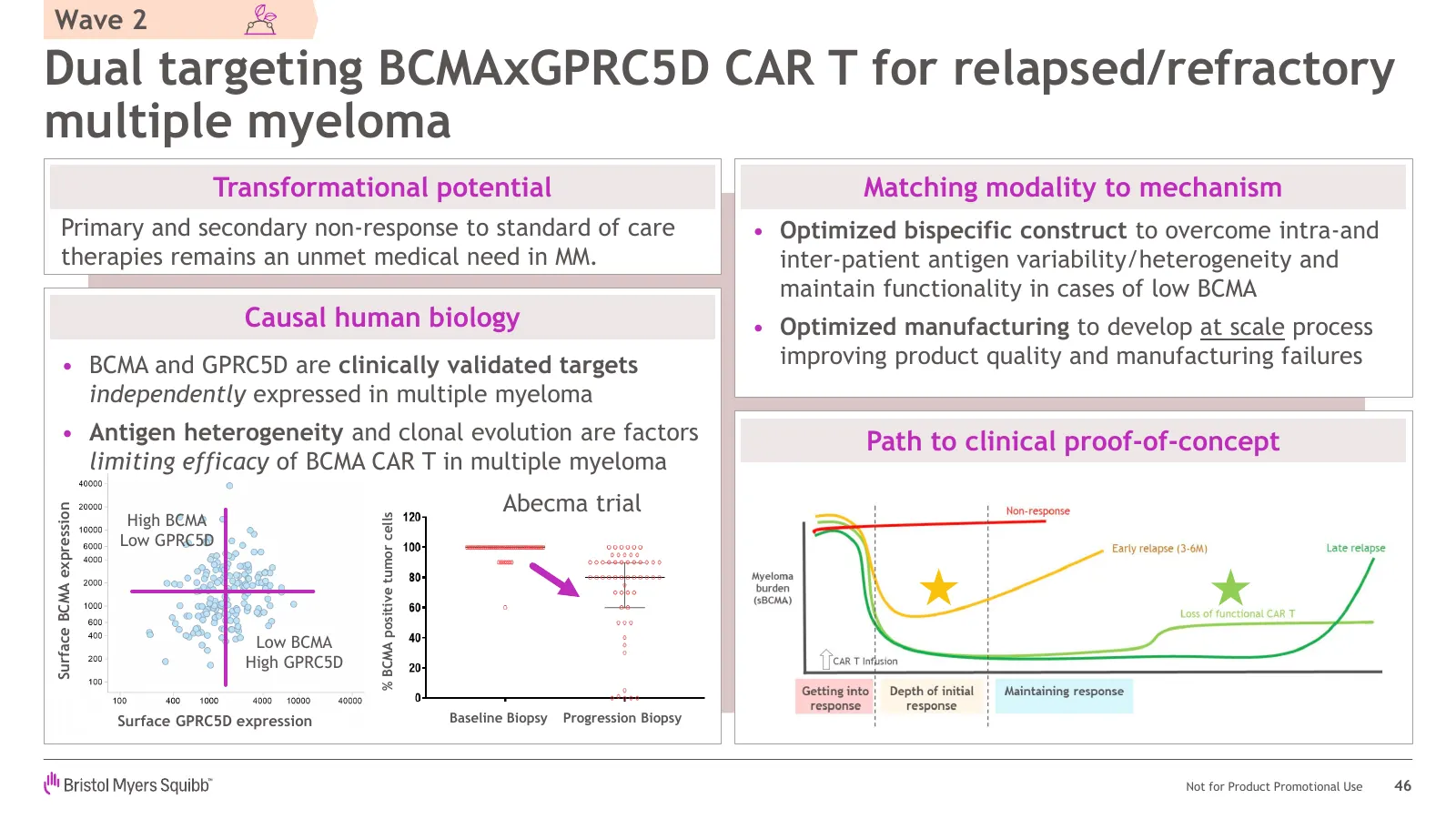
Slide 46: Dual targeting BCMAxGPRC5D CAR T for multiple myeloma
Wave 2 Dual targeting BCMAxGPRC5D CAR T for relapsed/refractory multiple myeloma Transformational potential Matching modality to mechanism Primary and secondary non-response to standard of care • Optimized bispecific construct to overcome intra-and therapies remains an unmet medical need in MM. inte
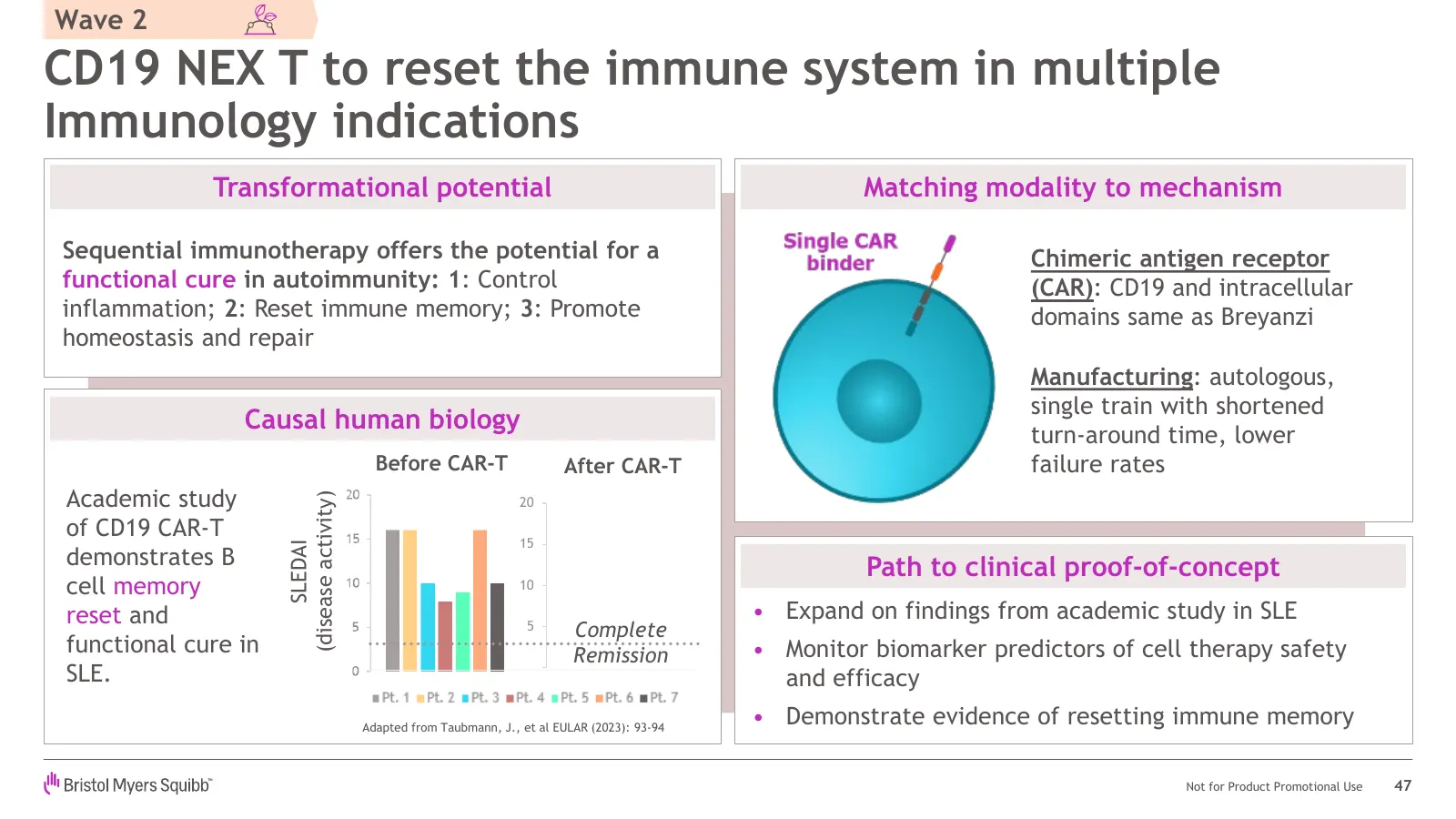
Slide 47: CD19 NEX T to reset the immune system
Wave 2 CD19 NEX T to reset the immune system in multiple Immunology indications Transformational potential Matching modality to mechanism Sequential immunotherapy offers the potential for a Chimeric antigen receptor functional cure in autoimmunity: 1: Control (CAR): CD19 and intracellular inflammati
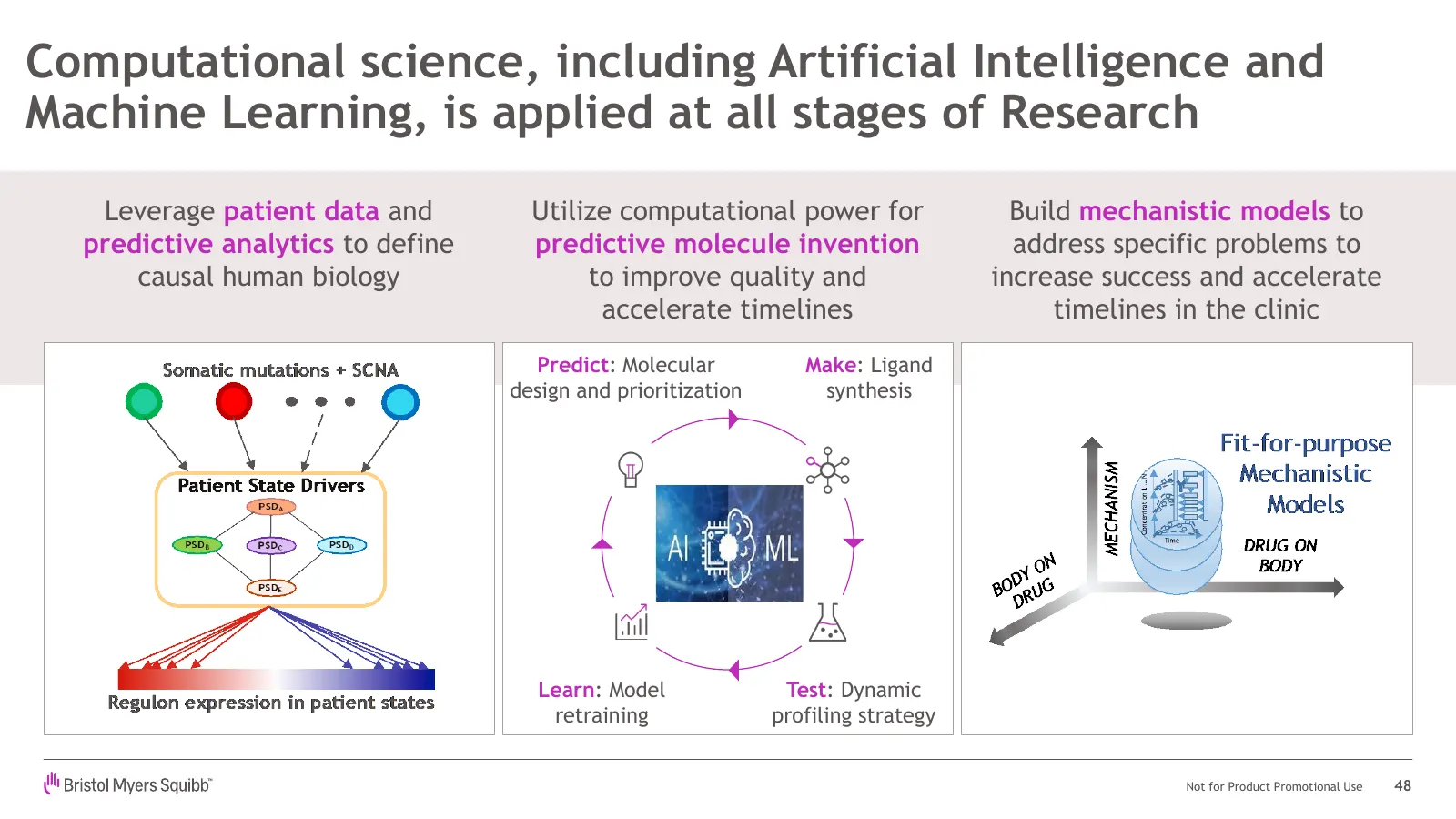
Slide 48: Computational science, AI and Machine Learning applied in Research
Computational science, including Artificial Intelligence and Machine Learning, is applied at all stages of Research Leverage patient data and Utilize computational power for Build mechanistic models to predictive analytics to define predictive molecule invention address specific problems to causal h
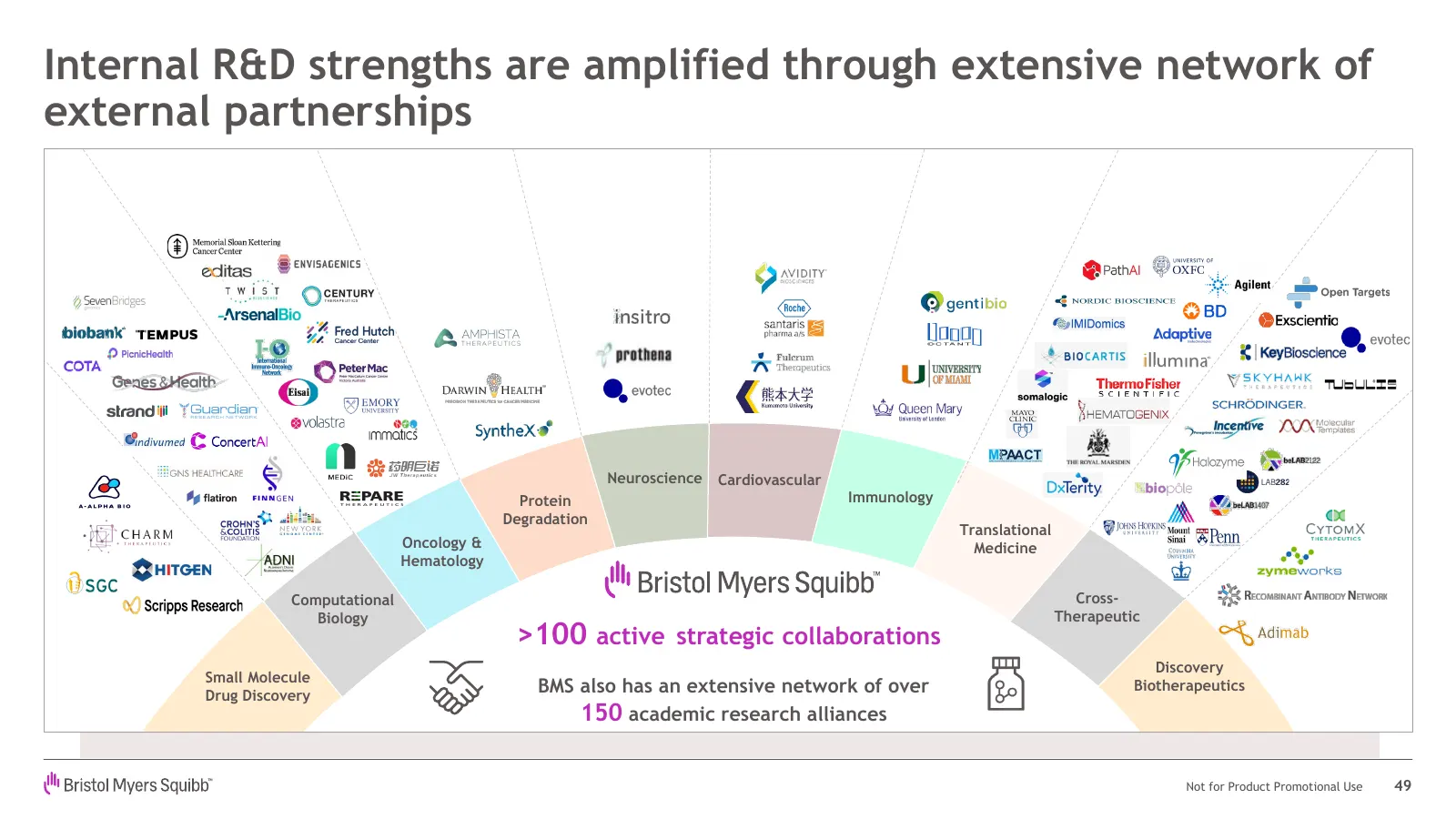
Slide 49: Internal R&D strengths amplified through external partnerships
Internal R&D strengths are amplified through extensive network of external partnerships Neuroscience Cardiovascular Protein Immunology Degradation Translational Oncology & Medicine Hematology Computational Cross- Biology Therapeutic >100 active strategic collaborations Discovery Small Molecule Drug
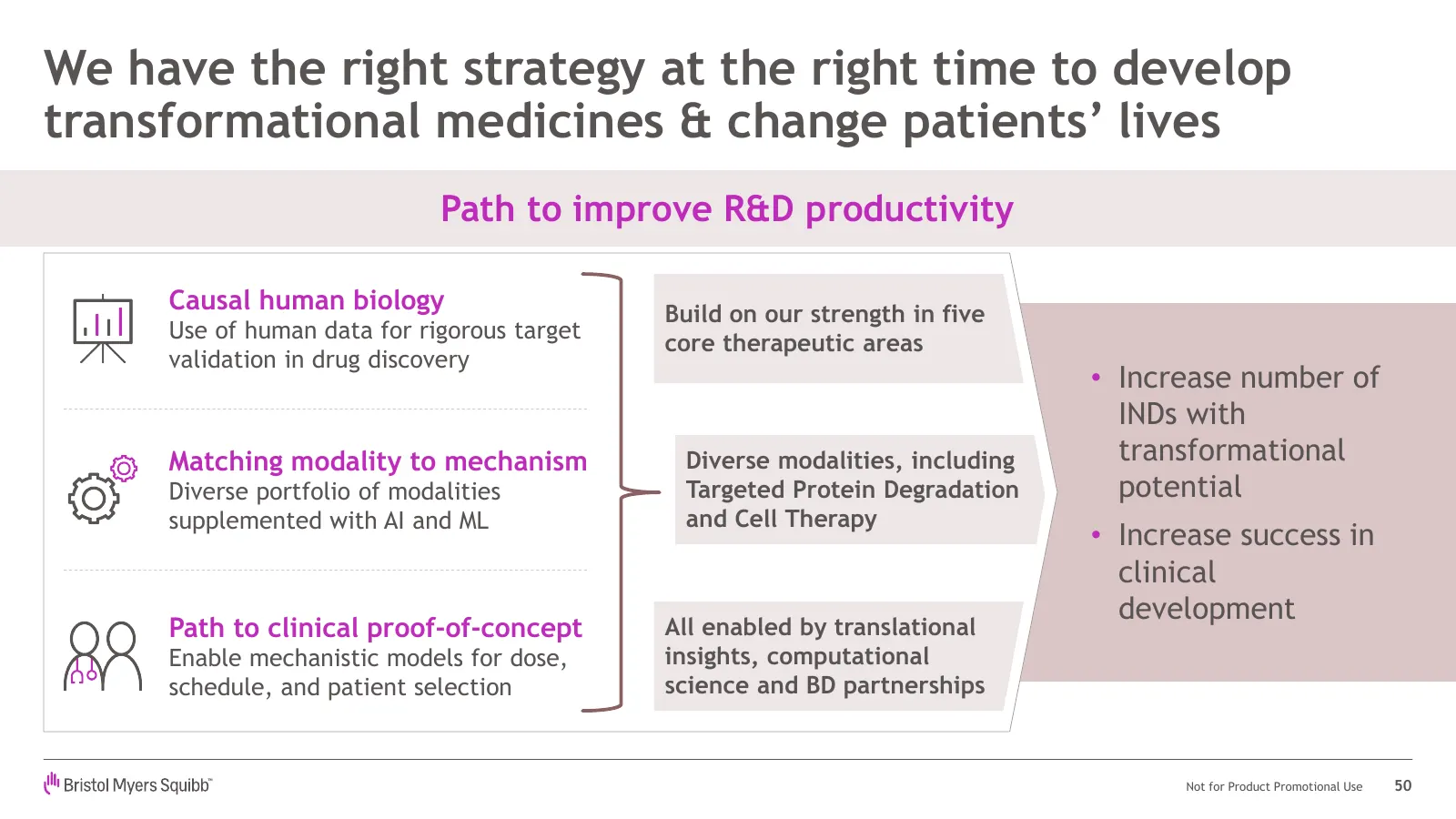
Slide 50: The right strategy at the right time
We have the right strategy at the right time to develop transformational medicines & change patients’ lives Path to improve R&D productivity Causal human biology Build on our strength in five Use of human data for rigorous target core therapeutic areas validation in drug discovery • Increase number
Slide 51: Program will reconvene following a short break
Program will reconvene following a short break (10 min) Not for Product Promotional Use 51
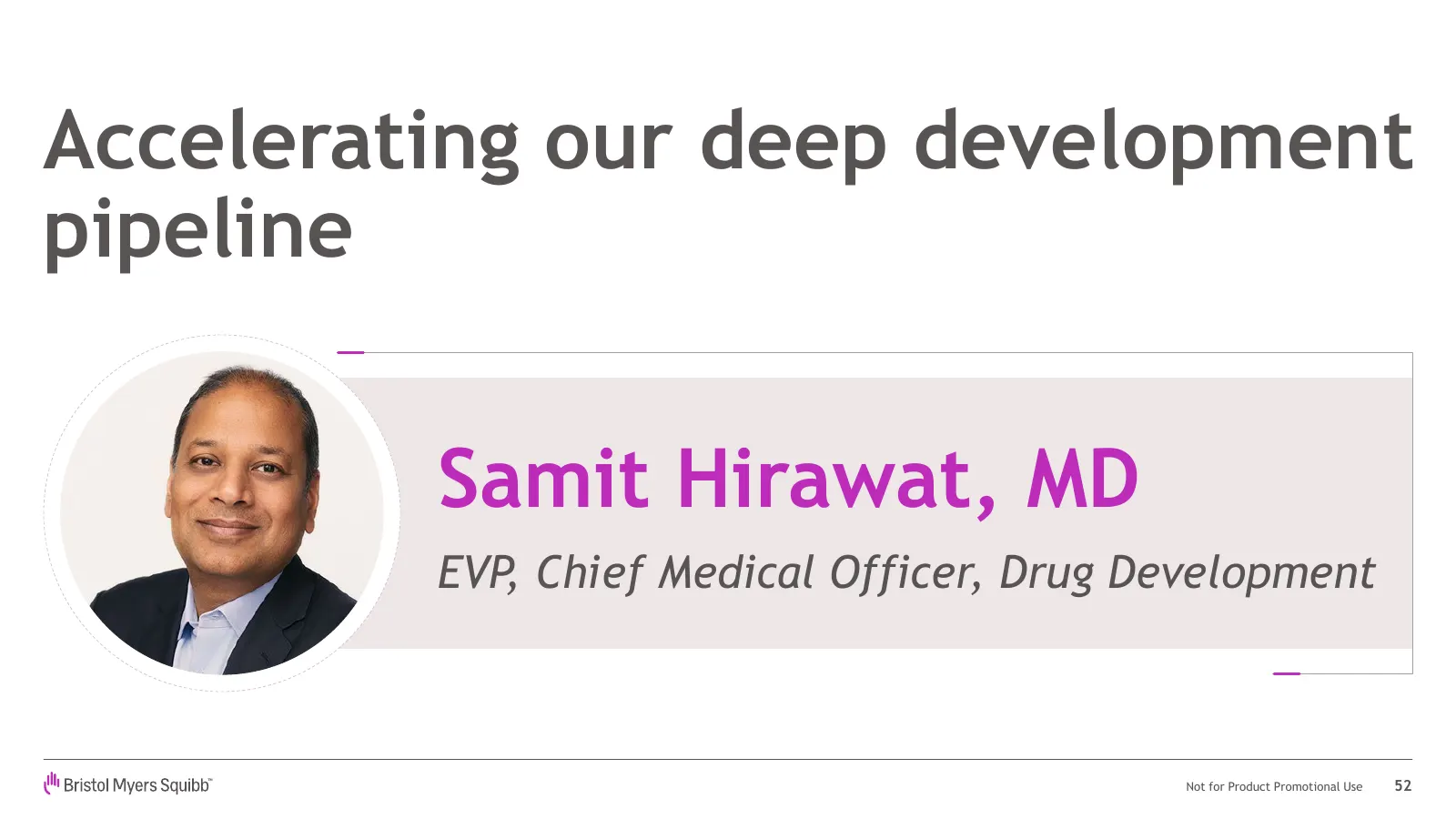
Slide 52: Accelerating our deep development pipeline
Accelerating our deep development pipeline Samit Hirawat, MD EVP, Chief Medical Officer, Drug Development Not for Product Promotional Use 52
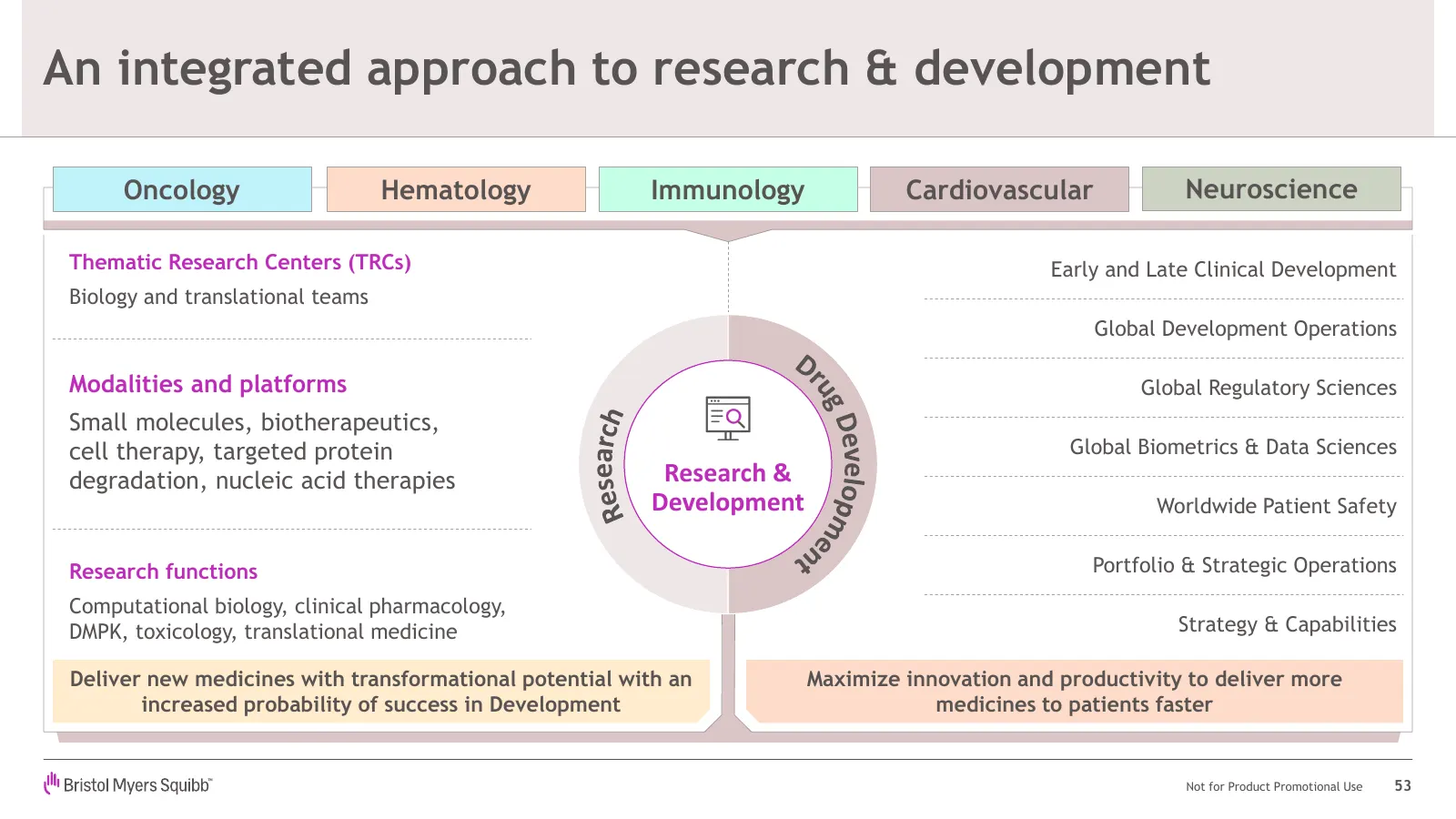
Slide 53: An integrated approach to research & development
An integrated approach to research & development Oncology Hematology Immunology Cardiovascular Neuroscience Thematic Research Centers (TRCs) Early and Late Clinical Development Biology and translational teams Global Development Operations Modalities and platforms Global Regulatory Sciences Small mol
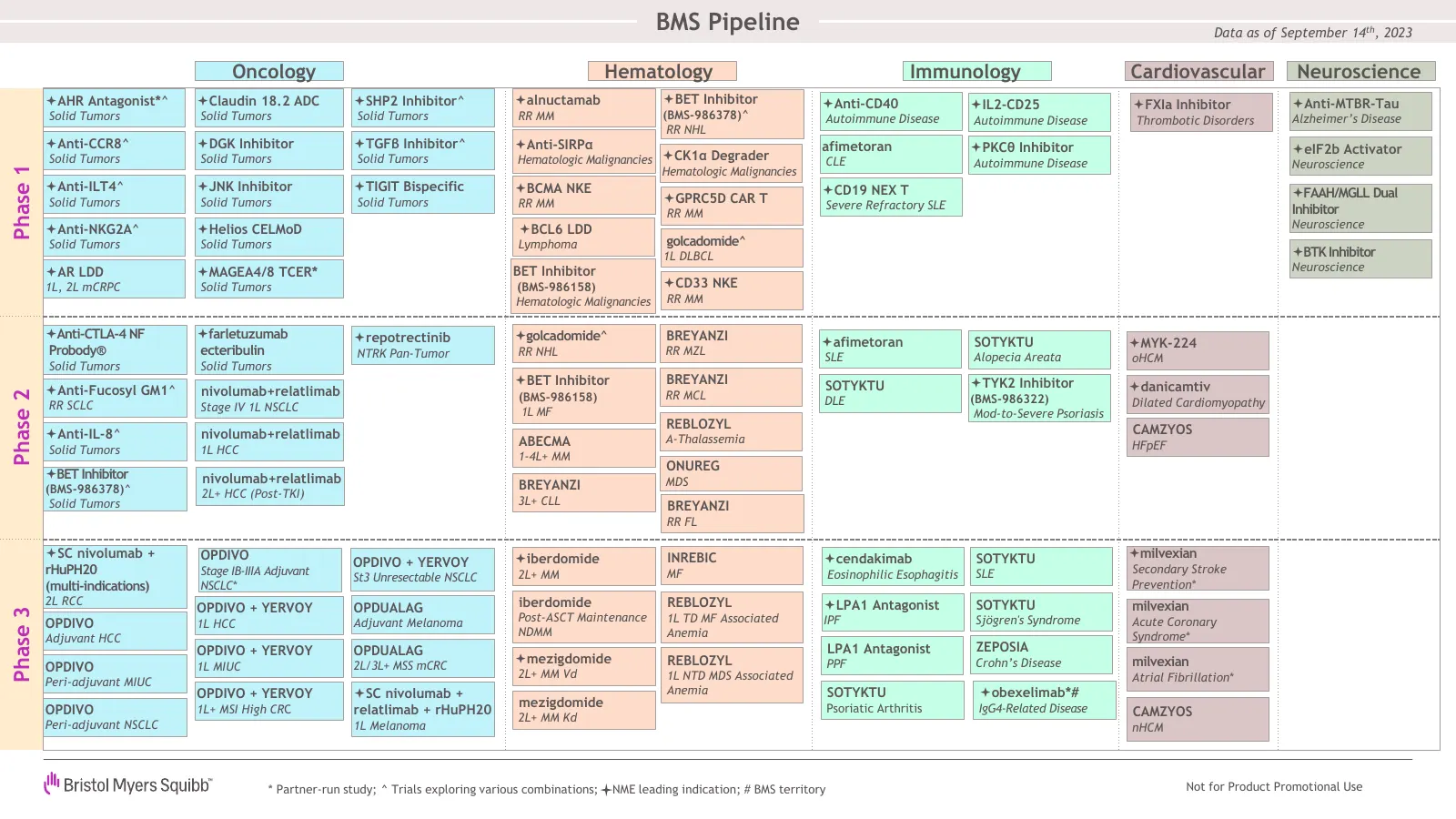
Slide 54: BMS Pipeline
BMS Pipeline Data as of September 14th, 2023 Oncology Hematology Immunology Cardiovascular Neuroscience AHR Antagonist*^ Claudin 18.2 ADC SHP2 Inhibitor^ alnuctamab BET Inhibitor Anti-CD40 IL2-CD25 FXIa Inhibitor Anti-MTBR-Tau Solid Tumors Solid Tumors Solid Tumors RR MM (BMS-986378)^ Autoi
Slide 55: Immunology
Immunology Not for Product Promotional Use 55
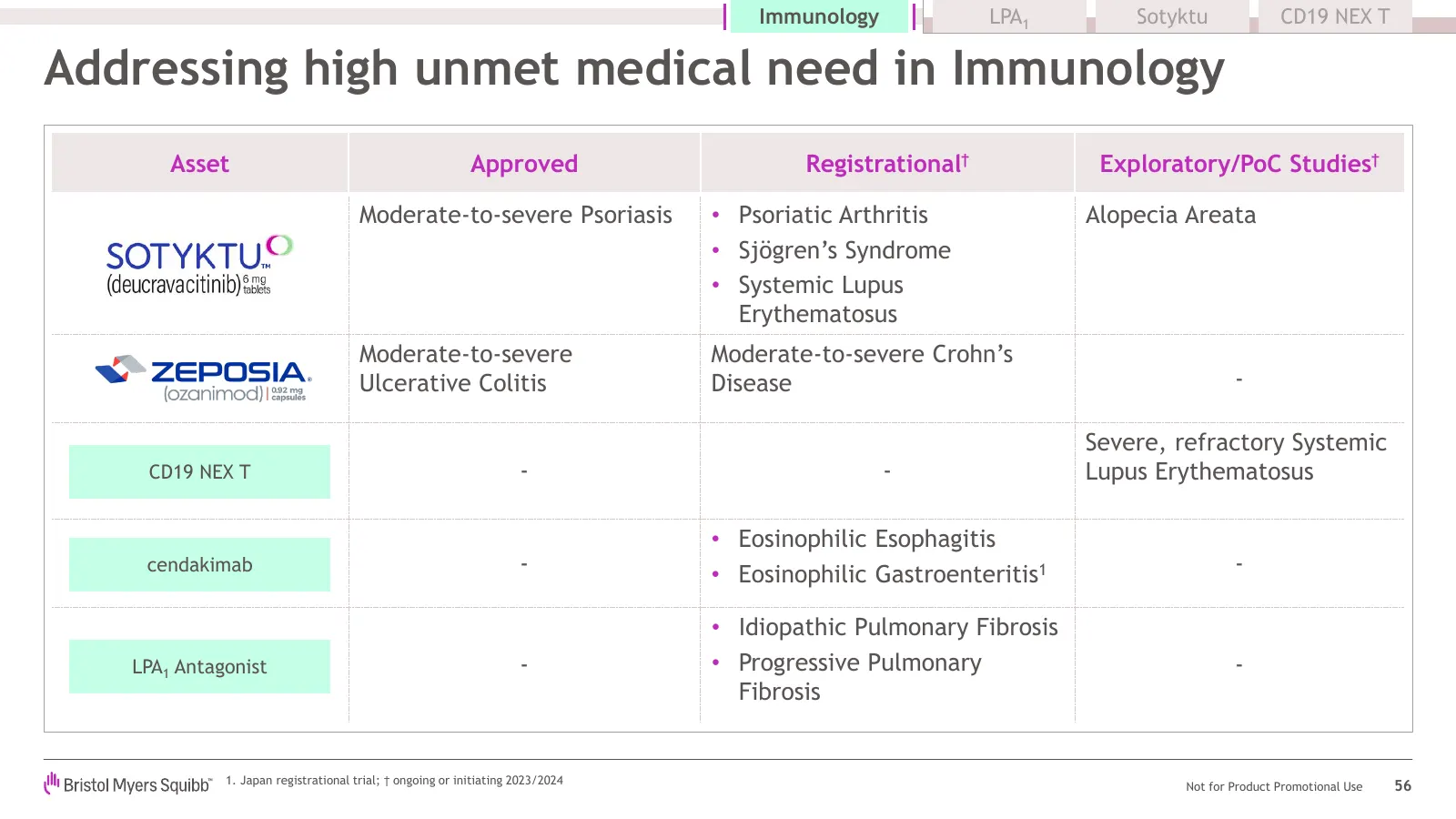
Slide 56: Addressing high unmet medical need in Immunology
Immunology LPA1 Sotyktu CD19 NEX T Addressing high unmet medical need in Immunology Asset Approved Registrational† Exploratory/PoC Studies† Moderate-to-severe Psoriasis • Psoriatic Arthritis Alopecia Areata • Sjögren’s Syndrome • Systemic Lupus Erythematosus Moderate-to-severe Moderate-to-severe Cro
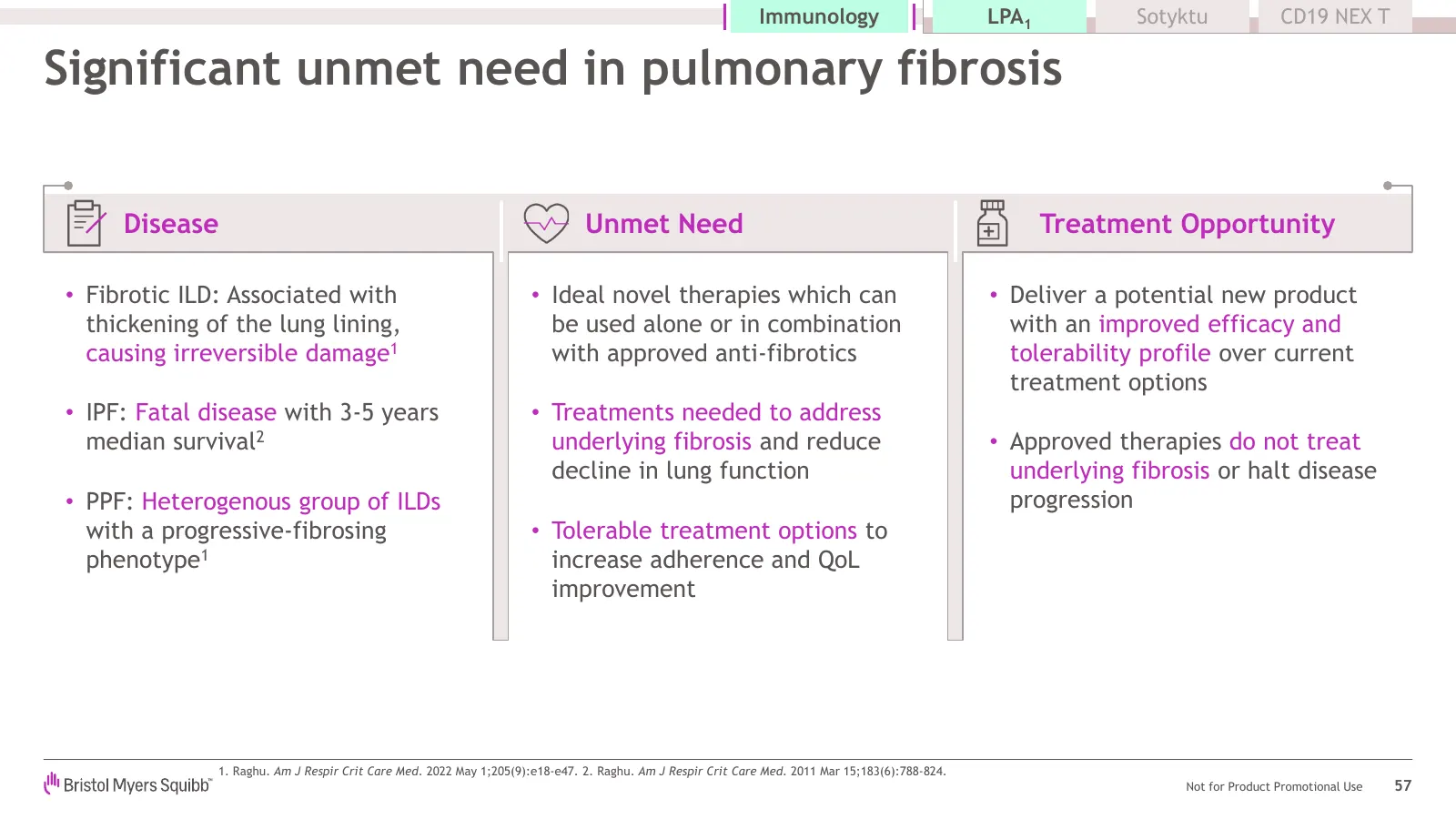
Slide 57: Significant unmet need in pulmonary fibrosis
Immunology LPA1 Sotyktu CD19 NEX T Significant unmet need in pulmonary fibrosis Disease Unmet Need Treatment Opportunity • Fibrotic ILD: Associated with • Ideal novel therapies which can • Deliver a potential new product thickening of the lung lining, be used alone or in combination with an improved
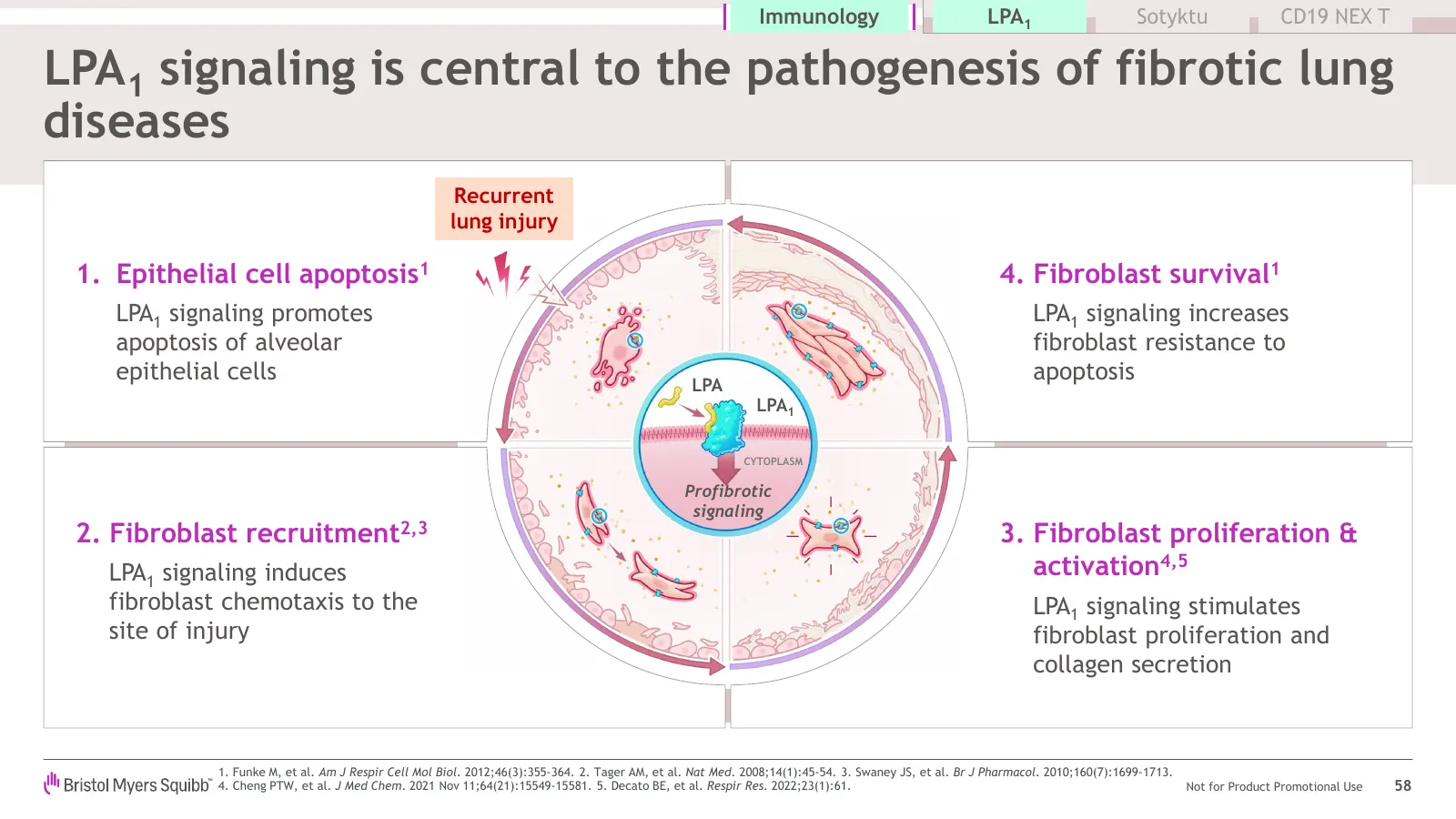
Slide 58: LPA1 signaling is central to fibrotic lung diseases
Immunology LPA1 Sotyktu CD19 NEX T LPA1 signaling is central to the pathogenesis of fibrotic lung diseases Recurrent lung injury 1. Epithelial cell apoptosis1 4. Fibroblast survival1 LPA1 signaling promotes LPA1 signaling increases apoptosis of alveolar fibroblast resistance to epithelial cells LPA
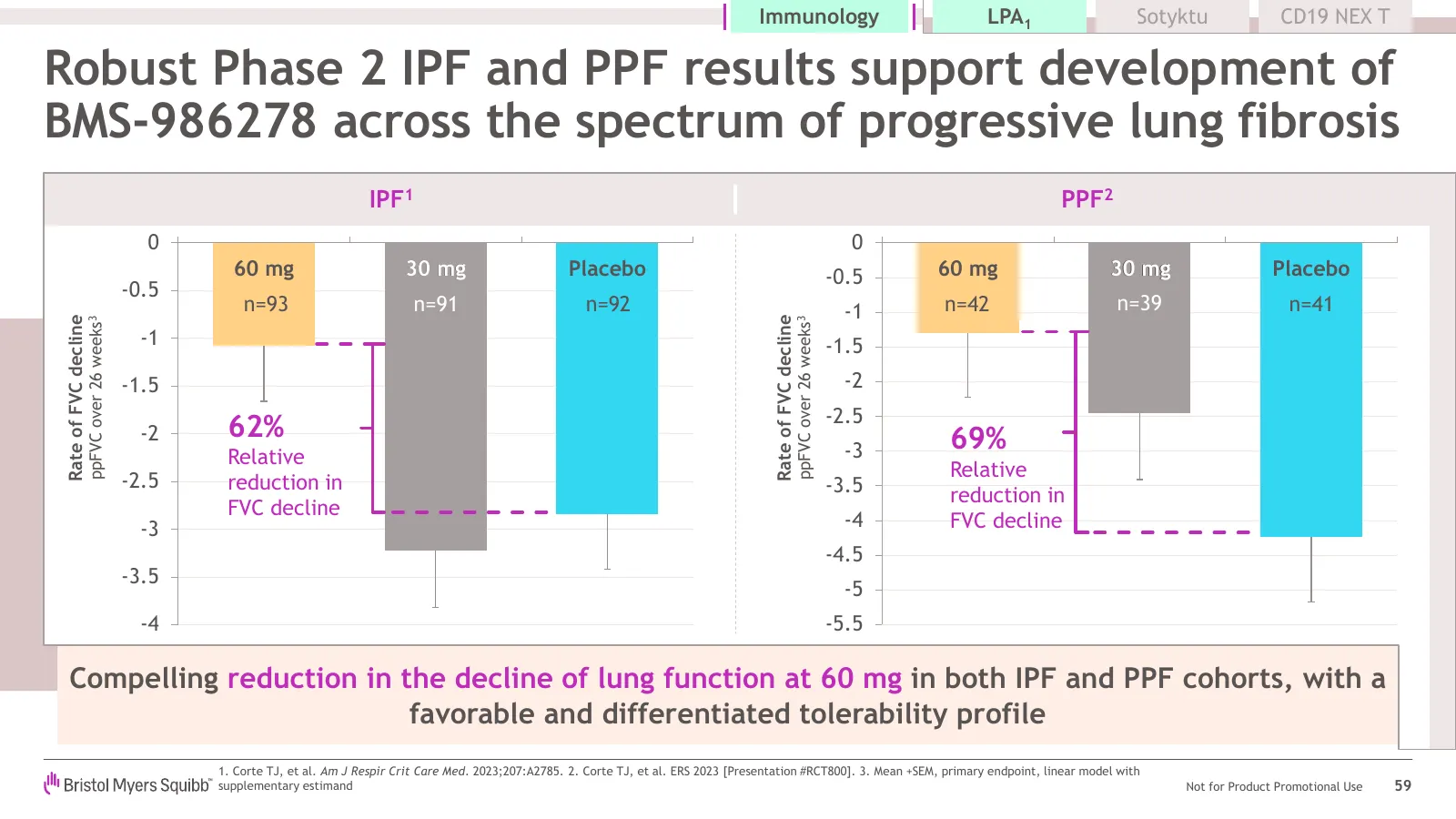
Slide 59: Robust Phase 2 IPF and PPF results support BMS-986278
Immunology LPA1 Sotyktu CD19 NEX T Robust Phase 2 IPF and PPF results support development of BMS-986278 across the spectrum of progressive lung fibrosis IPF1 PPF2 0 0 60 mg 30 mg Placebo -0.5 60 mg 30 mg Placebo -0.5 n=93 n=91 n=92 -1 n=42 n=39 n=41 Rate of FVC decline Rate of FVC decline ppFVC over
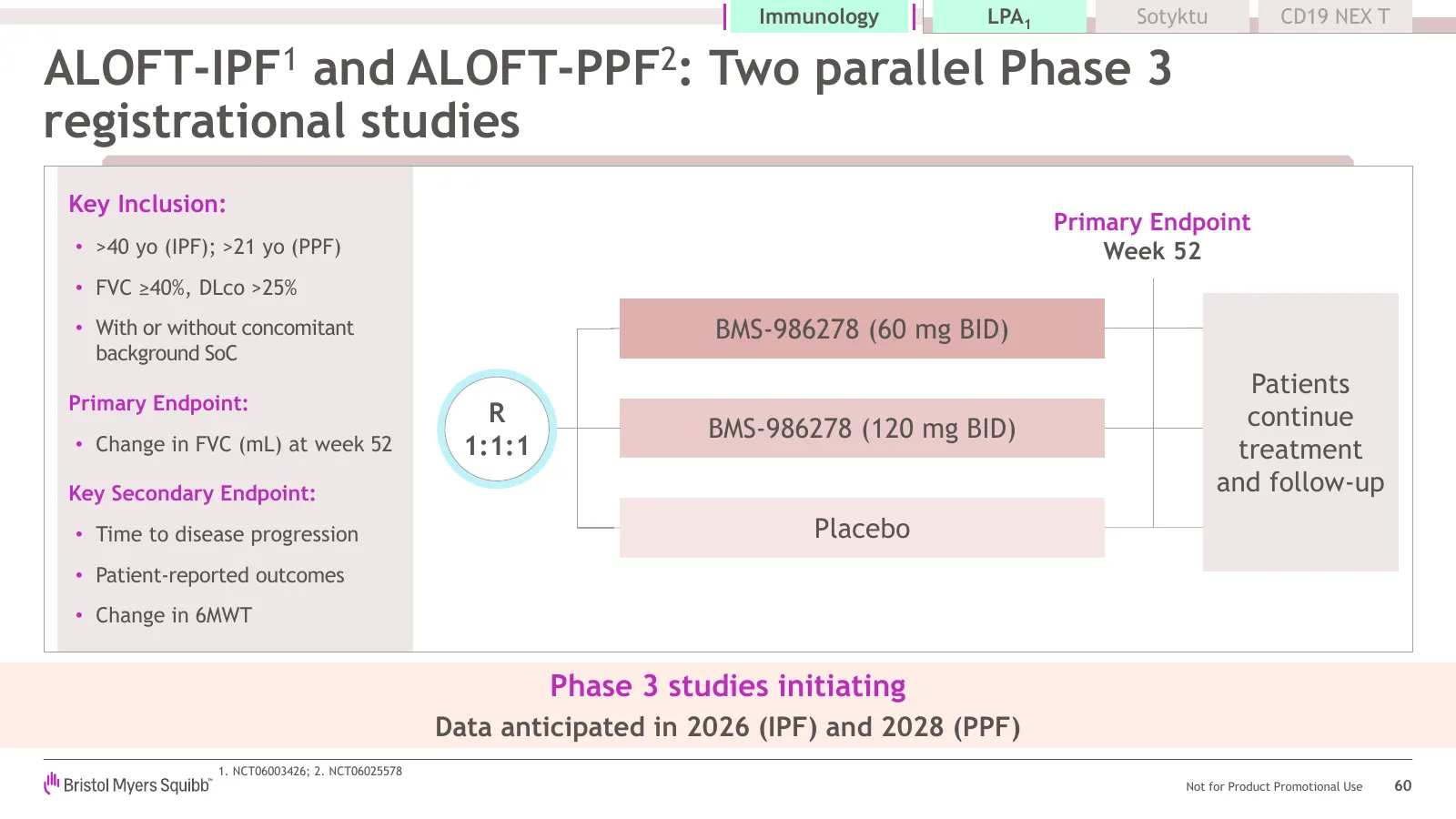
Slide 60: ALOFT-IPF and ALOFT-PPF Phase 3 registrational studies
Immunology LPA1 Sotyktu CD19 NEX T ALOFT-IPF1 and ALOFT-PPF2: Two parallel Phase 3 registrational studies Key Inclusion: Primary Endpoint • >40 yo (IPF); >21 yo (PPF) Week 52 • FVC ≥40%, DLco >25% • With or without concomitant BMS-986278 (60 mg BID) background SoC Patients Primary Endpoint: R contin
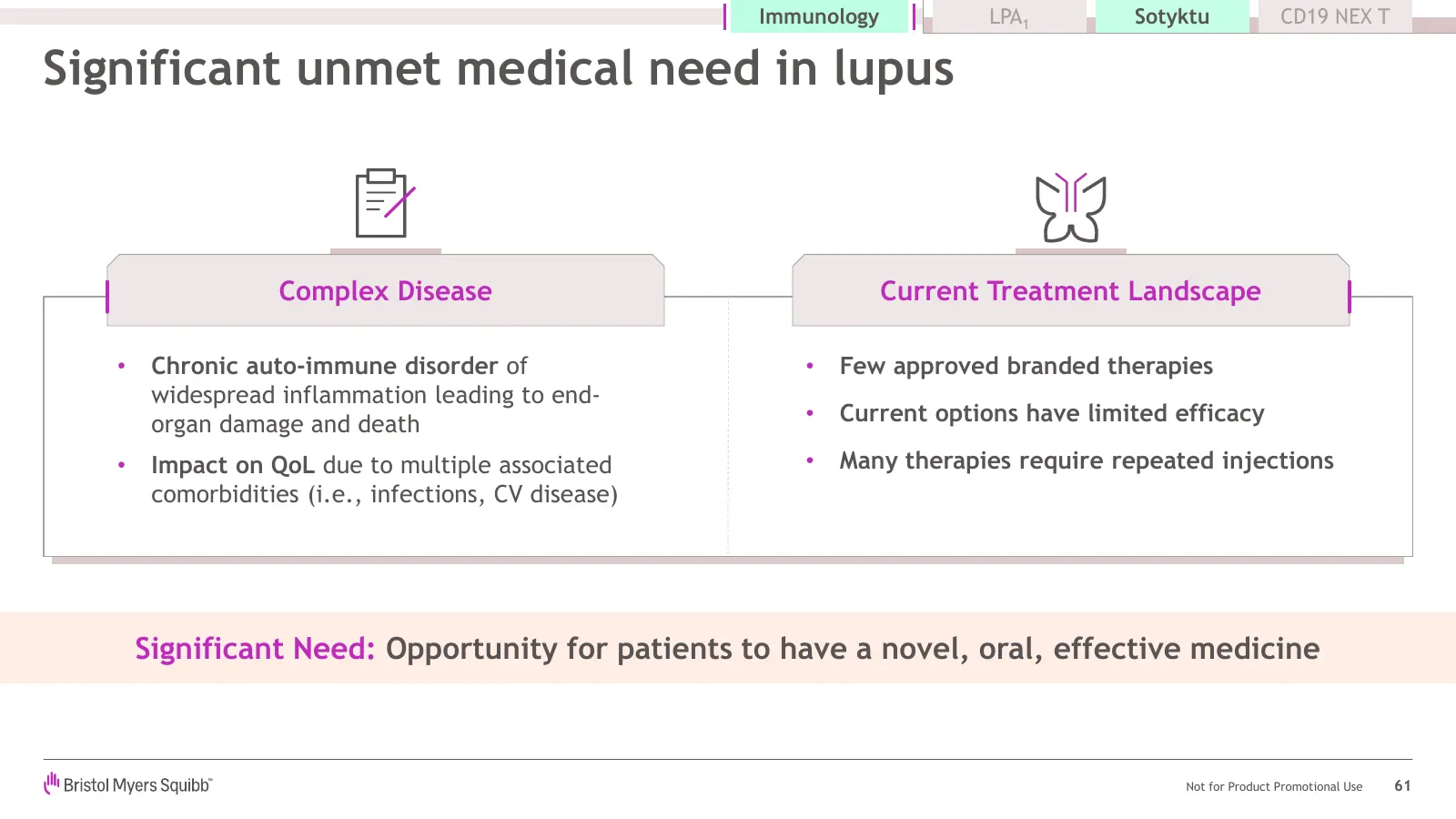
Slide 61: Significant unmet medical need in lupus
Immunology LPA1 Sotyktu CD19 NEX T Significant unmet medical need in lupus Complex Disease Current Treatment Landscape • Chronic auto-immune disorder of • Few approved branded therapies widespread inflammation leading to end- organ damage and death • Current options have limited efficacy • Impact on
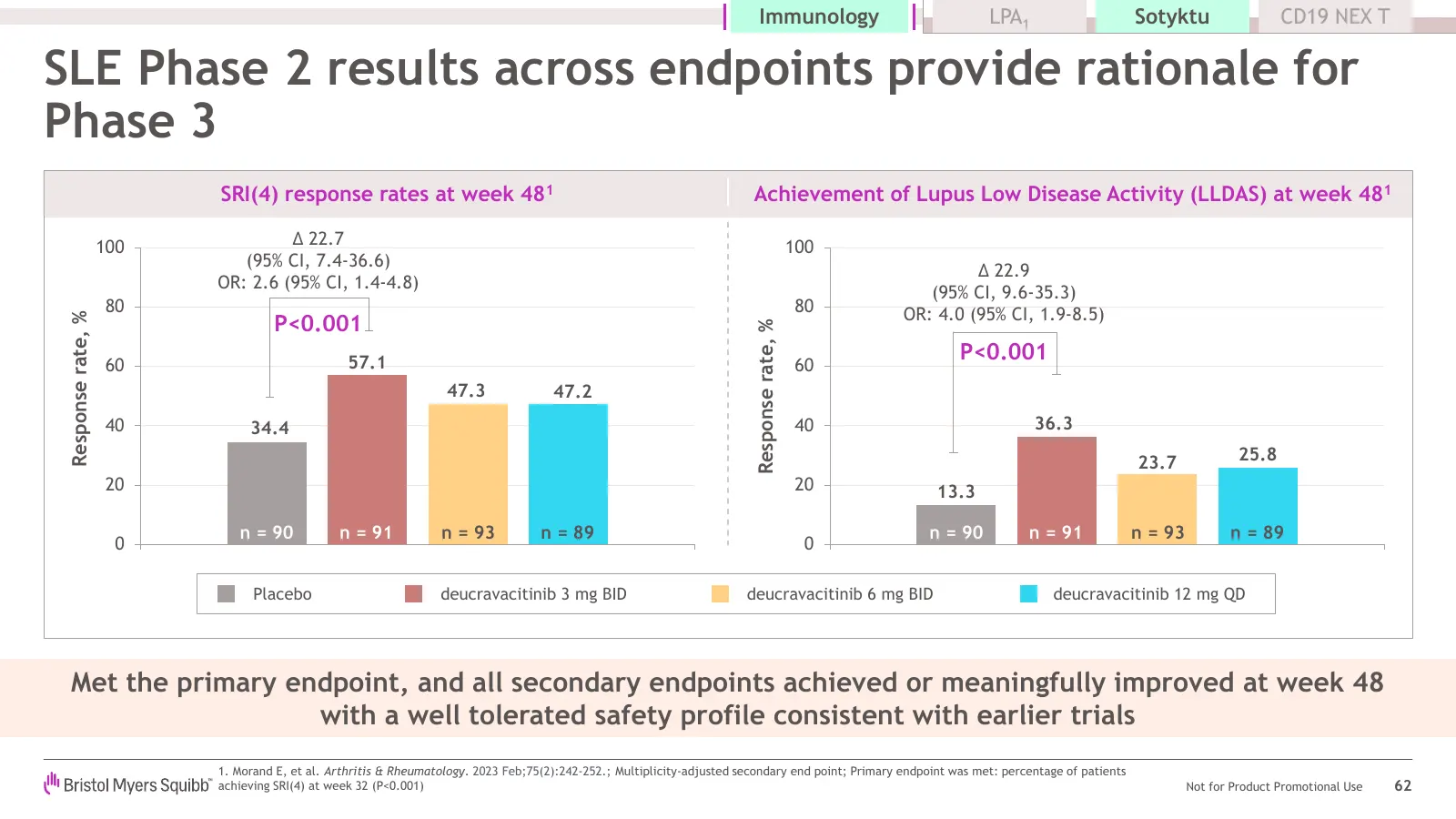
Slide 62: SLE Phase 2 results provide rationale for Phase 3
Immunology LPA1 Sotyktu CD19 NEX T SLE Phase 2 results across endpoints provide rationale for Phase 3 SRI(4) response rates at week 481 Achievement of Lupus Low Disease Activity (LLDAS) at week 481 100 Δ 22.7 100 (95% CI, 7.4-36.6) Δ 22.9 OR: 2.6 (95% CI, 1.4-4.8) (95% CI, 9.6-35.3) 80 80 OR: 4.0 (9
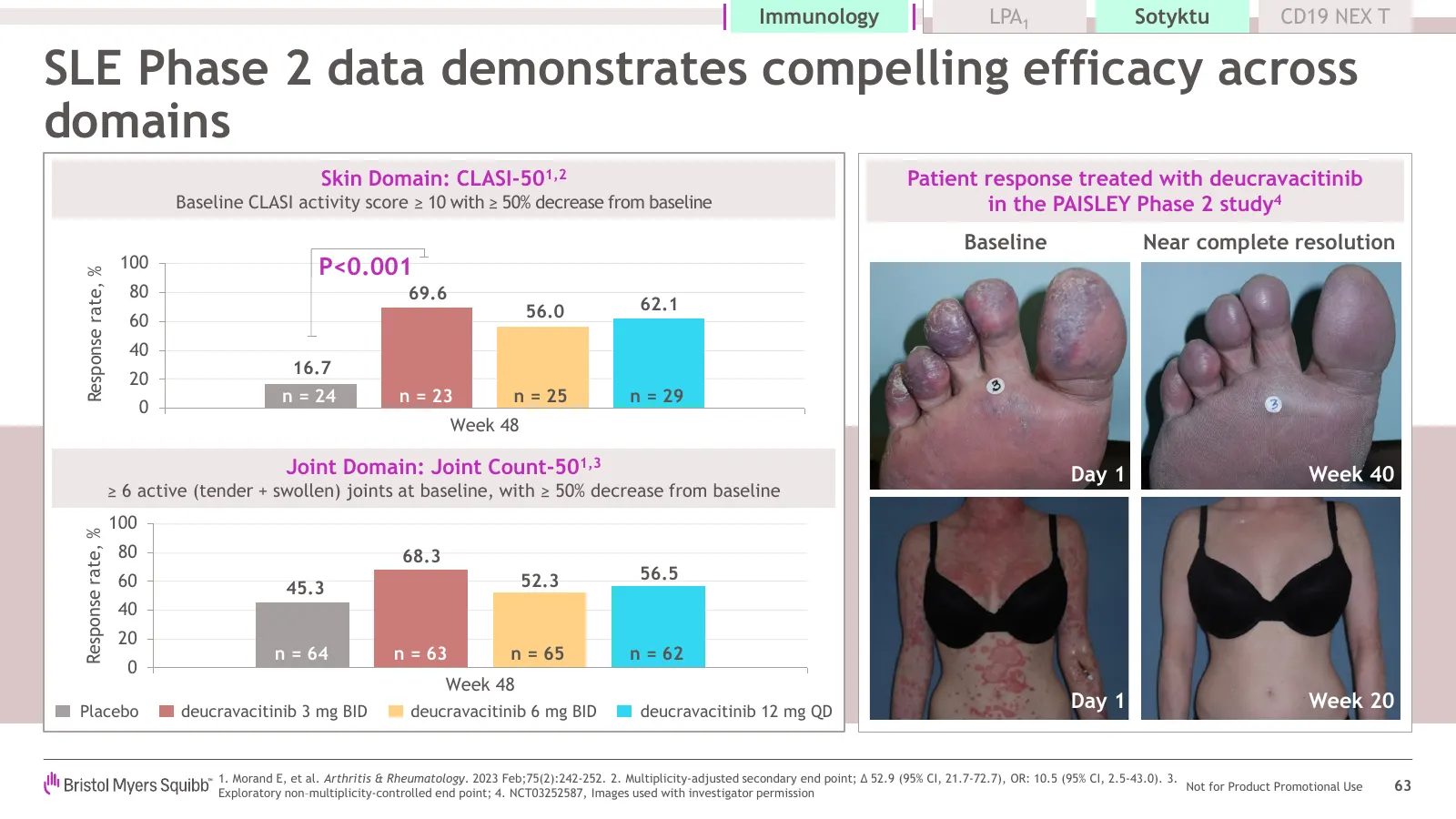
Slide 63: SLE Phase 2 data demonstrates efficacy across domains
Immunology LPA1 Sotyktu CD19 NEX T SLE Phase 2 data demonstrates compelling efficacy across domains Skin Domain: CLASI-501,2 Patient response treated with deucravacitinib Baseline CLASI activity score ≥ 10 with ≥ 50% decrease from baseline in the PAISLEY Phase 2 study4 Baseline Near complete resolut
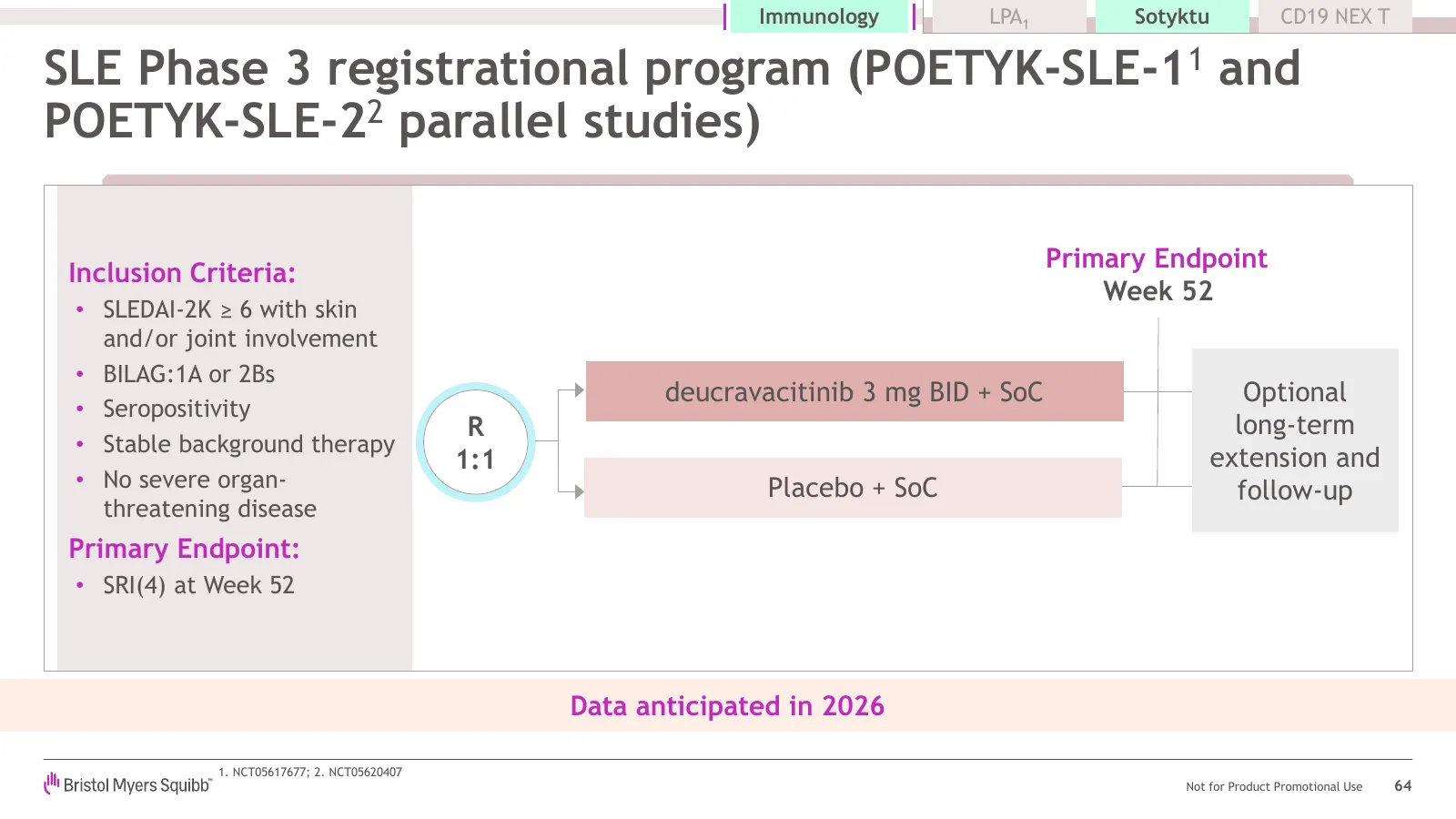
Slide 64: SLE Phase 3 registrational program
Immunology LPA1 Sotyktu CD19 NEX T SLE Phase 3 registrational program (POETYK-SLE-11 and POETYK-SLE-22 parallel studies) Primary Endpoint Inclusion Criteria: Week 52 • SLEDAI-2K ≥ 6 with skin and/or joint involvement • BILAG:1A or 2Bs deucravacitinib 3 mg BID + SoC Optional • Seropositivity R long-t
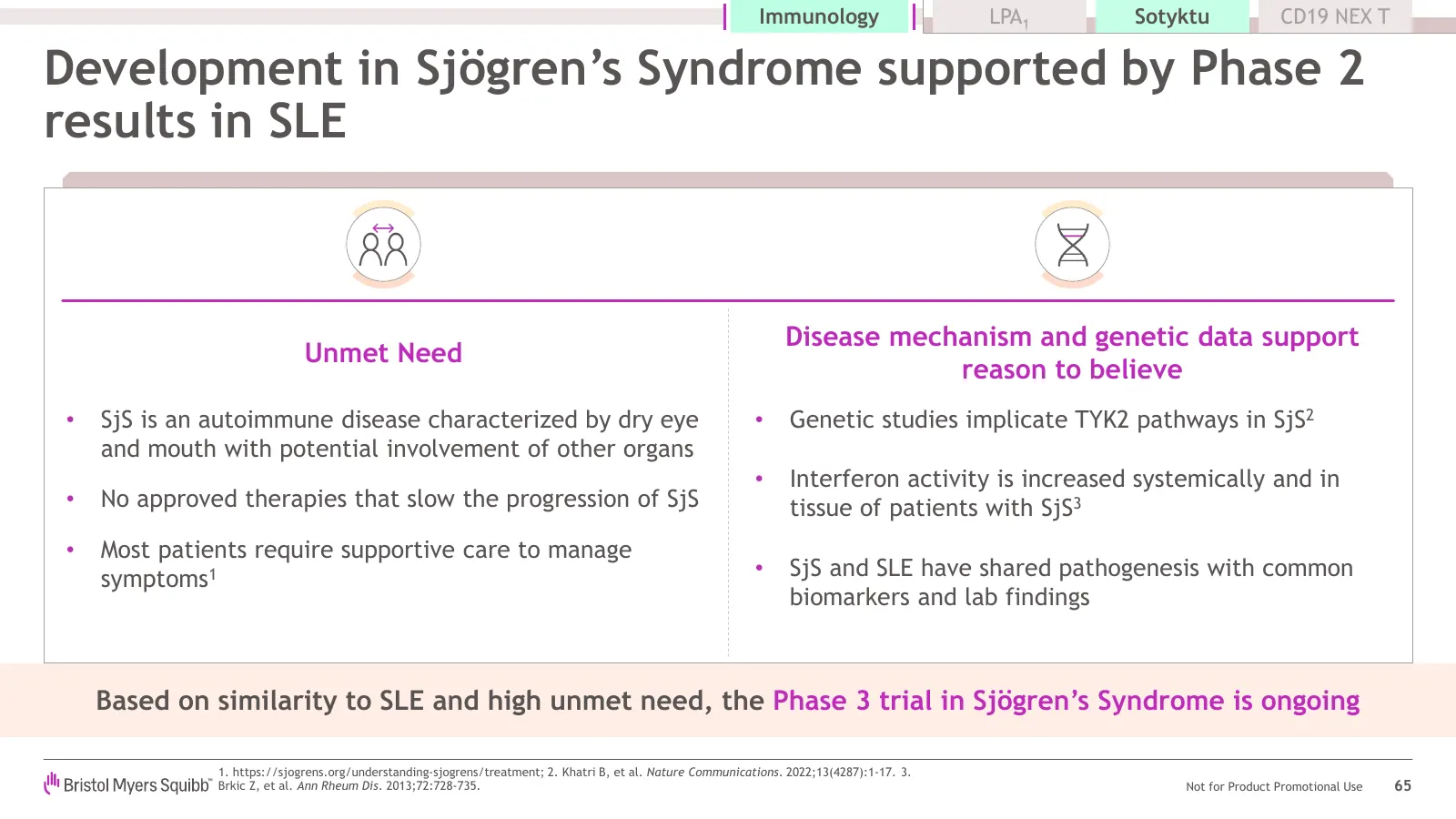
Slide 65: Development in Sjögren's Syndrome supported by Phase 2 SLE results
Immunology LPA1 Sotyktu CD19 NEX T Development in Sjögren’s Syndrome supported by Phase 2 results in SLE Disease mechanism and genetic data support Unmet Need reason to believe • SjS is an autoimmune disease characterized by dry eye • Genetic studies implicate TYK2 pathways in SjS2 and mouth with po
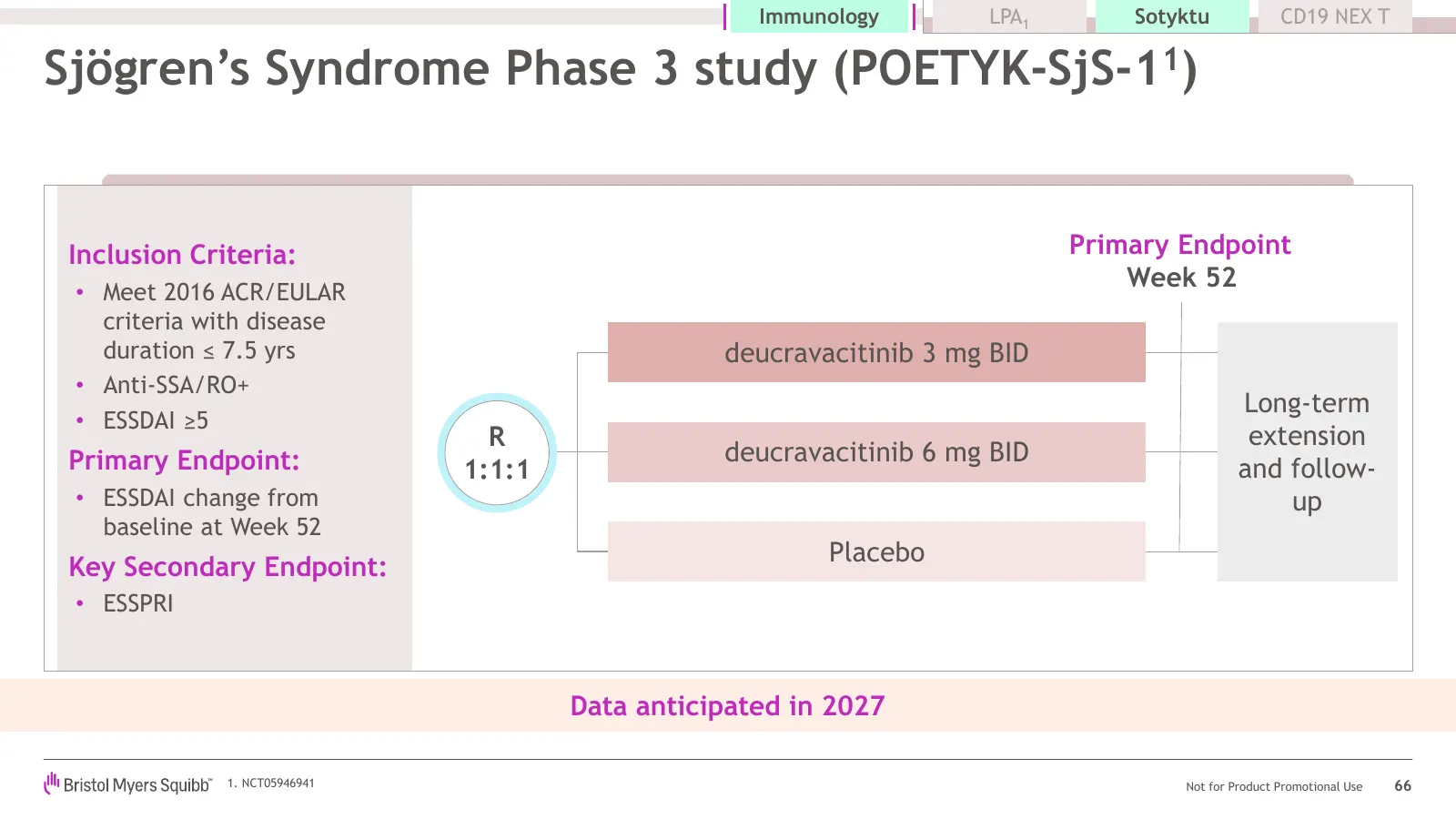
Slide 66: Sjögren's Syndrome Phase 3 study
Immunology LPA1 Sotyktu CD19 NEX T Sjögren’s Syndrome Phase 3 study (POETYK-SjS-11) Inclusion Criteria: Primary Endpoint • Meet 2016 ACR/EULAR Week 52 criteria with disease duration ≤ 7.5 yrs deucravacitinib 3 mg BID • Anti-SSA/RO+ Long-term • ESSDAI ≥5 R extension Primary Endpoint: deucravacitinib
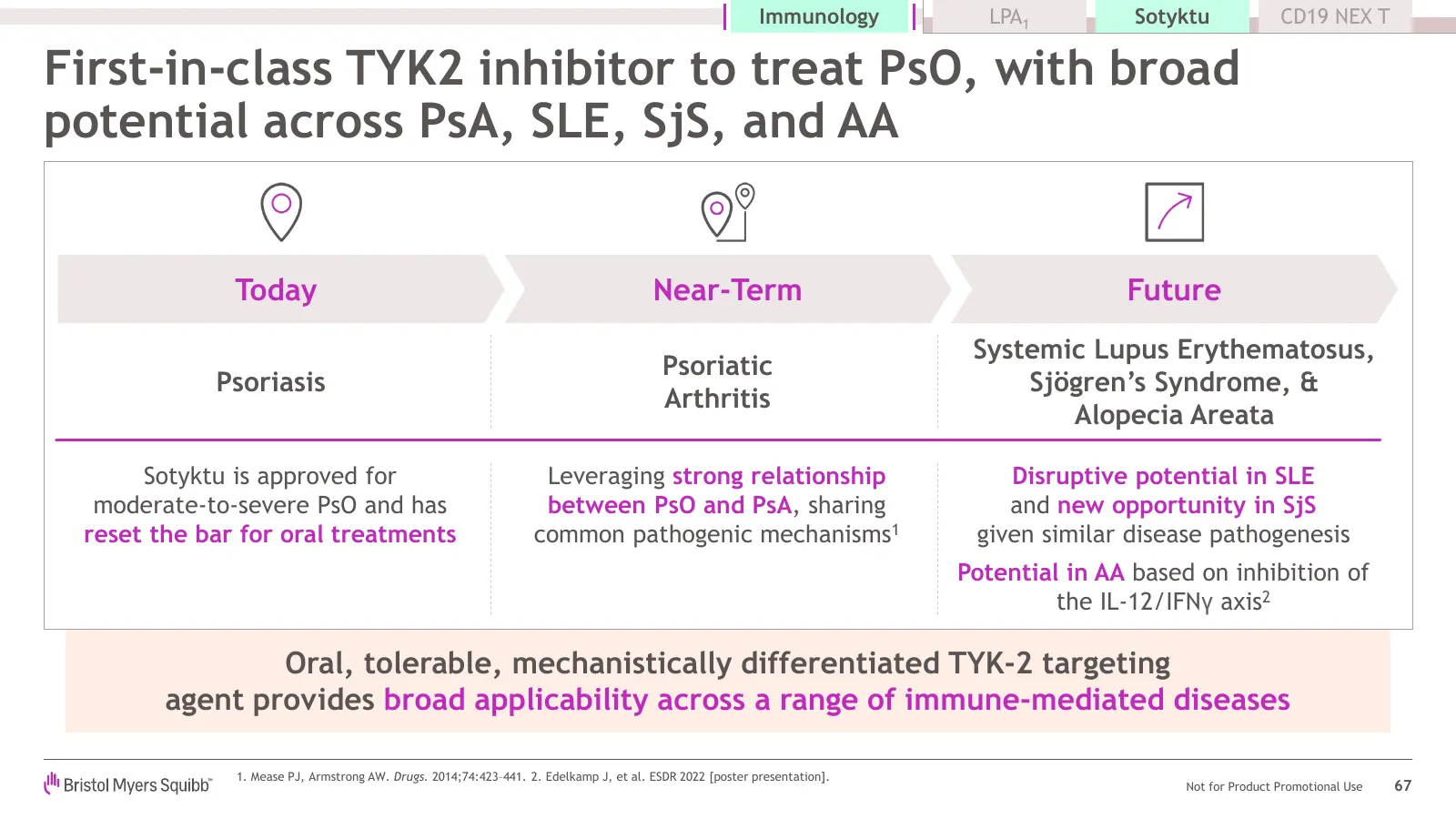
Slide 67: First-in-class TYK2 inhibitor with broad potential
Immunology LPA1 Sotyktu CD19 NEX T First-in-class TYK2 inhibitor to treat PsO, with broad potential across PsA, SLE, SjS, and AA Today Near-Term Future Systemic Lupus Erythematosus, Psoriatic Psoriasis Sjögren’s Syndrome, & Arthritis Alopecia Areata Sotyktu is approved for Leveraging strong relation
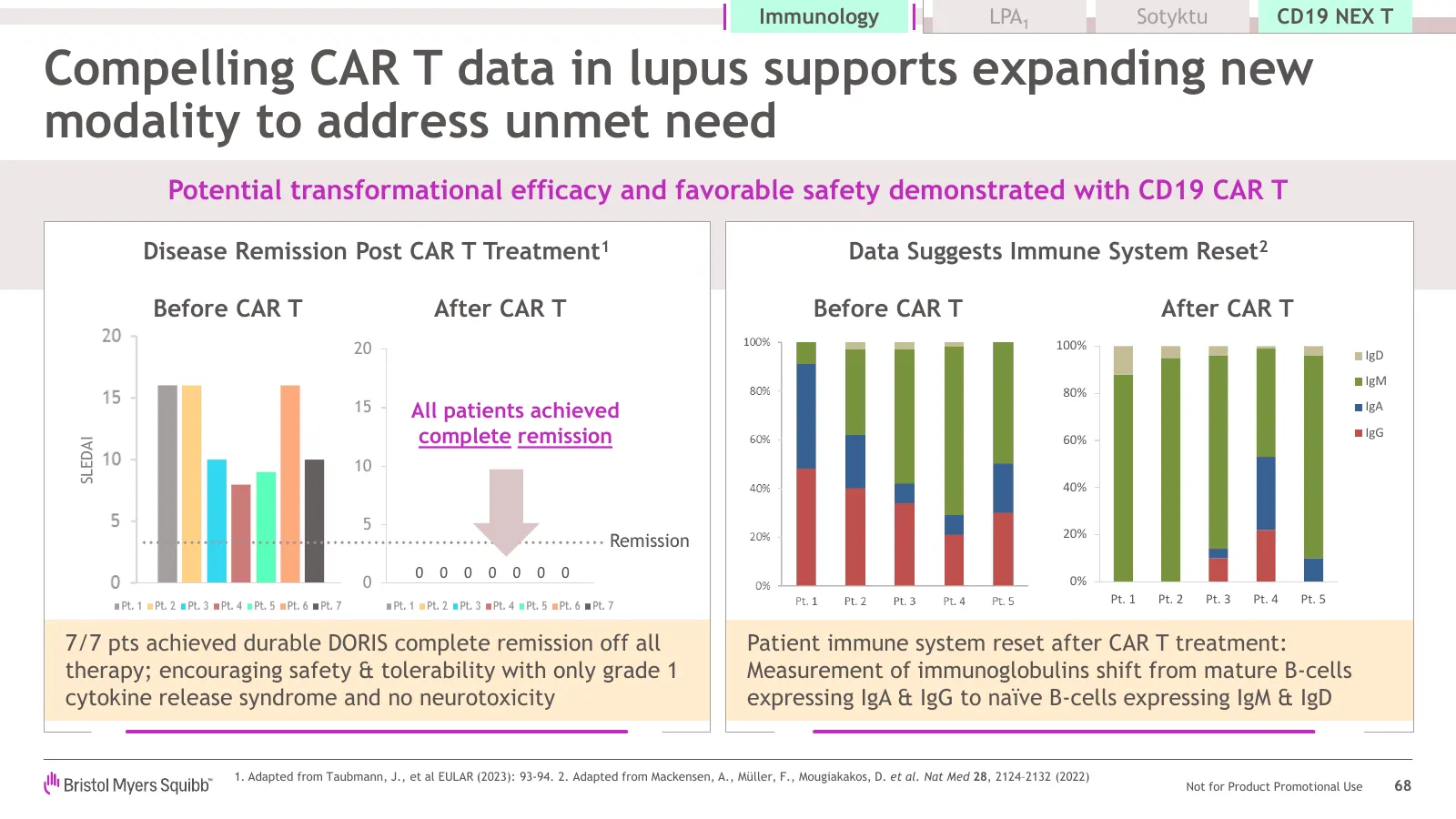
Slide 68: Compelling CAR T data in lupus
Immunology LPA1 Sotyktu CD19 NEX T Compelling CAR T data in lupus supports expanding new modality to address unmet need Potential transformational efficacy and favorable safety demonstrated with CD19 CAR T Disease Remission Post CAR T Treatment1 Data Suggests Immune System Reset2 Before CAR T After
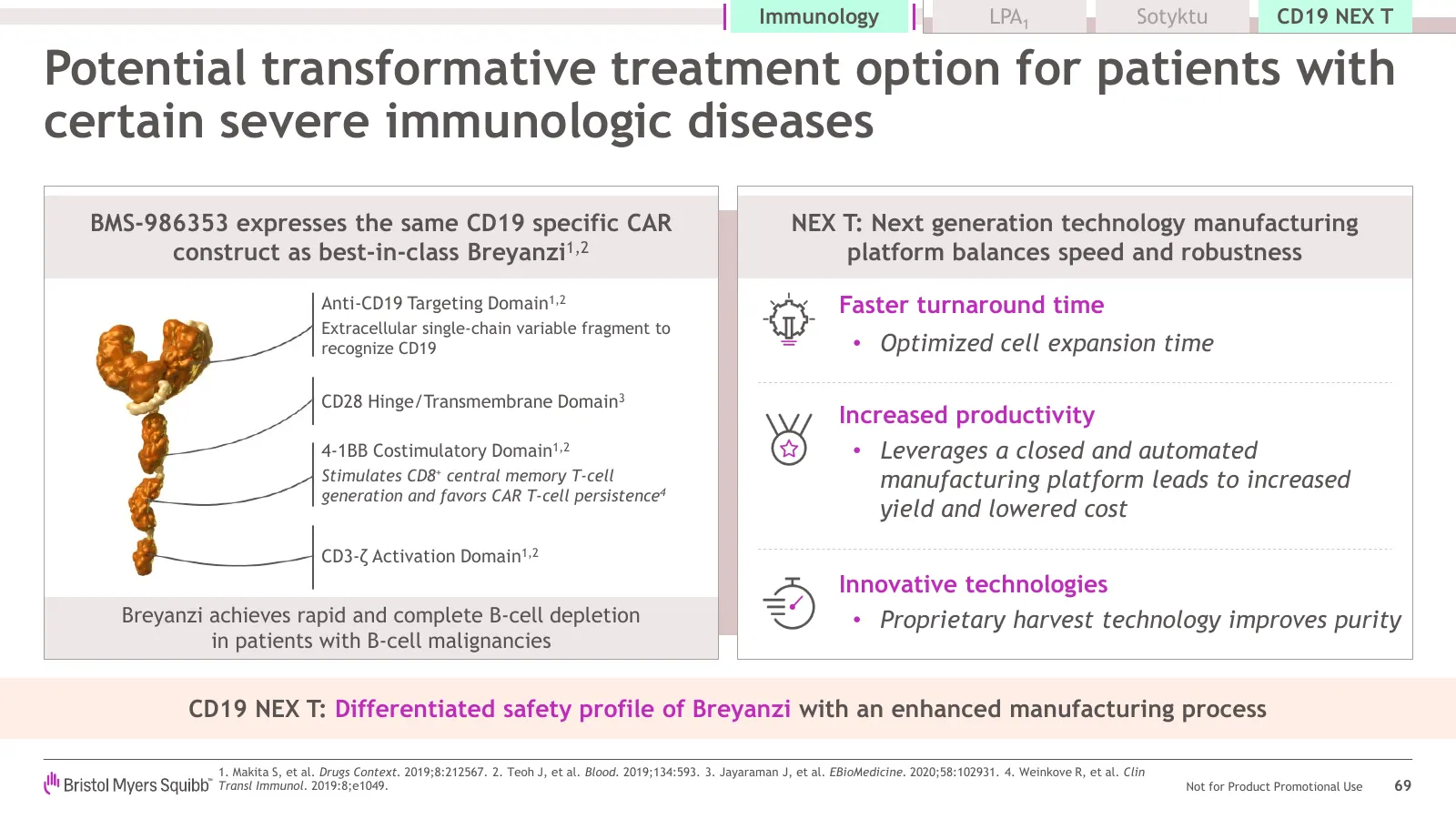
Slide 69: Potential transformative treatment option for severe immunologic diseases
Immunology LPA1 Sotyktu CD19 NEX T Potential transformative treatment option for patients with certain severe immunologic diseases BMS-986353 expresses the same CD19 specific CAR NEX T: Next generation technology manufacturing construct as best-in-class Breyanzi1,2 platform balances speed and robust
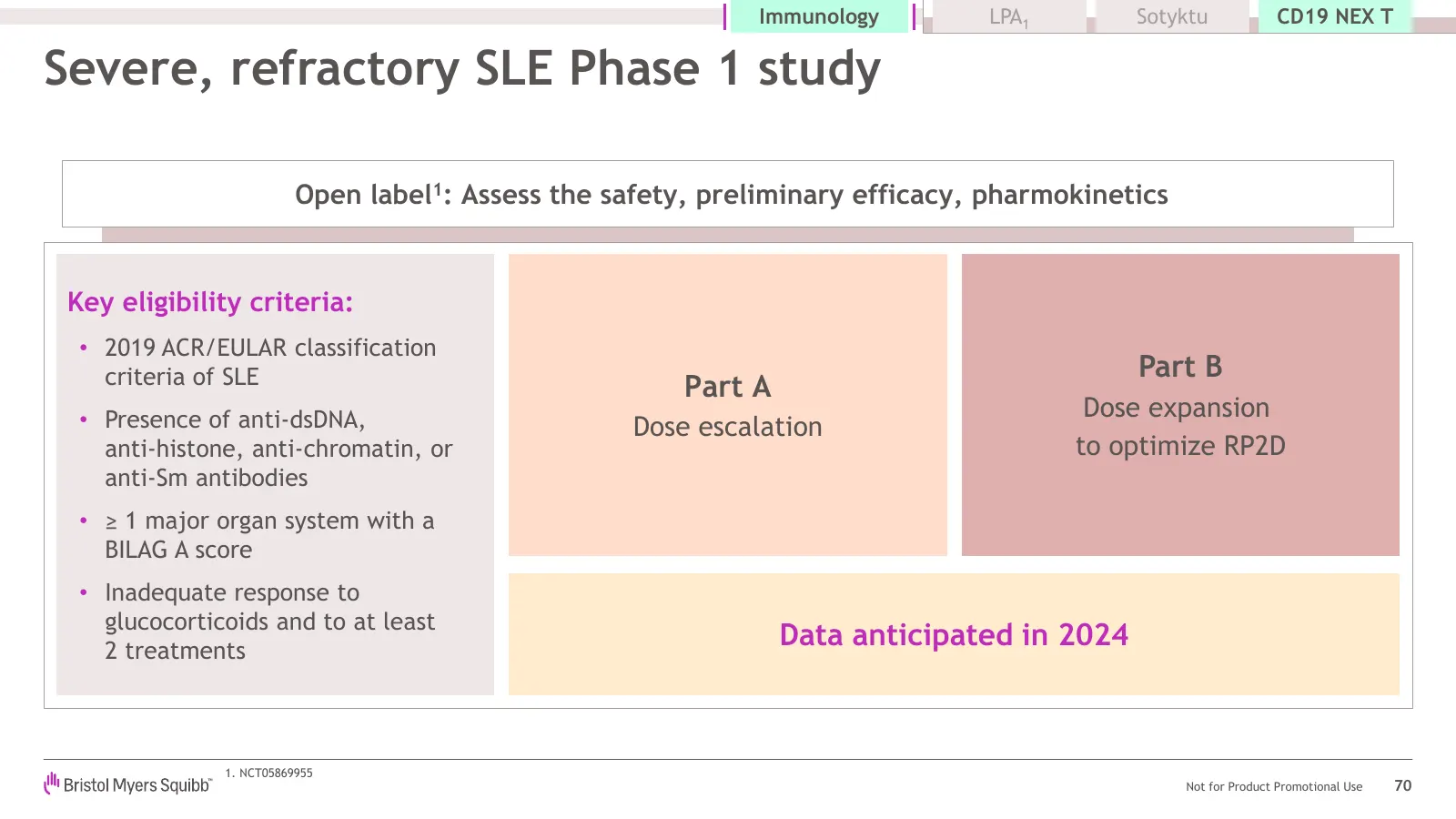
Slide 70: Severe, refractory SLE Phase 1 study
Immunology LPA1 Sotyktu CD19 NEX T Severe, refractory SLE Phase 1 study Open label1: Assess the safety, preliminary efficacy, pharmokinetics Key eligibility criteria: • 2019 ACR/EULAR classification criteria of SLE Part B Part A • Presence of anti-dsDNA, Dose expansion Dose escalation anti-histone,
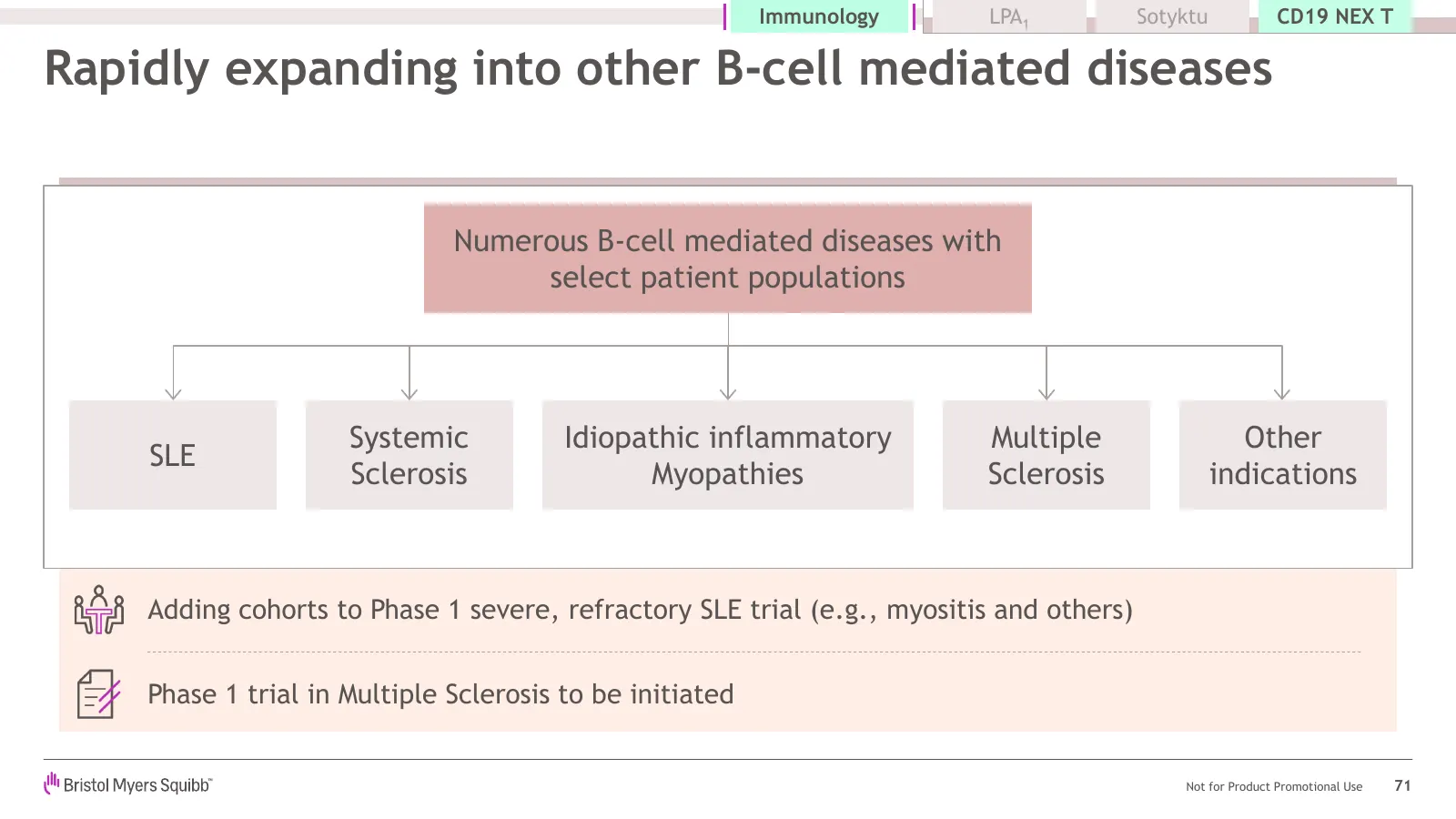
Slide 71: Rapidly expanding into other B-cell mediated diseases
Immunology LPA1 Sotyktu CD19 NEX T Rapidly expanding into other B-cell mediated diseases Numerous B-cell mediated diseases with select patient populations Systemic Idiopathic inflammatory Multiple Other SLE Sclerosis Myopathies Sclerosis indications Adding cohorts to Phase 1 severe, refractory SLE t
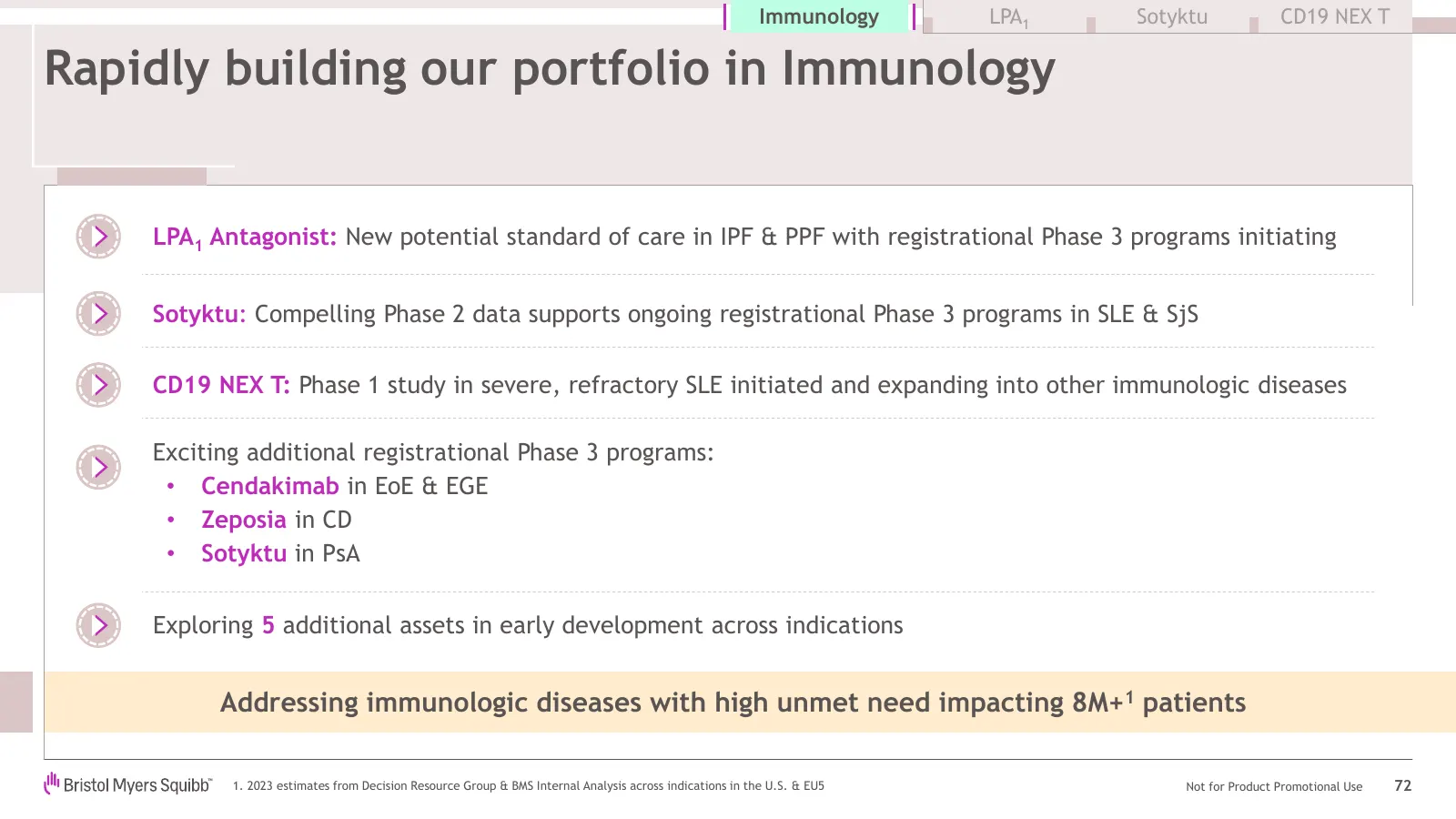
Slide 72: Rapidly building our portfolio in Immunology
Immunology LPA1 Sotyktu CD19 NEX T Rapidly building our portfolio in Immunology LPA1 Antagonist: New potential standard of care in IPF & PPF with registrational Phase 3 programs initiating Sotyktu: Compelling Phase 2 data supports ongoing registrational Phase 3 programs in SLE & SjS CD19 NEX T: Phas
Slide 73: Hematology
Hematology Not for Product Promotional Use 73
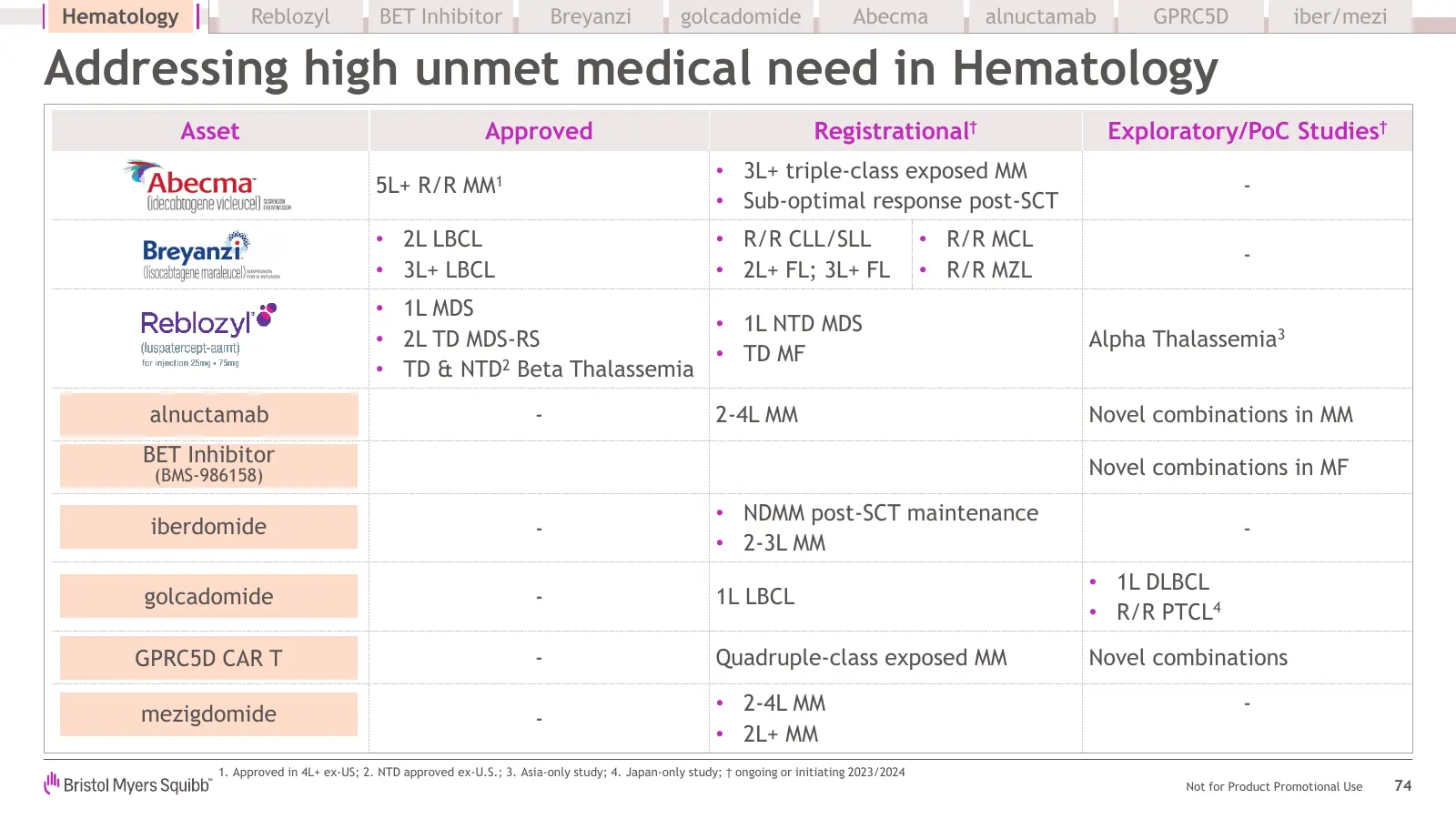
Slide 74: Addressing high unmet medical need in Hematology
Hematology Reblozyl BET Inhibitor Breyanzi golcadomide Abecma alnuctamab GPRC5D iber/mezi Addressing high unmet medical need in Hematology Asset Approved Registrational† Exploratory/PoC Studies† • 3L+ triple-class exposed MM 5L+ R/R MM1 - • Sub-optimal response post-SCT • 2L LBCL • R/R CLL/SLL • R/R
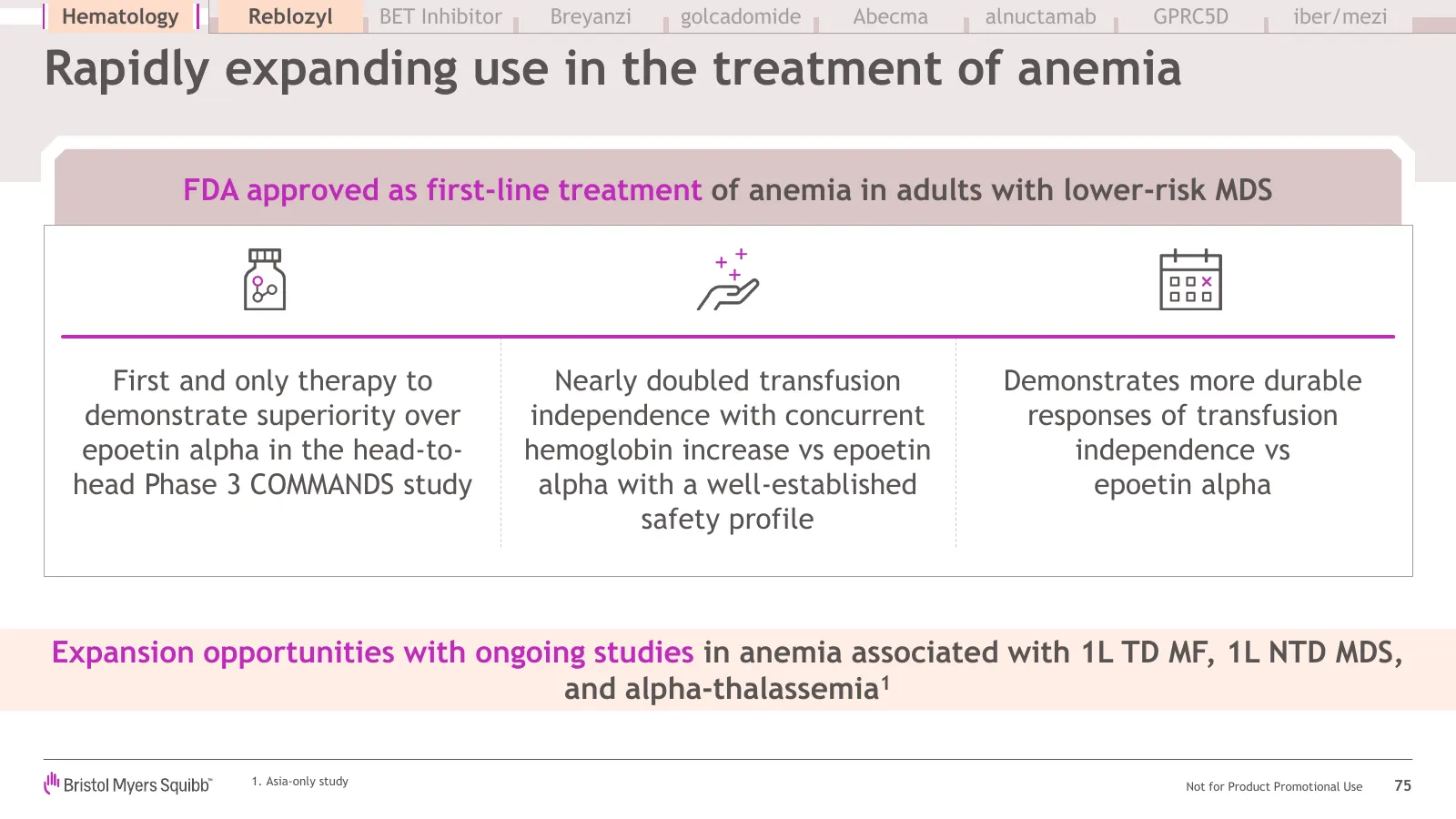
Slide 75: Rapidly expanding use in the treatment of anemia
Hematology Reblozyl BET Inhibitor Breyanzi golcadomide Abecma alnuctamab GPRC5D iber/mezi Rapidly expanding use in the treatment of anemia FDA approved as first-line treatment of anemia in adults with lower-risk MDS First and only therapy to Nearly doubled transfusion Demonstrates more durable demon
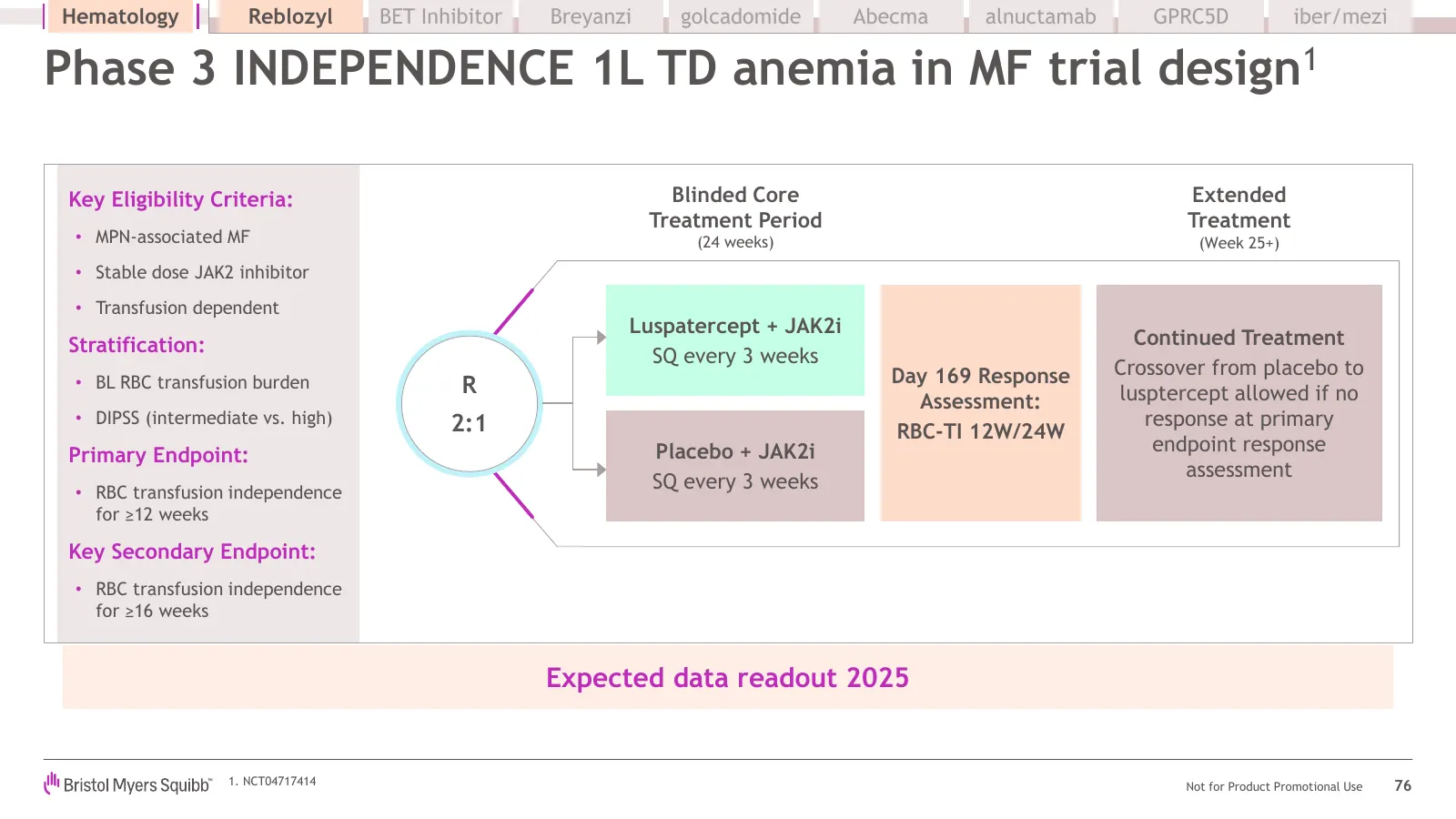
Slide 76: Phase 3 INDEPENDENCE 1L TD anemia in MF trial design
Hematology Reblozyl BET Inhibitor Breyanzi golcadomide Abecma alnuctamab GPRC5D iber/mezi Phase 3 INDEPENDENCE 1L TD anemia in MF trial design1 Key Eligibility Criteria: Blinded Core Extended Treatment Period Treatment • MPN-associated MF (24 weeks) (Week 25+) • Stable dose JAK2 inhibitor • Transfus
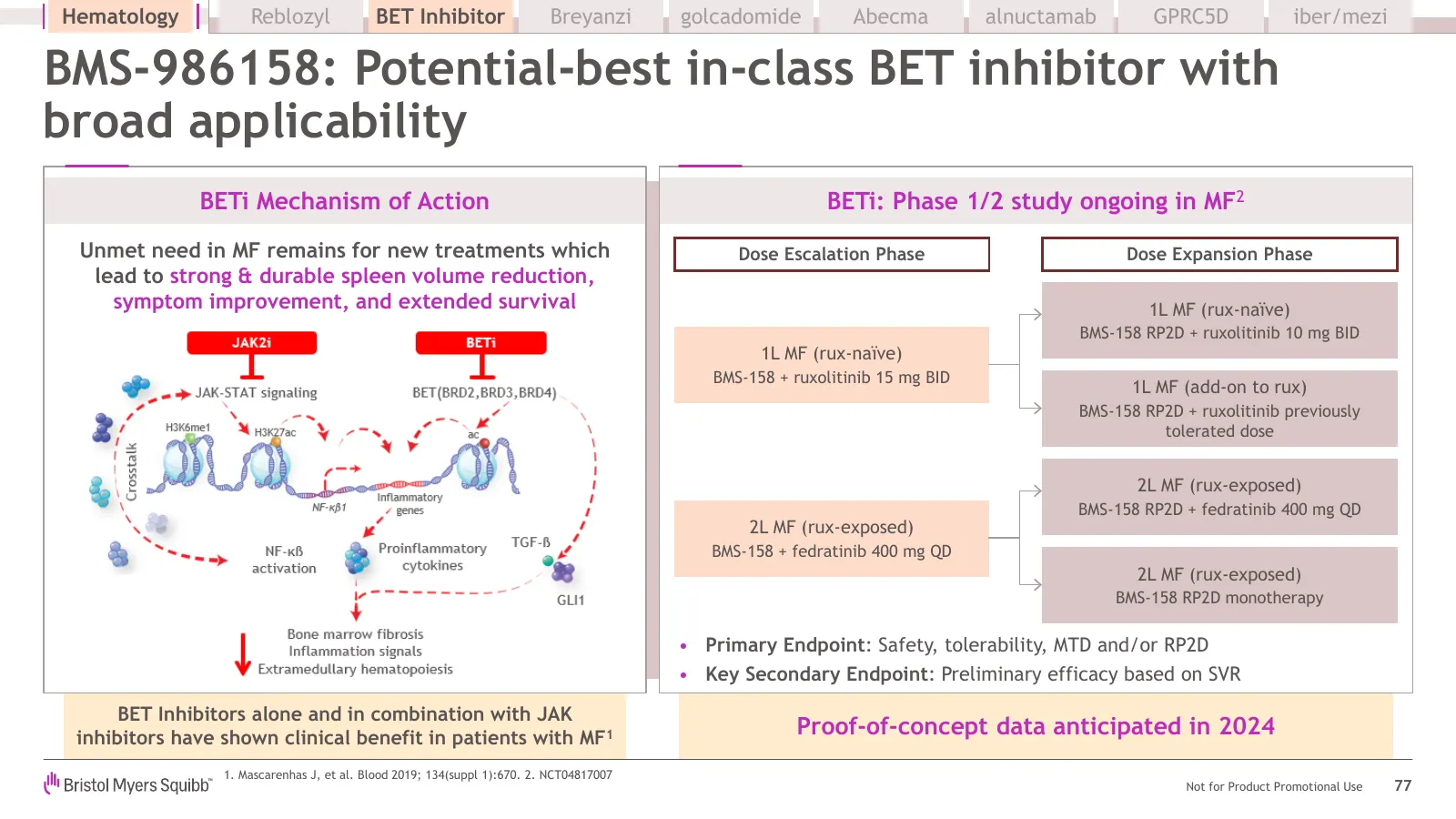
Slide 77: BMS-986158: Potential best-in-class BET inhibitor
Hematology Reblozyl BET Inhibitor Breyanzi golcadomide Abecma alnuctamab GPRC5D iber/mezi BMS-986158: Potential-best in-class BET inhibitor with broad applicability BETi Mechanism of Action BETi: Phase 1/2 study ongoing in MF2 Unmet need in MF remains for new treatments which Dose Escalation Phase D
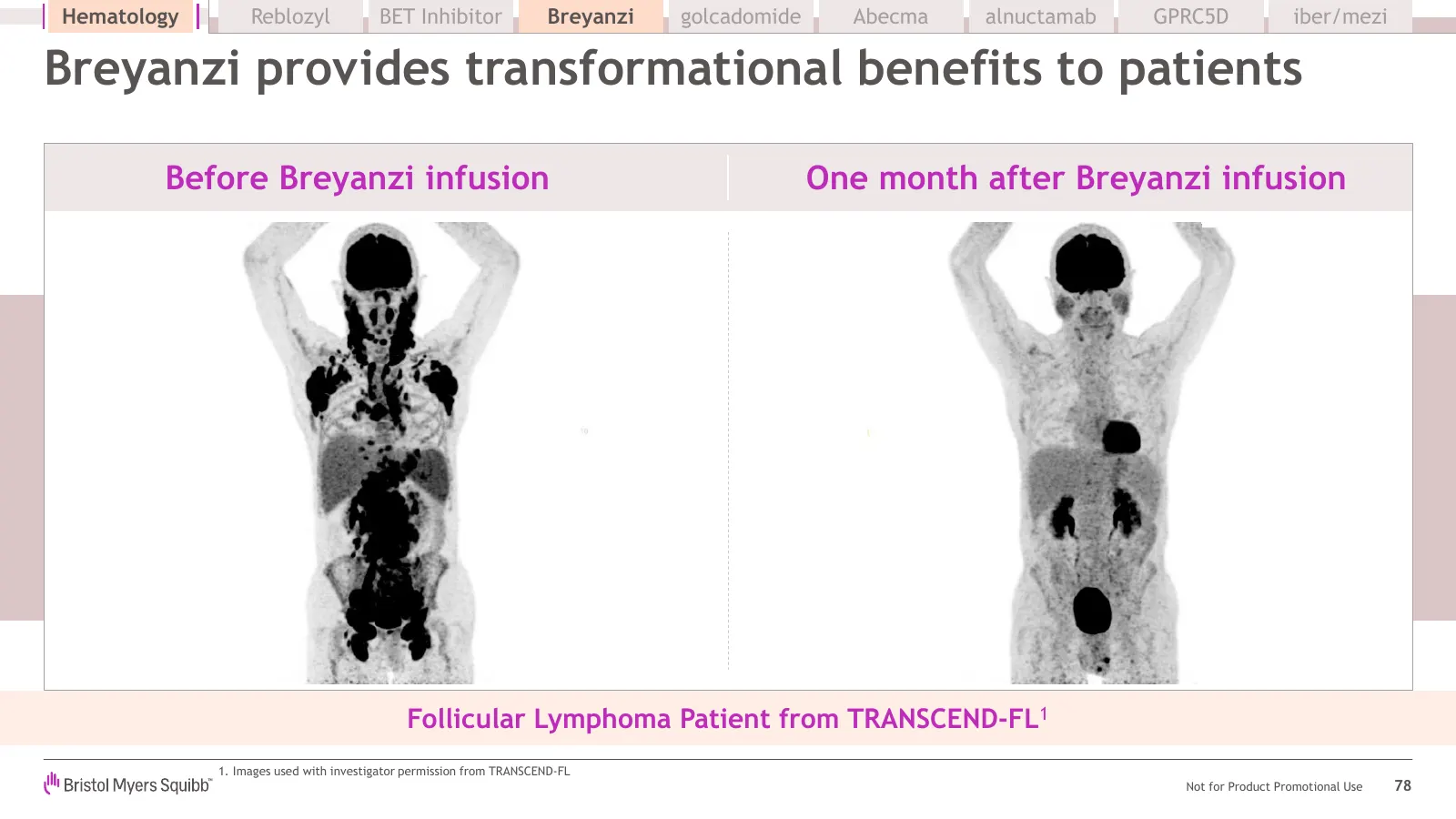
Slide 78: Breyanzi provides transformational benefits to patients
Hematology Reblozyl BET Inhibitor Breyanzi golcadomide Abecma alnuctamab GPRC5D iber/mezi Breyanzi provides transformational benefits to patients Before Breyanzi infusion One month after Breyanzi infusion Follicular Lymphoma Patient from TRANSCEND-FL1 1. Images used with investigator permission from
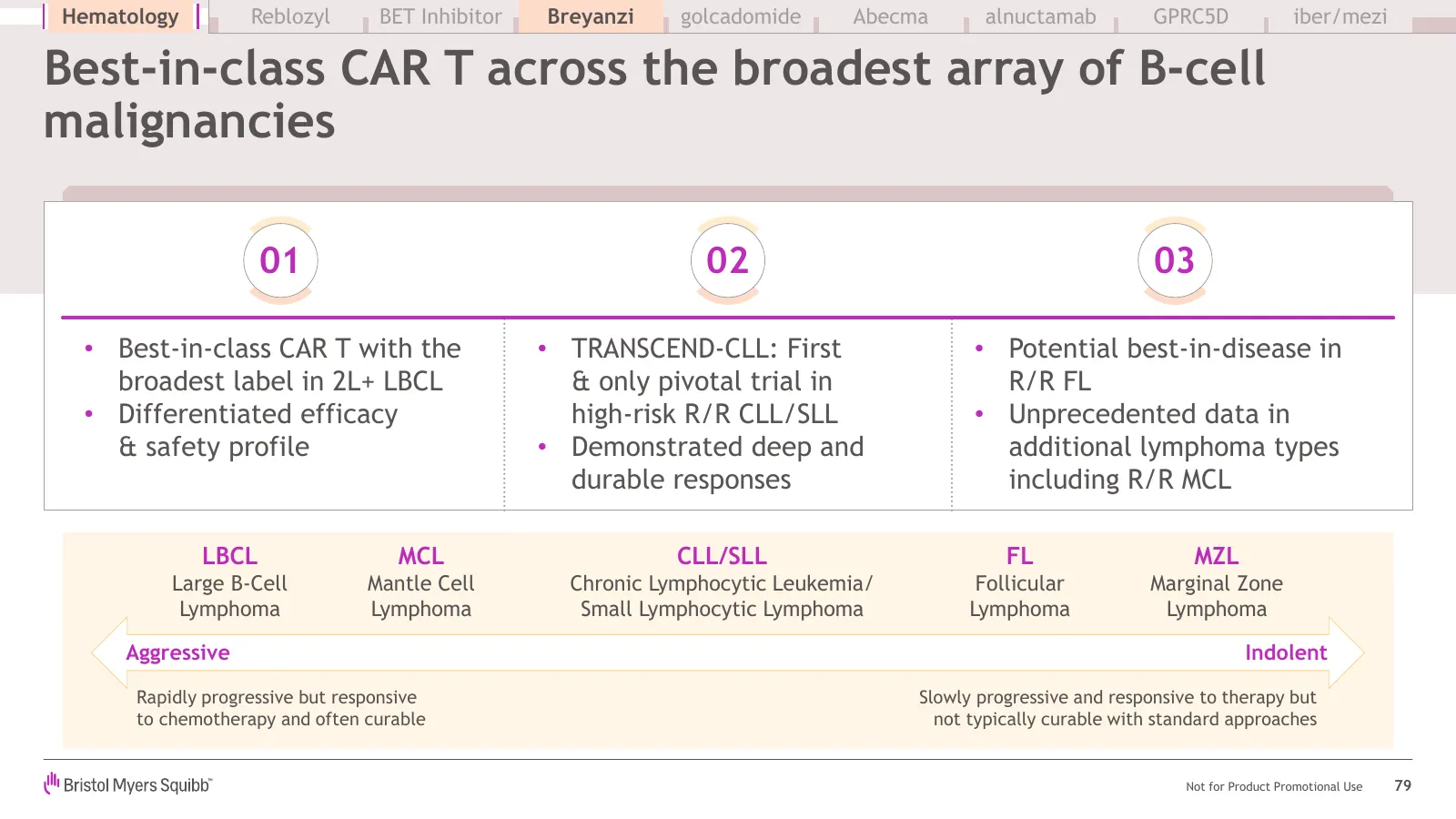
Slide 79: Best-in-class CAR T across the broadest array of B-cell malignancies
Hematology Reblozyl BET Inhibitor Breyanzi golcadomide Abecma alnuctamab GPRC5D iber/mezi Best-in-class CAR T across the broadest array of B-cell malignancies 01 02 03 • Best-in-class CAR T with the • TRANSCEND-CLL: First • Potential best-in-disease in broadest label in 2L+ LBCL & only pivotal trial
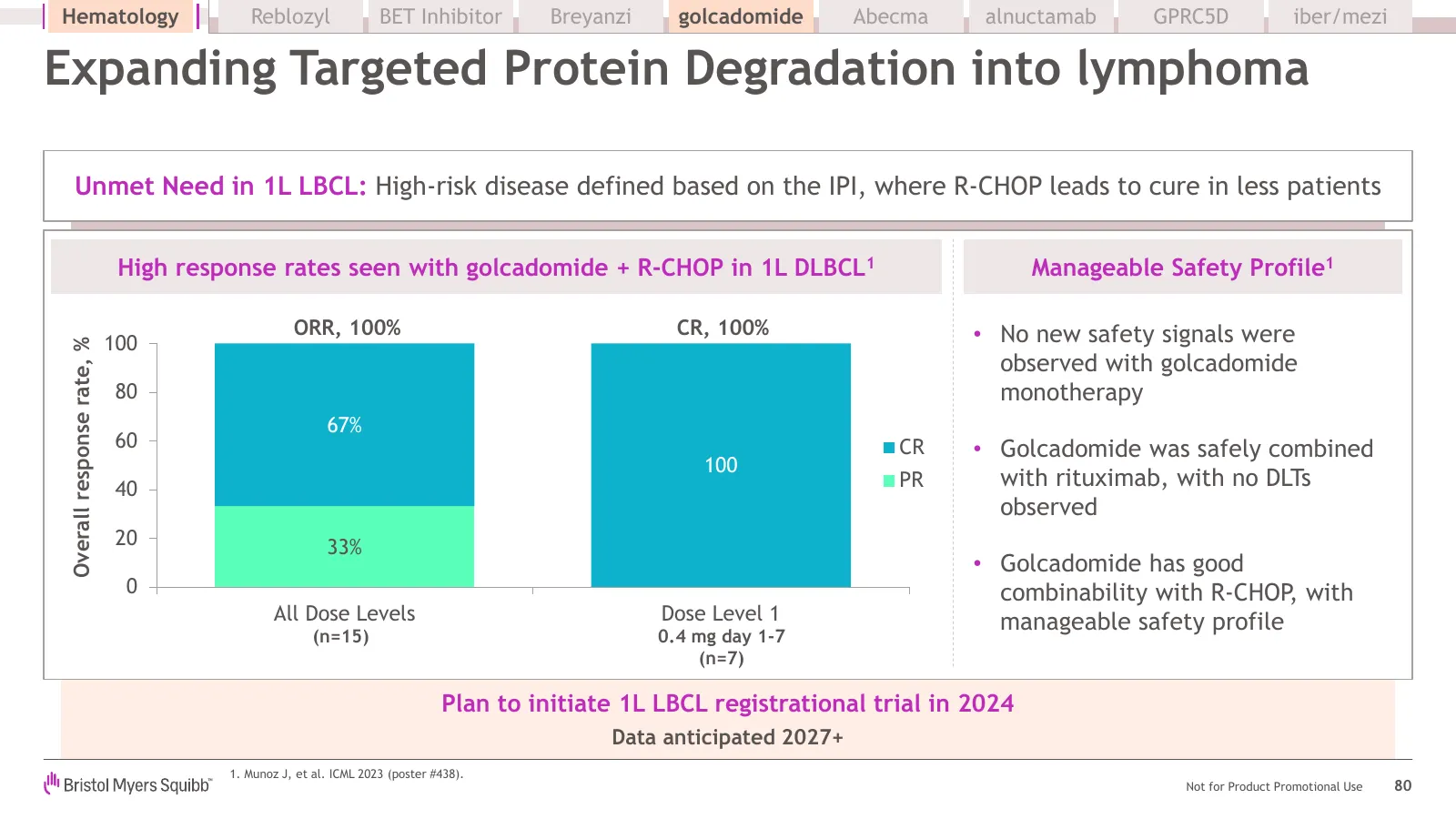
Slide 80: Expanding Targeted Protein Degradation into lymphoma
Hematology Reblozyl BET Inhibitor Breyanzi golcadomide Abecma alnuctamab GPRC5D iber/mezi Expanding Targeted Protein Degradation into lymphoma Unmet Need in 1L LBCL: High-risk disease defined based on the IPI, where R-CHOP leads to cure in less patients High response rates seen with golcadomide + R-
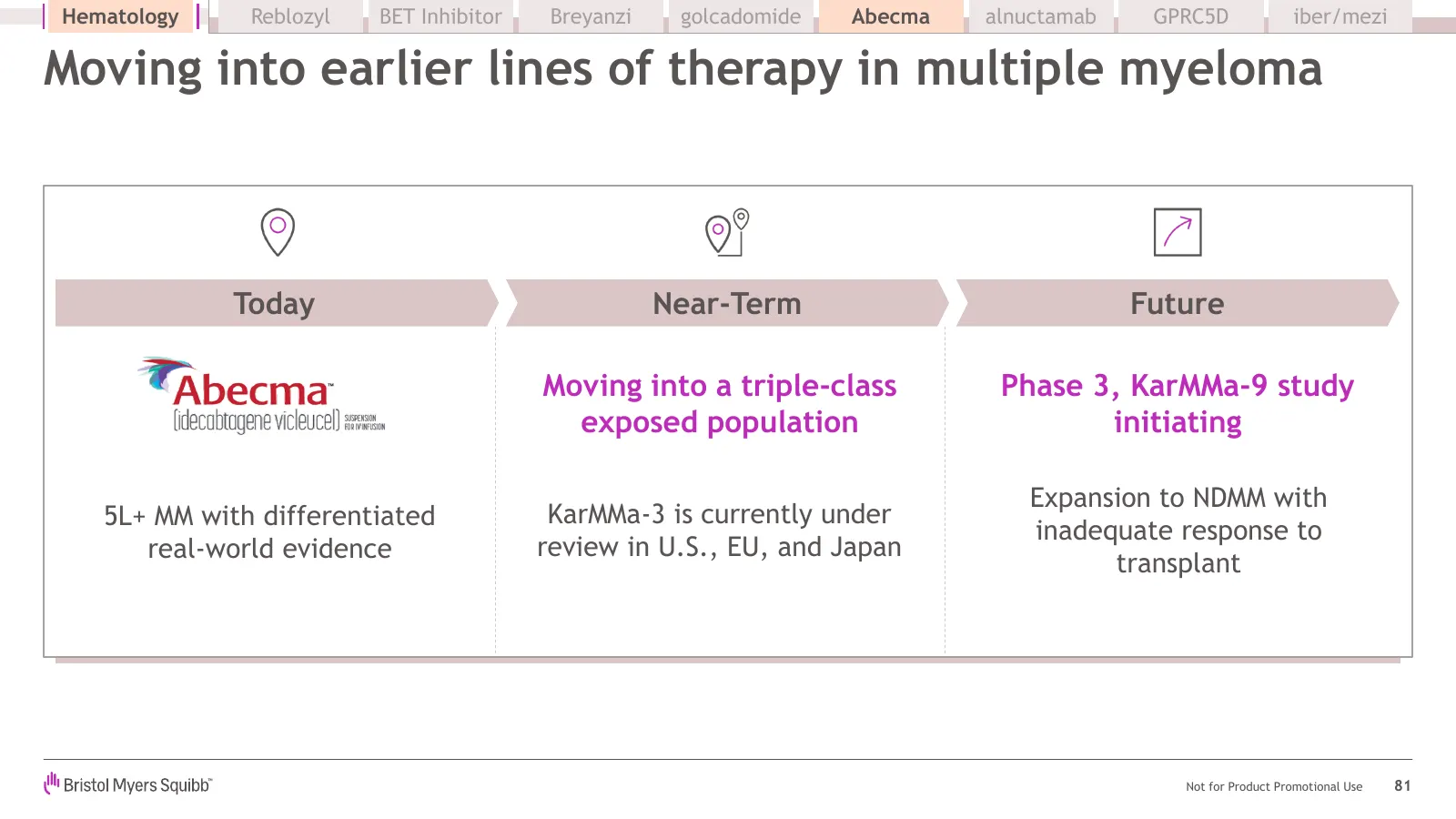
Slide 81: Moving into earlier lines of therapy in multiple myeloma
Hematology Reblozyl BET Inhibitor Breyanzi golcadomide Abecma alnuctamab GPRC5D iber/mezi Moving into earlier lines of therapy in multiple myeloma Today Near-Term Future Moving into a triple-class Phase 3, KarMMa-9 study exposed population initiating Expansion to NDMM with 5L+ MM with differentiated
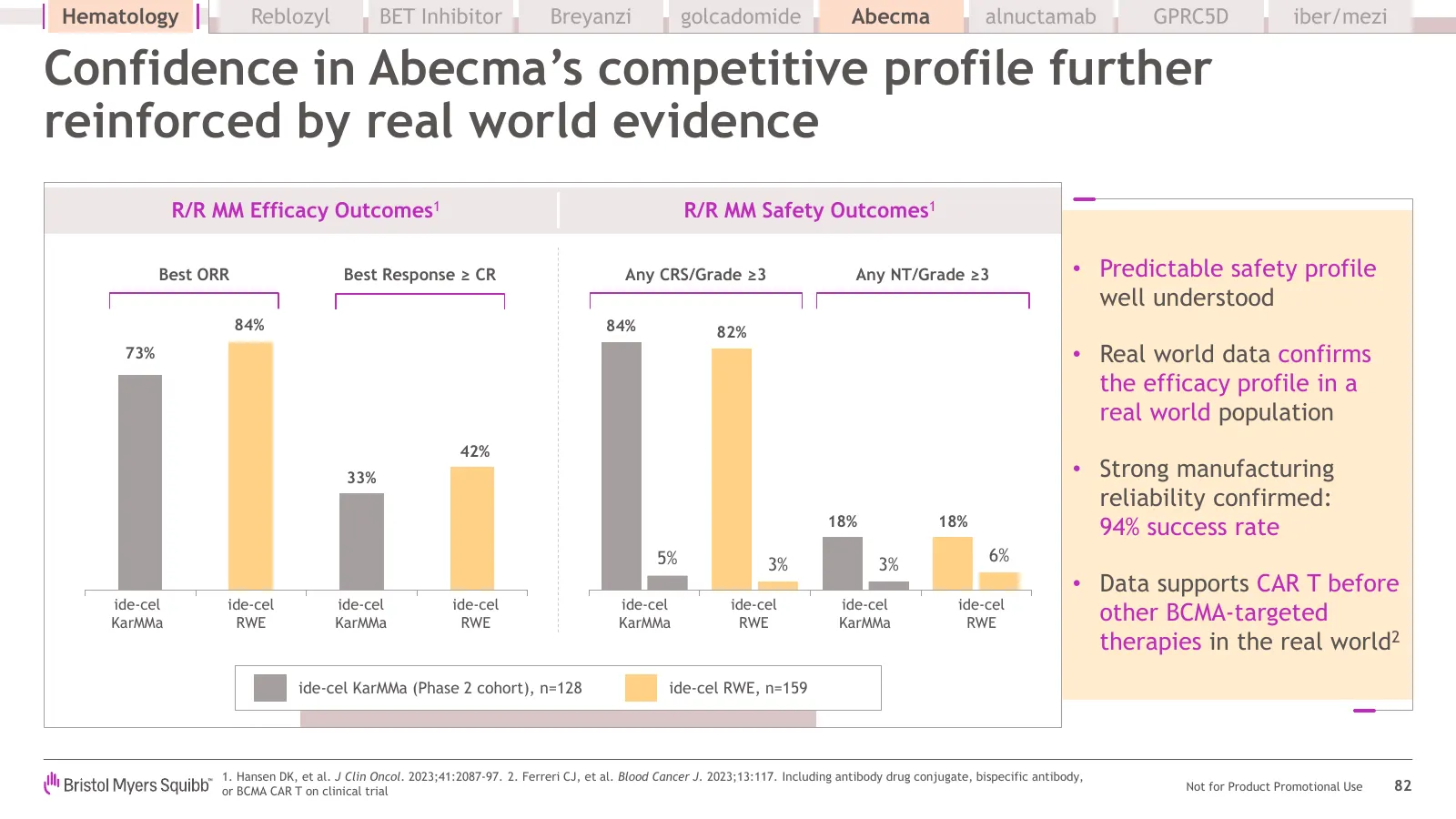
Slide 82: Abecma's competitive profile reinforced by real world evidence
Hematology Reblozyl BET Inhibitor Breyanzi golcadomide Abecma alnuctamab GPRC5D iber/mezi Confidence in Abecma’s competitive profile further reinforced by real world evidence R/R MM Efficacy Outcomes1 R/R MM Safety Outcomes1 Best ORR Best Response ≥ CR Any CRS/Grade ≥3 Any NT/Grade ≥3 • Predictable
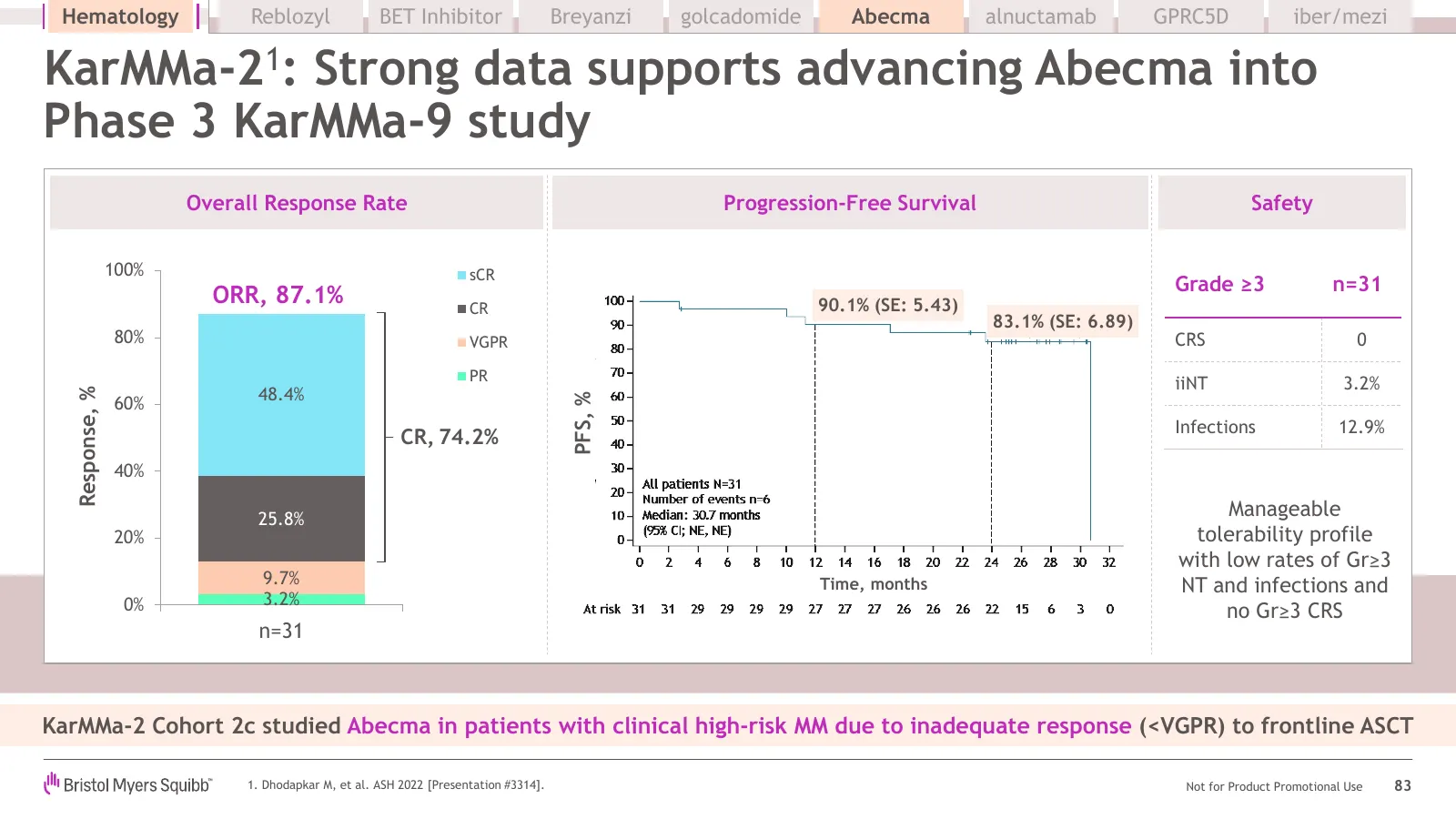
Slide 83: KarMMa-2: Strong data supports Phase 3 KarMMa-9
Hematology Reblozyl BET Inhibitor Breyanzi golcadomide Abecma alnuctamab GPRC5D iber/mezi KarMMa-21: Strong data supports advancing Abecma into Phase 3 KarMMa-9 study Overall Response Rate Progression-Free Survival Safety 100% sCR Grade ≥3 n=31 ORR, 87.1% CR 90.1% (SE: 5.43) 83.1% (SE: 6.89) 80% VGP
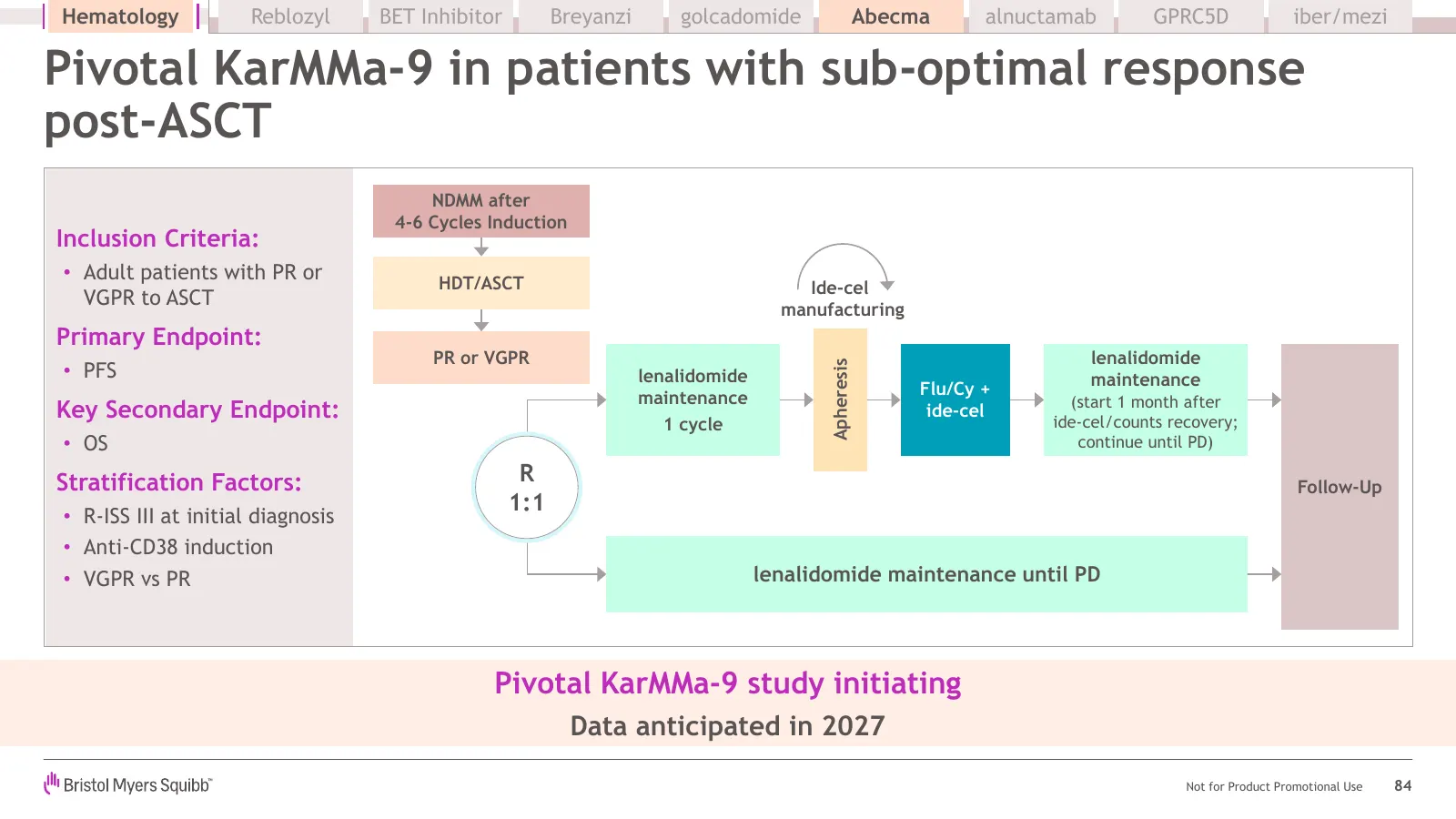
Slide 84: Pivotal KarMMa-9 in patients with sub-optimal response post-ASCT
Hematology Reblozyl BET Inhibitor Breyanzi golcadomide Abecma alnuctamab GPRC5D iber/mezi Pivotal KarMMa-9 in patients with sub-optimal response post-ASCT NDMM after 4-6 Cycles Induction Inclusion Criteria: • Adult patients with PR or HDT/ASCT Ide-cel VGPR to ASCT manufacturing Primary Endpoint: PR
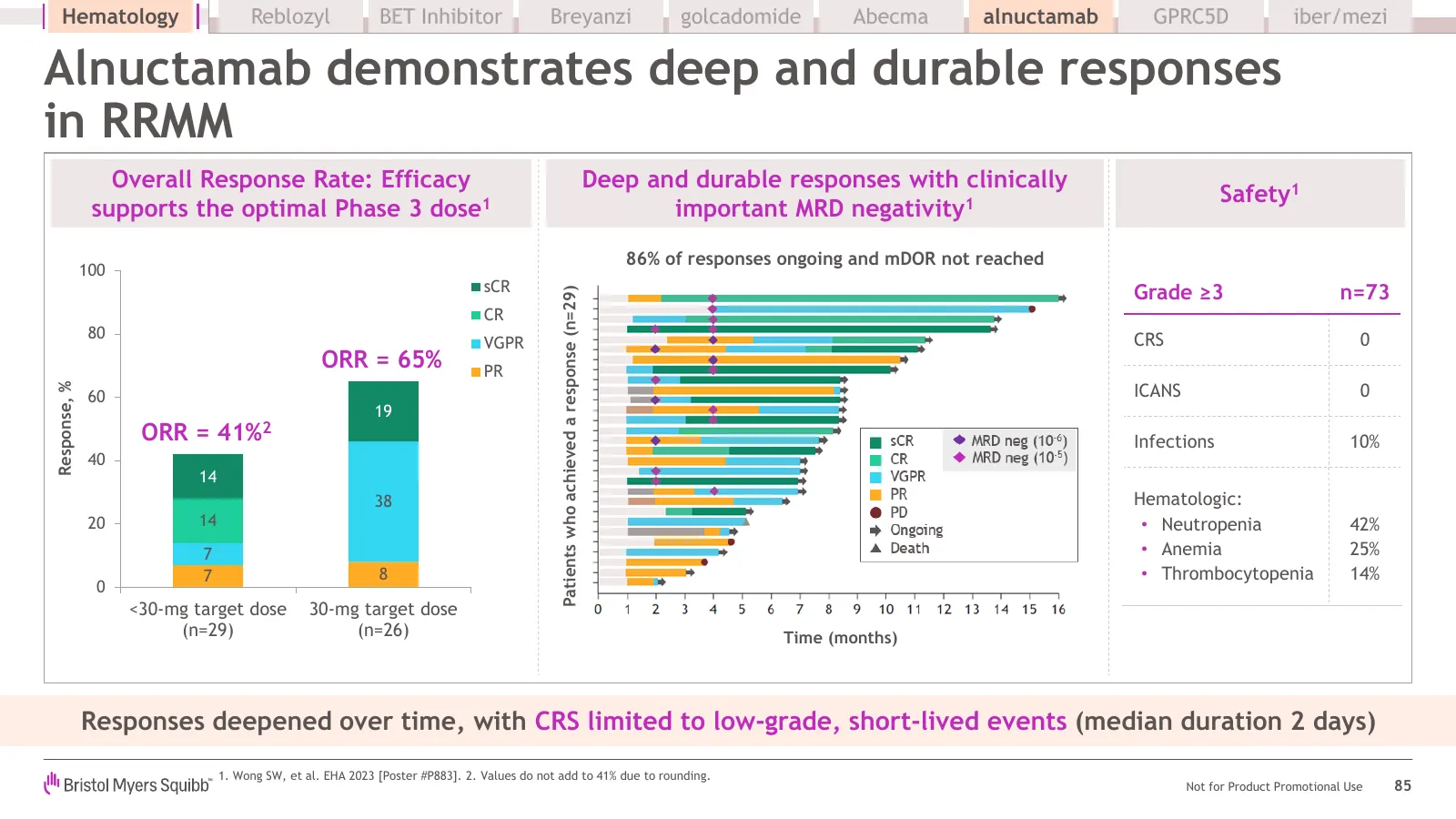
Slide 85: Alnuctamab demonstrates deep and durable responses in RRMM
Hematology Reblozyl BET Inhibitor Breyanzi golcadomide Abecma alnuctamab GPRC5D iber/mezi Alnuctamab demonstrates deep and durable responses in RRMM Overall Response Rate: Efficacy Deep and durable responses with clinically Safety1 supports the optimal Phase 3 dose1 important MRD negativity1 86% of
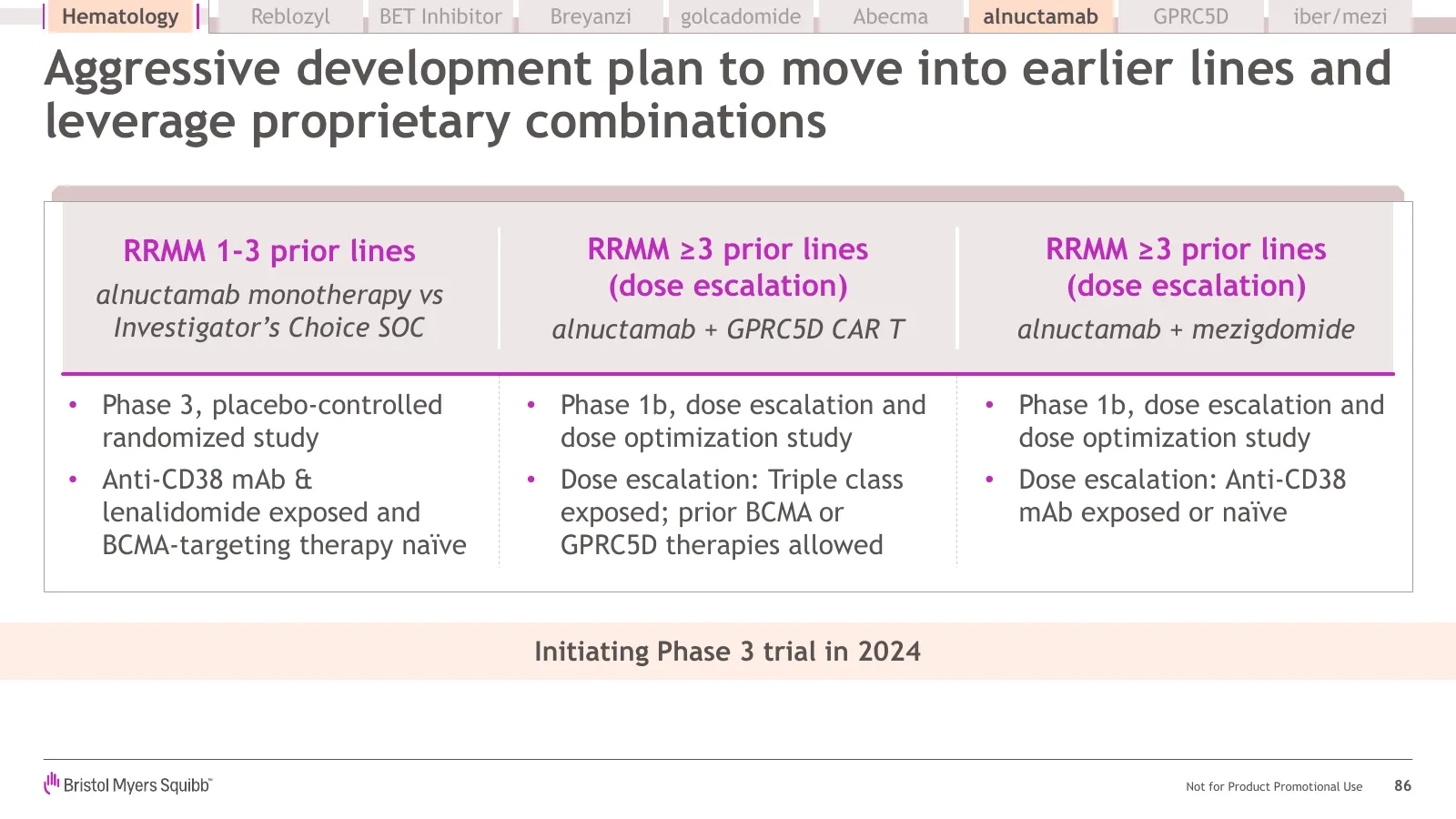
Slide 86: Aggressive development plan for earlier lines and combinations
Hematology Reblozyl BET Inhibitor Breyanzi golcadomide Abecma alnuctamab GPRC5D iber/mezi Aggressive development plan to move into earlier lines and leverage proprietary combinations RRMM 1-3 prior lines RRMM ≥3 prior lines RRMM ≥3 prior lines alnuctamab monotherapy vs (dose escalation) (dose escala
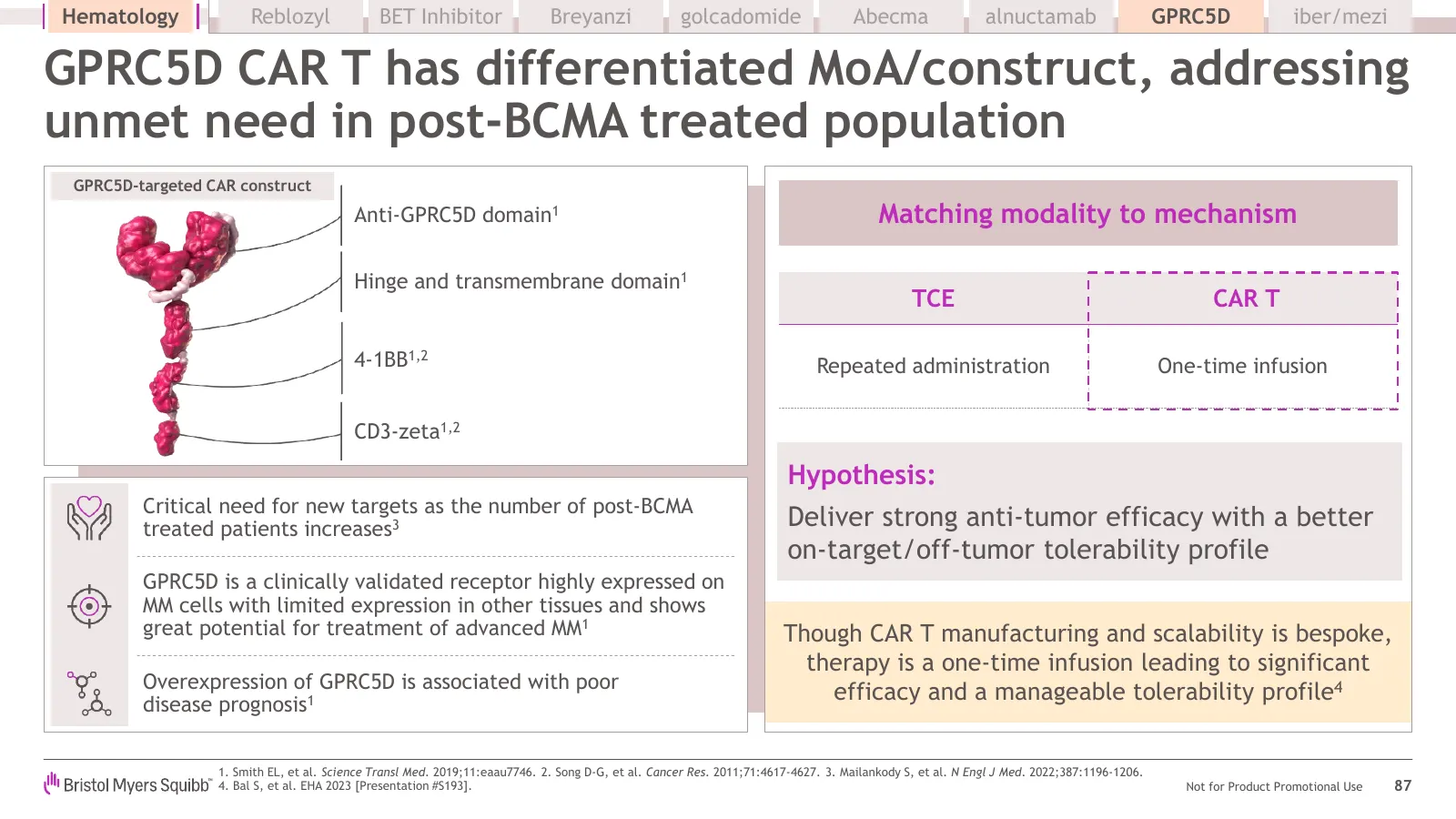
Slide 87: GPRC5D CAR T addressing unmet need post-BCMA
Hematology Reblozyl BET Inhibitor Breyanzi golcadomide Abecma alnuctamab GPRC5D iber/mezi GPRC5D CAR T has differentiated MoA/construct, addressing unmet need in post-BCMA treated population GPRC5D-targeted CAR construct Anti-GPRC5D domain1 Matching modality to mechanism Hinge and transmembrane doma
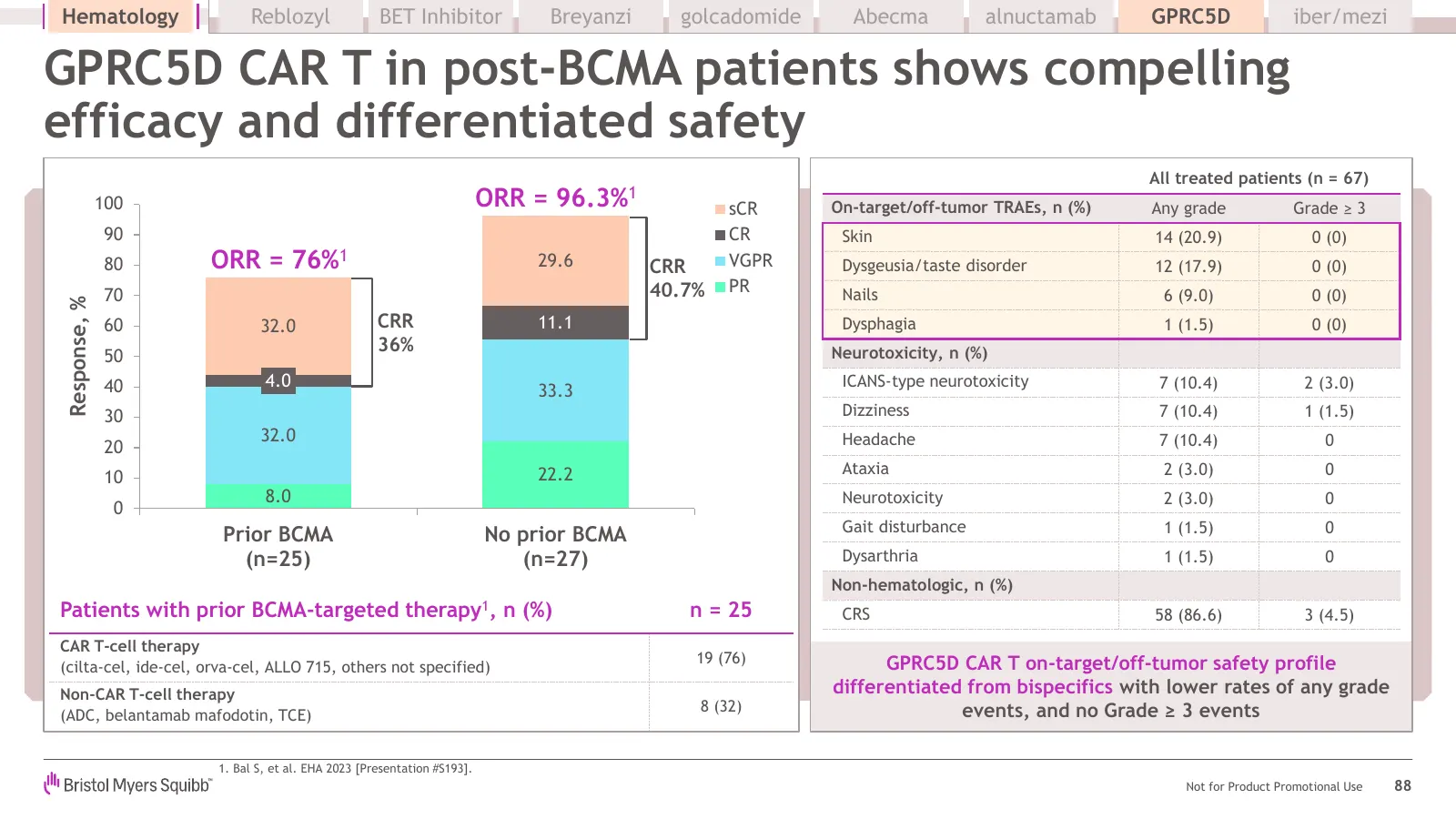
Slide 88: GPRC5D CAR T in post-BCMA patients shows compelling efficacy
Hematology Reblozyl BET Inhibitor Breyanzi golcadomide Abecma alnuctamab GPRC5D iber/mezi GPRC5D CAR T in post-BCMA patients shows compelling efficacy and differentiated safety All treated patients (n = 67) 100 ORR = 96.3%1 sCR On-target/off-tumor TRAEs, n (%) Any grade Grade ≥ 3 90 CR Skin 14 (20.9
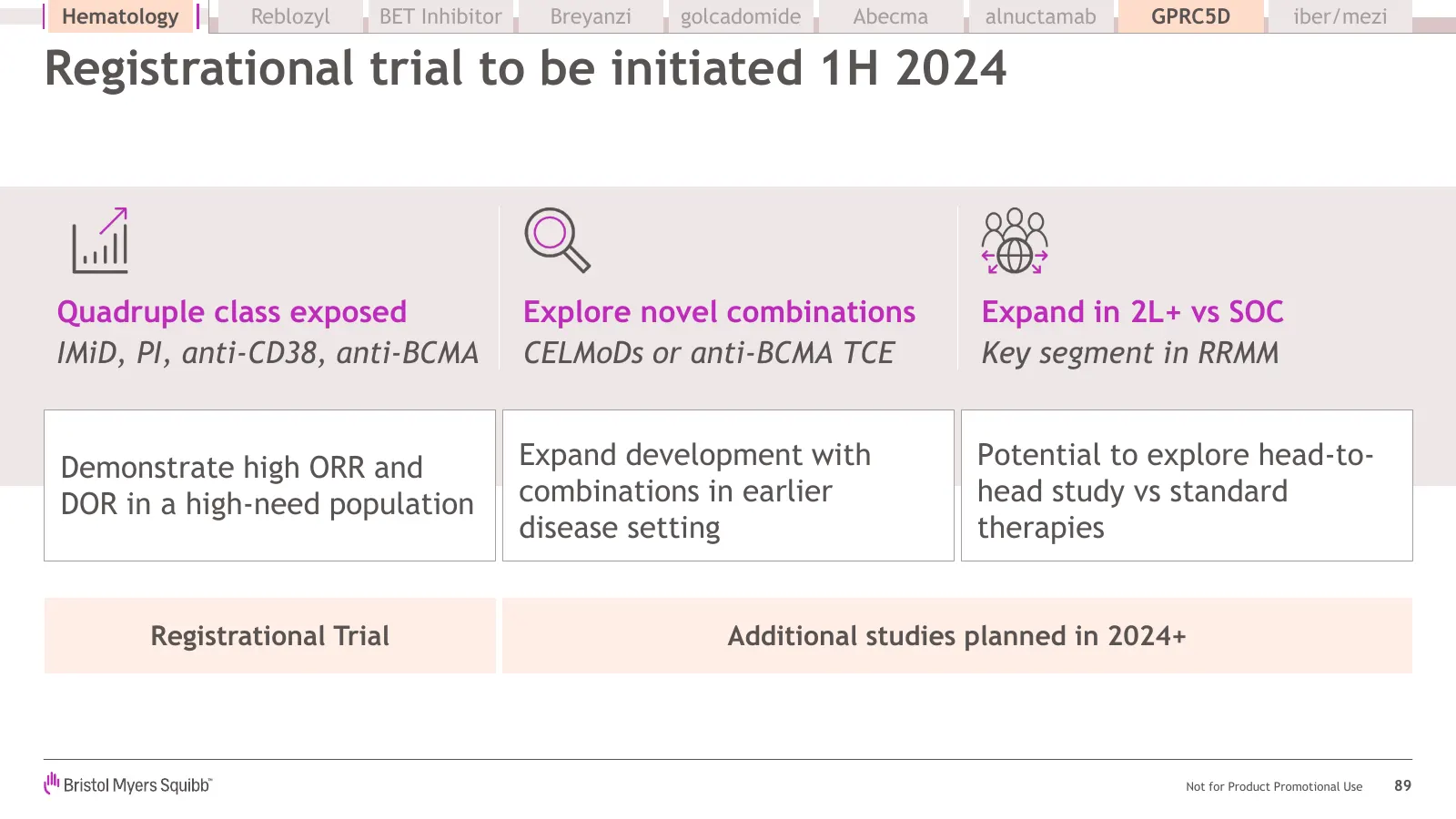
Slide 89: Registrational trial to be initiated 1H 2024
Hematology Reblozyl BET Inhibitor Breyanzi golcadomide Abecma alnuctamab GPRC5D iber/mezi Registrational trial to be initiated 1H 2024 Quadruple class exposed Explore novel combinations Expand in 2L+ vs SOC IMiD, PI, anti-CD38, anti-BCMA CELMoDs or anti-BCMA TCE Key segment in RRMM Demonstrate high
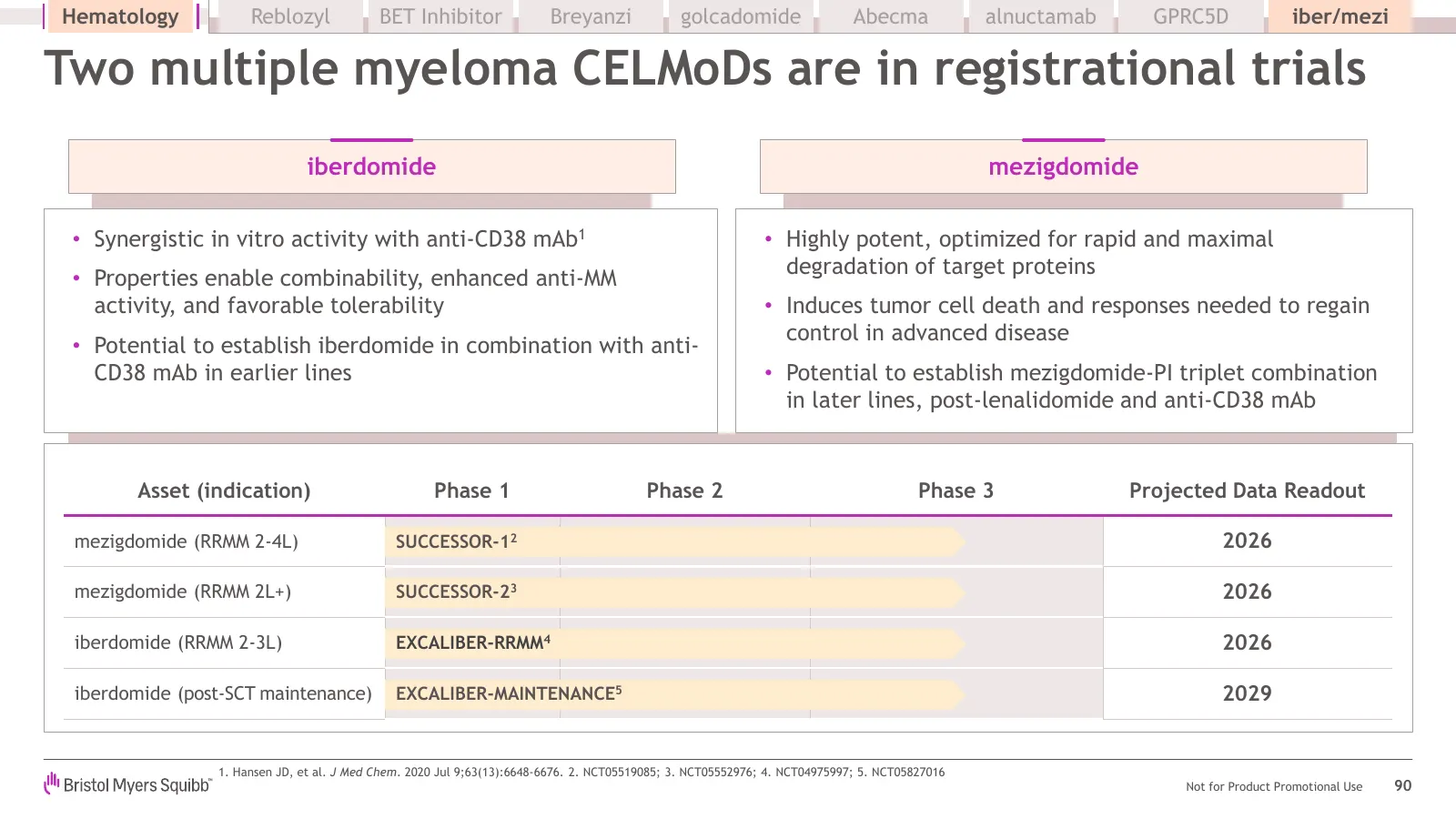
Slide 90: Two multiple myeloma CELMoDs are in registrational trials
Hematology Reblozyl BET Inhibitor Breyanzi golcadomide Abecma alnuctamab GPRC5D iber/mezi Two multiple myeloma CELMoDs are in registrational trials iberdomide mezigdomide • Synergistic in vitro activity with anti-CD38 mAb1 • Highly potent, optimized for rapid and maximal degradation of target protei
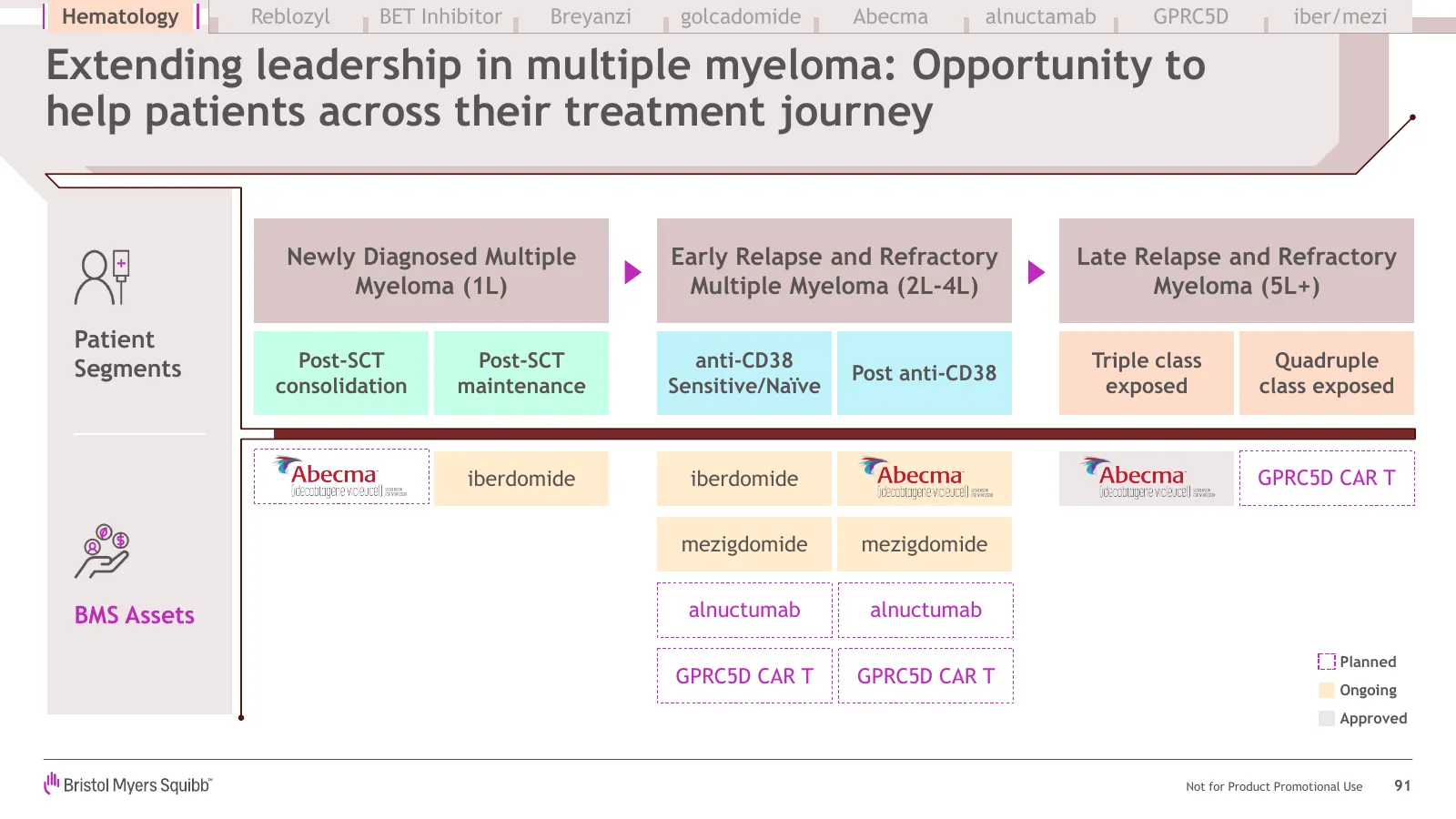
Slide 91: Extending leadership in multiple myeloma
Hematology Reblozyl BET Inhibitor Breyanzi golcadomide Abecma alnuctamab GPRC5D iber/mezi Extending leadership in multiple myeloma: Opportunity to help patients across their treatment journey Newly Diagnosed Multiple Early Relapse and Refractory Late Relapse and Refractory Myeloma (1L) Multiple Myel
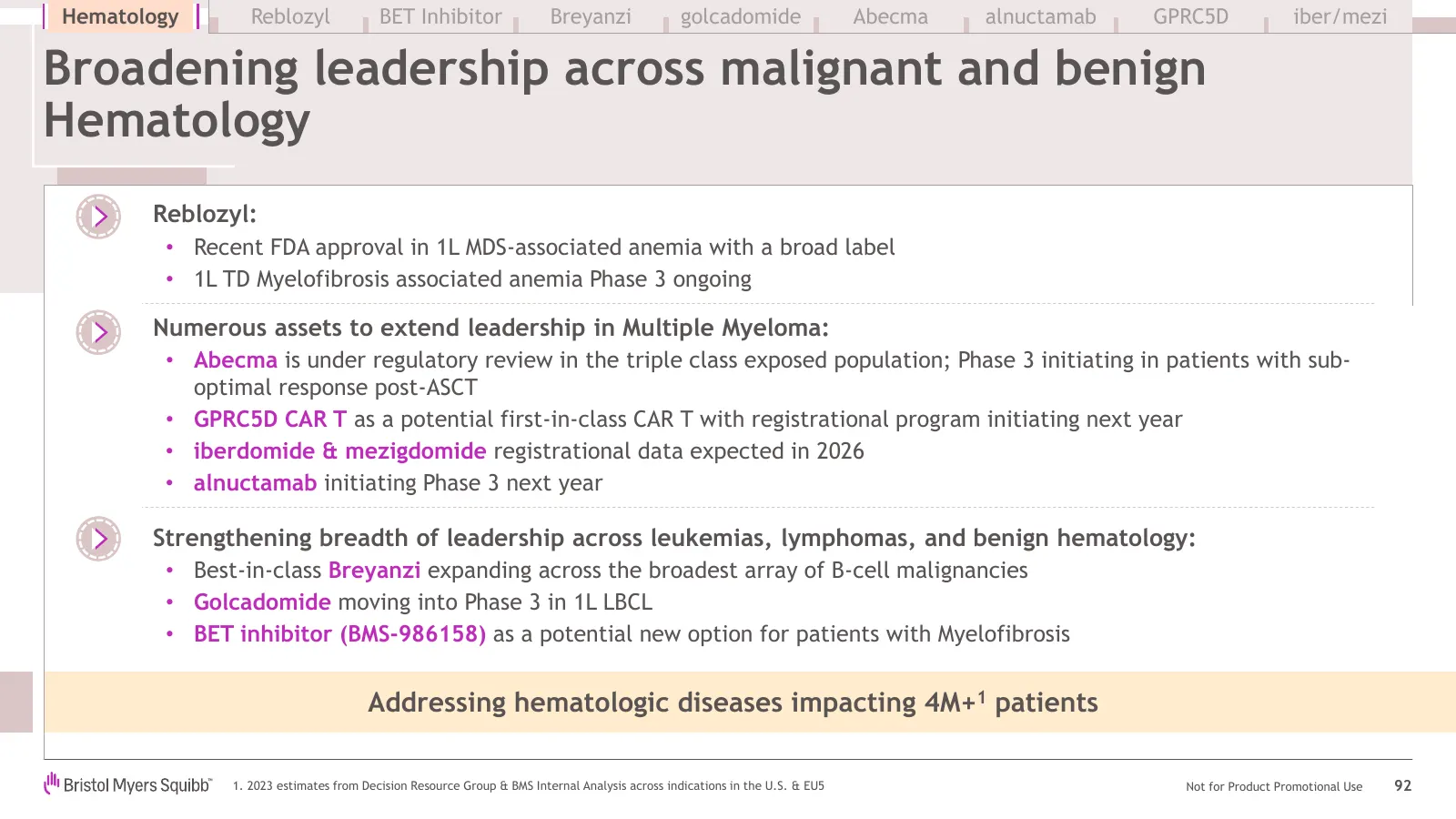
Slide 92: Broadening leadership across malignant and benign Hematology
Hematology Reblozyl BET Inhibitor Breyanzi golcadomide Abecma alnuctamab GPRC5D iber/mezi Broadening leadership across malignant and benign Hematology Reblozyl: • Recent FDA approval in 1L MDS-associated anemia with a broad label • 1L TD Myelofibrosis associated anemia Phase 3 ongoing Numerous asset

Slide 93: Oncology
Oncology Not for Product Promotional Use 93
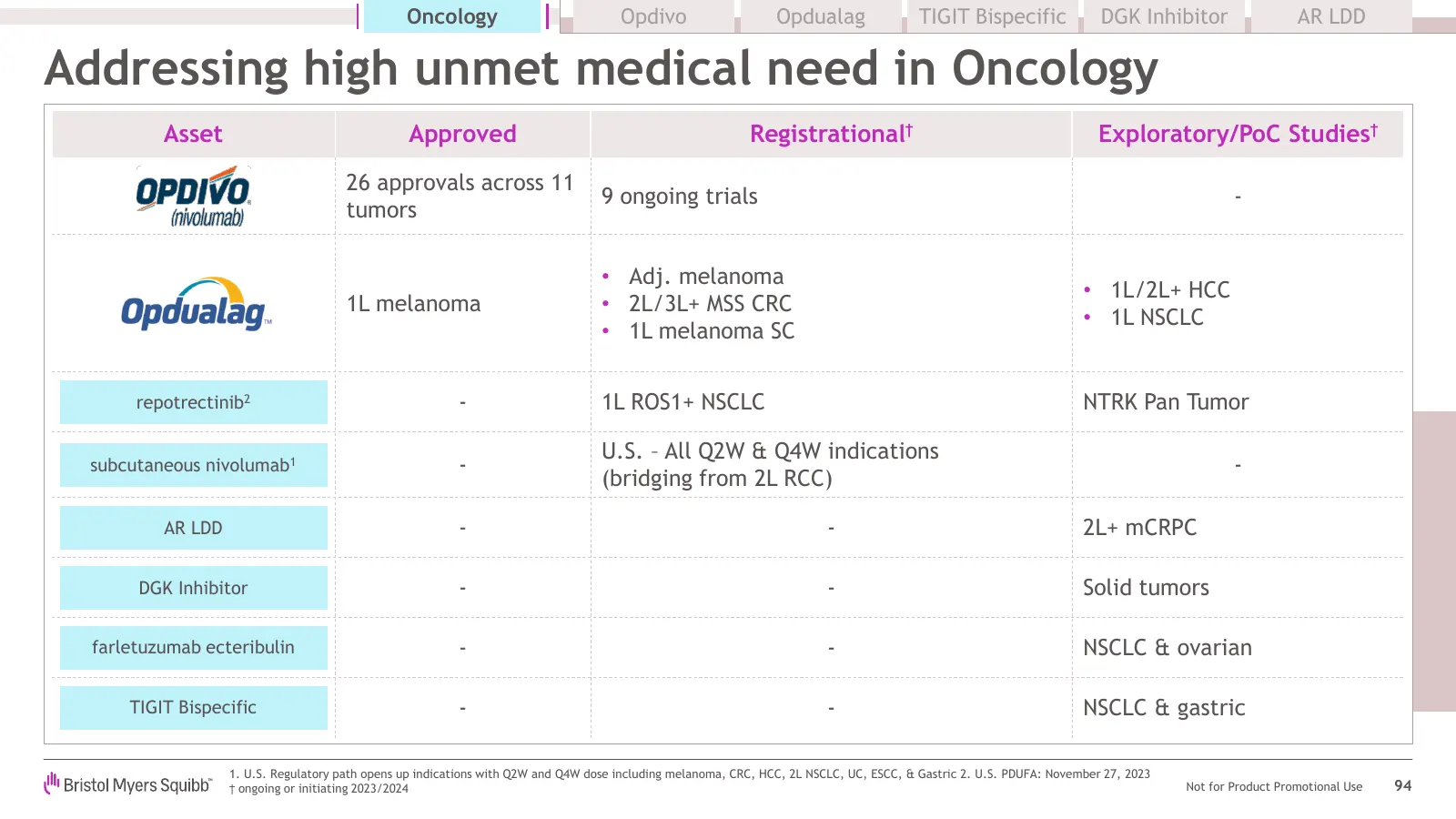
Slide 94: Addressing high unmet medical need in Oncology
Oncology Opdivo Opdualag TIGIT Bispecific DGK Inhibitor AR LDD Addressing high unmet medical need in Oncology Asset Approved Registrational† Exploratory/PoC Studies† 26 approvals across 11 9 ongoing trials - tumors • Adj. melanoma • 1L/2L+ HCC 1L melanoma • 2L/3L+ MSS CRC • 1L NSCLC • 1L melanoma SC
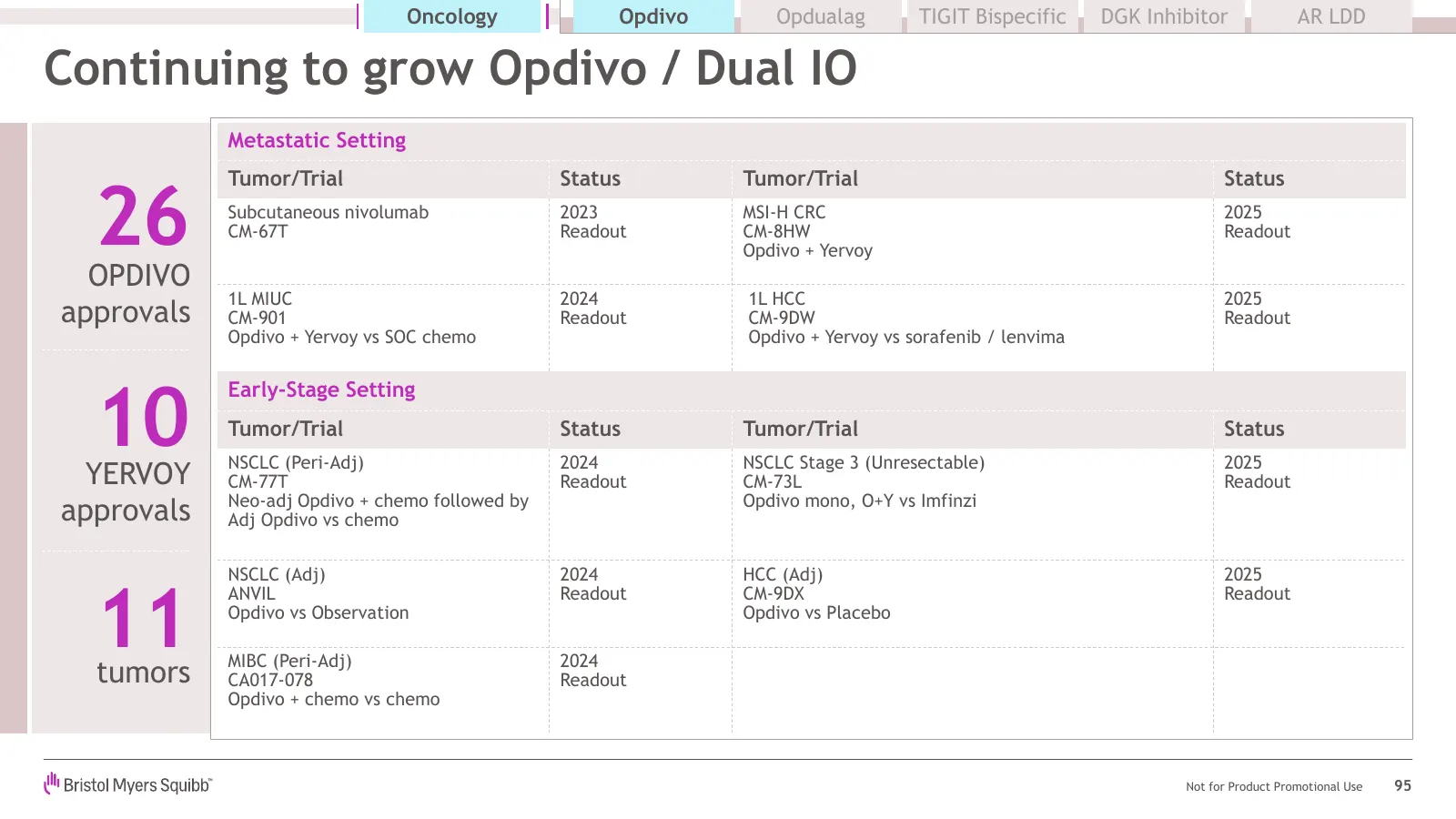
Slide 95: Continuing to grow Opdivo / Dual IO
Oncology Opdivo Opdualag TIGIT Bispecific DGK Inhibitor AR LDD Continuing to grow Opdivo / Dual IO Metastatic Setting 26 Tumor/Trial Status Tumor/Trial Status Subcutaneous nivolumab 2023 MSI-H CRC 2025 CM-67T Readout CM-8HW Readout Opdivo + Yervoy OPDIVO 1L MIUC 2024 1L HCC 2025 approvals CM-901 Rea
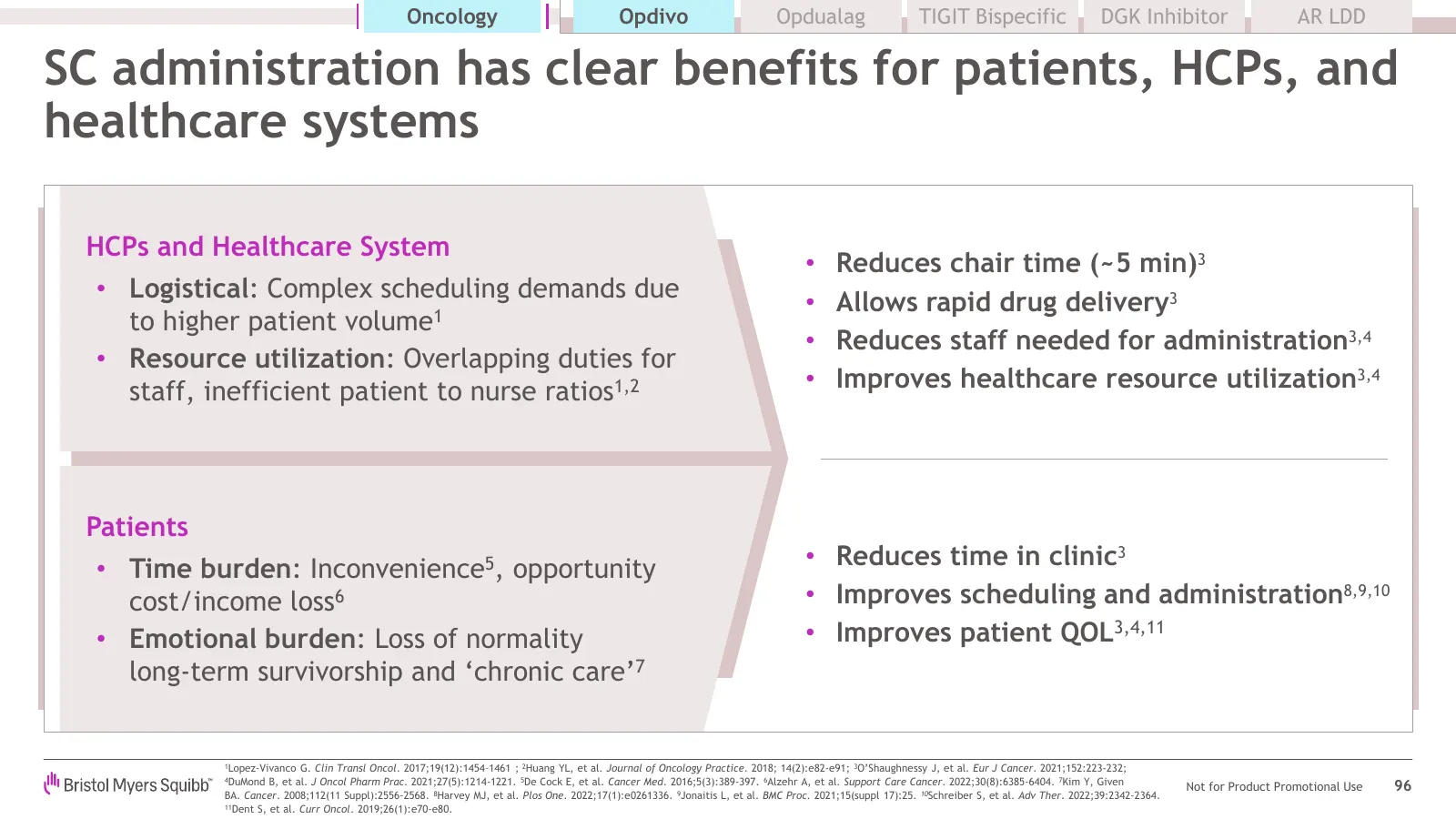
Slide 96: SC administration has clear benefits for patients, HCPs, and healthcare systems
Oncology Opdivo Opdualag TIGIT Bispecific DGK Inhibitor AR LDD SC administration has clear benefits for patients, HCPs, and healthcare systems HCPs and Healthcare System • Reduces chair time (~5 min)3 • Logistical: Complex scheduling demands due • Allows rapid drug delivery3 to higher patient volume
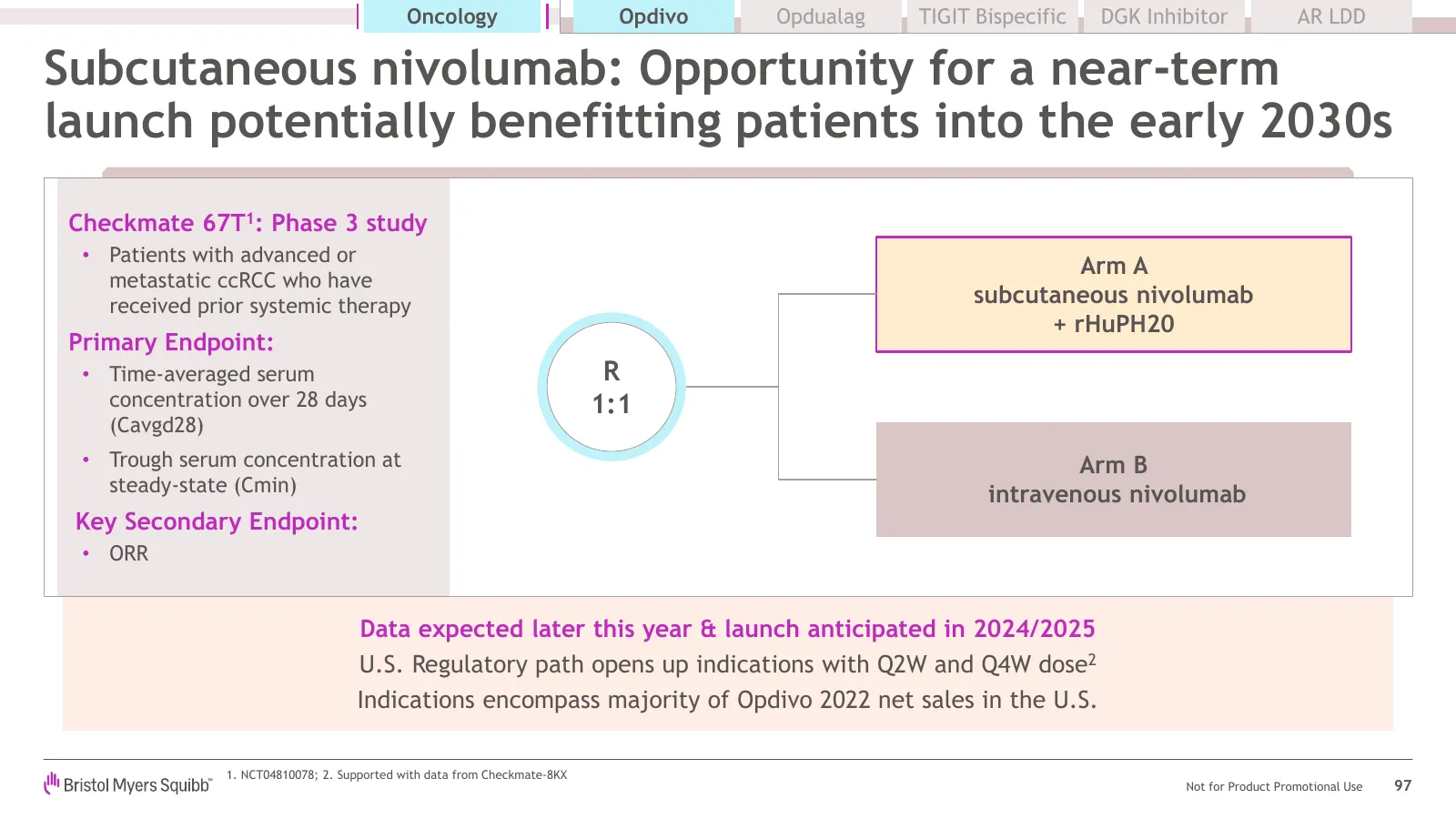
Slide 97: Subcutaneous nivolumab: near-term launch opportunity
Oncology Opdivo Opdualag TIGIT Bispecific DGK Inhibitor AR LDD Subcutaneous nivolumab: Opportunity for a near-term launch potentially benefitting patients into the early 2030s Checkmate 67T1: Phase 3 study • Patients with advanced or Arm A metastatic ccRCC who have received prior systemic therapy su
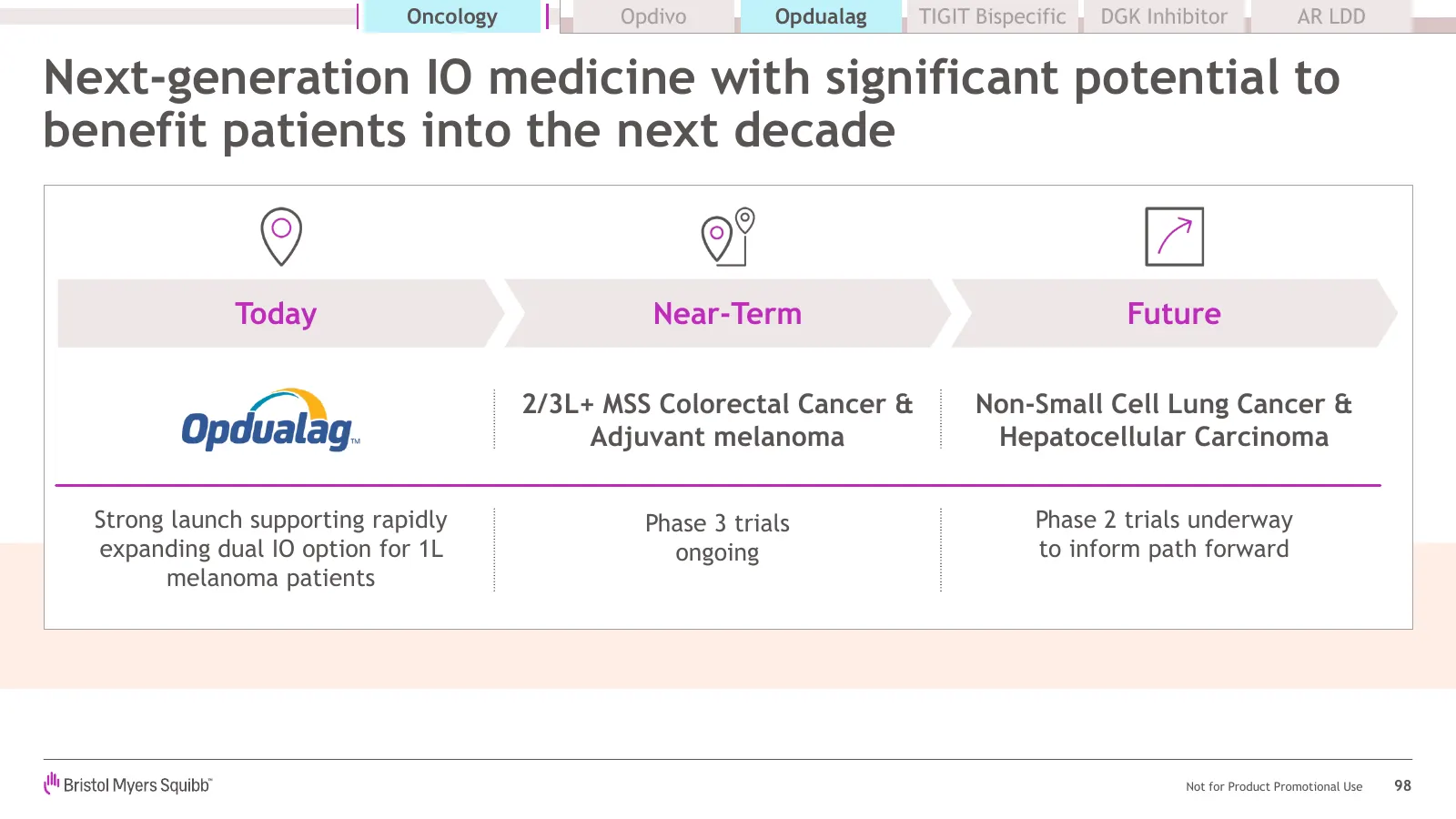
Slide 98: Next-generation IO medicine with significant potential
Oncology Opdivo Opdualag TIGIT Bispecific DGK Inhibitor AR LDD Next-generation IO medicine with significant potential to benefit patients into the next decade Today Near-Term Future 2/3L+ MSS Colorectal Cancer & Non-Small Cell Lung Cancer & Adjuvant melanoma Hepatocellular Carcinoma Strong launch su
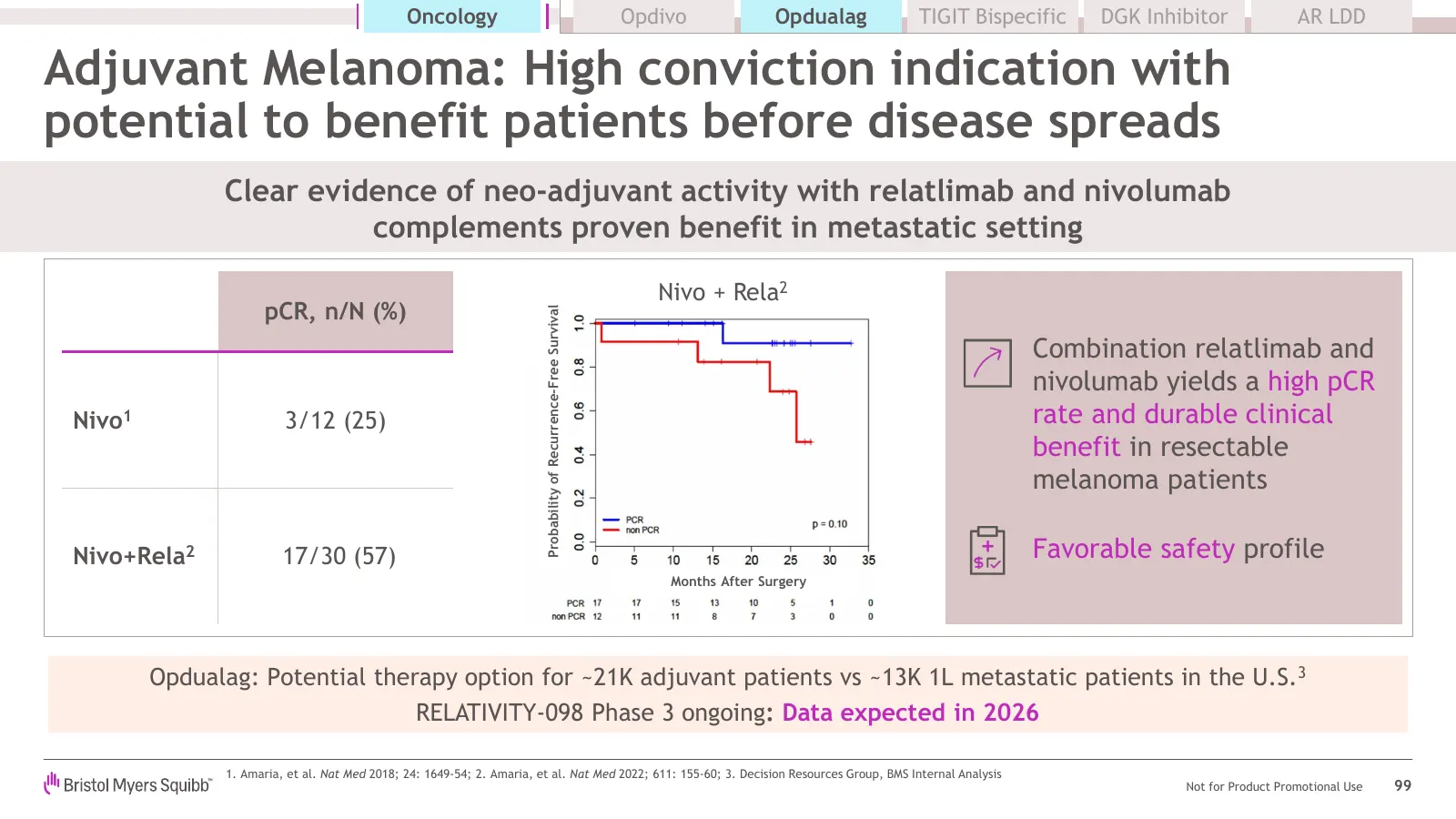
Slide 99: Adjuvant Melanoma: High conviction indication
Oncology Opdivo Opdualag TIGIT Bispecific DGK Inhibitor AR LDD Adjuvant Melanoma: High conviction indication with potential to benefit patients before disease spreads Clear evidence of neo-adjuvant activity with relatlimab and nivolumab complements proven benefit in metastatic setting Nivo + Rela2 p
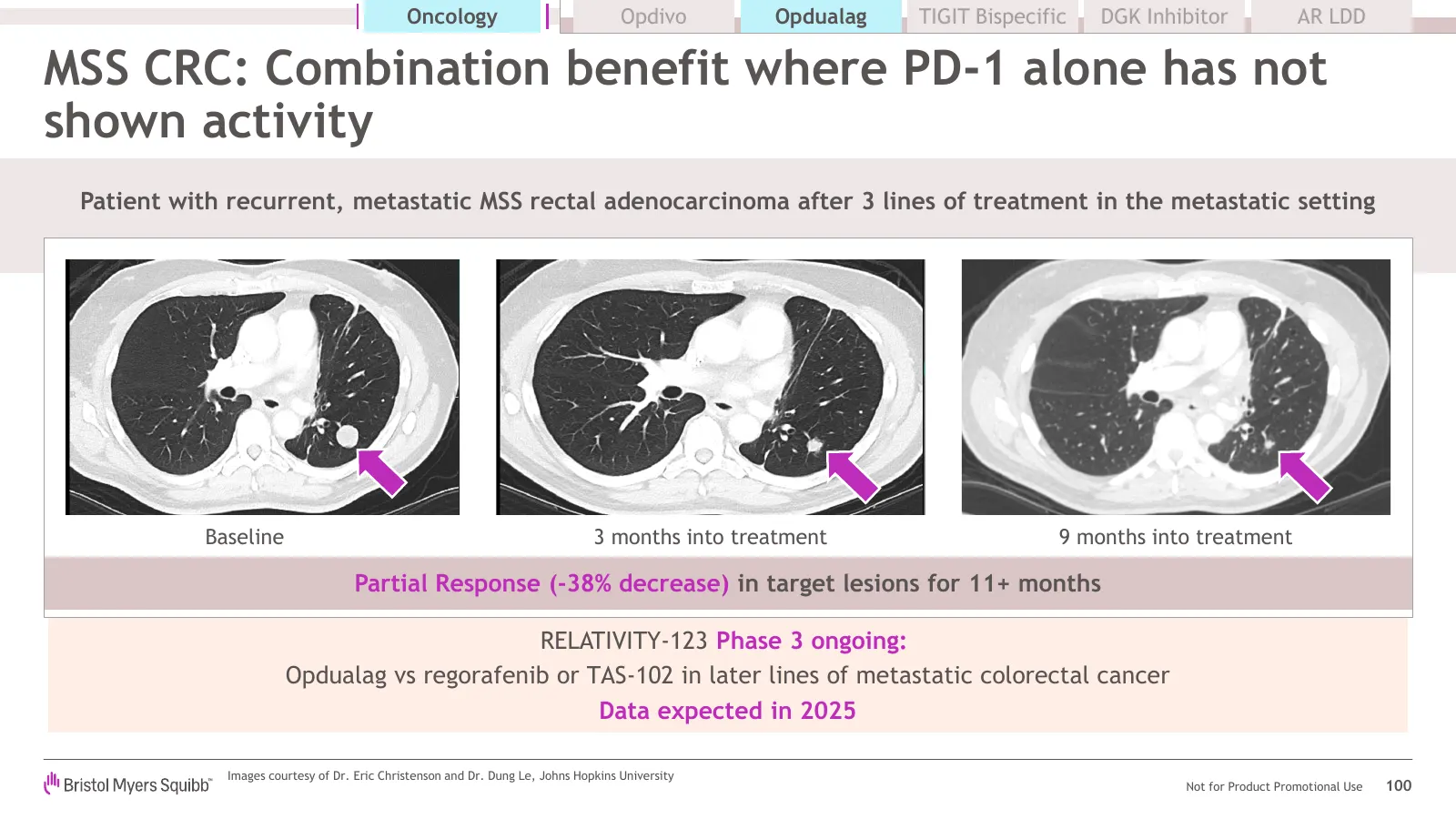
Slide 100: MSS CRC: Combination benefit where PD-1 alone has not shown activity
Oncology Opdivo Opdualag TIGIT Bispecific DGK Inhibitor AR LDD MSS CRC: Combination benefit where PD-1 alone has not shown activity Patient with recurrent, metastatic MSS rectal adenocarcinoma after 3 lines of treatment in the metastatic setting Baseline 3 months into treatment 9 months into treatme
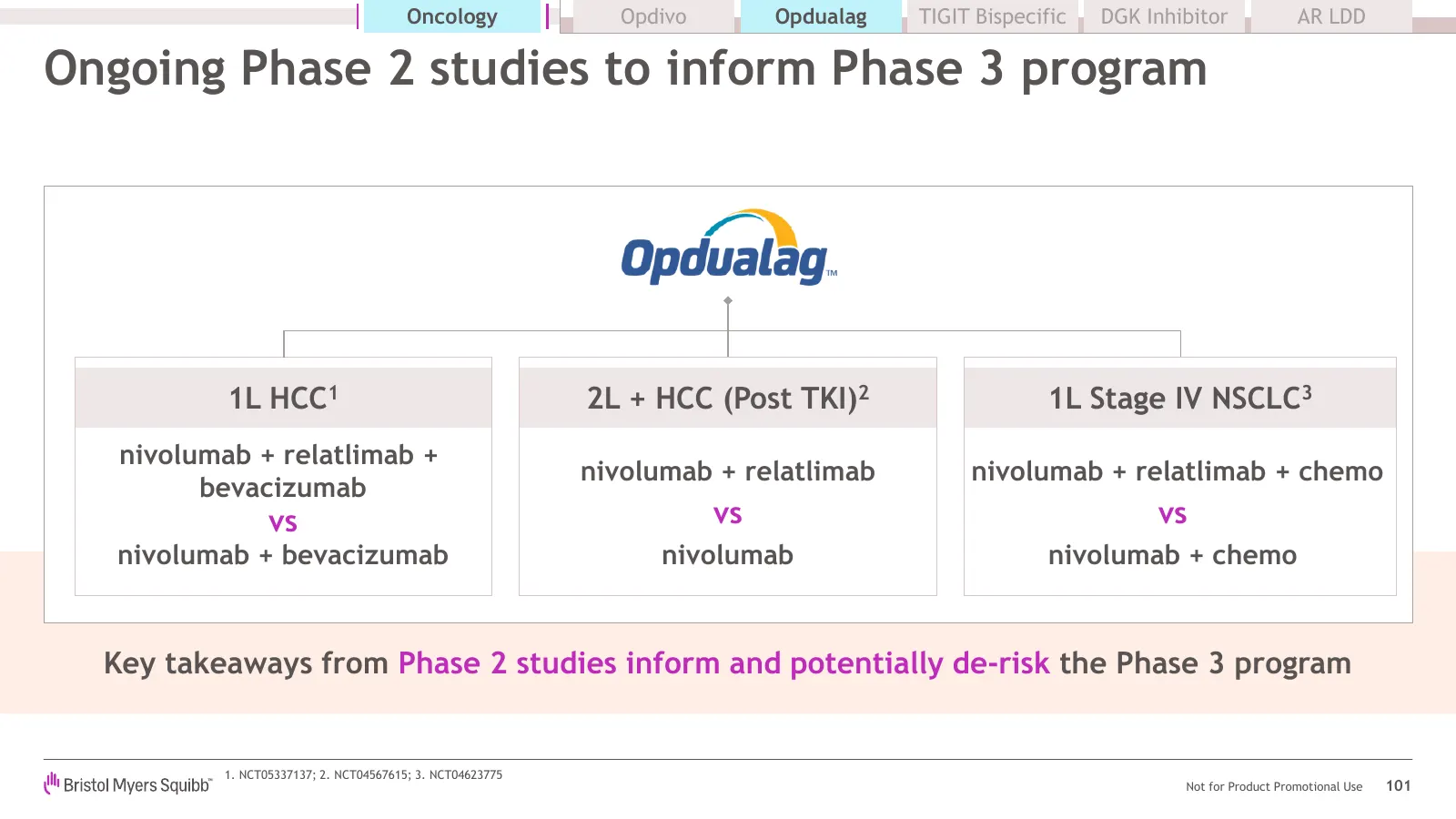
Slide 101: Ongoing Phase 2 studies to inform Phase 3 program
Oncology Opdivo Opdualag TIGIT Bispecific DGK Inhibitor AR LDD Ongoing Phase 2 studies to inform Phase 3 program 1L HCC1 2L + HCC (Post TKI)2 1L Stage IV NSCLC3 nivolumab + relatlimab + nivolumab + relatlimab nivolumab + relatlimab + chemo bevacizumab vs vs vs nivolumab + bevacizumab nivolumab nivol
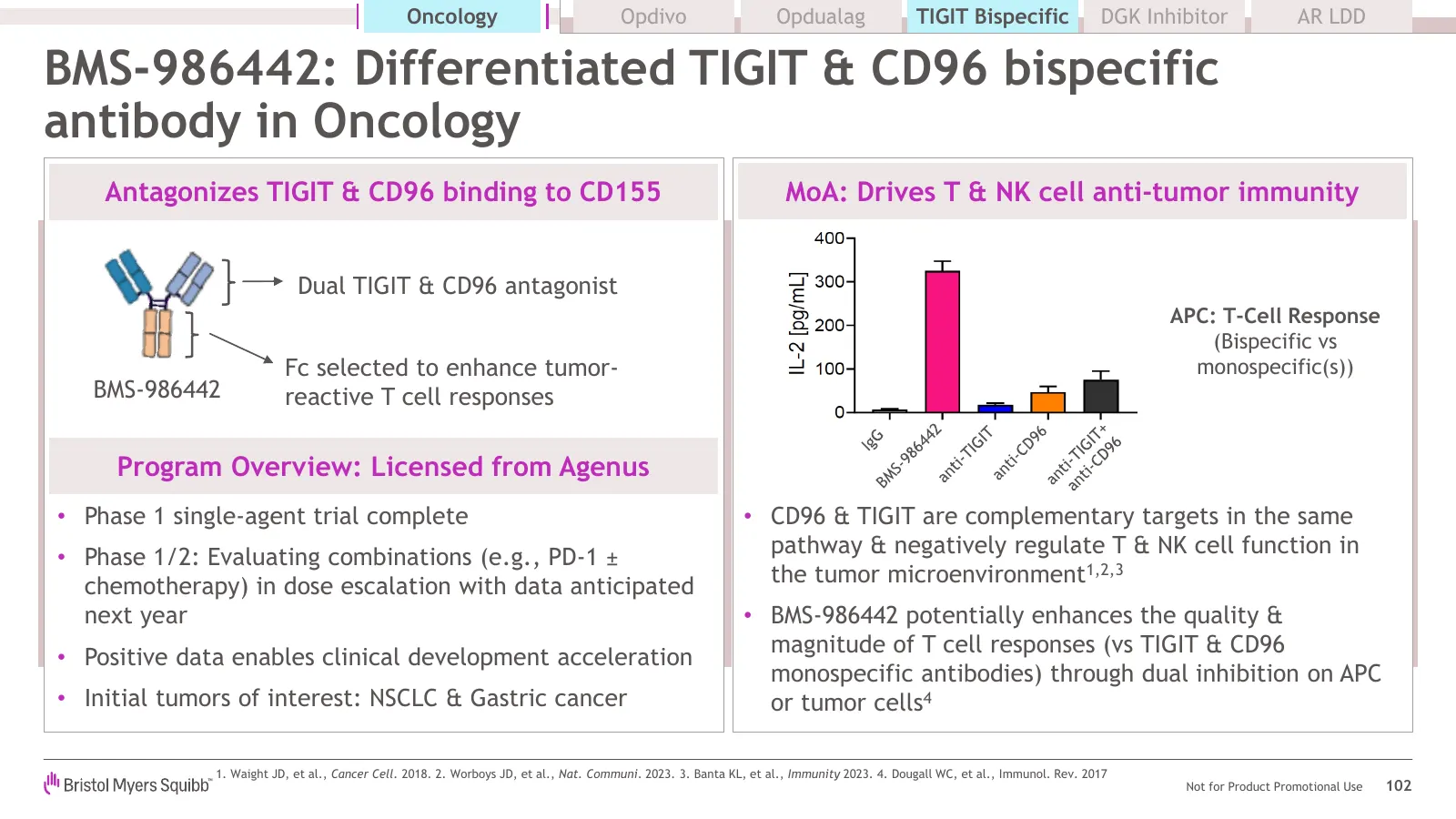
Slide 102: BMS-986442: Differentiated TIGIT & CD96 bispecific antibody
Oncology Opdivo Opdualag TIGIT Bispecific DGK Inhibitor AR LDD BMS-986442: Differentiated TIGIT & CD96 bispecific antibody in Oncology Antagonizes TIGIT & CD96 binding to CD155 MoA: Drives T & NK cell anti-tumor immunity Dual TIGIT & CD96 antagonist APC: T-Cell Response (Bispecific vs Fc selected to
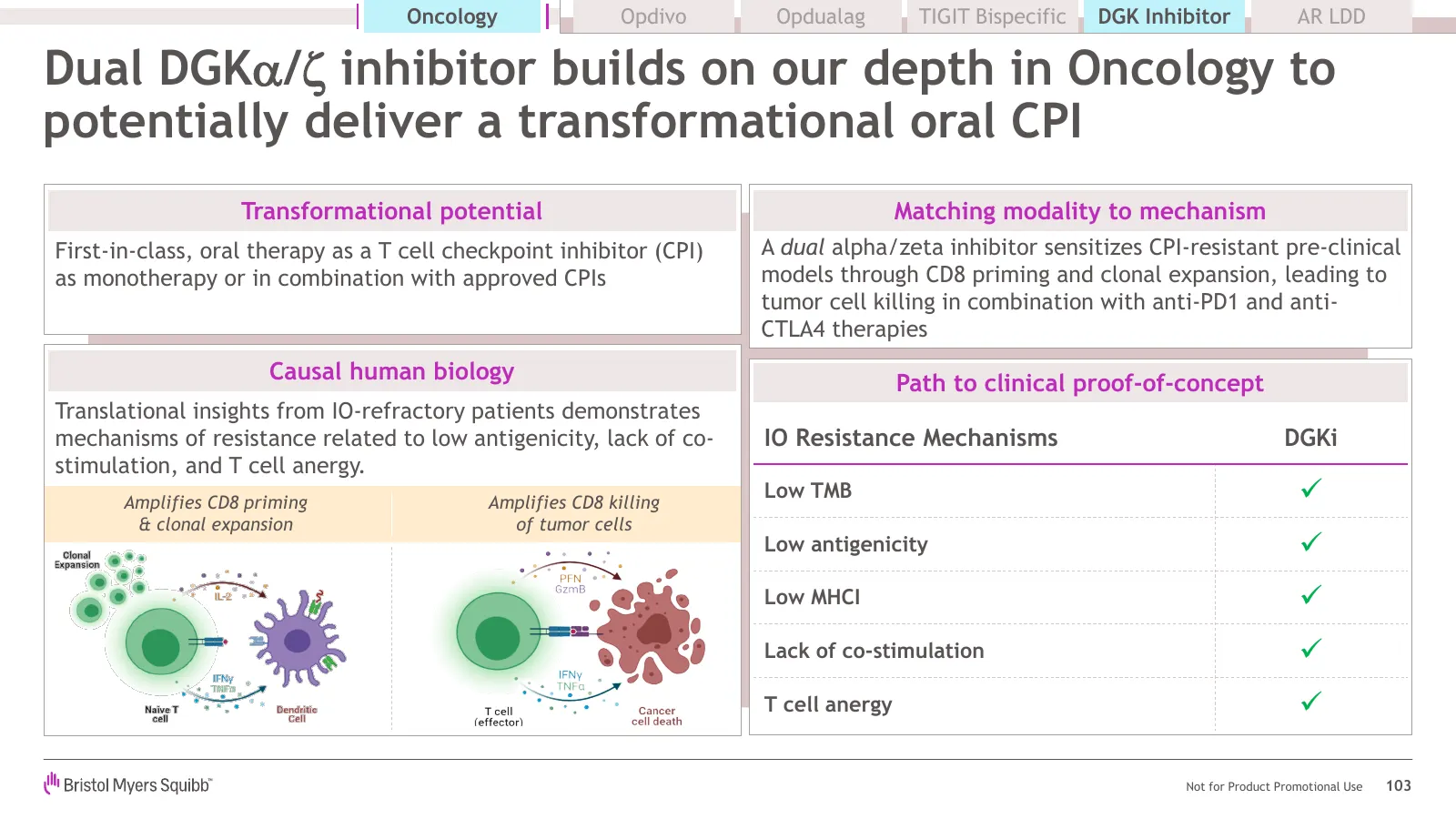
Slide 103: Dual DGKα/ζ inhibitor as a transformational oral CPI
Oncology Opdivo Opdualag TIGIT Bispecific DGK Inhibitor AR LDD Dual DGKα/ζ inhibitor builds on our depth in Oncology to potentially deliver a transformational oral CPI Transformational potential Matching modality to mechanism First-in-class, oral therapy as a T cell checkpoint inhibitor (CPI) A dual
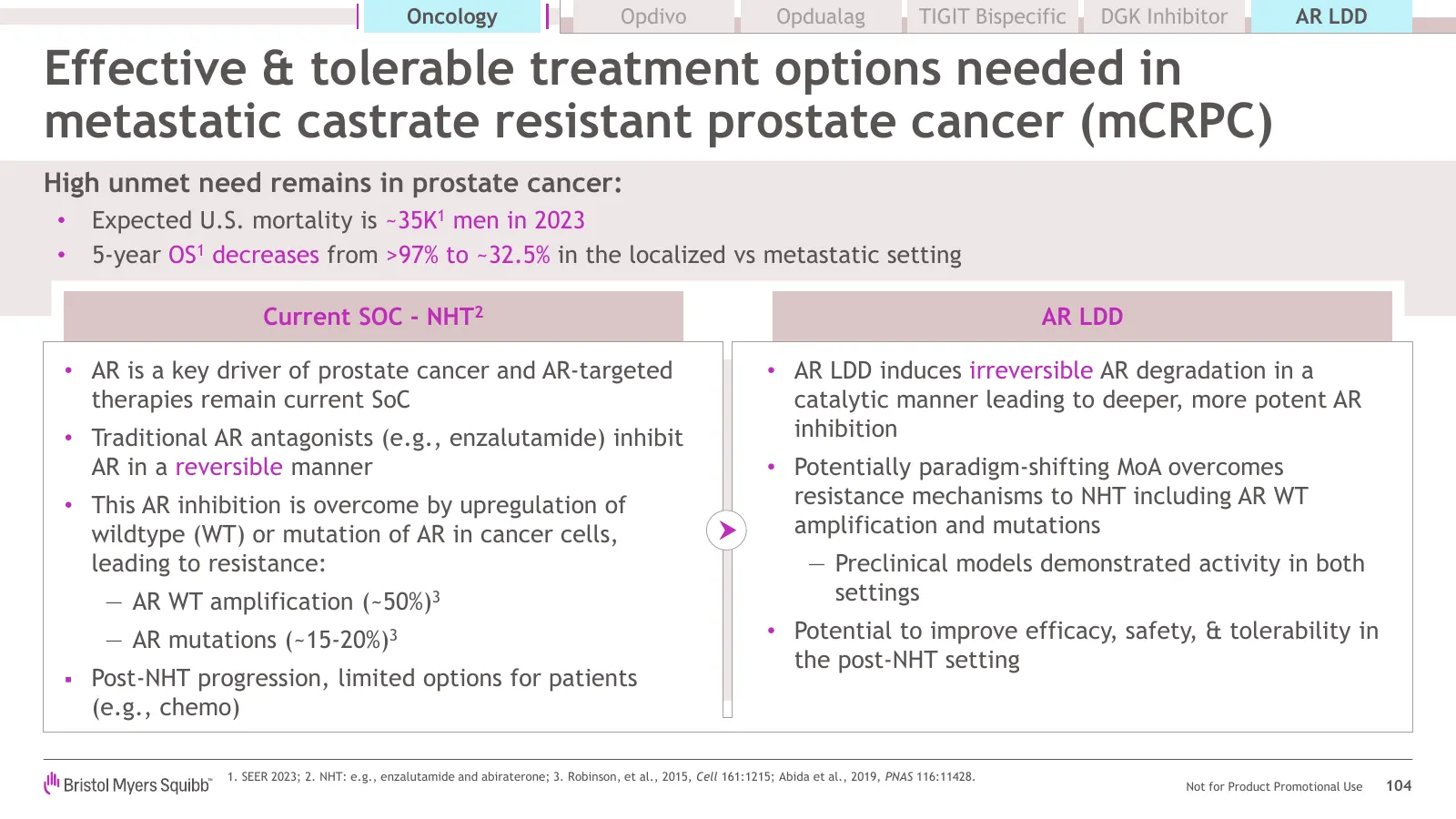
Slide 104: Treatment options needed in mCRPC
Oncology Opdivo Opdualag TIGIT Bispecific DGK Inhibitor AR LDD Effective & tolerable treatment options needed in metastatic castrate resistant prostate cancer (mCRPC) High unmet need remains in prostate cancer: • Expected U.S. mortality is ~35K1 men in 2023 • 5-year OS1 decreases from >97% to ~32.5%
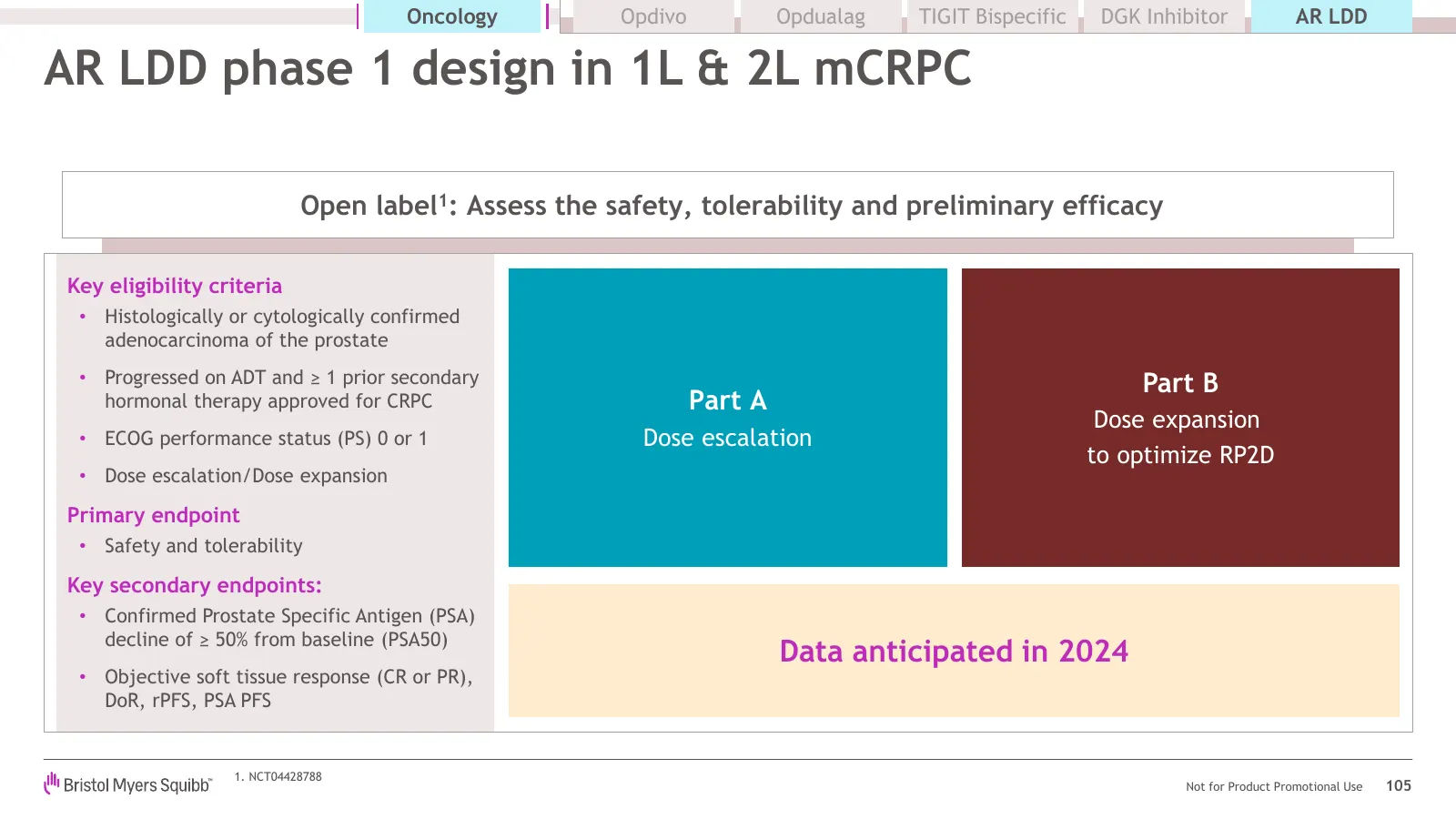
Slide 105: AR LDD phase 1 design in 1L & 2L mCRPC
Oncology Opdivo Opdualag TIGIT Bispecific DGK Inhibitor AR LDD AR LDD phase 1 design in 1L & 2L mCRPC Open label1: Assess the safety, tolerability and preliminary efficacy Key eligibility criteria • Histologically or cytologically confirmed adenocarcinoma of the prostate • Progressed on ADT and ≥ 1
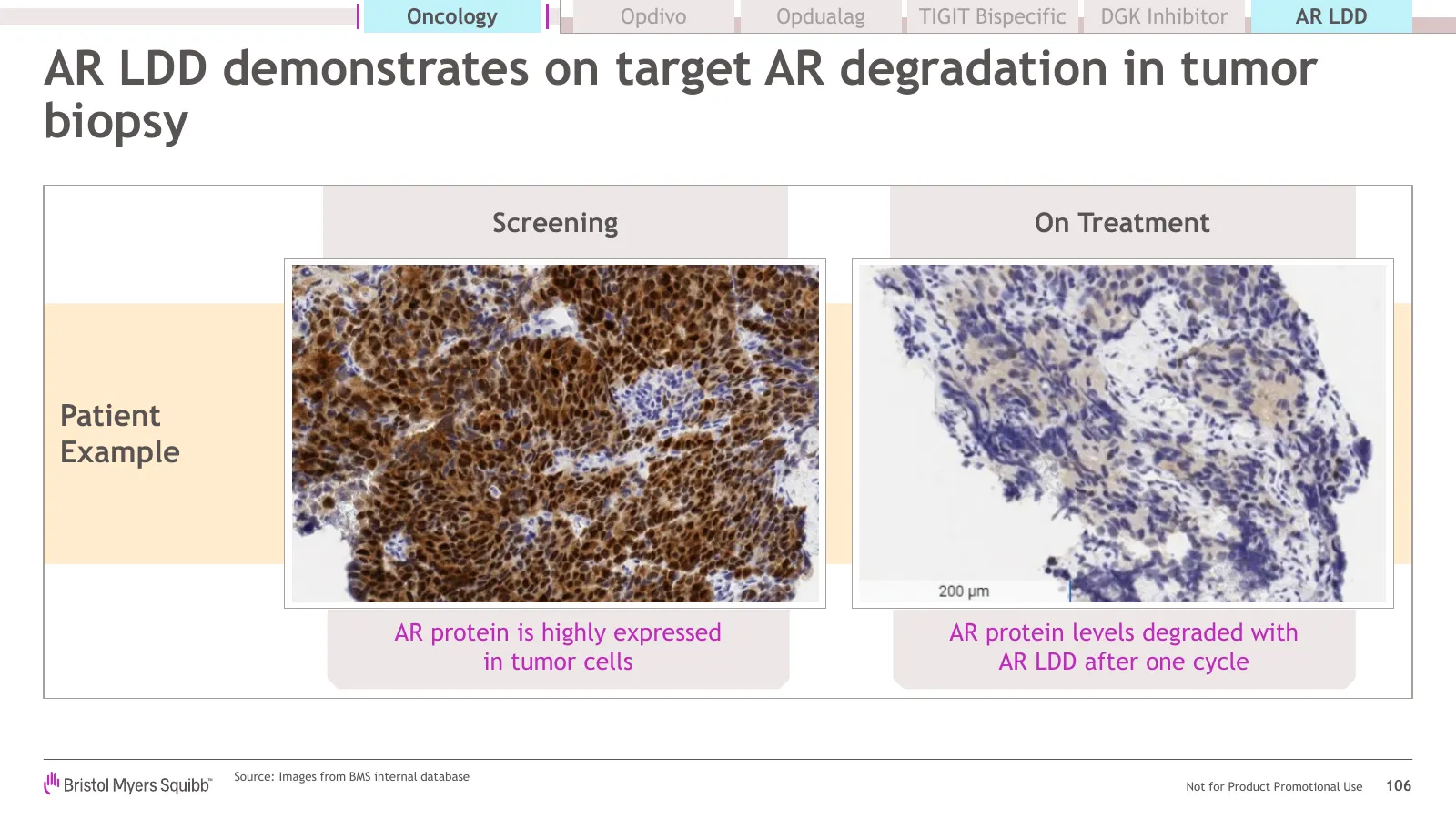
Slide 106: AR LDD demonstrates on target AR degradation in tumor biopsy
Oncology Opdivo Opdualag TIGIT Bispecific DGK Inhibitor AR LDD AR LDD demonstrates on target AR degradation in tumor biopsy Screening On Treatment Patient Example AR protein is highly expressed AR protein levels degraded with in tumor cells AR LDD after one cycle Source: Images from BMS internal dat
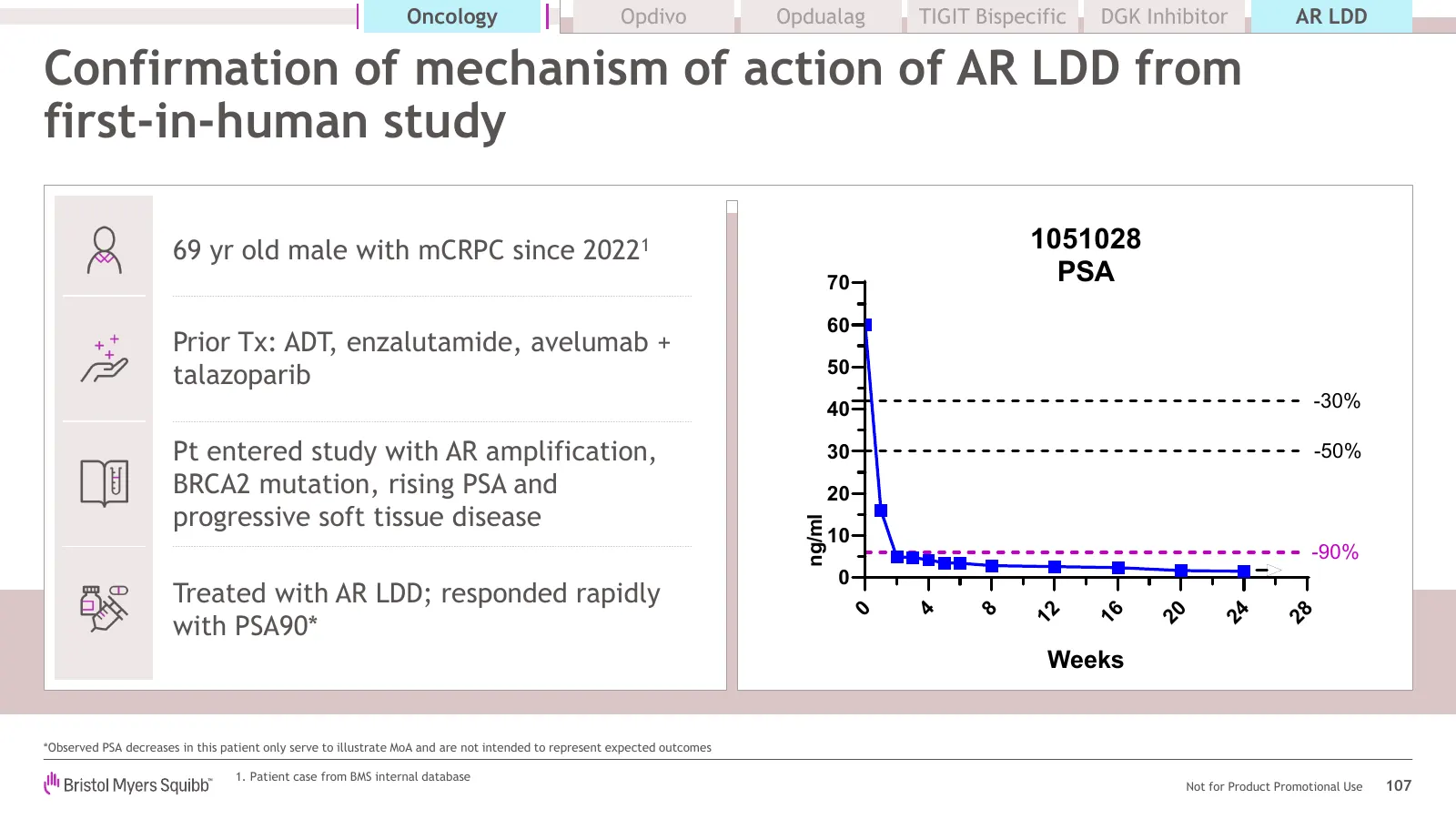
Slide 107: Confirmation of mechanism of action of AR LDD
Oncology Opdivo Opdualag TIGIT Bispecific DGK Inhibitor AR LDD Confirmation of mechanism of action of AR LDD from first-in-human study 69 yr old male with mCRPC since 20221 1051028 70 PSA 60 Prior Tx: ADT, enzalutamide, avelumab + 50 talazoparib 40 -30% Pt entered study with AR amplification, 30 -50
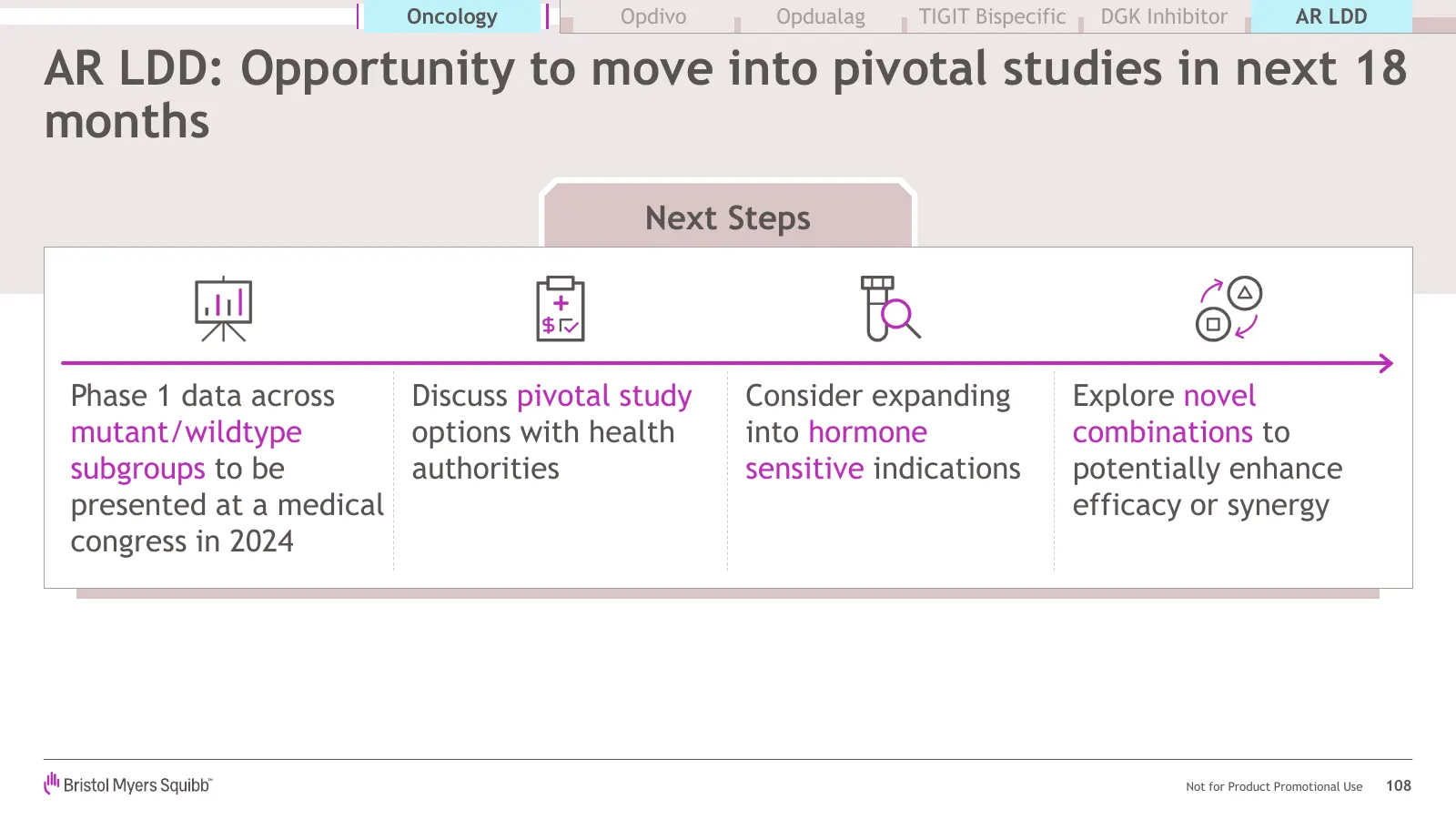
Slide 108: AR LDD: Opportunity to move into pivotal studies
Oncology Opdivo Opdualag TIGIT Bispecific DGK Inhibitor AR LDD AR LDD: Opportunity to move into pivotal studies in next 18 months Next Steps Phase 1 data across Discuss pivotal study Consider expanding Explore novel mutant/wildtype options with health into hormone combinations to subgroups to be aut
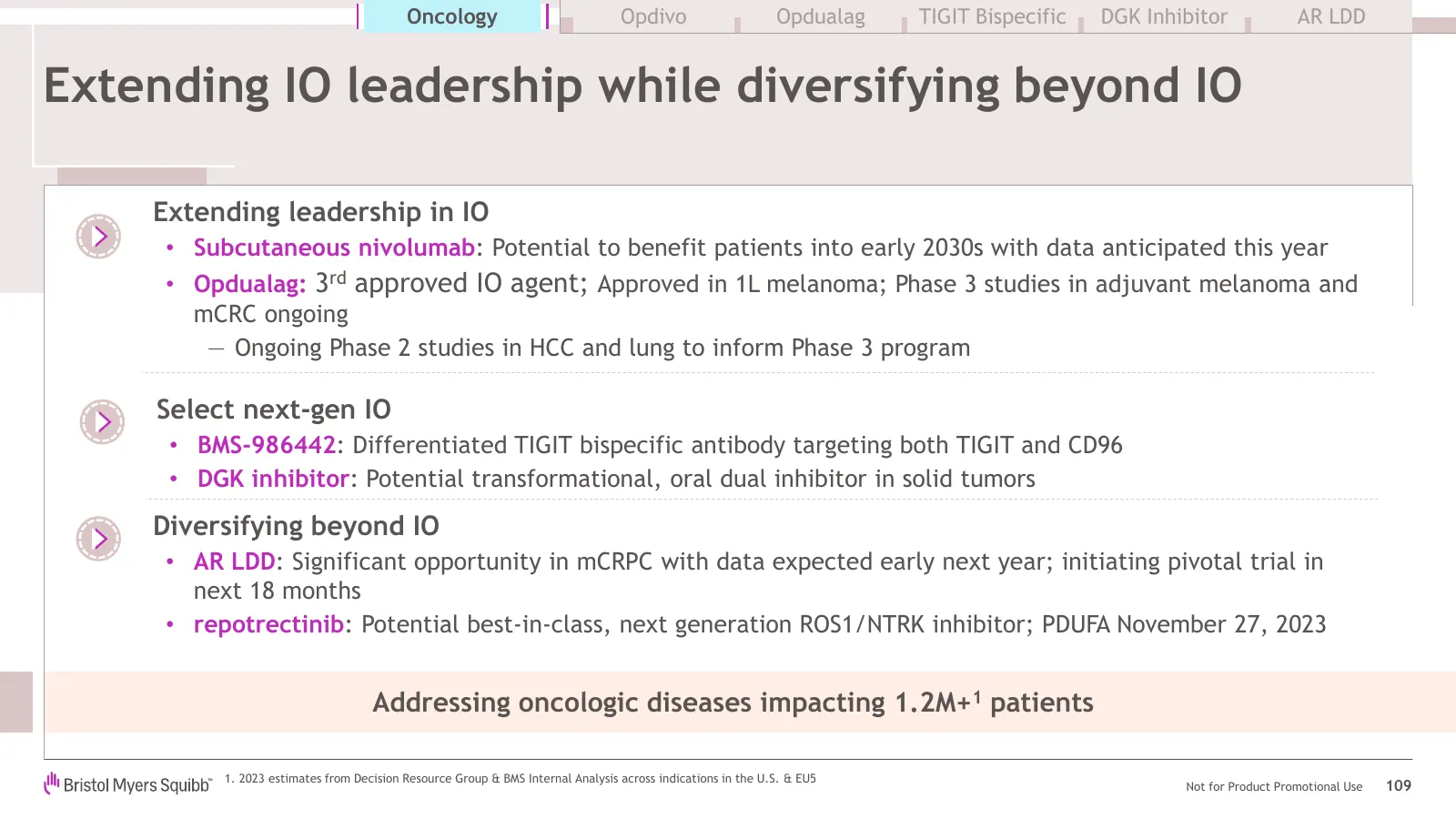
Slide 109: Extending IO leadership while diversifying beyond IO
Oncology Opdivo Opdualag TIGIT Bispecific DGK Inhibitor AR LDD Extending IO leadership while diversifying beyond IO Extending leadership in IO • Subcutaneous nivolumab: Potential to benefit patients into early 2030s with data anticipated this year • Opdualag: 3rd approved IO agent; Approved in 1L me
Slide 110: Program will reconvene following a short break
Program will reconvene following a short break (10 min) Not for Product Promotional Use 110

Slide 111: Cardiovascular
Cardiovascular Not for Product Promotional Use 111
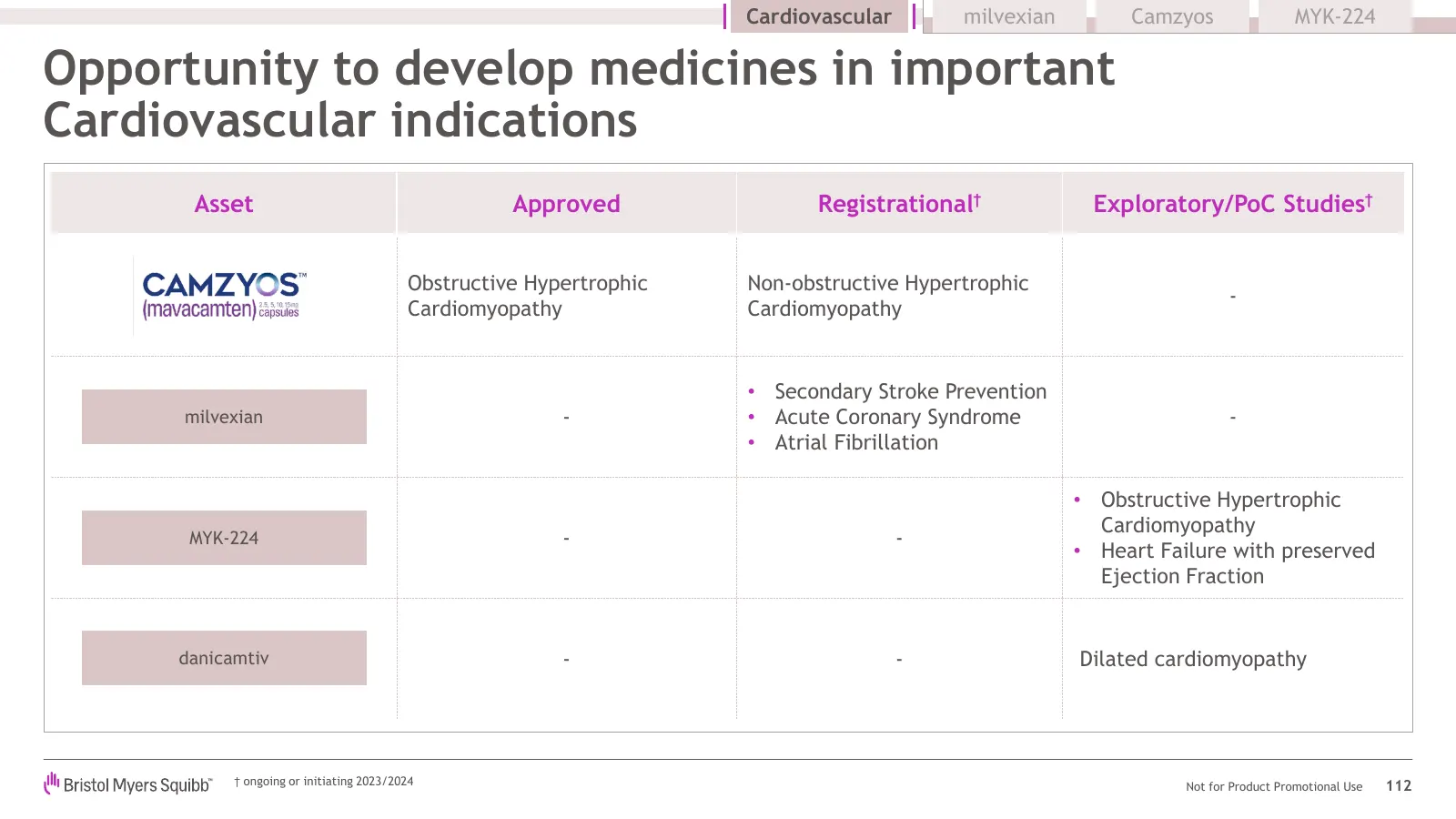
Slide 112: Opportunity to develop medicines in Cardiovascular indications
Cardiovascular milvexian Camzyos MYK-224 Opportunity to develop medicines in important Cardiovascular indications Asset Approved Registrational† Exploratory/PoC Studies† Obstructive Hypertrophic Non-obstructive Hypertrophic - Cardiomyopathy Cardiomyopathy • Secondary Stroke Prevention milvexian - •
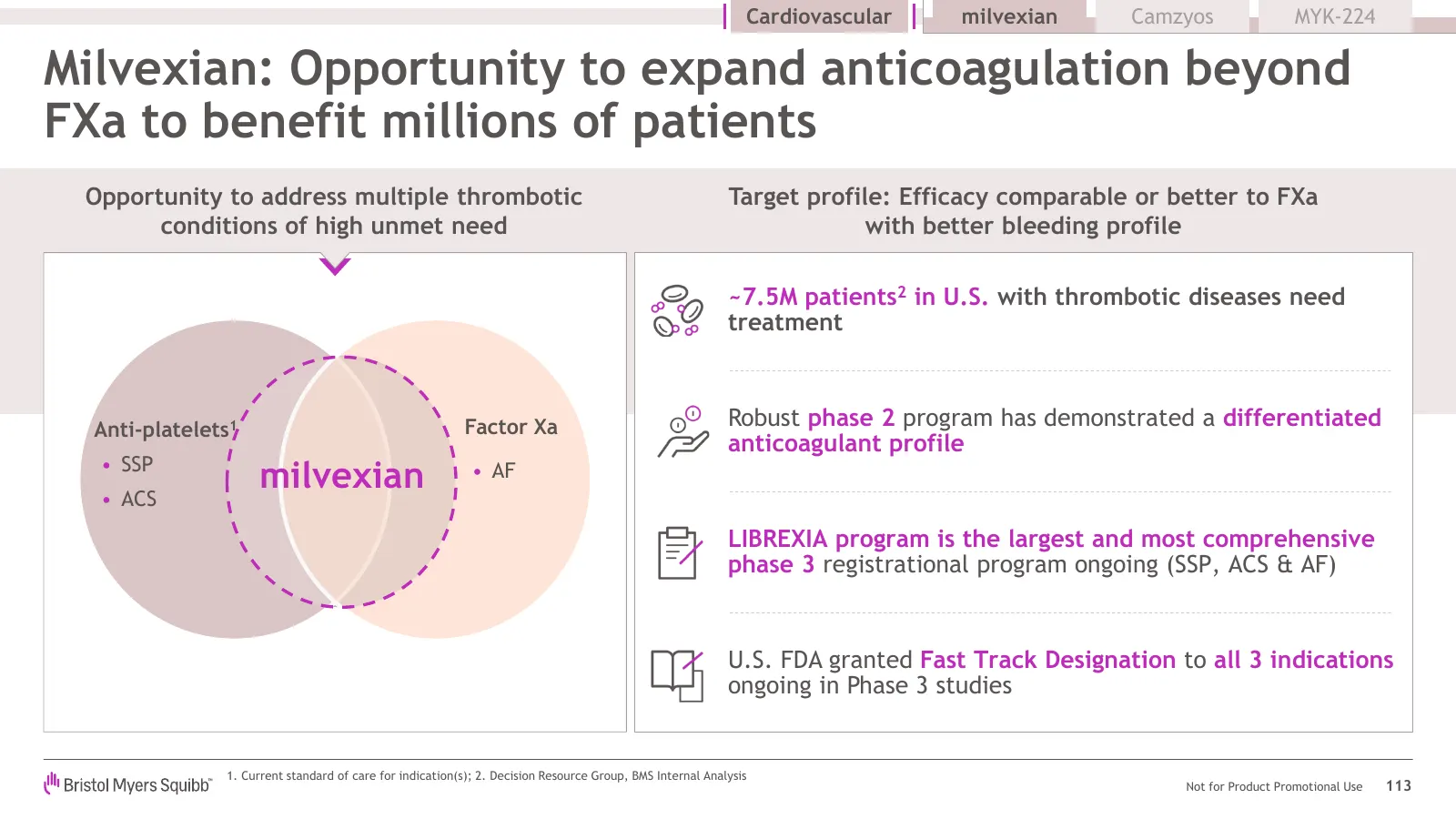
Slide 113: Milvexian: Opportunity to expand anticoagulation beyond FXa
Cardiovascular milvexian Camzyos MYK-224 Milvexian: Opportunity to expand anticoagulation beyond FXa to benefit millions of patients Opportunity to address multiple thrombotic Target profile: Efficacy comparable or better to FXa conditions of high unmet need with better bleeding profile ~7.5M patien
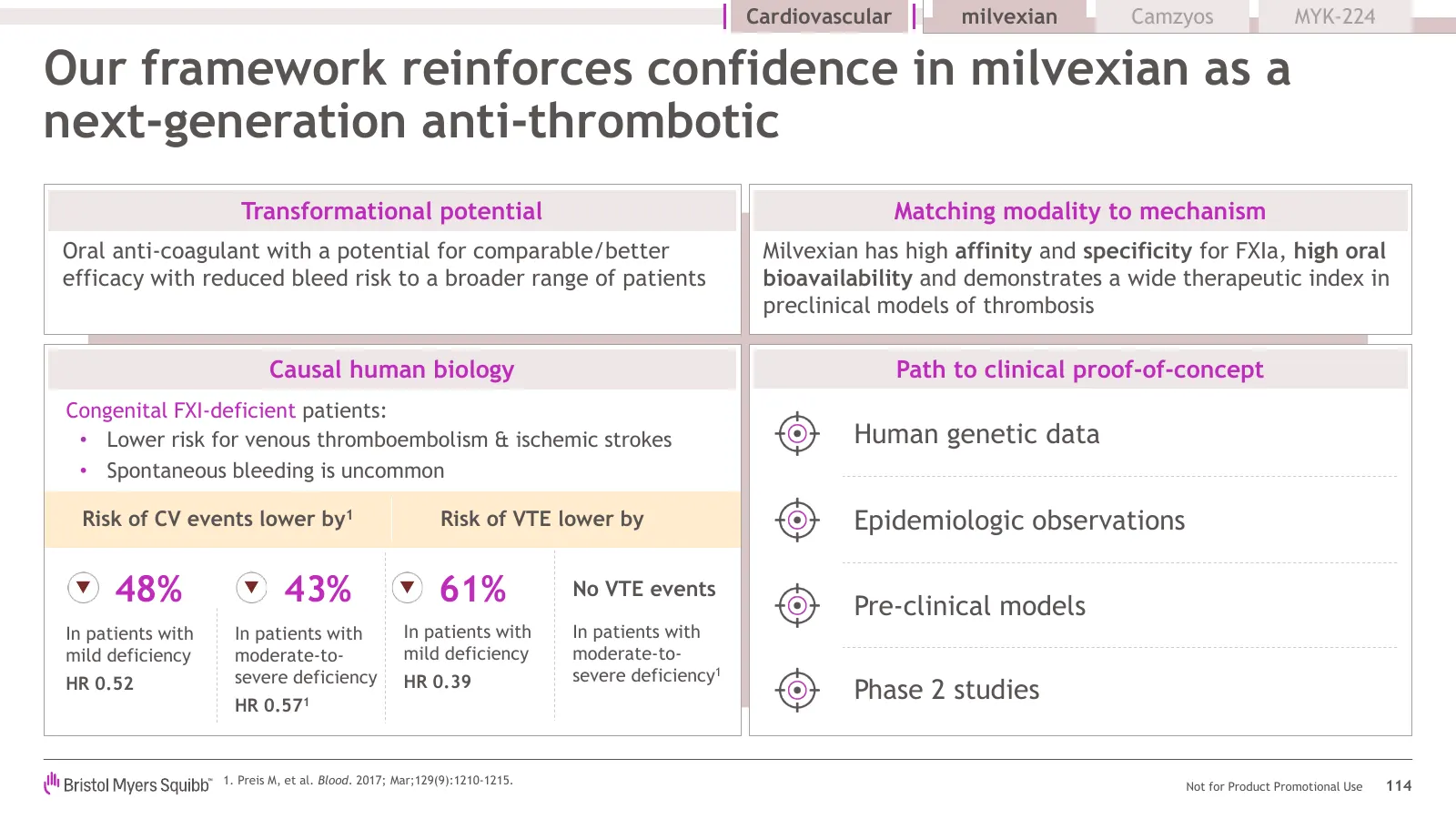
Slide 114: Framework reinforces confidence in milvexian
Cardiovascular milvexian Camzyos MYK-224 Our framework reinforces confidence in milvexian as a next-generation anti-thrombotic Transformational potential Matching modality to mechanism Oral anti-coagulant with a potential for comparable/better Milvexian has high affinity and specificity for FXIa, hi
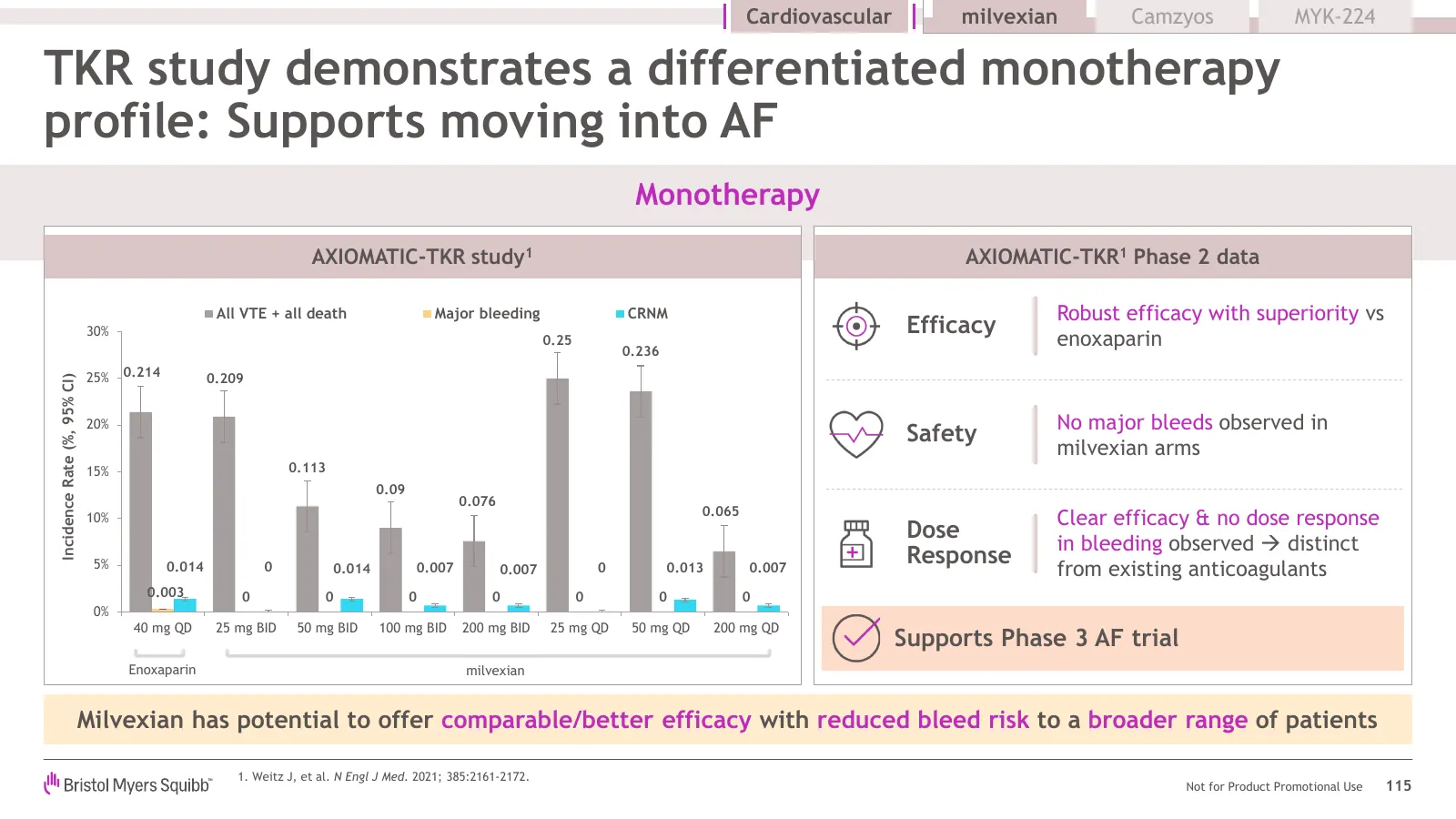
Slide 115: TKR study demonstrates a differentiated monotherapy profile
Cardiovascular milvexian Camzyos MYK-224 TKR study demonstrates a differentiated monotherapy profile: Supports moving into AF Monotherapy AXIOMATIC-TKR study1 AXIOMATIC-TKR1 Phase 2 data All VTE + all death Major bleeding CRNM Robust efficacy with superiority vs 30% Efficacy 0.25 0.236 enoxaparin 25
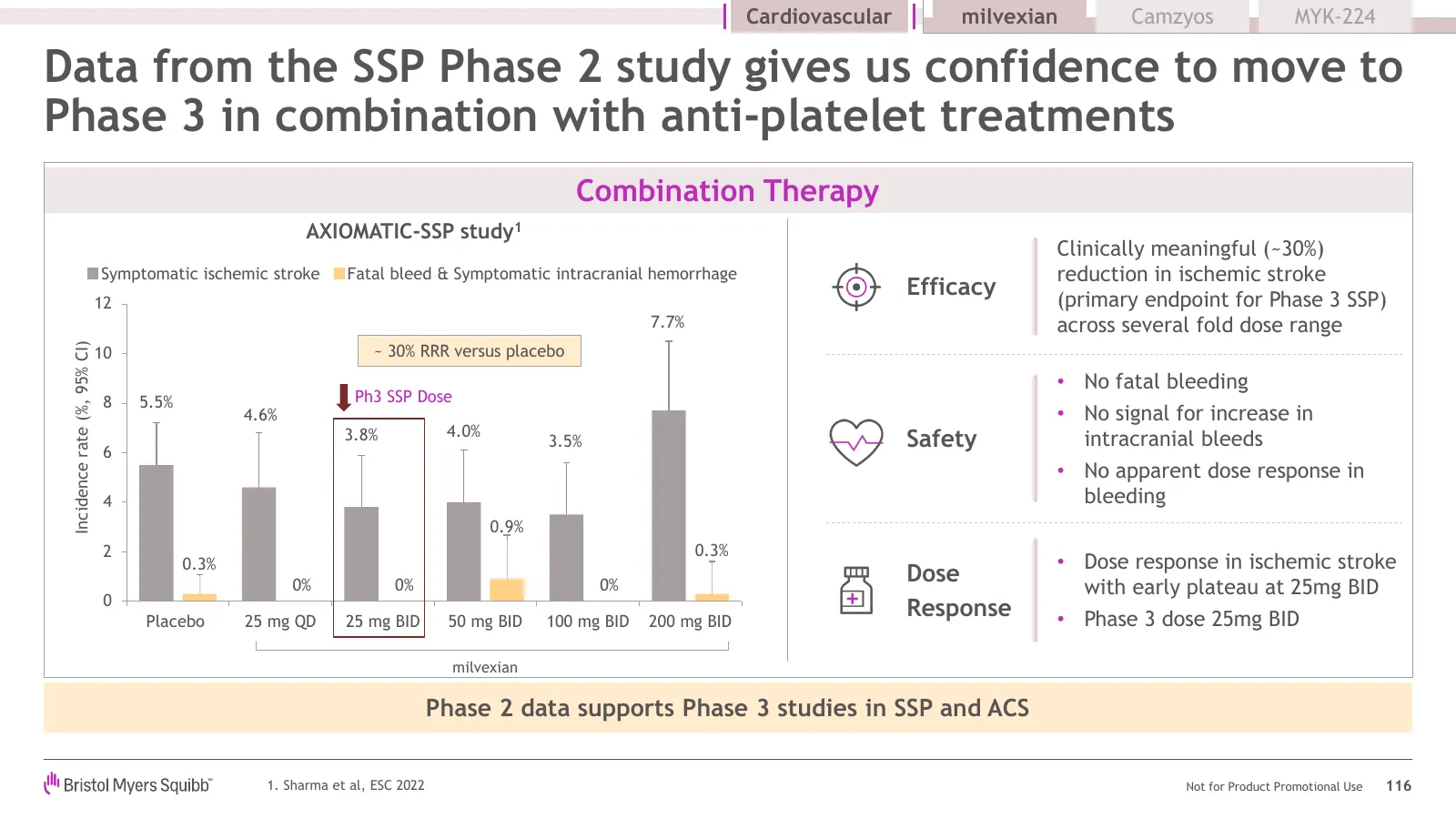
Slide 116: SSP Phase 2 data supports Phase 3 with anti-platelets
Cardiovascular milvexian Camzyos MYK-224 Data from the SSP Phase 2 study gives us confidence to move to Phase 3 in combination with anti-platelet treatments Combination Therapy AXIOMATIC-SSP study1 Clinically meaningful (~30%) Symptomatic ischemic stroke Fatal bleed & Symptomatic intracranial hemorr
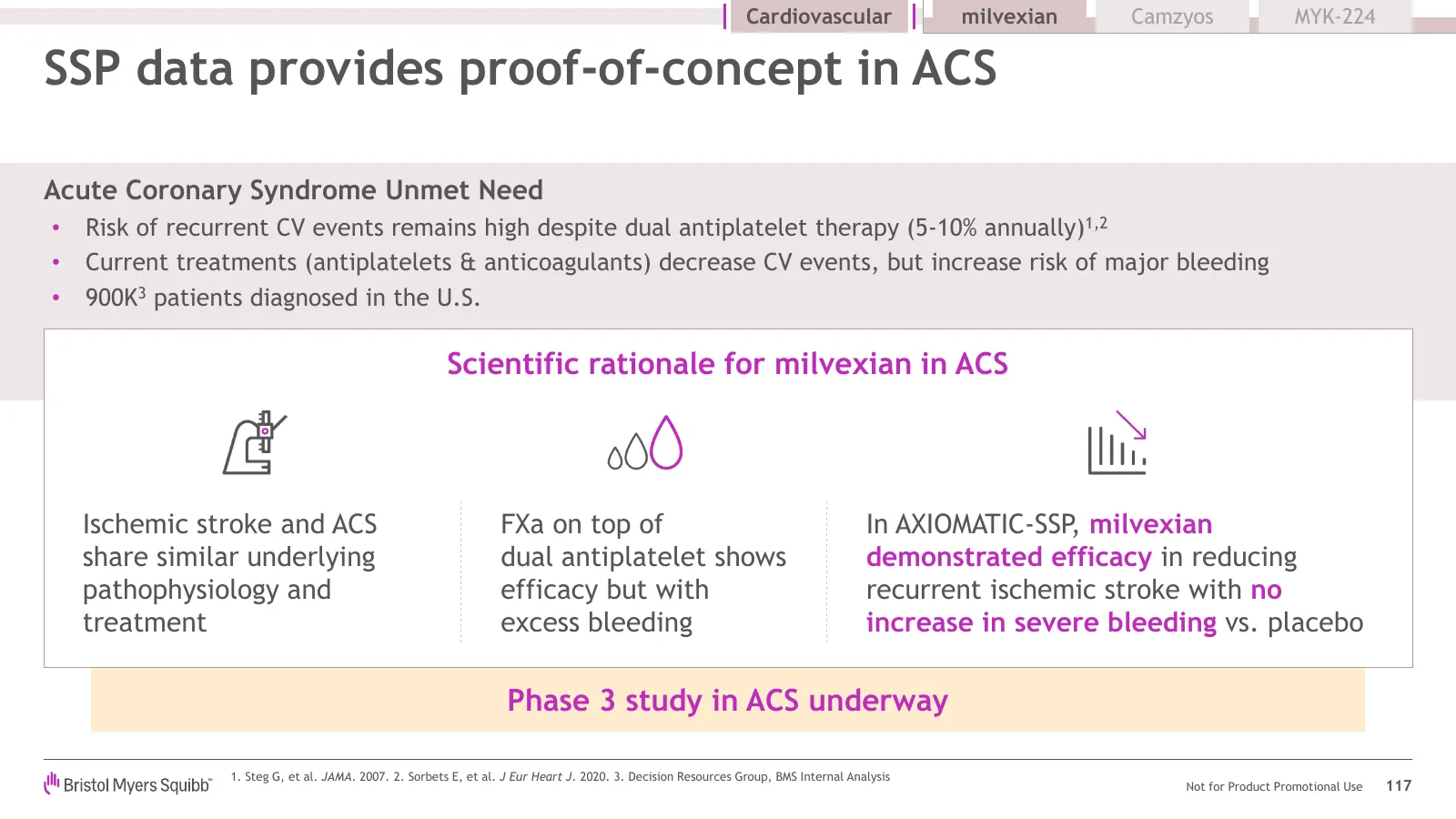
Slide 117: SSP data provides proof-of-concept in ACS
Cardiovascular milvexian Camzyos MYK-224 SSP data provides proof-of-concept in ACS Acute Coronary Syndrome Unmet Need • Risk of recurrent CV events remains high despite dual antiplatelet therapy (5-10% annually)1,2 • Current treatments (antiplatelets & anticoagulants) decrease CV events, but increas
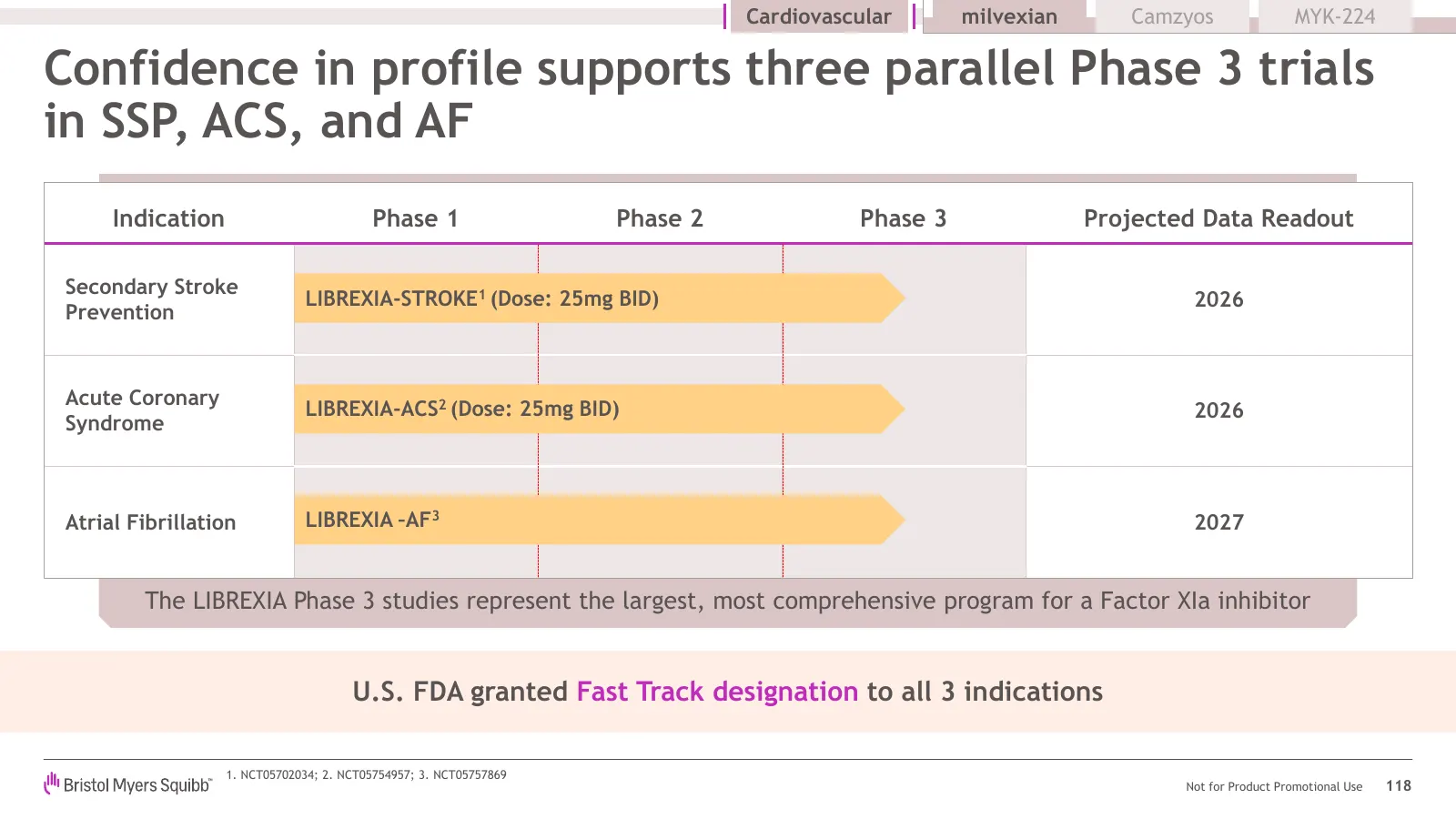
Slide 118: Three parallel Phase 3 trials in SSP, ACS, and AF
Cardiovascular milvexian Camzyos MYK-224 Confidence in profile supports three parallel Phase 3 trials in SSP, ACS, and AF Indication Phase 1 Phase 2 Phase 3 Projected Data Readout Secondary Stroke LIBREXIA-STROKE1 (Dose: 25mg BID) 2026 Prevention Acute Coronary LIBREXIA-ACS2 (Dose: 25mg BID) 2026 Sy
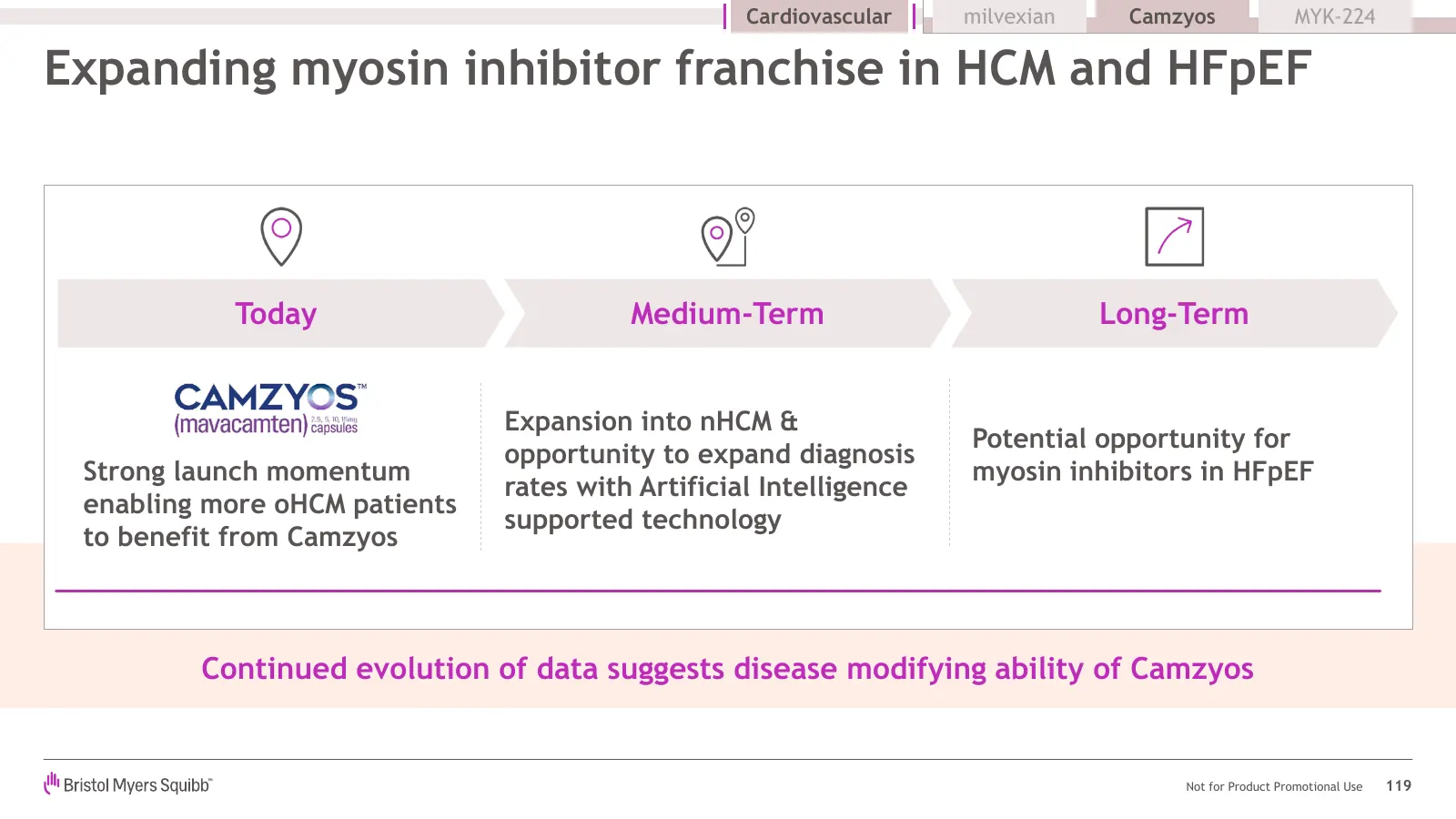
Slide 119: Expanding myosin inhibitor franchise in HCM and HFpEF
Cardiovascular milvexian Camzyos MYK-224 Expanding myosin inhibitor franchise in HCM and HFpEF Today Medium-Term Long-Term Expansion into nHCM & Potential opportunity for opportunity to expand diagnosis Strong launch momentum myosin inhibitors in HFpEF rates with Artificial Intelligence enabling mor
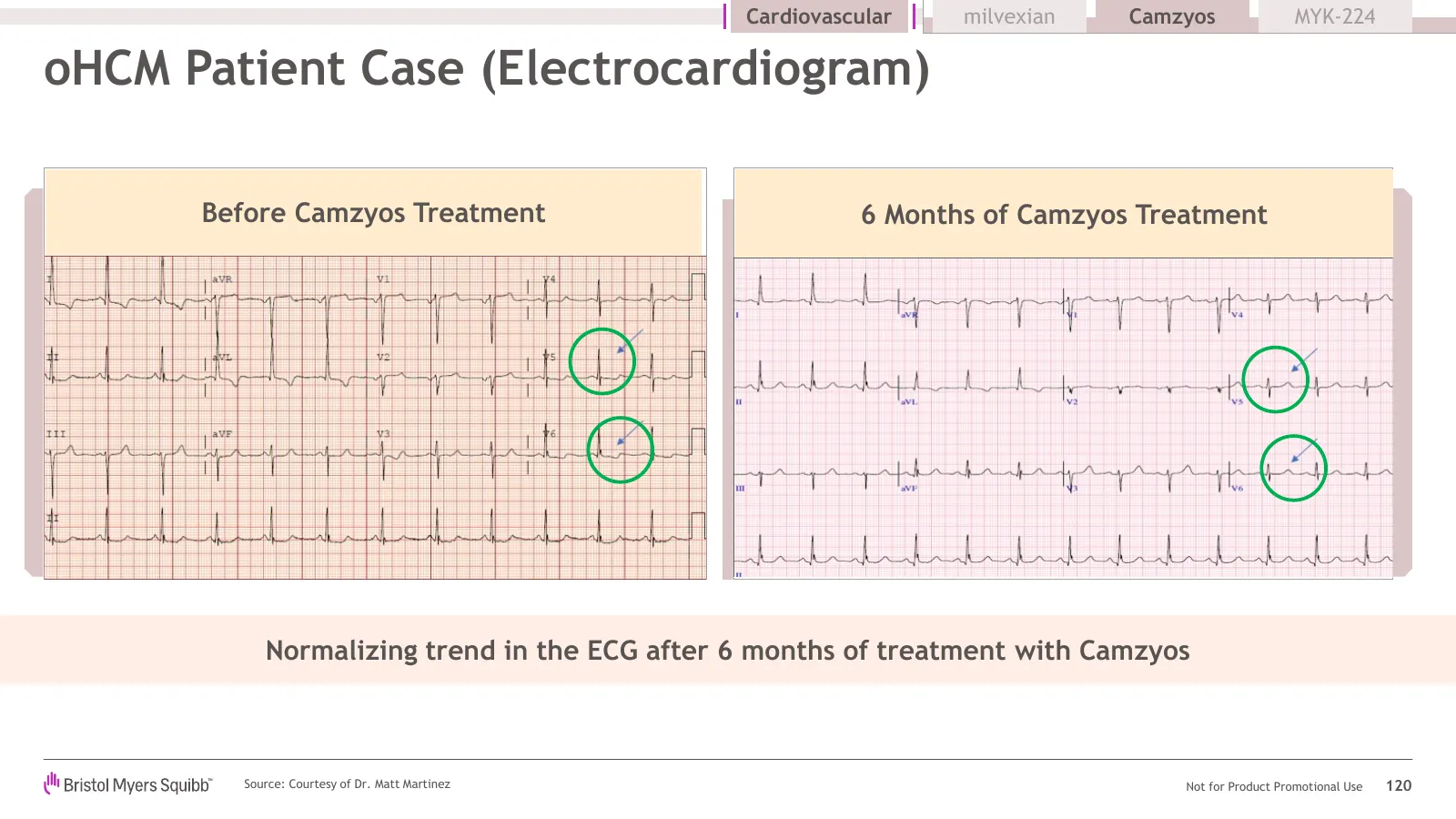
Slide 120: oHCM Patient Case (Electrocardiogram)
Cardiovascular milvexian Camzyos MYK-224 oHCM Patient Case (Electrocardiogram) Before Camzyos Treatment 6 Months of Camzyos Treatment Normalizing trend in the ECG after 6 months of treatment with Camzyos Source: Courtesy of Dr. Matt Martinez Not for Product Promotional Use 120
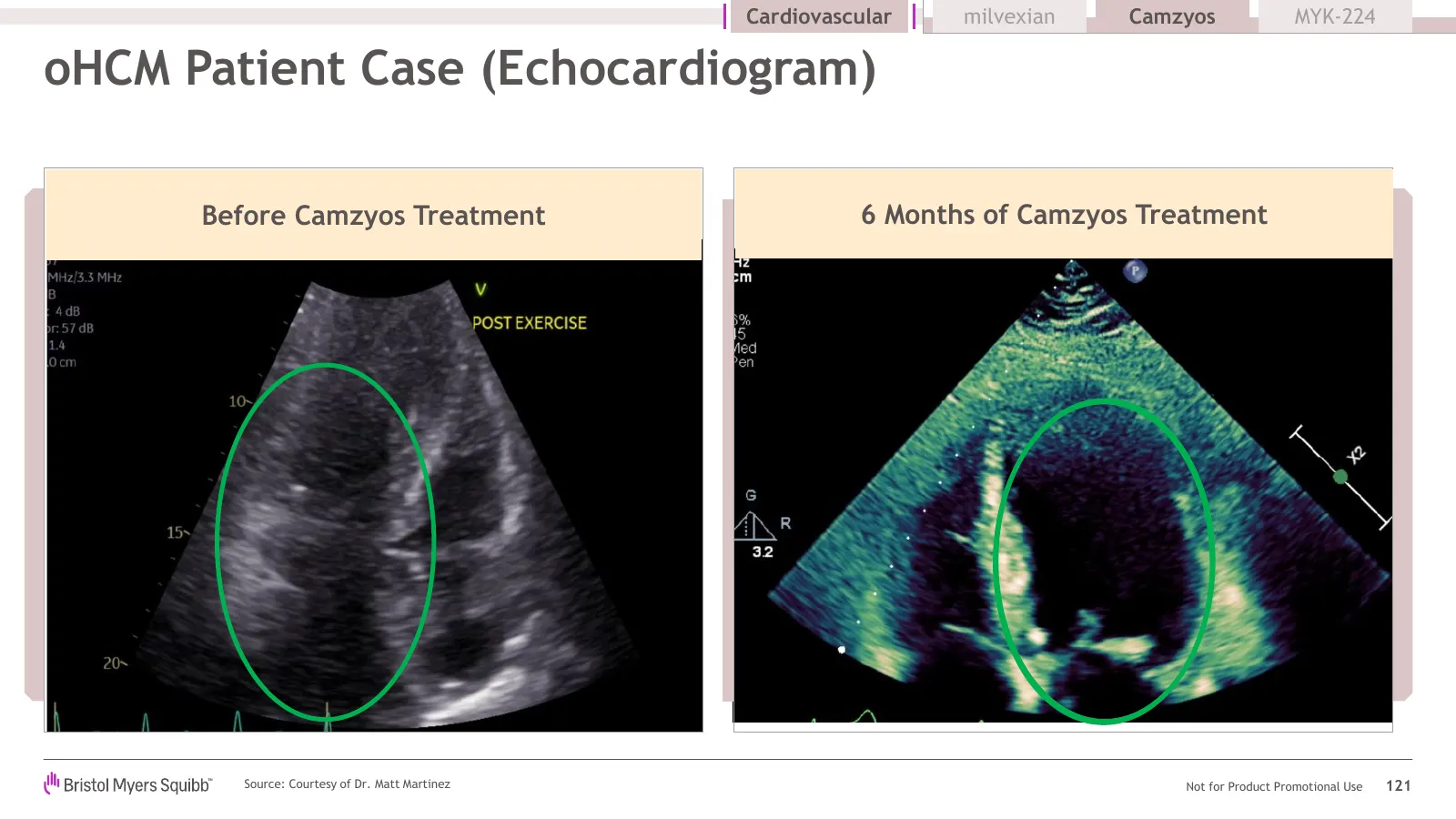
Slide 121: oHCM Patient Case (Echocardiogram)
Cardiovascular milvexian Camzyos MYK-224 oHCM Patient Case (Echocardiogram) Before Camzyos Treatment 6 Months of Camzyos Treatment Source: Courtesy of Dr. Matt Martinez Not for Product Promotional Use 121
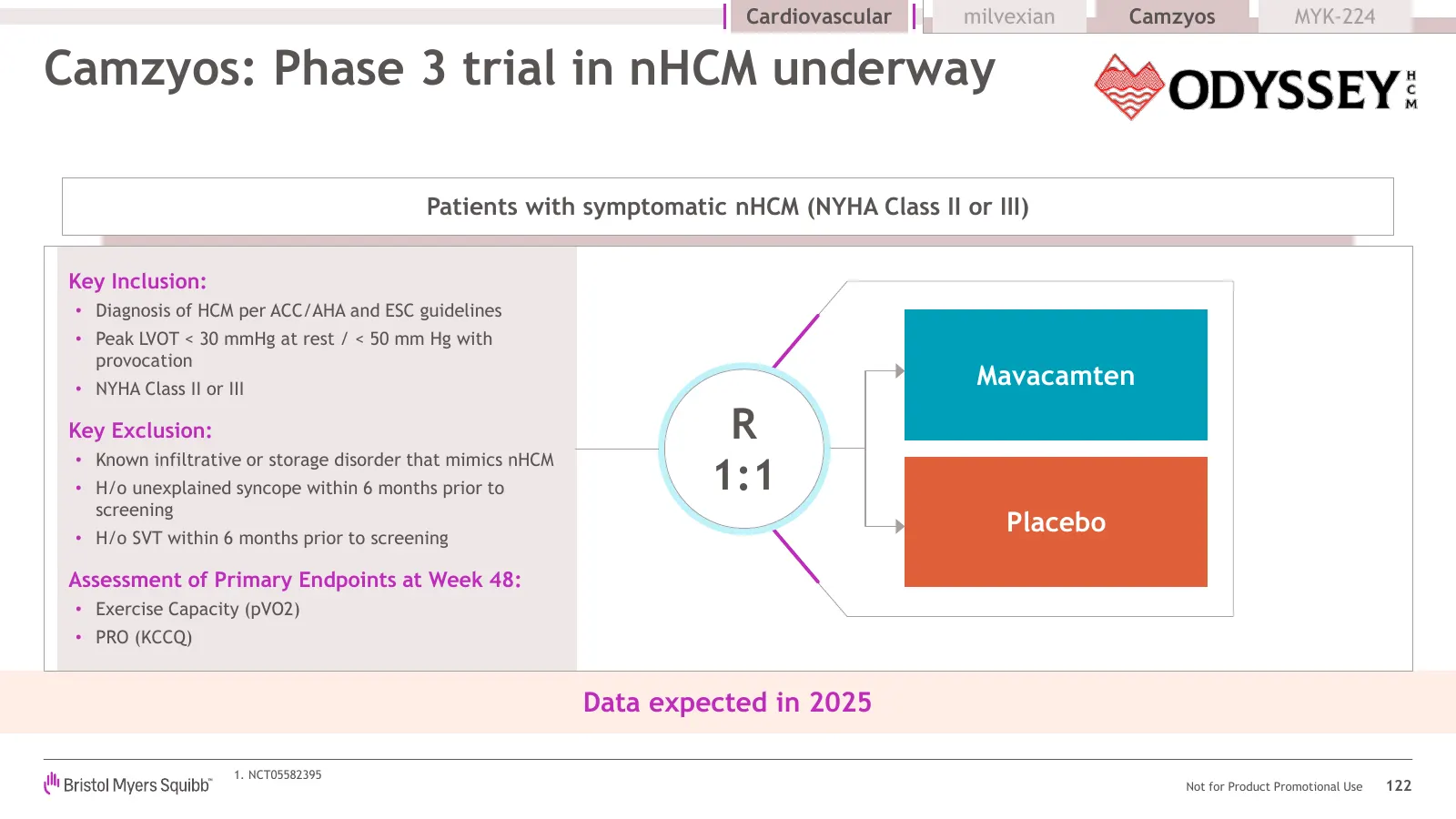
Slide 122: Camzyos: Phase 3 trial in nHCM underway
Cardiovascular milvexian Camzyos MYK-224 Camzyos: Phase 3 trial in nHCM underway Patients with symptomatic nHCM (NYHA Class II or III) Key Inclusion: • Diagnosis of HCM per ACC/AHA and ESC guidelines • Peak LVOT < 30 mmHg at rest / < 50 mm Hg with provocation • NYHA Class II or III Mavacamten Key Ex
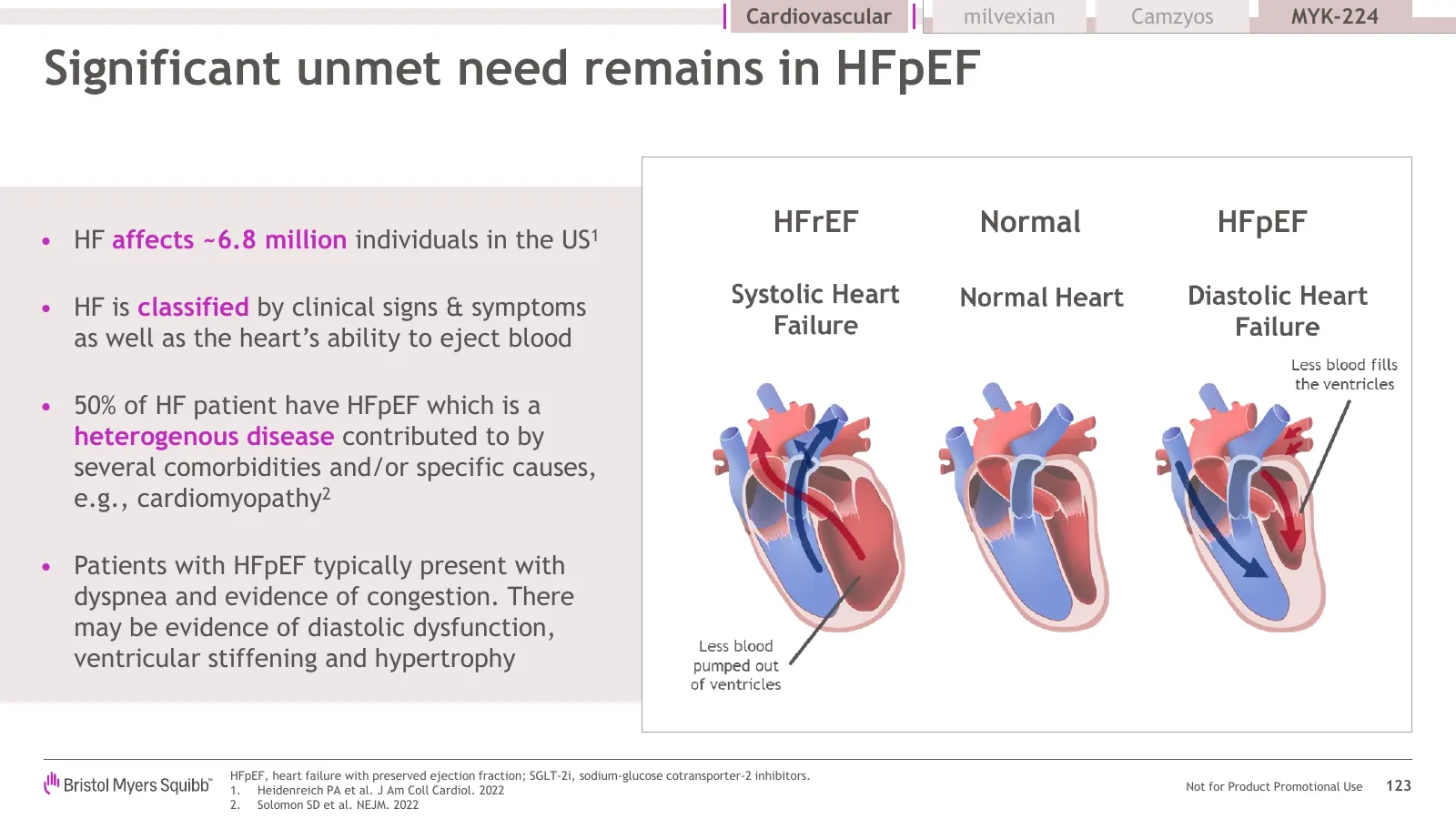
Slide 123: Significant unmet need remains in HFpEF
Cardiovascular milvexian Camzyos MYK-224 Significant unmet need remains in HFpEF HFrEF Normal HFpEF • HF affects ~6.8 million individuals in the US1 • HF is classified by clinical signs & symptoms as well as the heart’s ability to eject blood • 50% of HF patient have HFpEF which is a heterogenous di
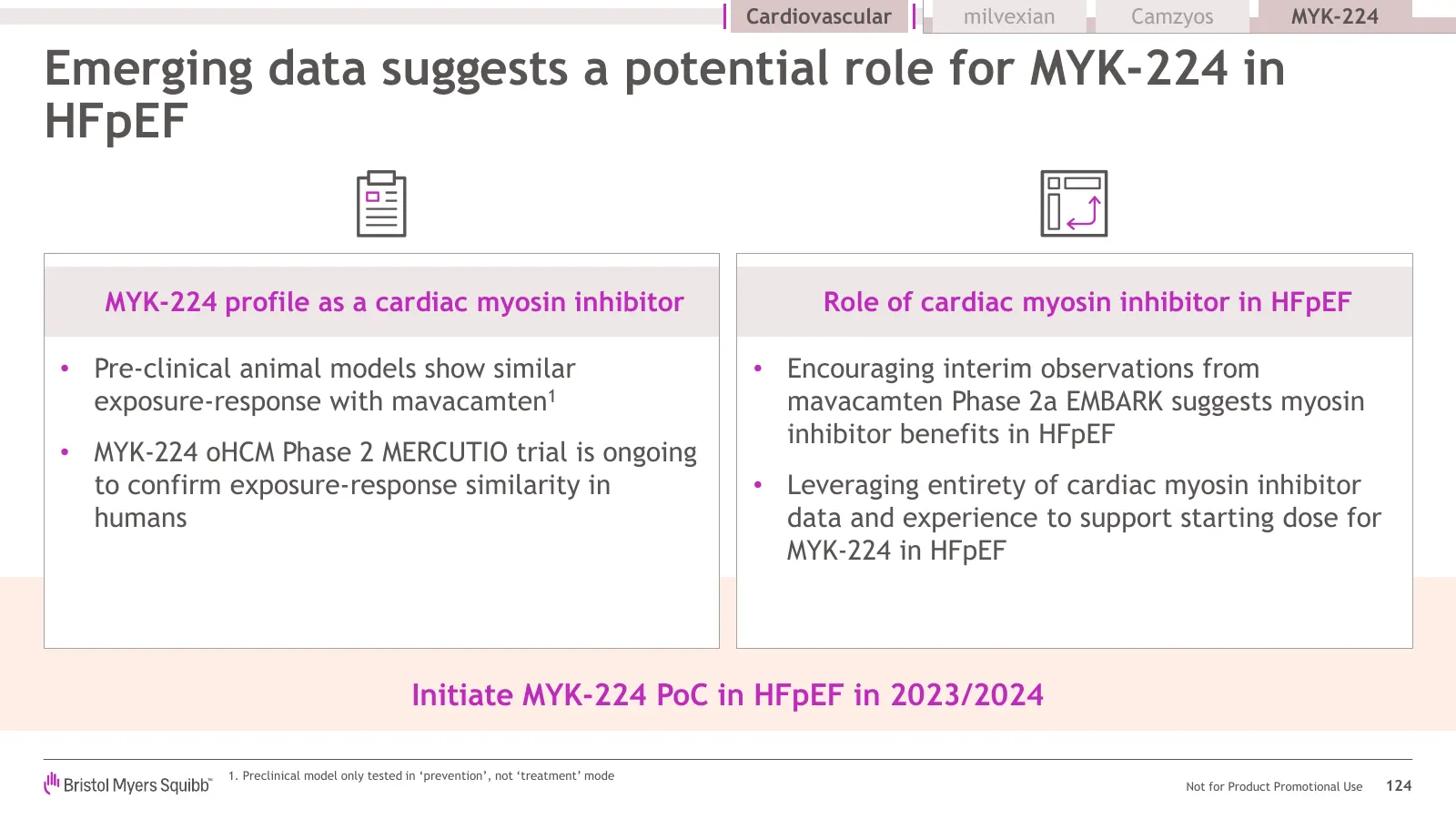
Slide 124: Potential role for MYK-224 in HFpEF
Cardiovascular milvexian Camzyos MYK-224 Emerging data suggests a potential role for MYK-224 in HFpEF MYK-224 profile as a cardiac myosin inhibitor Role of cardiac myosin inhibitor in HFpEF • Pre-clinical animal models show similar • Encouraging interim observations from exposure-response with mavac
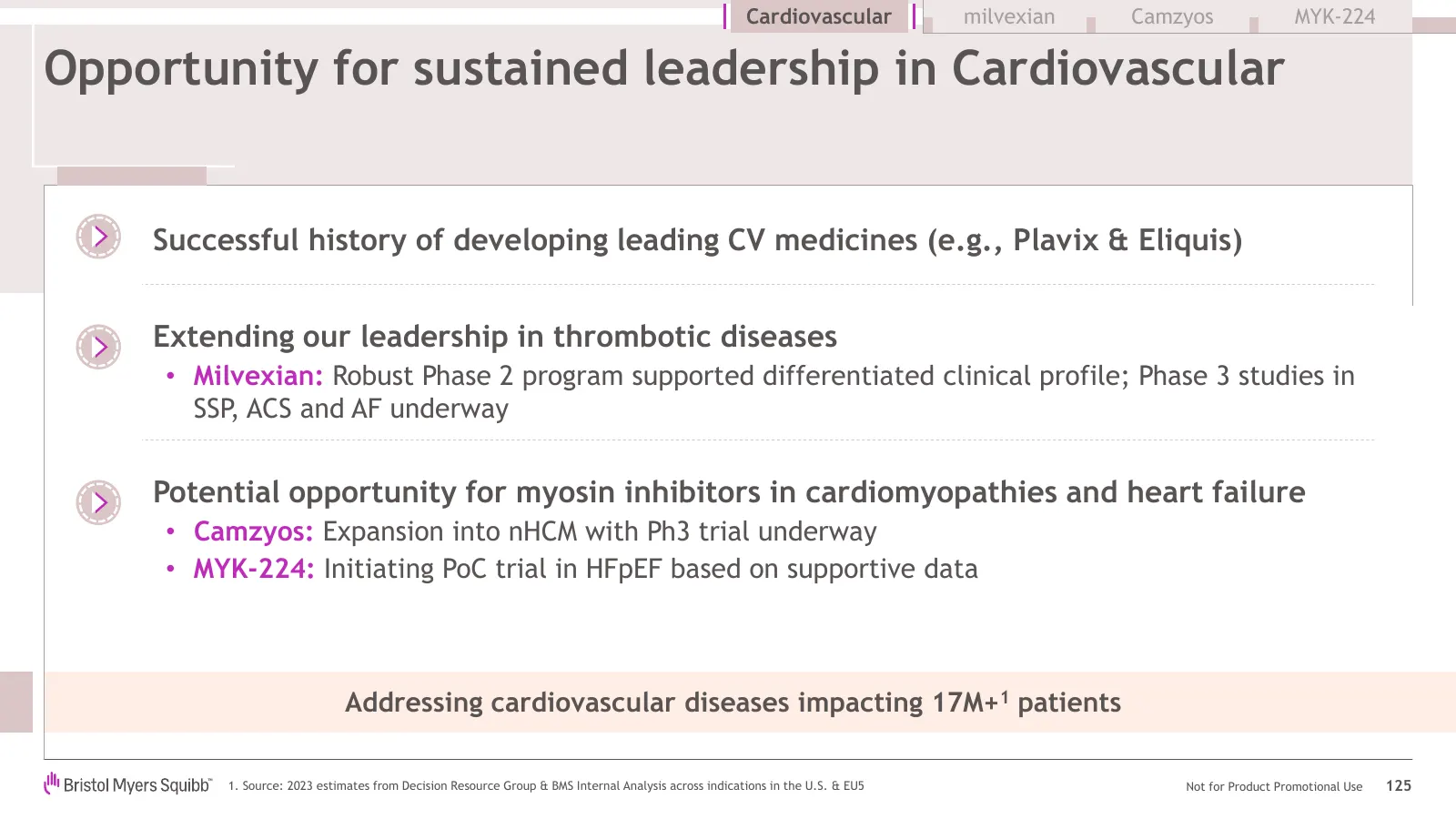
Slide 125: Opportunity for sustained leadership in Cardiovascular
Cardiovascular milvexian Camzyos MYK-224 Opportunity for sustained leadership in Cardiovascular Successful history of developing leading CV medicines (e.g., Plavix & Eliquis) Extending our leadership in thrombotic diseases • Milvexian: Robust Phase 2 program supported differentiated clinical profile
Slide 126: Neuroscience
Neuroscience Not for Product Promotional Use 126
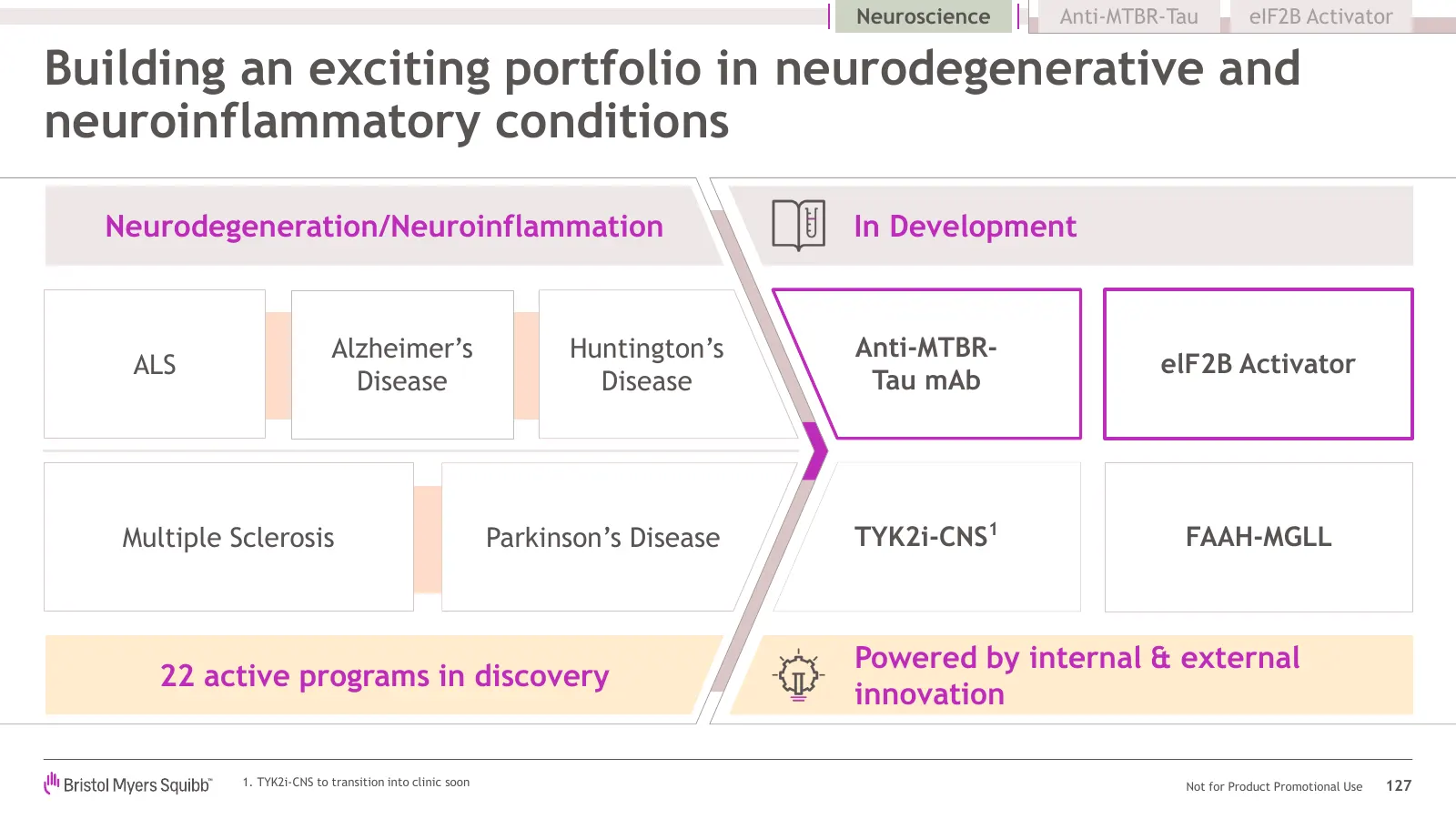
Slide 127: Building a portfolio in neurodegenerative and neuroinflammatory conditions
Neuroscience Anti-MTBR-Tau eIF2B Activator Building an exciting portfolio in neurodegenerative and neuroinflammatory conditions Neurodegeneration/Neuroinflammation In Development Alzheimer’s Huntington’s Anti-MTBR- ALS elF2B Activator Disease Disease Tau mAb Multiple Sclerosis Parkinson’s Disease TY
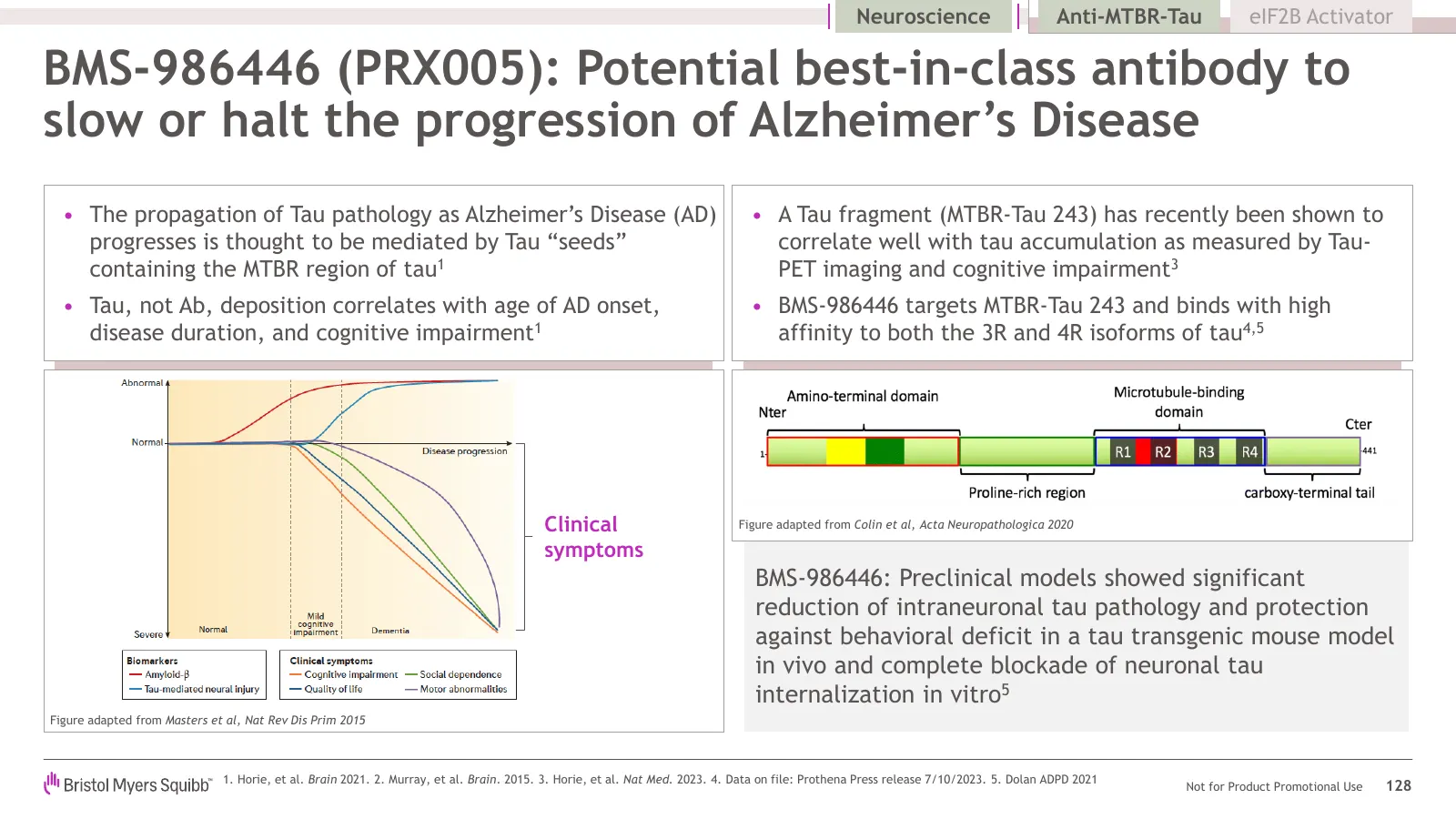
Slide 128: BMS-986446 (PRX005): Potential best-in-class Alzheimer's antibody
Neuroscience Anti-MTBR-Tau eIF2B Activator BMS-986446 (PRX005): Potential best-in-class antibody to slow or halt the progression of Alzheimer’s Disease • The propagation of Tau pathology as Alzheimer’s Disease (AD) • A Tau fragment (MTBR-Tau 243) has recently been shown to progresses is thought to b
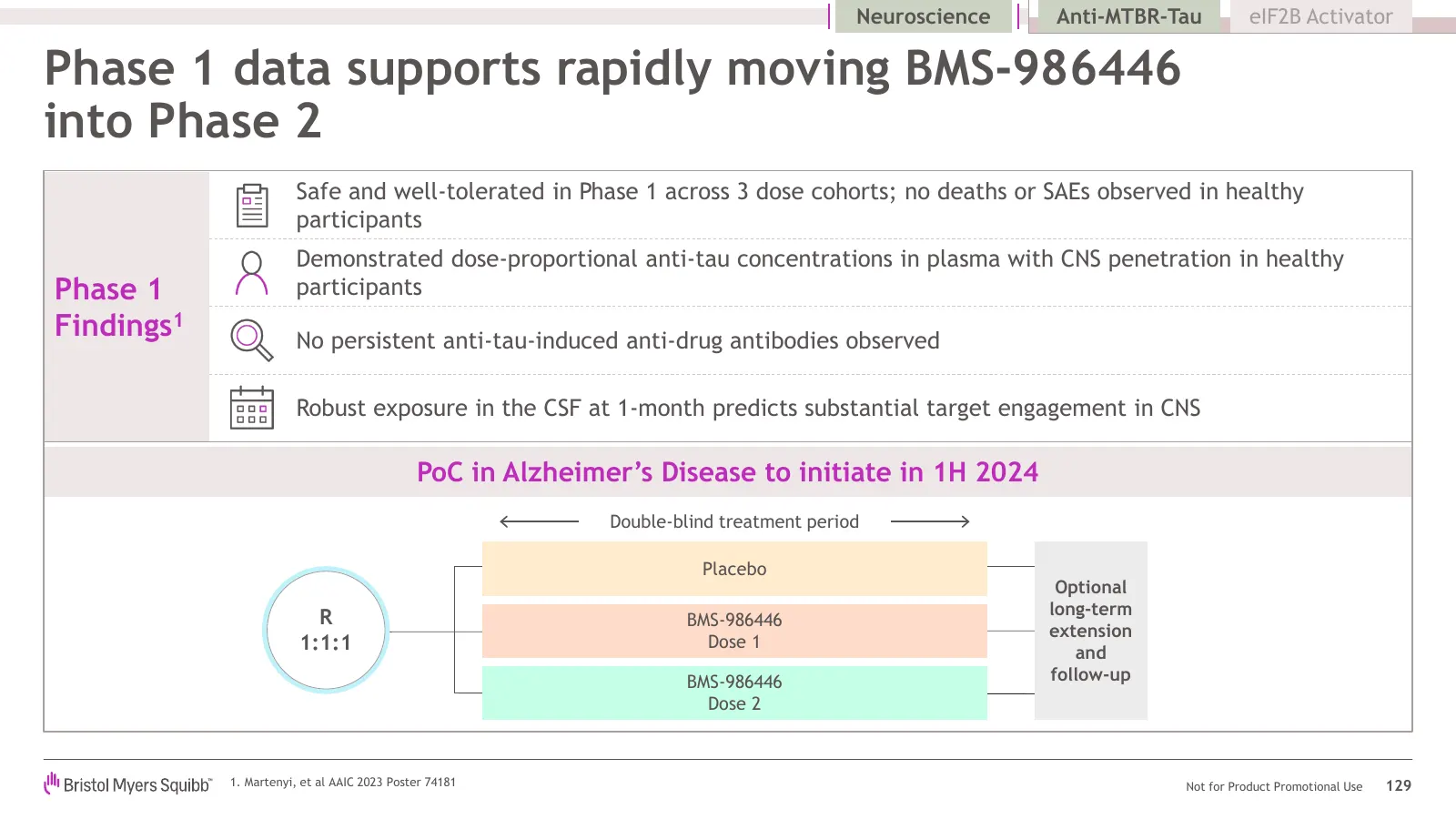
Slide 129: Phase 1 data supports moving BMS-986446 into Phase 2
Neuroscience Anti-MTBR-Tau eIF2B Activator Phase 1 data supports rapidly moving BMS-986446 into Phase 2 Safe and well-tolerated in Phase 1 across 3 dose cohorts; no deaths or SAEs observed in healthy participants Demonstrated dose-proportional anti-tau concentrations in plasma with CNS penetration i
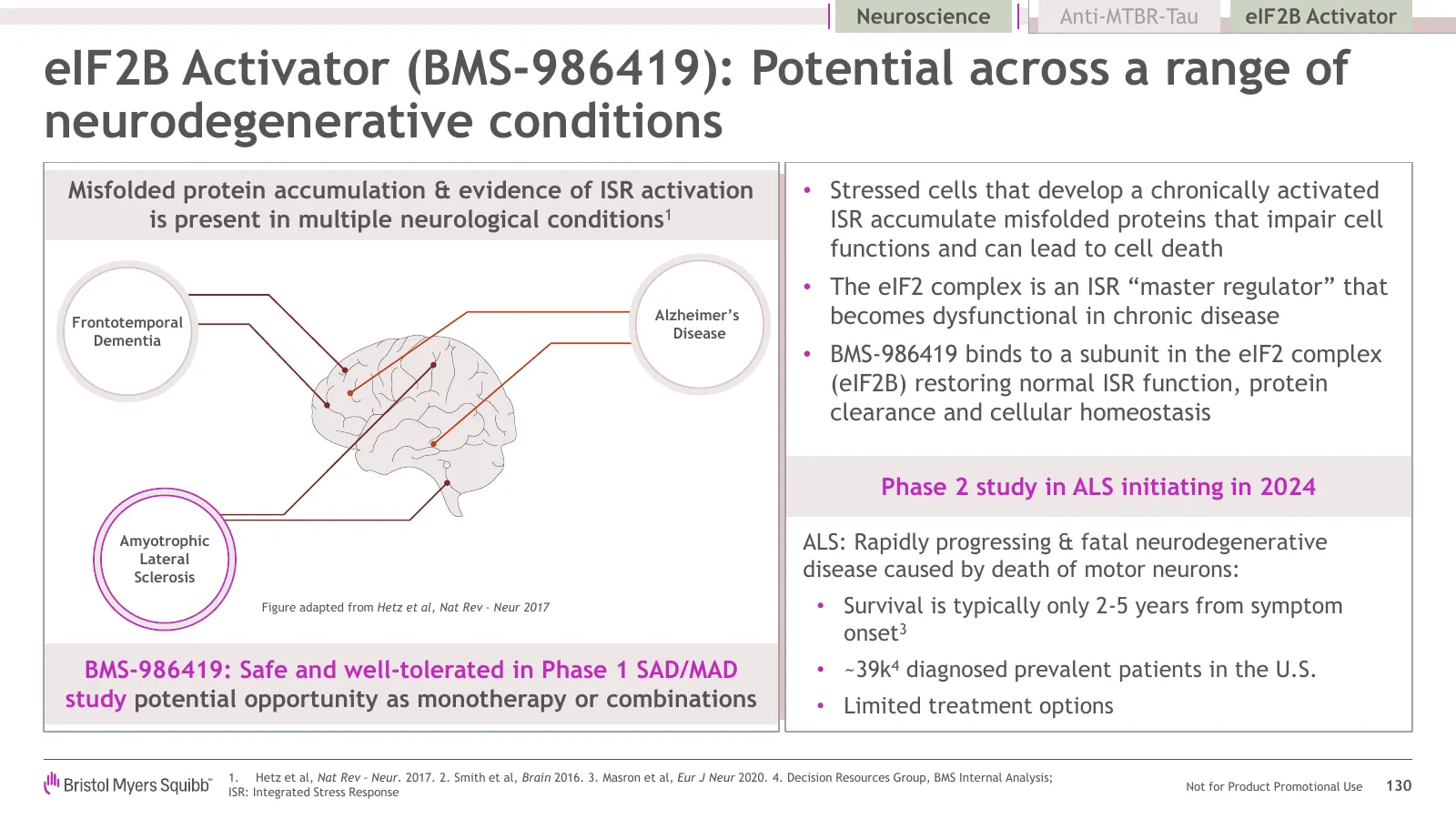
Slide 130: eIF2B Activator (BMS-986419) across neurodegenerative conditions
Neuroscience Anti-MTBR-Tau eIF2B Activator eIF2B Activator (BMS-986419): Potential across a range of neurodegenerative conditions Misfolded protein accumulation & evidence of ISR activation • Stressed cells that develop a chronically activated is present in multiple neurological conditions1 ISR accu
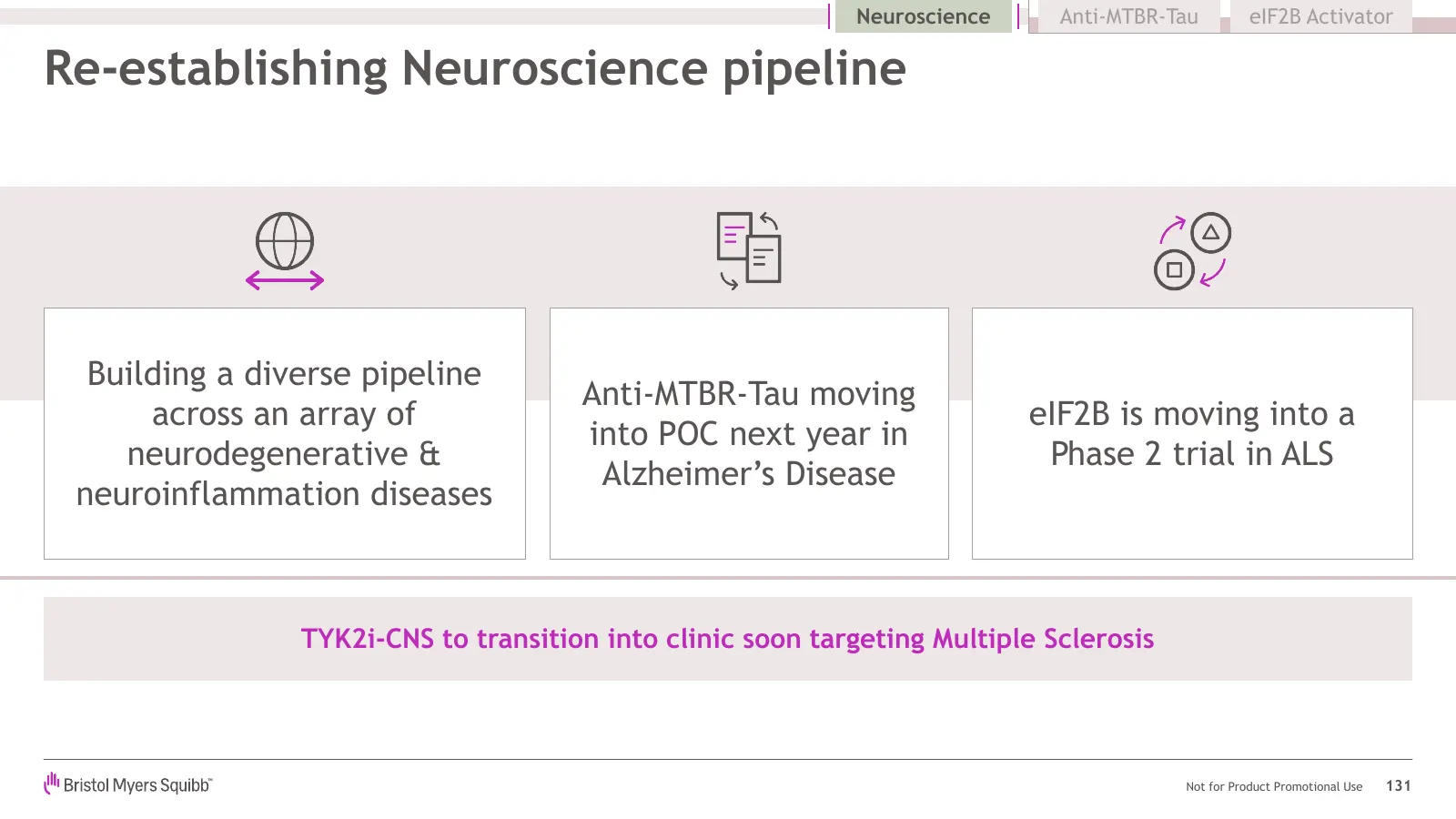
Slide 131: Re-establishing Neuroscience pipeline
Neuroscience Anti-MTBR-Tau eIF2B Activator Re-establishing Neuroscience pipeline Building a diverse pipeline Anti-MTBR-Tau moving across an array of eIF2B is moving into a into POC next year in neurodegenerative & Phase 2 trial in ALS Alzheimer’s Disease neuroinflammation diseases TYK2i-CNS to trans
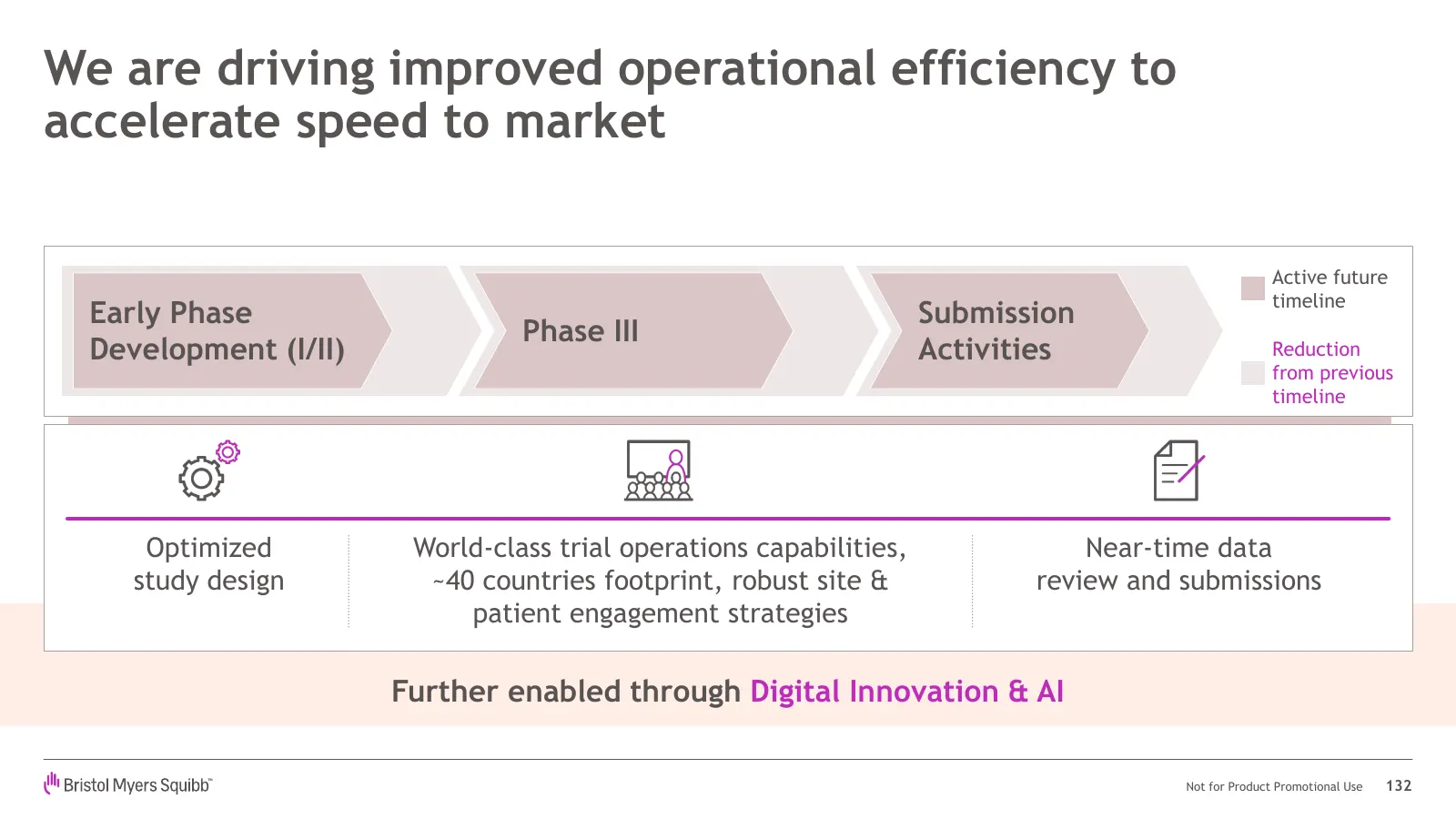
Slide 132: Driving improved operational efficiency to accelerate speed to market
We are driving improved operational efficiency to accelerate speed to market Active future timeline Early Phase Submission Phase III Development (I/II) Activities Reduction from previous timeline Optimized World-class trial operations capabilities, Near-time data study design ~40 countries footprint
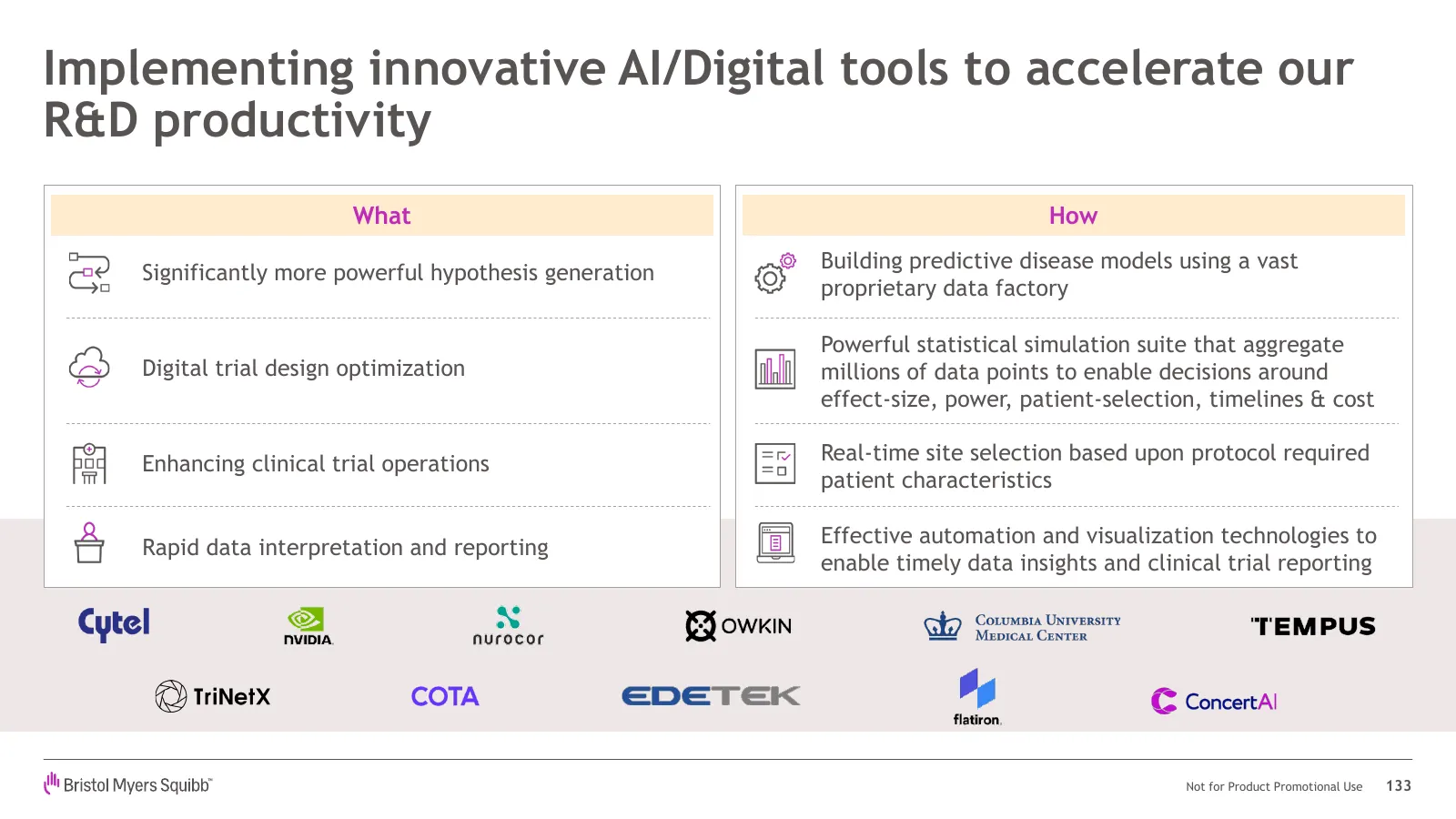
Slide 133: Implementing AI/Digital tools to accelerate R&D productivity
Implementing innovative AI/Digital tools to accelerate our R&D productivity What How Significantly more powerful hypothesis generation Building predictive disease models using a vast proprietary data factory Powerful statistical simulation suite that aggregate Digital trial design optimization milli
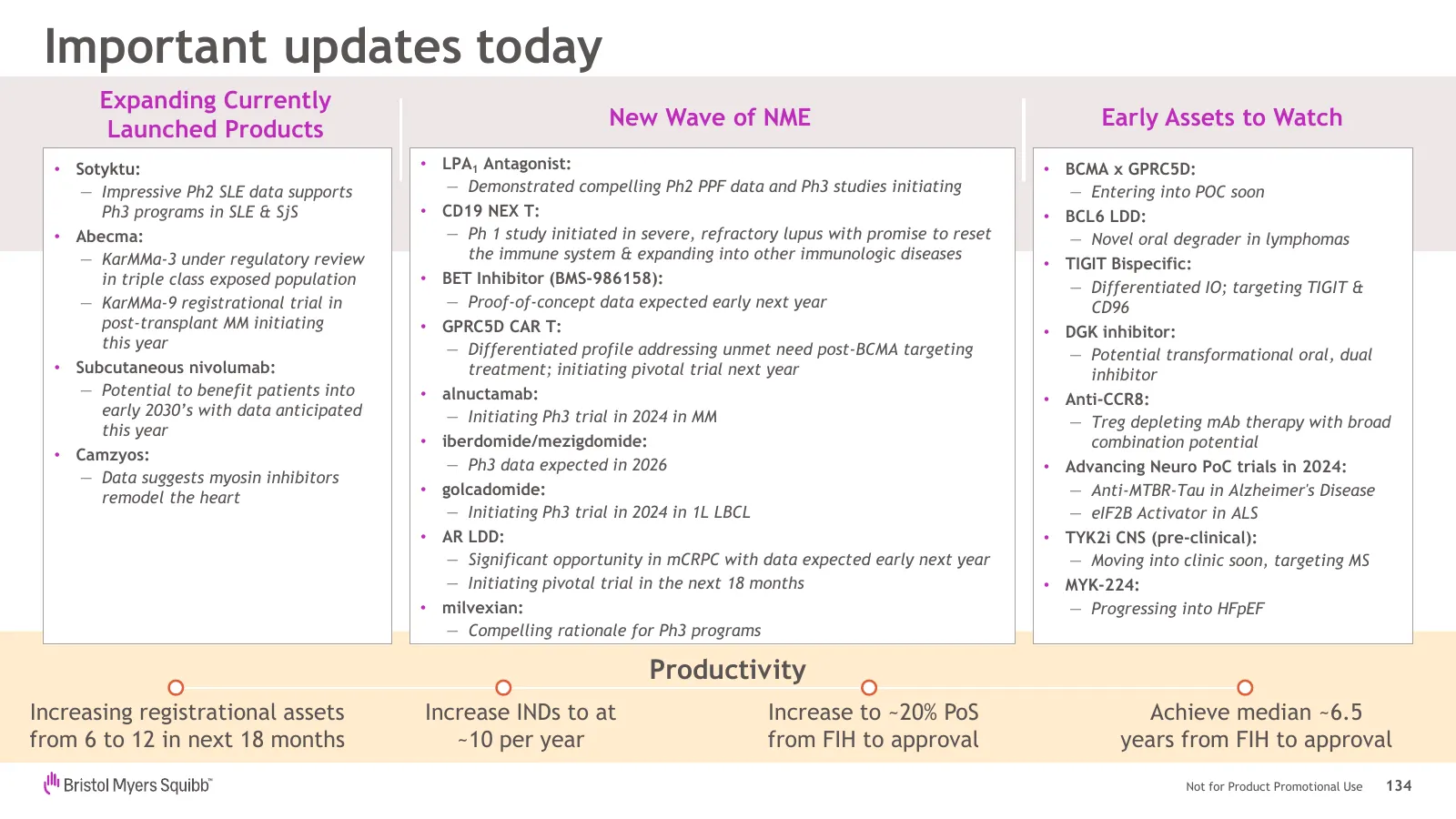
Slide 134: Important updates today
Important updates today Expanding Currently Launched Products New Wave of NME Early Assets to Watch • Sotyktu: • LPA1 Antagonist: • BCMA x GPRC5D: ― Impressive Ph2 SLE data supports ― Demonstrated compelling Ph2 PPF data and Ph3 studies initiating ― Entering into POC soon Ph3 programs in SLE & SjS •
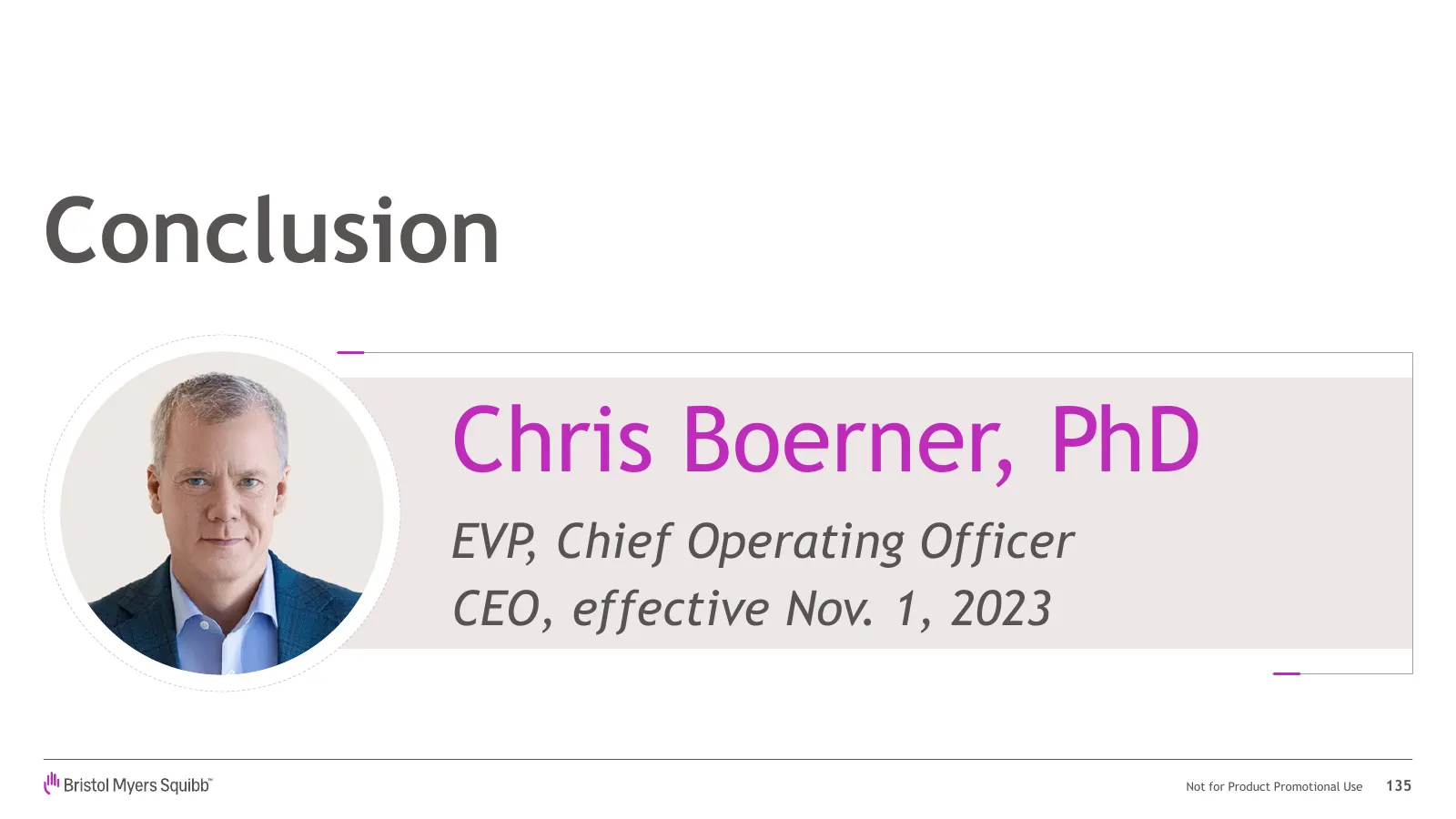
Slide 135: Conclusion
Conclusion Chris Boerner, PhD EVP, Chief Operating Officer CEO, effective Nov. 1, 2023 Not for Product Promotional Use 135
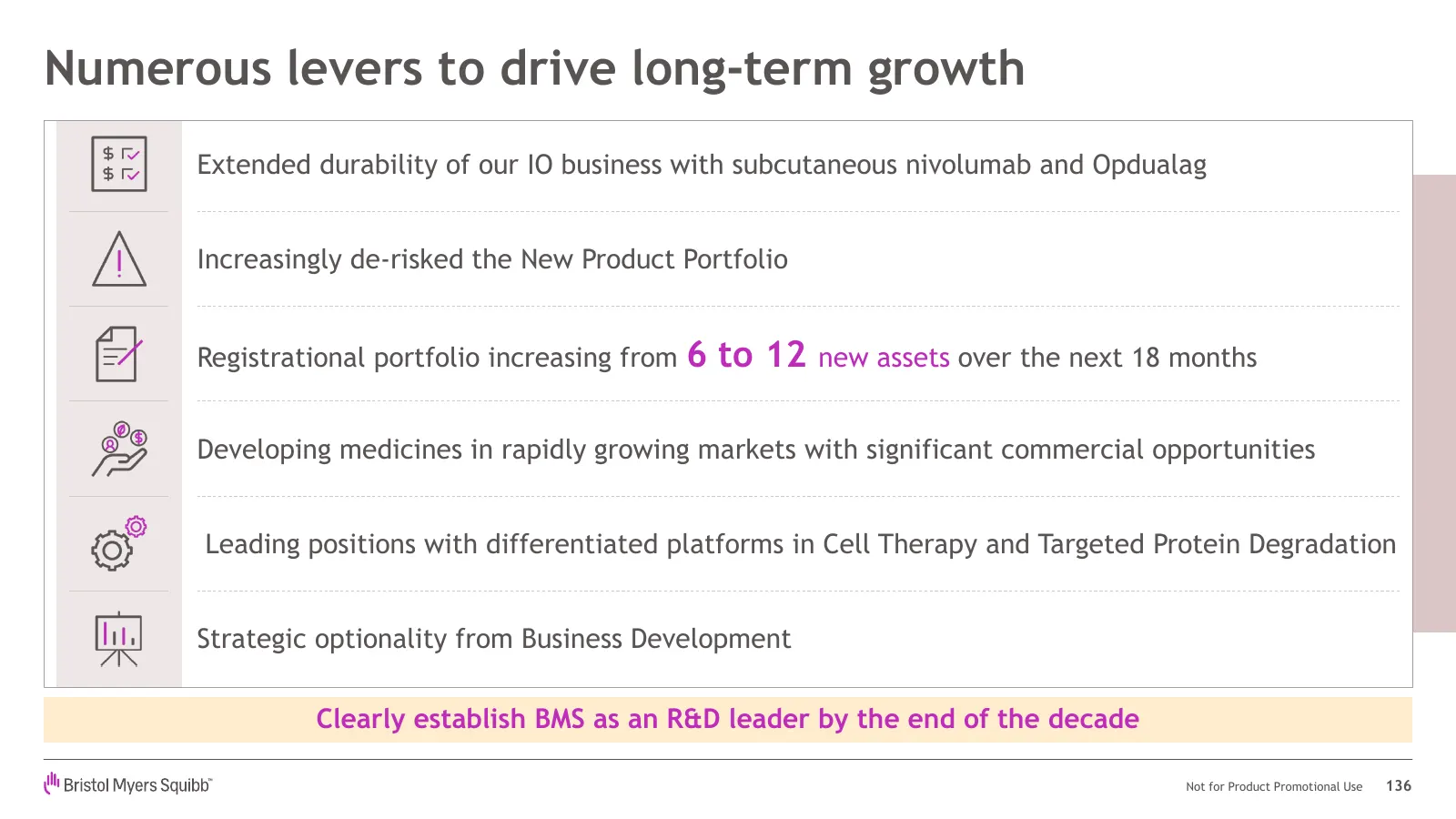
Slide 136: Numerous levers to drive long-term growth
Numerous levers to drive long-term growth Extended durability of our IO business with subcutaneous nivolumab and Opdualag Increasingly de-risked the New Product Portfolio Registrational portfolio increasing from 6 to 12 new assets over the next 18 months Developing medicines in rapidly growing marke
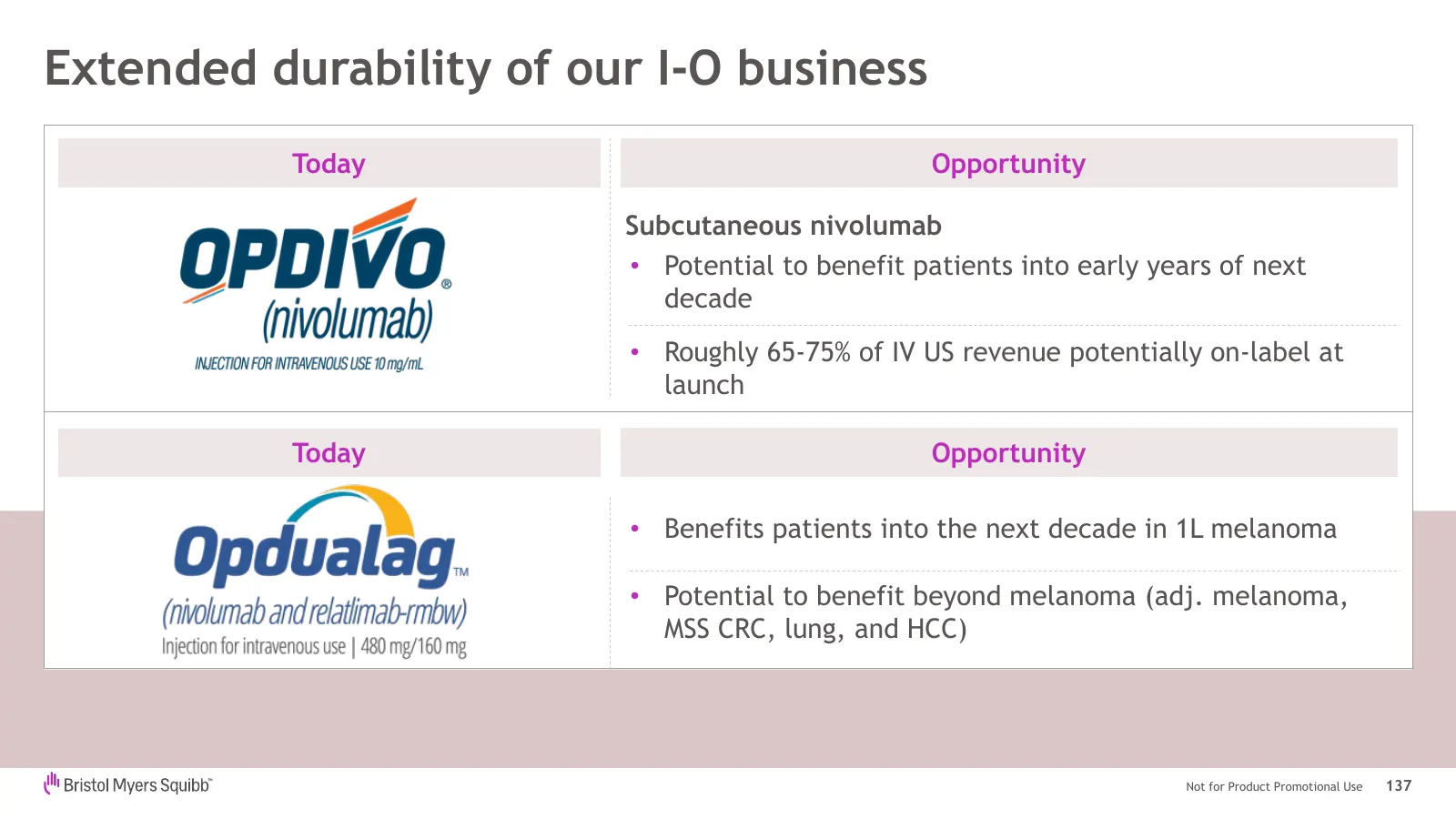
Slide 137: Extended durability of our I-O business
Extended durability of our I-O business Today Opportunity Subcutaneous nivolumab • Potential to benefit patients into early years of next decade • Roughly 65-75% of IV US revenue potentially on-label at launch Today Opportunity • Benefits patients into the next decade in 1L melanoma • Potential to b
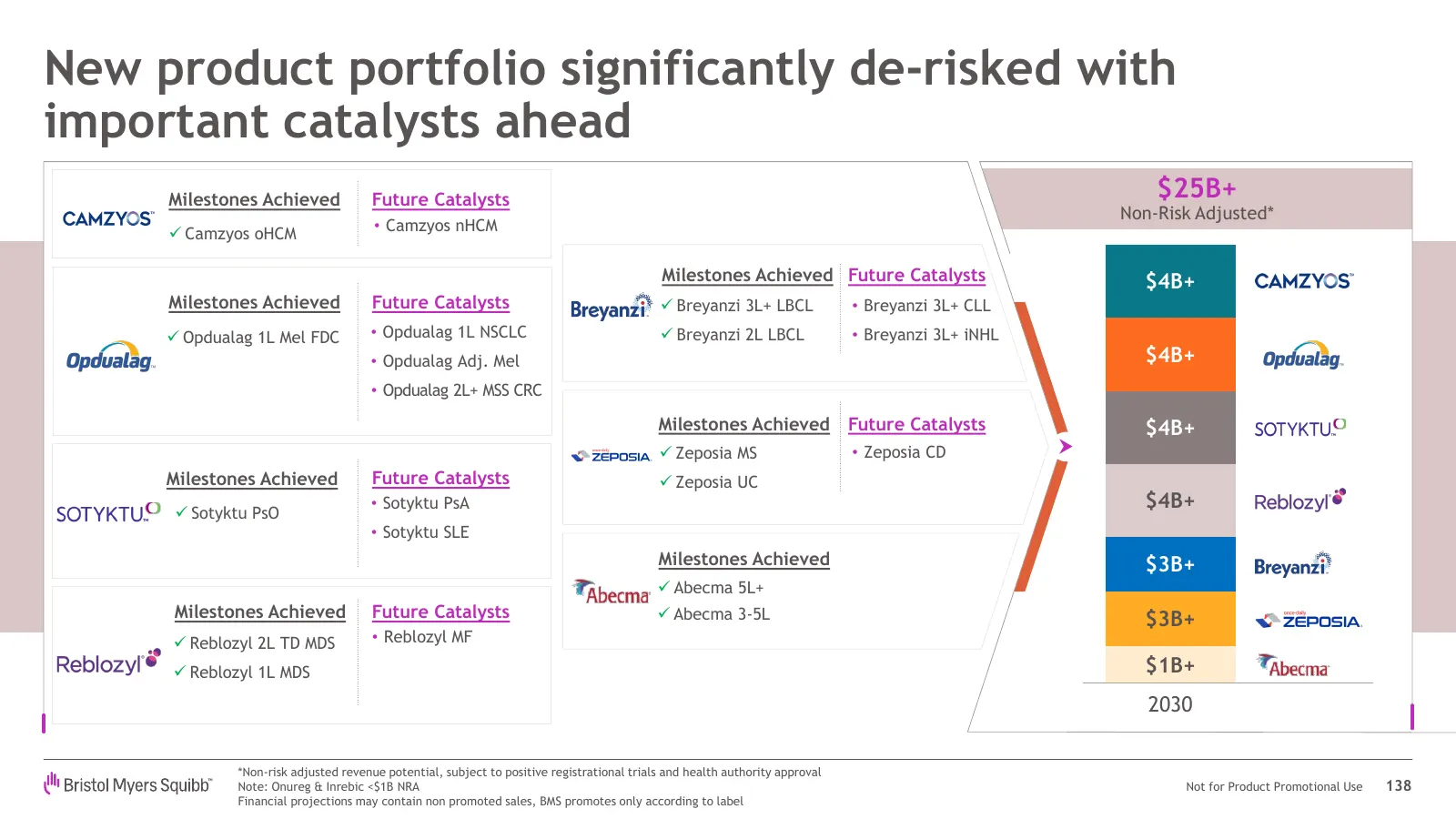
Slide 138: New product portfolio de-risked with important catalysts ahead
New product portfolio significantly de-risked with important catalysts ahead Milestones Achieved Future Catalysts $25B+ Non-Risk Adjusted* Camzyos oHCM • Camzyos nHCM Milestones Achieved Future Catalysts $4B+ Milestones Achieved Future Catalysts Breyanzi 3L+ LBCL • Breyanzi 3L+ CLL Opdualag 1L
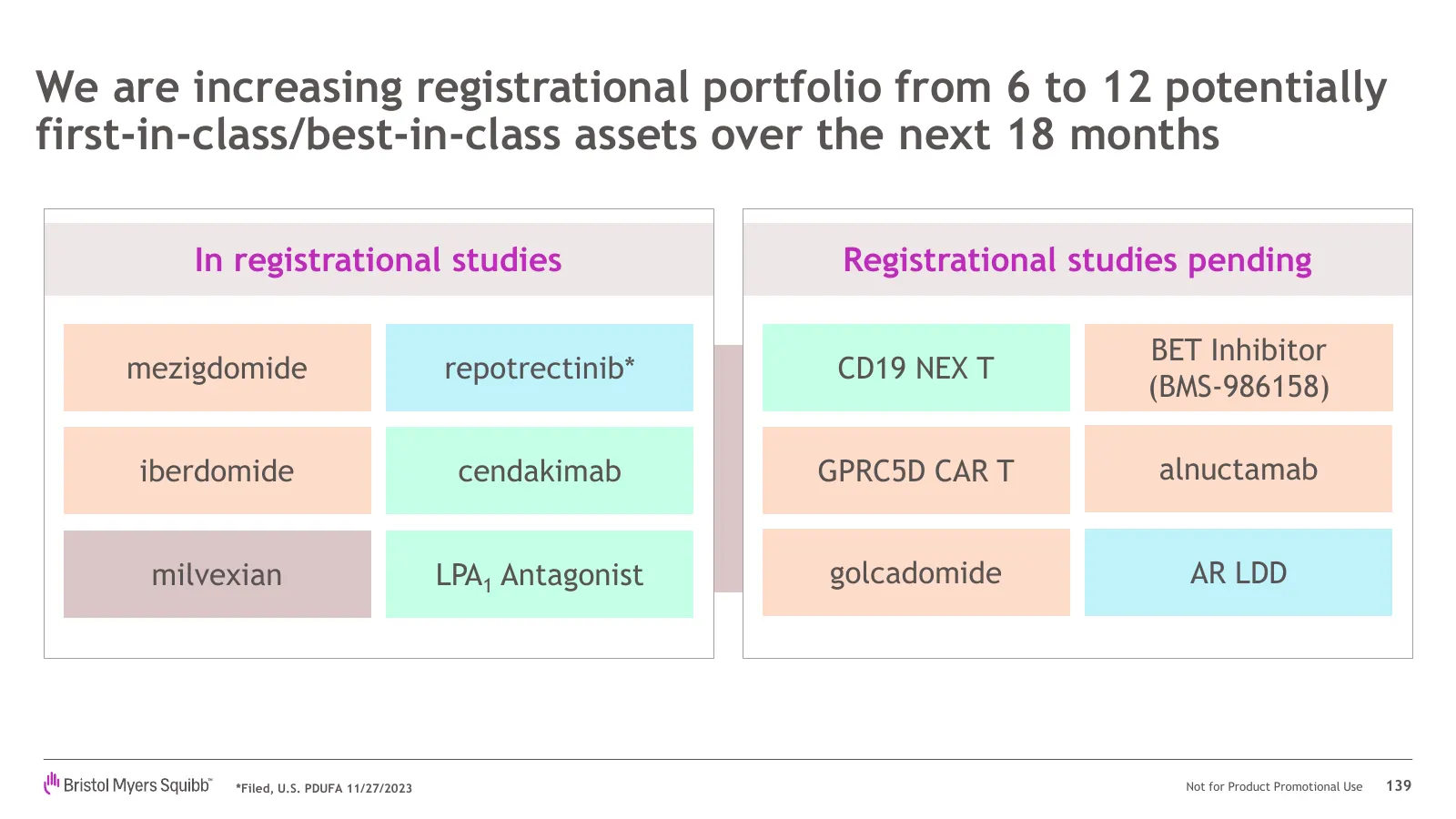
Slide 139: Increasing registrational portfolio from 6 to 12 assets
We are increasing registrational portfolio from 6 to 12 potentially first-in-class/best-in-class assets over the next 18 months In registrational studies Registrational studies pending BET Inhibitor mezigdomide repotrectinib* CD19 NEX T (BMS-986158) iberdomide cendakimab GPRC5D CAR T alnuctamab milv
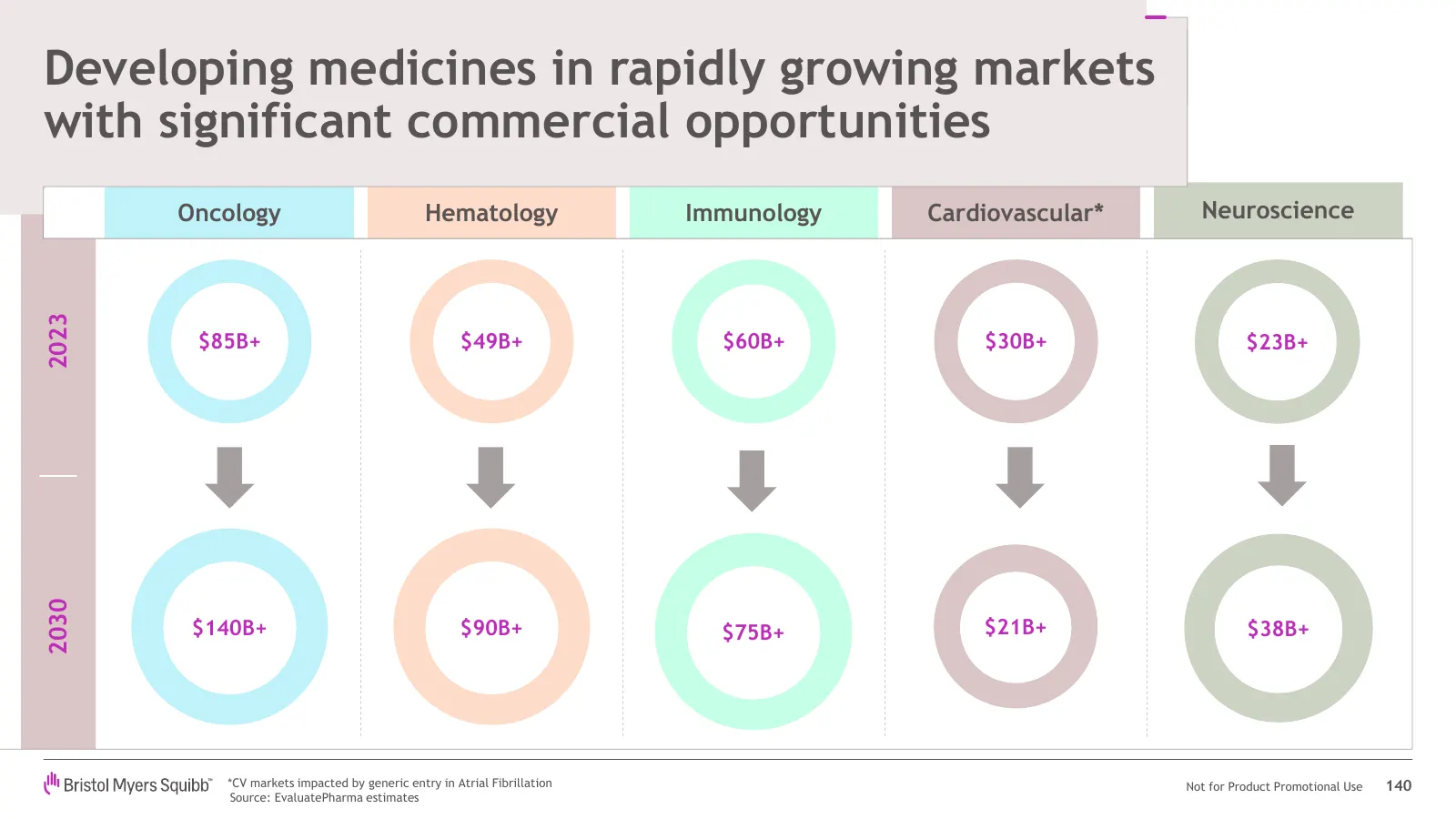
Slide 140: Developing medicines in rapidly growing markets
Developing medicines in rapidly growing markets with significant commercial opportunities Oncology Hematology Immunology Cardiovascular* Neuroscience 2023 $85B+ $49B+ $60B+ $30B+ $23B+ 2030 $140B+ $90B+ $75B+ $21B+ $38B+ *CV markets impacted by generic entry in Atrial Fibrillation Not for Product Pr
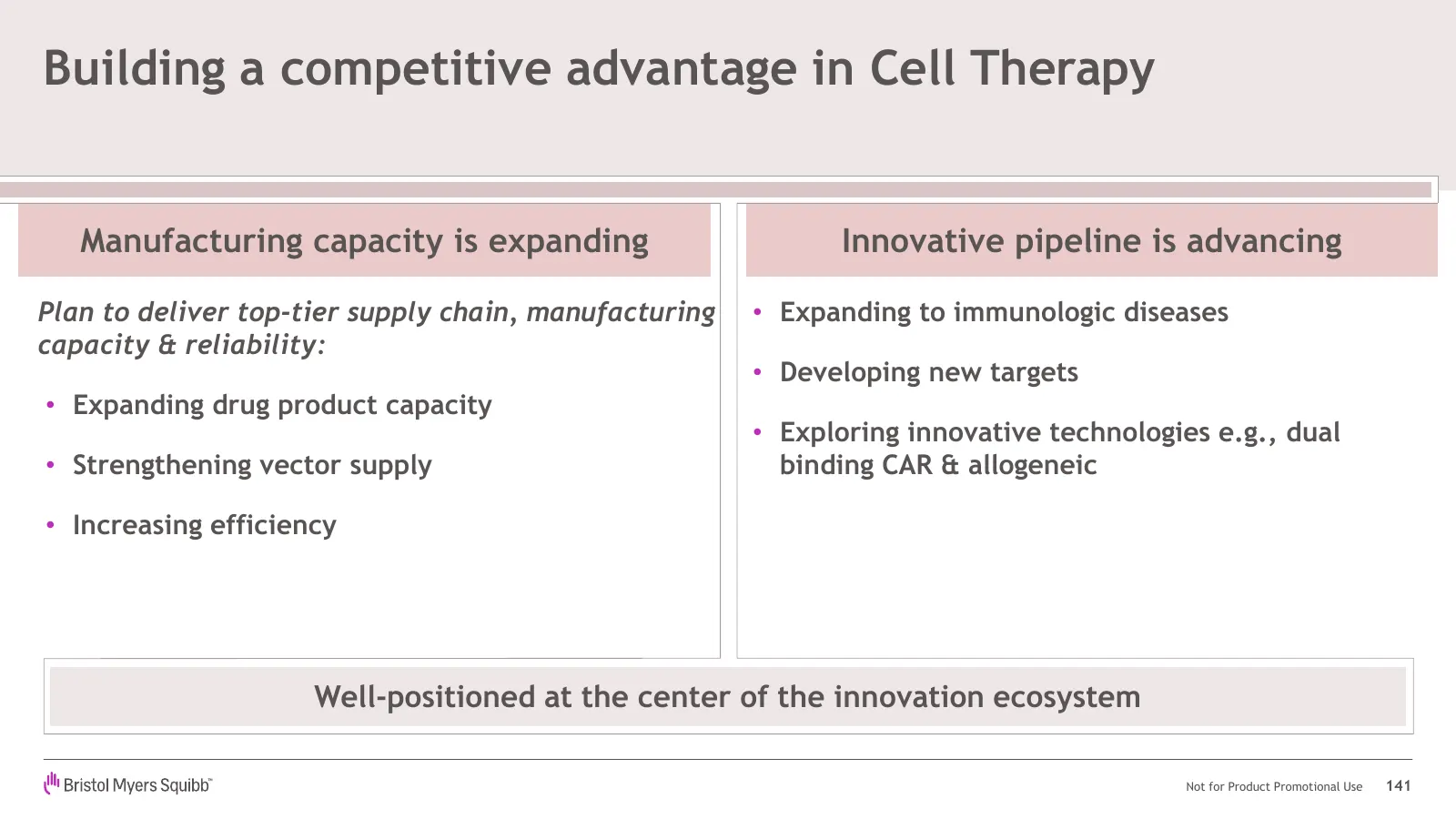
Slide 141: Building a competitive advantage in Cell Therapy
Building a competitive advantage in Cell Therapy Manufacturing capacity is expanding Innovative pipeline is advancing Plan to deliver top-tier supply chain, manufacturing • Expanding to immunologic diseases capacity & reliability: • Developing new targets • Expanding drug product capacity • Explorin
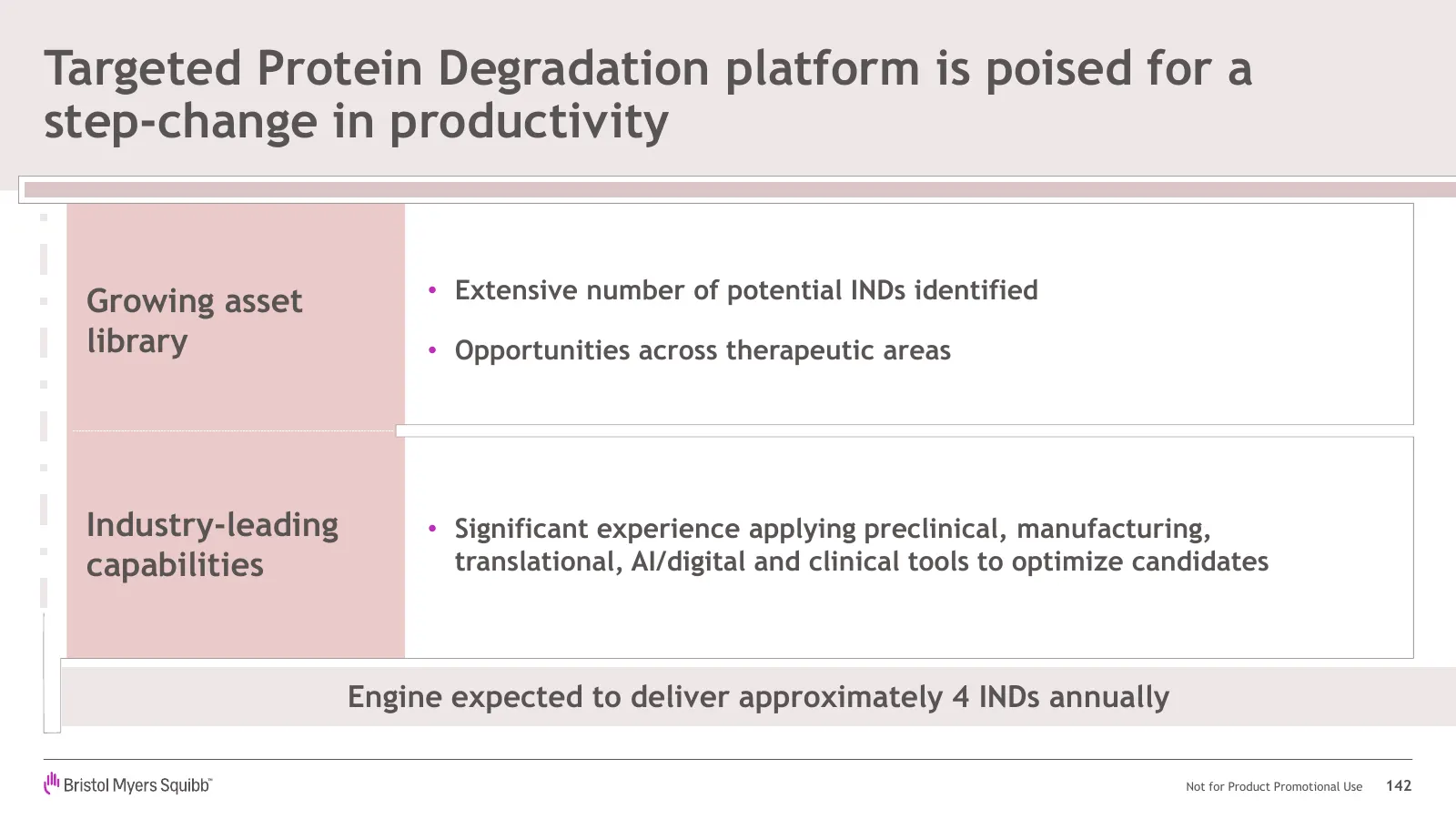
Slide 142: Targeted Protein Degradation platform poised for step-change in productivity
Targeted Protein Degradation platform is poised for a step-change in productivity Growing asset • Extensive number of potential INDs identified library • Opportunities across therapeutic areas Industry-leading • Significant experience applying preclinical, manufacturing, capabilities translational,
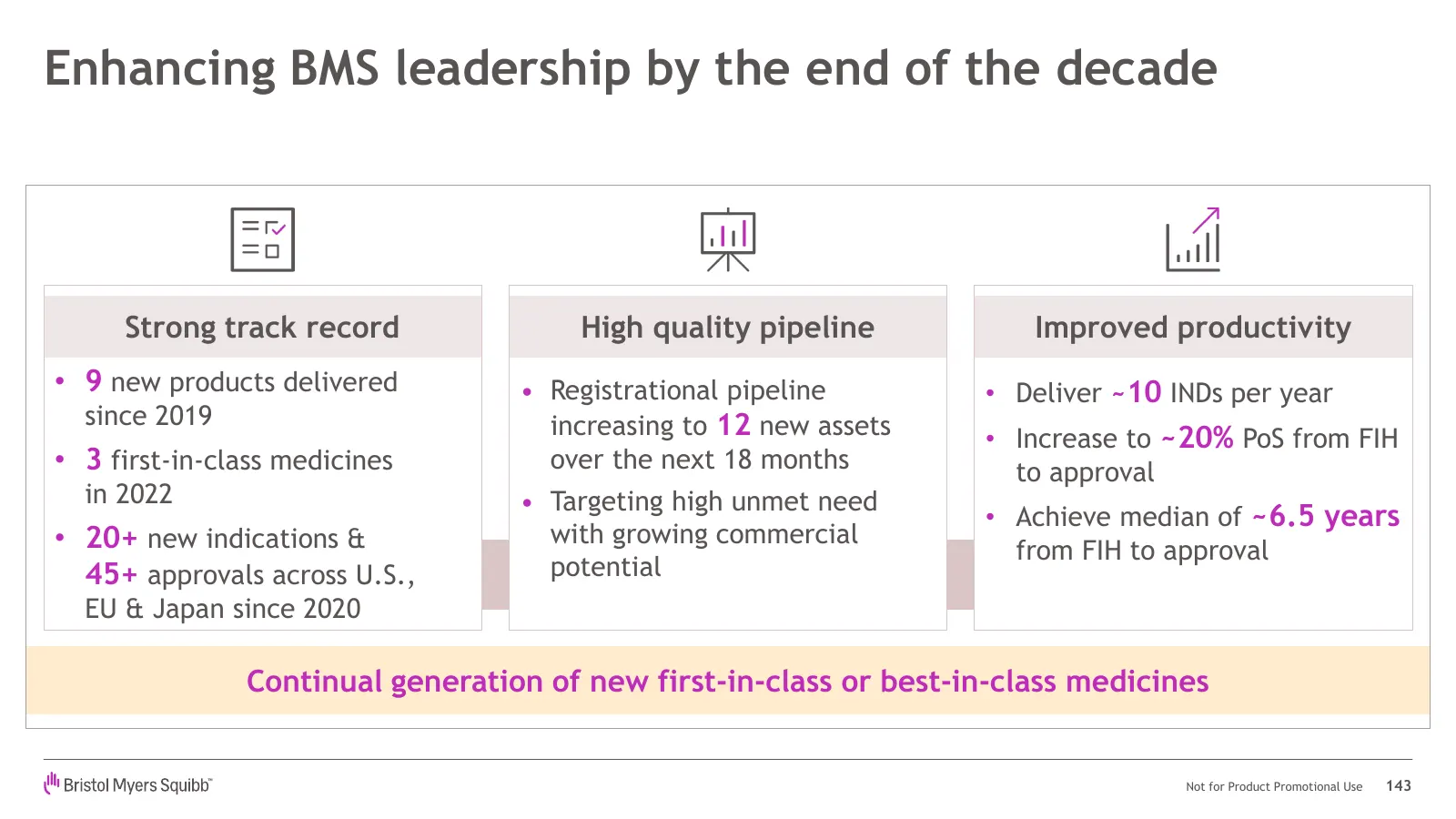
Slide 143: Enhancing BMS leadership by the end of the decade
Enhancing BMS leadership by the end of the decade Strong track record High quality pipeline Improved productivity • 9 new products delivered • Registrational pipeline • Deliver ~10 INDs per year since 2019 increasing to 12 new assets • Increase to ~20% PoS from FIH • 3 first-in-class medicines over
Slide 144: Q&A
Q&A Not for Product Promotional Use 144
Slide 145: Acronyms
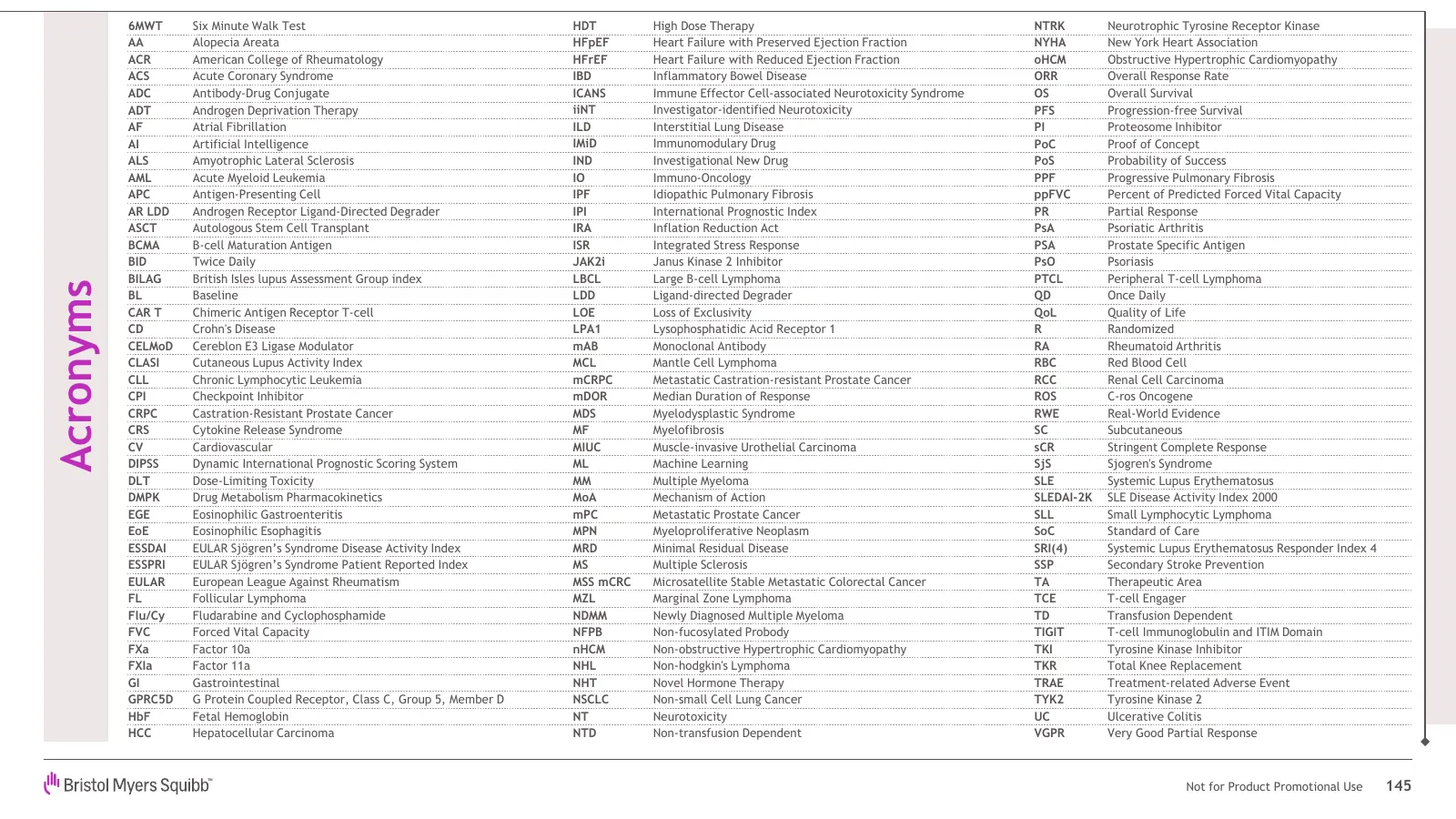
6MWT Six Minute Walk Test HDT High Dose Therapy NTRK Neurotrophic Tyrosine Receptor Kinase AA Alopecia Areata HFpEF Heart Failure with Preserved Ejection Fraction NYHA New York Heart Association ACR American College of Rheumatology HFrEF Heart Failure with Reduced Ejection Fraction oHCM Obstructive
Slide 146: R&D efforts align with ESG values
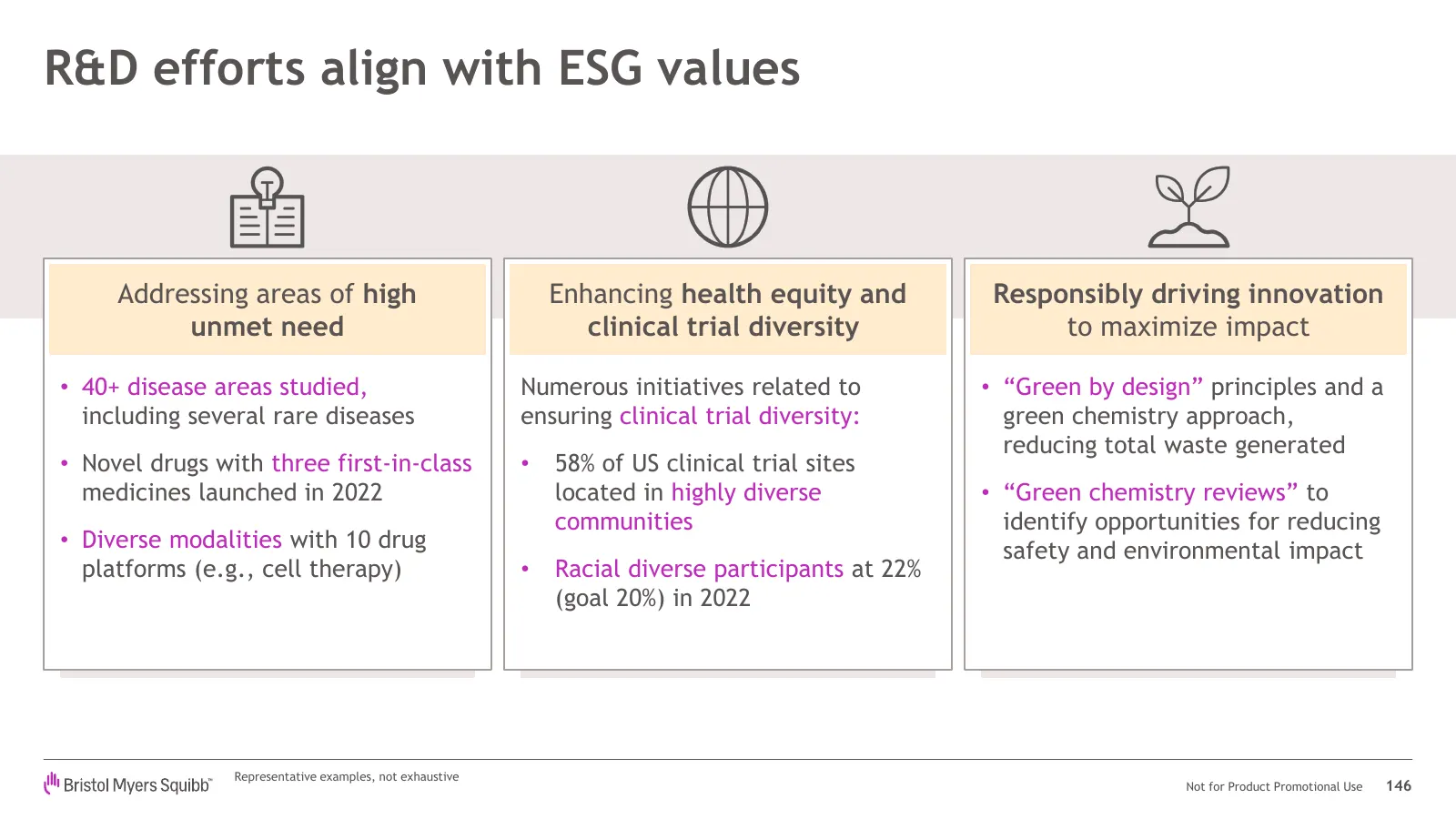
R&D efforts align with ESG values Addressing areas of high Enhancing health equity and Responsibly driving innovation unmet need clinical trial diversity to maximize impact • 40+ disease areas studied, Numerous initiatives related to • “Green by design” principles and a including several rare diseas
Slide 147: Changes to the Development Pipeline
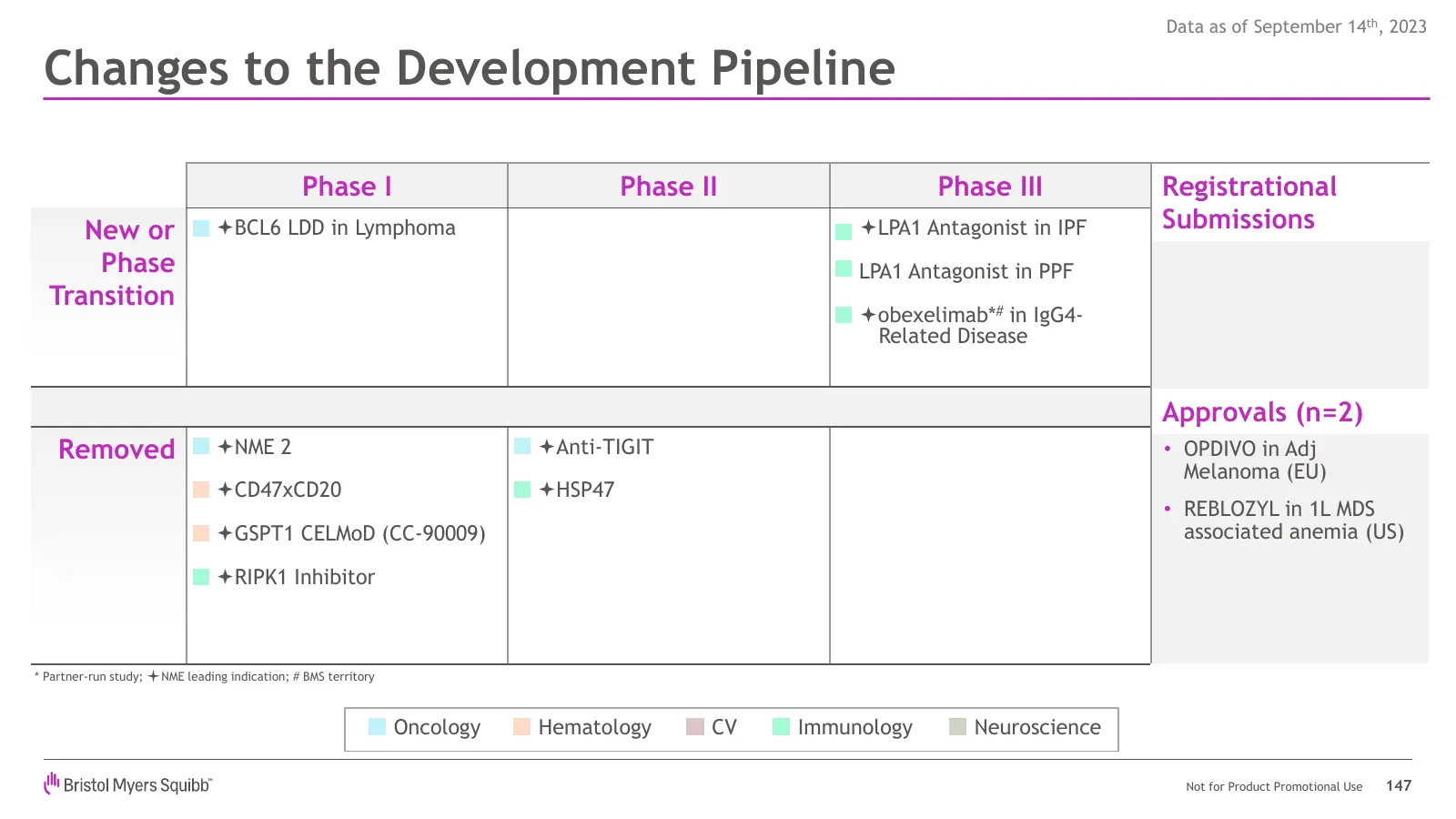
Data as of September 14th, 2023 Changes to the Development Pipeline Phase I Phase II Phase III Registrational New or BCL6 LDD in Lymphoma LPA1 Antagonist in IPF Submissions Phase LPA1 Antagonist in PPF Transition obexelimab*# in IgG4- Related Disease Approvals (n=2) Removed NME 2 Anti-TIGIT • O
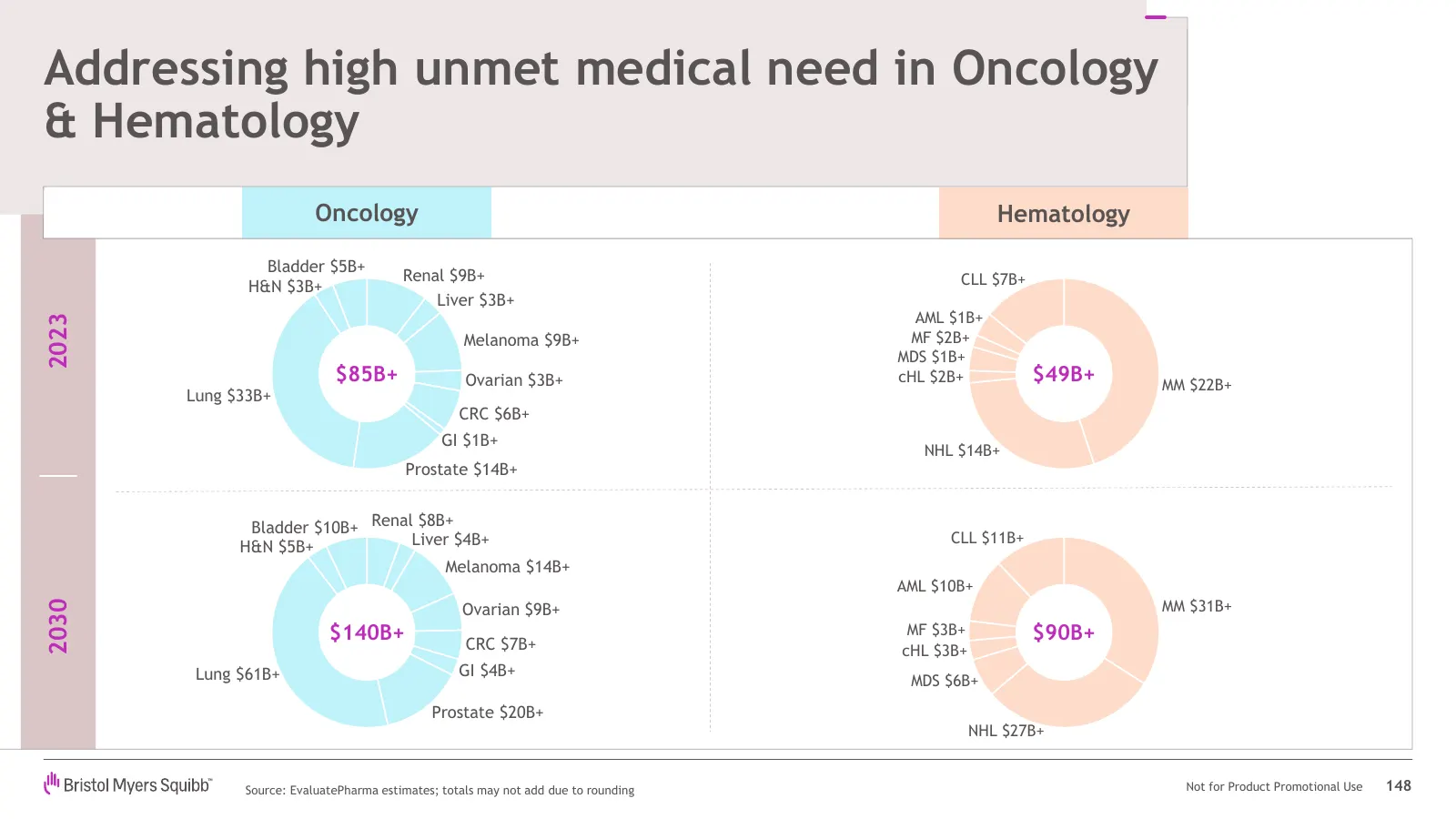
Slide 148: Addressing high unmet medical need in Oncology & Hematology
Addressing high unmet medical need in Oncology & Hematology Oncology Hematology Bladder $5B+ Renal $9B+ CLL $7B+ H&N $3B+ Liver $3B+ AML $1B+ 2023 Melanoma $9B+ MF $2B+ MDS $1B+ $85B+ Ovarian $3B+ cHL $2B+ $49B+ MM $22B+ Lung $33B+ CRC $6B+ GI $1B+ NHL $14B+ Prostate $14B+ Bladder $10B+ Renal $8B+ L
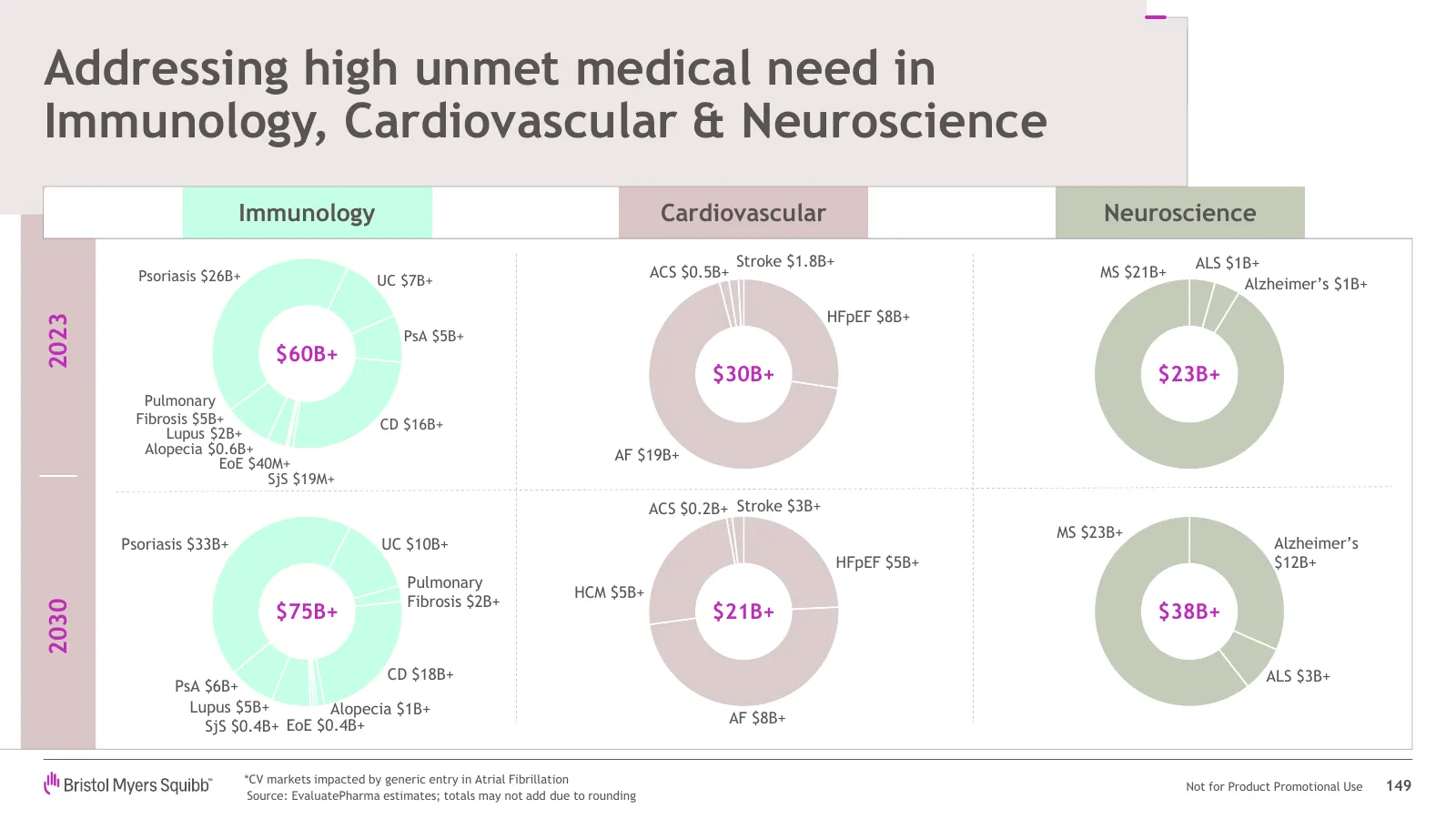
Slide 149: Addressing high unmet medical need in Immunology, Cardiovascular & Neuroscience
Addressing high unmet medical need in Immunology, Cardiovascular & Neuroscience Immunology Cardiovascular Neuroscience Stroke $1.8B+ ALS $1B+ Psoriasis $26B+ ACS $0.5B+ MS $21B+ UC $7B+ Alzheimer’s $1B+ HFpEF $8B+ 2023 PsA $5B+ $60B+ $30B+ $23B+ Pulmonary Fibrosis $5B+ CD $16B+ Lupus $2B+ Alopecia $
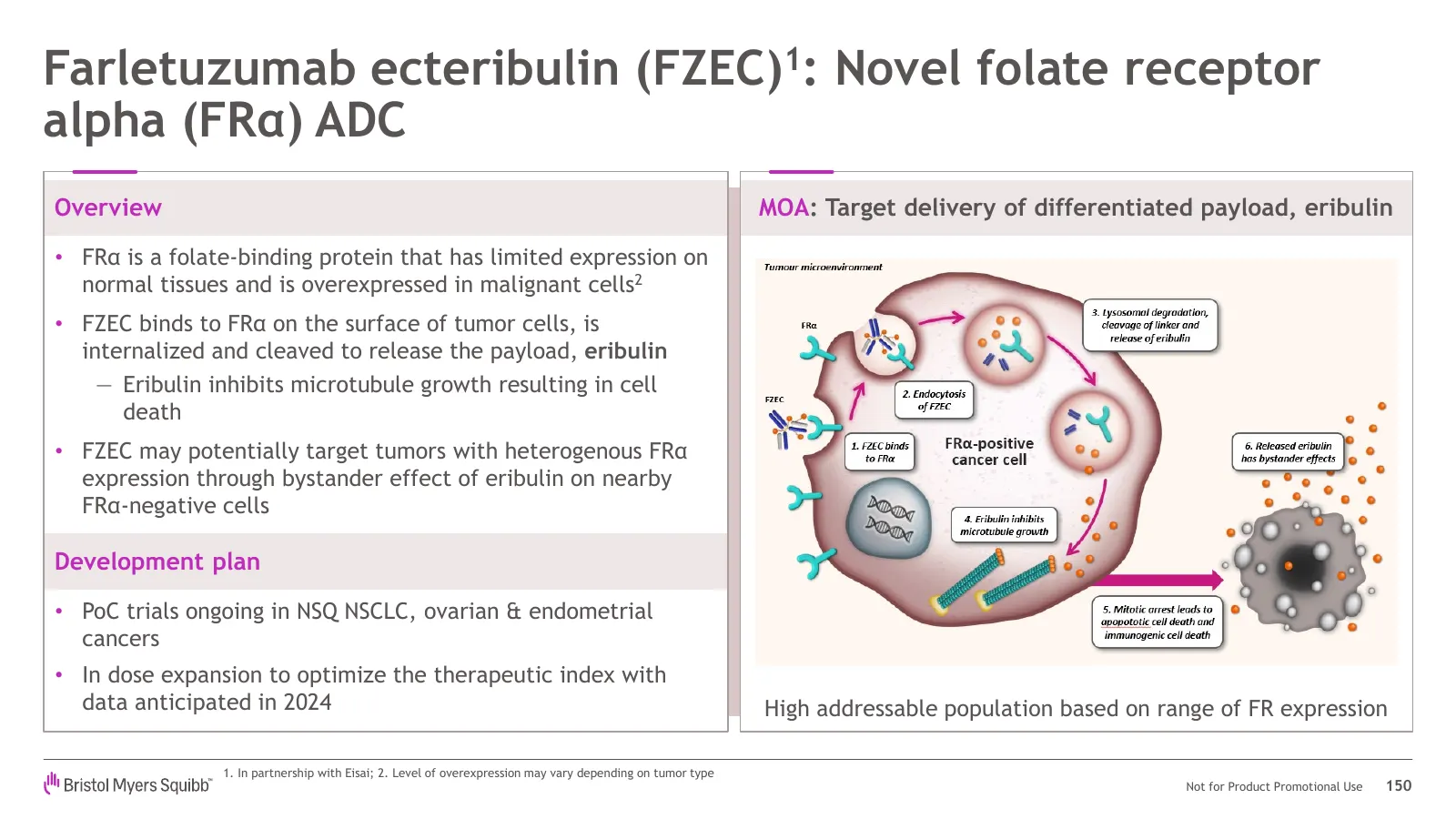
Slide 150: Farletuzumab ecteribulin: Novel folate receptor alpha ADC
Farletuzumab ecteribulin (FZEC)1: Novel folate receptor alpha (FRα) ADC Overview MOA: Target delivery of differentiated payload, eribulin • FRα is a folate-binding protein that has limited expression on normal tissues and is overexpressed in malignant cells2 • FZEC binds to FRα on the surface of tum
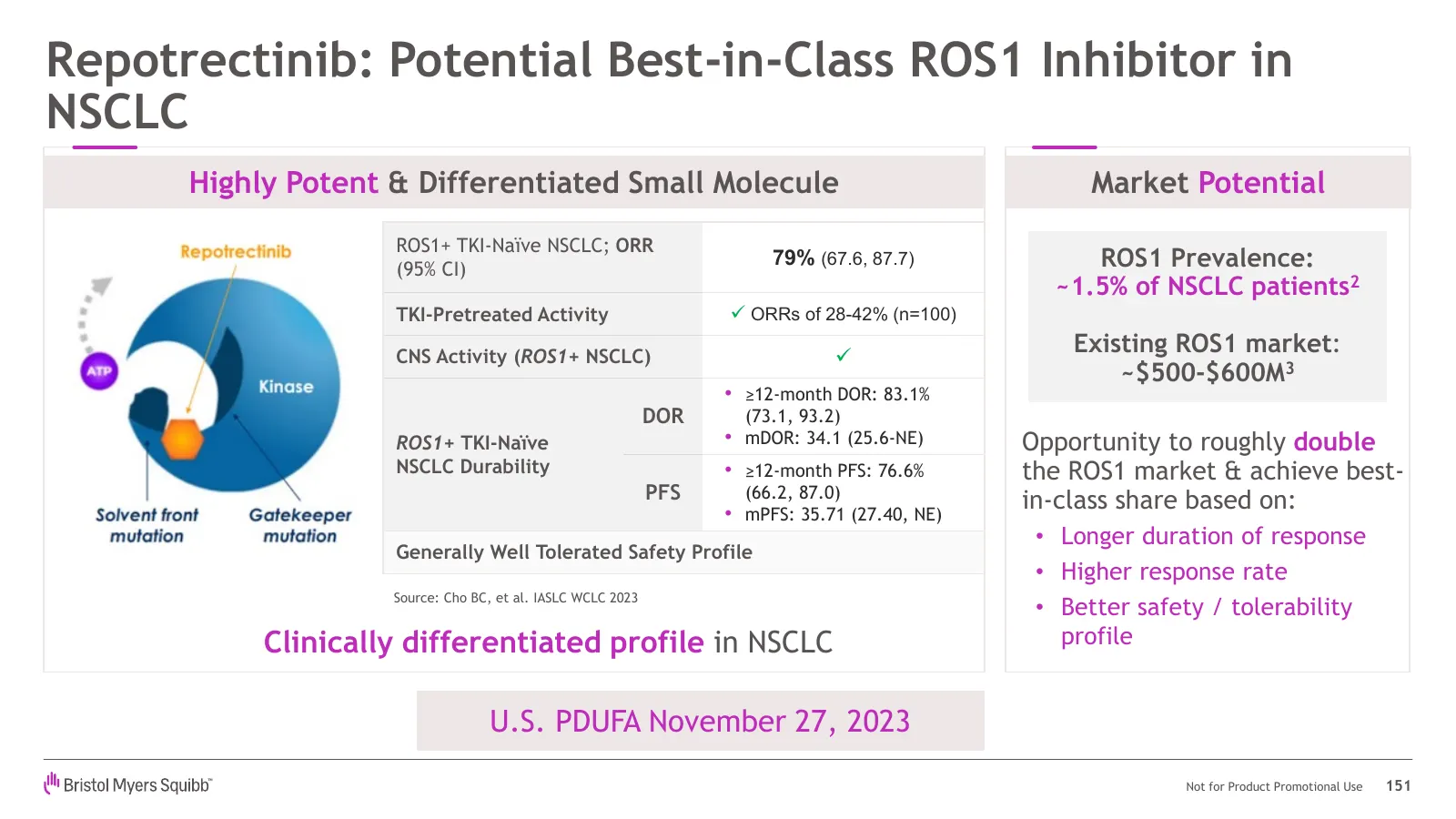
Slide 151: Repotrectinib: Potential Best-in-Class ROS1 Inhibitor in NSCLC
Repotrectinib: Potential Best-in-Class ROS1 Inhibitor in NSCLC Highly Potent & Differentiated Small Molecule Market Potential ROS1+ TKI-Naïve NSCLC; ORR (95% CI) 79% (67.6, 87.7) ROS1 Prevalence: ~1.5% of NSCLC patients2 TKI-Pretreated Activity ORRs of 28-42% (n=100) CNS Activity (ROS1+ NSCLC) E
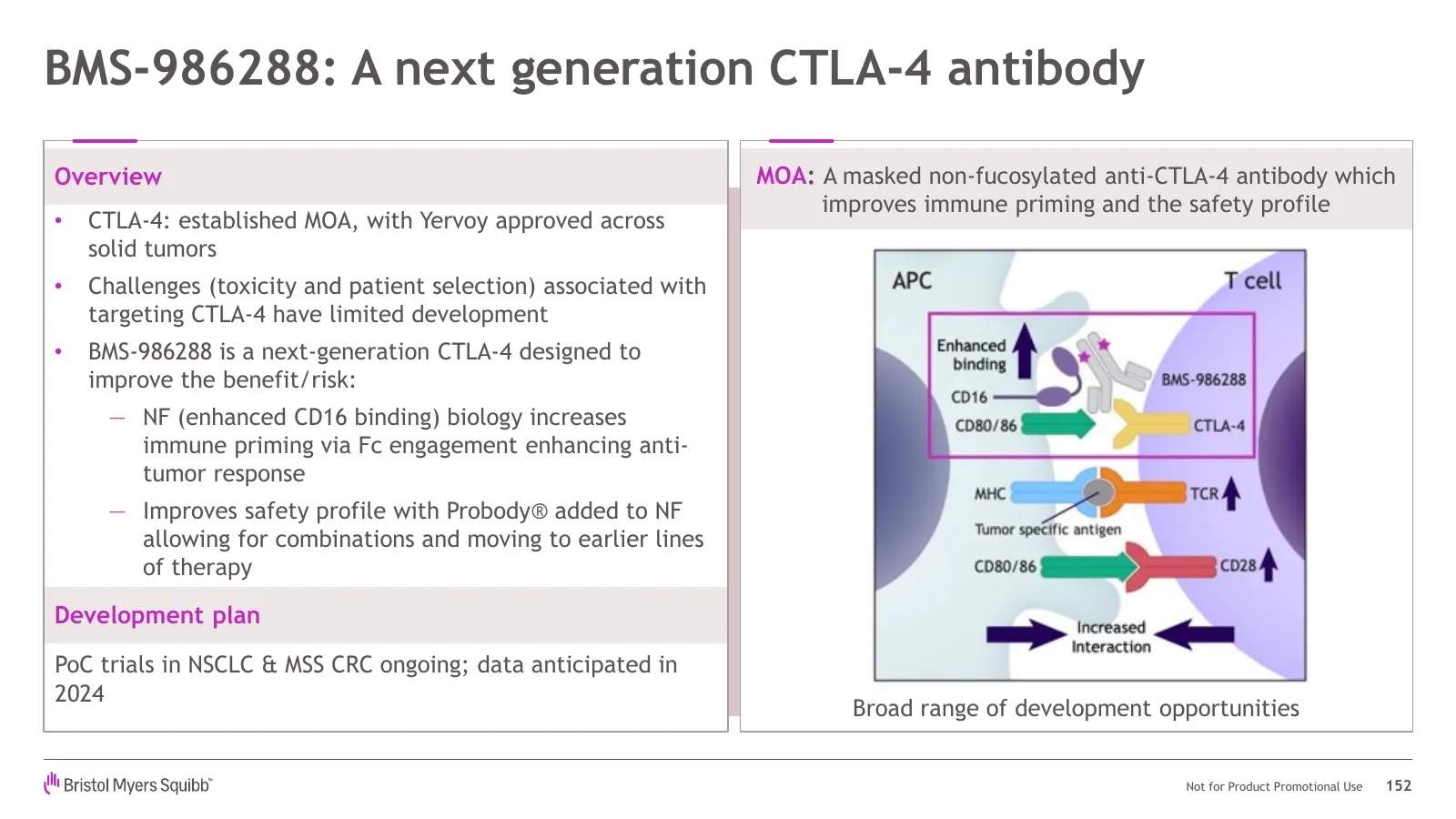
Slide 152: BMS-986288: A next generation CTLA-4 antibody
BMS-986288: A next generation CTLA-4 antibody Overview MOA: A masked non-fucosylated anti-CTLA-4 antibody which improves immune priming and the safety profile • CTLA-4: established MOA, with Yervoy approved across solid tumors • Challenges (toxicity and patient selection) associated with targeting C
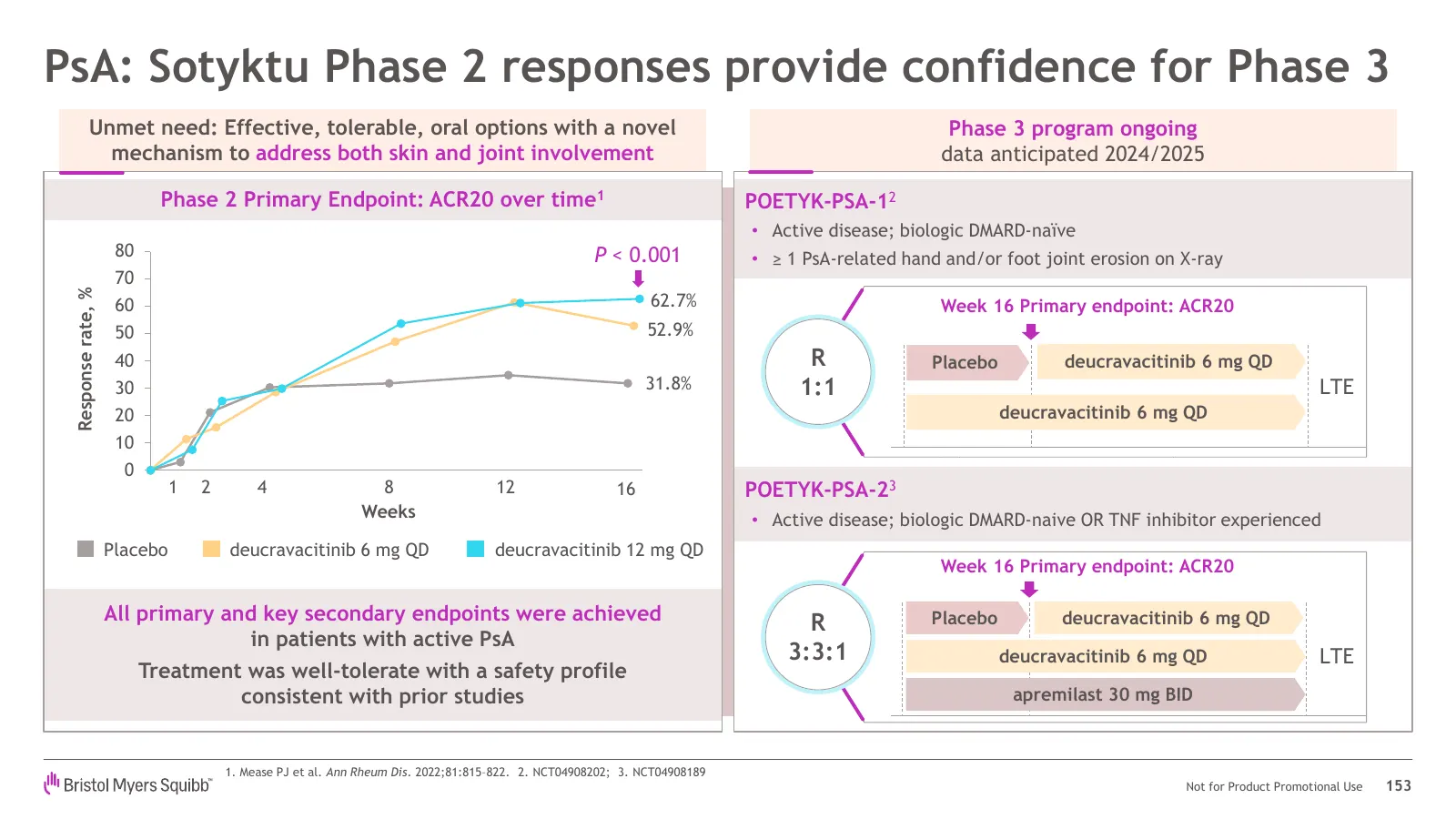
Slide 153: PsA: Sotyktu Phase 2 responses provide confidence for Phase 3
PsA: Sotyktu Phase 2 responses provide confidence for Phase 3 Unmet need: Effective, tolerable, oral options with a novel Phase 3 program ongoing mechanism to address both skin and joint involvement data anticipated 2024/2025 Phase 2 Primary Endpoint: ACR20 over time1 POETYK-PSA-12 • Active disease;
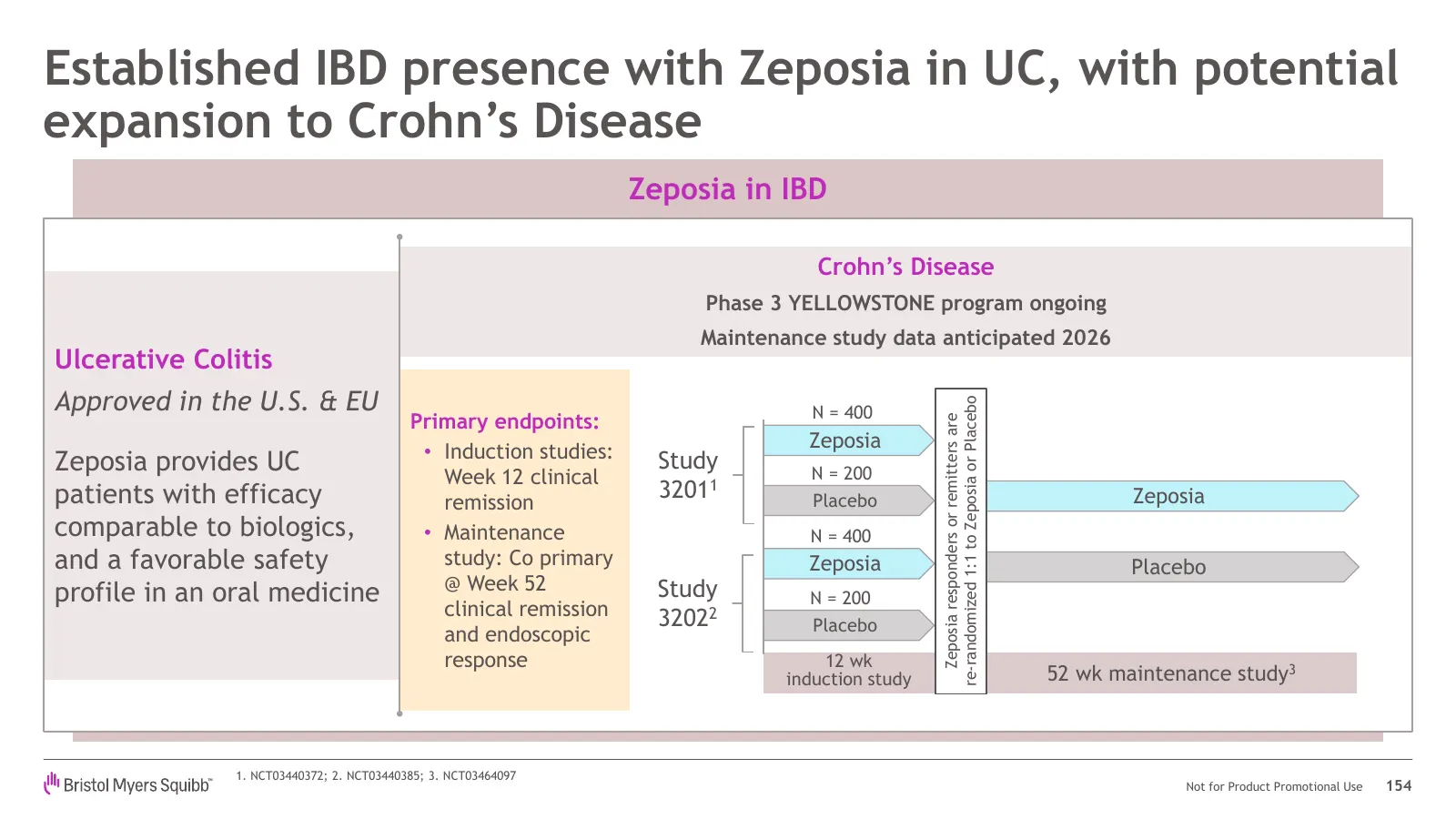
Slide 154: Zeposia in IBD: UC and Crohn's Disease
Established IBD presence with Zeposia in UC, with potential expansion to Crohn’s Disease Zeposia in IBD Crohn’s Disease Phase 3 YELLOWSTONE program ongoing Maintenance study data anticipated 2026 Ulcerative Colitis Approved in the U.S. & EU re-randomized 1:1 to Zeposia or Placebo N = 400 Primary end
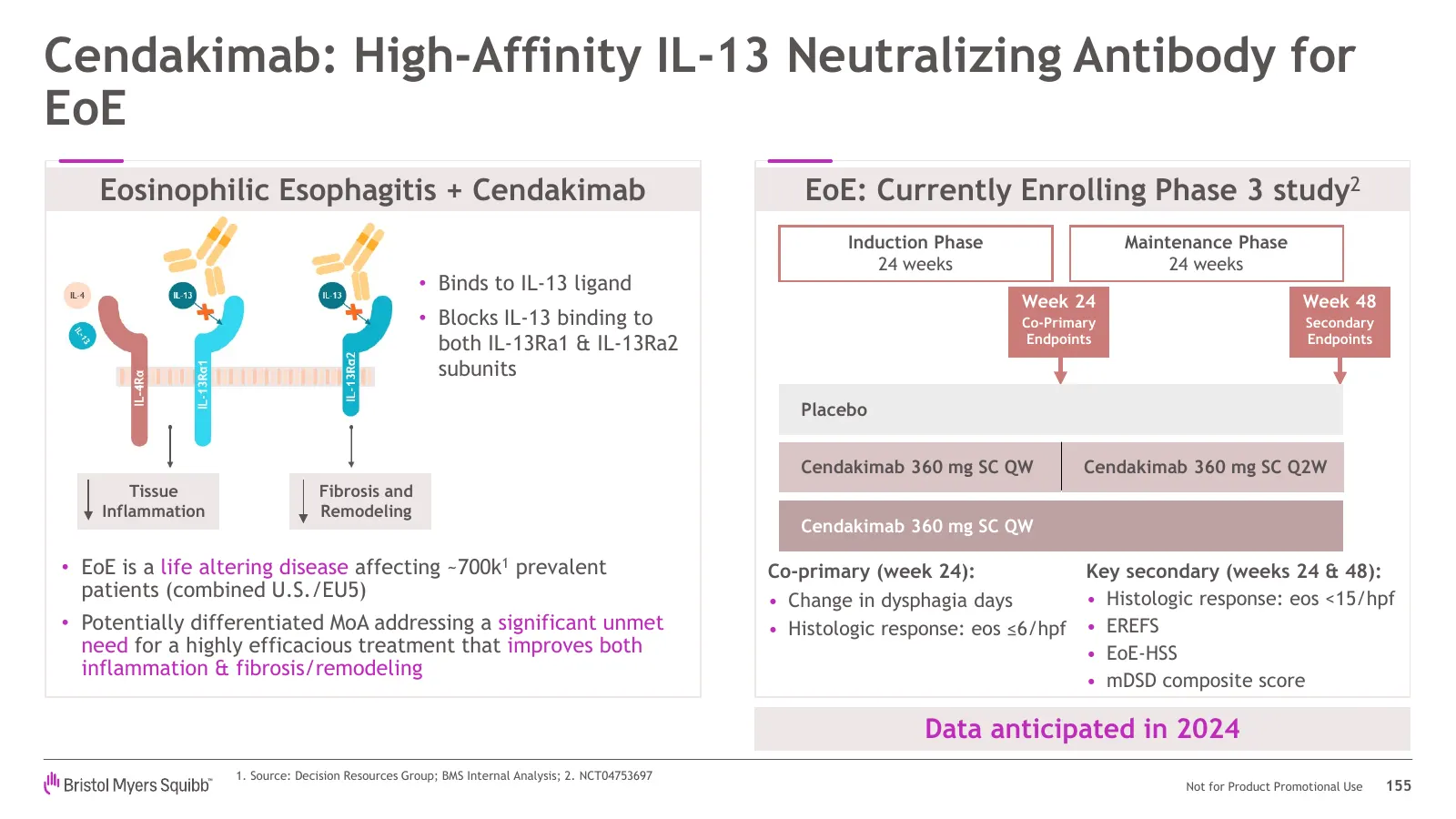
Slide 155: Cendakimab: High-Affinity IL-13 Neutralizing Antibody for EoE
Cendakimab: High-Affinity IL-13 Neutralizing Antibody for EoE Eosinophilic Esophagitis + Cendakimab EoE: Currently Enrolling Phase 3 study2 Induction Phase Maintenance Phase 24 weeks 24 weeks • Binds to IL-13 ligand Week 24 Week 48 • Blocks IL-13 binding to Co-Primary Secondary both IL-13Ra1 & IL-13
Source: Internet Archive copy of bms.com
More decks from Bristol-Myers Squibb Company
 Q3 2026 Earnings Presentation57 slides · Oct 29, 2026
 Q3 2026 Earnings Presentation16 slides · Oct 29, 2026
 Q2 2026 Earnings Presentation57 slides · Jul 30, 2026
 Q2 2026 Earnings Presentation16 slides · Jul 30, 2026
 Q1 2026 Earnings Presentation58 slides · Apr 30, 2026
 Q1 2026 Earnings Presentation16 slides · Apr 30, 2026