Agilent Technologies, Inc. · NYSE:A
Agilent Technologies — Technical Presentation (January 2020)
36 slides from Agilent Technologies's technical presentation, Jan 16, 2020

Slide 1: Getting Off to a Good Start
Getting Off to a Good Start The makings of a reliable method Rita Steed LC Columns Application Engineer January 16, 2020
Slide 2: The Importance of Developing a Reliable Method
The Importance of Developing a Reliable Method* Scenario: You’re trying to reproduce an experiment in a journal article but have been unsuccessful. You contact one of the authors, Marco the Magnificent. You explain your dilemma and ask him to help you understand why it’s not working. His response: “
Slide 3: Get Off to a Good Start
Get Off to a Good Start Method Development • Goals • Good resolution: ≥2 • Robust and reliable • Key Considerations • Column – Particle size – Bonded phase • Conditions – Mobile phase – pH – Temperature • Sample • Instrument 3 1/21/2020 Getting Off to a Good Start DE.4937037037 Agilent Restricted
Slide 4: Common Separation Goals and Method Performance Criteria
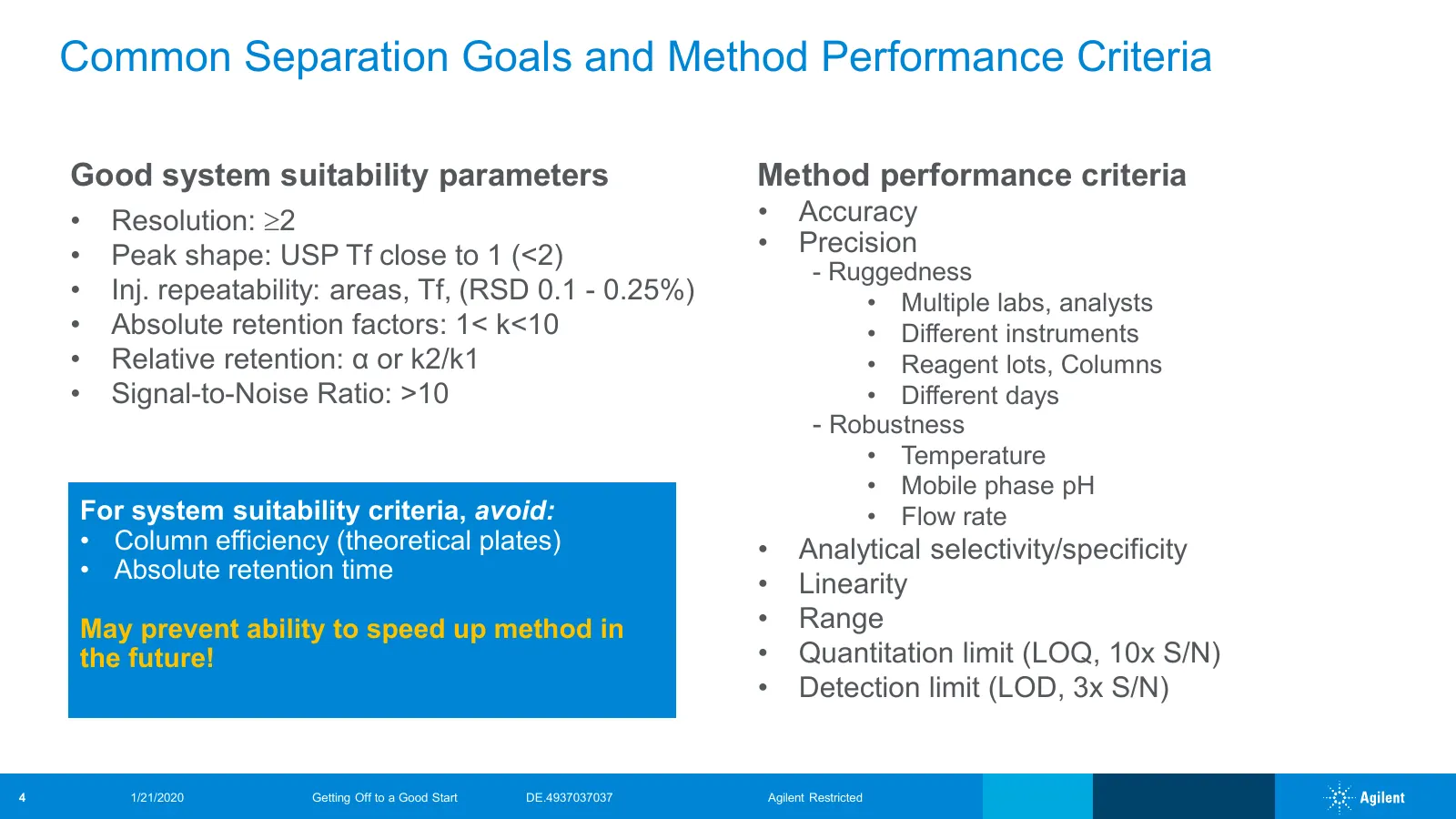
Common Separation Goals and Method Performance Criteria Good system suitability parameters Method performance criteria • Resolution: ≥2 • Accuracy • Peak shape: USP Tf close to 1 (<2) • Precision - Ruggedness • Inj. repeatability: areas, Tf, (RSD 0.1 - 0.25%) • Multiple labs, analysts • Absolute ret
Slide 5: Rs ≥ 2.0 is Important
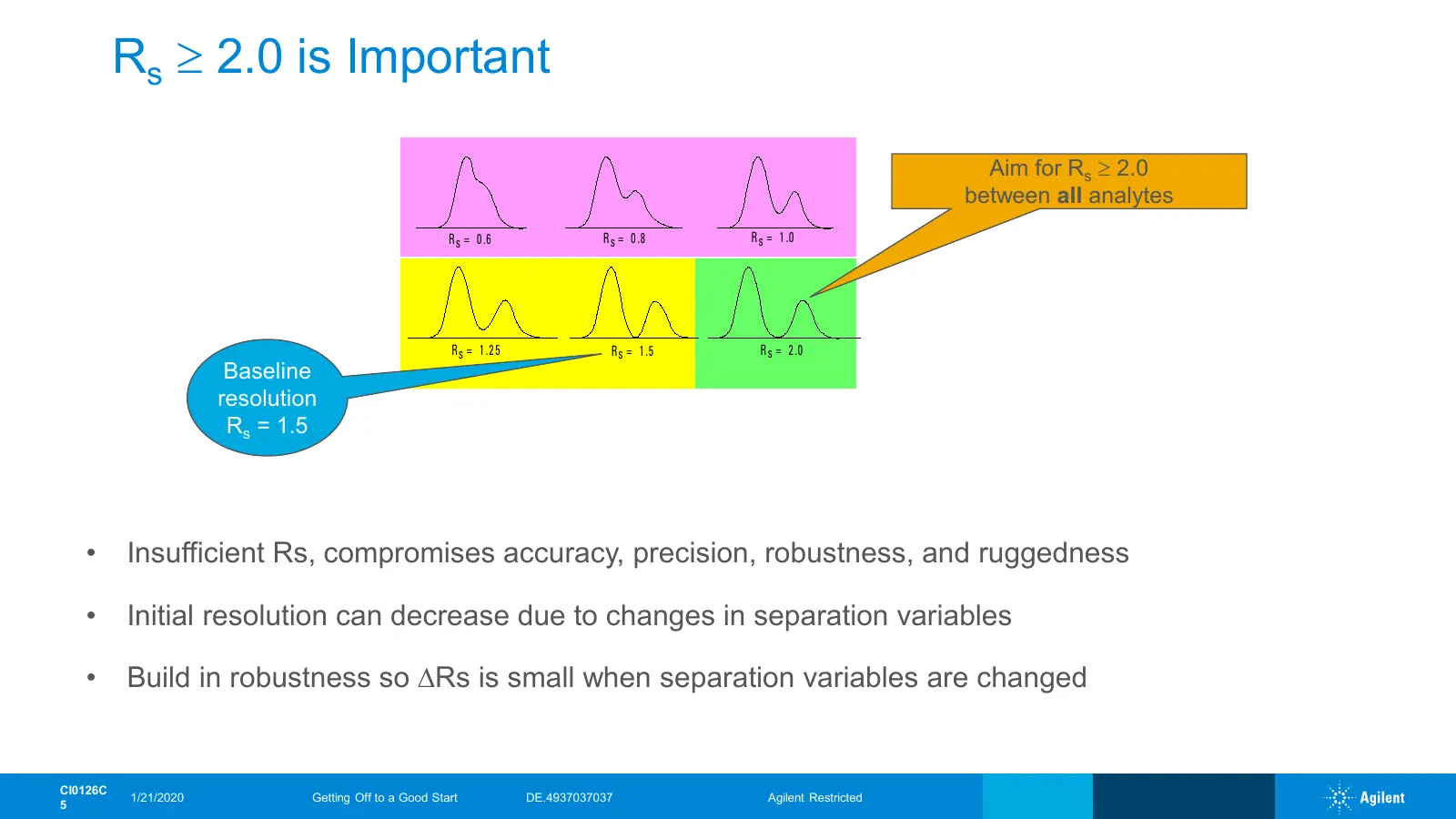
Rs ≥ 2.0 is Important Aim for Rs ≥ 2.0 between all analytes R s = 0 .6 R s = 0 .8 R s = 1 .0 R s = 1 .2 5 R s = 1 .5 R s = 2 .0 Baseline resolution Rs = 1.5 • Insufficient Rs, compromises accuracy, precision, robustness, and ruggedness • Initial resolution can decrease due to changes in separation v
Slide 6: Factors that Affect Resolution
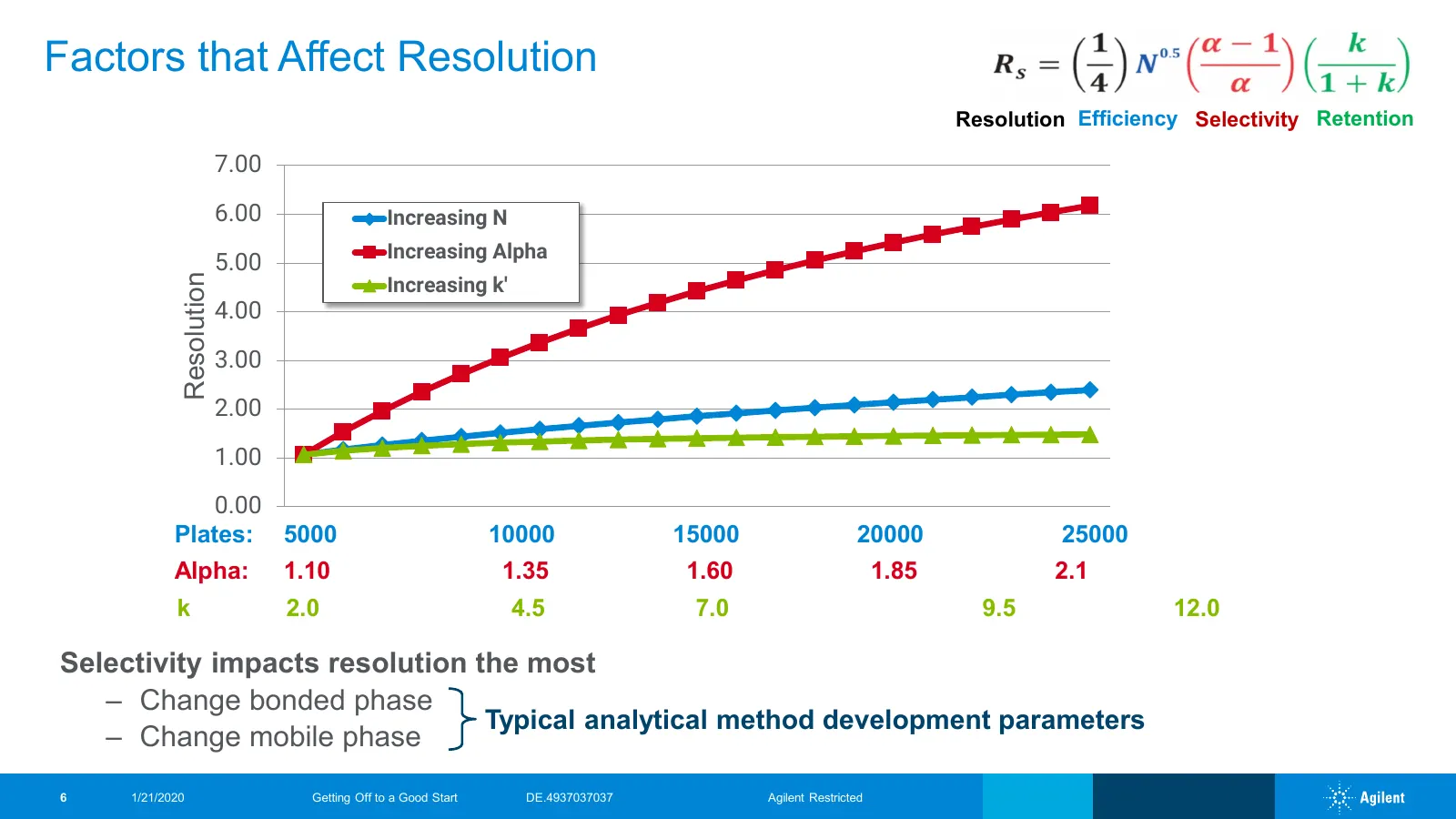
Factors that Affect Resolution Resolution Efficiency Selectivity Retention 7.00 6.00 Increasing N Increasing Alpha 5.00 Increasing k' Resolution 4.00 3.00 2.00 1.00 0.00 Plates: 5000 10000 15000 20000 25000 Alpha: 1.10 1.35 1.60 1.85 2.1 k 2.0 4.5 7.0 9.5 12.0 Selectivity impacts resolution the most
Slide 7: Key Factors and Conditions to Consider
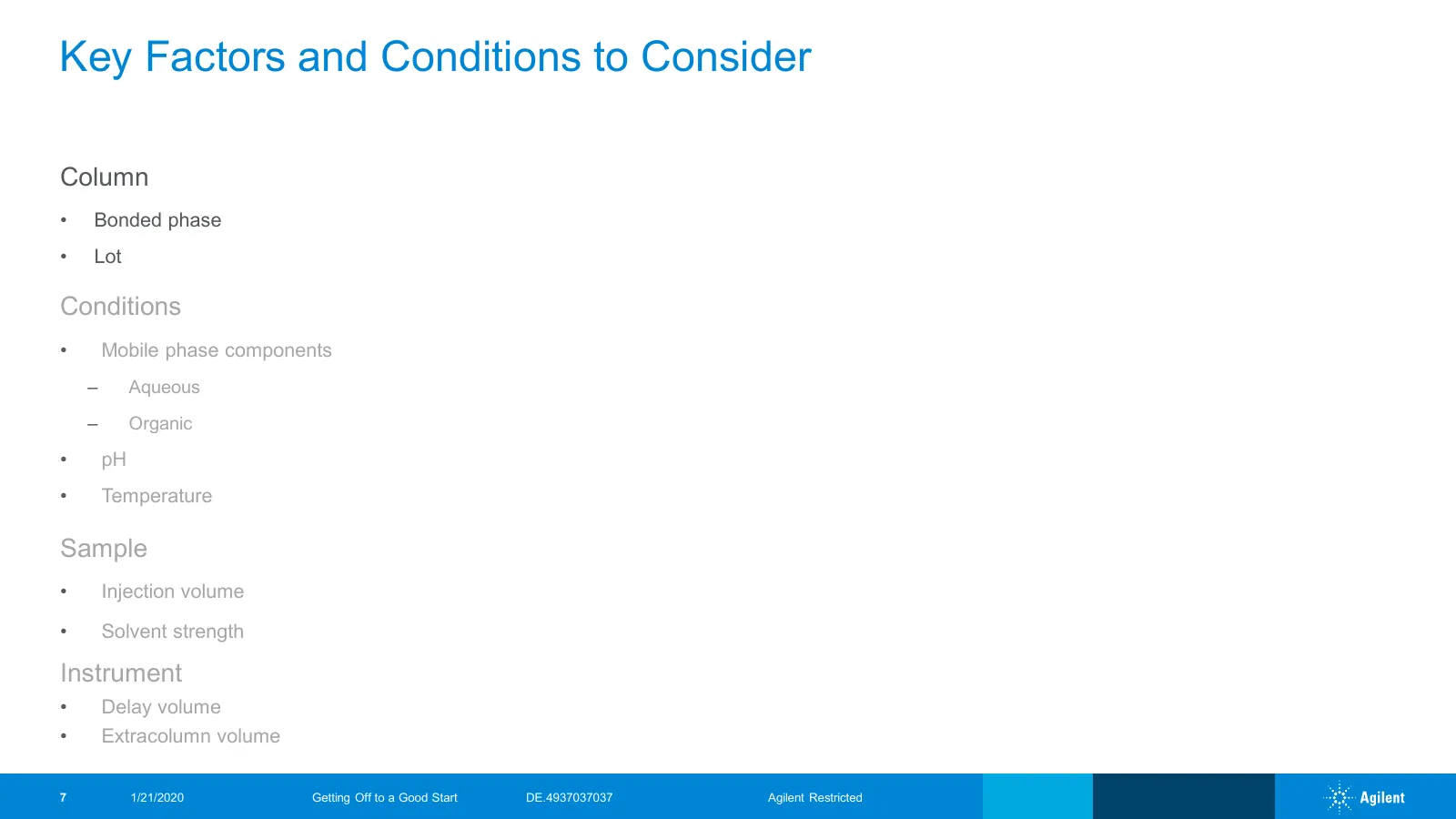
Key Factors and Conditions to Consider Column • Bonded phase • Lot Conditions • Mobile phase components – Aqueous – Organic • pH • Temperature Sample • Injection volume • Solvent strength Instrument • Delay volume • Extracolumn volume 7 1/21/2020 Getting Off to a Good Start DE.4937037037 Agilent Res
Slide 8: Column Choice Considerations
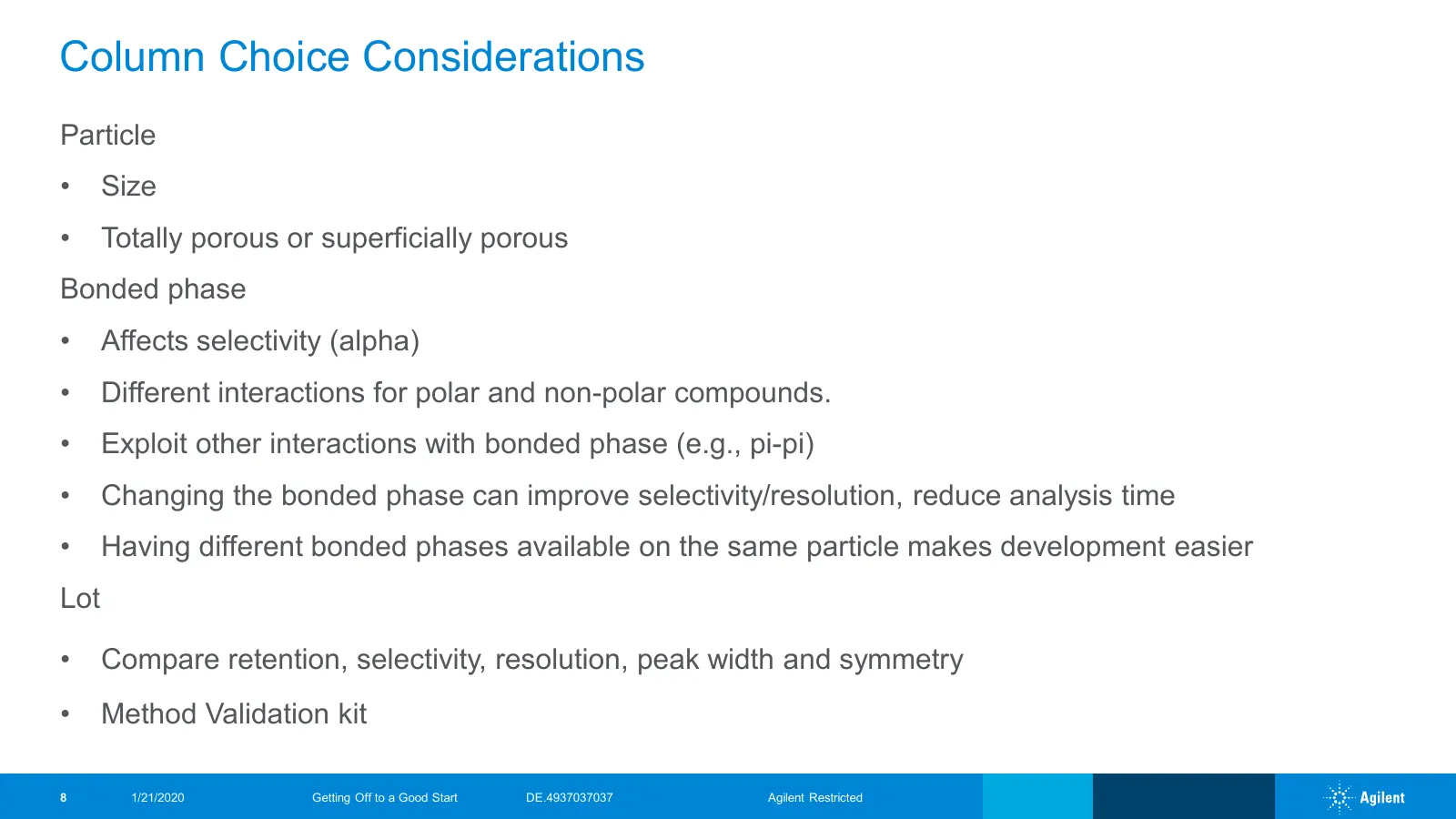
Column Choice Considerations Particle • Size • Totally porous or superficially porous Bonded phase • Affects selectivity (alpha) • Different interactions for polar and non-polar compounds. • Exploit other interactions with bonded phase (e.g., pi-pi) • Changing the bonded phase can improve selectivit
Slide 9: Agilent InfinityLab Poroshell 120 Portfolio
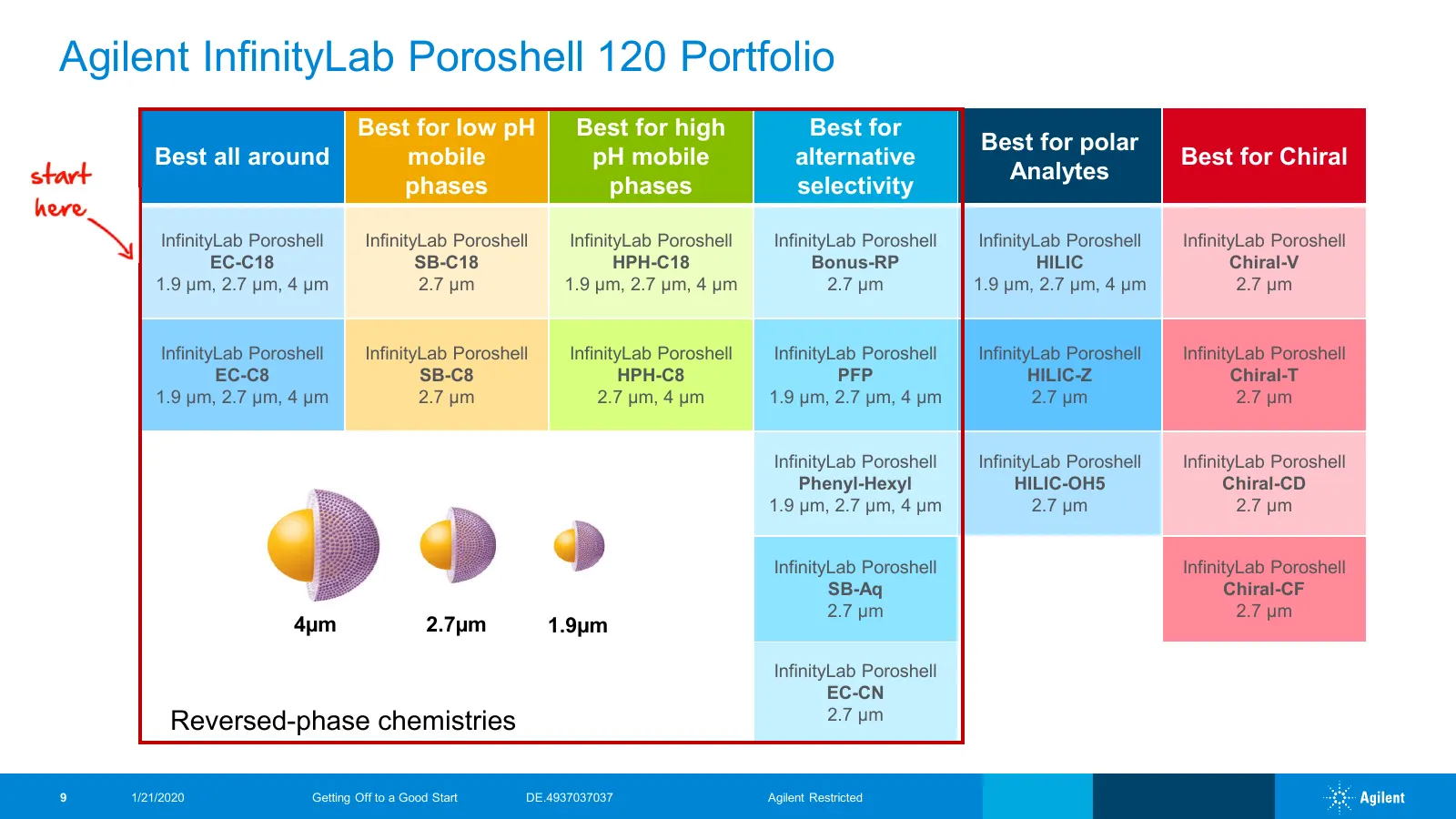
Agilent InfinityLab Poroshell 120 Portfolio Best for low pH Best for high Best for Best for polar Best all around mobile pH mobile alternative Best for Chiral Analytes phases phases selectivity InfinityLab Poroshell InfinityLab Poroshell InfinityLab Poroshell InfinityLab Poroshell InfinityLab Porosh
Slide 10: Select the Right Column Phase
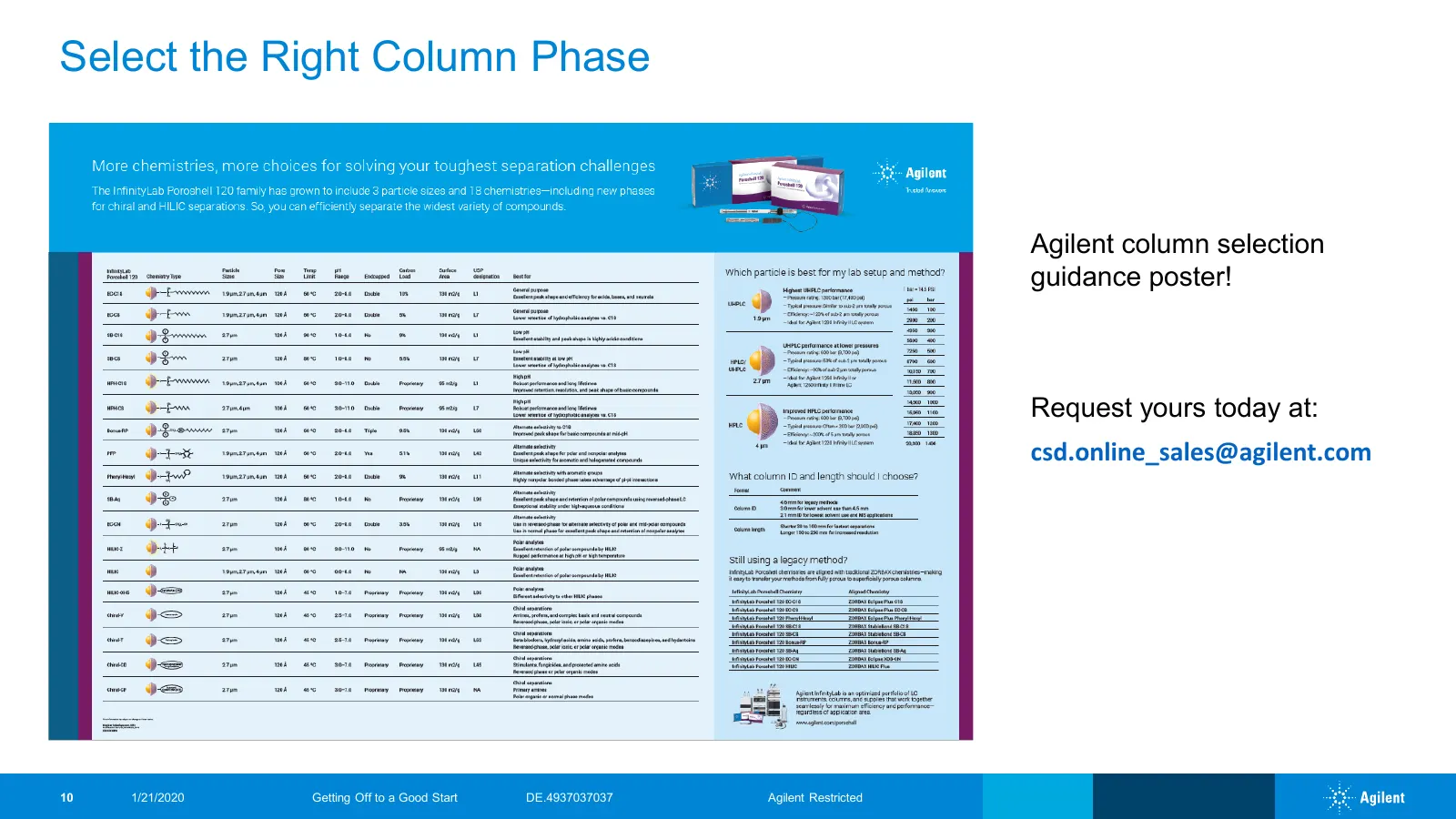
Select the Right Column Phase Agilent column selection guidance poster! Request yours today at: [email protected] 10 1/21/2020 Getting Off to a Good Start DE.4937037037 Agilent Restricted
Slide 11: Selectivity Differences Across InfinityLab Poroshell Bonded Phases
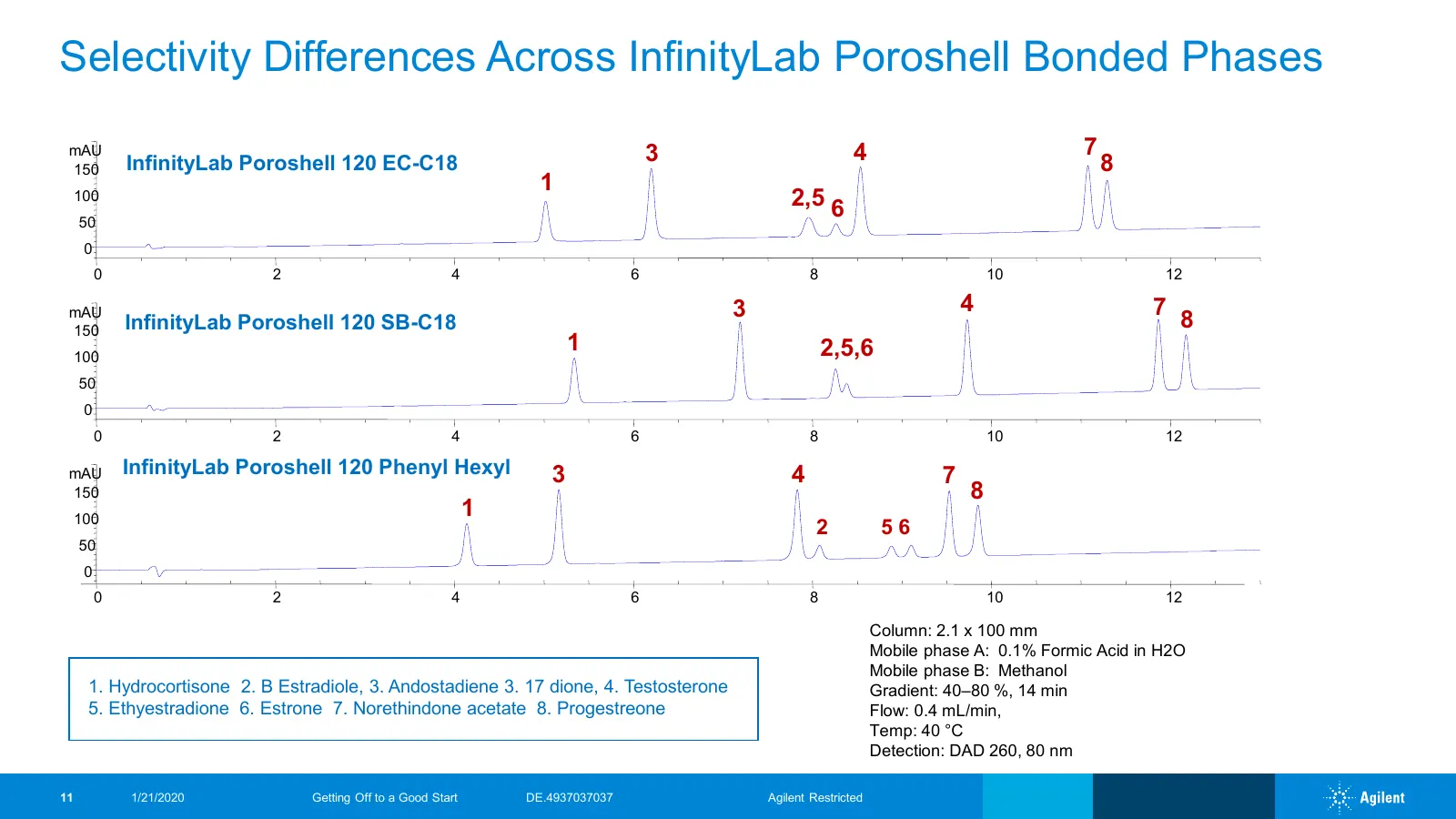
Selectivity Differences Across InfinityLab Poroshell Bonded Phases mAU 3 4 7 150 InfinityLab Poroshell 120 EC-C18 8 1 100 2,5 6 50 0 0 2 4 6 8 10 12 mAU 3 4 7 150 InfinityLab Poroshell 120 SB-C18 8 100 1 2,5,6 50 0 0 2 4 6 8 10 12 mAU InfinityLab Poroshell 120 Phenyl Hexyl 3 4 7 150 8 100 1 2 56 50
Slide 12: Column Lot-to-Lot How to
Column How to – Lot-to-Lot Test Ruggedness Best practice – Assess method performance in Ruggedness example: column lot two or more labs, ideally over time Lack of ruggedness is often attributable to • Test 3 different column lots – Method Validation kit • Insufficient documentation • Differing pract
Slide 13: Help Ensure Method Reproducibility
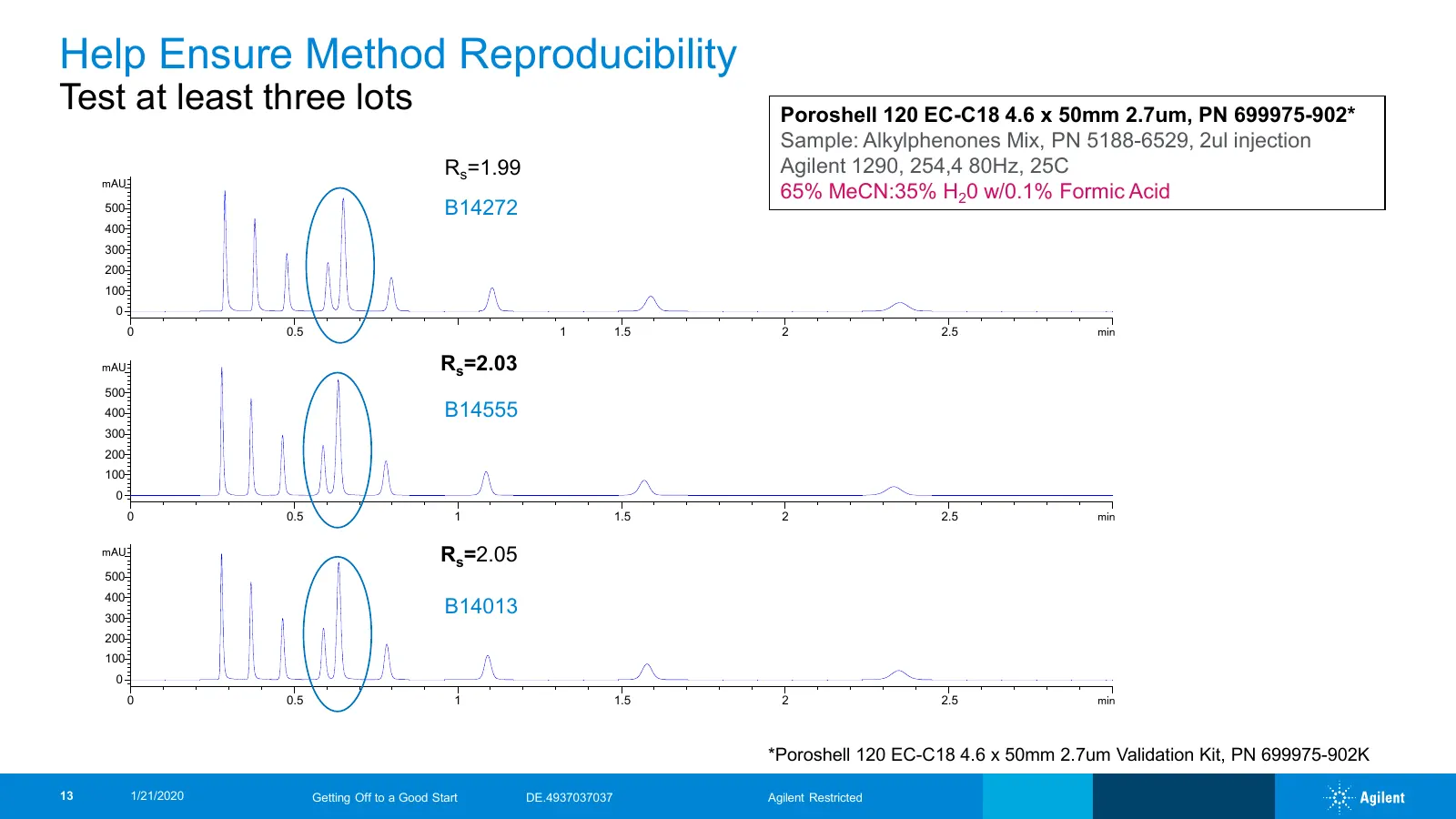
Help Ensure Method Reproducibility Test at least three lots Poroshell 120 EC-C18 4.6 x 50mm 2.7um, PN 699975-902* Sample: Alkylphenones Mix, PN 5188-6529, 2ul injection Rs=1.99 Agilent 1290, 254,4 80Hz, 25C 65% MeCN:35% H20 w/0.1% Formic Acid mAU 500 B14272 400 300 200 100 0 0 0.5 1 1.5 2 2.5 min mA
Slide 14: Slight Change to Method, More Reliable Results
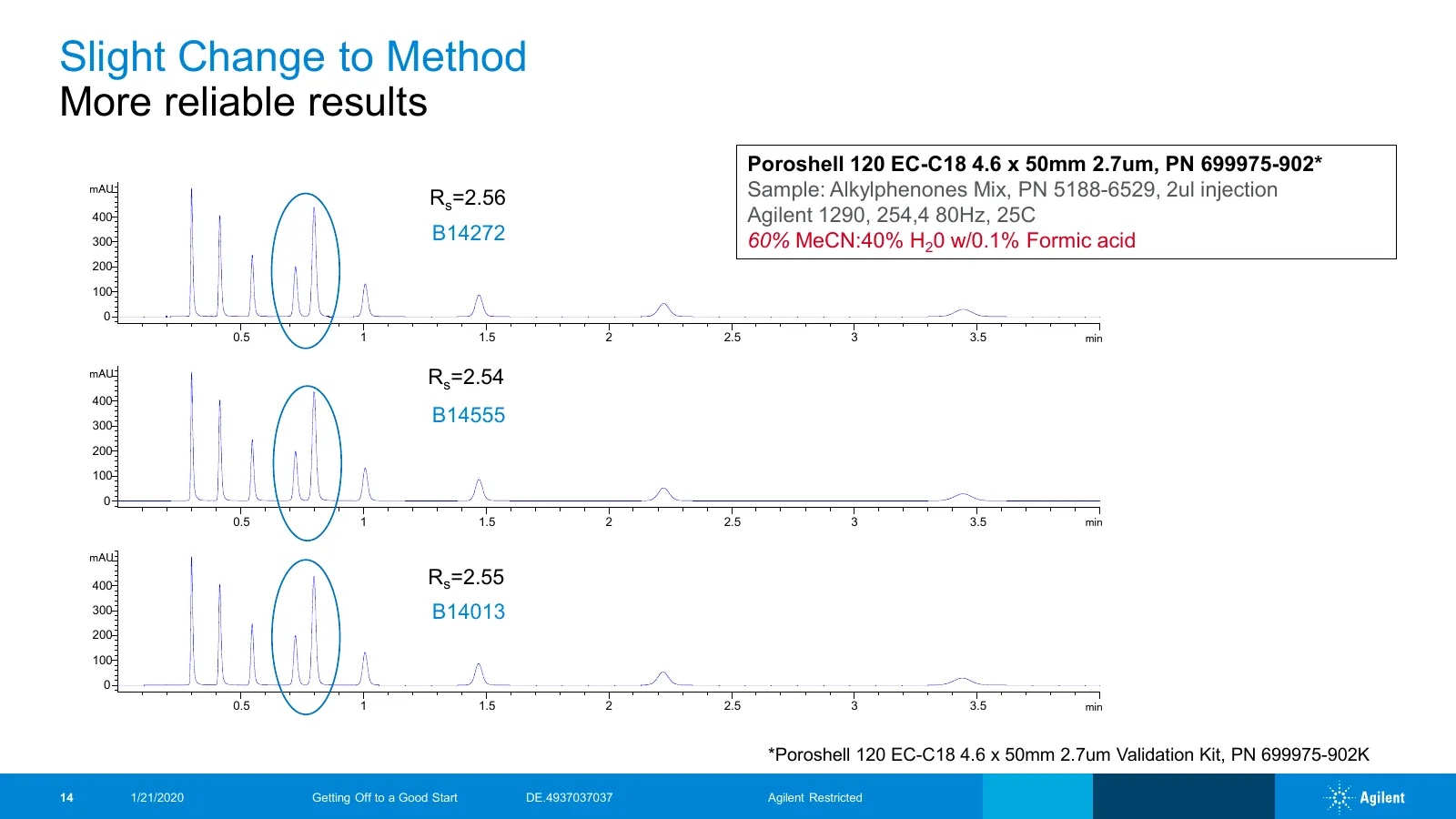
Slight Change to Method More reliable results Poroshell 120 EC-C18 4.6 x 50mm 2.7um, PN 699975-902* mAU Rs=2.56 Sample: Alkylphenones Mix, PN 5188-6529, 2ul injection 400 Agilent 1290, 254,4 80Hz, 25C 300 B14272 60% MeCN:40% H20 w/0.1% Formic acid 200 100 0 0.5 1 1.5 2 2.5 3 3.5 min mAU Rs=2.54 400
Slide 15: Help Insure a Reliable Method
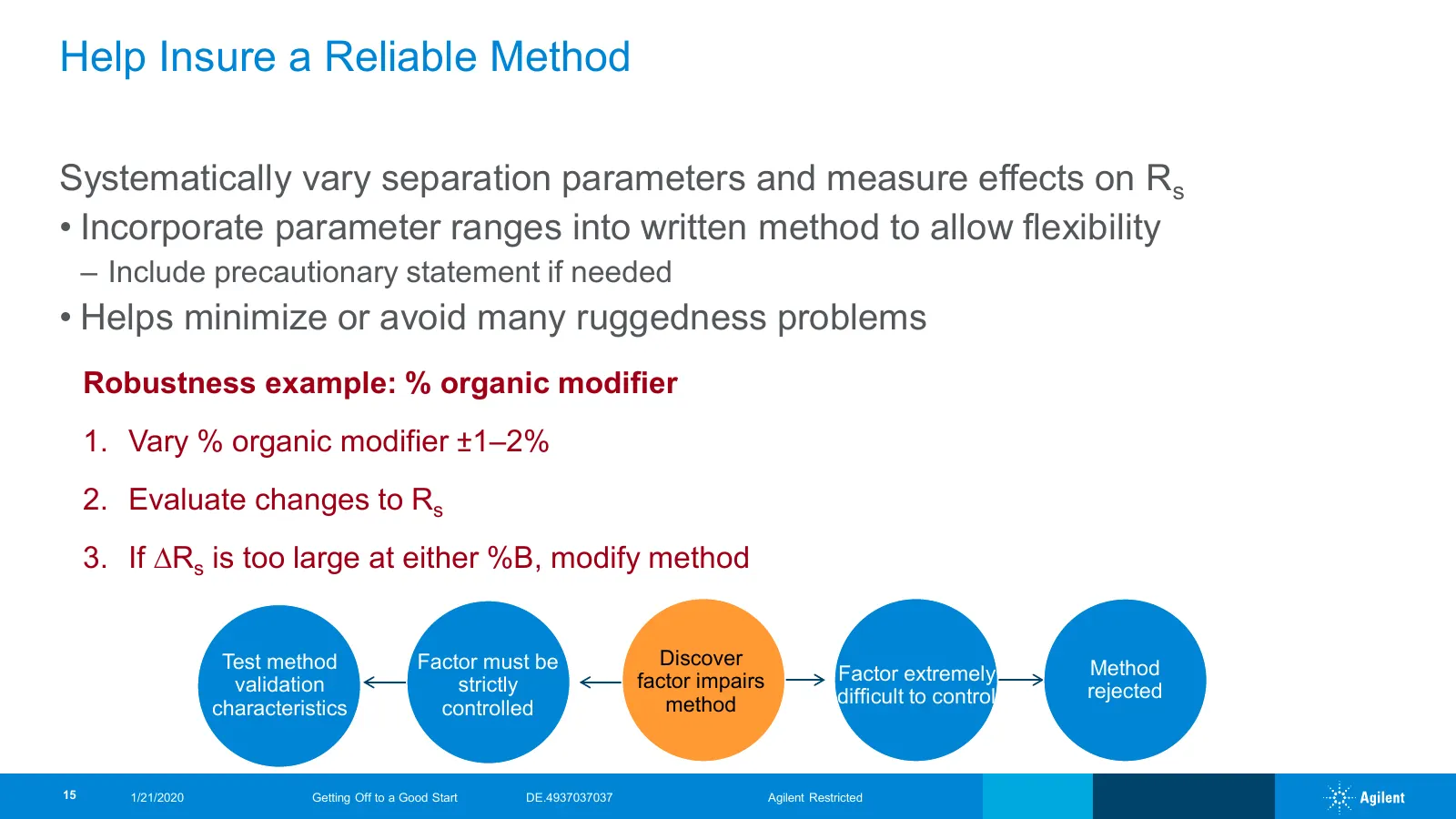
Help Insure a Reliable Method Systematically vary separation parameters and measure effects on Rs • Incorporate parameter ranges into written method to allow flexibility – Include precautionary statement if needed • Helps minimize or avoid many ruggedness problems Robustness example: % organic modif
Slide 16: Experimental Conditions That Affect Resolution
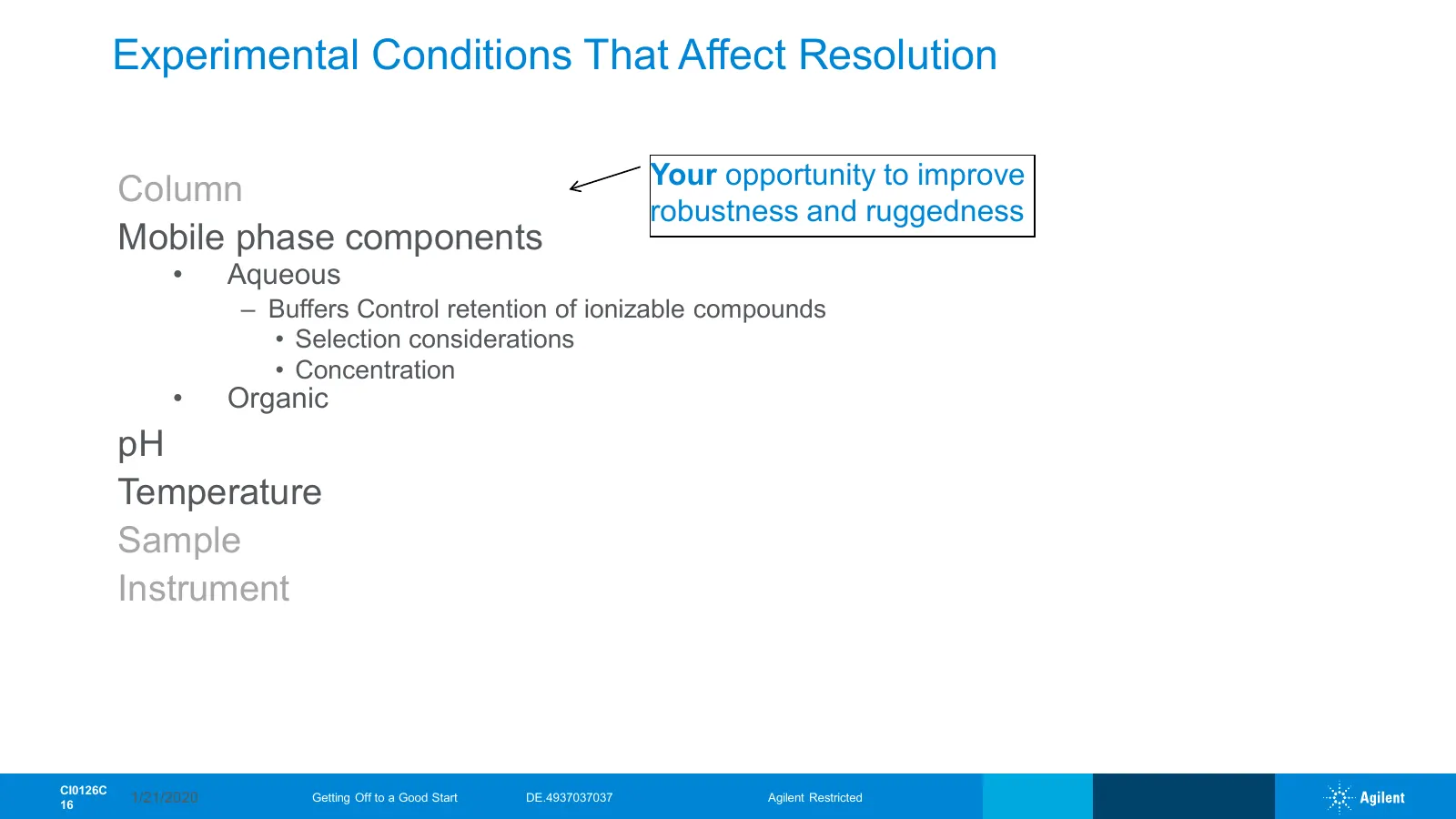
Experimental Conditions That Affect Resolution Your opportunity to improve Column robustness and ruggedness Mobile phase components • Aqueous – Buffers Control retention of ionizable compounds • Selection considerations • Concentration • Organic pH Temperature Sample Instrument CI0126C 16 1/21/2020
Slide 17: Mobile Phase – Aqueous
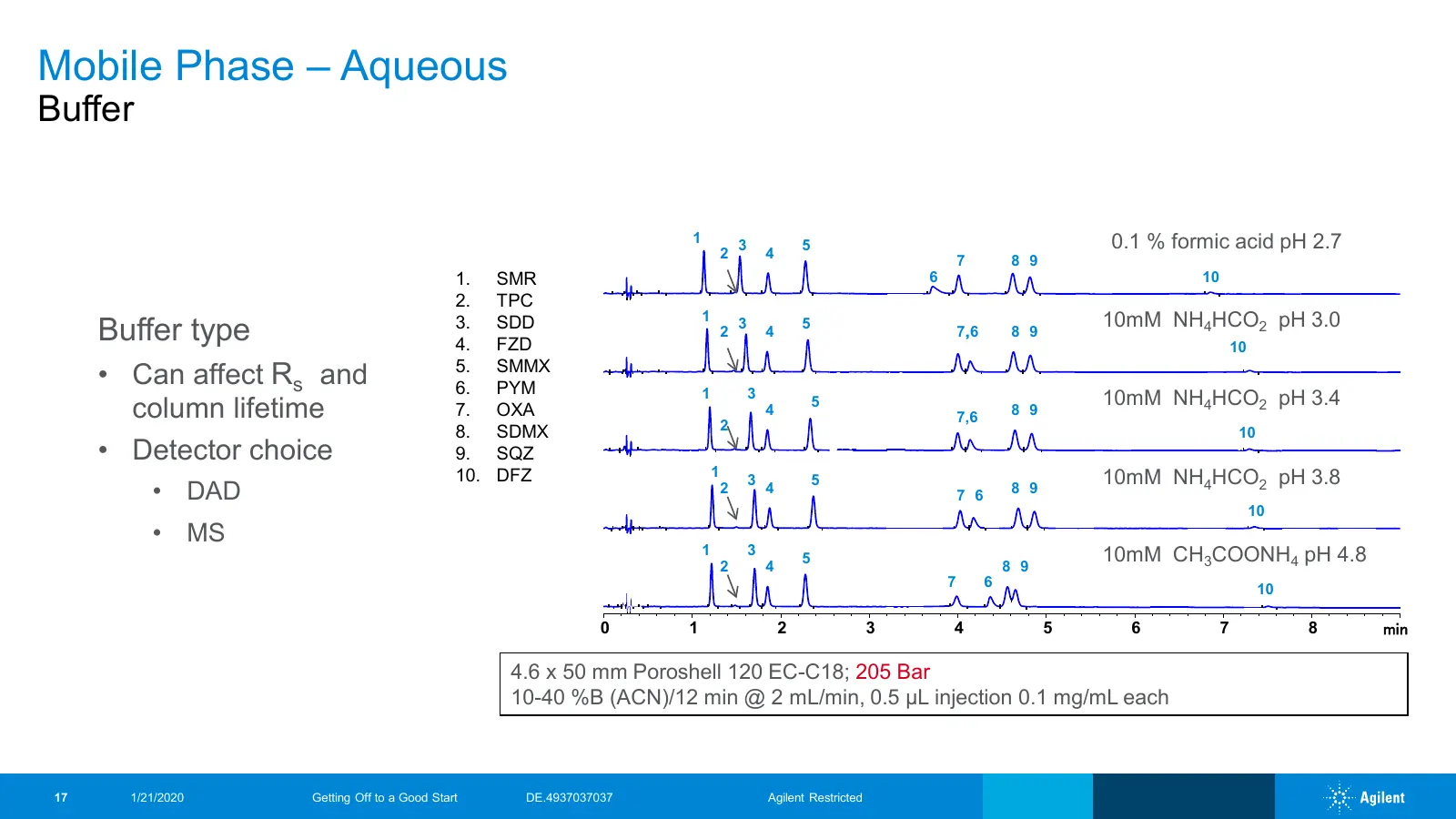
Mobile Phase – Aqueous Buffer 1 2 3 4 5 0.1 % formic acid pH 2.7 7 8 9 1. SMR 6 10 2. TPC 1 10mM NH4HCO2 pH 3.0 Buffer type 3. 4. SDD FZD 2 3 4 5 7,,6 8 9 10 • Can affect Rs and 5. 6. SMMX PYM 1 3 10mM NH4HCO2 pH 3.4 column lifetime 7. OXA 2 4 5 7,6 8 9 8. SDMX 10 • Detector choice 9. SQZ 10. DFZ 1
Slide 18: Test for pH Robustness
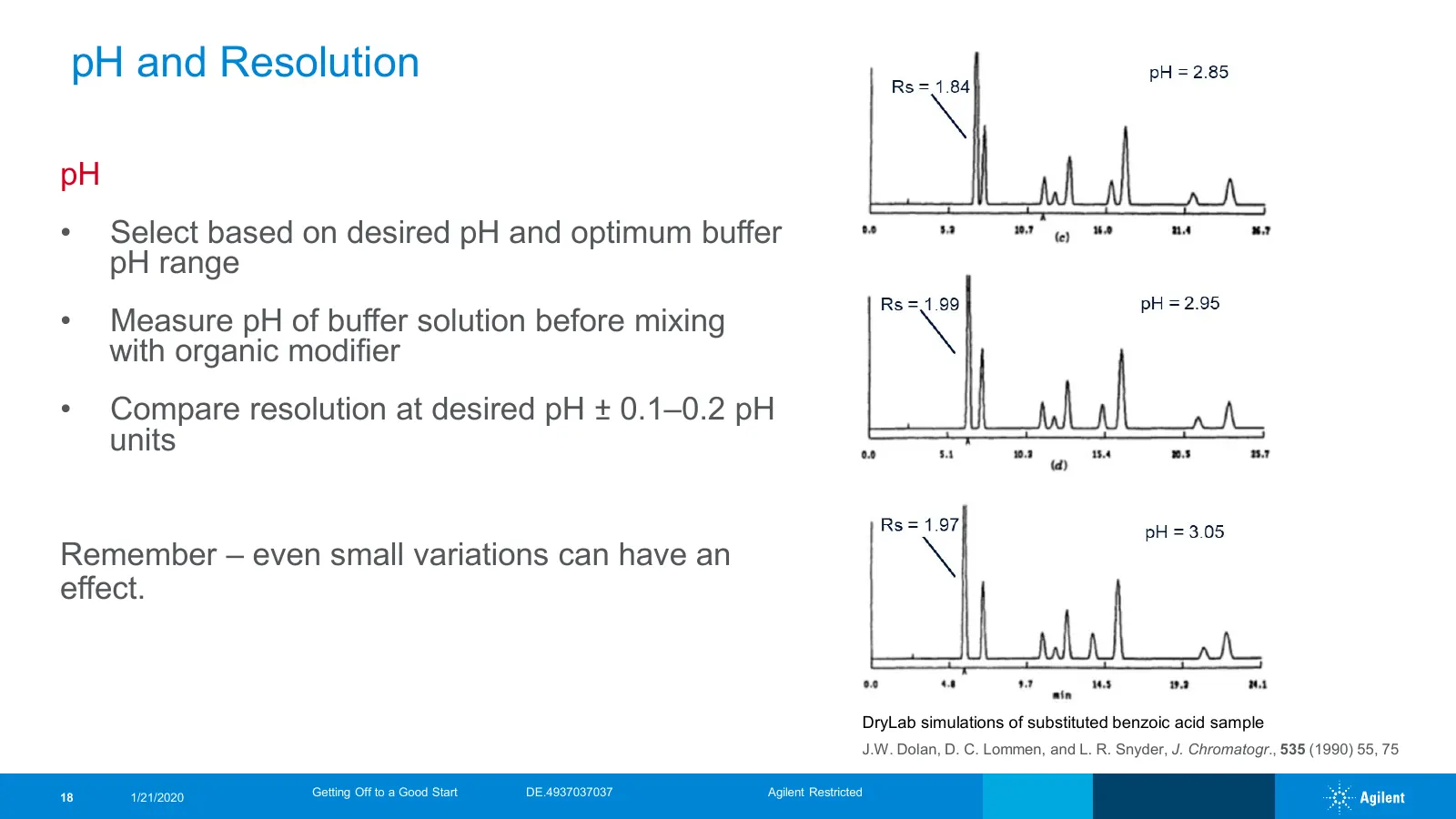
Test for pH pH and Robustness Resolution pH • Select based on desired pH and optimum buffer pH range • Measure pH of buffer solution before mixing with organic modifier • Compare resolution at desired pH ± 0.1–0.2 pH units Remember – even small variations can have an effect. DryLab simulations of su
Slide 19: Buffer Concentration
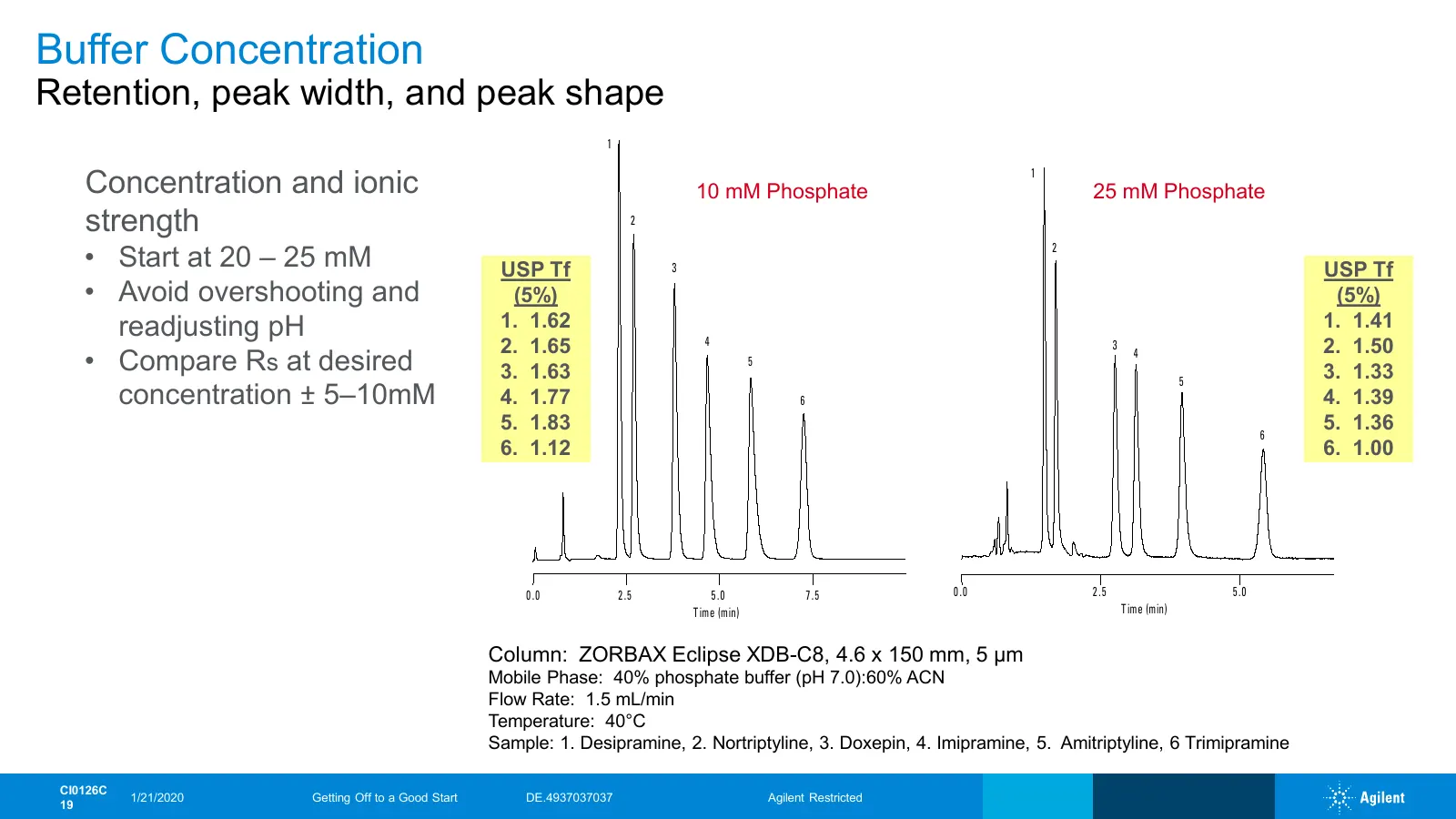
Buffer Concentration Retention, peak width, and peak shape 1 Concentration and ionic 10 mM Phosphate 1 25 mM Phosphate strength 2 • Start at 20 – 25 mM USP Tf 3 2 USP Tf • Avoid overshooting and (5%) (5%) readjusting pH 1. 1.62 1. 1.41 2. 1.65 4 3 2. 1.50 • Compare Rs at desired 3. 1.63 5 4 3. 1.33
Slide 20: Mobile Phase – Explore Organic Options
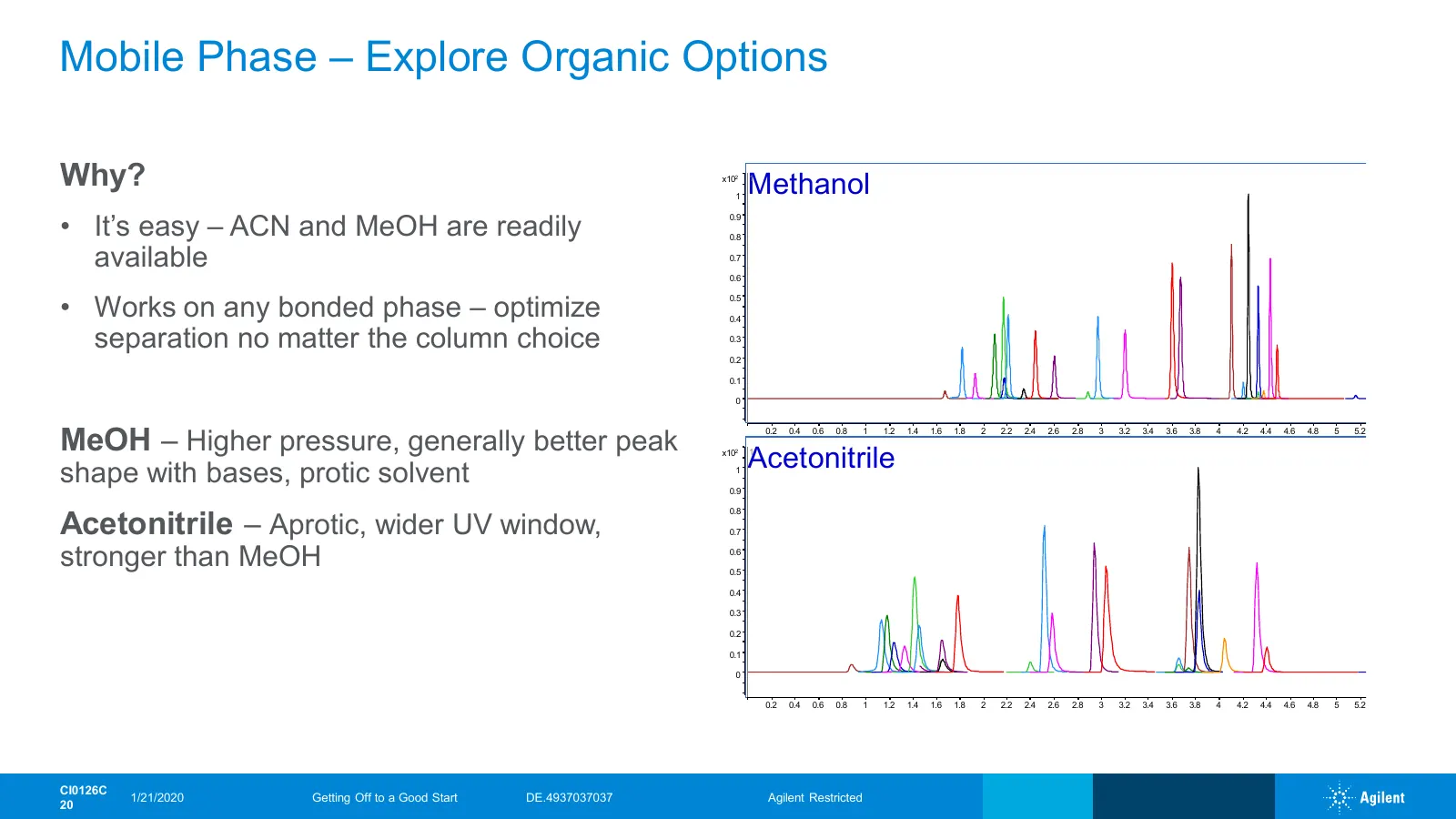
Mobile Phase – Explore Organic Options Why? x102 1 Methanol 1 • It’s easy – ACN and MeOH are readily 0.9 0.8 available 0.7 0.6 • Works on any bonded phase – optimize 0.5 0.4 separation no matter the column choice 0.3 0.2 0.1 0 MeOH – Higher pressure, generally better peak 0.2 0.4 0.6 0.8 1 1.2 1.4 1
Slide 21: % Organic
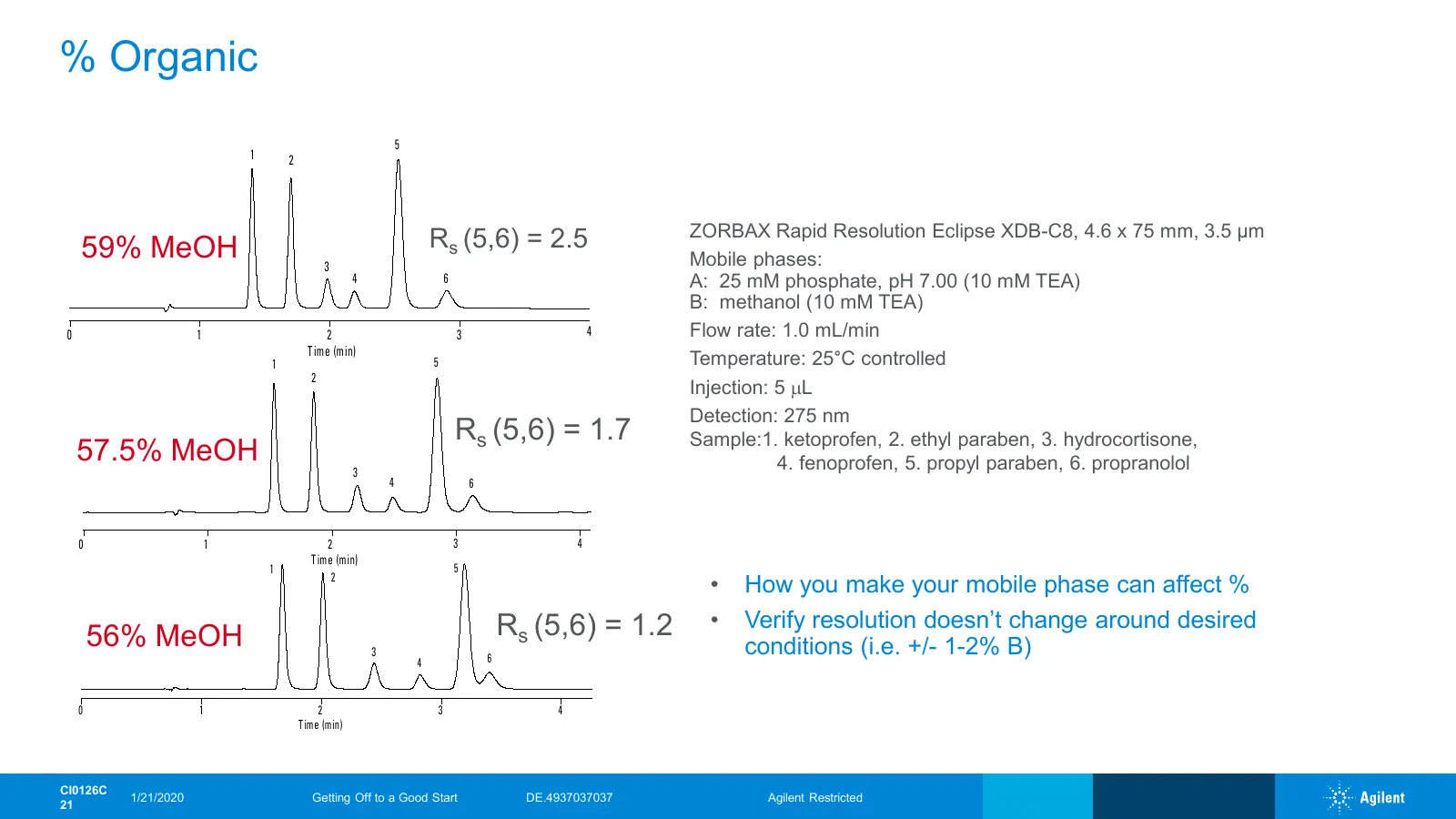
% Organic 5 1 2 Rs (5,6) = 2.5 ZORBAX Rapid Resolution Eclipse XDB-C8, 4.6 x 75 mm, 3.5 µm 59% MeOH 3 Mobile phases: 4 6 A: 25 mM phosphate, pH 7.00 (10 mM TEA) B: methanol (10 mM TEA) 0 1 2 3 4 Flow rate: 1.0 mL/min T ime (min) 1 5 Temperature: 25°C controlled 2 Injection: 5 µL Detection: 275 nm Rs
Slide 22: Mobile phase preparation – be consistent and document
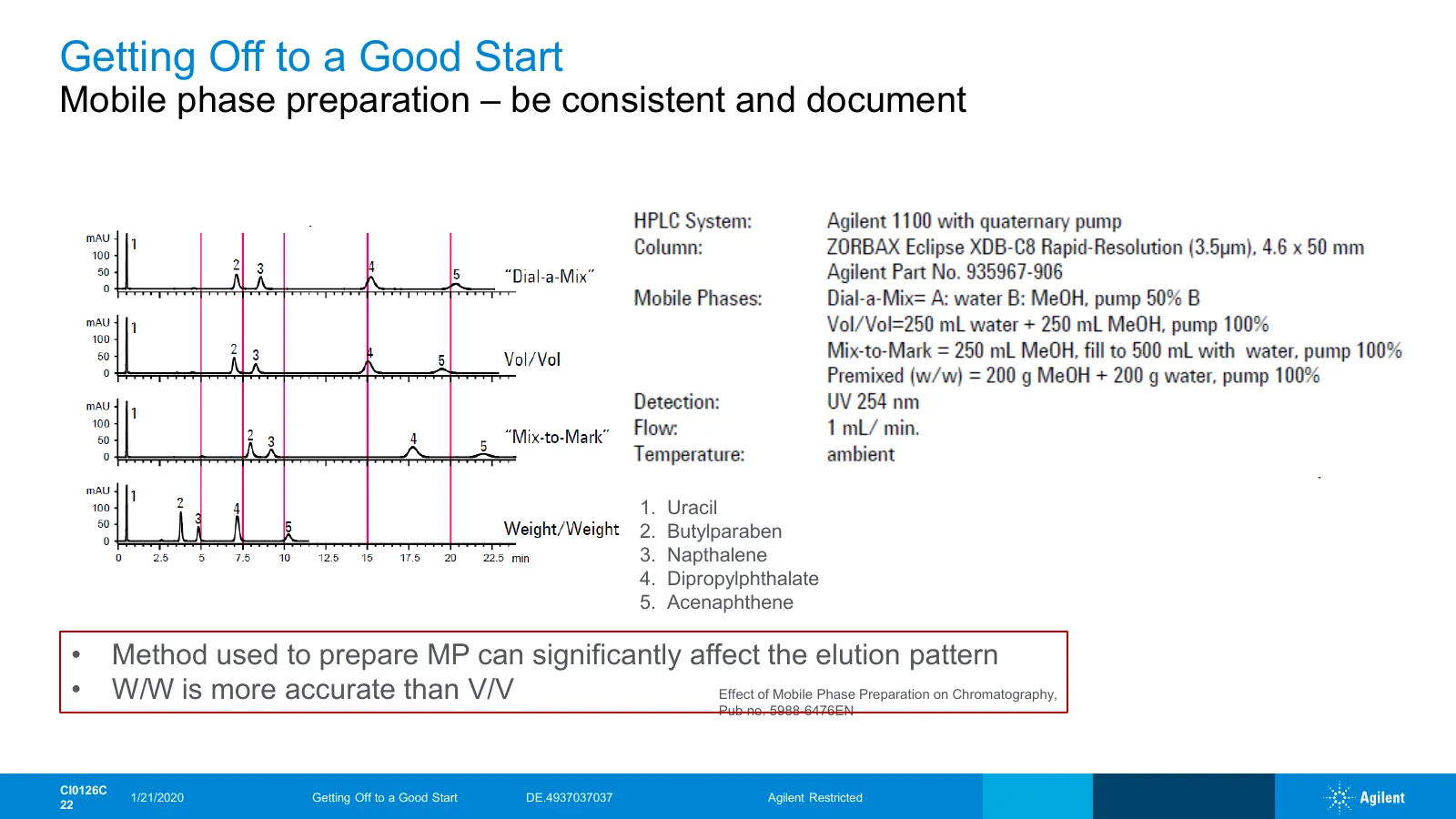
Getting Off to a Good Start Mobile phase preparation – be consistent and document 1. Uracil 2. Butylparaben 3. Napthalene 4. Dipropylphthalate 5. Acenaphthene • Method used to prepare MP can significantly affect the elution pattern • W/W is more accurate than V/V Effect of Mobile Phase Preparation o
Slide 23: The Sample
The Sample Experimental Variables That Can Impact Resolution • Column • Mobile phase • Sample • Injection volume ruggedness – Issue – Vinj is increased to improve (S/N) ratio – Issue – Decrease column size – Solution – Compare resolution, peak shape and repeatability at 20% and 200-500% Vinj • Use m
Slide 24: Injection Volume Robustness
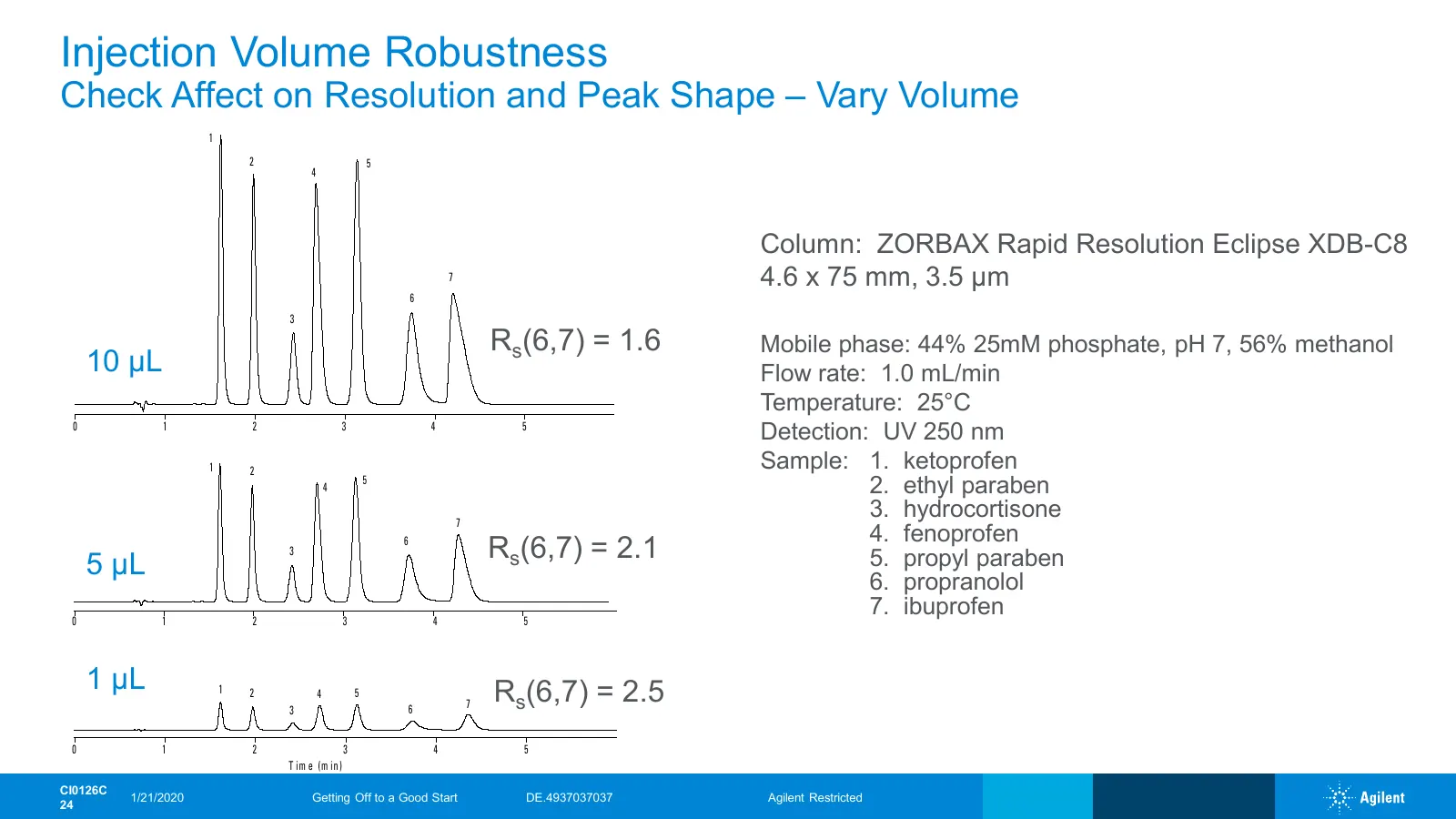
Injection Volume Robustness Check Affect on Resolution and Peak Shape – Vary Volume 1 2 5 4 Column: ZORBAX Rapid Resolution Eclipse XDB-C8 7 4.6 x 75 mm, 3.5 µm 6 3 Rs(6,7) = 1.6 Mobile phase: 44% 25mM phosphate, pH 7, 56% methanol 10 µL Flow rate: 1.0 mL/min Temperature: 25°C 0 1 2 3 4 5 Detection:
Slide 25: Increasing Sample Solvent Strength
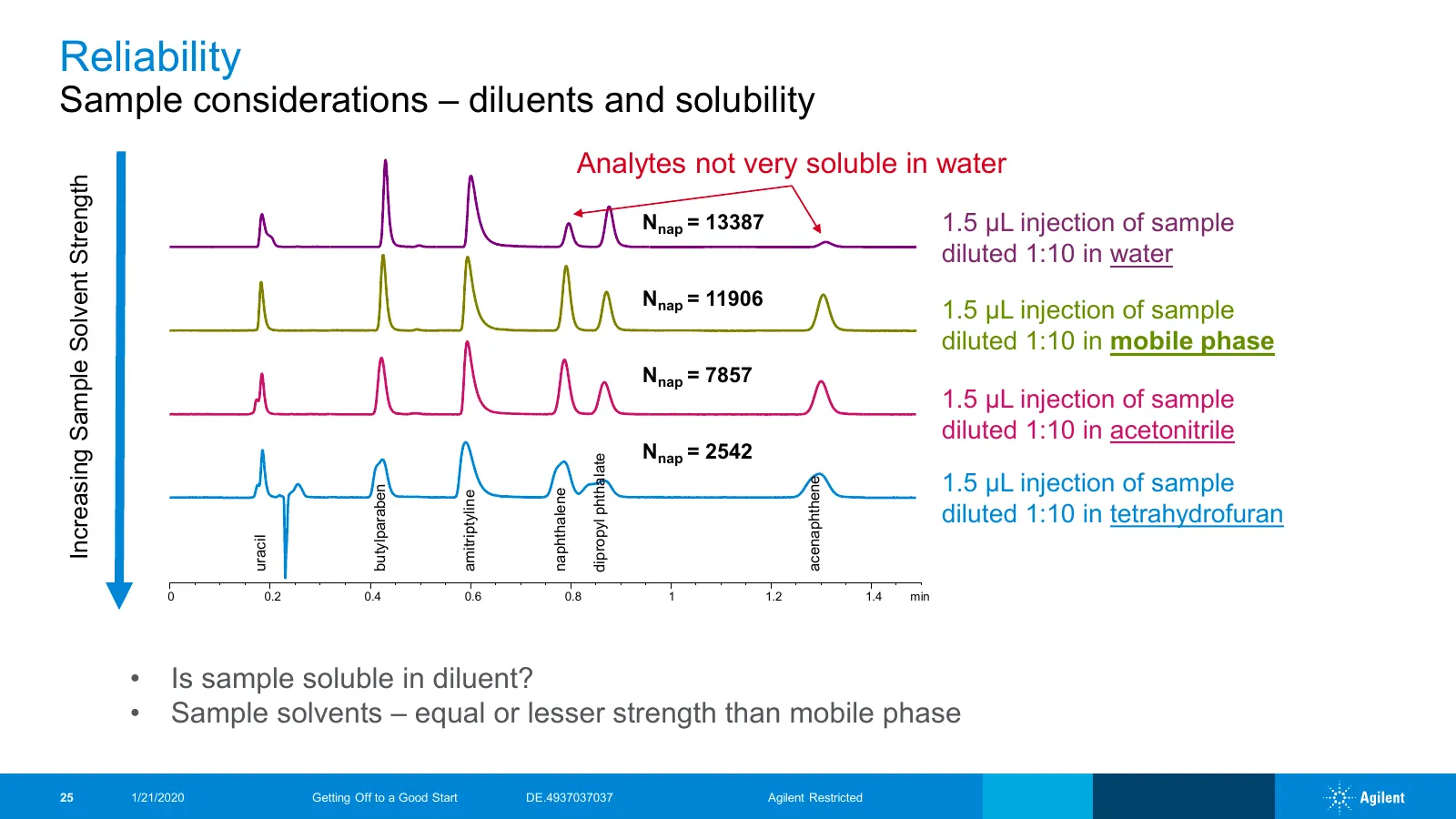
Reliability Sample considerations – diluents and solubility Analytes not very soluble in water Increasing Sample Solvent Strength Nnap = 13387 1.5 μL injection of sample diluted 1:10 in water Nnap = 11906 1.5 μL injection of sample diluted 1:10 in mobile phase Nnap = 7857 1.5 μL injection of sample
Slide 26: Instrument
Instrument Variability can affect resolution • Column • Mobile Phase • Sample • Instrument • Dwell volume • Extracolumn volume 26 1/21/2020 Getting Off to a Good Start DE.4937037037 Agilent Restricted
Slide 27: Gradient Delay Volume
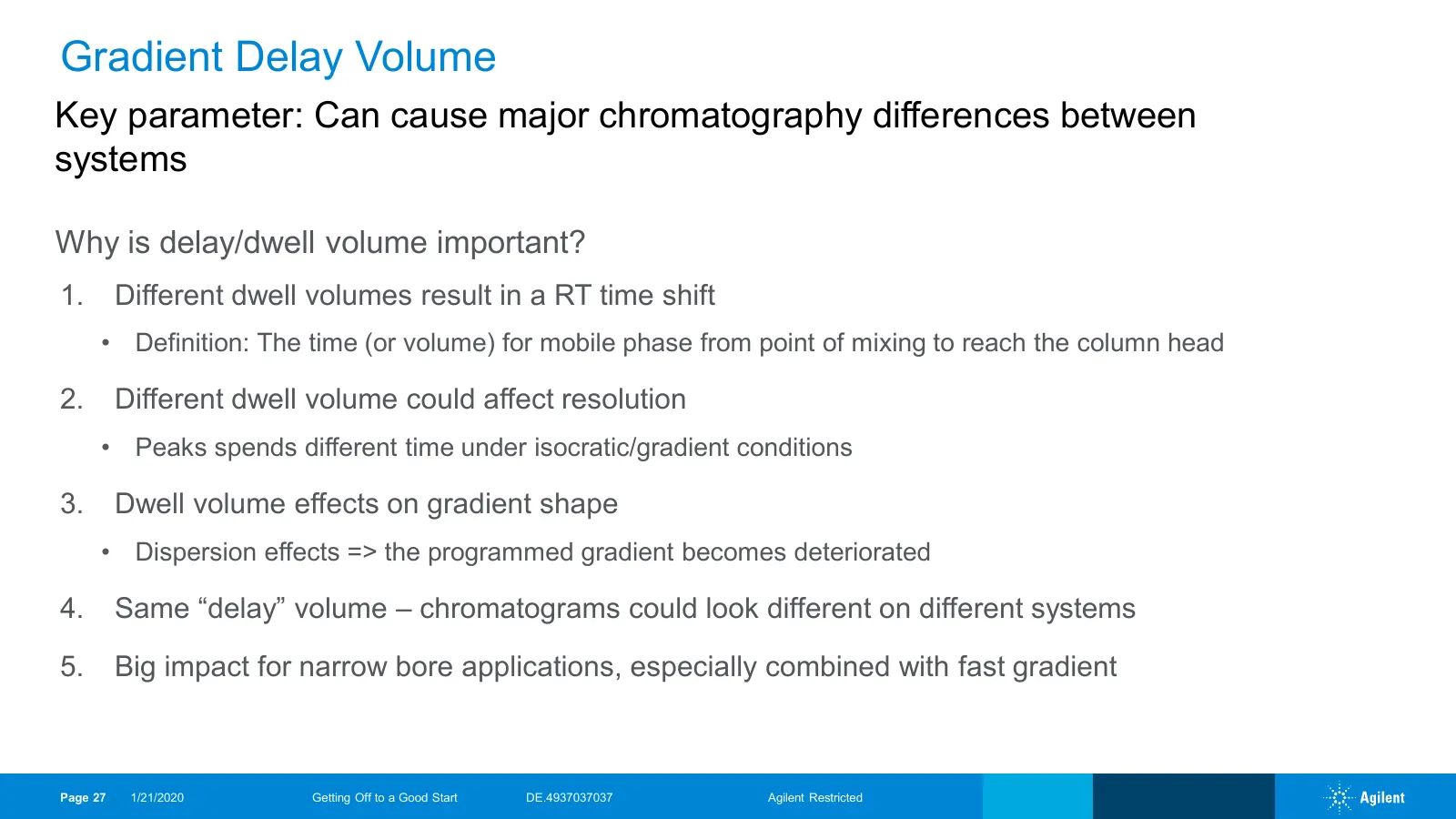
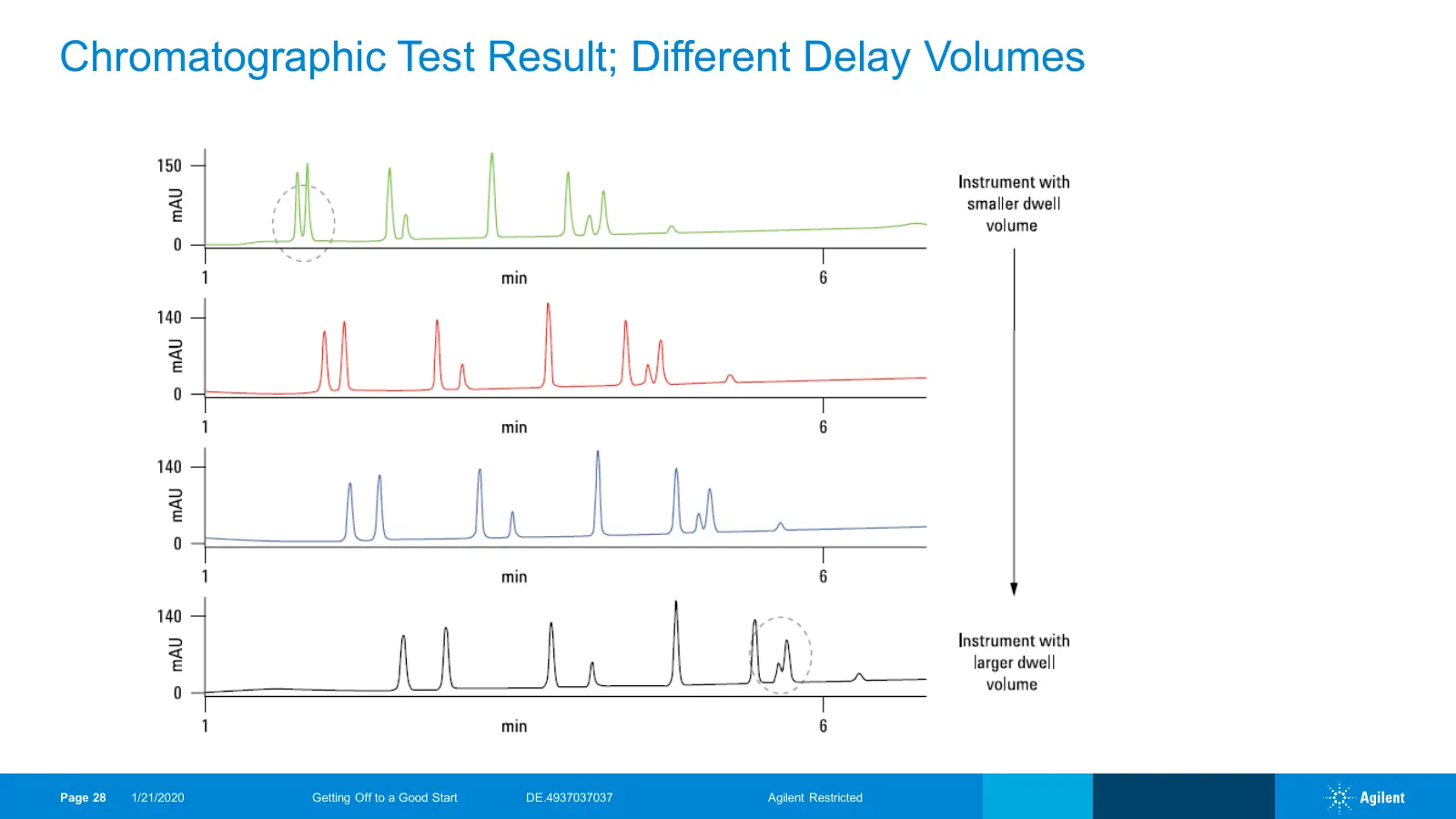
Gradient Delay Volume Key parameter: Can cause major chromatography differences between systems Why is delay/dwell volume important? 1. Different dwell volumes result in a RT time shift • Definition: The time (or volume) for mobile phase from point of mixing to reach the column head 2. Different dwe
Slide 28: Chromatographic Test Result; Different Delay Volumes
Chromatographic Test Result; Different Delay Volumes Page 28 1/21/2020 Getting Off to a Good Start DE.4937037037 Agilent Restricted
Slide 29: Dispersion
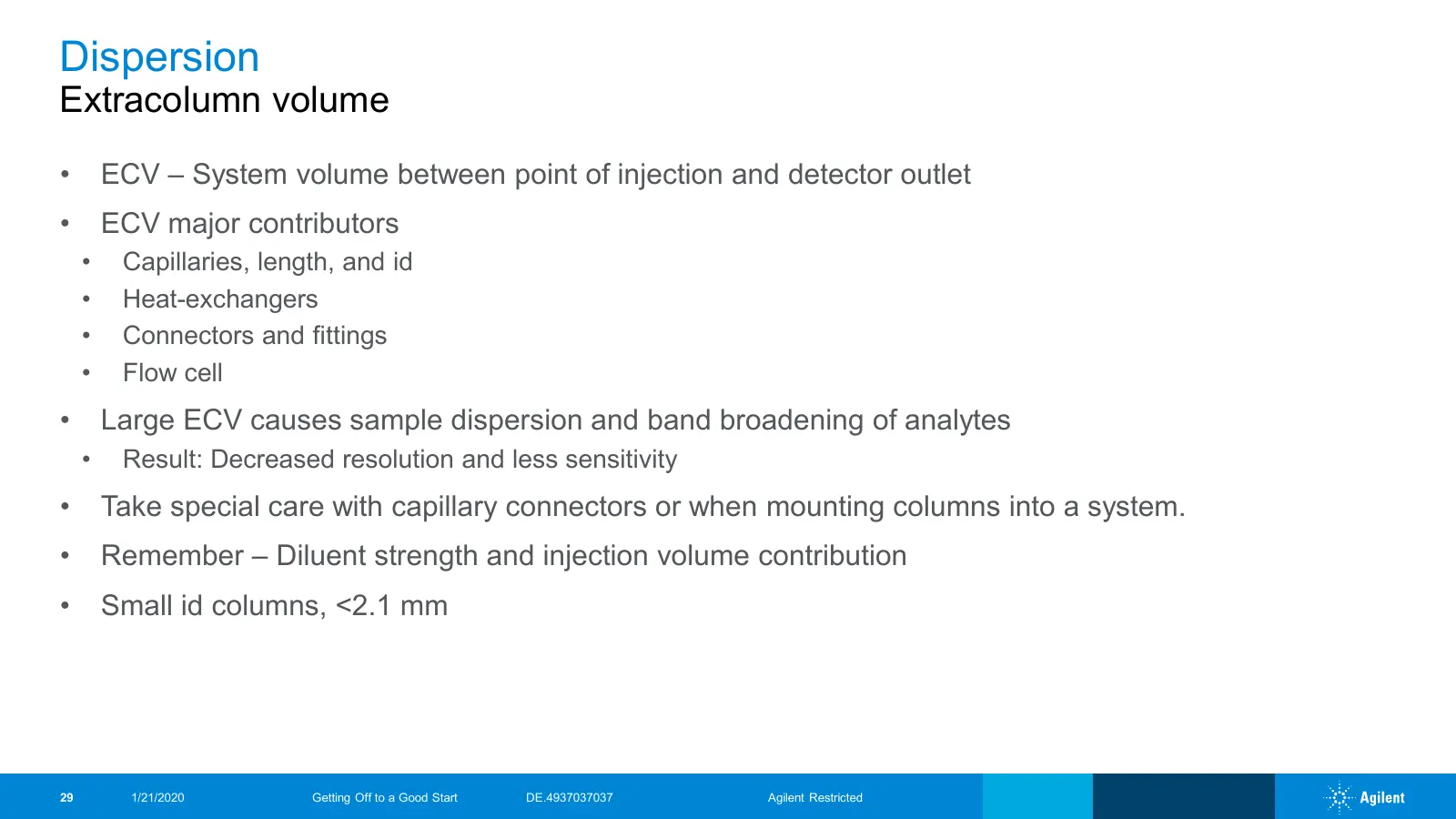
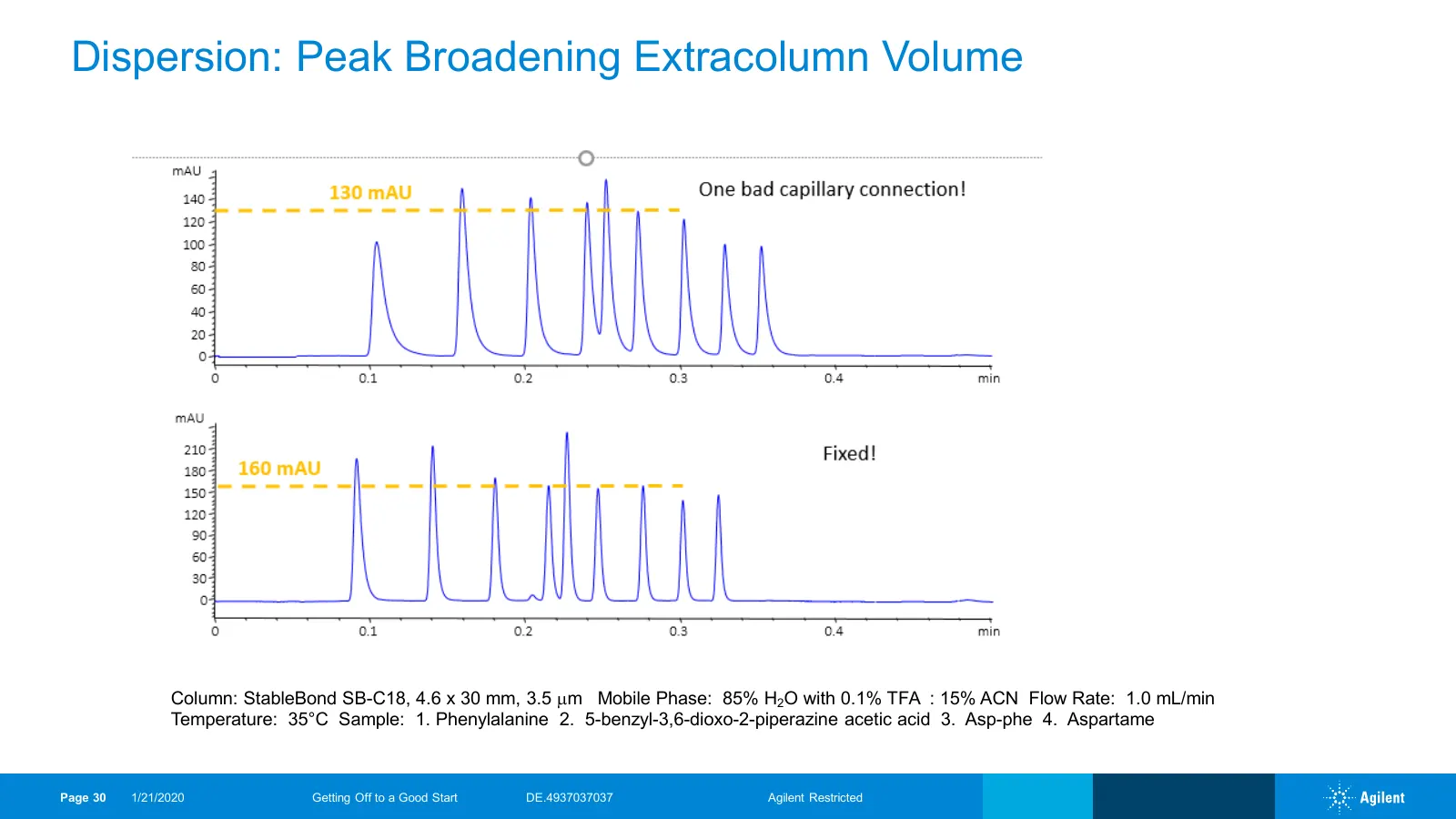
Dispersion Extracolumn volume • ECV – System volume between point of injection and detector outlet • ECV major contributors • Capillaries, length, and id • Heat-exchangers • Connectors and fittings • Flow cell • Large ECV causes sample dispersion and band broadening of analytes • Result: Decreased r
Slide 30: Dispersion: Peak Broadening Extracolumn Volume
Dispersion: Peak Broadening Extracolumn Volume Column: StableBond SB-C18, 4.6 x 30 mm, 3.5 µm Mobile Phase: 85% H2O with 0.1% TFA : 15% ACN Flow Rate: 1.0 mL/min Temperature: 35°C Sample: 1. Phenylalanine 2. 5-benzyl-3,6-dioxo-2-piperazine acetic acid 3. Asp-phe 4. Aspartame Page 30 1/21/2020 Gettin
Slide 31: Tips for Minimizing Dispersion in LC Systems
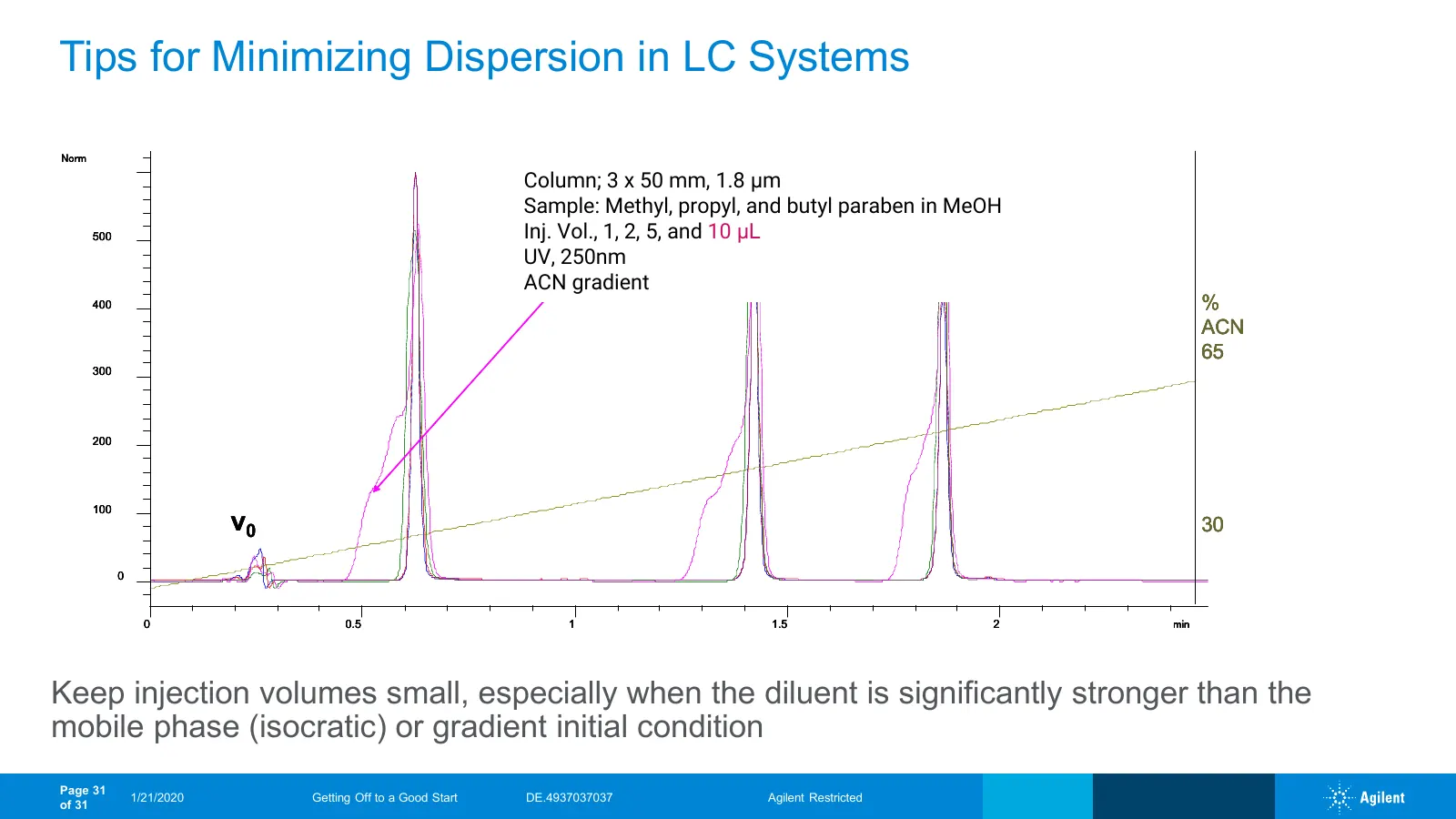
Tips for Minimizing Dispersion in LC Systems Norm Column; Methyl,3propyl x 50 mm, and1.8 µm paraben in methanol diluent. 250nm butyl Sample: UV, DirectMethyl, propyl,toand injection butyl paraben in MeOH column 500 Inj. Inj.Vol., 1, 2, 5,1,and volume 2, 510and µL UV, 10ul250nm ACN gradient 400 % ACN
Slide 32: Getting Off To a Good Start: Reliability is key
Getting Off To a Good Start Reliability is key • Many variables to consider; some more apparent than others • A reliable method minimizes “headaches” and repeat work • Well-conceived and documented lab practices • Equilibration • Mobile phase – What’s in it and how do you make it? • Column selection
Slide 33: Contact Agilent Chemistries and Supplies Technical Support
Contact Agilent Chemistries and Supplies Technical Support 1-800-227-9770 Option 3, Option 3: Option 1 for GC/GCMS Columns and Supplies Option 2 for LC/LCMS Columns and Supplies Option 3 for Sample Preparation, Filtration and QuEChERS Option 4 for Spectroscopy Supplies Option 5 for Standards gc-colu
Slide 34: Resources for Support
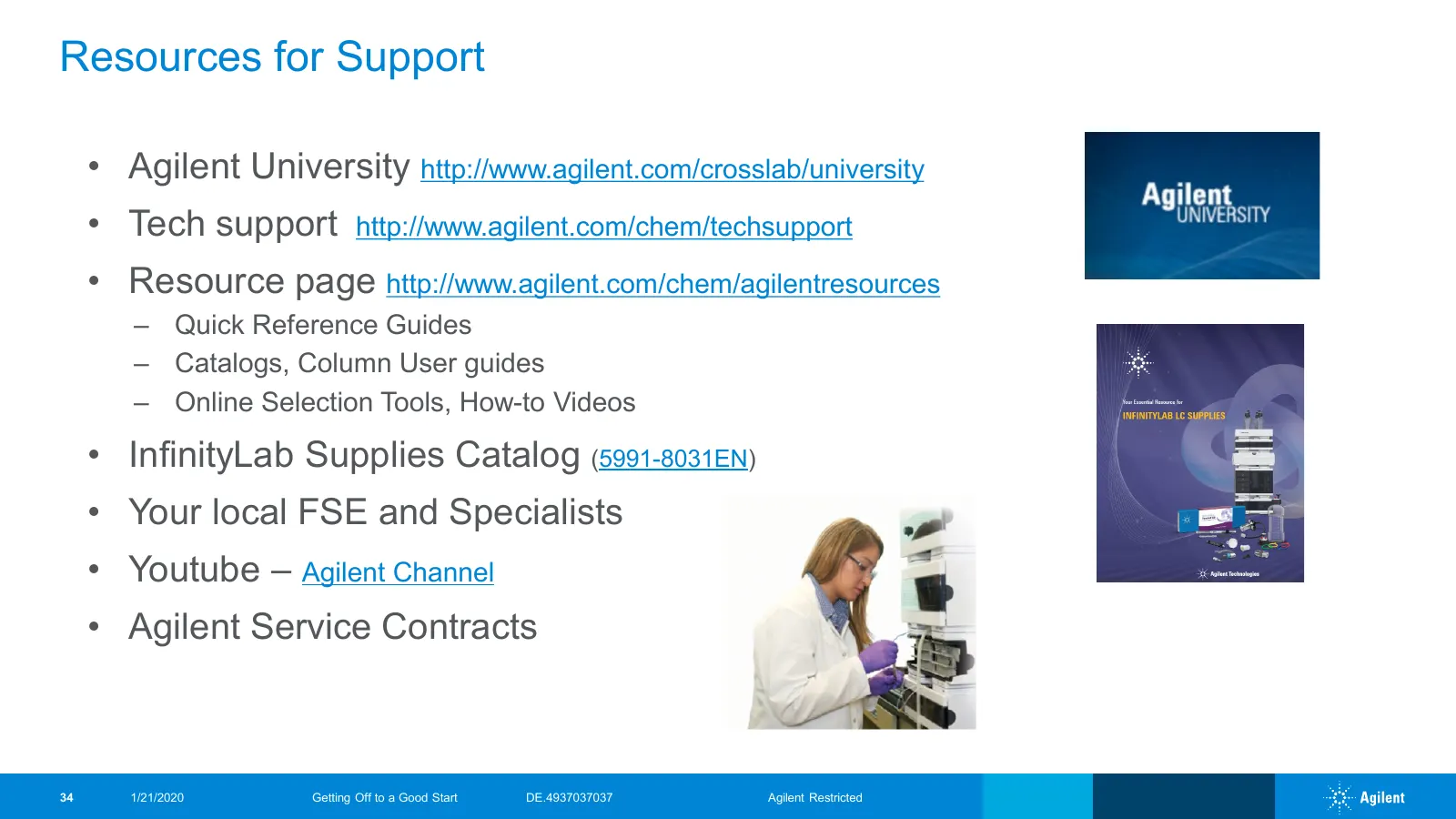
Resources for Support • Agilent University http://www.agilent.com/crosslab/university • Tech support http://www.agilent.com/chem/techsupport • Resource page http://www.agilent.com/chem/agilentresources – Quick Reference Guides – Catalogs, Column User guides – Online Selection Tools, How-to Videos •
Slide 35: Determining the Dwell Volume of Your System
Determining the Dwell Volume of Your System Replace column with short piece of HPLC stainless steel tubing Prepare mobile phase components A. Water - UV-transparent B. Water with 0.2% acetone - UV-absorbing Monitor at 265 nm Adjust attenuation so that both 100% A and 100% B are on scale Run gradient
Slide 36: Measuring Dwell Volume (VD)
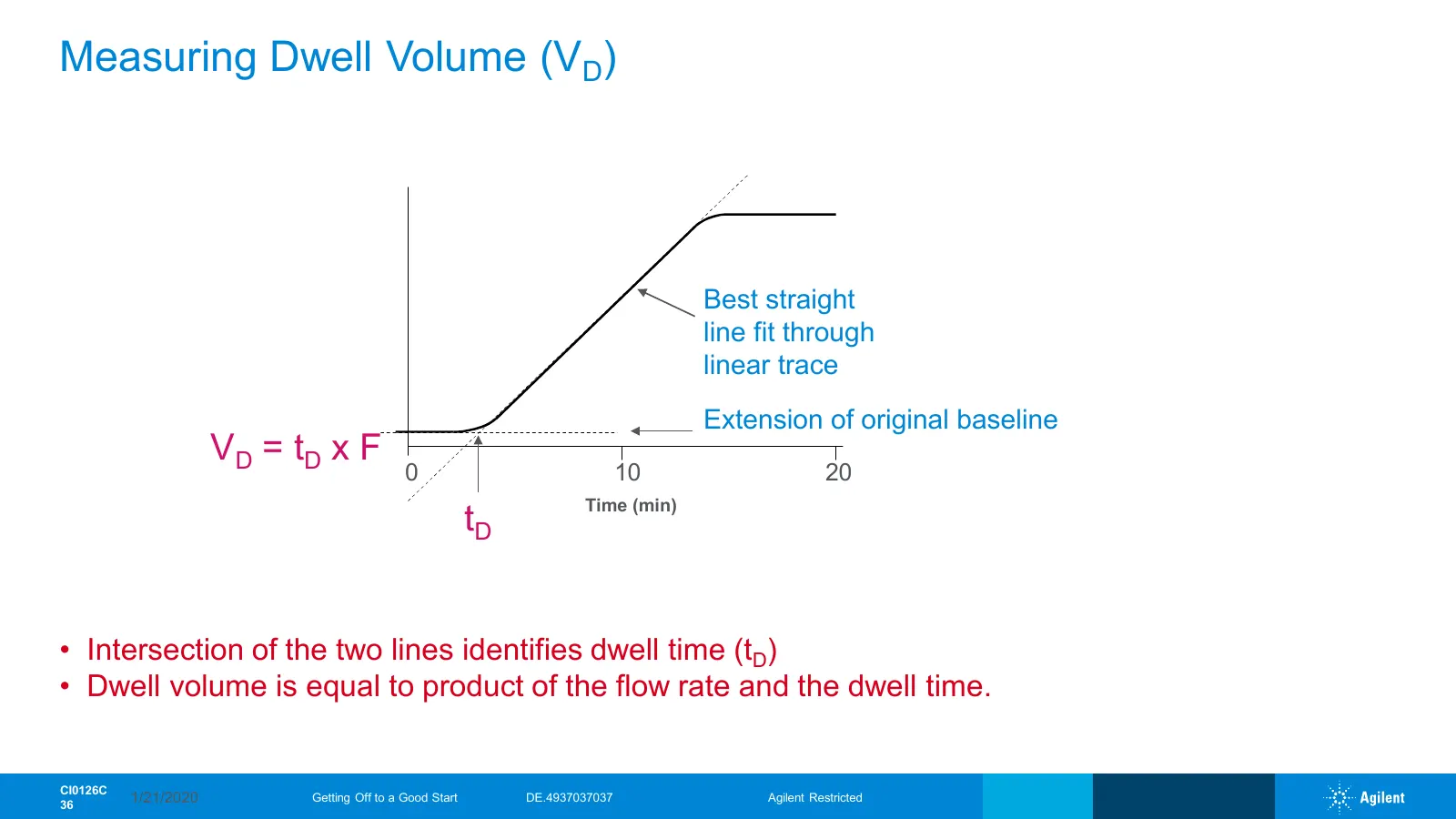
Measuring Dwell Volume (VD) Best straight line fit through linear trace Extension of original baseline VD = tD x F 0 10 20 Time (min) tD • Intersection of the two lines identifies dwell time (tD) • Dwell volume is equal to product of the flow rate and the dwell time. CI0126C 36 1/21/2020 Getting Off
Source: Internet Archive copy of agilent.com
More decks from Agilent Technologies, Inc.
 Investor Presentation (October 2026)10 slides · Oct 8, 2026
 Technical Presentation (October 2026)11 slides · Oct 7, 2026
 Q3 2026 Earnings Presentation10 slides · Aug 26, 2026
 Q2 2026 Earnings Presentation11 slides · May 27, 2026
 Q1 2026 Earnings Presentation10 slides · Feb 25, 2026
 Q4 2025 Earnings Presentation10 slides · Nov 24, 2025