Pharmacyclics — 12th International Conference on Malignant Lymphoma (ICML), Lugano 2013
20 slides from Pharmacyclics's conference presentation, Jun 19, 2013
Slide 1: Single agent ibrutinib (PCI-32765) is highly effective in CLL patients with 17p deletion
Single agent ibrutinib (PCI-32765) is highly effective in chronic lymphocytic leukemia (CLL) patients with 17p deletion Adrian Wiestner, MD/PhD Hematology Branch, NHLBI, National Institutes of Health Bethesda, MD ds Ns», & \ National Heart sy %, Lung and Blood Institute E@®: oo People Science Health
Slide 2: Disclosures: Adrian Wiestner
Disclosures: Adrian Wiestner + Employee of the National Heart, Lung, and Blood Institute. + Supported by the Intramural Research Program, NHLBI, NIH. + Ibrutinib is an investigational agent that is currently not approved and is provided by Pharmacyclics. National Heart Lung and Blood Institute Peopl
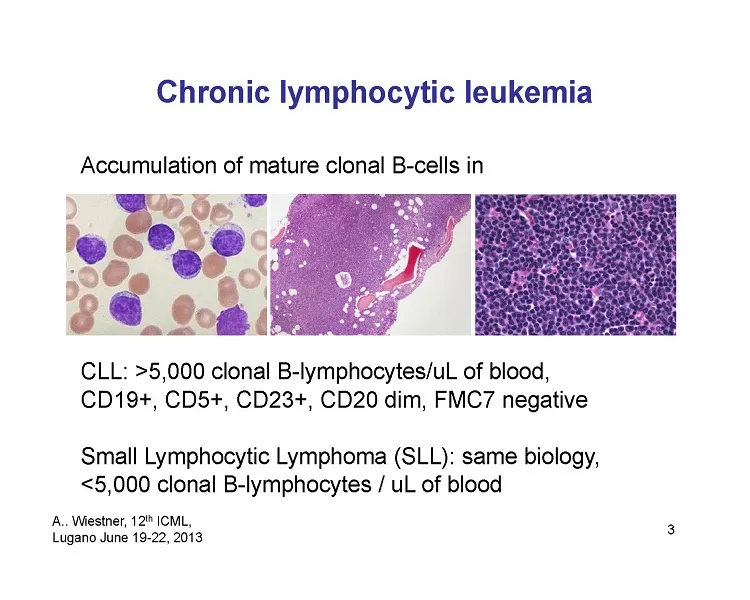
Slide 3: Chronic lymphocytic leukemia
Chronic lymphocytic leukemia Accumulation of mature clonal B-cells in CLL: >5,000 clonal B-lymphocytes/uL of blood, CD19+, CD5+, CD23+, CD20 dim, FMC7 negative Small Lymphocytic Lymphoma (SLL): same biology, <5,000 clonal B-lymphocytes / uL of blood A. Wiestner, 12" ICML, Lugano June 19-22, 2013
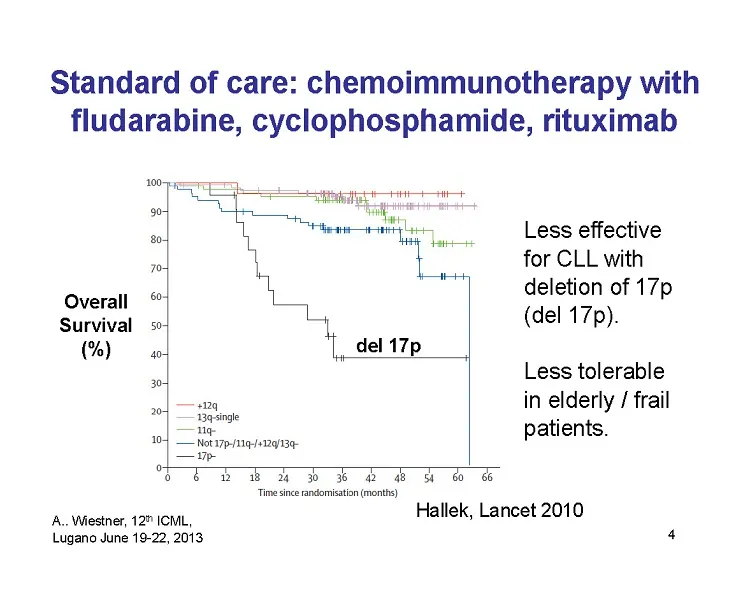
Slide 4: Standard of care: chemoimmunotherapy with fludarabine, cyclophosphamide, rituximab
Standard of care: chemoimmunotherapy with fludarabine, cyclophosphamide, rituximab es mare 2 Less effective % for CLL with 6 deletion of 17p Survival so (del 17p). (%) x Less tolerable ao} — 4 in elderly / frail f= patients. — Not 17p-/119-/+12q/13¢- i 0 6 bo my BO GO “Time since randomisation (mont
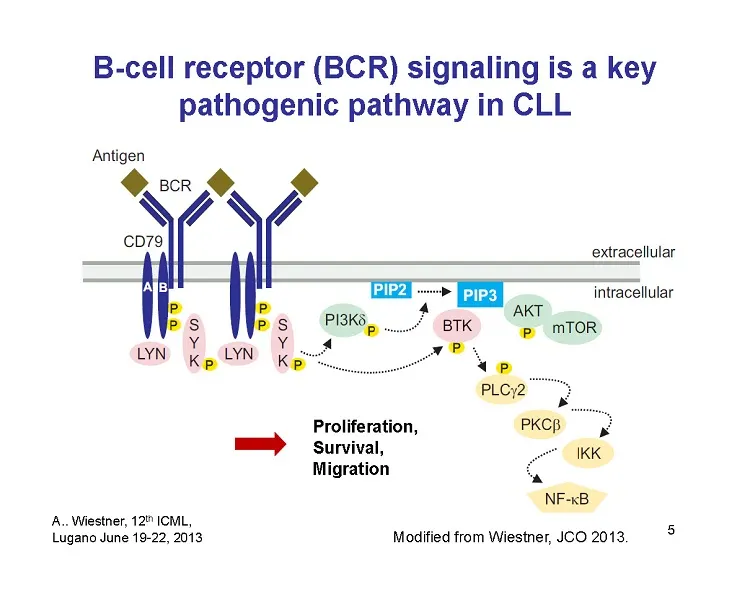
Slide 5: B-cell receptor (BCR) signaling is a key pathogenic pathway in CLL
B-cell receptor (BCR) signaling is a key pathogenic pathway in CLL Antigen scr _@, o \Z a cp79 extracellular 1 [PIP2 | PIP3 intracellular s s PSK, Ee v Y BTK p» =mTOR WN Kp LYN K ‘ Proliferation, ===> survival, Migration A.. Wiestner, 12” ICML, Lugano June 19-22, 2013 Modified from Wiestner, CO 2013
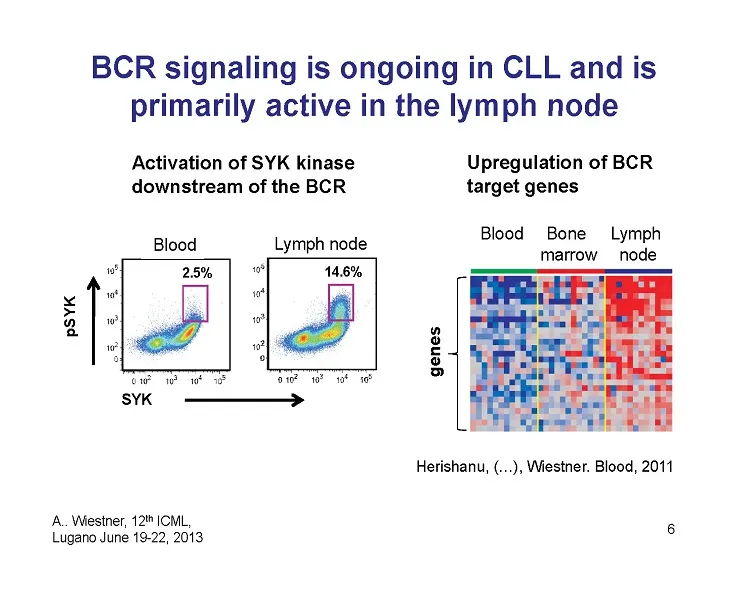
Slide 6: BCR signaling is ongoing in CLL and is primarily active in the lymph node
BCR signaling is ongoing in CLL and is primarily active in the lymph node Activation of SYK kinase downstream of the BCR Blood Lymph node cs 25% | 14.6% ye fo vl a ° Te Te we ee ‘A. Westner, 12" ICML, Lugano June 19-22, 2013 Upregulation of BCR target genes Blood Bone Lymph marrow node genes Herisha
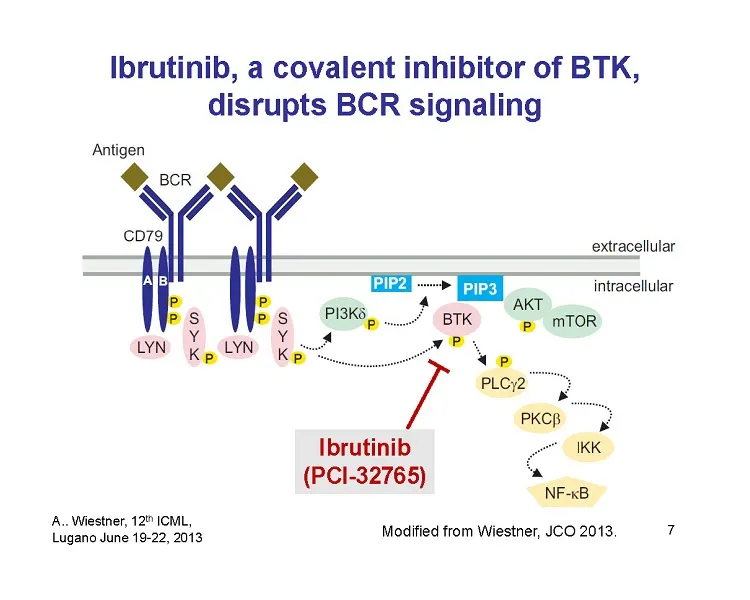
Slide 7: Ibrutinib, a covalent inhibitor of BTK, disrupts BCR signaling
Ibrutinib, a covalent inhibitor of BTK, disrupts BCR signaling extracellular intracellular Ibrutinib (PCI-32765) . Cienoute to ont Modified from Wiestner, JCO 2013. 7
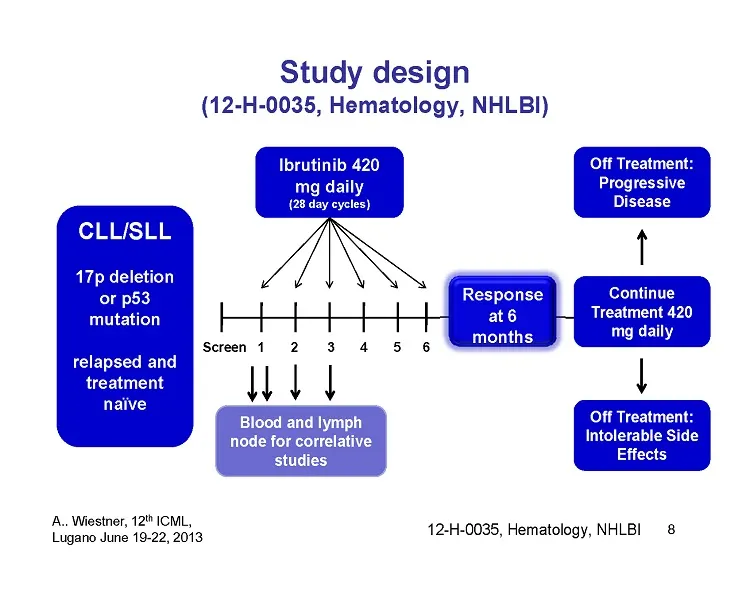
Slide 8: Study design
Study design (12-H-0035, Hematology, NHLBI) Off Treatment: Progressive pe Disease (28 day cycles) CLL/SLL 17p deletion or p53 Response Continue mutation at 6 Treatment 420 months mg daily 5 6 Screen 1 2 3 4 relapsed and treatment \ i | naive Blood and lymph node for correlative Off Treatment: Intole
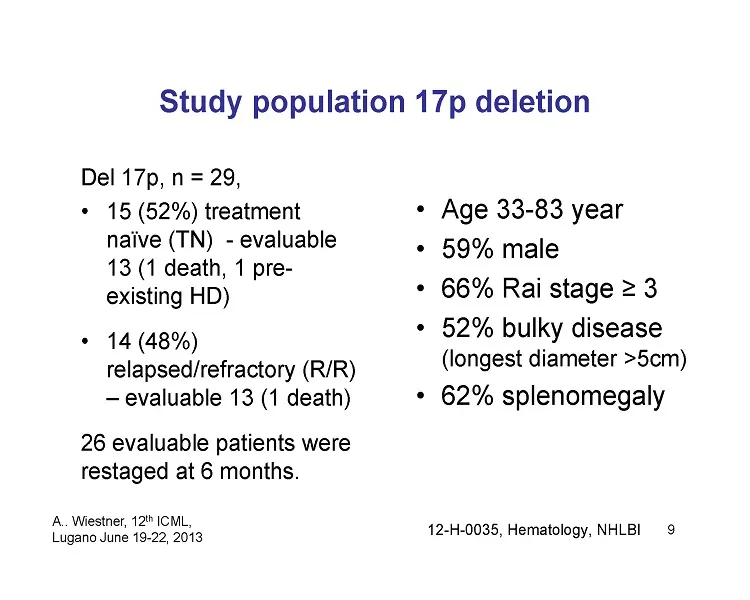
Slide 9: Study population 17p deletion
Study population 17p deletion Del 17p, n = 29, * 15 (52%) treatment * Age 33-83 year naive (TN) - evaluable . 9 13 (1 death, 1 pre- ners male existing HD) * 66% Rai stage 23 52% bulky disease + 14 (48% (48%) (longest diameter >5cm) relapsed/refractory (R/R) — evaluable 13 (1 death) * 62% splenomegal
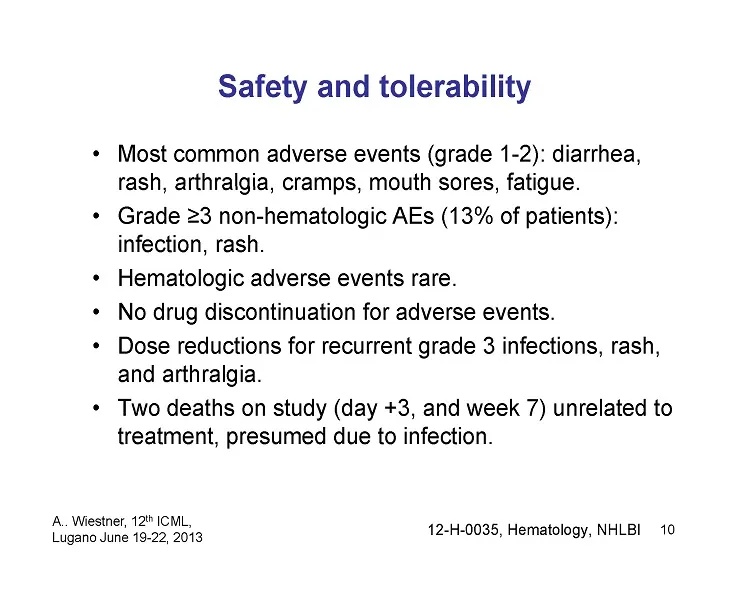
Slide 10: Safety and tolerability
Safety and tolerability + Most common adverse events (grade 1-2): diarrhea, rash, arthralgia, cramps, mouth sores, fatigue. * Grade 23 non-hematologic AEs (13% of patients): infection, rash. + Hematologic adverse events rare. + No drug discontinuation for adverse events. + Dose reductions for recurr
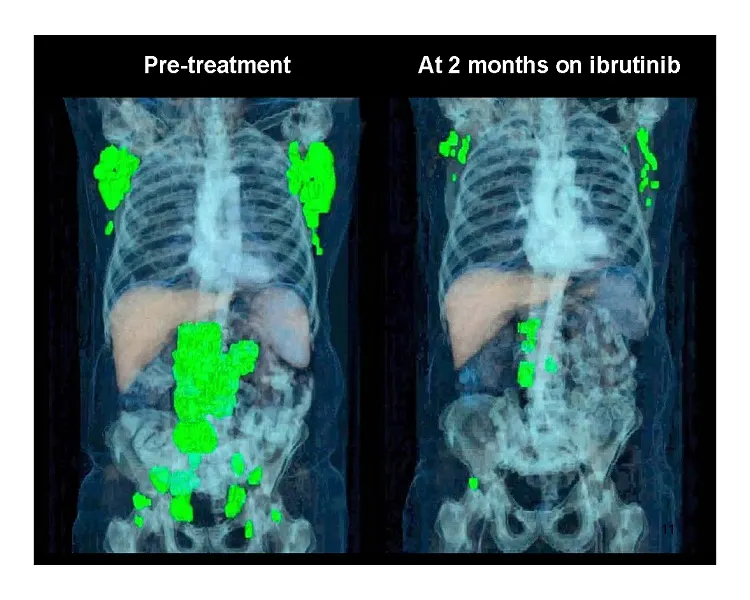
Slide 11: Pre-treatment At months on ibrutinib
Pre-treatment At 2 months on ibrutinib
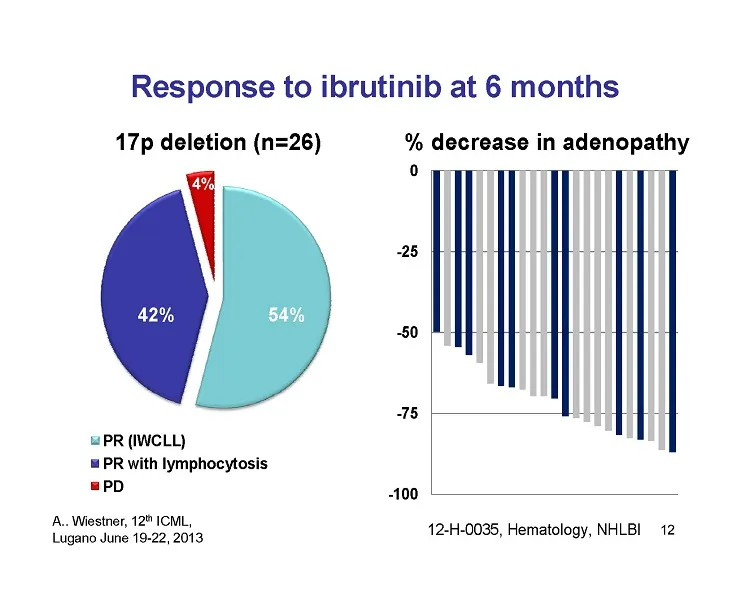
Slide 12: Response to ibrutinib at months
Response to ibrutinib at 6 months 17p deletion (n=26) % decrease in adenopathy PR (IWCLL) ™ PR with lymphocytosis =PD Ab A.. Wiestner, 12" ICML, Wagener 1822, 2018 12-H-0035, Hematology, NHLBI 12
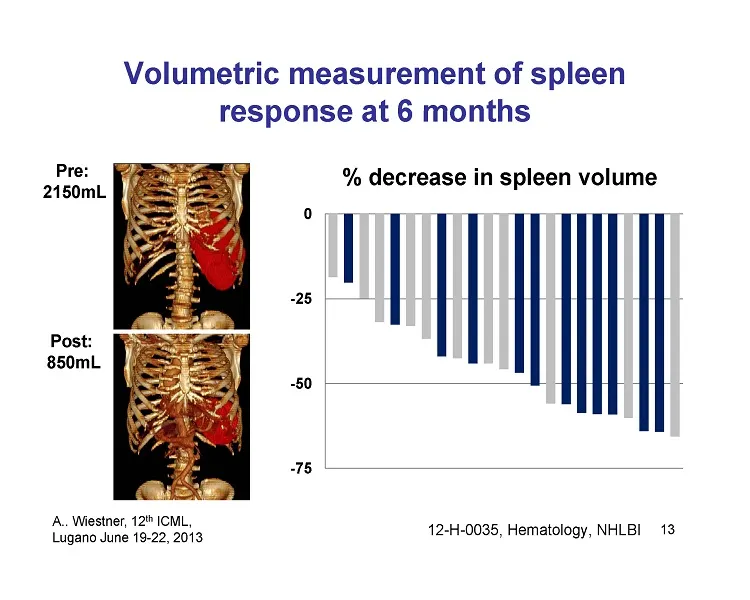
Slide 13: Volumetric measurement of spleen response at months
Volumetric measurement of spleen response at 6 months % decrease in spleen volume | 25 | -50 75 A.. Wiestner, 12" ICML, Lugano June 19-22, 2013 12-H-0035, Hematology, NHLBI 13
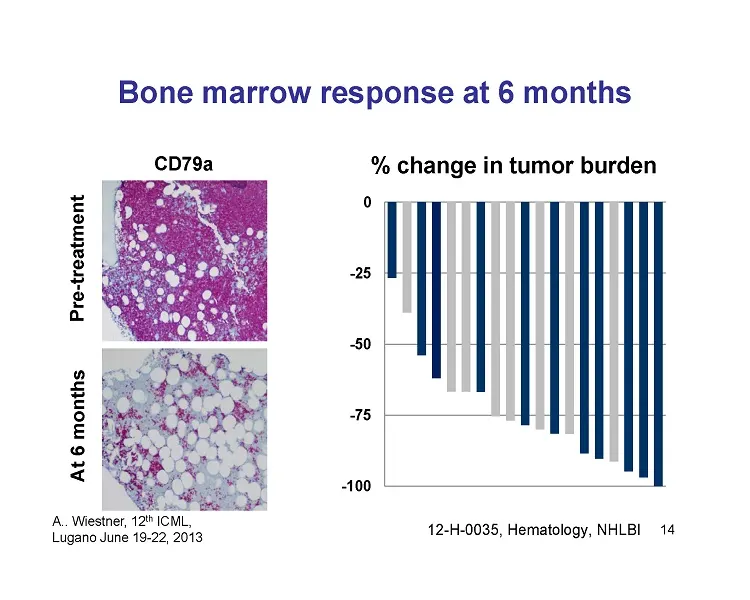
Slide 14: Bone marrow response at months
Bone marrow response at 6 months CcD79a Pre-treatment At6 months Men A.. Wiestner, 12 ICML, Lugano June 19-22, 2013 % change in tumor burden 50 100 12-H-0035, Hematology, NHLBI 14
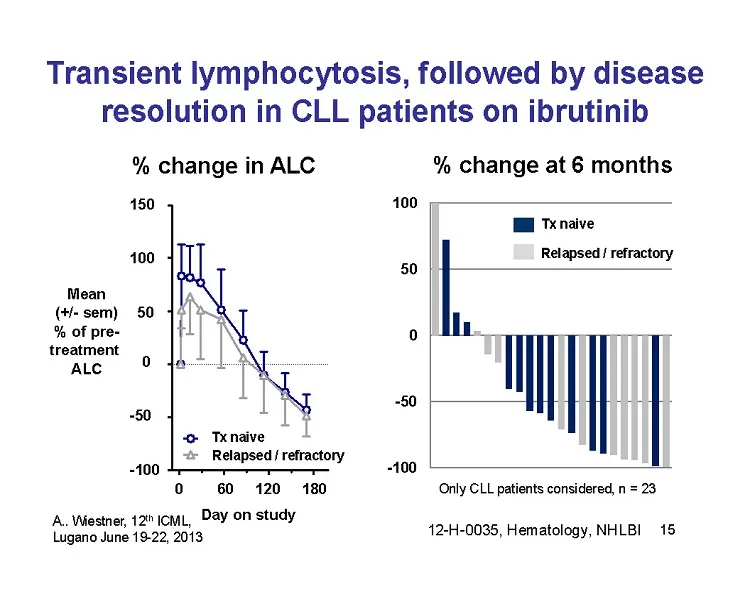
Slide 15: Transient lymphocytosis, followed by disease resolution in CLL patients on ibrutinib
Transient lymphocytosis, followed by disease resolution in CLL patients on ibrutinib % change in ALC % change at 6 months 150 100 I Txnaive 400 Relapsed refractory 50 Mean (#/-sem) 50 % of pre- 0 - aera treatment I ALC -50 Mili -50 > Txnaive ~& Relapsed / refractor -100 si "y 400 0 60 120 180 A. Wes
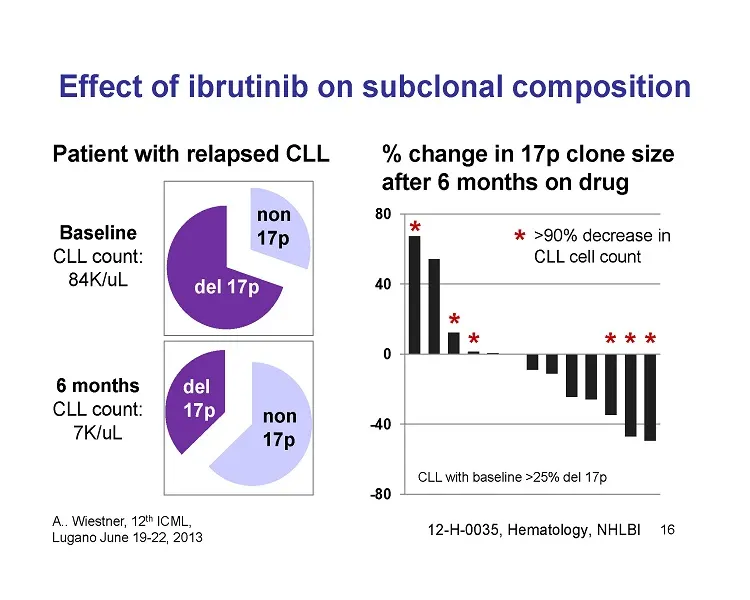
Slide 16: Effect of ibrutinib on subclonal composition
Effect of ibrutinib on subclonal composition Patient with relapsed CLL % change in 17p clone size after 6 months on drug non 80 Baseline 17p = **& >90% decrease in CLL count: CLL cell count 84K/uL 6 months CLL count: non 7K/uL 17p CLL with baseline >25% del 17p 80 + A.. Wiestner, 12" ICML, Lugano du
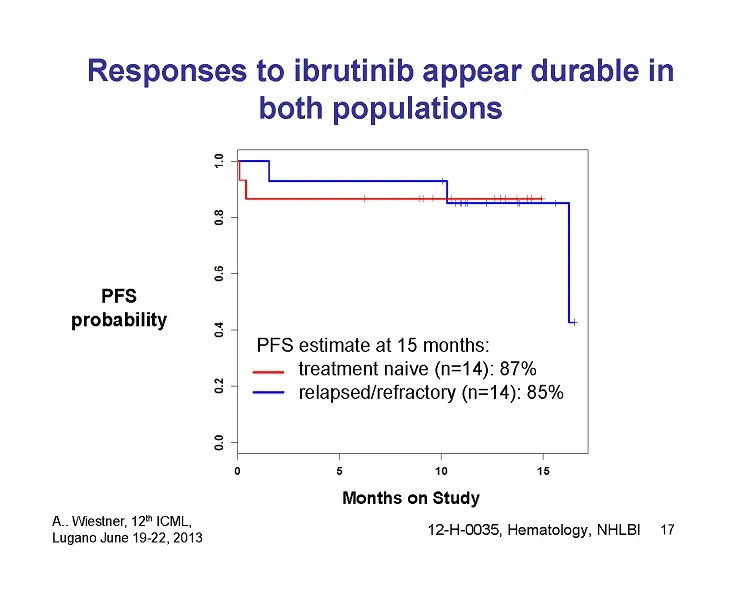
Slide 17: Responses to ibrutinib appear durable in both populations
Responses to ibrutinib appear durable in both populations _ =a PFS probability «| “| PFS estimate at 15 months: — treatment naive (n=14): 87% “| — relapsed/refractory (n=14): 85% Months on Study . AsMMesiner, 127 OME, 12-H-0035, Hematology, NHLBI 17 Lugano June 19-22, 2013
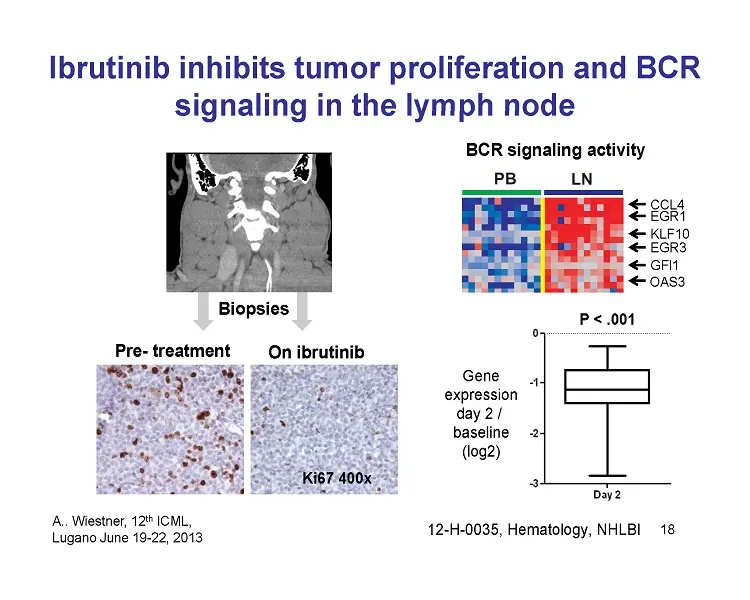
Slide 18: Ibrutinib inhibits tumor proliferation and BCR signaling in the lymph node
Ibrutinib inhibits tumor proliferation and BCR signaling in the lymph node BCR signaling activity Gene expression day 2/ baseline 2 (log2) at—_——_. Day2 A.. Wiestner, 12" ICML, cer ee 12-H-0035, Hematology, NHLBI 18
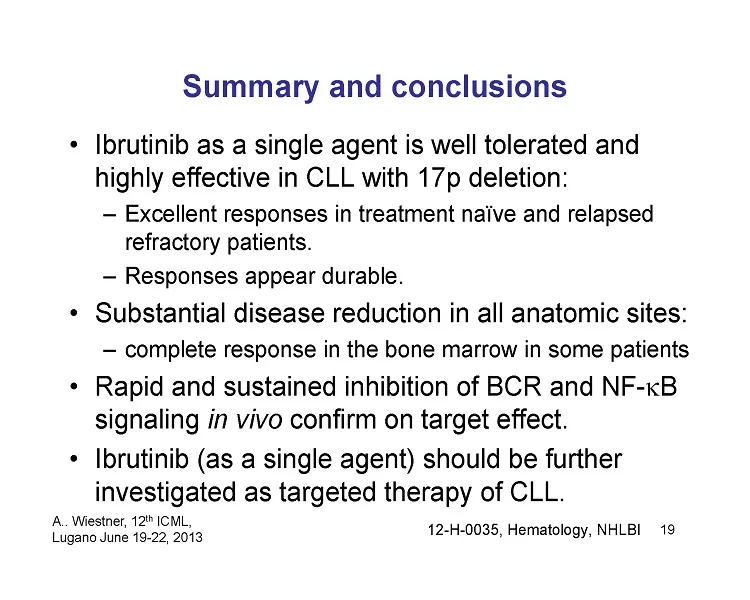
Slide 19: Summary and conclusions
Summary and conclusions * Ibrutinib as a single agent is well tolerated and highly effective in CLL with 17p deletion: — Excellent responses in treatment naive and relapsed refractory patients. — Responses appear durable. * Substantial disease reduction in all anatomic sites: — complete response in
Slide 20: Supported by the Intramural Research Program of NHLBI/NIH
Supported by the Intramural Research Program of NHLBI/NIH Irina Maric Laboratory Medicine Stefania Pittaluga Diane Arthur Pathology Richard Cheng Francine Thomas Radiology Xin Tian Office of Biostatistics Research Our patients for partici Mohammed Farooqui Sarah Herman Georg Aue Rashida Mustafa Nakh
Source: SEC EDGAR · 8-K filed Jun 19, 2013
More decks from Pharmacyclics Inc
 Merger or Acquisition (March 2015)20 slides · Mar 5, 2015
 33rd Annual J.P. Morgan Healthcare Conference (January 2015)38 slides · Jan 13, 2015
 Technical Presentation (June 2014)18 slides · Jun 5, 2014
 American Society of Hematology Annual Meeting 201317 slides · Dec 11, 2013
 Technical Presentation (December 2013)18 slides · Dec 11, 2013
 Technical Presentation (December 2013)22 slides · Dec 11, 2013