Omrix Biopharmaceuticals — Investor Day (March 2008)
127 slides from Omrix Biopharmaceuticals's investor day presentation, Mar 27, 2008

Slide 1: Analyst & Investor Day: Perspectives in Biosurgery
NASDAQ: OMRI Innovative Solutions for a Healthier World Analyst & Investor Day March 27, 2008 "PERSPECTIVES IN BIOSURGERY"
Slide 2: Safe Harbor Statement
SAFE HARBOR STATEMENT During the course of this presentation the Company or its representatives may make forward-looking statements within the meaning of the Private Securities Litigation Reform Act of 1995. These statements, including those relating to future events or the future financial performa
Slide 3: Welcome & Agenda
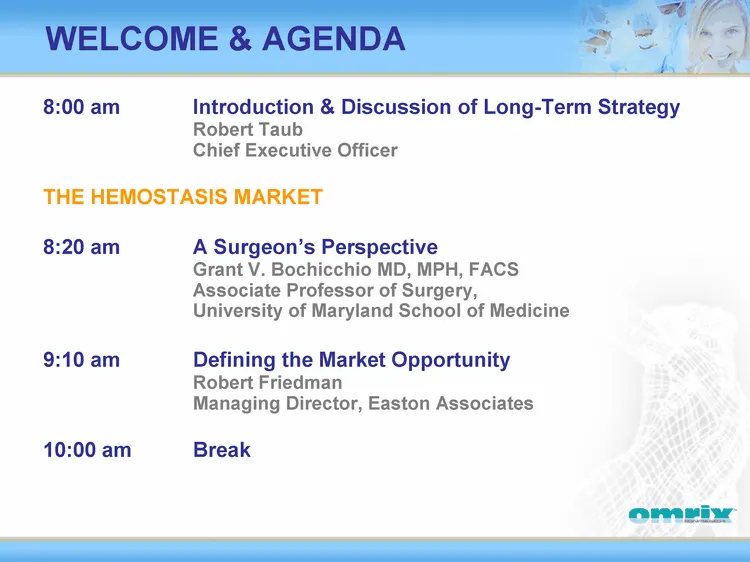
WELCOME & AGENDA 8:00 am Introduction & Discussion of Long-Term Strategy Robert Taub Chief Executive Officer THE HEMOSTASIS MARKET 8:20 am A Surgeon's Perspective Grant V. Bochicchio MD, MPH, FACS Associate Professor of Surgery, University of Maryland School of Medicine 9:10 am Defining the Market O
Slide 4: Welcome & Agenda
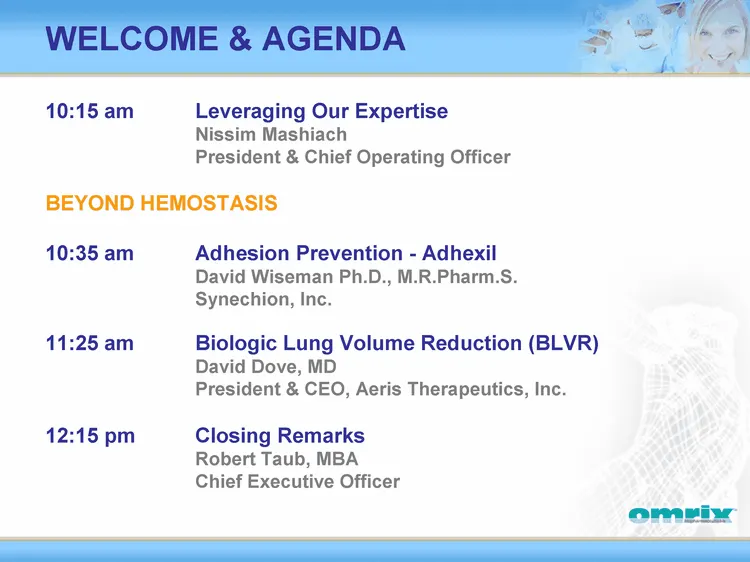
WELCOME & AGENDA 10:15 am Leveraging Our Expertise Nissim Mashiach President & Chief Operating Officer BEYOND HEMOSTASIS 10:35 am Adhesion Prevention - Adhexil David Wiseman Ph.D., M.R.Pharm.S. Synechion, Inc. 11:25 am Biologic Lung Volume Reduction (BLVR) David Dove, MD President & CEO, Aeris Thera
Slide 5: Introduction and Long-Term Strategy
Introduction and Long-Term Strategy Robert Taub Chief Executive Officer
Slide 6: Omrix Today
OMRIX TODAY Fully-integrated biopharmaceutical company Develop and market protein-based biosurgery and passive immunotherapy products Focused on innovative products in growing and under-penetrated markets Visible pipeline of near-term and medium-term product launches Continued revenue growth and pro
Slide 7: Business Model
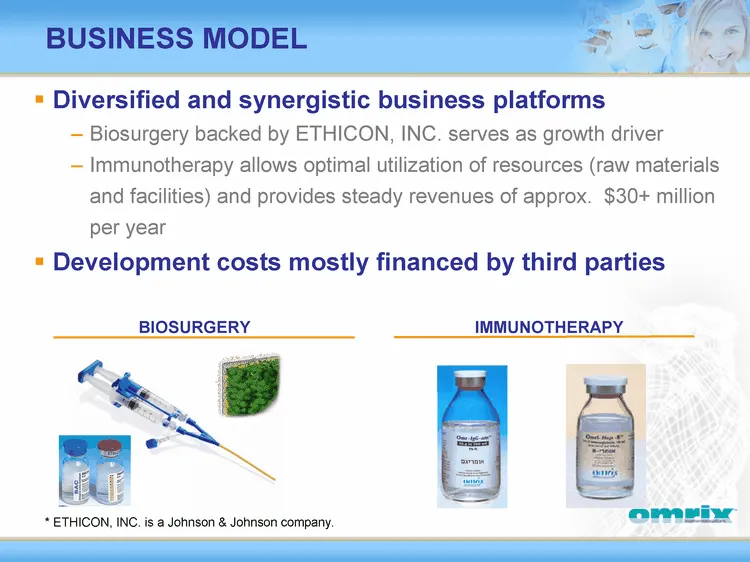
BUSINESS MODEL IMMUNOTHERAPY BIOSURGERY * ETHICON, INC. is a Johnson & Johnson company. Diversified and synergistic business platforms Biosurgery backed by ETHICON, INC. serves as growth driver Immunotherapy allows optimal utilization of resources (raw materials and facilities) and provides steady r
Slide 8: Portfolio
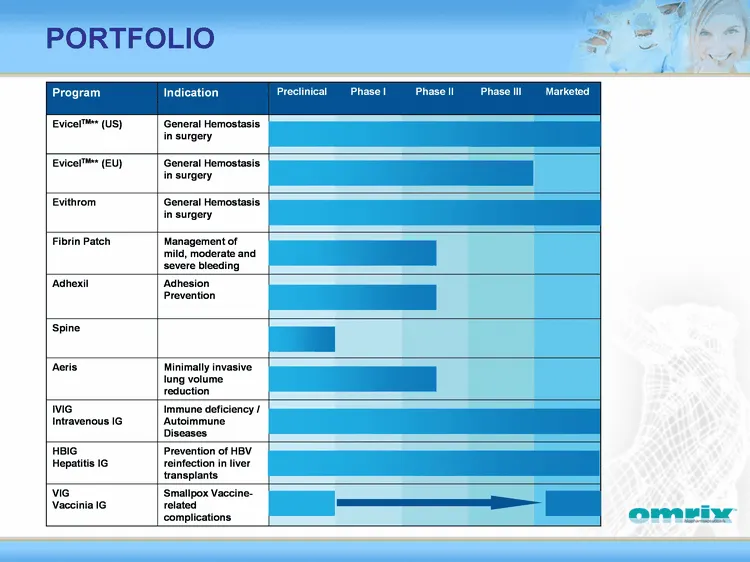
PORTFOLIO Program Phasell Phase i Evicer"™ (US) ‘General Hemostasis insurgery Evicel™ (EU) ‘General Hemostasis in surgery Evithrom ‘General Hemostasis in surgery f Fibrin Patch Management ot | mild, moderate and severe bleeding ‘Adhexit ‘Adhesion t Prevention f ‘Spine } ‘Aeris Minimally invasive Jun
Slide 9: Organic Growth Plan
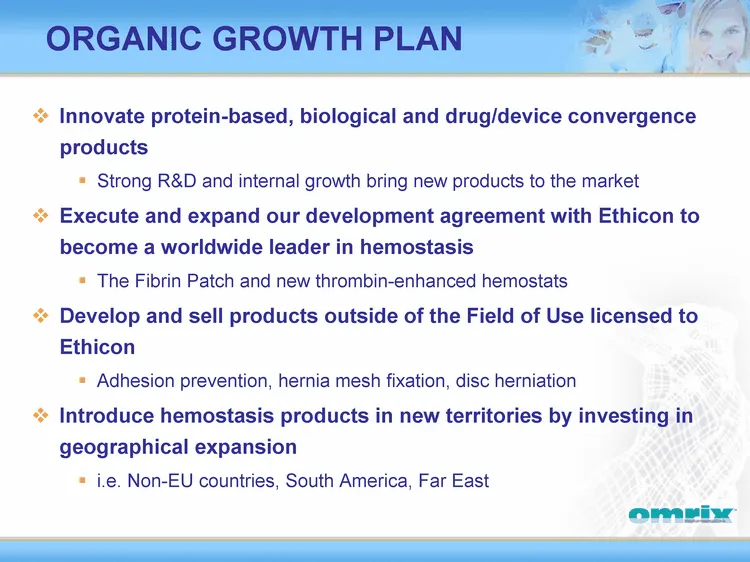
ORGANIC GROWTH PLAN Innovate protein-based, biological and drug/device convergence products Strong R&D and internal growth bring new products to the market Execute and expand our development agreement with Ethicon to become a worldwide leader in hemostasis The Fibrin Patch and new thrombin-enhanced
Slide 10: Organic Growth Drivers
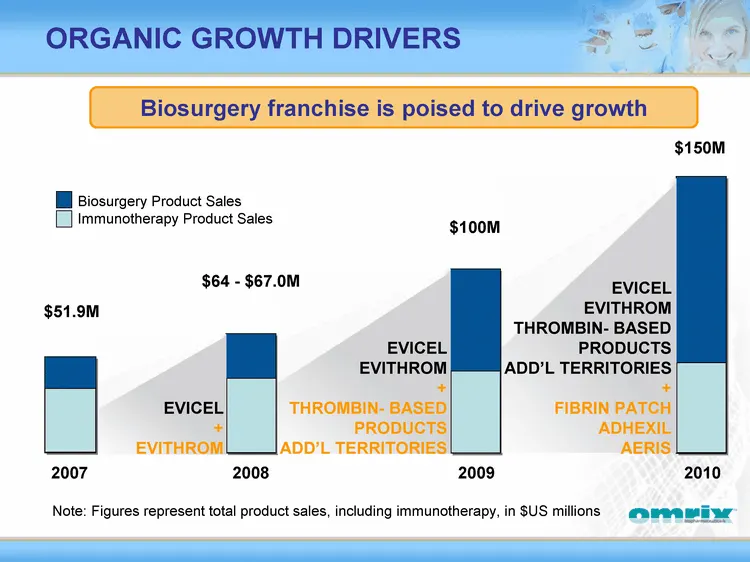
ORGANIC GROWTH DRIVERS 2007 2008 2010 2009 EVICEL + EVITHROM EVICEL EVITHROM + THROMBIN- BASED PRODUCTS ADD'L TERRITORIES EVICEL EVITHROM THROMBIN- BASED PRODUCTS ADD'L TERRITORIES + FIBRIN PATCH ADHEXIL AERIS $51.9M $64 - $67.0M $150M $100M Biosurgery franchise is poised to drive growth Note: Figur
Slide 11: Current U.S. Hemostats Market
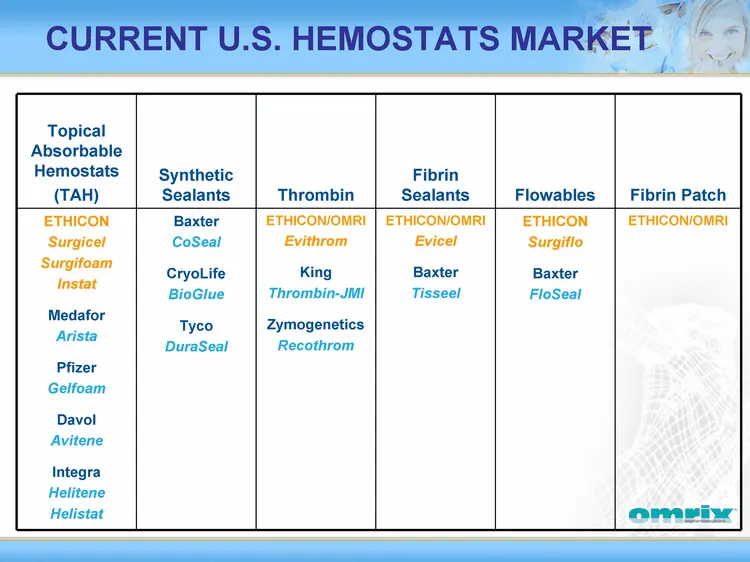
CURRENT U.S. HEMOSTATS MARKET Topical Absorbable Hemostats (TAH) Synthetic Sealants Thrombin Fibrin Sealants Flowables Fibrin Patch ETHICON Surgicel Surgifoam Instat Medafor Arista Pfizer Gelfoam Davol Avitene Integra Helitene Helistat Baxter CoSeal CryoLife BioGlue Tyco DuraSeal ETHICON/OMRI Evithr
Slide 12: U.S. Hemostats Market Annual Dollar Volume 2002-2007
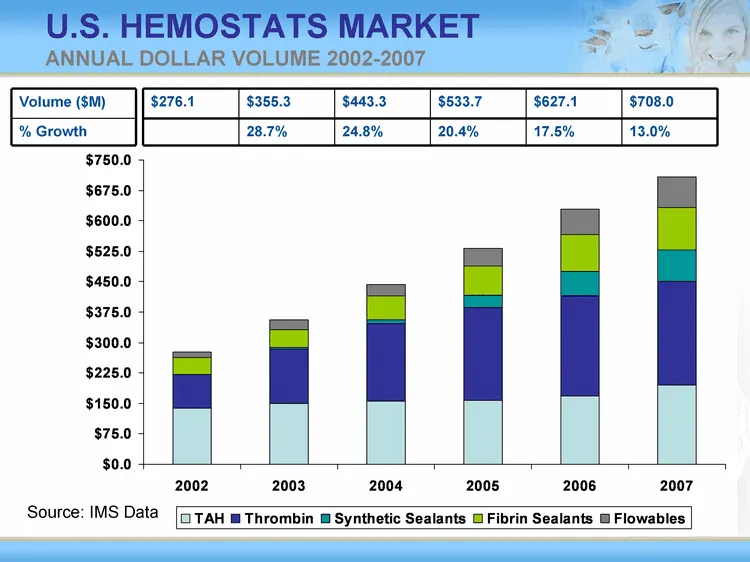
U.S. HEMOSTATS MARKET ANNUAL DOLLAR VOLUME 2002-2007 2002 2003 2004 2005 2006 2007 TAH 139 150 156 157 168 196 Thrombin 82 134 190 229 246 255 Synthetic Sealants 1 3 10 31 61 78 Fibrin Sealants 41 45 58 72 92 103 Flowables 14 24 29 44 61 77 $276.1 $355.3 $443.3 $533.7 $627.1 $708.0 28.7% 24.8% 20.4%
Slide 13: Projected Market Trends
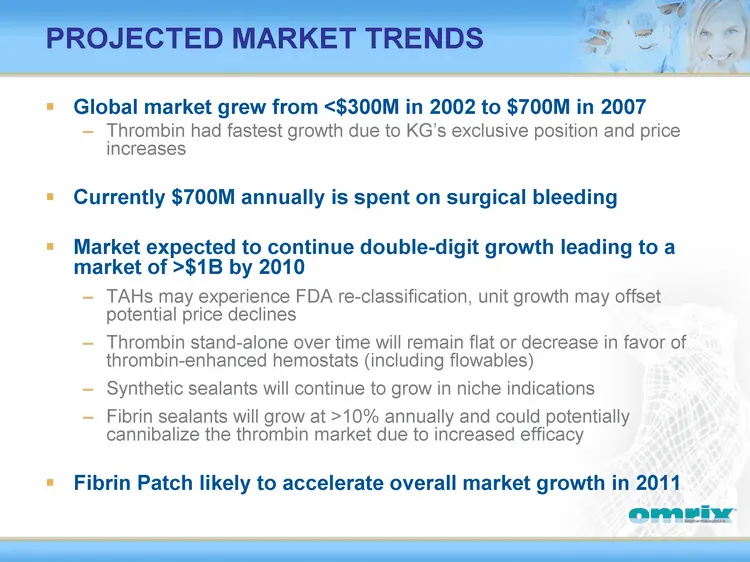
PROJECTED MARKET TRENDS Global market grew from <$300M in 2002 to $700M in 2007 Thrombin had fastest growth due to KG's exclusive position and price increases Currently $700M annually is spent on surgical bleeding Market expected to continue double-digit growth leading to a market of >$1B by 2010 TA
Slide 14: Capturing Market Share
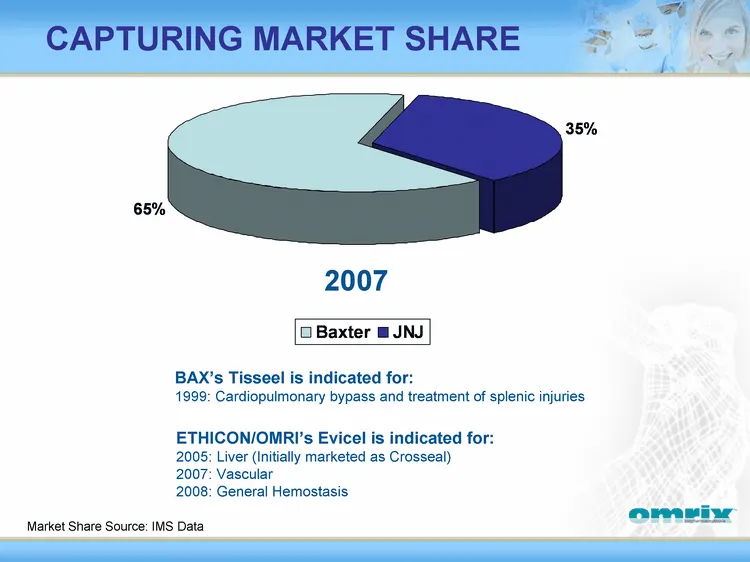
CAPTURING MARKET SHARE Baxter JNJ 3rd Qtr 4th Qtr Baxter 65 35 90 20.4 JNJ/OMRI 40 38.6 34.6 31.6 North 45.9 46.9 45 43.9 BAX's Tisseel is indicated for: 1999: Cardiopulmonary bypass and treatment of splenic injuries ETHICON/OMRI's Evicel is indicated for: 2005: Liver (Initially marketed as Crosseal
Slide 15: 2007 U.S. Market Penetration
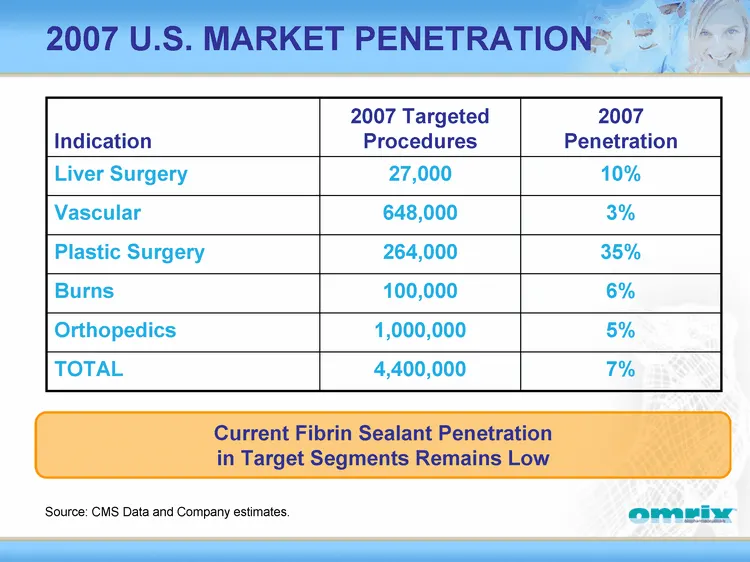
2007 U.S. MARKET PENETRATION Source: CMS Data and Company estimates. Current Fibrin Sealant Penetration in Target Segments Remains Low Indication 2007 Targeted Procedures 2007 Penetration Liver Surgery 27,000 10% Vascular 648,000 3% Plastic Surgery 264,000 35% Burns 100,000 6% Orthopedics 1,000,000
Slide 16: The Fibrin Patch: Capitalizing on Convergence
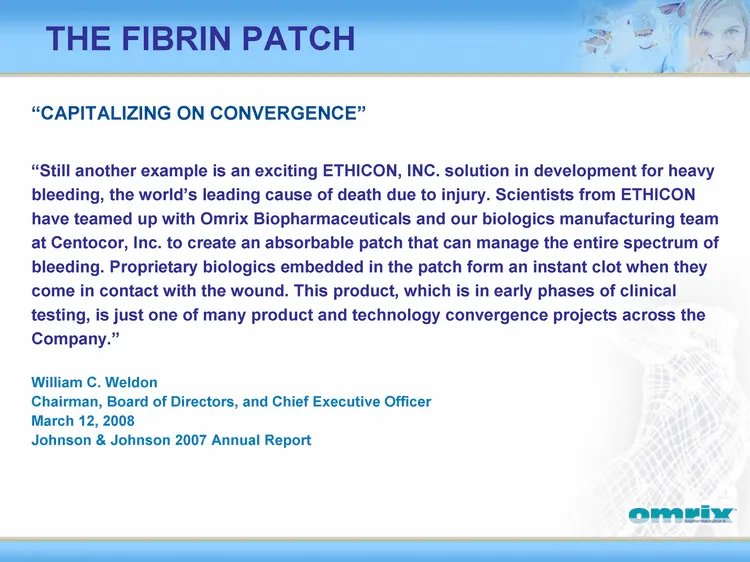
THE FIBRIN PATCH "CAPITALIZING ON CONVERGENCE" "Still another example is an exciting ETHICON, INC. solution in development for heavy bleeding, the world's leading cause of death due to injury. Scientists from ETHICON have teamed up with Omrix Biopharmaceuticals and our biologics manufacturing team a
Slide 17: Defining the Market Opportunity
Defining the Market Opportunity Robert Friedman Managing Director, Easton Associates
Slide 18: Evaluation of OMRIX's Fibrin Patch Technology
Evaluation of OMRIX's Fibrin Patch Technology Analyst & Investor Day NASDAQ MarketSite March 27, 2008
Slide 19: Disclaimer
DISCLAIMER This report has been prepared for OMRIX Biopharmaceuticals and contains proprietary information of Easton Associates, L.L.C. The report may not be altered, modified, reproduced, or distributed, in whole or in part, without the written consent of Easton Associates from its office listed be
Slide 20: Easton Associates Methodology
Easton Associates was hired by OMRIX to assess the potential of its novel fibrin patch Extensive secondary sources In-depth interviews with close to 100 surgeons and hospital administrators Project conducted in 2005; not updated Focus on the U.S. market; ROW extrapolation For sales projection purpos
Slide 21: Surgical Wound Closure Market Sub-Categories
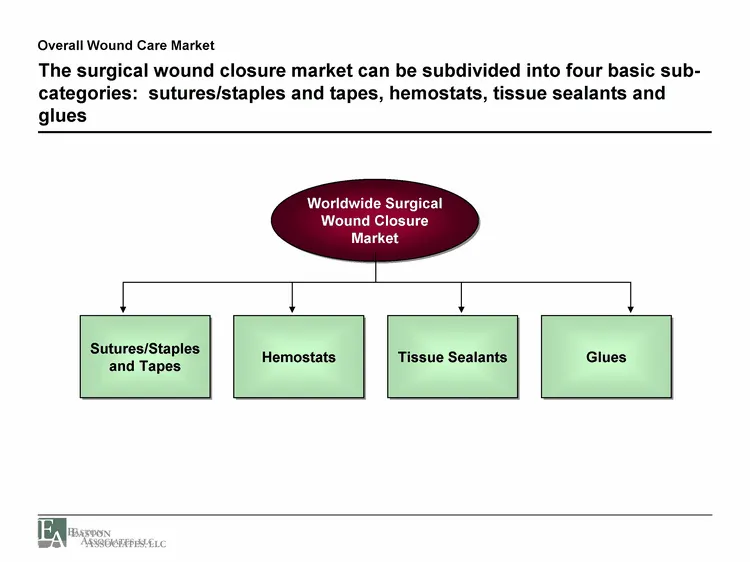
The surgical wound closure market can be subdivided into four basic sub- categories: sutures/staples and tapes, hemostats, tissue sealants and glues Overall Wound Care Market Worldwide Surgical Wound Closure Market Sutures/Staples and Tapes Hemostats Tissue Sealants Glues
Slide 22: Worldwide Surgical Wound Closure Market $5.5 Billion in 2004
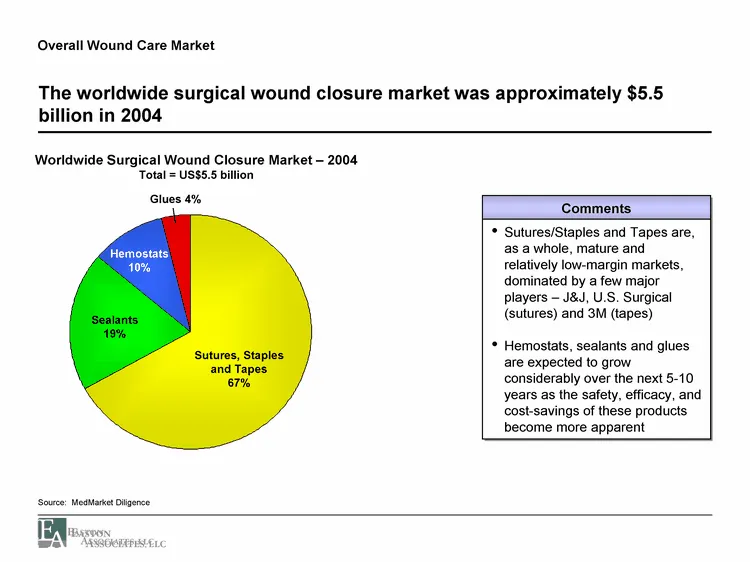
The worldwide surgical wound closure market was approximately $5.5 billion in 2004 Overall Wound Care Market Source: MedMarket Diligence Comments Sutures/Staples and Tapes are, as a whole, mature and relatively low-margin markets, dominated by a few major players - J&J, U.S. Surgical (sutures) and 3
Slide 23: U.S. Surgical Sealants Fastest Growing Segment
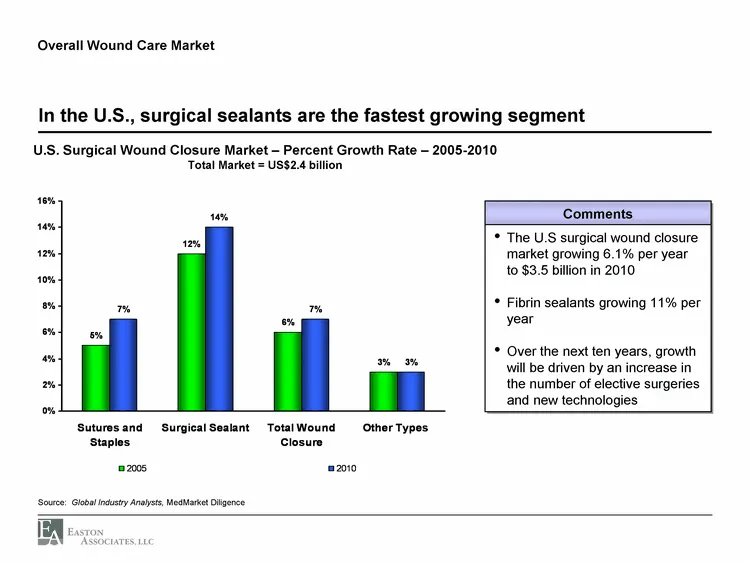
In the U.S., surgical sealants are the fastest growing segment Source: Global Industry Analysts, MedMarket Diligence 2005 2006 2007 2008 2009 2010 Sutures and Staples 0.05 0.06 0.06 0.06 0.06 0.07 Surgical Sealant 0.12 0.13 0.13 0.13 0.14 0.14 Total Wound Closure 0.06 0.05 0.07 0.07 0.07 0.07 Other
Slide 24: Existing Products Have Weaknesses
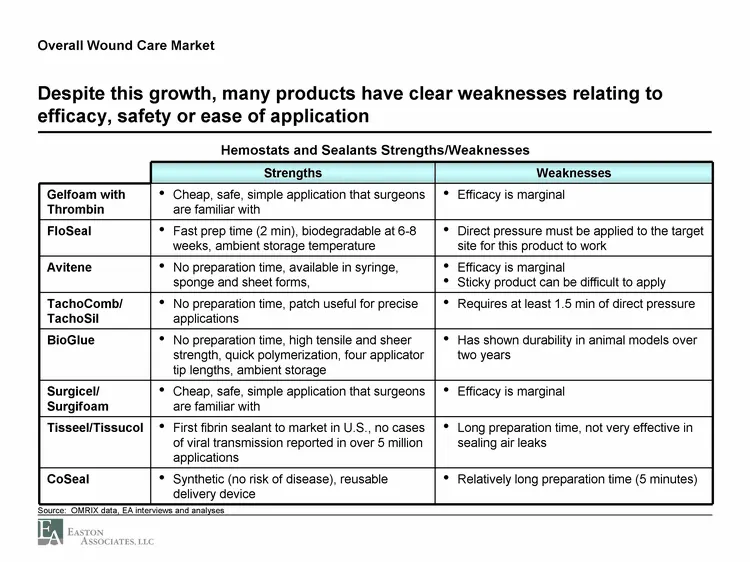
Despite this growth, many products have clear weaknesses relating to efficacy, safety or ease of application Strengths Weaknesses Gelfoam with Thrombin Cheap, safe, simple application that surgeons are familiar with Efficacy is marginal FloSeal Fast prep time (2 min), biodegradable at 6-8 weeks, amb
Slide 25: Unmet Need Is Substantial
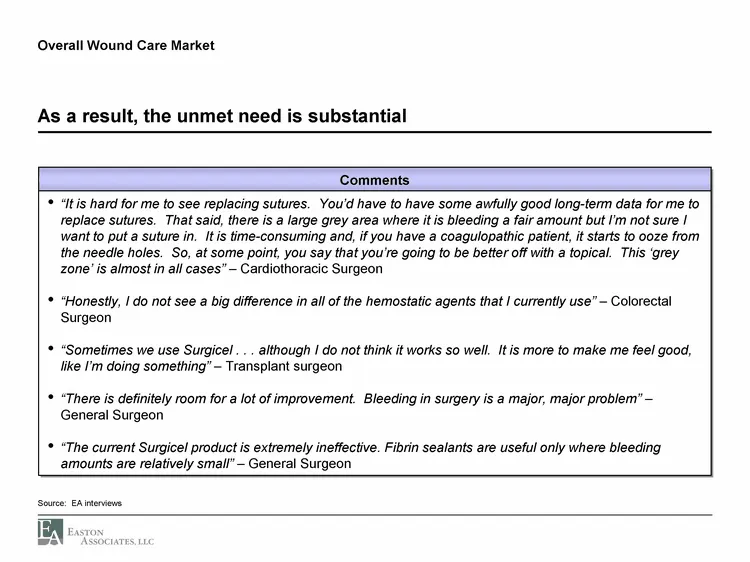
As a result, the unmet need is substantial Source: EA interviews Comments "It is hard for me to see replacing sutures. You'd have to have some awfully good long-term data for me to replace sutures. That said, there is a large grey area where it is bleeding a fair amount but I'm not sure I want to pu
Slide 26: Five Million Procedures at Risk for Problematic Bleeding
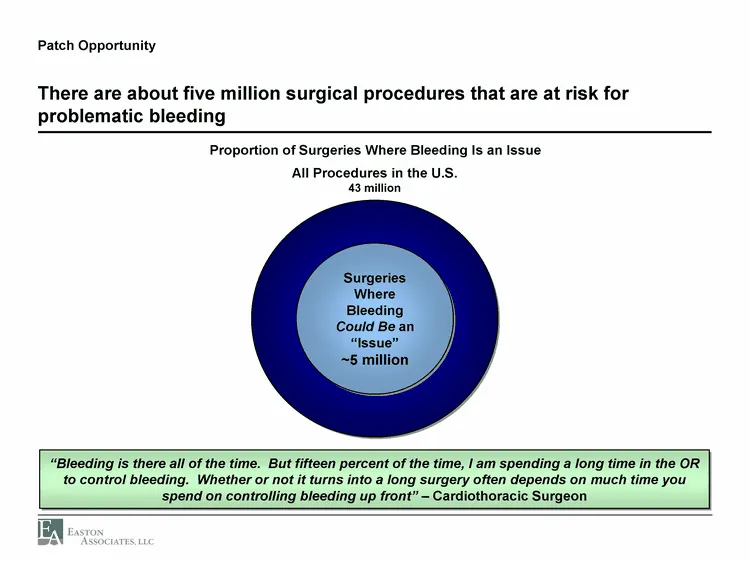
There are about five million surgical procedures that are at risk for problematic bleeding "Bleeding is there all of the time. But fifteen percent of the time, I am spending a long time in the OR to control bleeding. Whether or not it turns into a long surgery often depends on much time you spend on
Slide 27: Spectrum of Problematic Bleeding
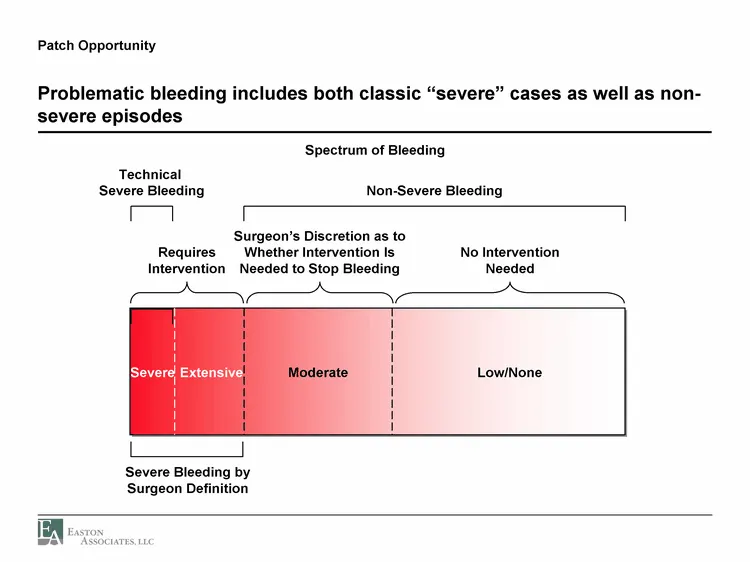
Problematic bleeding includes both classic "severe" cases as well as non- severe episodes Spectrum of Bleeding Surgeon's Discretion as to Whether Intervention Is Needed to Stop Bleeding No Intervention Needed Requires Intervention Severe Extensive Moderate Low/None Non-Severe Bleeding Technical Seve
Slide 28: Severe Bleeding Occurs in Up to 20 Percent of At-Risk Cases
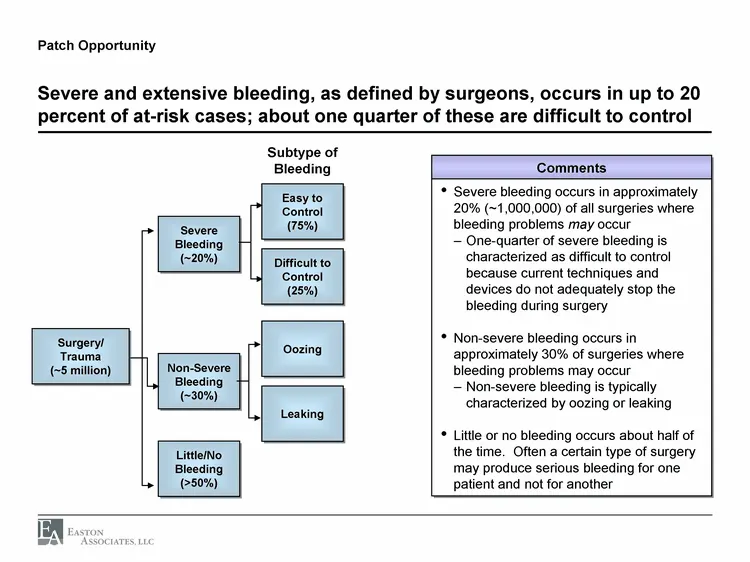
Severe and extensive bleeding, as defined by surgeons, occurs in up to 20 percent of at-risk cases; about one quarter of these are difficult to control Subtype of Bleeding Comments Severe bleeding occurs in approximately 20% (~1,000,000) of all surgeries where bleeding problems may occur One-quarter
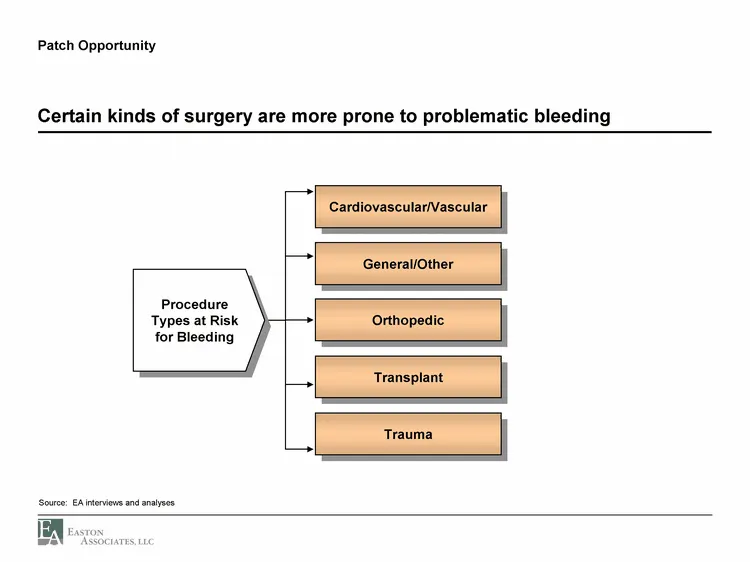
Slide 29: Surgeries Prone to Problematic Bleeding
Certain kinds of surgery are more prone to problematic bleeding Procedure Types at Risk for Bleeding Cardiovascular/Vascular General/Other Orthopedic Transplant Trauma Source: EA interviews and analyses Patch Opportunity
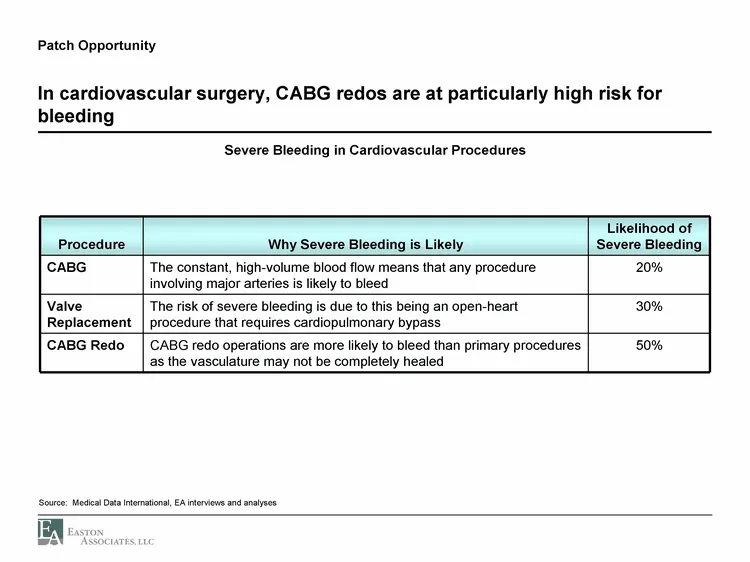
Slide 30: Cardiovascular Surgery Bleeding Risk
In cardiovascular surgery, CABG redos are at particularly high risk for bleeding Procedure Why Severe Bleeding is Likely Likelihood of Severe Bleeding CABG The constant, high-volume blood flow means that any procedure involving major arteries is likely to bleed 20% Valve Replacement The risk of seve
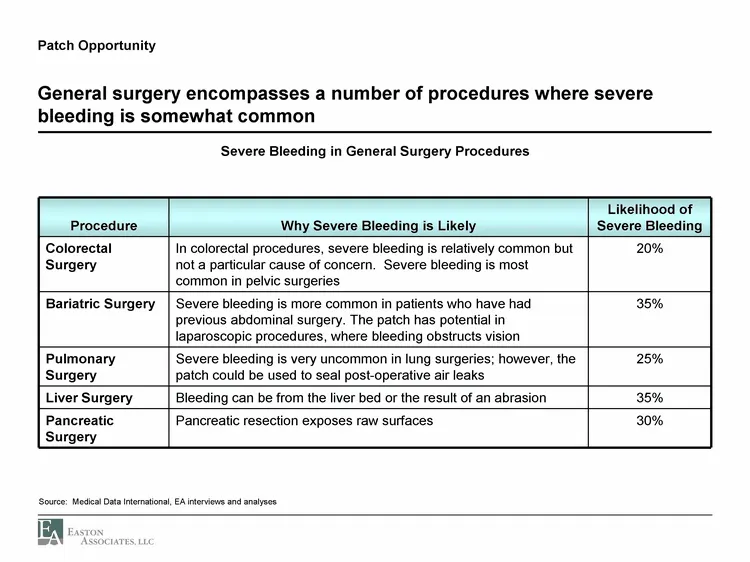
Slide 31: General Surgery Bleeding Risk
General surgery encompasses a number of procedures where severe bleeding is somewhat common Procedure Why Severe Bleeding is Likely Likelihood of Severe Bleeding Colorectal Surgery In colorectal procedures, severe bleeding is relatively common but not a particular cause of concern. Severe bleeding i
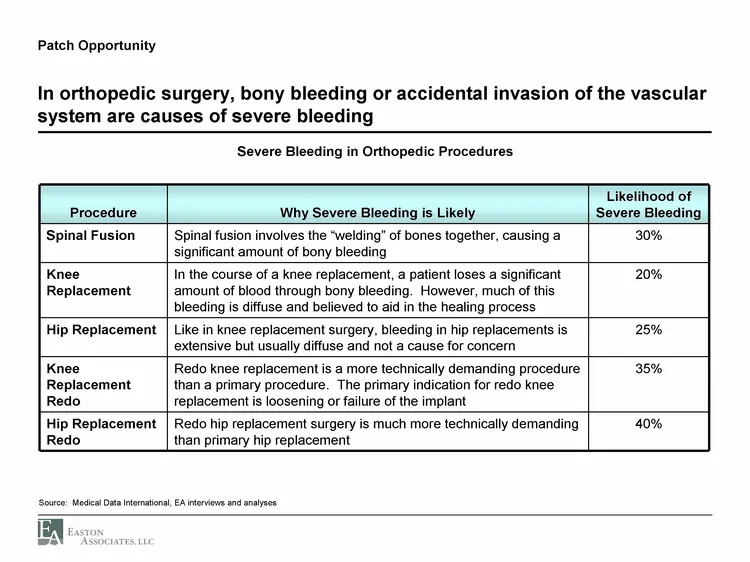
Slide 32: Orthopedic Surgery Bleeding Risk
In orthopedic surgery, bony bleeding or accidental invasion of the vascular system are causes of severe bleeding Procedure Why Severe Bleeding is Likely Likelihood of Severe Bleeding Spinal Fusion Spinal fusion involves the "welding" of bones together, causing a significant amount of bony bleeding 3
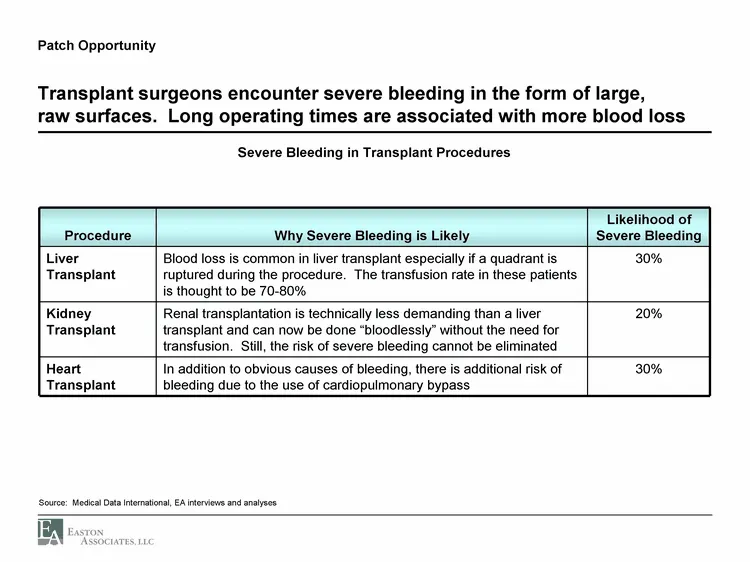
Slide 33: Transplant Surgery Bleeding Risk
Transplant surgeons encounter severe bleeding in the form of large, raw surfaces. Long operating times are associated with more blood loss Procedure Why Severe Bleeding is Likely Likelihood of Severe Bleeding Liver Transplant Blood loss is common in liver transplant especially if a quadrant is ruptu
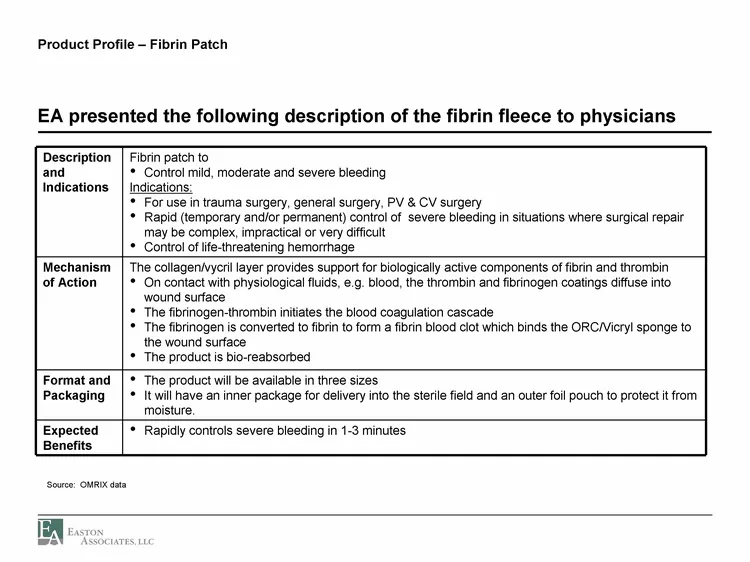
Slide 34: Description of the Fibrin Fleece Presented to Physicians
EA presented the following description of the fibrin fleece to physicians Source: OMRIX data Description and Indications Fibrin patch to Control mild, moderate and severe bleeding Indications: For use in trauma surgery, general surgery, PV & CV surgery Rapid (temporary and/or permanent) control of s
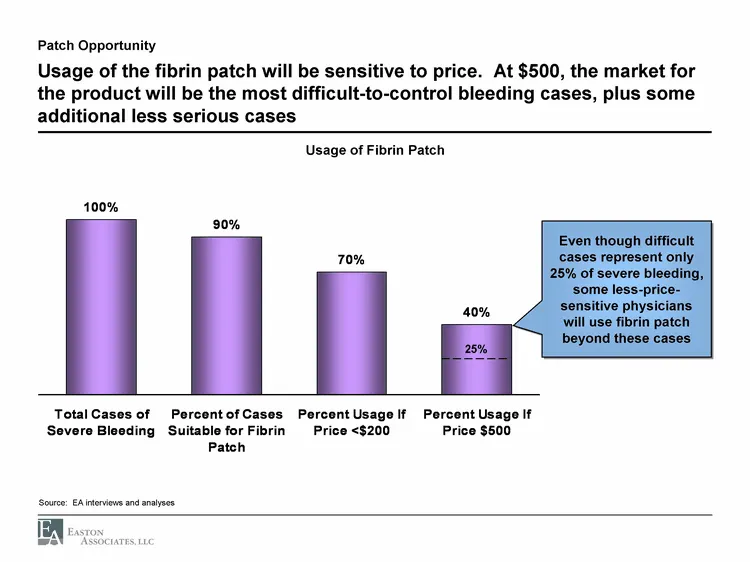
Slide 35: Fibrin Patch Usage Sensitive to Price
Usage of the fibrin patch will be sensitive to price. At $500, the market for the product will be the most difficult-to-control bleeding cases, plus some additional less serious cases Source: EA interviews and analyses Patch Opportunity Total Cases of Severe Bleeding Percent of Cases Suitable for Fi
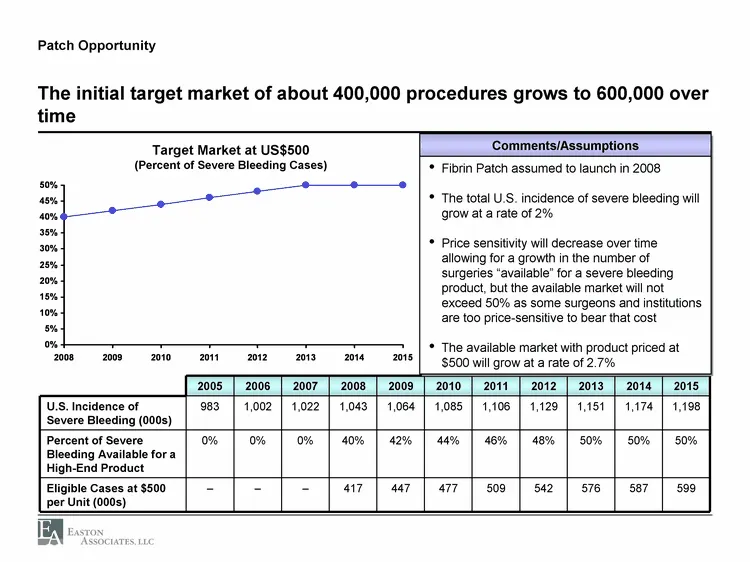
Slide 36: Initial Target Market of About 400,000 Procedures
The initial target market of about 400,000 procedures grows to 600,000 over time Target Market at US$500 (Percent of Severe Bleeding Cases) 2005 2006 2007 2008 2009 2010 2011 2012 2013 2014 2015 Series 1 0 0 0 0.4 0.42 0.44 0.46 0.48 0.5 0.5 0.5 2005 2006 2007 2008 2009 2010 2011 2012 2013 2014 2015
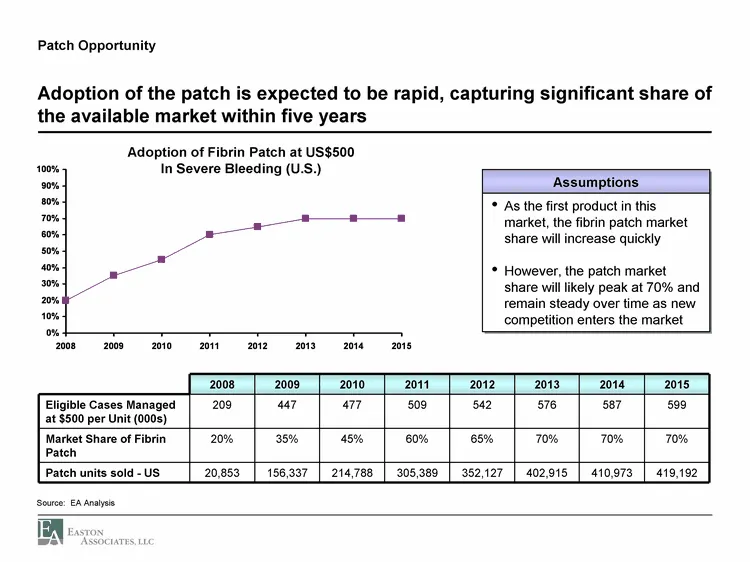
Slide 37: Adoption of Fibrin Patch in Severe Bleeding
Adoption of the patch is expected to be rapid, capturing significant share of the available market within five years Assumptions As the first product in this market, the fibrin patch market share will increase quickly However, the patch market share will likely peak at 70% and remain steady over tim
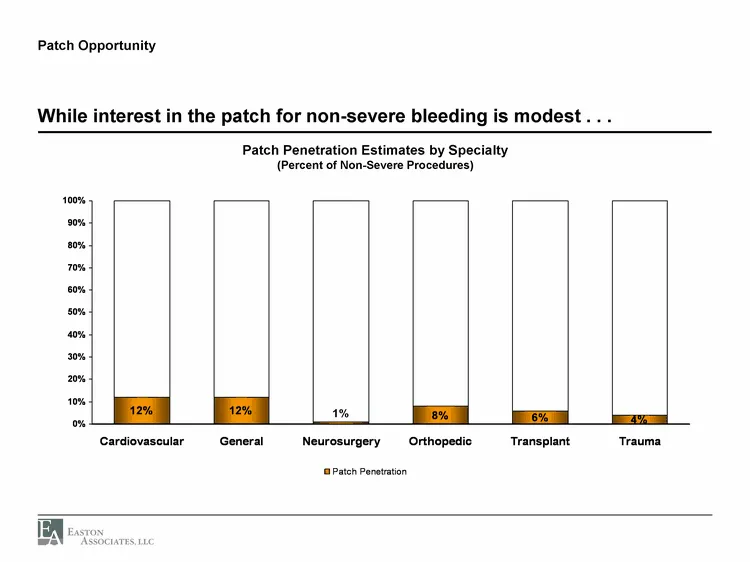
Slide 38: Patch Penetration in Non-Severe Bleeding by Specialty
While interest in the patch for non-severe bleeding is modest . . . Cardiovascular General Neurosurgery Orthopedic Transplant Trauma Patch Penetration 0.12 0.12 0.01 0.08 0.06 0.04 0.88 0.88 0.99 0.92 0.94 0.96 Patch Penetration Estimates by Specialty (Percent of Non-Severe Procedures) Patch Opportu
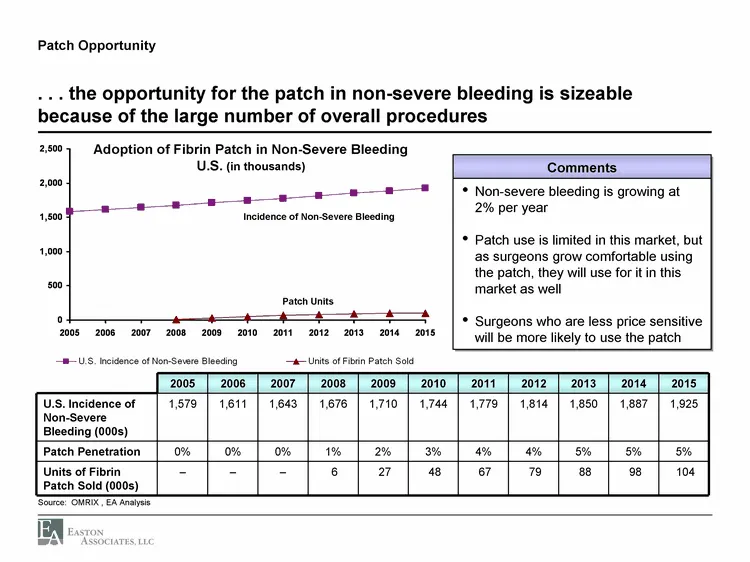
Slide 39: Adoption in Non-Severe Bleeding
2005 2006 2007 2008 2009 2010 2011 2012 2013 2014 2015 U.S. Incidence of Non-Severe Bleeding 1579 1611 1643 1676 1710 1744 1779 1814 1850 1887 1925 Units of Fibrin Patch Sold 6 27 48 67 79 88 98 104 - .. . . the opportunity for the patch in non-severe bleeding is sizeable because of the large number
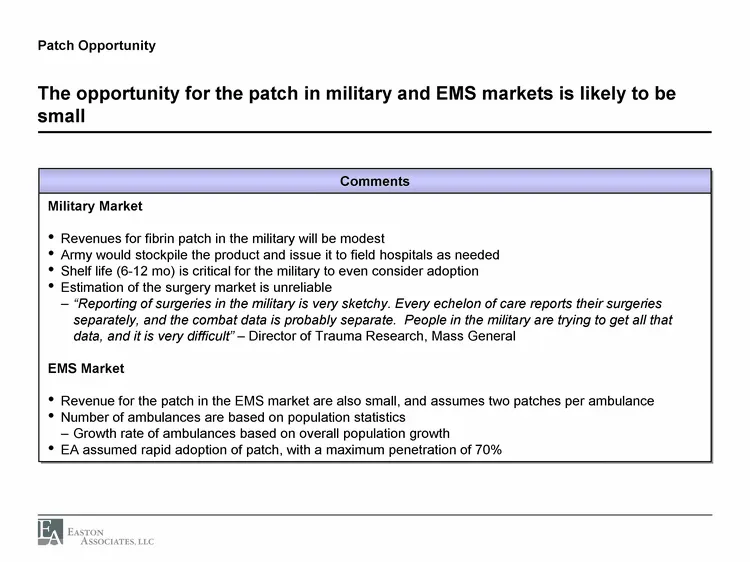
Slide 40: Military and EMS Opportunity
The opportunity for the patch in military and EMS markets is likely to be small Patch Opportunity Comments Military Market Revenues for fibrin patch in the military will be modest Army would stockpile the product and issue it to field hospitals as needed Shelf life (6-12 mo) is critical for the mili
Slide 41: Summary of Worldwide Patch Revenues
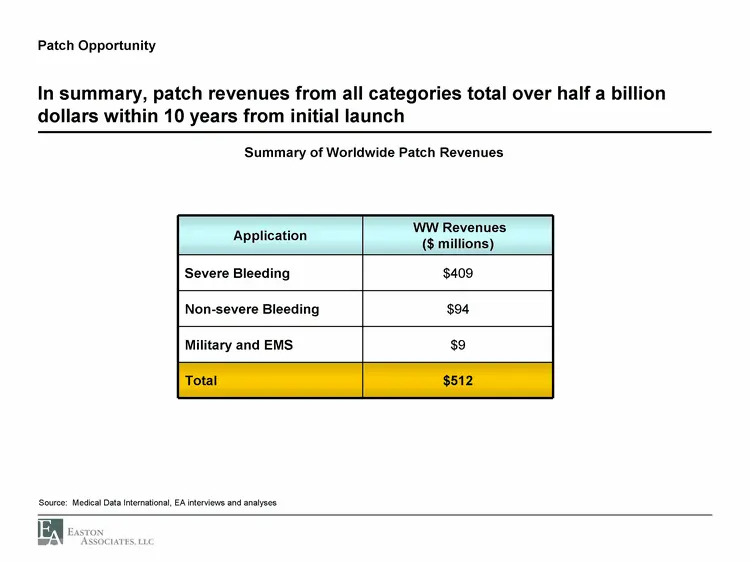
In summary, patch revenues from all categories total over half a billion dollars within 10 years from initial launch Application WW Revenues ($ millions) Severe Bleeding $409 Non-severe Bleeding $94 Military and EMS $9 Total $512 Source: Medical Data International, EA interviews and analyses Summary
Slide 42: WW Revenue Projections of Fibrin Patch
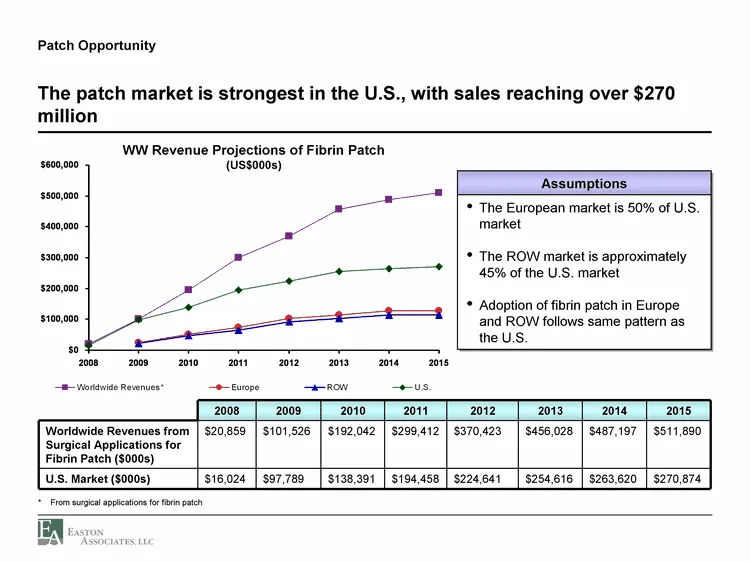
The patch market is strongest in the U.S., with sales reaching over $270 million Assumptions The European market is 50% of U.S. market The ROW market is approximately 45% of the U.S. market Adoption of fibrin patch in Europe and ROW follows same pattern as the U.S. WW Revenue Projections of Fibrin P
Slide 43: Leveraging Our Expertise
Leveraging Our Expertise Nissim Mashiach President & Chief Operating Officer
Slide 44: Introduction
INTRODUCTION Overview of Omrix' expertise: Research & Product Development Intellectual Property & Know How Clinical Operations and Regulatory Affairs Quality Assurance Manufacturing How Omrix will leverage its expertise to expand its Product pipeline
Slide 45: Core Competencies: Research & Product Development
DEFINING OUR CORE COMPETENCIES Research & Product Development - Background Omrix' R&D team was established in 1995 with 2 employees (still employed at Omrix) Today: 38 employees Core R&D team has an average of 7 years at Omrix Diverse backgrounds in: Protein purification Hematology Virology Biochemi
Slide 46: Core Competencies: Marketed and Development Products
DEFINING OUR CORE COMPETENCIES Currently marketed products: Crosseal / Quixil Evicel Evithrom IVIG HBIG In development: Adhexil Thrombin-enhanced products Fibrin Patch Demonstrated ability to develop commercial products
Slide 47: Core Competencies: Intellectual Property
DEFINING OUR CORE COMPETENCIES Intellectual Property 13 US patents; 93 Non-US Patents IP encompasses the following: Protein purification Methods for ensuring safety of plasma-based products Combination products - Devices combined with biologicals Applicator devices
Slide 48: Core Competencies: Clinical Operations & Regulatory Affairs
DEFINING OUR CORE COMPETENCIES Clinical Operations & Regulatory Affairs Significant experience with the FDA and EMEA Targeting regulatory approvals in new territories, e.g. Japan and other Far East areas Quality Assurance Proven track record of successful inspection FDA EMEA Health Canada Israeli Mi
Slide 49: Fibrin Patch: Demonstrated R&D Efficiency
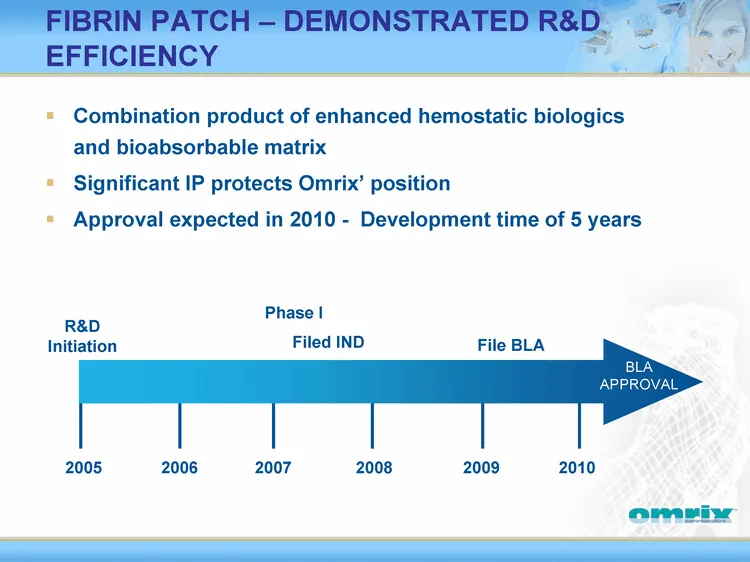
FIBRIN PATCH - DEMONSTRATED R&D EFFICIENCY Combination product of enhanced hemostatic biologics and bioabsorbable matrix Significant IP protects Omrix' position Approval expected in 2010 - Development time of 5 years 2005 2006 2007 2008 2009 2010 R&D Initiation Phase I Filed IND File BLA BLA APPROVA
Slide 50: Core Competencies: Manufacturing
DEFINING OUR CORE COMPETENCIES Manufacturing Capacity Current capacity meets market requirements Staged expansion capability to meet future market requirements Allows incremental capital investments Production line optimization Shared production line for all product segments Shared QA/QC Optimizes u
Slide 51: Building for Growth: New Jerusalem Plant
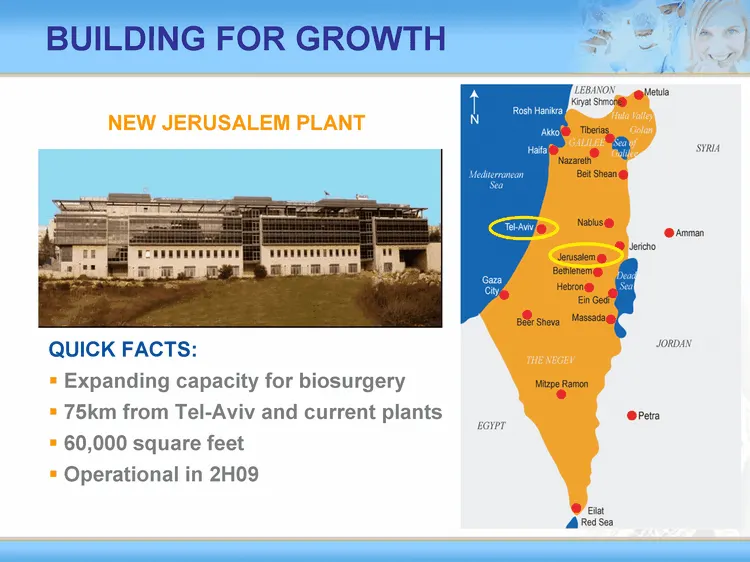
BUILDING FOR GROWTH BUILDING FOR GROWTH QUICK FACTS: Expanding capacity for biosurgery 75km from Tel-Aviv and current plants 60,000 square feet Operational in 2H09 NEW JERUSALEM PLANT
Slide 52: Leveraging Our Core Competencies
LEVERAGING OUR CORE COMPETENCIES Develop new combination products which use existing R&D, QA and RA knowledge e.g. Fibrin patch and thrombin-enhanced products Develop new technologies which coat/combine biological materials with devices e.g. coated hernia mesh to prevent adhesions Go to the next lev
Slide 53: Adhesion Prevention - Adhexil
Adhesion Prevention - Adhexil David Wiseman Ph.D., M.R.Pharm.S. Synechion, Inc.
Slide 54: An Adhesions Opportunity for Omrix
An Adhesions Opportunity for Omrix What are adhesions and what problems do they cause? Why do adhesions form? How can we prevent adhesions? Why fibrin? Does AdhexilTM prevent adhesions in animal models? What is the clinical potential of AdhexilTM ? Clinical evaluation of AdhexilTM : Program and Stud
Slide 55: What Are Adhesions and What Problems Do They Cause?
What are adhesions, what problems do they cause? A scar that forms an abnormal connection between two parts of the body Caused by any trauma within the body as a consequence of normal healing (surgery, endometriosis, infection, radiation) Adhesions cause severe problems Infertility Chronic abdominal
Slide 56: Abnormal Connections Between Tissues
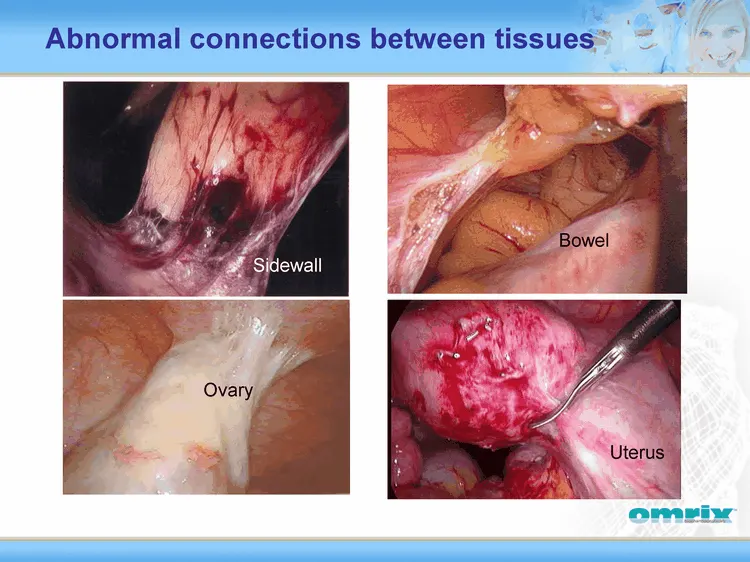
Abnormal connections between tissues Abnormal connections between tissues Abnormal connections between tissues Abnormal connections between tissues Ovary Bowel Uterus Uterus Sidewall
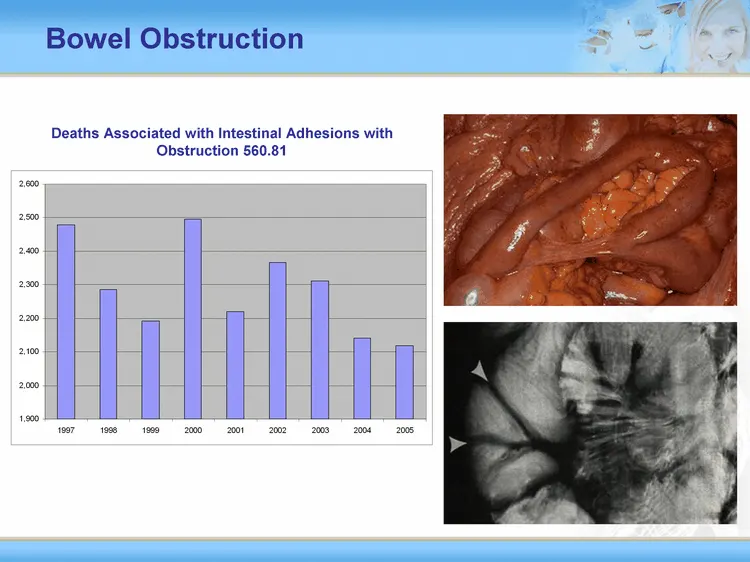
Slide 57: Bowel Obstruction
Bowel Obstruction Bowel Obstruction Bowel Obstruction Deaths Associated with Intestinal Adhesions with Obstruction 560.81
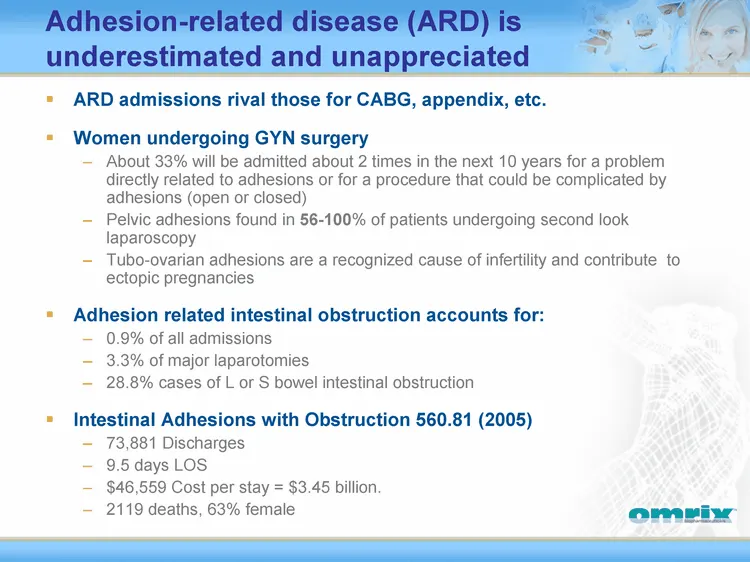
Slide 58: Adhesion-Related Disease Is Underestimated
Adhesion-related disease (ARD) is underestimated and unappreciated ARD admissions rival those for CABG, appendix, etc. Women undergoing GYN surgery About 33% will be admitted about 2 times in the next 10 years for a problem directly related to adhesions or for a procedure that could be complicated b
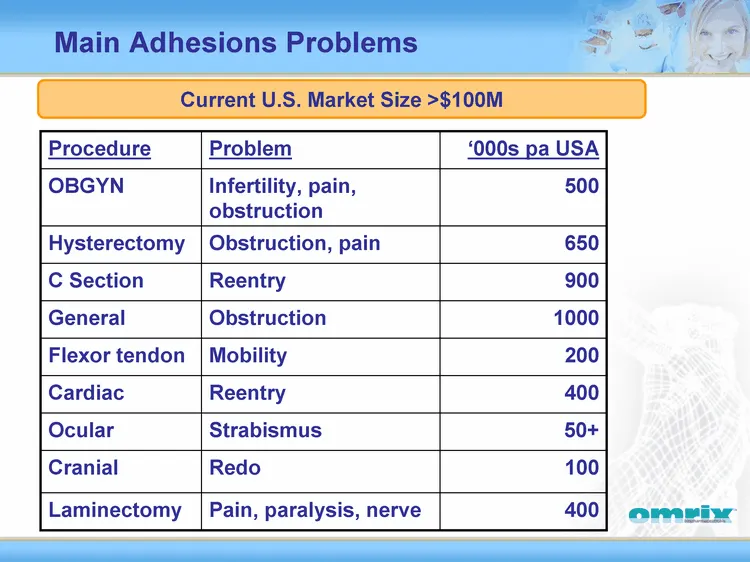
Slide 59: Main Adhesions Problems
Main Adhesions Problems Procedure Problem '000s pa USA OBGYN Infertility, pain, obstruction 500 Hysterectomy Obstruction, pain 650 C Section Reentry 900 General Obstruction 1000 Flexor tendon Mobility 200 Cardiac Reentry 400 Ocular Strabismus 50+ Cranial Redo 100 Laminectomy Pain, paralysis, nerve 4
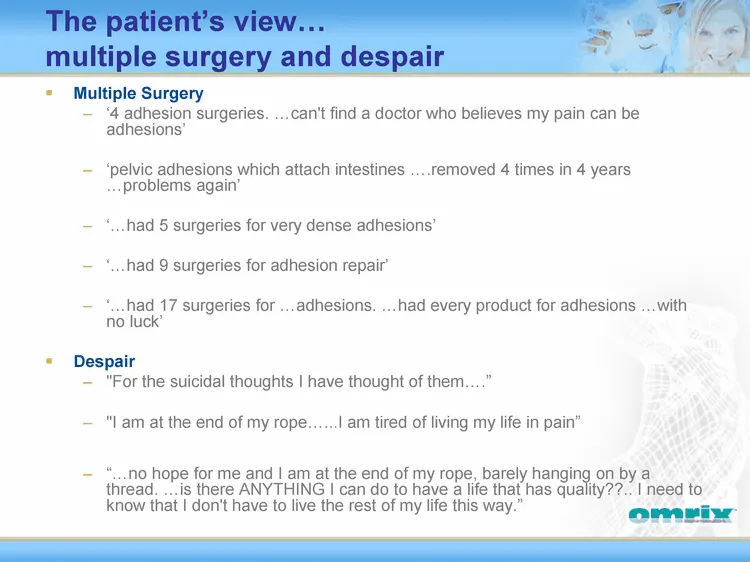
Slide 60: The Patient's View
The patient's view... multiple surgery and despair Multiple Surgery '4 adhesion surgeries. ...can't find a doctor who believes my pain can be adhesions' 'pelvic adhesions which attach intestines ....removed 4 times in 4 years ....problems again' '...had 5 surgeries for very dense adhesions' '...had
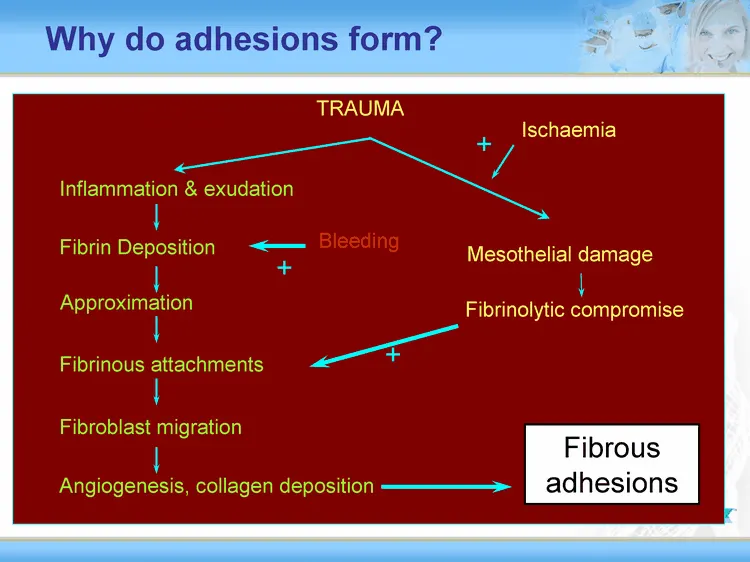
Slide 61: Why Do Adhesions Form?
TRAUMA Fibrous adhesions Mesothelial damage Fibrinolytic compromise Ischaemia + Inflammation & exudation Fibrin Deposition Fibrinous attachments Fibroblast migration Angiogenesis, collagen deposition + Approximation Bleeding + Why do adhesions form?
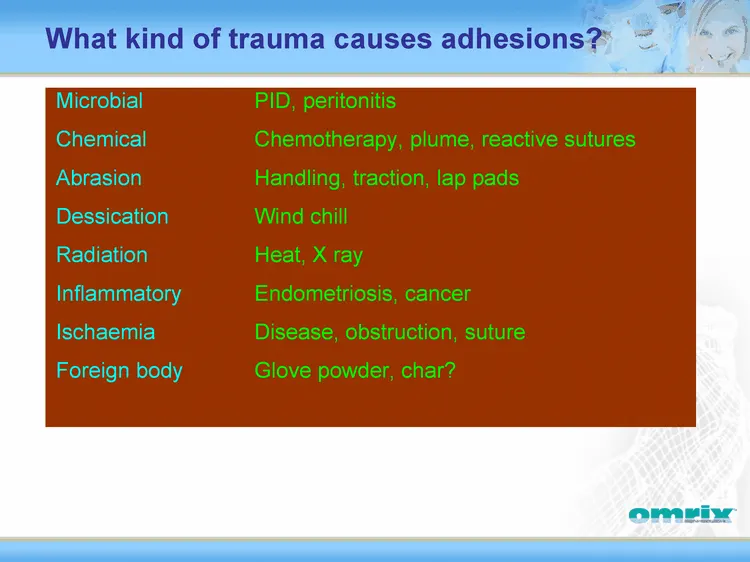
Slide 62: What Kind of Trauma Causes Adhesions?
What kind of trauma causes adhesions?
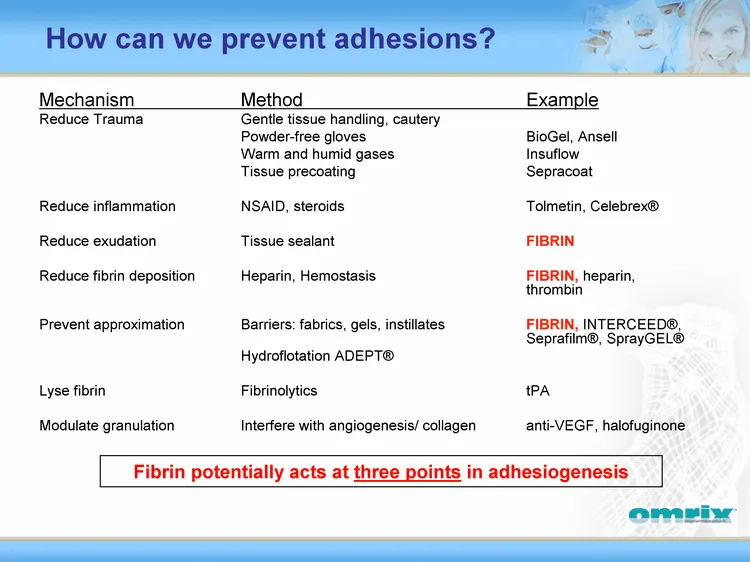
Slide 63: How Can We Prevent Adhesions?
How can we prevent adhesions? Mechanism Method Example Reduce Trauma Gentle tissue handling, cautery Powder-free gloves BioGel, Ansell Warm and humid gases Insuflow Tissue precoating Sepracoat Reduce inflammation NSAID, steroids Tolmetin, Celebrex(r) Reduce exudation Tissue sealant FIBRIN Reduce fib
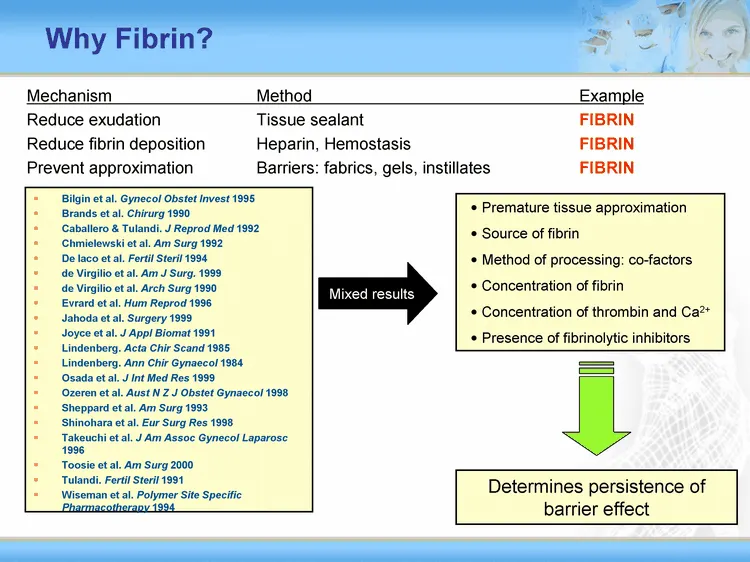
Slide 64: Why Fibrin?
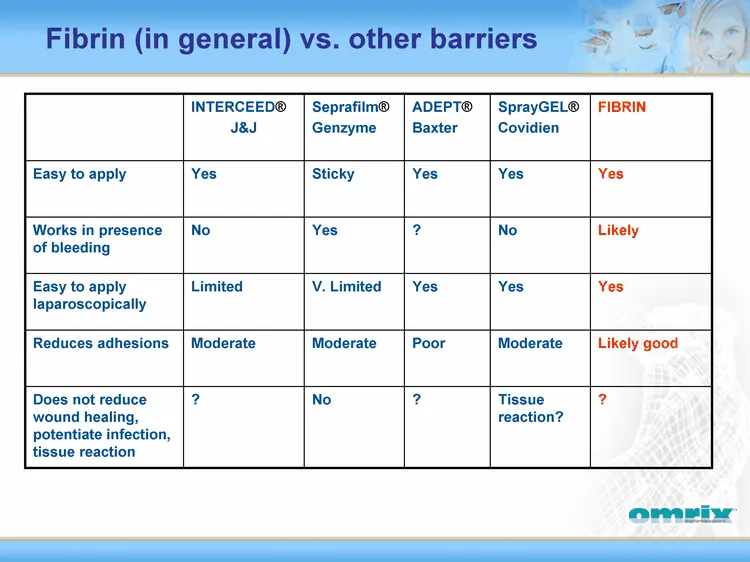
Why Fibrin? Mechanism Method Example Reduce exudation Tissue sealant FIBRIN Reduce fibrin deposition Heparin, Hemostasis FIBRIN Prevent approximation Barriers: fabrics, gels, instillates FIBRIN Bilgin et al. Gynecol Obstet Invest 1995 Brands et al. Chirurg 1990 Caballero & Tulandi. J Reprod Med 1992
Slide 65: Fibrin vs. Other Barriers
Fibrin (in general) vs. other barriers INTERCEED(r) J&J Seprafilm(r) Genzyme ADEPT(r) Baxter SprayGEL(r) Covidien FIBRIN Easy to apply Yes Sticky Yes Yes Yes Works in presence of bleeding No Yes ? No Likely Easy to apply laparoscopically Limited V. Limited Yes Yes Yes Reduces adhesions Moderate Mode
Slide 66: Does Adhexil Prevent Adhesions in Animal Models?
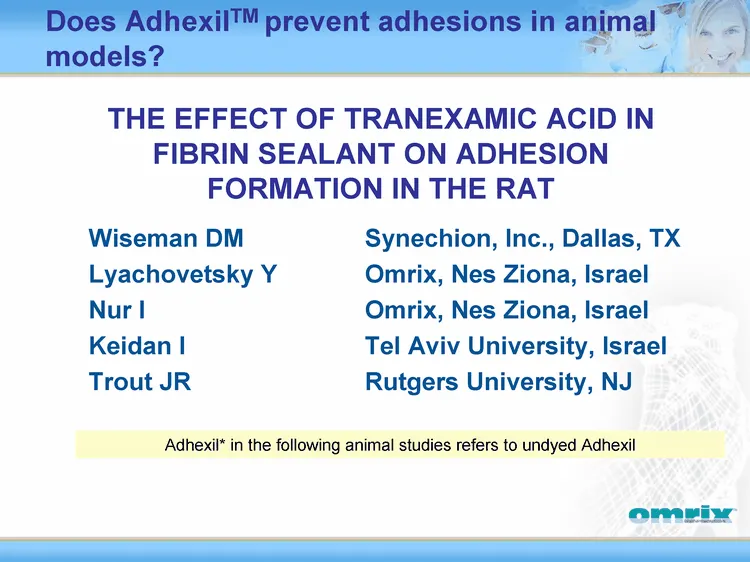
THE EFFECT OF TRANEXAMIC ACID IN FIBRIN SEALANT ON ADHESION FORMATION IN THE RAT Wiseman DM Synechion, Inc., Dallas, TX Lyachovetsky Y Omrix, Nes Ziona, Israel Nur I Omrix, Nes Ziona, Israel Keidan I Tel Aviv University, Israel Trout JR Rutgers University, NJ J Biomed Mater Res Part B: Appl Biomater
Slide 67: Rat Cecum Abrasion Model
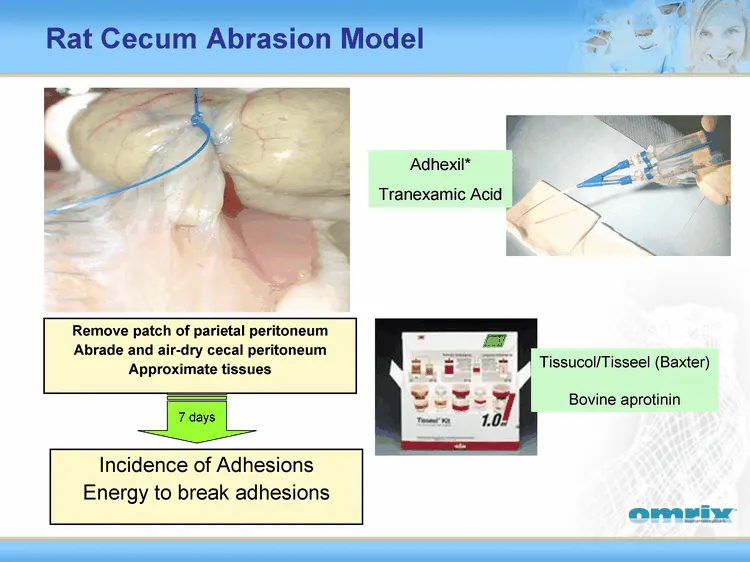
Rat Cecum Abrasion Model Rat Cecum Abrasion Model Remove patch of parietal peritoneum Abrade and air-dry cecal peritoneum Approximate tissues 7 days Tissucol/Tisseel (Baxter) Bovine aprotinin Incidence of Adhesions Energy to break adhesions Energy to break adhesions Energy to break adhesions Adhexil
Slide 68: Adhexil Reduces Adhesions in Rats
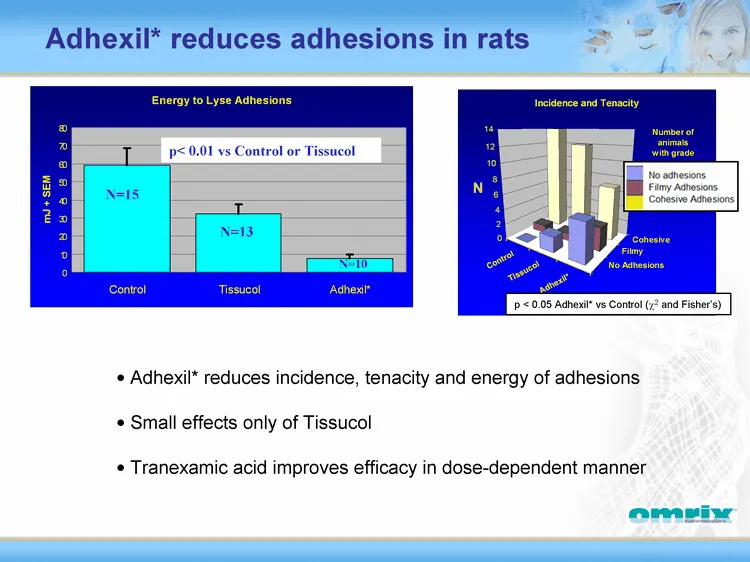
Adhexil* reduces adhesions in rats N=15 N=13 N=10 p< 0.01 vs Control or Tissucol Adhexil* reduces incidence, tenacity and energy of adhesions Small effects only of Tissucol Tranexamic acid improves efficacy in dose-dependent manner p < 0.05 Adhexil* vs Control (c2 and Fisher's) p < 0.05 Adhexil* vs
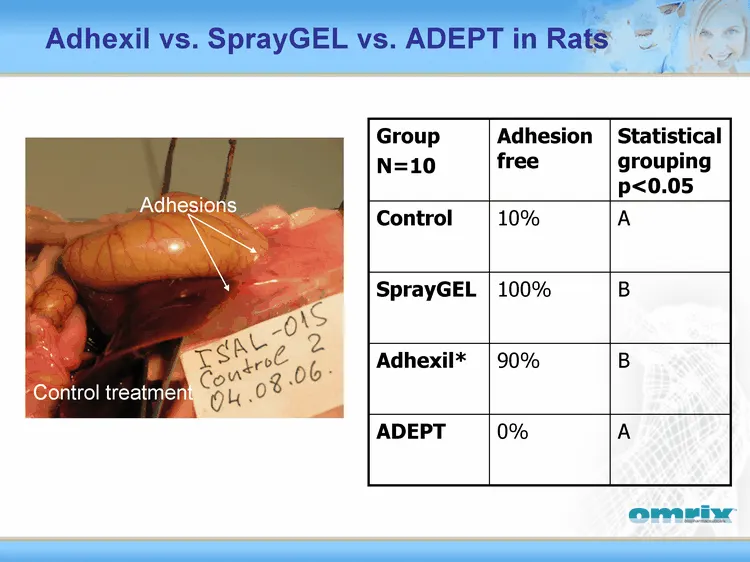
Slide 69: Adhexil vs. SprayGEL vs. ADEPT in Rats
Adhesions Adhesions Control treatment Adhexil vs. SprayGEL vs. ADEPT in Rats Group N=10 Adhesion free Statistical grouping p<0.05 Control 10% A SprayGEL 100% B Adhexil* 90% B ADEPT 0% A
Slide 70: Can We Predict Clinical Outcomes from Animal Studies?
Can we predict clinical outcomes from animal studies? What is the clinical potential of AdhexilTM?
Slide 71: Models Are Often Chosen Arbitrarily
Models are often chosen arbitrarily "There is no animal model that predicts clinical outcome"
Slide 72: What Is the Best Model for Postoperative Adhesions?
What is the best model for postoperative adhesions? What is the clinical potential of AdhexilTM?
Slide 73: What Is the Best Model for Postoperative Adhesions?
What is the best model for postoperative adhesions? What result would you like?
Slide 74: Right Model for the Right Question
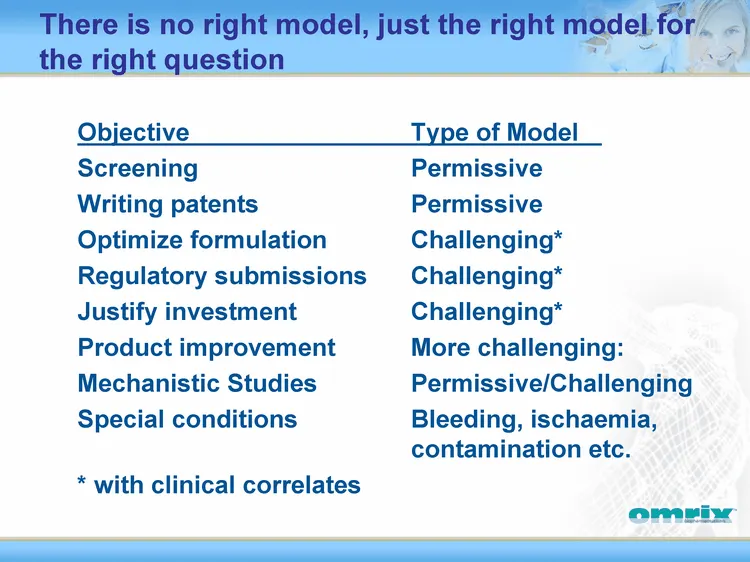
There is no right model, just the right model for the right question Objective Type of Model Screening Permissive Writing patents Permissive Optimize formulation Challenging* Regulatory submissions Challenging* Justify investment Challenging* Product improvement More challenging: Mechanistic Studies
Slide 75: Animal Model Correlations
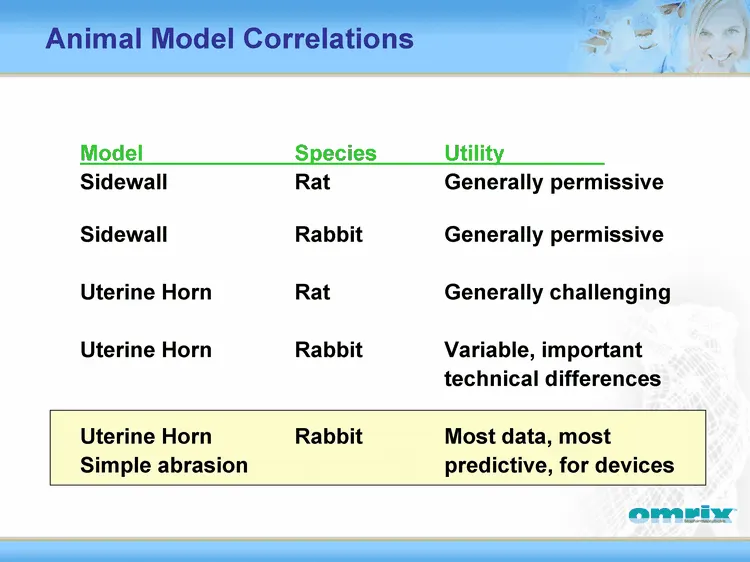
Animal Model Correlations Model Species Utility Sidewall Rat Generally permissive Sidewall Rabbit Generally permissive Uterine Horn Rat Generally challenging Uterine Horn Rabbit Variable, important technical differences Uterine Horn Rabbit Most data, most Simple abrasion predictive, for devices
Slide 76: Animal-Clinical Correlation: Rabbit Uterine Horn Models
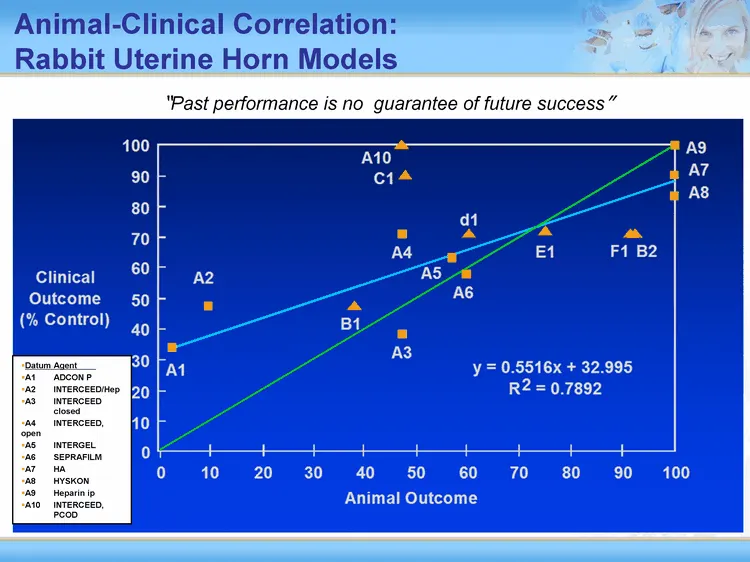
Animal-Clinical Correlation: Rabbit Uterine Horn Models Datum Agent A1 ADCON P A2 INTERCEED/Hep A3 INTERCEED closed A4 INTERCEED, open A5 INTERGEL A6 SEPRAFILM A7 HA A8 HYSKON A9 Heparin ip A10 INTERCEED, PCOD "Past performance is no guarantee of future success"
Slide 77: Abrasion Rabbit Uterine Horn Model
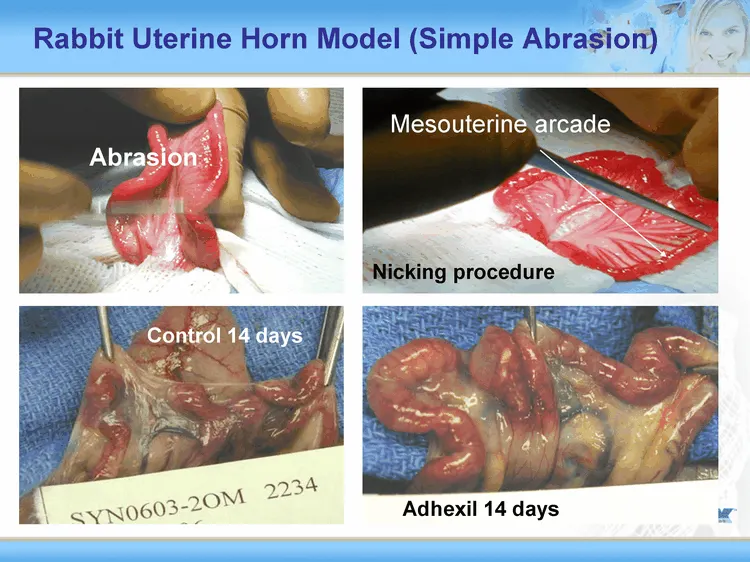
Abrasion Rabbit Uterine Horn Model (Simple Abrasion) Nicking procedure Mesouterine arcade Mesouterine arcade Mesouterine arcade Control 14 days Adhexil 14 days
Slide 78: Adhexil Reduces Adhesions With and Without Bleeding
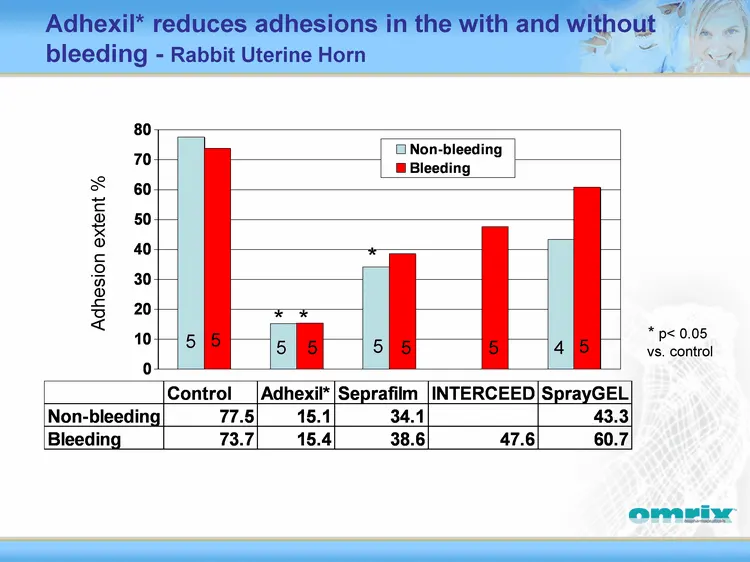
Adhexil* reduces adhesions in the with and without bleeding - Rabbit Uterine Horn Control Adhexil* Seprafilm INTERCEED SprayGEL Non-bleeding 77.5 15.1 34.1 43.3 Bleeding 73.7 15.4 38.6 47.6 60.7 Adhesion extent % 5 5 5 4 5 5 5 5 5 * * * * p< 0.05 vs. control vs. control vs. control
Slide 79: Does Adhexil Stack Up Against the Competition?
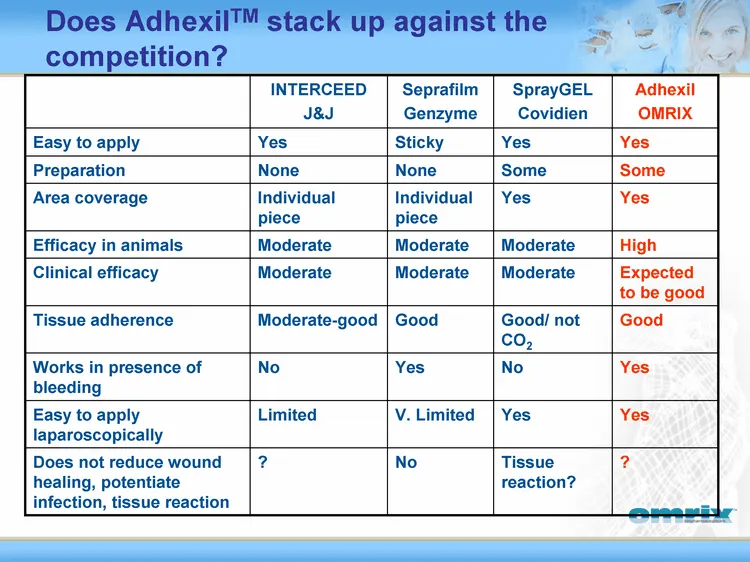
Does AdhexilTM stack up against the competition? INTERCEED J&J Seprafilm Genzyme SprayGEL Covidien Adhexil OMRIX Easy to apply Yes Sticky Yes Yes Preparation None None Some Some Area coverage Individual piece Individual piece Yes Yes Efficacy in animals Moderate Moderate Moderate High Clinical effic
Slide 80: Excellent Safety Profile
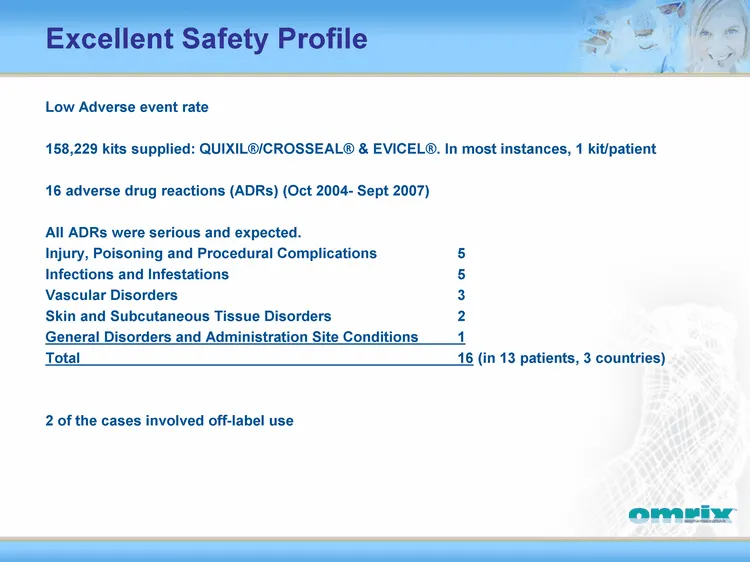
Excellent Safety Profile Low Adverse event rate 158,229 kits supplied: QUIXIL(r)/CROSSEAL(r) & EVICEL(r). In most instances, 1 kit/patient 16 adverse drug reactions (ADRs) (Oct 2004- Sept 2007) All ADRs were serious and expected. Injury, Poisoning and Procedural Complications 5 Infections and Infest
Slide 81: Adhexil Value Proposition
AdhexilTM Value Proposition Product with most/all ideal product characteristics High efficacy in predictive models + bleeding Excellent safety profile Natural biological polymers, mimic natural repair mechanism Can be used in other adhesions indications Little/no additional manufacturing investment
Slide 82: Clinical Evaluation of Adhexil: Program and Study Design
Clinical evaluation of AdhexilTM: Program and Study Design.
Slide 83: Phase I/II Clinical Study Objective
Phase I/II Clinical study - Objective To evaluate the safety and initial efficacy of Adhexil(tm) in preventing and/or reducing post-operative adhesions in patients undergoing surgery involving the ovaries.
Slide 84: Phase I/II Safety and Efficacy Parameters
Phase I/II Clinical study - Safety and Efficacy Parameters Safety evaluations will include the following parameters: Adverse events Clinically abnormal laboratory and coagulation assessments Efficacy evaluation will include the following parameters: Incidence Extent Severity of post-operative adhesi
Slide 85: Phase I/II Study Endpoints
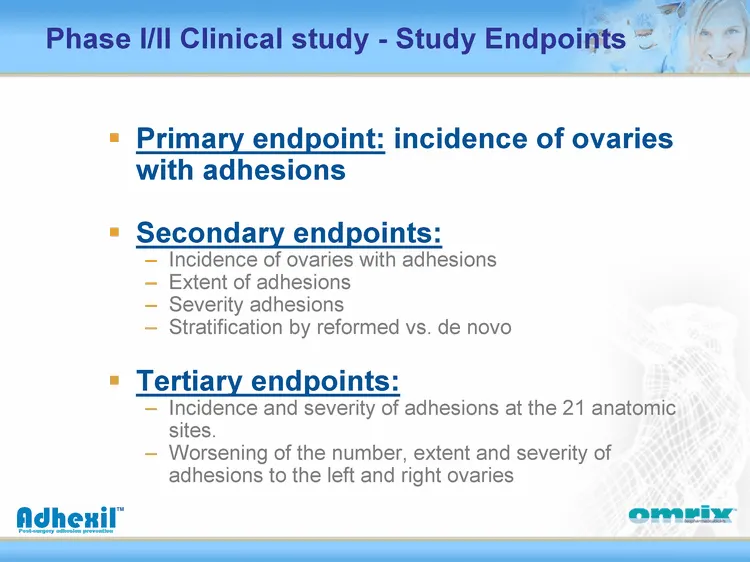
Phase I/II Clinical study - Study Endpoints Primary endpoint: incidence of ovaries with adhesions Secondary endpoints: Incidence of ovaries with adhesions Extent of adhesions Severity adhesions Stratification by reformed vs. de novo Tertiary endpoints: Incidence and severity of adhesions at the 21 a
Slide 86: Phase I/II Study Design Overview
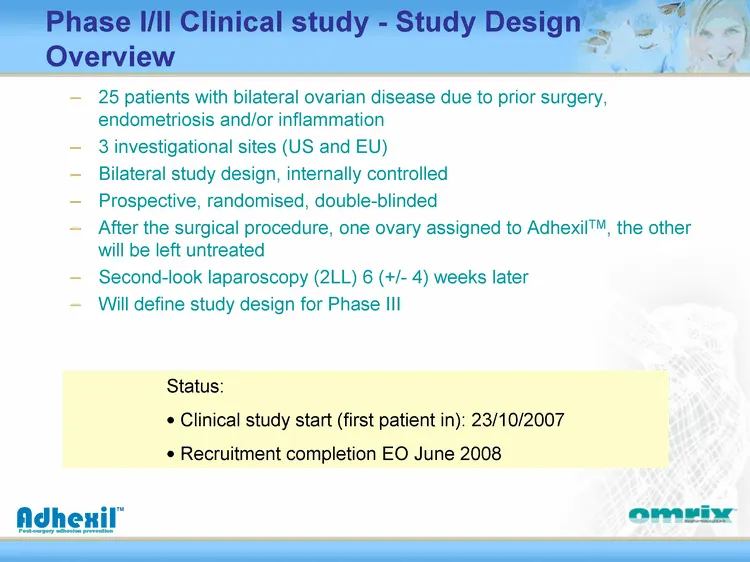
Phase I/II Clinical study - Study Design Overview 25 patients with bilateral ovarian disease due to prior surgery, endometriosis and/or inflammation 3 investigational sites (US and EU) Bilateral study design, internally controlled Prospective, randomised, double-blinded After the surgical procedure,
Slide 87: Adhexil Project Timelines
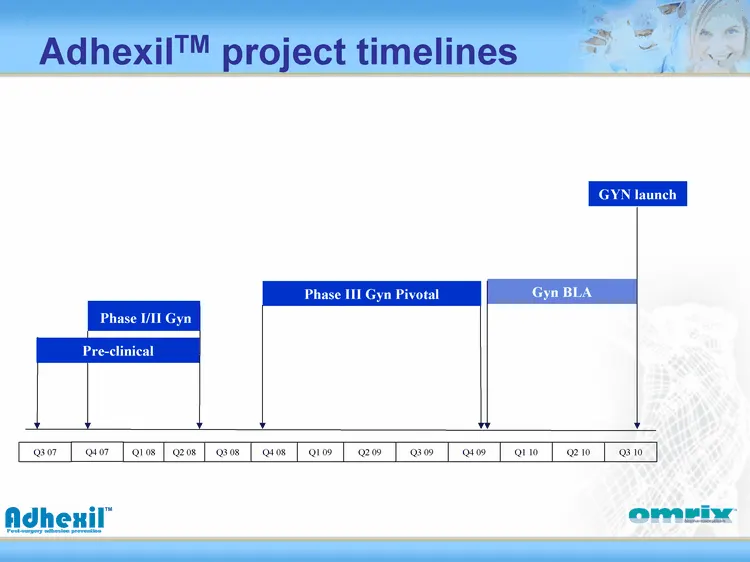
AdhexilTM project timelines Q4 07 Q1 08 Q2 09 Q1 10 Q2 10 Q3 09 GYN launch Q3 08 Phase III Gyn Pivotal Pre-clinical Q2 08 Q4 08 Q1 09 Q4 09 Q3 10 Q3 07 Phase I/II Gyn Gyn BLA
Slide 88: Conclusion
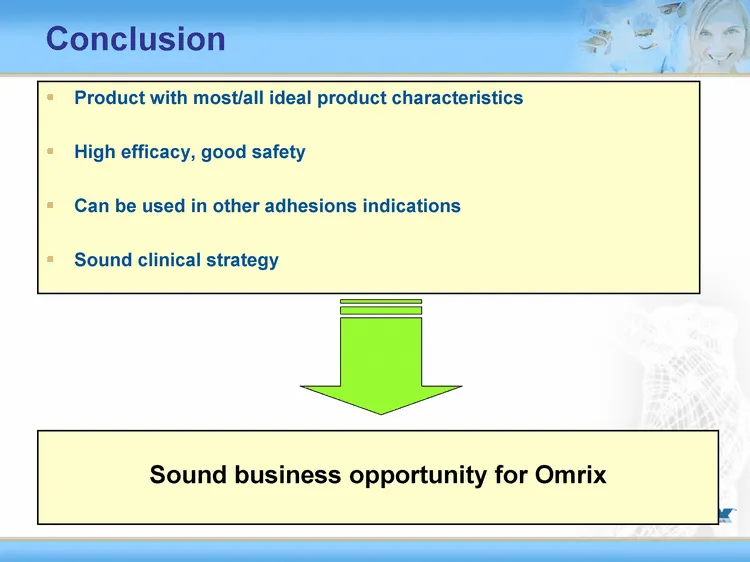
Conclusion Product with most/all ideal product characteristics High efficacy, good safety Can be used in other adhesions indications Sound clinical strategy Sound business opportunity for Omrix
Slide 89: Biologic Lung Volume Reduction (BLVR)
Biologic Lung Volume Reduction (BLVR) David Dove, MD President & CEO, Aeris Therapeutics, Inc.
Slide 90: Agenda
Agenda Aeris Overview Emphysema & pathophysiology Treatment approaches Biologic Lung Volume Reduction Importance of fibrin sealant Clinical strategy & results Competitive approaches Sales & Marketing Plans
Slide 91: Aeris Overview
Aeris Overview Specialty bio-pharmaceutical company developing innovative treatments to improve the lives of patients with emphysema and other lung diseases. World class expertise in pulmonary physiology, biology and clinical medicine Development efforts focused on lung volume reduction as a treatme
Slide 92: The Problem We Are Addressing: Emphysema
The problem we are addressing: Emphysema 3.8 million patients in the U.S. with Emphysema As many as 60 million patients worldwide Emphysema is a subset of COPD 4th leading cause of death; every 4 minutes another patient dies Only top killer with increasing mortality Direct medical costs of COPD in 2
Slide 93: Pathophysiology of Emphysema
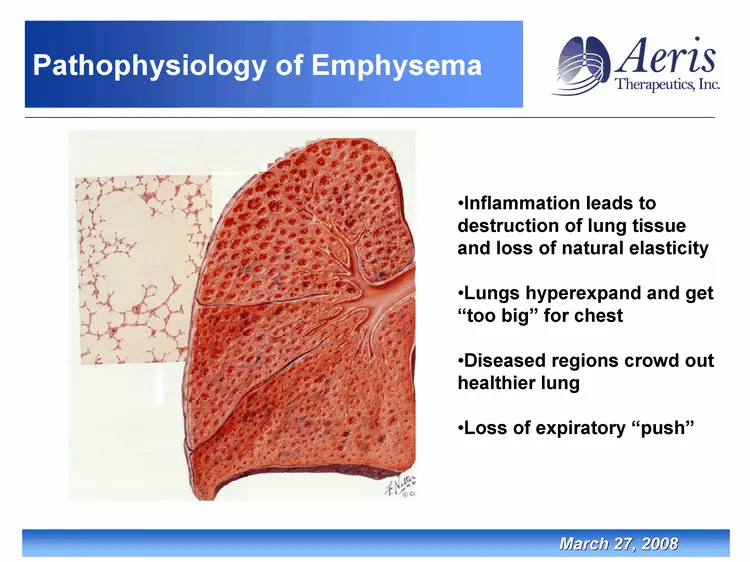
Pathophysiology of Emphysema Inflammation leads to destruction of lung tissue and loss of natural elasticity Lungs hyperexpand and get "too big" for chest Diseased regions crowd out healthier lung Loss of expiratory "push"
Slide 94: Emphysema Signs & Symptoms
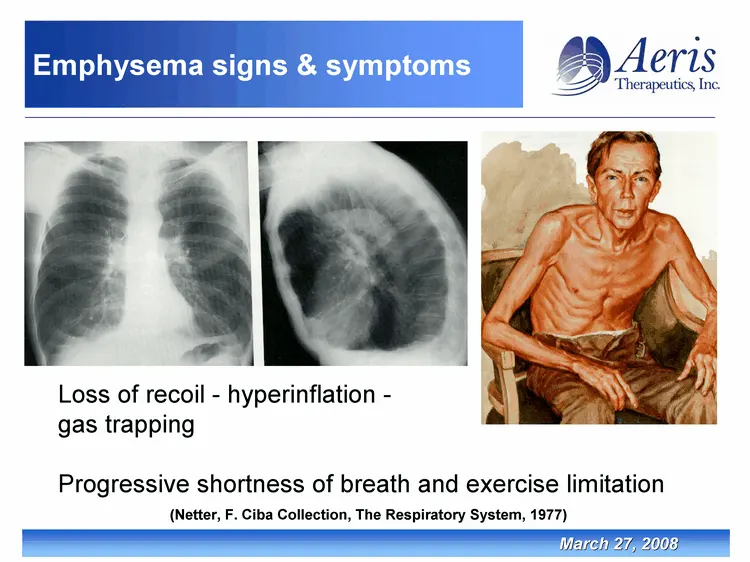
Emphysema signs & symptoms Loss of recoil - hyperinflation - gas trapping Progressive shortness of breath and exercise limitation (Netter, F. Ciba Collection, The Respiratory System, 1977)
Slide 95: Treatment Options for Emphysema
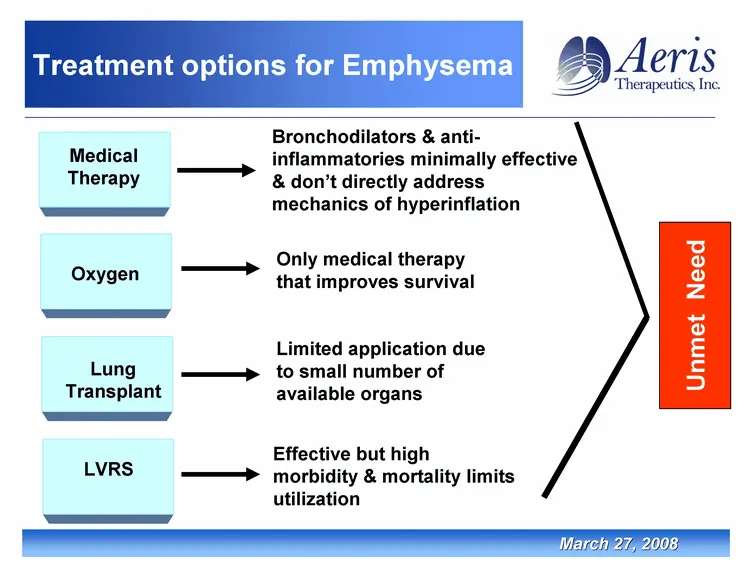
Treatment options for Emphysema Medical Therapy Oxygen Lung Transplant LVRS Bronchodilators & anti- inflammatories minimally effective & don't directly address mechanics of hyperinflation Only medical therapy that improves survival Limited application due to small number of available organs Effectiv
Slide 96: Lung Volume Reduction Rationale
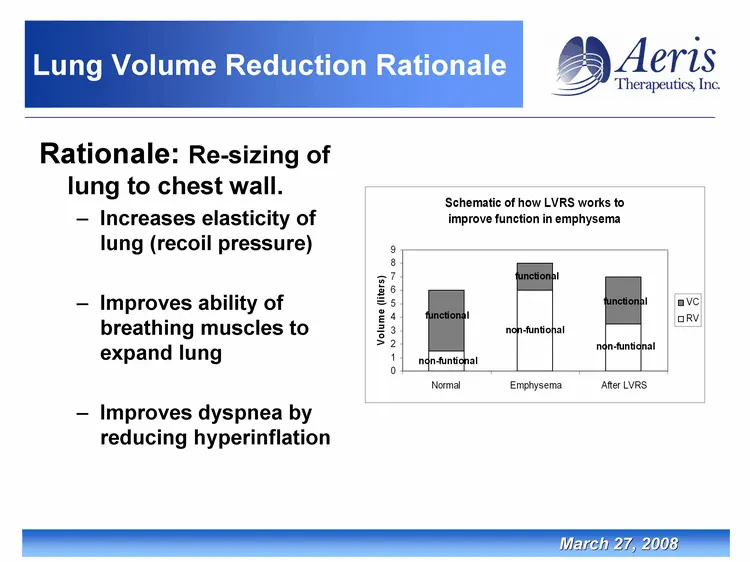
Lung Volume Reduction Rationale Rationale: Re-sizing of lung to chest wall. Increases elasticity of lung (recoil pressure) Improves ability of breathing muscles to expand lung Improves dyspnea by reducing hyperinflation
Slide 97: Validation: National Emphysema Treatment Trial (NETT)
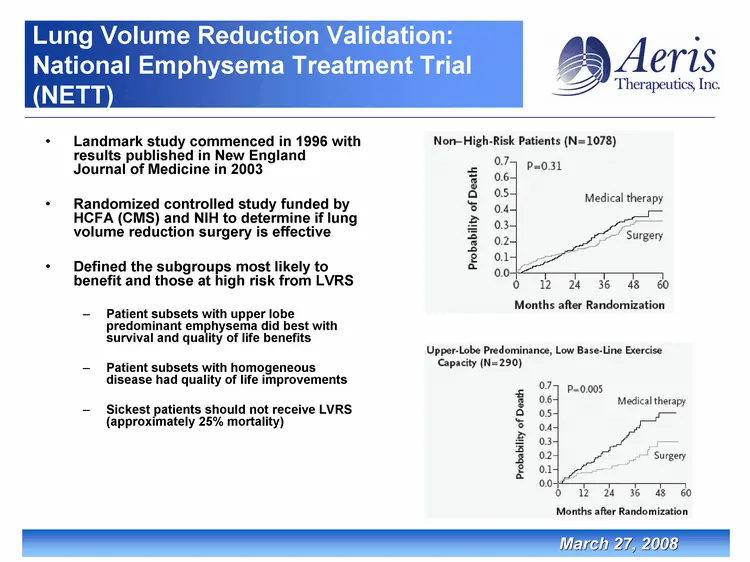
Lung Volume Reduction Validation: National Emphysema Treatment Trial (NETT) Landmark study commenced in 1996 with results published in New England Journal of Medicine in 2003 Randomized controlled study funded by HCFA (CMS) and NIH to determine if lung volume reduction surgery is effective Defined t
Slide 98: Results of NETT
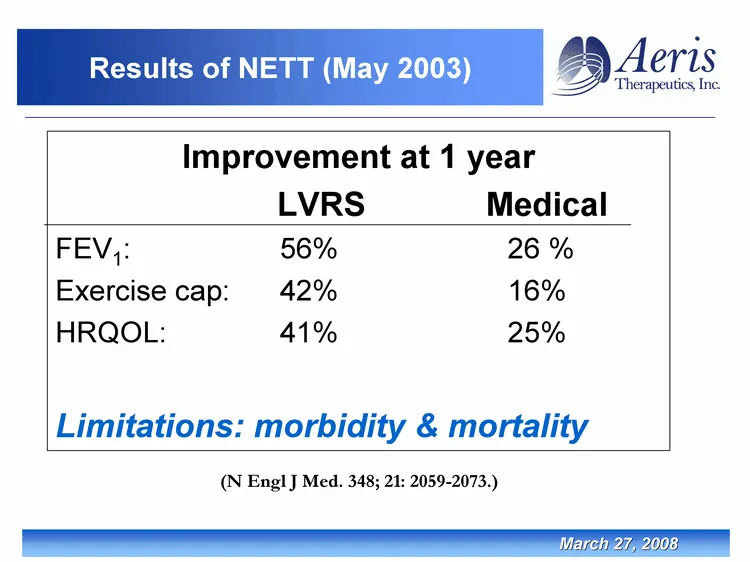
Results of NETT (May 2003) Improvement at 1 year LVRS Medical FEV1: 56% 26 % Exercise cap: 42% 16% HRQOL: 41% 25% Limitations: morbidity & mortality (N Engl J Med. 348; 21: 2059-2073.)
Slide 99: Results of NETT: Mortality and Morbidity
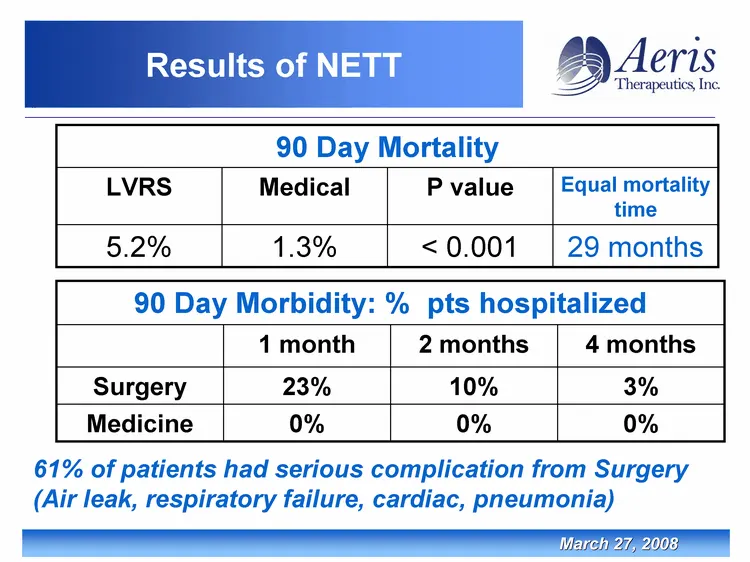
Results of NETT 90 Day Mortality 90 Day Mortality 90 Day Mortality 90 Day Mortality LVRS Medical P value Equal mortality time 5.2% 1.3% < 0.001 29 months 61% of patients had serious complication from Surgery (Air leak, respiratory failure, cardiac, pneumonia) 90 Day Morbidity: % pts hospitalized 90
Slide 100: Conclusions from NETT
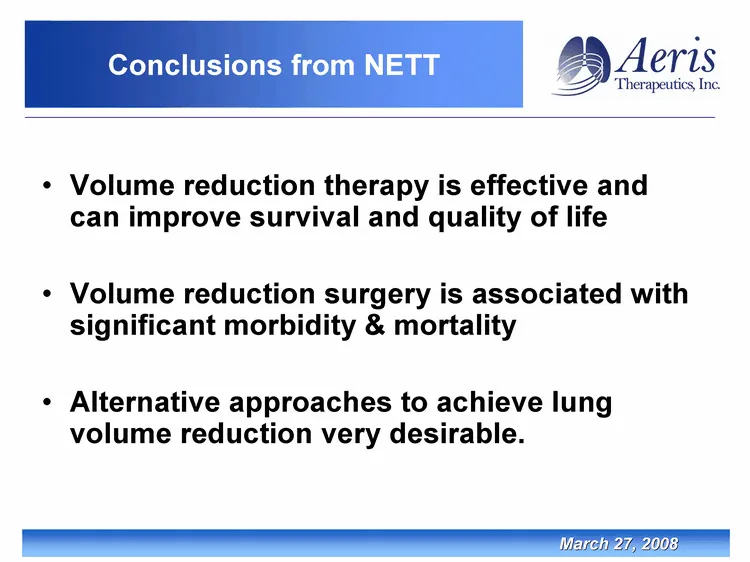
Conclusions from NETT Volume reduction therapy is effective and can improve survival and quality of life Volume reduction surgery is associated with significant morbidity & mortality Alternative approaches to achieve lung volume reduction very desirable.
Slide 101: Lead Product: Biologic Lung Volume Reduction (BLVR)
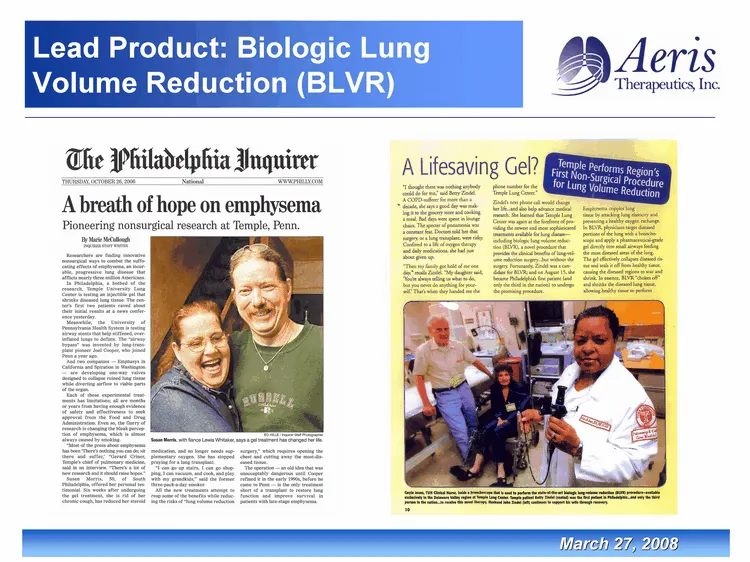
Lead Product: Biologic Lung Volume Reduction (BLVR)
Slide 102: Biologic Lung Volume Reduction
Biologic Lung Volume Reduction Lung regions selected for treatment using CT image Patient is consciously sedated Biologic & drug materials are bronchoscopically administered into targeted lung subsegments Initiates a remodeling reaction that shrinks & collapses damaged lung tissue over 3-6 weeks All
Slide 103: The Aeris BLVR System
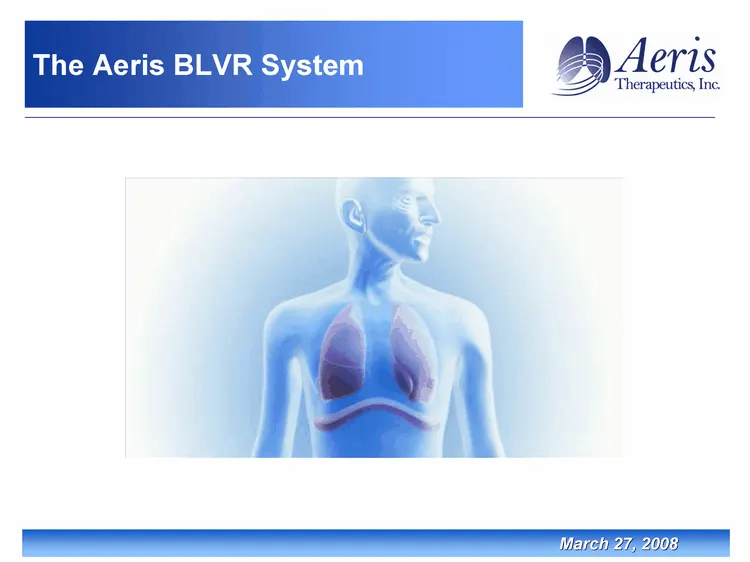
The Aeris BLVR System AHAeris Therapeutics, Inc. Marchi 272008;
Slide 104: Biologic Lung Volume Reduction System
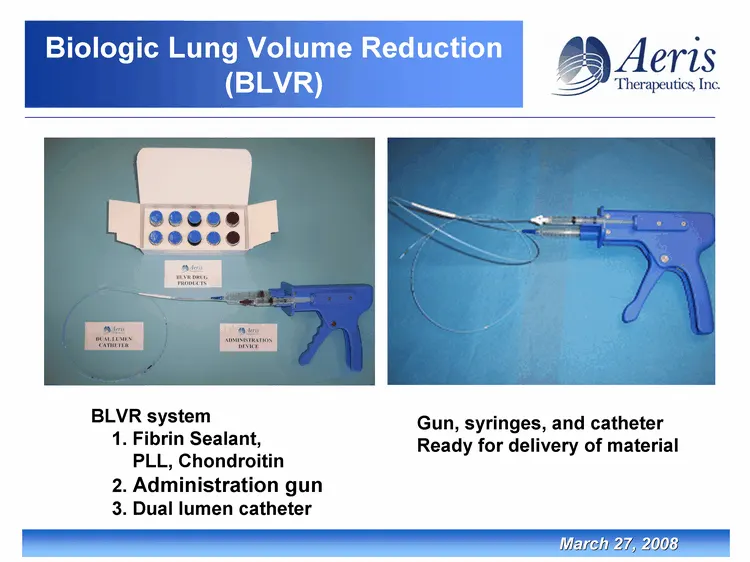
Biologic Lung Volume Reduction (BLVR) BLVR system 1. Fibrin Sealant, PLL, Chondroitin 2. Administration gun 3. Dual lumen catheter Gun, syringes, and catheter Ready for delivery of material
Slide 105: Choice of Fibrin Sealant/Omrix BAC2/Thrombin
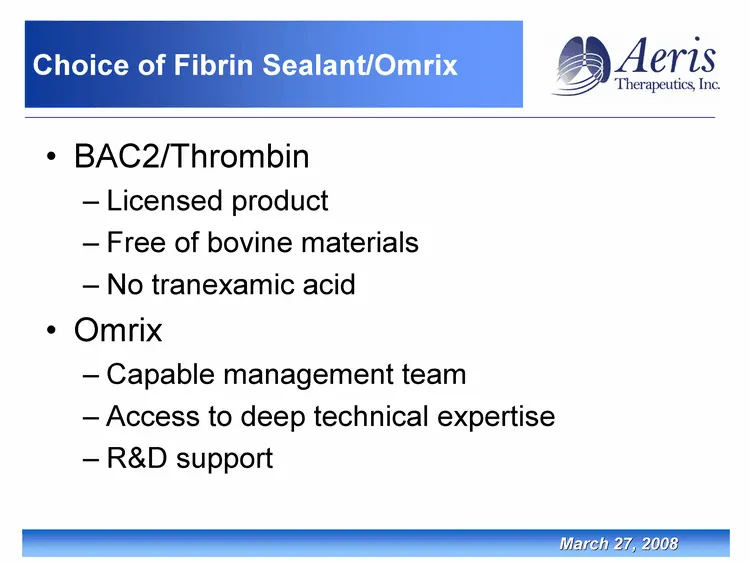
Choice of Fibrin Sealant/Omrix BAC2/Thrombin Licensed product Free of bovine materials No tranexamic acid Omrix Capable management team Access to deep technical expertise R&D support
Slide 106: Omrix's Supplemented Fibrin Sealants
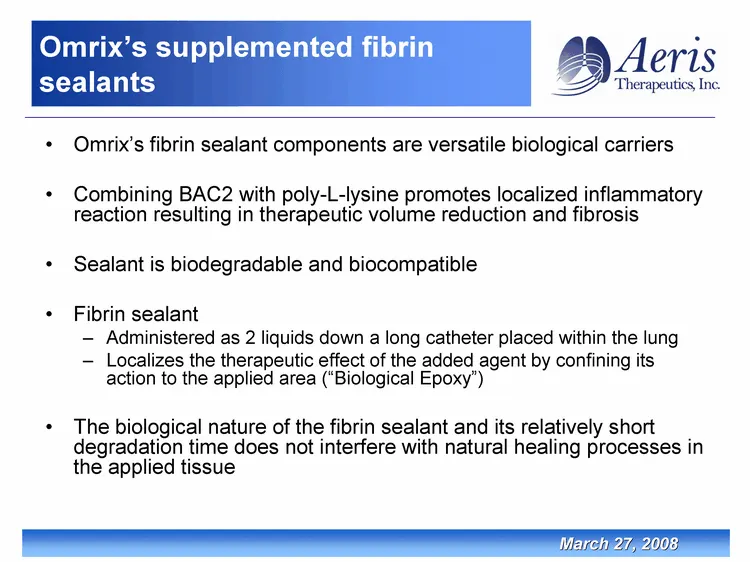
Omrix's supplemented fibrin sealants Omrix's fibrin sealant components are versatile biological carriers Combining BAC2 with poly-L-lysine promotes localized inflammatory reaction resulting in therapeutic volume reduction and fibrosis Sealant is biodegradable and biocompatible Fibrin sealant Adminis
Slide 107: BLVR Phase 2 Clinical Trials Strategy
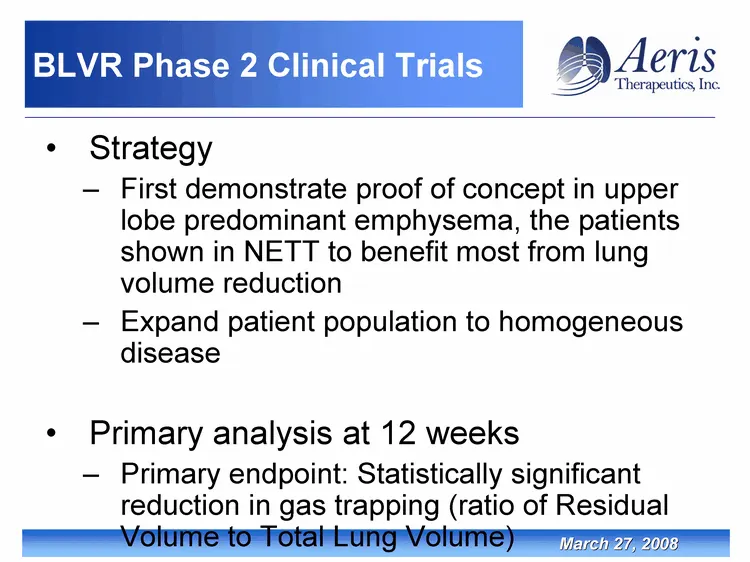
BLVR Phase 2 Clinical Trials Strategy First demonstrate proof of concept in upper lobe predominant emphysema, the patients shown in NETT to benefit most from lung volume reduction Expand patient population to homogeneous disease Primary analysis at 12 weeks Primary endpoint: Statistically significan
Slide 108: BLVR Phase 2 Clinical Trial Status
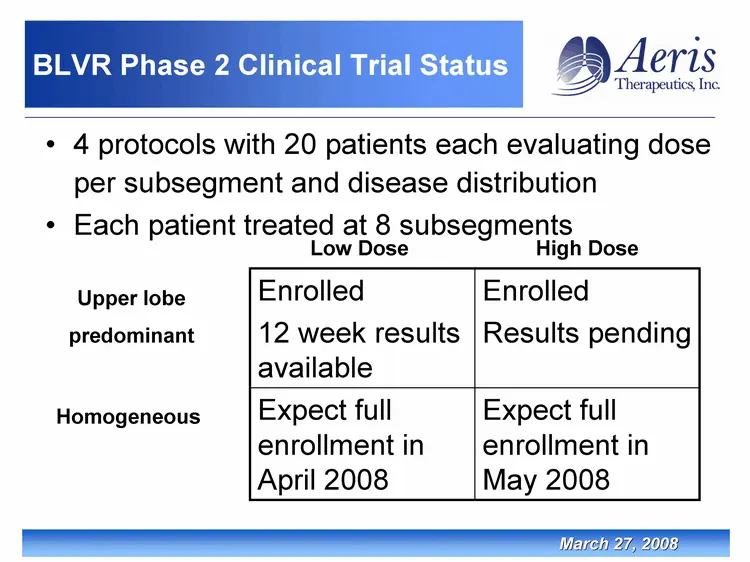
BLVR Phase 2 Clinical Trial Status 4 protocols with 20 patients each evaluating dose per subsegment and disease distribution Each patient treated at 8 subsegments Enrolled 12 week results available Enrolled Results pending Expect full enrollment in April 2008 Expect full enrollment in May 2008 Low D
Slide 109: BLVR Phase 2 Experience
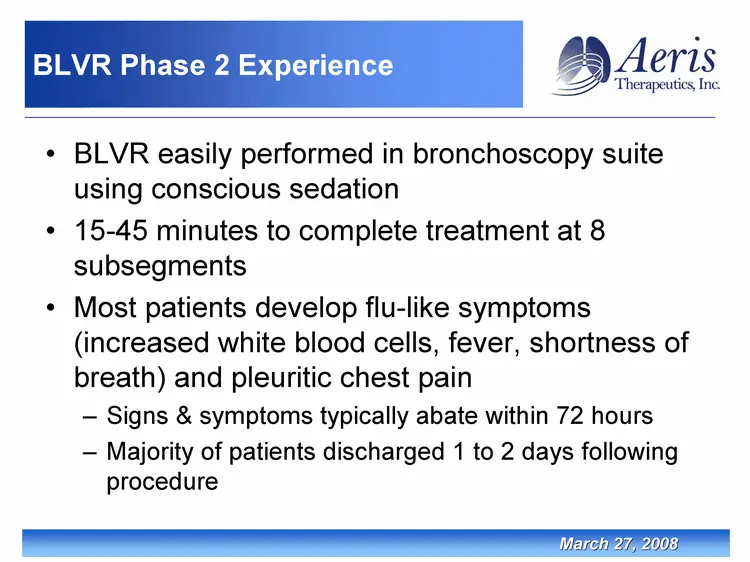
BLVR Phase 2 Experience BLVR easily performed in bronchoscopy suite using conscious sedation 15-45 minutes to complete treatment at 8 subsegments Most patients develop flu-like symptoms (increased white blood cells, fever, shortness of breath) and pleuritic chest pain Signs & symptoms typically abat
Slide 110: Initial Patient Experience
Initial Patient Experience
Slide 111: Comparison of Low Dose BLVR Data with LVRS
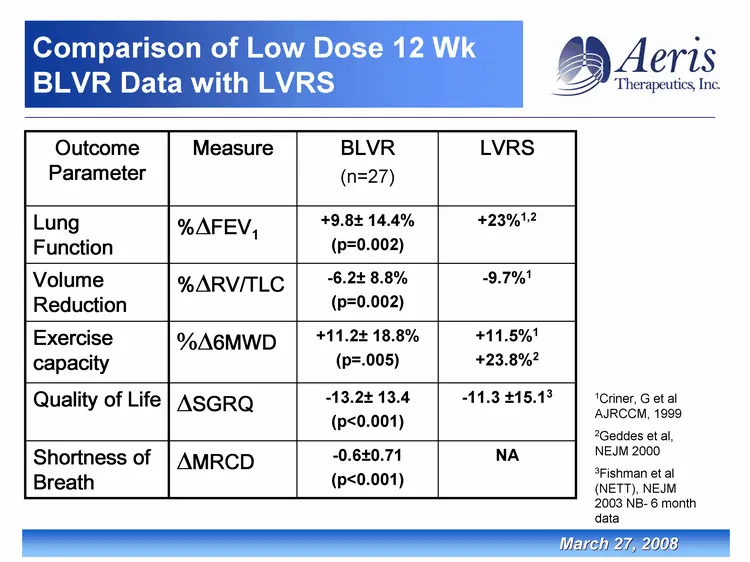
Comparison of Low Dose 12 Wk BLVR Data with LVRS Outcome Parameter Measure BLVR (n=27) LVRS Lung Function %DFEV1 +9.8+- 14.4% (p=0.002) +23%1,2 Volume Reduction %DRV/TLC -6.2+- 8.8% (p=0.002) -9.7%1 Exercise capacity %D6MWD +11.2+- 18.8% (p=.005) +11.5%1 +23.8%2 Quality of Life DSGRQ -13.2+- 13.4 (p
Slide 112: Competitive Matrix
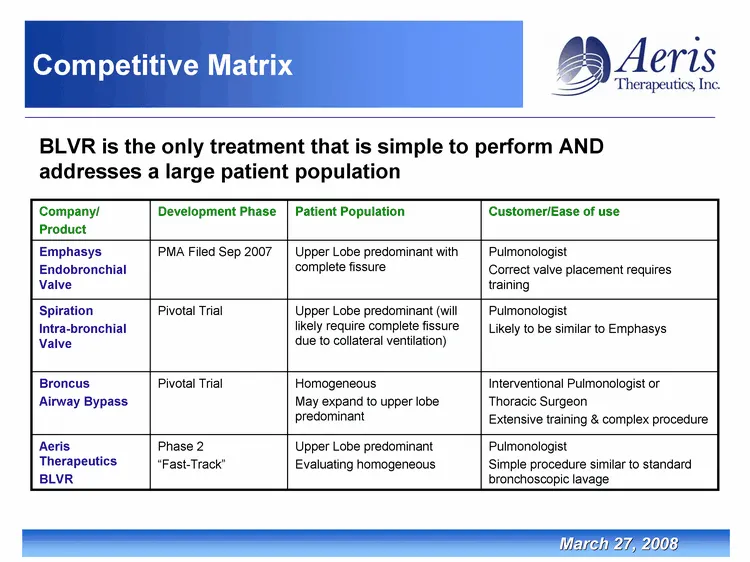
Competitive Matrix Company/ Product Development Phase Patient Population Customer/Ease of use Emphasys Endobronchial Valve PMA Filed Sep 2007 Upper Lobe predominant with complete fissure Pulmonologist Correct valve placement requires training Spiration Intra-bronchial Valve Pivotal Trial Upper Lobe
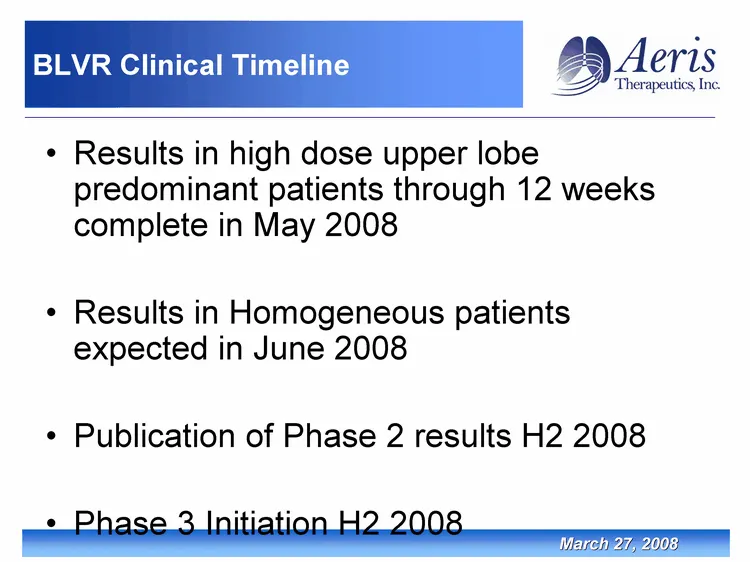
Slide 113: BLVR Clinical Timeline
BLVR Clinical Timeline Results in high dose upper lobe predominant patients through 12 weeks complete in May 2008 Results in Homogeneous patients expected in June 2008 Publication of Phase 2 results H2 2008 Phase 3 Initiation H2 2008 BLA Submission 2010
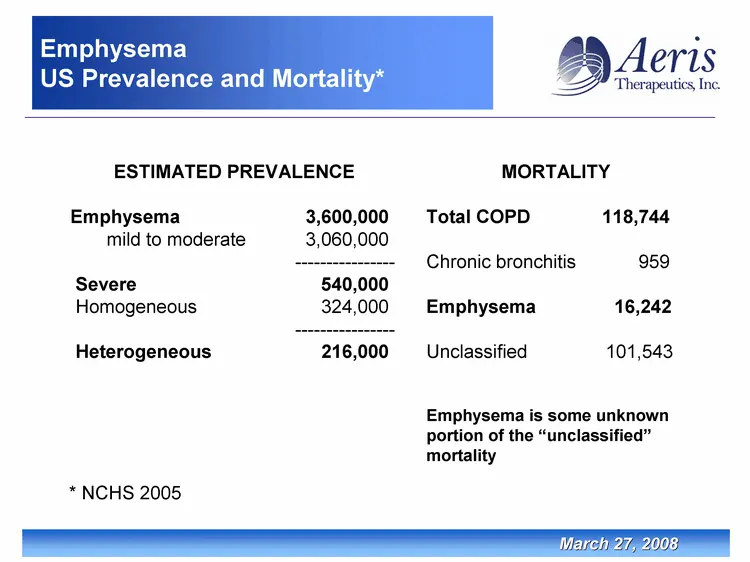
Slide 114: Emphysema US Prevalence and Mortality
Emphysema US Prevalence and Mortality* ESTIMATED PREVALENCE Emphysema 3,600,000 mild to moderate 3,060,000 ---------------- Severe 540,000 Homogeneous 324,000 ---------------- Heterogeneous 216,000 MORTALITY Total COPD 118,744 Chronic bronchitis 959 Emphysema 16,242 Unclassified 101,543 Emphysema is
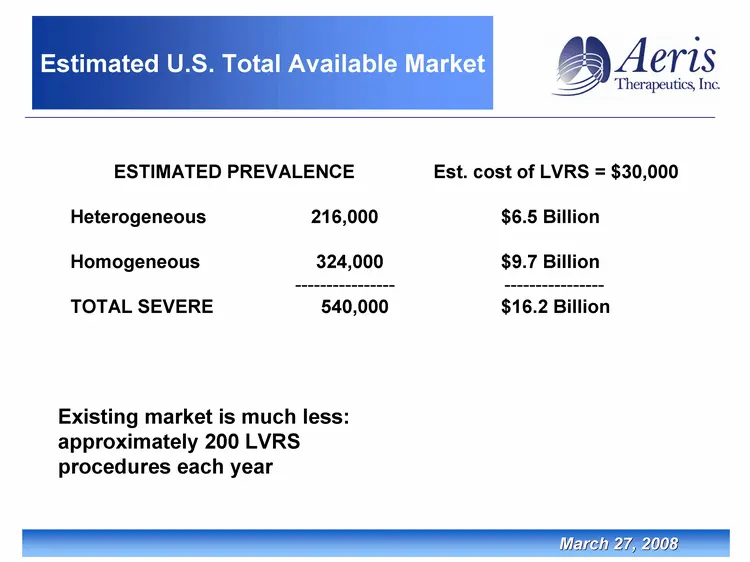
Slide 115: Estimated U.S. Total Available Market
Estimated U.S. Total Available Market ESTIMATED PREVALENCE Heterogeneous 216,000 Homogeneous 324,000 ---------------- TOTAL SEVERE 540,000 Est. cost of LVRS = $30,000 $6.5 Billion $9.7 Billion ---------------- $16.2 Billion Existing market is much less: approximately 200 LVRS procedures each year
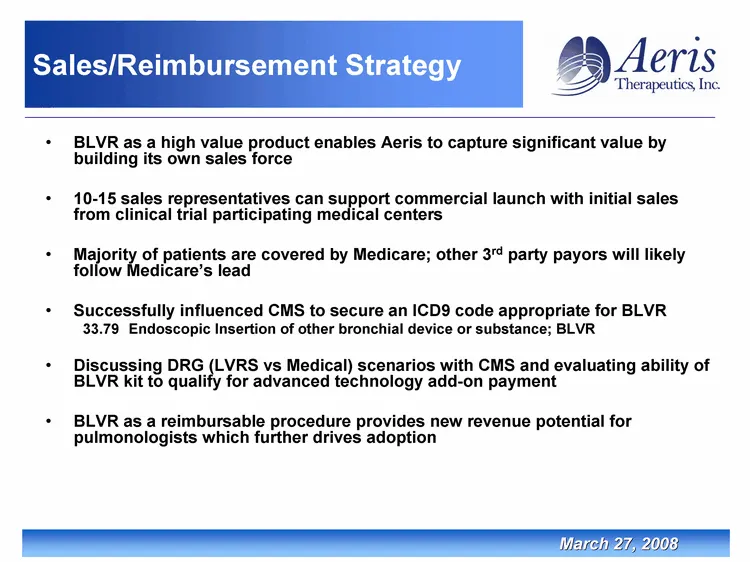
Slide 116: Sales/Reimbursement Strategy
Sales/Reimbursement Strategy BLVR as a high value product enables Aeris to capture significant value by building its own sales force 10-15 sales representatives can support commercial launch with initial sales from clinical trial participating medical centers Majority of patients are covered by Medi
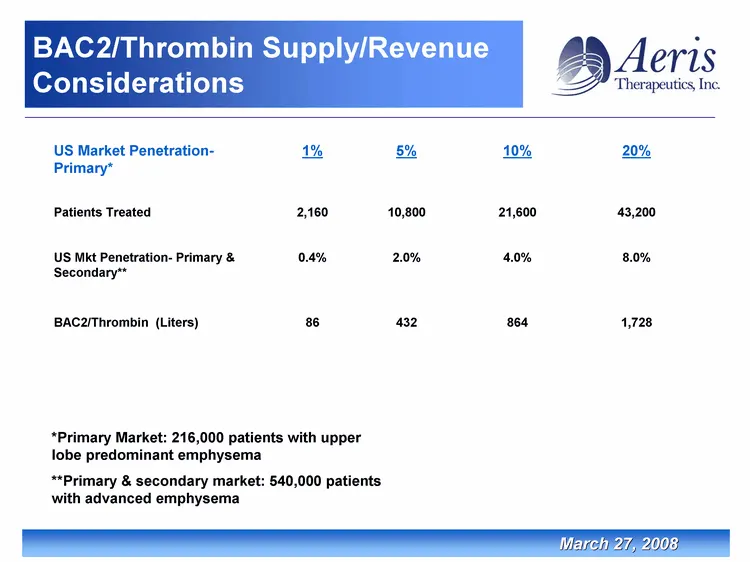
Slide 117: BAC2/Thrombin Supply/Revenue Considerations
BAC2/Thrombin Supply/Revenue Considerations US Market Penetration- Primary* 1% 5% 10% 20% Patients Treated 2,160 10,800 21,600 43,200 US Mkt Penetration- Primary & Secondary** 0.4% 2.0% 4.0% 8.0% BAC2/Thrombin (Liters) 86 432 864 1,728 *Primary Market: 216,000 patients with upper lobe predominant em
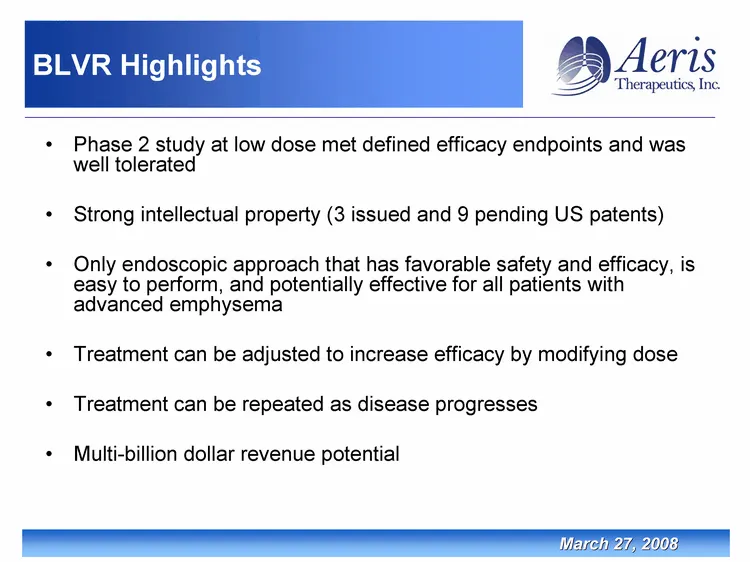
Slide 118: BLVR Highlights
BLVR Highlights Phase 2 study at low dose met defined efficacy endpoints and was well tolerated Strong intellectual property (3 issued and 9 pending US patents) Only endoscopic approach that has favorable safety and efficacy, is easy to perform, and potentially effective for all patients with advanc

Slide 119: Closing Remarks
Closing Remarks Robert Taub, MBA Chief Executive Officer
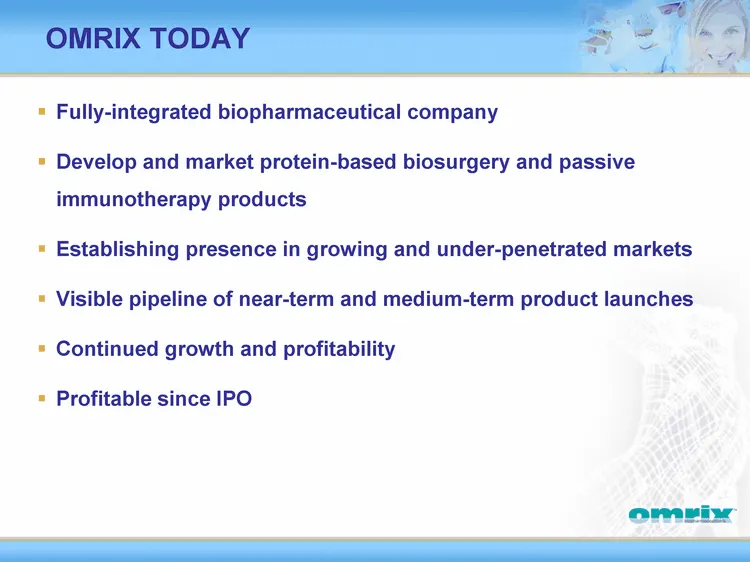
Slide 120: Omrix Today
OMRIX TODAY Fully-integrated biopharmaceutical company Develop and market protein-based biosurgery and passive immunotherapy products Establishing presence in growing and under-penetrated markets Visible pipeline of near-term and medium-term product launches Continued growth and profitability Profit
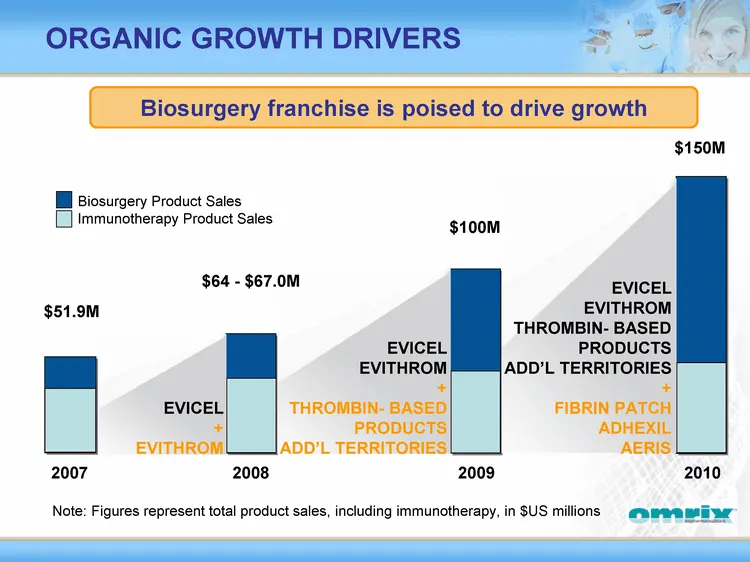
Slide 121: Organic Growth Drivers
ORGANIC GROWTH DRIVERS 2007 2008 2010 2009 EVICEL + EVITHROM EVICEL EVITHROM + THROMBIN- BASED PRODUCTS ADD'L TERRITORIES EVICEL EVITHROM THROMBIN- BASED PRODUCTS ADD'L TERRITORIES + FIBRIN PATCH ADHEXIL AERIS $51.9M $64 - $67.0M $150M $100M Biosurgery franchise is poised to drive growth Note: Figur
Slide 122: Upcoming Milestones
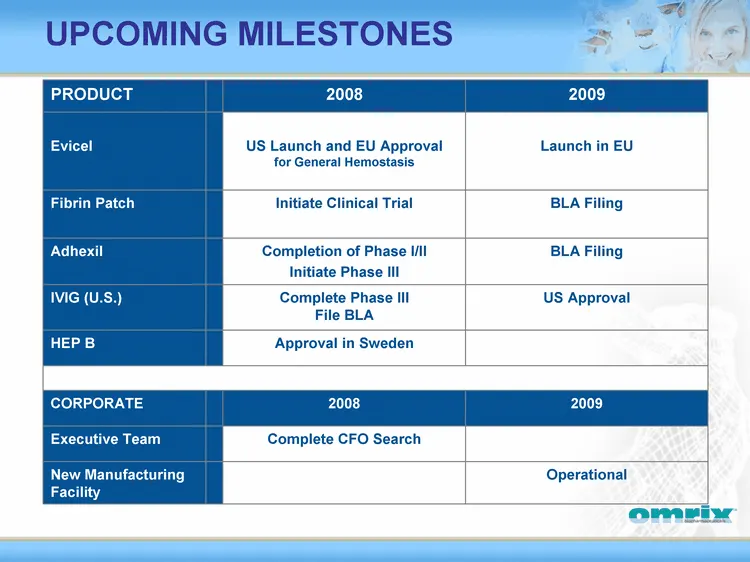
UPCOMING MILESTONES PRODUCT 2008 2009 Evicel US Launch and EU Approval for General Hemostasis Launch in EU Fibrin Patch Initiate Clinical Trial BLA Filing Adhexil Completion of Phase I/II Initiate Phase III BLA Filing IVIG (U.S.) Complete Phase III File BLA US Approval HEP B Approval in Sweden CORPO
Slide 123: Previous 2008 Guidance
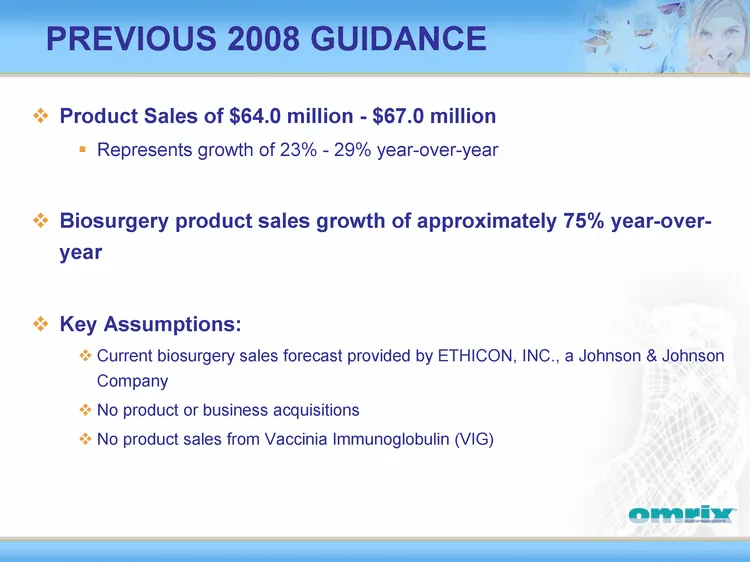
PREVIOUS 2008 GUIDANCE Product Sales of $64.0 million - $67.0 million Represents growth of 23% - 29% year-over-year Biosurgery product sales growth of approximately 75% year-over- year Key Assumptions: Current biosurgery sales forecast provided by ETHICON, INC., a Johnson & Johnson Company No produc
Slide 124: Additional Guidance Considerations
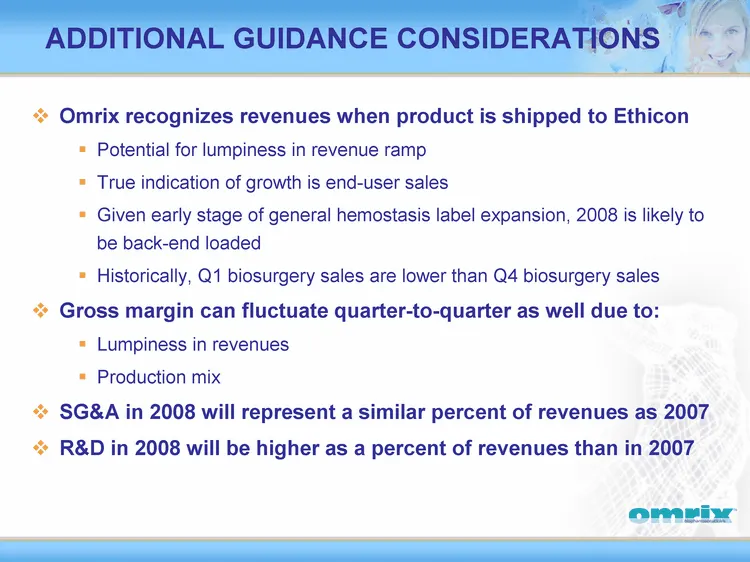
ADDITIONAL GUIDANCE CONSIDERATIONS Omrix recognizes revenues when product is shipped to Ethicon Potential for lumpiness in revenue ramp True indication of growth is end-user sales Given early stage of general hemostasis label expansion, 2008 is likely to be back-end loaded Historically, Q1 biosurger
Slide 125: Guidance Update
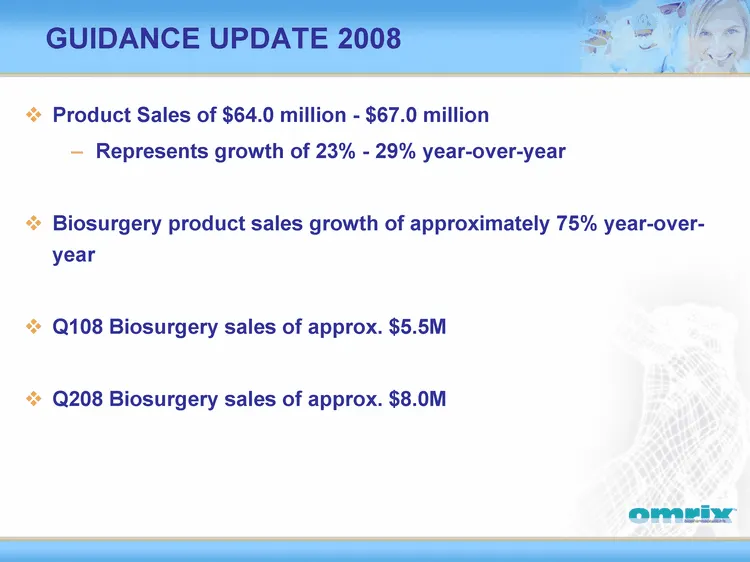
GUIDANCE UPDATE 2008 Product Sales of $64.0 million - $67.0 million Represents growth of 23% - 29% year-over-year Biosurgery product sales growth of approximately 75% year-over- year Q108 Biosurgery sales of approx. $5.5M Q208 Biosurgery sales of approx. $8.0M
Slide 126: Key Takeaways
KEY TAKEAWAYS Diversified business model with two distinct buy synergistic platforms, with biosurgery products likely to lead growth over the next few years Evicel sales are growing rapidly in a substantial market with significant additional growth opportunities Multiple other significant products u

Slide 127: Analyst & Investor Day: Perspectives in Biosurgery
NASDAQ: OMRI Innovative Solutions for a Healthier World Analyst & Investor Day March 27, 2008 "PERSPECTIVES IN BIOSURGERY"
Source: SEC EDGAR · 8-K filed Mar 27, 2008