uniQure N.V. · NASDAQ:QURE
uniQure — J.P. Morgan Healthcare Conference 2024
47 slides from uniQure's conference presentation, January 2024

Slide 1: Leadership in Gene Therapy
Leadership in Gene Therapy Corporate Presentation January 2024 Ashley, Huntington’s disease patient advocate
Slide 2: Disclaimer
Disclaimer This presentation contains forward-looking statements within the meaning of Section 27A of the Securities Act of 1933, as amended, and Section 21E of the Securities Exchange Act of 1934, as amended. All statements other than statements of historical fact are forward-looking statements, wh

Slide 3: Our mission is to reimagine the future of medicine
— Rob Clinical trial patient for etranacogene dezaparvovec, Toledo, Ohio Our mission is to reimagine the future of medicine by delivering innovative cures that transform lives. LEADERSHIP IN GENE THERAPY J AJ N ANUU AR Y Y2 022042 4 | AR 33
Slide 4: Corporate investment highlights: 2024
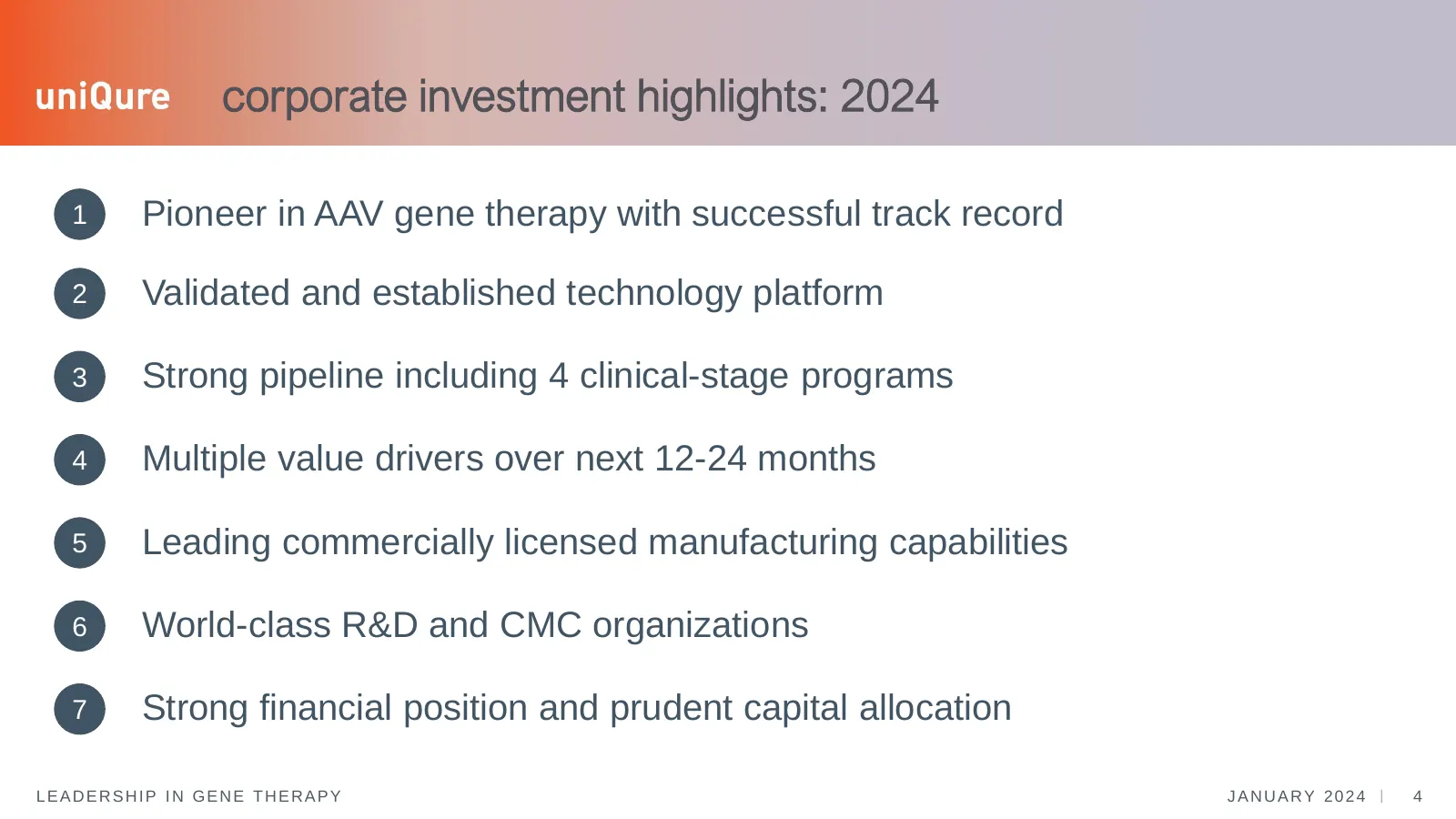
corporate investment highlights: 2024 1 Pioneer in AAV gene therapy with successful track record 2 Validated and established technology platform 3 Strong pipeline including 4 clinical-stage programs 4 Multiple value drivers over next 12-24 months 5 Leading commercially licensed manufacturing capabil
Slide 5: Our history of innovation
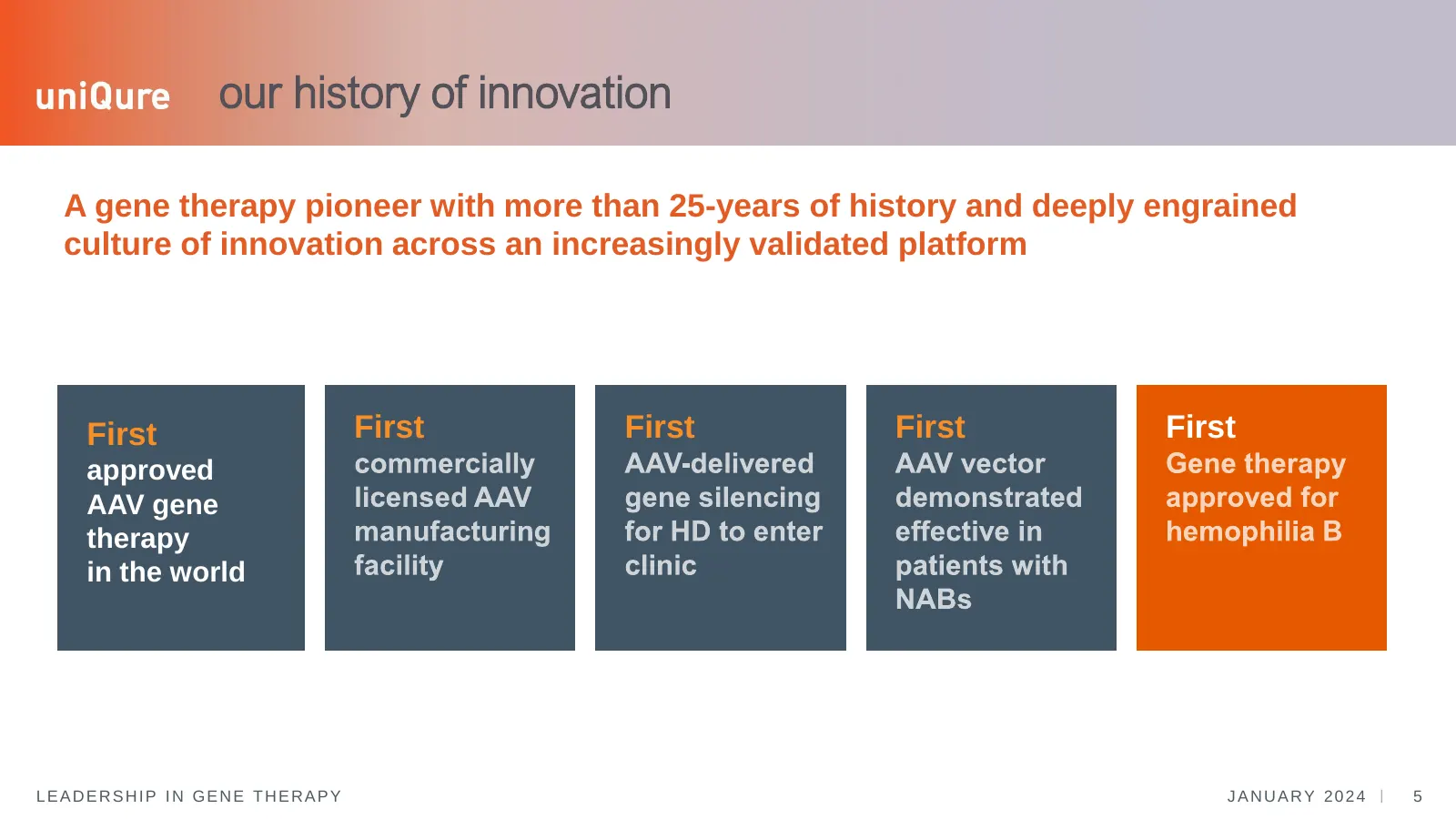
our history of innovation A gene therapy pioneer with more than 25-years of history and deeply engrained culture of innovation across an increasingly validated platform First First First First First approved AAV gene therapy in the world LEADERSHIP IN GENE THERAPY JANUARY 2024 | 5
Slide 6: A case study in delivering value through innovation
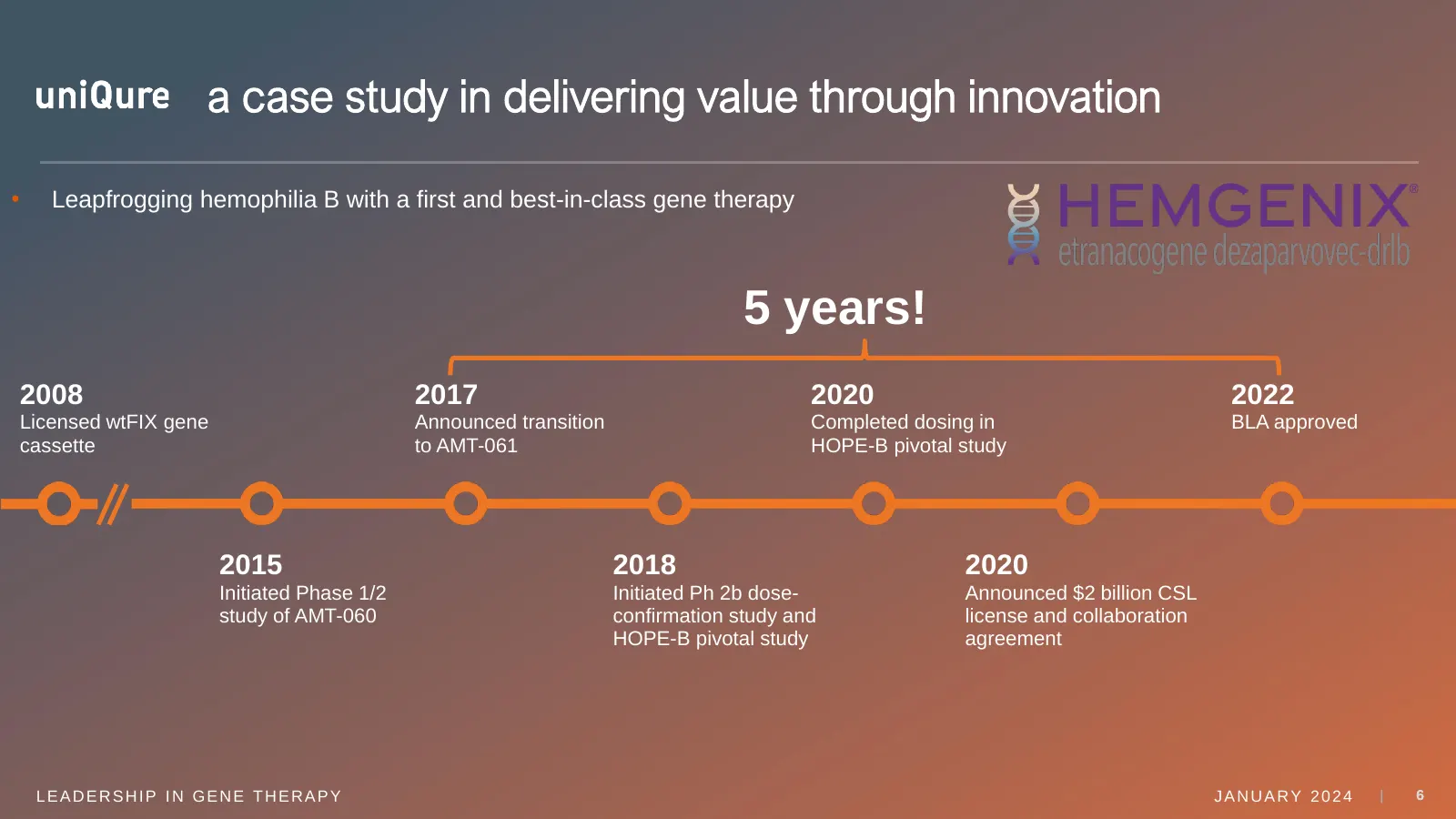
a case study in delivering value through innovation • Leapfrogging hemophilia B with a first and best-in-class gene therapy 5 years! 2008 2017 2020 2022 Licensed wtFIX gene Announced transition Completed dosing in BLA approved cassette to AMT-061 HOPE-B pivotal study 2015 2018 2020 Initiated Phase 1
Slide 7: Key corporate achievements of 2023
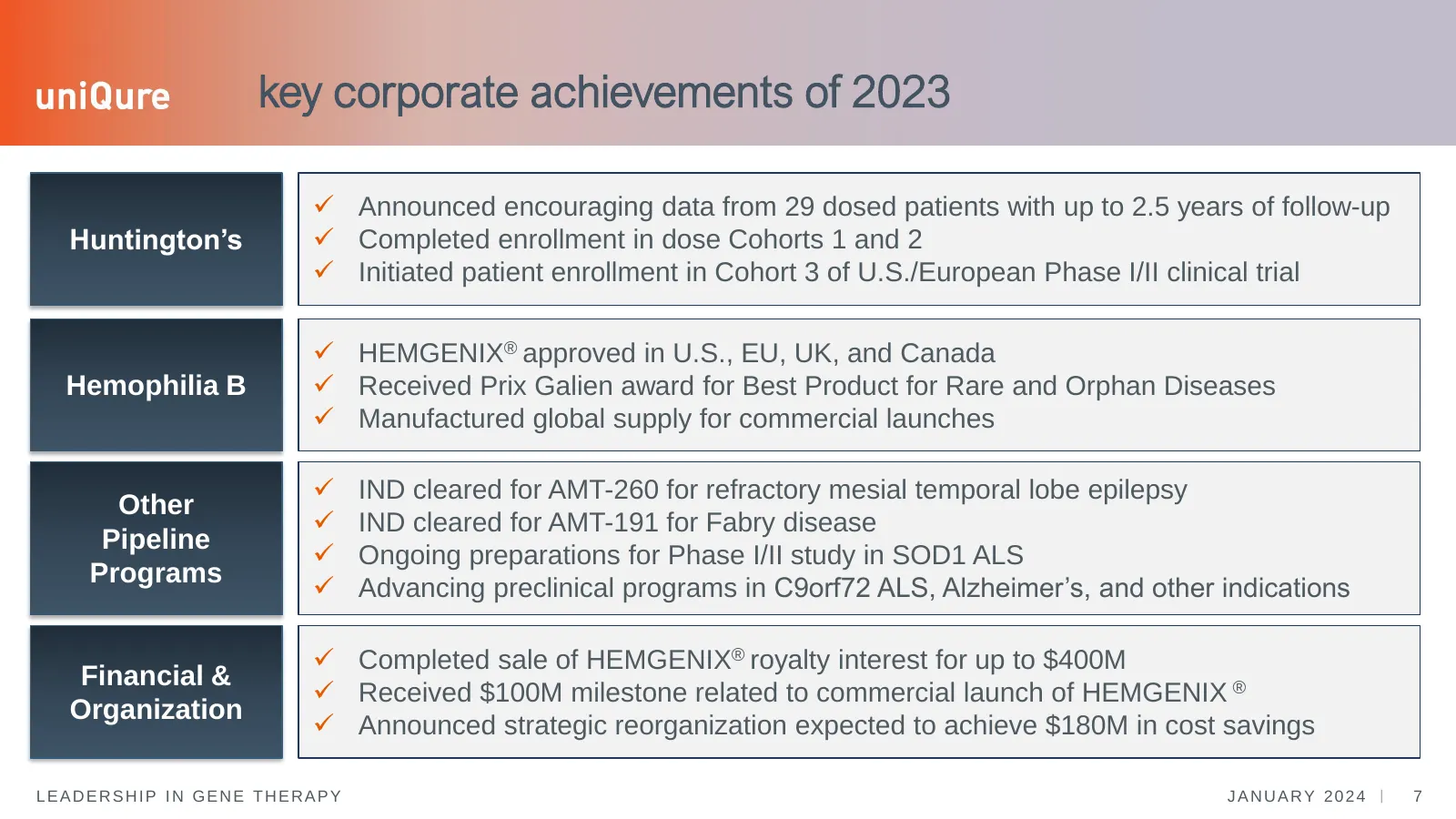
key corporate achievements of 2023 ✓ Announced encouraging data from 29 dosed patients with up to 2.5 years of follow-up Huntington’s ✓ Completed enrollment in dose Cohorts 1 and 2 ✓ Initiated patient enrollment in Cohort 3 of U.S./European Phase I/II clinical trial ✓ HEMGENIX® approved in U.S., EU,
Slide 8: Key milestones for 2024
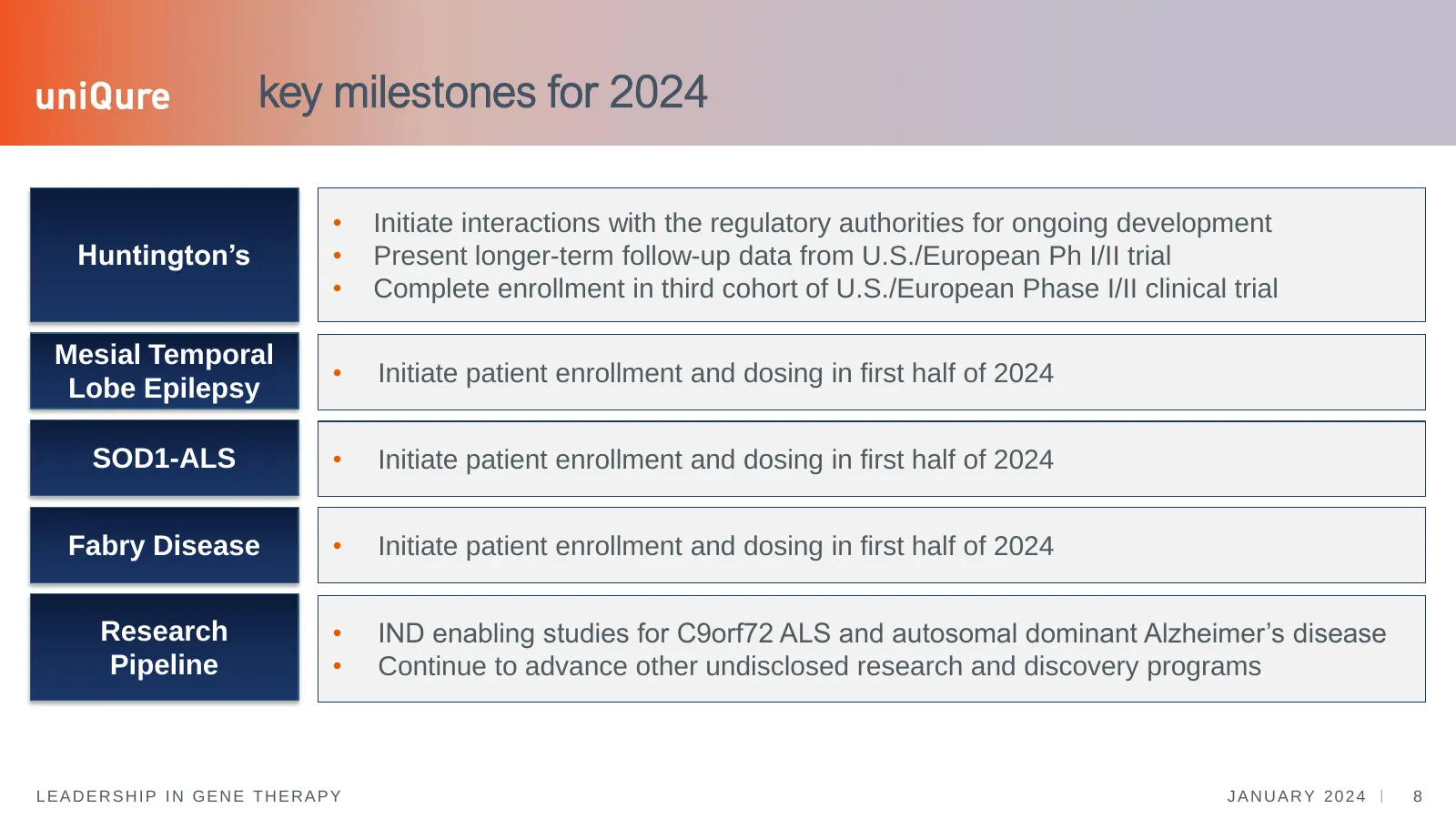
key milestones for 2024 • Initiate interactions with the regulatory authorities for ongoing development Huntington’s • Present longer-term follow-up data from U.S./European Ph I/II trial • Complete enrollment in third cohort of U.S./European Phase I/II clinical trial Mesial Temporal • Initiate patie
Slide 9: Our Research and Development Pipeline
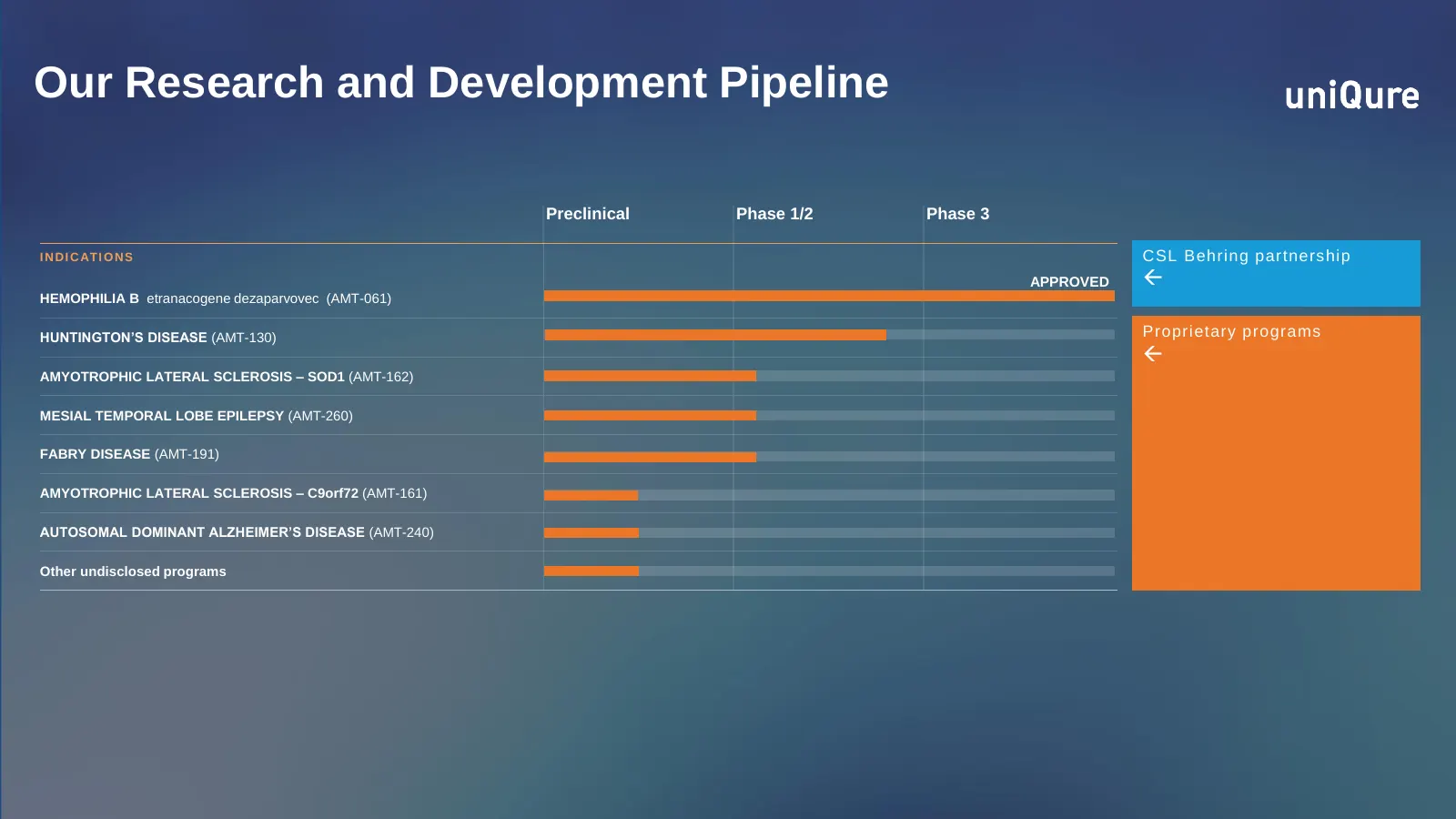
Our Research and Development Pipeline Preclinical Phase 1/2 Phase 3 I N D I C AT I O N S CSL Behring partnership APPROVED HEMOPHILIA B etranacogene dezaparvovec (AMT-061) HUNTINGTON’S DISEASE (AMT-130) Proprietary programs AMYOTROPHIC LATERAL SCLEROSIS – SOD1 (AMT-162) MESIAL TEMPORAL LOBE EPILE
Slide 10: Our leading three-pillar technology platform
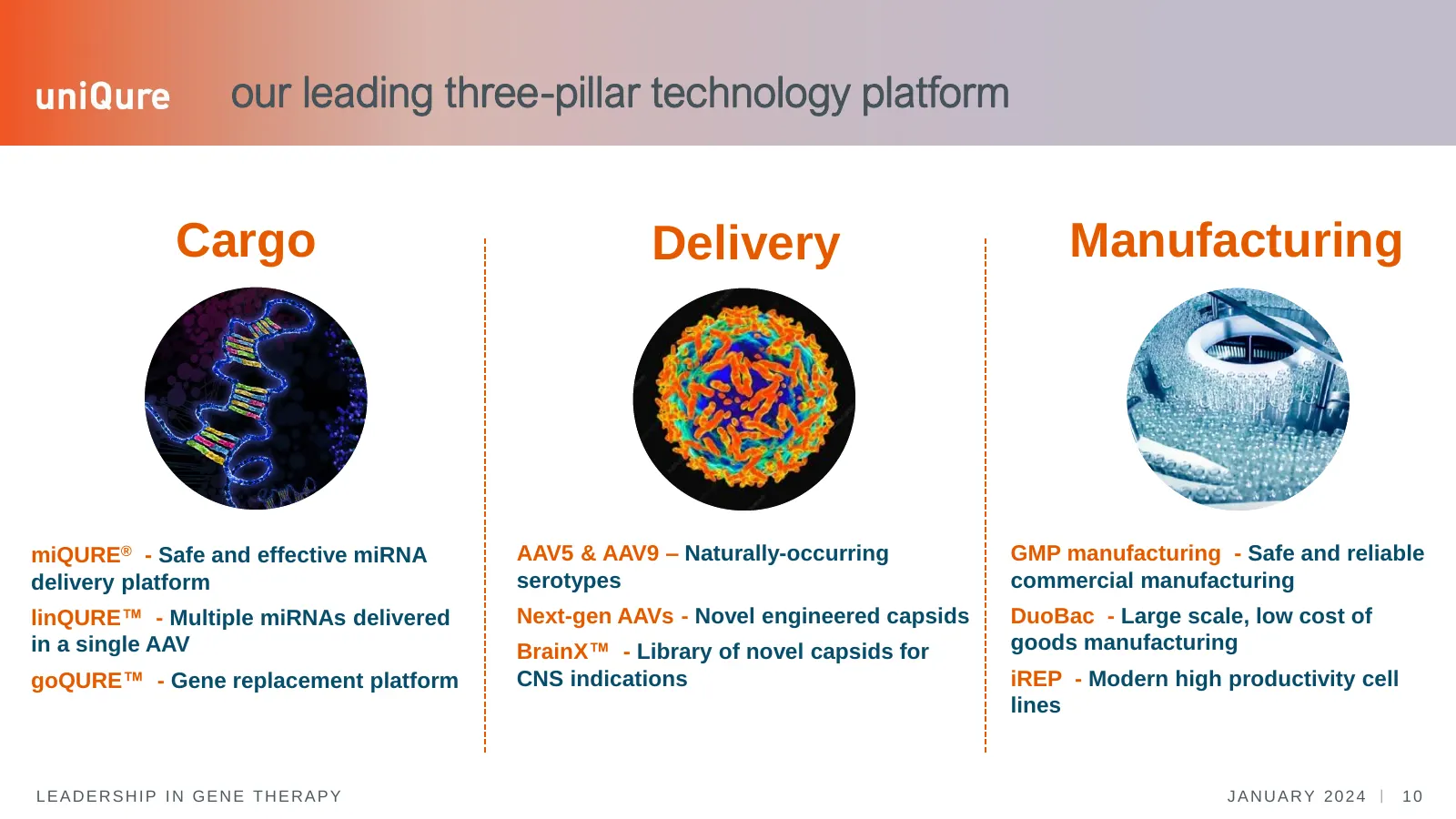
our leading three-pillar technology platform Cargo Delivery Manufacturing miQURE® - Safe and effective miRNA AAV5 & AAV9 – Naturally-occurring GMP manufacturing - Safe and reliable delivery platform serotypes commercial manufacturing linQURE™ - Multiple miRNAs delivered Next-gen AAVs - Novel enginee
Slide 11: Manufacturing excellence for global, commercial opportunities
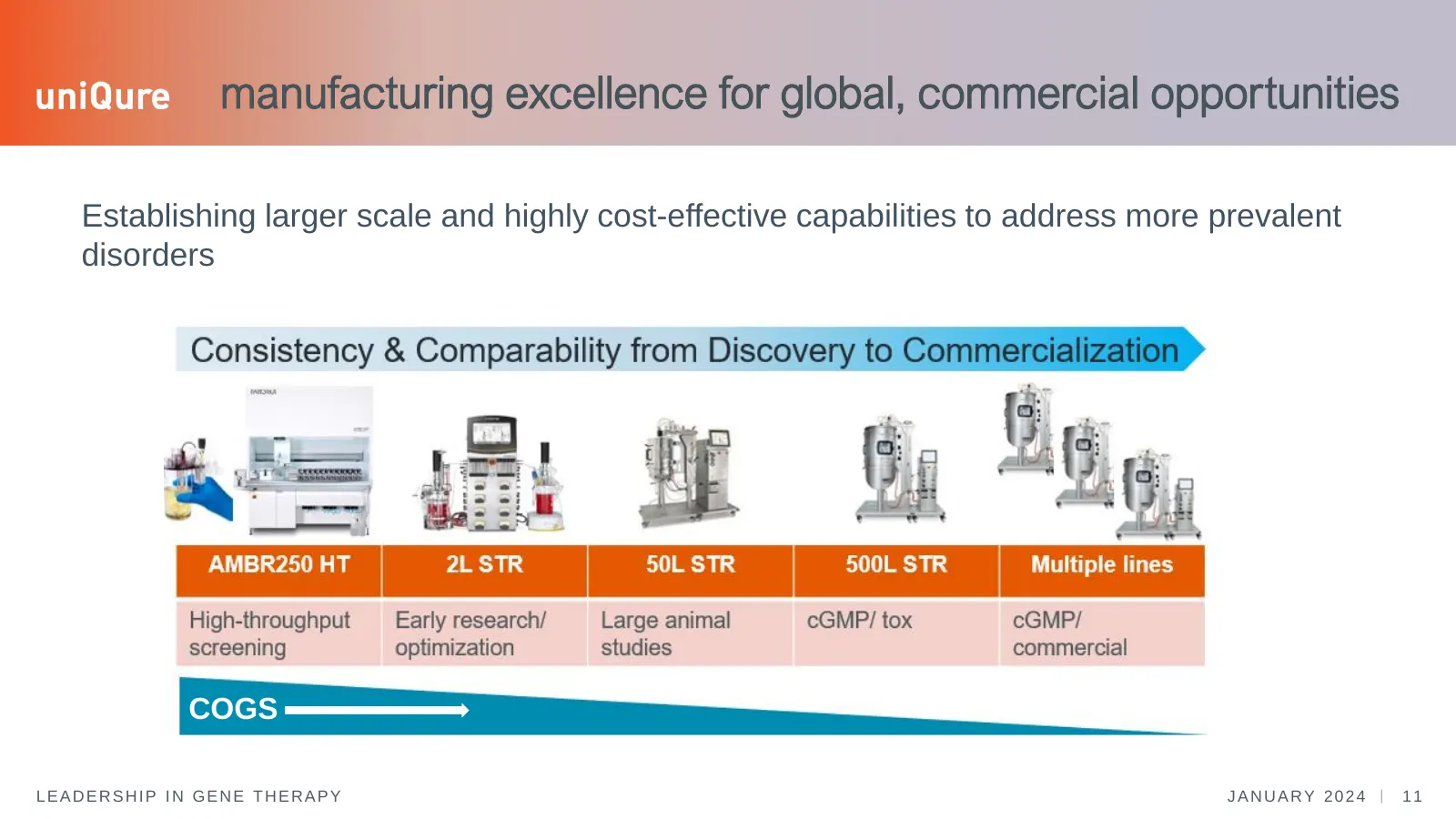
manufacturing excellence for global, commercial opportunities Establishing larger scale and highly cost-effective capabilities to address more prevalent disorders COGS LEADERSHIP IN GENE THERAPY JANUARY 2024 | 11
Slide 12: Commercial product manufacturing and research capabilities
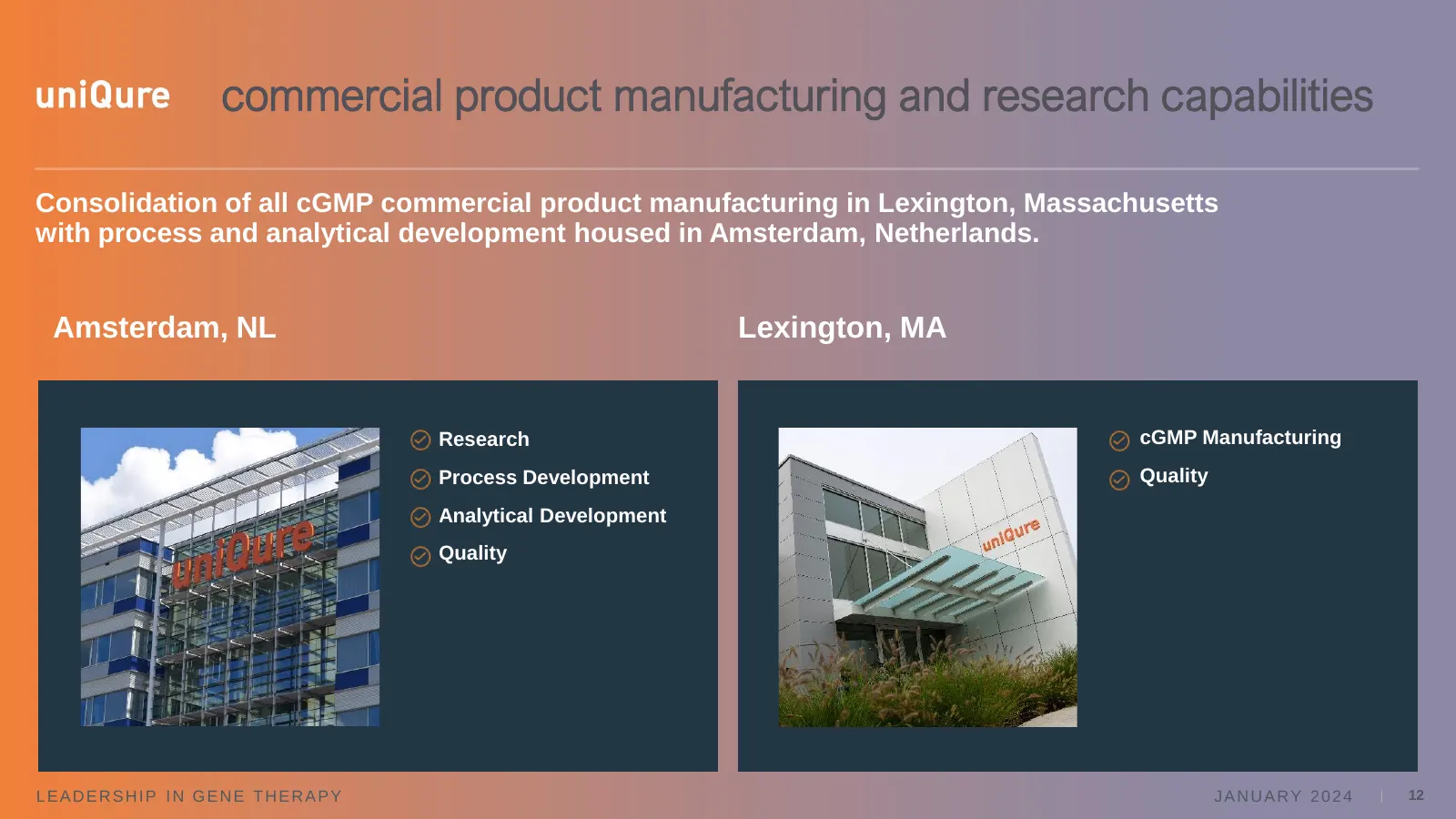
commercial product manufacturing and research capabilities Consolidation of all cGMP commercial product manufacturing in Lexington, Massachusetts with process and analytical development housed in Amsterdam, Netherlands. Amsterdam, NL Lexington, MA Research cGMP Manufacturing Process Development Qual
Slide 13: Company well funded to meet future needs
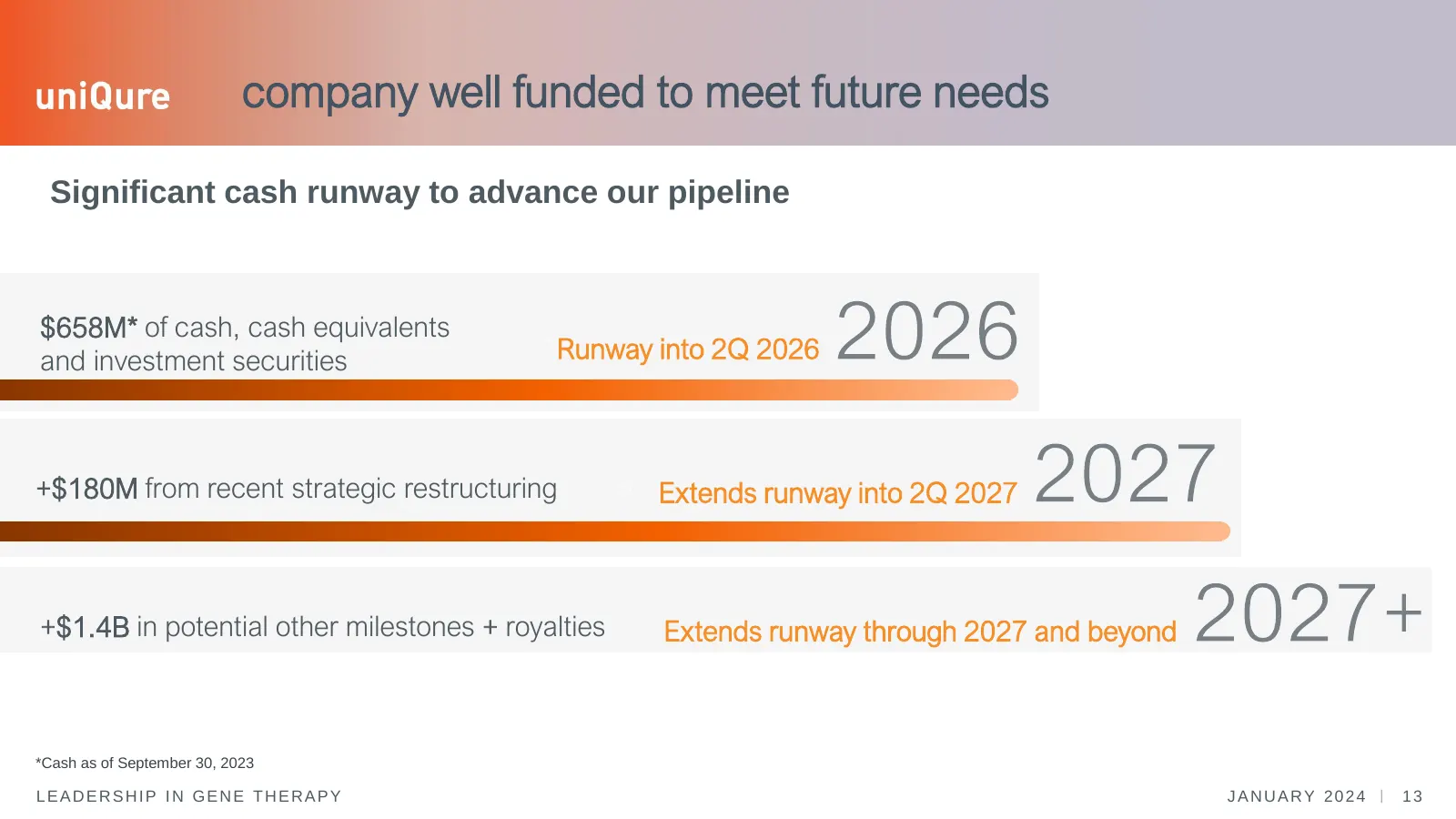
company well funded to meet future needs Significant cash runway to advance our pipeline $658M* of cash, cash equivalents and investment securities Runway into 2Q 2026 +$180M from recent strategic restructuring Extends runway into 2Q 2027 +$1.4B in potential other milestones + royalties Extends runw

Slide 14: Huntington's Disease AMT-130
Huntington’s Disease AMT-130 Ashley, Huntington’s disease patient advocate
Slide 15: Huntington's disease (HD): an overview
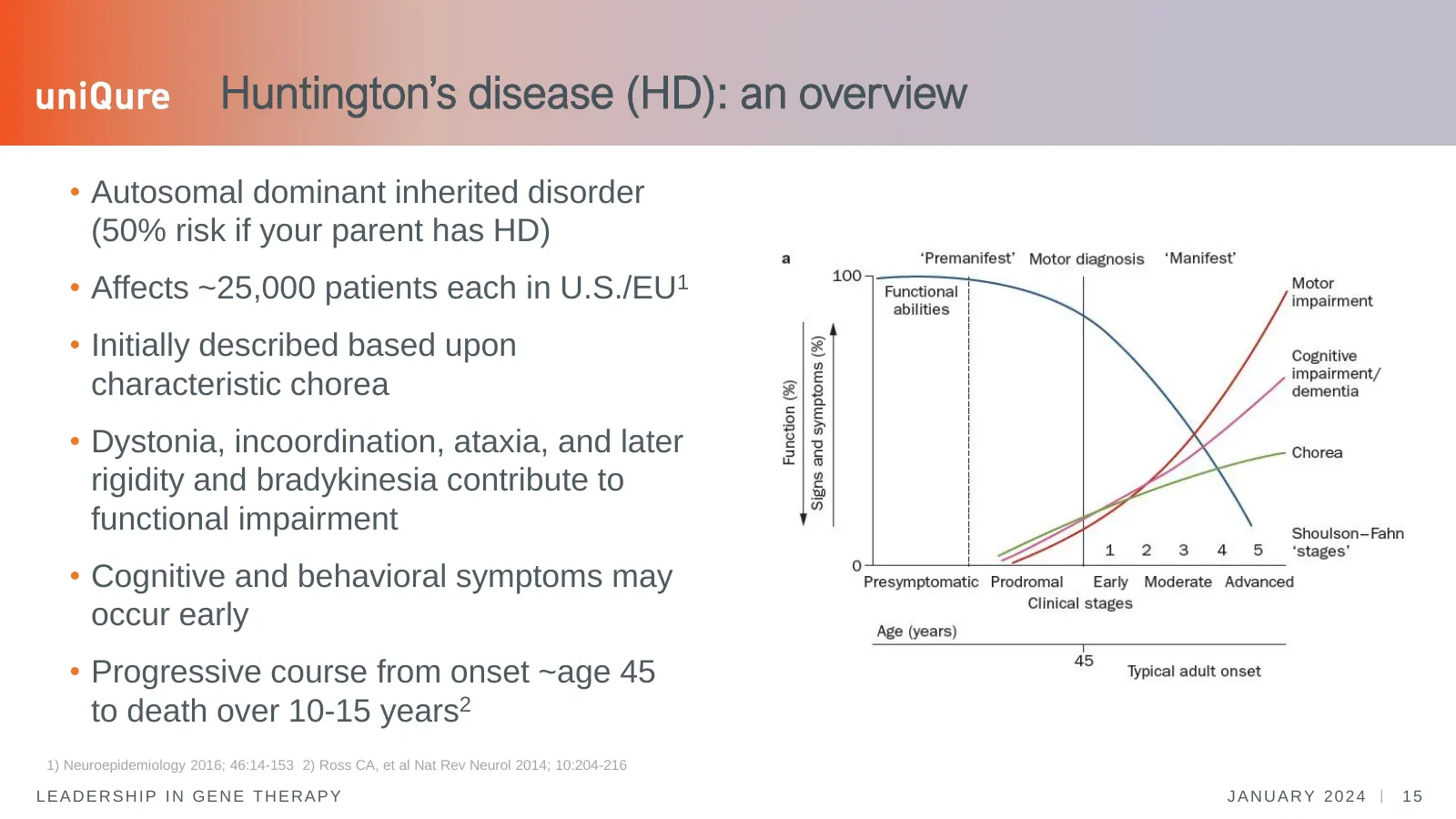
Huntington’s disease (HD): an overview • Autosomal dominant inherited disorder (50% risk if your parent has HD) • Affects ~25,000 patients each in U.S./EU1 • Initially described based upon characteristic chorea • Dystonia, incoordination, ataxia, and later rigidity and bradykinesia contribute to fun
Slide 16: AMT-130: a gene therapy approach for early manifest HD
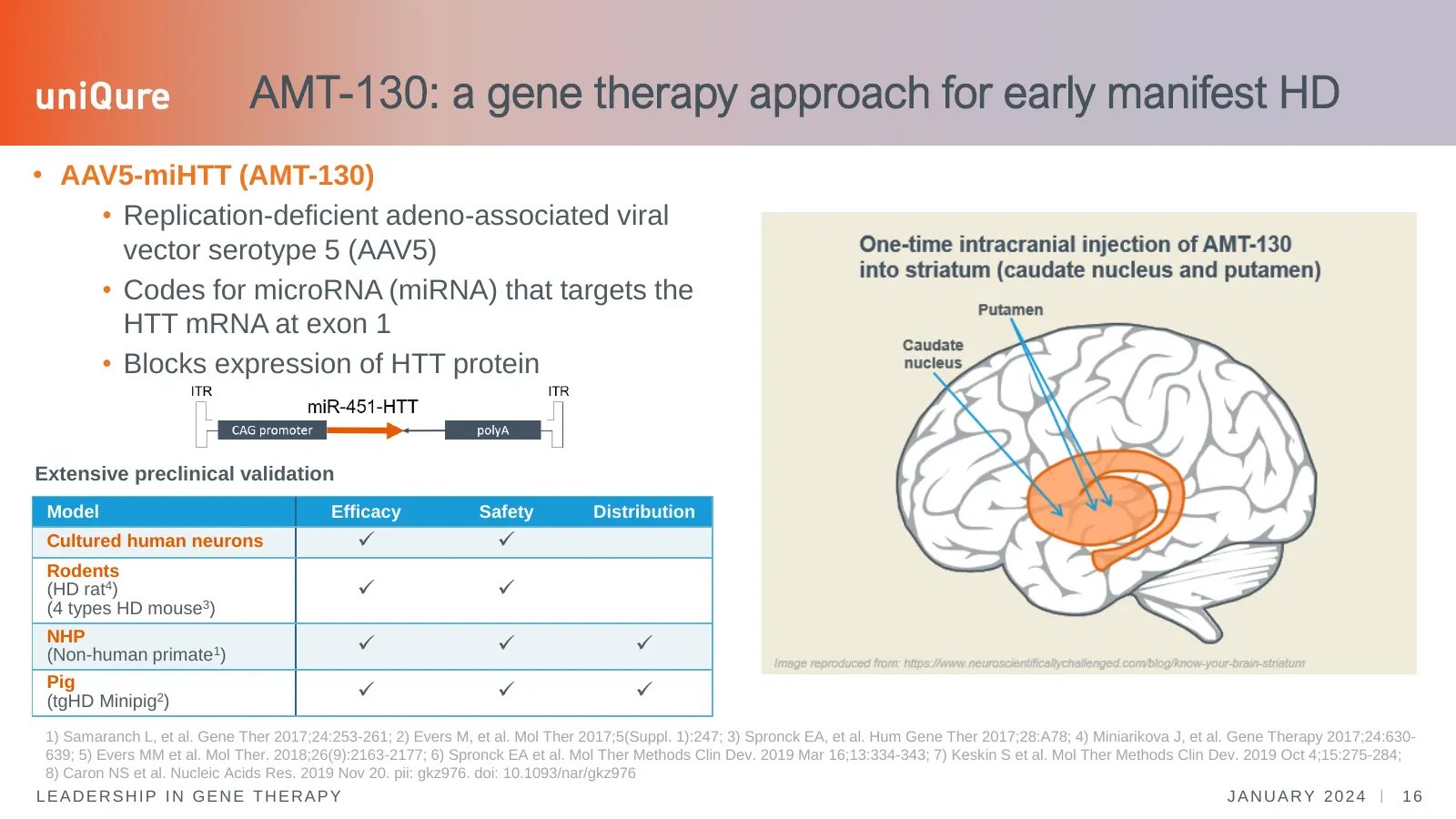
AMT-130: a gene therapy approach for early manifest HD • AAV5-miHTT (AMT-130) • Replication-deficient adeno-associated viral vector serotype 5 (AAV5) • Codes for microRNA (miRNA) that targets the HTT mRNA at exon 1 • Blocks expression of HTT protein Extensive preclinical validation Model Efficacy Sa
Slide 17: AMT-130: patient enrollment overview
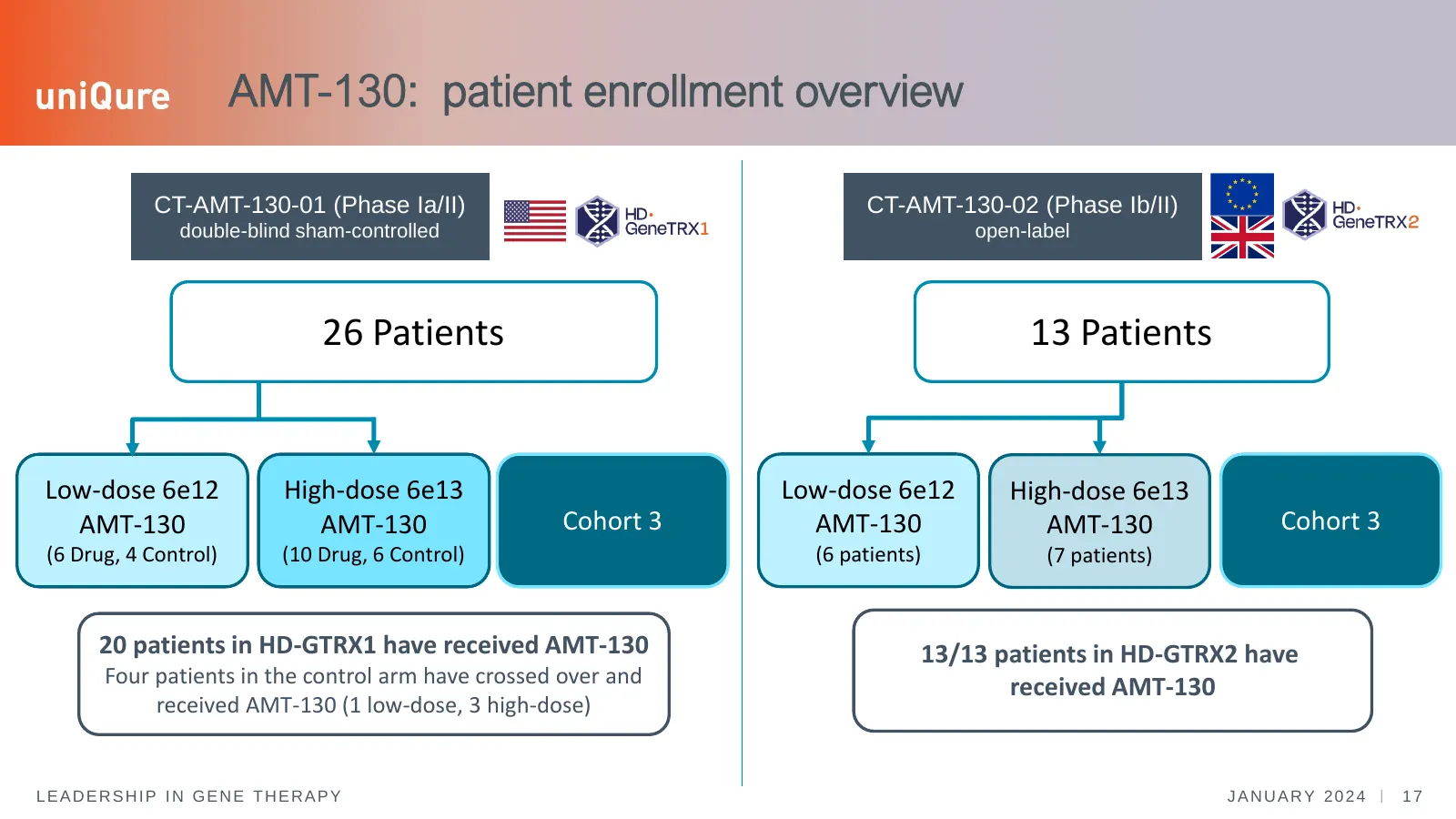
AMT-130: patient enrollment overview CT-AMT-130-01 (Phase Ia/II) CT-AMT-130-02 (Phase Ib/II) double-blind sham-controlled open-label 26 Patients 13 Patients Low-dose 6e12 High-dose 6e13 Low-dose 6e12 High-dose 6e13 AMT-130 AMT-130 Cohort 3 AMT-130 AMT-130 Cohort 3 (6 Drug, 4 Control) (10 Drug, 6 Con
Slide 18: AMT-130: phase I/II U.S. & European clinical trial design
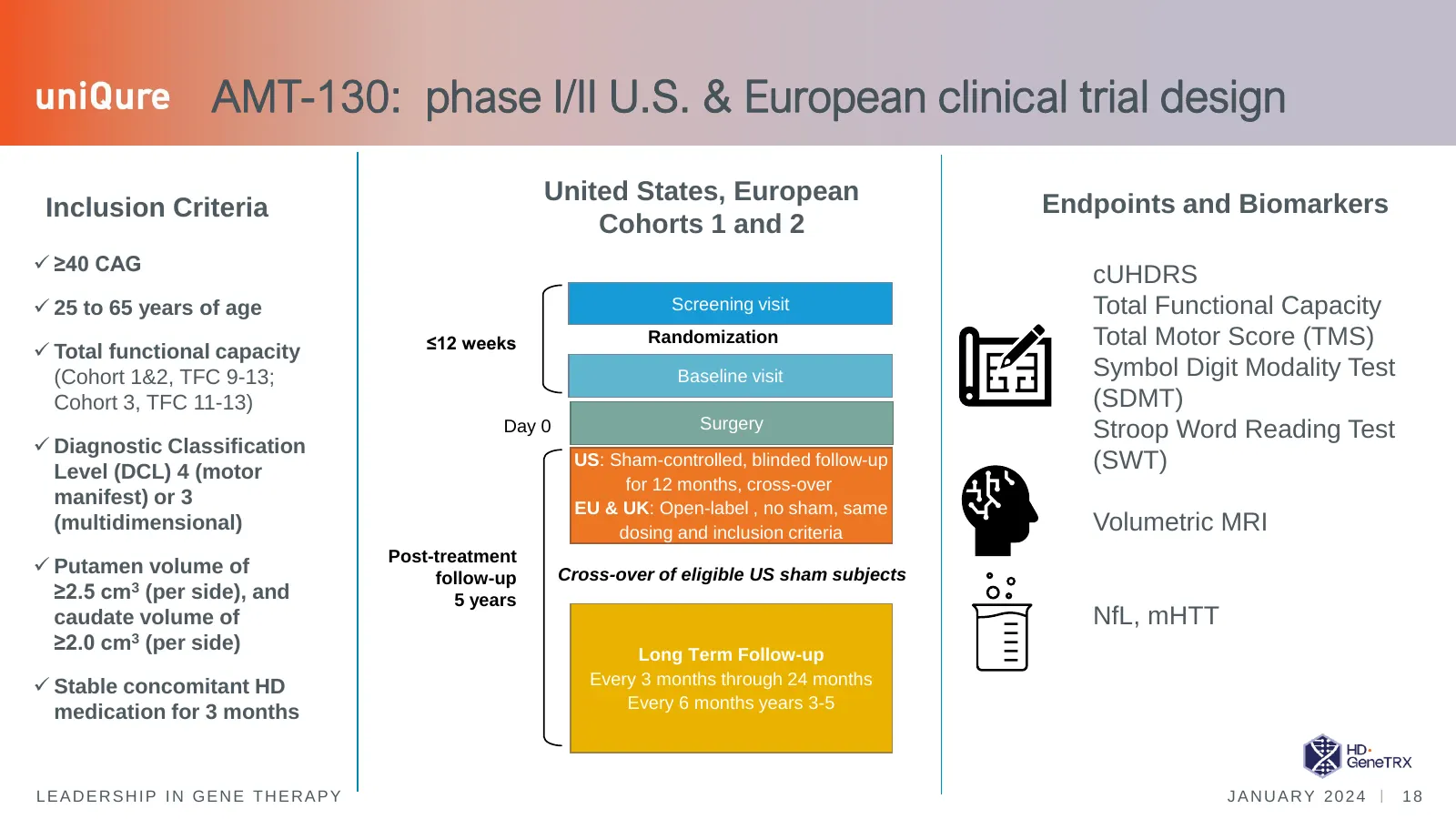
AMT-130: phase I/II U.S. & European clinical trial design United States, European Endpoints and Biomarkers Inclusion Criteria Cohorts 1 and 2 ✓ ≥40 CAG cUHDRS ✓ 25 to 65 years of age Screening visit Total Functional Capacity ≤12 weeks Randomization Total Motor Score (TMS) ✓ Total functional capacity
Slide 19: AMT-130: safety and tolerability
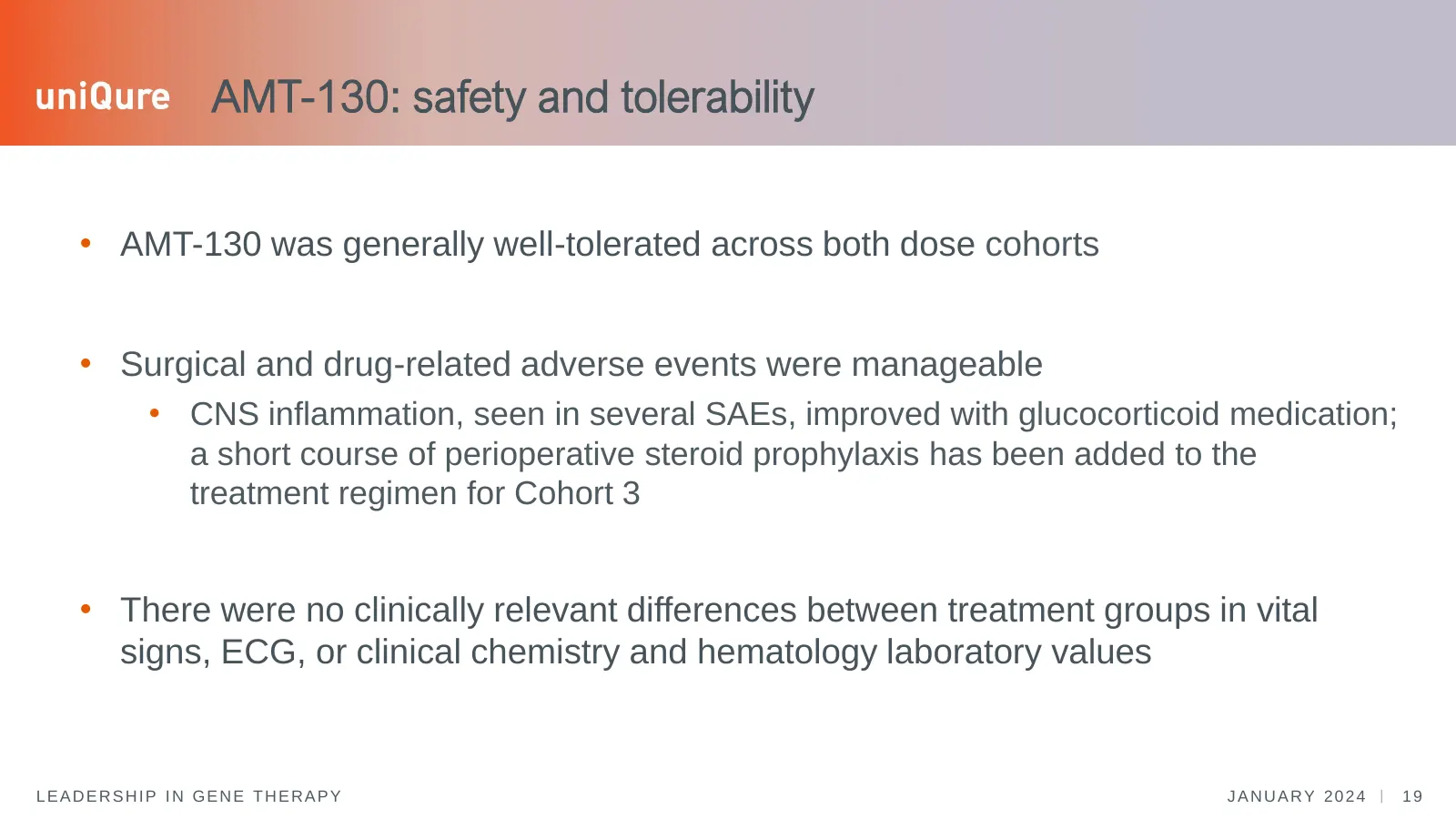
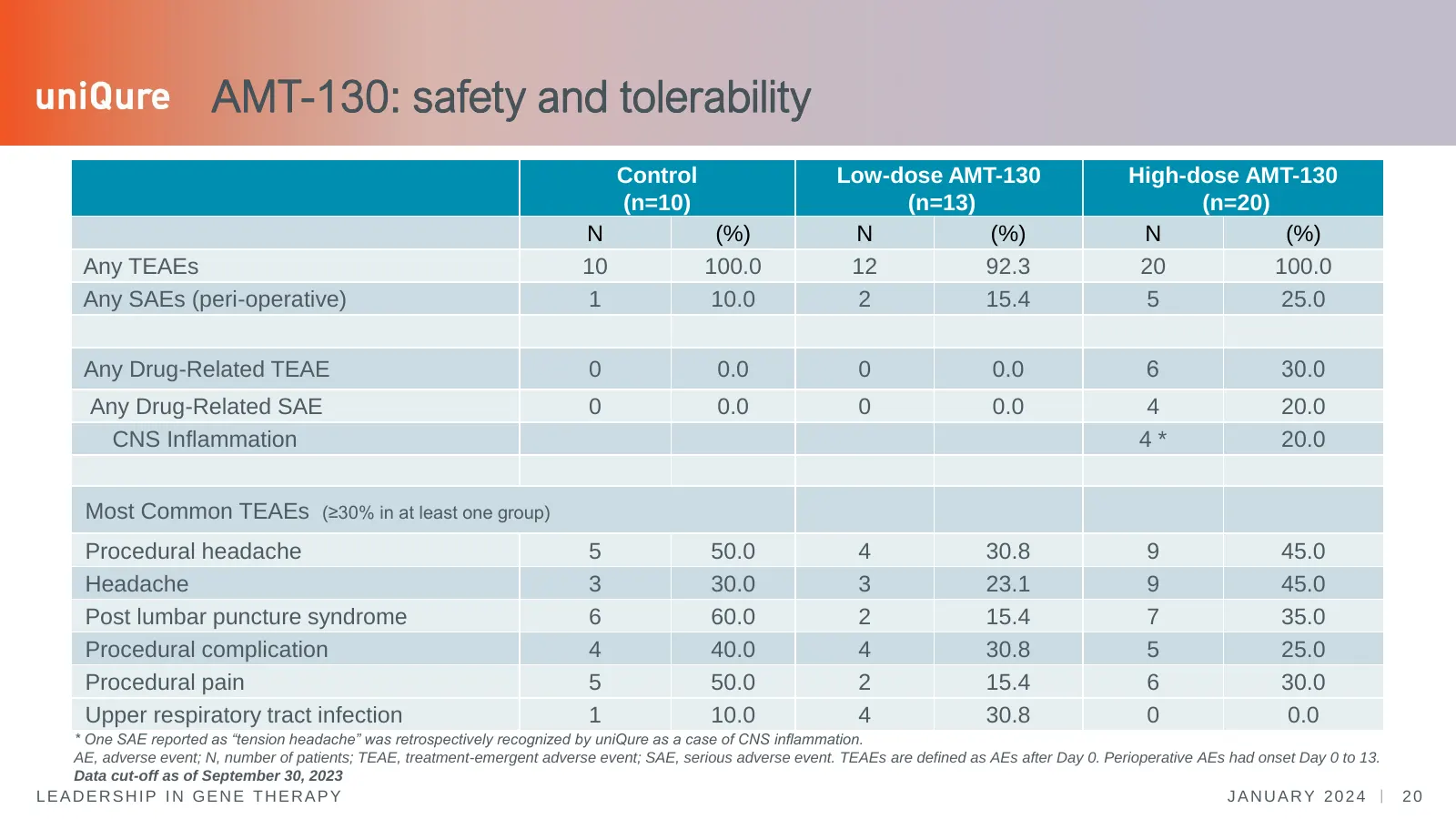
AMT-130: safety and tolerability • AMT-130 was generally well-tolerated across both dose cohorts • Surgical and drug-related adverse events were manageable • CNS inflammation, seen in several SAEs, improved with glucocorticoid medication; a short course of perioperative steroid prophylaxis has been
Slide 20: AMT-130: safety and tolerability
AMT-130: safety and tolerability Control Low-dose AMT-130 High-dose AMT-130 (n=10) (n=13) (n=20) N (%) N (%) N (%) Any TEAEs 10 100.0 12 92.3 20 100.0 Any SAEs (peri-operative) 1 10.0 2 15.4 5 25.0 Any Drug-Related TEAE 0 0.0 0 0.0 6 30.0 Any Drug-Related SAE 0 0.0 0 0.0 4 20.0 CNS Inflammation 4*
Slide 21: AMT-130: non-concurrent natural history comparator cohorts
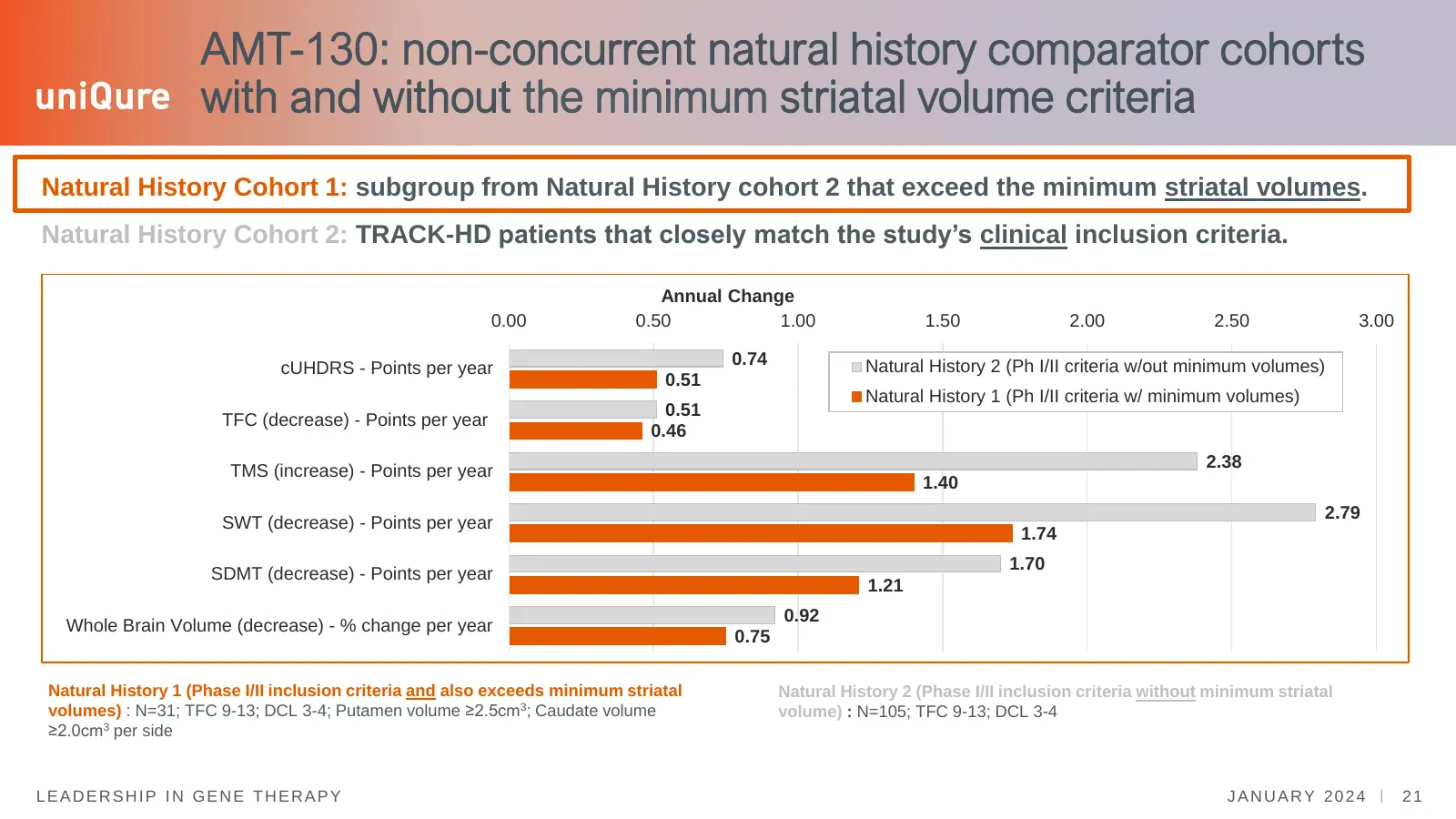
AMT-130: non-concurrent natural history comparator cohorts with and without the minimum striatal volume criteria Natural History Cohort 1: subgroup from Natural History cohort 2 that exceed the minimum striatal volumes. Natural History Cohort 2: TRACK-HD patients that closely match the study’s clini
Slide 22: AMT-130: cUHDRS remained favorable compared to natural history
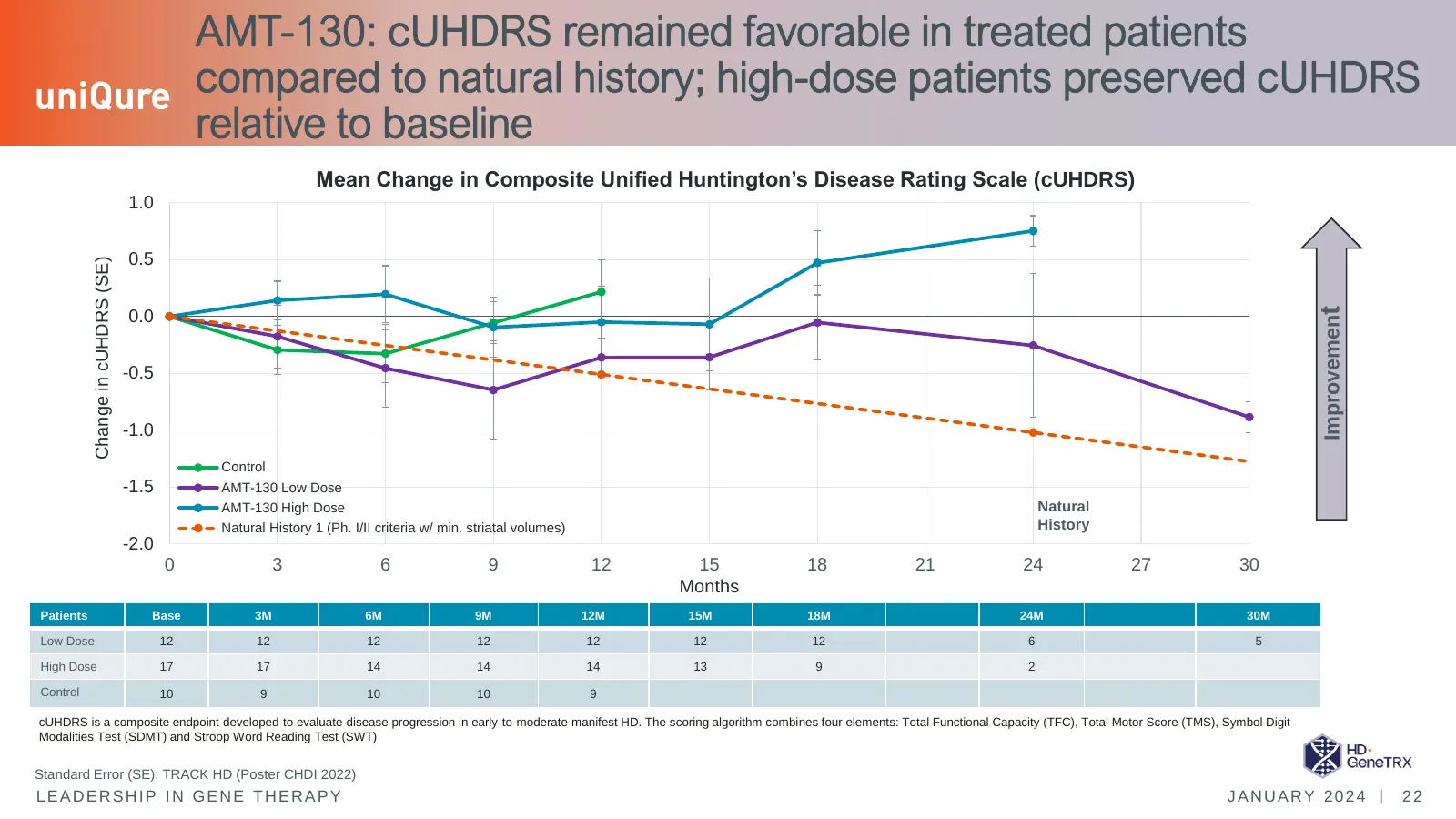
AMT-130: cUHDRS remained favorable in treated patients compared to natural history; high-dose patients preserved cUHDRS relative to baseline Mean Change in Composite Unified Huntington’s Disease Rating Scale (cUHDRS) 1.0 0.5 Change in cUHDRS (SE) Improvement 0.0 -0.5 -1.0 Control -1.5 AMT-130 Low Do
Slide 23: AMT-130: favorable difference in TFC vs natural history
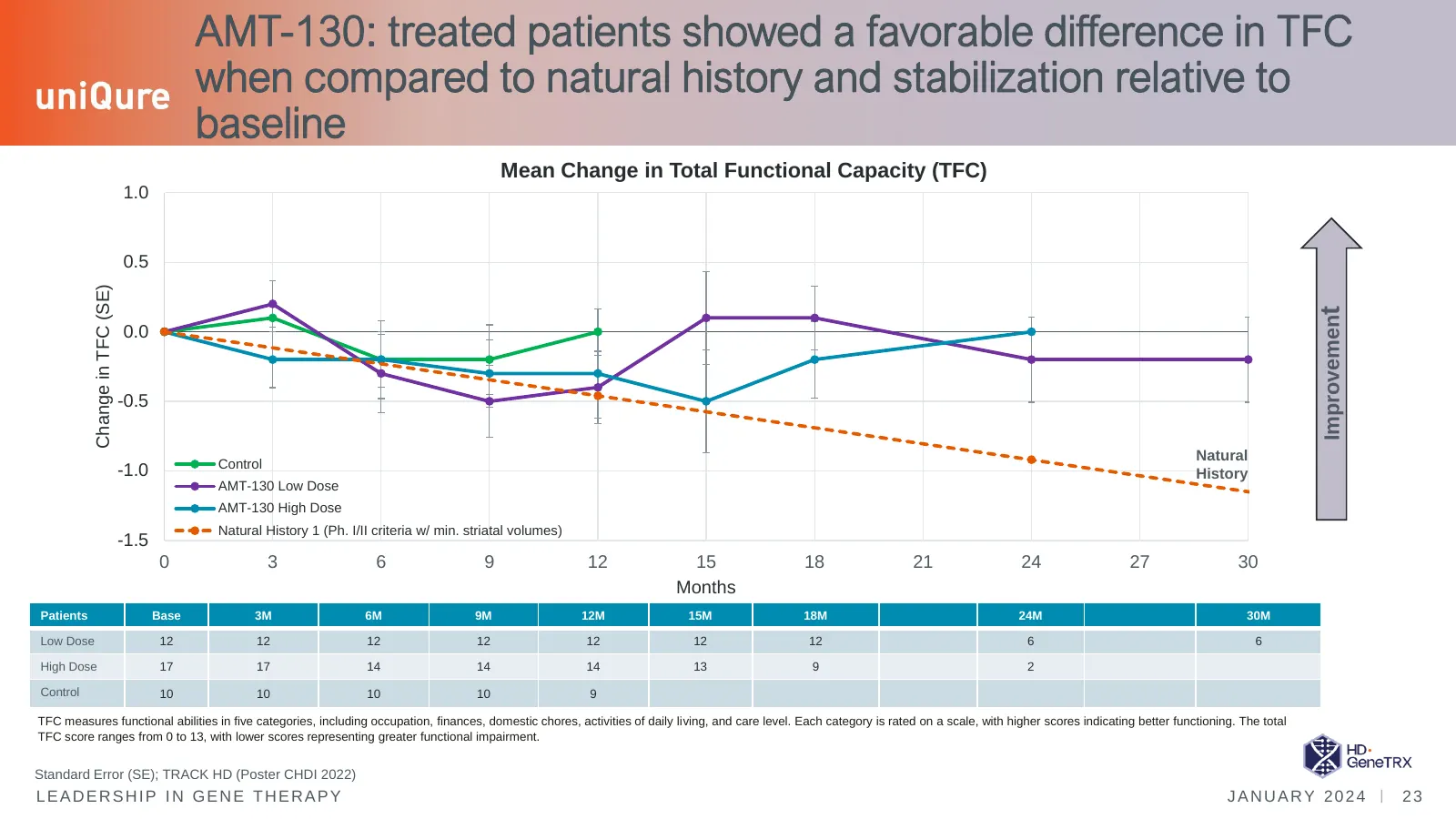
AMT-130: treated patients showed a favorable difference in TFC when compared to natural history and stabilization relative to baseline Mean Change in Total Functional Capacity (TFC) 1.0 0.5 Change in TFC (SE) Improvement 0.0 -0.5 Natural Control -1.0 History AMT-130 Low Dose AMT-130 High Dose Natura
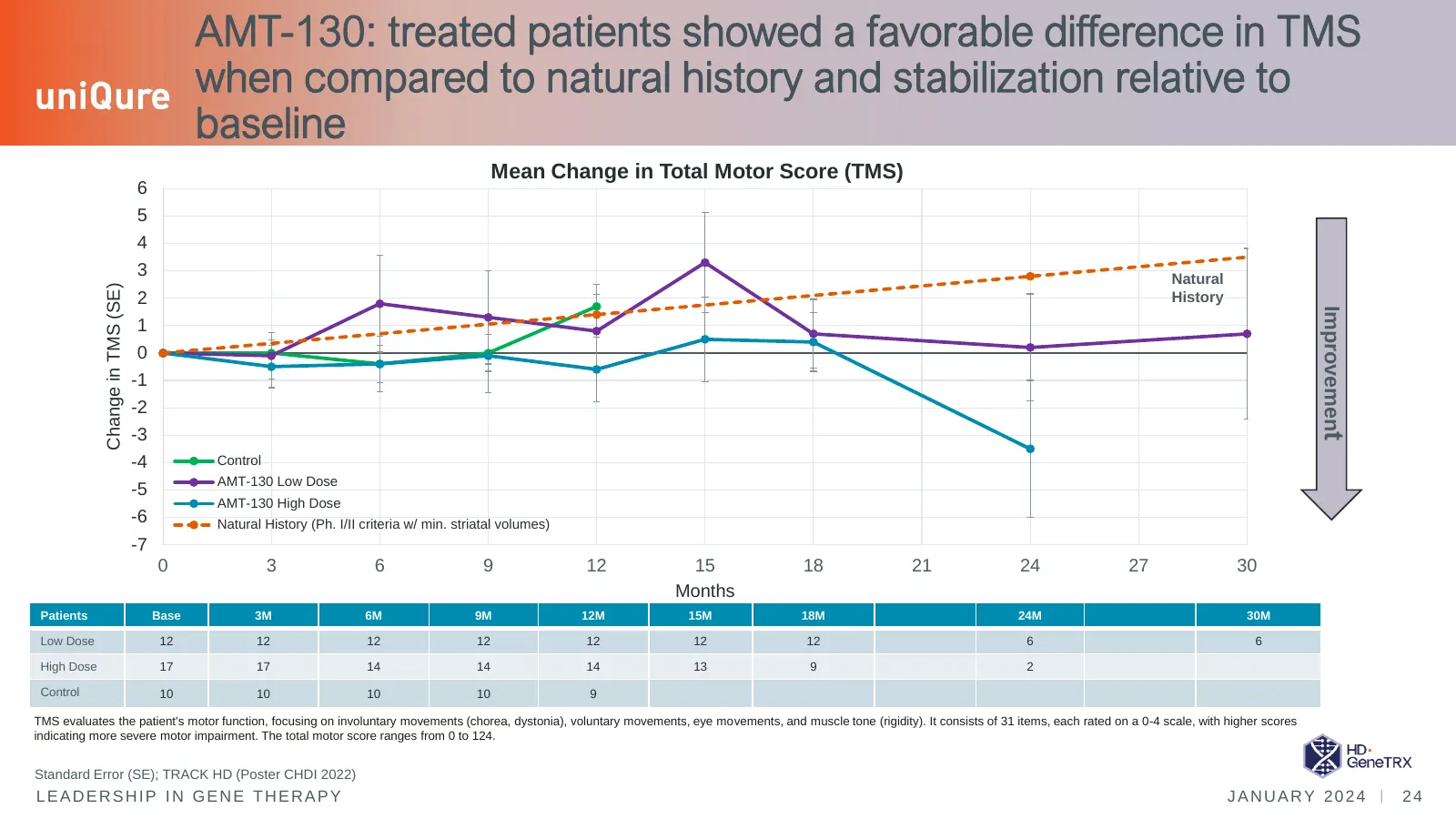
Slide 24: AMT-130: favorable difference in TMS vs natural history
AMT-130: treated patients showed a favorable difference in TMS when compared to natural history and stabilization relative to baseline Mean Change in Total Motor Score (TMS) 6 5 4 3 Natural Change in TMS (SE) 2 History Improvement 1 0 -1 -2 -3 -4 Control AMT-130 Low Dose -5 AMT-130 High Dose -6 Natu
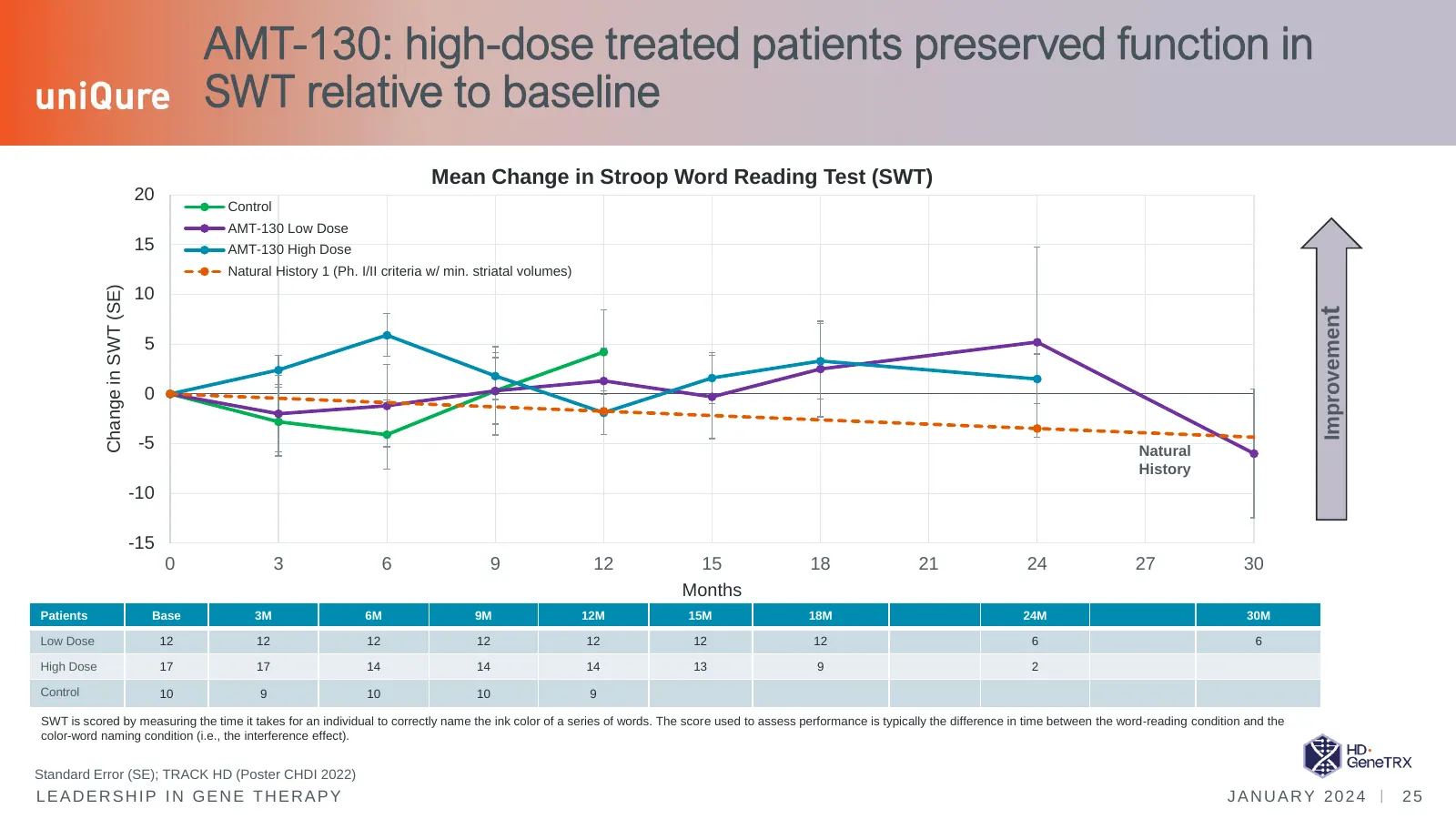
Slide 25: AMT-130: high-dose preserved function in SWT
AMT-130: high-dose treated patients preserved function in SWT relative to baseline Mean Change in Stroop Word Reading Test (SWT) 20 Control AMT-130 Low Dose 15 AMT-130 High Dose Natural History 1 (Ph. I/II criteria w/ min. striatal volumes) Change in SWT (SE) 10 Improvement 5 0 -5 Natural History -1
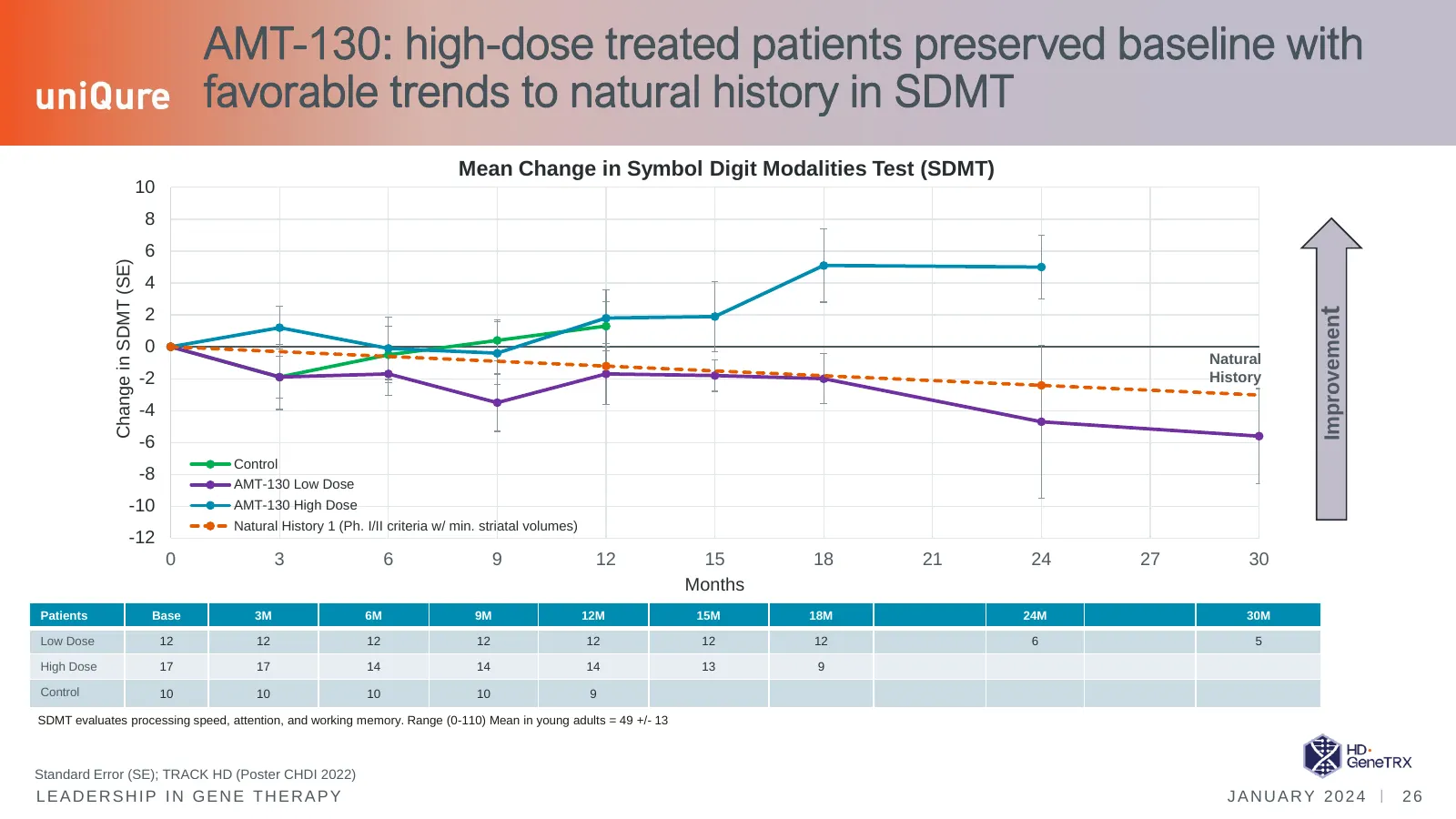
Slide 26: AMT-130: high-dose preserved baseline in SDMT
AMT-130: high-dose treated patients preserved baseline with favorable trends to natural history in SDMT Mean Change in Symbol Digit Modalities Test (SDMT) 10 8 6 Change in SDMT (SE) 4 Improvement 2 0 Natural -2 History -4 -6 Control -8 AMT-130 Low Dose -10 AMT-130 High Dose Natural History 1 (Ph. I/
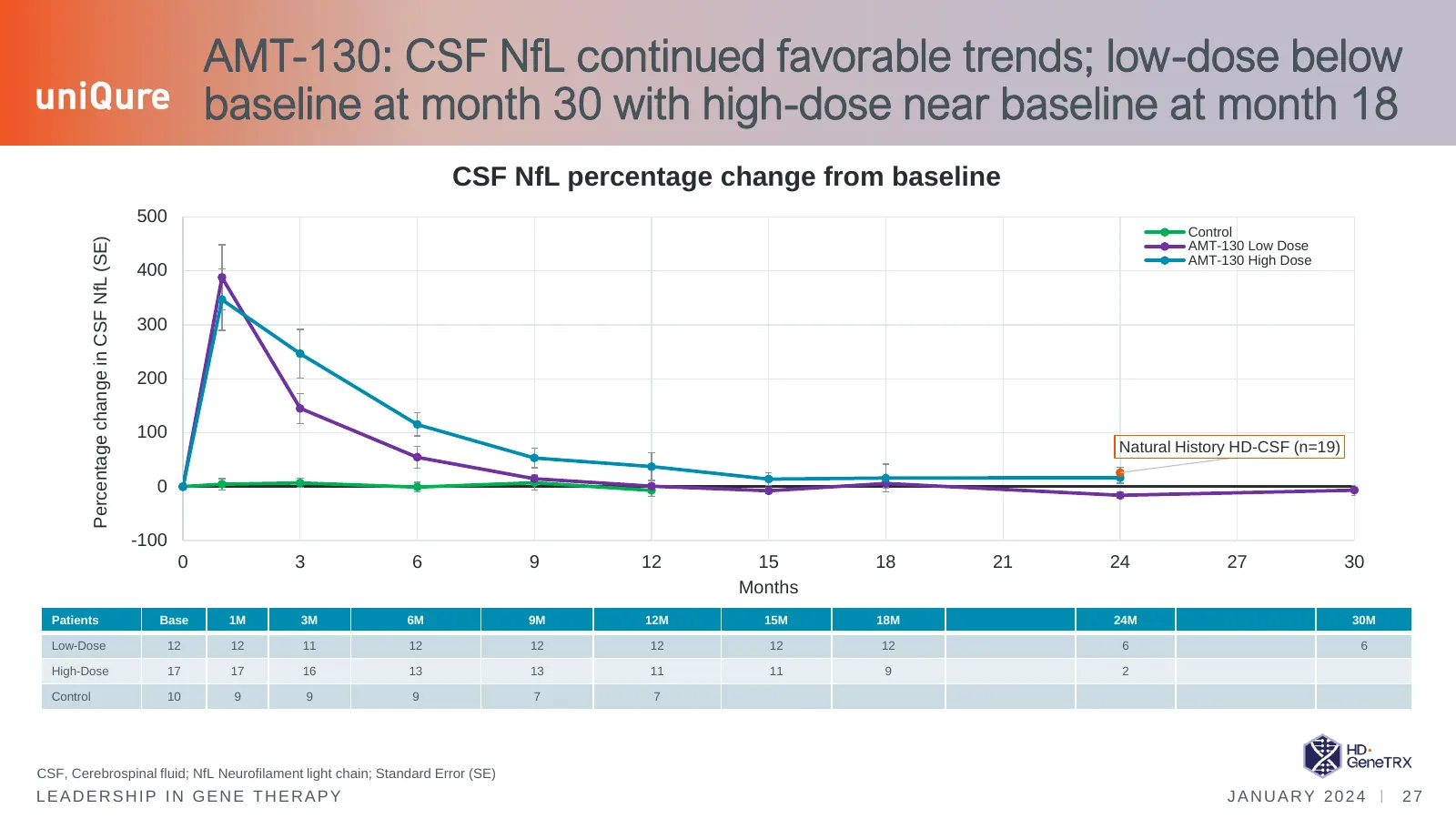
Slide 27: AMT-130: CSF NfL continued favorable trends
AMT-130: CSF NfL continued favorable trends; low-dose below baseline at month 30 with high-dose near baseline at month 18 CSF NfL percentage change from baseline 500 Control Percentage change in CSF NfL (SE) AMT-130 Low Dose AMT-130 High Dose 400 300 200 100 Natural History HD-CSF (n=19) 0 -100 0 3
Slide 28: AMT-130: CSF NfL excluding single high-dose outlier
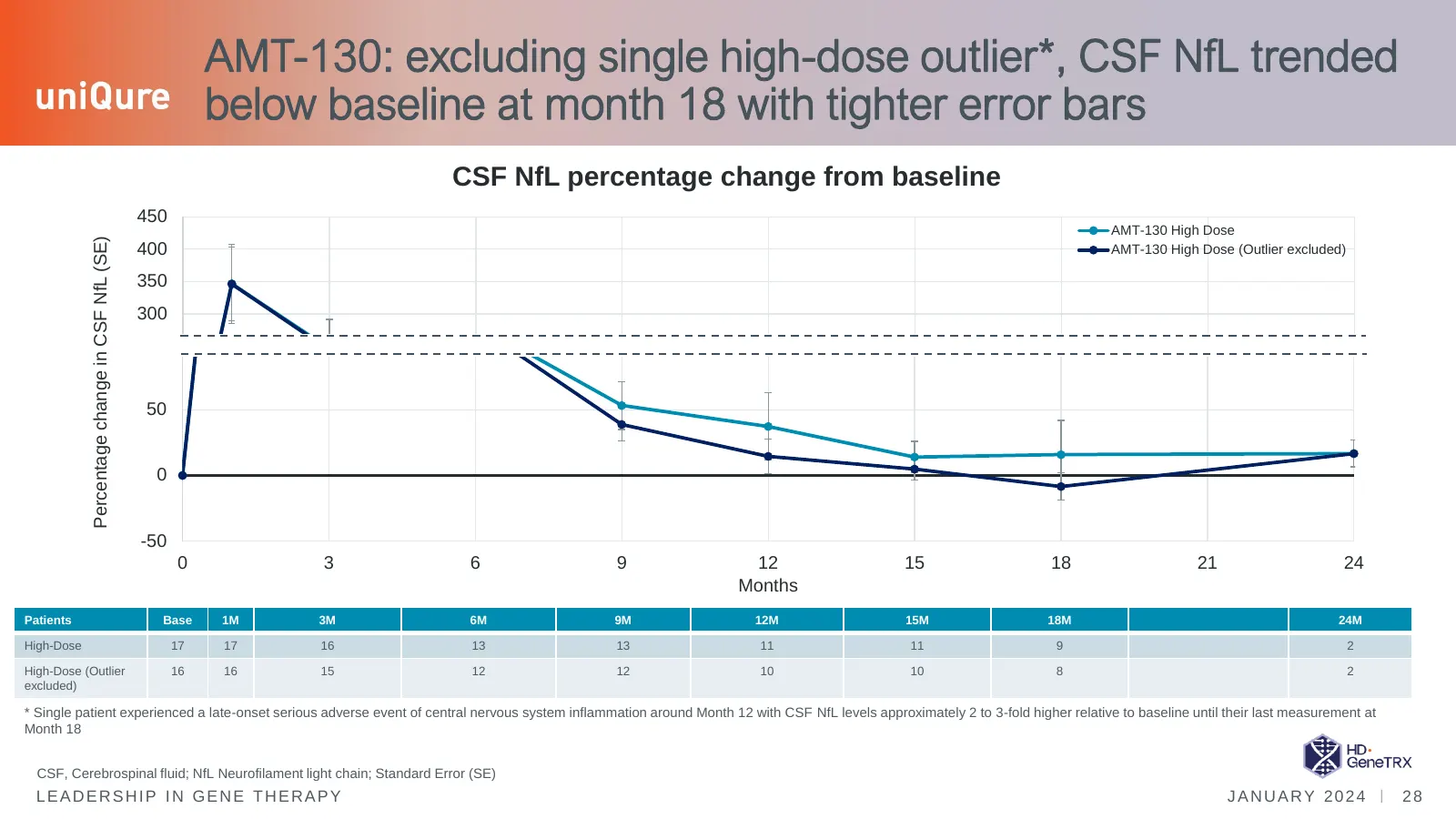
AMT-130: excluding single high-dose outlier*, CSF NfL trended below baseline at month 18 with tighter error bars CSF NfL percentage change from baseline 450 AMT-130 High Dose Percentage change in CSF NfL (SE) 400 AMT-130 High Dose (Outlier excluded) 350 300 250 200 50 150 100 0 50 0 -50 0 3 6 9 12 1
Slide 29: AMT-130: promising trends support continuing development
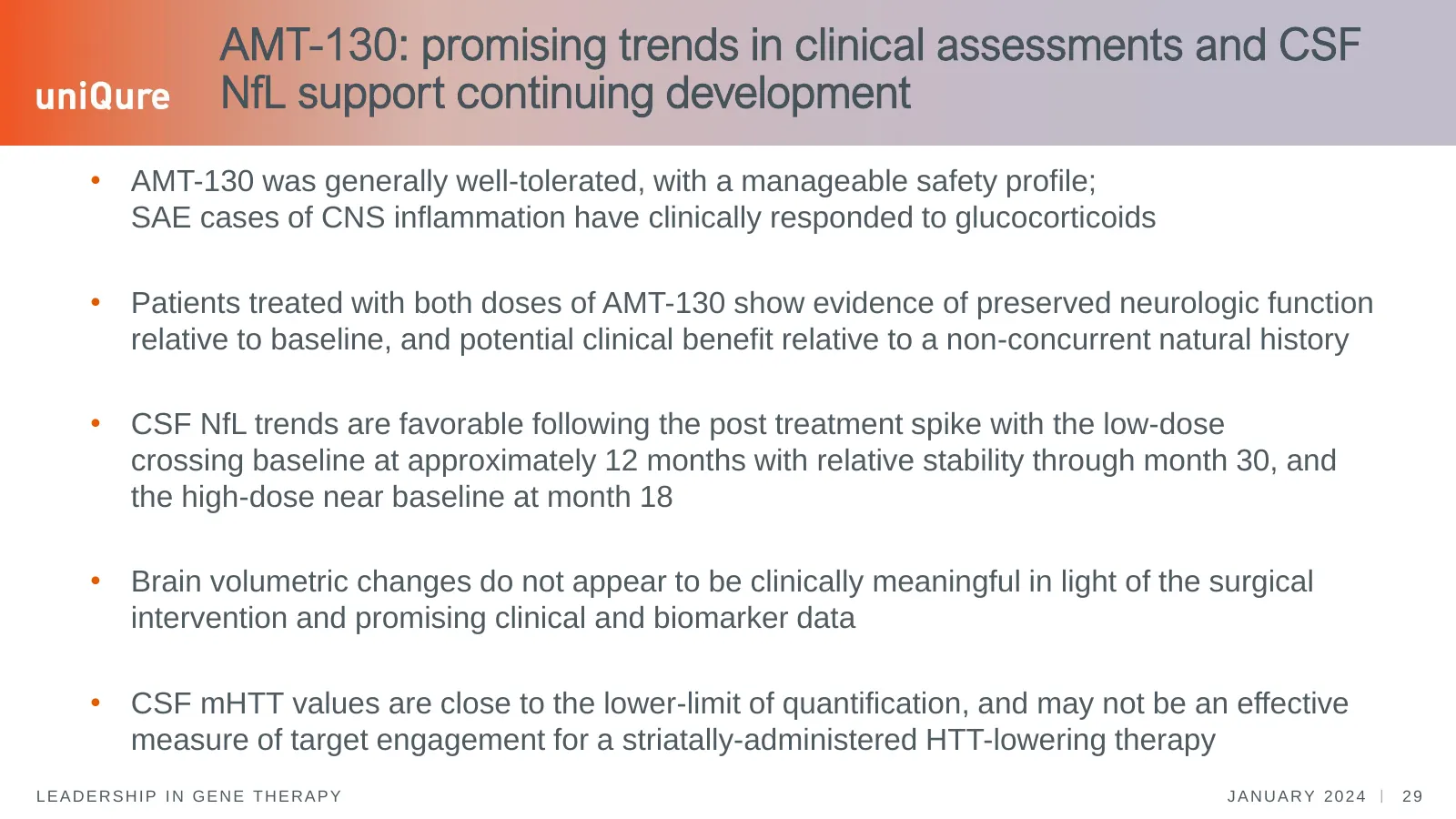
AMT-130: promising trends in clinical assessments and CSF NfL support continuing development • AMT-130 was generally well-tolerated, with a manageable safety profile; SAE cases of CNS inflammation have clinically responded to glucocorticoids • Patients treated with both doses of AMT-130 show evidenc
Slide 30: AMT-130: next steps in clinical development
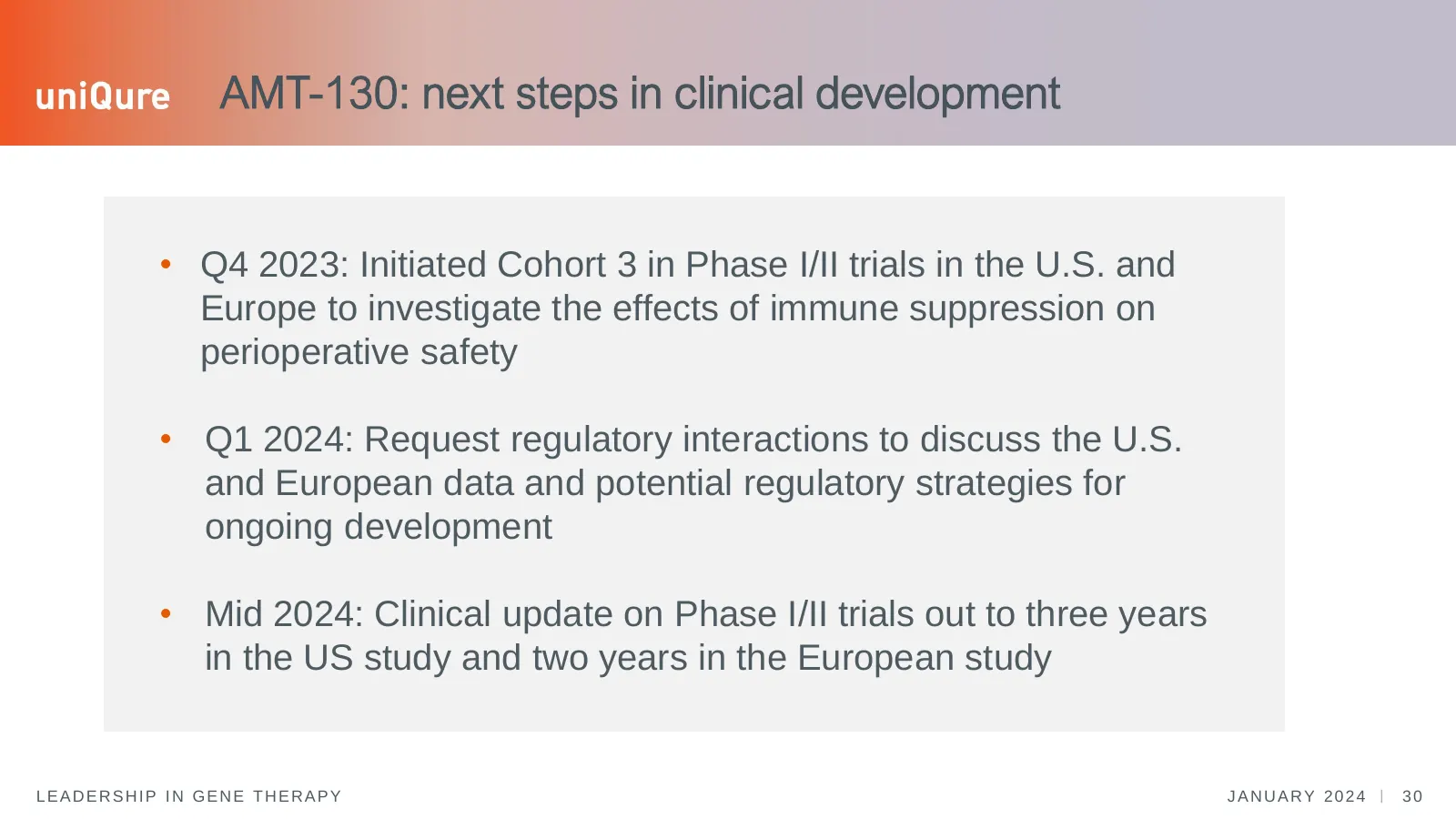
AMT-130: next steps in clinical development • Q4 2023: Initiated Cohort 3 in Phase I/II trials in the U.S. and Europe to investigate the effects of immune suppression on perioperative safety • Q1 2024: Request regulatory interactions to discuss the U.S. and European data and potential regulatory str
Slide 31: Refractory Mesial Temporal Lobe Epilepsy AMT-260
Refractory Mesial Temporal Lobe Epilepsy AMT-260
Slide 32: Refractory mesial temporal lobe epilepsy (MTLE)
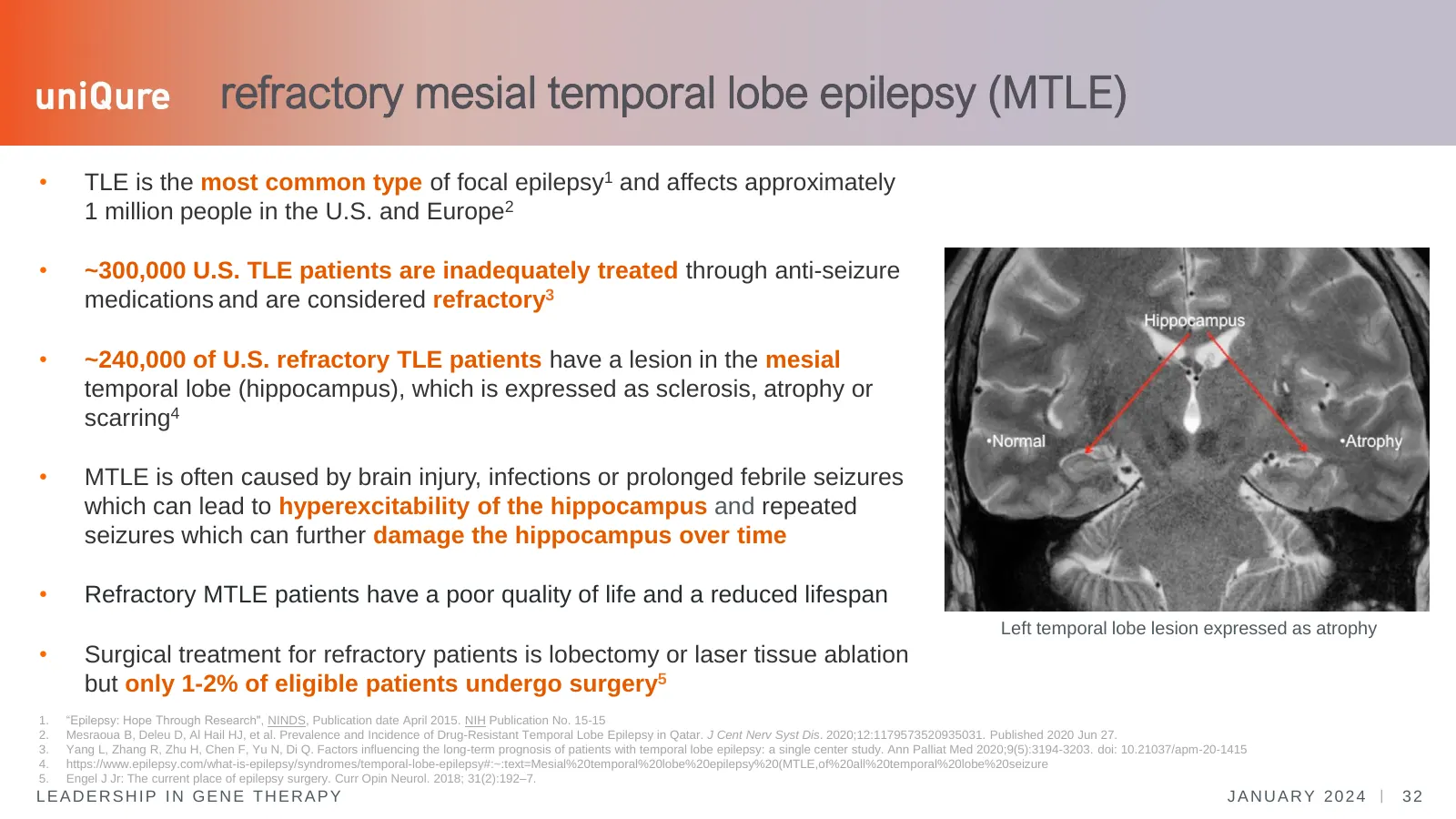
refractory mesial temporal lobe epilepsy (MTLE) • TLE is the most common type of focal epilepsy1 and affects approximately 1 million people in the U.S. and Europe2 • ~300,000 U.S. TLE patients are inadequately treated through anti-seizure medications and are considered refractory3 • ~240,000 of U.S.
Slide 33: AMT-260: an AAV9 targeting GRIK2
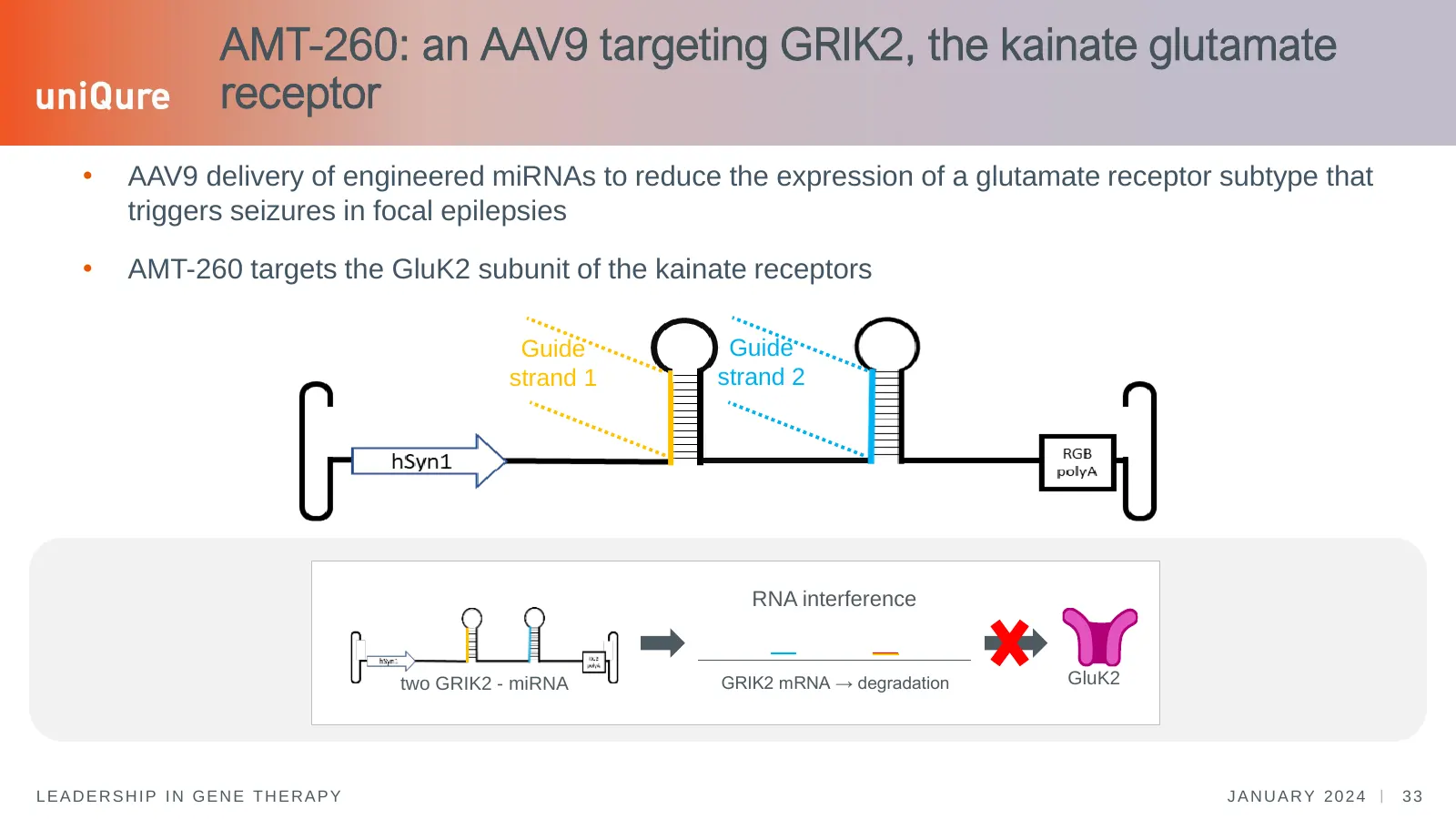
AMT-260: an AAV9 targeting GRIK2, the kainate glutamate receptor • AAV9 delivery of engineered miRNAs to reduce the expression of a glutamate receptor subtype that triggers seizures in focal epilepsies • AMT-260 targets the GluK2 subunit of the kainate receptors Guide Guide strand 1 strand 2 RNA int
Slide 34: AMT-260: route of administration demonstrated focal biodistribution
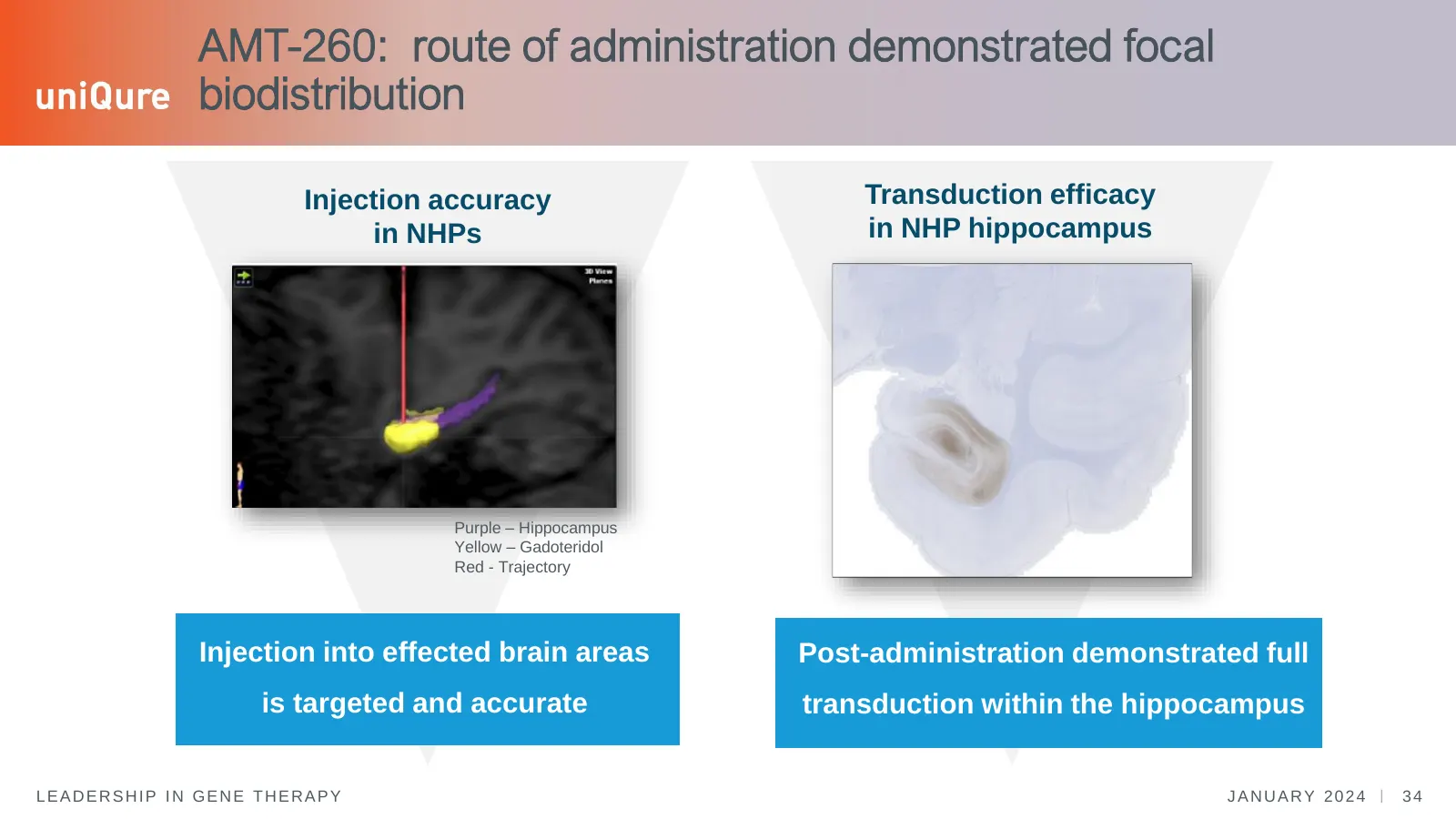
AMT-260: route of administration demonstrated focal biodistribution Injection accuracy Transduction efficacy in NHPs in NHP hippocampus Purple – Hippocampus Yellow – Gadoteridol Red - Trajectory Injection into effected brain areas Post-administration demonstrated full is targeted and accurate transd
Slide 35: AMT-260: targeted MTLE patient population
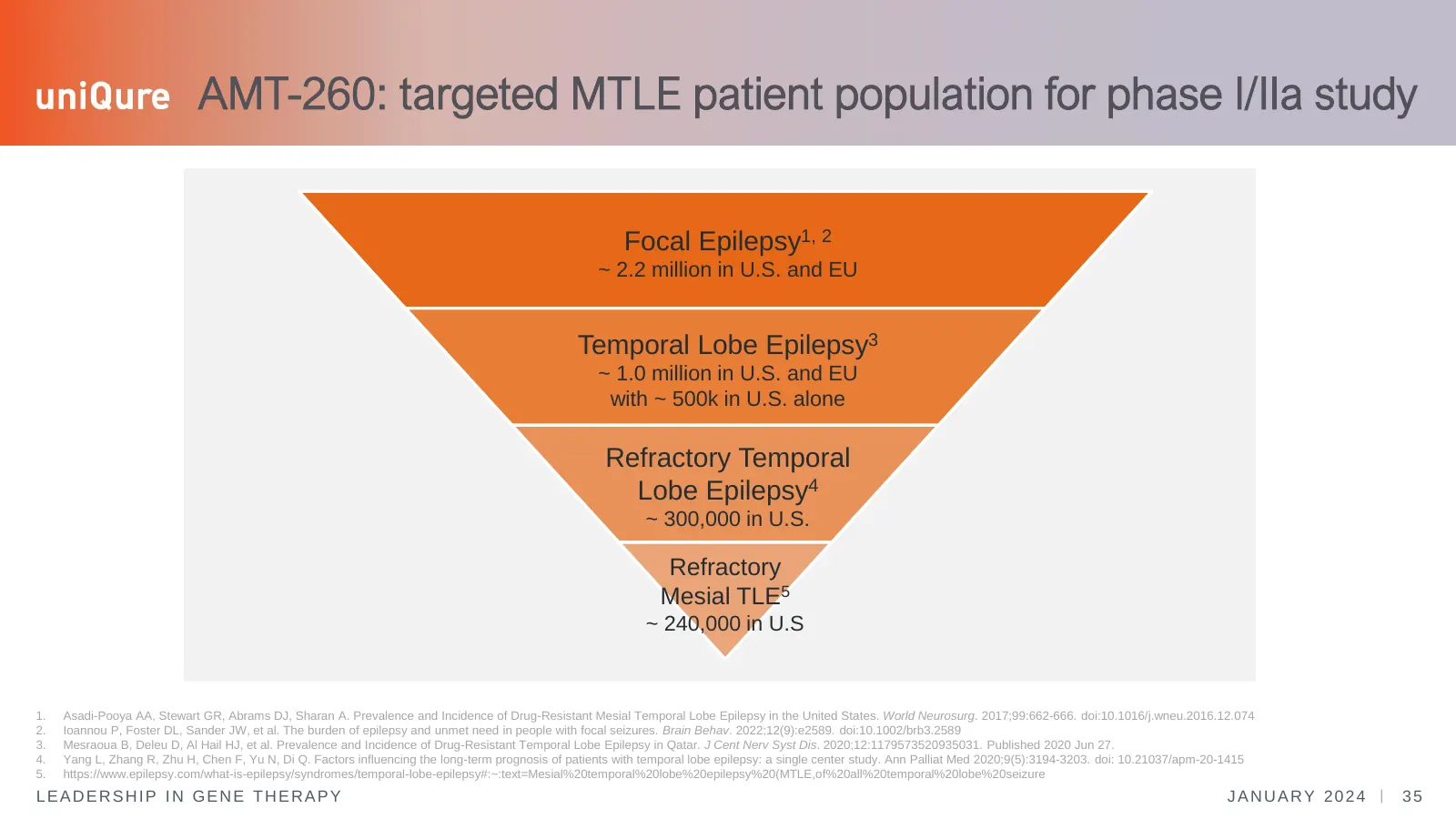
AMT-260: targeted MTLE patient population for phase I/IIa study Focal Epilepsy1, 2 ~ 2.2 million in U.S. and EU Temporal Lobe Epilepsy3 ~ 1.0 million in U.S. and EU with ~ 500k in U.S. alone Refractory Temporal Lobe Epilepsy4 ~ 300,000 in U.S. Refractory Mesial TLE5 ~ 240,000 in U.S 1. Asadi-Pooya A
Slide 36: AMT-260: anticipated phase I/IIa clinical study
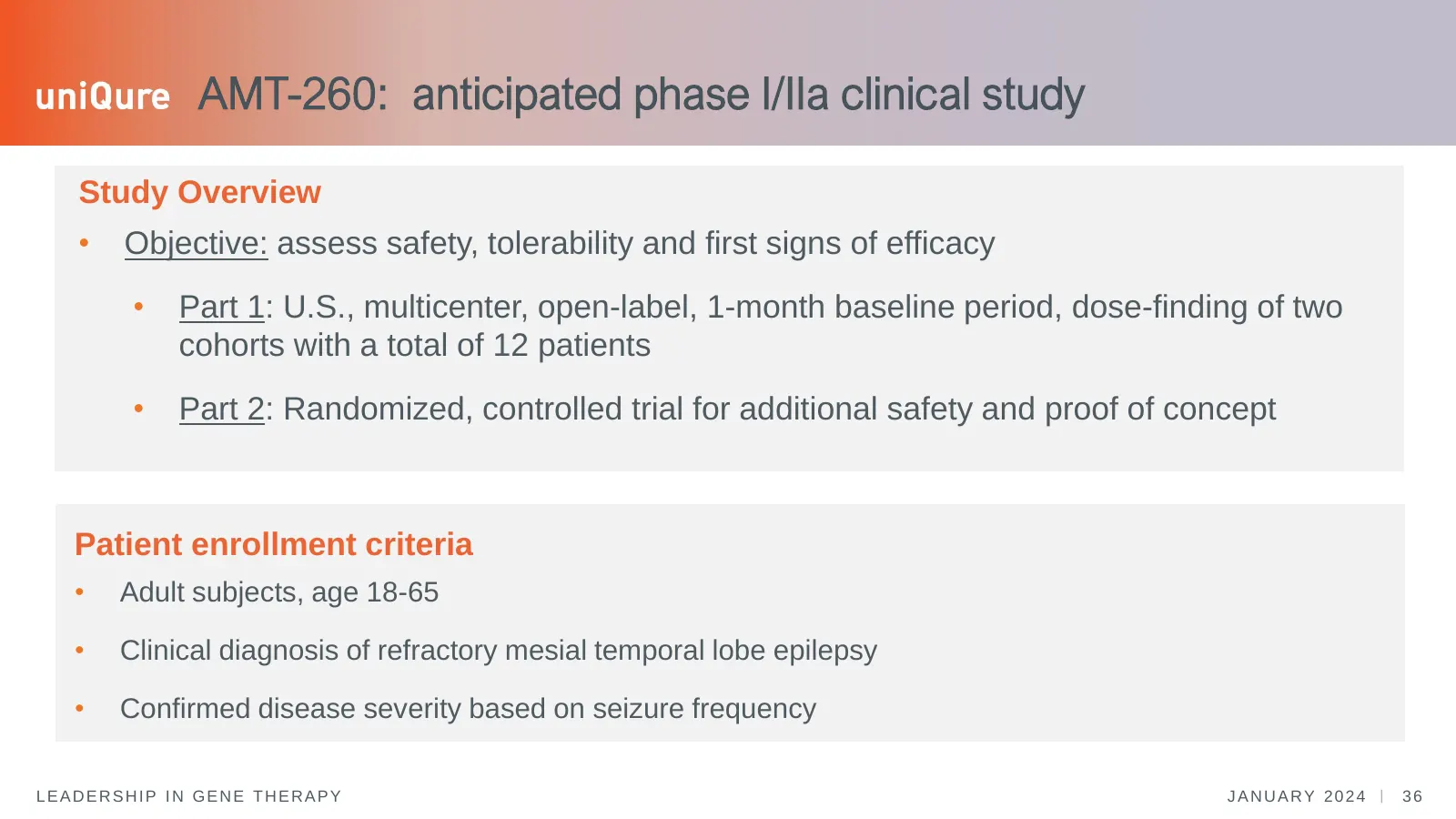
AMT-260: anticipated phase I/IIa clinical study Study Overview • Objective: assess safety, tolerability and first signs of efficacy • Part 1: U.S., multicenter, open-label, 1-month baseline period, dose-finding of two cohorts with a total of 12 patients • Part 2: Randomized, controlled trial for add
Slide 37: Amyotrophic Lateral Sclerosis (SOD1 ALS) AMT-162
Amyotrophic Lateral Sclerosis (SOD1 ALS) AMT-162 LEADERSHIP IN GENE THERAPY JANUARY 2024 | 37
Slide 38: SOD1 Amyotrophic Lateral Sclerosis (ALS)
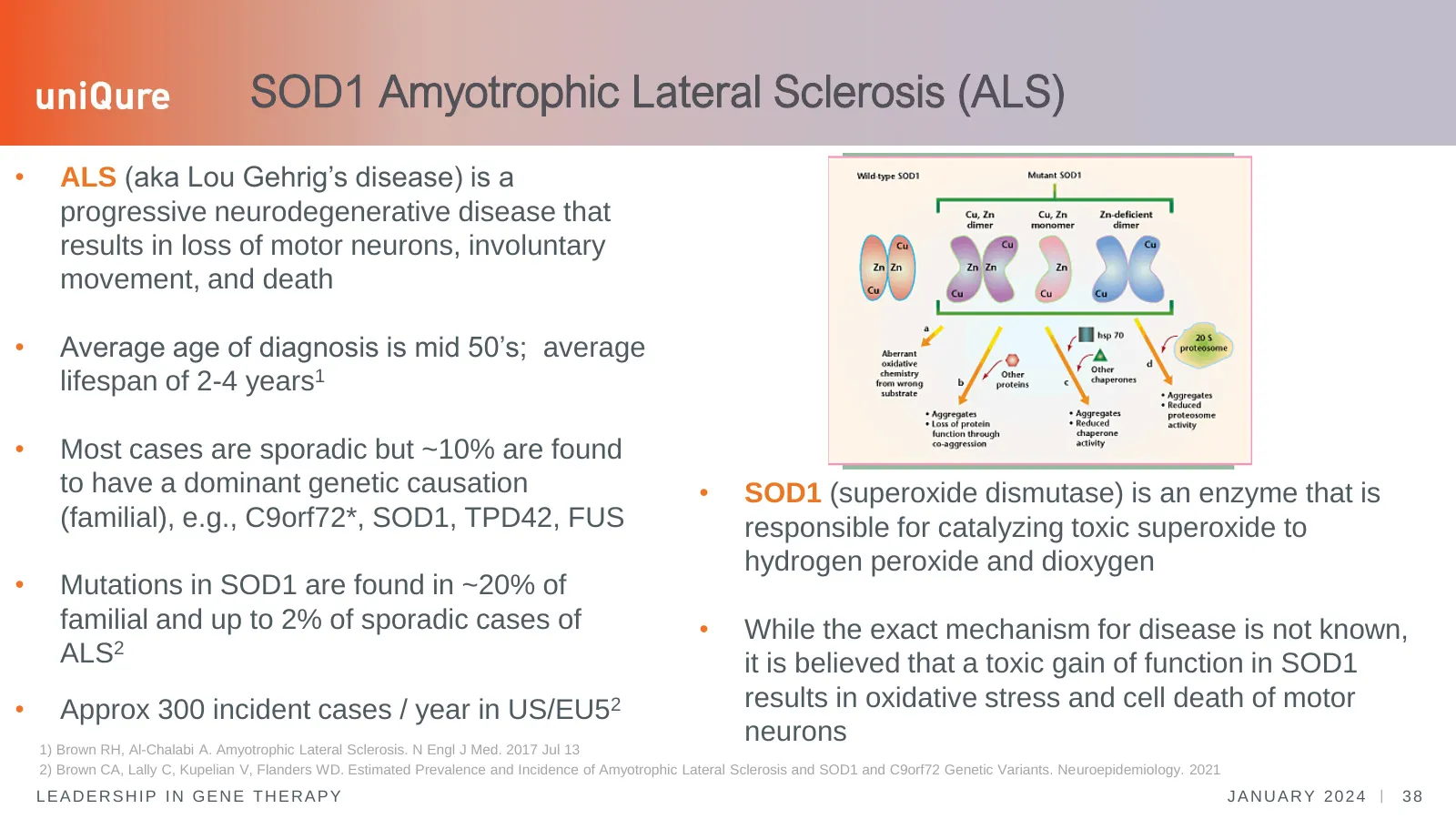
SOD1 Amyotrophic Lateral Sclerosis (ALS) • ALS (aka Lou Gehrig’s disease) is a progressive neurodegenerative disease that results in loss of motor neurons, involuntary movement, and death • Average age of diagnosis is mid 50’s; average lifespan of 2-4 years1 • Most cases are sporadic but ~10% are fo
Slide 39: SOD1 genetics and pathophysiology
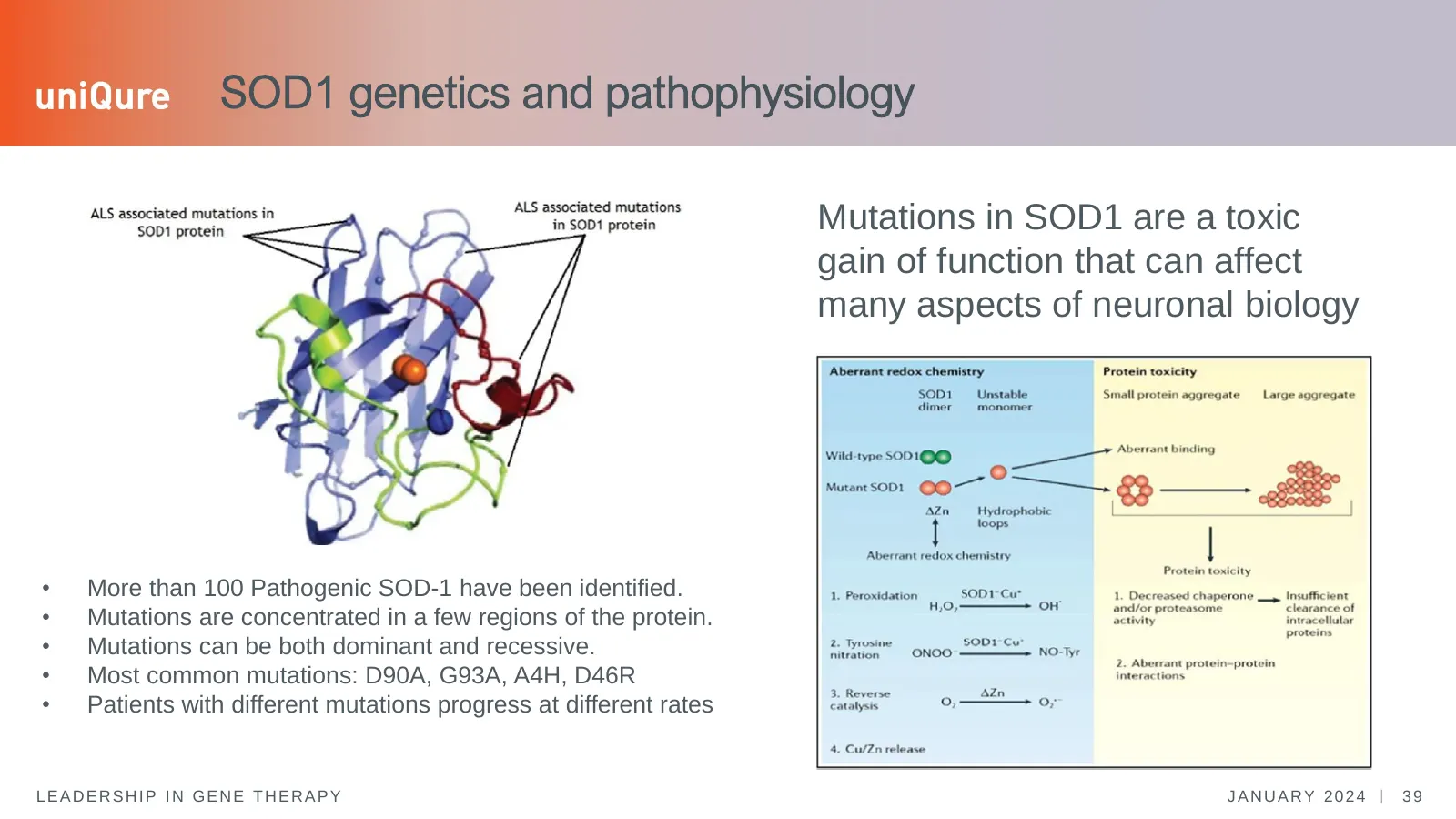
SOD1 genetics and pathophysiology Mutations in SOD1 are a toxic gain of function that can affect many aspects of neuronal biology • More than 100 Pathogenic SOD-1 have been identified. • Mutations are concentrated in a few regions of the protein. • Mutations can be both dominant and recessive. • Mos
Slide 40: AMT-162 (formerly APB-102) for SOD1-ALS
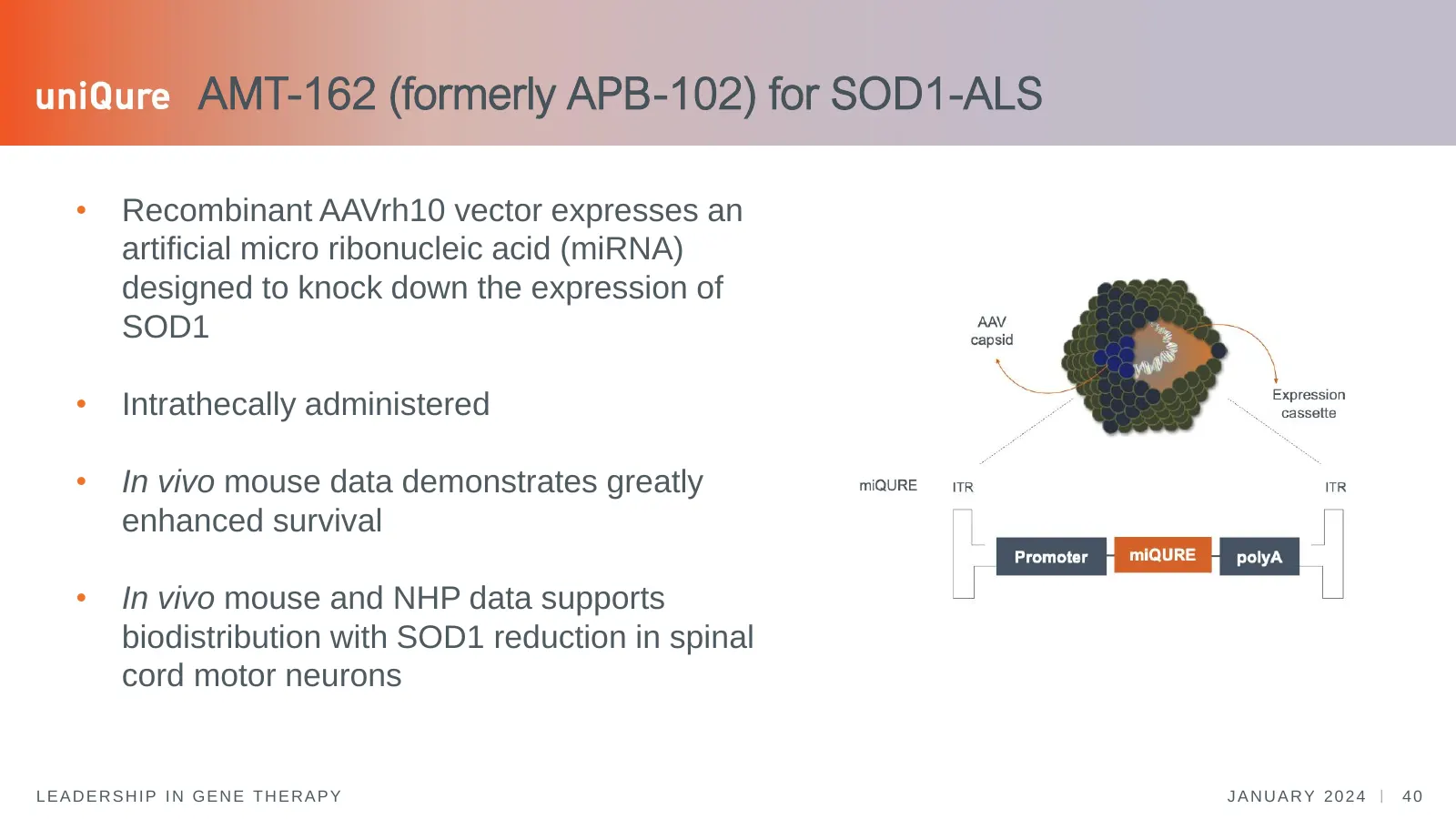
AMT-162 (formerly APB-102) for SOD1-ALS • Recombinant AAVrh10 vector expresses an artificial micro ribonucleic acid (miRNA) designed to knock down the expression of SOD1 • Intrathecally administered • In vivo mouse data demonstrates greatly enhanced survival • In vivo mouse and NHP data supports bio
Slide 41: Strategic rationale for global licensing with Apic Bio
strategic rationale for global licensing with Apic Bio • Aligns with current neurodegenerative focus of pipeline and highly complementary with AMT-161 program for ALS caused by mutations in c9orf72 gene • Expands uniQure's ALS familial franchise allowing for synergistic clinical development and pote

Slide 42: Fabry Disease AMT-191
\ oi uniQure - / Fabry Diseasey AMT-191
Slide 43: Fabry disease: a lysosomal storage disease
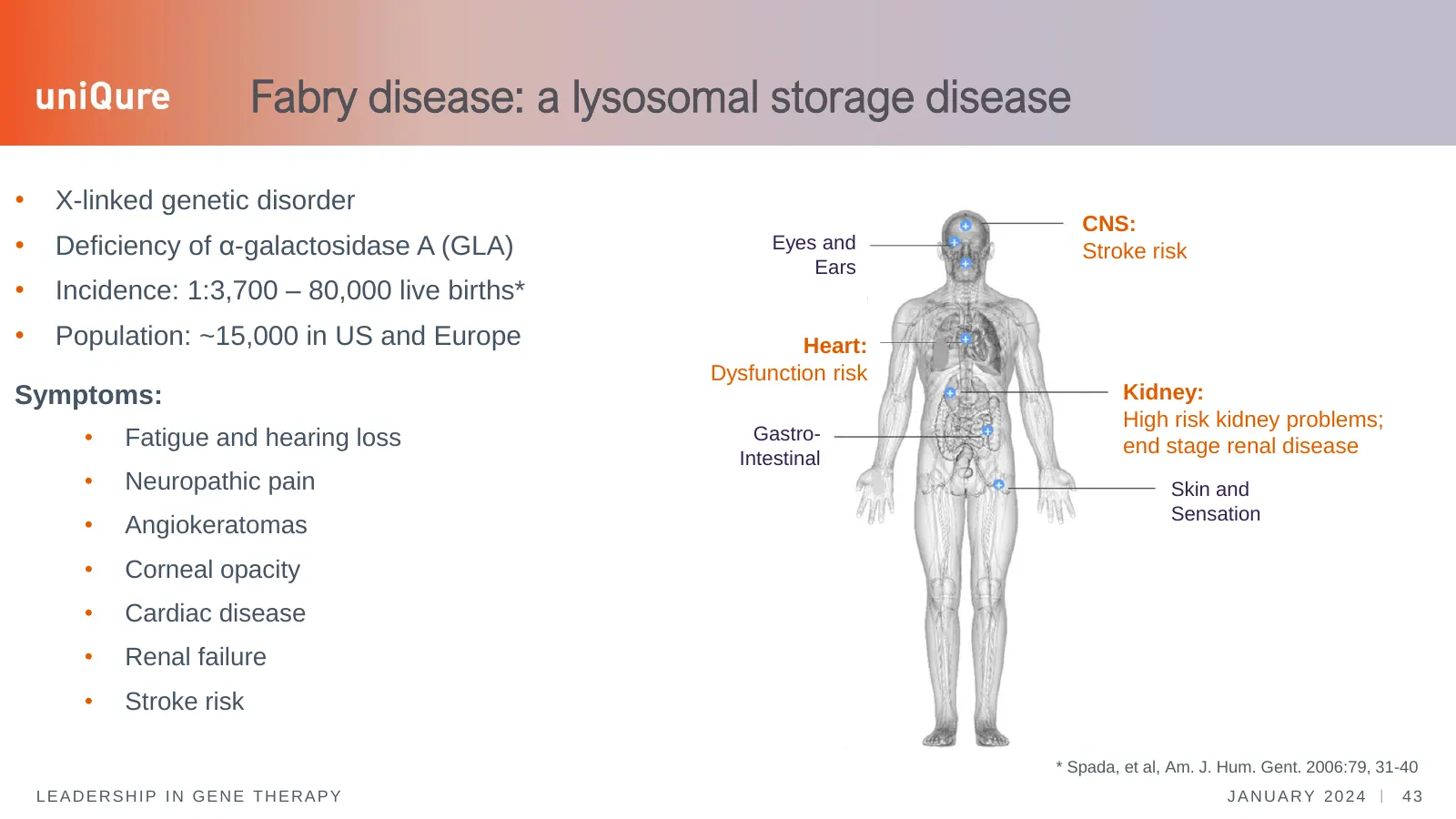
Fabry disease: a lysosomal storage disease • X-linked genetic disorder CNS: • Deficiency of α-galactosidase A (GLA) Eyes and Stroke risk Ears • Incidence: 1:3,700 – 80,000 live births* • Population: ~15,000 in US and Europe Heart: Dysfunction risk Symptoms: Kidney: High risk kidney problems; • Fatig
Slide 44: Fabry disease: unmet need with current enzyme replacement therapy
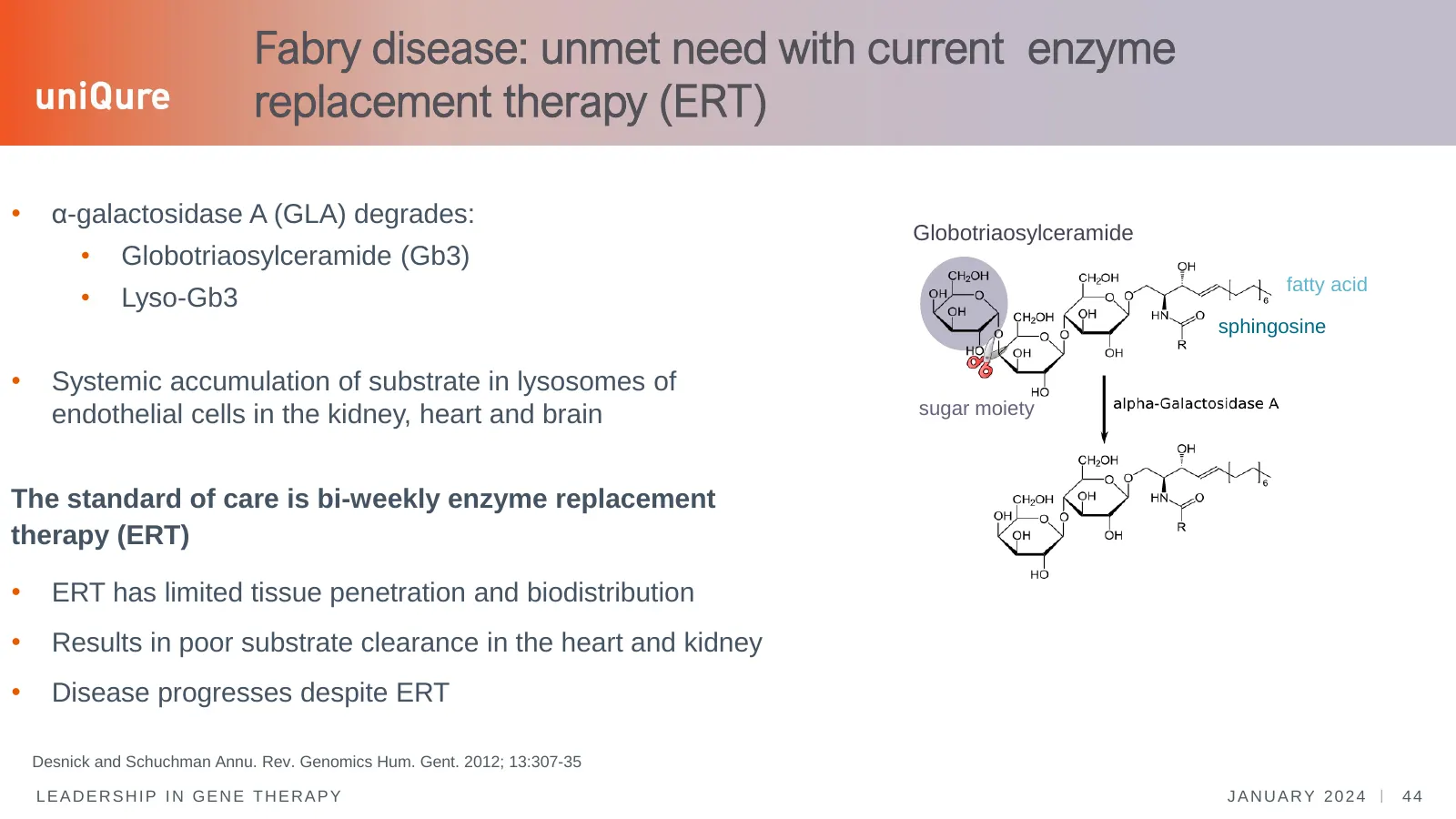
Fabry disease: unmet need with current enzyme replacement therapy (ERT) • α-galactosidase A (GLA) degrades: Globotriaosylceramide • Globotriaosylceramide (Gb3) fatty acid • Lyso-Gb3 sphingosine • Systemic accumulation of substrate in lysosomes of endothelial cells in the kidney, heart and brain suga
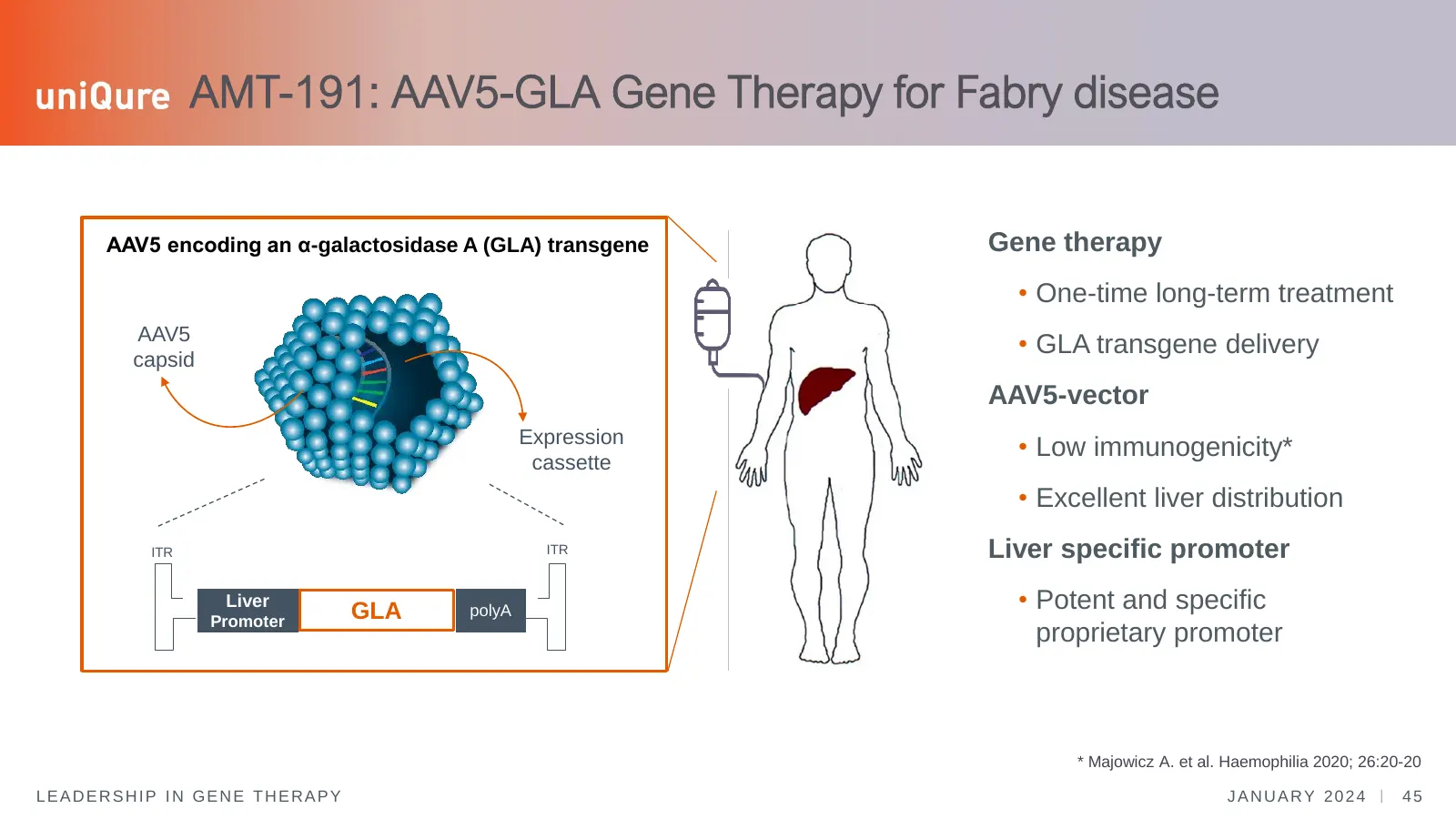
Slide 45: AMT-191: AAV5-GLA Gene Therapy for Fabry disease
AMT-191: AAV5-GLA Gene Therapy for Fabry disease AAV5 encoding an α-galactosidase A (GLA) transgene Gene therapy • One-time long-term treatment AAV5 capsid • GLA transgene delivery AAV5-vector Expression • Low immunogenicity* cassette • Excellent liver distribution ITR ITR Liver specific promoter Li
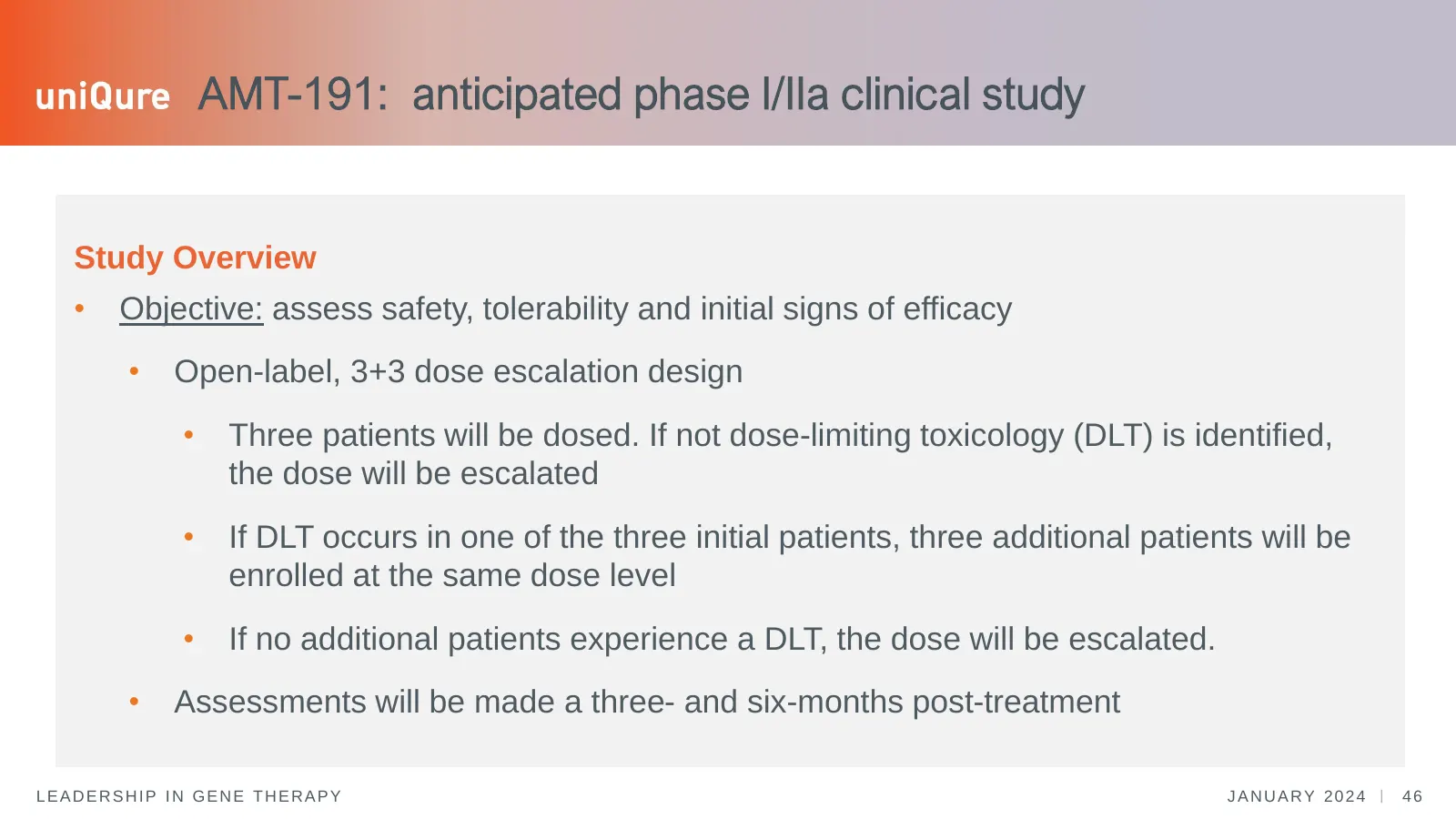
Slide 46: AMT-191: anticipated phase I/IIa clinical study
AMT-191: anticipated phase I/IIa clinical study Study Overview • Objective: assess safety, tolerability and initial signs of efficacy • Open-label, 3+3 dose escalation design • Three patients will be dosed. If not dose-limiting toxicology (DLT) is identified, the dose will be escalated • If DLT occu

Slide 47
Source: Internet Archive copy of uniqure.com
More decks from uniQure N.V.
 Corporate Update (September 2026)34 slides · Sep 29, 2026
 Epilepsy Pipeline Conference June 20266 slides · Jun 1, 2026
 2026 HD Therapeutics Conference33 slides · Feb 24, 2026
 WORLDSymposium 202613 slides · February 2026
 Investor Presentation (January 2026)34 slides · Jan 13, 2026
 Corporate Update (September 2025)29 slides · Sep 24, 2025