Corbus Pharmaceuticals Holdings, Inc. · NASDAQ:CRBP
Corbus Pharmaceuticals — 37th Annual Cowen Health Care Conference (March 2017)
43 slides from Corbus Pharmaceuticals's conference presentation, Mar 8, 2017

Slide 1: Developing Breakthrough Therapies for Rare Inflammatory and Fibrotic Diseases
Slide 2: Forward-Looking Statements
FORWARD-LOOKING STATEMENTS This presentation contains certain forward-looking statements, including those relating to the Company's product development, clinical trials, clinical and regulatory timelines, market opportunity, competitive position, possible or assumed future results of operations, bus
Slide 3: The Corbus Business Model
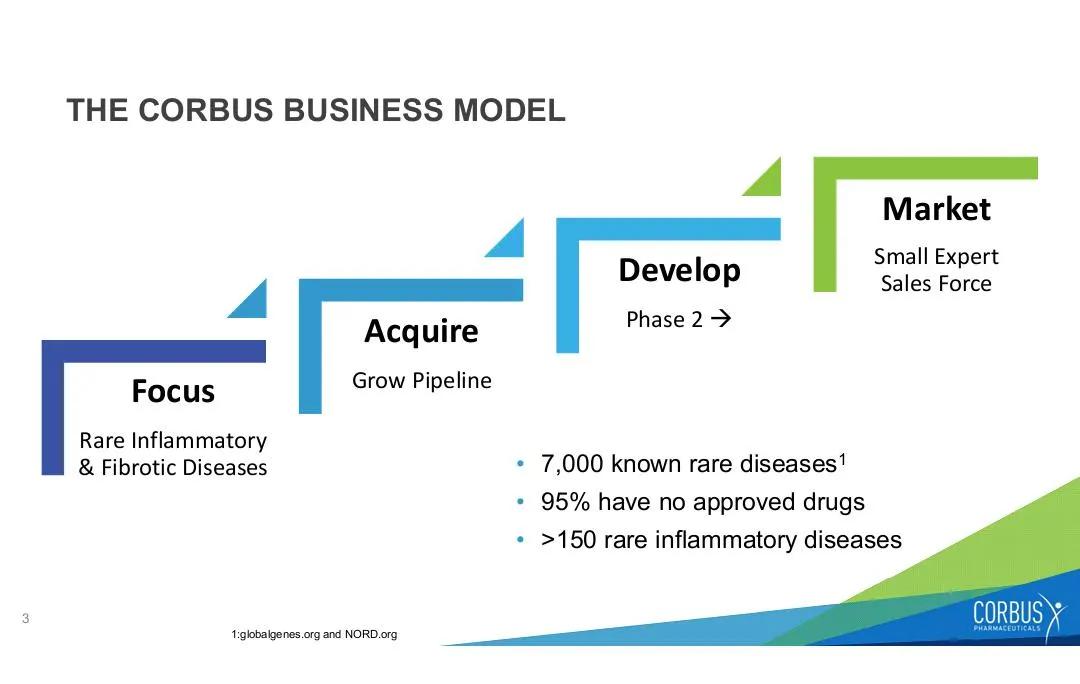
THE CORBUS BUSINESS MODEL Market Small Expert Sales Force Acquire Grow Pipeline Focus Rare Inflammatory & Fibrotic Diseases * 7,000 known rare diseases * 95% have no approved drugs * >150 rare inflammatory diseases ‘iglobalgenes.org and NORD.org

Slide 4: Management Team
MANAGEMENT TEAM ‘YUVAL COHEN PH.D. CHIEF EXECUTIVE OFFICER, DIRECTOR ‘Co-founder and former President of Celsus Therapeutics (CLTX). Expertise in developing antiinflammatory drugs including for CF SEAN MORAN C.P.A. M.B.A CHIEF FINANCIAL OFFICER Former CFO: InVivo (NVIV), Celsion (CLSN), Transport Ph
Slide 5: JBT-101
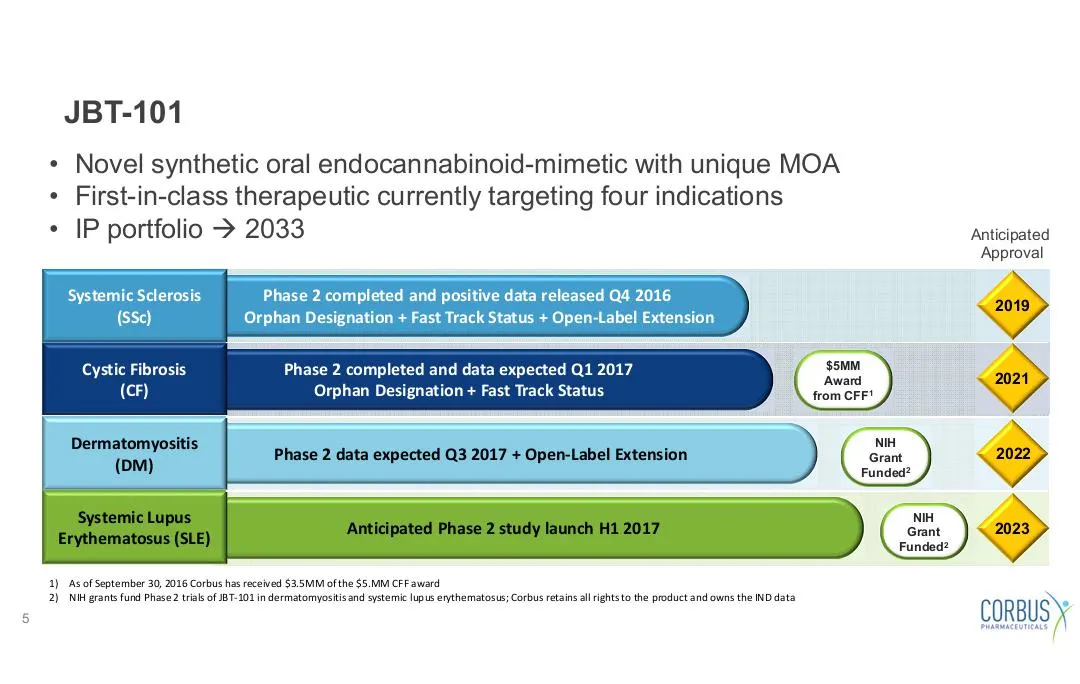
JBT-101 * Novel synthetic oral endocannabinoid-mimetic with unique MOA ¢ First-in-class therapeutic currently targeting four indications * IP portfolio > 2033 Systemic Sclerosis Phase 2 completed and positive data released Q4 2016 (SSc) Orphan Designation + Fast Track Status + Open-Label Extension C
Slide 6: Expected Near-Term Milestones
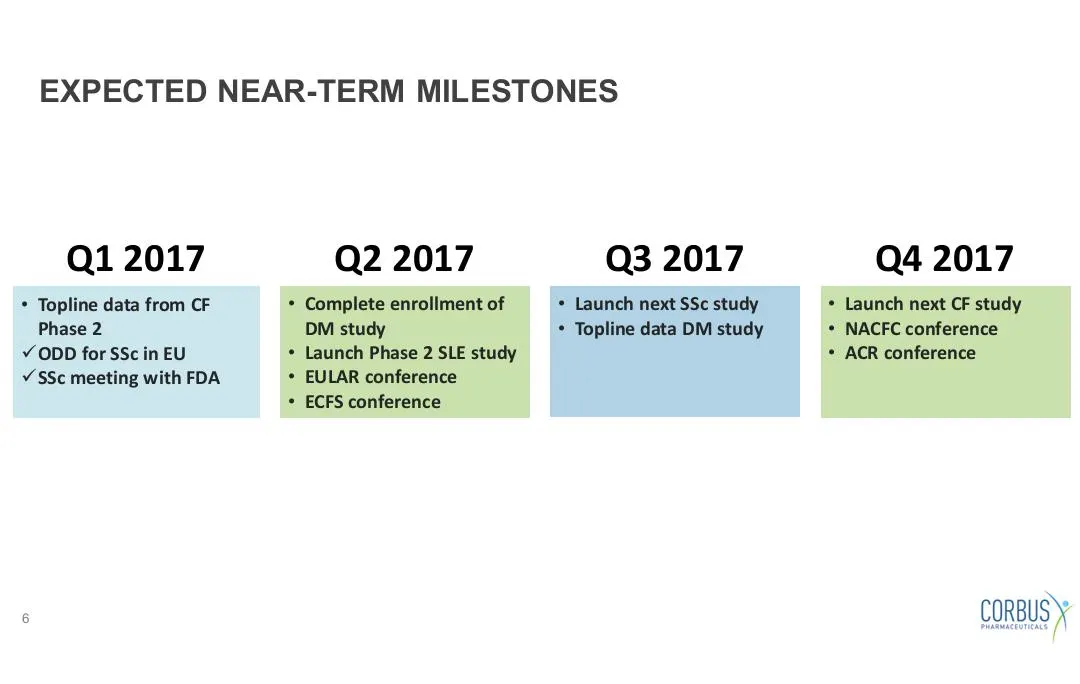
EXPECTED NEAR-TERM MILESTONES Q1 2017 Q2 2017 Q3 2017 Q4 2017 * Topline data from CF + Launch next SSc study Phase 2 * Topline data DM study ¥ ODD for SSc in EU VSSc meeting with FDA ‘ CORBUS)y
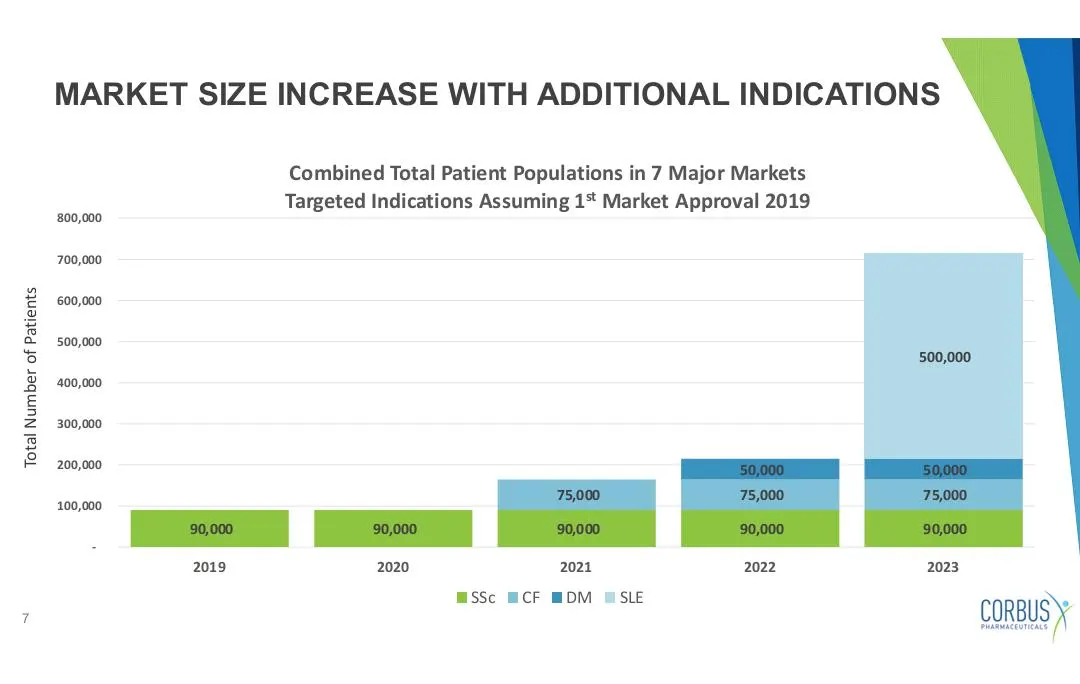
Slide 7: Market Size Increase with Additional Indications
Total Number of Patients MARKET SIZE INCREASE WITH ADDITIONAL INDICATIONS ‘800,000 700,000 600,000 500,000 400,000 300,000 200,000 100,000 Combined Total Patient Populations in 7 Major Markets Targeted Indications Assuming 1* Market Approval 2019 2019 2020 2021 2022 mSSc MCF MOM @SLE
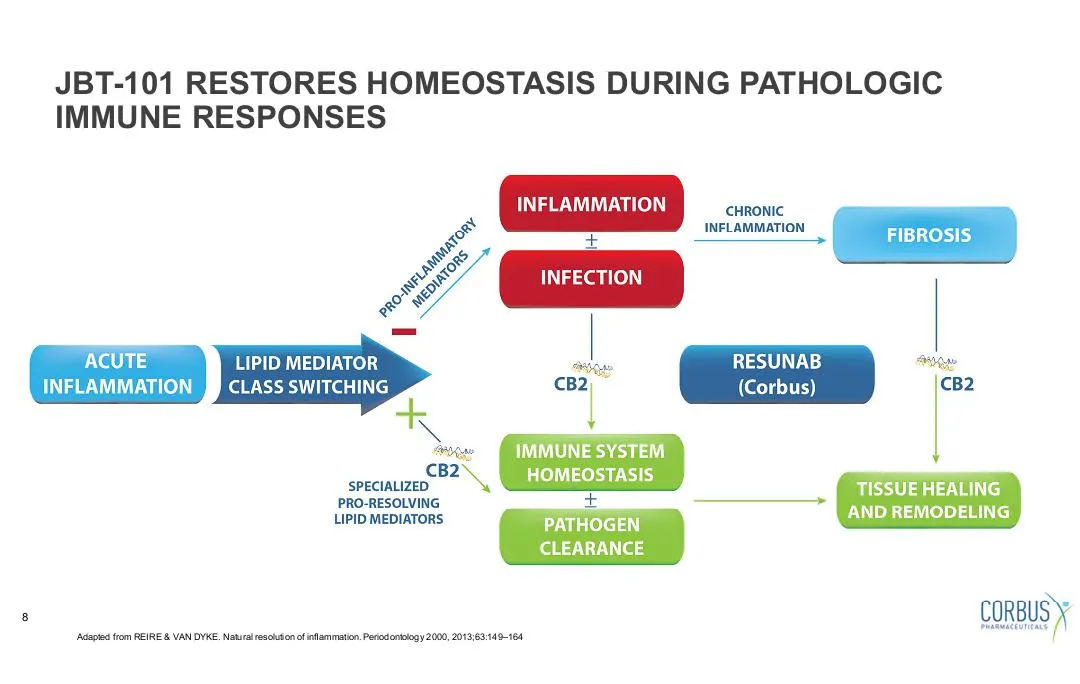
Slide 8: JBT-101 Restores Homeostasis During Pathologic Immune Responses
JBT-101 RESTORES HOMEOSTASIS DURING PATHOLOGIC IMMUNE RESPONSES RESUNAB eo il at “| (Corbus) cB2 IMMUNE SYSTEM FIBROSIS. LIPID MEDIATOR CLASS SWITCHING ACUTE INFLAMMATION K cB2\ SBECIALZED OM EOSIAS LIPID MEDIATORS a AND REMODELING CORBUS Adapted from REIRE A VAN DYKE, Natural eschaon of iflammation
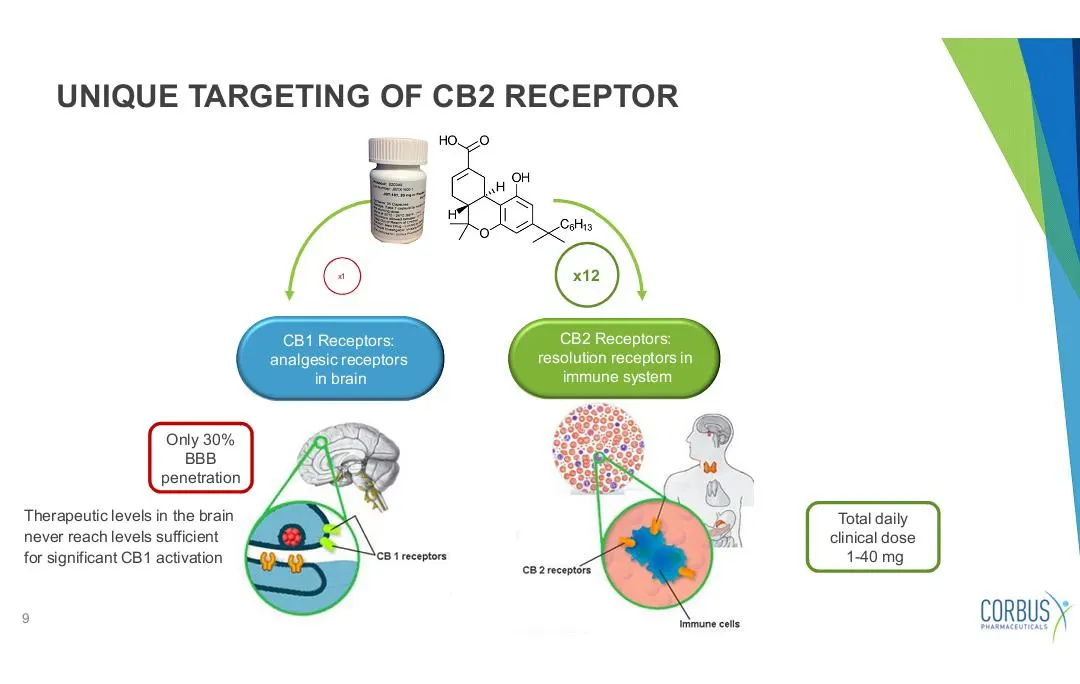
Slide 9: Unique Targeting of CB2 Receptor
UNIQUE TARGETING OF CB2 RECEPTOR Therapeutic levels in the brain never reach levels sufficient for significant CB1 activation
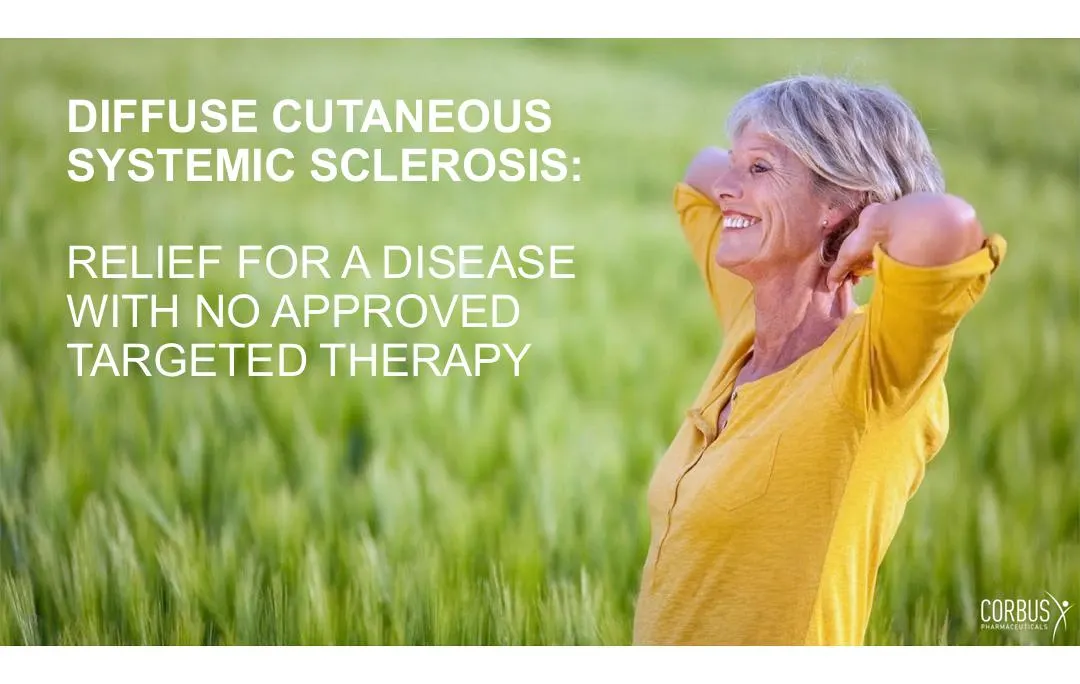
Slide 10: Diffuse Cutaneous Systemic Sclerosis
f WO eae Phare, DIFFUSE CUTANEOUS SYSTEMIC SCLEROSIS: * RELIEF FOR A DISEASE WITH NO APPROVED TARGETED THERAPY CORBUSY
Slide 11: Systemic Sclerosis
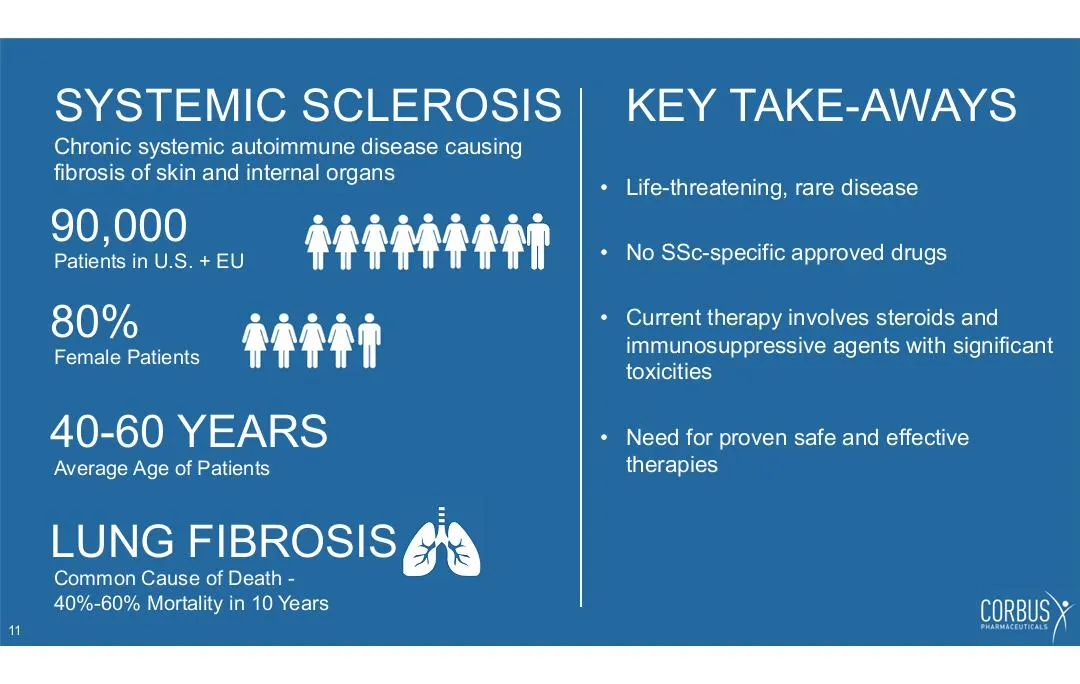
oT SYSTEMIC SCLEROSIS Chronic systemic autoimmune disease causing fibrosis of skin and internal organs 90,000. Saeed 0%. htt 40-60 YEARS Average Age of Patients LUNG FIBROSIS gy Common Cause of Death - 0%-60% Mortality in 10 Years KEY TAKE-AWAYS + Life-threatening, rare disease + No SSc-specific app
Slide 12: JBT101-SSc-001 Phase 2 Trial Design
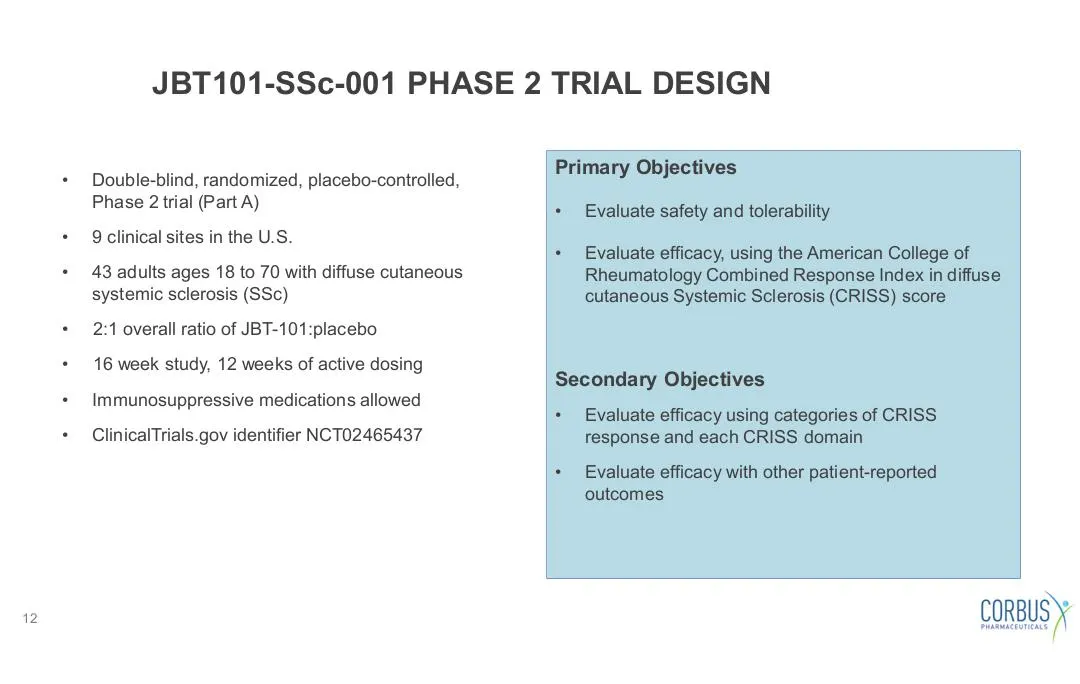
12 JBT101-SSc-001 PHASE 2 TRIAL DESIGN Double-blind, randomized, placebo-controlled, Phase 2 trial (Part A) 9 clinical sites in the U.S. 43 adults ages 18 to 70 with diffuse cutaneous systemic sclerosis (SSc) 2:1 overall ratio of JBT-101:placebo 16 week study, 12 weeks of active dosing Immunosuppres
Slide 13: Distribution of ACR-CRISS Scores by Week
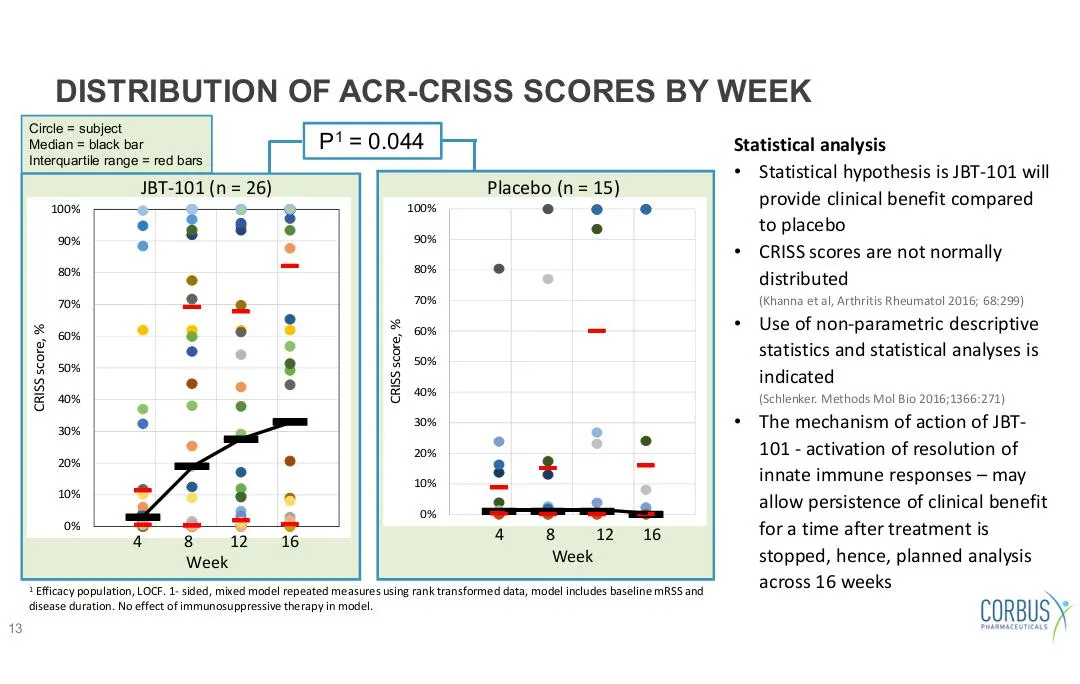
13 DISTRIBUTION OF ACR-CRISS SCORES BY WEEK Circle = subject Median = black bar Placebo (n = 15) oe @ e CRISS score, % x 6 z & * Efficacy population, LOCF. 1- sided, mixed model repeated measures using rank transformed data, model includes baseline mRSS and <isease duration. No effect of immunosuppr
Slide 14: CRISS Scores by Week
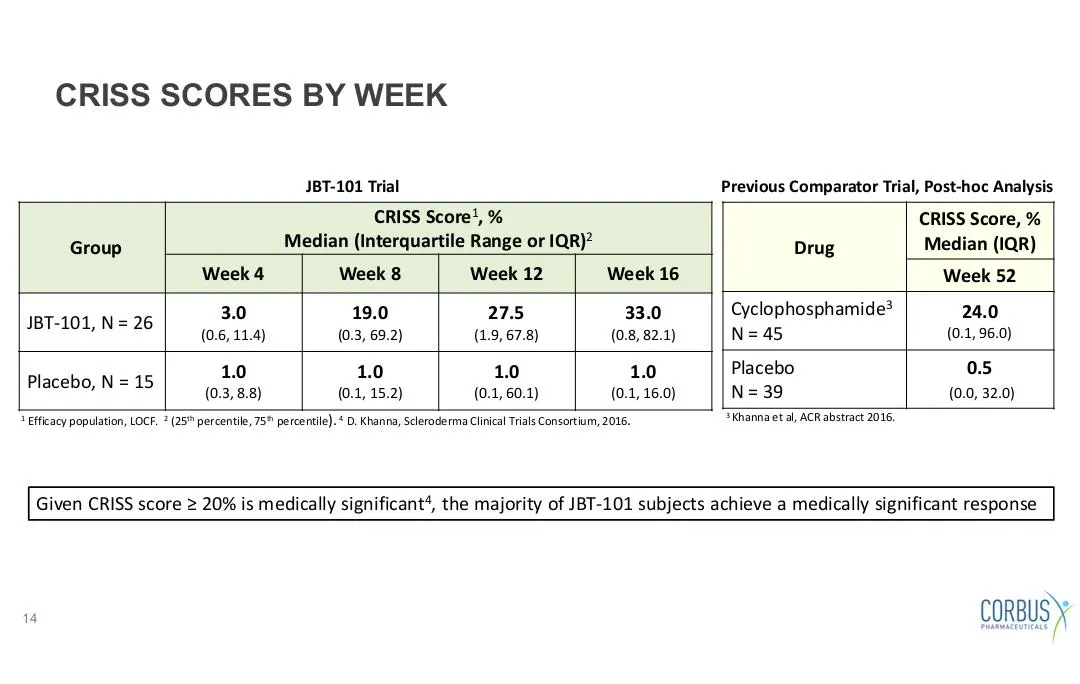
CRISS SCORES BY WEEK JBT-101 Trial Previous Comparator Trial, Post-hoc Analysis CRISS Score!, % CRISS Score, % Group Median (interquartile Range or 1QR)? Drug Median (IQR) Week 4 Week 8 Week 12 Week 16 Week 52 : 3.0 19.0 275 33.0 Cyclophosphamide 24.0 ABTIOL Ne 26 (0.6, 11.4) (0.3, 69.2) (1.9, 67.8)
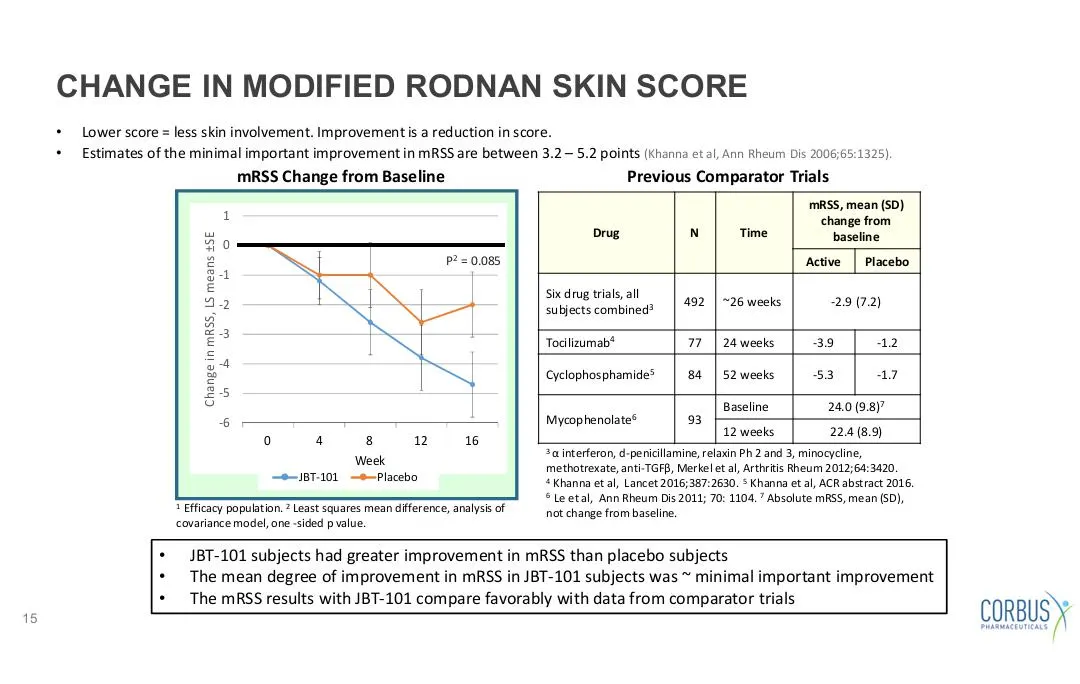
Slide 15: Change in Modified Rodnan Skin Score
CHANGE IN MODIFIED RODNAN SKIN SCORE Lower score = less skin involvement. Improvements a reduction in score. Estimates of the minimal important improvement in mRSS are between 3.2 ~ 5.2 points (Khanna et al, Ann Rheum Dis 2006;65:1325) ™RSS Change from Baseline Previous Comparator Trials mRSS, mean
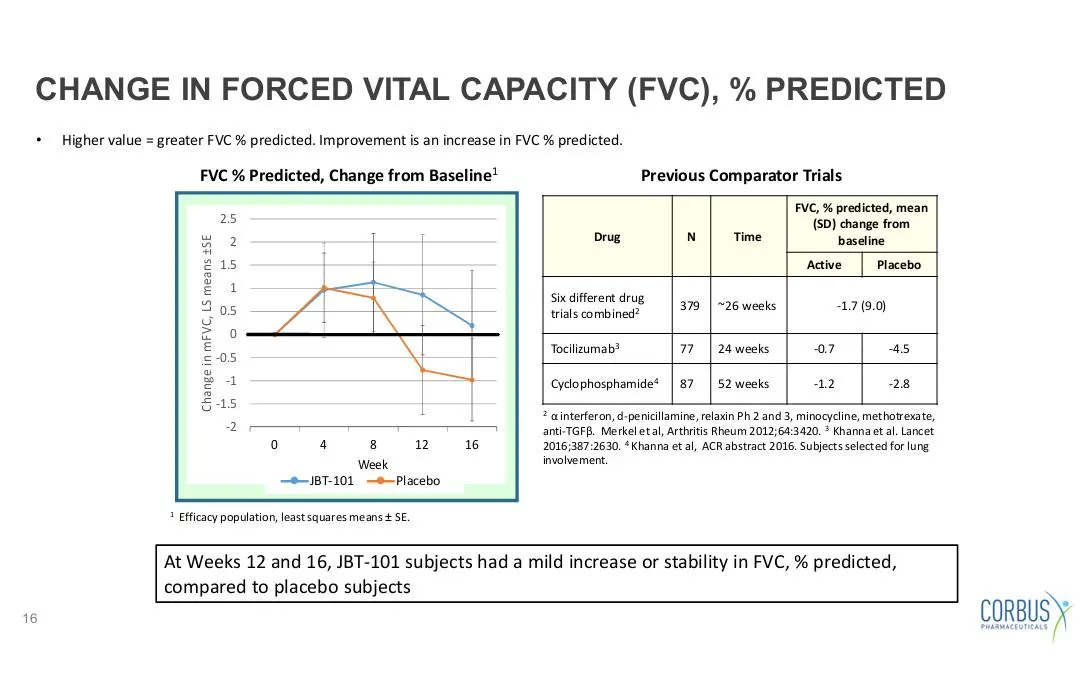
Slide 16: Change in Forced Vital Capacity (FVC), % Predicted
16 CHANGE IN FORCED VITAL CAPACITY (FVC), % PREDICTED Higher value = greater FVC % predicted. Improvement is an increase in FVC % predicted. FVC % Predicted, Change from Baseline* Previous Comparator Trials FVG, % predicted, mean (8D) change from 4 Drug N | Time baseline 2 Active | Placebo E Six dif
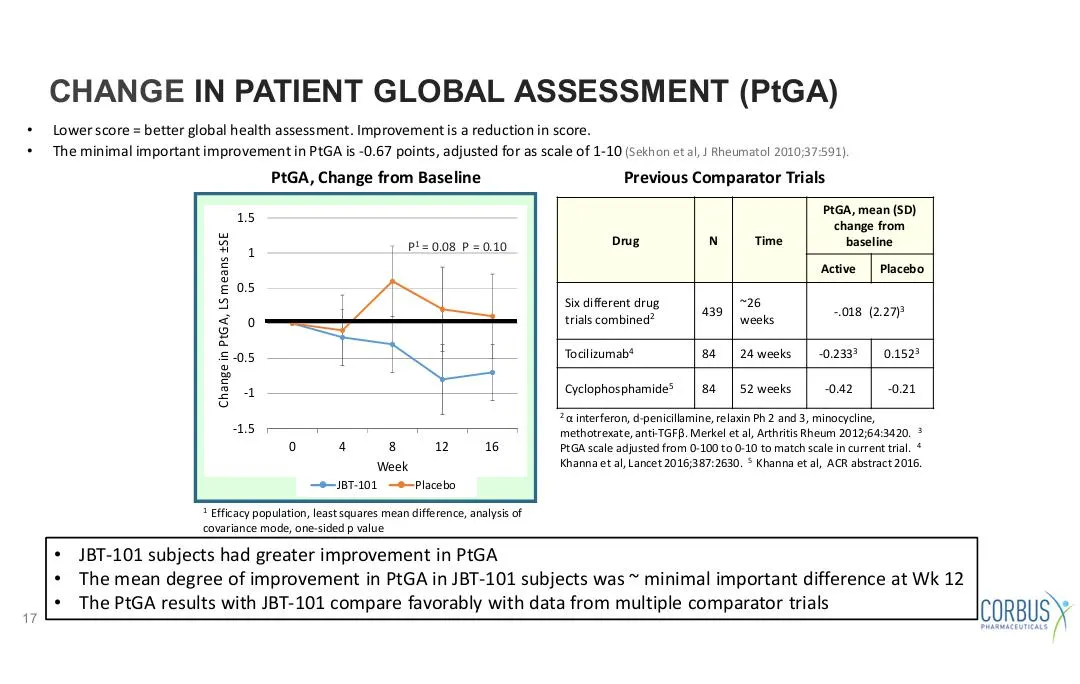
Slide 17: Change in Patient Global Assessment (PtGA)
CHANGE IN PATIENT GLOBAL ASSESSMENT (PtGA) Lower score = better global health assessment. Improvement is a reduction in score. The minimal important improvement in PtGA is -0.67 points, adjusted for as scale of 1-10 (Sekhion et al, | Rheumatol 2010;37:591) PtGA, Change from Baseline Previous Compara
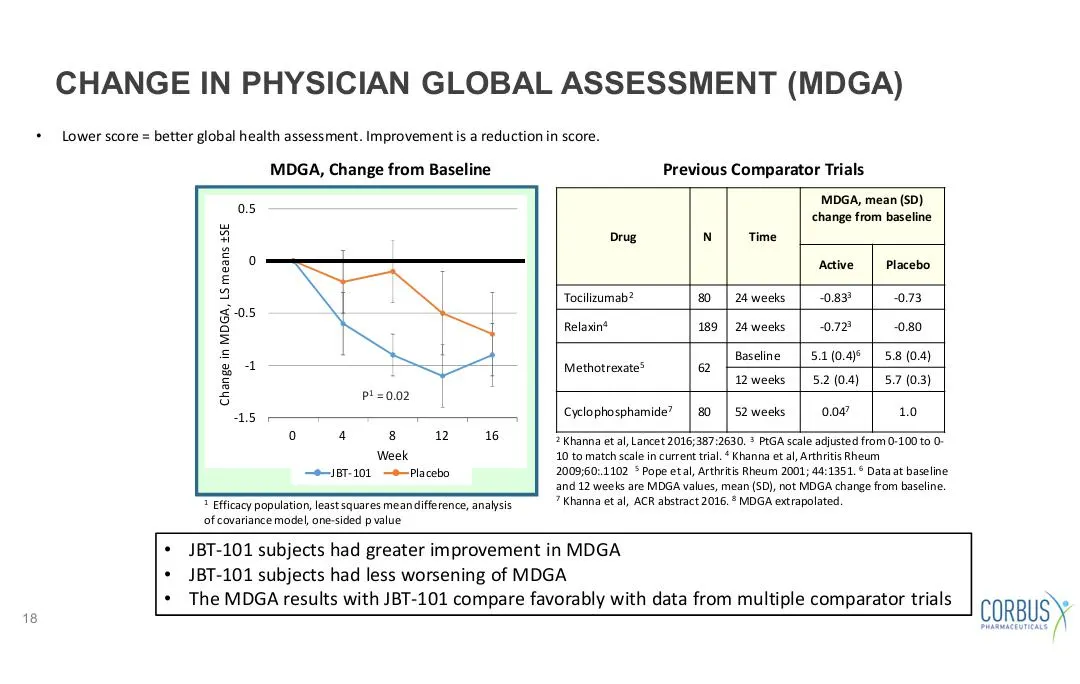
Slide 18: Change in Physician Global Assessment (MDGA)
CHANGE IN PHYSICIAN GLOBAL ASSESSMENT (MDGA) + Lower score = better global health assessment. Improvement is a reduction in score. MDGA, Change from Baseline Previous Comparator Trials MDGA, mean (SD) 7 change from baseline bd Drug n | Time 8 Active | Placebo z 4 Tociiumab? m | 24wees | ap | 073 g R
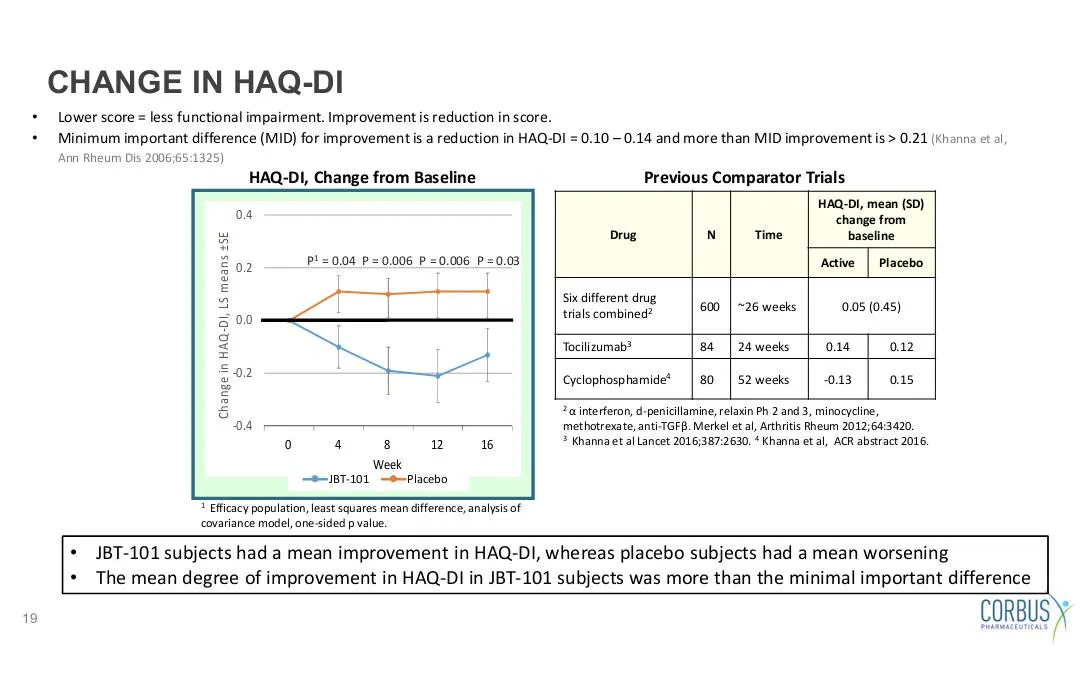
Slide 19: Change in HAQ-DI
CHANGE IN HAQ-DI + Lower score = less functional impairment. Improvement is reduction in score. + Minimum important difference (MID) for improvements a reduction in HAQ-DI = 0.10 -0.14 and more than MID improvements > 0.21 (khanna et a Ann Rheum Dis 2006;65: HAQ-DI, Change from Baseline Previous Com
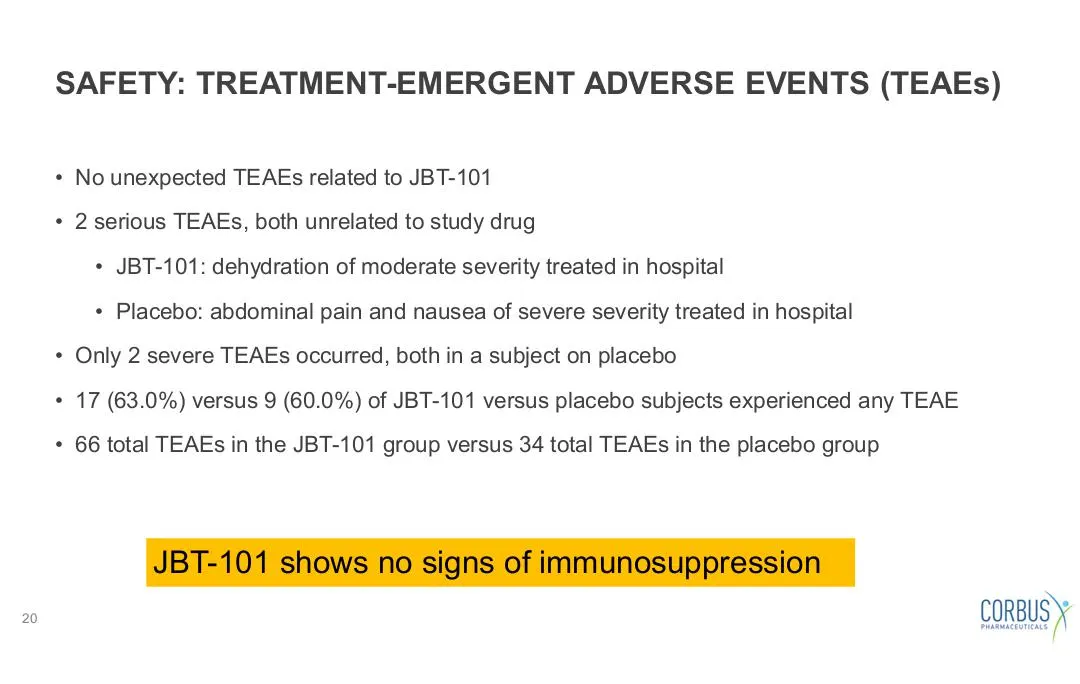
Slide 20: Safety: Treatment-Emergent Adverse Events (TEAEs)
20 SAFETY: TREATMENT-EMERGENT ADVERSE EVENTS (TEAEs) No unexpected TEAEs related to JBT-101 2 serious TEAEs, both unrelated to study drug + JBT-101: dehydration of moderate severity treated in hospital + Placebo: abdominal pain and nausea of severe severity treated in hospital Only 2 severe TEAEs oc
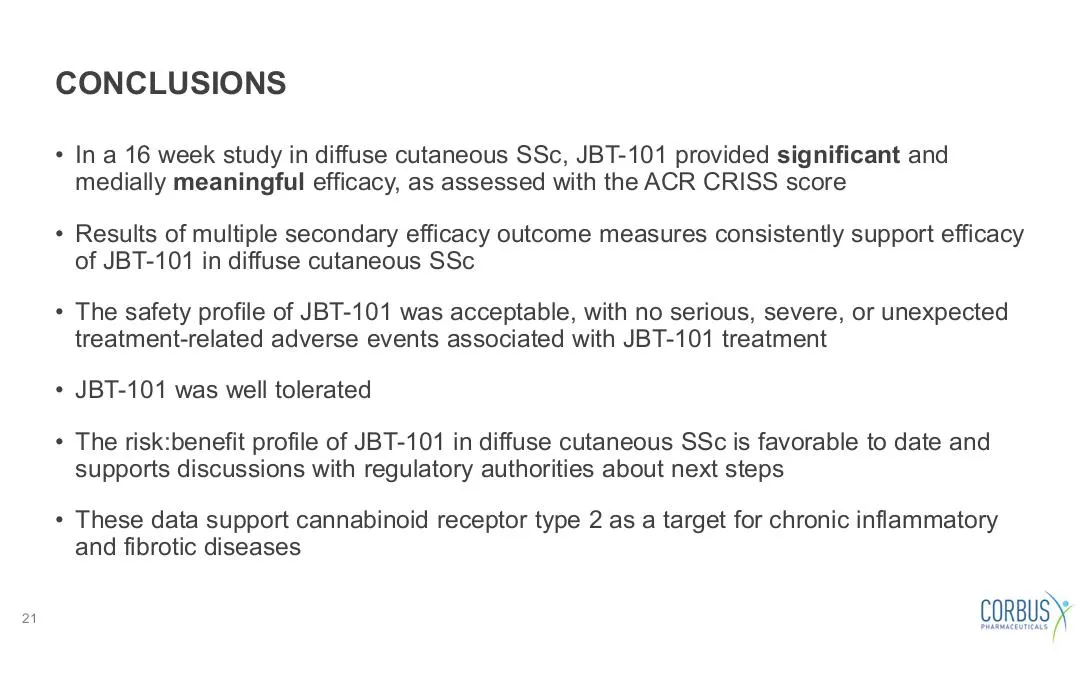
Slide 21: Conclusions
CONCLUSIONS + Ina 16 week study in diffuse cutaneous SSc, JBT-101 provided significant and medially meaningful efficacy, as assessed with the ACR CRISS score « Results of multiple secondary efficacy outcome measures consistently support efficacy of JBT-101 in diffuse cutaneous SSc * The safety profi
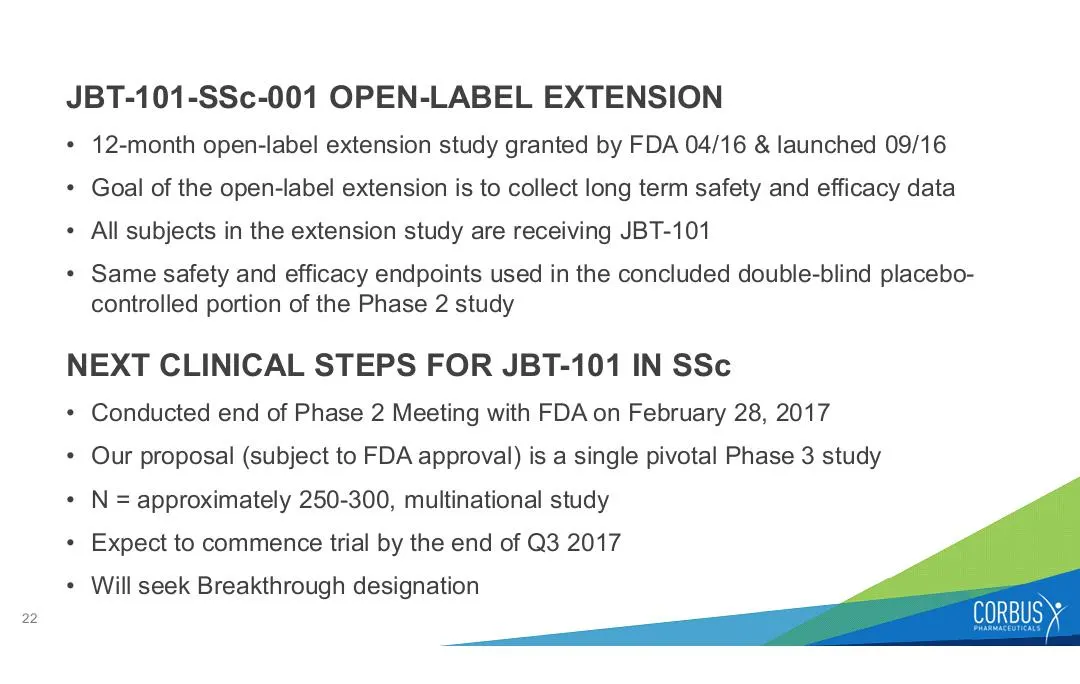
Slide 22: JBT-101-SSc-001 Open-Label Extension
22 JBT-101-SSc-001 OPEN-LABEL EXTENSION * 12-month open-label extension study granted by FDA 04/16 & launched 09/16 * Goal of the open-label extension is to collect long term safety and efficacy data + All subjects in the extension study are receiving JBT-101 + Same safety and efficacy endpoints use
Slide 23: Cystic Fibrosis: Focusing on Inflammation & Fibrosis
C BROSIS: FOCUSING ON INFLAMMATION & FIBROSIS ORBUS)y
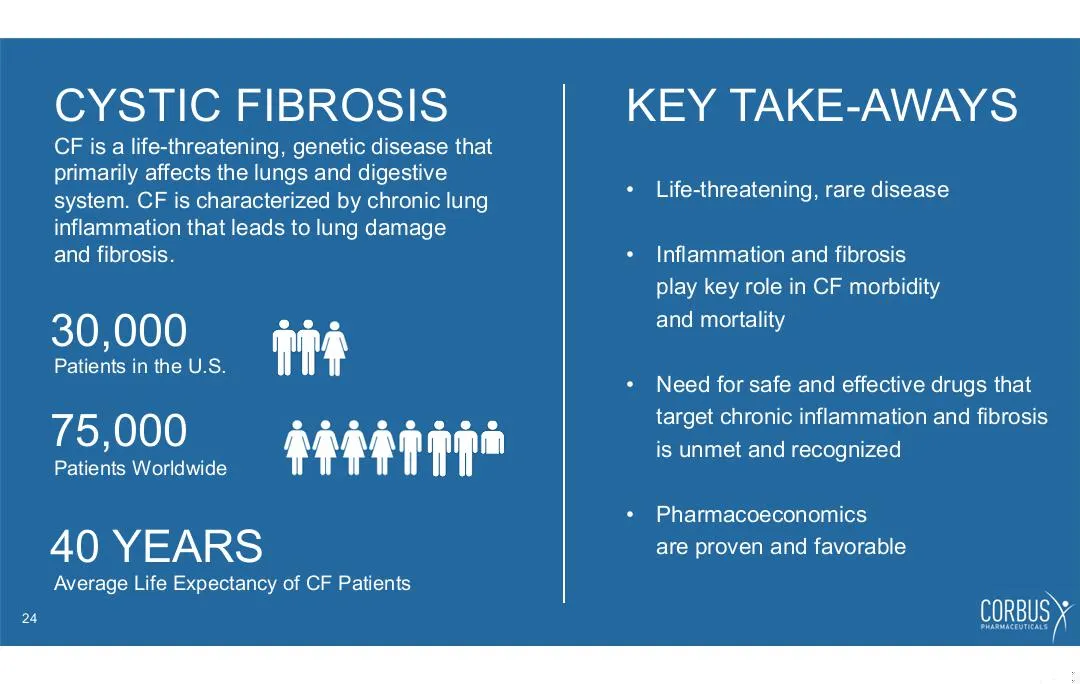
Slide 24: Cystic Fibrosis
24 CYSTIC FIBROSIS CF is a life-threatening, genetic disease that primarily affects the lungs and digestive system. CF is characterized by chronic lung inflammation that leads to lung damage and fibrosis. 30,000 pre oT oeeet ere 40 YEARS Average Life Expectancy of CF Patients KEY TAKE-AWAYS + Life-t
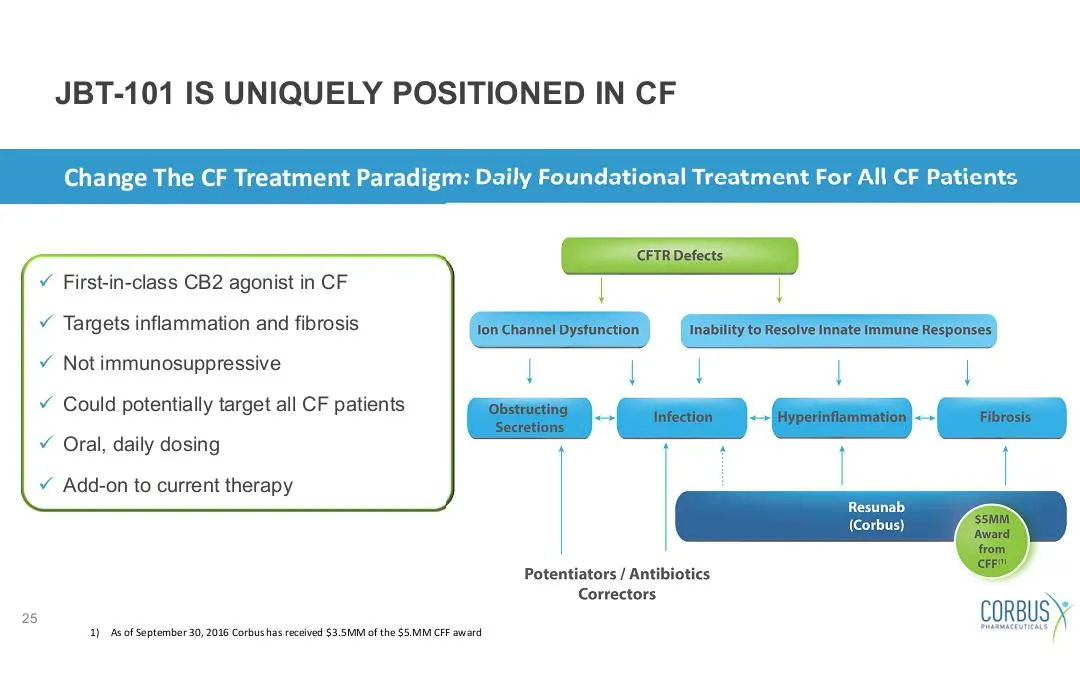
Slide 25: JBT-101 Is Uniquely Positioned in CF
JBT-101 IS UNIQUELY POSITIONED IN CF ange The CF Treatment Paradigm: Daily Foundational Treatment For All CF Patients Y First-in-class CB2 agonist in CF i | Y Targets inflammation and fibrosis (ton channel bystunction | v Not immunosuppressive | | | | | «ee eee LS) ga ian femete) -emate) ¥ Oral, dai
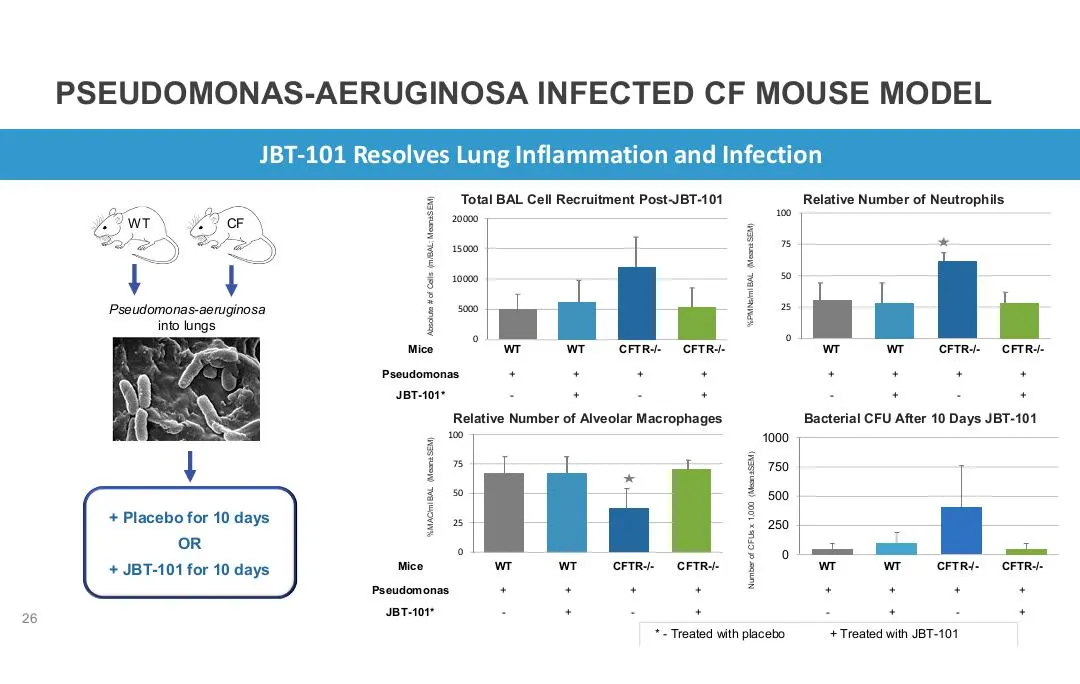
Slide 26: Pseudomonas-aeruginosa Infected CF Mouse Model
PSEUDOMONAS-AERUGINOSA INFECTED CF MOUSE MODEL JBT-101 Resolves Lung Inflammation and Infecti a Total BAL Cell Recruitment Post-JBT-101 Relative Number of Neutrophils: | 70m _” 3 E] 1s i* i 3 3 * : ee into lungs j i ° Mice CFTRI- CFTRI- CFTRY- CFTRI- Psoudomonas sBr-101" 2 ‘ 2 + a ‘ ‘ Relative Numbe
Slide 27: Pseudomonas-aeruginosa Infected CF Mouse Model: Weight Loss and Survival
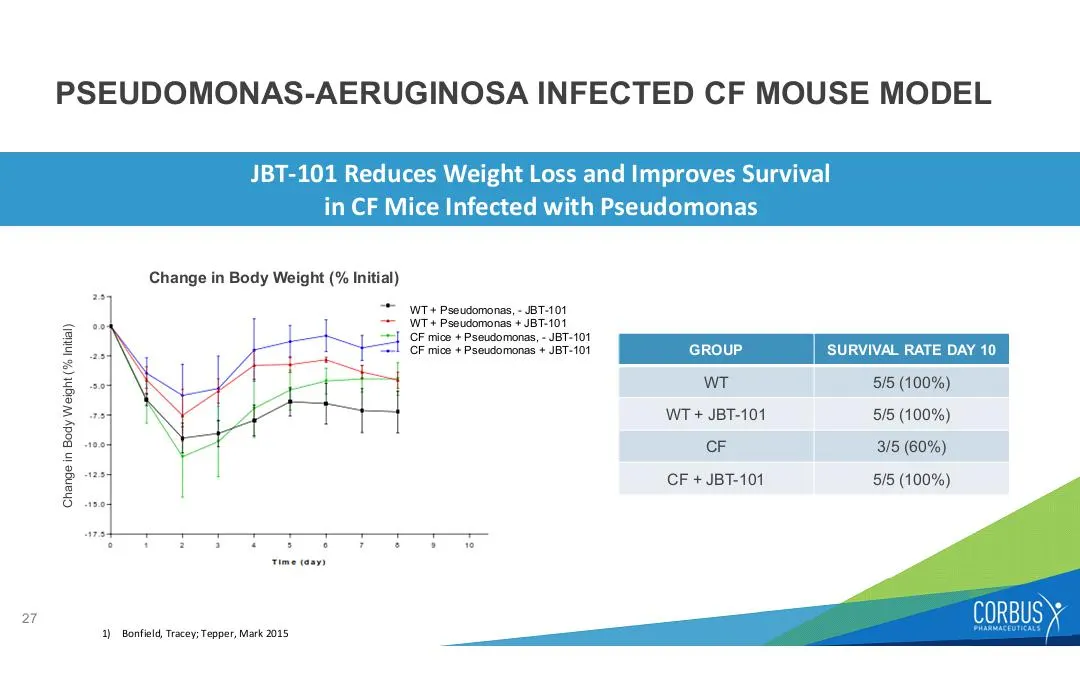
ar PSEUDOMONAS-AERUGINOSA INFECTED CF MOUSE MODEL JBT-101 Reduces We’ Loss and Improves Survival in CF Mice Infected with Pseudomonas Change in Body Weight (% Initial) “T+ Pseudomonas, - JBT-101 oe “~_ WT+ Pseudomonas + JBT-101 2. = Ge meet Paeworenas © JBT-101 = a WT 515 (100%) Fa ae WT + JBT-101 5
Slide 28: JBT-101: CF Phase 2 Clinical Study
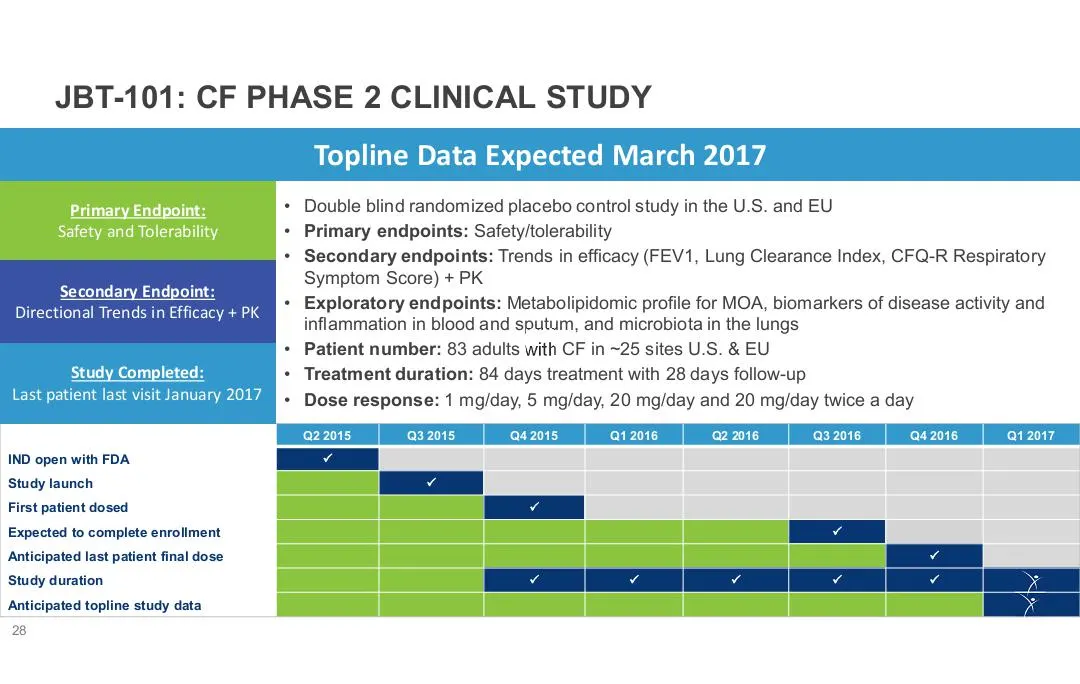
JBT-101: CF PHASE 2 CLINICAL STUDY Topline Data Expected Mar Double blind randomized placebo control study in the U.S. and EU + Primary endpoints: Safety/tolerability + Secondary endpoints: Trends in efficacy (FEV1, Lung Clearance Index, CFQ-R Respiratory Symptom Score) + PK + Exploratory endpoints:
Slide 29: Dermatomyositis & Lupus (SLE): Working with the NIH
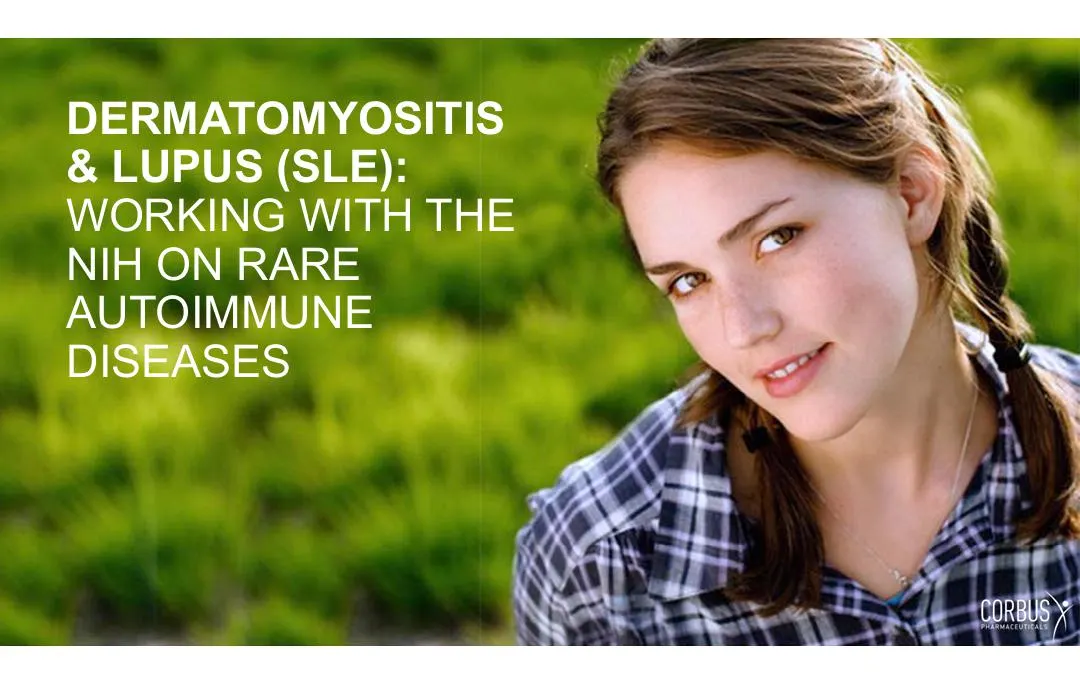
DERMATOMYOSITIS & LUPUS (SLE): WORKING WITH THE NIH ON RARE AUTOIMMUNE DISEASES a — ff + *
Slide 30: Dermatomyositis
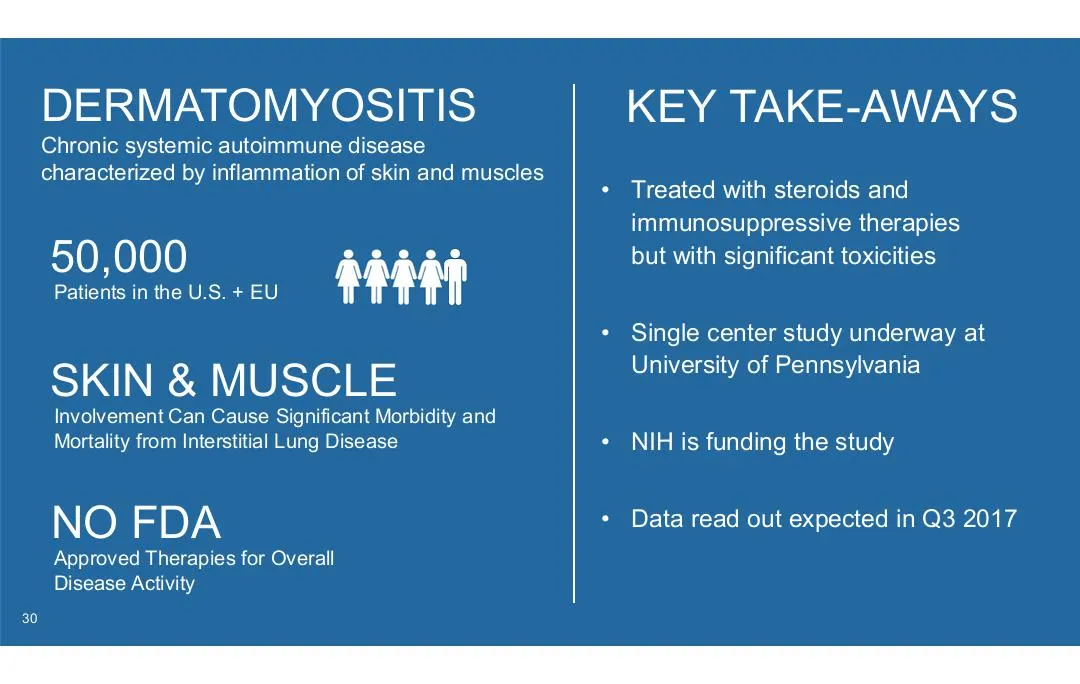
DERMATOMYOSITIS Chronic systemic autoimmune disease characterized by inflammation of skin and muscles 20,000 | EU HEPET SKIN & MUSCLE Involvement Can Cause Significant Morbidity and Mortality from Interstitial Lung Disease NO FDA Approved Therapies for Overall Disease Activity 30 KEY TAKE-AWAYS + Tr
Slide 31: JBT-101: DM Phase 2 Clinical Study
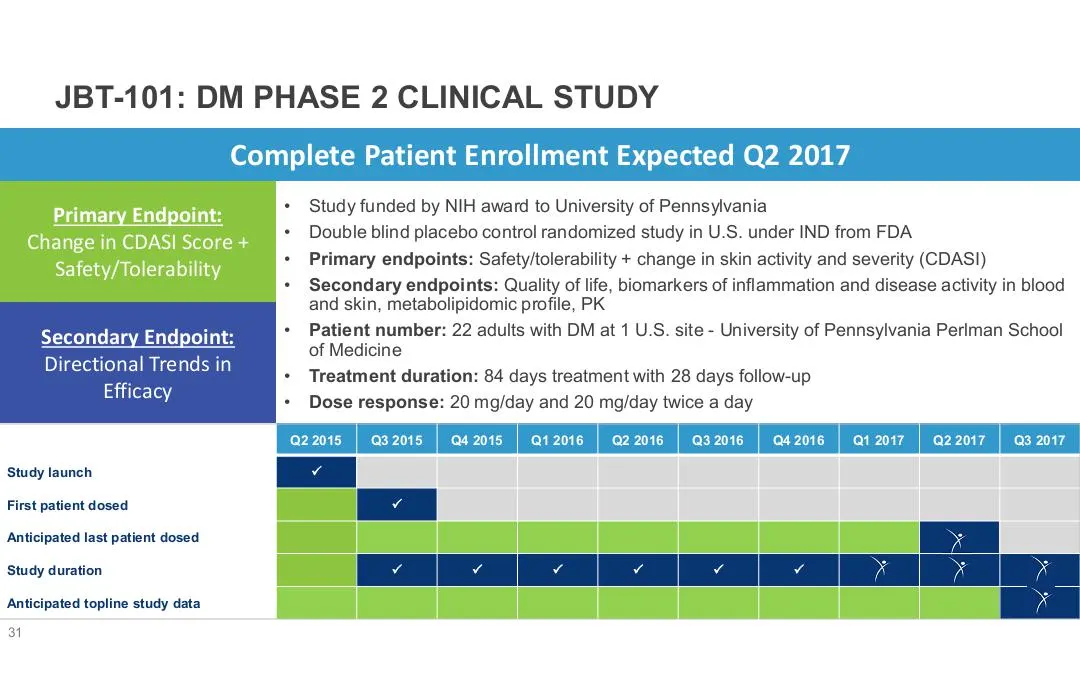
JBT-101: DM PHASE 2 CLINICAL STUDY Primary Endpoint: Change in CDASI Score + Safety/Tolerability Secondary Endpoint: Directional Trends in Efficacy Study launch First patient dosed Anticipated last patient dosed Study duration Anticipated topline study data a4 Complete Patient Enrollment Expected Q2
Slide 32: JBT-101-DM-001 Open-Label Extension
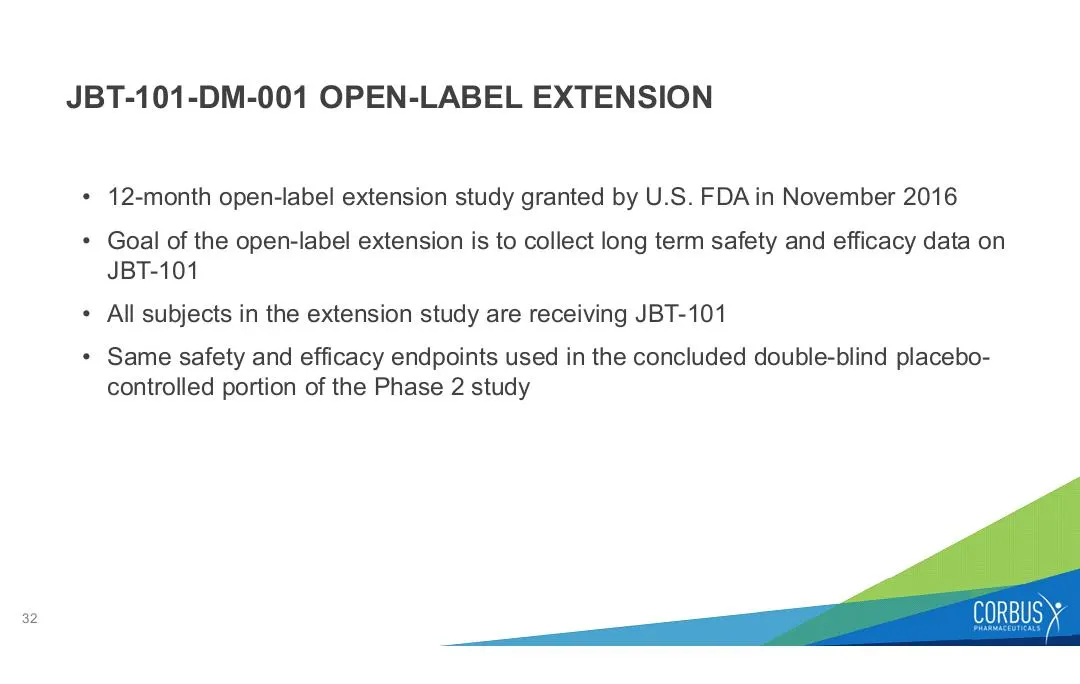
32 JBT-101-DM-001 OPEN-LABEL EXTENSION + 12-month open-label extension study granted by U.S. FDA in November 2016 * Goal of the open-label extension is to collect long term safety and efficacy data on JBT-101 + All subjects in the extension study are receiving JBT-101 + Same safety and efficacy endp
Slide 33: Systemic Lupus Erythematosus
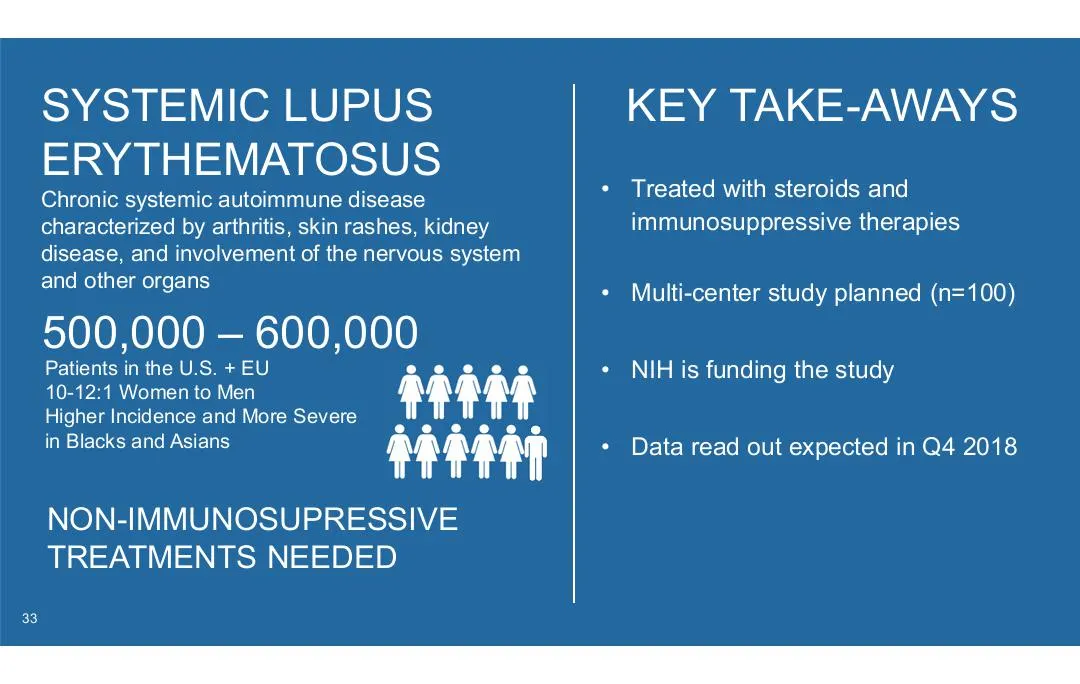
SYSTEMIC LUPUS ERYTHEMATOSUS Chronic systemic autoimmune disease characterized by arthritis, skin rashes, kidney disease, and involvement of the nervous system and other organs 500,000 — 600,000 Patients in the U.S. + EU ee ee 10-12:1 Women to Men Rohae erent Higher Incidence and More Severe in Blac
Slide 34: JBT-101: SLE Phase 2 Clinical Study
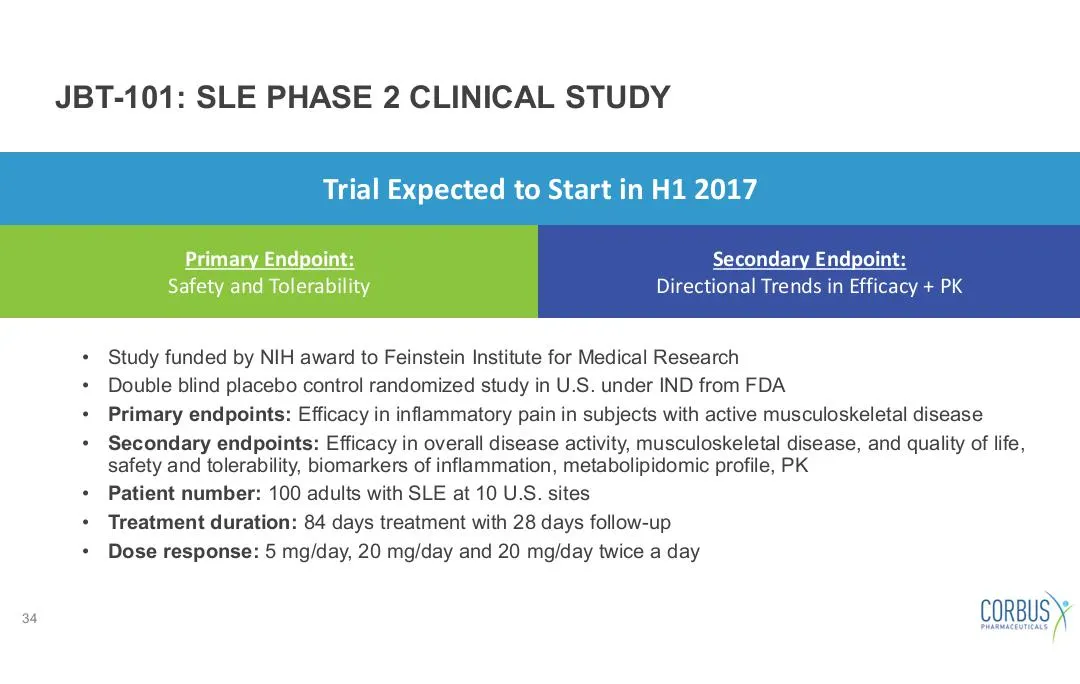
JBT-101: SLE PHASE 2 CLINICAL STUDY Trial Expected to Start in H1 2017 Primary En it: Secondary Endpoint: Safety and Tolerability Directional Trends in Efficacy + PK + Study funded by NIH award to Feinstein Institute for Medical Research + Double blind placebo control randomized study in U.S. under
Slide 35: Scientific Advisors and Principal Investigators
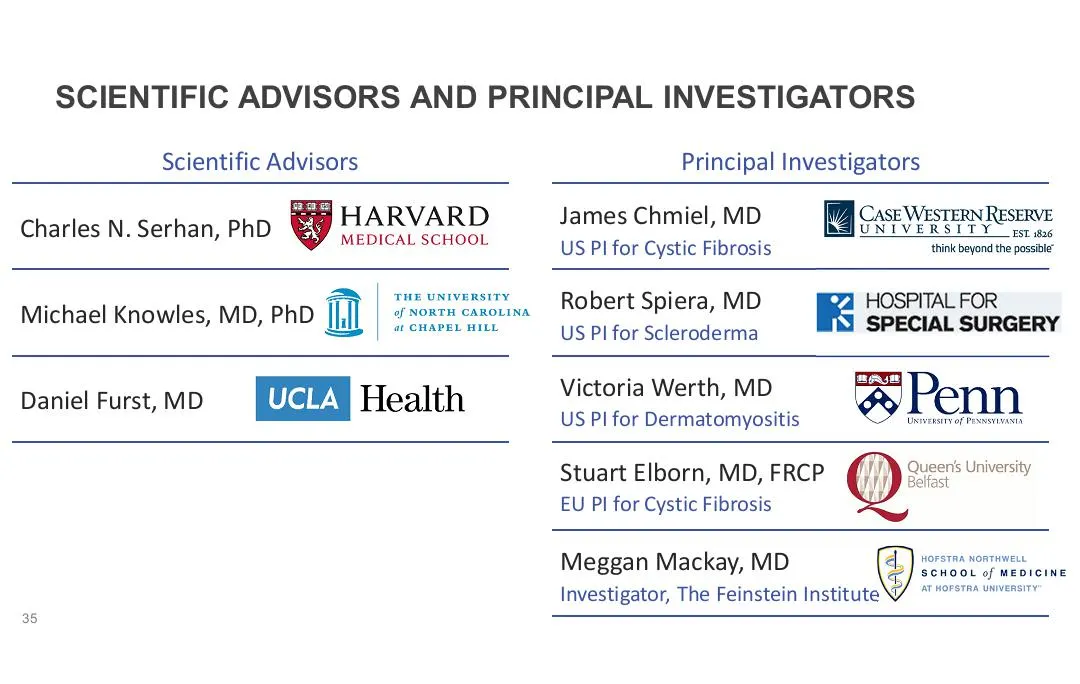
SCIENTIFIC ADVISORS AND PRINCIPAL INVESTIGATORS Scientific Advisors Principal Investigators MEDICAL SCHOOL Charles N. Serhan, PhD Ss] HARVARD Michael Knowles, MD, PhD il ‘THE UNIVERSITY of NORTH CAROLINA at CHAPEL HILL James Chmiel, MD ZY CASE WESTERN RESERVE US PI for Cystic Fibrosis think beyond t
Slide 36: Financial Profile: CRBP (NASDAQ)
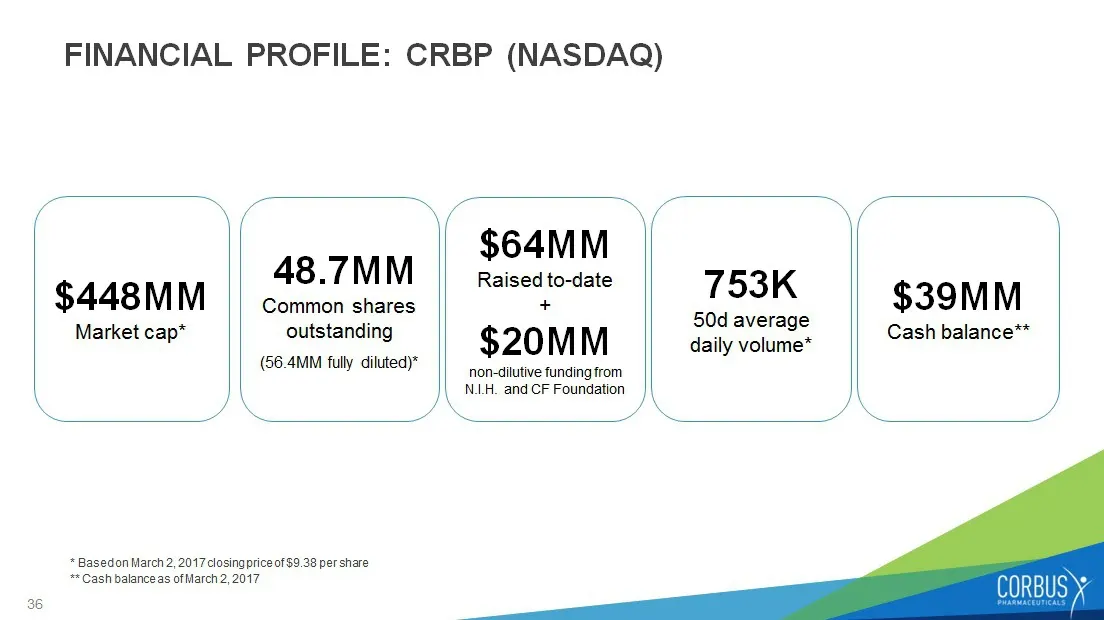
36 a = =< FINANCIAL PROFILE: CRBP (NASDAQ) \\ \ / " $64MM_— $448 M M eo aM Raised to-date £ Market cap* outstanding $20 M M (56.4MM fully diluted)" non-dilutive funding from } | NLLH. and CF Foundation i S\. AR e. ll 753K 50d average daily volume* $39MM Cash balance** * Basedon March 2, 2017 closing
Slide 37: Corbus to Host Research and Development Day
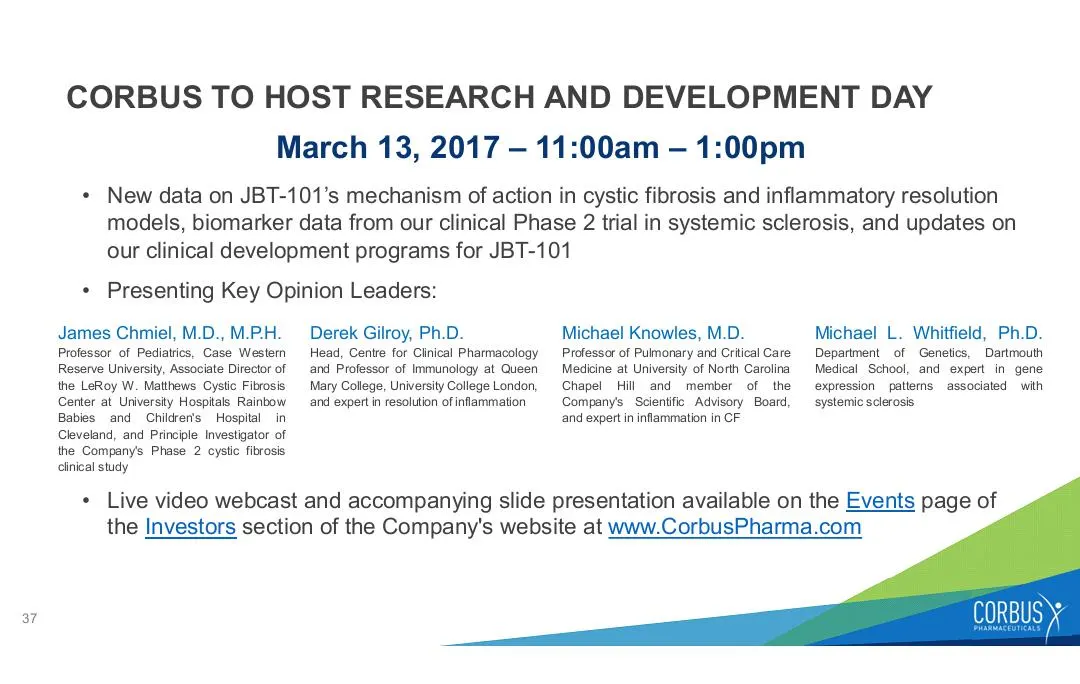
CORBUS TO HOST RESEARCH AND DEVELOPMENT DAY March 13, 2017 — 11:00am — 1:00pm * New data on JBT-101’s mechanism of action in cystic fibrosis and inflammatory resolution models, biomarker data from our clinical Phase 2 trial in systemic sclerosis, and updates on our clinical development programs for

Slide 38: Contact Us
CONTACT US Corbus Pharmaceuticals Holdings, Inc. 617.963.0100 rb [email protected] 100 River Ridge Drive Norwood, MA 02062 38
Slide 39: Appendix
APPENDIX CORBUS
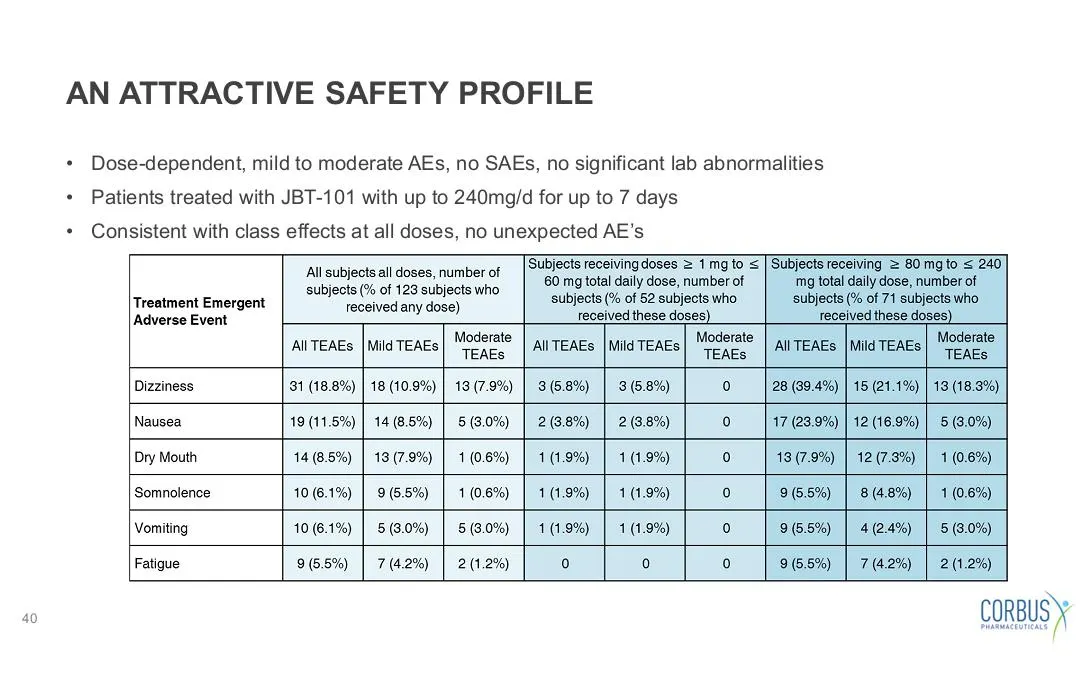
Slide 40: An Attractive Safety Profile
AN ATTRACTIVE SAFETY PROFILE + Dose-dependent, mild to moderate AEs, no SAEs, no significant lab abnormalities + Patients treated with JBT-101 with up to 240mg/d for up to 7 days + Consistent with class effects at all doses, no unexpected AE’s ‘All subjectsall doses, number of _ | Sublects receiving
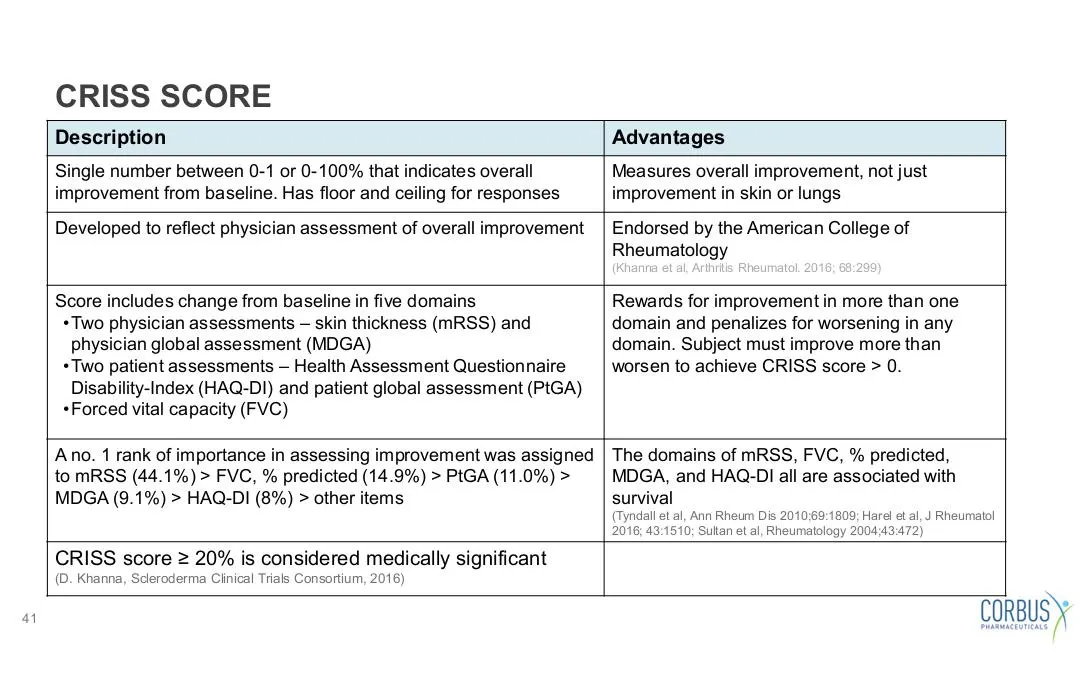
Slide 41: CRISS Score
CRISS SCORE Description Advantages Single number between 0-1 or 0-100% that indicates overall improvement from baseline. Has floor and ceiling for responses Measures overall improvement, not just improvement in skin or lungs Developed to reflect physician assessment of overall improvement Endorsed b
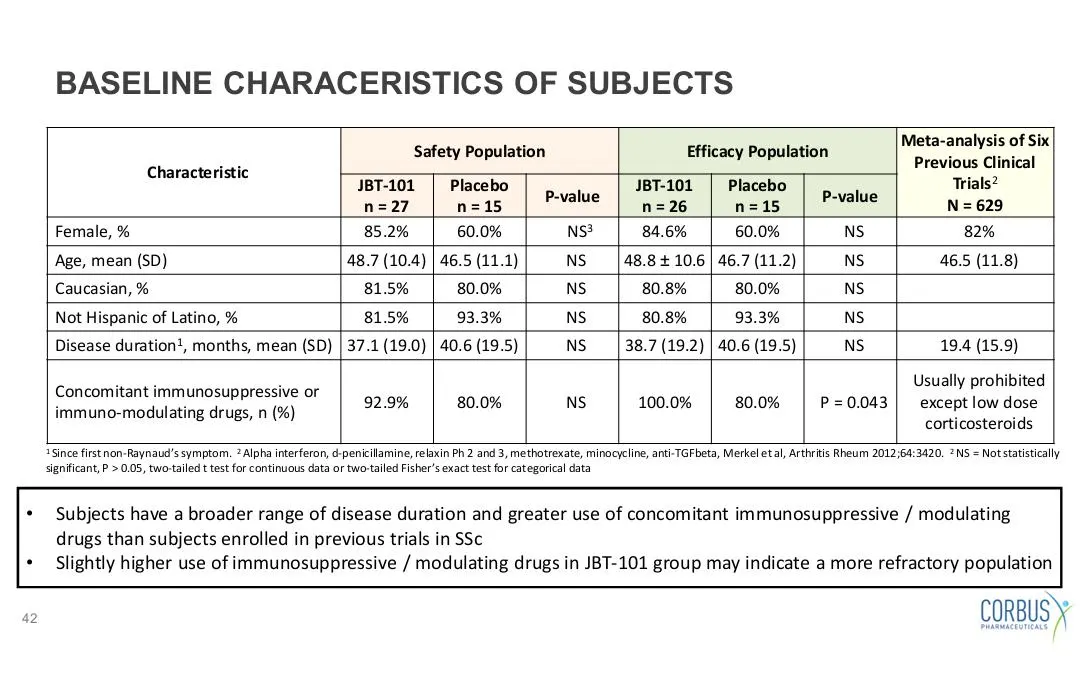
Slide 42: Baseline Characteristics of Subjects
BASELINE CHARACERISTICS OF SUBJECTS Safety Population Efficacy Population Meta analysis of Ste ss Previous Clinical Characteristic che wT-101 ] Placebo |» |. weT-101 ] Placebo | 5 Trials: n=27 n=15 value | n=26 n=15 vane N= 629 Female, % 85.2% | 60.0% nse | 84.6% | 60.0% NS 82% ‘Age, mean (SD) 48.7
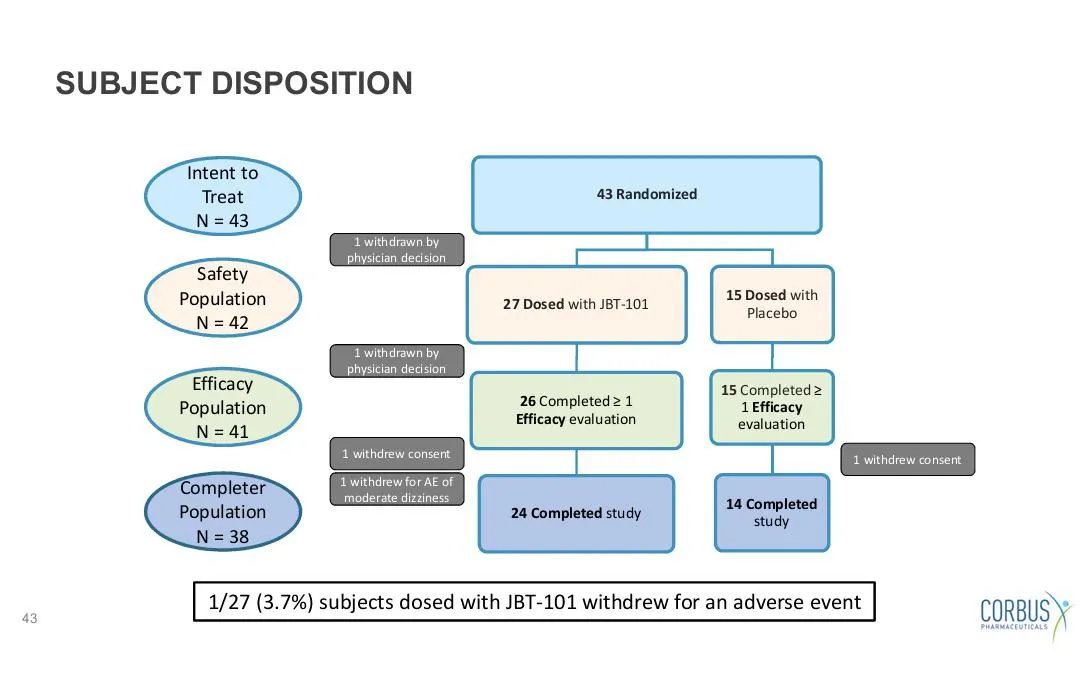
Slide 43: Subject Disposition
SUBJECT DISPOSITION Intent to Treat N=43 withdrawn by physician decision Safety Population N=42 27 Dosed with JBT-101 a5 Dosed with ‘withdrawn by physician decision Efficacy Population N=41 15 Completed 2. 26 Completed > 1 lh Efficacy evaluation ‘withdrew for AE of moderate dizziness “Complete Popul
Source: SEC EDGAR · 8-K filed Mar 8, 2017
More decks from Corbus Pharmaceuticals Holdings, Inc.
 Investor Presentation (November 2026)55 slides · Nov 16, 2026
 Investor Presentation (October 2026)62 slides · Oct 15, 2026
 Investor Presentation (September 2026)58 slides · Sep 14, 2026
 Investor Presentation (May 2026)58 slides · May 26, 2026
 Investor Presentation (March 2026)63 slides · Mar 9, 2026
 Investor Presentation (February 2026)61 slides · Feb 25, 2026