Australian Agricultural Company Limited · ASX:AAC
Australian Agricultural — J.P. Morgan's Annual 'A Day at the Farm' 2012
29 slides from Australian Agricultural's conference presentation, Jul 26, 2012
Slide 1: J.P. Morgan's Annual 'A Day at the Farm'
J.P. Morgan’s Annual ‘A Day at the Farm’ 26 July 2012 Australian Agricultural Company Limited
Slide 2: Who is AAco? Australia's largest beef producer
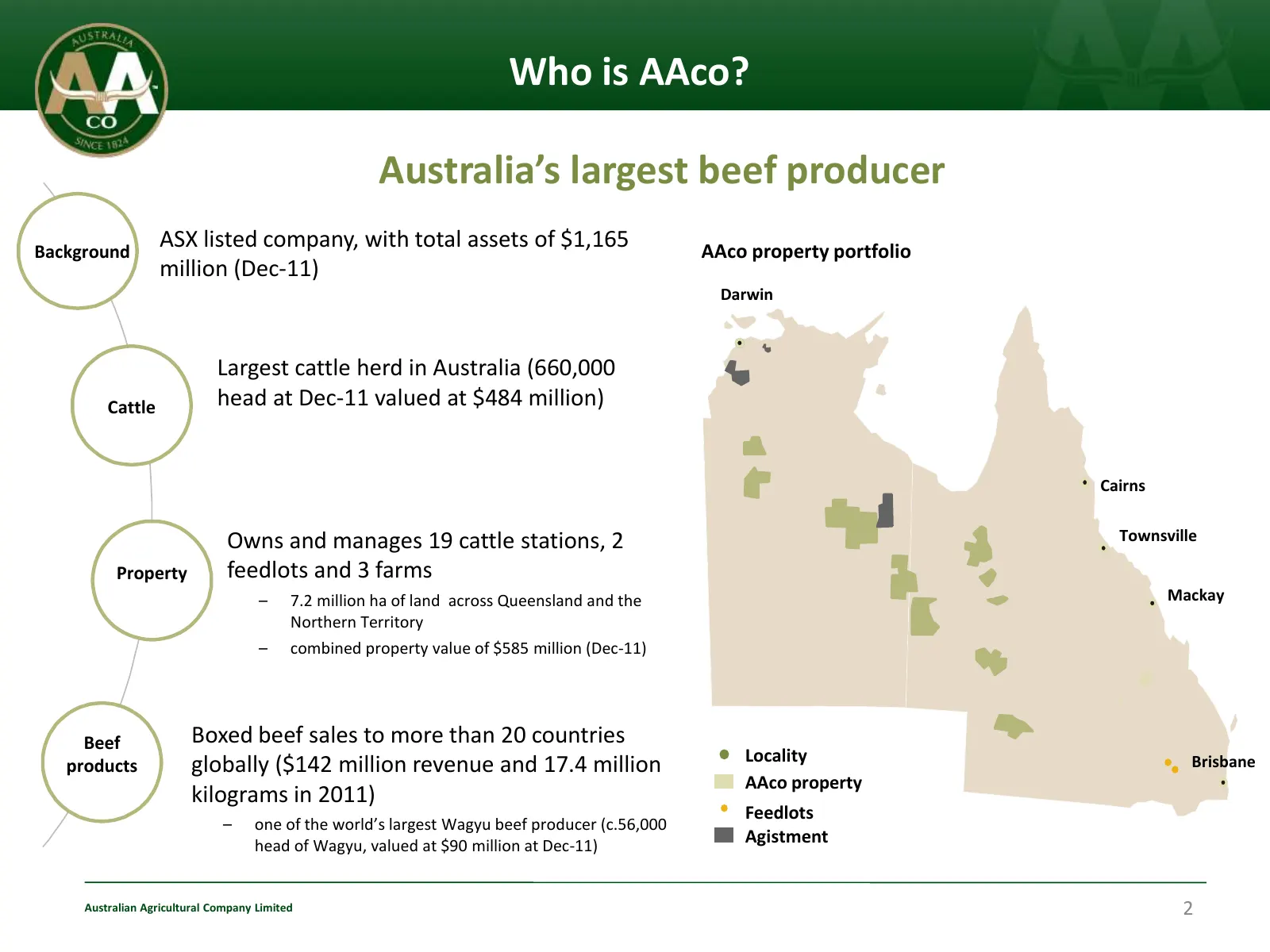
Who is AAco? Australia’s largest beef producer Background ASX listed company, with total assets of $1,165 AAco property portfolio million (Dec-11) Darwin Largest cattle herd in Australia (660,000 Cattle head at Dec-11 valued at $484 million) Cairns Owns and manages 19 cattle stations, 2 Townsville P
Slide 3: Who is AAco? Net tangible asset backing
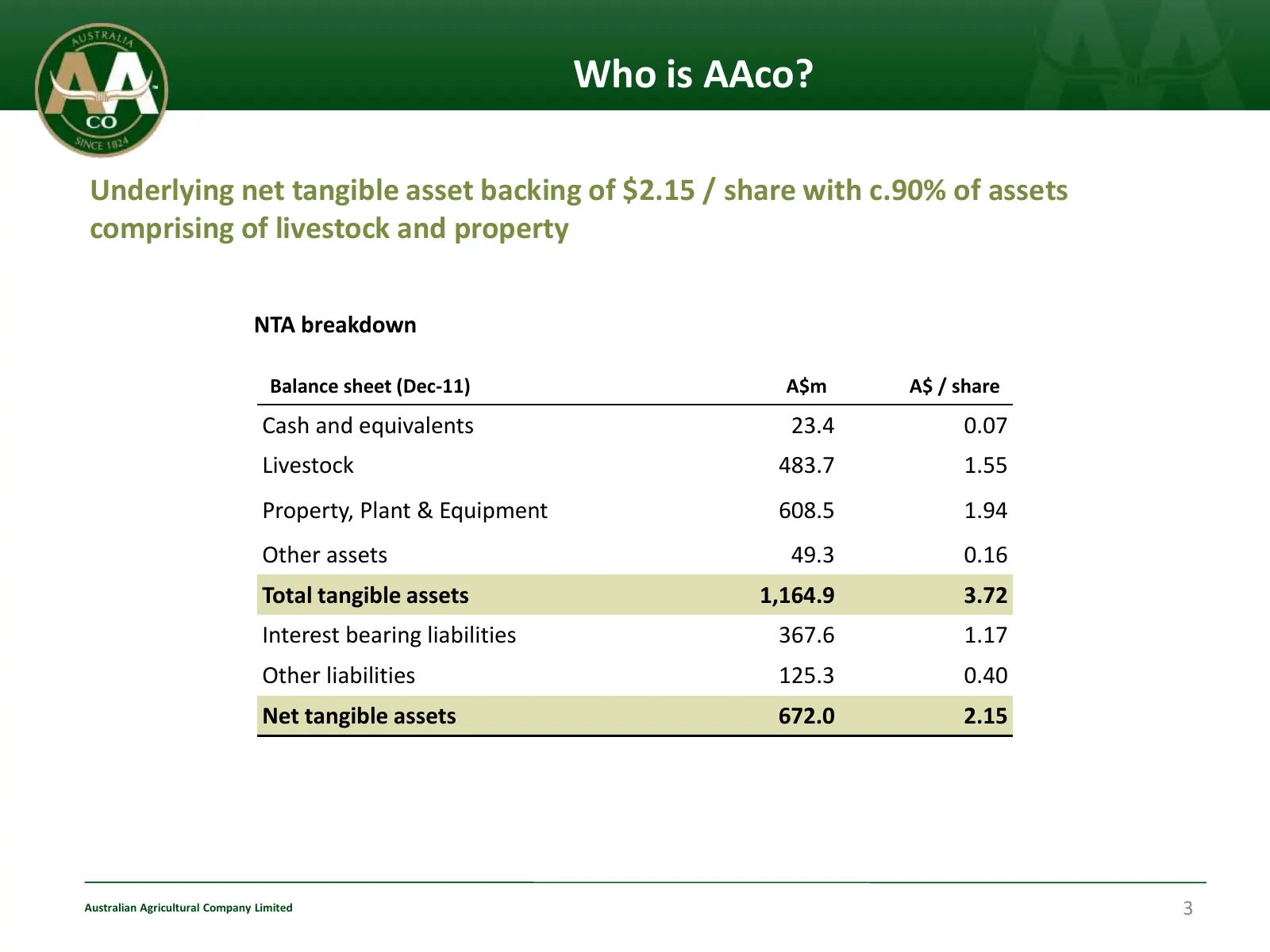
Who is AAco? Underlying net tangible asset backing of $2.15 / share with c.90% of assets comprising of livestock and property NTA breakdown Balance sheet (Dec-11) A$m A$ / share Cash and equivalents 23.4 0.07 Livestock 483.7 1.55 Property, Plant & Equipment 608.5 1.94 Other assets 49.3 0.16 Total ta
Slide 4: Australian Agriculture in the global context
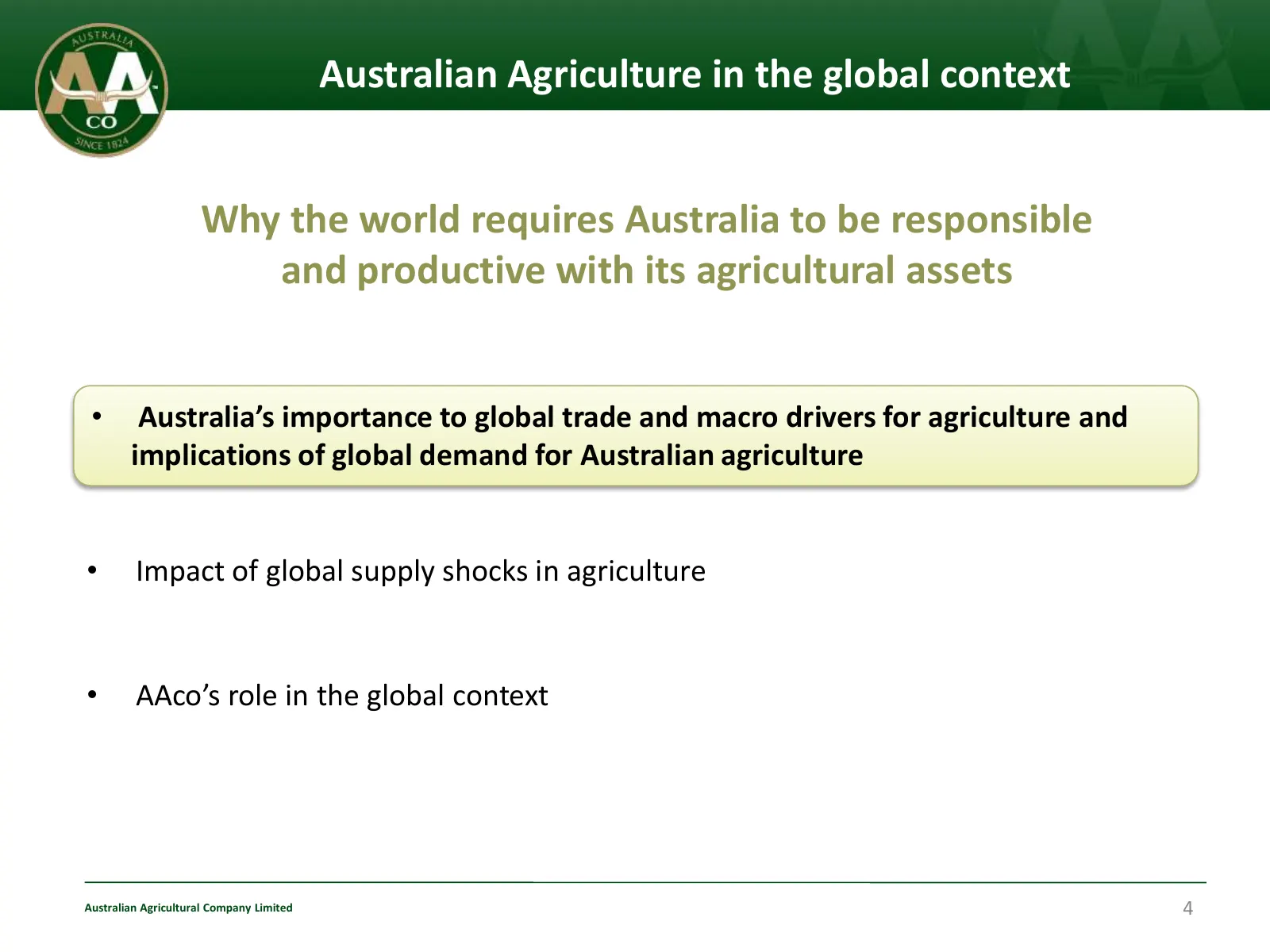
Australian Agriculture in the global context Why the world requires Australia to be responsible and productive with its agricultural assets • Australia’s importance to global trade and macro drivers for agriculture and implications of global demand for Australian agriculture • Impact of global suppl
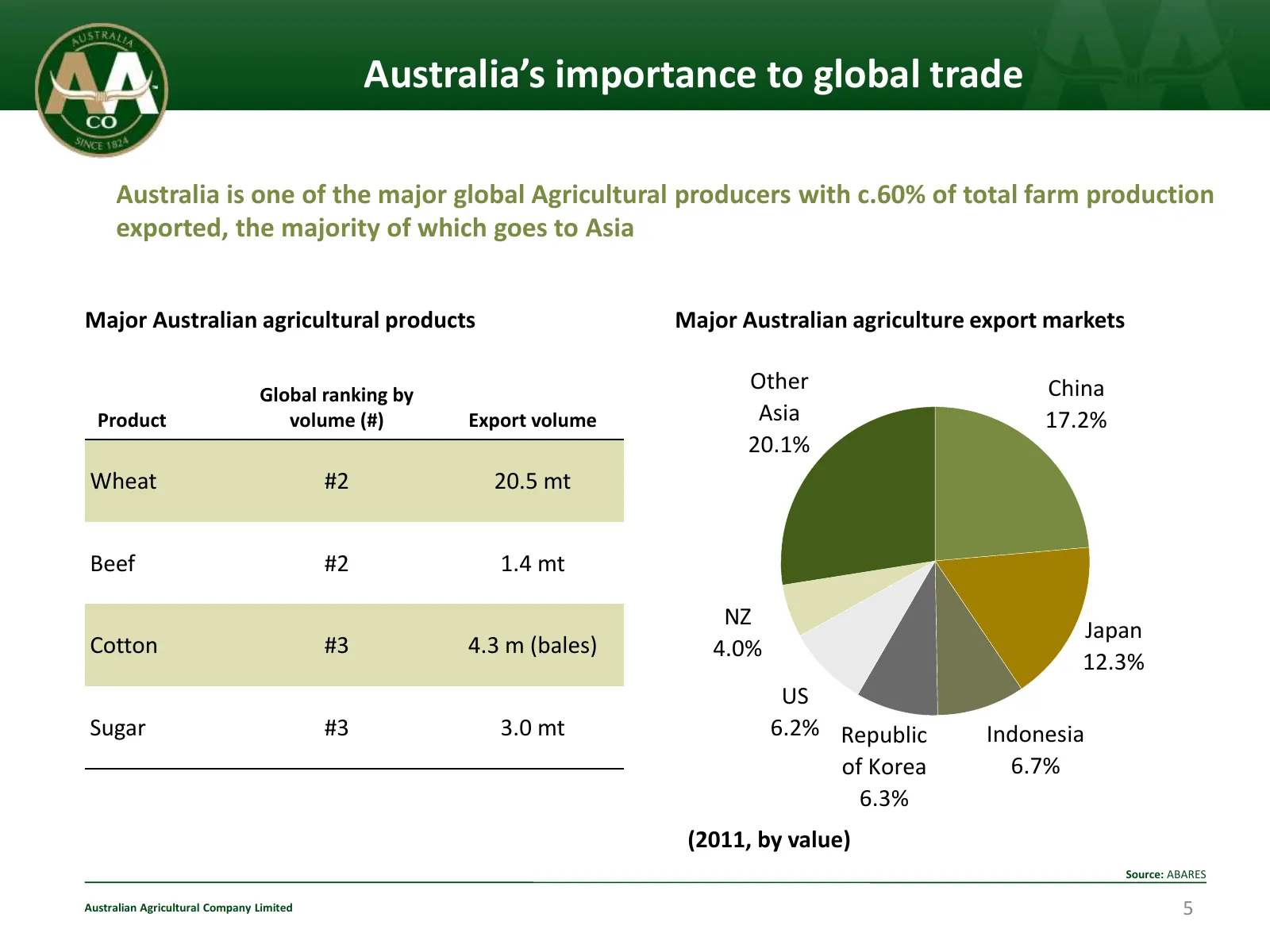
Slide 5: Australia's importance to global trade
Australia’s importance to global trade Australia is one of the major global Agricultural producers with c.60% of total farm production exported, the majority of which goes to Asia Major Australian agricultural products Major Australian agriculture export markets Other China Global ranking by Product
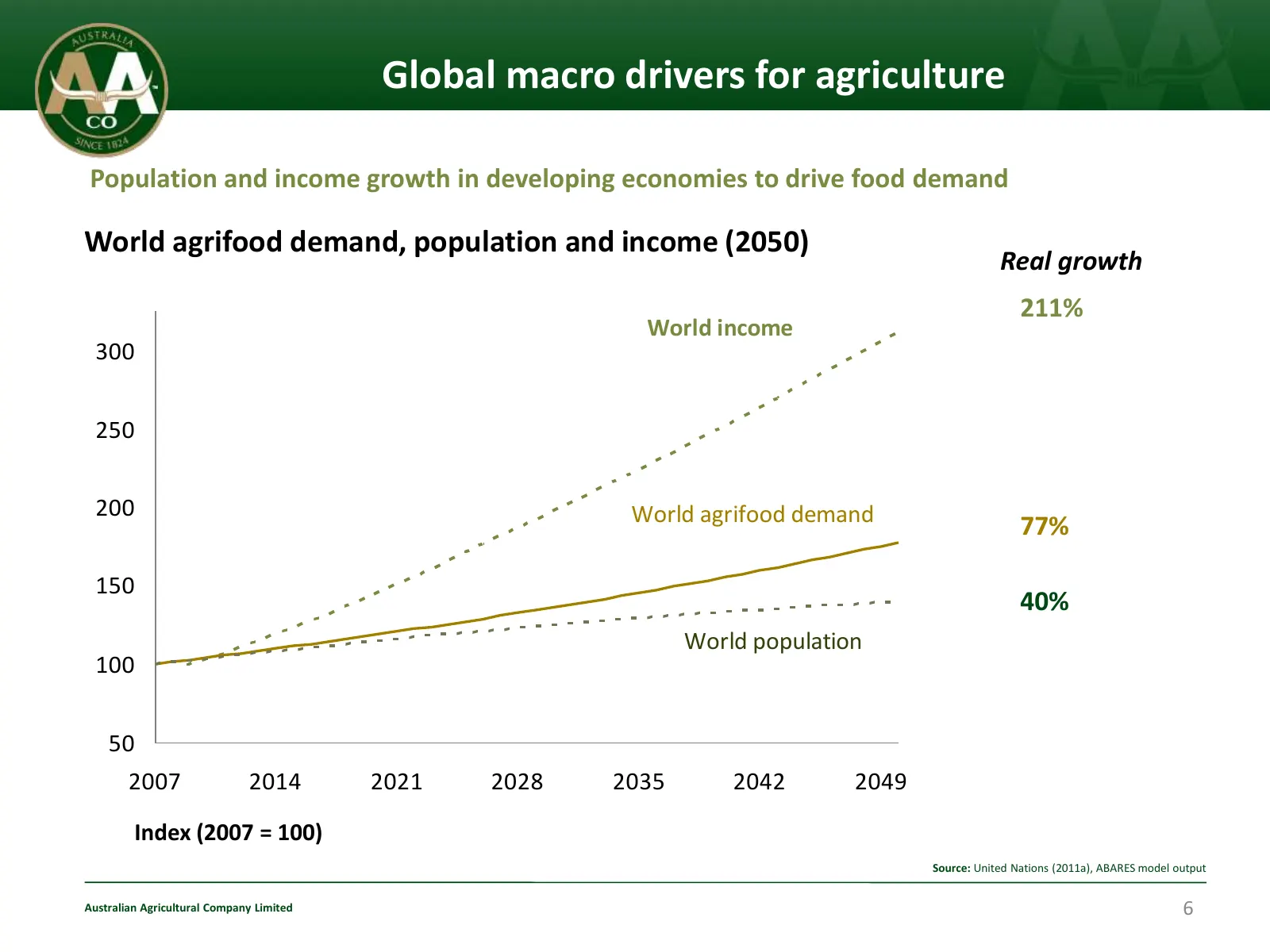
Slide 6: Global macro drivers for agriculture
Global macro drivers for agriculture Population and income growth in developing economies to drive food demand World agrifood demand, population and income (2050) Real growth 211% World income 300 250 200 World agrifood demand 77% 150 40% World population 100 50 2007 2014 2021 2028 2035 2042 2049 In
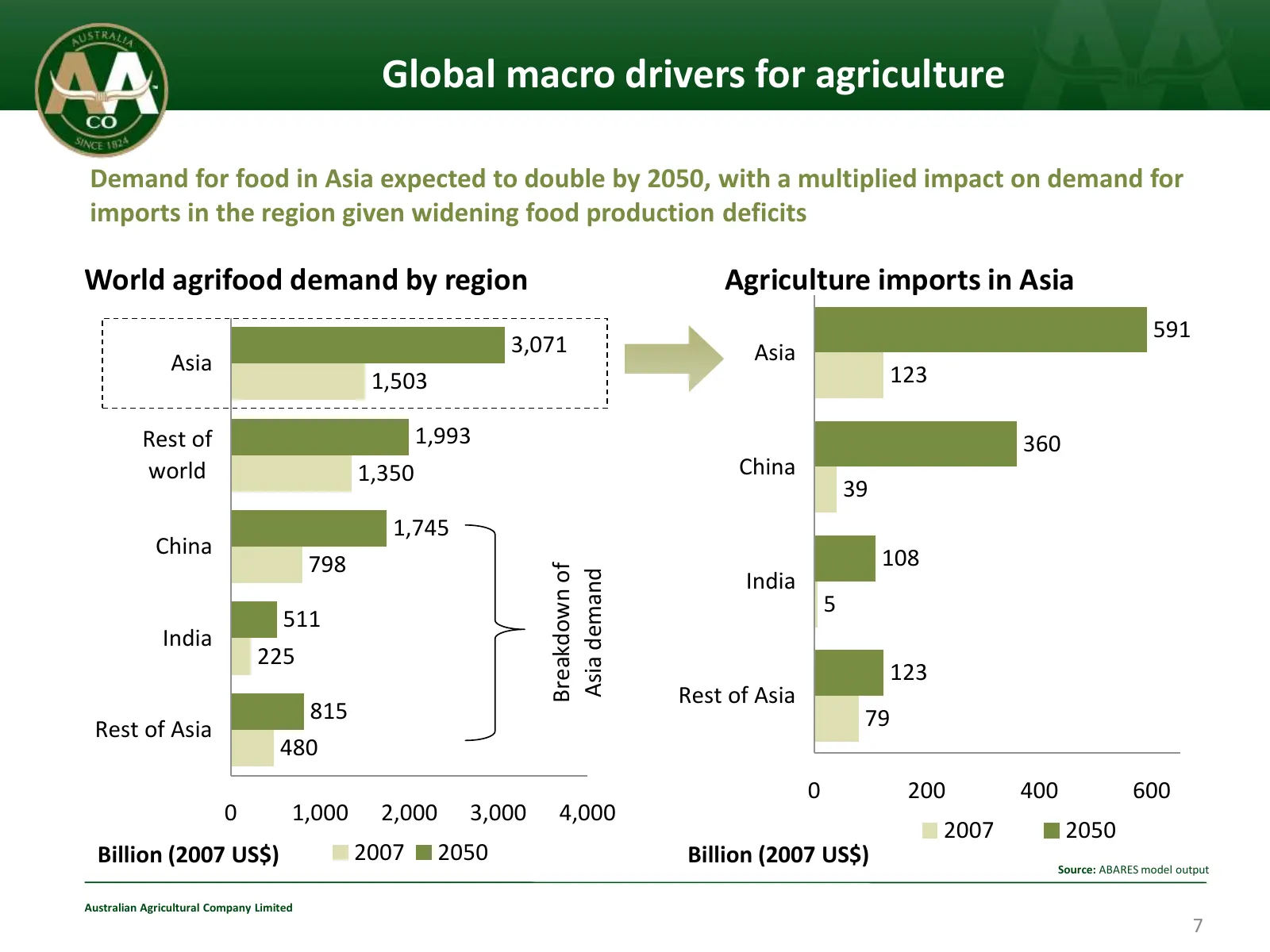
Slide 7: Global macro drivers for agriculture: Asia demand
Global macro drivers for agriculture Demand for food in Asia expected to double by 2050, with a multiplied impact on demand for imports in the region given widening food production deficits World agrifood demand by region Agriculture imports in Asia 591 3,071 Asia Asia 123 1,503 Rest of 1,993 360 wo
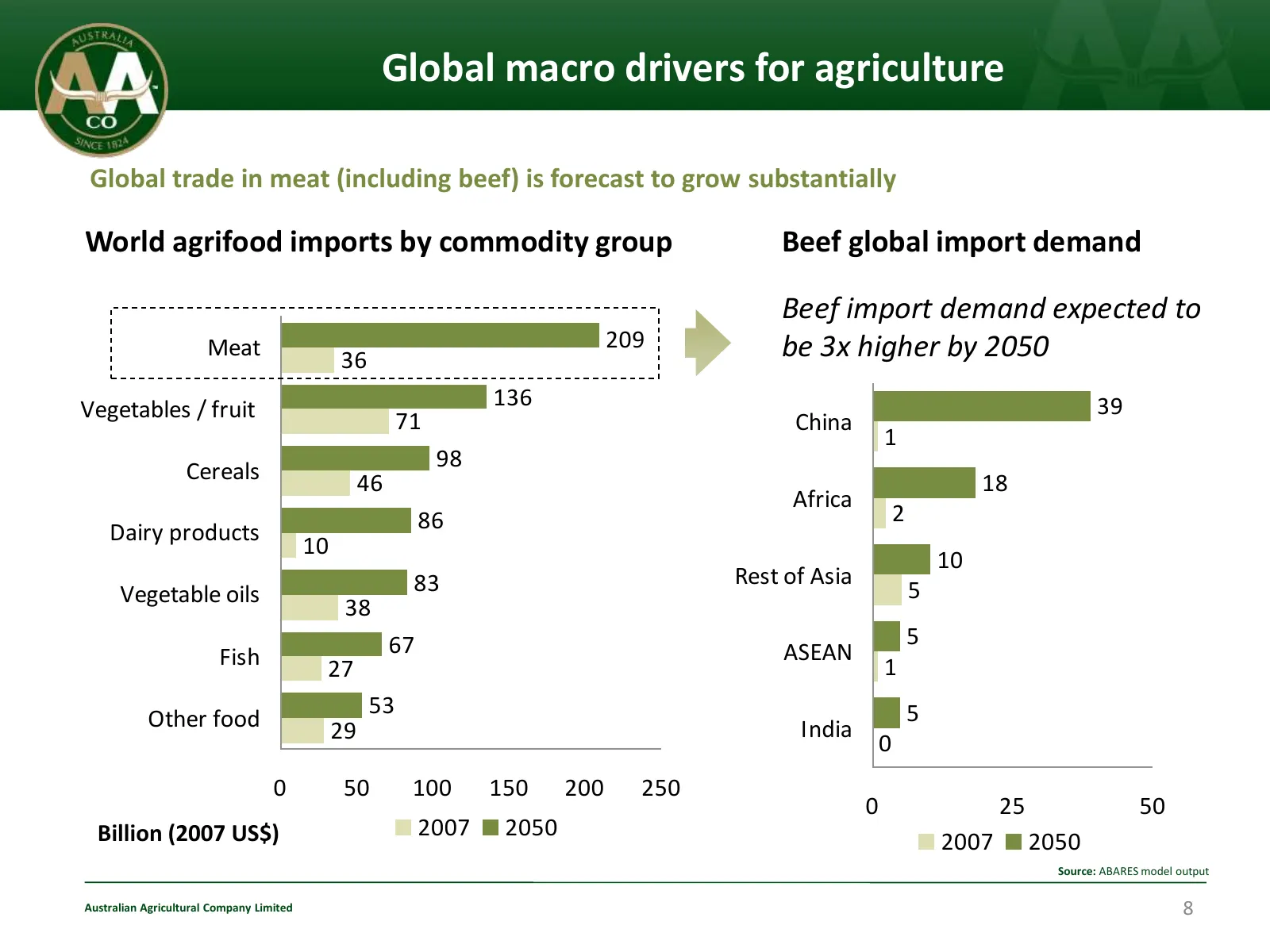
Slide 8: Global macro drivers for agriculture: meat trade
Global macro drivers for agriculture Global trade in meat (including beef) is forecast to grow substantially World agrifood imports by commodity group Beef global import demand Beef import demand expected to Meat 209 be 3x higher by 2050 36 Vegetables / fruit 136 39 71 China 1 98 Cereals 46 18 Afric
Slide 9: Implications for Australian Agriculture
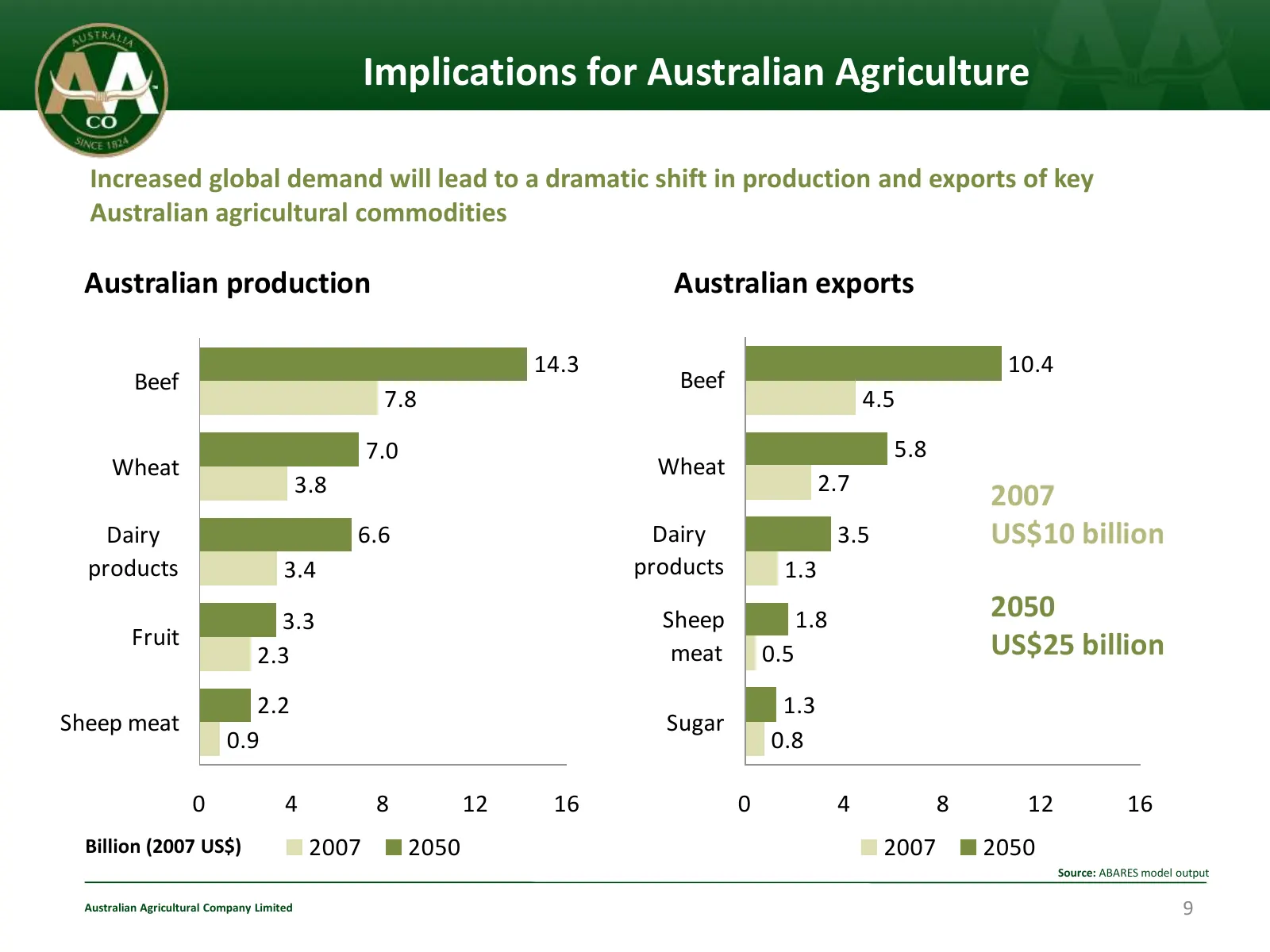
Implications for Australian Agriculture Increased global demand will lead to a dramatic shift in production and exports of key Australian agricultural commodities Australian production Australian exports 14.3 10.4 Beef Beef 7.8 4.5 7.0 5.8 Wheat Wheat 3.8 2.7 2007 Dairy 6.6 Dairy 3.5 US$10 billion p
Slide 10: Australian Agriculture in the global context
Australian Agriculture in the global context Why the world requires Australia to be responsible and productive with its agricultural assets • Australia’s importance to global trade and macro drivers for agriculture & implications of global demand for Australian agriculture • Impact of global supply
Slide 11: Impact of global supply shocks in agriculture
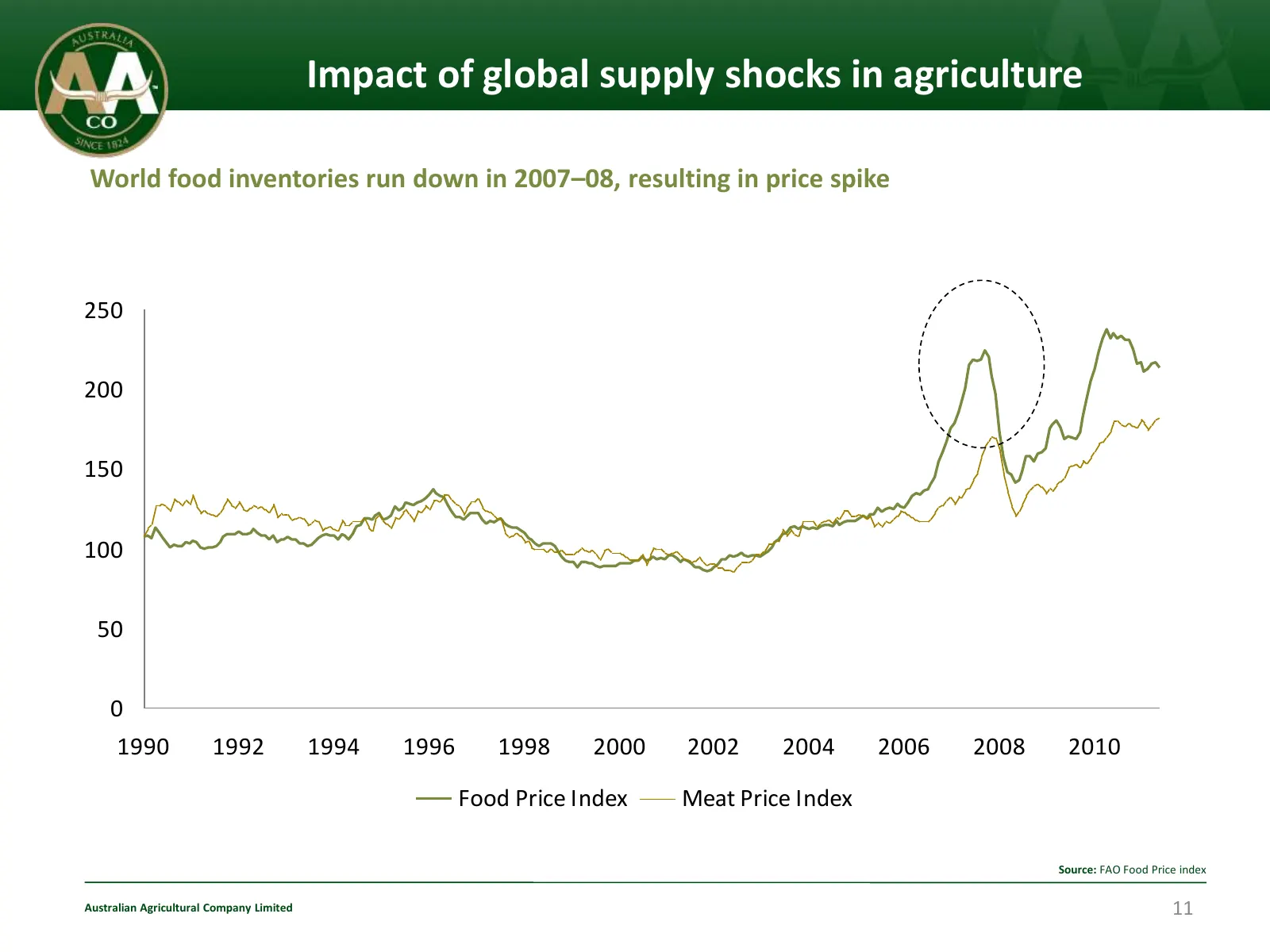
Impact of global supply shocks in agriculture World food inventories run down in 2007–08, resulting in price spike 250 200 150 100 50 0 1990 1992 1994 1996 1998 2000 2002 2004 2006 2008 2010 Food Price Index Meat Price Index Source: FAO Food Price index Australian Agricultural Company Limited 11
Slide 12: Impact of global supply shocks: flow on effects
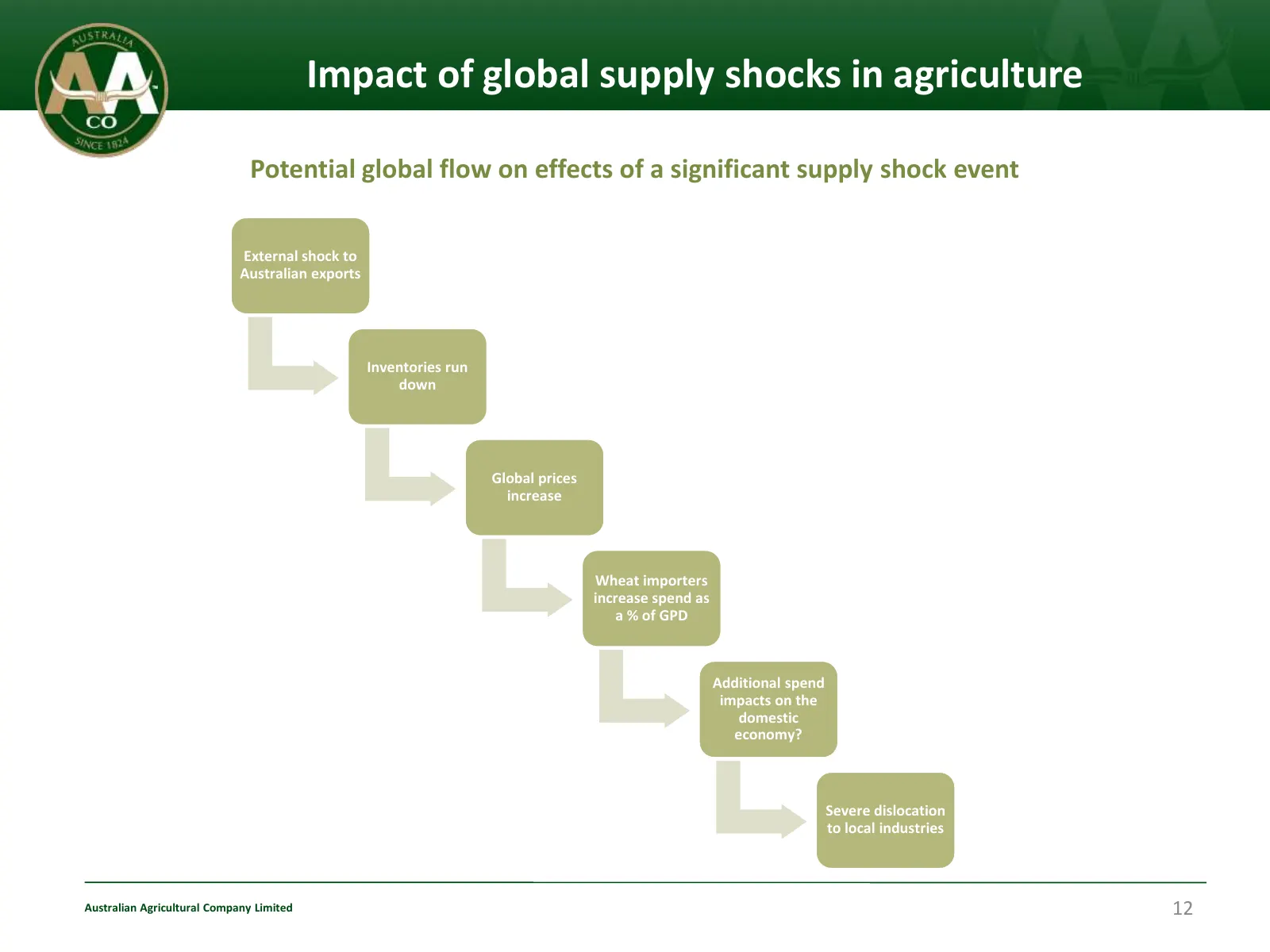
Impact of global supply shocks in agriculture Potential global flow on effects of a significant supply shock event External shock to Australian exports Inventories run down Global prices increase Wheat importers increase spend as a % of GPD Additional spend impacts on the domestic economy? Severe di
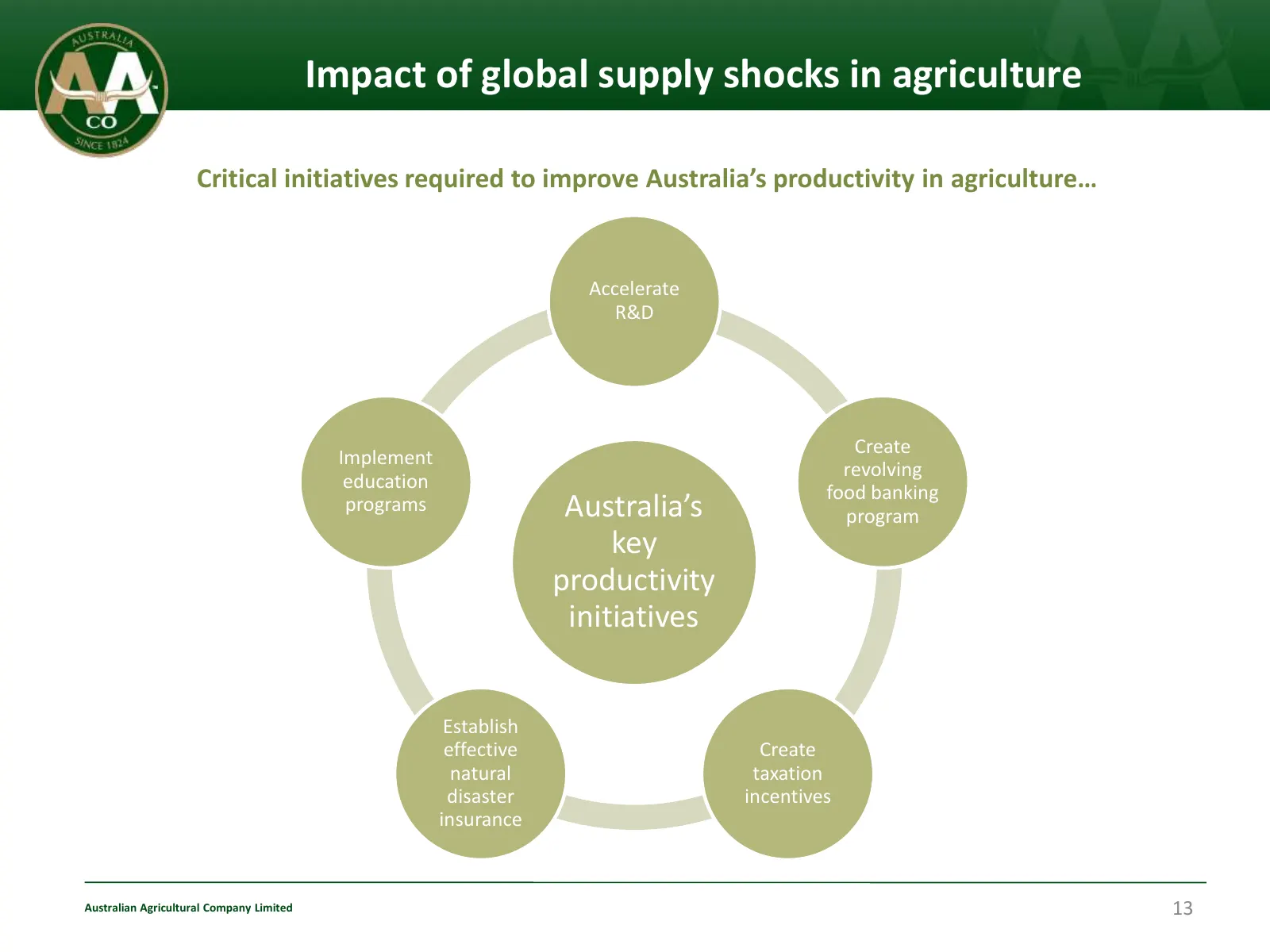
Slide 13: Critical initiatives to improve Australia's productivity
Impact of global supply shocks in agriculture Critical initiatives required to improve Australia’s productivity in agriculture… Accelerate R&D Create Implement revolving education food banking programs Australia’s program key productivity initiatives Establish effective Create natural taxation disas
Slide 14: Australian Agriculture in the global context
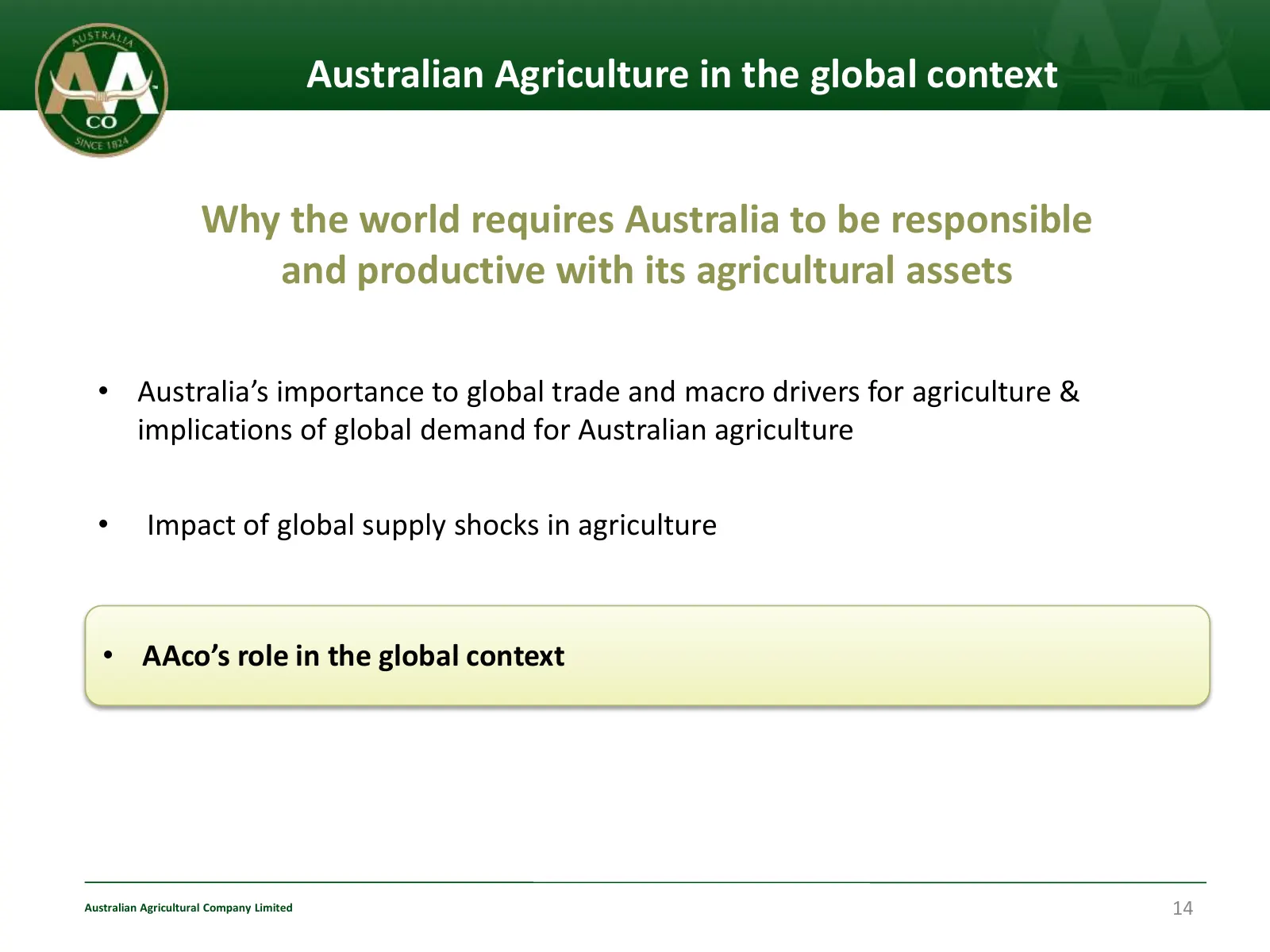
Australian Agriculture in the global context Why the world requires Australia to be responsible and productive with its agricultural assets • Australia’s importance to global trade and macro drivers for agriculture & implications of global demand for Australian agriculture • Impact of global supply
Slide 15: AAco's role in the global context
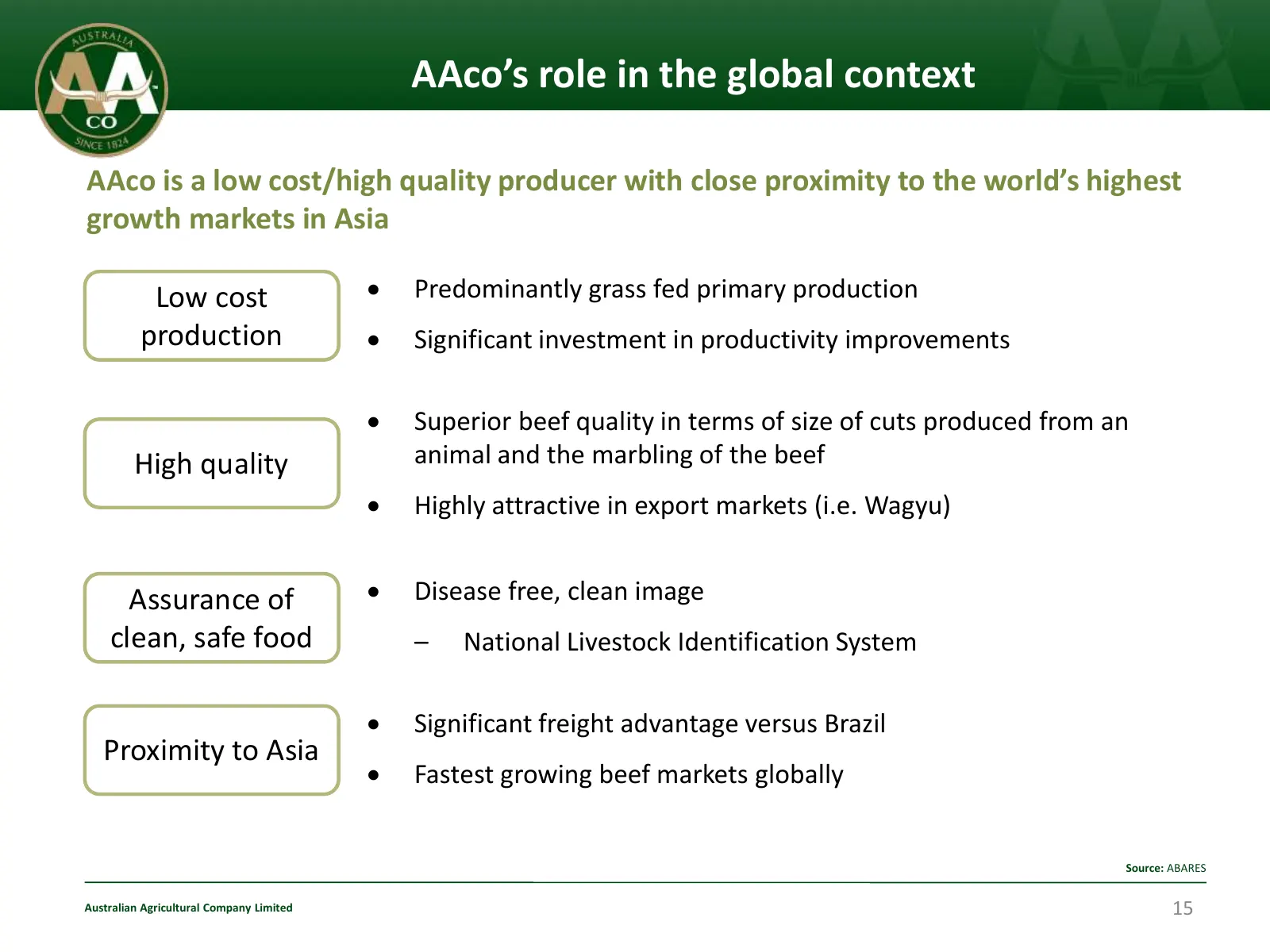
AAco’s role in the global context AAco is a low cost/high quality producer with close proximity to the world’s highest growth markets in Asia Low cost Predominantly grass fed primary production production Significant investment in productivity improvements Superior beef quality in terms of siz
Slide 16: Transforming into a globally focussed, vertically integrated producer
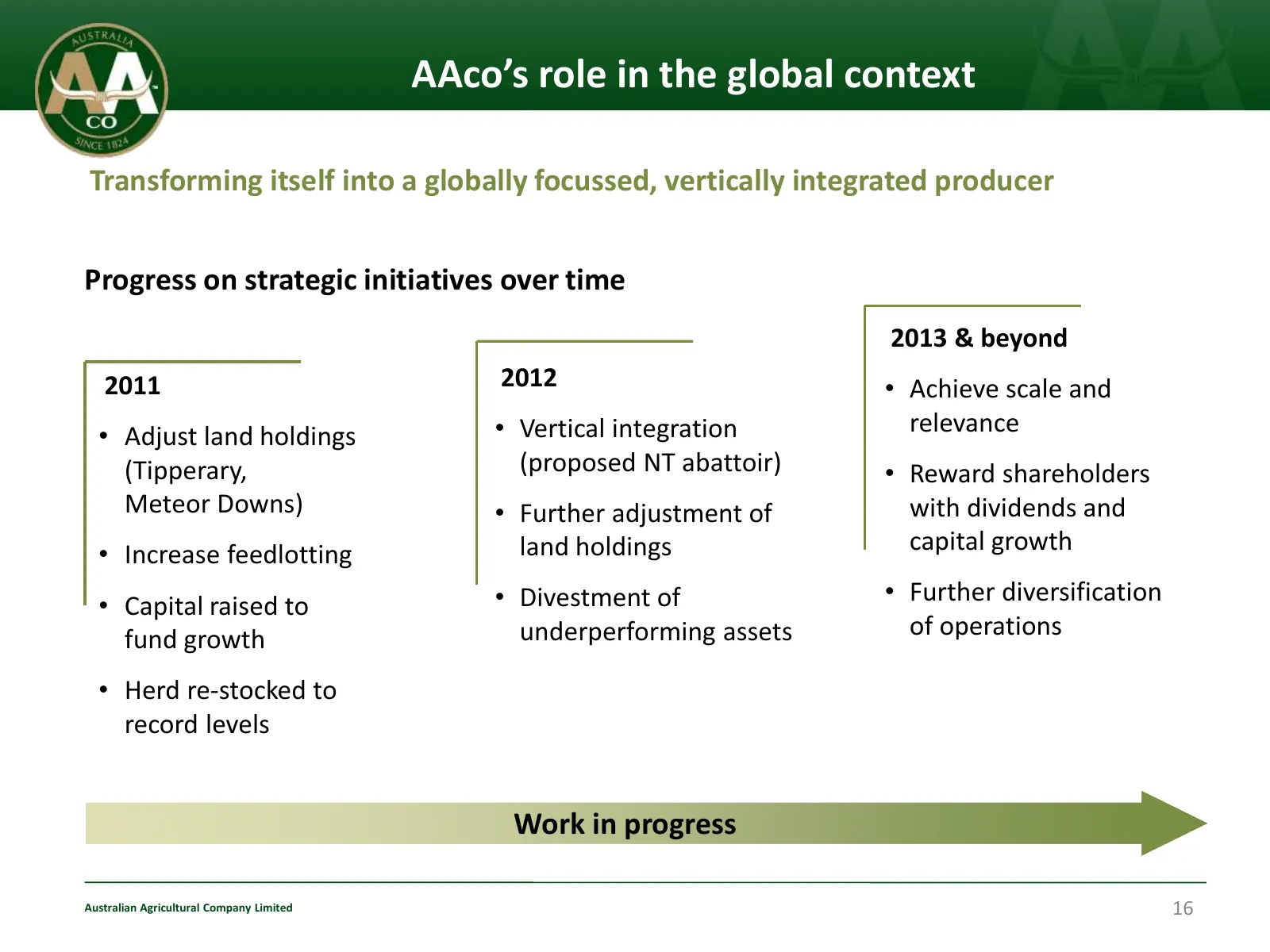
AAco’s role in the global context Transforming itself into a globally focussed, vertically integrated producer Progress on strategic initiatives over time 2013 & beyond 2011 2012 • Achieve scale and • Adjust land holdings • Vertical integration relevance (Tipperary, (proposed NT abattoir) • Reward s
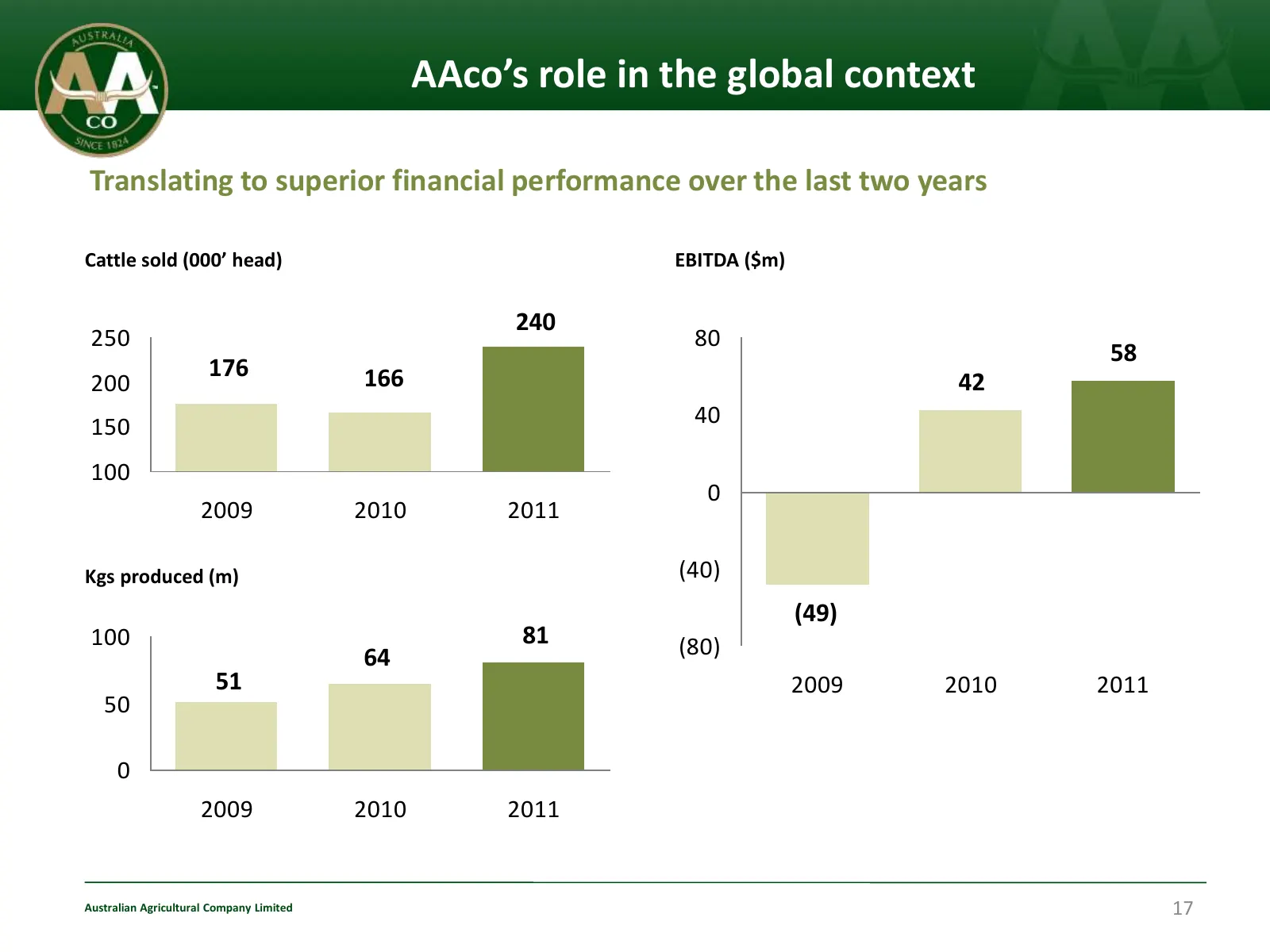
Slide 17: Translating to superior financial performance
AAco’s role in the global context Translating to superior financial performance over the last two years Cattle sold (000’ head) EBITDA ($m) 240 250 80 58 176 166 200 42 150 40 100 0 2009 2010 2011 Kgs produced (m) (40) (49) 100 81 (80) 64 51 2009 2010 2011 50 0 2009 2010 2011 Australian Agricultural
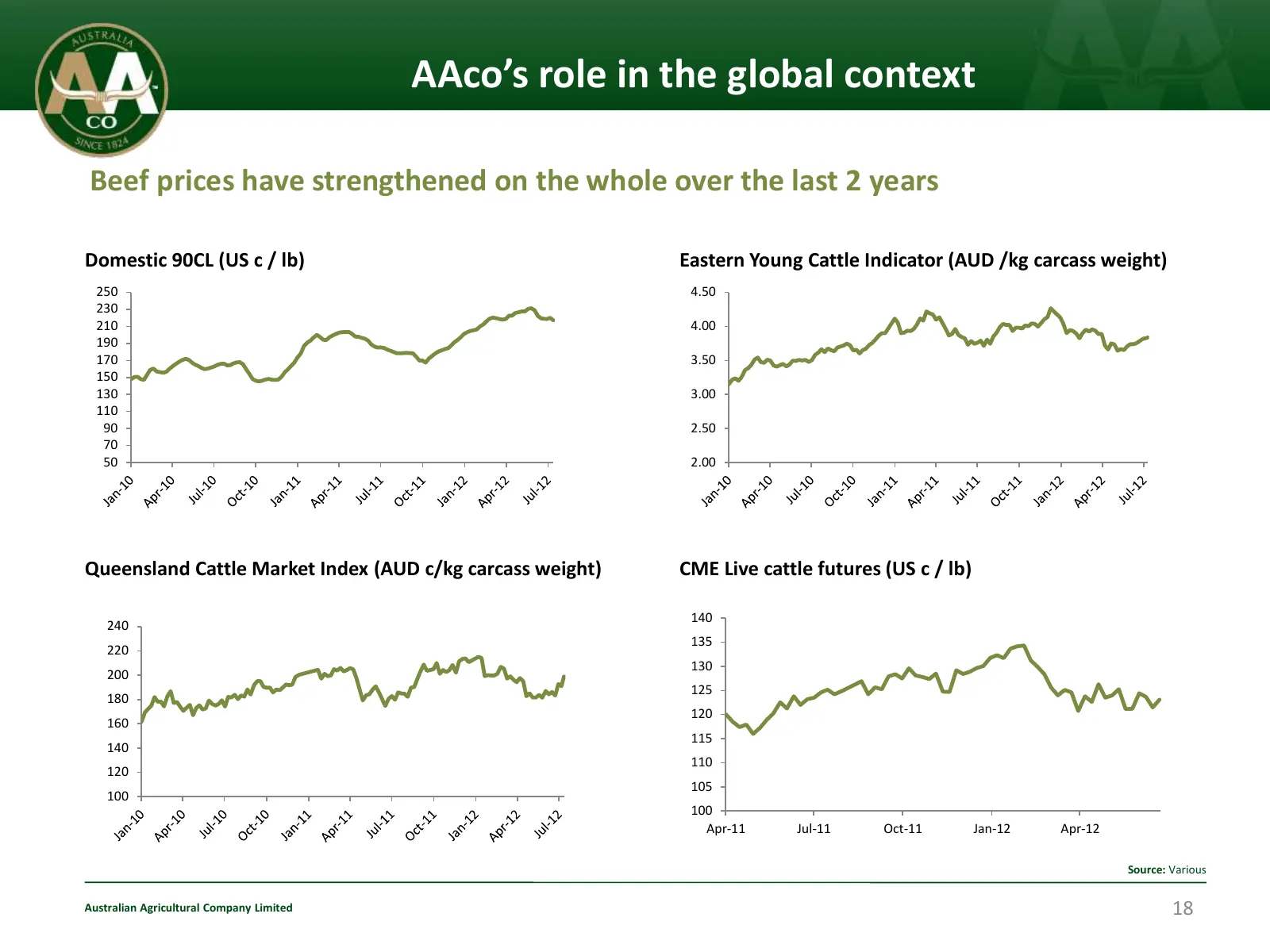
Slide 18: Beef prices have strengthened over the last years
AAco’s role in the global context Beef prices have strengthened on the whole over the last 2 years Domestic 90CL (US c / lb) Eastern Young Cattle Indicator (AUD /kg carcass weight) 250 4.50 230 210 4.00 190 170 3.50 150 130 3.00 110 90 2.50 70 50 2.00 Queensland Cattle Market Index (AUD c/kg carcass
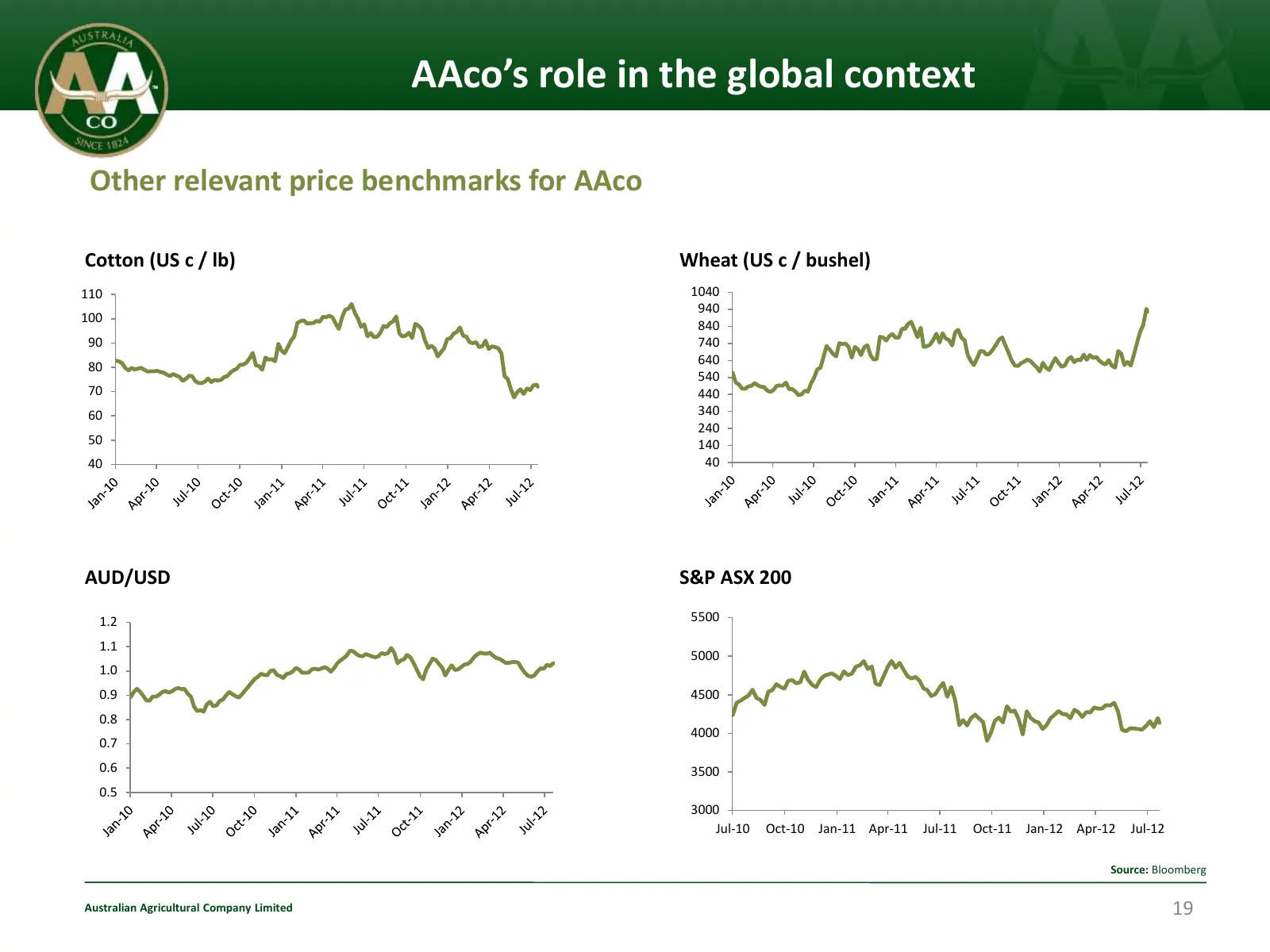
Slide 19: Other relevant price benchmarks for AAco
AAco’s role in the global context Other relevant price benchmarks for AAco Cotton (US c / lb) Wheat (US c / bushel) 110 1040 940 100 840 90 740 80 640 540 70 440 60 340 240 50 140 40 40 AUD/USD S&P ASX 200 1.2 5500 1.1 5000 1.0 0.9 4500 0.8 4000 0.7 0.6 3500 0.5 3000 Jul-10 Oct-10 Jan-11 Apr-11 Jul-
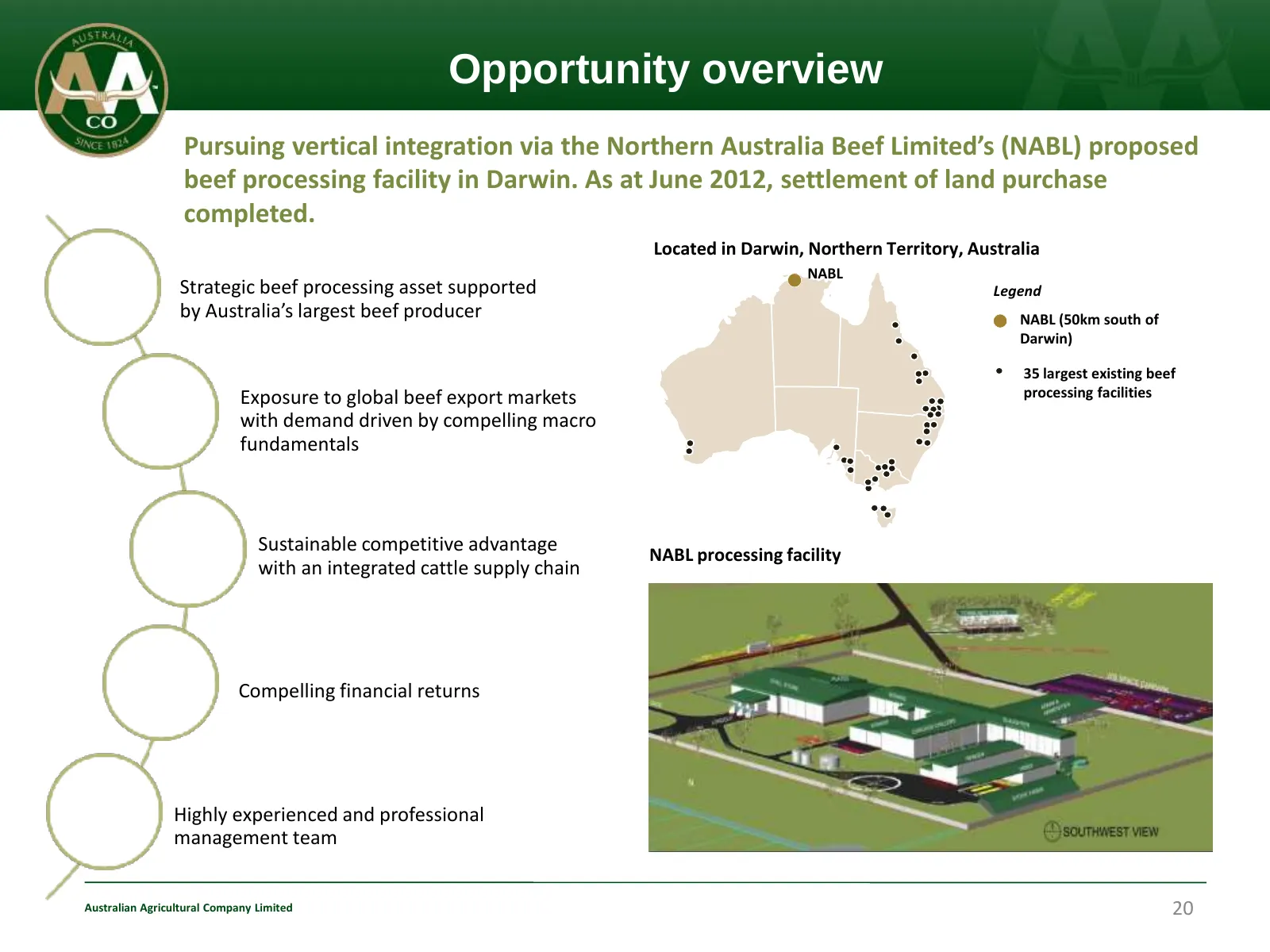
Slide 20: Opportunity overview
Opportunity overview Pursuing vertical integration via the Northern Australia Beef Limited’s (NABL) proposed beef processing facility in Darwin. As at June 2012, settlement of land purchase completed. Located in Darwin, Northern Territory, Australia NABL Strategic beef processing asset supported Leg
Slide 21: Proximity to key markets
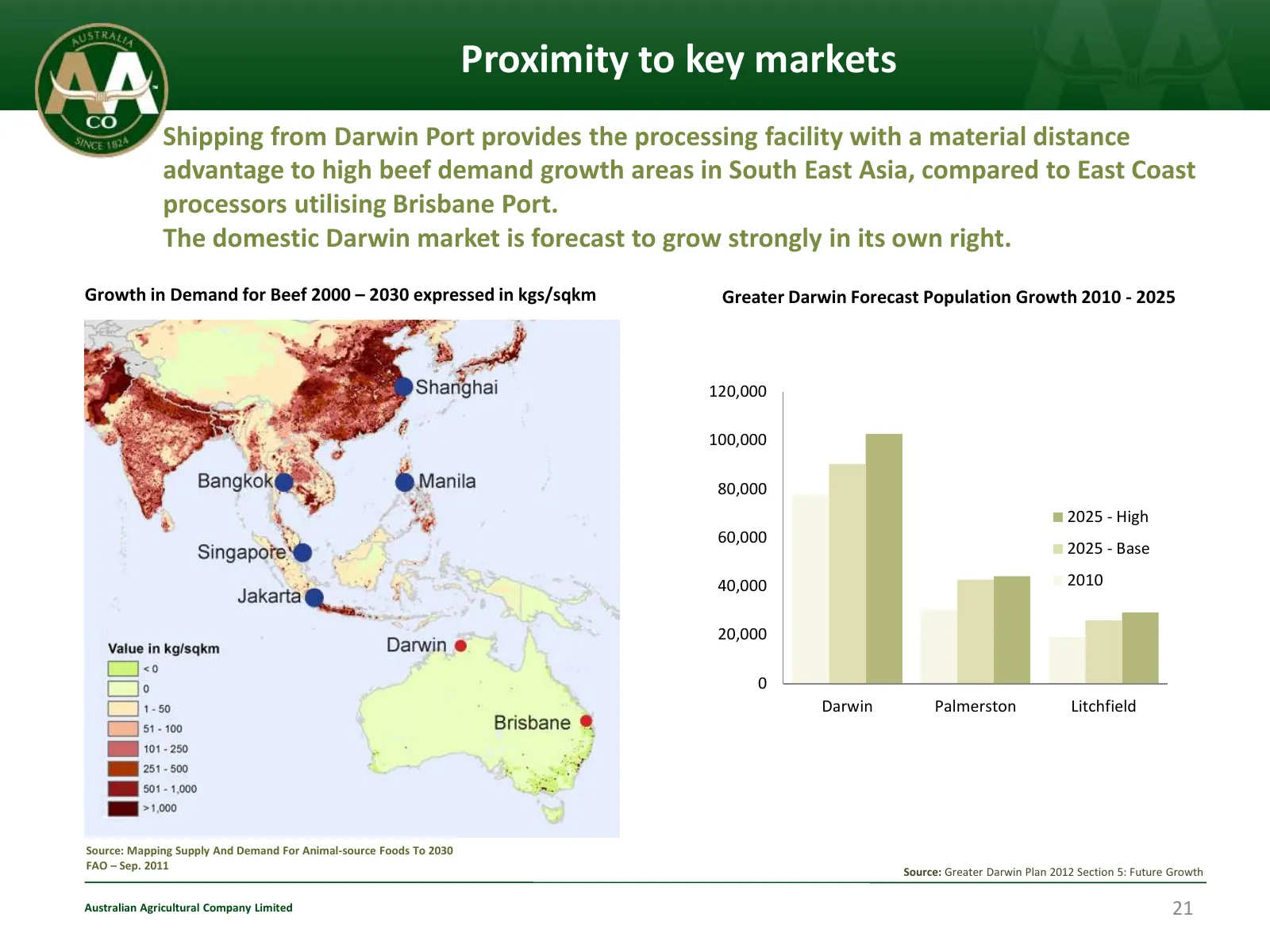
Proximity to key markets Shipping from Darwin Port provides the processing facility with a material distance advantage to high beef demand growth areas in South East Asia, compared to East Coast processors utilising Brisbane Port. The domestic Darwin market is forecast to grow strongly in its own ri
Slide 22: NABL's impact on the northern cattle industry
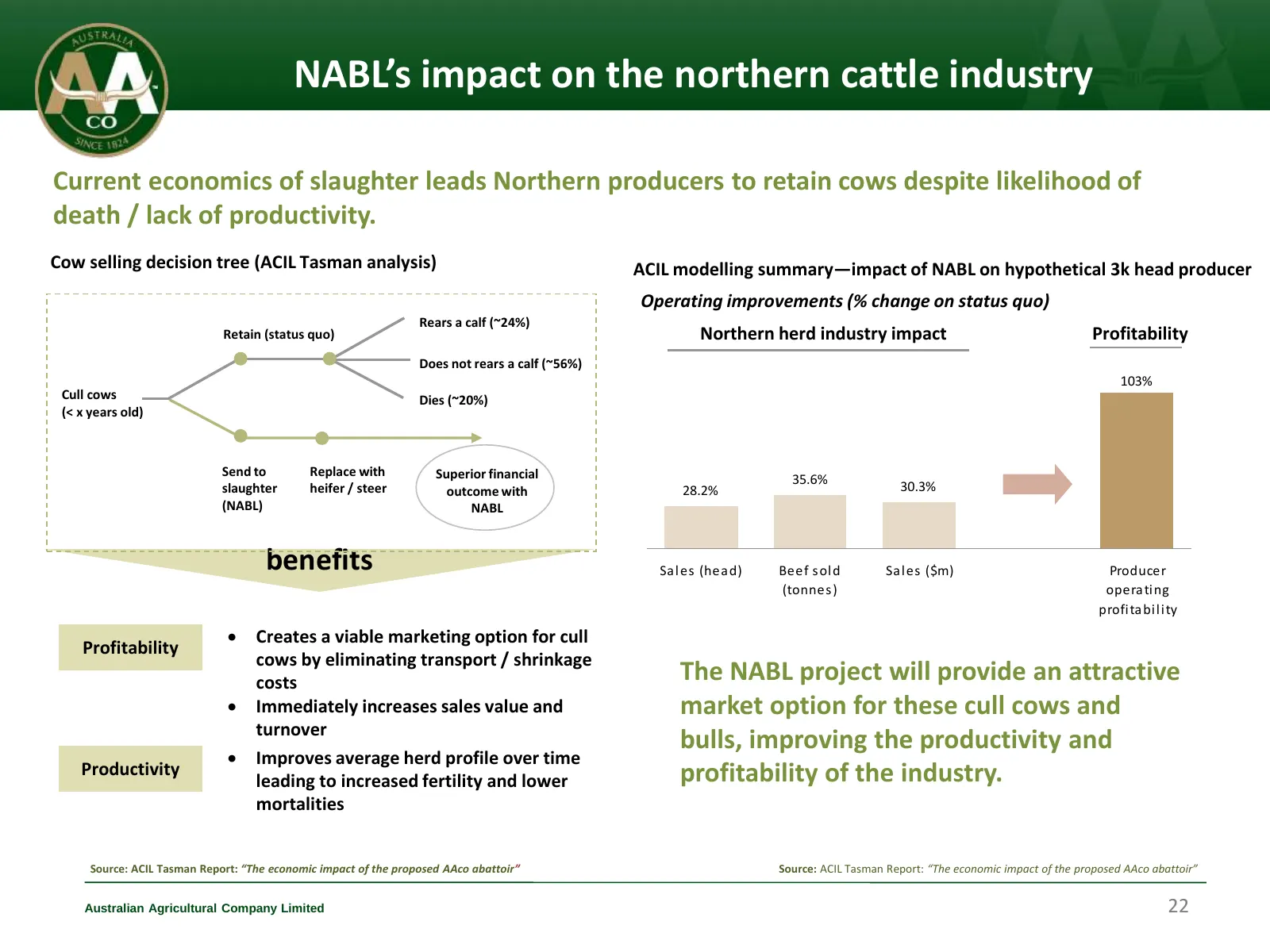
NABL’s impact on the northern cattle industry Current economics of slaughter leads Northern producers to retain cows despite likelihood of death / lack of productivity. Cow selling decision tree (ACIL Tasman analysis) ACIL modelling summary—impact of NABL on hypothetical 3k head producer Operating i
Slide 23: Key regions of supply for NABL
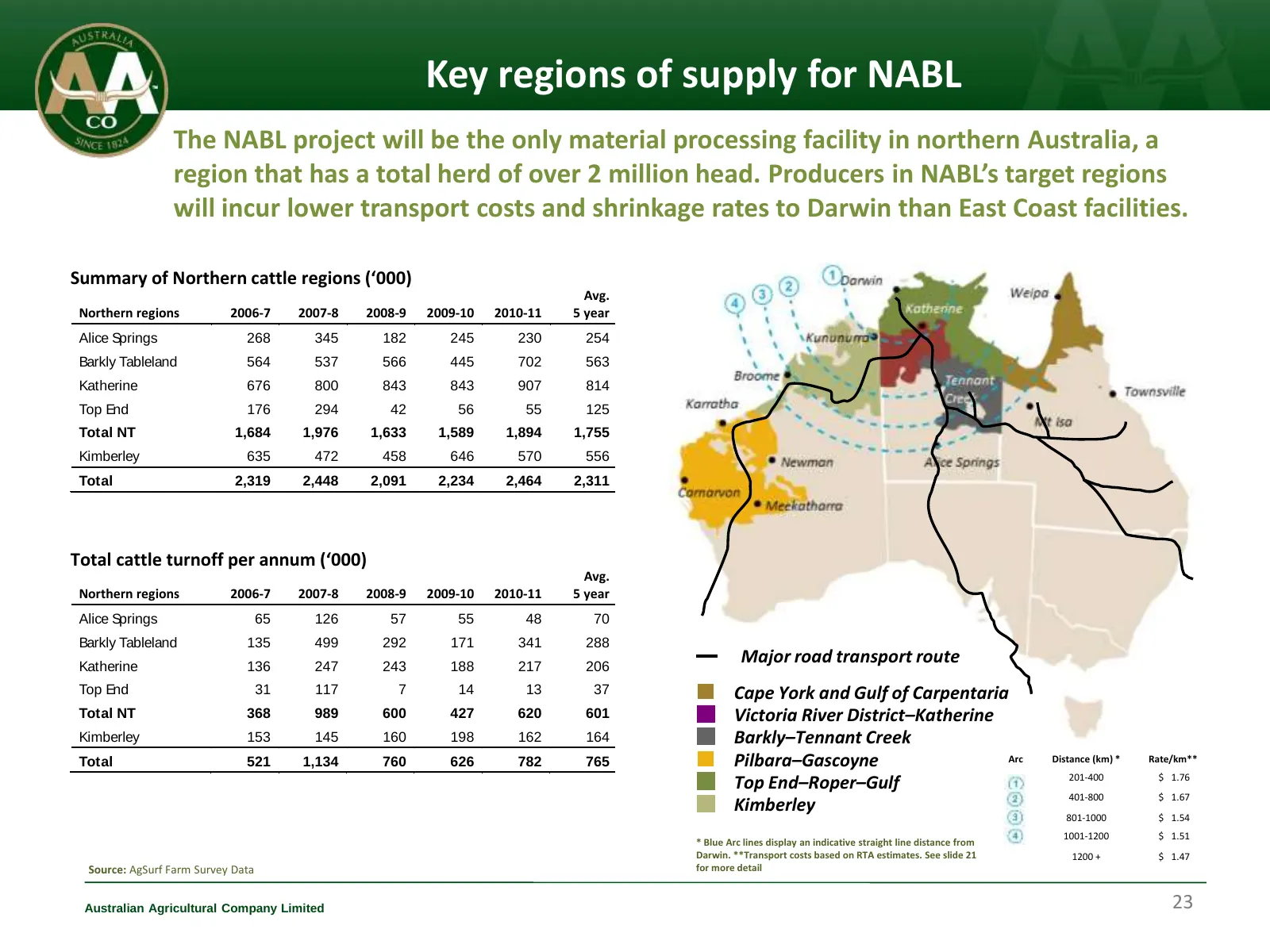
Key regions of supply for NABL The NABL project will be the only material processing facility in northern Australia, a region that has a total herd of over 2 million head. Producers in NABL’s target regions will incur lower transport costs and shrinkage rates to Darwin than East Coast facilities. Su
Slide 24: Environmental, regional and animal welfare benefits
Environmental, regional and animal welfare benefits Pursuing the NABL project will have numerous positive impacts across the Northern Territory community • Significant reduction in potential welfare impacts from transport, handling, loading, Environmental unloading and dipping requirements, with res
Slide 25: Superior genetics and breeding programs
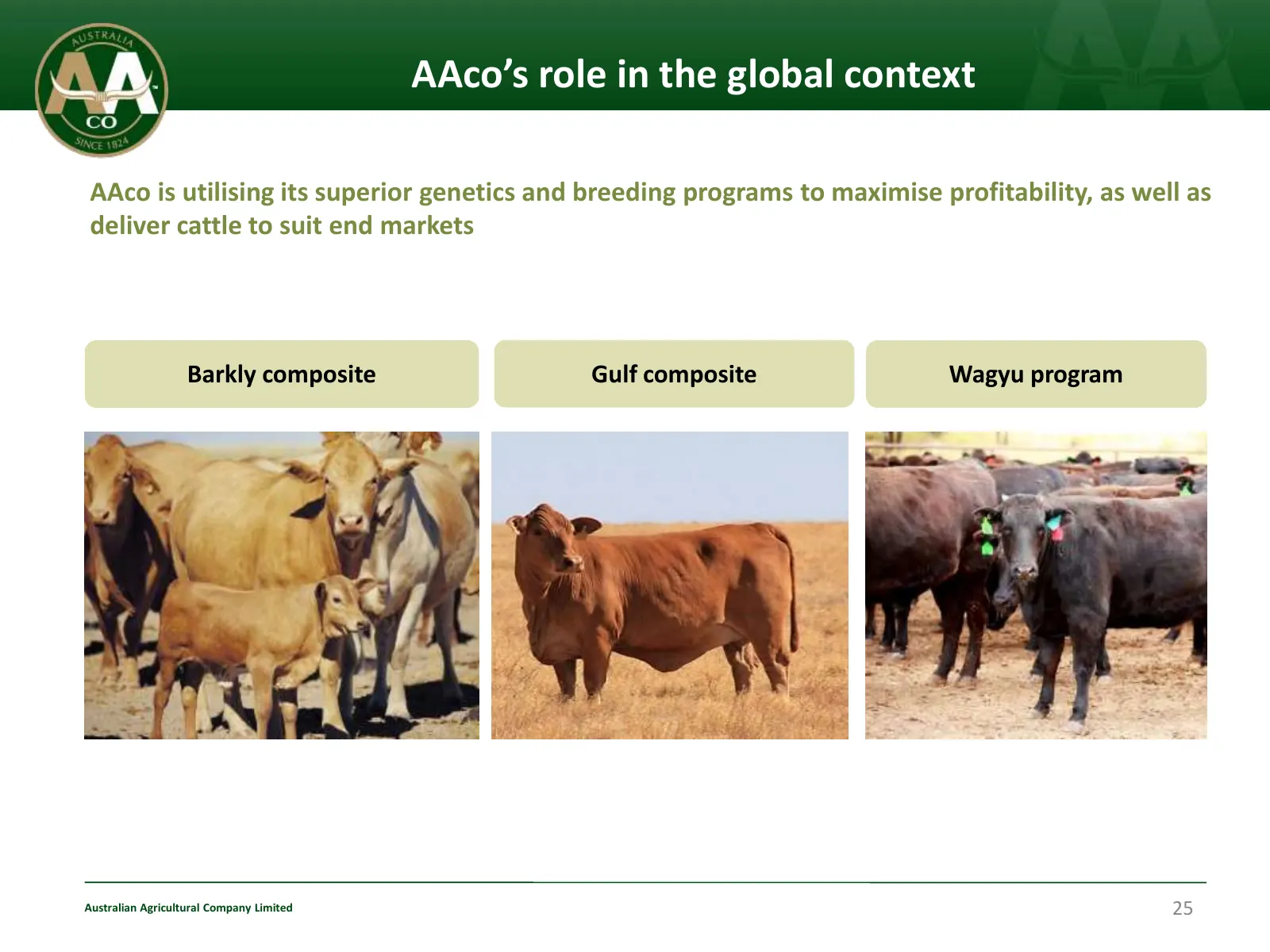
AAco’s role in the global context AAco is utilising its superior genetics and breeding programs to maximise profitability, as well as deliver cattle to suit end markets Barkly composite Gulf composite Wagyu program Australian Agricultural Company Limited 25
Slide 26: Opportunity to increase cropping contribution
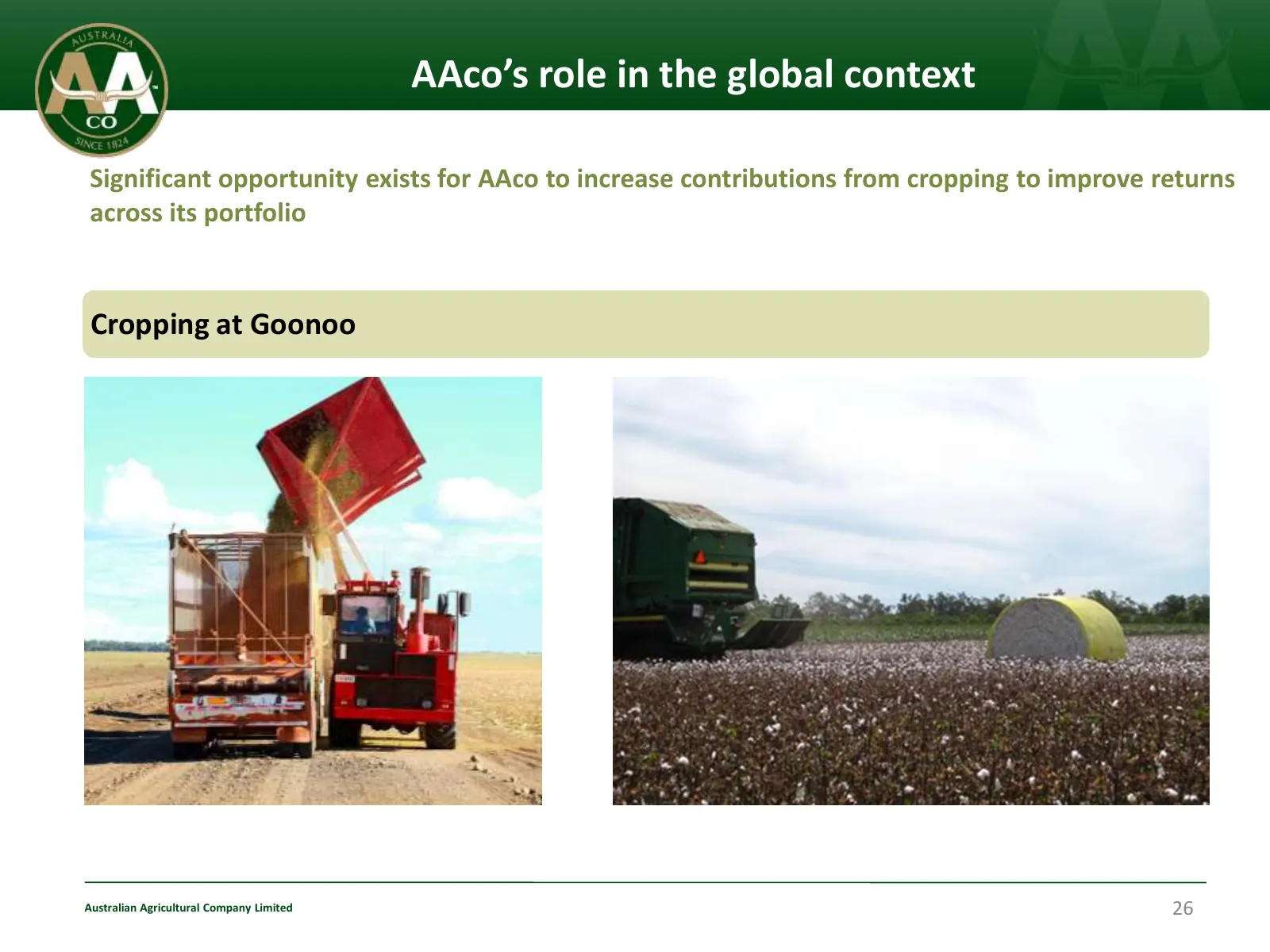
AAco’s role in the global context Significant opportunity exists for AAco to increase contributions from cropping to improve returns across its portfolio Cropping at Goonoo Australian Agricultural Company Limited 26
Slide 27: Innovative management programs
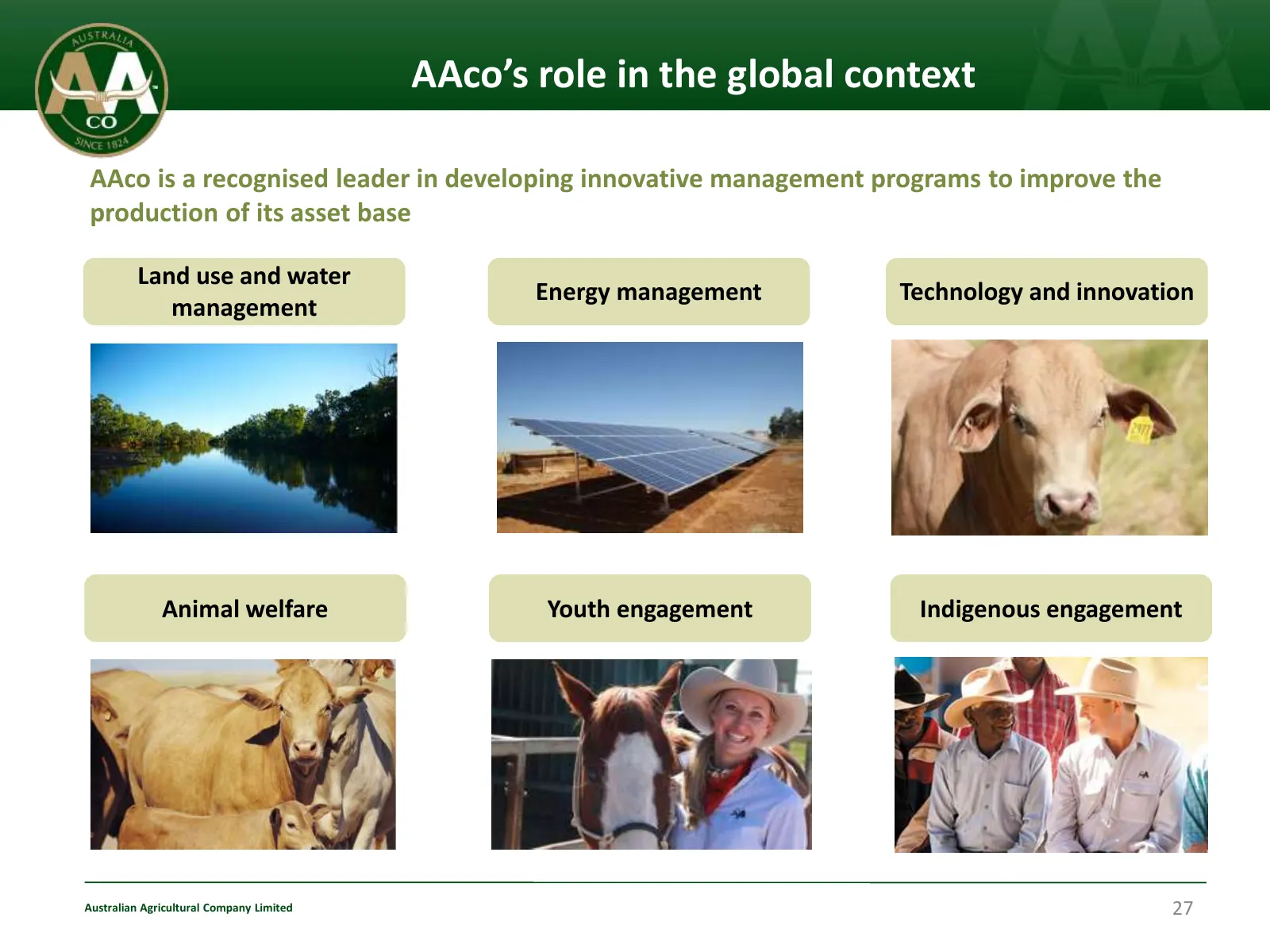
AAco’s role in the global context AAco is a recognised leader in developing innovative management programs to improve the production of its asset base Land use and water Energy management Technology and innovation management Animal welfare Youth engagement Indigenous engagement Australian Agricultur
Slide 28: Indigenous engagement update
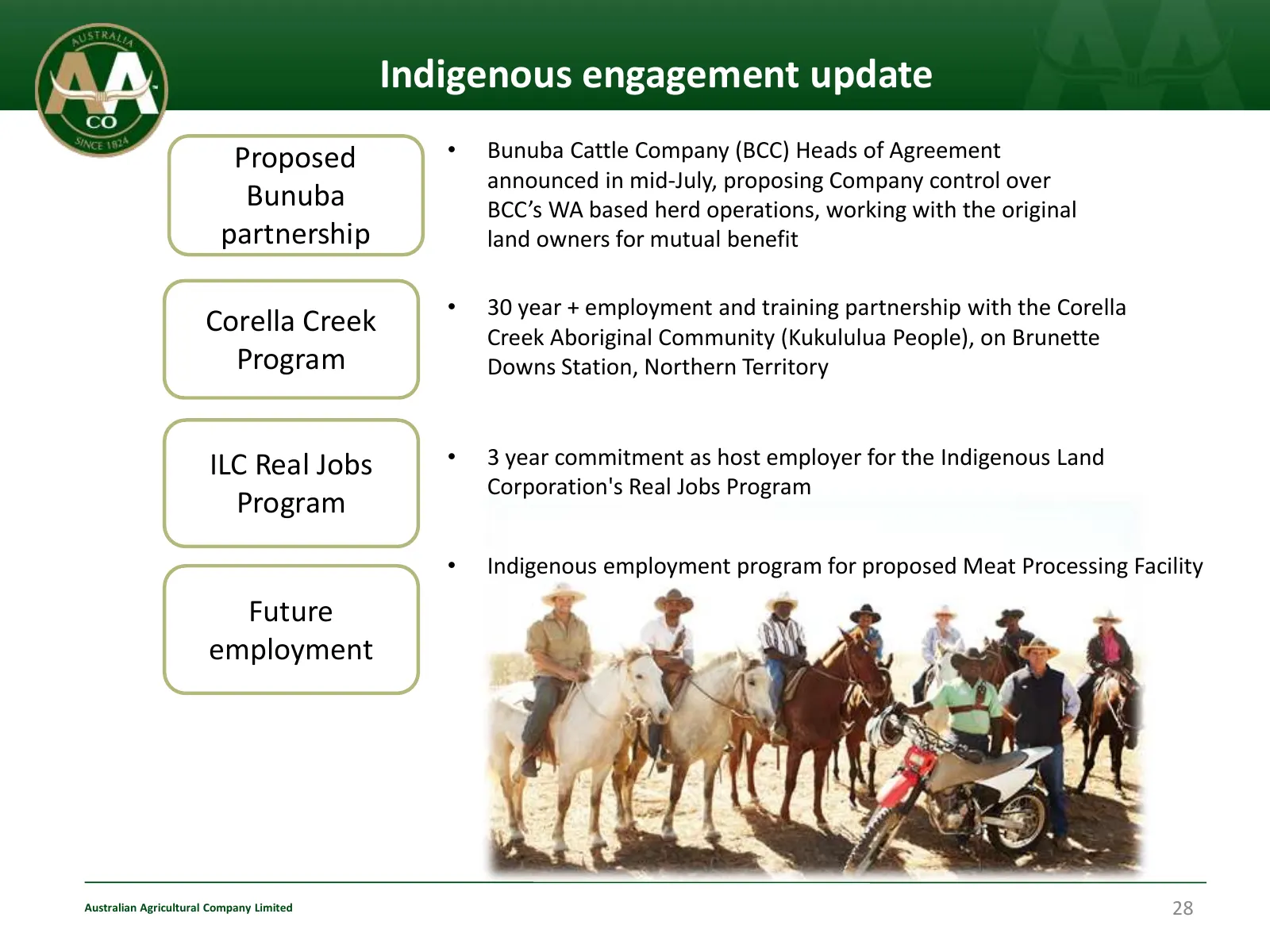
Indigenous engagement update Proposed • Bunuba Cattle Company (BCC) Heads of Agreement announced in mid-July, proposing Company control over Bunuba BCC’s WA based herd operations, working with the original partnership land owners for mutual benefit • 30 year + employment and training partnership wit
Slide 29: In summary
In summary Population and income growth in developing economies is driving food demand Need for more productivity in Australian agriculture AAco is transforming into a globally focused vertically integrated producer Latest initiative — acquisition of land for Darwin processing facility. Substantial
Source: Internet Archive copy of aaco.com.au
More decks from Australian Agricultural Company Limited
 HY27 Earnings Presentation23 slides · Nov 19, 2026
 Investor Presentation (May 2026)22 slides · May 21, 2026
 H1 FY2026 Earnings Presentation23 slides · Nov 20, 2025
 Investor Presentation (May 2025)22 slides · May 22, 2025
 H1 2025 Earnings Presentation23 slides · Nov 15, 2024
 FY2024 Earnings Presentation28 slides · May 15, 2024