Progenics Pharmaceuticals — Jefferies Healthcare Conference 2019
30 slides from Progenics Pharmaceuticals's conference presentation, Jun 6, 2019
Slide 1: Leading Development of Radiopharmaceuticals to Detect and Treat Cancer
Leading Development of Radiopharmaceuticals to Detect and Treat Cancer Mark R Baker v CEO eax Jefferies Healthcare Conference June 6, 2019 Progenics | Pharmaceuticals" Find Fight and Follow"
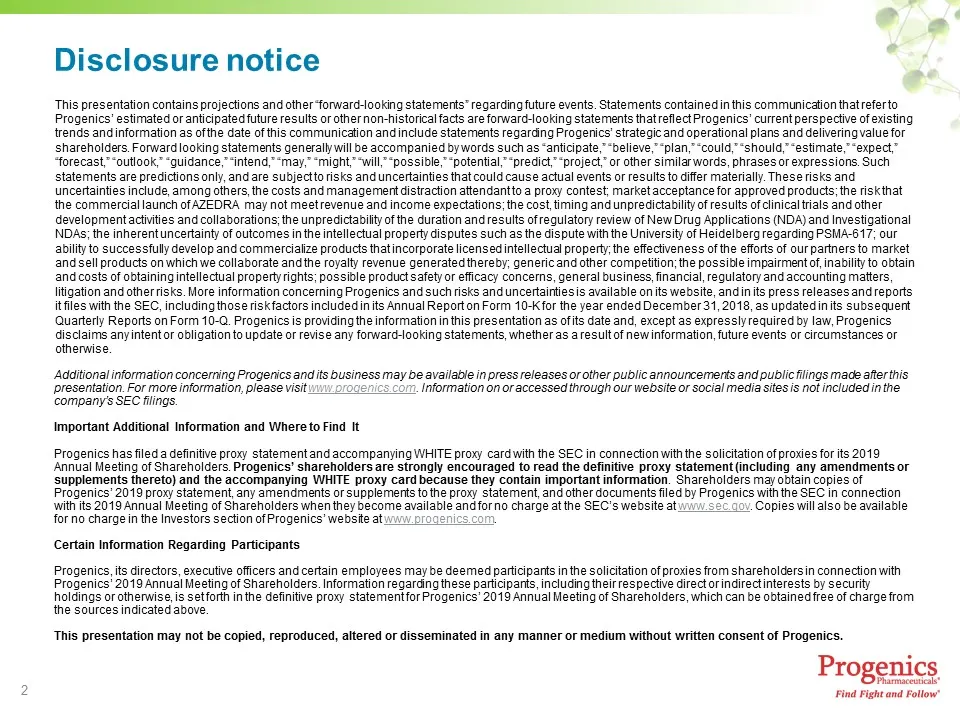
Slide 2: Disclosure notice
Disclosure notice ‘This presentation contains projections and other forward-looking statements” regarding future events. Statements containedin this communication thatrefer to Progenics’ estimated or anticipated future results or other non-historical facts are forward-looking statements that reflect
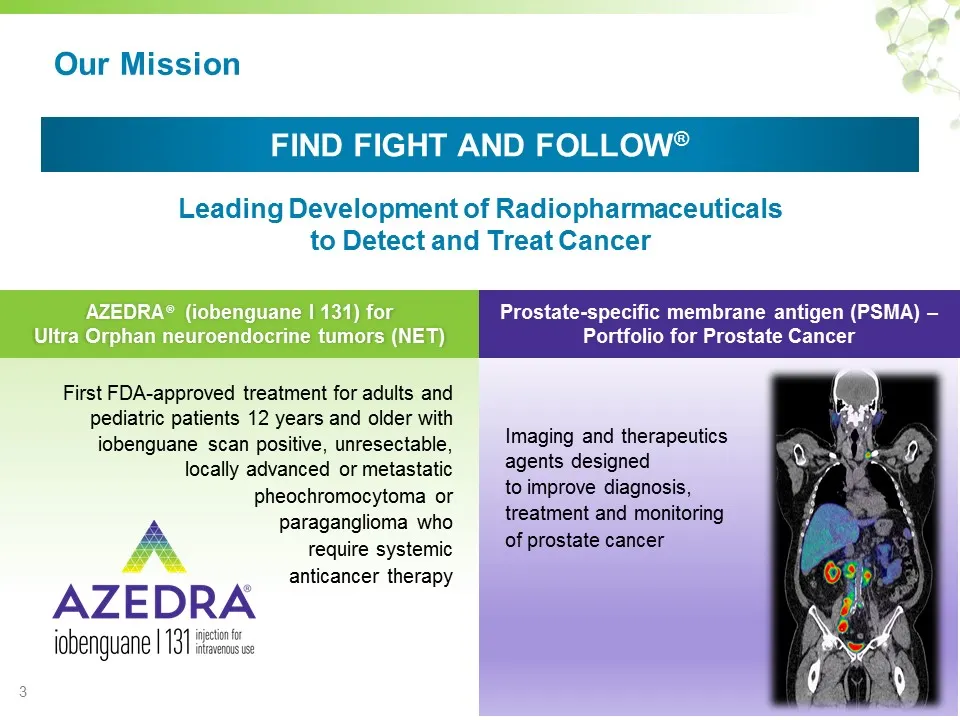
Slide 3: Leading Development of Radiopharmaceuticals to Detect and Treat Cancer
Developm to Detect an nt ent benguane | 131) for Ultra Orphan neuroendocrine tumors (NET) First FDA-approved treatment for adults and pediatric patients 12 years and older with iobenguane scan positive, unresectable, locally advanced or metastatic pheochromocytoma or ba paraganglioma who MN enteacer
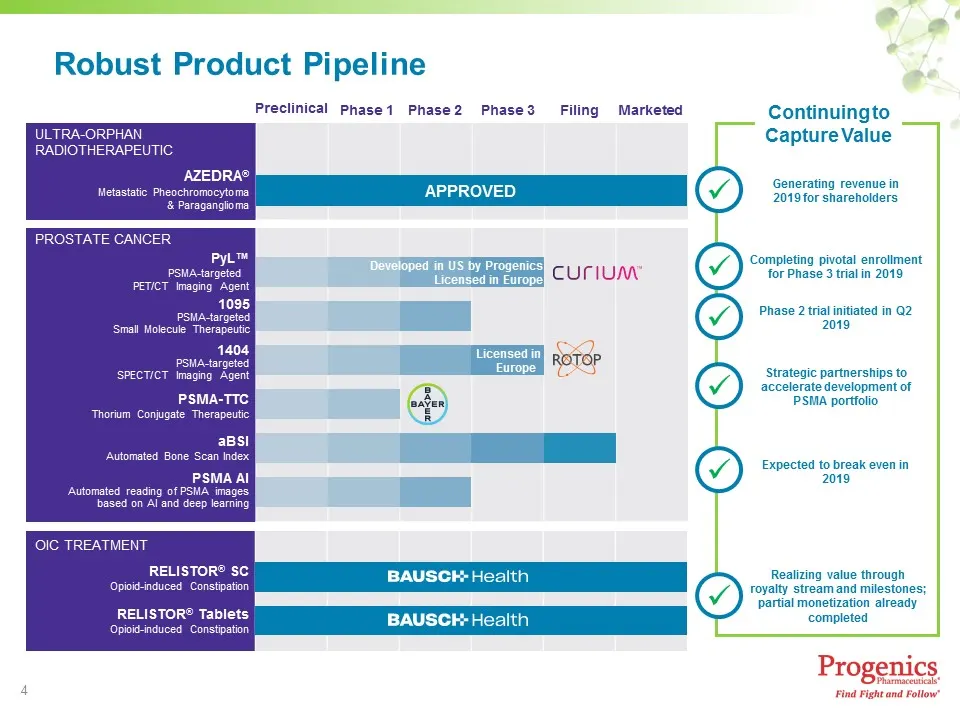
Slide 4: Robust Product Pipeline
Robust Product Pipeline Preclinical Phase1 Phase2 Phase3 ULTRA-ORPHAN RADIOTHERAPEUTIC Metastatic APPROVED PETICT Imaging Agent 1095 PSMA-targeted ‘Small Molecule PSMA-TTC Thorium Conjugate Therapet aBsI Automated Bone Scan index PSMA Al Automated reading of PSMA images based on Al and deep learning
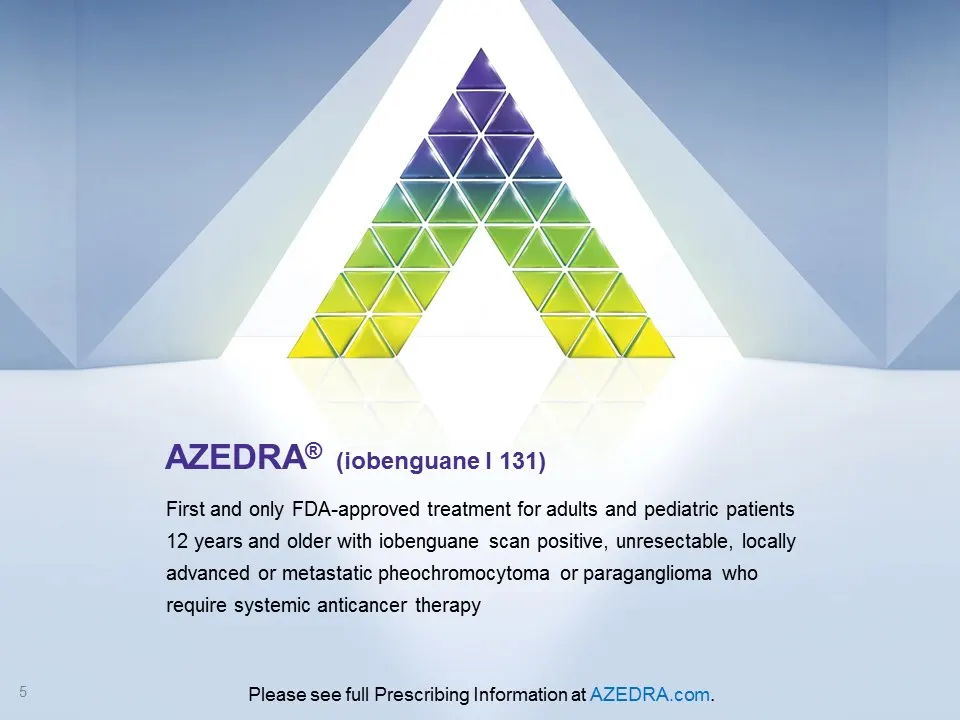
Slide 5: AZEDRA (iobenguane I-131)
A WN E\/\/N TIA LAY VAM. IY A. MS Th AZEDRA® (iobenguane | 131) First and only FDA-approved treatment for adults and pediatric patients 12 years and older with iobenguane scan positive, unresectable, locally advanced or metastatic pheochromocytoma or paraganglioma who require systemic anticancer the
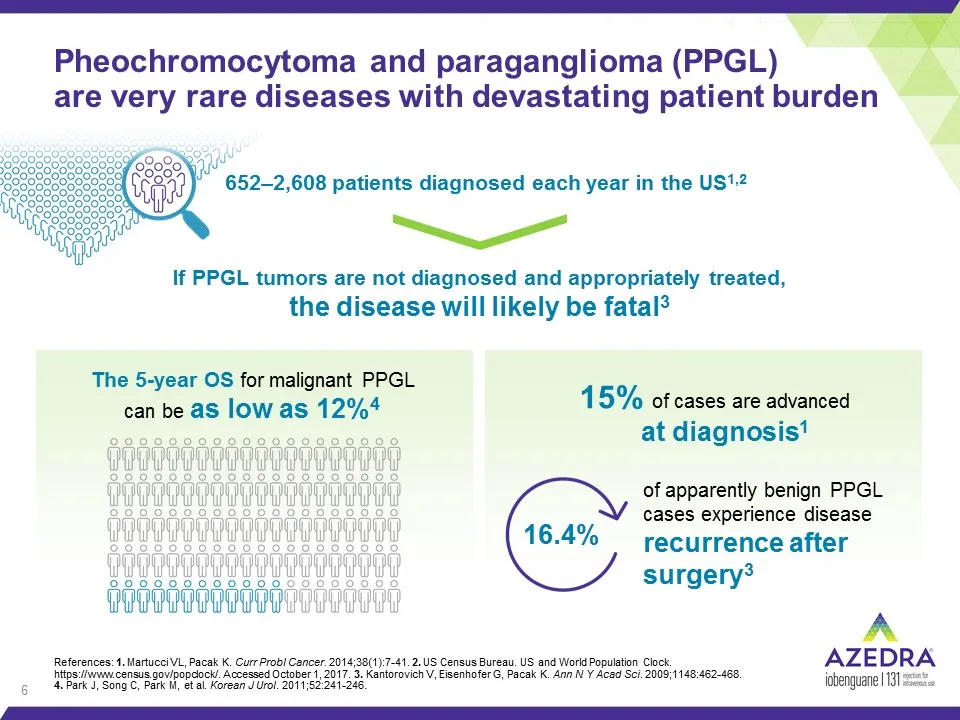
Slide 6: Pheochromocytoma and paraganglioma (PPGL) are very rare diseases
Pheochromocytoma and paraganglioma (PPGL) are very rare diseases with devastating patient burden RENEE CORO TE Sees, ee 652-2,608 patients diagnosed each year in the US'? Ui Geeeeeeee8 Ap. se ~~ If PPGL tumors are not diagnosed and appropriately treated, the disease will likely be fatal* The 5-year
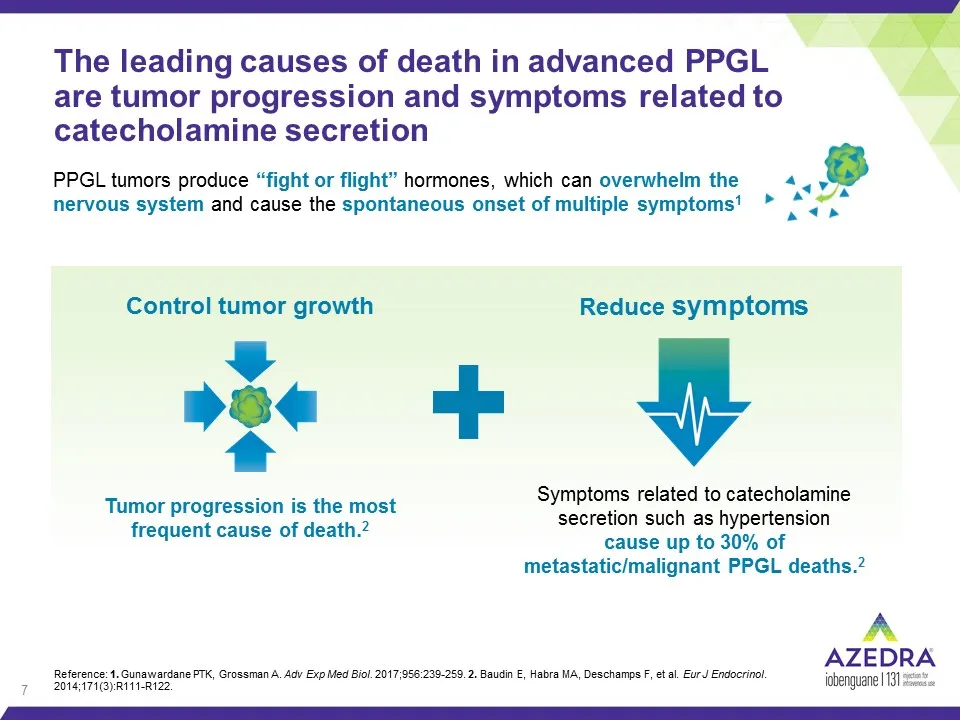
Slide 7: The leading causes of death in advanced PPGL
The leading causes of death in advanced PPGL are tumor progression and symptoms related to catecholamine secretion PPGL tumors produce “fight or flight” hormones, which can overwhelm the 4 x 2 nervous system and cause the spontaneous onset of multiple symptoms’ rei Control tumor growth Reduce sympto
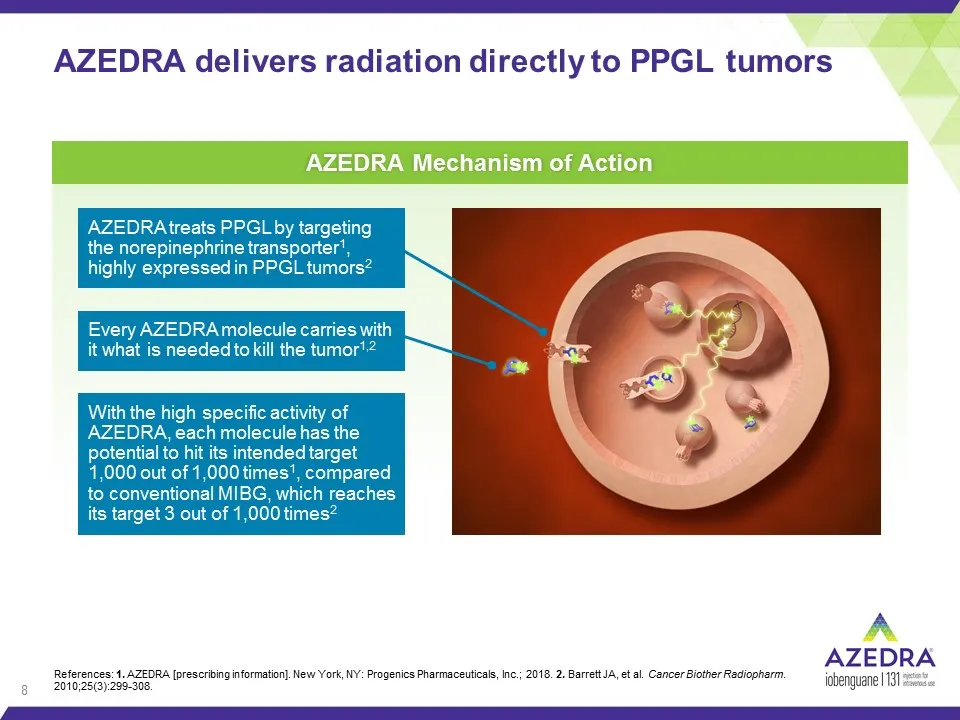
Slide 8: AZEDRA delivers radiation directly to PPGL tumors
AZEDRA delivers radiation directly to PPGL tumors A Reterences:4,AZEDRA [orescrbnginformaton New York NY: Progenies Parmacevicals, he: 2018.2 BaretJA et Cancer iether Reclopharm, bs Sorozse) seo esomens : 9 mt iobenguane 131
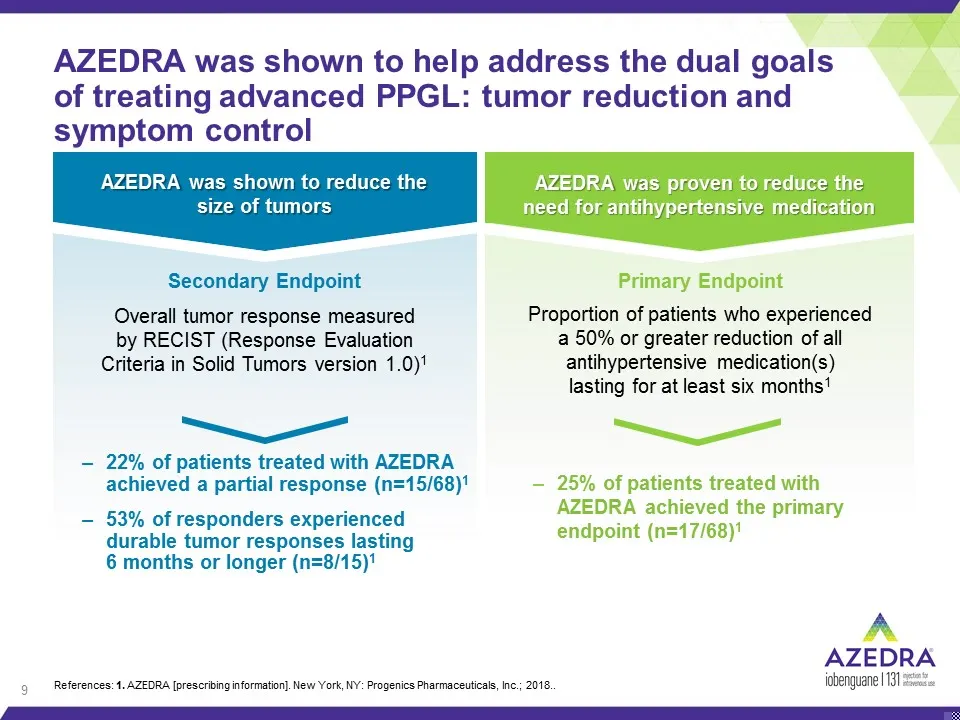
Slide 9: AZEDRA addresses dual goals of treating advanced PPGL
AZEDRA was shown to help address the dual goals of treating advanced PPGL: tumor reduction and symptom control AZEDRA was shown to reduce the AZEDRA was proven to reduce the size of tumors need for antihypertensive medication Secondary Endpoint Primary Endpoint Overall tumor response measured Propor
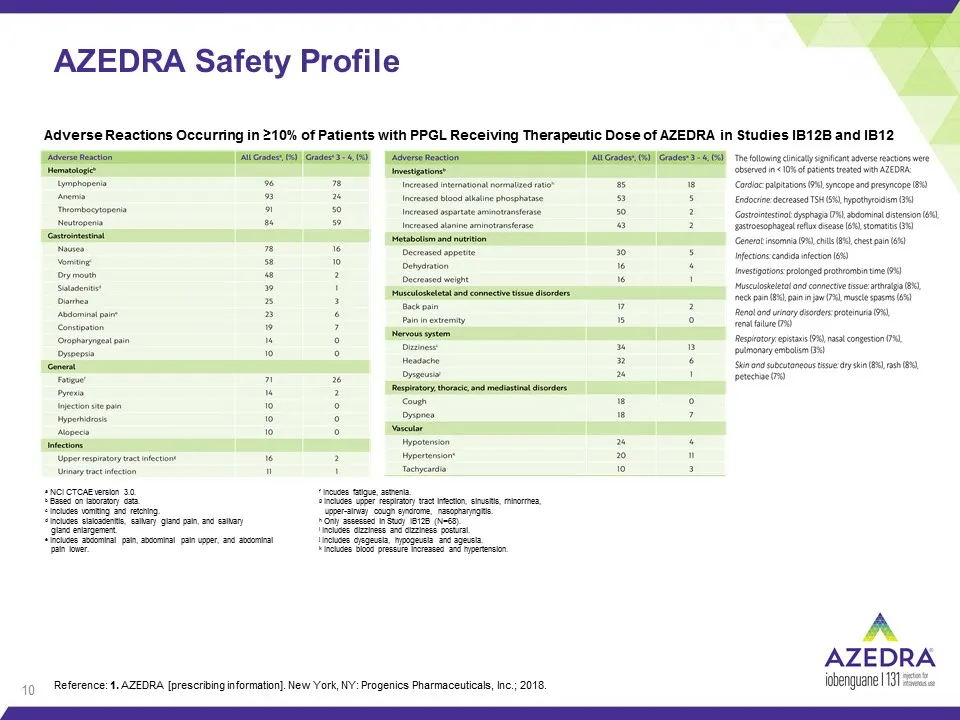
Slide 10: AZEDRA Safety Profile
AZEDRA Safety Profile Adverse Reactions Occurring in 210% of Patients with PPGL Receiving Therapeutic Dose of AZEDRA in Studies IB12B and IB12 ‘Te flowing cna santcart adverse reacbons were obsenedn< 10% patents ese wth AZEDRR mre * » reseed arate rete ee . Mt Groce coped pepe 2S iy x sparen i 3 Enn
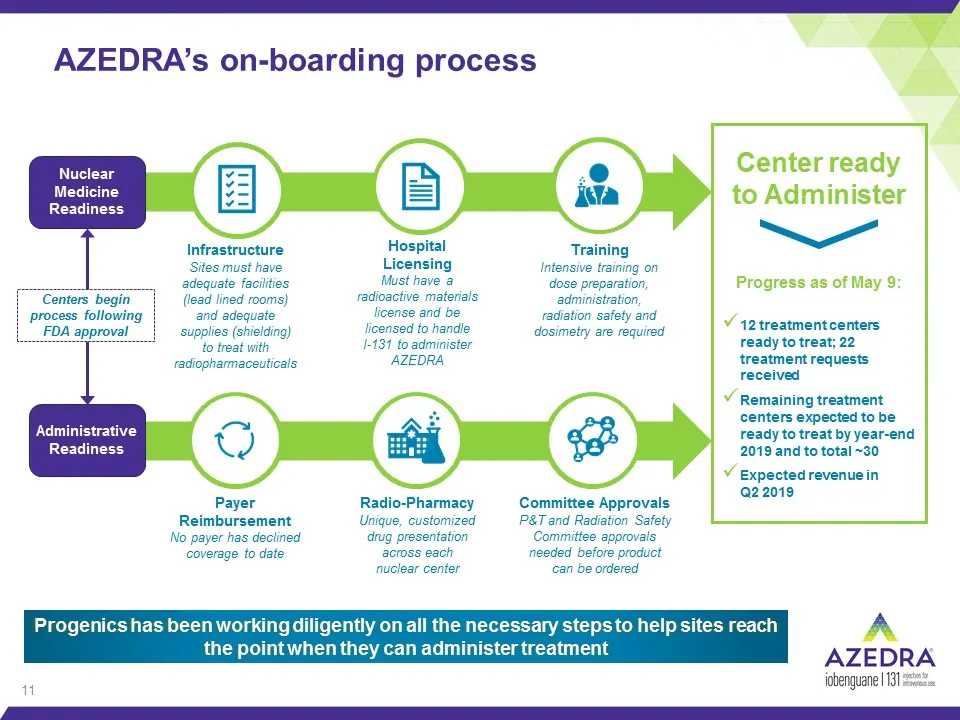
Slide 11: AZEDRA's on-boarding process
AZEDRA’s on-boarding process Nuclear Center ready Rennes to Administer ~ Infrastructure Hospital Training Sites must have Licensing Intensive training on adequate facilities Must have a dose preparation, Progress as of May 9: Centers begin (lead lined rooms) gre ee administration, process following
Slide 12: PSMA-Targeted Pipeline
PSMA-Targeted Pipeline oS are Progenics Find Fight and Follow*
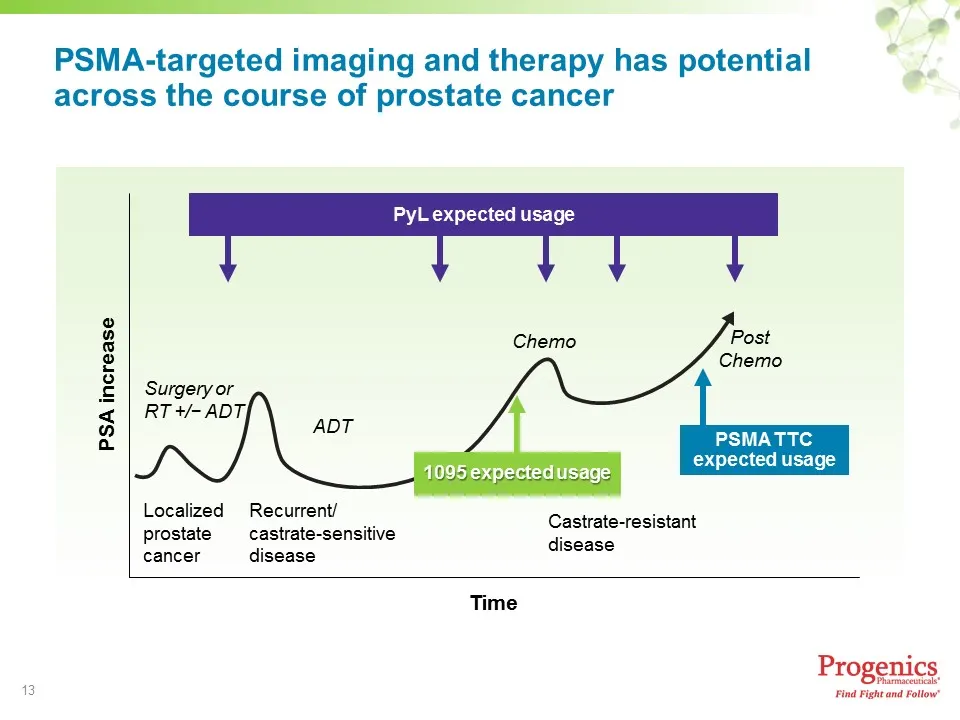
Slide 13: PSMA-targeted imaging and therapy has potential across the course of prostate cancer
PSMA-targeted imaging and therapy has potential across the course of prostate cancer PyL expected usage Post Chemo Surgery or RT+/-ADT| PSMATTC expected usage PSA increase 1095 expectedusage Localized Recurrent/ Castrate-resistant prostate castrate-sensitive di isease cancer disease Time Progenics,
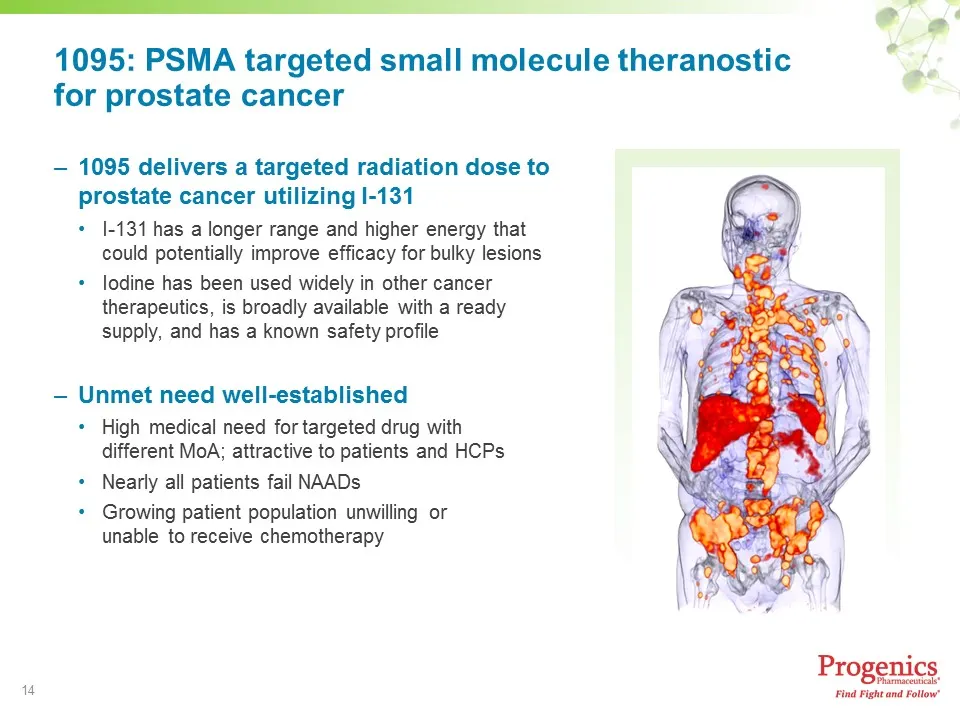
Slide 14: 1095: PSMA targeted small molecule theranostic for prostate cancer
a ee 1095: PSMA targeted small molecule theranostic for prostate cancer *% — 1095 delivers a targeted radiation dose to prostate cancer utilizing I-131 + 1-131 has a longer range and higher energy that could potentially improve efficacy for bulky lesions + lodine has been used widely in other cancer
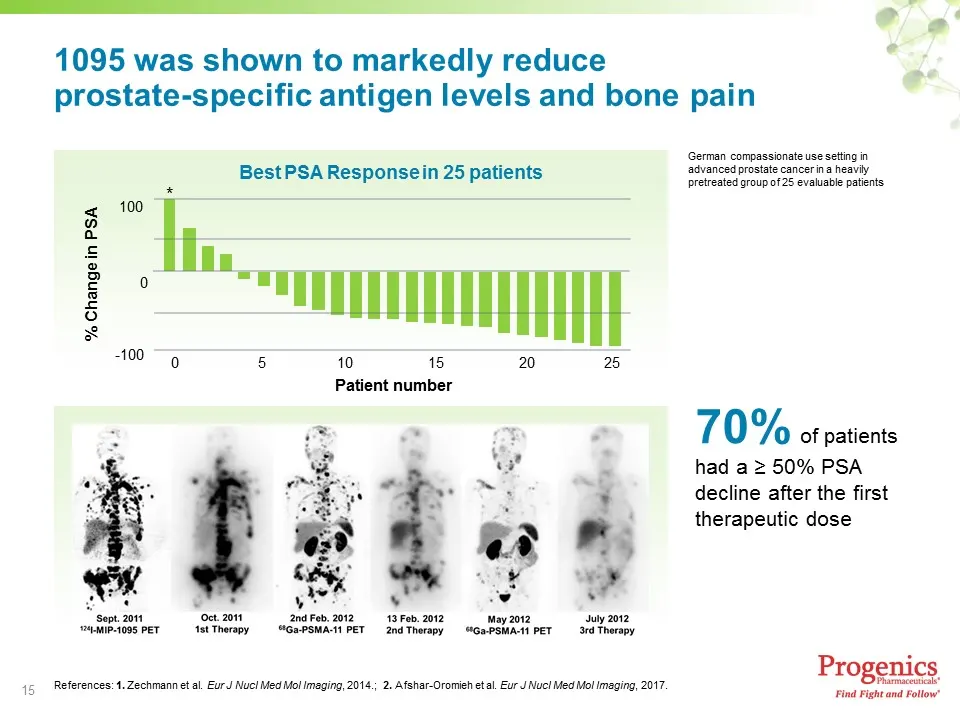
Slide 15: 1095 markedly reduced PSA levels and bone pain
Ne ’ wh ad 1095 was shown to markedly reduce prostate-specific antigen levels and bone pain ‘German compassionate use setting in Best PSA Responsein 25 patients Sores calniars cress orca 100 rr) 2 £ ra e ° TT 5 £ oO x 100 "0 5 10 18 20 25 Patient number % “ fs 70 ‘0 of patients =. * « m1 had a 2 50%
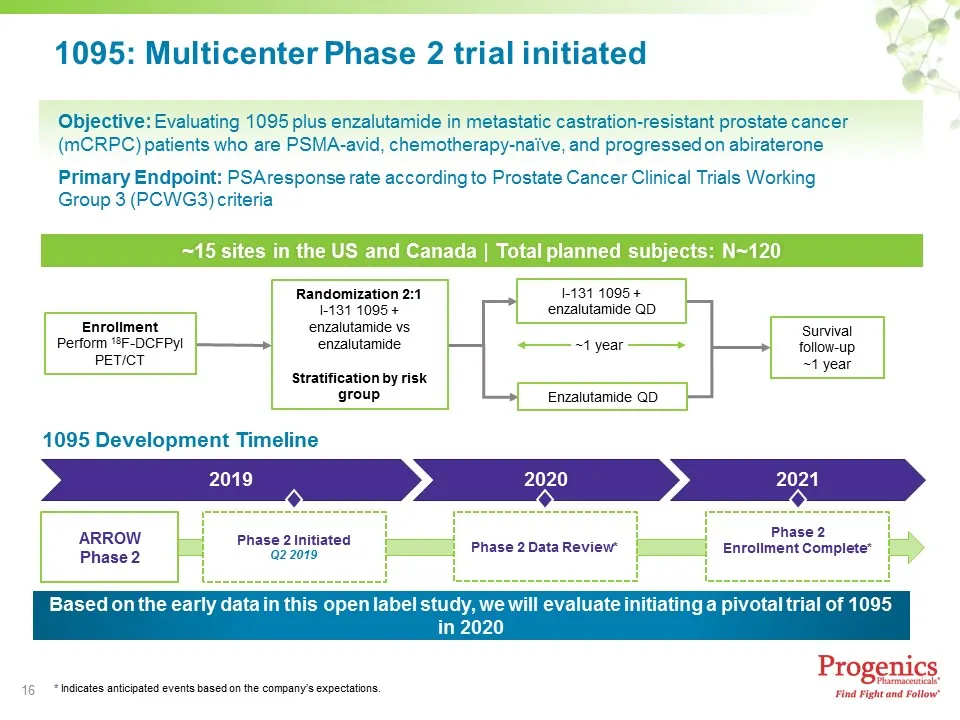
Slide 16: 1095: Multicenter Phase 2 trial initiated
1095: Multicenter Phase 2 trial initiated bas Objective: Evaluating 1095 plus enzalutamide in metastatic castration-resistant prostate cancer (mCRPC) patients who are PSMA-avid, chemotherapy-naive, and progressedon abiraterone Primary Endpoint: PSAresponse rate according to Prostate Cancer Clinical
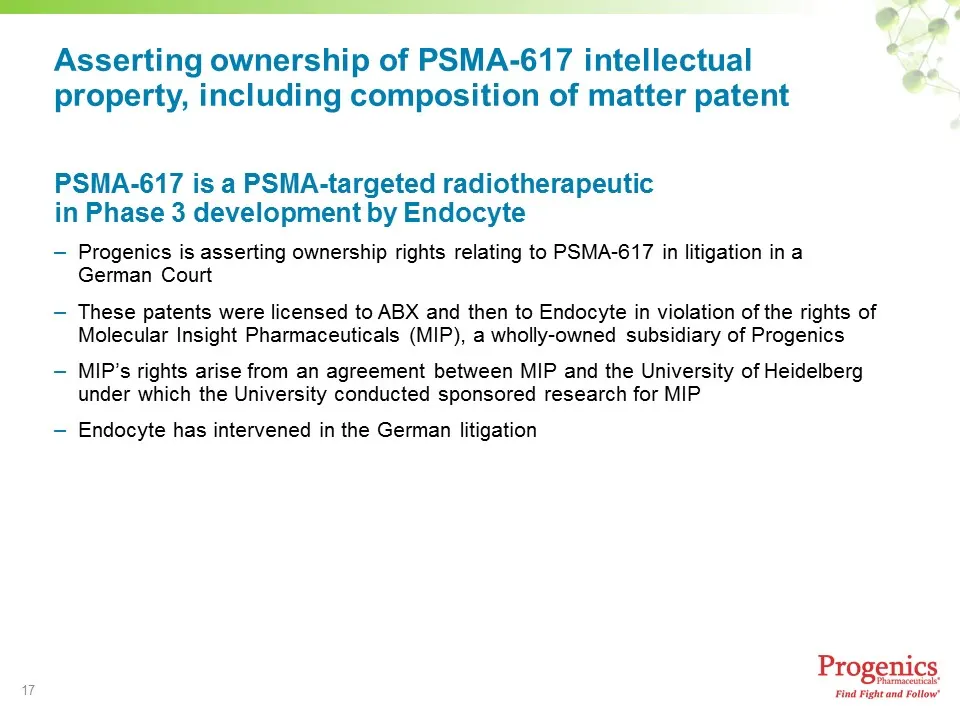
Slide 17: Asserting ownership of PSMA-617 intellectual property
a e/ Asserting ownership of PSMA-617 intellectual property, including composition of matter patent PSMA-617 is a PSMA-targeted radiotherapeutic in Phase 3 development by Endocyte — Progenics is asserting ownership rights relating to PSMA-617 in litigation in a German Court — These patents were licen
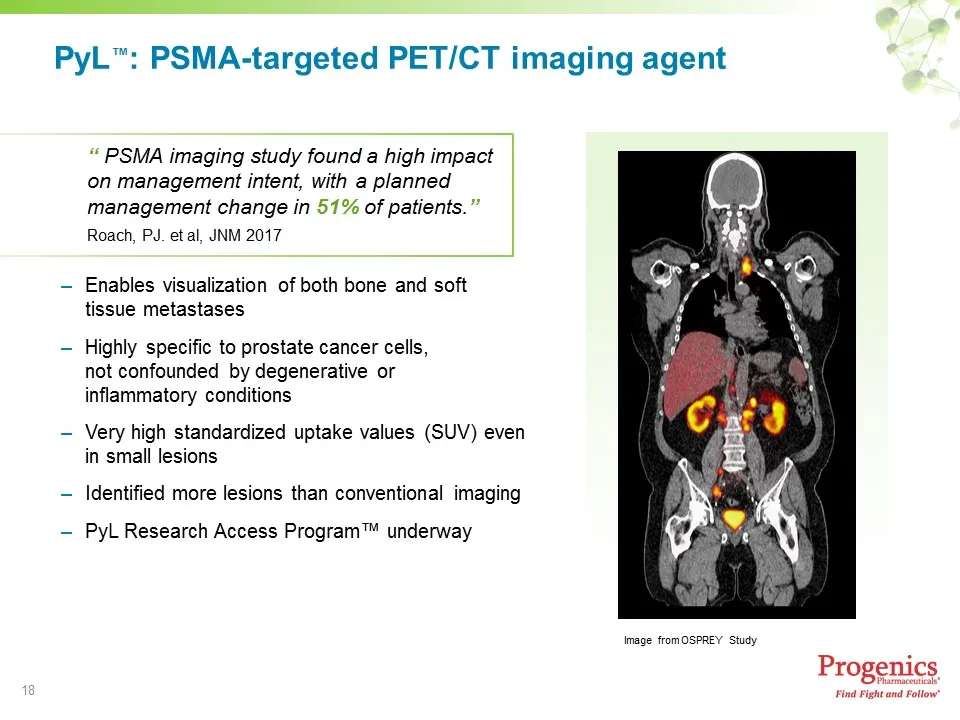
Slide 18: PyL: PSMA-targeted PET/CT imaging agent
PyL™: PSMA-targeted PET/CT imaging agent “ PSMA imaging study found a high impact on management intent, with a planned management change in 51% of patients.” Roach, PJ. et al, JNM 2017 — Enables visualization of both bone and soft tissue metastases — Highly specific to prostate cancer cells, not con
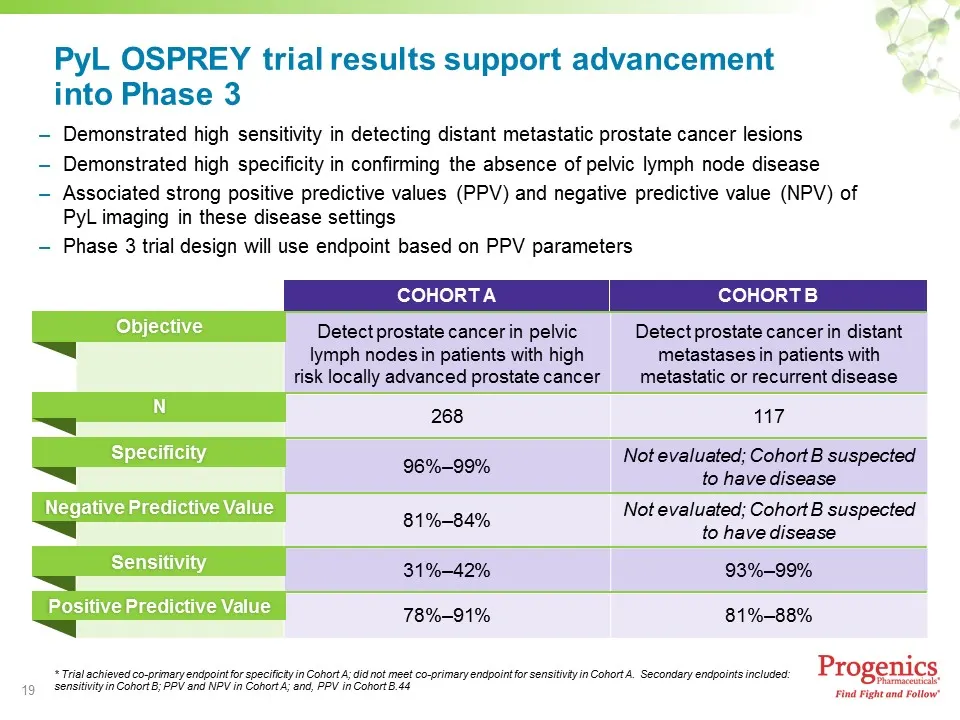
Slide 19: PyL OSPREY trial results support advancement into Phase 3
PyL OSPREY trial results support advancement into Phase 3 — Demonstrated high sensitivity in detecting distant metastatic prostate cancer lesions — Demonstrated high specificity in confirming the absence of pelvic lymph node disease — Associated strong positive predictive values (PPV) and negative p
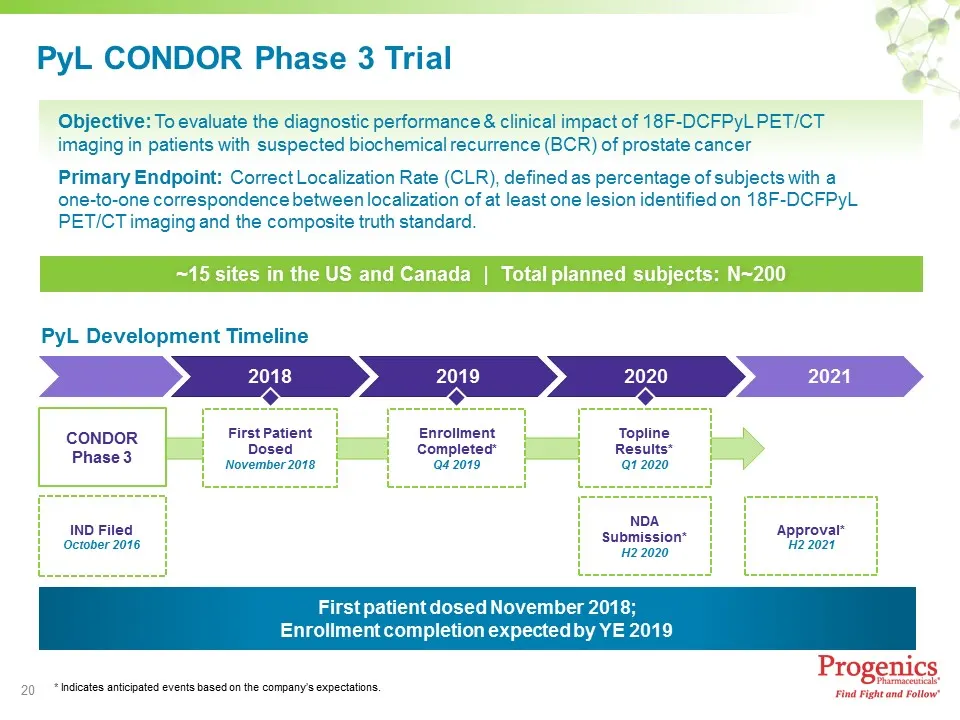
Slide 20: PyL CONDOR Phase 3 Trial
PyL CONDOR Phase 3 Trial <y Objective: To evaluate the diagnostic performance & clinical impact of 18F-DCFPyL PET/CT imaging in patients with suspected biochemical recurrence (BCR) of prostate cancer Primary Endpoint: Correct Localization Rate (CLR), defined as percentage of subjects with a one-to-o
Slide 21: KOLs Drive Development of PyL
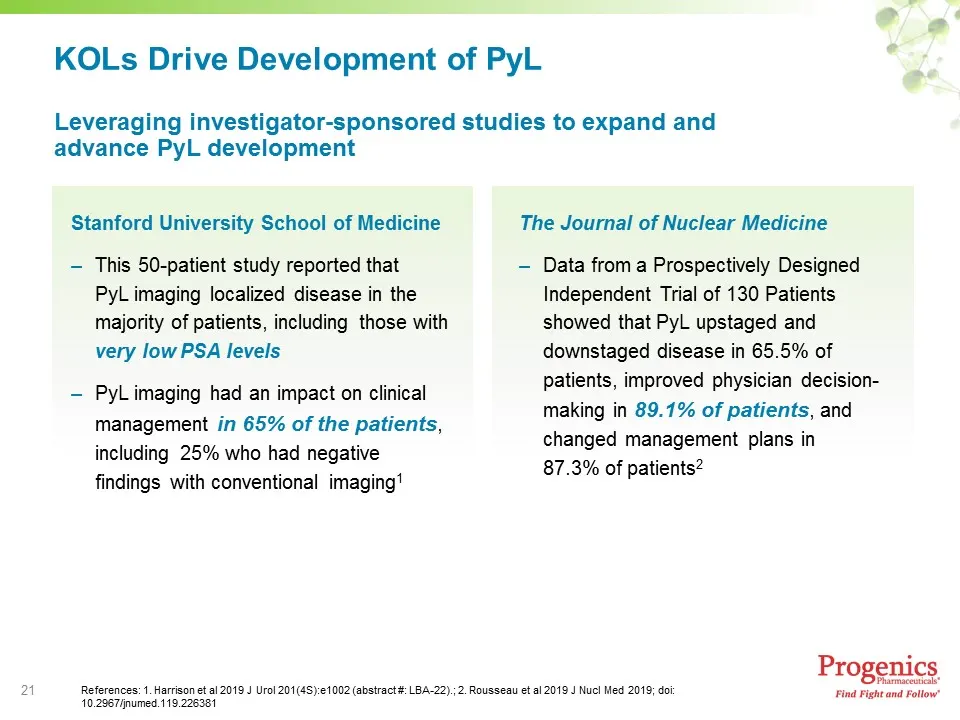
KOLs Drive Development of PyL Leveraging investigator-sponsored studies to expand and advance PyL development Stanford University School of Medicine The Journal of Nuclear Medicine — This 50-patient study reported that — Data from a Prospectively Designed PyL imaging localized disease in the Indepen
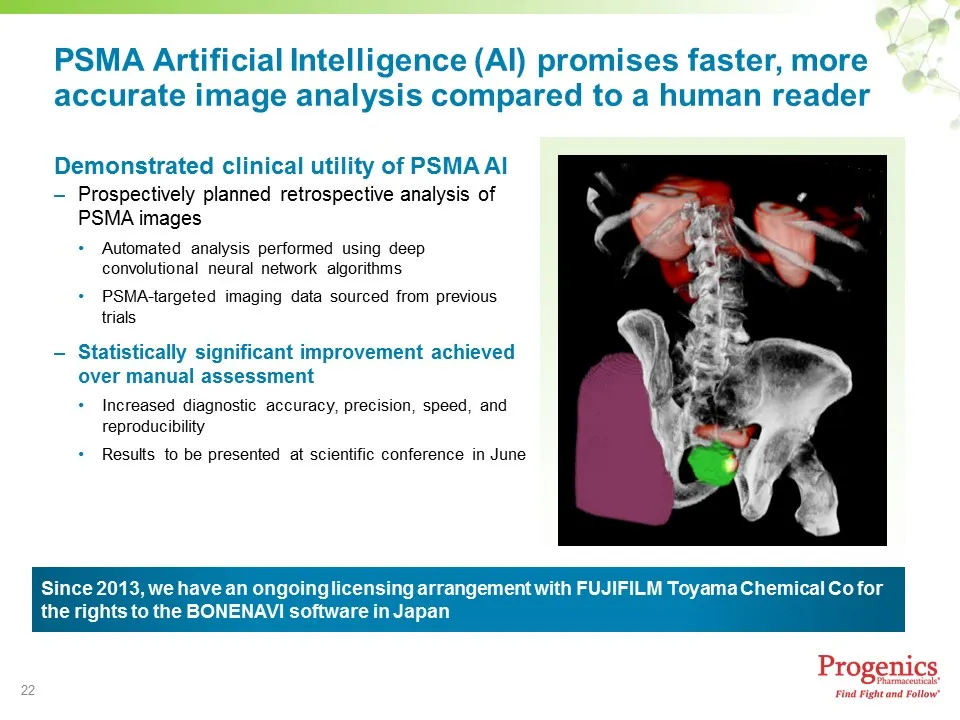
Slide 22: Prospectively planned retrospective analysis of PSMA images
— Prospectively planned retrospective analysis of PSMA images Automated analysis performed using deep convolutional neural network algorithms PSMAtargeted imaging data sourced from previous trials Increased diagnostic accuracy, precision, speed, and reproducibility Results to be presented at scienti
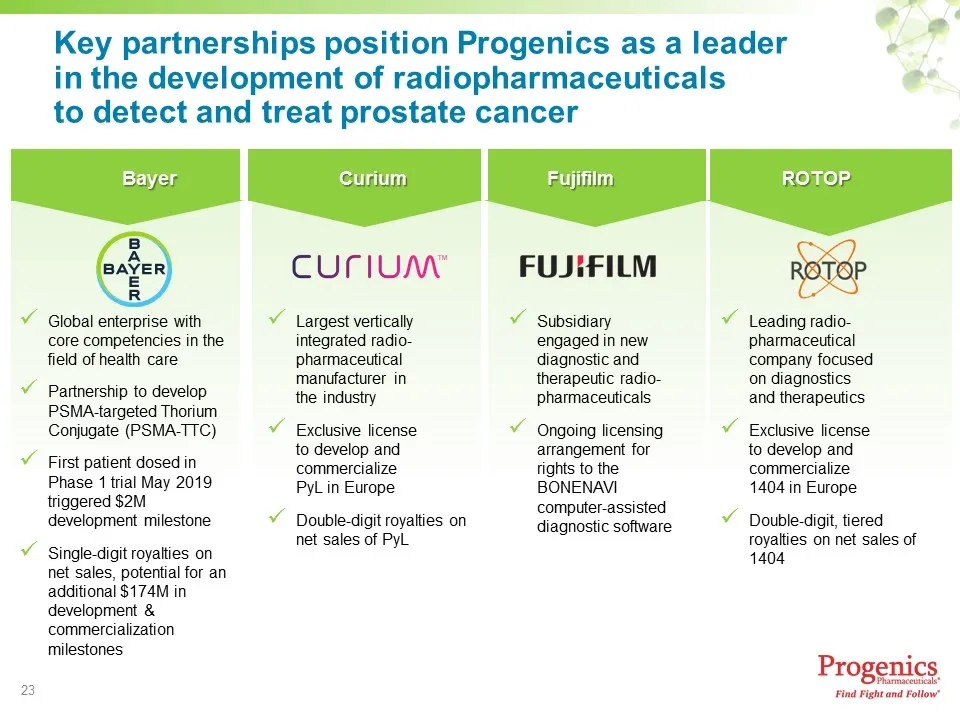
Slide 23: Key partnerships position Progenics as a leader in radiopharmaceuticals
23 Key partnerships position Progenics as a leader in the development of radiopharmaceuticals to detect and treat prostate cancer Bayer, & BAYER CUrIUM R Global enterprise with ¥ Largest vertically core competencies in the integrated radio- field of health care pharmaceutical manufacturer in Partner

Slide 24: Corporate Overview
Corporate Overview * ip, Progenics Find Fight and Follow*
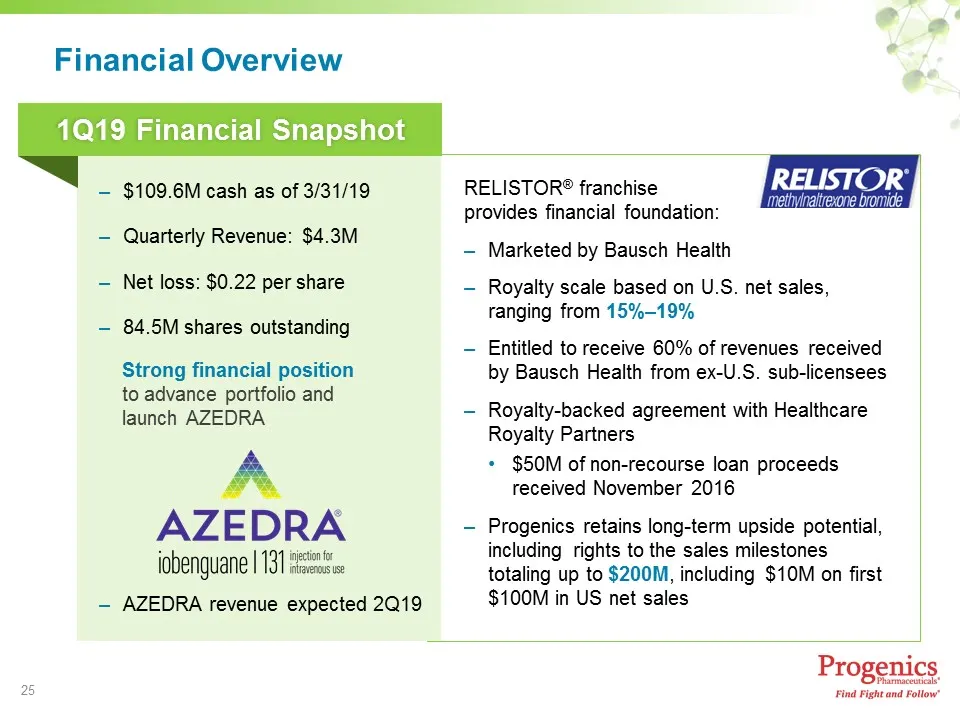
Slide 25: Financial Overview
Financial Overview 1Q19 Financial Snapshot — $109.6M cash as of 3/31/19 — Quarterly Revenue: $4.3M — Net loss: $0.22 per share — 84.5M shares outstanding Strong financial position to advance portfolio and launch AZEDRA A AZEDRA injection for iobenguane | 131 fe — AZEDRA revenue expected 2Q19 RELISTO
Slide 26: Upcoming milestones
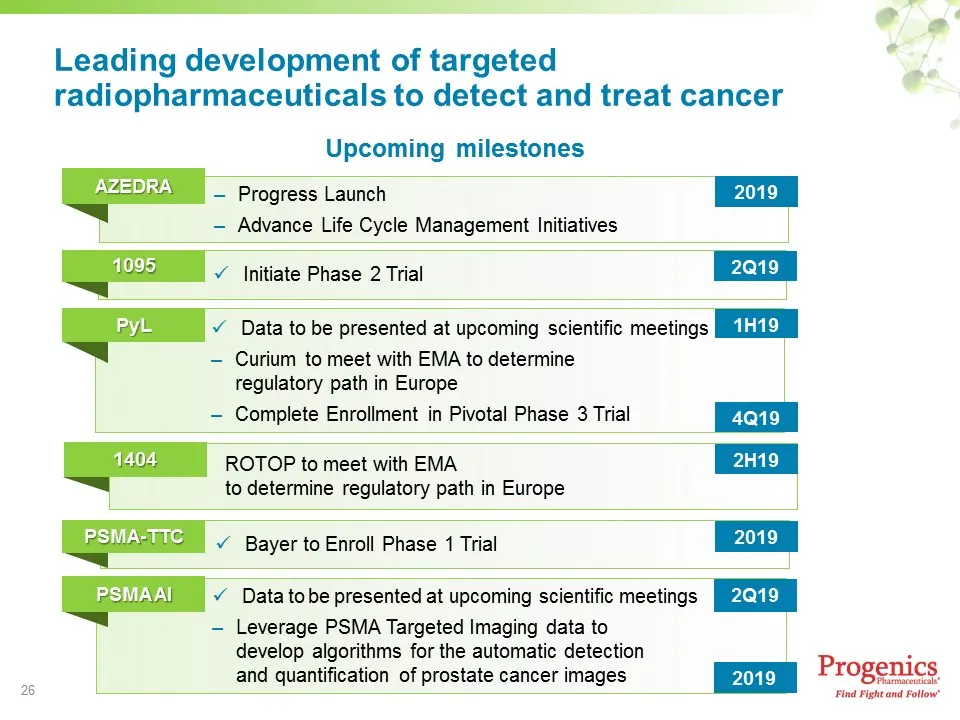
Leading development of targeted radiopharmaceuticals to detect and treat cancer Upcoming milestones 45955 | _ Progress Launch — Advance Life Cycle Management Initiatives ¥ Initiate Phase 2 Trial ¥ Data to be presented at upcoming scientific meetings [ii — Curium to meet with EMA to determine regulat
Slide 27: PGNX is positioned for future success
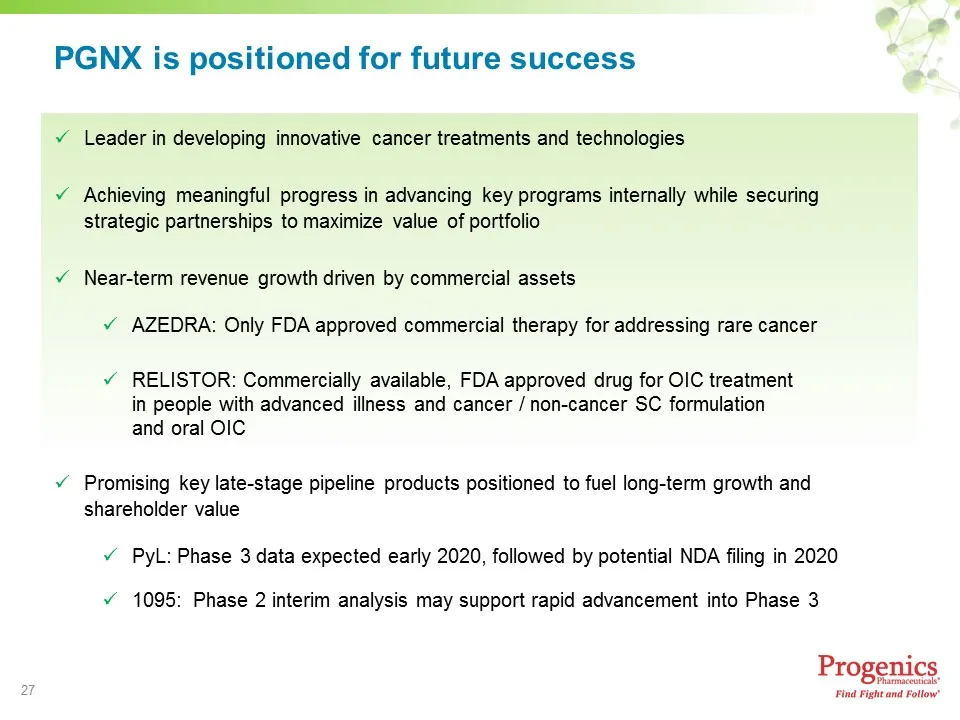
PGNX is positioned for future success v Leader in developing innovative cancer treatments and technologies v Achieving meaningful progress in advancing key programs internally while securing strategic partnerships to maximize value of portfolio v Near-term revenue growth driven by commercial assets

Slide 28: Appendix
Appendix id te Be Progenics Find Fight and Follow*
Slide 29: Board leadership and composition
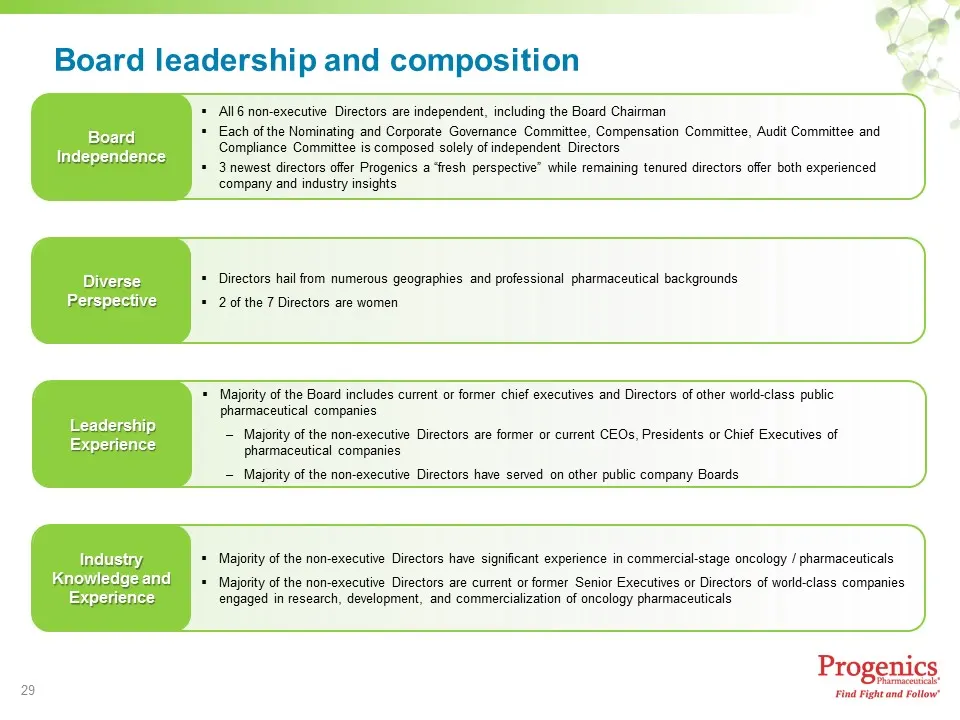
29 Board leadership and composition Board Independence Diverse Perspective Leadership Experience Industry Knowledge and. Experience AIl6 non-executive Directors are independent, including the Board Chairman Each of the Nominating and Corporate Governance Committee, Compensation Committee, Audit Comm
Slide 30: Independent and highly qualified Board
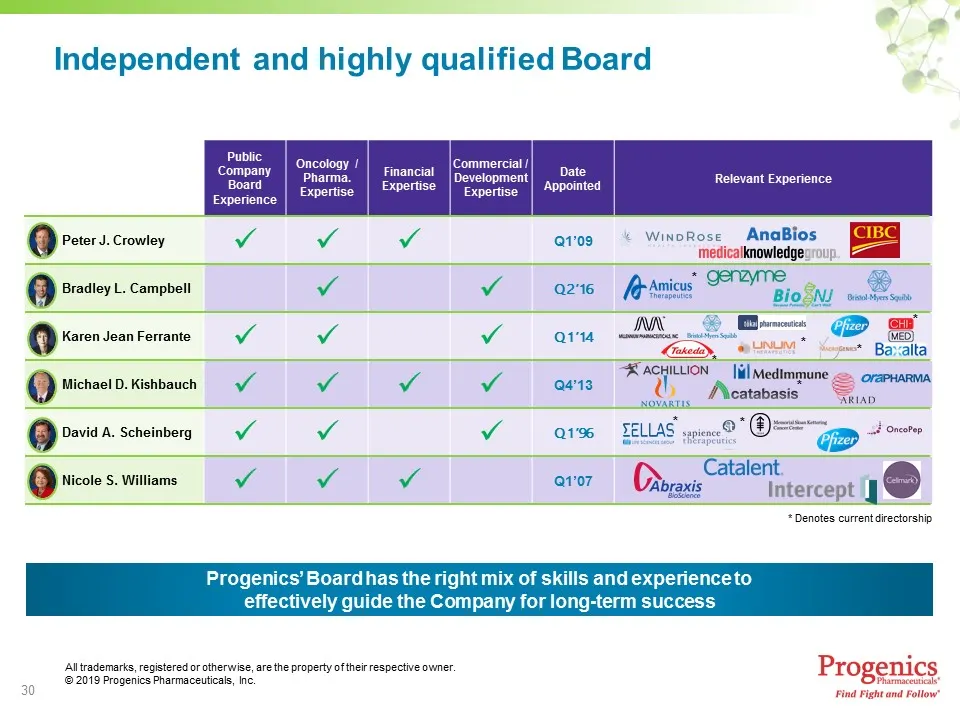
Independent and highly qualified Board f Public c:) David A. Scheinberg re) Nicole S. Williams Oncology 1 ‘Commercial Company Financial f Date Board alate Expertise a fenectintedl Relevant Experience Experience Peter J. Crow! aves & WinoRose AnaBios ss Qe my v v v medicalknowledge® 00 x27 comoan vo
Source: SEC EDGAR · DEFA14A filed Jun 6, 2019
More decks from Progenics Pharmaceuticals Inc
 Merger or Acquisition (May 2020)29 slides · May 12, 2020
 Proxy Contest (October 2019)56 slides · Oct 30, 2019
 Proxy Contest (October 2019)21 slides · Oct 23, 2019
 Proxy Contest (October 2019)43 slides · Oct 22, 2019
 Proxy Contest (October 2019)162 slides · Oct 21, 2019
 Merger or Acquisition (October 2019)16 slides · Oct 2, 2019