Synergy Pharmaceuticals — UBS Global Healthcare Conference 2014
36 slides from Synergy Pharmaceuticals's conference presentation, May 19, 2014
Slide 1: UBS Global Healthcare Conference May 19, 2014
UBS Global Healthcare Conference May 19, 2014
Slide 2: Safe Harbor Statement
2 Safe Harbor Statement This presentation may contain forward-looking statements within the meaning of Section 27A of the Securities Act of 1933 and Section 21E of the Securities Exchange Act of 1934. Such forward-looking statements are characterized by future or conditional verbs such as “may,” “wi
Slide 3: Our Focus: Pioneering Gastrointestinal (GI) Research & Development
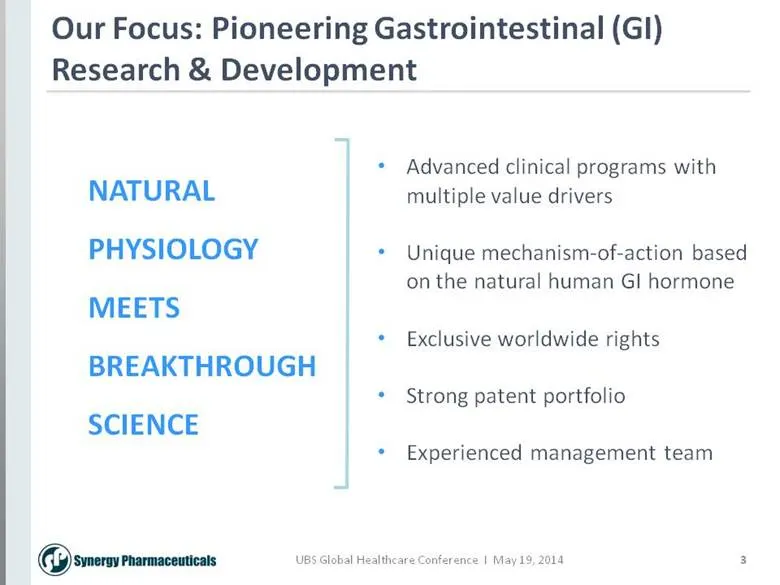
3 Our Focus: Pioneering Gastrointestinal (GI) Research & Development NATURAL PHYSIOLOGY MEETS BREAKTHROUGH SCIENCE Advanced clinical programs with multiple value drivers Unique mechanism-of-action based on the natural human GI hormone Exclusive worldwide rights Strong patent portfolio Experienced ma
Slide 4: Our Approach: Based on the Natural GI Hormone
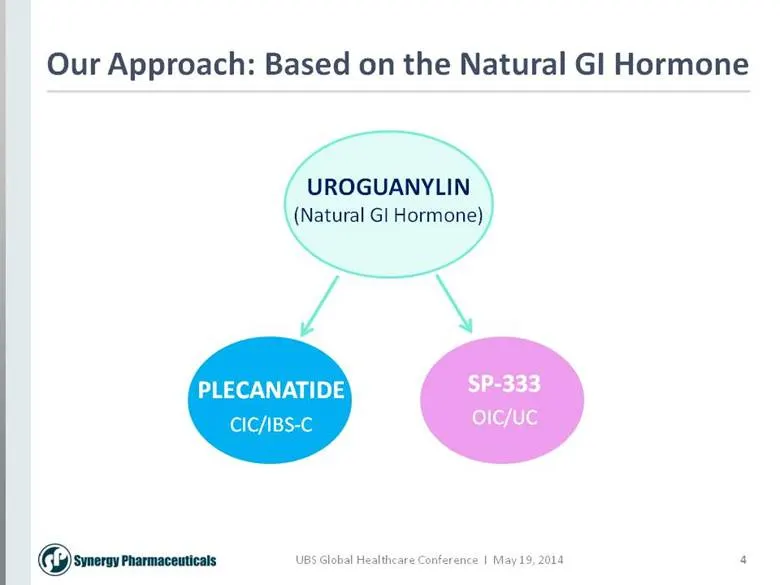
4 Our Approach: Based on the Natural GI Hormone UROGUANYLIN (Natural GI Hormone) PLECANATIDE CIC/IBS-C SP-333 OIC/UC
Slide 5: Our Platform: Proprietary Uroguanylin Analogs
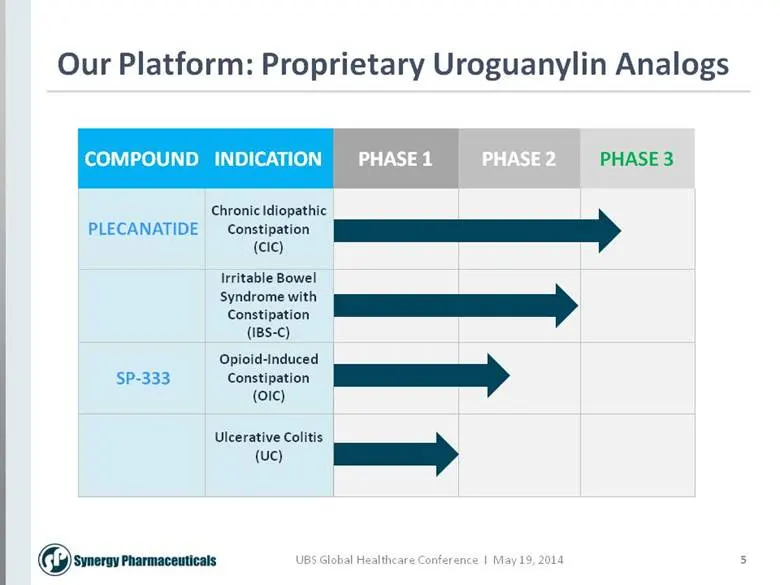
5 Our Platform: Proprietary Uroguanylin Analogs COMPOUND INDICATION PHASE 1 PHASE 2 PHASE 3 PLECANATIDE Chronic Idiopathic Constipation (CIC) Irritable Bowel Syndrome with Constipation (IBS-C) SP-333 Opioid-Induced Constipation (OIC) Ulcerative Colitis (UC)
Slide 6: Uroguanylin: Key Regulator of Normal Physiology
6 Uroguanylin: Key Regulator of Normal Physiology Natural GI hormone produced by humans in the small intestine Natural agonist for the intestinal guanylate cyclase-C (GC-C) receptor Activates GC-C and regulates normal digestive functioning
Slide 7: Uroguanylin: Physiological Mechanism of Action
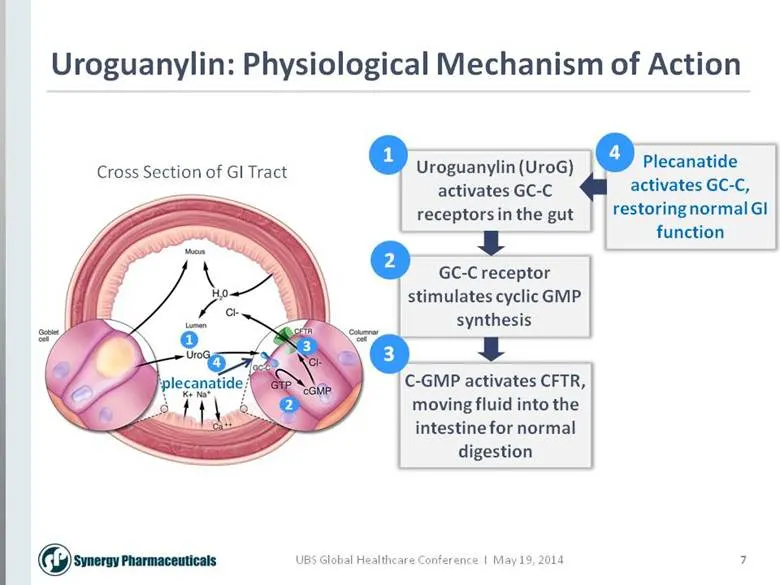
7 Uroguanylin: Physiological Mechanism of Action 1 2 3 plecanatide Uroguanylin (UroG) activates GC-C receptors in the gut GC-C receptor stimulates cyclic GMP synthesis C-GMP activates CFTR, moving fluid into the intestine for normal digestion Plecanatide activates GC-C, restoring normal GI function
Slide 8: Plecanatide: Superior Analog of Uroguanylin
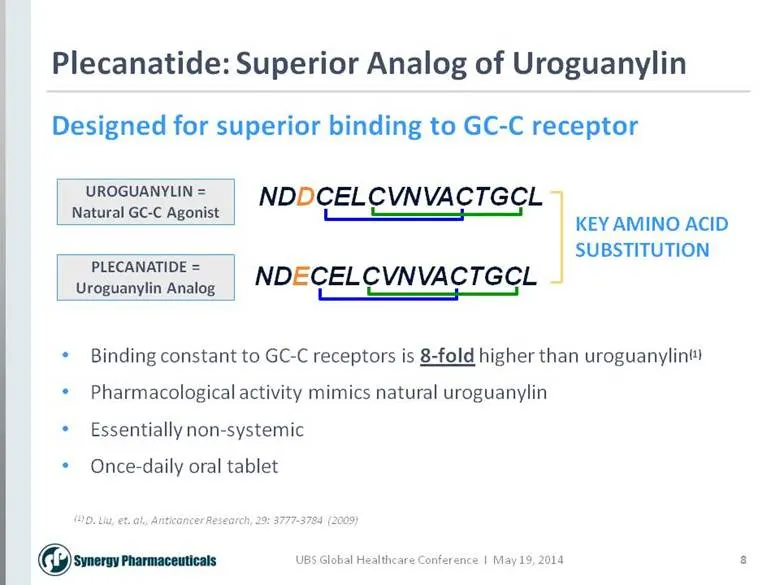
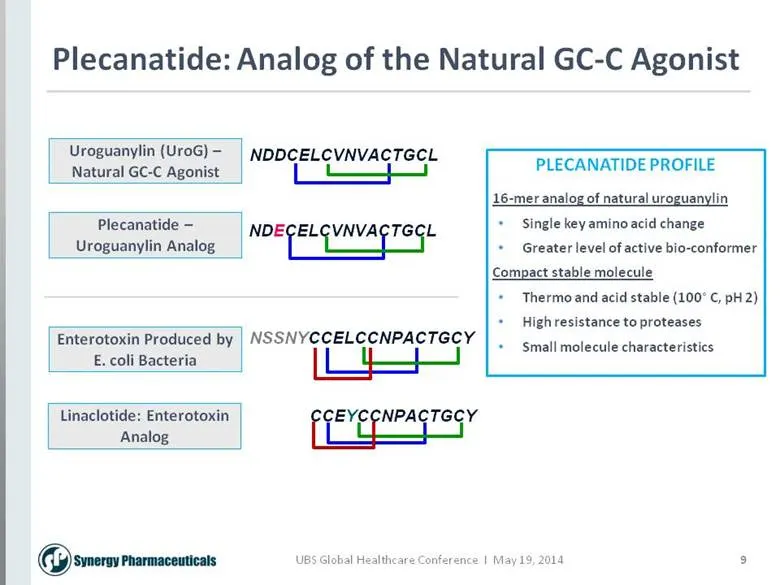
8 Plecanatide: Superior Analog of Uroguanylin NDDCELCVNVACTGCL NDECELCVNVACTGCL KEY AMINO ACID SUBSTITUTION Designed for superior binding to GC-C receptor (1) D. Liu, et. al., Anticancer Research, 29: 3777-3784 (2009) UROGUANYLIN = Natural GC-C Agonist PLECANATIDE = Uroguanylin Analog Binding consta
Slide 9: Plecanatide: Analog of the Natural GC-C Agonist
9 Plecanatide: Analog of the Natural GC-C Agonist Uroguanylin (UroG) – Natural GC-C Agonist Plecanatide – Uroguanylin Analog Enterotoxin Produced by E. coli Bacteria Linaclotide: Enterotoxin Analog PLECANATIDE PROFILE 16-mer analog of natural uroguanylin Single key amino acid change Greater level of
Slide 10: Plecanatide Program: CIC & IBS-C
Plecanatide Program Chronic Idiopathic Constipation (CIC) & Irritable Bowel Syndrome with Constipation (IBS-C)
Slide 11: Plecanatide Phase 2b/3 CIC Trial Study Design & Results Summary
Plecanatide Phase 2b/3 CIC Trial Study Design & Results Summary
Slide 12: Phase 2b/3 CIC Trial: Study Design
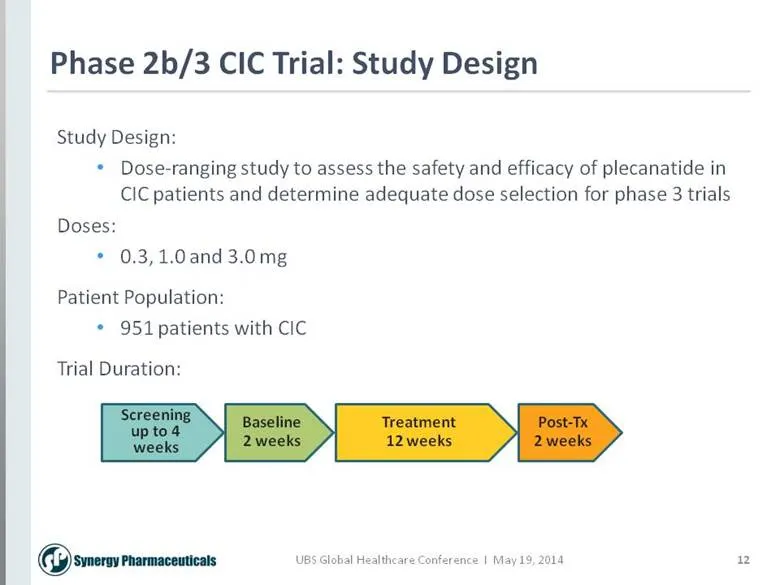
12 Phase 2b/3 CIC Trial: Study Design Study Design: Dose-ranging study to assess the safety and efficacy of plecanatide in CIC patients and determine adequate dose selection for phase 3 trials Doses: 0.3, 1.0 and 3.0 mg Patient Population: 951 patients with CIC Trial Duration: Screening up to 4 week
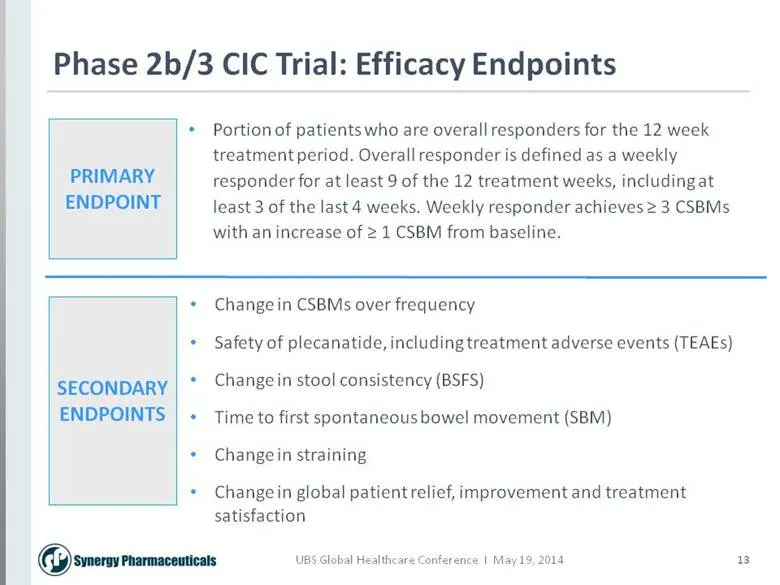
Slide 13: Phase 2b/3 CIC Trial: Efficacy Endpoints
13 Phase 2b/3 CIC Trial: Efficacy Endpoints Portion of patients who are overall responders for the 12 week treatment period. Overall responder is defined as a weekly responder for at least 9 of the 12 treatment weeks, including at least 3 of the last 4 weeks. Weekly responder achieves > 3 CSBMs with
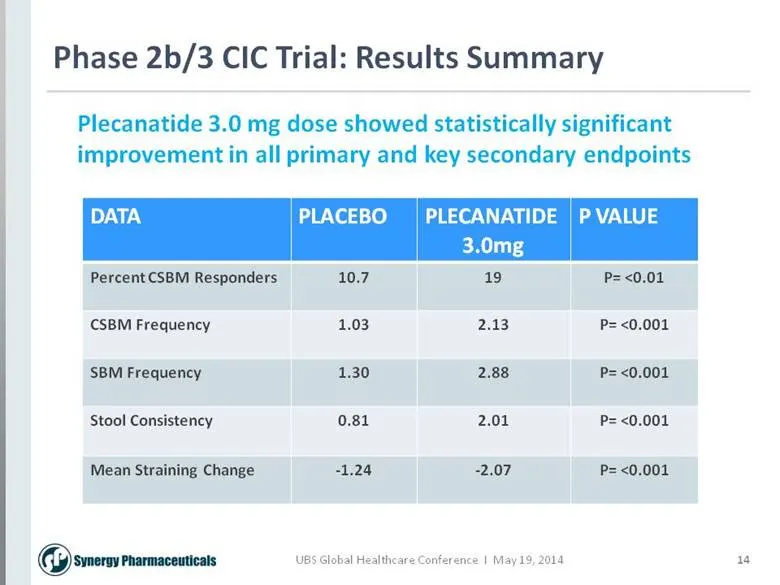
Slide 14: Phase 2b/3 CIC Trial: Results Summary
14 DATA PLACEBO PLECANATIDE 3.0mg P VALUE Percent CSBM Responders 10.7 19 P= <0.01 CSBM Frequency 1.03 2.13 P= <0.001 SBM Frequency 1.30 2.88 P= <0.001 Stool Consistency 0.81 2.01 P= <0.001 Mean Straining Change -1.24 -2.07 P= <0.001 Phase 2b/3 CIC Trial: Results Summary Plecanatide 3.0 mg dose show
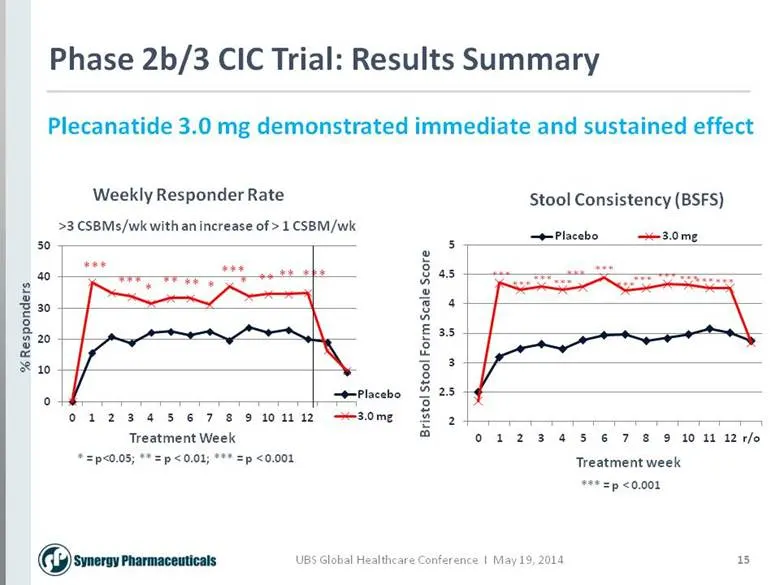
Slide 15: Phase 2b/3 CIC Trial: Results Summary
15 Phase 2b/3 CIC Trial: Results Summary % Responders * = p<0.05; ** = p < 0.01; *** = p < 0.001 Treatment Week *** = p < 0.001 Treatment week Bristol Stool Form Scale Score Stool Consistency (BSFS) Weekly Responder Rate >3 CSBMs/wk with an increase of > 1 CSBM/wk Plecanatide 3.0 mg demonstrated imm
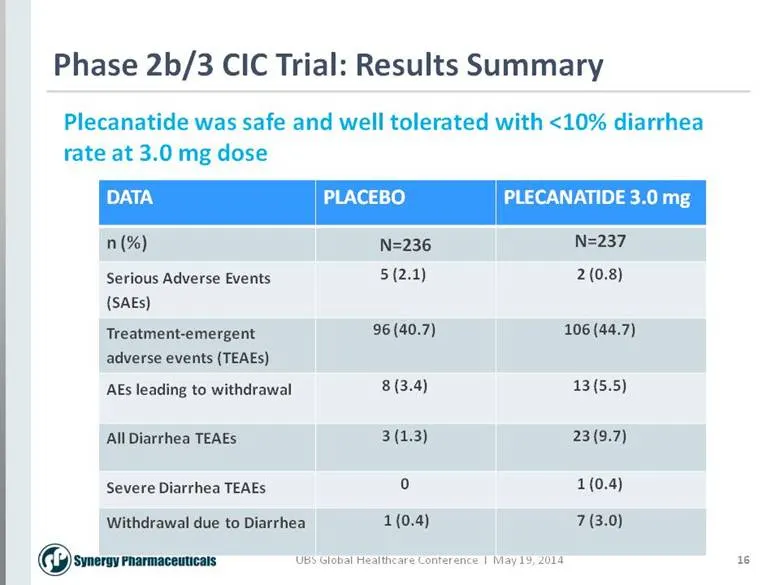
Slide 16: Phase 2b/3 CIC Trial: Results Summary (Safety)
16 DATA PLACEBO PLECANATIDE 3.0 mg n (%) N=236 N=237 Serious Adverse Events (SAEs) 5 (2.1) 2 (0.8) Treatment-emergent adverse events (TEAEs) 96 (40.7) 106 (44.7) AEs leading to withdrawal 8 (3.4) 13 (5.5) All Diarrhea TEAEs 3 (1.3) 23 (9.7) Severe Diarrhea TEAEs 0 1 (0.4) Withdrawal due to Diarrhea
Slide 17: Phase 2b/3 CIC Data Validate Plecanatide's Unique Profile
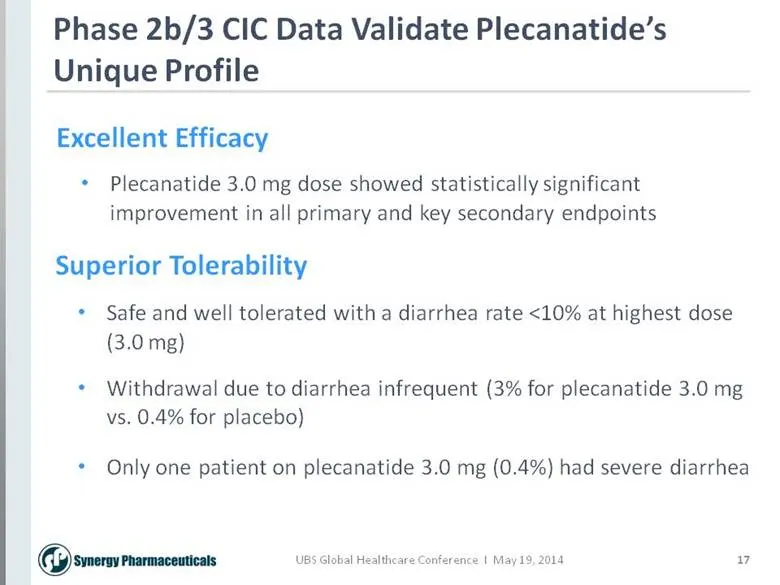
17 Phase 2b/3 CIC Data Validate Plecanatide’s Unique Profile Safe and well tolerated with a diarrhea rate <10% at highest dose (3.0 mg) Withdrawal due to diarrhea infrequent (3% for plecanatide 3.0 mg vs. 0.4% for placebo) Only one patient on plecanatide 3.0 mg (0.4%) had severe diarrhea Superior To
Slide 18: Plecanatide Phase 3 CIC Trials Study Design & Endpoints
Plecanatide Phase 3 CIC Trials Study Design & Endpoints
Slide 19: Phase 3 CIC Trials: Study Design
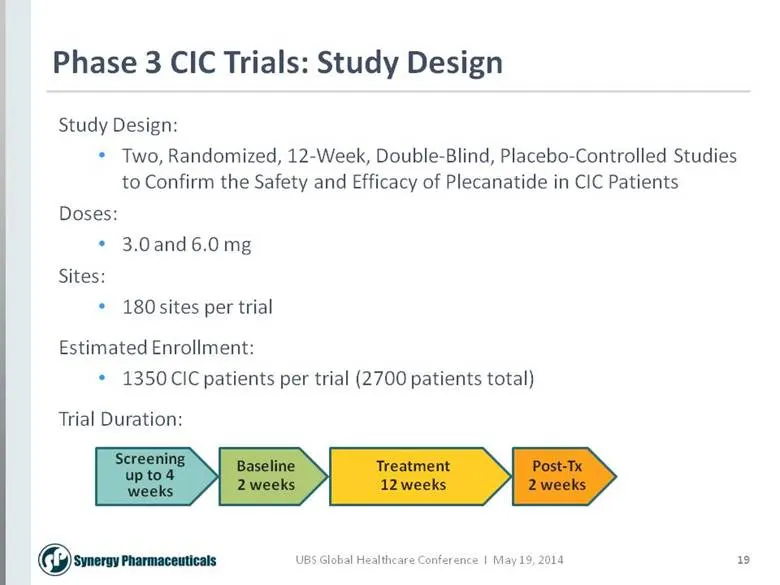
19 Phase 3 CIC Trials: Study Design Study Design: Two, Randomized, 12-Week, Double-Blind, Placebo-Controlled Studies to Confirm the Safety and Efficacy of Plecanatide in CIC Patients Doses: 3.0 and 6.0 mg Sites: 180 sites per trial Estimated Enrollment: 1350 CIC patients per trial (2700 patients tot
Slide 20: Phase 3 CIC Trials: Efficacy Endpoints
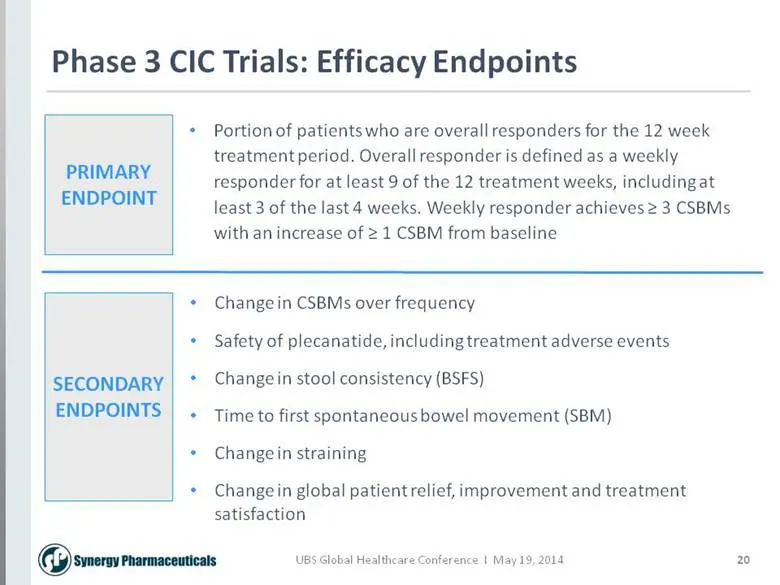
20 Phase 3 CIC Trials: Efficacy Endpoints PRIMARY ENDPOINT SECONDARY ENDPOINTS Portion of patients who are overall responders for the 12 week treatment period. Overall responder is defined as a weekly responder for at least 9 of the 12 treatment weeks, including at least 3 of the last 4 weeks. Weekl
Slide 21: Phase 3 CIC Program: Key Events & Timelines
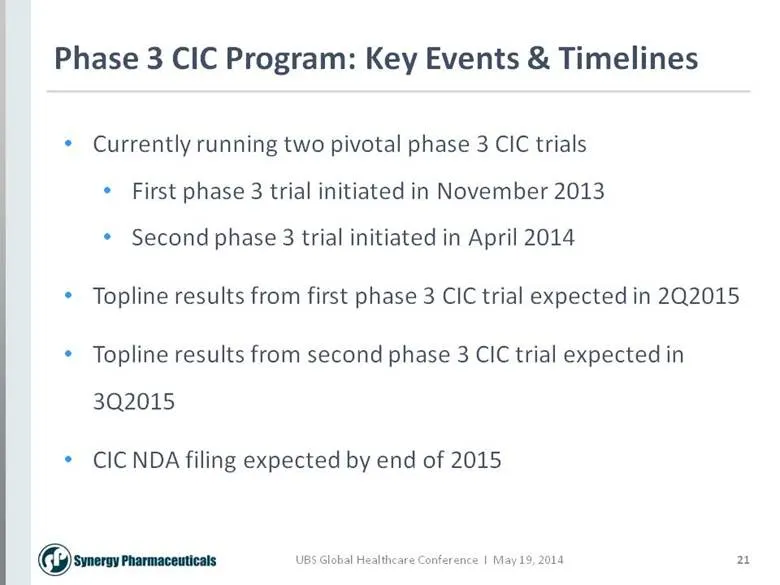
21 Phase 3 CIC Program: Key Events & Timelines Currently running two pivotal phase 3 CIC trials First phase 3 trial initiated in November 2013 Second phase 3 trial initiated in April 2014 Topline results from first phase 3 CIC trial expected in 2Q2015 Topline results from second phase 3 CIC trial ex
Slide 22: Plecanatide Phase 2b IBS-C Trial Study Design & Preliminary Top-line Data
Plecanatide Phase 2b IBS-C Trial Study Design & Preliminary Top-line Data April 30, 2014: Announced preliminary top-line results
Slide 23: Phase 2b IBS-C Trial: Study Design
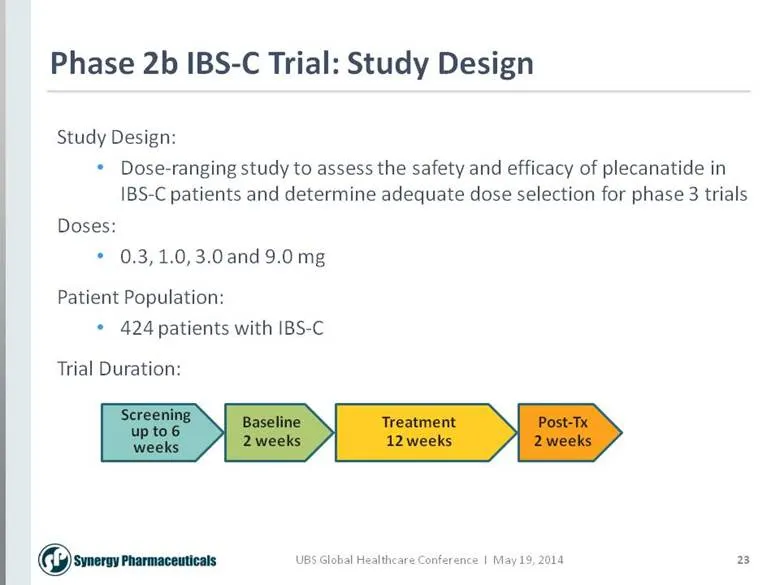
23 Phase 2b IBS-C Trial: Study Design Study Design: Dose-ranging study to assess the safety and efficacy of plecanatide in IBS-C patients and determine adequate dose selection for phase 3 trials Doses: 0.3, 1.0, 3.0 and 9.0 mg Patient Population: 424 patients with IBS-C Trial Duration: Screening up
Slide 24: Phase 2b IBS-C Trial: Efficacy Endpoints
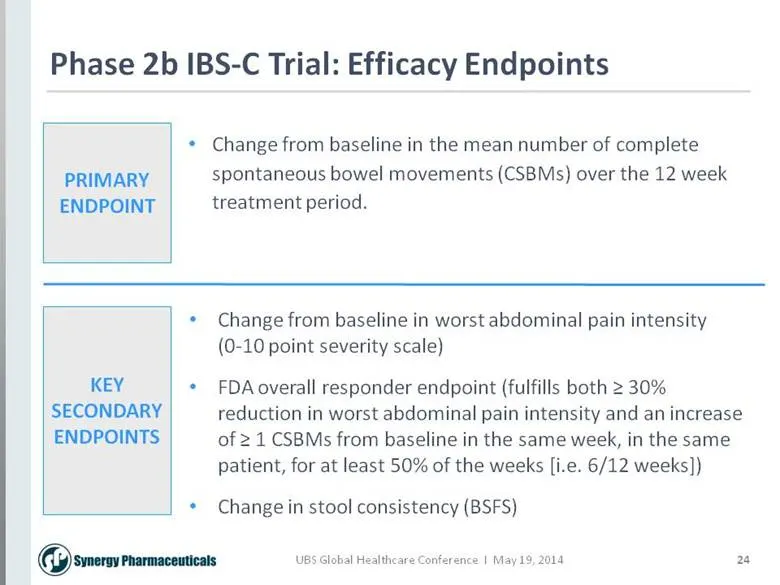
24 Phase 2b IBS-C Trial: Efficacy Endpoints PRIMARY ENDPOINT KEY SECONDARY ENDPOINTS Change from baseline in the mean number of complete spontaneous bowel movements (CSBMs) over the 12 week treatment period. Change from baseline in worst abdominal pain intensity (0-10 point severity scale) FDA overa
Slide 25: Phase 2b IBS-C Trial: Preliminary Top-line Data
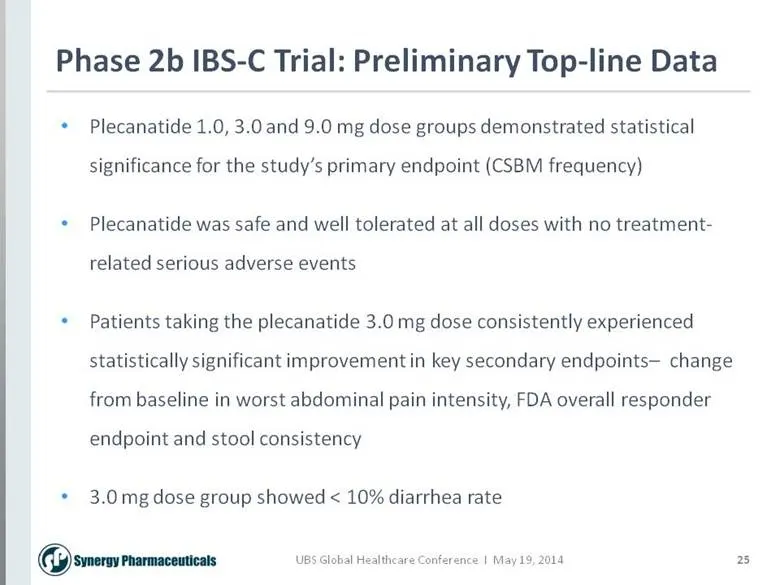
25 Phase 2b IBS-C Trial: Preliminary Top-line Data Plecanatide 1.0, 3.0 and 9.0 mg dose groups demonstrated statistical significance for the study’s primary endpoint (CSBM frequency) Plecanatide was safe and well tolerated at all doses with no treatment-related serious adverse events Patients taking
Slide 26: Phase 2b IBS-C Trial: Preliminary Top-line Data
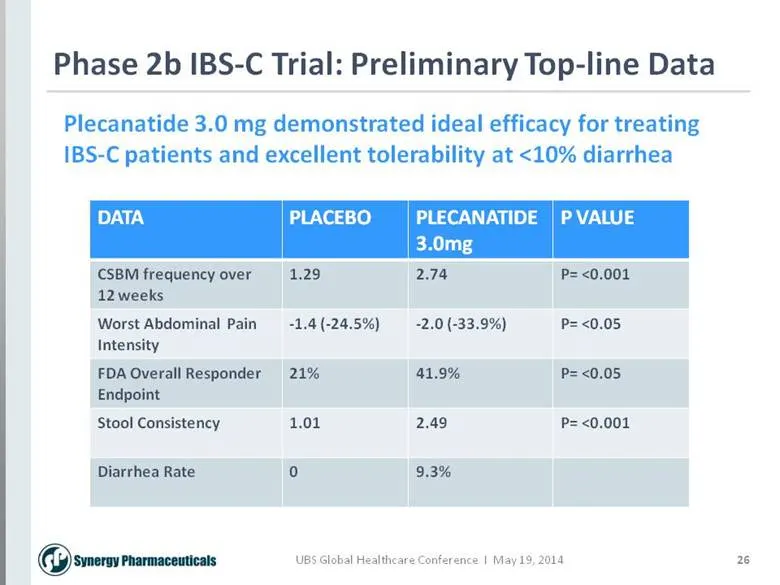
26 DATA PLACEBO PLECANATIDE 3.0mg P VALUE CSBM frequency over 12 weeks 1.29 2.74 P= <0.001 Worst Abdominal Pain Intensity -1.4 (-24.5%) -2.0 (-33.9%) P= <0.05 FDA Overall Responder Endpoint 21% 41.9% P= <0.05 Stool Consistency 1.01 2.49 P= <0.001 Diarrhea Rate 0 9.3% Phase 2b IBS-C Trial: Preliminar
Slide 27: Next Steps for Plecanatide IBS-C Program
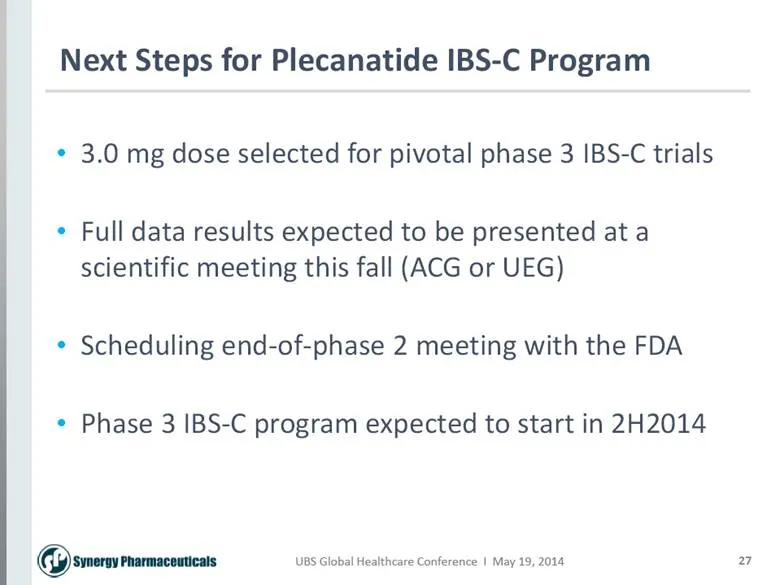
27 Next Steps for Plecanatide IBS-C Program 3.0 mg dose selected for pivotal phase 3 IBS-C trials Full data results expected to be presented at a scientific meeting this fall (ACG or UEG) Scheduling end-of-phase 2 meeting with the FDA Phase 3 IBS-C programs expected to start in 2H2014
Slide 28: SP-333 Program: OIC & Ulcerative Colitis
SP-333 Program Opioid-induced Constipation (OIC) & Ulcerative Colitis (UC)
Slide 29: SP-333: Superior Stability Expands the Potential
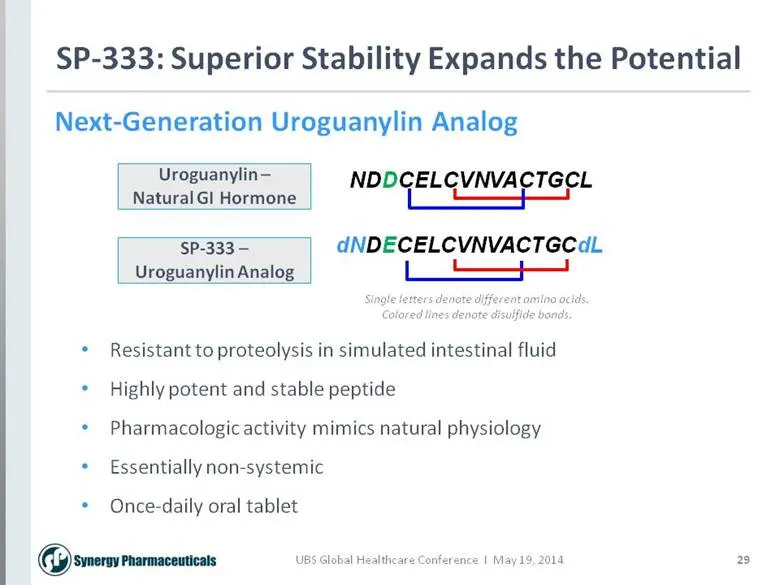
29 SP-333: Superior Stability Expands the Potential dNDECELCVNVACTGCdL NDDCELCVNVACTGCL Next-Generation Uroguanylin Analog Resistant to proteolysis in simulated intestinal fluid Highly potent and stable peptide Pharmacologic activity mimics natural physiology Essentially non-systemic Once-daily oral
Slide 30: Activity of Uroguanylin, Plecanatide and SP-333 is pH-dependent
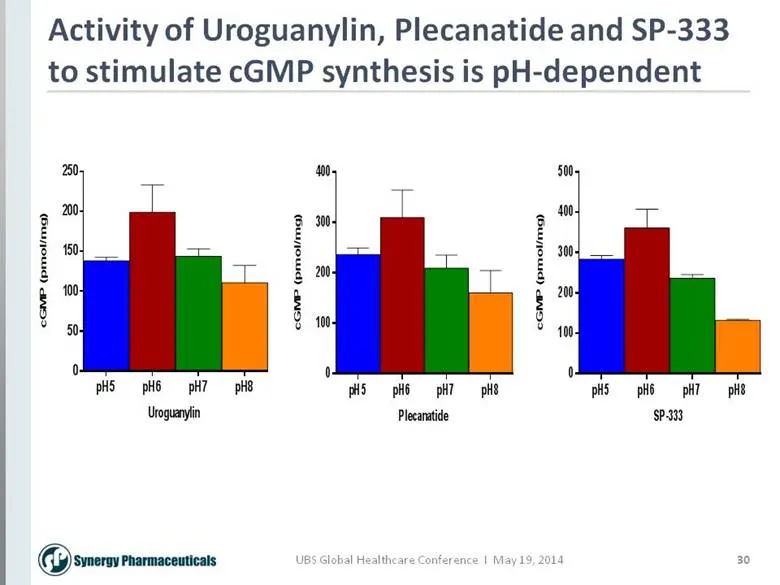
30 Activity of Uroguanylin, Plecanatide and SP-333 to stimulate cGMP synthesis is pH-dependent Plecanatide cGMP (pmol/mg) pH5 pH6 pH7 pH8 0 100 200 300 400 Uroguanylin cGMP (pmol/mg) pH5 pH6 pH7 pH8 0 50 100 150 200 250 SP-333 cGMP (pmol/mg) pH5 pH6 pH7 pH8 0 100 200 300 400 500
Slide 31: SP-333: Unique Potential for OIC Market
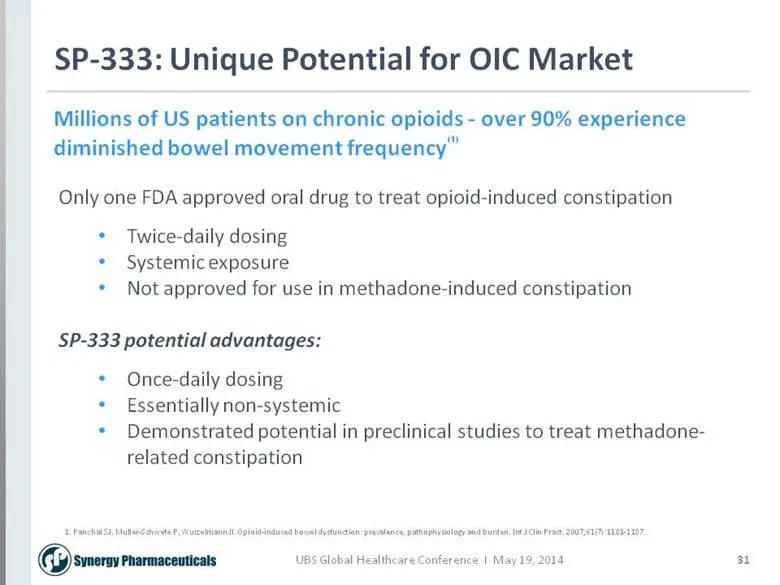
31 SP-333: Unique Potential for OIC Market (1) Only one FDA approved oral drug to treat opioid-induced constipation Twice-daily dosing Systemic exposure Not approved for use in methadone-induced constipation SP-333 potential advantages: Once-daily dosing Essentially non-systemic Demonstrated potenti
Slide 32: SP-333 for OIC and UC: Development Overview
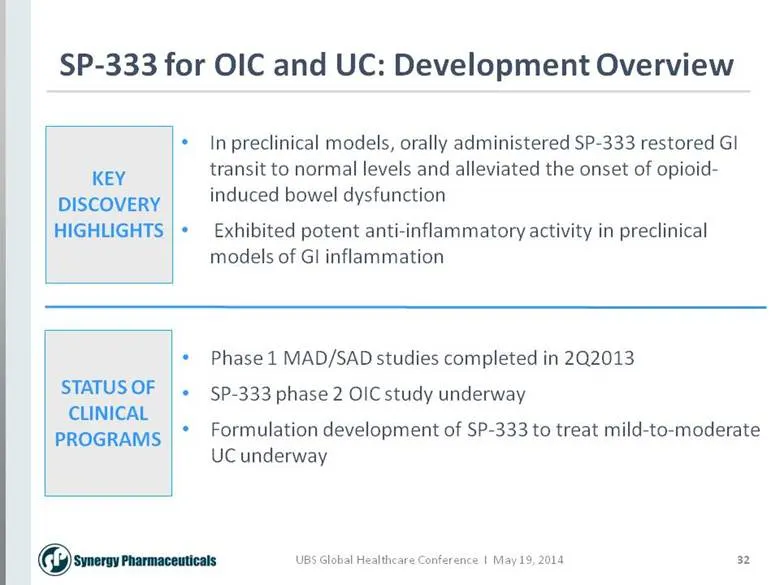
32 SP-333 for OIC and UC: Development Overview KEY DISCOVERY HIGHLIGHTS STATUS OF CLINICAL PROGRAMS In preclinical models, orally administered SP-333 restored GI transit to normal levels and alleviated the onset of opioid-induced bowel dysfunction Exhibited potent anti-inflammatory activity in precl
Slide 33: SP-333 Phase 2 OIC Trial
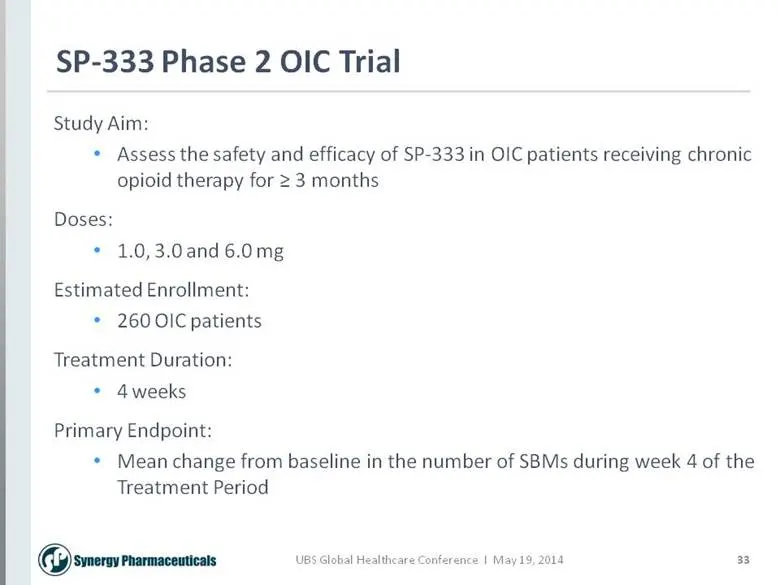
33 SP-333 Phase 2 OIC Trial Study Aim: Assess the safety and efficacy of SP-333 in OIC patients receiving chronic opioid therapy for > 3 months Doses: 1.0, 3.0 and 6.0 mg Estimated Enrollment: 260 OIC patients Treatment Duration: 4 weeks Primary Endpoint: Mean change from baseline in the number of S
Slide 34: Corporate Summary
@ Synergy Pharmaceuticals Corporate Summary
Slide 35: Anticipated Milestones
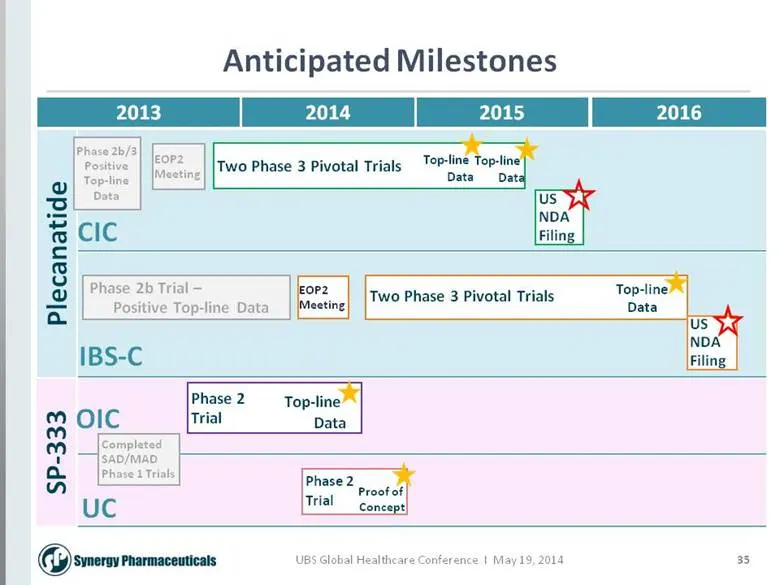
35 Anticipated Milestones 2013 Plecanatide SP-333 CIC IBS-C OIC UC EOP2 Meeting Phase 2b/3 Positive Top-line Data 2014 2015 2016 Two Phase 3 Pivotal Trials Top-line Data US NDA Filing Phase 2b Trial – Positive Top-line Data Top-line Data US NDA Filing Phase 2 Trial Top-line Data Phase 2 Trial Comple
Slide 36: The Synergy Opportunity
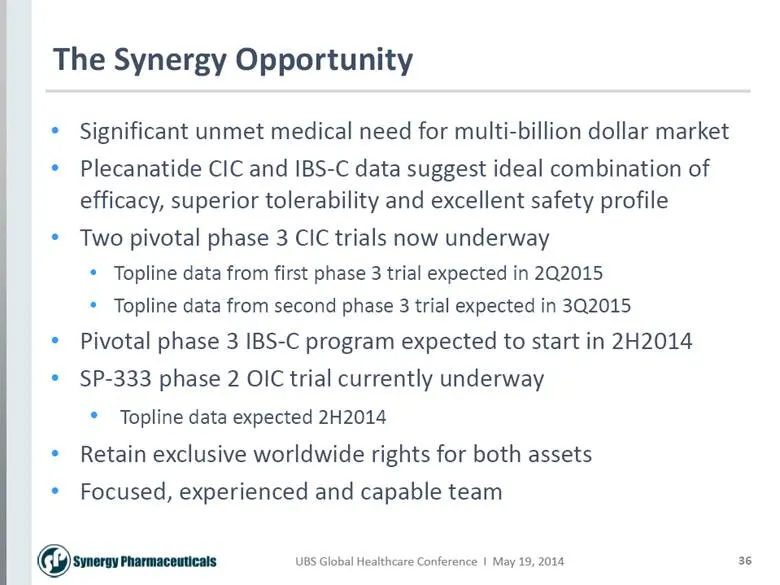
36 The Synergy Opportunity Significant unmet medical need for multi-billion dollar market Plecanatide CIC and IBS-C data suggest ideal combination of efficacy, superior tolerability and excellent safety profile Two pivotal phase 3 CIC trials now underway Topline data from first phase 3 trial expecte
Source: SEC EDGAR · 8-K filed May 19, 2014
More decks from Synergy Pharmaceuticals Inc
 Oppenheimer 28th Annual Healthcare Conference 201827 slides · Mar 20, 2018
 Leerink Partners Global Healthcare Conference 20188 slides · Feb 15, 2018
 Corporate Update (May 2017)27 slides · May 3, 2017
 Oppenheimer Healthcare Conference 201724 slides · Mar 21, 2017
 Leerink Global Healthcare Conference 201716 slides · Feb 15, 2017
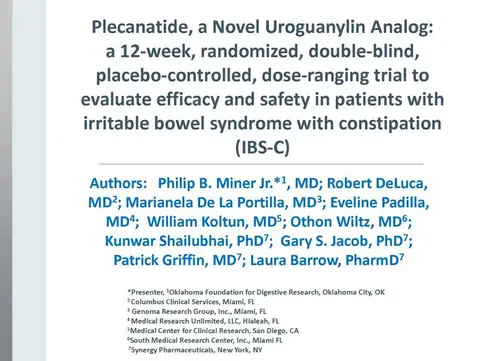 Technical Presentation (October 2014)15 slides · Oct 20, 2014