CalciMedica, Inc. · NASDAQ:CALC
CalciMedica — American College of Gastroenterology (ACG) 2024 Annual Scientific Meeting
13 slides from CalciMedica's conference presentation, October 2024
Slide 1: Randomized, Double-Blind Dose Ranging Study of Auxora in Acute Pancreatitis (CARPO)
A Randomized, Double-Blind, Placebo Controlled Dose Ranging Study of Auxora in Patients with Acute Pancreatitis (AP) and Accompanying Systemic Inflammatory Response Syndrome (SIRS) - CARPO (NCT0468106) Prof. Robert Sutton BA (Hons), MB, BS, DPhil, FRCS1, Pramod K. Garg MD, DM2, Bechien Wu MD, MPH3,
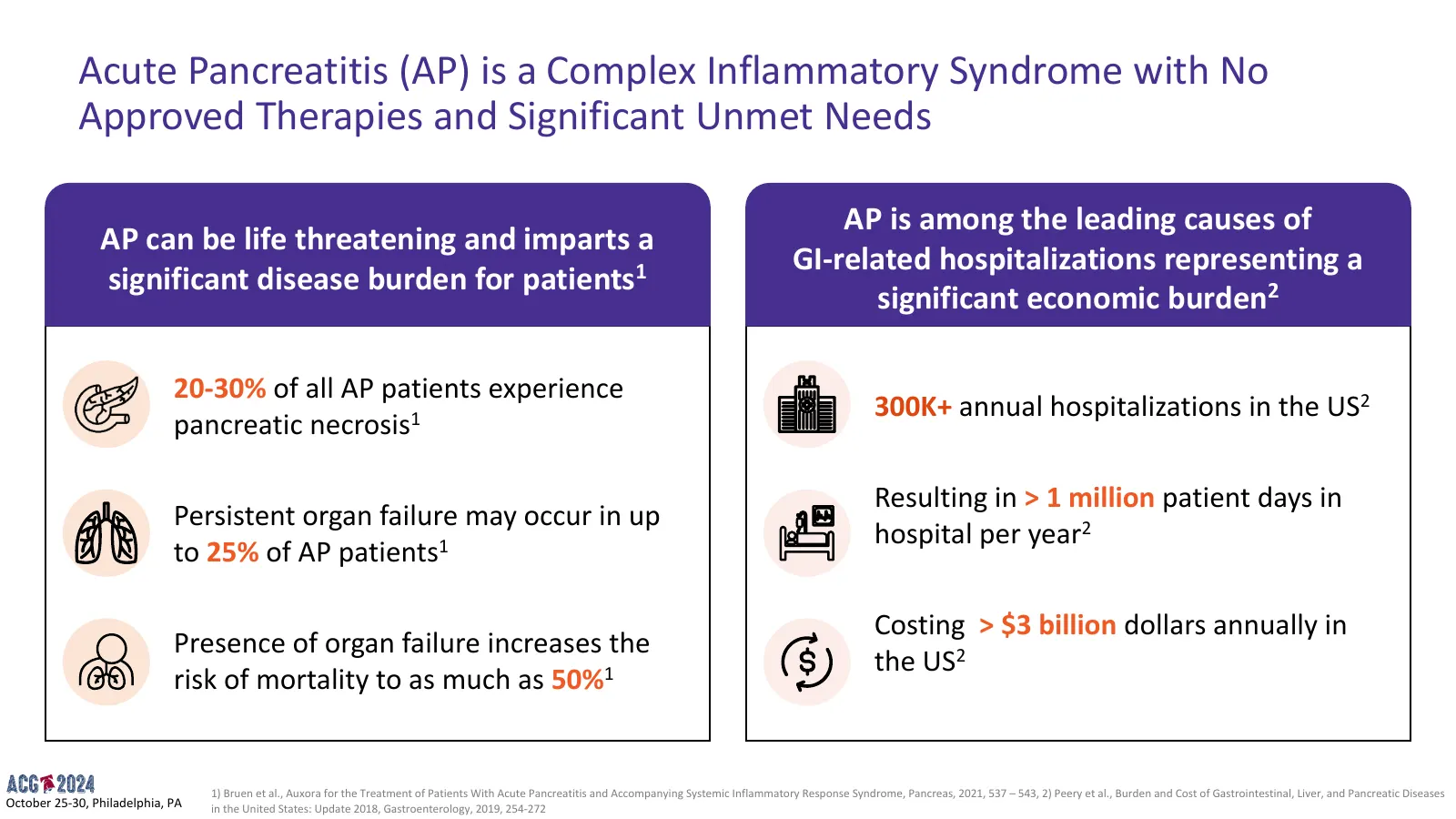
Slide 2: Acute Pancreatitis is a Complex Inflammatory Syndrome with No Approved Therapies
Acute Pancreatitis (AP) is a Complex Inflammatory Syndrome with No Approved Therapies and Significant Unmet Needs AP is among the leading causes of AP can be life threatening and imparts a GI-related hospitalizations representing a significant disease burden for patients1 significant economic burden
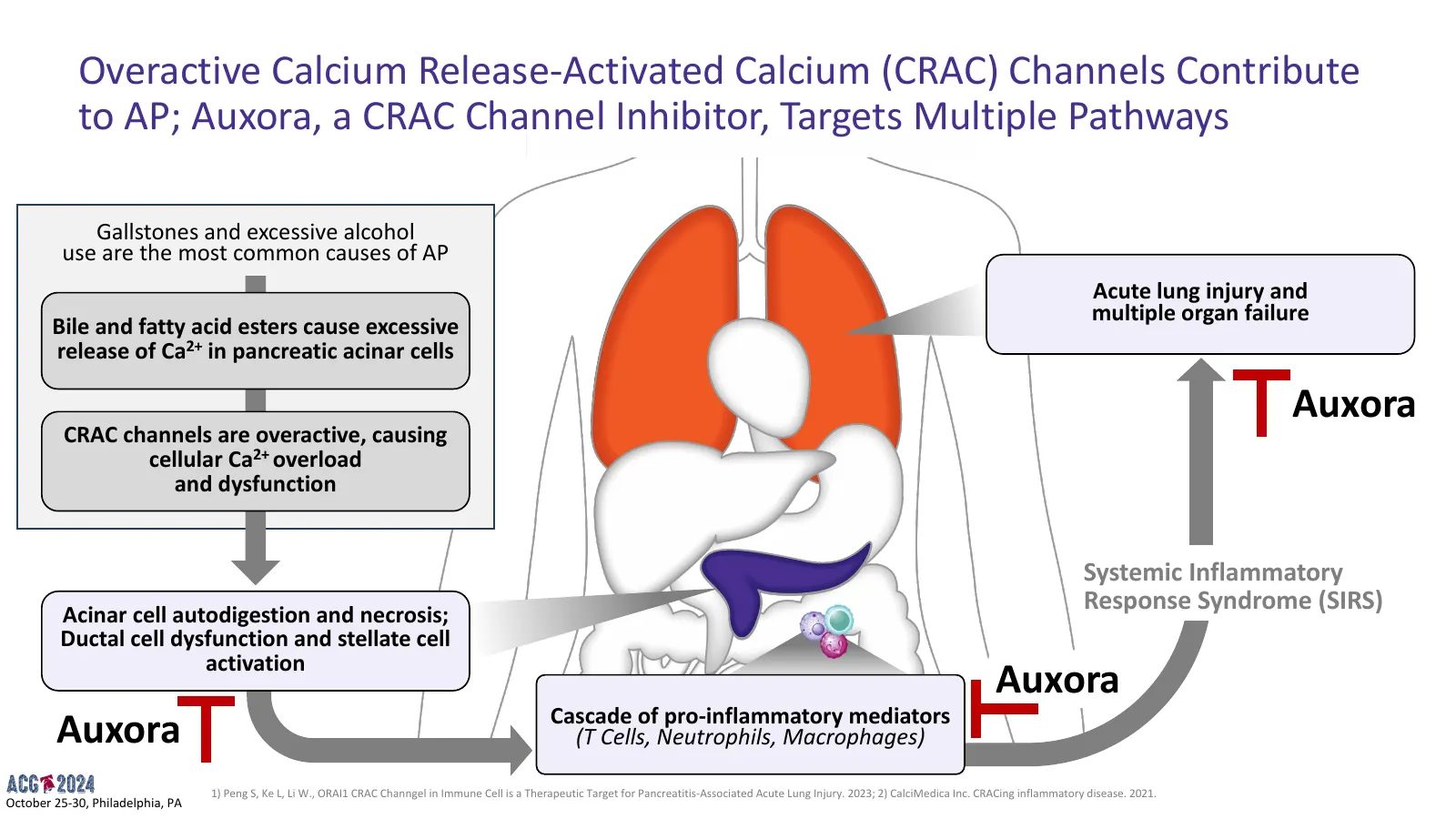
Slide 3: Overactive CRAC Channels Contribute to AP; Auxora Targets Multiple Pathways
Overactive Calcium Release-Activated Calcium (CRAC) Channels Contribute to AP; Auxora, a CRAC Channel Inhibitor, Targets Multiple Pathways Gallstones and excessive alcohol use are the most common causes of AP Acute lung injury and multiple organ failure Bile and fatty acid esters cause excessive rel
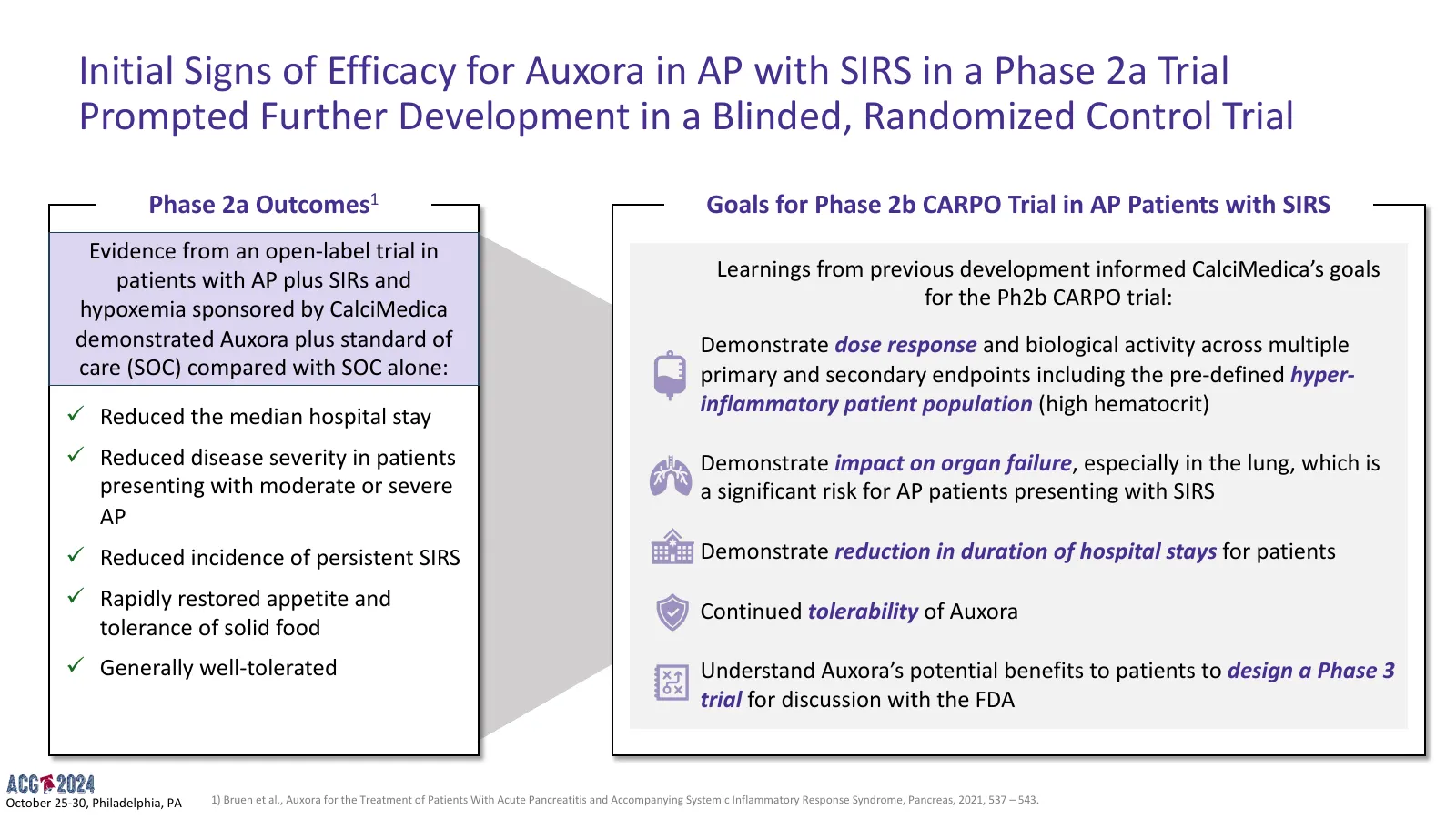
Slide 4: Initial Signs of Efficacy for Auxora in AP with SIRS in a Phase 2a Trial
Initial Signs of Efficacy for Auxora in AP with SIRS in a Phase 2a Trial Prompted Further Development in a Blinded, Randomized Control Trial Phase 2a Outcomes1 Goals for Phase 2b CARPO Trial in AP Patients with SIRS Evidence from an open-label trial in patients with AP plus SIRs and Learnings from p
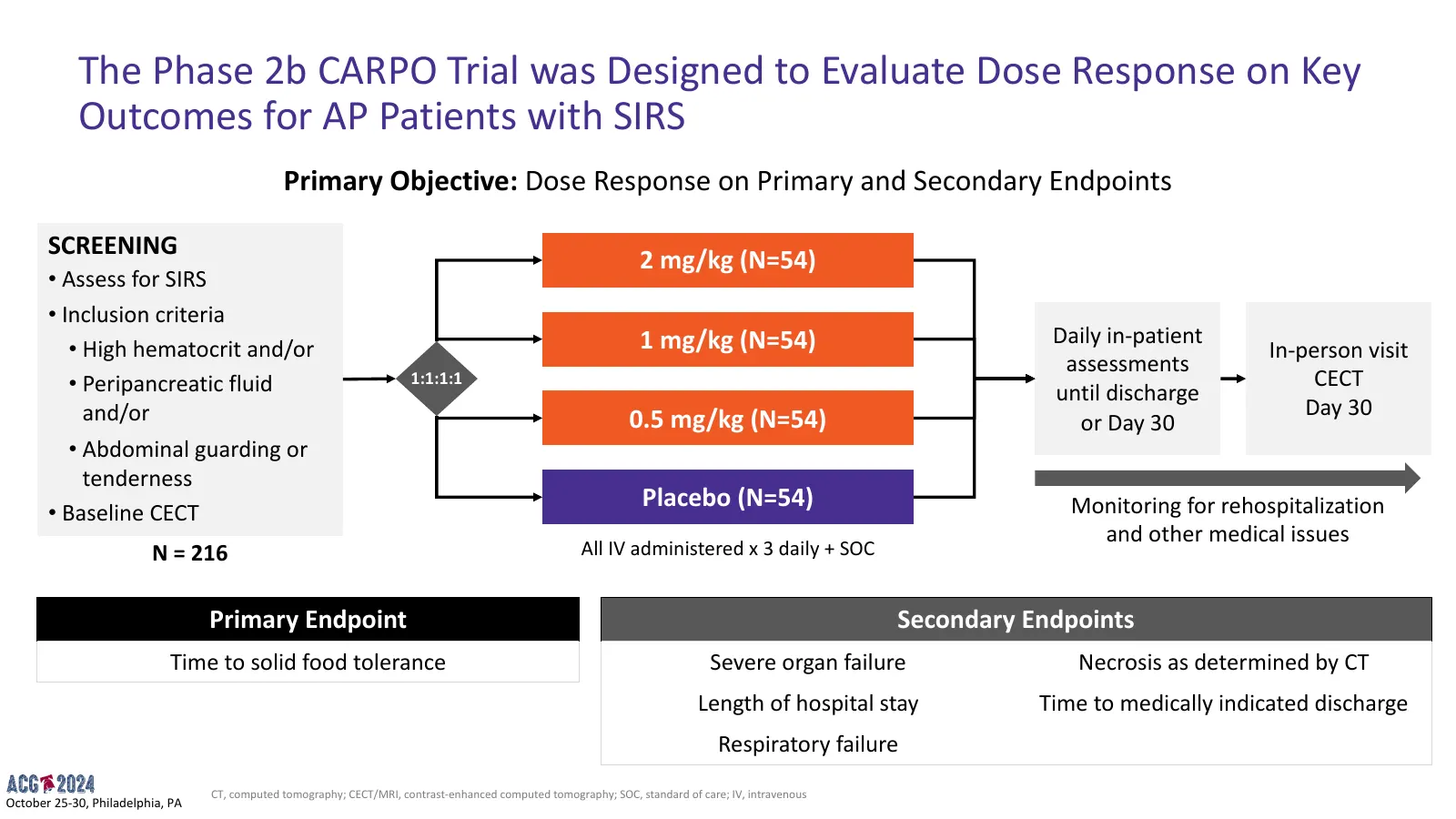
Slide 5: Phase 2b CARPO Trial Designed to Evaluate Dose Response on Key Outcomes
The Phase 2b CARPO Trial was Designed to Evaluate Dose Response on Key Outcomes for AP Patients with SIRS Primary Objective: Dose Response on Primary and Secondary Endpoints SCREENING 2 mg/kg (N=54) • Assess for SIRS • Inclusion criteria 1 mg/kg (N=54) Daily in-patient • High hematocrit and/or In-pe
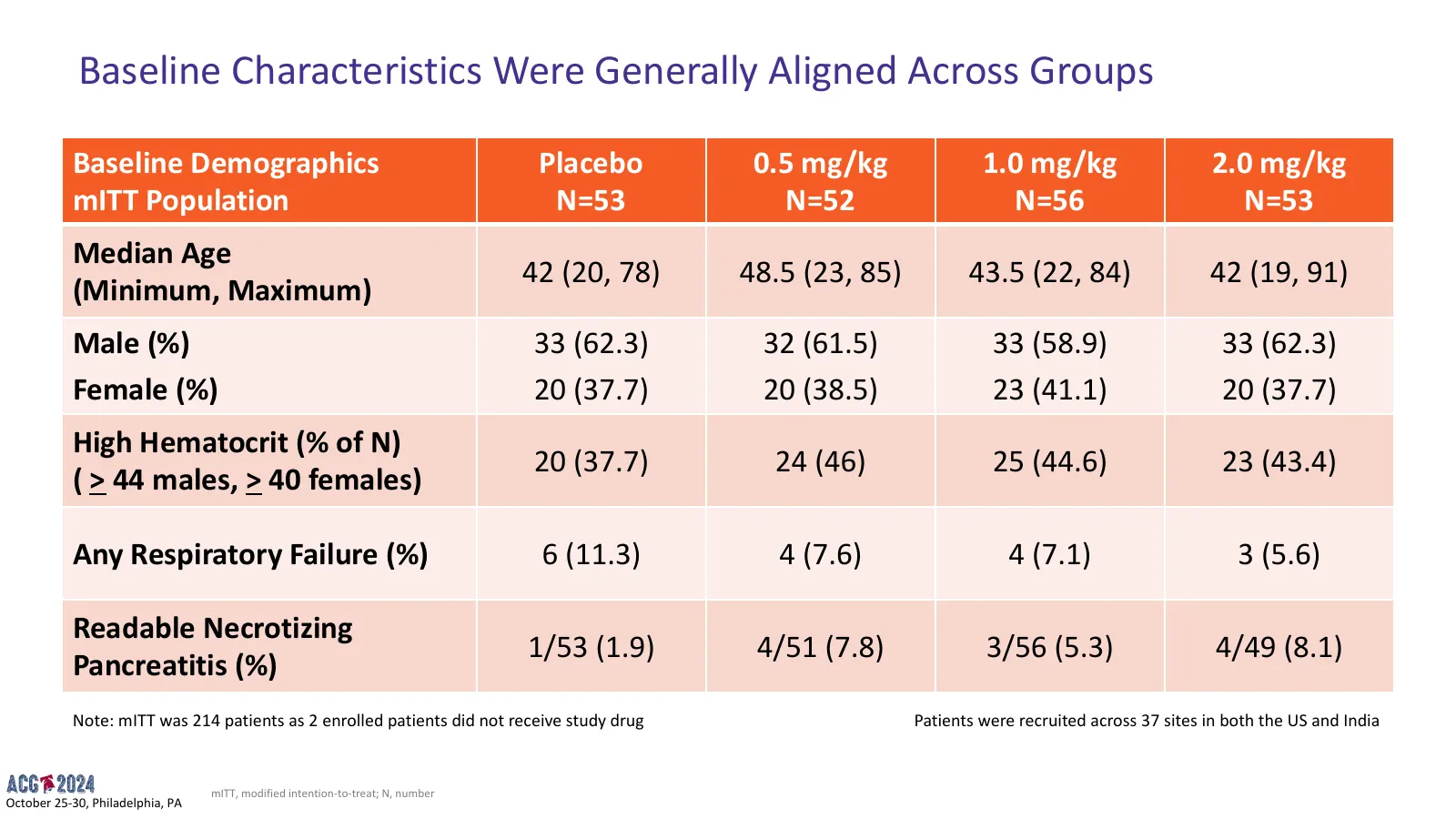
Slide 6: Baseline Characteristics Were Generally Aligned Across Groups
Baseline Characteristics Were Generally Aligned Across Groups Baseline Demographics Placebo 0.5 mg/kg 1.0 mg/kg 2.0 mg/kg mITT Population N=53 N=52 N=56 N=53 Median Age 42 (20, 78) 48.5 (23, 85) 43.5 (22, 84) 42 (19, 91) (Minimum, Maximum) Male (%) 33 (62.3) 32 (61.5) 33 (58.9) 33 (62.3) Female (%)
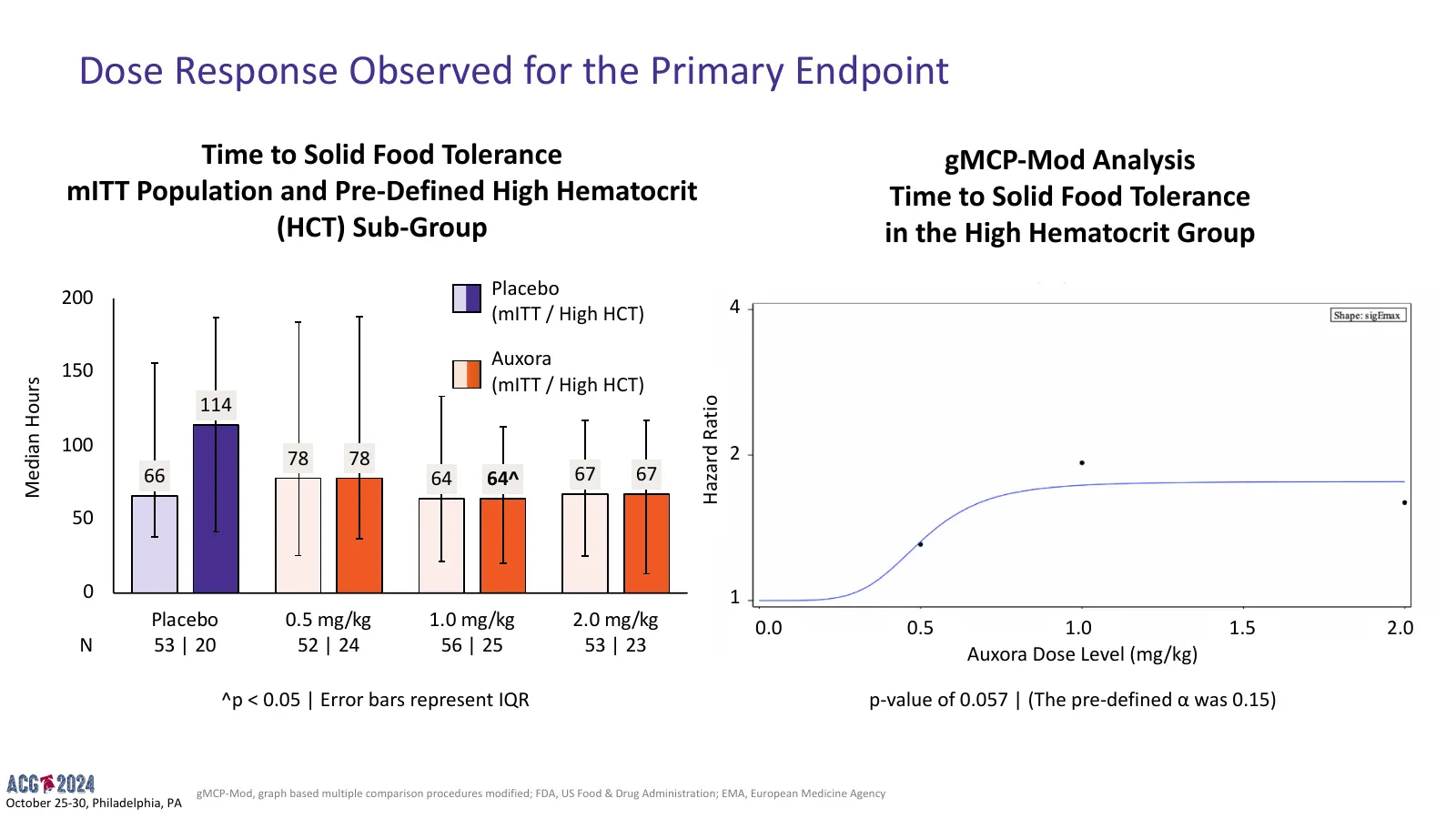
Slide 7: Dose Response Observed for the Primary Endpoint
Dose Response Observed for the Primary Endpoint Time to Solid Food Tolerance gMCP-Mod Analysis mITT Population and Pre-Defined High Hematocrit Time to Solid Food Tolerance (HCT) Sub-Group in the High Hematocrit Group 200 Placebo (mITT / High HCT) 4 Auxora 150 (mITT / High HCT) Median Hours 114 Hazar
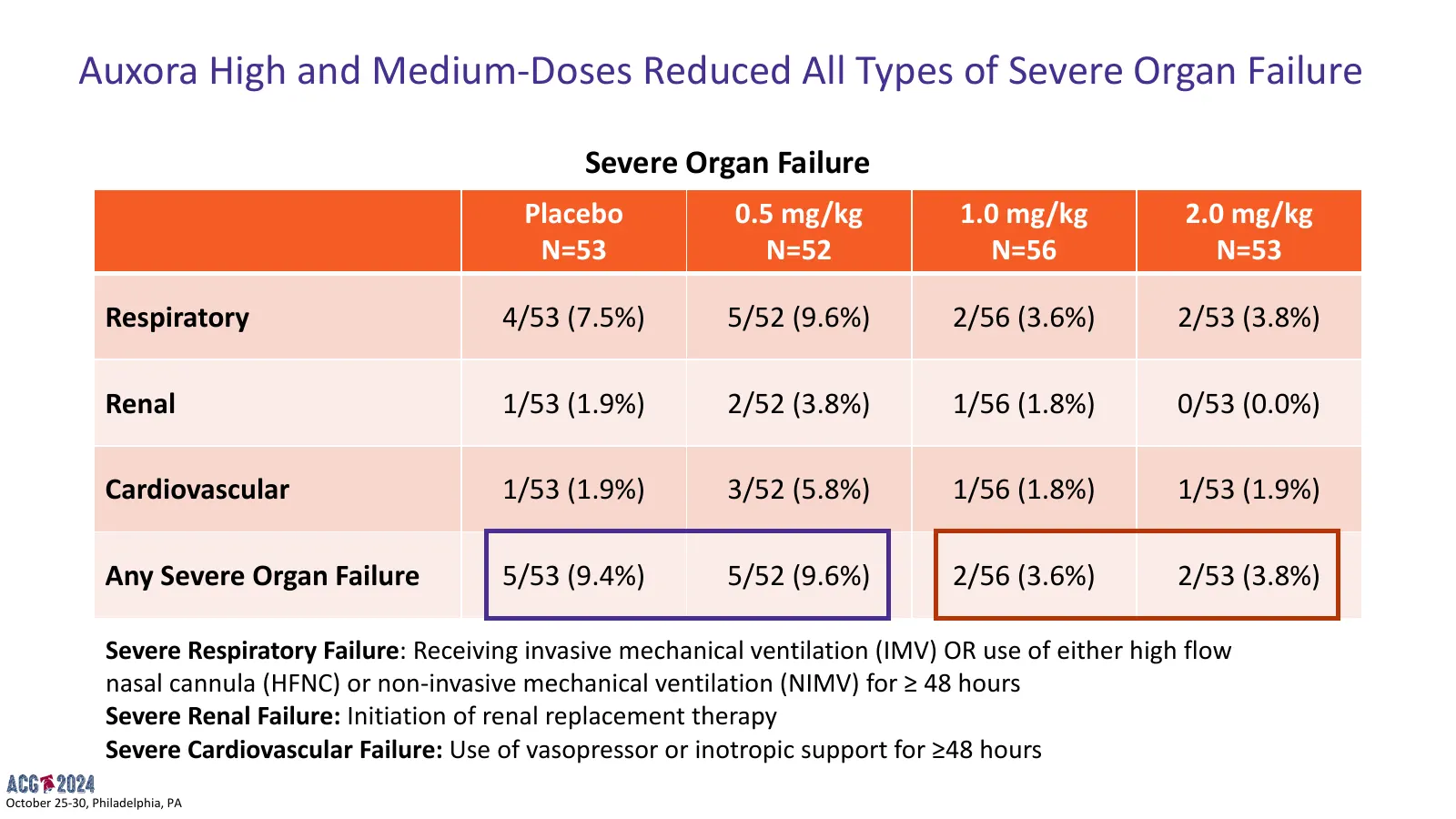
Slide 8: Auxora High and Medium-Doses Reduced All Types of Severe Organ Failure
Auxora High and Medium-Doses Reduced All Types of Severe Organ Failure Severe Organ Failure Placebo 0.5 mg/kg 1.0 mg/kg 2.0 mg/kg N=53 N=52 N=56 N=53 Respiratory 4/53 (7.5%) 5/52 (9.6%) 2/56 (3.6%) 2/53 (3.8%) Renal 1/53 (1.9%) 2/52 (3.8%) 1/56 (1.8%) 0/53 (0.0%) Cardiovascular 1/53 (1.9%) 3/52 (5.8
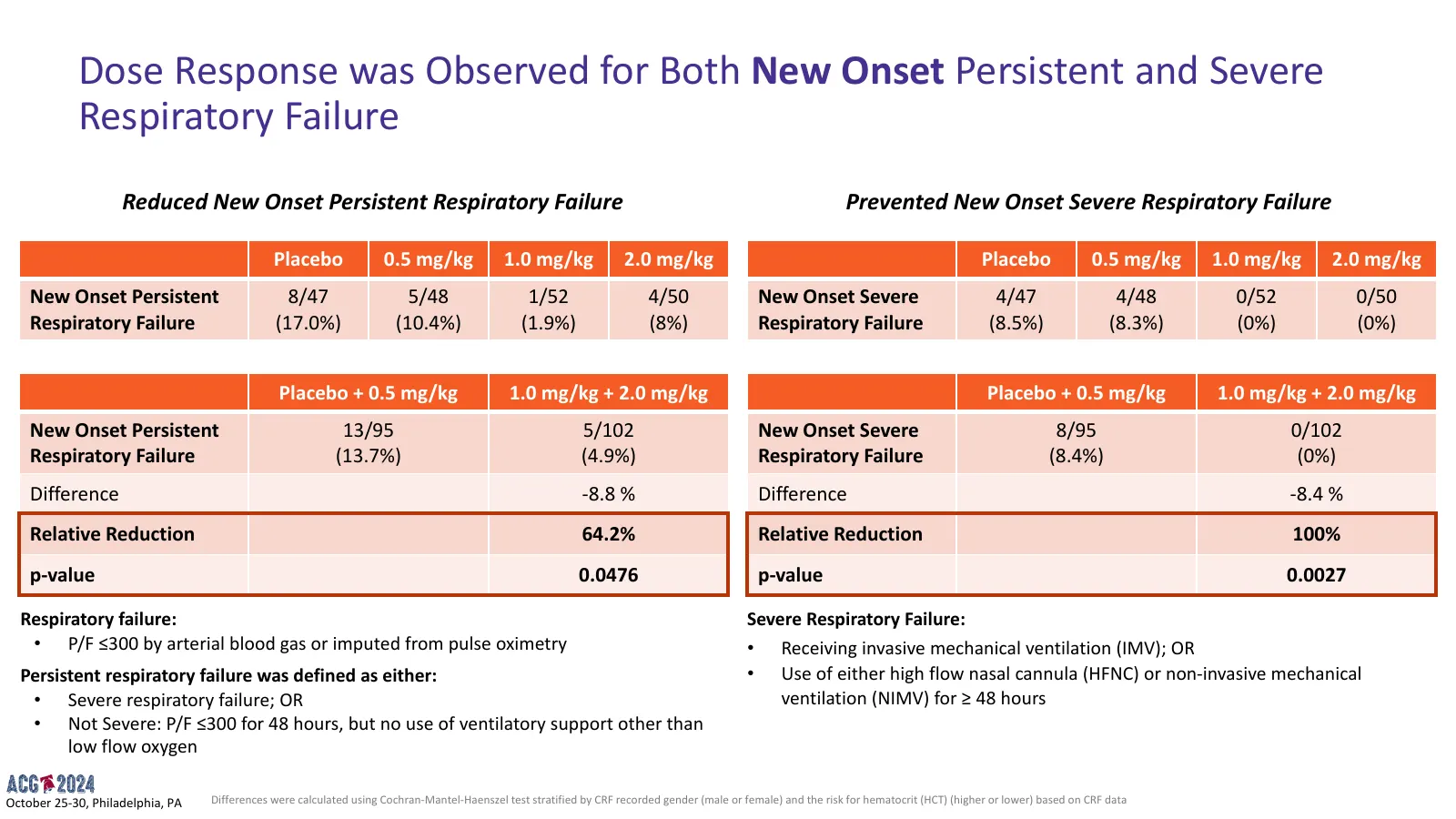
Slide 9: Dose Response Observed for New Onset Persistent and Severe Respiratory Failure
Dose Response was Observed for Both New Onset Persistent and Severe Respiratory Failure Reduced New Onset Persistent Respiratory Failure Prevented New Onset Severe Respiratory Failure Placebo 0.5 mg/kg 1.0 mg/kg 2.0 mg/kg Placebo 0.5 mg/kg 1.0 mg/kg 2.0 mg/kg New Onset Persistent 8/47 5/48 1/52 4/50
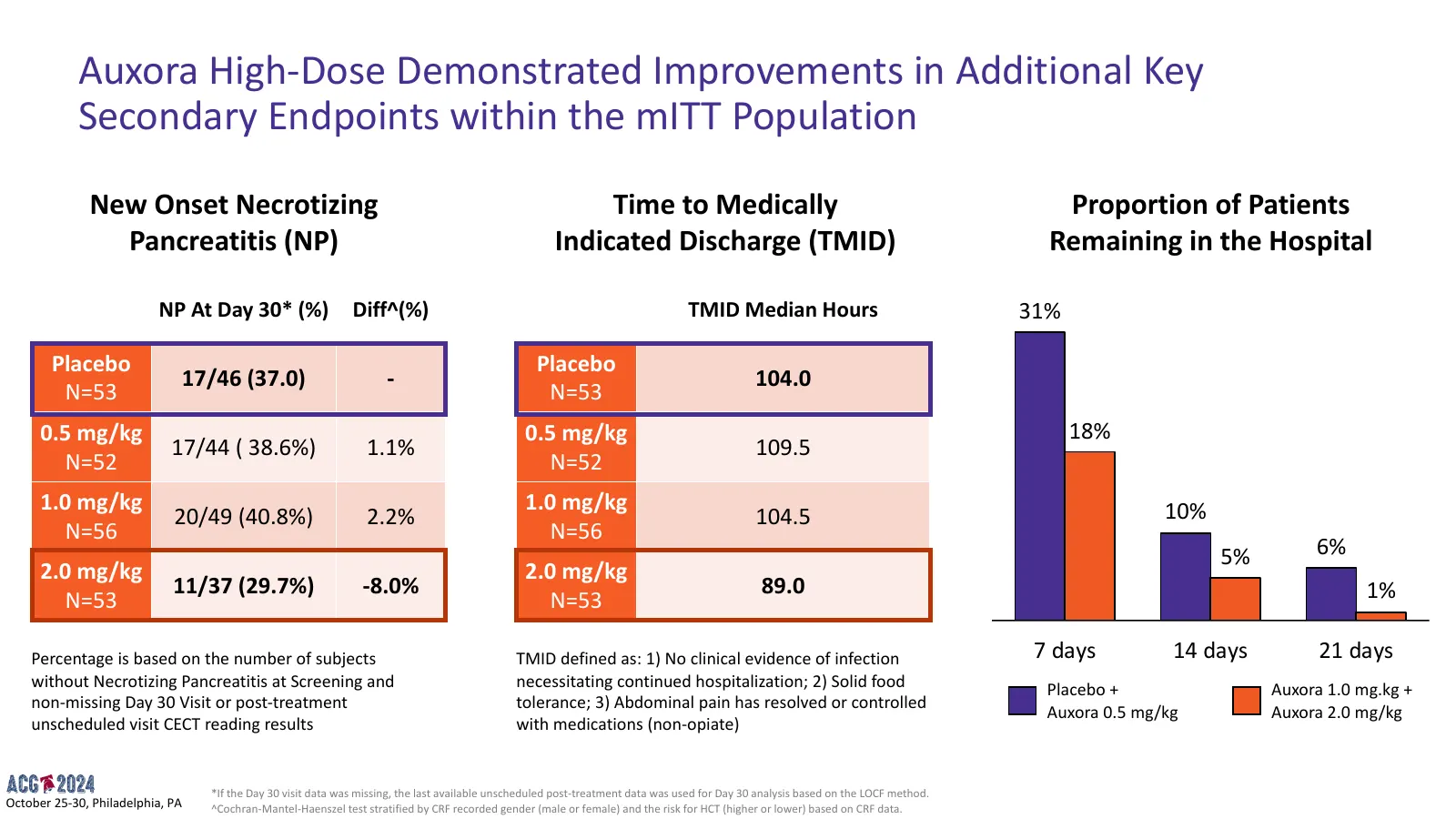
Slide 10: Auxora High-Dose Improvements in Additional Key Secondary Endpoints
Auxora High-Dose Demonstrated Improvements in Additional Key Secondary Endpoints within the mITT Population New Onset Necrotizing Time to Medically Proportion of Patients Pancreatitis (NP) Indicated Discharge (TMID) Remaining in the Hospital NP At Day 30* (%) Diff^(%) TMID Median Hours 31% Placebo P
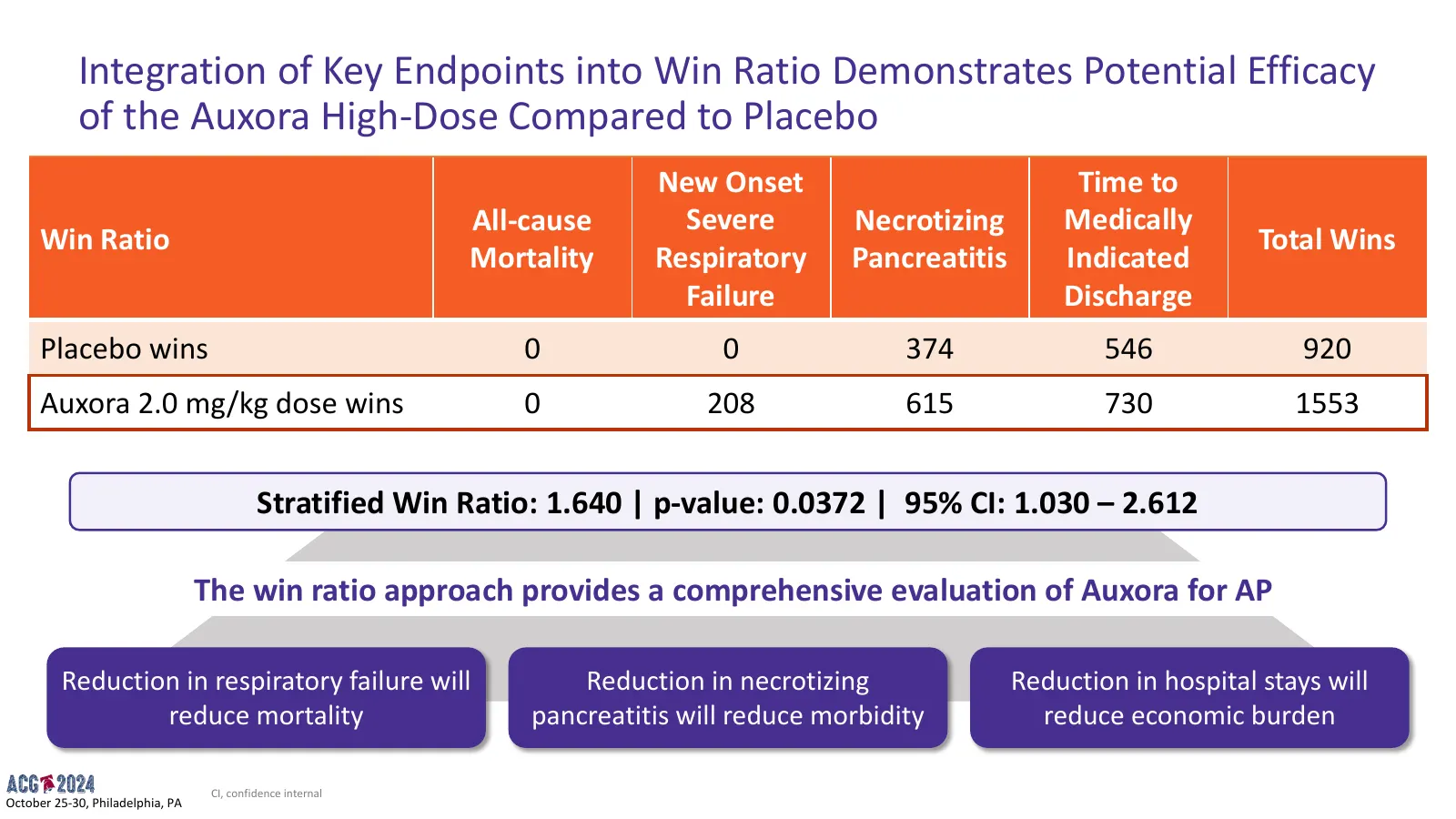
Slide 11: Win Ratio Demonstrates Potential Efficacy of Auxora High-Dose Compared to Placebo
Integration of Key Endpoints into Win Ratio Demonstrates Potential Efficacy of the Auxora High-Dose Compared to Placebo New Onset Time to All-cause Severe Necrotizing Medically Win Ratio Total Wins Mortality Respiratory Pancreatitis Indicated Failure Discharge Placebo wins 0 0 374 546 920 Auxora 2.0
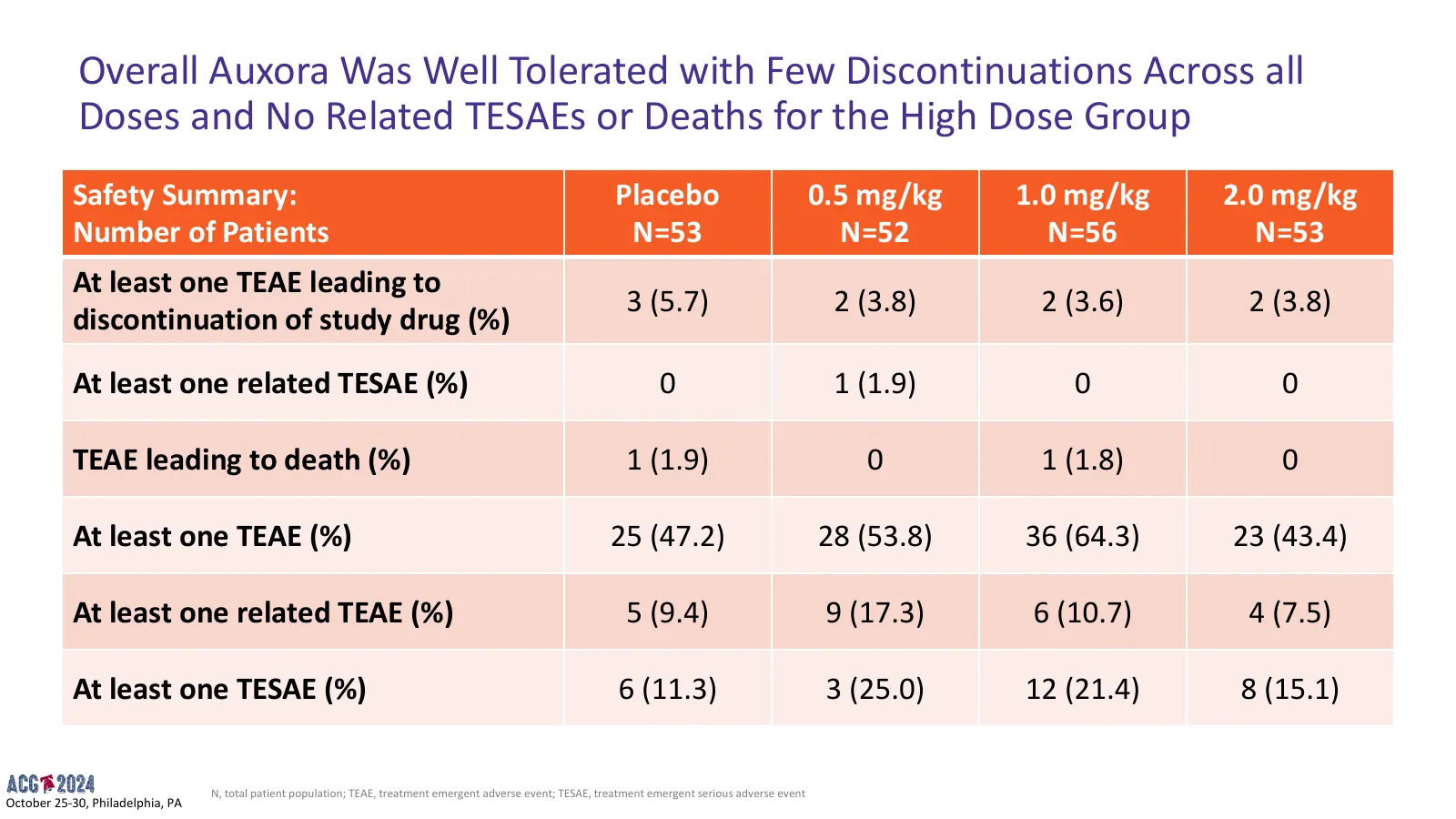
Slide 12: Auxora Was Well Tolerated with Few Discontinuations Across All Doses
Overall Auxora Was Well Tolerated with Few Discontinuations Across all Doses and No Related TESAEs or Deaths for the High Dose Group Safety Summary: Placebo 0.5 mg/kg 1.0 mg/kg 2.0 mg/kg Number of Patients N=53 N=52 N=56 N=53 At least one TEAE leading to 3 (5.7) 2 (3.8) 2 (3.6) 2 (3.8) discontinuati
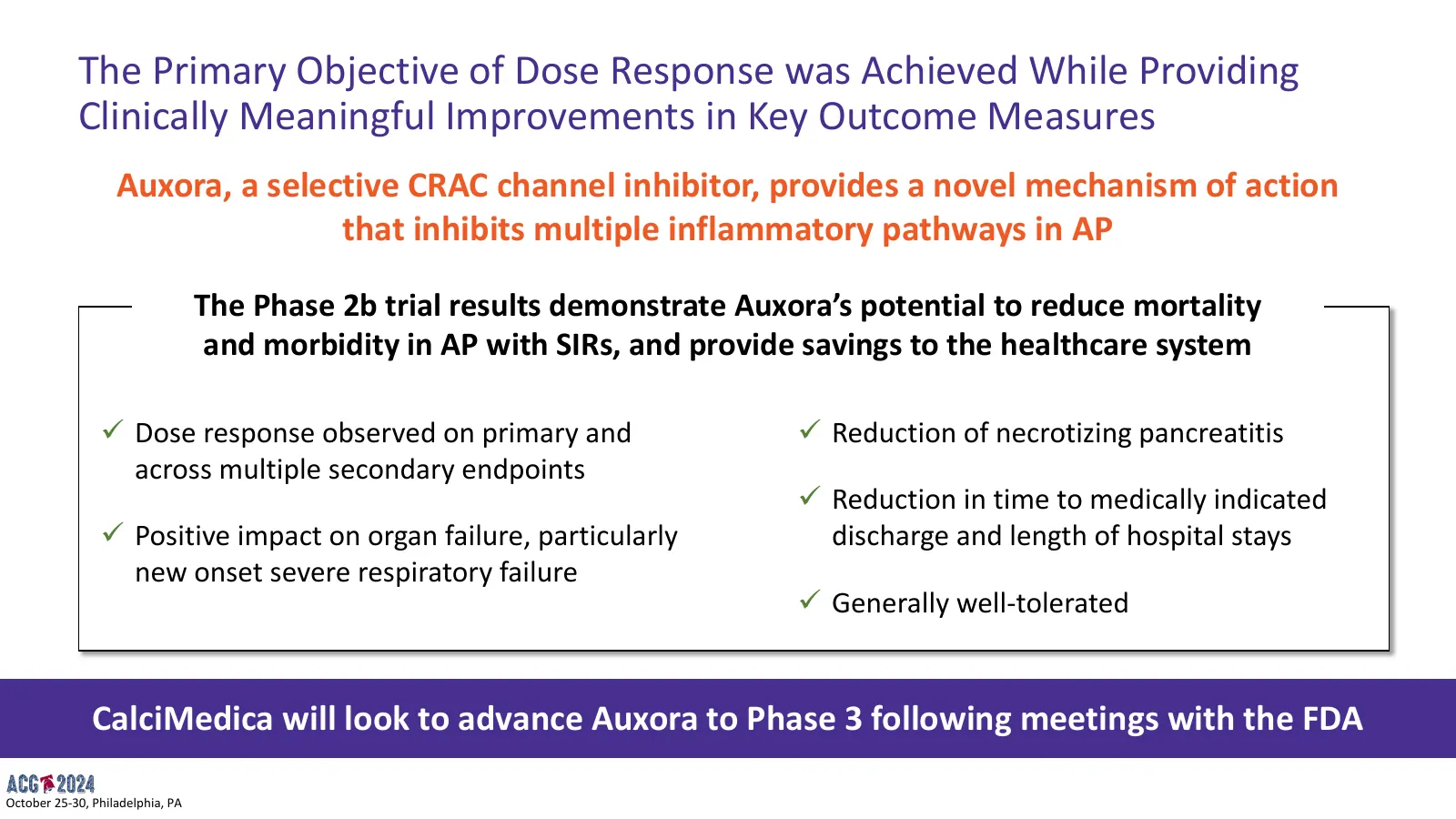
Slide 13: Primary Objective of Dose Response Achieved with Clinically Meaningful Improvements
The Primary Objective of Dose Response was Achieved While Providing Clinically Meaningful Improvements in Key Outcome Measures Auxora, a selective CRAC channel inhibitor, provides a novel mechanism of action that inhibits multiple inflammatory pathways in AP The Phase 2b trial results demonstrate Au
Source: Internet Archive copy of calcimedica.com
More decks from CalciMedica, Inc.
 Investor Presentation (November 2026)26 slides · November 2026
 Investor Presentation (June 2026)29 slides · Jun 24, 2026
 Investor Presentation (October 2024)38 slides · Oct 30, 2024
 Technical Presentation (June 2024)14 slides · Jun 27, 2024
 Investor Presentation (February 2024)31 slides · Feb 13, 2024
 Investor Presentation (June 2023)29 slides · Jun 15, 2023