Banco Bilbao Vizcaya Argentaria, S.A. · BME:BBVA
Banco Bilbao Vizcaya Argentaria — BBVA — Investor Presentation (January 2006)
51 slides from Banco Bilbao Vizcaya Argentaria's investor presentation, January 2006
Slide 1: Mexican Banking and Financial System
Mexican Banking and Financial System A journey from nationalization to consolidation Economic Research Department January 2006 1
Slide 2: Index
Index One step back and two steps forward: nationalization, privatization and opening to FDI Effects of the 1995 crisis in the banking sector New financial institutions: Sofoles and Afores Banking system since 1999 Bank lending activity Traditional deposits, mutual funds and other deposits Links bet
Slide 3: The nationalization process took place in September 1982
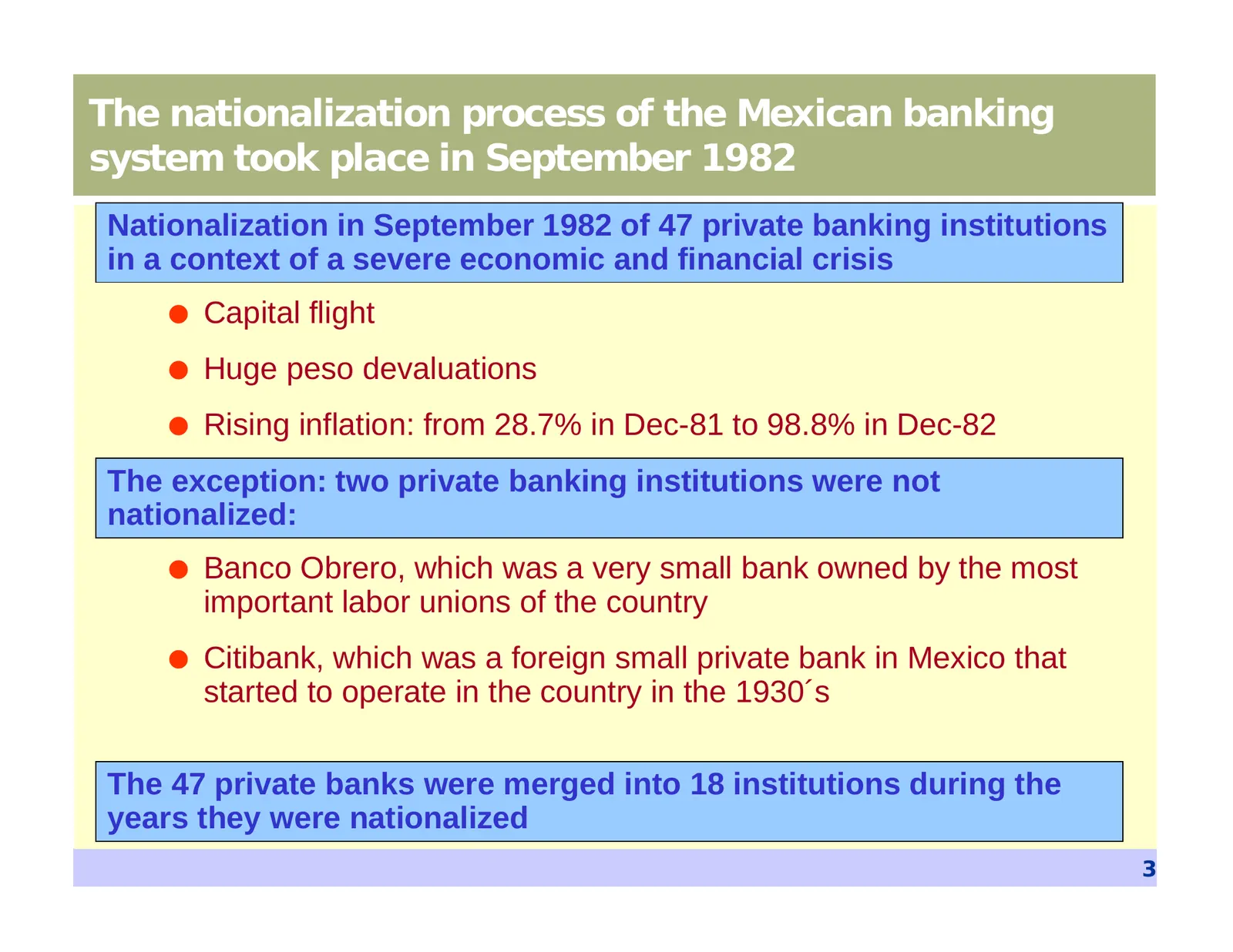
The nationalization process of the Mexican banking system took place in September 1982 Nationalization in September 1982 of 47 private banking institutions in a context of a severe economic and financial crisis O Capital flight O Huge peso devaluations O Rising inflation: from 28.7% in Dec-81 to 98.
Slide 4: Privatization began in mid 1991
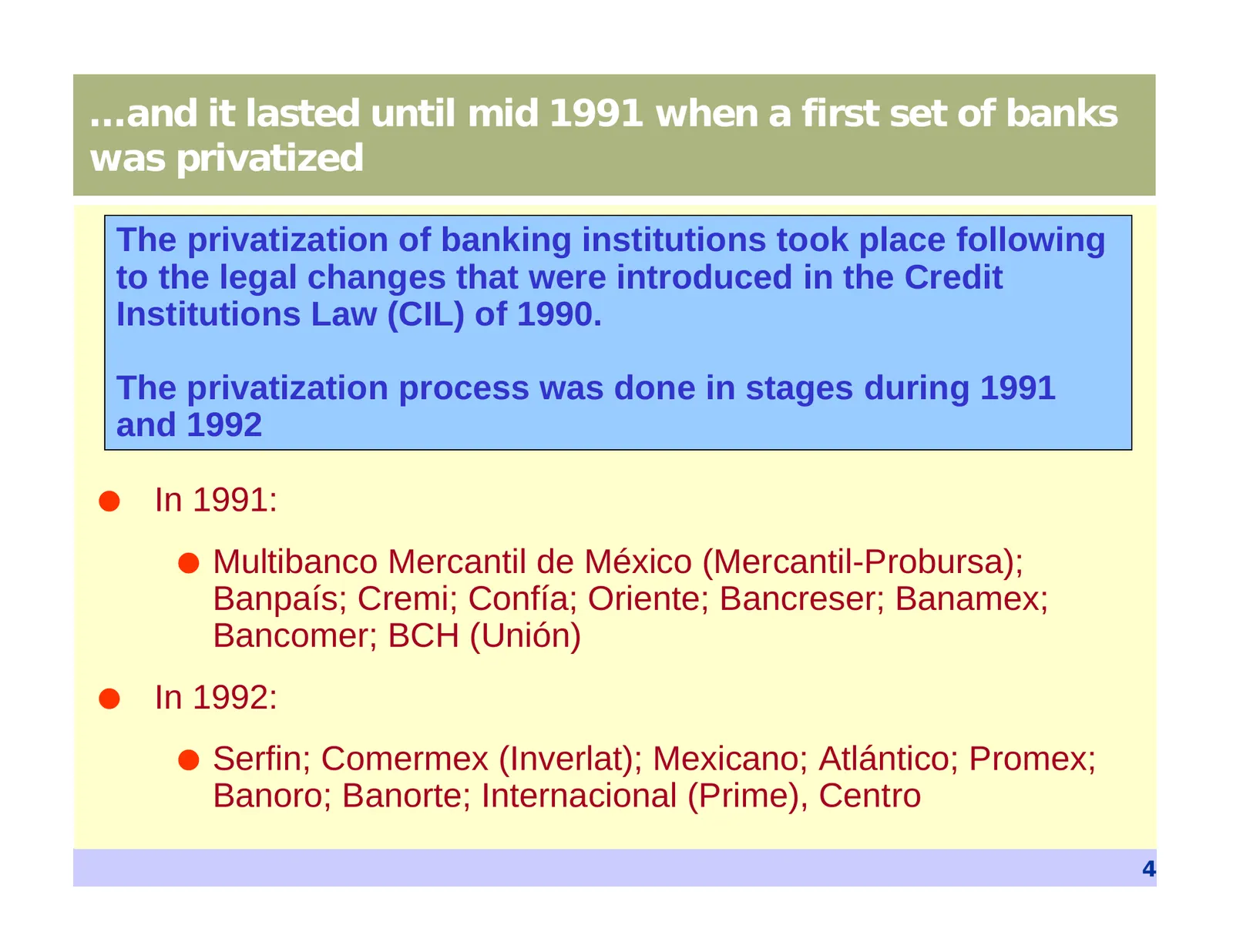
…and it lasted until mid 1991 when a first set of banks was privatized The privatization of banking institutions took place following to the legal changes that were introduced in the Credit Institutions Law (CIL) of 1990. The privatization process was done in stages during 1991 and 1992 O In 1991: O
Slide 5: Privatization allowed limited opening to foreign direct investment
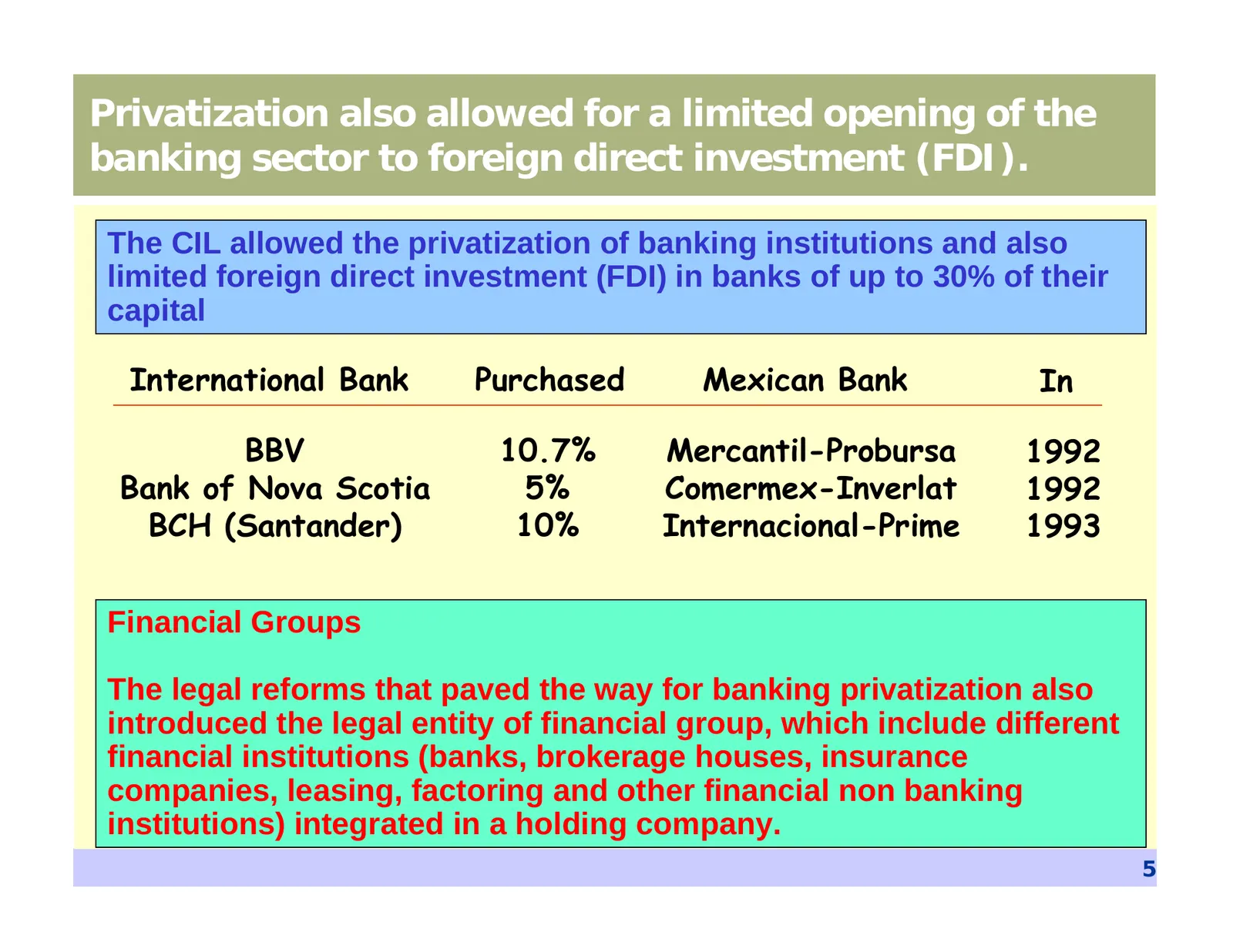
Privatization also allowed for a limited opening of the banking sector to foreign direct investment (FDI). The CIL allowed the privatization of banking institutions and also limited foreign direct investment (FDI) in banks of up to 30% of their capital International Bank Purchased Mexican Bank In BB
Slide 6: Opening of the Mexican financial sector under NAFTA rules
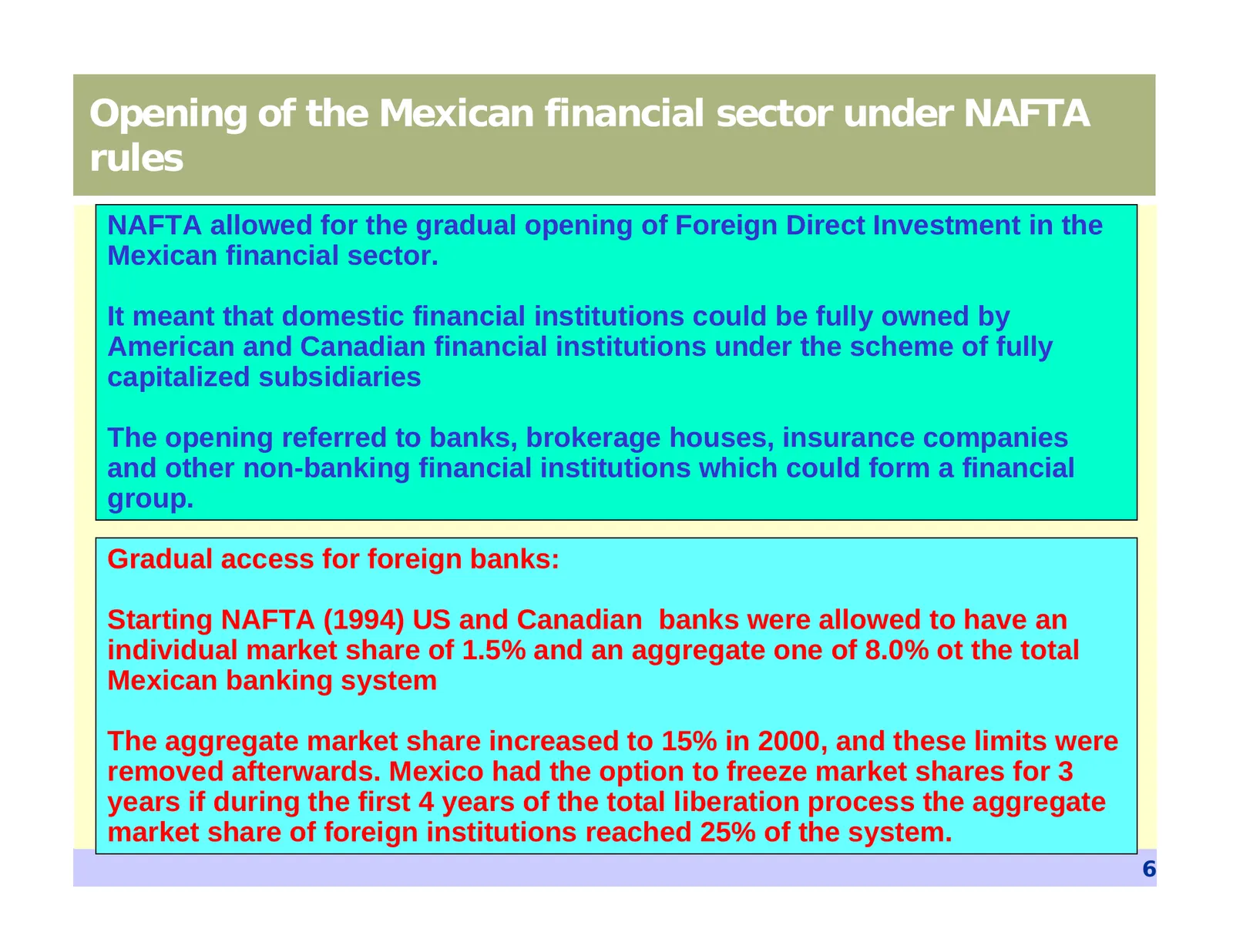
Opening of the Mexican financial sector under NAFTA rules NAFTA allowed for the gradual opening of Foreign Direct Investment in the Mexican financial sector. It meant that domestic financial institutions could be fully owned by American and Canadian financial institutions under the scheme of fully c
Slide 7: New foreign banks entered Mexico in 1994-1996
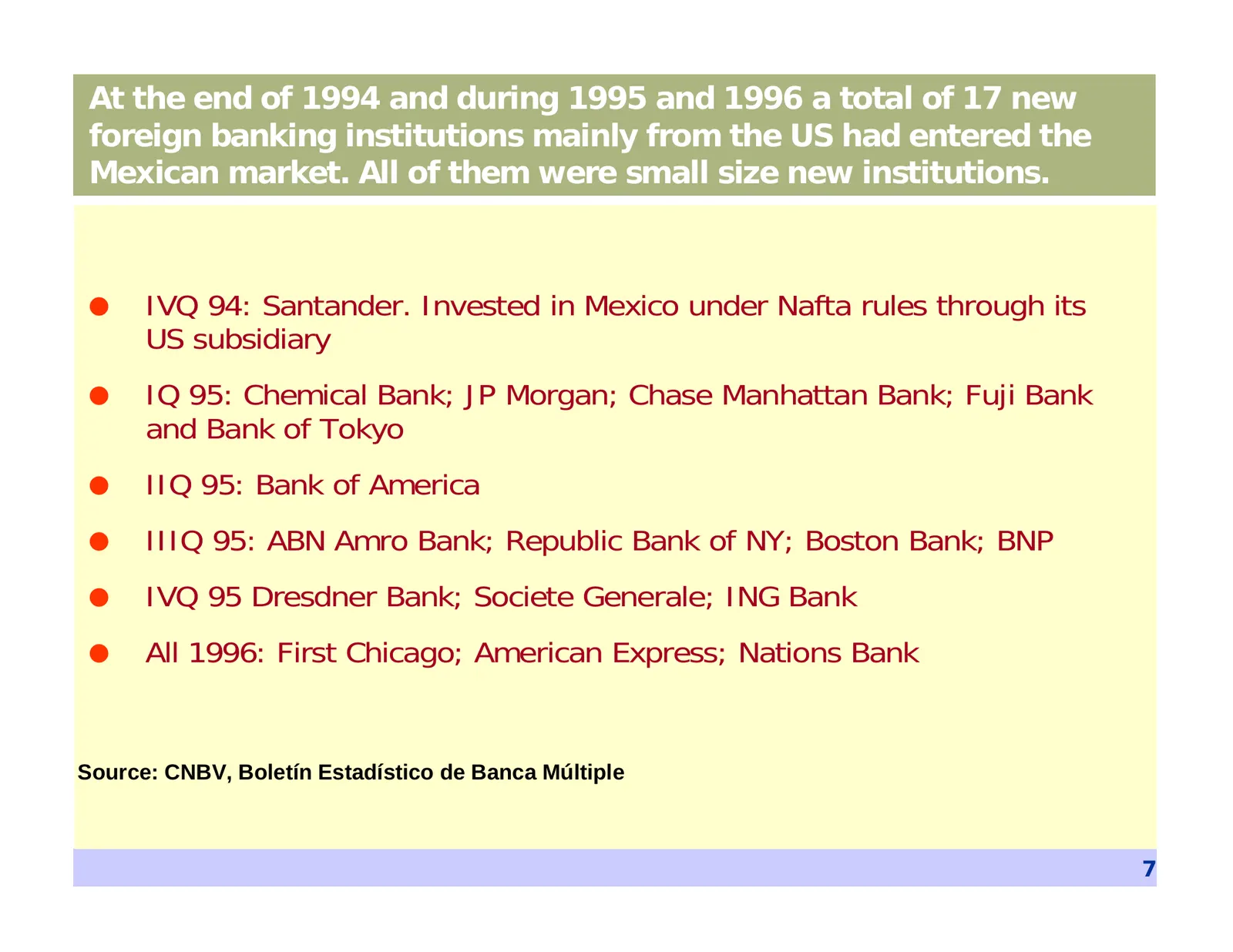
At the end of 1994 and during 1995 and 1996 a total of 17 new foreign banking institutions mainly from the US had entered the Mexican market. All of them were small size new institutions. O IVQ 94: Santander. Invested in Mexico under Nafta rules through its US subsidiary O IQ 95: Chemical Bank; JP M
Slide 8: Index
Index One step back and two steps forward: nationalization, privatization and opening to FDI Effects of the 1995 crisis in the banking sector New financial institutions: Sofoles and Afores Banking system since 1999 Bank lending activity Traditional deposits, mutual funds and other deposits Links bet
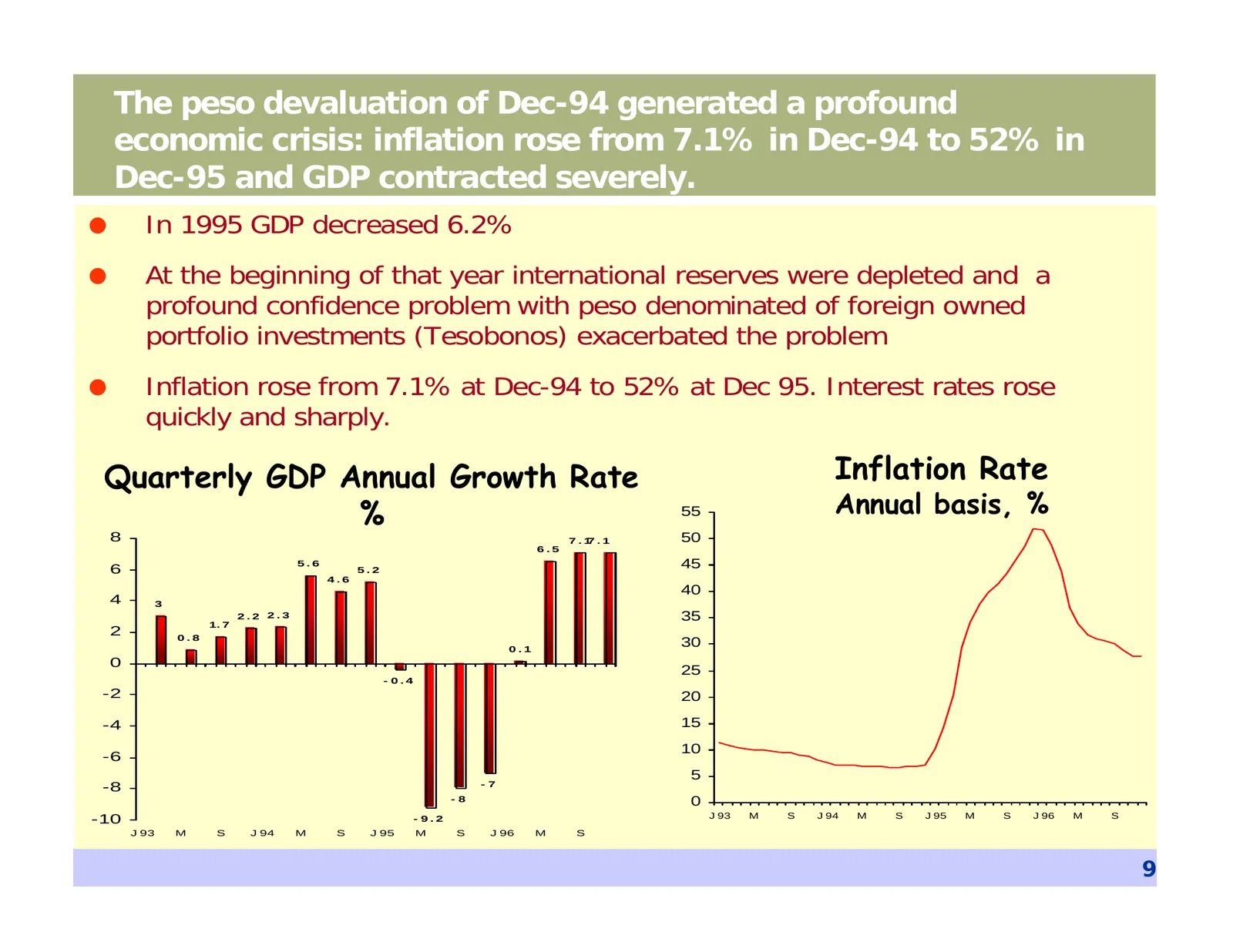
Slide 9: Peso devaluation of Dec-94 generated a profound economic crisis
The peso devaluation of Dec-94 generated a profound economic crisis: inflation rose from 7.1% in Dec-94 to 52% in Dec-95 and GDP contracted severely. O In 1995 GDP decreased 6.2% O At the beginning of that year international reserves were depleted and a profound confidence problem with peso denomina
Slide 10: Economic problems of 1995 became a severe banking crisis
The economic problems of 1995 translated into a severe banking crisis that lasted several years O Mostly all bank loans that were granted until Dec-94 were given on a variable interest rate basis. This meant that these rates were related to a leader interest rate (Cetes 28 days) plus a spread. Due t
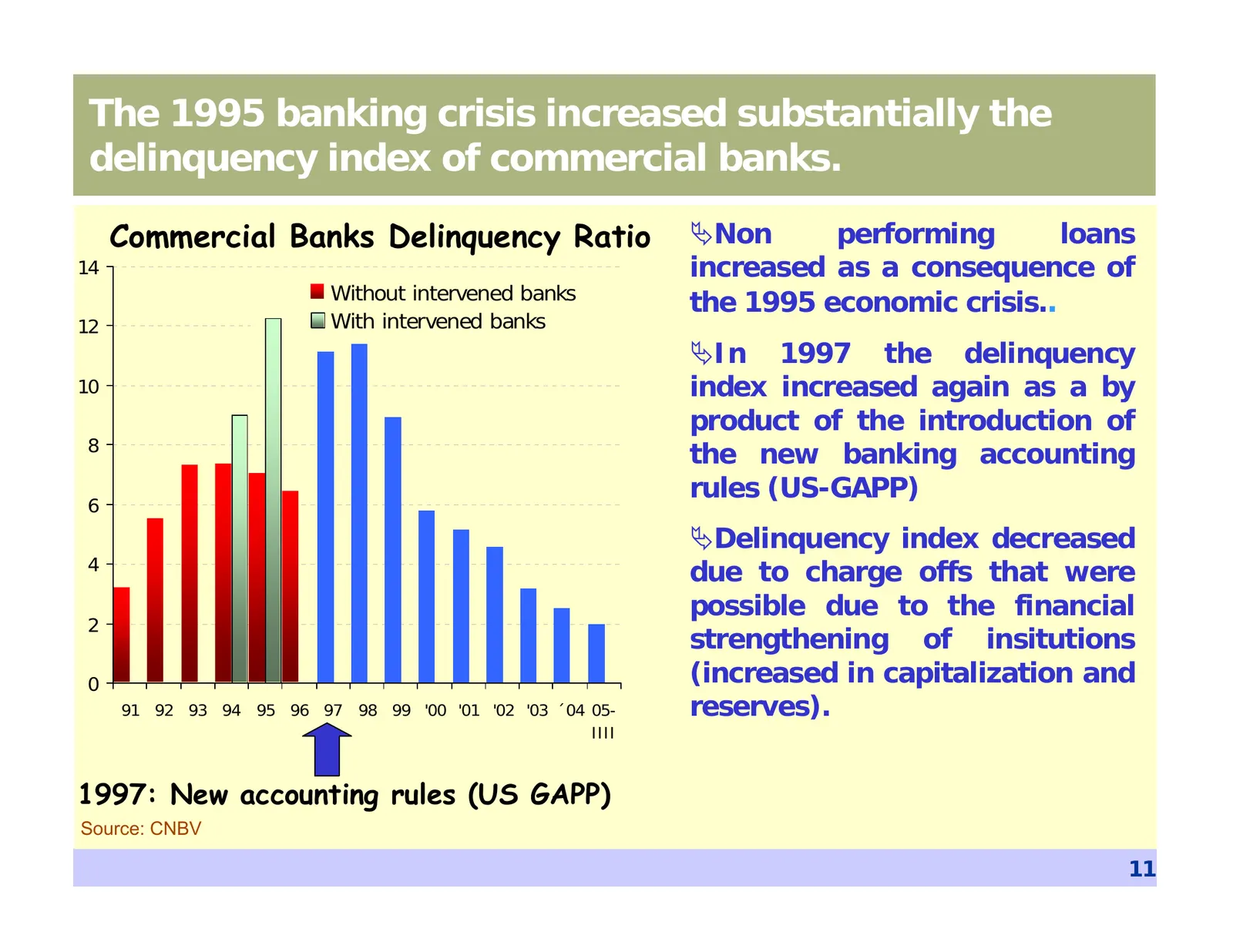
Slide 11: The 1995 crisis increased the delinquency index of commercial banks
The 1995 banking crisis increased substantially the delinquency index of commercial banks. Commercial Banks Delinquency Ratio ªNon performing loans 14 increased as a consequence of Without intervened banks the 1995 economic crisis.. 12 With intervened banks ªIn 1997 the delinquency 10 index increase
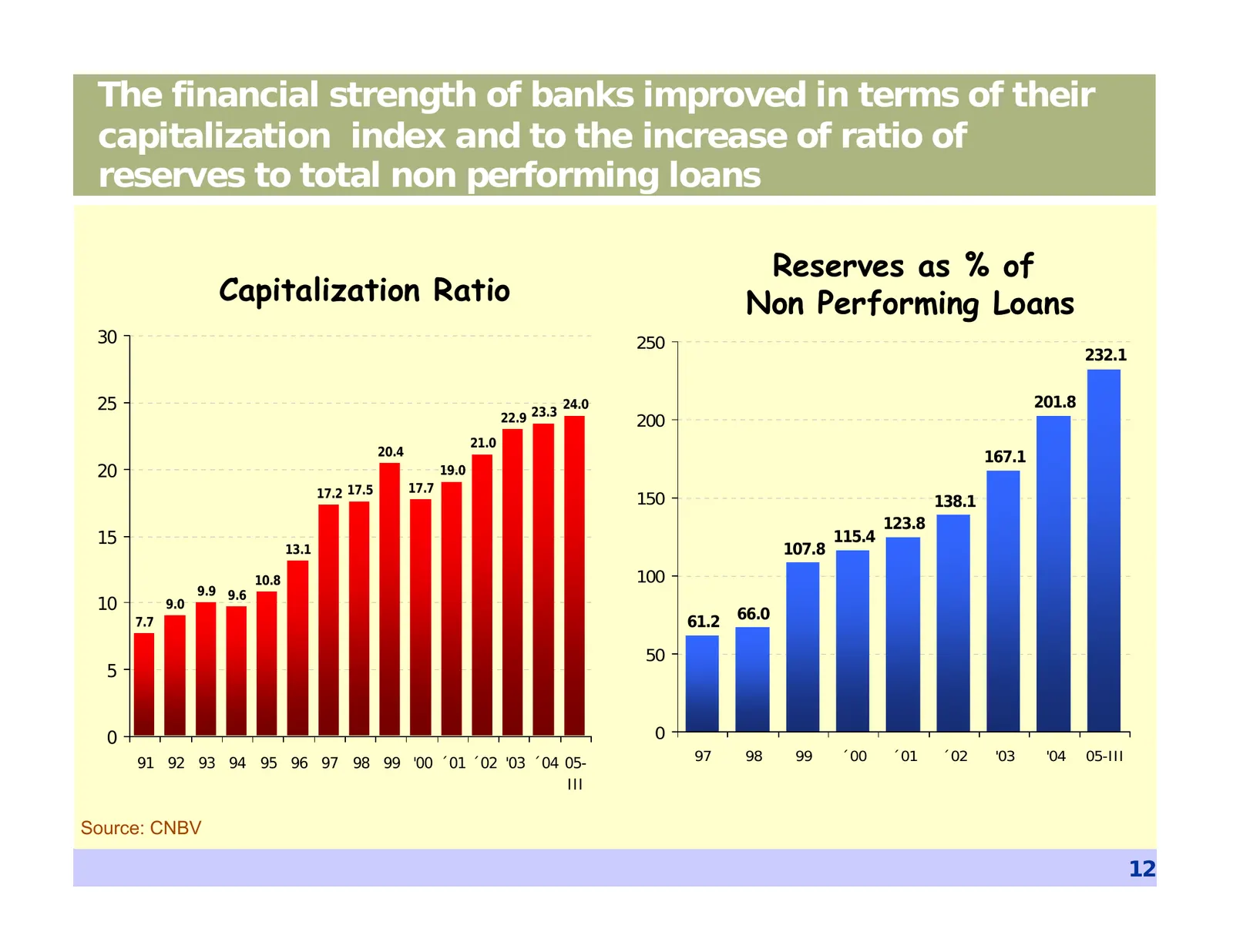
Slide 12: Financial strength of banks improved in capitalization and reserves
The financial strength of banks improved in terms of their capitalization index and to the increase of ratio of reserves to total non performing loans Reserves as % of Capitalization Ratio Non Performing Loans 30 250 232.1 25 24.0 201.8 22.9 23.3 200 21.0 20.4 167.1 20 19.0 17.2 17.5 17.7 150 138.1
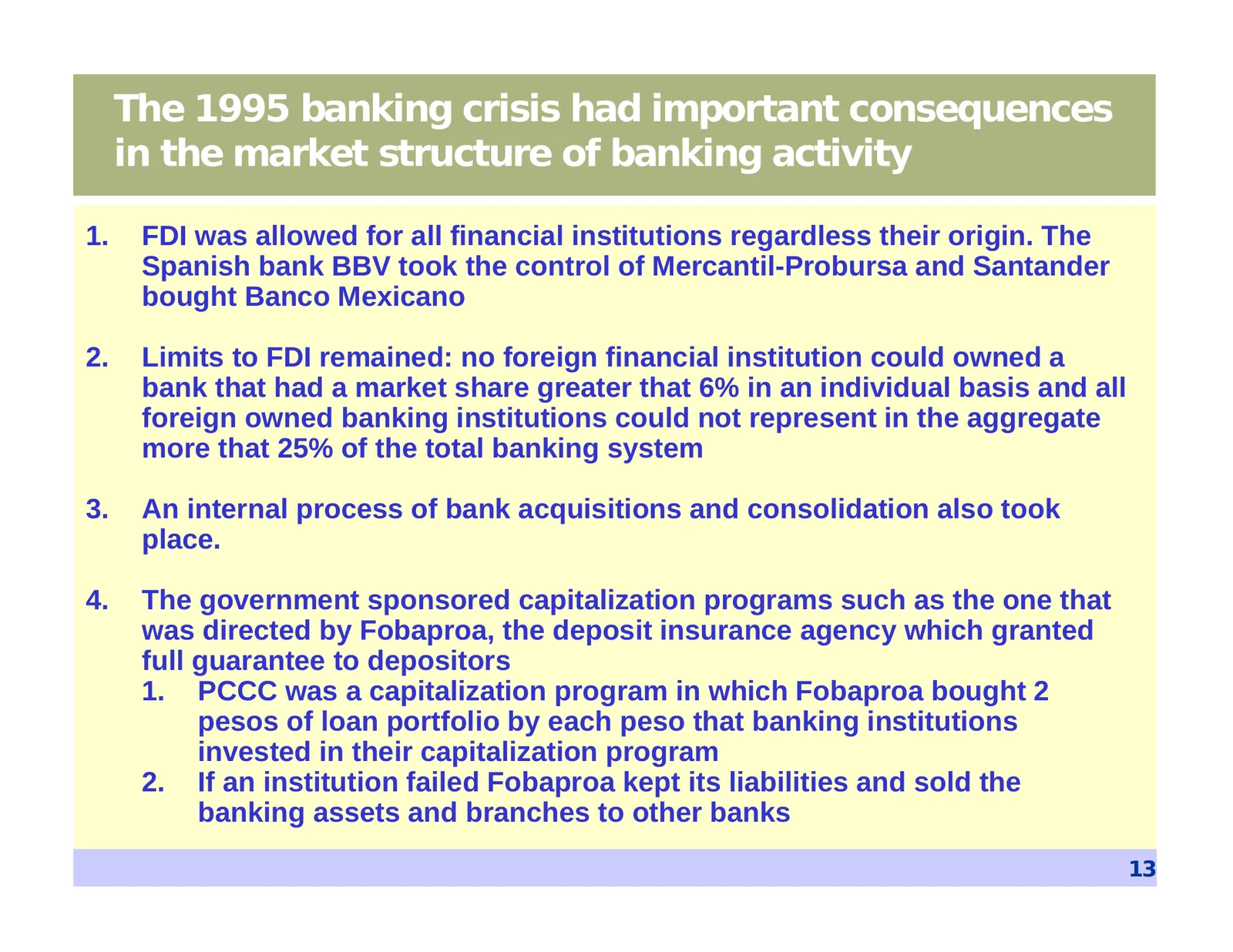
Slide 13: Consequences of the 1995 crisis for market structure
The 1995 banking crisis had important consequences in the market structure of banking activity 1. FDI was allowed for all financial institutions regardless their origin. The Spanish bank BBV took the control of Mercantil-Probursa and Santander bought Banco Mexicano 2. Limits to FDI remained: no fore
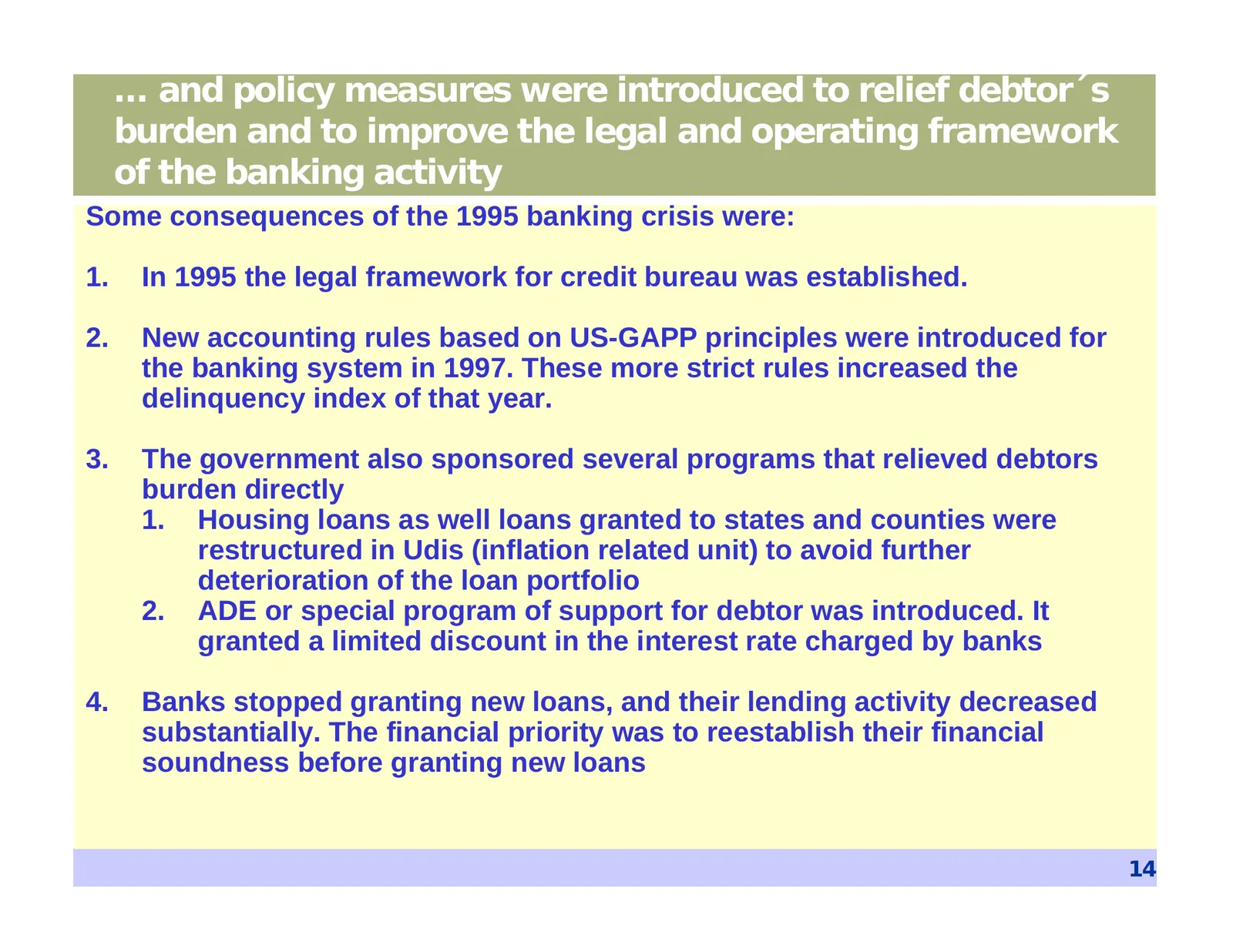
Slide 14: Policy measures to relieve debtors and improve the legal framework
… and policy measures were introduced to relief debtor´s burden and to improve the legal and operating framework of the banking activity Some consequences of the 1995 banking crisis were: 1. In 1995 the legal framework for credit bureau was established. 2. New accounting rules based on US-GAPP princ
Slide 15: Index
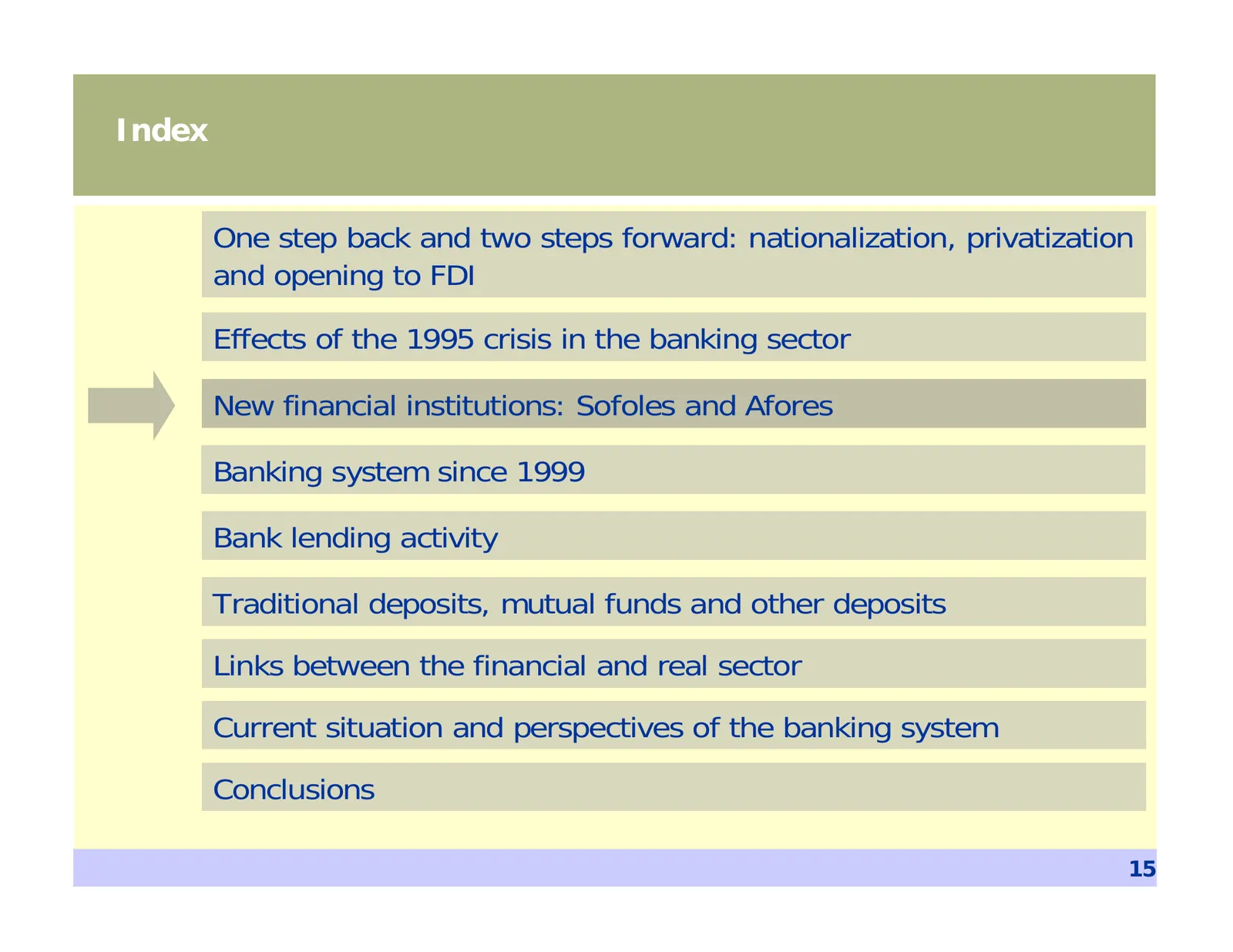
Index One step back and two steps forward: nationalization, privatization and opening to FDI Effects of the 1995 crisis in the banking sector New financial institutions: Sofoles and Afores Banking system since 1999 Bank lending activity Traditional deposits, mutual funds and other deposits Links bet
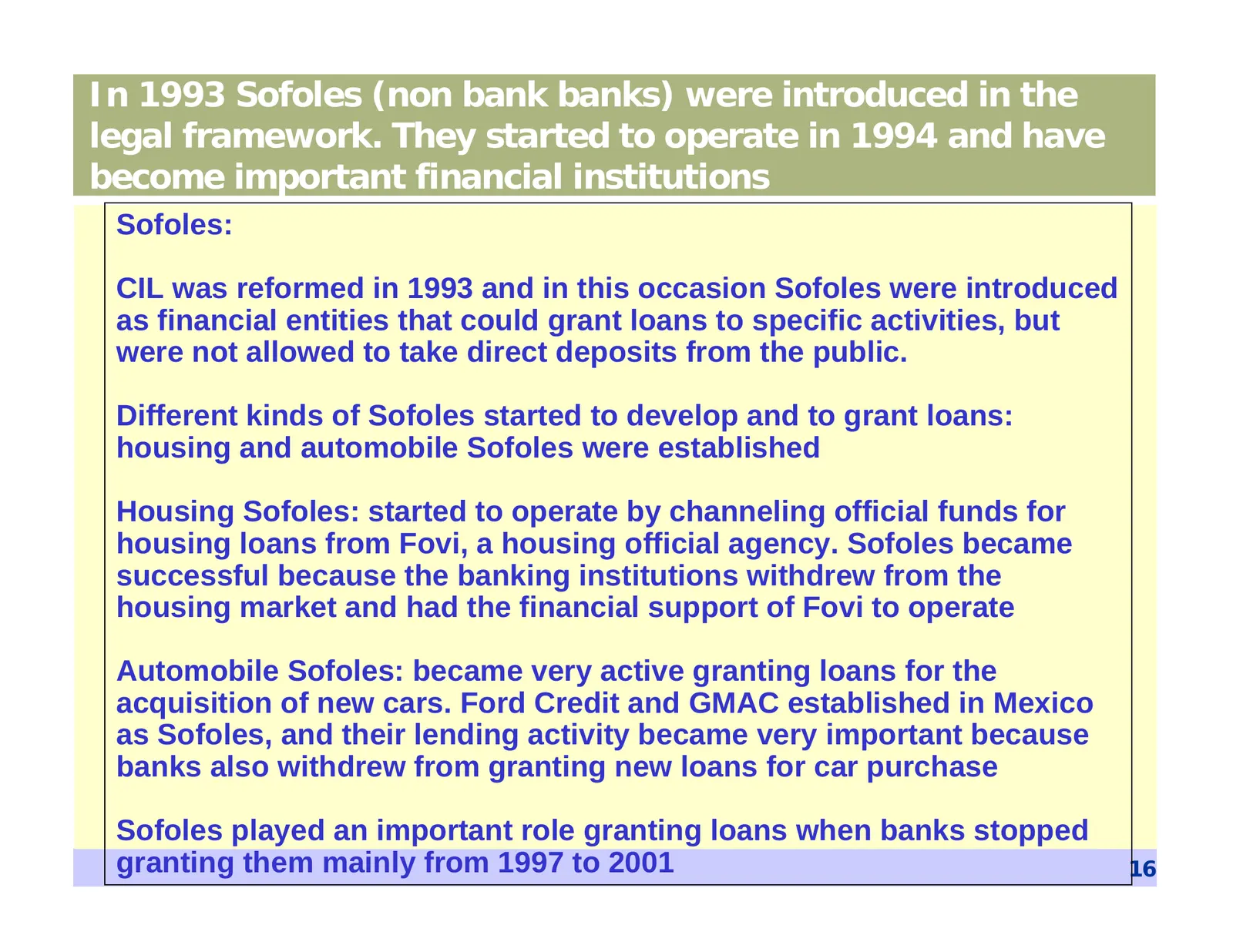
Slide 16: Sofoles were introduced in 1993
In 1993 Sofoles (non bank banks) were introduced in the legal framework. They started to operate in 1994 and have become important financial institutions Sofoles: CIL was reformed in 1993 and in this occasion Sofoles were introduced as financial entities that could grant loans to specific activities
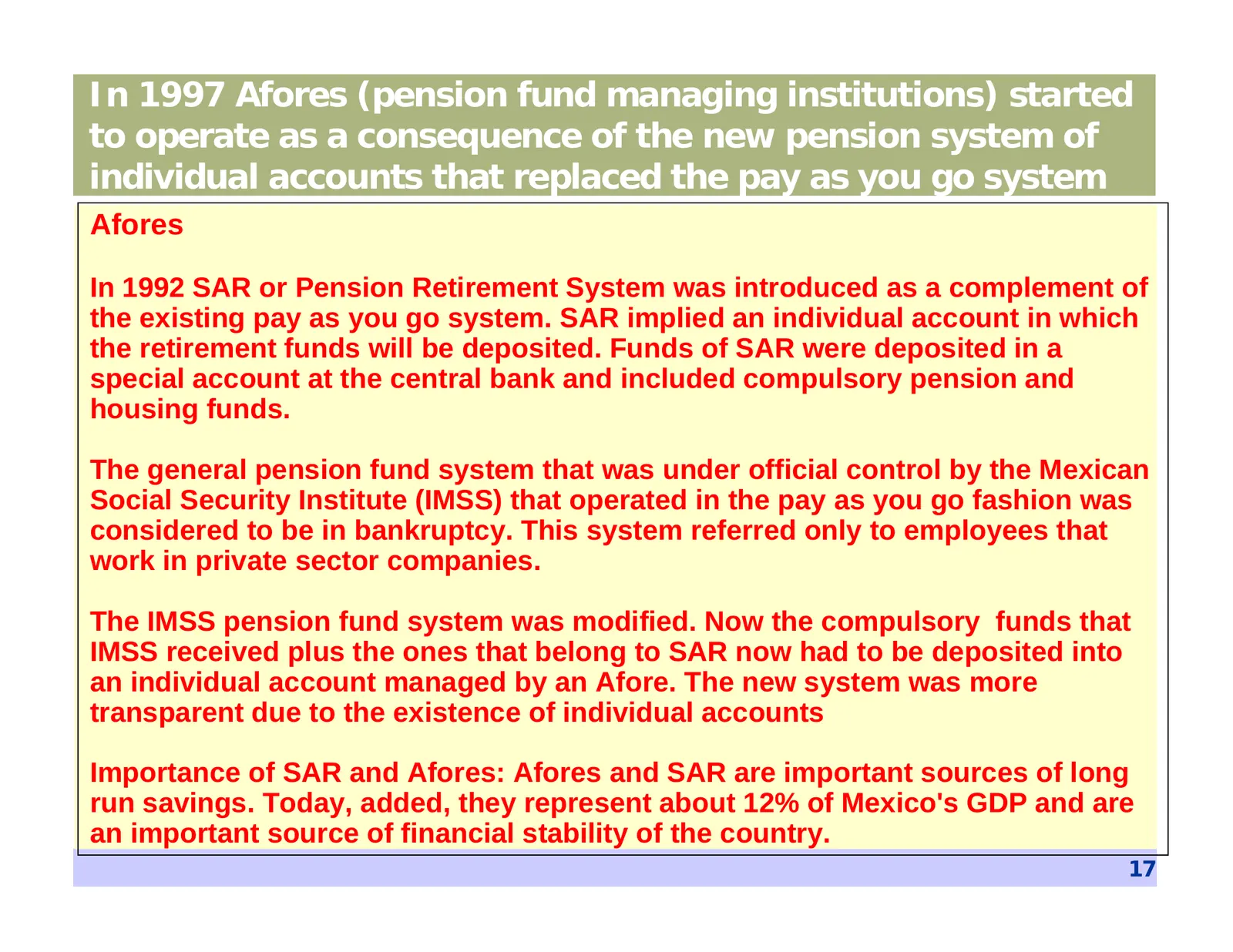
Slide 17: Afores started to operate in 1997
In 1997 Afores (pension fund managing institutions) started to operate as a consequence of the new pension system of individual accounts that replaced the pay as you go system Afores In 1992 SAR or Pension Retirement System was introduced as a complement of the existing pay as you go system. SAR imp
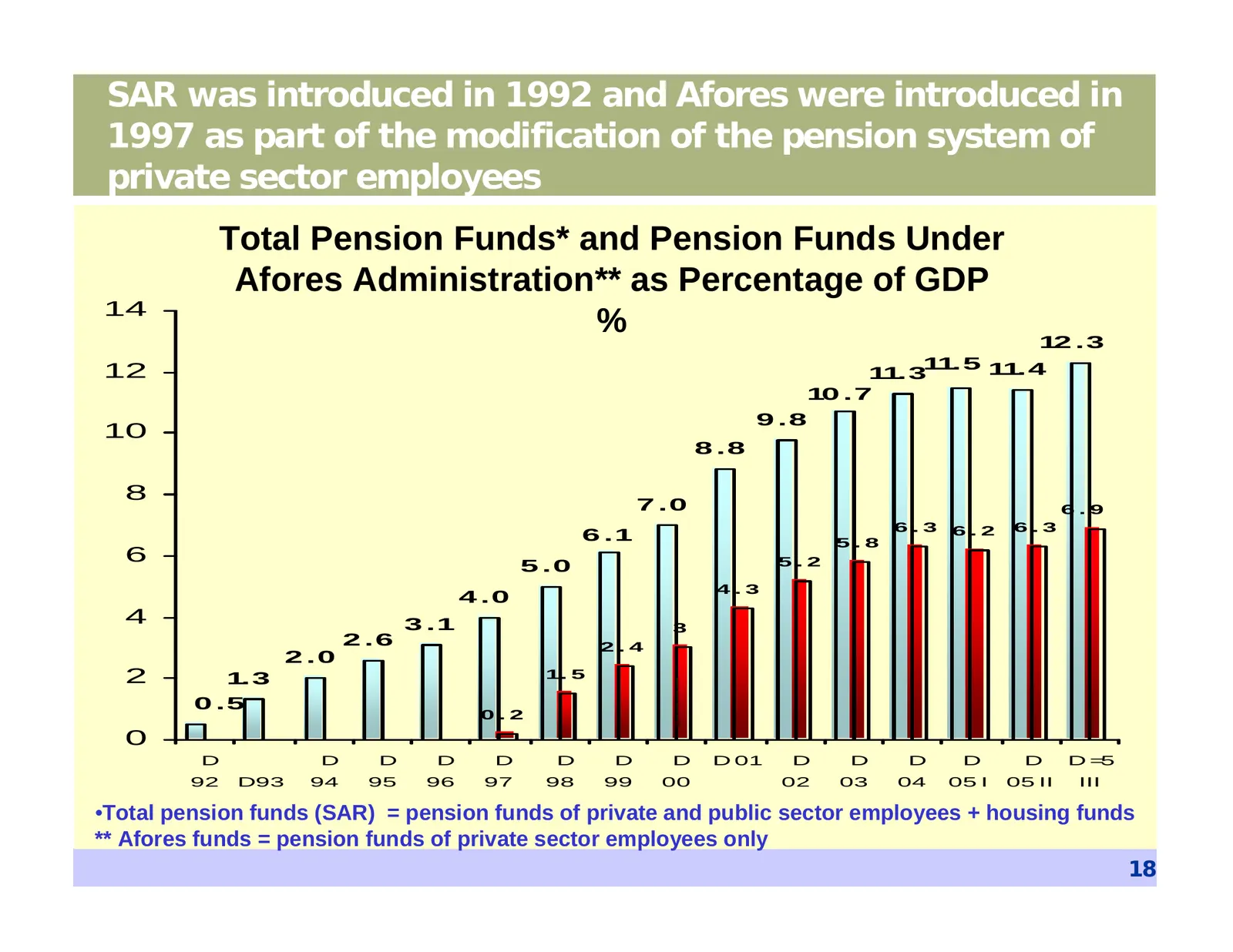
Slide 18: SAR and Afores pension funds as percentage of GDP
SAR was introduced in 1992 and Afores were introduced in 1997 as part of the modification of the pension system of private sector employees Total Pension Funds* and Pension Funds Under Afores Administration** as Percentage of GDP 14 % 12 . 3 11. 5 11. 4 12 11. 3 10 . 7 9 .8 10 8 .8 8 7 .0 6.9 6.3 6.
Slide 19: Index
Index One step back and two steps forward: nationalization, privatization and opening to FDI Effects of the 1995 crisis in the banking sector New financial institutions: Sofoles and Afores Banking system since 1999 Bank lending activity Traditional deposits, mutual funds and other deposits Links bet
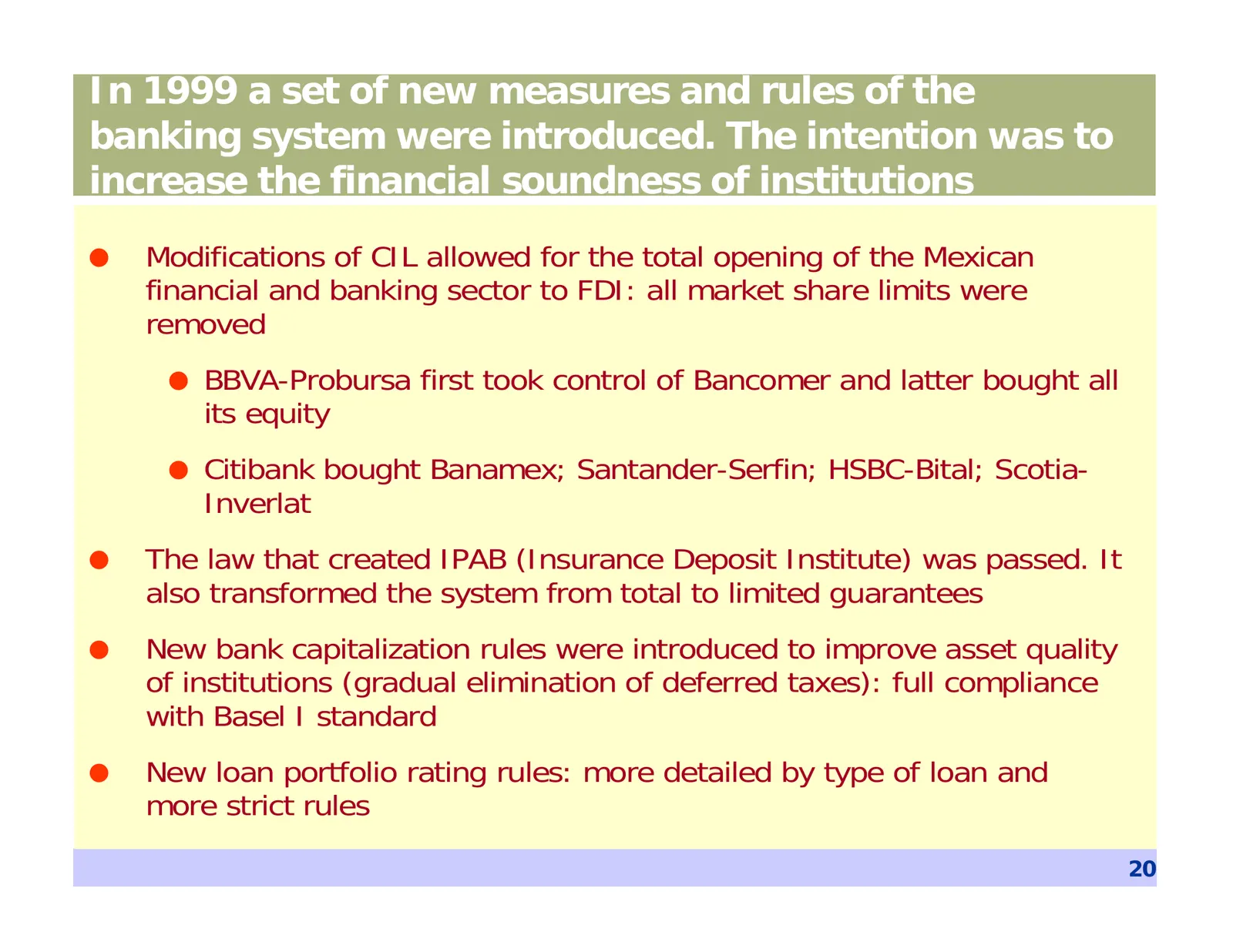
Slide 20: New measures and rules of the banking system in 1999
In 1999 a set of new measures and rules of the banking system were introduced. The intention was to increase the financial soundness of institutions O Modifications of CIL allowed for the total opening of the Mexican financial and banking sector to FDI: all market share limits were removed O BBVA-Pr
Slide 21: Legal framework improvements for lending in 2000
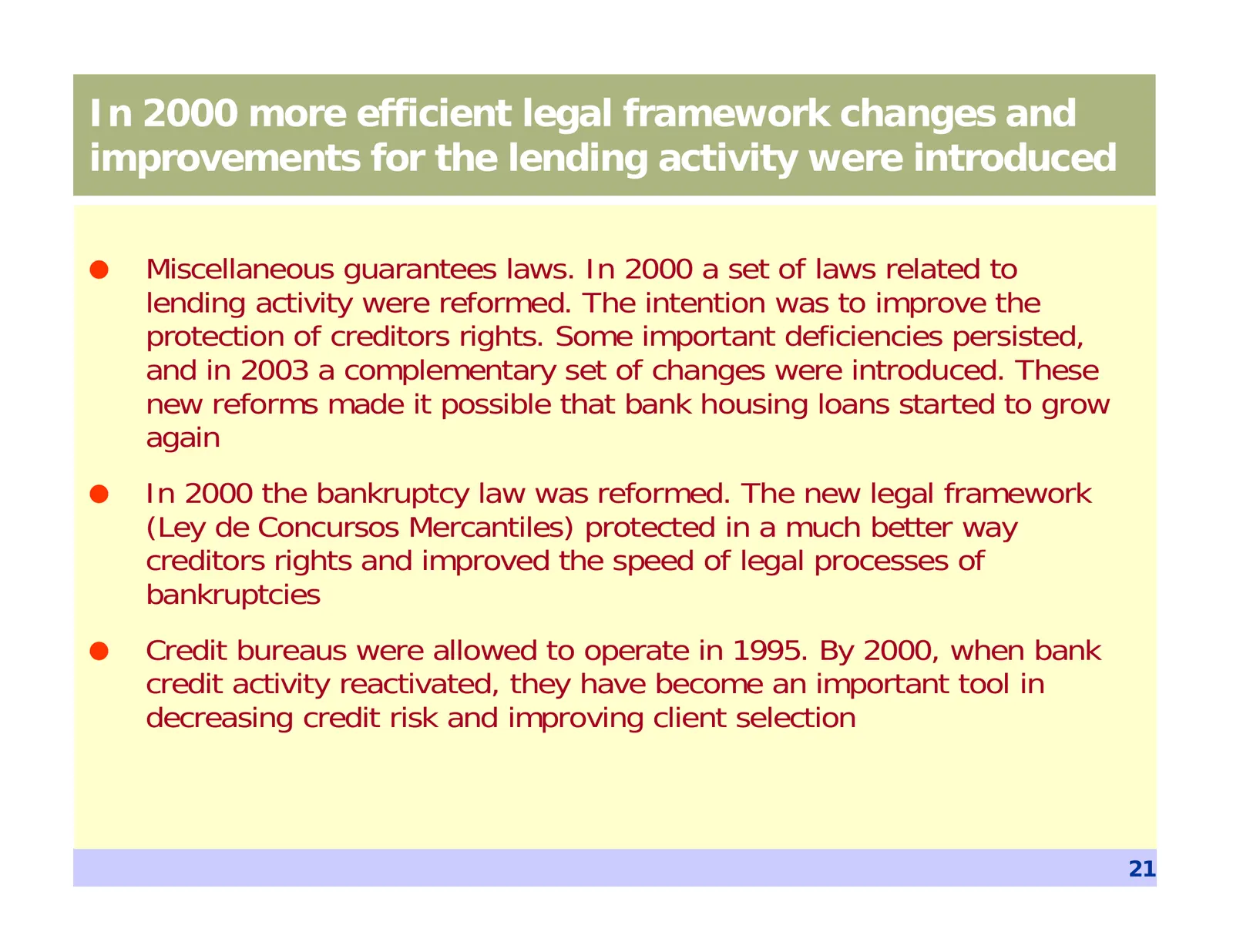
In 2000 more efficient legal framework changes and improvements for the lending activity were introduced O Miscellaneous guarantees laws. In 2000 a set of laws related to lending activity were reformed. The intention was to improve the protection of creditors rights. Some important deficiencies pers
Slide 22: Consolidation and internationalization of the banking sector
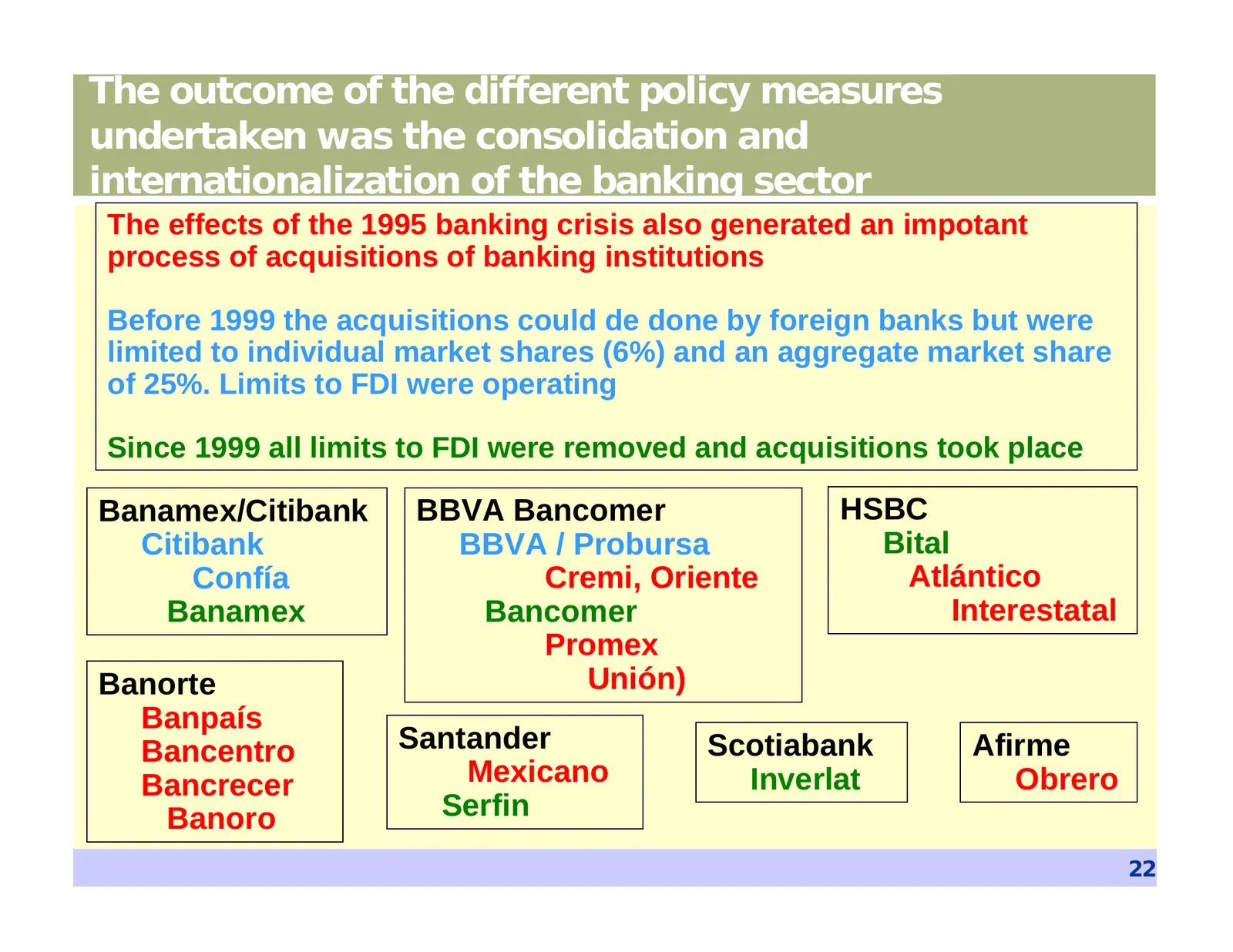
The outcome of the different policy measures undertaken was the consolidation and internationalization of the banking sector The effects of the 1995 banking crisis also generated an impotant process of acquisitions of banking institutions Before 1999 the acquisitions could de done by foreign banks b
Slide 23: Internationalization of the banking sector since 2000
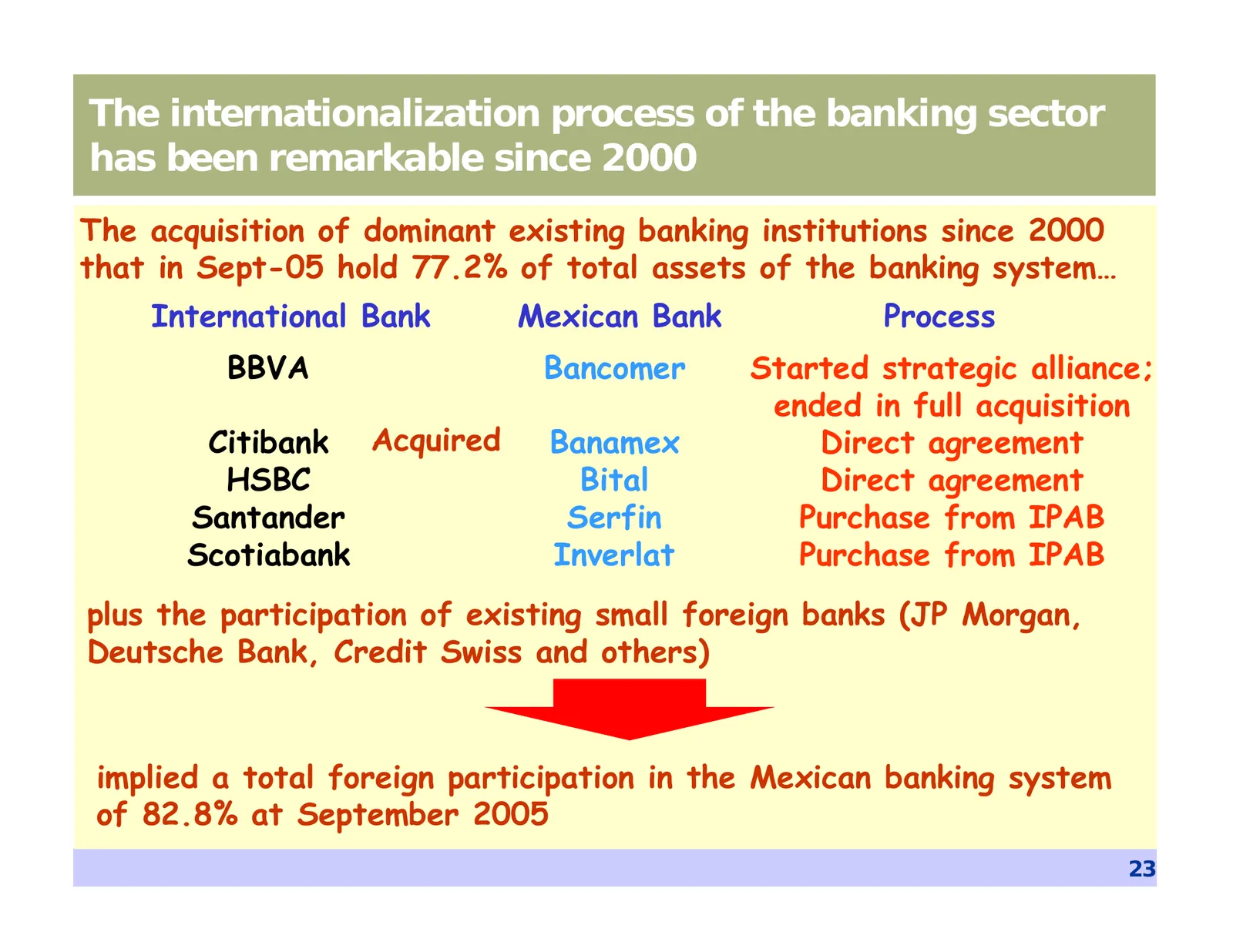
The internationalization process of the banking sector has been remarkable since 2000 The acquisition of dominant existing banking institutions since 2000 that in Sept-05 hold 77.2% of total assets of the banking system… International Bank Mexican Bank Process BBVA Bancomer Started strategic allianc
Slide 24: Index
Index One step back and two steps forward: nationalization, privatization and opening to FDI Effects of the 1995 crisis in the banking sector New financial institutions: Sofoles and Afores Banking system since 1999 Bank lending activity Traditional deposits, mutual funds and other deposits Links bet
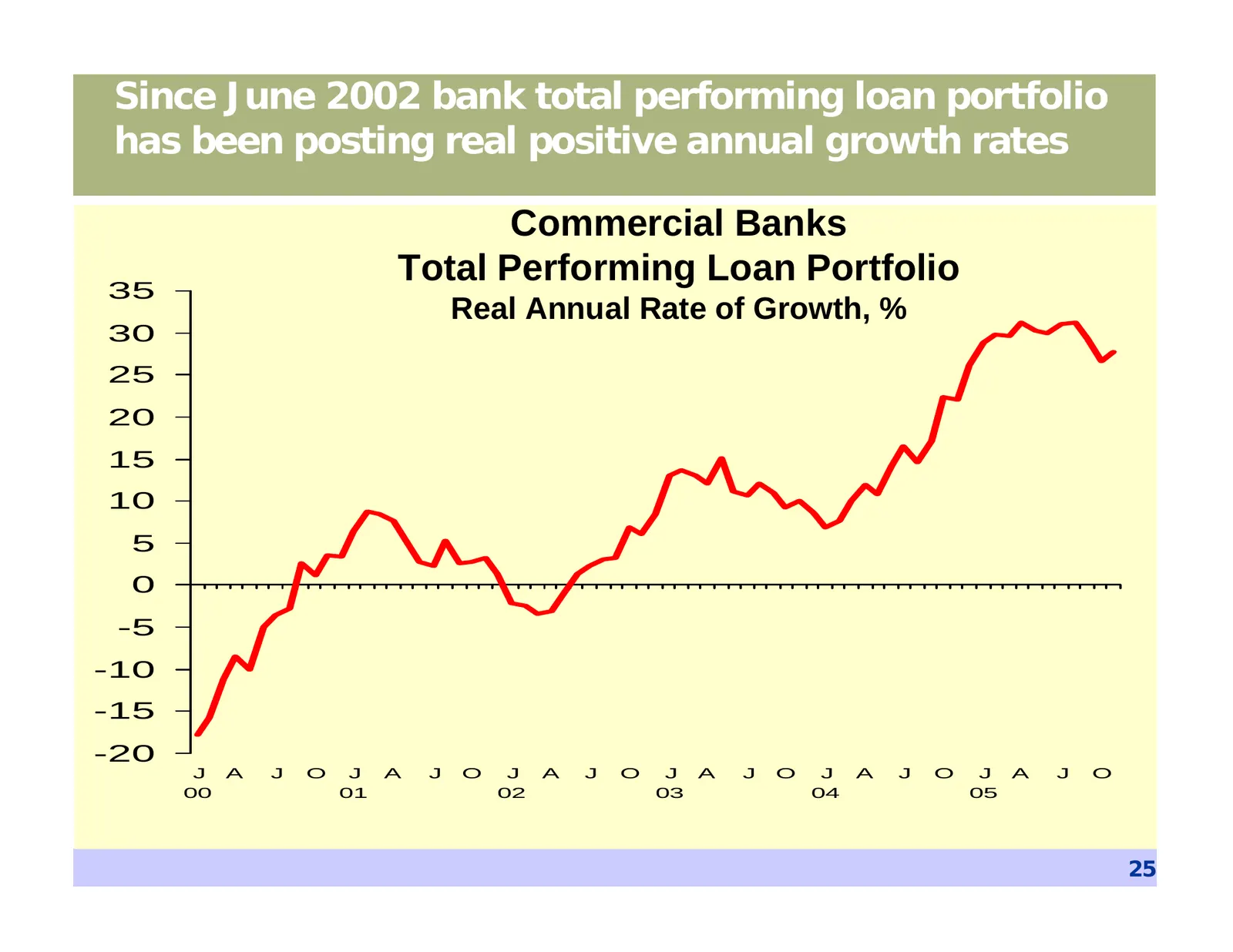
Slide 25: Performing loan portfolio growing in real terms since June 2002
Since June 2002 bank total performing loan portfolio has been posting real positive annual growth rates Commercial Banks Total Performing Loan Portfolio 35 Real Annual Rate of Growth, % 30 25 20 15 10 5 0 -5 -10 -15 -20 J A J O J A J O J A J O J A J O J A J O J A J O 00 01 02 03 04 05 25
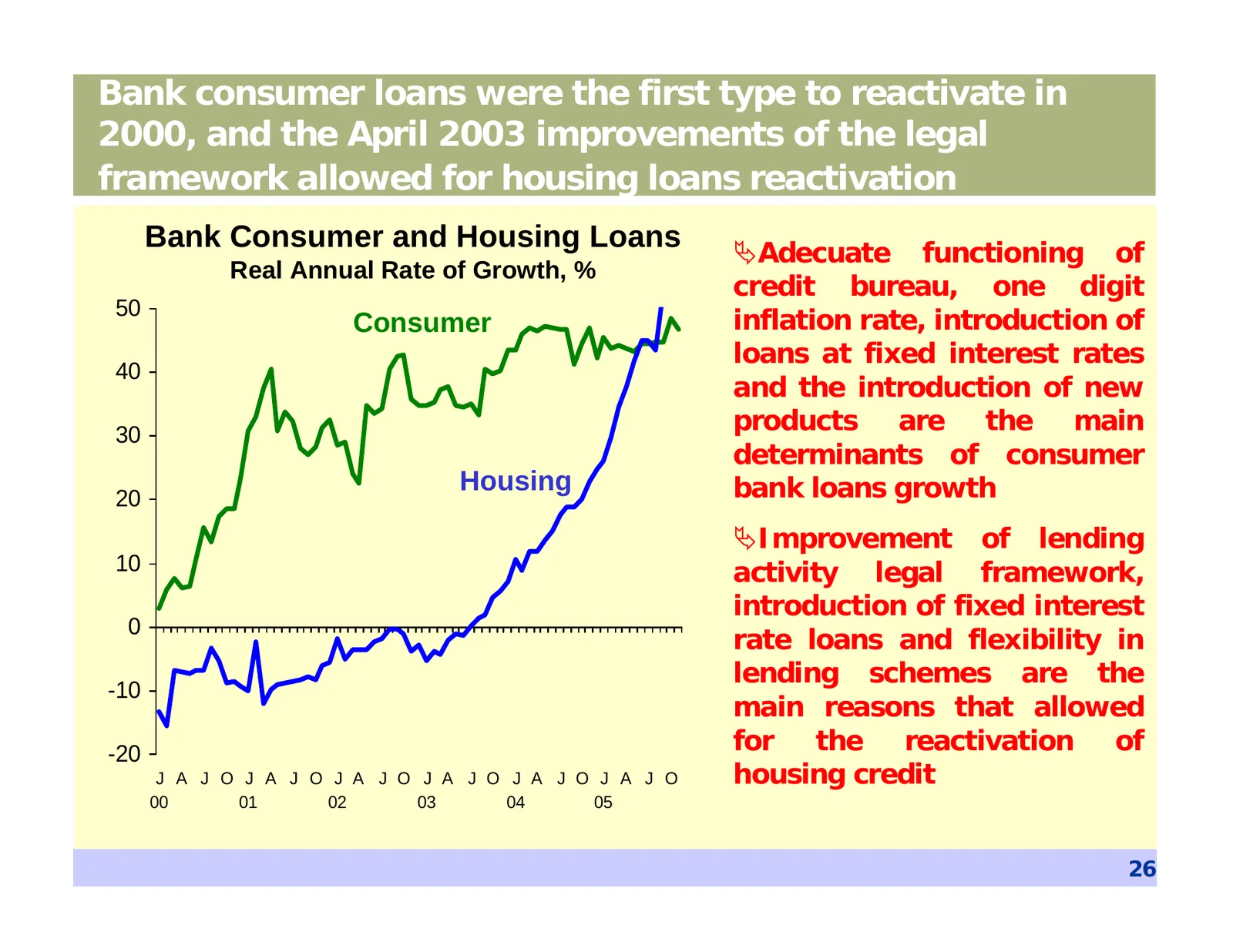
Slide 26: Consumer loans reactivated first, then housing loans
Bank consumer loans were the first type to reactivate in 2000, and the April 2003 improvements of the legal framework allowed for housing loans reactivation Bank Consumer and Housing Loans ªAdecuate functioning of Real Annual Rate of Growth, % credit bureau, one digit 50 Consumer inflation rate, int
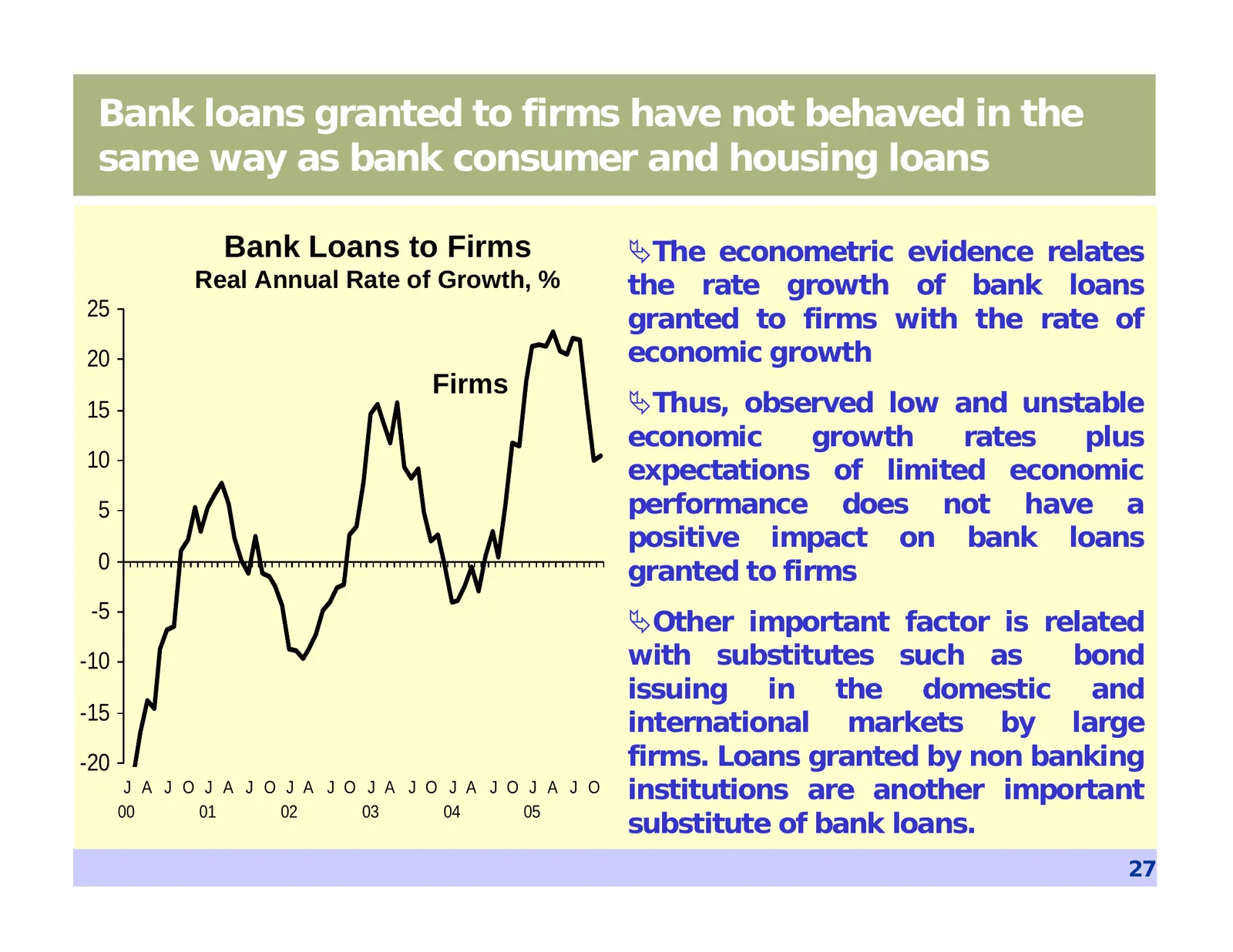
Slide 27: Loans to firms have not behaved like consumer and housing loans
Bank loans granted to firms have not behaved in the same way as bank consumer and housing loans Bank Loans to Firms ªThe econometric evidence relates Real Annual Rate of Growth, % the rate growth of bank loans 25 granted to firms with the rate of 20 economic growth Firms 15 ªThus, observed low and u
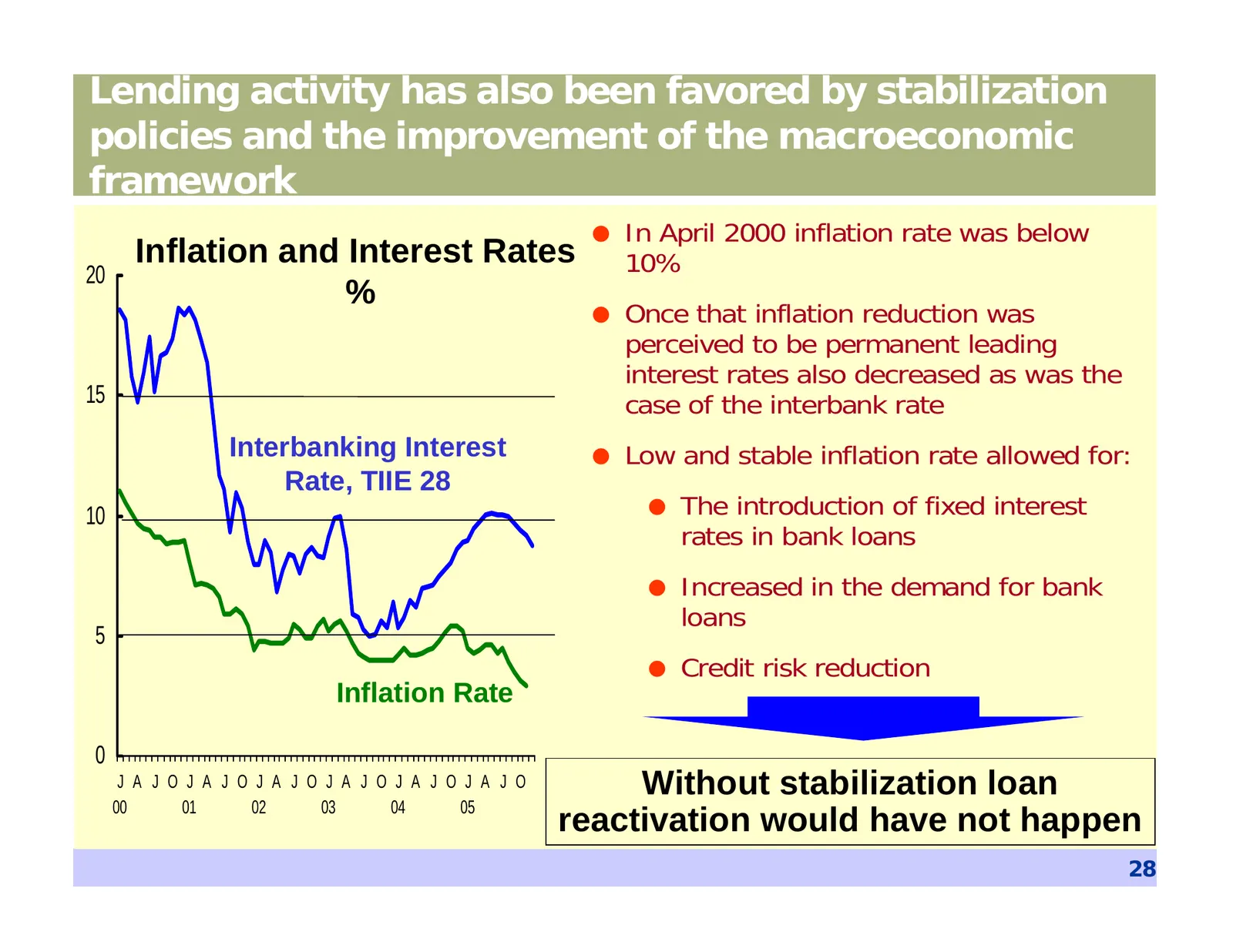
Slide 28: Lending favored by stabilization policies
Lending activity has also been favored by stabilization policies and the improvement of the macroeconomic framework O In April 2000 inflation rate was below Inflation and Interest Rates 10% 20 % O Once that inflation reduction was perceived to be permanent leading interest rates also decreased as wa
Slide 29: Factors that allowed bank loan reactivation
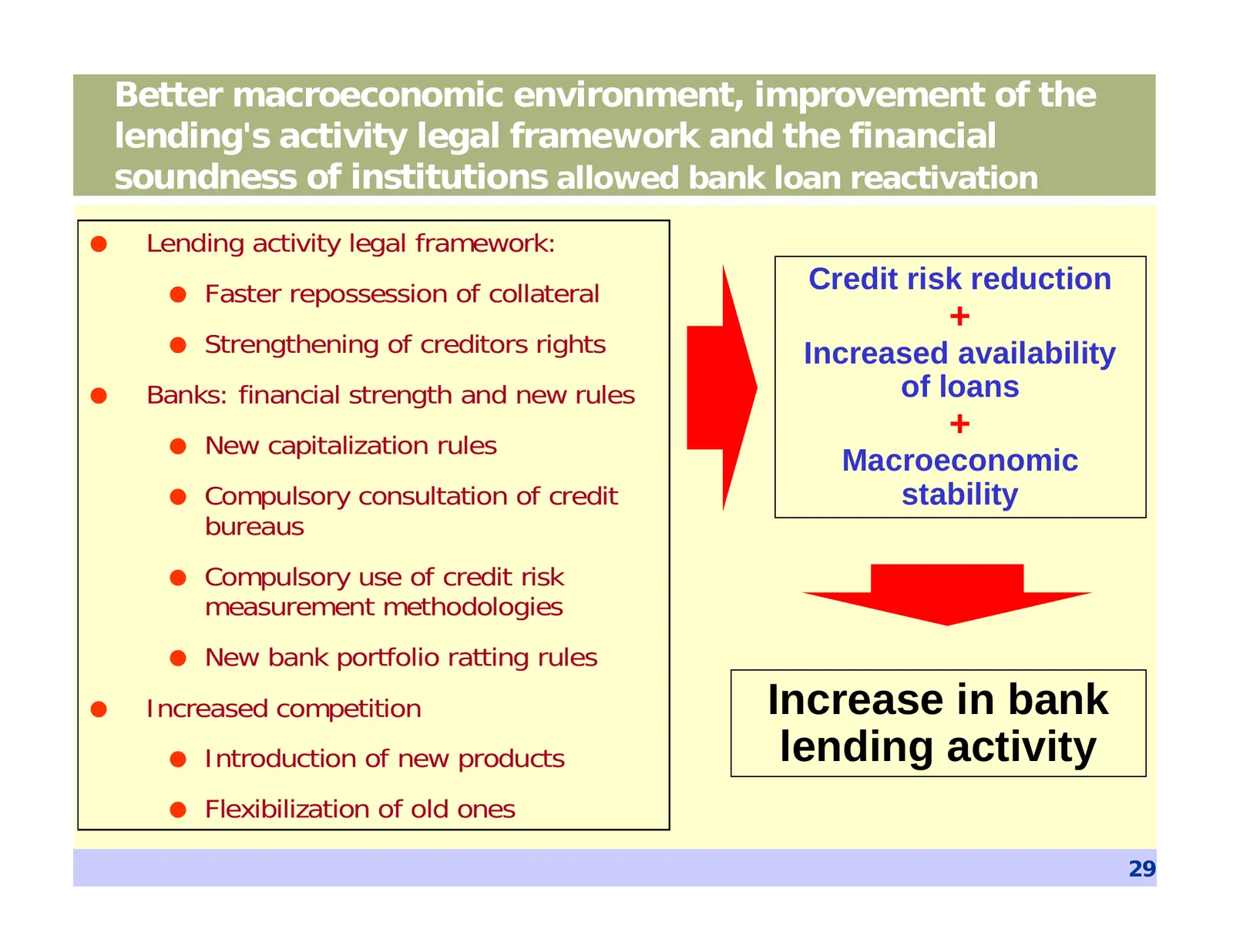
Better macroeconomic environment, improvement of the lending's activity legal framework and the financial soundness of institutions allowed bank loan reactivation O Lending activity legal framework: O Faster repossession of collateral Credit risk reduction + O Strengthening of creditors rights Incre
Slide 30: Bank loans relative to Dec-94 levels
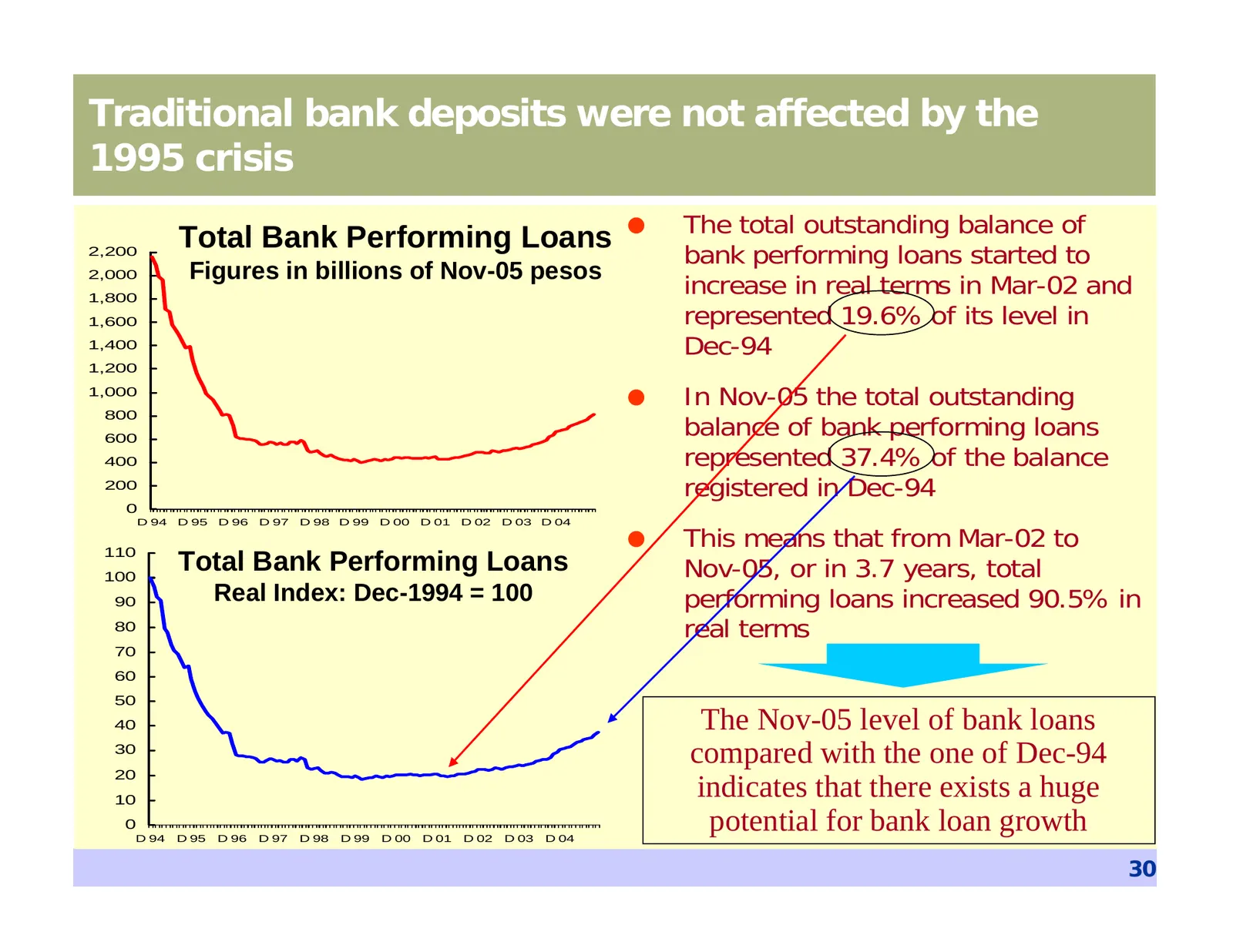
Traditional bank deposits were not affected by the 1995 crisis The total outstanding balance of Total Bank Performing Loans O 2,200 bank performing loans started to Figures in billions of Nov-05 pesos increase in real terms in Mar-02 and 2,000 1,800 1,600 represented 19.6% of its level in 1,400 Dec-
Slide 31: Performing loans as percentage of GDP
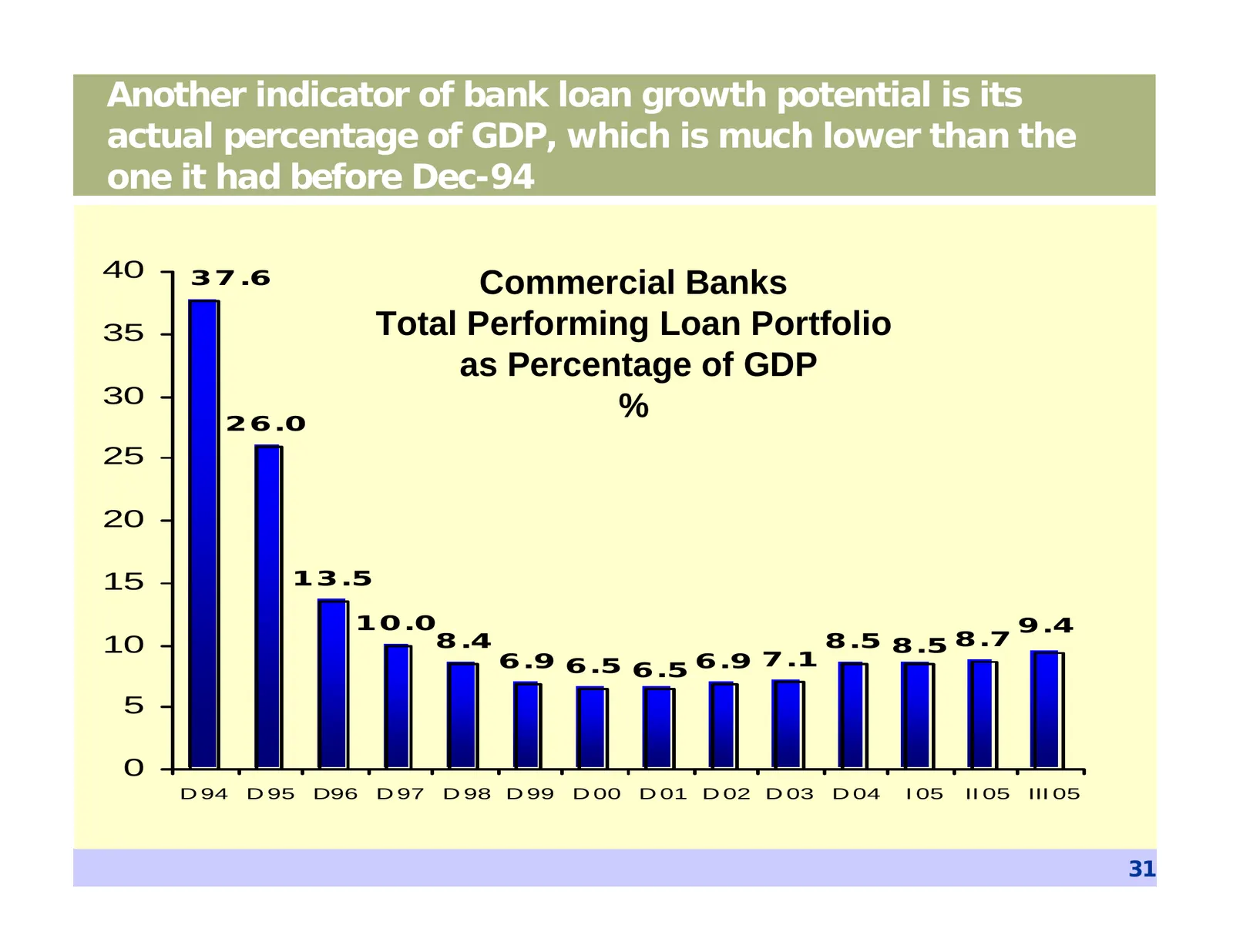
Another indicator of bank loan growth potential is its actual percentage of GDP, which is much lower than the one it had before Dec-94 40 3 7 .6 Commercial Banks 35 Total Performing Loan Portfolio as Percentage of GDP 30 2 6 .0 % 25 20 15 1 3 .5 1 0 .0 9 .4 10 8 .4 8 .5 8 .5 8 .7 6 .9 6 .5 6 .5 6 .9
Slide 32: Index
Index One step back and two steps forward: nationalization, privatization and opening to FDI Effects of the 1995 crisis in the banking sector New financial institutions: Sofoles and Afores Banking system since 1999 Bank lending activity Traditional deposits, mutual funds and other deposits Links bet
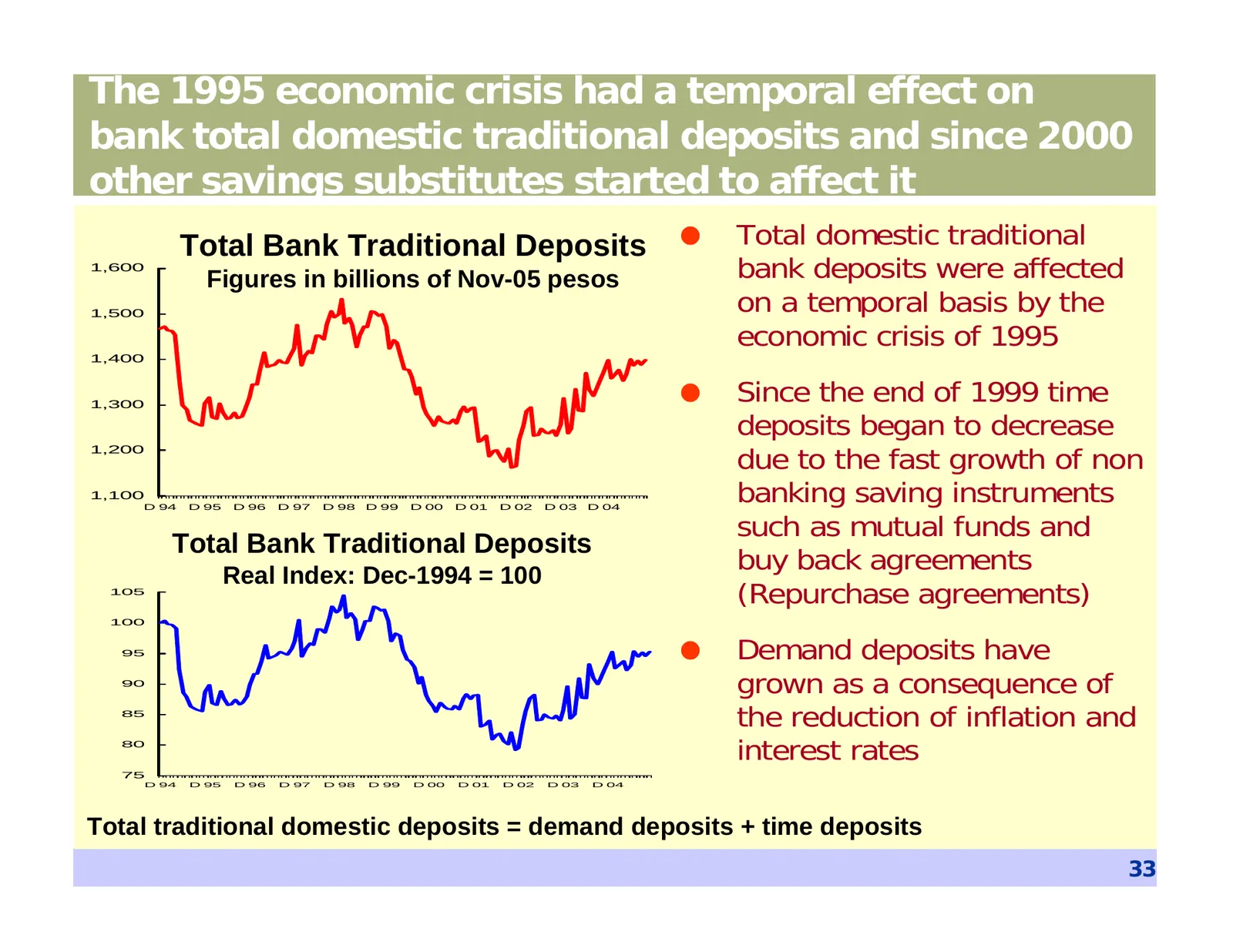
Slide 33: Effect of the 1995 crisis on traditional deposits
The 1995 economic crisis had a temporal effect on bank total domestic traditional deposits and since 2000 other savings substitutes started to affect it Total Bank Traditional Deposits O Total domestic traditional 1,600 Figures in billions of Nov-05 pesos bank deposits were affected 1,500 on a tempo
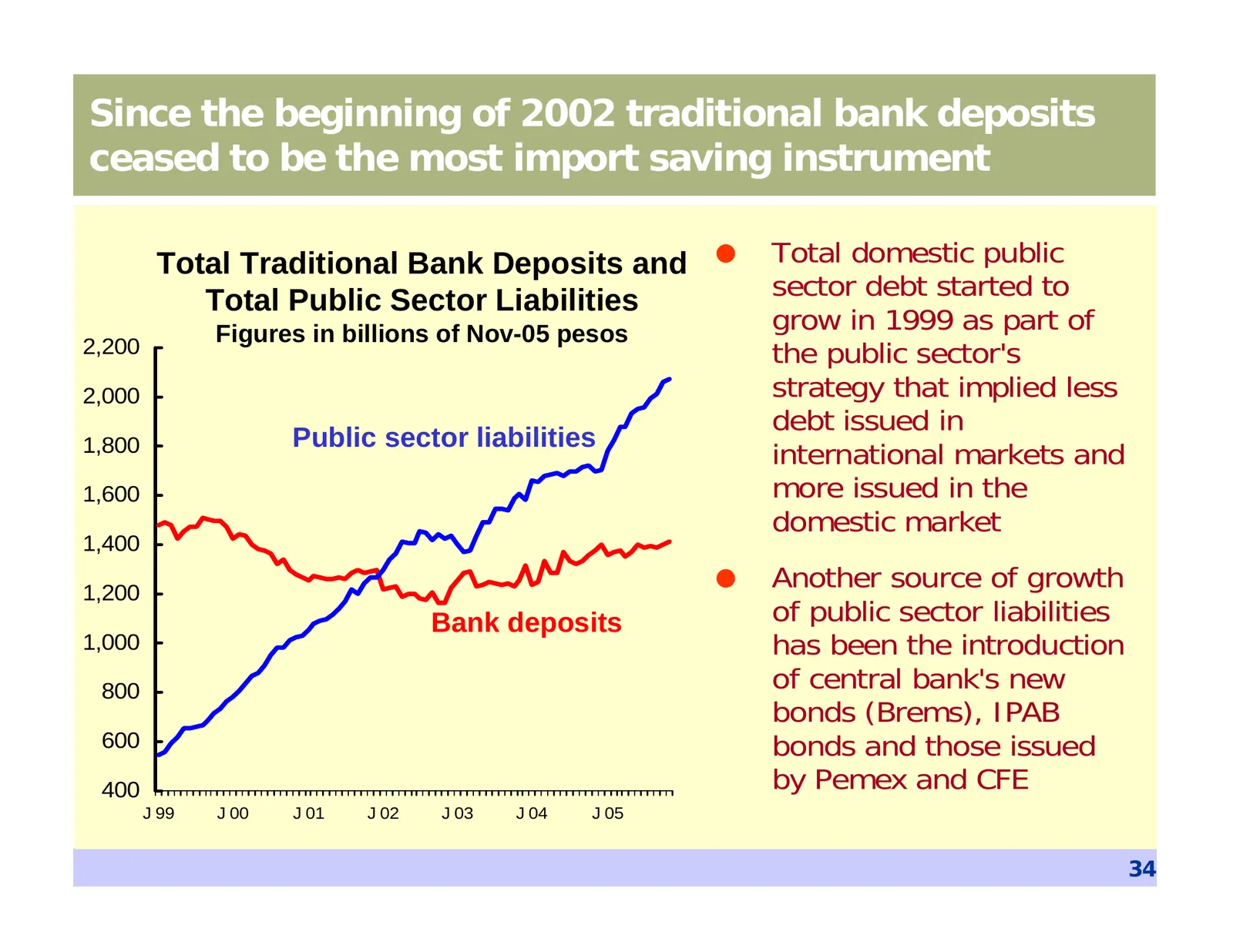
Slide 34: Traditional deposits ceased to be the most important saving instrument
Since the beginning of 2002 traditional bank deposits ceased to be the most import saving instrument Total Traditional Bank Deposits and O Total domestic public Total Public Sector Liabilities sector debt started to Figures in billions of Nov-05 pesos grow in 1999 as part of 2,200 the public sector'
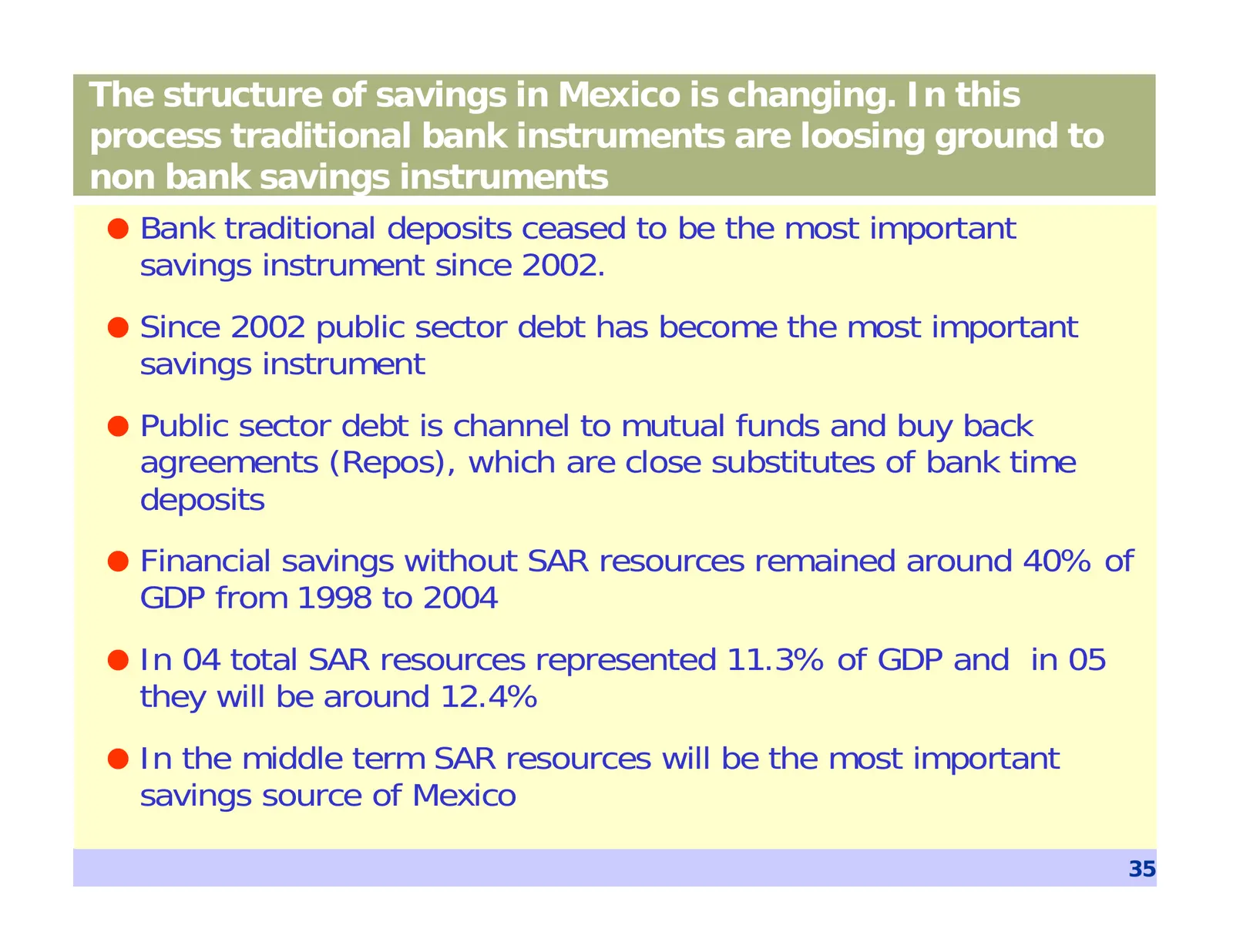
Slide 35: The structure of savings in Mexico is changing
The structure of savings in Mexico is changing. In this process traditional bank instruments are loosing ground to non bank savings instruments O Bank traditional deposits ceased to be the most important savings instrument since 2002. O Since 2002 public sector debt has become the most important sav
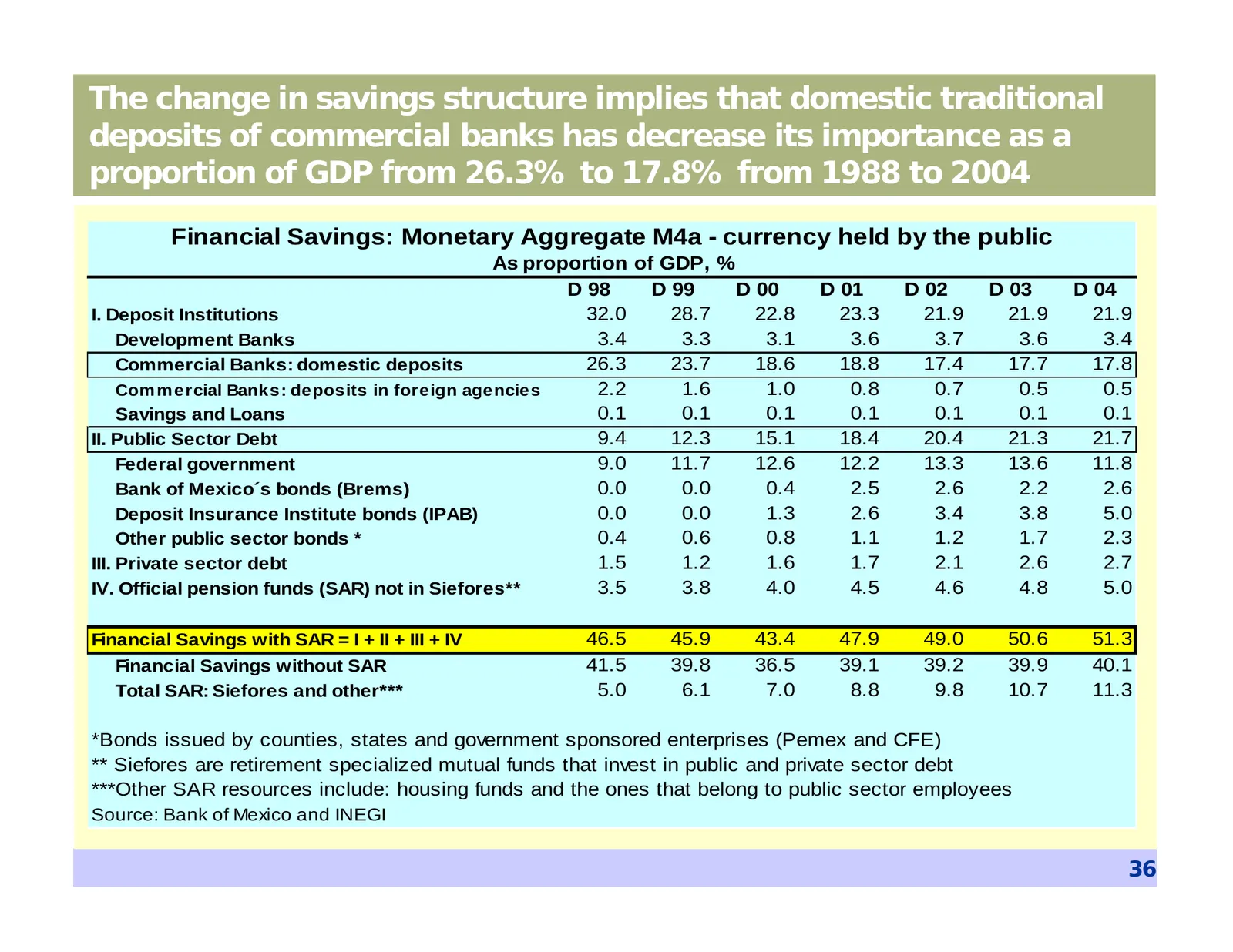
Slide 36: Deposits decreased in importance as a proportion of GDP
The change in savings structure implies that domestic traditional deposits of commercial banks has decrease its importance as a proportion of GDP from 26.3% to 17.8% from 1988 to 2004 Financial Savings: Monetary Aggregate M4a - currency held by the public As proportion of GDP, % D 98 D 99 D 00 D 01
Slide 37: Index
Index One step back and two steps forward: nationalization, privatization and opening to FDI Effects of the 1995 crisis in the banking sector New financial institutions: Sofoles and Afores Banking system since 1999 Bank lending activity Traditional deposits, mutual funds and other deposits Links bet
Slide 38: The current economic cycle is new in Mexico
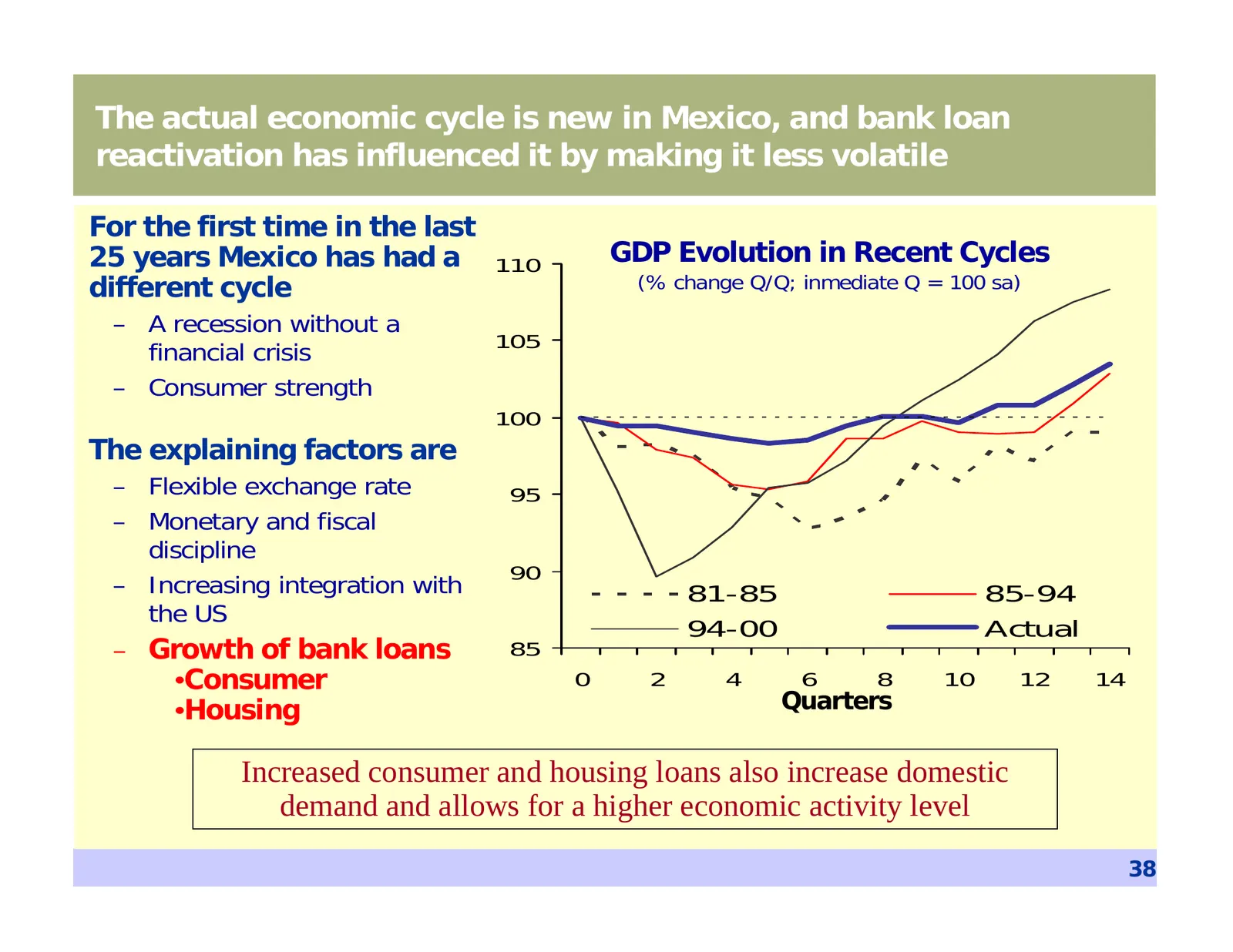
The actual economic cycle is new in Mexico, and bank loan reactivation has influenced it by making it less volatile For the first time in the last 25 years Mexico has had a 110 GDP Evolution in Recent Cycles different cycle (% change Q/Q; inmediate Q = 100 sa) – A recession without a 105 financial c
Slide 39: Bank loans were pro-cyclical in past cycles
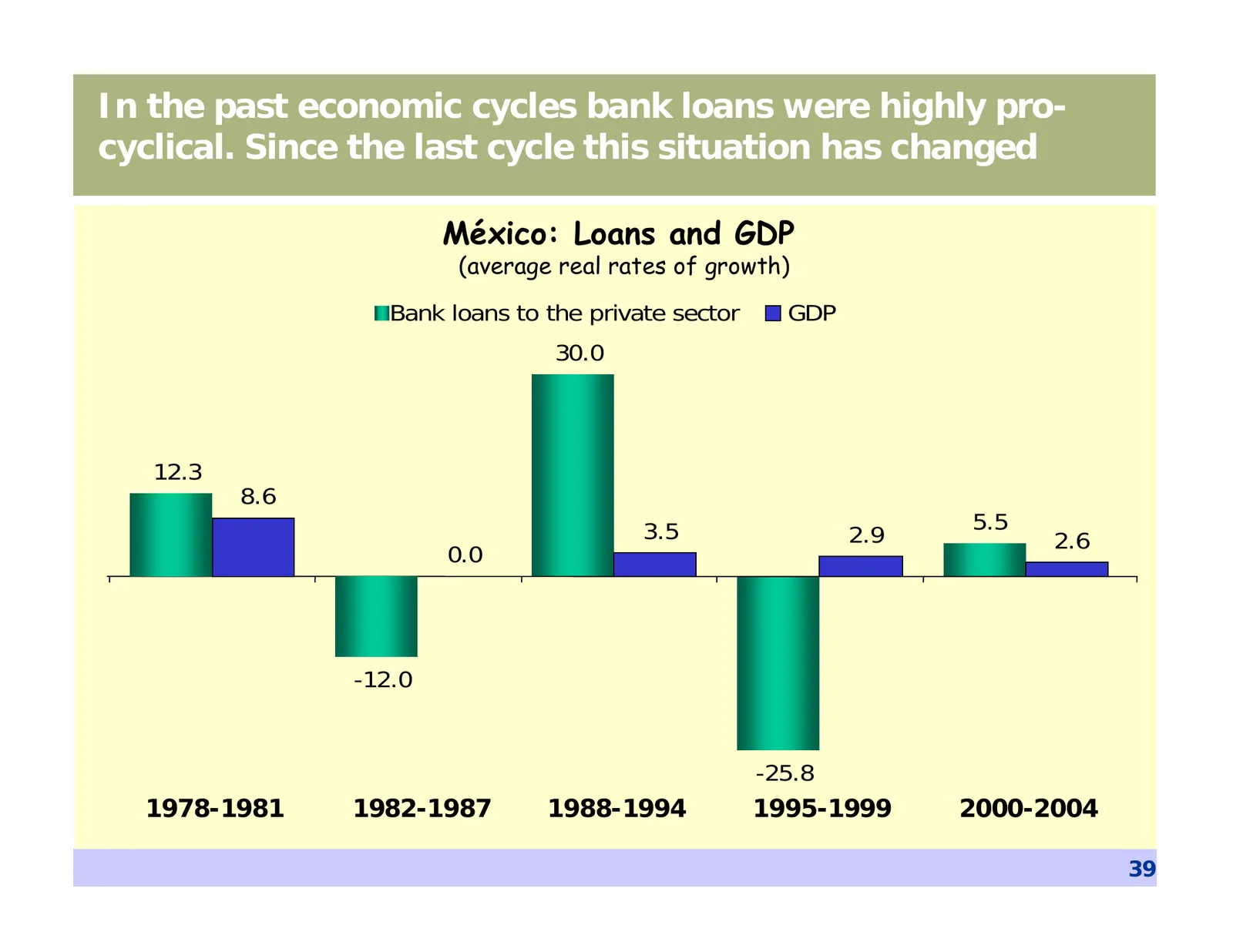
In the past economic cycles bank loans were highly pro- cyclical. Since the last cycle this situation has changed México: Loans and GDP (average real rates of growth) Bank loans to the private sector GDP 30.0 12.3 8.6 3.5 5.5 2.9 2.6 0.0 -12.0 -25.8 1978-1981 1982-1987 1988-1994 1995-1999 2000-2004
Slide 40: Index
Index One step back and two steps forward: nationalization, privatization and opening to FDI Effects of the 1995 crisis in the banking sector New financial institutions: Sofoles and Afores Banking system since 1999 Bank lending activity Traditional deposits, mutual funds and other deposits Links bet
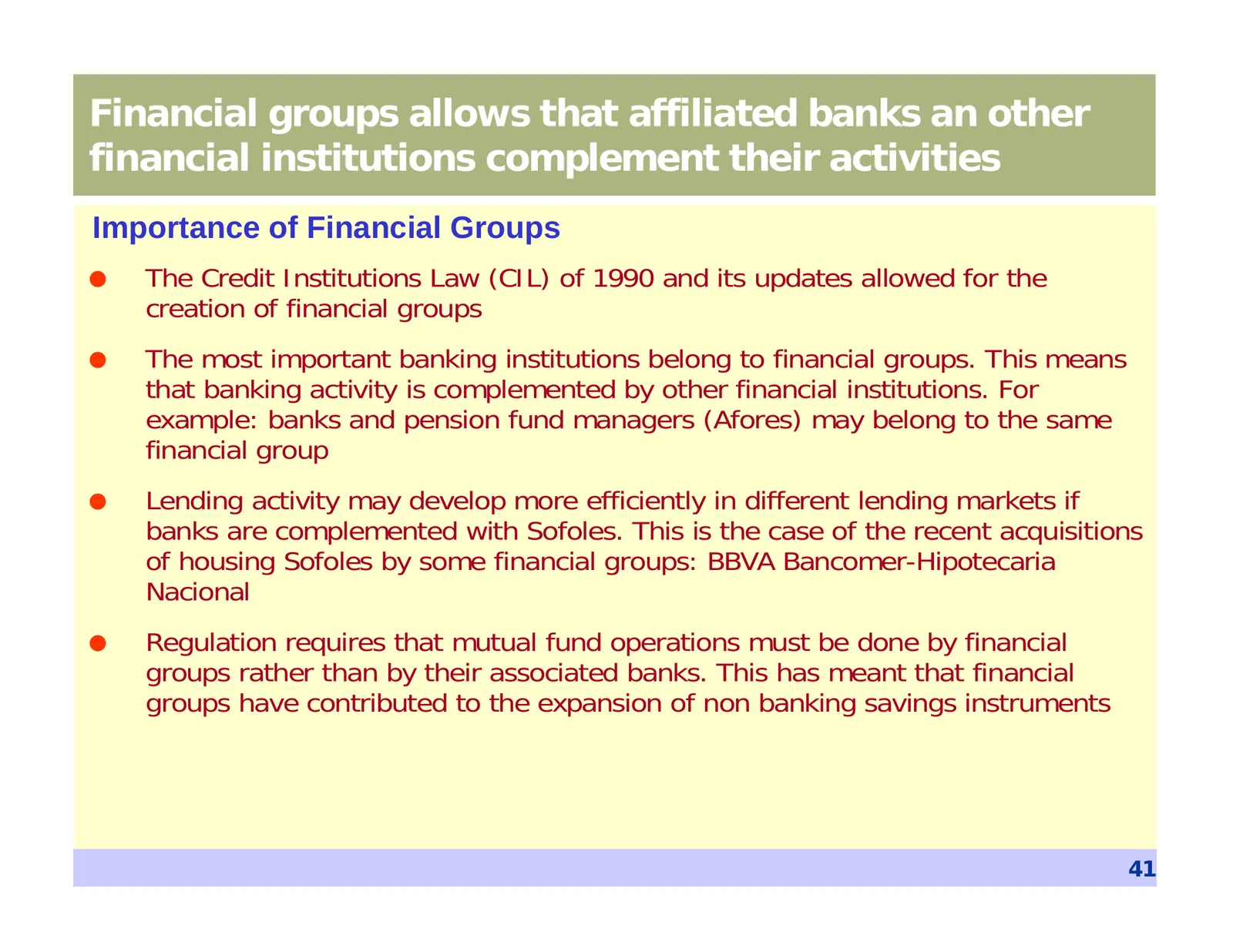
Slide 41: Financial groups allow affiliated institutions to complement activities
Financial groups allows that affiliated banks an other financial institutions complement their activities Importance of Financial Groups O The Credit Institutions Law (CIL) of 1990 and its updates allowed for the creation of financial groups O The most important banking institutions belong to financ
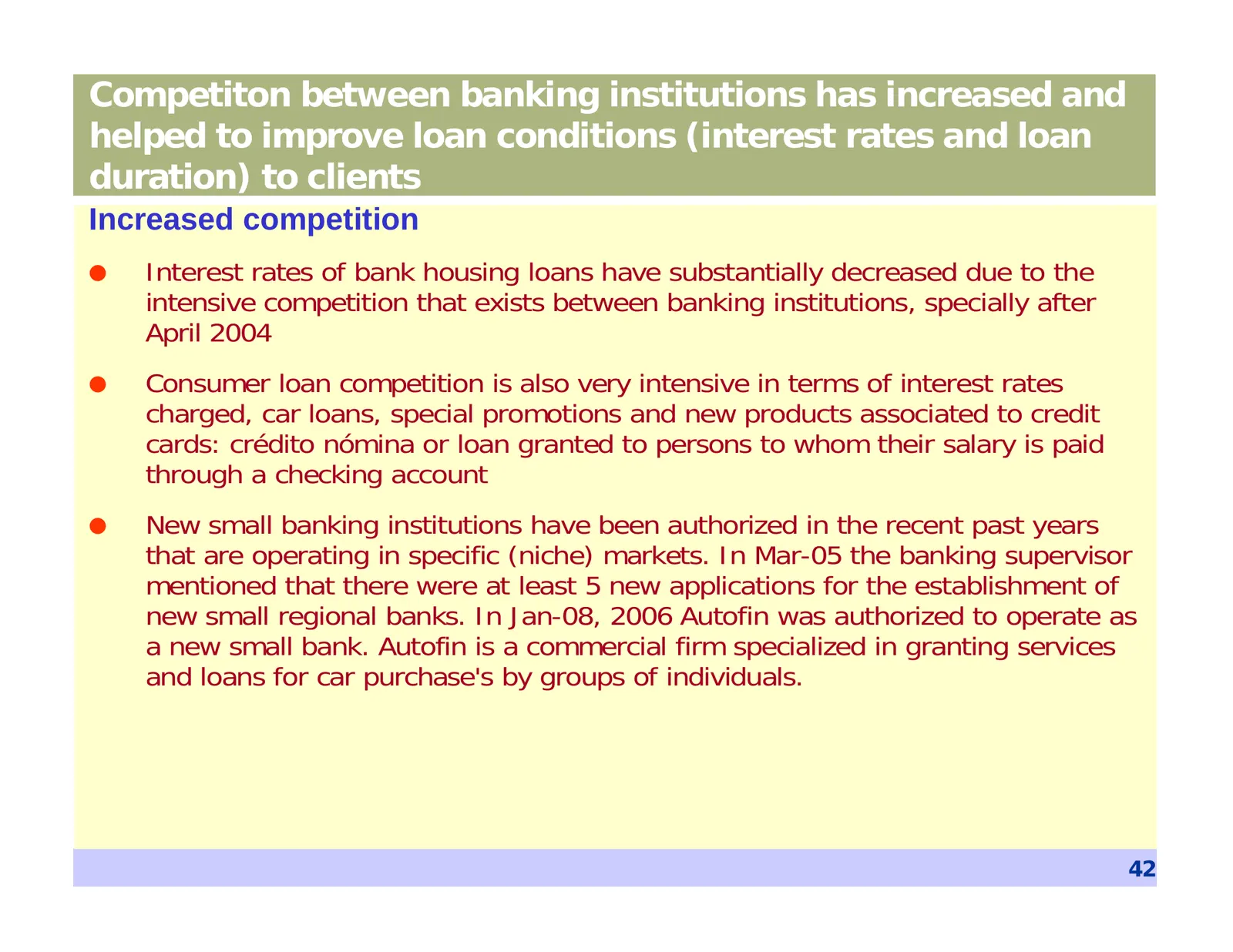
Slide 42: Competition between banks has increased
Competiton between banking institutions has increased and helped to improve loan conditions (interest rates and loan duration) to clients Increased competition O Interest rates of bank housing loans have substantially decreased due to the intensive competition that exists between banking institution
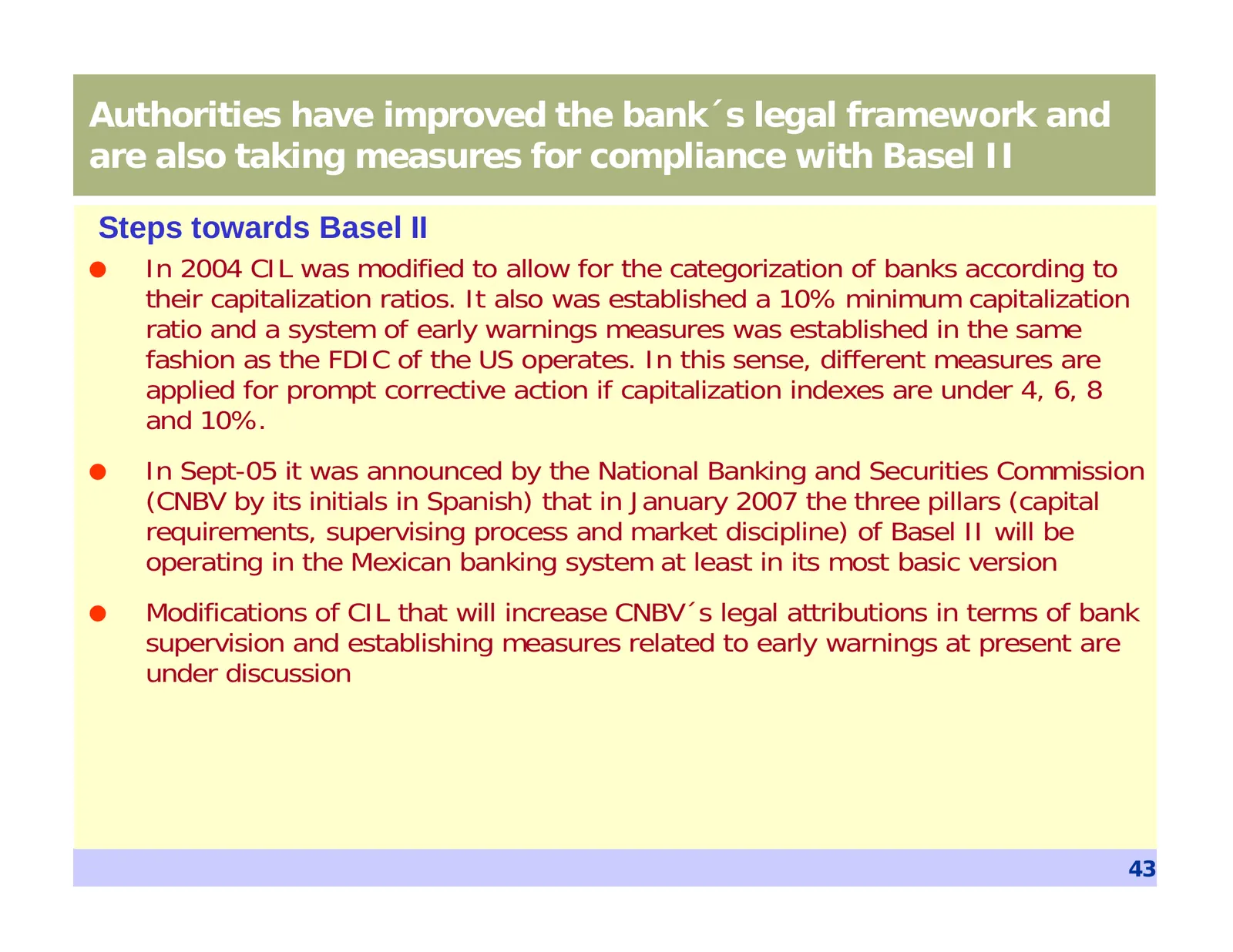
Slide 43: Improved legal framework and steps toward Basel II
Authorities have improved the bank´s legal framework and are also taking measures for compliance with Basel II Steps towards Basel II O In 2004 CIL was modified to allow for the categorization of banks according to their capitalization ratios. It also was established a 10% minimum capitalization rat
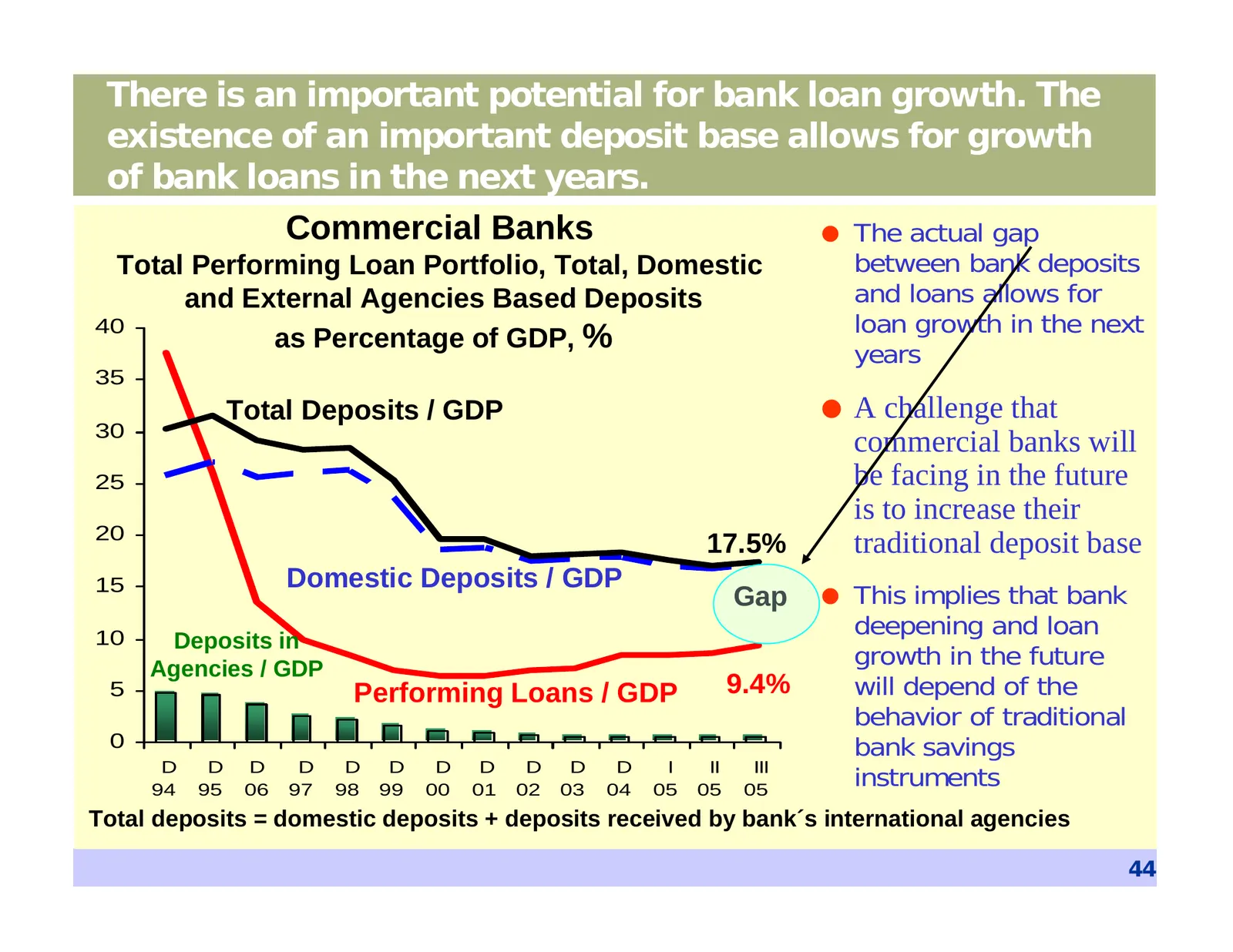
Slide 44: Important potential for bank loan growth
There is an important potential for bank loan growth. The existence of an important deposit base allows for growth of bank loans in the next years. Commercial Banks O The actual gap Total Performing Loan Portfolio, Total, Domestic between bank deposits and External Agencies Based Deposits and loans
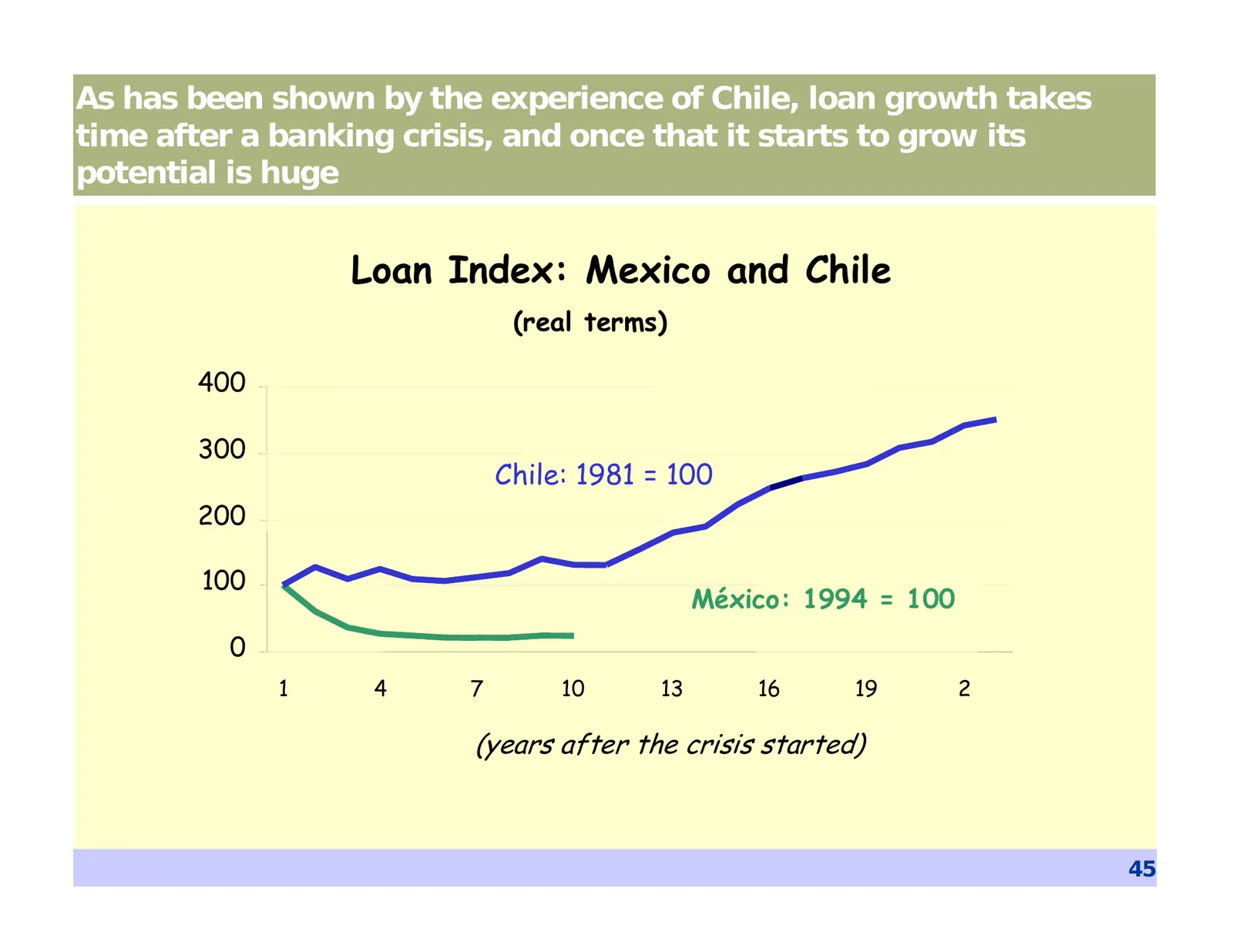
Slide 45: Loan Index: Mexico and Chile
As has been shown by the experience of Chile, loan growth takes time after a banking crisis, and once that it starts to grow its potential is huge Loan Index: Mexico and Chile (real terms) 400 300 Chile: 1981 = 100 200 100 México: 1994 = 100 0 1 4 7 10 13 16 19 2 (years after the crisis started) 45
Slide 46: Index
Index One step back and two steps forward: nationalization, privatization and opening to FDI Effects of the 1995 crisis in the banking sector New financial institutions: Sofoles and Afores Banking system since 1999 Bank lending activity Traditional deposits, mutual funds and other deposits Links bet
Slide 47: Conclusions
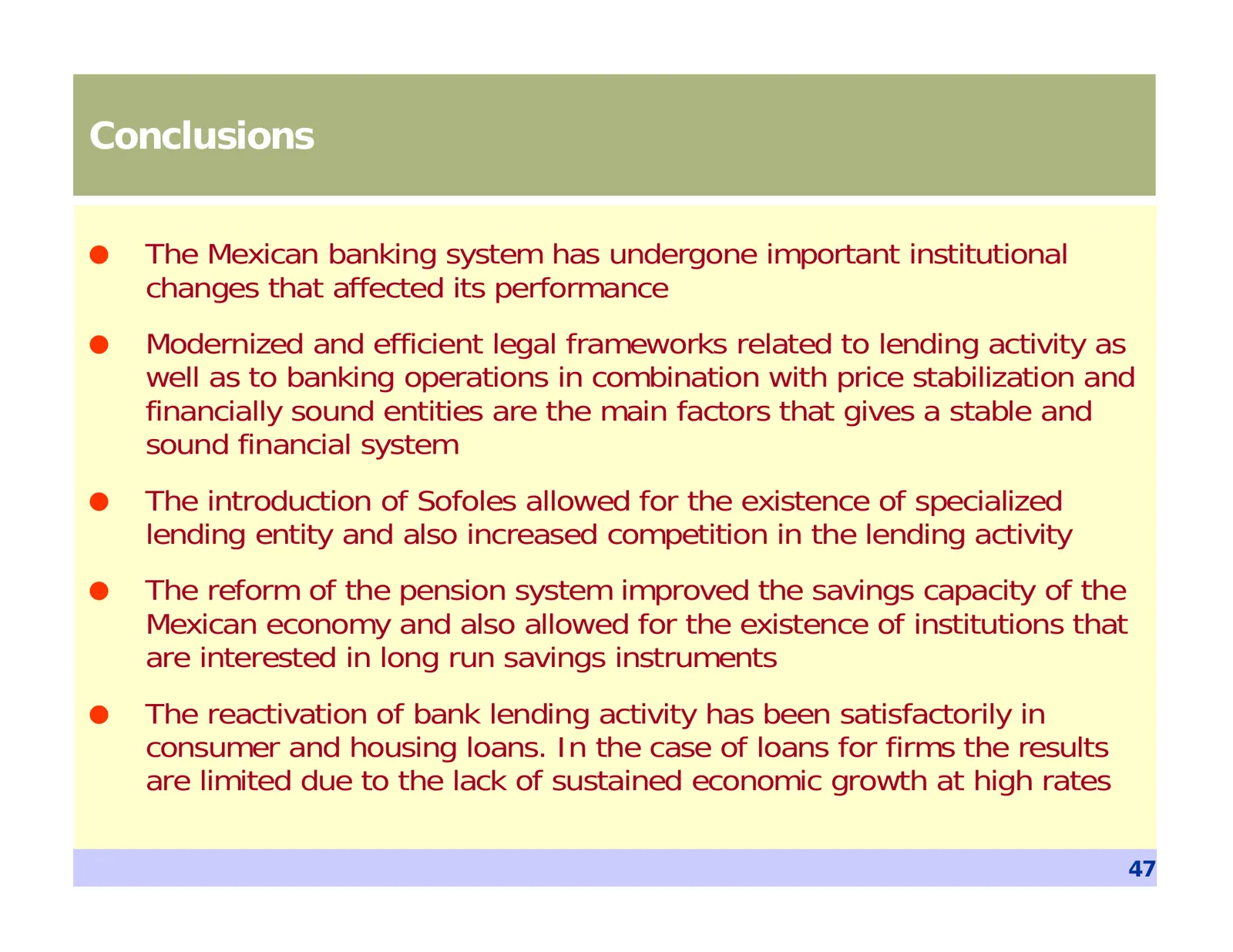
Conclusions O The Mexican banking system has undergone important institutional changes that affected its performance O Modernized and efficient legal frameworks related to lending activity as well as to banking operations in combination with price stabilization and financially sound entities are the
Slide 48: Conclusions
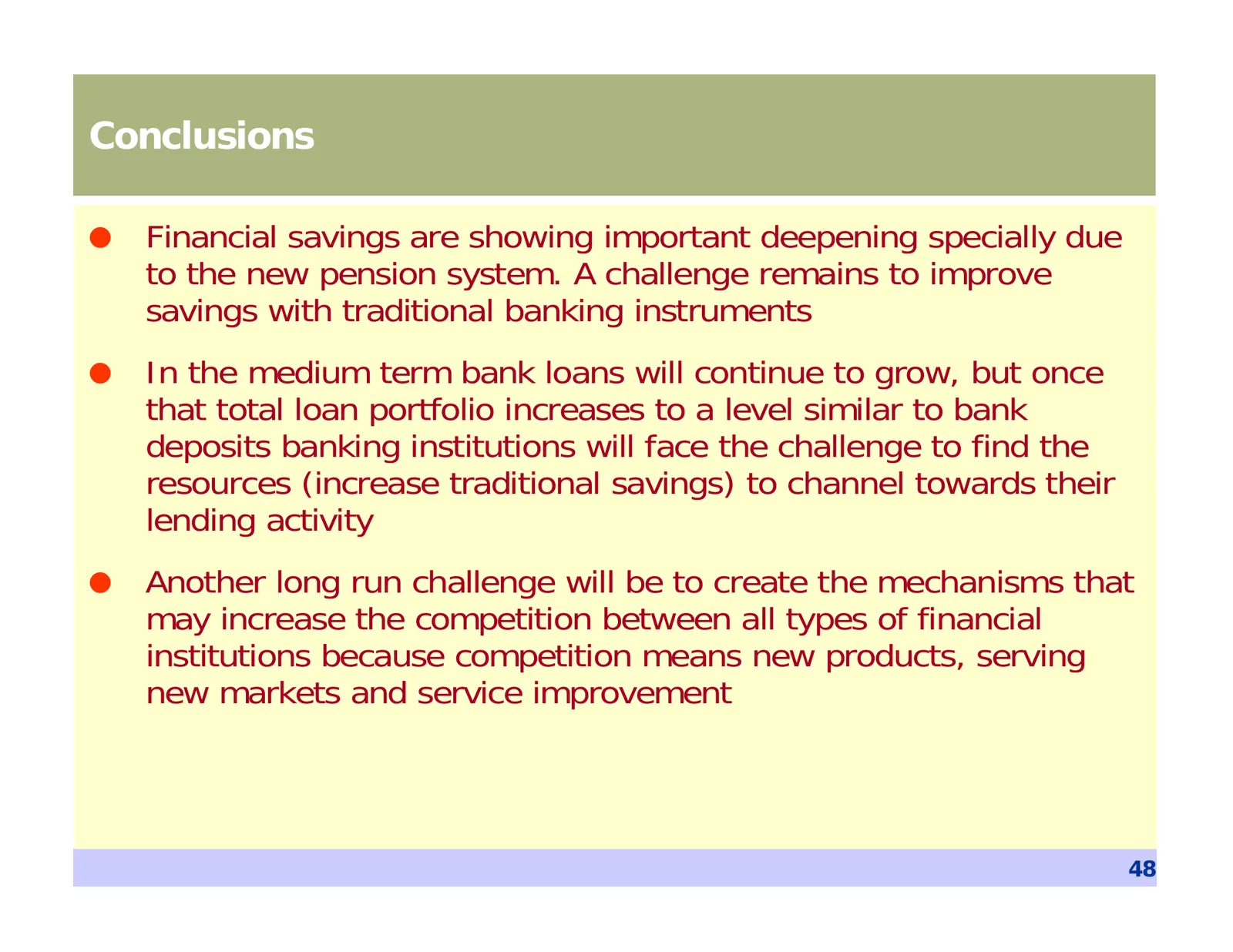
Conclusions O Financial savings are showing important deepening specially due to the new pension system. A challenge remains to improve savings with traditional banking instruments O In the medium term bank loans will continue to grow, but once that total loan portfolio increases to a level similar
Slide 49: Mexican Banking and Financial System
Mexican Banking and Financial System A journey from nationalization to consolidation Economic Research Department January 2006 49
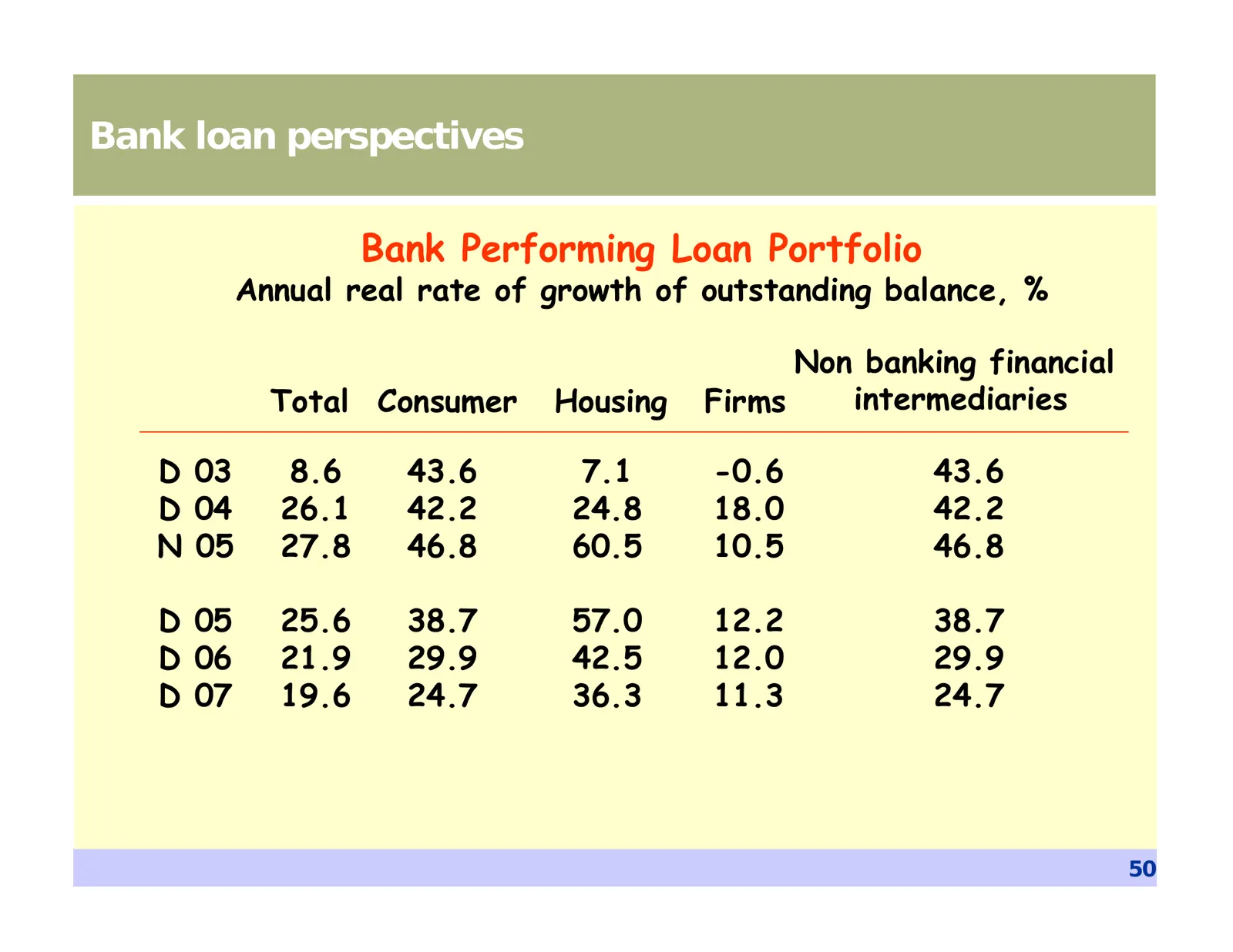
Slide 50: Bank loan perspectives
Bank loan perspectives Bank Performing Loan Portfolio Annual real rate of growth of outstanding balance, % Non banking financial Total Consumer Housing Firms intermediaries D 03 8.6 43.6 7.1 -0.6 43.6 D 04 26.1 42.2 24.8 18.0 42.2 N 05 27.8 46.8 60.5 10.5 46.8 D 05 25.6 38.7 57.0 12.2 38.7 D 06 21.9
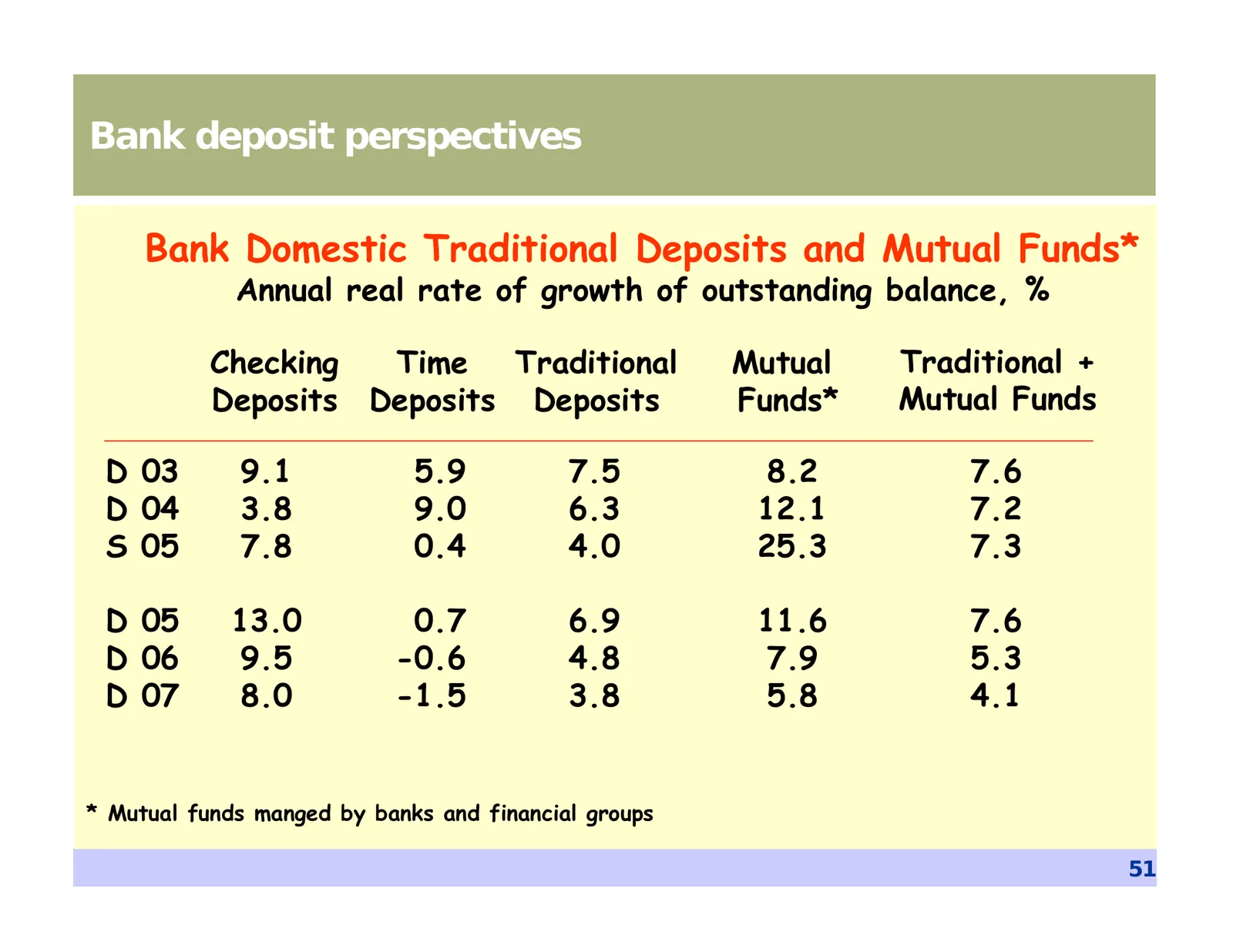
Slide 51: Bank deposit perspectives
Bank deposit perspectives Bank Domestic Traditional Deposits and Mutual Funds* Annual real rate of growth of outstanding balance, % Checking Time Traditional Mutual Traditional + Deposits Deposits Deposits Funds* Mutual Funds D 03 9.1 5.9 7.5 8.2 7.6 D 04 3.8 9.0 6.3 12.1 7.2 S 05 7.8 0.4 4.0 25.3 7
Source: Internet Archive copy of serviciodeestudios.bbva.com
More decks from Banco Bilbao Vizcaya Argentaria, S.A.
 Q3 2026 Earnings Presentation31 slides · November 2026
 Debt Investor Presentation (November 2026)60 slides · November 2026
 BBVA — Q3 2026 Earnings Presentation53 slides · Oct 29, 2026
 BBVA — Q2 2026 Earnings Presentation31 slides · Sep 1, 2026
 Q2 2026 Earnings Presentation53 slides · Jul 31, 2026
 Q2 2026 Earnings Presentation53 slides · Jul 30, 2026