Fibrocell Science — Barclays Global Healthcare Conference 2014
28 slides from Fibrocell Science's conference presentation, Mar 12, 2014
Slide 1: Fibrocell Corporate Presentation, Barclays Global Healthcare Conference
Fibrocell Corporate Presentation Barclays Global Healthcare Conference March 12, 2014
Slide 2: Forward Looking Statement
2 Forward Looking Statement This presentation includes statements that are “forward - looking statements.” Forward - looking statements include, without limitation, our ability ( i ) to timely enroll, commence and successfully complete our clinical programs, (ii) to successfully genetically modify t
Slide 3: Investment Highlights
Investment Highlights • Fibrocell is the scientific and commercial leader in autologous fibroblasts for high - value human therapeutic applications • Leverage azficel - T BLA for multiple follow - on indications – Demonstrated ability to manufacture autologous therapy – Moderate to severe nasolabial
Slide 4: The Leader in Autologous Fibroblasts
The Leader in Autologous Fibroblasts • The scientific and commercial leader in autologous fibroblasts, the most common cells in connective tissue − Localized drug delivery advantage − Autologous cells reduce risk of patient rejection − Unique expertise in collection and cultivation of fibroblasts •
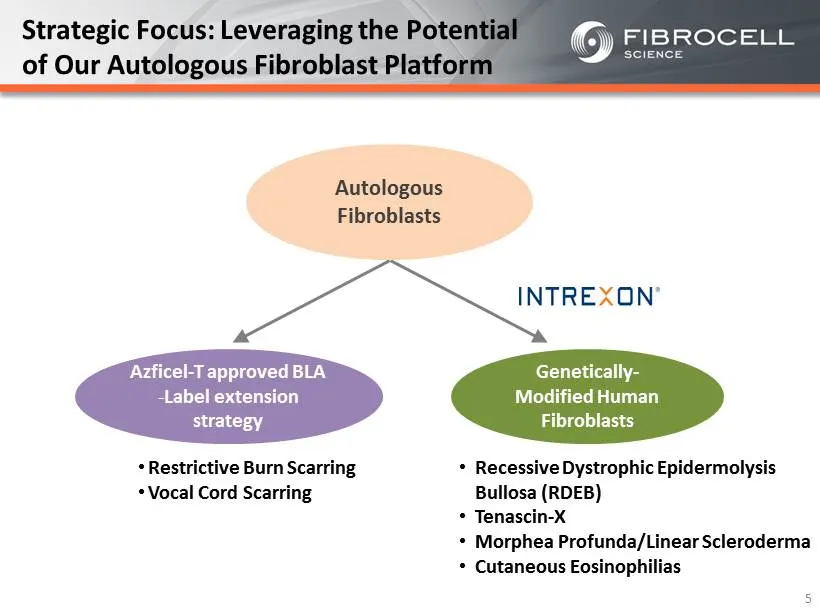
Slide 5: Strategic Focus: Leveraging the Potential of Our Autologous Fibroblast Platform
Strategic Focus: Leveraging the Potential of Our Autologous Fibroblast Platform Autologous Fibroblasts • Restrictive Burn Scarring • Vocal Cord Scarring • Recessive Dystrophic Epidermolysis Bullosa (RDEB) • Tenascin - X • Morphea Profunda /Linear Scleroderma • Cutaneous Eosinophilias Genetically - M
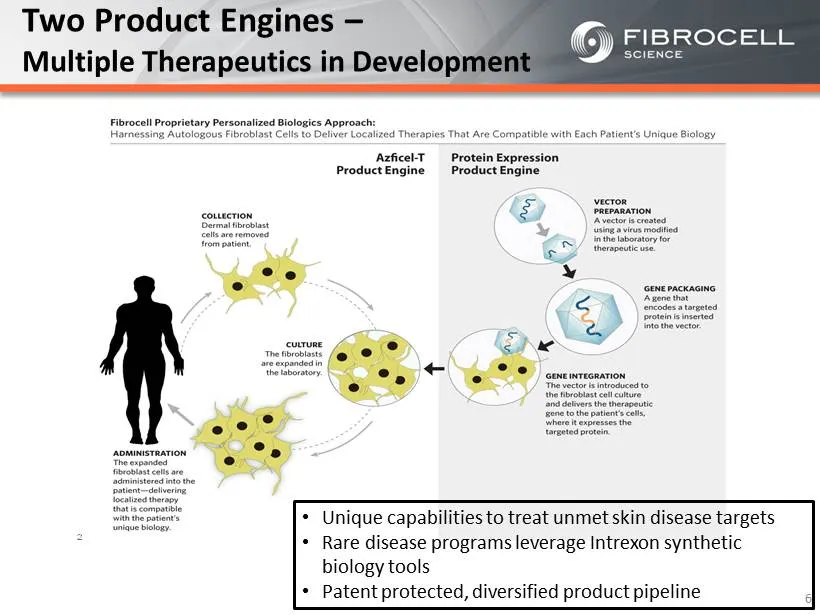
Slide 6: Two Product Engines – Multiple Therapeutics in Development
Two Product Engines – Multiple Therapeutics in Development 6 2 • Unique capabilities to treat unmet skin disease targets • Rare disease programs leverage Intrexon synthetic biology tools • Patent protected, diversified product pipeline
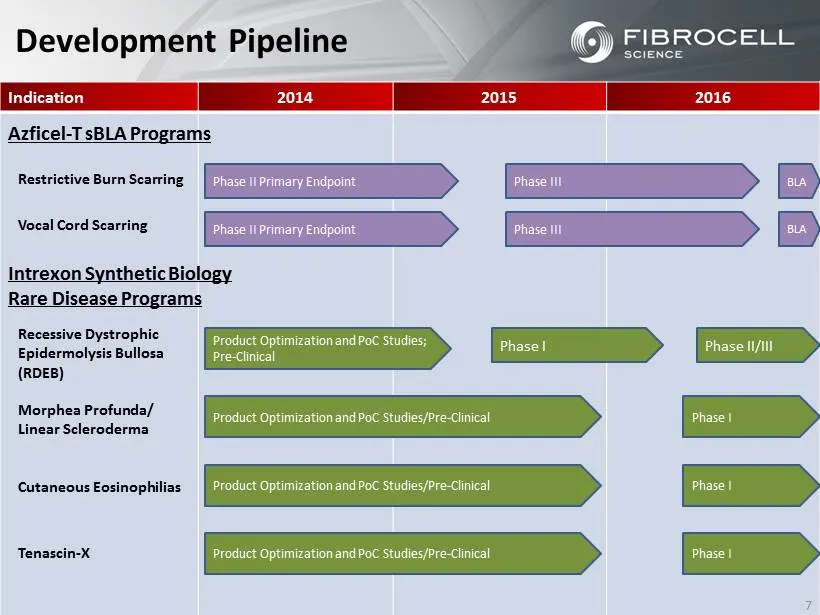
Slide 7: Development Pipeline
Indication 2014 2015 2016 Restrictive Burn Scarring Vocal Cord Scarring Recessive Dystrophic Epidermolysis Bullosa (RDEB) Morphea Profunda / Linear Scleroderma Cutaneous Eosinophilias Tenascin - X Phase II Primary Endpoint Phase II Primary Endpoint Product Optimization and PoC Studies; Pre - Clinica
Slide 8: Importance of BLA for azficel-T
Importance of BLA for azficel - T • Label Expansion – high value opportunities near term – Leveraging established proof of concept and extensive clinical experience • Two clinical stage development programs – Phase II Restrictive Burn Scarring – Phase II Vocal Cord Scarring • Demonstrated ability to
Slide 9: Scarring: azficel-T Label Extensions
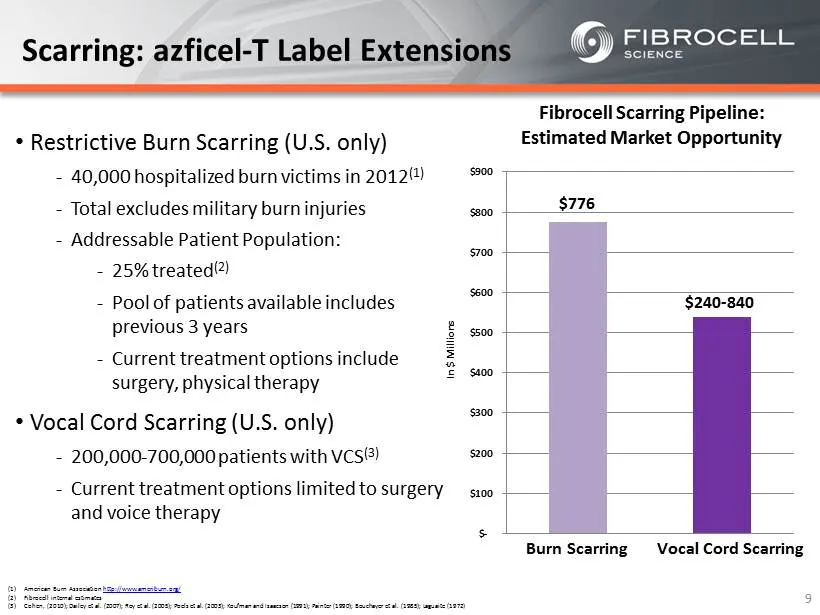
9 Scarring: azficel - T Label Extensions Fibrocell Scarring Pipeline: Estimated Market Opportunity • Restrictive Burn Scarring (U.S. only) - 40,000 hospitalized burn victims in 2012 (1) - Total excludes military burn injuries - Addressable Patient Population: - 25% treated (2) - Pool of patients ava
Slide 10: Restrictive Burn Scarring Overview
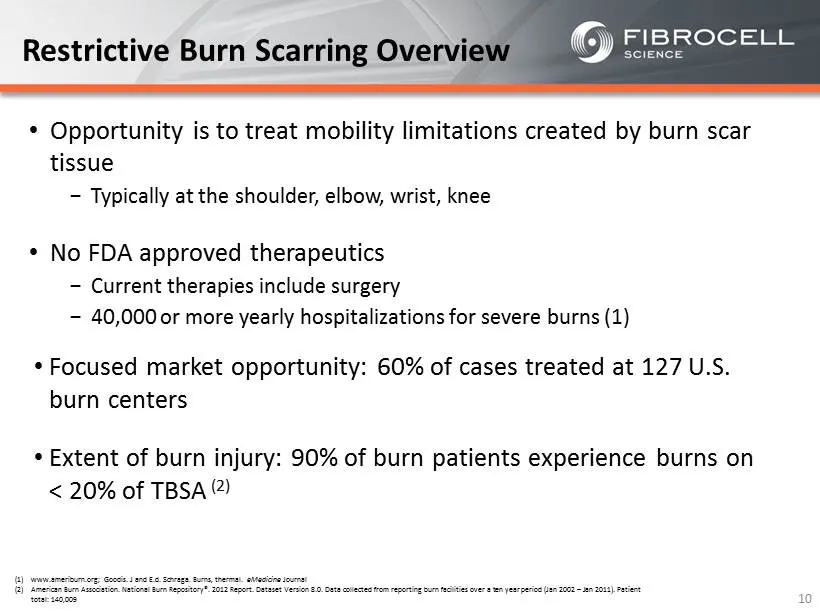
Restrictive Burn Scarring Overview 10 (1) www.ameriburn.org; Goodis . J and E.d . Schraga . Burns, thermal. eMedicine Journal (2) American Burn Association. National Burn Repository®. 2012 Report. Dataset Version 8.0. Data collected from reporting burn fa cil ities over a ten year period (Jan 2002 –
Slide 11: Restrictive Burn Scarring Results from Open-Label Case Studies
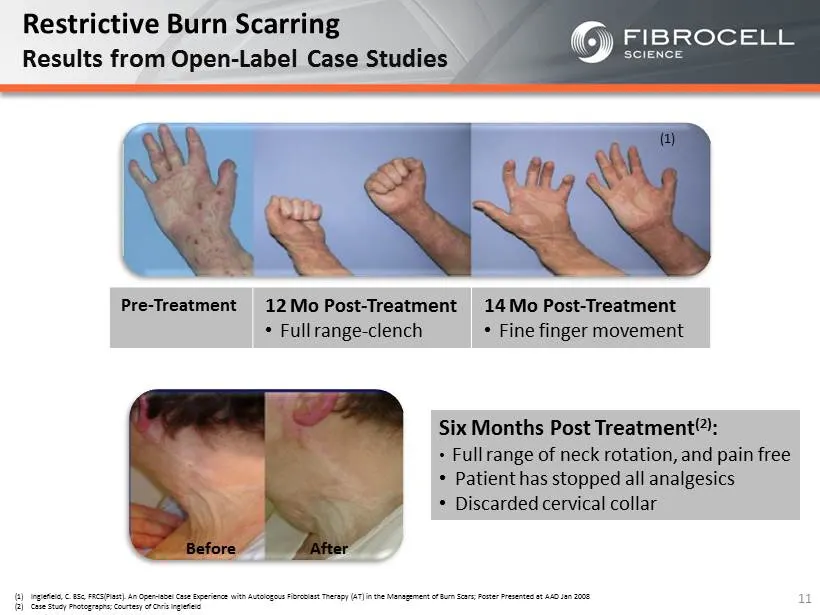
Pre - Treatment 12 Mo Post - Treatment • Full range - clench 14 Mo Post - Treatment • Fine finger movement Six Months Post Treatment (2) : • Full range of neck rotation, and pain free • Patient has stopped all analgesics • Discarded cervical collar (1) (1) Inglefield, C. BSc , FRCS( Plast ). An Open
Slide 12: Restrictive Burn Scarring Phase II
• Trial Initiated • Multi - center trial: 8 major centers anticipated • Double - blind, randomized, placebo - controlled, 21 subjects (up to 30) • 6 month efficacy endpoint: Results expected 2015 • Subjects inclusion criteria: − Unilateral restrictive burn scars of a jointed area − 20 - 60% restrict
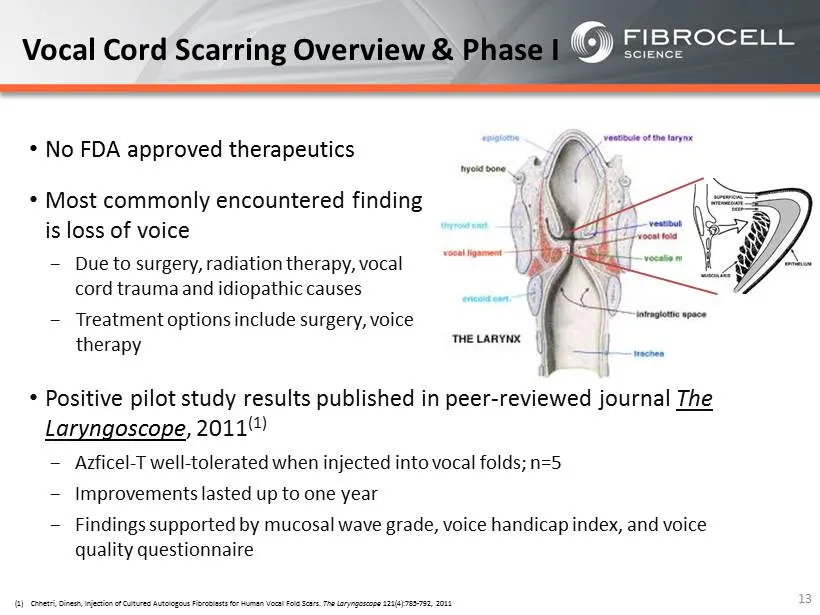
Slide 13: Vocal Cord Scarring Overview & Phase I
• Positive pilot study results published in peer - reviewed journal The La ryngoscope , 2011 (1) − Azficel - T well - tolerated when injected into vocal folds; n=5 − Improvements lasted up to one year − Findings supported by mucosal wave grade, voice handicap index, and voice quality questionnaire (
Slide 14: Vocal Cord Scarring Phase II
• Trial initiated • Multi - center trial: 3 major centers anticipated • Double - blind, randomized, placebo - controlled, 20 subjects (up to 30) • 4 month efficacy endpoint: Results expected 2015 • Subject inclusion criteria : ₋ Presence of unilateral or bilateral vocal fold scarring or age - relate
Slide 15: The Power of the Intrexon Collaboration
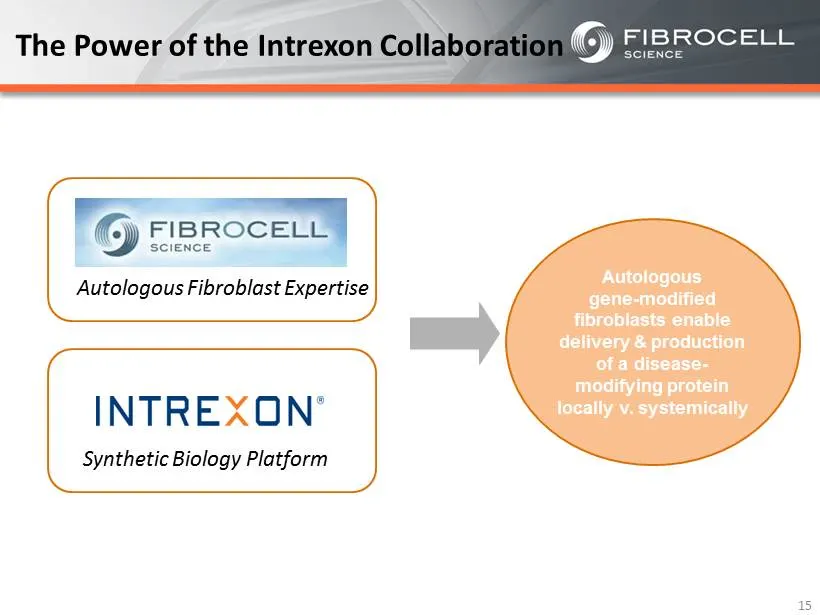
The Power of the Intrexon Collaboration Autologous Fibroblast Expertise Synthetic Biology Platform Autologous gene - modified fibroblasts enable delivery & production of a disease - modifying protein locally v. systemically 15
Slide 16: Intrexon Collaboration Highlights
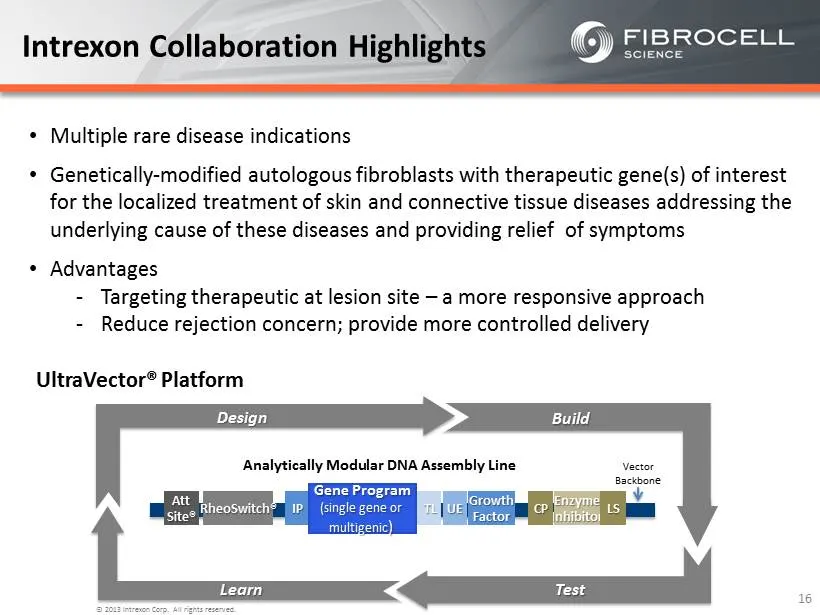
Design • Multiple rare disease indications • Genetically - modified autologous fibroblasts with therapeutic gene(s) of interest for the localized treatment of skin and connective tissue diseases addressing the underlying cause of these diseases and providing relief of symptoms • Advantages - Targeti
Slide 17: Rare Skin Diseases: Orphan Market Opportunities
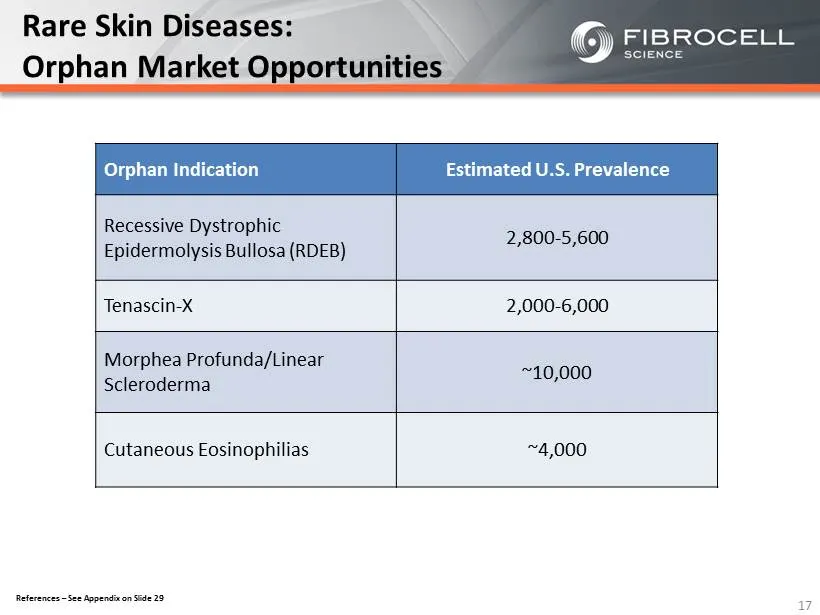
Rare Skin Diseases: Orphan Market Opportunities 17 Orphan Indication Estimated U.S. Prevalence Recessive Dystrophic Epidermolysis Bullosa (RDEB) 2,800 - 5,600 Tenascin - X 2,000 - 6,000 Morphea Profunda /Linear Scleroderma ~10,000 Cutaneous Eosinophilias ~4,000 References – See Appendix on Slide 29
Slide 18: RDEB: Unique Approach to Localized Treatment of Rare Skin Disease
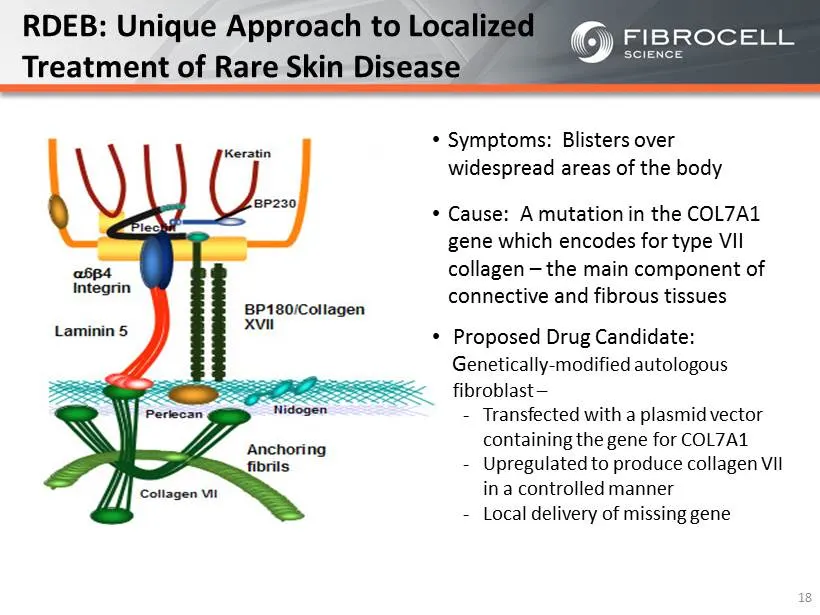
RDEB: Unique Approach to Localized Treatment of Rare Skin Disease 18 • Symptoms: Blisters over widespread areas of the body • Cause: A mutation in the COL7A1 gene which encodes for type VII collagen – the main component of connective and fibrous tissues • Proposed Drug Candidate: G enetically - modi
Slide 19: Tenascin-X Deficiency
Tenascin - X Deficiency • Tenascin - X is an extracellular matrix glycoprotein found in loose connective tissue, a deficiency of which causes a hyper - mobility disorder that can create significant disability in patients • Tenascin - X helps determine how collagen fibrils are deposited in the extrac
Slide 20: Intrexon RheoSwitch Therapeutic System: Key for Autoimmune Diseases
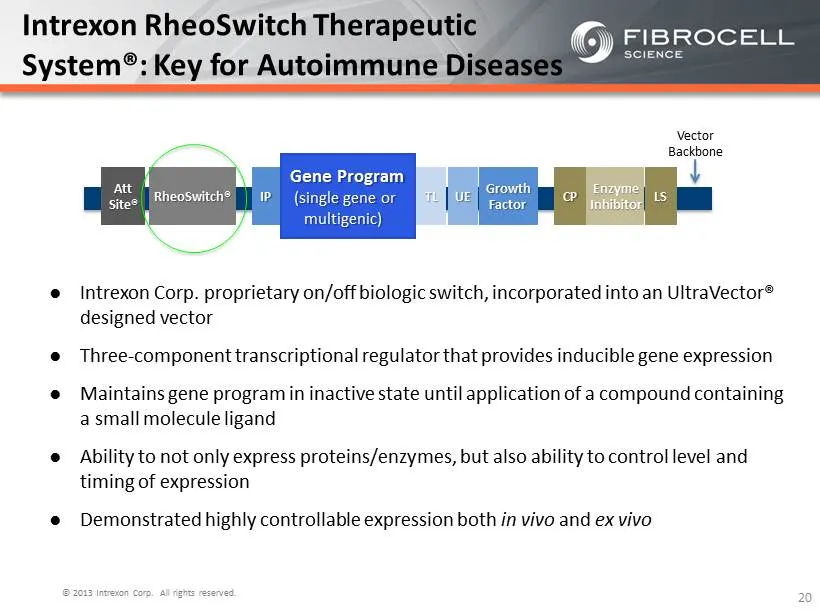
Intrexon RheoSwitch Therapeutic System®: Key for Autoimmune Diseases Att Site® RheoSwitch® Enzyme Inhibitor LS CP Gene Program (single gene or multigenic) Growth Factor UE TL IP Vector Backbone ● Intrexon Corp. proprietary on/off biologic switch, incorporated into an UltraVector® designed vector ● T
Slide 21: Autoimmune Skin Diseases – Localized Treatment
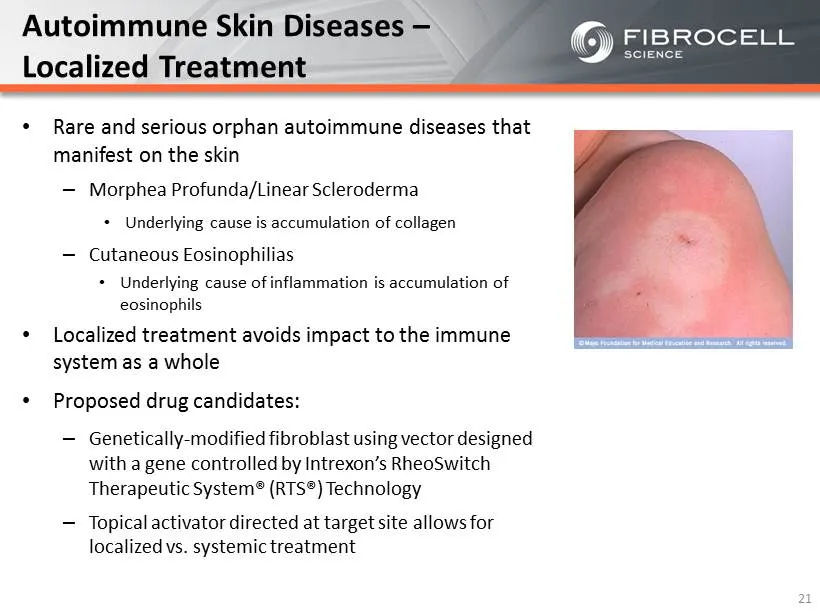
Autoimmune Skin Diseases – Localized Treatment 21 • Rare and serious orphan autoimmune diseases that manifest on the skin – Morphea Profunda /Linear Scleroderma • Underlying cause is accumulation of collagen – Cutaneous Eosinophilias • Underlying cause of inflammation is accumulation of eosinophils
Slide 22: UCLA Research Collaboration
UCLA Research Collaboration • M ulti - year research collaboration with UCLA • Programs use Fibrocell autologous fibroblast skin cell technologies • Funded partially through government CIRM grants • Anticipate peer - reviewed publications in 2014/2015 • Bone Morphogenetic Protein (BMP2) – Osteogenic
Slide 23: Financial Information
• Cash position ~$64 million following October 2013 financing • $50.5 million gross proceeds from underwritten offering • Quarterly average use of cash: $6 - 7 million • 40.9 million shares outstanding - 6.0 million warrants; 2.3 million options • Clean capital structure • Analyst research: - Ying H
Slide 24: 2014 Key Milestones
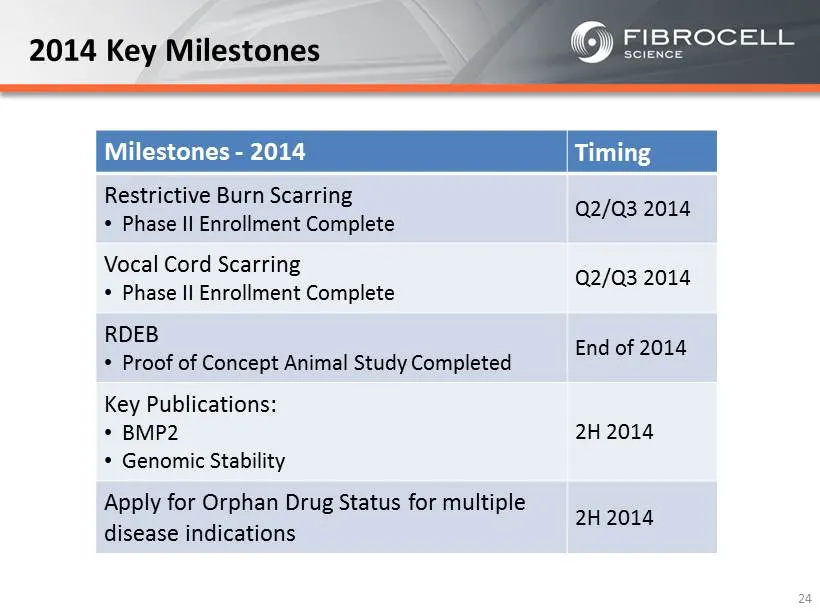
2014 Key Milestones 24 Milestones - 2014 Timing Restrictive Burn Scarring • Phase II Enrollment Complete Q2/Q3 2014 Vocal Cord Scarring • Phase II Enrollment Complete Q2/Q3 2014 RDEB • Proof of Concept Animal Study Completed End of 2014 Key Publications: • BMP2 • Genomic Stability 2H 2014 Apply for
Slide 25: 2015 Key Milestones
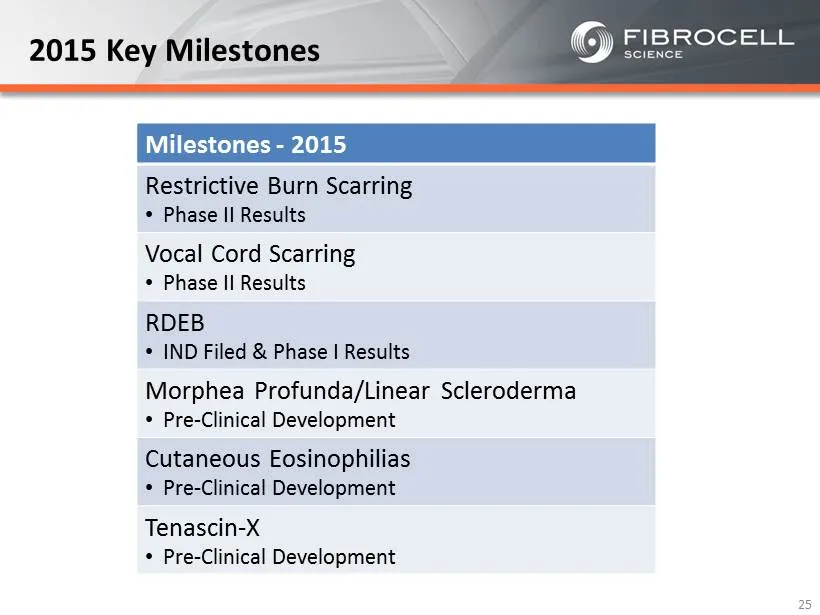
Milestones - 2015 Restrictive Burn Scarring • Phase II Results Vocal Cord Scarring • Phase II Results RDEB • IND Filed & Phase I Results Morphea Profunda /Linear Scleroderma • Pre - Clinical Development Cutaneous Eosinophilias • Pre - Clinical Development Tenascin - X • Pre - Clinical Development 20
Slide 26: Corporate Profile
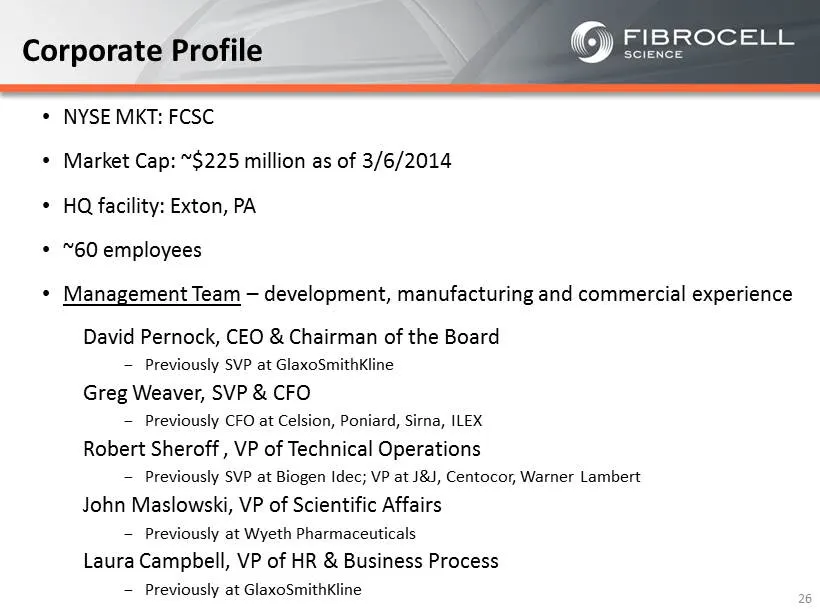
• NYSE MKT: FCSC • Market Cap: ~$225 million as of 3/6/2014 • HQ facility: Exton, PA • ~60 employees • Management Team – development, manufacturing and commercial experience David Pernock, CEO & Chairman of the Board − Previously SVP at GlaxoSmithKline Greg Weaver, SVP & CFO − Previously CFO at Cels
Slide 27: Investment Highlights
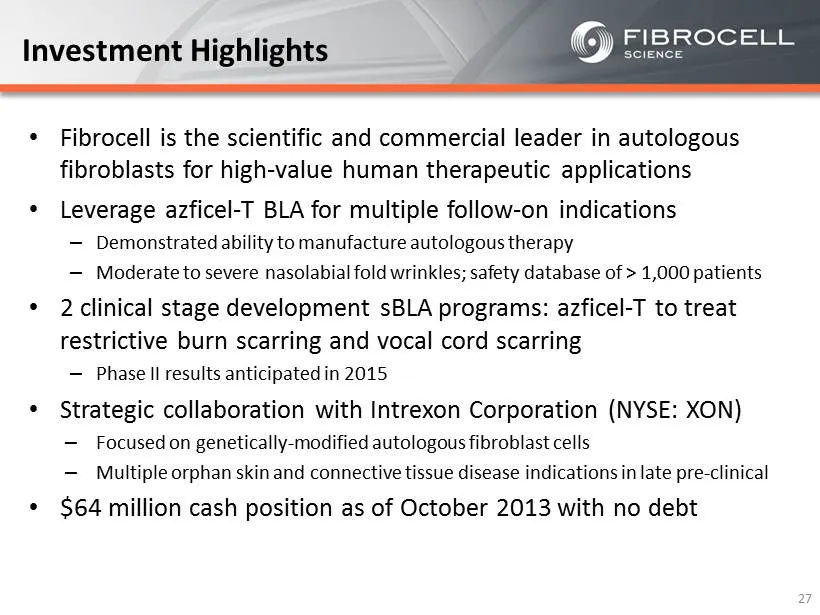
Investment Highlights • Fibrocell is the scientific and commercial leader in autologous fibroblasts for high - value human therapeutic applications • Leverage azficel - T BLA for multiple follow - on indications – Demonstrated ability to manufacture autologous therapy – Moderate to severe nasolabial
Slide 28: Appendix – References Slide – Orphan Skin Diseases
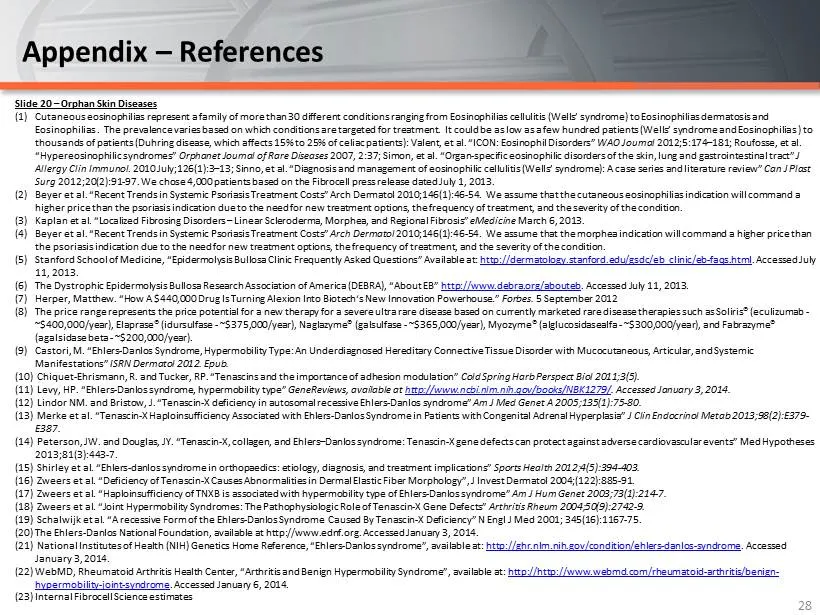
Appendix – References Slide 20 – Orphan Skin Diseases (1) Cutaneous eosinophilias represent a family of more than 30 different conditions ranging from Eosinophilias cellulitis (Wells’ syndrome) to Eosinophilias dermatosis and Eosinophilias . The prevalence varies based on which conditions are target
Source: SEC EDGAR · 8-K filed Mar 12, 2014
More decks from Fibrocell Science Inc
 Investor Presentation (August 2019)22 slides · Aug 15, 2019
 Investor Presentation (July 2019)22 slides · Jul 2, 2019
 Investor Presentation (May 2019)22 slides · May 29, 2019
 Investor Presentation (March 2019)22 slides · Mar 27, 2019
 Investor Presentation (January 2019)24 slides · Jan 8, 2019
 Investor Presentation (November 2018)24 slides · Nov 13, 2018