Human Genome Sciences — American College of Rheumatology (ACR) 74th Annual Scientific Meeting 2010
10 slides from Human Genome Sciences's conference presentation, Nov 8, 2010
Slide 1: BENLYSTA Update: Combined Phase 3 Study Results Presented at ACR 2010
com com BENLYSTA(r) UPDATE Combined Phase 3 Study Results Presented at ACR 2010 November 8, 2010
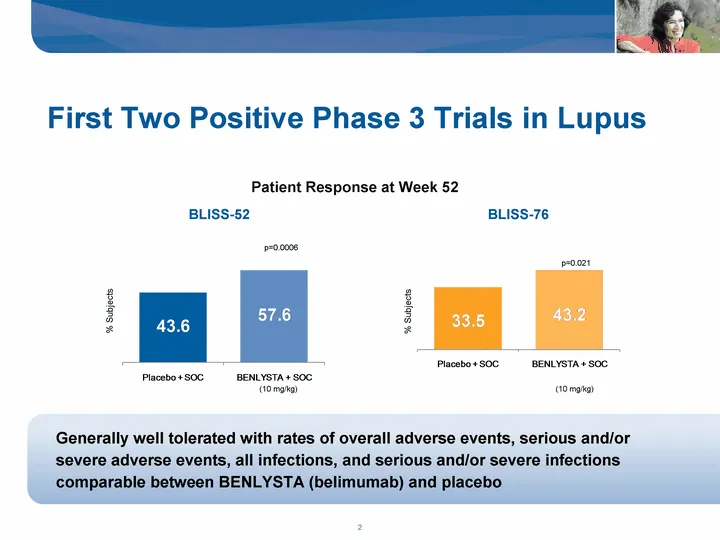
Slide 2: First Two Positive Phase 3 Trials in Lupus: Patient Response at Week 52
First Two Positive Phase 3 Trials in Lupus Patient Response at Week 52 % Subjects Generally well tolerated with rates of overall adverse events, serious and/or severe adverse events, all infections, and serious and/or severe infections comparable between BENLYSTA (belimumab) and placebo p=0.0006 p=0
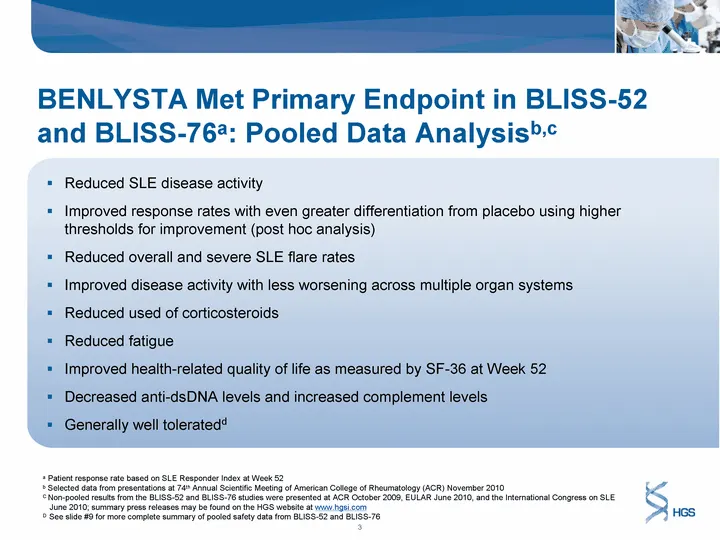
Slide 3: BENLYSTA Met Primary Endpoint in BLISS-52 and BLISS-76: Pooled Data Analysis
BENLYSTA Met Primary Endpoint in BLISS-52 and BLISS-76a: Pooled Data Analysisb,c Reduced SLE disease activity Improved response rates with even greater differentiation from placebo using higher thresholds for improvement (post hoc analysis) Reduced overall and severe SLE flare rates Improved disease
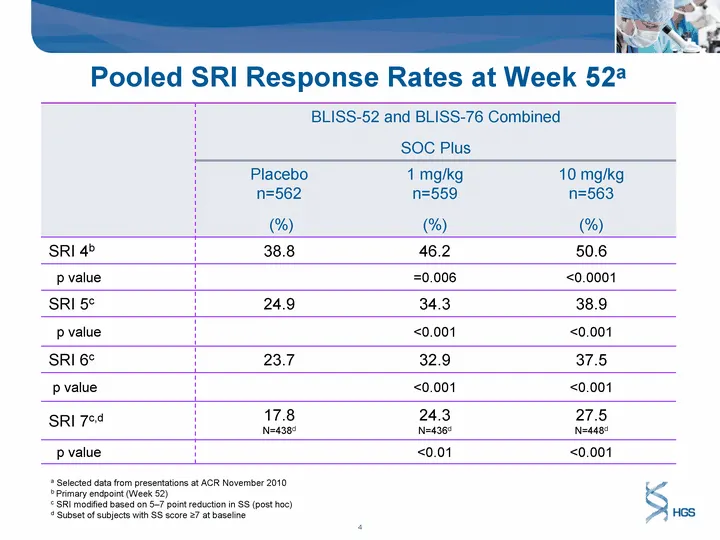
Slide 4: Pooled SRI Response Rates at Week 52
Pooled SRI Response Rates at Week 52a BLISS-52 and BLISS-76 Combined SOC Plus BLISS-52 and BLISS-76 Combined SOC Plus BLISS-52 and BLISS-76 Combined SOC Plus Placebo n=562 (%) 1 mg/kg n=559 (%) 10 mg/kg n=563 (%) SRI 4b 38.8 46.2 50.6 p value =0.006 <0.0001 SRI 5c 24.9 34.3 38.9 p value <0.001 <0.00
Slide 5: Additional Disease Activity Data: BLISS-52 and BLISS-76 Combined
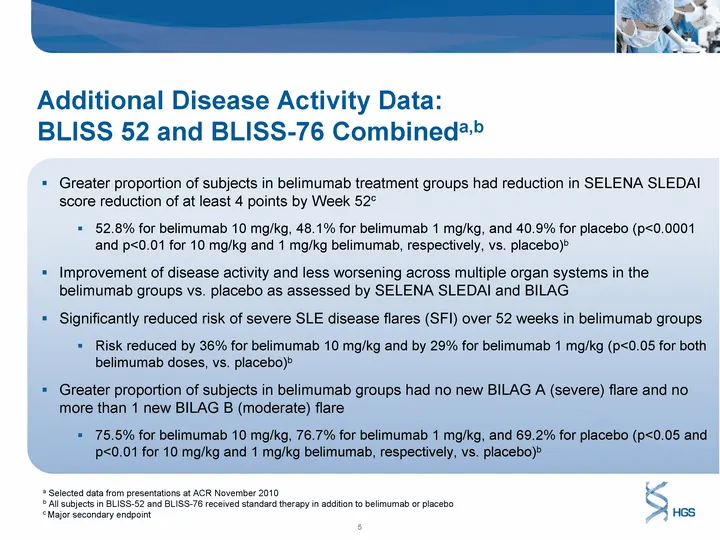
Additional Disease Activity Data: BLISS 52 and BLISS-76 Combineda,b Greater proportion of subjects in belimumab treatment groups had reduction in SELENA SLEDAI score reduction of at least 4 points by Week 52c 52.8% for belimumab 10 mg/kg, 48.1% for belimumab 1 mg/kg, and 40.9% for placebo (p<0.0001
Slide 6: Additional Disease Activity Data (cont.): BLISS-52 and BLISS-76 Combined
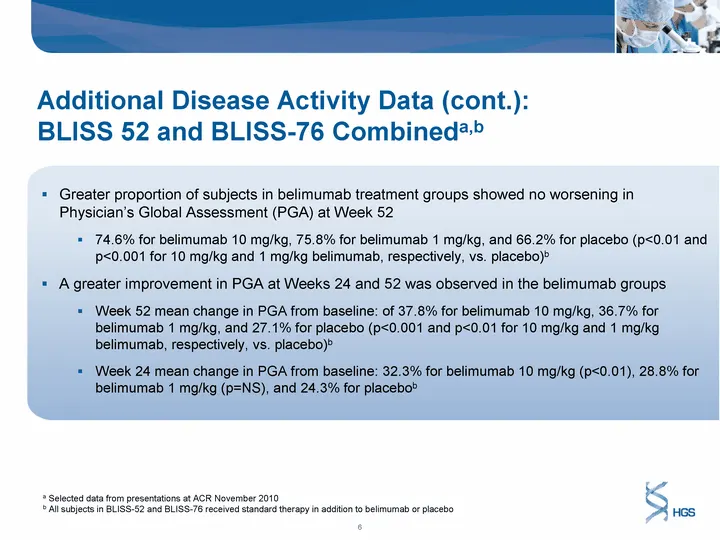
Additional Disease Activity Data (cont.): BLISS 52 and BLISS-76 Combineda,b Greater proportion of subjects in belimumab treatment groups showed no worsening in Physician's Global Assessment (PGA) at Week 52 74.6% for belimumab 10 mg/kg, 75.8% for belimumab 1 mg/kg, and 66.2% for placebo (p<0.01 and
Slide 7: Steroid Use Data: BLISS-52 and BLISS-76 Combined
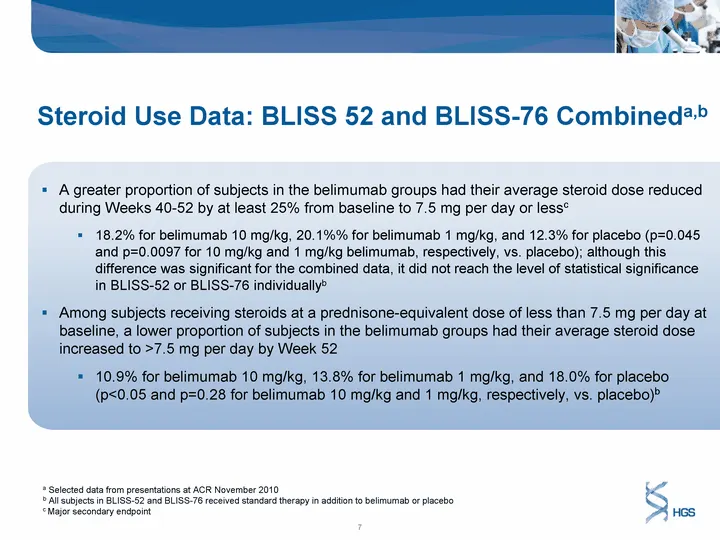
Steroid Use Data: BLISS 52 and BLISS-76 Combineda,b A greater proportion of subjects in the belimumab groups had their average steroid dose reduced during Weeks 40-52 by at least 25% from baseline to 7.5 mg per day or lessc 18.2% for belimumab 10 mg/kg, 20.1%% for belimumab 1 mg/kg, and 12.3% for pl
Slide 8: Effect on Protective Immune Response
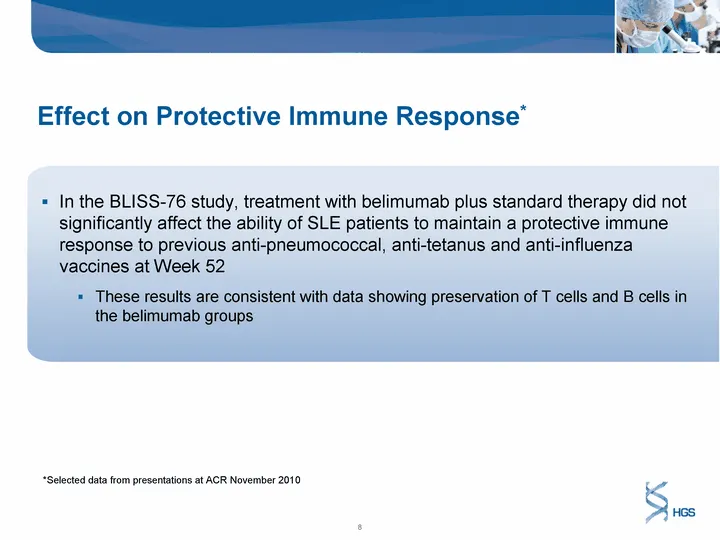
Effect on Protective Immune Response* In the BLISS-76 study, treatment with belimumab plus standard therapy did not significantly affect the ability of SLE patients to maintain a protective immune response to previous anti-pneumococcal, anti-tetanus and anti-influenza vaccines at Week 52 These resul
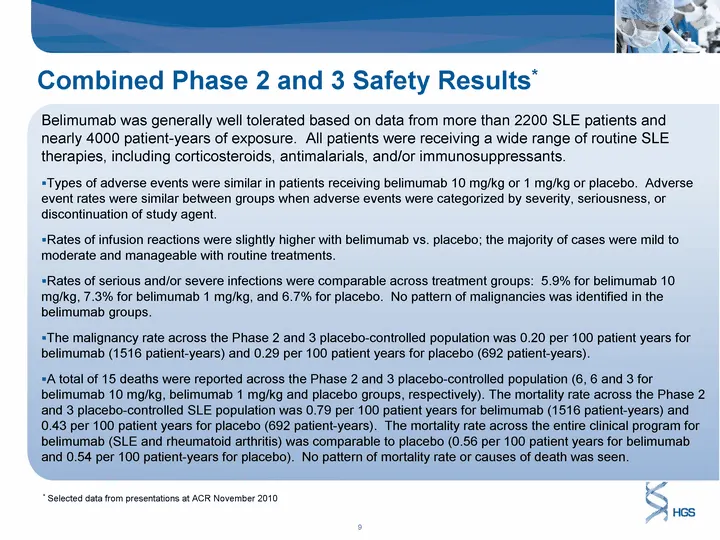
Slide 9: Combined Phase 3 Safety Results
Combined Phase 2 and 3 Safety Results* Belimumab was generally well tolerated based on data from more than 2200 SLE patients and nearly 4000 patient-years of exposure. All patients were receiving a wide range of routine SLE therapies, including corticosteroids, antimalarials, and/or immunosuppressan
Slide 10: Belimumab Scientific Sessions ACR Annual Scientific Meeting 2010, Atlanta
Belimumab Scientific Sessions ACR Annual Scientific Meeting 2010, Atlanta Belimumab, a BLyS-specific inhibitor, reduced disease activity and severe flares in seropositive SLE Patients: BLISS-76 study results through wk 76. Furie R, et al, Oral #1454. Belimumab, a BLyS-specific inhibitor, reduced dis
Source: SEC EDGAR · 8-K filed Nov 8, 2010
More decks from Human Genome Sciences Inc
 Corporate Update (April 2012)15 slides · Apr 24, 2012
 JP Morgan Healthcare Conference 201229 slides · Jan 9, 2012
 Investor Presentation (November 2011)26 slides · Nov 10, 2011
 Investor Presentation (September 2011)25 slides · Sep 8, 2011
 Investor Day (April 2011)59 slides · Apr 14, 2011
 JPMorgan Healthcare Conference 201129 slides · Jan 10, 2011