BridgeBio Pharma, Inc. · NASDAQ:BBIO
BridgeBio Pharma — MENA Congress for Rare Diseases 2024
12 slides from BridgeBio Pharma's conference presentation, May 2024
Slide 1: ML Bio Solutions – MENA Congress for Rare Diseases
ML Bio Solutions MENA Congress for Rare Diseases May 16-19 2024 BridgeBio Pharma, Inc. © 2024 Courtesy from and proprietary to: ML Bio Solutions Inc., a BridgeBio company
Slide 2: Forward-Looking Statements and Disclaimer
Forward-Looking Statements and Disclaimer Statements in this Presentation that are not statements of historical fact are forward-looking statements within the meaning of Section 27A of the Securities Act of 1933, as amended, and Section 21E of the Securities Exchange Act of 1934, as amended. Such fo
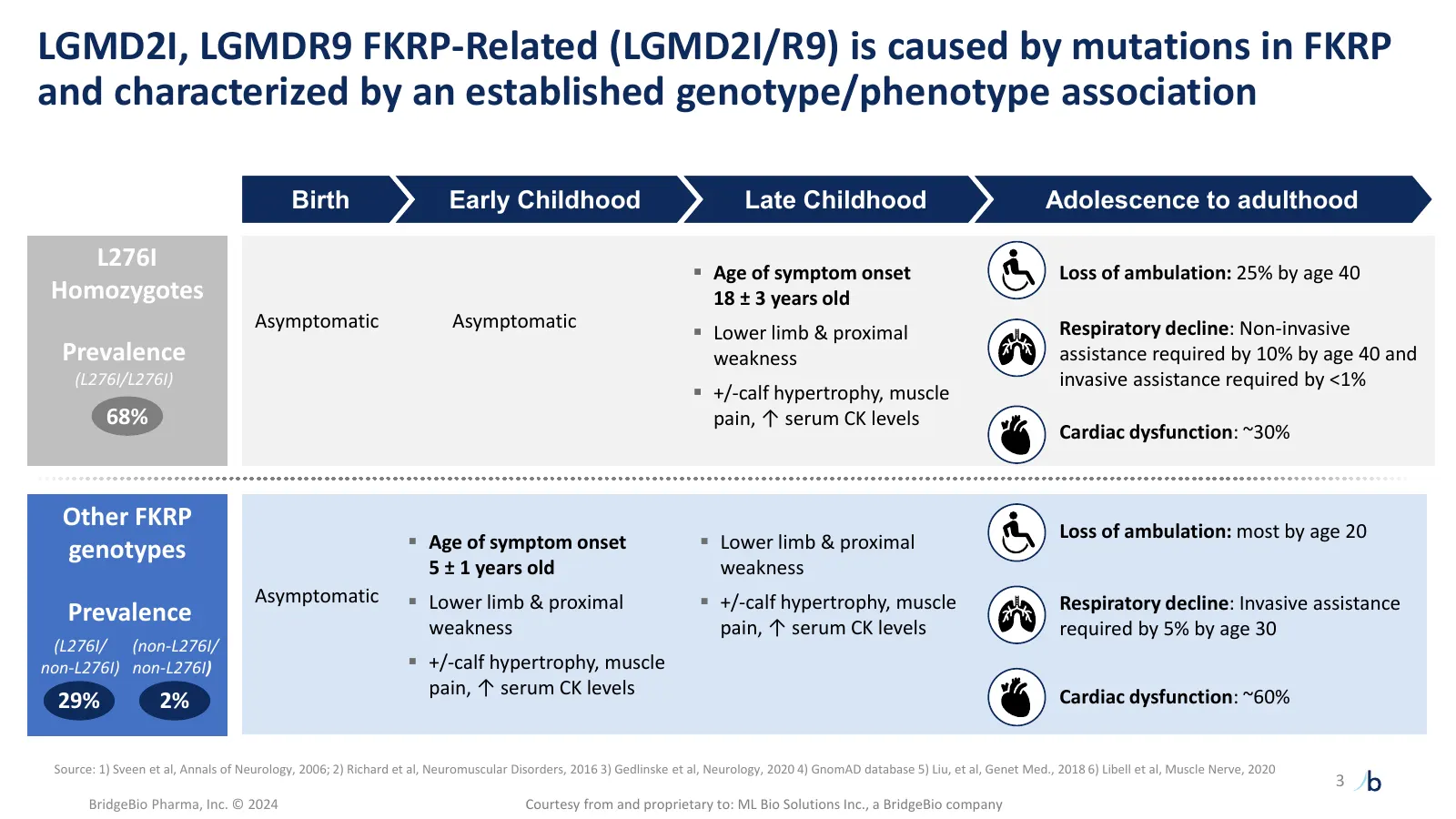
Slide 3: FKRP-Related LGMD2I/R9 is caused by mutations in FKRP
LGMD2I, LGMDR9 FKRP-Related (LGMD2I/R9) is caused by mutations in FKRP and characterized by an established genotype/phenotype association Birth Early Childhood Late Childhood Adolescence to adulthood L276I Age of symptom onset Loss of ambulation: 25% by age 40 Homozygotes 18 ± 3 years old Asymptom
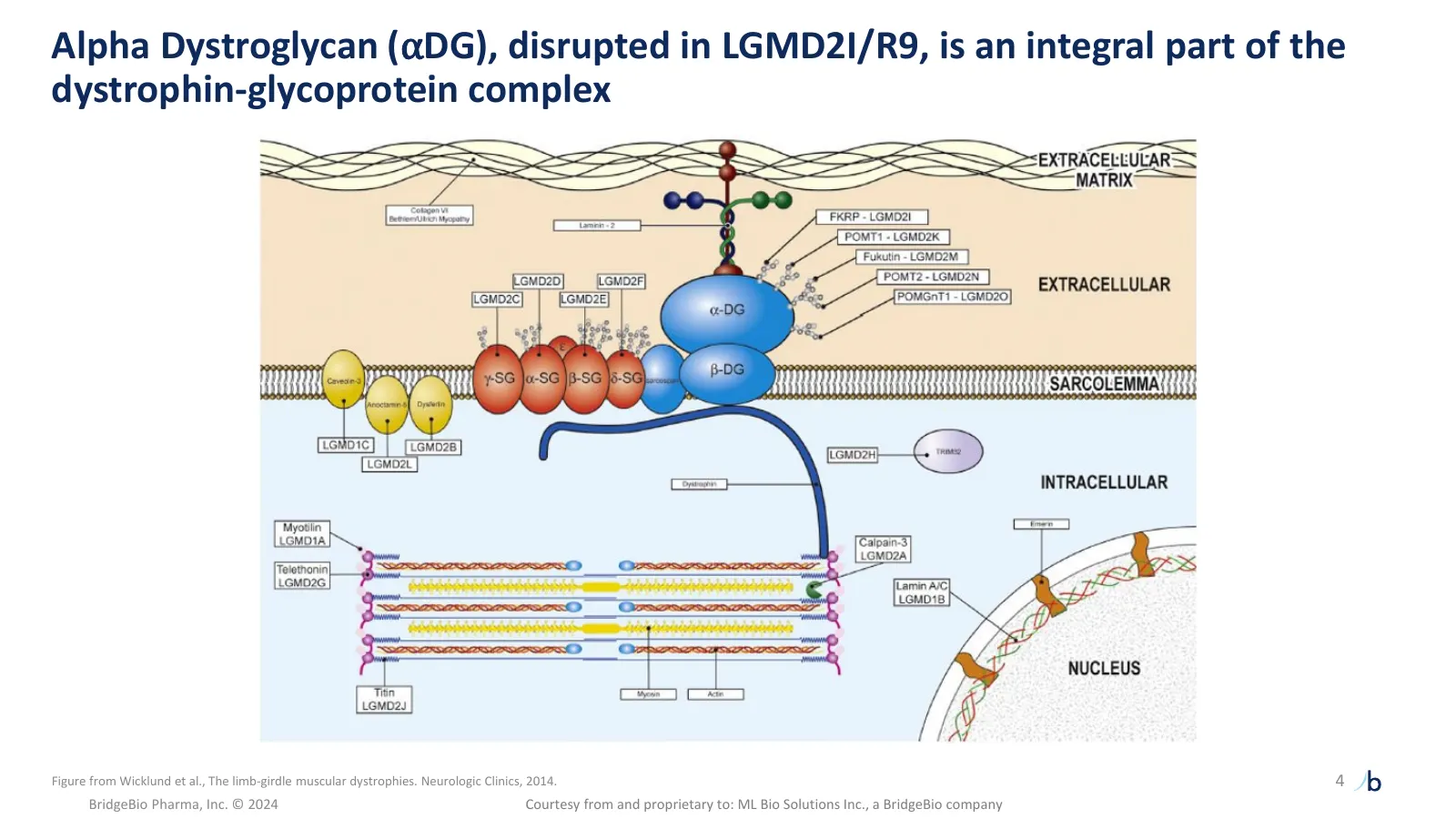
Slide 4: Alpha Dystroglycan, disrupted in LGMD2I/R9, is part of the dystrophin-glycoprotein complex
Alpha Dystroglycan (⍺DG), disrupted in LGMD2I/R9, is an integral part of the dystrophin-glycoprotein complex Figure from Wicklund et al., The limb-girdle muscular dystrophies. Neurologic Clinics, 2014. 4 BridgeBio Pharma, Inc. © 2024 Courtesy from and proprietary to: ML Bio Solutions Inc., a Bridge
Slide 5: Oral BBP-418 is an upstream substrate supplement to drive residual FKRP activity
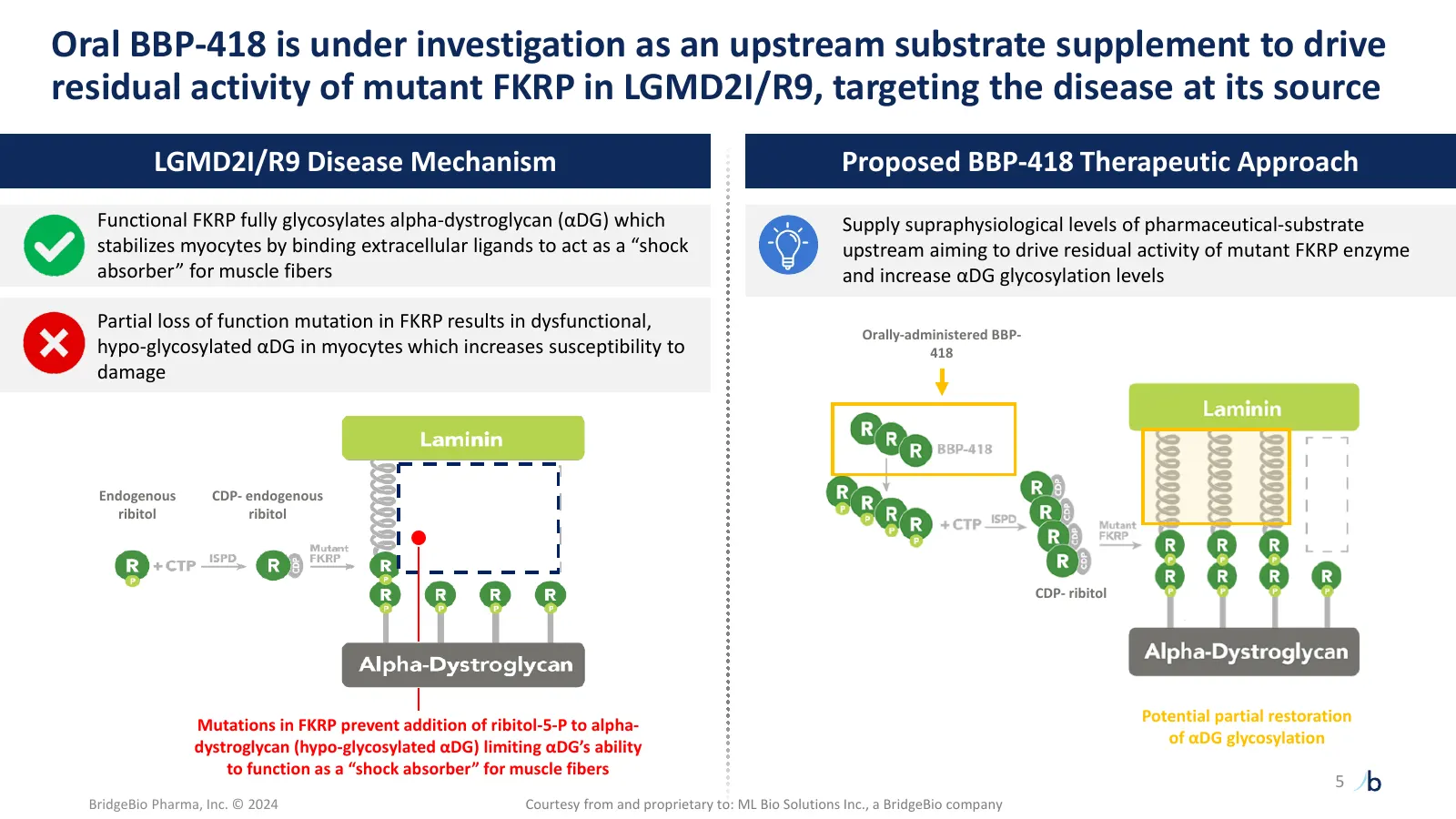
Oral BBP-418 is under investigation as an upstream substrate supplement to drive residual activity of mutant FKRP in LGMD2I/R9, targeting the disease at its source LGMD2I/R9 Disease Mechanism Proposed BBP-418 Therapeutic Approach Functional FKRP fully glycosylates alpha-dystroglycan (αDG) which Supp
Slide 6: Natural history data: glycosylation of αDG mirrors LGMD2I/R9 severity and remains stable
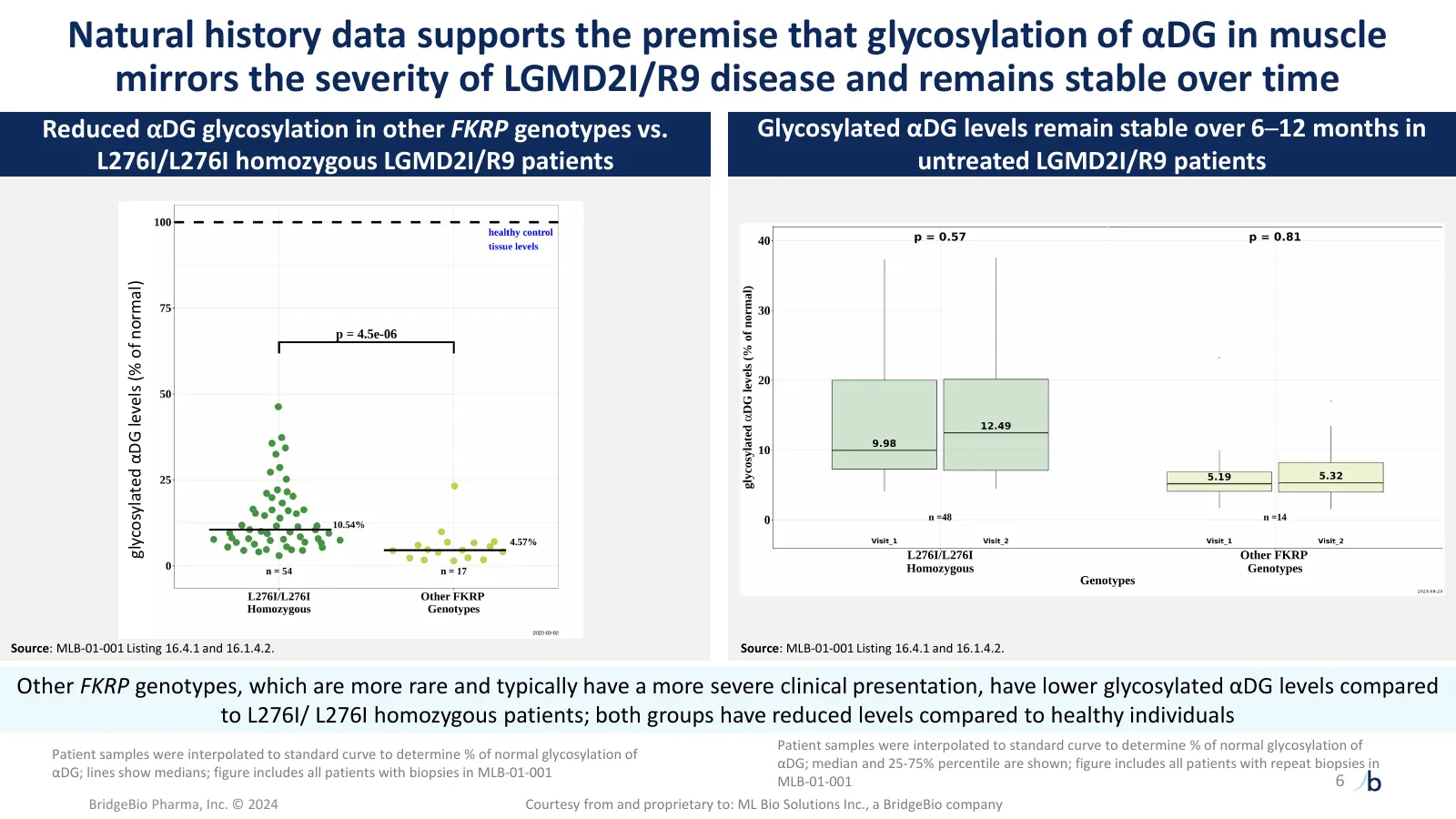
Natural history data supports the premise that glycosylation of αDG in muscle mirrors the severity of LGMD2I/R9 disease and remains stable over time Reduced ⍺DG glycosylation in other FKRP genotypes vs. Glycosylated αDG levels remain stable over 6─12 months in L276I/L276I homozygous LGMD2I/R9 patien
Slide 7: BBP-418 in a small, open label Phase 2 study in LGMD2I/R9
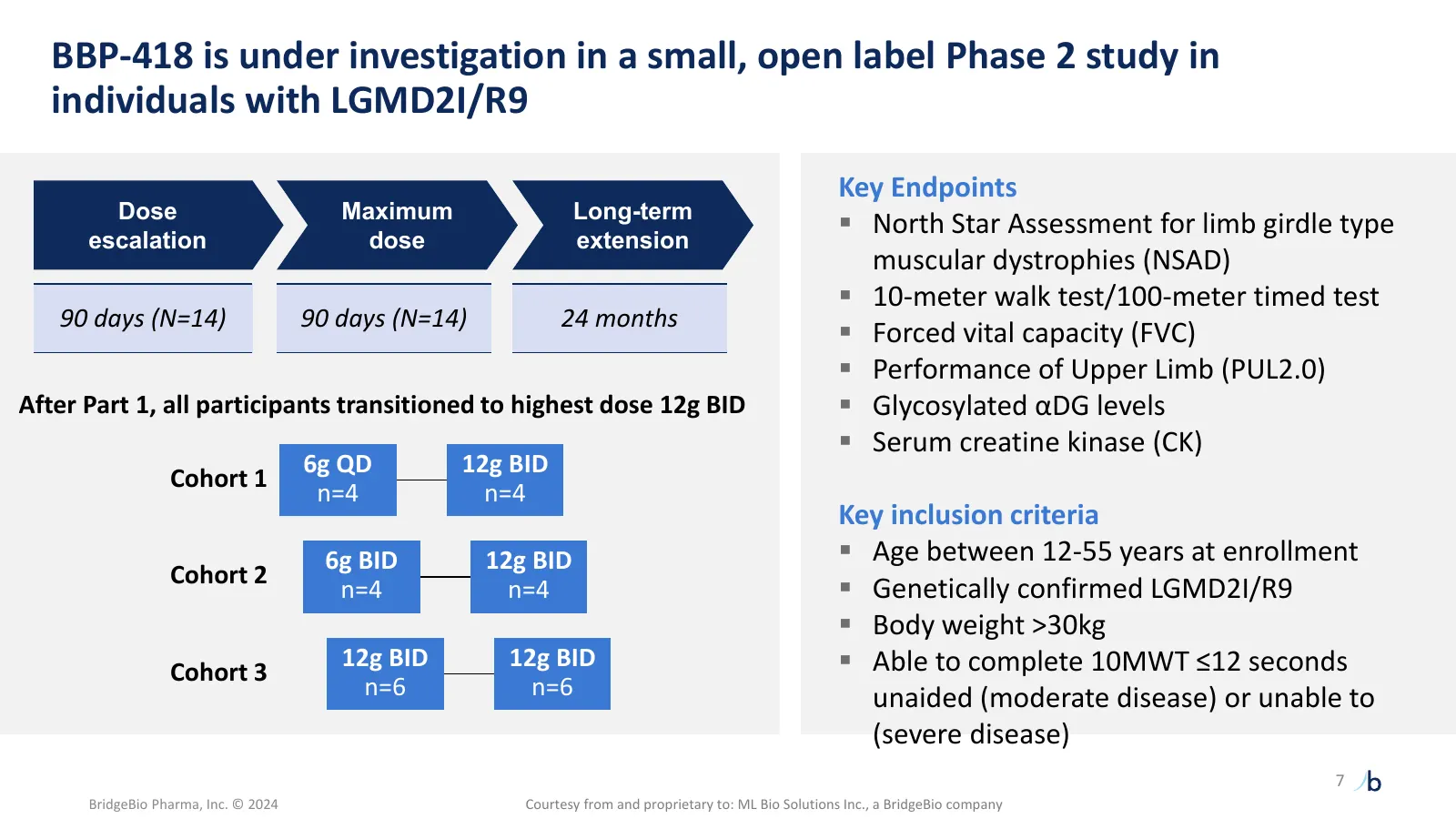
BBP-418 is under investigation in a small, open label Phase 2 study in individuals with LGMD2I/R9 Key Endpoints Dose Maximum Long-term escalation dose extension North Star Assessment for limb girdle type muscular dystrophies (NSAD) 10-meter walk test/100-meter timed test 90 days (N=14) 90 days (
Slide 8: BBP-418 well tolerated, with only minor GI related adverse events
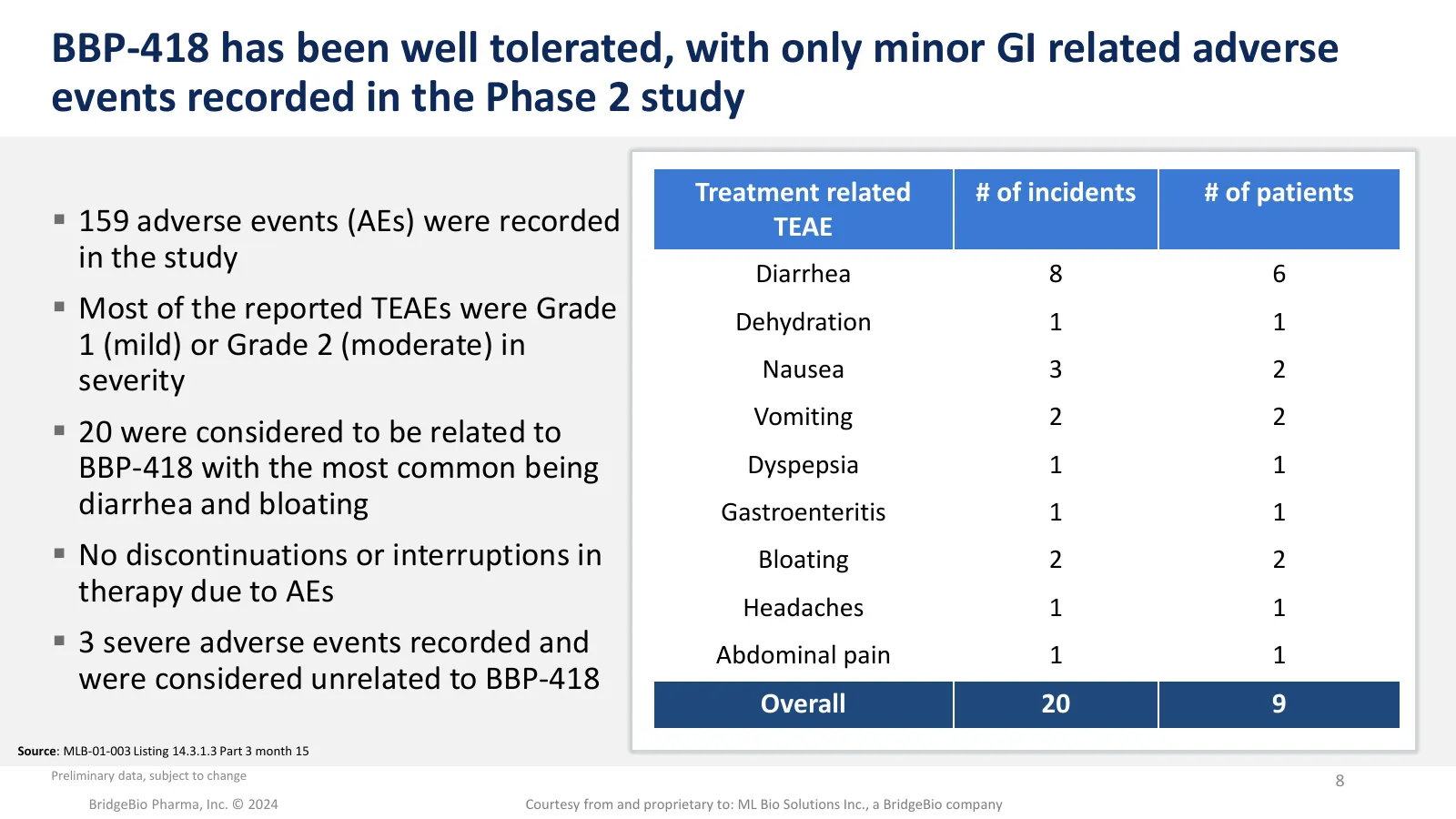
BBP-418 has been well tolerated, with only minor GI related adverse events recorded in the Phase 2 study Treatment related # of incidents # of patients 159 adverse events (AEs) were recorded TEAE in the study Diarrhea 8 6 Most of the reported TEAEs were Grade Dehydration 1 1 1 (mild) or Grade 2
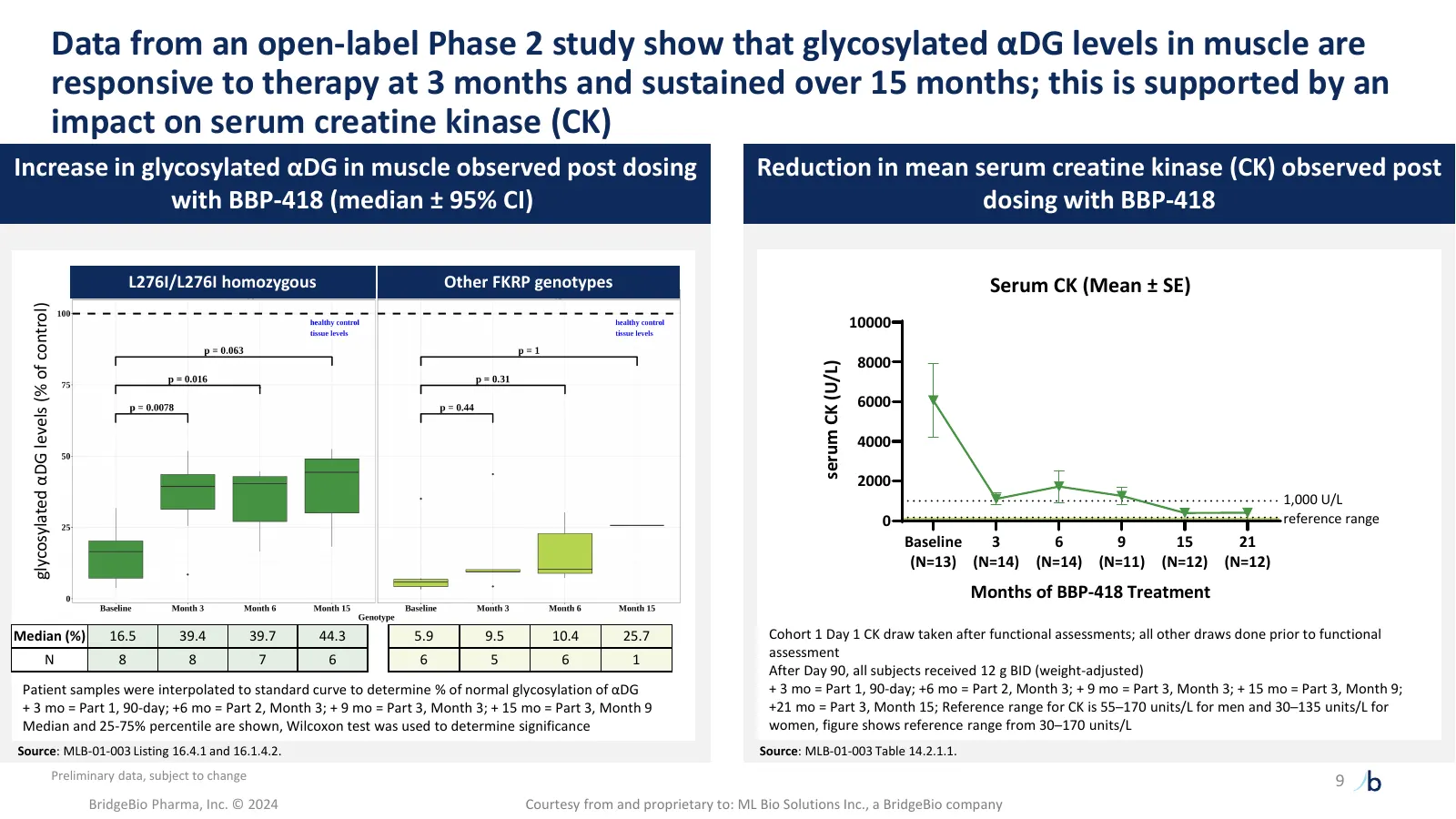
Slide 9: Glycosylated αDG levels responsive to therapy and sustained over 15 months
Data from an open-label Phase 2 study show that glycosylated αDG levels in muscle are responsive to therapy at 3 months and sustained over 15 months; this is supported by an impact on serum creatine kinase (CK) Increase in glycosylated αDG in muscle observed post dosing Reduction in mean serum creat
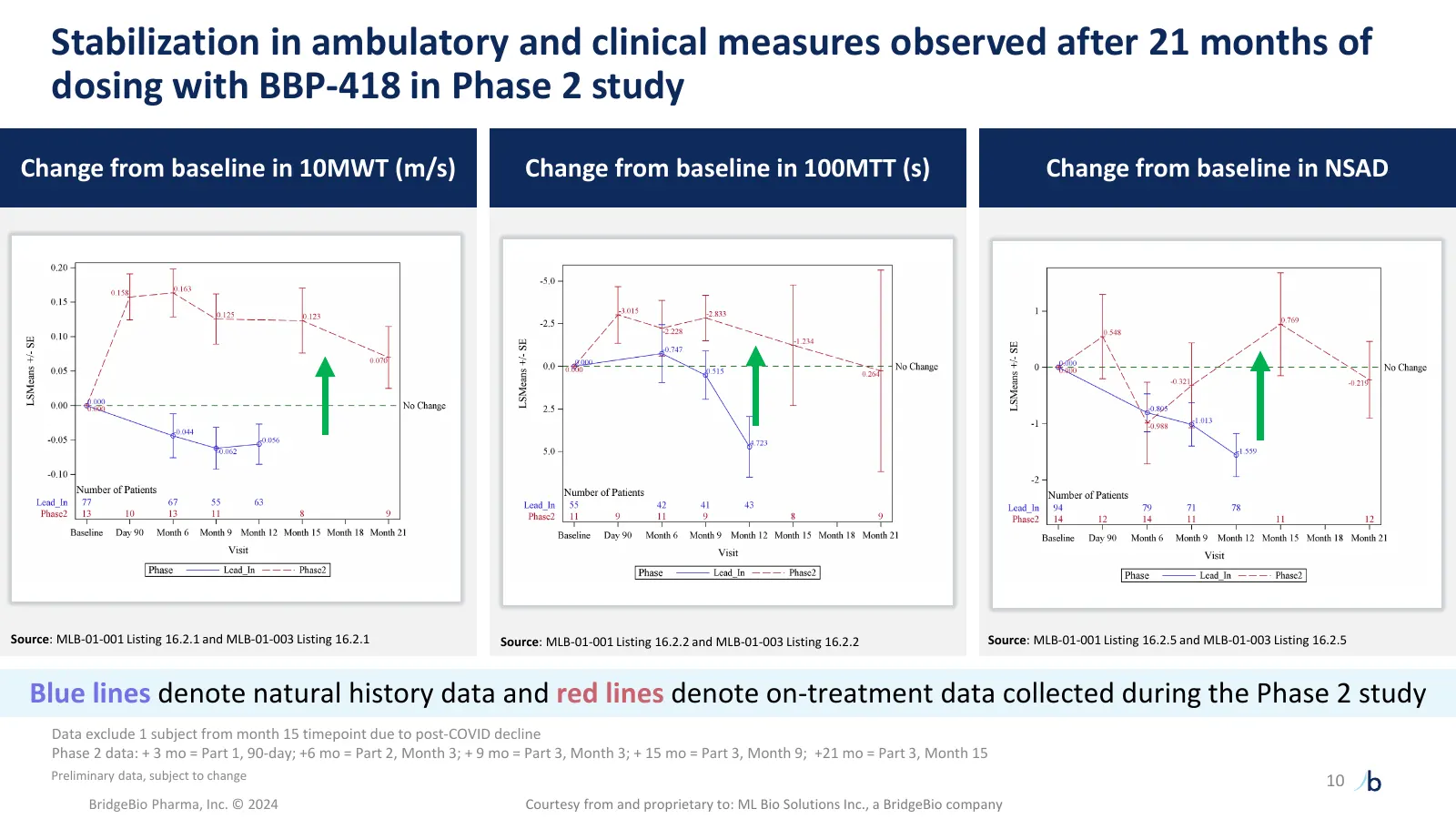
Slide 10: Stabilization in ambulatory and clinical measures after 21 months of dosing
Stabilization in ambulatory and clinical measures observed after 21 months of dosing with BBP-418 in Phase 2 study Change from baseline in 10MWT (m/s) Change from baseline in 100MTT (s) Change from baseline in NSAD Source: MLB-01-001 Listing 16.2.1 and MLB-01-003 Listing 16.2.1 Source: MLB-01-001 Li
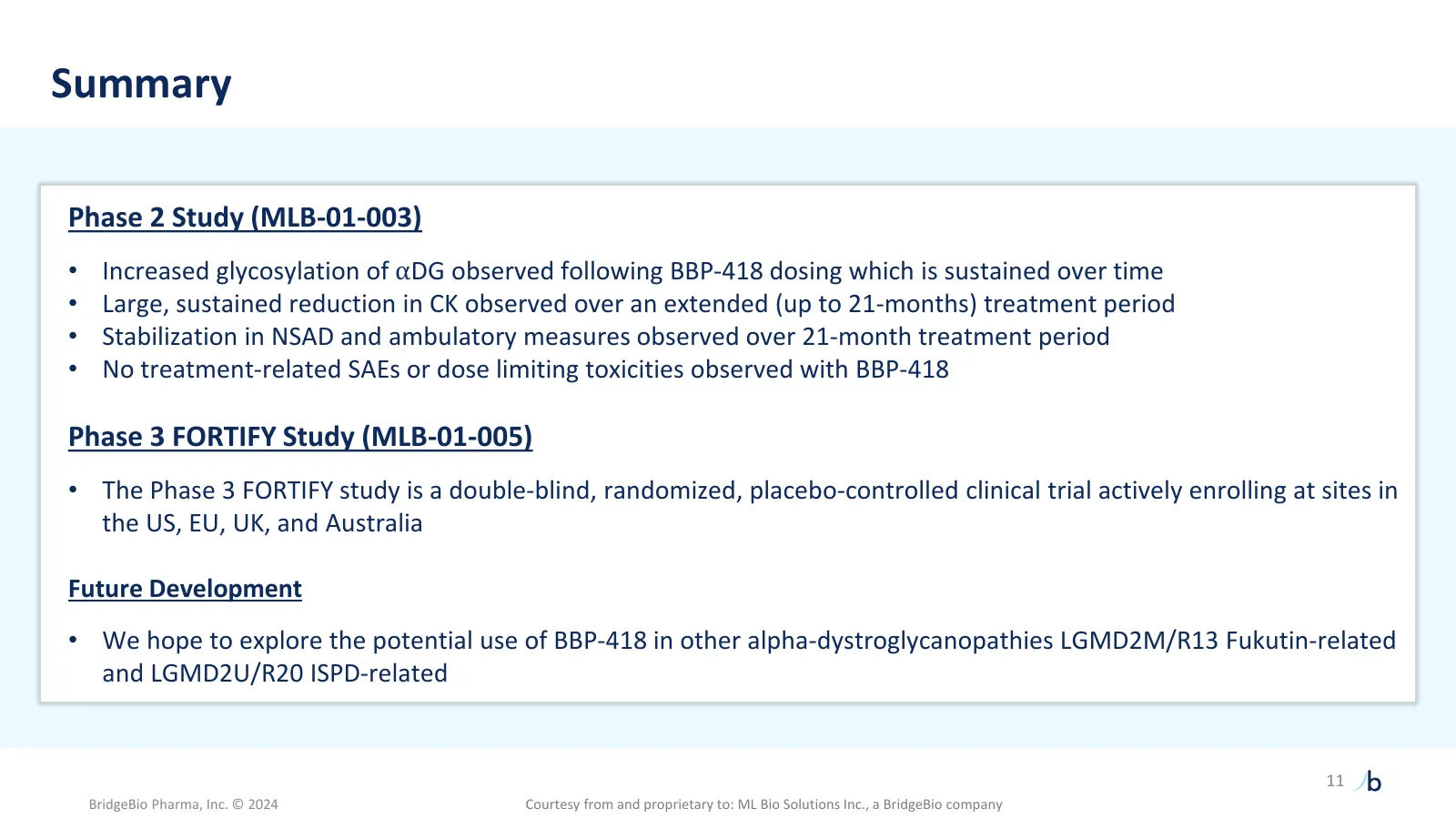
Slide 11: Summary: increased glycosylation of αDG sustained over time
Summary Phase 2 Study (MLB-01-003) • Increased glycosylation of ⍺DG observed following BBP-418 dosing which is sustained over time • Large, sustained reduction in CK observed over an extended (up to 21-months) treatment period • Stabilization in NSAD and ambulatory measures observed over 21-month tr
Slide 12: Thank You!
Thank You! • ML Bio study participants • LGMD2I/R9 patients, families, and patient advocates BridgeBio Pharma, Inc. © 2024 Courtesy from and proprietary to: ML Bio Solutions Inc., a BridgeBio company
Source: Internet Archive copy of s205.q4cdn.com
More decks from BridgeBio Pharma, Inc.
 Q1 2026 Earnings Presentation41 slides · May 7, 2026
 Investor Presentation (February 2026)92 slides · Feb 24, 2026
 Q4 2025 Earnings Presentation93 slides · Feb 24, 2026
 Technical Presentation (February 2026)32 slides · Feb 12, 2026
 Investor Presentation (January 2026)83 slides · Jan 12, 2026
 44th Annual J.P. Morgan Healthcare Conference 202648 slides · Jan 12, 2026